Blog

Offshore training

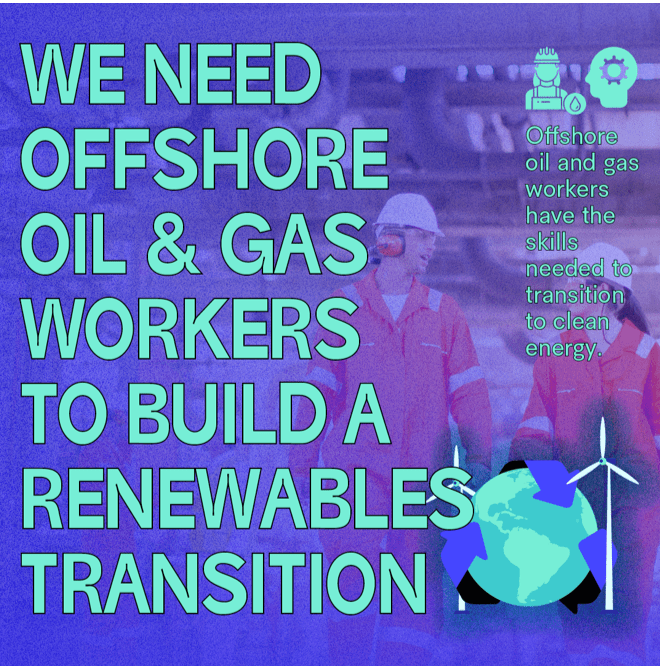
Friends of the Earth Scotland and Platform are launching a campaign for an Offshore Training Passport.

Here’s their rationale for the campaign:

What’s the issue?

  • Offshore oil and gas workers regularly pay thousands of pounds from their own pocket for their training and safety qualifications. Despite huge overlap, workers need to go through separate training for the oil and gas industry and the wind industry.
  • A Just Transition must include creating clear pathways for workers in high-carbon industries to bring their skills and experience into renewables.
  • The duplication of training is a major barrier to workers being able to bring their skills and experience from fossil fuels into renewable energy.

How can we fix it?

An Offshore Training Passport scheme would standardise training accreditation across the offshore oil and gas and offshore renewables industries where possible, reducing costs for workers by reducing the need for duplication of certificates and allowing workers to shift more easily between oil and gas and renewables.

A Just Transition must be shaped by the workers and communities who will be affected as we move from fossil fuels to renewables – the offshore workforce wants training barriers removed.

When surveyed, 94% of offshore workers supported an Offshore Training Passport

To find out how to support the campaign download the campaign toolkit which includes sample letters that can be sent to MSPs and MPs and material for social media.

Briefing #14: Climate, fuel poverty & the cost of living

Briefing #14 on climate, fuel poverty and the cost of living is now available for download. As with all the our briefings you are welcome to use and adapt the briefing content – attribution to https://scote3.net is appreciated.

The content of the briefing is reproduced below.

Climate, fuel poverty & the cost of living

Fuel poverty kills

Prior to the latest crisis almost 25% of households in Scotland lived in fuel poverty and just over 12% were in extreme fuel poverty.  Households in extreme fuel poverty are disproportionately represented in rural Scotland.  Older people living in rural Scotland are particularly hard hit. Every year thousands die because of fuel poverty – in 2018/19 excess winter mortality (that’s in comparison with the average winter mortality for the previous five years) was 2060 – the death toll can be more than twice as high in cold winters. Around 85% of households in the UK rely on gas for heating and cooking.  The huge hike in gas prices is going to make an already unacceptable situation much, much worse.  

Rising fuel prices

Gas and electricity prices have been rising faster than inflation for a long time.  From 2006 – 2016, Gas prices rose by 71% and Electricity 62%. Between 2017 and 2020 electricity prices increased by a further 8% in real terms while gas prices fell by a similar amount.  But gas prices are extremely volatile.  Since 2019 the wholesale price has almost trebled. 

Gas consumption fell by just over 2% in 2020, a consequence of lockdowns around the world.  In 2021 there was a rebound with consumption increasing by 4.6% because of increased economic activity and several extreme weather events worldwide.  The cost of producing gas is about the same this year as it was last year and the year before. So why has the price rocketed up?  Prior to 1987 the EU designated natural gas a premium fuel that should be reserved for home heating.  Now 60% of gas is used to generate electricity.  Britain used to have significant storage capability. This was abandoned in favour of allowing the market to deliver gas as needed.  These changes have been a disaster.  Gas is traded on the spot market with hedge funds gambling on future prices.  As a result, the cost of an essential utility is determined by a casino where traders rake in massive profits while consumers pay the price.

Lack of ambition

In June 2019 the Scottish Parliament passed a new act setting statutory targets for reducing fuel poverty.  Rightly it highlights the impact of fuel poverty on the most vulnerable in society. Low-income, high-energy costs, and poorly insulated housing result in the appalling situation where families, young people, elderly, disabled and many working people, cannot afford adequate warmth.  The new act sets interim targets for reducing fuel poverty to 15% of households by 2030 and final targets for 2040.  Considering the cost of living and climate crises we face this is too slow and not enough.   The act failed to address the threat posed by a chaotic market.  From April 2022 annual bills will increase by an average of almost £700.  Further increases are expected later in the year.  The numbers in fuel poverty are set to rise well above the current level.  

Fossil fuels cost the earth

Both Holyrood and Westminster remain committed to the maximum economic extraction of oil and gas from the North Sea. The big energy companies are making billions in extra profits out of the crisis.  North Sea oil and gas operates under a regime of very low taxation.  With prices high companies will be doubling down on plans to open new gas fields.  If this happens there is no chance of meeting the reductions in greenhouse gas emissions that are essential.  We argue that there are two essential steps.  The first is to protect all those who are in fuel poverty and stop more people joining them.  A windfall tax on profiteers will help with this but should not be mistaken for a long-term solution – and the scale of the problem is so large that it requires significant redistribution with higher taxes on the rich and much more support for the poor.  These are necessary short-term steps to prevent large scale misery, deprivation and increased winter deaths.  But a secure future for us all rests on gas being taken out of the market, with North Sea and North Atlantic oil and gas taken into public ownership and control.  With public control it then becomes possible to plan for the phase out of fossil fuels from the North Sea.  In the process we cut greenhouse gas emissions and replace expensive gas heating by cheaper renewables.  The interests of working people and the need to protect the planet are aligned.

A mass insulation campaign

In its ‘One Million Climate Jobs Pamphlet’, the Campaign Against Climate Change (CACC) notes that 

Three quarters of emissions from houses and flats … are caused by heating air and water. To reduce this we need to insulate and draught- proof the buildings, and replace inefficient boilers. This can cut the amount of energy used to heat the home and water by about 40% and delivers the double-whammy of reducing energy costs and helping mitigate the scourge of fuel poverty. 

Based on these CACC estimates, which are for the whole of the UK, a campaign to properly insulate all homes in Scotland would employ around 20,000 construction workers for the next 20 years.  This doesn’t account for additional jobs in education, training and manufacture that would spin off from such an endeavour.  Through this carbon dioxide emissions from homes would be cut by 95%.   We could ensure that all new houses are effectively carbon neutral.  The technology exists – there are examples of ‘passive houses’ that use very little energy.  Insulation together with the steady replacement of gas boilers by affordable heat pumps is the solution to cutting the energy demands of domestic heating. Hydrogen is not a solution (see Briefing #13).

Image by Pete Cannell CC0 Public Domain

New Technologies 

The current costs for fossil fuel power range from 4p -12p per kilowatt-hour. Inter renewable energy agency (IREA) state that renewable energy will cost 2p – 7p with the best onshore wind and solar photovoltaic projects expected to deliver electricity for 2p or less.  Renewable energy is necessary for a sustainable future, and it is cheaper than fossil fuels.  Current Westminster Government policy – notably the subsidy ban for new onshore wind farms – is impeding the shift to renewables. 

No Fracking

For the moment fracking is off the agenda in Scotland.  The result of a magnificent campaign of resistance.  But INEOS continues to import fracked gas from the US.  This has to stop.

In conclusion

Fuel Poverty and the cost-of-living crisis are the direct result of the “wrecking ball” of market forces dominating our need for energy to give us warmth, light and sustenance. In the pursuit of profit, the use of fossil fuels adds to the catastrophe of climate change.

We have the technology and skills to stop this madness and misery through a radical shift in Energy policy that would combine sustainable and renewable resources dedicated to social need.  Tackling climate change would go hand in hand with creating additional jobs, eliminating fuel poverty, and improving health and well-being.  To make this happen we need the kind of focus and the level of investment that has only normally applied at times of war.  Ending the use of fossil fuels over a short period is practically possible provided there is the political will.

Some of the material in this briefing also appears in Briefing #7 – Fuel Poverty

About Scot E3

Scot.E3 is a group of rank and file trade unionists, activists and environmental campaigners. In 2107 we made a submission to the Scottish Government’s Consultation on a Scottish Energy Strategy. Since then we have been busy producing and sharing leaflets and bulletins.

We believe there is a compelling case for a radical shift in energy policy. Looming over us there is the prospect of catastrophic climate change, which will wreck the future for our children and grandchildren.

We have the knowledge and the skills to make a difference to people’s lives in the here and now. A sustainable future requires a coherent strategy for employment, energy and the environment. We need a sense of urgency.  We need a coordinated strategy and massive public investment.

More on hydrogen, heating and the North Sea

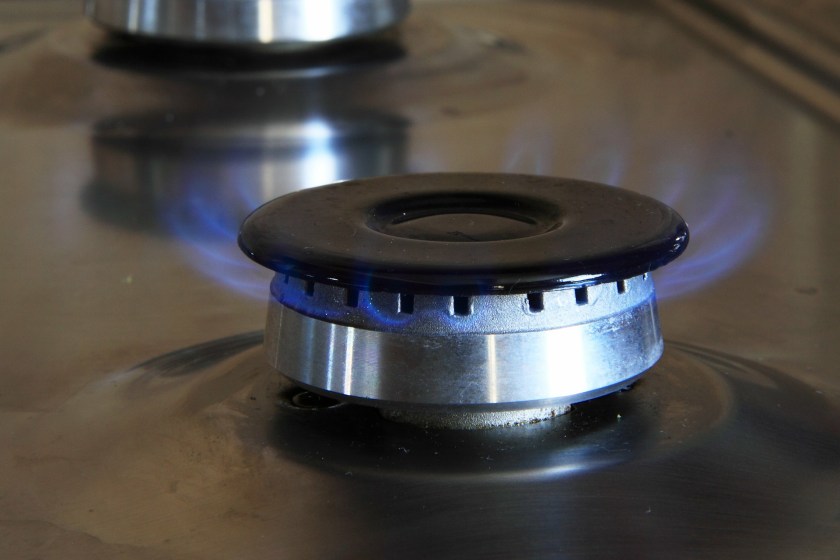
The UK and Scottish governments both remain fully behind the North Sea Transition Deal, which envisages production of oil and gas continuing up to 2050 and beyond.  Hydrogen – initial produced from natural gas – is key to the strategy, and the assumption is that hydrogen will replace direct use of natural gas for home cooking and heating, the source of around 23% of the UK’s greenhouse gas emissions.  Hydrogen produced from gas is usually called ‘blue hydrogen’ and while burning hydrogen involves no emissions, the production of blue hydrogen involves the emission of large amounts of carbon dioxide.  

Image by PublicDomainPictures from Pixabay

The case against the strategy is growing apace.  Back in August 2021 Chris Jackson, the chair of the UK Hydrogen and Fuel Cell Association (UKHFCA) resigned just days before the publication of the Westminster government’s hydrogen strategy.  He stated: 

“I believe passionately that I would be betraying future generations by remaining silent on that fact that blue hydrogen is at best an expensive distraction, and at worst a lock-in for continued fossil fuel use that guarantees we will fail to meet our decarbonisation goals.”

Last week we posted on the findings of research by the Imperial College Energy Futures Lab comparing hydrogen and heat pumps for domestic heating.  The report recommended that hydrogen will be important in decarbonising some specific industrial and transport processes but should not be used for domestic heating. Now MPs on the Westminster Business, Energy and Industrial Strategy Committee have come to the same conclusion.  The committee’s report slates the government for the lack of clarity in phasing out domestic gas boilers.  It argues that hydrogen is not a practical or sustainable solution. And it condemns the lack of urgency shown by the government in organising for and supporting viable alternatives such as heat pumps and district schemes.

We should be clear that despite the evidence to contrary the hydrogen-based strategy for home heating – while driven by the oil and gas industry – remains the policy option preferred by Westminster, Holyrood and some of the major unions.  Now’s the time for climate activists in workplaces to insist that unions need to rethink and for of all us to get behind a campaign to phase out North Sea Oil and Gas and end all the attempts to pretend that a net zero oil and gas basin (the purported aim of the North Sea Transition Deal)  is possible.

Check out the Scot.E3 briefing for more on this topic.

Photo report – RMT protest

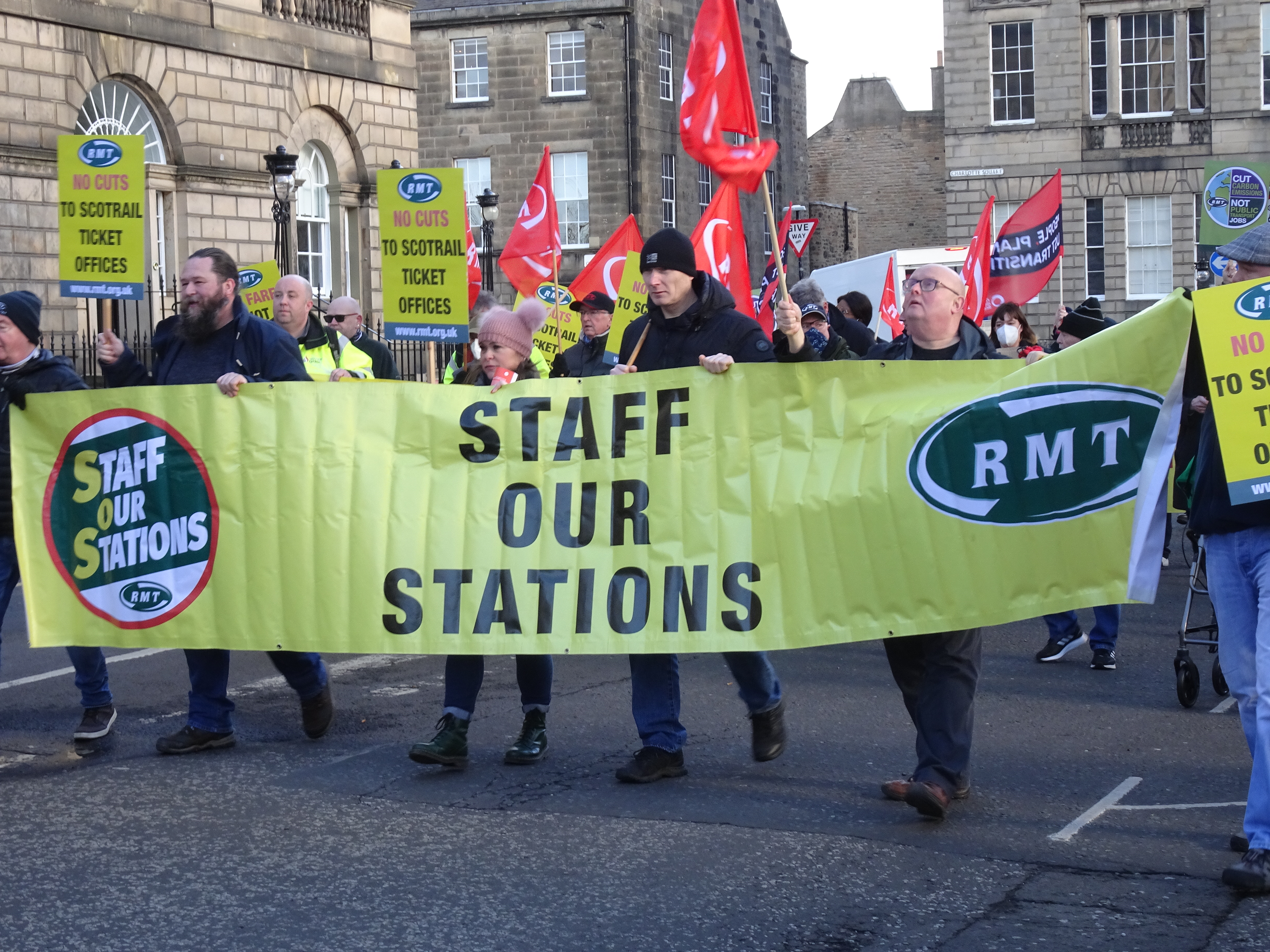
Transport workers, members of the RMT working for ScotRail and Calmac Ferries protested outside Bute House – the first minister’s official residence today. Several speakers stressed that cutting more than 300 services and closing ticket offices at many stations is unacceptable and particularly so only two months after politicians at COP26 were pledging to tackle the climate crisis. Trains and ferries are an essential part of Scotland’s transport infrastructure and critical to a zero carbon future.

Time to phase out North Sea Oil and Gas

Retired oil worker and XR Scotland activist Neil Rothnie responds to the recently published XR strategy for 2022.  Neil argues that the strategy is weakened by not making specific reference to the North Sea when North Sea Oil and Gas remains at the heart of both the UK and Scottish governments energy strategies. 

Begin a planned rundown of North Sea oil and gas production without delay.

That’s a real ‘demand’ and is directed at the UK oil industry and the UK and Scottish Governments.

North Sea oil and gas is a major contributor to the greenhouse gases that are the UK’s contribution to global heating.

 So why does the Extinction Rebellion UK Strategy 2022, on the fossil economy, make no mention of North Sea oil and gas?  

The new 2022 strategy document talks instead about End(ing) The Fossil Fuel Economy in general, and specifically demands No New Fossil Fuel Investment,   No New Fossil Fuel Licences,  and an End (to) Fossil Fuel Subsidies Now.  

But – End the Fossil Fuel Economy – is not a demand.  It’s a slogan!  And the three specific demands could be met in full today without making a jot of difference to the climate catastrophe that’s unfolding.  

Because without one more penny being invested in the North Sea, without one more licence issued, and without a penny more in public subsidy, everything is already in place to ensure that North Sea oil and gas fields will, unless someone puts a stop to it, produce more than the UK’s share of global greenhouse gases that will heat the atmosphere to way over +1.5 degrees, and trigger the irreversible climate change that leads, according to the science as I understand it, to mass extinctions of life forms on the planet.

A similar scenario is set to be repeated all over the world.  In Norway, the Gulf of Mexico, Saudi Arabia, Russia, the China’s coalfields, etc etc.  So, it’s a global problem that has to be addressed in each locality.  

In the UK, we have a responsibility to begin to choke back North Sea oil and gas production.  In the US the responsibility to end fracking and wind down hydrocarbon production from the Gulf of Mexico falls, in the main, to Americans.  In Russia to Russians . .  .

We must have the confidence that the peoples in each and every other fossil production zone will act at least as decisively as we will.  We can talk to them and encourage them, but above all we need to lead by example.  The main enemy is at home.  It’s our responsibility to fight our corner.

And the biggest support we can give to the masses of people in the global south who face climate chaos earlier and harder than us, is to end North Sea oil and gas production.

One massive implication of “disappearing” North Sea Oil and Gas from a UK strategy for fossil fuels is that you also “disappear” the North Sea oil and gas workers and their rights and their responsibilities.

Oil & gas production is going to go.  Sooner rather than later if the climate and our grandchildren are to have a chance. Oil workers must not be shafted like the coal miners were before them.

If you are an oil and gas worker. a climate activist, a trade unionist – if you live in a community that hosts the industry and the workers – or if you’re young and fearful for your future, put your name to our demands*.

  • No more redundancies of oil and gas workers.
  • Workers whose jobs are threatened as the oil industry is wound down, must be furloughed until they are retrained and re-employed.
  • North Sea wind jobs must be made to pay North Sea wage rates.

*These three demands are still in draft but will form part of a new Scot.E3 campaign in 2022.

Cut Carbon Emissions not transport jobs

Solidarity with rail, ferry and energy workers, members of the RMT union who are protesting on Monday 31st January in Edinburgh. Assemble 11am on the Waverley Station concourse.

This is the RMT press statement

28 January 2022RMT Press Office

Transport and energy workers to protest on 31 January in Edinburgh against betrayal of COP26 promises

Marking the three-month anniversary of the beginning of the COP26 Climate Conference – on 31st January – transport and energy workers are to march to the office of the First Minister Nicola Sturgeon to protest at the betrayal by the SNP / Green Government of commitments made to move towards a greener Scotland.

The protest by rail, ferry and energy workers who are members of the RMT will be the start of a concerted campaign to increase the pressure on politicians as the country approaches the local government elections in May. 

The charge sheet against the Scottish Government includes:

• Instead of cutting climate change, the SNP/ Green Government is cutting rail services including rail ticket offices hours, timetables and infrastructure while the cost of rail travel is increasing at four times the rate of using a car.
• Instead of securing our vital lifeline ferry services in the public sector, ministers appear to be paving the way for privatisation where profits will be put before people and climate. 
• Instead of helping guarantee the livelihoods of energy workers, ministers have sold Scotland’s renewable energy resources on the cheap to the likes of BP and Shell without securing supply chain jobs. 

RMT General Secretary Mick Lynch said:

“COP26 started only three months ago but already the lofty rhetoric about fighting climate change seems a distant memory as we witness a betrayal of ambitions by the SNP / Green Government to move towards a greener Scotland.

“Instead of cutting climate change the Government is cutting rail services and ticket offices, threatening the privatisation of our lifeline ferry services and doing far too little to protect the livelihoods of energy workers and the vital service they provide. 

“As the country approaches the local government elections in May this protest will be the start of a concerted campaign to persuade politicians to protect these services and jobs which are so vital to our local communities.”

The future for home heating

Yesterday (27th January 2022 saw the launch of a new report weighing up the relative merits of hydrogen and heat pumps for domestic heating.  The report was produced by the Imperial College Energy Futures Lab.  It concludes that while hydrogen will have a role in decarbonising some industrial process it is not appropriate for domestic heating. 

The research finds that hydrogen infrastructure is not going to be viable for domestic heating applications at scale for at least the next 10 years and therefore, the Government should focus on deploying solutions which are available now including energy efficiency, electrification through heat pumps and heat networks as the main focus for its strategy. 

Richard Hanna one of the reports authors says:

… hydrogen has potential to help decarbonize challenging sectors like industry and shipping but right now there is not a strong case for using it to here in our homes. In the near-term government should focus efforts on improving heat pump products and their affordability and supporting industry to rapidly scale up production of technology in the UK

Scot.E3 argues that current UK and Scottish government support hydrogen as a replacement for natural gas is deeply misguided and is unlikely to be effective in cutting carbon emissions.  This really matters since domestic heating is responsible for around 23% of the UK’s greenhouse gas emissions.  The UK is currently very dependent on the use of natural gas for domestic heating.  Around 85% of homes use gas. One consequence of this heavy dependence is the ratchetting up of levels of fuel poverty because of the massive hike in gas prices that has occurred over the last few months.  

The report is well worth reading and includes a really useful and extensive list of links to further reading.  Butven if you don’t have time to read the report in full, do read the policy recommendations.  These highlight the need for public sector procurement, for planning, for rapidly increasing the rate of heat pump installation starting from now and critically for immediate investment in training to create a skilled workforce able to carry out this work.

This is the video of the meeting at which the report was launched.

Trask, A., Hanna, R. and Rhodes, A. The Future of Home Heating: the Roles of Heat Pumps and Hydrogen, An Energy Futures Lab Briefing Paper, Imperial College London Consultants. Available at: https://www.imperial.ac.uk/energy-futures-lab/reports/ briefing-papers/paper-8/ 

Fossil fuel systems and how to change them

Simon Pirani is the author of ‘Burning Up – A Global History of Fossil Fuel Consumption’* – Simon recently spoke on Fossil Fuel Systems at one of. series of events discussion issues around ecosocialism. The video of his introduction provides a very clear and comprehensive account of how fossil fuel systems are embedded in modern capitalist economies and of the challenges of breaking from an economic system based on these fuels.

Simon blogs at the People and Nature website which carries lots of articles that will be of interest to followers of Scot.E3.

* we have a small number of copies of Simon’s book available at the reduced price of £11 (postage extra) – email triple.e.scot@gmail.com if you’d be interested in a copy.

Briefing – the use and abuse of hydrogen

The latest in our series of briefings. Like all of the briefings this one is just two sides of A4 and is published under a Creative Commons license which means you are welcome to share, adapt and reuse the content. Download a PDF version here.

Abuse

Check through the news bulletins and the financial papers and you’ll find hydrogen in the news.  Big energy companies, the Westminster and Holyrood governments and some trade unions are all heralding hydrogen as a ‘green’ alternative to the natural gas which most of us use for heating and cooking.  For example, SGN who run Scotland’s gas network are promoting a plan in which hydrogen would be produced and stored at the St Fergus gas terminal, north of Peterhead.  It envisages starting to use hydrogen in Aberdeen and then extending the hydrogen network to the rest of the northeast coast and the central belt by 2045.

Natural gas used for heating and cooking accounts for around 30% of the UK’s carbon emissions.  In contrast burning hydrogen for heat results in zero emissions.  So, it appears that replacing natural gas with hydrogen is a no brainer.  In this briefing we’ll explain why that’s not the case. 

Grey, blue and green?

You will hear talk about grey, blue, and green hydrogen.  The colours refer to how the hydrogen is produced – and it’s the production method that determines the impact of hydrogen on the environment.

Grey hydrogen is made from natural gas. Almost all the hydrogen that’s in use now is produced in this way. World-wide production currently amounts to 70 million tonnes.  Greenhouse gases are a by-product of the production process, and current production has a similar impact on global warming to the whole aviation industry.

Much of the current hype is over blue hydrogen.  Blue hydrogen is produced from natural gas in the same way as grey – the difference is that the production process incorporates carbon capture and storage. Greenhouse gases are stored rather than released to the atmosphere.  Using blue hydrogen for all our domestic heating and cooking would require carbon capture on a massive scale.  Large-scale carbon capture is untested, the technology for capture is not yet available and there are serious concerns about the long-term safety of large-scale storage.  The production process for blue hydrogen is energy intensive and needs large amounts of green electricity.  One example – Northern Gas Networks have a plan to convert domestic gas supplies to hydrogen.  The aim is to have converted 15.7 million homes by 2050.  This would require 8 million tonnes of hydrogen and need the equivalent of 60 production plants of the size of the largest currently operational plus a huge deployment of unproven carbon capture and storage technology.

Green hydrogen is produced by electrolysing water – if that electricity is from a renewable source the process is zero carbon.  However, the process requires even more green electricity than producing blue hydrogen.  The NGN scheme to supply 15.7 million homes would require around seven times as much wind generated electricity as is currently produced in the UK.

Image by Utahraptor ostrommaysi CCBY-SA 3.0

Generating electricity to provide the energy to ‘reform’ natural gas or electrolyse water into hydrogen and then using the hydrogen for heat is inherently inefficient.  Direct use of electricity is cheaper, more efficient and would require much less generating capacity.

So why the hydrogen hype?

A new hydrogen economy (dependent on carbon capture and storage technology) is at the heart of the North Sea Transition Deal, dreamed up by the industry body Oil and Gas UK, published by the UK government in March 2021 and endorsed by Holyrood. The transition deal aims at continuing extraction of oil and gas through to 2050 and beyond. It is a costly diversion. To be sure of cutting emissions with the speed that is required we need to phase out oil and gas and invest in proven technologies that are based on renewable energy sources.  

Ed Matthew Associate Director at independent climate and energy think tank E3G says hydrogen is the wrong choice for heating homes.  Blue hydrogen (manufactured from natural gas) needs CCS so would be massively expensive and keeps us hooked on gas. Green hydrogen (made by electrolysis using renewable electricity) is 4 times less efficient than using heat pumps. “Hydrogen is being pushed by the gas industry. Beware.”  Dave Toke, reader in energy politics at Aberdeen University agrees. He calls it: “the start of one of the greatest pieces of greenwash that have been committed in the UK.”

Use

There is a place for hydrogen in a new sustainable economy.  Hydrogen fuel cells supplied with green hydrogen are likely to be an integral part of a full decarbonised economy.  Fuel cells work by using hydrogen to produce electricity which can then power a motor instead of using battery power, such as for electric vehicles.

Image by Bill Harrison CC BY-SA 2.0

Hydrogen fuel cells are currently better suited than batteries for long distance transport and to transport heavy loads.  There are likely to be applications in energy storage and in some very specialised processes that are difficult to decarbonise.  Sea transport may be a case in point

Campaign

The main message of this briefing is that the hydrogen + CCS strategy is designed to maintain the profits of the big energy companies and will not achieve the cuts in carbon emissions that are needed.  It puts profit before people and planet.  There are alternatives that will work.

To decarbonise heat, we need retrofitted insulation, heat pumps and district heating schemes on a mass scale that can only be achieved by the public sector.

Firms producing filthy-dirty “grey” hydrogen must be required to take action to reduce the horrendous levels of greenhouse gas emissions they produce. 

Hydrogen use must be limited to applications that are socially useful and don’t add to the climate crisis.

You can find all our briefings on the resources page.