We were invited to contribute to a workshop on fossil fuels and developing a workers’ plan for just transition held in London on 13 April 2024 by the Campaign Against Climate Change Trade Union Group. This is a summary of the contribution made by Pete Cannell – responses to this piece would be very welcome.
Dundee Harbour – image by Pete Cannell CC0
The previous speakers have talked about some of the very important practical issues that are central to enabling a transition to a sustainable zero carbon economy. There’s plenty of evidence to show that phasing out oil and gas combined with serious investment in renewables creates more jobs. The Sea Change report, published in 2019, shows how switching from oil and gas to wind and solar would create a big net increase in jobs and how failing to make this transition would mean that targets to cut carbon emissions would not be met.
Similarly, home insulation, retrofitting and replacing gas with electricity for heating and cooking is essential, but critically dependent on a skilled workforce.
This workshop is framed around developing a workers plan for just transition. I would argue that the main elements of such a plan are in place. That being the case in the rest of this contribution I’d like to talk about why there’s not yet a simple consensus about a plan. Having a plan is clearly necessary, and critical to being credible in the eyes of working people who are not yet convinced.
In one sense we’ve made serious progress in the last five or so years, it’s now common sense in the climate movement to talk about the role of workers and the need for a just transition. I think in this respect COP26 in Glasgow was a watershed moment. But ironically in practical terms, in terms of action I think we’ve gone backwards in the same period. So, for example, the number of workers in renewables in Scotland is about the same now as it was in 2014. In the eyes of many workers talk of just transition looks like hot air. And in the hands of right-wing populist politicians, it fuels arguments that the climate crisis is not a problem and climate action is a threat. So, there’s a real danger that repetition of just transition, in the absence tangible steps that improve lives and livelihoods, becomes a form of greenwashing.
So, while we need consensus on what to do for me the 64,000-dollar question is
How do we build a mass movement with powerful roots in every workplace and working-class community that has the power to make the necessary changes happen?
I think the climate movement often underestimates the extent to which commitment to the North Sea and to the interests of the big oil and gas companies shapes and directs climate policy. Westminster, Holyrood, the energy sector trade unions and the oil and gas industry work in partnership through what used to be called Oil and Gas UK and has now been rebranded as Offshore Energies UK. They are all signed up to the North Sea Transition Deal and it essentially guides their actions. So, for example it’s hard to find a serious analyst who things hydrogen for domestic heating and cooking makes sense but using hydrogen in this way remains a key plank of policy for both Westminster and Holyrood. And while it does other options are not pursued. Why? Because hydrogen together with Carbon Capture and Storage is the best option for Fossil Capital that wants to maintain existing market dominance, infrastructure and (not least) profits.
For more than fifty years the big oil and gas companies have used their operations in the UK sector of the North Sea to blaze a trail for what we have come to know as neoliberalism; establishing practices that have been copied and taken up internationally. Outsourcing, multiple layers of subcontracting, vicious anti-union policies and the use of blacklists. At the same time the so-called free ‘market’ has been featherbedded by massive state subsidies which have exceeded taxation revenue.
In the old saying – if we had a choice – we wouldn’t start from here. All the evidence is that we are just going past the 1.5degree threshold and the scientific evidence is that change is taking place more rapidly than anticipated. This while the Scottish government which has been strong on rhetoric but feebly reliant on the market for action is judged to be a long way for reaching its targets and Westminster gives the green light for maintaining oil and gas production. And the most important unions remain wedded to a policy of partnership with the energy industry. To answer my earlier question, that partnership, is why we don’t have consensus about a plan. It’s the partnership that pulls in Unite, RMT and GMB behind CCS, Hydrogen and Nuclear.
In this context I think it’s legitimate to ask whether just transition is any longer the right framing for what we want or need.
We need to be clear about what we want to happen and largely that thinking is in place. But to make it happen – perhaps what we should now be talking about is rupture rather than transition. And the power to make that rupture resides within the working class.
North Sea workers are key, but the oil industry has been successful at keeping their organisation fractured and largely ineffective. I think it’s most likely that oil workers will become active participants in the rupture we need only if the mass movement we need is built across all sectors and in working class communities.
And if we are to win that mass participation then there’s no place for partnership with Fossil capital – and that means some very sharp arguments within our movement.
Paul Atkin replies to an interview with the GMB union’s General Secretary Gary Smith in the Spectator.
In agreeing to be interviewed by the Spectator under the title “the folly of Net Zero” GMB General Secretary Gary Smith lets his members down; not least because remarks like these from a leading trade unionist help give Rishi Sunak encouragement to accelerate his retreat from the government’s already inadequate climate targets.
The phrase “the folly of Net Zero” makes as much sense as “the folly of getting into the lifeboats when the ship is sinking”.
Difficulties in making a transition to sustainability does not mean that making it isn’t essential, and the faster we move the less damage is done. We can see that damage all around us even now.
Gary doesn’t seem to get this, any more than Rishi Sunak does, and he latches on to some of the same lines as the PM does, albeit with a more pungent turn of phrase. To go through these point by point, quotes are either directly from Gary Smith or the Spectator.
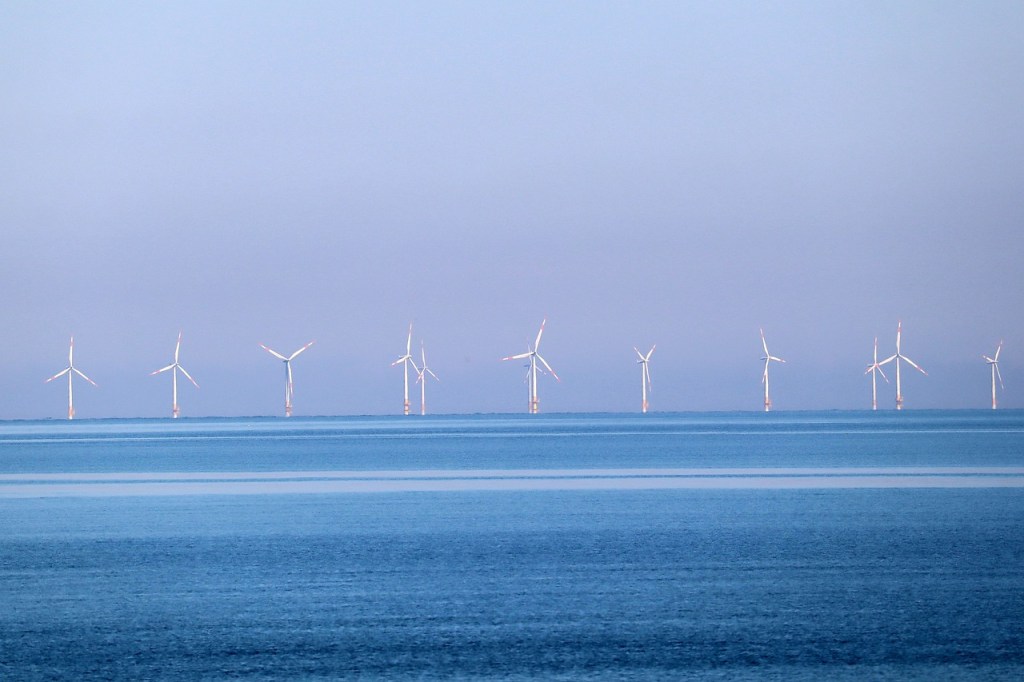
Image from pixabay.com CC0
Auctions for offshore wind power
“Now there will be no bids for the next round of licences because the wind industry can’t afford to put up the projects”
The article starts with an odd bit of misdirection, that echoes the entire right-wing press, on the results of the latest round Contracts for Difference auction for new electricity generation. This focusses on the absence of offshore wind bids at the strike price of £44 per Megawatt hour. The way the Spectator puts it is “The government and the renewables lobby hoped that a successful auction would show that wind power could compete with fossil fuels”. The fact is that it already does. There were no bids from fossil fuel sources at this price either; and the successful bids were all from renewable sources.
24 onshore wind projects
1 Remote Island wind project
56 Solar projects
3 Geothermal projects
11 Tidal stream projects.
These are slated to produce 3.7GW of power. So, renewables 95: Fossil Fuels 0. It’s quite clear which source is heading for the relegation zone. And the International Energy Agency has just reported that electricity generation from fossil fuel sources declined by 7.4% in the whole OECD in the year to September, so this is happening in every developed country.
“Starmer’s 2030 deadline is impossible, I don’t even worry about it”
With 5GW of potential offshore wind projects not coming online, due to rising raw material and interest rate charges increasing costs beyond the auction price, you have to wonder if the government set this up to fail. With the current wholesale electricity price set at over £80 per Kilowatt hour, there was a lot of room to set a price (perhaps around £60 per KWH as suggested by the industry) that could have brought this on stream, and still cut the cost of electricity for customers. This will have a knock-on effect on bills and supply chain jobs – which have been projected on the basis of a tripling of UK offshore wind by 2030 – and choke them off unless the momentum is restored at the next auction. Anyone concerned about jobs in the supply chain will be campaigning between now and then to make sure this is the case.
The stop-go market driven model embodied in the CfD system makes a consistent plan for energy transition vulnerable and chaotic. To take this process by the scruff of the neck and drive it through at the scale and pace that we need requires, as UNITE successfully argued at the TUC, public ownership of energy.
Undersea cables
“The National Grid can’t get undersea cables, There are 4 suppliers of cables in the globe, they’re all booked out to 2030”
If you are concerned with cutting carbon emissions and growing jobs, this is an argument for campaigning for more investment in cable laying and the jobs that go with them, not accepting current limited capacity as an insuperable obstacle. A very good use for some of that £28 billion Labour is pledged to ramp up to.
North Sea drilling
“There will be more drilling in the North Sea”
Senior figures in the unions can’t afford to ignorethe scientific reports on this matter. They are not ambiguous. NO new oil and gas exploration is compatible with Net Zero. 60% of existing reserves have to be kept in the ground to avoid catastrophic consequences. Weaning ourselves off fossil fuels requires unions to fight for a just transition as rapidly as possible for their members in the oil and gas sector. Spinning a delusion that everything can carry on as it is, will speed us to a point at which sustaining jobs will be the least of our problems.
Renewables lobby
“The renewables lobby is very wealthy and powerful. I think people on the left, for good intentions, have got hoodwinked into a lot of this”
This is a breathtaking inversion of reality. How “wealthy and powerful” is the “renewables lobby” compared to the fossil fuel companies? Octopus compared to Shell? Vesta compared to BP, or Aramco, or Exxon? According to the IMF, last year total fossil fuel subsidies were $7 Trillion. 7.1% of global GDP. That’s power. That’s wealth. We should note that this is $3 Trillion more than the total that would be needed globally to get us on track for sustainable development. Shell is now casually projecting that Net Zero will only be possible sometime in the 22nd century if they have their way, with no accounting at all for the social, economic and political consequences of that. Gary sees these companies as “people who we can work with” without reflecting that, since they have known about climate change for fifty years and tried to cover it up, with no “good intentions” at all, that hoodwinking is a large part of what they do.
UK net zero targets
“We’ve cut carbon emissions by decimating working class communities
Who does he mean by “we”? A better word would be “they”. The succession of Tory governments, in all their various guises, since 2010 have been bad for climate breakdown and the working class. They have put business imperatives (profit) above sustainability, and dumped costs of transition downwards onto those least able to afford it. Two examples. Insulation and solar energy installation fell off a cliff when the Tories “cut the green crap”, leading to thousands of lost jobs and higher bills as a result.
Green levies
“Green levies are a modern-day poll tax”
It’s also the case that, because it was the Tories, the schemes they had were skewed to subsiding the sort of consumers who could afford the upfront investment; while dumping the costs on everyone else’s bills. Hence Gary’s complaint that this was ‘disproportionately paid for by the poorest’. Quite so, but the answer to that is not to scrap insulation and solar panel installation altogether, but to approach it as a social mission to upgrade the “leaky, freezing council house(s)” that need it most first, and do it through Direct Labour run by Local Authorities; thereby creating jobs, cutting fuel poverty and improving health, as well as cutting energy demand and therefore emissions. Win, win, win.
Green Jobs
“It’s usually a man in a rowing boat sweeping up the dead birds”
Given that there were 19,600 jobs directly in offshore wind in 2022, and another 11,500 in the supply chain, that’s quite a lot of rowing boats. 30% of these are in Scotland. 15% in Yorkshire and Humber. If considering bird fatalities, Gary might note that in this study from the US, “for every one bird killed by a wind turbine, nuclear and fossil fuel powered plants killed 2,118 “. If we go for nuclear and stick with fossil fuels, we’re going to need a bigger boat.
According to Prof Sir Jim McDonald, president of the Royal Academy of Engineering, 30,000 new skilled workers would be required to retrofit buildings, while 60,000 technicians would have to be on hand to go one step further and install energy efficient heating systems in homes, offices and factories, with intensive training required. This is an extremely conservative estimate given that it can take four skilled workers six months to do a thorough retrofit on a house. In their latest Climate Jobs Report the Campaign Against Climate Change Trade Union Group argues that two million jobs will be required to deal with all 27 million homes and public buildings that need retrofitting if it were to be addressed seriously with the level of investment that’s needed.
That’s an awful lot of new jobs. Were the GMB to campaign for this, positively and proactively, some of these new workers might join.
Nuclear energy
“Smith is broadly positive about the future of green energy and sees Hinckley Point as a success story”
The argument that new nuclear is the core of future “green energy” is not consistent with any concern for impact on energy bills. The strike price for electricity generated by Hinckley Point is £93.50 per KWh. More than double the price at the last CFD auction and a third more than Offshore wind companies were pitching. This will go onto electricity bills and hit the poorest hardest. Small Modular Reactors are projected to be even more costly. So, whatever the green merits or otherwise of nuclear, it is not compatible with the concern for costs to customers that is foregrounded in his argument against “green levies”.
Hydrogen
Gary also argues for hydrogen, in general terms in this article. Elsewhere the GMB has pushed hard for hydrogen to be used as a mass replacement for natural gas for domestic cooking and heating. This is a complete non-starter on grounds of cost, emissions and safety. Unless the hydrogen is produced by renewable energy, the carbon emissions produced in making it are greater than if you just use natural gas in the first place. To produce sufficient hydrogen for mass domestic use using renewable energy would need far more wind farms than Gary is prepared to contemplate as a realistic possibility. Hydrogen has a role in some hard to decarbonise industrial sectors, so any green hydrogen we produce should be kept for that. It will be an expensive and precious resource that we should use accordingly. You have to add to that the concerns about how flammable the stuff is in a domestic context. As hydrogen is much lighter and more flammable than natural gas, the possibility of leaks and fires is much greater, so the existing infrastructure would need significant upgrading. A recent government report concluded that hydrogen in the home would be four times more dangerous than natural gas. A job creation scheme for the Fire Brigade perhaps, but probably one they’d rather not have. That’s why people selected to trial it as a cooking and heating tool in Ellesmere Port rebelled against the prospect of a domestic Hindenburg disaster* in their kitchen, leading to the pilot project having to be scrapped. Many gas fitters are less than happy at the prospect of working with hydrogen for domestic heating or cooking for the same reason.
China and supply chains
“We’ve become increasingly dependent on China because we can’t secure our energy future”
Gary’s position on trade and supply chains is contradictory. The GMB has argued for a “Great British Supply Chain”, with an almost autarkic vision of everything from widgets to jackets to turbines being built here, and for the CFD auctions to be stopped until one is established. At the same time, he quite rightly says he is “not a protectionist”, because workers lose out. But also, that the UK can’t do what the US is doing with the Inflation Reduction Act because it does not have a major reserve currency; which does not quite add up. He objects to the Tory approach for its “ideological bent” to neo liberal globalisation and buying the goods from the cheapest source, but also objects to imports from China as a “non-market economy” that “distorts the world economy”.
Gary seems to accept that China’s “non market economy” is more efficient at producing the necessary goods than the UK neo liberal economy is. In the case of energy, this is probably because they are investing more than twice as much in renewable energy generation than the EU and USA combined, and the UK lags behind both of these. Whether you agree with China’s definition of itself as “Socialist with Chinese characteristics”, or argue that it is a form of “state capitalism”, there’s no doubt that their state directed investment and coordination of state companies, academia and the private sector is beginning to produce the necessary goods at the necessary speed and scale. Just as well, because getting their dependence on coal down fast is crucial for all of us and, again according to theInternational Energy Agency, both possible and happening.
And that brings us to the paradox of Gary’s position. To develop a comparable supply chain here would require investment on that scale. But he claims that investment even on the smaller scale being carried out in the US is beyond the UK’s capacity. To deploy the £28 billion that Labour projects that it will ramp up to (which will be comparable to the US and EU, so therefore about half the Chinese level) would either require direct state investment through newly created nationalised industries, or you have to bribe a multinational, which at the moment is “free money” that comes with no government stake or even a say for the workforce or affected communities. Tata is doing rather well out of this at the moment, with half a billion for an electric arc steel furnace in Port Talbot and another 600 million for their EV plant in Swindon. Gary’s complaint that the redundancies that come with this deal at Port Talbot shows that Just Transition is “fantasy land” undercuts the position that his members would expect him to take alongside the other affected unions – for a say in the transition, for investment in a wider range of viable technologies to sustain volume steel making and the jobs that go with it. If this is a “fantasy” then so is any prospect of defending those jobs.
The reality is that “British” manufacturing is, for the most part, owned by multinationals and might be better understood as “production in Britain”. It also shows that companies like these and the Fossil Fuel majors in the North Sea about whom Gary argues “we’ve got to stop seeing them as the enemy and we’ve got to start seeing them as people who we can work with”, do not return the favour, and shut the unions out whenever they can.
More positively, it should be noted that high quality locally produced goods are not solely dependent on the national market and can also be exported, and companies based here, whoever owns them, do that too. In 2017, according to the Renewables UK Export Nation Reportthis included “an extraordinarily wide variety of goods and services, including supplying, installing and maintaining onshore wind turbines and components, designing gearboxes, manufacturing offshore wind turbine blades and steelwork, supplying and laying underwater power cables, installing, inspecting and maintaining offshore wind farms, providing helicopters, crew and vessels, developing wave and tidal energy projects and providing components for the marine energy industry, as well as designing software, conducting geological surveys, monitoring wildlife, and providing financial and legal services”. With properly targeted and coordinated R&D producing patents as part of a proper industrial strategy, there is a lot of room for growth in all of this, which matters for the sector because most of the growth in it will be “in Asia”.
“Failing to prepare is preparing to fail.” Benjamin Franklin
Transition and jobs growth will only happen if there is investment at scale and speed. Seeking to “moderate” Labour’s policy so that the investment doesn’t happen, means there will be no growth in jobs either. Without plans, and without union engagement in making them, we will stagnate at best. That is what we should be concentrating on now, so that mobilising people for transitions in their communities and workplaces that will cut their bills, boost jobs and cut our carbon emissions fast becomes part of the election campaign to drive the Tories out of office and cement Labour in government into actions that drive that forward.
*I was once told at a SERA meeting by a representative of the Hydrogen industry that the reason the Hindenburg burned so fiercely was not because of the highly flammable gas that it was filled with, but because of the lacquer that was painted on the outside of the dirigible. He did this with a straight face.
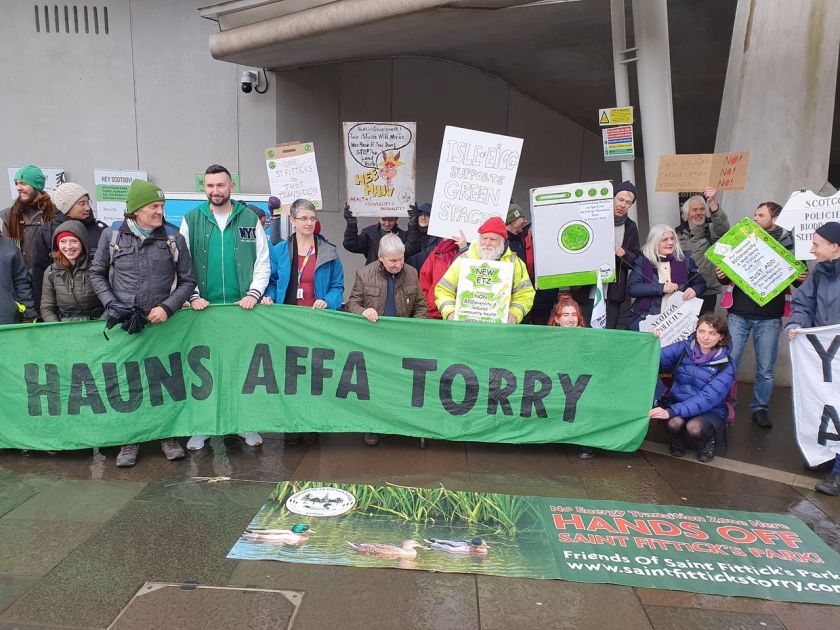
Demonstrating outside the Scottish Parliament in January 2023
Campaigners in Torry are still waiting on the Scottish Government announcement that was expected back in January. Each month it has been put back another 28 days and is now due on 6th May. If the government gives the go ahead to the current plans for the ETZ (Energy Transition Zone) it will be a decisive step down a road that panders to the oil and gas industry and has nothing to with social justice. St Fitticks Park, which the plans would take over for industrial use, is the only green space in a working class area that suffered from decades of pollution as a result of the oil and gas industry. Most recently a new Energy from Waste incinerator, built close to a primary school, has led to a further deterioration in living conditions.
This film from REELNews highlights the issues involved and the resistance of the local community. Please share it widely.
In the film it’s noted that it’s not clear what use the new industrial zone will be put to. However, since the film was made campaigners have found evidence that there will be a large hydrogen storage facility – with 80% blue hydrogen and 20% green – that will be used to convert the cooking and heating supply for 20,000 social housing tenants in Aberdeen. If this goes ahead not only will Torry lose it’s green space many of its residents will be locked in to a very expensive energy future.
St Fitticks deserves to be a national campaign. The issues it raises around social justice, the use of hydrogen and carbon capture are national issues and they expose the weaknesses and contradictions in Scottish Government Energy Policy.
Share this post – support the St Fitticks campaigners.
Read more detail and watch video from the campaign here and here.
This article by John Szabo and Gareth Dale was first published in shortened form in the Conversation and then on 13th January by the Ecologist. We are grateful to the authors and the Ecologist for their permission to publish it here.
The hydrogen economy appears to enjoying its great leap forward. Assuming its construction goes to plan, a €2.5bn undersea pipeline will from 2030 convey “green hydrogen” from Spain to France. It is one element in a hydrogen infrastructure package that the European Commission announced earlier this year.
In the USA, some power stations are being upgraded to allow hydrogen to be blended with fossil gas, and the Norwegian oil company Equinor is teaming up with Thermal SSE to build a 1,800MW “blue hydrogen” power plant in Britain. China, earlier this year, unveiled a long-term hydrogen plan which includes major technological and infrastructure investments.
If the number of projects is growing at pace, one may suppose, a large supply of the resource must exist somewhere. Well, it does and it doesn’t.
Decarbonise
Hydrogen is produced in multiple ways. A colour spectrum is used to render it simple. “Grey” and “brown/black” refer to hydrogen produced from fossil gas (methane) and coal (brown or black coal) respectively—a process that, for every ton of hydrogen, emits between ten and twelve tons of carbon dioxide for grey hydrogen or eighteen to twenty for brown.
“Blue” is the same process but filed under “low carbon” because the carbon dioxide is supposed to be captured and stored underground. “Green” hydrogen is conventionally defined as generated from renewable electricity passed through water to split it into hydrogen and oxygen.
When you zoom in on hydrogen’s “colours,” however, they appear slippery. The hydrogen economy is not a palette of technological options but a grey-brown oil refinery behind an eye-catching blue-green front gate. All the chatter is of the latter.
Green and blue hydrogen yield 11 million and 320,000 Google hits respectively, as against 95,000 for grey and 49,000 for brown. The reality curves in the opposite direction: only 0.04 per cent of hydrogen is green, and blue hydrogen is also less than one per cent. At least 96 per cent is grey or brown, most of which is used in oil refineries and for manufacturing ammonia and methanol.
It’s an enormous industry, responsible for emitting more carbon dioxide than all of Britain’s and France’s emissions combined. The test of any government or corporate hydrogen agenda, then, is the nature—or even the existence—of its plans to decarbonise the 96 per cent. In some cases this is beginning to happen. But if the focus is on producing more ‘blue’ and more ‘green’ for other purposes, something is amiss.
Failures
When you look closely at green hydrogen, some of it resolves into shades of grey. It’s not simply that its production is extremely energy-intensive or that in its double transformation—from electricity to hydrogen and thence to its final usage—so much energy is wasted.
It is partly that, if combusted, it emits nitrogen oxides, and also that, if scaled up to play a significant economic role by 2050 (as in recent projections by the International Energy Agency), its freshwater requirements will exceed one quarter of today’s global annual consumption, causing water stress in some regions.
Above all, green hydrogen is meaningfully green only if the renewable energy that generates it cannot be fed into the grid to replace power from gas or coal plants.
A similar but much more harmful trick of the light occurs with blue hydrogen. Look closely and you see that in reality it’s either chequered blue/grey or even blank, a mere fiction.
For hydrogen to be true blue, the emissions must be captured and securely stored. In theory, CCS is workable but nearly all plants use the captured carbon to pump more oil and many have been shut down as failures.
Blue hydrogen is still in its infancy and we don’t yet know whether most of the CCS costs will be loaded onto taxpayers, as the gas companies demand.
Price projections should be treated with the utmost scepticism. One boosterish paper cites blue hydrogen from Alberta (Canada) at $1.50 to $2.0 per kg. It adds that blue hydrogen production will help Canada achieve its decarbonisation goals.
In fact, research at Shell’s CCS plant in Alberta discovered that it emits more carbon than it captures. For the foreseeable future, this is not a “low carbon” product in any sense of the term. It is a hypothetical solution the costs of which remain unknown, as the development of projects has been slow and costly with few realised, while future operating costs are also unclear.
Electrolysers
Given the question marks that surround blue hydrogen, it’s widely hoped that a silver lining of today’s high gas prices will be that green hydrogen becomes cost competitive.
In terms of inputs, the green-blue price difference boils down to the cost of electricity versus fossil gas. With the global energy crisis exacerbated by Russia’s war on Ukraine, many are asking: will high gas prices favour green hydrogen? Spoiler alert: probably not.
In the EU, as in many economies, electricity pricing is based on the principle of marginal costs, and that usually means the price of power from fossil gas plants. When it is high, renewable electricity generators will seek to sell to the grid. In this way, blue and green prices are largely interwoven in the current market setup; their inputs move in sync.
Of course, there are geographical and temporal differences. During sunny spells, electricity prices may collapse as solar PV-based generation picks up.
This unlinks electricity and natural gas prices, but only momentarily, often only for a few hours—not enough to justify investment in electrolysers to produce green hydrogen. On the whole, the price gap between blue and green will remain fairly narrow until electricity markets are fundamentally restructured.
Transition
There’s worse. The high price of hydrocarbons has turbocharged the industry’s expansion. The US government is exhorting oil and fracking firms to ‘drill baby drill.’ Britain’s government has issued over one hundred additional licenses to drill. Colossal new fossil fuel investments have been announced across the Middle East and Africa.
All this will have long-term ramifications. First, in a few years when the new production comes on stream, and particularly if the current growth slowdown substantially depresses demand, gas and oil will again become cheaper—until the next price spike prompts new rounds of investment, and the infernal cycle continues.
Second, the owners of the new-drilled wells and other infrastructure will fight tooth and nail to defend those assets, and to stall the decarbonisation agenda. The peculiarity of hydrogen is that it is a means to both the stalling and the decarbonisation.
The latter can be simply stated. Green hydrogen will be important to the decarbonisation of certain sectors such as steel, and ammonia for fertilisers, and possibly shipping and trucking.
The role of hydrogen in stalling the transition is complex but no less important. It begins with the recognition that the fossil fuel corporations are rebranding themselves as agents of “carbon management.”
Ramping
The goals are to prevent their assets from getting stranded by repurposing them, above all by marketing grey and blue hydrogen as “bridge” fuels; to lock in hydrocarbon production for decades to come; and to defray the costs onto taxpayers.
For this, hydrogen offers the perfect vehicle, in view of its confusion of shades and colours. Fossil fuel interests use it to counter opposition to new investments in fossil gas through an aggressive marketing and lobbying campaign that presents a largely fictional substance, blue hydrogen, as a low-carbon “bridge” to an unspecified future genuinely-green transition.
Other sectors have joined the oil-led coalition. As the engineer Tom Baxter observes, it is seen by gas network operators and boiler manufacturers as their survival route.
Likewise, power utility companies are keen, as hydrogen’s inefficiencies mean they’ll sell more power. Relatively conservative trade unions, such as Britain’s GMB (General, Municipal, Boilermakers), are onboard too.
To tackle this stalling operation, a strong role for public policy is indispensable. Governments will need to regulate or tax carbon out of the market while simultaneously ramping up renewables.
Malign
Fiscal and subsidy schemes need to pivot from supporting fossil fuels to supporting renewables. The approach to electricity pricing must shift, to decouple the prices of electricity and fossil gas.
Instead of the marginal pricing system, it requires incentivising rewards for generators according to their average costs plus a slight surplus, either through a robustly regulated market system or by nationalising the energy companies and setting prices and production.
Such interventions would give green hydrogen a competitive advantage, one that can be furthered by other subsidies, such as tax credits on the model of the US Inflation Reduction Act. Above all, energy demand needs to be scaled down. The lower the demand, the less the upward pressure on price.
In any future energy system, hydrogen will have a role. But its expansion needs to be carefully designed, to prevent the promise of green hydrogen being mis-used, in opening the back door to its ecologically malign blue and grey cousins.
These Authors
John Szabo is a Fellow at the Institute of World Economics, Centre for Economic and Regional Studies as well as an Assistant Lecturer at the Department of Eötvös Loránd University International Relations and European Studies, Eötvös Loránd University. His research focuses on the energy-society nexus, especially in the context of the energy transition.
Gareth Dale teaches politics at Brunel University, and many of his articles appear on its website. He tweets at @Gareth_Dale.
If you’d like to read more you can look at the ScotE3 briefing – ‘The Use and Abuse of Hydrogen’ – the briefing can also be downloaded as a PDF for hard copy distribution.
Around 80 people, with a strong contingent from Aberdeen, rallied at the Scottish Parliament yesterday to demand that the Scottish Government stops developments in Torry, Aberdeen that would see the end of St Fitticks park, a hugely important green space in a heavily built up area. The message from the protestors was that there’s no justice if ‘transition’ is driven by the Oil Industry seeking new sources of profit at the expense of working people and the environment.
The protestors called for supporters to text, tweet and use every available means to tell Minister Tom Arthur and your local MSP to order the removal of the rezoning of St Fittick’s Park from Aberdeen’s new Local Development Plan.
Here’s an updated version of Briefing 13 on the use and abuse of hydrogen. You can download the briefing as a PDF.
Abuse
Check through the news bulletins and the financial papers and you’ll find hydrogen in the news. Big energy companies, the Westminster and Holyrood governments and some trade unions are all heralding hydrogen as a ‘green’ alternative to the natural gas which most of us use for heating and cooking. For example, SGN who run Scotland’s gas network are promoting a plan in which hydrogen would be produced and stored at the St Fergus gas terminal, north of Peterhead. It envisages starting to use hydrogen in Aberdeen and then extending the hydrogen network to the rest of the northeast coast and the central belt by 2045.
Natural gas used for heating and cooking accounts for around 30% of the UK’s carbon emissions. In contrast burning hydrogen for heat results in zero emissions. But while Westminster and Holyrood continue to advocate investment in hydrogen a string of expert reports have been published warning that going down this road will be disastrous. So, what should we believe and what should we campaign for?
Grey, blue and green?
You will hear talk about grey, blue, and green hydrogen. The colours refer to how the hydrogen is produced – and it’s the production method that determines the impact of hydrogen on the environment.
Grey hydrogen is made from natural gas. Almost all the hydrogen that’s in use now is produced in this way. World-wide production currently amounts to 70 million tonnes. Greenhouse gases are a by-product of the production process, and current production has a similar impact on global warming to the whole aviation industry.
Much of the current hype is over blue hydrogen. Blue hydrogen is produced from natural gas in the same way as grey – the difference is that the production process incorporates carbon capture and storage. Greenhouse gases are stored rather than released to the atmosphere. Using blue hydrogen for all our domestic heating and cooking would require carbon capture on a massive scale. Large-scale carbon capture is untested, the technology for capture is not yet available and there are serious concerns about the long-term safety of large-scale storage. The production process for blue hydrogen is energy intensive and needs large amounts of green electricity. One example – Northern Gas Networks have a plan to convert domestic gas supplies to hydrogen. The aim is to have converted 15.7 million homes by 2050. This would require 8 million tonnes of hydrogen and need the equivalent of 60 production plants of the size of the largest currently operational, plus a huge deployment of unproven carbon capture and storage technology.
Green hydrogen is produced by electrolysing water – if that electricity is from a renewable source the process is zero carbon. However, the process requires even more green electricity than producing blue hydrogen. The NGN scheme to supply 15.7 million homes would require around seven times as much wind generated electricity as is currently produced in the UK.
Generating electricity to provide the energy to ‘reform’ natural gas or electrolyse water into hydrogen and then using the hydrogen for heat is inherently inefficient. Direct use of electricity is cheaper, more efficient and would require much less generating capacity.
So why the hydrogen hype?
A new hydrogen economy (dependent on carbon capture and storage technology) is at the heart of the North Sea Transition Deal, dreamed up by the industry body Oil and Gas UK, published by the UK government in March 2021 and endorsed by Holyrood. The transition deal aims at continuing extraction of oil and gas through to 2050 and beyond. To be sure of cutting emissions with the speed that is required we need to phase out oil and gas now and invest in proven technologies that are based on renewable energy sources.
Ed Matthew Associate Director at independent climate and energy think tank E3G says hydrogen is the wrong choice for heating homes. Blue hydrogen (manufactured from natural gas) needs CCS so would be massively expensive and keeps us hooked on gas. Green hydrogen (made by electrolysis using renewable electricity) is 4 times less efficient than using heat pumps. “Hydrogen is being pushed by the gas industry. Beware.” Dave Toke, reader in energy politics at Aberdeen University agrees. He calls it: “the start of one of the greatest pieces of greenwash that have been committed in the UK.”
Use
It’s currently hard to see how even green hydrogen can have more than a very specialised place in a fully decarbonised economy. Hydrogen fuel cells are currently being used for buses, and mass transport is of great importance in decarbonisation. But it seems likely that electric buses will make more sense than using large amounts of renewable energy to produce green hydrogen.
Heat pump – Lerwick, Shetland. Image by Pete Cannell CC0
The priority uses for renewable energy are to replace gas and coal in power stations and to heat homes and other buildings with electrically driven heat pumps. It’s possible however that hydrogen will have a roll in transporting heavy loads and in sea transport.”
Campaign
The main message of this briefing is that the hydrogen + CCS strategy is designed to maintain the profits of the big energy companies and will not achieve the cuts in carbon emissions that are needed. It puts profit before people and planet. There are alternatives that will work.
To decarbonise heat, we need retrofitted insulation, heat pumps and district heating schemes on a mass scale that can only be achieved by the public sector.
Firms producing filthy-dirty “grey” hydrogen must be required to take action to reduce the horrendous levels of greenhouse gas emissions they produce.
Hydrogen use must be limited to applications that are socially useful and don’t add to the climate crisis.
Briefing #14 on climate, fuel poverty and the cost of living is now available for download. As with all the our briefings you are welcome to use and adapt the briefing content – attribution to https://scote3.net is appreciated.
The content of the briefing is reproduced below.
Climate, fuel poverty & the cost of living
Fuel poverty kills
Prior to the latest crisis almost 25% of households in Scotland lived in fuel poverty and just over 12% were in extreme fuel poverty. Households in extreme fuel poverty are disproportionately represented in rural Scotland. Older people living in rural Scotland are particularly hard hit. Every year thousands die because of fuel poverty – in 2018/19 excess winter mortality (that’s in comparison with the average winter mortality for the previous five years) was 2060 – the death toll can be more than twice as high in cold winters. Around 85% of households in the UK rely on gas for heating and cooking. The huge hike in gas prices is going to make an already unacceptable situation much, much worse.
Rising fuel prices
Gas and electricity prices have been rising faster than inflation for a long time. From 2006 – 2016, Gas prices rose by 71% and Electricity 62%. Between 2017 and 2020 electricity prices increased by a further 8% in real terms while gas prices fell by a similar amount. But gas prices are extremely volatile. Since 2019 the wholesale price has almost trebled.
Gas consumption fell by just over 2% in 2020, a consequence of lockdowns around the world. In 2021 there was a rebound with consumption increasing by 4.6% because of increased economic activity and several extreme weather events worldwide. The cost of producing gas is about the same this year as it was last year and the year before. So why has the price rocketed up? Prior to 1987 the EU designated natural gas a premium fuel that should be reserved for home heating. Now 60% of gas is used to generate electricity. Britain used to have significant storage capability. This was abandoned in favour of allowing the market to deliver gas as needed. These changes have been a disaster. Gas is traded on the spot market with hedge funds gambling on future prices. As a result, the cost of an essential utility is determined by a casino where traders rake in massive profits while consumers pay the price.
Lack of ambition
In June 2019 the Scottish Parliament passed a new act setting statutory targets for reducing fuel poverty. Rightly it highlights the impact of fuel poverty on the most vulnerable in society. Low-income, high-energy costs, and poorly insulated housing result in the appalling situation where families, young people, elderly, disabled and many working people, cannot afford adequate warmth. The new act sets interim targets for reducing fuel poverty to 15% of households by 2030 and final targets for 2040. Considering the cost of living and climate crises we face this is too slow and not enough. The act failed to address the threat posed by a chaotic market. From April 2022 annual bills will increase by an average of almost £700. Further increases are expected later in the year. The numbers in fuel poverty are set to rise well above the current level.
Fossil fuels cost the earth
Both Holyrood and Westminster remain committed to the maximum economic extraction of oil and gas from the North Sea. The big energy companies are making billions in extra profits out of the crisis. North Sea oil and gas operates under a regime of very low taxation. With prices high companies will be doubling down on plans to open new gas fields. If this happens there is no chance of meeting the reductions in greenhouse gas emissions that are essential. We argue that there are two essential steps. The first is to protect all those who are in fuel poverty and stop more people joining them. A windfall tax on profiteers will help with this but should not be mistaken for a long-term solution – and the scale of the problem is so large that it requires significant redistribution with higher taxes on the rich and much more support for the poor. These are necessary short-term steps to prevent large scale misery, deprivation and increased winter deaths. But a secure future for us all rests on gas being taken out of the market, with North Sea and North Atlantic oil and gas taken into public ownership and control. With public control it then becomes possible to plan for the phase out of fossil fuels from the North Sea. In the process we cut greenhouse gas emissions and replace expensive gas heating by cheaper renewables. The interests of working people and the need to protect the planet are aligned.
A mass insulation campaign
In its ‘One Million Climate Jobs Pamphlet’, the Campaign Against Climate Change (CACC) notes that
Three quarters of emissions from houses and flats … are caused by heating air and water. To reduce this we need to insulate and draught- proof the buildings, and replace inefficient boilers. This can cut the amount of energy used to heat the home and water by about 40% and delivers the double-whammy of reducing energy costs and helping mitigate the scourge of fuel poverty.
Based on these CACC estimates, which are for the whole of the UK, a campaign to properly insulate all homes in Scotland would employ around 20,000 construction workers for the next 20 years. This doesn’t account for additional jobs in education, training and manufacture that would spin off from such an endeavour. Through this carbon dioxide emissions from homes would be cut by 95%. We could ensure that all new houses are effectively carbon neutral. The technology exists – there are examples of ‘passive houses’ that use very little energy. Insulation together with the steady replacement of gas boilers by affordable heat pumps is the solution to cutting the energy demands of domestic heating. Hydrogen is not a solution (see Briefing #13).
Image by Pete Cannell CC0 Public Domain
New Technologies
The current costs for fossil fuel power range from 4p -12p per kilowatt-hour. Inter renewable energy agency (IREA) state that renewable energy will cost 2p – 7p with the best onshore wind and solar photovoltaic projects expected to deliver electricity for 2p or less. Renewable energy is necessary for a sustainable future, and it is cheaper than fossil fuels. Current Westminster Government policy – notably the subsidy ban for new onshore wind farms – is impeding the shift to renewables.
No Fracking
For the moment fracking is off the agenda in Scotland. The result of a magnificent campaign of resistance. But INEOS continues to import fracked gas from the US. This has to stop.
In conclusion
Fuel Poverty and the cost-of-living crisis are the direct result of the “wrecking ball” of market forces dominating our need for energy to give us warmth, light and sustenance. In the pursuit of profit, the use of fossil fuels adds to the catastrophe of climate change.
We have the technology and skills to stop this madness and misery through a radical shift in Energy policy that would combine sustainable and renewable resources dedicated to social need. Tackling climate change would go hand in hand with creating additional jobs, eliminating fuel poverty, and improving health and well-being. To make this happen we need the kind of focus and the level of investment that has only normally applied at times of war. Ending the use of fossil fuels over a short period is practically possible provided there is the political will.
Some of the material in this briefing also appears in Briefing #7 – Fuel Poverty
About Scot E3
Scot.E3 is a group of rank and file trade unionists, activists and environmental campaigners. In 2107 we made a submission to the Scottish Government’s Consultation on a Scottish Energy Strategy. Since then we have been busy producing and sharing leaflets and bulletins.
We believe there is a compelling case for a radical shift in energy policy. Looming over us there is the prospect of catastrophic climate change, which will wreck the future for our children and grandchildren.
We have the knowledge and the skills to make a difference to people’s lives in the here and now. A sustainable future requires a coherent strategy for employment, energy and the environment. We need a sense of urgency. We need a coordinated strategy and massive public investment.
The UK and Scottish governments both remain fully behind the North Sea Transition Deal, which envisages production of oil and gas continuing up to 2050 and beyond. Hydrogen – initial produced from natural gas – is key to the strategy, and the assumption is that hydrogen will replace direct use of natural gas for home cooking and heating, the source of around 23% of the UK’s greenhouse gas emissions. Hydrogen produced from gas is usually called ‘blue hydrogen’ and while burning hydrogen involves no emissions, the production of blue hydrogen involves the emission of large amounts of carbon dioxide.
The case against the strategy is growing apace. Back in August 2021 Chris Jackson, the chair of the UK Hydrogen and Fuel Cell Association (UKHFCA) resigned just days before the publication of the Westminster government’s hydrogen strategy. He stated:
“I believe passionately that I would be betraying future generations by remaining silent on that fact that blue hydrogen is at best an expensive distraction, and at worst a lock-in for continued fossil fuel use that guarantees we will fail to meet our decarbonisation goals.”
Last week we posted on the findings of research by the Imperial College Energy Futures Lab comparing hydrogen and heat pumps for domestic heating. The report recommended that hydrogen will be important in decarbonising some specific industrial and transport processes but should not be used for domestic heating. Now MPs on the Westminster Business, Energy and Industrial Strategy Committee have come to the same conclusion. The committee’s report slates the government for the lack of clarity in phasing out domestic gas boilers. It argues that hydrogen is not a practical or sustainable solution. And it condemns the lack of urgency shown by the government in organising for and supporting viable alternatives such as heat pumps and district schemes.
We should be clear that despite the evidence to contrary the hydrogen-based strategy for home heating – while driven by the oil and gas industry – remains the policy option preferred by Westminster, Holyrood and some of the major unions. Now’s the time for climate activists in workplaces to insist that unions need to rethink and for of all us to get behind a campaign to phase out North Sea Oil and Gas and end all the attempts to pretend that a net zero oil and gas basin (the purported aim of the North Sea Transition Deal) is possible.
Yesterday (27th January 2022 saw the launch of a new report weighing up the relative merits of hydrogen and heat pumps for domestic heating. The report was produced by the Imperial College Energy Futures Lab. It concludes that while hydrogen will have a role in decarbonising some industrial process it is not appropriate for domestic heating.
The research finds that hydrogen infrastructure is not going to be viable for domestic heating applications at scale for at least the next 10 years and therefore, the Government should focus on deploying solutions which are available now including energy efficiency, electrification through heat pumps and heat networks as the main focus for its strategy.
Richard Hanna one of the reports authors says:
… hydrogen has potential to help decarbonize challenging sectors like industry and shipping but right now there is not a strong case for using it to here in our homes. In the near-term government should focus efforts on improving heat pump products and their affordability and supporting industry to rapidly scale up production of technology in the UK
Scot.E3 argues that current UK and Scottish government support hydrogen as a replacement for natural gas is deeply misguided and is unlikely to be effective in cutting carbon emissions. This really matters since domestic heating is responsible for around 23% of the UK’s greenhouse gas emissions. The UK is currently very dependent on the use of natural gas for domestic heating. Around 85% of homes use gas. One consequence of this heavy dependence is the ratchetting up of levels of fuel poverty because of the massive hike in gas prices that has occurred over the last few months.
The report is well worth reading and includes a really useful and extensive list of links to further reading. Butven if you don’t have time to read the report in full, do read the policy recommendations. These highlight the need for public sector procurement, for planning, for rapidly increasing the rate of heat pump installation starting from now and critically for immediate investment in training to create a skilled workforce able to carry out this work.
This is the video of the meeting at which the report was launched.
Trask, A., Hanna, R. and Rhodes, A. The Future of Home Heating: the Roles of Heat Pumps and Hydrogen, An Energy Futures Lab Briefing Paper, Imperial College London Consultants. Available at: https://www.imperial.ac.uk/energy-futures-lab/reports/ briefing-papers/paper-8/
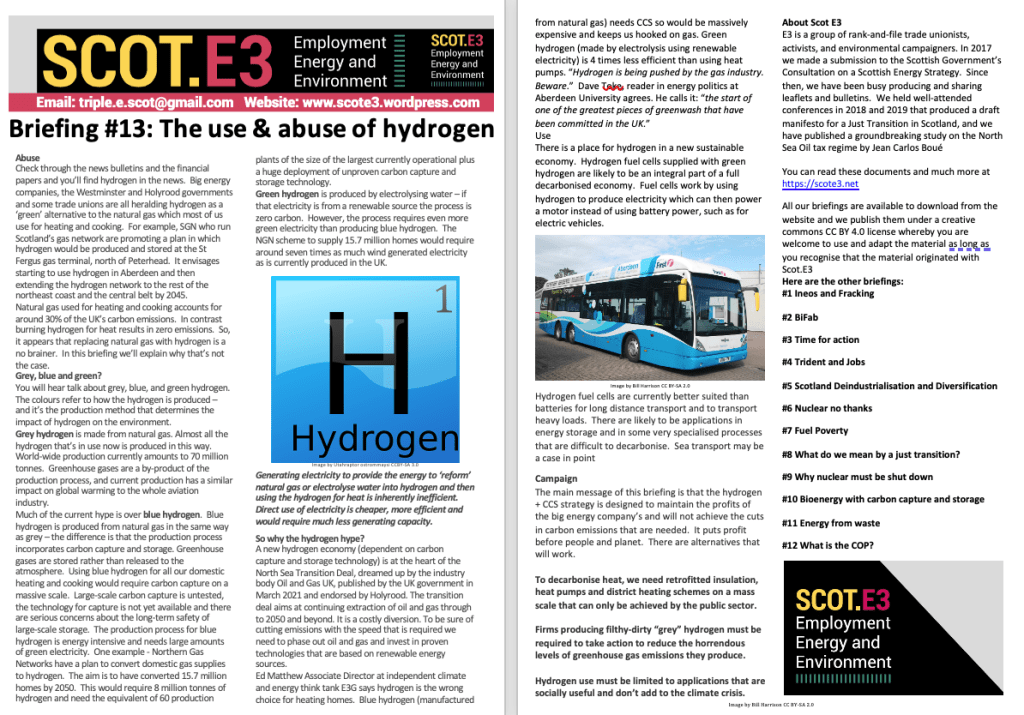
The latest in our series of briefings. Like all of the briefings this one is just two sides of A4 and is published under a Creative Commons license which means you are welcome to share, adapt and reuse the content. Download a PDF version here.
Abuse
Check through the news bulletins and the financial papers and you’ll find hydrogen in the news. Big energy companies, the Westminster and Holyrood governments and some trade unions are all heralding hydrogen as a ‘green’ alternative to the natural gas which most of us use for heating and cooking. For example, SGN who run Scotland’s gas network are promoting a plan in which hydrogen would be produced and stored at the St Fergus gas terminal, north of Peterhead. It envisages starting to use hydrogen in Aberdeen and then extending the hydrogen network to the rest of the northeast coast and the central belt by 2045.
Natural gas used for heating and cooking accounts for around 30% of the UK’s carbon emissions. In contrast burning hydrogen for heat results in zero emissions. So, it appears that replacing natural gas with hydrogen is a no brainer. In this briefing we’ll explain why that’s not the case.
Grey, blue and green?
You will hear talk about grey, blue, and green hydrogen. The colours refer to how the hydrogen is produced – and it’s the production method that determines the impact of hydrogen on the environment.
Grey hydrogen is made from natural gas. Almost all the hydrogen that’s in use now is produced in this way. World-wide production currently amounts to 70 million tonnes. Greenhouse gases are a by-product of the production process, and current production has a similar impact on global warming to the whole aviation industry.
Much of the current hype is over blue hydrogen. Blue hydrogen is produced from natural gas in the same way as grey – the difference is that the production process incorporates carbon capture and storage. Greenhouse gases are stored rather than released to the atmosphere. Using blue hydrogen for all our domestic heating and cooking would require carbon capture on a massive scale. Large-scale carbon capture is untested, the technology for capture is not yet available and there are serious concerns about the long-term safety of large-scale storage. The production process for blue hydrogen is energy intensive and needs large amounts of green electricity. One example – Northern Gas Networks have a plan to convert domestic gas supplies to hydrogen. The aim is to have converted 15.7 million homes by 2050. This would require 8 million tonnes of hydrogen and need the equivalent of 60 production plants of the size of the largest currently operational plus a huge deployment of unproven carbon capture and storage technology.
Green hydrogen is produced by electrolysing water – if that electricity is from a renewable source the process is zero carbon. However, the process requires even more green electricity than producing blue hydrogen. The NGN scheme to supply 15.7 million homes would require around seven times as much wind generated electricity as is currently produced in the UK.
Image by Utahraptor ostrommaysi CCBY-SA 3.0
Generating electricity to provide the energy to ‘reform’ natural gas or electrolyse water into hydrogen and then using the hydrogen for heat is inherently inefficient. Direct use of electricity is cheaper, more efficient and would require much less generating capacity.
So why the hydrogen hype?
A new hydrogen economy (dependent on carbon capture and storage technology) is at the heart of the North Sea Transition Deal, dreamed up by the industry body Oil and Gas UK, published by the UK government in March 2021 and endorsed by Holyrood. The transition deal aims at continuing extraction of oil and gas through to 2050 and beyond. It is a costly diversion. To be sure of cutting emissions with the speed that is required we need to phase out oil and gas and invest in proven technologies that are based on renewable energy sources.
Ed Matthew Associate Director at independent climate and energy think tank E3G says hydrogen is the wrong choice for heating homes. Blue hydrogen (manufactured from natural gas) needs CCS so would be massively expensive and keeps us hooked on gas. Green hydrogen (made by electrolysis using renewable electricity) is 4 times less efficient than using heat pumps. “Hydrogen is being pushed by the gas industry. Beware.” Dave Toke, reader in energy politics at Aberdeen University agrees. He calls it: “the start of one of the greatest pieces of greenwash that have been committed in the UK.”
Use
There is a place for hydrogen in a new sustainable economy. Hydrogen fuel cells supplied with green hydrogen are likely to be an integral part of a full decarbonised economy. Fuel cells work by using hydrogen to produce electricity which can then power a motor instead of using battery power, such as for electric vehicles.
Image by Bill Harrison CC BY-SA 2.0
Hydrogen fuel cells are currently better suited than batteries for long distance transport and to transport heavy loads. There are likely to be applications in energy storage and in some very specialised processes that are difficult to decarbonise. Sea transport may be a case in point
Campaign
The main message of this briefing is that the hydrogen + CCS strategy is designed to maintain the profits of the big energy companies and will not achieve the cuts in carbon emissions that are needed. It puts profit before people and planet. There are alternatives that will work.
To decarbonise heat, we need retrofitted insulation, heat pumps and district heating schemes on a mass scale that can only be achieved by the public sector.
Firms producing filthy-dirty “grey” hydrogen must be required to take action to reduce the horrendous levels of greenhouse gas emissions they produce.
Hydrogen use must be limited to applications that are socially useful and don’t add to the climate crisis.

















 Employment, Energy and Environment