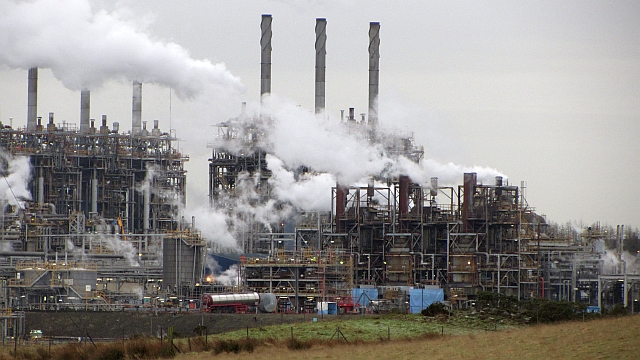
ExxonMobil has announced plans to close the Fife Ethylene Plant (FEP) at Mossmorran in Fife in February next year. Up to 400 jobs will be lost if the closure goes ahead.
The announced closure of the gas treatment plant closure may have consequences upstream for its supply terminal at St Fergus in Northern Aberdeenshire. St Fergus is the landfall terminal for all the gas produced in the Central and Northern UK Continental Shelf fields and the recently opened North Atlantic West of Shetland fields. It also receives gas from the Western Norwegian sector.
Gas at St Fergus is primarily treated ‘fractioned’ to a standard acceptable for distribution through the UK National Transmission Authority network, which in turn supplies further treated gas into the National Grid. The treatment plant at Mossmorran receives the entirety of its ‘wet’ gas from St Fergus.
The site and plant of Mossmorran is jointly owned and operated by Exxon/Mobil and Shell UK.
The wet gas at Mossmorran is divided into two separate product streams:
Shell separates liquids further to produce methane vial its Fife Natural Gas Plant which is sent into the National Grid network, as well as some chemical feed-stocks for export.
Exxon/Mobil uses an ethylene plant to ‘fraction’ the wet gas into ethylene as a feed-stock forpetro-chemicalproduction via its Fife Ethylene Plant as well as:
Propane, butane and other liquid gases for further treatment for fuels and also grease and other lubricants.
Last year Exxon/Mobil produced over 830,00 tonnes of ethylene, over 50% of which was exported to Europe and the US. Until recently Exxon/Mobil used a direct pipeline to Ineos Grangemouth plant.
Braefoot Bay is a private facility which handles almost all of the output of the two Mossmorran operations, and is presently at 85% capacity. It operates under the joint ownership of Exxon/Mobil and Shell UK and is entirely dependent on the export requirements of Mossmorran. The port has two jetties- a deep-water jetty capable of handling 40,000- 80,000 tonne vessels, and the smaller, for 5,000- 10,000 tonne tankers.
The main tanker loading is via floating ‘roof’ tanks are continuously ‘toped-up’ from large quayside storage tanks.
At Mossmorran, there are around 90 directly employed in control rooms and plant management. with most engineers, electrical and welders etc being subcontractors directly employed with Balfour Beatty. Virtually all Balfour Beatty workers are members of Unite.
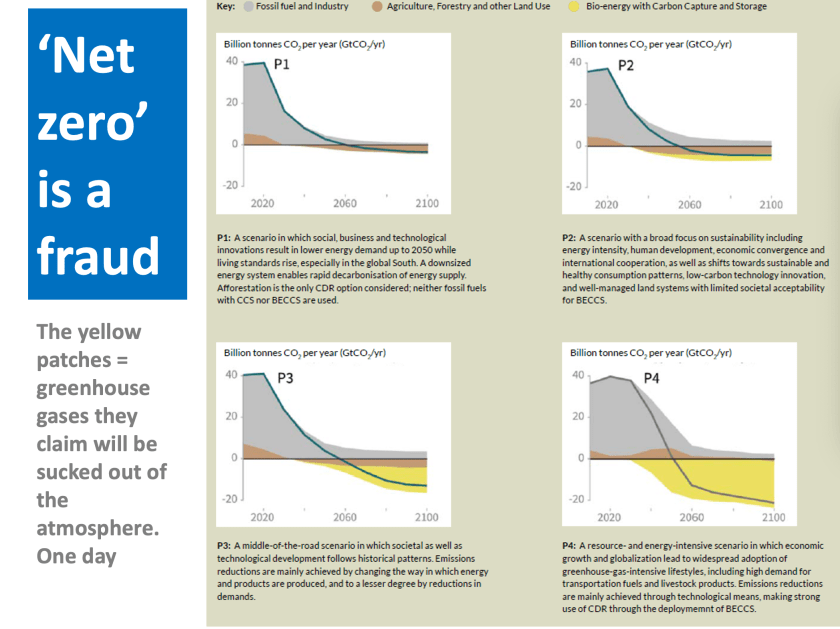
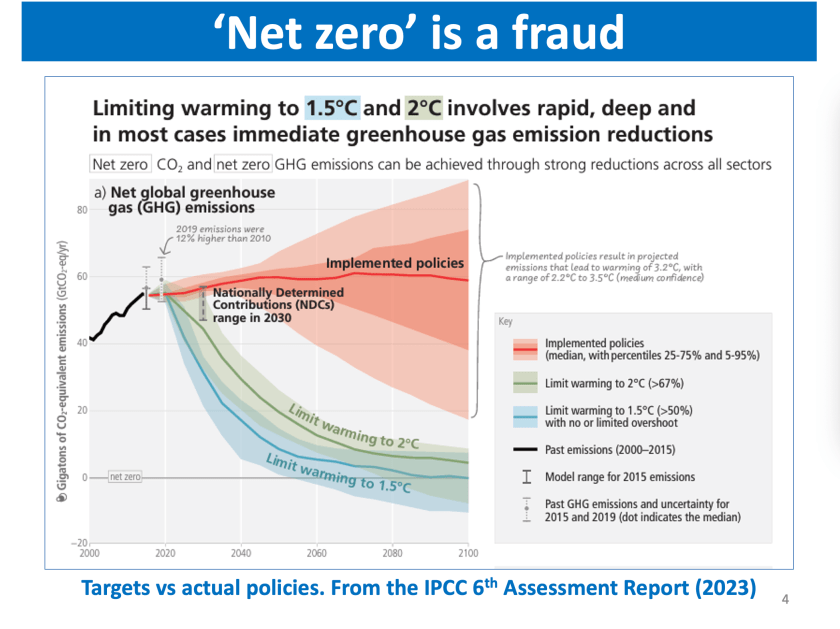
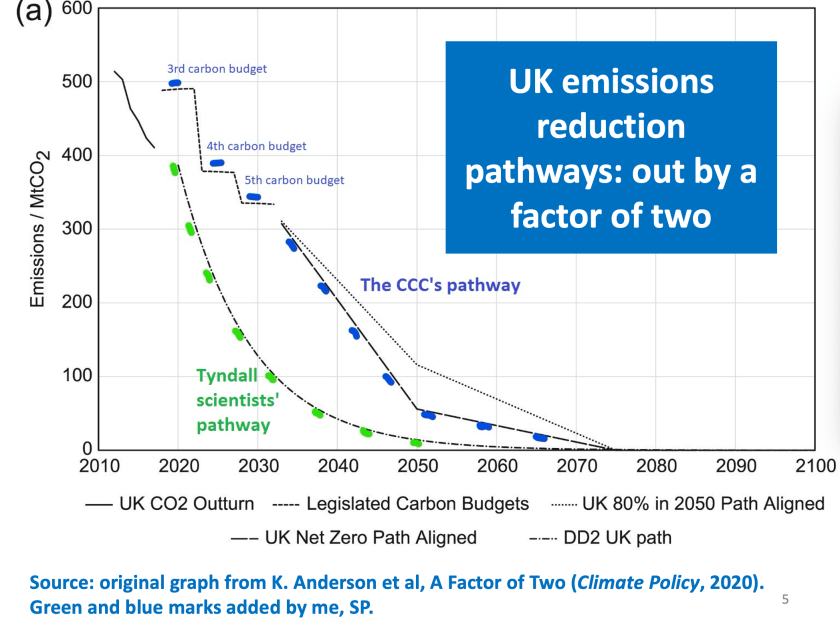
The slides from Simon Pirani’s talk at the Scot.E3 conference
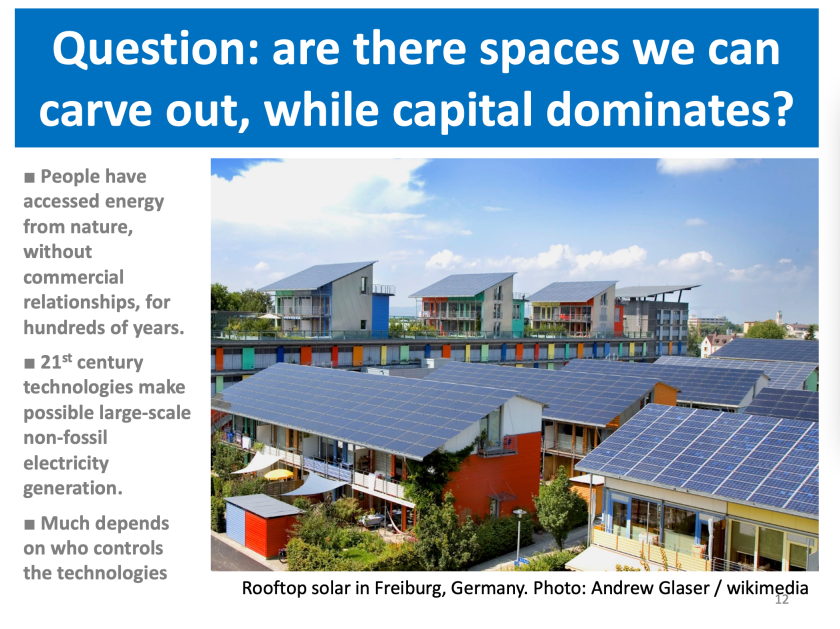
Simon edits the People and Nature blog and is the author of Burning Up – a global history of fossil fuel consumption. In the introductory session of the conference he argued that Climate Change is an injustice multiplier and that Net Zero and Technological Transition are frauds. He asked how do we defend workers’ rights in the climate emergency and whether there are spaces we can carve out while capital dominates.
Simon Pirani reviews Crude Capitalism: oil, corporate power and the making of the world market by Adam Hanieh
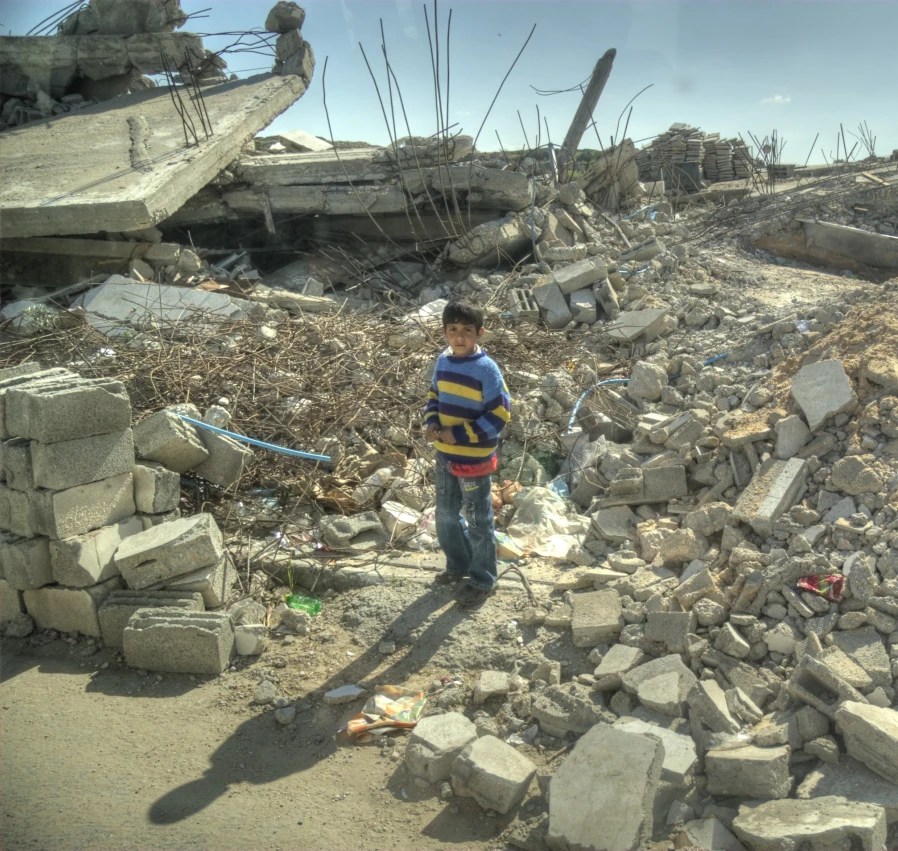
Review by SIMON PIRANI of Crude Capitalism: oil, corporate power and the making of the world market by Adam Hanieh (Verso 2024) Witnessing genocide can be paralysing. The horror of Israel’s onslaught on the civilian population of Gaza seeps in to the spaces in our heads, interrupting and disrupting attempts to think. My memory keeps connecting Gaza to the Vietnam war, news about which filtered through to me as a young teenager. My sheltered world was shattered by the cruelty with which innocent people were slaughtered and tortured, on the orders of governments I had vaguely assumed should protect people. I see teenagers going through analogous thought processes now.
How can it be that, half a century on, the grotesque “civilisation” that stalked Vietnamese villages has evolved, to produce the monstrous Netanyahu regime? What does this tell us about the many-headed hydra we are fighting, and humanity’s attempts to resist it?
Adam Hanieh’s book Crude Capitalism dissects one of the hydra’s heads – oil, and the corporations and states that use it to reinforce their wealth and power – and offers us a view on the part it plays in the whole organism. Reading it helped me to think of the horror of Gaza not as an aberration, but as a logical outcome of capital’s dominance in the twenty-first century.
Crude Capitalism tackles its big, difficult themes with precision and attention to detail. It is beautifully presented and organised.
The first part of the story Hanieh tells, of oil’s initial growth, plays out in the early twentieth century, in the US, and to a lesser extent in Iran, Azerbaijan and in Latin America. In the second part, from the mid twentieth century onwards, Middle Eastern oil resources and the battles for control of them loom large. And this is part of the background to the deluge of war crimes now being committed against Palestinians.
The connections are not direct. Regimes centred on vicious ethnic cleansing, like Netanyahu’s, are produced by capitalism; capitalism thrives on oil. But there are multiple mediations. Hanieh’s approach to these is an antidote to the simplifications that all too often circulate in radical political circles.
Physical control over oil production was crucial in the early twentieth century, but that has long ceased to be the case, Hanieh argues.
In the 1960s and 70s, against the background of powerful anti-colonialist movements, control over oil production shifted substantially from the powerful US- and European-based multinationals to state-controlled national oil companies, in the Middle East above all.
But capital and its state machines adapted. The US, which during the 1950s and 60s had superceded Britain and France as the dominant imperial power in the Middle East, established strategic and military relationships with the Gulf states and the Shah’s regime in Iran (at least, until the latter was overthrown in 1979). In the 1970s, the Saudi and Iranian monarchies were one pillar of US power in the region; Israel was the other.
Brute military force was only one aspect of imperial domination. Crucial, too, Hanieh argues, were changes in economic relationships, and in the financial system, through which control was maintained over oil revenues.
In the 1960s, oil producer countries’ governments, led by Venezuela, had forced through changes in oil pricing that disadvantaged the powerful US companies that had stakes in their oil fields. The Saudi monarchy, too, demanded a bigger slice of the cake. The US responded by changing its own tax rules so that, while more oil money flowed to Riyadh, the largest oil companies continued to earn record profits.
In the 1970s, price shocks shattered the monopolistic pricing system that had served the biggest companies. Action by the producer nations, coordinated through the Organisation of Petroleum Exporting Countries (OPEC), took control of prices out of the multinationals’ hands. Crude oil prices quadrupled in 1973-74, and doubled again in 1979.
In the 1980s, there was further momentous change: oil increasingly became a traded commodity; wealth and power poured into intermediary trading firms. The oil profits that had once flowed mostly to rich-country corporations were now pouring into the Gulf states especially.
Oil refining in Saudoi Arabia
These “petro dollars”, flowing to countries outside the circle of imperialist powers in unprecedented quantities, became a big factor in financialisation (the expansion of international money markets, supercharged by computerised trading) and globalisation (the minimisation of capital controls and other trade barriers associated with neo-liberal economics).
(Forty years later, the flow is greater than ever. The Gulf states accumulated an estimated two-thirds of a trillion dollars in current account surplus in 2022, when, after the Russian invasion of Ukraine, oil prices shot up.)
“Petro dollars” became “euro dollars”, funding that gathered in markets outside the US, denominated in its currency. The dollar, the status of which as a reserve currency had been endangered when it was unhooked from the gold standard in 1971, was reinforced.
Forms of money and the rise of the euromarkets, the dollar’s position as international reserve currency, the dominance of Anglo-American financial institutions, the chains of debt and the rise of neoliberal orthodoxy – these were not the automatic outcomes of dry economic processes centred in north America and Europe, but inextricably linked to the geopolitics of oil and the US presence in the Middle East.
By focusing on these “subterranean global roots” of the new financial system, Hanieh writes, “it is possible to shift the ways that we usually think about the control of oil”.
This is not simply reducible to territorial power and the ownership of foreign oil fields – it is also a question of the control of oil’s wealth.
To understand the killing fields of Gaza, we need to think, on one hand, about US military supplies to the Gulf states and Israel and the deranged ideologies that propel Israeli soldiers to massacre – and, on the other, about these “subterranean roots” that run through the banks, financial centres, trading houses and the City of London.
We are dealing with a many-headed hydra that combines wealth, power and terror in complex ways.
These relationships belie myths, such as the idea that our enemies fight repeated wars for oil. Actually, they rarely do.
The devastating 2003 US- and UK-led invasion of Iraq, Hanieh reminds us in a footnote, was “not so much about the seizure of Iraq’s oil as about the protection of the Gulf monarchies”.
He quotes another historian of the Middle East, Toby Craig Jones, who pointed out that capturing oil and oil fields has not been part of the US’s strategic logic for war, “but protecting oil, oil producers, and the flow of oil, has been”.
Oil does not just produce cash wealth. Once out of the ground, it is transported long distances, usually by ship (itself a hellishly oil-intensive business). It is refined into products: tarmac and bitumen; fuels from petrol to aviation fuel, the supply of which has shaped military, industrial and agricultural practices, and consumer markets, for a century; and ethylene and other raw materials for petrochemical plants.
Hanieh, in contrast to other big-picture historians of oil, foregrounds this “downstream”. He shows that, from the start, the US and European oil giants’ strategy was vertical integration, i.e. control of the whole process, down to the petrol stations.
Motor cars, the ultimate consumer good that consumes so much oil, loom large in this story. So does the burning of oil in power stations. Hanieh picks out for more detailed treatment the petrochemical industry, where oil is used not as an energy carrier that can be converted into mechanical motion, heat or electricity, but as a raw material.
He traces the origins of petrochemical processing in Germany; its development (if that is the right word) during the second world war as an arm of the Nazi military machine; and the US’s post-war acquisition of German technologies by theft and expropriation. Petrochemicals, while US- and European-dominated through the late twentieth century, are expanding rapidly in the Middle East and China in the twenty-first.
Fossil-fuel-based plastics and other synthetic materials, Hanieh argues, have displaced natural materials such as wood, cotton and rubber. “By decoupling commodity production from nature, there was a radical reduction in the time taken to produce commodities, and an end to any limits on the quantity and diversity of goods produced.”
This was a qualitative transformation: petrochemicals helped capital to achieve revolutions in productivity, labour-saving technologies and mass consumption; “birthed in war and militarism, they helped constitute a US-centred world order”. Our social being is bound up with a seemingly unlimited supply of cheap and disposable petrochemicals.
I hope Hanieh’s arguments on petrochemicals are brought to the centre of discussions about the transition away from oil, and what that implies for the socialist project of confronting and defeating capitalism.
First, the flow of oil as a raw material through the petrochemical industry needs to be put in the wider context of the colossal flow through the capitalist economy of extracted materials, including metals, minerals, concrete, asphalts, and living matter such as biomass and farm animals.
A team led by Fridolin Krausmann recently estimated that the aggregate of these material flows swelled 12 times over between 1900 and 2015. Eric Pineault has attempted to draw on this work, and that of ecological economists, to develop a Marxist view of this aspect of capital’s earth-shattering drive to expand.
Second, an issue of interpretation. I do not think the petrochemical industry “decouples” production from nature: it is another way of processing, and reprocessing, materials accessed from nature. Hanieh has, though, pointed to something hugely important, and dangerous, in the way that synthetic materials corrupt and deform humanity’s relationship with nature. Pinning down exactly what should be a concern to us all.
In the final chapter of Crude Capitalism, Hanieh surveys oil companies’ response to the threat of climate change. Having spent decades funding climate science denial, they have in the last decade reversed their public stance, accepted global heating as a fact … and become “enthusiastic converts” to the concept of “net zero”, as warped by politicians, that displaces genuine greenhouse gas emissions reductions with chimerical techno-fixes, above all carbon capture.
“By appearing to transform themselves into part of the solution”, the oil companies “not only hide their ongoing centrality to the fossil economy, but aim to frame and determine the societal response to climate change”, Hanieh warns.
The companies embrace technical false solutions – biomass, electric vehicles and hydrogen – that have moved to the centre of establishment climate policy. They are betting on expansion of the synthetic consumerist dystopia underpinned by petrochemicals. And their Orwellian grip on politics, hand in hand with producing-nation dictators, is on display at the international climate talks – last year (Abu Dhabi) and this (Azerbaijan) more than ever.
Ecosocialists, who endeavour to bring together the fight to overcome humanity’s disastrous rupture with nature with the fight for social justice, must first confront the fact that energy production and infrastructure “remain solidly in the hands of the largest oil conglomerates”, Hanieh argues.
Secondly, though, we need to acknowledge that while these firms are a “major obstacle” to moving away from oil, “they are a manifestation, not a cause, of the underlying problem” of capitalist social relations.
Let’s not only recoil in horror at the genocide: let’s also dissect and better understand the many-headed hydra. This book helps.
Scotland’s only petrol refinery, based on the Firth of Forth at Grangemouth, is scheduled to close in 2025. The closure is not a cause for celebration by climate campaigners, it will be replaced by a new refinery in Antwerp and 500 workers at the Grangemouth site will lose their jobs. The closure is in no sense part of a transition away from Fossil Fuels and even less is it part of a just transition.
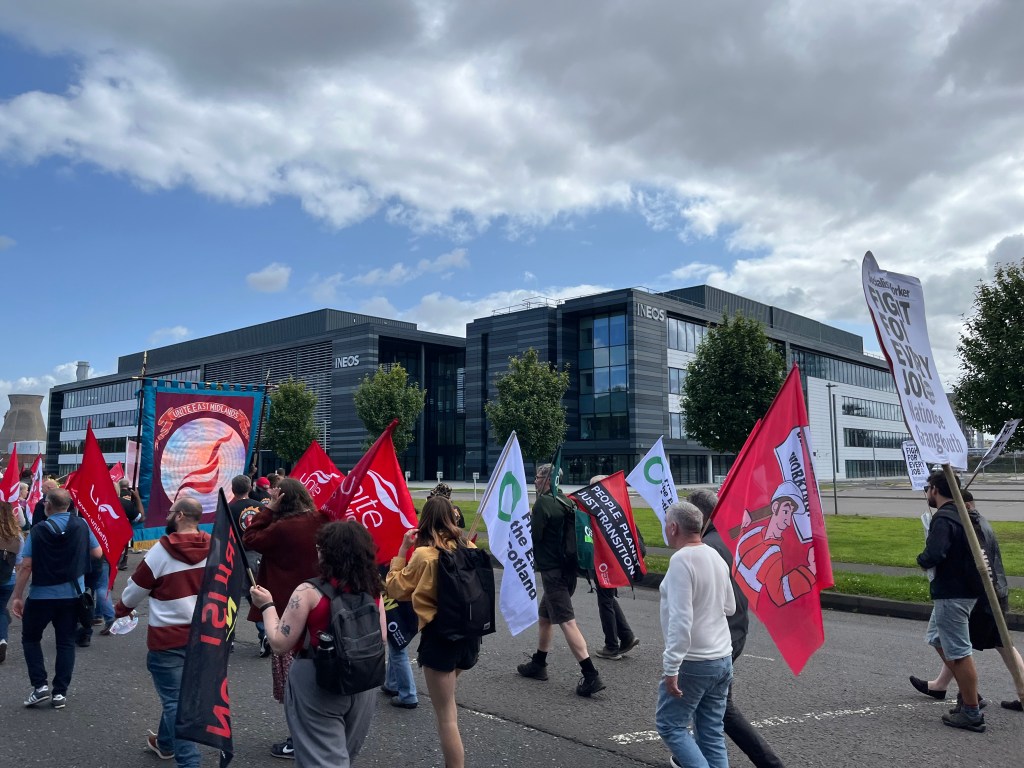
The march assembling outside the Grangemouth stadium – image Pete Cannell CC0
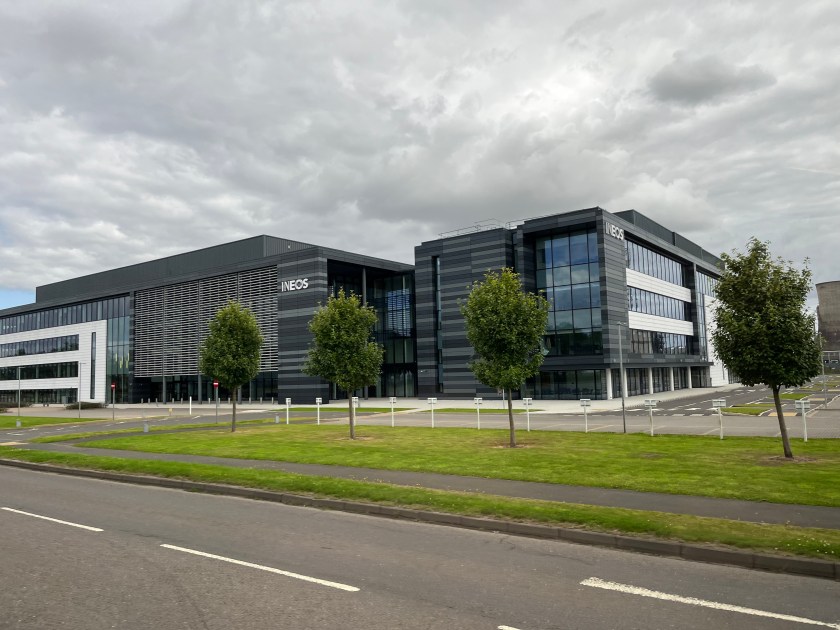
The huge 1700 acre Grangemouth site is owned by billionaire Jim Ratcliffe’s INEOS. They bought the Grangemouth petrochemical plant and the refinery from BP in 2005. Then in 2014 the company raided the pension fund originally established by BP and in turn de-recognised the plant unions. The refinery part of the site is now run by Petroineos, a joint venture between INEOS and the Chinese state-owned oil and gas company PetroChina.
Unite, the main union at the refinery is leading a campaign to ‘Keep Grangemouth Working’. The union is calling for action to ‘Extend, Invest and Transition’. On 3August, they organised a march and rally starting from the Grangemouth stadium on the edge of the INEOS site. Around 600, including refinery workers and their families, and trade unionists from around Scotland and further afield marched to a rally held in a local park. There were a handful of climate activists.
At the rally Unite Scottish Regional Secretary Derek Thomson talked about how the union was campaigning locally to raise awareness of the impact that closure would have on jobs and the local economy. Unite believes that the new Labour Government may be able to persuade Ratcliffe to extend the life of the refinery. The Tories pledged to provide 700 million Euros in credit to support the development of the new Petroineos refinery in Antwerp and they think that if Labour were to question this it would provide leverage.
Grangemouth is a critical campaign for the climate movement. There are moments when decisions are made and actions taken, or not made and not taken, that then resonate through the movement and shape its future trajectory. If the Grangemouth refinery is closed it will be such a moment. In Scotland another such time was the failure to take the BiFab fabrication yards into public ownership in the autumn of 2017. The loss of 1400 jobs at BiFab offshore renewables technology yards discredited the idea that action over climate offers opportunities for employment. The closure of Grangemouth would be not just a blow to the workers, their families and the local economy, it would also send political shockwaves through the climate and workers movements.
On the march – image Pete Cannell CC0
At the rally on 3 August the speaker from Friends of the Earth Scotland received a great response from the Unite members in the crowd. It is important that the union and the Grangemouth workers see transition to a sustainable future as a positive goal. However, there is a real weakness in the current campaign. Unite’s strategy seems to be based on pressurising INEOS into extending the lifetime of the refinery. But there’s no evidence that Ratcliffe is interested in doing this or interested in planning for a sustainable transition. And it’s not that Grangemouth is unprofitable – simply that Antwerp would be more profitable. None of the speakers at the rally criticised INEOS. Implicitly or explicitly the focus was on partnership with the company.
At a time when all the indicators suggest that global heating is increasing faster than the most pessimistic predictions, companies like INEOS and BP are doubling down on investment in fossil fuels. They aim to make mega-profits while they can. In these circumstances, when action to decarbonise is overdue, working in partnership with big oil, while talking about the need for transition and social justice is simply greenwashing. It won’t save jobs, and it sets back progress towards transition.
So, what’s the alternative? Public ownership, and democratic planning that involves energy workers is essential. To build the mass campaign that could make this possible the unions and the climate movement need go beyond slogans.
The private sector is simply not capable of the kind of planning and coordination that is needed to save jobs and manage a just transition.
Convincing energy workers, winning hearts and minds and building the mass support for public ownership requires brutal clarity about what the oil and gas companies are doing. The profits they’ve made and continue to make, the huge subsidies they continue to attract and the way they expect us to clean up their mess. Grangemouth has been a site for petrochemicals for a hundred years. Without an enormously expensive cleanup the site is only suitable for industrial use.
Image Pete Cannell CC0
Partnership with INEOS is a dead end. The company has no loyalty or regard for the workers or the local population. There’s no guarantee if the refinery closes in 2025 that the rest of the operations on the site will continue much longer, and with it, the loss of over 2,500 jobs. Ratcliffe expects us to pay the huge cost of cleaning up the site. And the residents of Grangemouth having lived with the stink and pollution of the plant for decades will remain with a toxic legacy.
But to win hearts and minds and build the campaign there also needs to be a plan for change. The vast site at Grangemouth could become a hub for a wide range of renewable technologies. There’s room to establish new facilities, there’s good communications by land and via the Firth of Forth and there is an established workforce and a cluster of further and higher education institutions in the region that could support the development of a new low carbon economy.
The nature of the plan matters. At the Grangemouth rally – ex-MP and deputy leader of the Alba Party, Kenny MacAskill argued that Grangemouth could prosper through the development of green hydrogen and carbon capture and storage. But these are the solutions that are promoted by Offshore Energy UK, the organisation that represents the interests of the UK oil and gas sector. Both technologies may have some use in the future but the industry focus on them right now is aimed at maintaining oil and gas production, and the infrastructure and systems that support it, for as long as possible. Opportunities for rapid progress lie in Wind, Solar, Wave and Tidal technologies together with energy storage and a new smart distribution grid. Ending partnership between unions and big oil also requires a new and critical view of what technologies support jobs and employment and support rapid decarbonisation and a break from the fake self-serving solutions that are advanced by the oil and gas industry. Which technologies are prioritised is not simply a technical choice but also highly political.
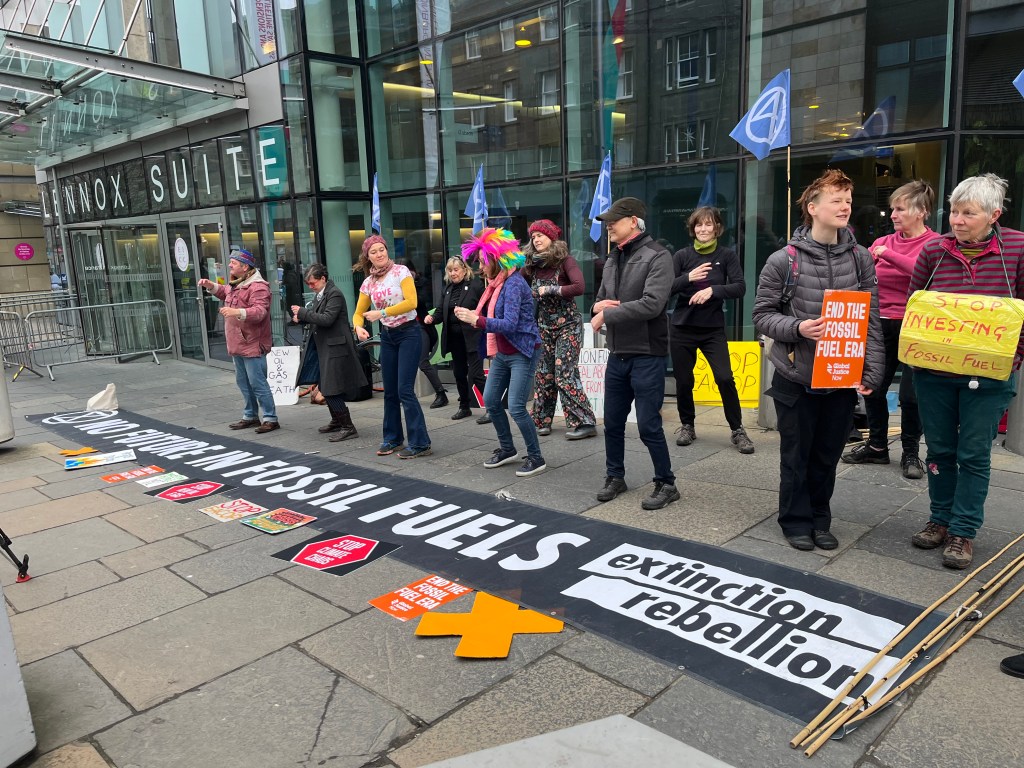
Climate campaigners from Extinction Rebellion Scotland, Divest Lothian and Global Justice Now Scotland danced (and leafleted) outside the Pensions and Lifetime Savings Association Conference at the Edinburgh International Conference Centre on 28th February to highlight the flawed climate risk models used by pension funds and to call on the funds to stop investing in fossil fuels.
Despite increasingly stark warnings from climate scientists, oil majors continue to uinvest far more in fossil fuel expansion than in renewables.
For example, the East African Crude Oil Pipeline (EACOP) is being developed by TotalEnergies to run for 1444km across Uganda and Tanzania. It will transport oil for export to the global north that will release 34 million metric tons of CO2 each year.
Many. UK pension funds including the University Superannuation Scheme, West Midlands Pension Fund and Lothian Pension Fund invest in TotalEnergies. However, the tide is turning. PFZW is the third largest pension fund in Europe. On February 24th it announced that has completed a two-year programme during which, 310 oil and gas companies that do not comply with the Paris Climate Agreement have been sold (including Shell, BP and TotalEnergies). It plans to significantly increase investments in companies focused on the energy transition.
Thanks to Divest Lothian for information and some of the text.
Pete Cannell from ScotE3 was invited to introduce a discussion on Fossil Fuels and Right-Wing Populism at a recent meeting of Dumfries TUC. This is a slightly edited version of his talk.
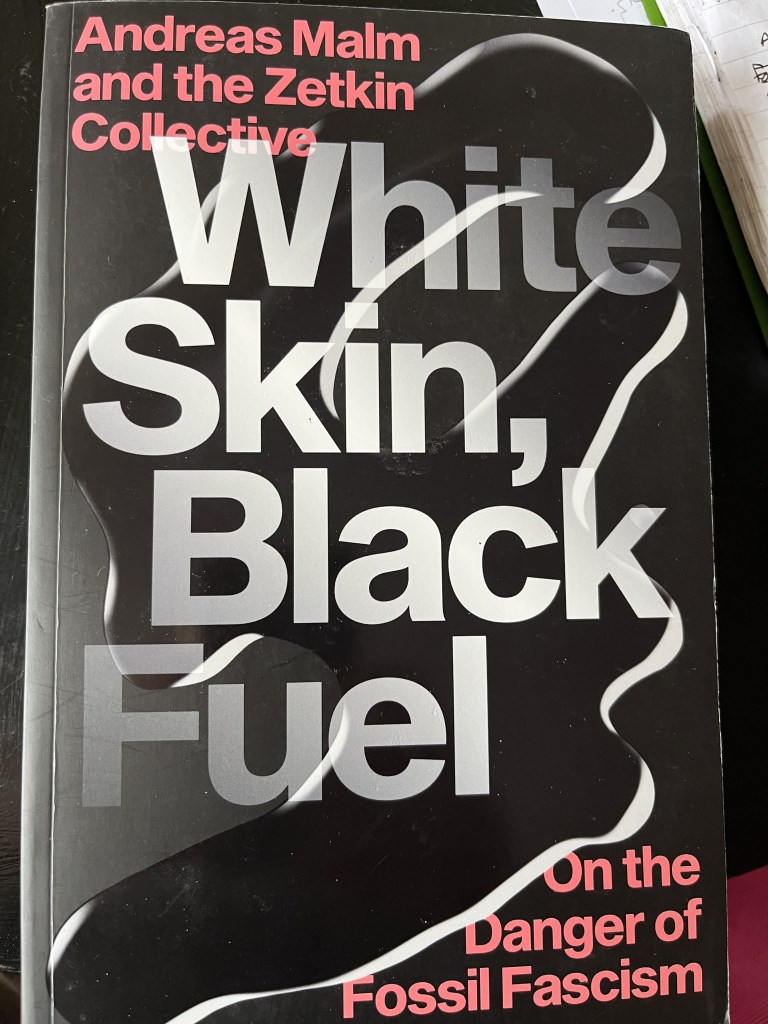
This post explores the way in which right wing populist parties use climate denial as a key part of their agenda. In thinking about the topic, I found Andreas Malm’s excellent book ‘White Skin – Black Fuel on the danger of Fossil Fascism’ very helpful. Early on in the book, Malm notes that:
“All European far-right parties of political significance in the early twenty-first century expressed climate denial.”
The book weas written 3 years ago but it’s hard to think of more recent exceptions. So, there’s definitely something to be explained here.
Clearly climate denial didn’t start with the rise of right-wing populism. From the 1970’s onwards the major oil and gas companies, particularly Exxon, were researching the impact of greenhouse gas emissions on the environment and at the same time funding organisations like the Global Climate Coalition in the US whose role was to argue that pushing large amounts of CO2 into the atmosphere was not a problem. Privately they knew from early on that fossil fuel extraction would have a devastating effect on the global climate. In 1995 the GCC in an internal document wrote that
“the potential impact of human emissions of greenhouse gases such as CO2 on climate is well established and cannot be denied”
but in public they denied it.
As a strategy outright denial had its limitations. The Kyoto protocol signed in 1997 marked the beginning of a new strategy – a shift from denial to greenwashing.
The three core tenets of Kyoto are:
Postpone the showdown with Fossil Fuels into distant future.
Place no serious limits on fossil fuel extraction.
New opportunities for generating profit.
In the UK, the industry’s plans for the North Sea are a good example of postponing any showdown with fossil fuels. The strategy is based on continuing extraction through to and beyond 2050 and the development of a so-called net zero oil and gas basin. Here net zero depends on heroic assumptions about techno-fixes such as carbon capture and storage combined with creative accountancy that ascribes all responsibility for the carbon in the oil and gas that’s produced to the users. Globally there are virtually no regulatory limits on the production of fossil fuels. It’s assumed that any run down will be as a result of market forces. At the same time trading carbon permits has been highly profitable in financial terms and has allowed the industry to claim that the trade contributes to reducing carbon emissions. There is next to no evidence that carbon trading and offsetting has reduced greenhouse gas emissions.
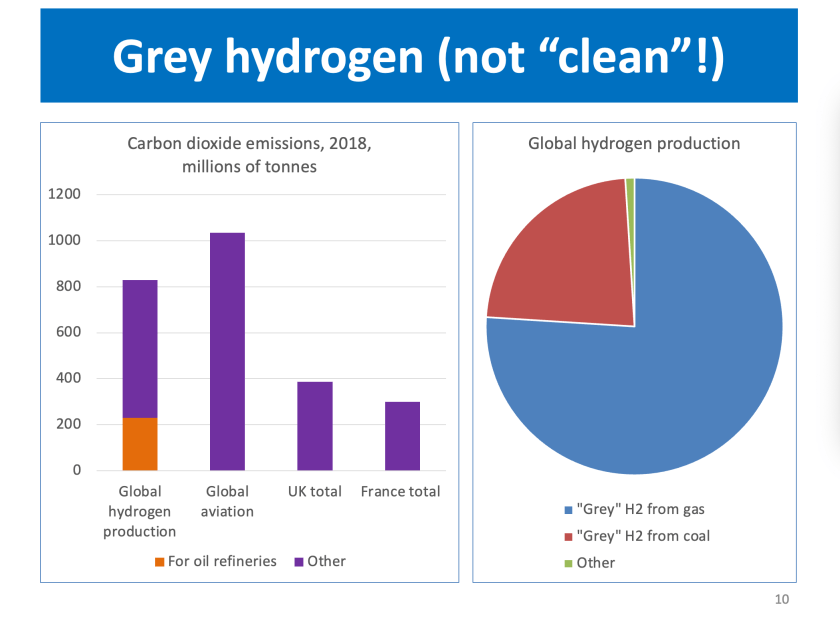
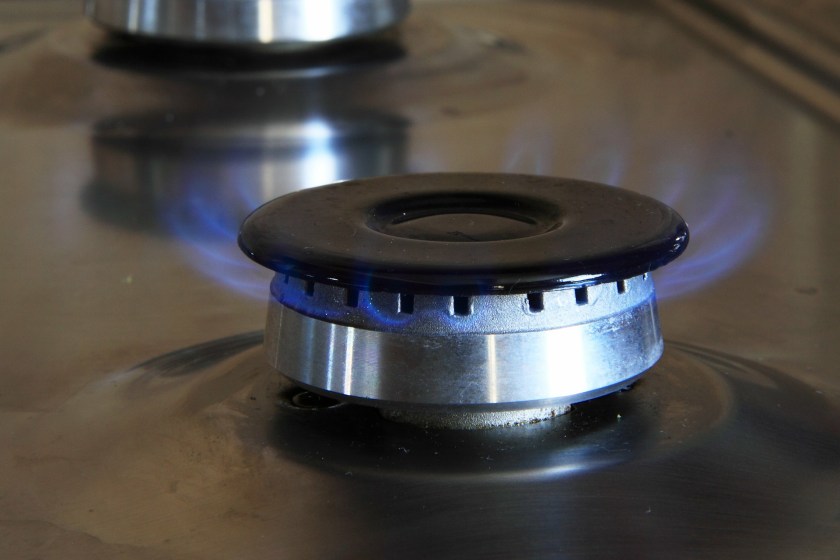
So as far as big business goes, we are still in the era of greenwashing. Big oil and gas are at pains to argue that they want to protect the planet. And almost all governments around the world are in lockstep with fossil fuel industry in this strategy. Practically, depending on local circumstances the form that greenwashing takes varies, but everywhere it’s about maintaining or enhancing the profitability of fossil capital and preserving the existing infrastructure. So, in the UK for example hydrogen is touted as the answer to domestic cooking and heating. In the short to medium term this would probably mean higher carbon emissions than the existing use of natural gas and if ultimately the hydrogen was all green, i.e. produced by electrolysis it would be fantastically inefficient. Requiring the use of up to seven times as much electricity than would be required to simply electrify cooking and heating. But it’s attractive to the industry because it enables the continuation of existing economic and technical infrastructure.
The result of all this is that investment is skewed away from forms of energy use and production that are sustainable and rapidly achievable – and rather than supporting a just transition for workers and communities existing inequalities are maintained and ramped up. The ongoing cost of living crisis in which poor consumers of gas and electricity contribute to eye watering profits for energy producers and distributors is a case in point.
And it’s this that has provided fertile ground for right wing populist parties.
Five decades of neo-liberalism has syphoned money and resources from public to private and increased inequality everywhere so that working class people are anxious or scared about climate, cost of living, war, housing, growing old – in a world where the belief that their parents or grandparents had that things would be better for the next generation is dead. Most people don’t trust established politicians – established parties offer variations on the same neo-liberal agenda. Into this vacuum has stepped forms of right-wing populism that purport to offer alternatives to the ‘establishment’.
Right wing populism takes different forms – sometimes taking over long-established parties – Trump and the Republican Party in the US. Or in the UK the continuing rise of right-wing populists as a major, perhaps majority faction within the Tory party. Sometimes emerging from explicitly fascist formations, for example, Le Pen in France or Meloni in Italy. And sometimes completely new organisations, for example the AfD in Germany. None of them are into Greenwashing. They are all about Climate Denial.
In Spain a prominent member of right wing populist party Vox explains climate change as
“any change on the sun, the moon, the rotation of the earth, volcanoes and naturally occurring atmospheric phenomena but absolutely not on CO2 emitted by humans. It would, said Abascal, be ‘very arrogant’ to believe that humans could alter the climate. It would be ‘even more arrogant’ to think that the alteration could be rectified by ‘coercive laws and taxes’.”
The AfD in Germany has increased its influence through organising around climate issues, demonising perhaps the biggest climate movement around the world, foregrounding the cost-of-living crisis and agitating around the farmers protests. Often supported and facilitated in this by the state and the police.
It’s obviously not just climate that is building the new far right. Climate issues intersect with the legacy of neo-liberalism, migration and racism and the failure of the left to provide an alternative that speaks to working people’s insecurity and against individualistic solutions. The far-right populists feed off social media fuelled confusion and conspiracies. Very often angry or frightened people looking for answers find them in apparently anti-establishment and authoritative voices online.
So, what’s to be done. I think we can see the embryo of an alternative in the picket lines and in the huge response to the ongoing horror in Gaza. It’s struck me standing on UCU picket lines last year, and then again in the last few months picketing and leafleting outside the Leonardo arms factory in Edinburgh, how many of the passing drivers beep their horns and wave. Early in the morning many of them are white van drivers, very few of them will be in a union. There’s are real possibility of breaking the rise of the populist right. But if I’m right about why they’ve been able to build on climate I think part of what a revitalised left has to do is set it’s face firmly against partnership with fossil capital and clearly against solutions like CCS for continuing oil and gas production and hydrogen for domestic heating that preserve the power of fossil capital. And that means for example that UNITE, RMT and GMB need to stop supporting the oil and gas industry’s North Sea transition deal.
Report of a public meeting called by ScotE3 on 12th September
The conversation at this meeting between about 40 people from widely differing backgrounds was both extremely valuable and extremely lively. It’s clear that a lot of people have got their blood up.
The meeting was kicked off by contributions from Neil Rothnie, who has spent much of his life as a North Sea offshore worker, and from Pete Cannell, a founder member of ScotE3. You can watch the video of their talks on YouTube
Three climate activists – Quan Nguyen (Climate Camp), Zareen Islam (Muslim Women’s Association of Edinburgh), and Phoebe Hayman (Just Stop Oil) – were then asked to react to Neil and Pete’s contributions. You can watch the video of their reactions here
Here are some of the points that Neil and Pete made in their introduction
The meeting has been called ostensibly about the cost-of-living crisis and North Sea oil and gas, but if we’re not talking about climate change, we’re not really talking about the real world.
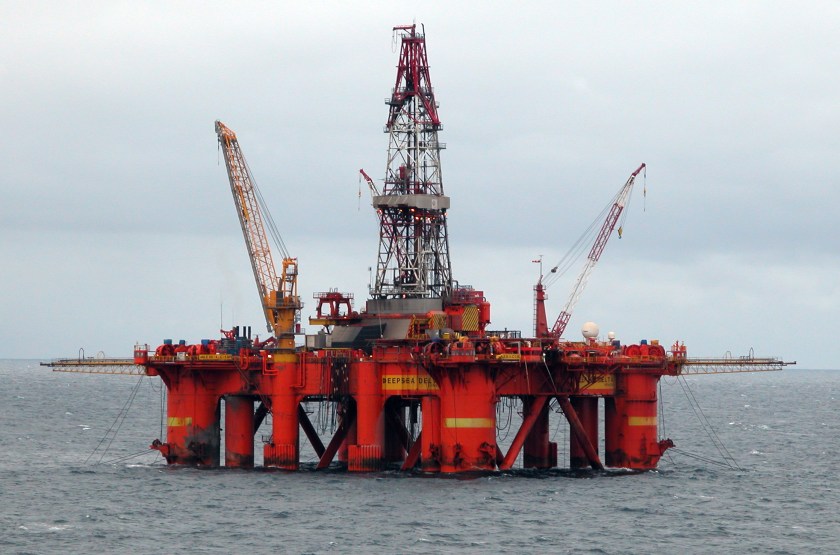
The oil companies operating on the North Sea have a plan to explore for, and produce, every single barrel of oil and gas that exists there. It’s called Maximising Economic Recovery. It’s written into law and has been since way before COP26. And if it’s the oil industry plan for the North Sea, it’s the oil industry plan everywhere. The deal to expedite Maximum Economic Recovery – called the ‘North Sea Transition Deal’ is signed up to by Scottish and UK governments and unions.
Almost all the gas used for heating in the UK comes from the British and Norwegian sectors of the North Sea and comes ashore via pipelines.
Only a very small amount of gas used in the UK ever came from Russia – it came by tanker – and was primarily used for plastic and other industrial processes not for heating.
The huge hike in gas prices came before the war in Ukraine. Gas and oil prices have been highly volatile for many decades. Not long ago the price dipped below zero for a short period.
Liz Truss has confirmed the enormity of the cost-of-living crisis, driven largely by North Sea gas here in the UK, in spectacular fashion by throwing £130 billion at it. Money she’s going to borrow in our name and make us pay back.
The fantasy is she’s going to grow the economy to pay for this. The madness is she thinks she’s going to do it by being cheerleader for the oil and gas industry on the North Sea and by fracking for shale gas in England.
The reality either way is that is she is going to try and make the people pay.
Truss treats the global market price for gas as if it is God given. The price bears no relation to how much gas costs to produce. It’s set by speculation (by hedge funds) betting on what the price might be at some point in the future.
There’s been no significant increase in the cost of gas production on the North Sea.
The finances of the poorest, the most vulnerable, those with special needs, are stretched to the limit by the price hikes that are already in place and would have been wrecked immediately by the October rise had it gone ahead as planned. The Truss decision to freeze energy bills for the next two years is not some sort of act of charity or generosity, but an admission that to proceed with the planned rises in retail energy prices till they met the wholesale energy price levels that profiteering by the gas producers and electricity generators and the market speculators have engineered, is just not acceptable. The people after years of austerity and real wages reductions, just could not, and would not, shoulder this burden.
The £130 billion package, even if the plan is that we eventually pay for it somehow in energy bills over the next 10 years, is a kind of a victory. At the very least it gives us the breathing space to begin to build a response in the communities. But that is still urgent.
Had the October cap rise gone ahead it is likely that catastrophic levels of poverty would have been the result and that local communities would have been faced with a couple of immediate challenges. How the most vulnerable were to keep warm? How they were to stay fed? These challenges have been at best delayed for many people but are still present for many already on prepayment meters and are likely to be unable to heat homes effectively or afford inflated food prices this winter.
The people of Pakistani heritage living in Govanhill and Pollokshields have watched as their families, friends and erstwhile neighbours in about a third of the districts and 12% of the land surface of Pakistan are devastated by floods which even the Government of Pakistan, recognises are a direct result of global warming driven by fossil fuel burning. Fossil fuel burning specifically not by most of the victims.
While trying to raise aid for the victims in Pakistan, this part of our community is facing their own fossil fuel induced crisis, a cost-of-living crisis that threatens to drive them into cold and hunger and which is driven by profiteering on North Sea gas.
The extraction of megaprofits from the North Sea is driving the current cost of living crisis. Longer-term Truss’s ‘payback plan’ and the government’s plans for Nuclear, Hydrogen for heat and fracking will ensure a high-cost energy future and continue to trash the environment.
A sustainable future requires breaking the power of the big energy companies on the North Sea, and through democratic public control phasing down production, ending the subsidies and shifting all that investment into renewables.
When they shout – It’s the war in Ukraine. We’ve got to shout it’s profiteering on North Sea gas.
You can watch a full video of the introductory talks here
And here is an attempt at summarising the general discussion which followed:
Actions we can take immediately
Most people don’t understand what’s happening. We need to get out into the streets with leaflets and speak to people – which is the key strategy of Just Stop Oil.
We should speak more about our ideas, and less about ‘theirs’.
A good talking point is the recent worst flooding ever in Pakistan. At the same moment when Pakistani families living in Scotland were watching their relatives dying on the news, many of these families, for example on the south side in Glasgow, are facing the impossibility this winter of both keeping warm and having enough to eat. Both these disasters are a direct result of the world continuing to burn fossil fuels as its main source of energy.
We need to keep expressing our solidarity with the people of the global south who are enduring the worst effects of global heating.
The power of the big North Sea oil and gas companies, through lobbying, bribery and their control of the media, is huge. This is a war we’re fighting, not a battle.
Beware these companies as they begin to invest in renewables. If we allow ourselves to be fooled by this they will make sure that renewables are developed in a way which is most profitable for them instead of prioritising public benefit.
We need to fight for state ownership of not only distribution of energy but also its production.
The processing plant at Mossmorran must be shut down.
One participant suggested that we should get into the Labour and LibDem parties and make the politicians listen to what we have to say.
We should organise for COP27 (to be held in November at Sharm El Sheik, Egypt).
At the same time as addressing the big political picture, we need to provide support for the many people in our communities who will be in desperate need this winter – for example by setting up ‘Warm Banks’, as communities in North Edinburgh are planning towards.
Workers and Unions
The unions need to come together with the workers, demanding with a single voice no more fossil fuel extraction and just transition for the workers.
There will be no pay and no jobs on a dead planet
We should go to picket lines to express solidarity and not be afraid to speak about the big picture, whatever immediate demands the strikers are making. For example whatever RMT workers immediate demands, they are the people who will be running the electric trains to get people out of their cars.
On October 1st we should be on the streets to support the BT group workers and their Communication Workers Union
We should particularly express solidarity with the current wave of wild-cat strikes by the North Sea offshore workers, especially in view of their Unions’ criticisms of their strike action. The work conditions of these workers are appalling,
Our rulers
Do not care about us
Are under the control of the big oil and gas companies
Deserve our anger
Hopeful considerations
Working together: one participant talked about ‘joining the dots’ – another suggested a good way of doing this is by supporting RMT pickets and making sure that climate and supporting public transport is part of the agenda; critical to make the links between organised workers and communities – the Edinburgh Trade Unions in Communities initiative is a good example. It was noted that the anti-fracking campaign went well because of solidarity across Scotland and England. So, the theme across these is about connecting, working together for greater impact.
There are now the beginnings of widespread collective action
The North Sea is at an end-game stage, with reducing quantities of oil and gas to extract, and the prospect of rising costs of extraction.
Two years ago, Platform ran a questionnaire for offshore workers which showed many hadn’t even heard about just transition, but that most would gladly move to jobs in renewables if they were given the opportunity.
One participant pointed out that when fundamental daily needs like warmth and food are being denied to large numbers of people, history tells us that revolution is likely. Other civilisations have fallen in similar circumstances.
Upcoming meetings
A number of events were mentioned during the discussion go to our Events page for details.
Here’s the text of out latest briefing on climate, oil and gas and the cost of living. You can download it here.
Cost of Living
Everyone knows that we are in a cost-of-living crisis. Most of us in Scotland rely on natural gas for cooking and heating and North Sea gas is a guided missile sent into every home in the country which will drive thousands of new people into poverty and will kill the most vulnerable. Oil and gas producers are making mega profits and demanding money with menaces.
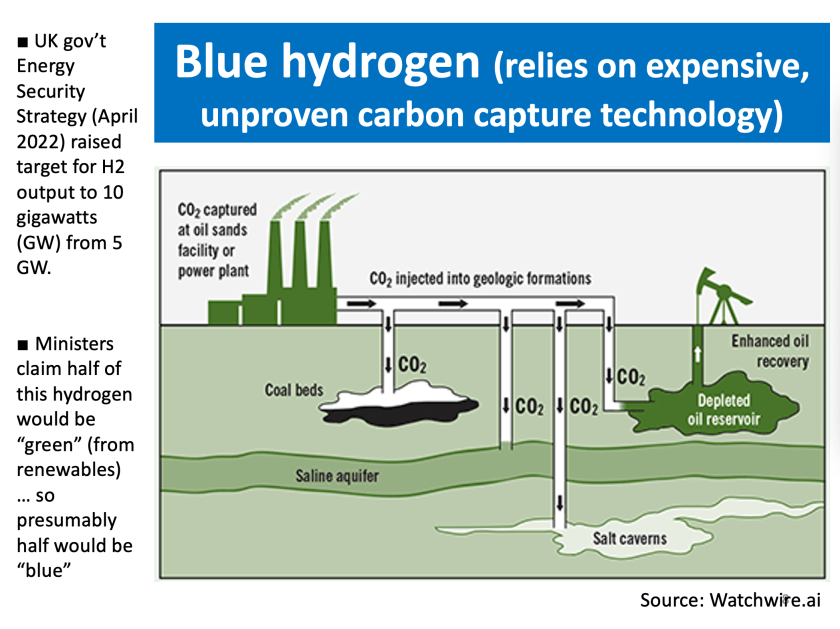
Before this happened around a quarter of Scots lived in fuel poverty. As a result of the price rises hundreds of thousands more will be forced to make impossible choices between food and heating. The response from the Tories has been derisory. Their so-called Energy Security Plan does nothing to tackle immediate hardship and doubles down on the most expensive energy options for the longer term – nuclear, oil and gas, hydrogen for heating and carbon capture and storage.
Business as usual – the North Sea Transition Deal
There is a simple reason why the Tories have made these choices. In the face of the climate and cost of living crises they’ve chosen to protect the interests of big oil. It’s not just that they won’t tax the enormous profits that are being made from North Sea Oil and Gas – it’s that they are following the logic of the oil industry’s ‘North Sea Transition Deal’.
A phony deal
The ‘Deal’ is a partnership between the UK and Scottish governments and the unions. It aims to continue the exploitation of North Sea oil and gas up to and beyond 2050. It talks about a net-zero oil and gas basin where the greenhouse gas emissions from the oil and gas would be captured and stored. This is not going to happen, certainly not in the next few decades, and the consequence will be that the UK will fail to meet its contribution to restricting global temperature rises.
Maintaining profits – wasting resources
Moreover, the ‘Transition Deal’ drives high-cost energy options at every step and leaves working people to pay the price. The latest UK government energy strategy aligns entirely with the ‘Deal’. Most of the electricity produced by new nuclear power stations will be required to produce the hydrogen for domestic heating. Using electricity to produce hydrogen for domestic heating at large scale is hugely inefficient. Moreover, nuclear produces much more carbon emissions over its lifecycle than wind or solar.
There is an alternative. Electricity produced by wind and solar is already much cheaper than that produced by nuclear, oil and gas and the costs of renewables continue to fall. The money the Tories want to spend on new nuclear is enough to retrofit most homes across the UK – creating jobs, improving health and well-being and cutting energy demand.
An economy based on renewables results in many more jobs than the fossil fuel and nuclear options.
A challenge for the trade union movement
It’s time for a decisive shift in policy and end to partnership with the oil industry. Just transition, indeed arguably any transition that restricts temperature rises to 1.5 degrees, is incompatible with the ‘North Sea Transition Deal’. Sticking with the ‘Deal’ is a disaster for the planet and undermines the ability of the workers movement and the climate movement to build the power we need to win over climate and the cost of living.
A new policy for the union movement
Tackling the cost-of-living crisis and the climate crisis means breaking the partnership with big oil that is inherent in the Transition Deal and campaigning for an end to the development of new North Sea oil and gas and the rapid planned phase out of existing fields. Large-scale investment in renewables and a massive programme of retrofitting would result in lower energy prices and reduced carbon emissions. A serious plan would include support for the oil and gas work force while they transition to new jobs and ramping up options for reskilling, education and training in the new industries.
No more subsidies
The oil and gas industry has been subsidised heavily over the lifetime of the North Sea. The subsidies must stop. Working people are suffering because what they pay for energy fuels super profits for big oil and goes into the pockets of the richest in society whose wealth grows as hedge funds speculate on the oil market. There’s plenty of money to pay for an energy transition.
Among the components of a new policy for the workers movement should be:
Massive investment in wind, solar and tidal energy.
Large-scale expansion of energy storage options.
No more North Sea development.
Taking the North Sea into public ownership and beginning a planned phased out of production.
Support for oil and gas workers to transition to new jobs.
Regulate energy prices to consumers and tax big oil and the rich to end the cost-of-living crisis.
COP26 gave us a glimpse of the potential power when the workers movement and the climate movement come together. Together we can win.
Briefing #14 on climate, fuel poverty and the cost of living is now available for download. As with all the our briefings you are welcome to use and adapt the briefing content – attribution to https://scote3.net is appreciated.
The content of the briefing is reproduced below.
Climate, fuel poverty & the cost of living
Fuel poverty kills
Prior to the latest crisis almost 25% of households in Scotland lived in fuel poverty and just over 12% were in extreme fuel poverty. Households in extreme fuel poverty are disproportionately represented in rural Scotland. Older people living in rural Scotland are particularly hard hit. Every year thousands die because of fuel poverty – in 2018/19 excess winter mortality (that’s in comparison with the average winter mortality for the previous five years) was 2060 – the death toll can be more than twice as high in cold winters. Around 85% of households in the UK rely on gas for heating and cooking. The huge hike in gas prices is going to make an already unacceptable situation much, much worse.
Rising fuel prices
Gas and electricity prices have been rising faster than inflation for a long time. From 2006 – 2016, Gas prices rose by 71% and Electricity 62%. Between 2017 and 2020 electricity prices increased by a further 8% in real terms while gas prices fell by a similar amount. But gas prices are extremely volatile. Since 2019 the wholesale price has almost trebled.
Gas consumption fell by just over 2% in 2020, a consequence of lockdowns around the world. In 2021 there was a rebound with consumption increasing by 4.6% because of increased economic activity and several extreme weather events worldwide. The cost of producing gas is about the same this year as it was last year and the year before. So why has the price rocketed up? Prior to 1987 the EU designated natural gas a premium fuel that should be reserved for home heating. Now 60% of gas is used to generate electricity. Britain used to have significant storage capability. This was abandoned in favour of allowing the market to deliver gas as needed. These changes have been a disaster. Gas is traded on the spot market with hedge funds gambling on future prices. As a result, the cost of an essential utility is determined by a casino where traders rake in massive profits while consumers pay the price.
Lack of ambition
In June 2019 the Scottish Parliament passed a new act setting statutory targets for reducing fuel poverty. Rightly it highlights the impact of fuel poverty on the most vulnerable in society. Low-income, high-energy costs, and poorly insulated housing result in the appalling situation where families, young people, elderly, disabled and many working people, cannot afford adequate warmth. The new act sets interim targets for reducing fuel poverty to 15% of households by 2030 and final targets for 2040. Considering the cost of living and climate crises we face this is too slow and not enough. The act failed to address the threat posed by a chaotic market. From April 2022 annual bills will increase by an average of almost £700. Further increases are expected later in the year. The numbers in fuel poverty are set to rise well above the current level.
Fossil fuels cost the earth
Both Holyrood and Westminster remain committed to the maximum economic extraction of oil and gas from the North Sea. The big energy companies are making billions in extra profits out of the crisis. North Sea oil and gas operates under a regime of very low taxation. With prices high companies will be doubling down on plans to open new gas fields. If this happens there is no chance of meeting the reductions in greenhouse gas emissions that are essential. We argue that there are two essential steps. The first is to protect all those who are in fuel poverty and stop more people joining them. A windfall tax on profiteers will help with this but should not be mistaken for a long-term solution – and the scale of the problem is so large that it requires significant redistribution with higher taxes on the rich and much more support for the poor. These are necessary short-term steps to prevent large scale misery, deprivation and increased winter deaths. But a secure future for us all rests on gas being taken out of the market, with North Sea and North Atlantic oil and gas taken into public ownership and control. With public control it then becomes possible to plan for the phase out of fossil fuels from the North Sea. In the process we cut greenhouse gas emissions and replace expensive gas heating by cheaper renewables. The interests of working people and the need to protect the planet are aligned.
A mass insulation campaign
In its ‘One Million Climate Jobs Pamphlet’, the Campaign Against Climate Change (CACC) notes that
Three quarters of emissions from houses and flats … are caused by heating air and water. To reduce this we need to insulate and draught- proof the buildings, and replace inefficient boilers. This can cut the amount of energy used to heat the home and water by about 40% and delivers the double-whammy of reducing energy costs and helping mitigate the scourge of fuel poverty.
Based on these CACC estimates, which are for the whole of the UK, a campaign to properly insulate all homes in Scotland would employ around 20,000 construction workers for the next 20 years. This doesn’t account for additional jobs in education, training and manufacture that would spin off from such an endeavour. Through this carbon dioxide emissions from homes would be cut by 95%. We could ensure that all new houses are effectively carbon neutral. The technology exists – there are examples of ‘passive houses’ that use very little energy. Insulation together with the steady replacement of gas boilers by affordable heat pumps is the solution to cutting the energy demands of domestic heating. Hydrogen is not a solution (see Briefing #13).
Image by Pete Cannell CC0 Public Domain
New Technologies
The current costs for fossil fuel power range from 4p -12p per kilowatt-hour. Inter renewable energy agency (IREA) state that renewable energy will cost 2p – 7p with the best onshore wind and solar photovoltaic projects expected to deliver electricity for 2p or less. Renewable energy is necessary for a sustainable future, and it is cheaper than fossil fuels. Current Westminster Government policy – notably the subsidy ban for new onshore wind farms – is impeding the shift to renewables.
No Fracking
For the moment fracking is off the agenda in Scotland. The result of a magnificent campaign of resistance. But INEOS continues to import fracked gas from the US. This has to stop.
In conclusion
Fuel Poverty and the cost-of-living crisis are the direct result of the “wrecking ball” of market forces dominating our need for energy to give us warmth, light and sustenance. In the pursuit of profit, the use of fossil fuels adds to the catastrophe of climate change.
We have the technology and skills to stop this madness and misery through a radical shift in Energy policy that would combine sustainable and renewable resources dedicated to social need. Tackling climate change would go hand in hand with creating additional jobs, eliminating fuel poverty, and improving health and well-being. To make this happen we need the kind of focus and the level of investment that has only normally applied at times of war. Ending the use of fossil fuels over a short period is practically possible provided there is the political will.
Some of the material in this briefing also appears in Briefing #7 – Fuel Poverty
About Scot E3
Scot.E3 is a group of rank and file trade unionists, activists and environmental campaigners. In 2107 we made a submission to the Scottish Government’s Consultation on a Scottish Energy Strategy. Since then we have been busy producing and sharing leaflets and bulletins.
We believe there is a compelling case for a radical shift in energy policy. Looming over us there is the prospect of catastrophic climate change, which will wreck the future for our children and grandchildren.
We have the knowledge and the skills to make a difference to people’s lives in the here and now. A sustainable future requires a coherent strategy for employment, energy and the environment. We need a sense of urgency. We need a coordinated strategy and massive public investment.
Retired oil worker and XR Scotland activist Neil Rothnie responds to the recently published XR strategy for 2022. Neil argues that the strategy is weakened by not making specific reference to the North Sea when North Sea Oil and Gas remains at the heart of both the UK and Scottish governments energy strategies.
Begin a planned rundown of North Sea oil and gas production without delay.
That’s a real ‘demand’ and is directed at the UK oil industry and the UK and Scottish Governments.
North Sea oil and gas is a major contributor to the greenhouse gases that are the UK’s contribution to global heating.
So why does the Extinction Rebellion UK Strategy 2022, on the fossil economy, make no mention of North Sea oil and gas?
The new 2022 strategy document talks instead about End(ing) The Fossil Fuel Economy in general, and specifically demands No New Fossil Fuel Investment, No New Fossil Fuel Licences, and an End (to) Fossil Fuel Subsidies Now.
But – End the Fossil Fuel Economy – is not a demand. It’s a slogan! And the three specific demands could be met in full today without making a jot of difference to the climate catastrophe that’s unfolding.
Because without one more penny being invested in the North Sea, without one more licence issued, and without a penny more in public subsidy, everything is already in place to ensure that North Sea oil and gas fields will, unless someone puts a stop to it, produce more than the UK’s share of global greenhouse gases that will heat the atmosphere to way over +1.5 degrees, and trigger the irreversible climate change that leads, according to the science as I understand it, to mass extinctions of life forms on the planet.
A similar scenario is set to be repeated all over the world. In Norway, the Gulf of Mexico, Saudi Arabia, Russia, the China’s coalfields, etc etc. So, it’s a global problem that has to be addressed in each locality.
In the UK, we have a responsibility to begin to choke back North Sea oil and gas production. In the US the responsibility to end fracking and wind down hydrocarbon production from the Gulf of Mexico falls, in the main, to Americans. In Russia to Russians . . .
We must have the confidence that the peoples in each and every other fossil production zone will act at least as decisively as we will. We can talk to them and encourage them, but above all we need to lead by example. The main enemy is at home. It’s our responsibility to fight our corner.
And the biggest support we can give to the masses of people in the global south who face climate chaos earlier and harder than us, is to end North Sea oil and gas production.
One massive implication of “disappearing” North Sea Oil and Gas from a UK strategy for fossil fuels is that you also “disappear” the North Sea oil and gas workers and their rights and their responsibilities.
Oil & gas production is going to go. Sooner rather than later if the climate and our grandchildren are to have a chance. Oil workers must not be shafted like the coal miners were before them.
If you are an oil and gas worker. a climate activist, a trade unionist – if you live in a community that hosts the industry and the workers – or if you’re young and fearful for your future, put your name to our demands*.
No more redundancies of oil and gas workers.
Workers whose jobs are threatened as the oil industry is wound down, must be furloughed until they are retrained and re-employed.
North Sea wind jobs must be made to pay North Sea wage rates.
*These three demands are still in draft but will form part of a new Scot.E3 campaign in 2022.













 Employment, Energy and Environment
