Solidarity with rail, ferry and energy workers, members of the RMT union who are protesting on Monday 31st January in Edinburgh. Assemble 11am on the Waverley Station concourse.
This is the RMT press statement
28 January 2022 – RMT Press Office
Transport and energy workers to protest on 31 January in Edinburgh against betrayal of COP26 promises
Marking the three-month anniversary of the beginning of the COP26 Climate Conference – on 31st January – transport and energy workers are to march to the office of the First Minister Nicola Sturgeon to protest at the betrayal by the SNP / Green Government of commitments made to move towards a greener Scotland.
The protest by rail, ferry and energy workers who are members of the RMT will be the start of a concerted campaign to increase the pressure on politicians as the country approaches the local government elections in May.
The charge sheet against the Scottish Government includes:
• Instead of cutting climate change, the SNP/ Green Government is cutting rail services including rail ticket offices hours, timetables and infrastructure while the cost of rail travel is increasing at four times the rate of using a car. • Instead of securing our vital lifeline ferry services in the public sector, ministers appear to be paving the way for privatisation where profits will be put before people and climate. • Instead of helping guarantee the livelihoods of energy workers, ministers have sold Scotland’s renewable energy resources on the cheap to the likes of BP and Shell without securing supply chain jobs. RMT General Secretary Mick Lynch said: “COP26 started only three months ago but already the lofty rhetoric about fighting climate change seems a distant memory as we witness a betrayal of ambitions by the SNP / Green Government to move towards a greener Scotland.
“Instead of cutting climate change the Government is cutting rail services and ticket offices, threatening the privatisation of our lifeline ferry services and doing far too little to protect the livelihoods of energy workers and the vital service they provide.
“As the country approaches the local government elections in May this protest will be the start of a concerted campaign to persuade politicians to protect these services and jobs which are so vital to our local communities.”
Yesterday (27th January 2022 saw the launch of a new report weighing up the relative merits of hydrogen and heat pumps for domestic heating. The report was produced by the Imperial College Energy Futures Lab. It concludes that while hydrogen will have a role in decarbonising some industrial process it is not appropriate for domestic heating.
The research finds that hydrogen infrastructure is not going to be viable for domestic heating applications at scale for at least the next 10 years and therefore, the Government should focus on deploying solutions which are available now including energy efficiency, electrification through heat pumps and heat networks as the main focus for its strategy.
Richard Hanna one of the reports authors says:
… hydrogen has potential to help decarbonize challenging sectors like industry and shipping but right now there is not a strong case for using it to here in our homes. In the near-term government should focus efforts on improving heat pump products and their affordability and supporting industry to rapidly scale up production of technology in the UK
Scot.E3 argues that current UK and Scottish government support hydrogen as a replacement for natural gas is deeply misguided and is unlikely to be effective in cutting carbon emissions. This really matters since domestic heating is responsible for around 23% of the UK’s greenhouse gas emissions. The UK is currently very dependent on the use of natural gas for domestic heating. Around 85% of homes use gas. One consequence of this heavy dependence is the ratchetting up of levels of fuel poverty because of the massive hike in gas prices that has occurred over the last few months.
The report is well worth reading and includes a really useful and extensive list of links to further reading. Butven if you don’t have time to read the report in full, do read the policy recommendations. These highlight the need for public sector procurement, for planning, for rapidly increasing the rate of heat pump installation starting from now and critically for immediate investment in training to create a skilled workforce able to carry out this work.
This is the video of the meeting at which the report was launched.
Trask, A., Hanna, R. and Rhodes, A. The Future of Home Heating: the Roles of Heat Pumps and Hydrogen, An Energy Futures Lab Briefing Paper, Imperial College London Consultants. Available at: https://www.imperial.ac.uk/energy-futures-lab/reports/ briefing-papers/paper-8/
Simon Pirani is the author of ‘Burning Up – A Global History of Fossil Fuel Consumption’* – Simon recently spoke on Fossil Fuel Systems at one of. series of events discussion issues around ecosocialism. The video of his introduction provides a very clear and comprehensive account of how fossil fuel systems are embedded in modern capitalist economies and of the challenges of breaking from an economic system based on these fuels.
Simon blogs at the People and Nature website which carries lots of articles that will be of interest to followers of Scot.E3.
* we have a small number of copies of Simon’s book available at the reduced price of £11 (postage extra) – email triple.e.scot@gmail.com if you’d be interested in a copy.
Good quality, affordable public transport is a key part of an energy transition. Here’s an excellent new video from Get Glasgow Moving that makes the case for reversing privatisation.
The latest in our series of briefings. Like all of the briefings this one is just two sides of A4 and is published under a Creative Commons license which means you are welcome to share, adapt and reuse the content. Download a PDF version here.
Abuse
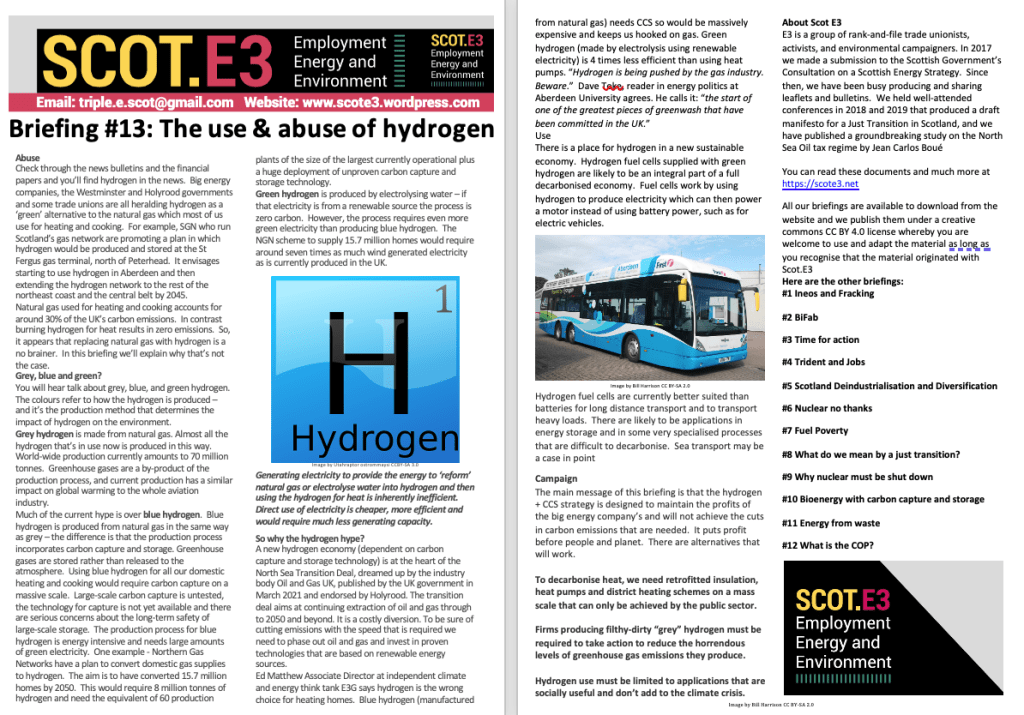
Check through the news bulletins and the financial papers and you’ll find hydrogen in the news. Big energy companies, the Westminster and Holyrood governments and some trade unions are all heralding hydrogen as a ‘green’ alternative to the natural gas which most of us use for heating and cooking. For example, SGN who run Scotland’s gas network are promoting a plan in which hydrogen would be produced and stored at the St Fergus gas terminal, north of Peterhead. It envisages starting to use hydrogen in Aberdeen and then extending the hydrogen network to the rest of the northeast coast and the central belt by 2045.
Natural gas used for heating and cooking accounts for around 30% of the UK’s carbon emissions. In contrast burning hydrogen for heat results in zero emissions. So, it appears that replacing natural gas with hydrogen is a no brainer. In this briefing we’ll explain why that’s not the case.
Grey, blue and green?
You will hear talk about grey, blue, and green hydrogen. The colours refer to how the hydrogen is produced – and it’s the production method that determines the impact of hydrogen on the environment.
Grey hydrogen is made from natural gas. Almost all the hydrogen that’s in use now is produced in this way. World-wide production currently amounts to 70 million tonnes. Greenhouse gases are a by-product of the production process, and current production has a similar impact on global warming to the whole aviation industry.
Much of the current hype is over blue hydrogen. Blue hydrogen is produced from natural gas in the same way as grey – the difference is that the production process incorporates carbon capture and storage. Greenhouse gases are stored rather than released to the atmosphere. Using blue hydrogen for all our domestic heating and cooking would require carbon capture on a massive scale. Large-scale carbon capture is untested, the technology for capture is not yet available and there are serious concerns about the long-term safety of large-scale storage. The production process for blue hydrogen is energy intensive and needs large amounts of green electricity. One example – Northern Gas Networks have a plan to convert domestic gas supplies to hydrogen. The aim is to have converted 15.7 million homes by 2050. This would require 8 million tonnes of hydrogen and need the equivalent of 60 production plants of the size of the largest currently operational plus a huge deployment of unproven carbon capture and storage technology.
Green hydrogen is produced by electrolysing water – if that electricity is from a renewable source the process is zero carbon. However, the process requires even more green electricity than producing blue hydrogen. The NGN scheme to supply 15.7 million homes would require around seven times as much wind generated electricity as is currently produced in the UK.
Image by Utahraptor ostrommaysi CCBY-SA 3.0
Generating electricity to provide the energy to ‘reform’ natural gas or electrolyse water into hydrogen and then using the hydrogen for heat is inherently inefficient. Direct use of electricity is cheaper, more efficient and would require much less generating capacity.
So why the hydrogen hype?
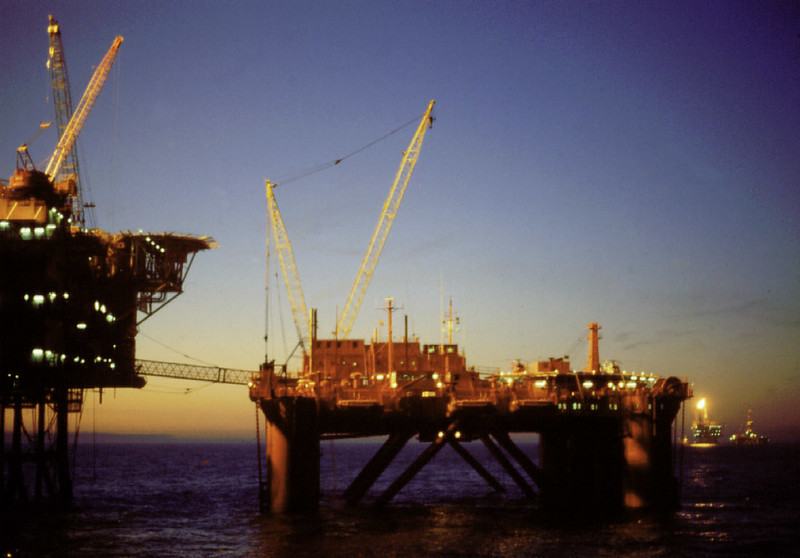
A new hydrogen economy (dependent on carbon capture and storage technology) is at the heart of the North Sea Transition Deal, dreamed up by the industry body Oil and Gas UK, published by the UK government in March 2021 and endorsed by Holyrood. The transition deal aims at continuing extraction of oil and gas through to 2050 and beyond. It is a costly diversion. To be sure of cutting emissions with the speed that is required we need to phase out oil and gas and invest in proven technologies that are based on renewable energy sources.
Ed Matthew Associate Director at independent climate and energy think tank E3G says hydrogen is the wrong choice for heating homes. Blue hydrogen (manufactured from natural gas) needs CCS so would be massively expensive and keeps us hooked on gas. Green hydrogen (made by electrolysis using renewable electricity) is 4 times less efficient than using heat pumps. “Hydrogen is being pushed by the gas industry. Beware.” Dave Toke, reader in energy politics at Aberdeen University agrees. He calls it: “the start of one of the greatest pieces of greenwash that have been committed in the UK.”
Use
There is a place for hydrogen in a new sustainable economy. Hydrogen fuel cells supplied with green hydrogen are likely to be an integral part of a full decarbonised economy. Fuel cells work by using hydrogen to produce electricity which can then power a motor instead of using battery power, such as for electric vehicles.
Image by Bill Harrison CC BY-SA 2.0
Hydrogen fuel cells are currently better suited than batteries for long distance transport and to transport heavy loads. There are likely to be applications in energy storage and in some very specialised processes that are difficult to decarbonise. Sea transport may be a case in point
Campaign
The main message of this briefing is that the hydrogen + CCS strategy is designed to maintain the profits of the big energy companies and will not achieve the cuts in carbon emissions that are needed. It puts profit before people and planet. There are alternatives that will work.
To decarbonise heat, we need retrofitted insulation, heat pumps and district heating schemes on a mass scale that can only be achieved by the public sector.
Firms producing filthy-dirty “grey” hydrogen must be required to take action to reduce the horrendous levels of greenhouse gas emissions they produce.
Hydrogen use must be limited to applications that are socially useful and don’t add to the climate crisis.
Mike Downham reflects on the impact of Covid, the aftermath of COP26 and what we might do differently in future.This article was first published inScottish Socialist Voice.
It’s nearly two long years since we began to become aware of the potential scale and danger of the new virus. At that point some prescient people suggested that how we reacted to the pandemic would be a rehearsal for our performance in the forthcoming big show of climate breakdown.
This wasn’t the first time ‘rehearsal’ had been used for how we organise on the left. John Berger described every act of resistance as a rehearsal. Colin Barker called his 1987 book about the uprisings in France, Chile, Portugal, Iran and Poland between 1968 and 1980 Revolutionary Rehearsals. And he used this title again in his subsequent book Revolutionary Rehearsals in the Neoliberal Age, written jointly with Gareth Dale and Neil Davidson published this year – posthumously for both Colin and Neil – which describes the uprisings in Eastern Europe, South Africa, Indonesia, Argentina, Bolivia, Venezuela, Sub-Saharan Africa and Egypt since 1989.
It’s reasonable I think to say that we’ve made a right mess of the Covid rehearsal. Had we known two years ago what we know today, we would have learnt our lines and our cues more thoroughly. What we know today is that 9,634 people in Scotland have died; that the majority of these snuffed-out lives have been among the poor, the disabled and the marginalised; that 99,000 people in Scotland are living with Long Covid; that about 10% of children who catch the virus go on to have disabling poor health for weeks or months; and that the NHS has broken down.
That the NHS has actually broken down, no longer something we just fear might happen, was brought home to me this week by hearing about a middle-aged woman in the Paisley area with an 18-month history of severe neck pain who waited so long for surgery that she’s been forced to give up her job as a care-worker, then lost her home because she couldn’t keep up with her mortgage repayments. Not that this is the only tragic story about NHS failure we could tell between us.
Now the omicron variant (whether or not it turns out to be as bad as feared – we’ll have to wait a week or so before we know) is shouting at us from the wings, telling us that if we allow the virus to spread, whether in Scotland’s communities, schools and workplaces in an incompletely vaccinated population, or in largely unvaccinated countries sent to the back of the queue because they can’t pay, sooner or later we’re going to get a variant which will evade current vaccines.
And yet the cues were there in the script from the beginning. If we’d read it and learned it we’d have known we couldn’t trust the governments of wealthy counties, including Scotland, to not rely so heavily on vaccines, or to prioritise supply and reduce the cost of vaccines for poor countries, because these governments are locked into a system where profit trumps health. Yesterday’s top news was about Pfizer rubbing its hands as it suggested that annual vaccination was likely to be necessary – without mention of the financial and logistical implications of vaccinating eight billion people annually. Pfizer is relishing not only the prospect of a limitless market but also that it has outcompeted AstraZeneca both technically and in its propaganda.
Just as profit trumps health, so that the ruling classes allow the Covid virus to spread, it also trumps the devastating impacts of global heating which are unfolding for all humanity. COP26 has finally made it clear that neither wealthy governments nor the oil and gas corporations are going to take effective action in relation to global heating, despite being fully aware of and no longer denying the scale of the impacts which will result from their inactivity.
How can it be that one small fraction of human beings can inflict such suffering on the rest of their species? Andreas Malm and colleagues, in their new book White Skin, Black Fuel try to explain:
They are not perturbed by the smell from the blazing trees. They do not worry at the site of islands sinking; they do not run from the roar of approaching hurricanes; their fingers never need to touch the stalks from withered harvests; their mouths do not become sticky and dry after a day with nothing to drink … After the past three decades, there can be no doubt that the ruling classes are constitutionally incapable of responding to the catastrophe in any other way than by expediting it; of their own accord, under their inner compulsion, they can do nothing but burn their way to the end.
The lake at Sweetwater Creek State Park Lithia Springs GA is one of the sources that Georgia residents are dependent on for drinking water Image by Global Water PartnershipCC BY-NC-SA 2.0
As we get our last call to take the stage in the climate crisis, what have we learned from the Covid rehearsal? What are our lines and what are our most critical cues?
The best approach to these questions may be to ask first what mistakes we made in the rehearsal, to avoid making them again. We should perhaps beware of:
Knocking politely on town-hall and parliament doors asking the politicians to do things few of them can even contemplate doing
One-off marches and protests which aren’t part of a charted programme of resistance
Loosely knit coalitions, which dilute militancy with compromise
Hoping to build a social democratic party which could win at the ballot-box
Organising strictly within our political silos, whether parliamentary parties, or revolutionary groups, or single-issue institutions
Underestimating the extent to which the ruling classes have stifled trade union power so that collective withdrawal of labour is no longer the readily available weapon it used to be
How then can we organise, if not in these ways? First, the Covid pandemic is far from over – in fact it can be said to be at a critical point, with the prospect that vaccines may not protect us, and that relying on vaccines alone is not sustainable. We’ll only be able to overcome this pandemic through traditional public health measures, delivered through a greatly expanded and well-resourced public health service. This is what we can start turning our attention to and fighting for. Covid is offering us the experience of another rehearsal, the key changes needed to address both Covid and climate becoming more clearly the same – rolling out and investing heavily in existing technologies instead of switching to uncertain ones. Vaccination on its own becomes the equivalent of Carbon Capture and Storage, both of them profitable for the ruling classes but disastrous for the rest of us.
Second, COP26 has shown us that targeted and sustained direct action works. The Indian farmers, after a year’s disruptive presence in Delhi, during which 700 of them died at the hands of the police, have won a historic victory. The first thing Modi did when he returned from Glasgow was to announce that he was going to withdraw the three laws against which the farmers had been protesting. Two weeks later Shell announced that they are giving up their ten-year plan to extract oil and gas from the Cambo field. This is a huge victory for the Stop Cambo! campaign – a direct result of its persistent visibility in Westminster over the last year, then its strong performance at the COP in Glasgow.
But in the midst of our celebrations of these two wins, we can see that the farmers are continuing to swamp Delhi. They want to see the three laws actually withdrawn, not just hear a promise. It’s probable that even then they will continue their protest for further, more systemic changes. Stop Cambo! knows too that it must not relax. There’s still Siccar Point Energy to unseat (the majority partner in the development of the Cambo field), and there’s the UK Government to force into a decision that no extraction license will be granted. A win is the cue to increasing the strength of a protest, not to ending it.
Third, we would do well at this point to start discussing what so far we’ve shunned: how are we to oppose the state oppression which is bound to escalate in relation to increased direct action? Is XR right to remain adamant about non-violence? Or did Mandela have a point when he said “The attacks of the wild beast cannot be averted with only bare hands”?
Part of the coalition deal between the Scottish Greens and the SNP was the allocation of £500 million to support the creation of new sustainable jobs. There are indications that all of this funding may now go to CCS (Carbon Capture and Storage projects). One time chair of the Wood Group, Sir Ian Wood is a strong advocate of CCS and has been vocal in his criticism of the Westminster government’s failure to fund the Acorn CCS project in Scotland. The Wood Group lobbies and argues for CCS. Their website asserts that ‘If we are to achieve a net-zero world, carbon capture and storage infrastructure is a necessity and needs to scale up rapidly.’ Scot.E3 believes that CCS is a central plank of Oil and Gas UK’s strategy to continue the policy of maximum economic extraction of oil and gas from the North Sea. Choosing to spend the £500 million on CCS would constitute big step down a road that the Oil Industry wishes to travel and a setback for the campaign for a rapid just transition away from fossil fuels. There are many other projects that could be funded.
We are pleased to publish this post that has been submitted to the site. The author has asked to remain anonymous.
One of the SNP’s proposed solutions to climate change is Carbon Capture and Storage (CCS). This is very dangerous in our mission to decarbonise Scotland’s economy and provide other countries with the tools to do the same. On the face of it CCS may seem like another tool in the box to reduce carbon emissions, and that might be right if it weren’t for the very strong vested interests.
There are very strong arguments that CCS can’t work for technical reasons – such as the inability to actually avoid the carbon being stored leaking. There are also strong economic reasons it can’t work – wind and solar are already cheaper than fossil fuels in most markets, with plenty of scope for further reduction. Adding an additional cost to the production of fossil fuel energy makes it even less competitive.
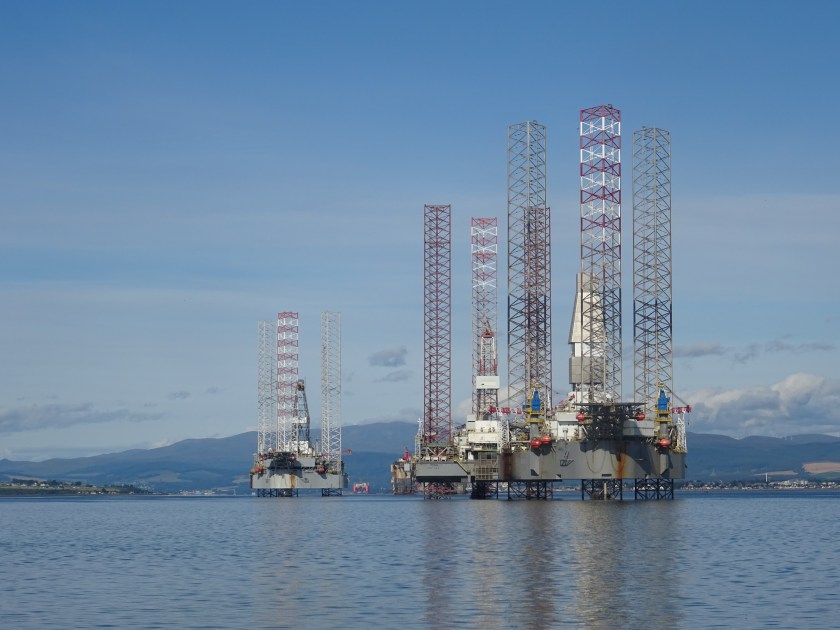
Image Pete Cannell – View from Cromarty – CCO
So why are fossil fuel interests so keen on CCS?
There are two reasons why CCS is favoured by fossil fuel executives who want to portray themselves as concerned about climate change. The first is that it allows them to continue extraction of the oil and gas that their company’s valuations are based on. The second is that it distracts from other clean technologies that will actually decarbonise energy, such as renewables and storage. It does this by ‘crowding out’ renewables investment.
So CCS will do two things, even if it isn’t viable. It will allow more drilling for fossil fuels and it will divert investment from renewables and storage.
The argument put forward by Oil and Gas UK is that CCS means we can continue to drill in Scottish waters and that those resources can be made ‘carbon neutral’ through CCS.
The danger particularly comes because the UK Government has chosen not to support the Scottish CCS project. This has created an opportunity for the vested fossil fuel interests in Scotland to argue that the Scottish Government should use the money set aside for a worker-led just transition from oil and gas jobs should be diverted to supporting CCS. The £500m negotiated by the Greens as part of the coalition deal for clean jobs to replace oil and gas is now at risk from a dead-end technology that exists mainly to prevent the end of fossil fuel drilling.
This illustrates exactly how CCS will crowd out renewables investment, but worse it will rob workers of the jobs that they need in truly clean industries.
The fossil fuel industry tried the same approach with fracking in the last decade. We urgently need a campaign to persuade politicians who have fallen for the CCS lies and greenwash that this is another wrong turn. At the moment, that means SNP ministers and backbenchers.
END
There are other posts relevant to CCS on this site:
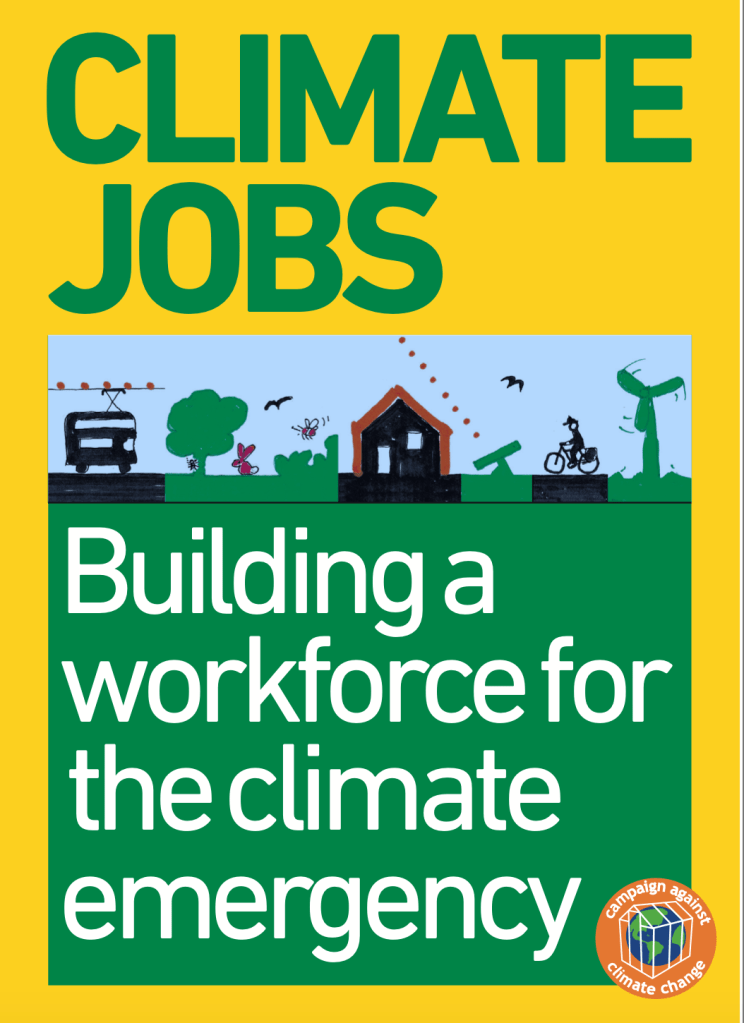
A new pamphlet, and accompanying technical resources, from the Campaign Against Climate Change Trade Union Group is indispensable reading for every trade unionist and climate activist.
It’s now 13 years since the One Million Climate Jobs pamphlet was published. The pamphlet’s proposition is a simple one – solving the climate crisis requires a rapid transition to a zero-carbon economy – transition involves ending economic activity in areas that create greenhouse gas emissions and hugely expanding the number of new jobs that are essential to a decarbonised economy – these jobs are what the pamphlet describes as ‘climate jobs’.
A focus on climate jobs is practical and political. It’s practical because an energy transition is simply impossible unless the jobs are created. So, the extent to which jobs are being created is a measure of progress. If there’s no evidence of jobs, then all the rhetoric about a climate emergency from politicians is just hot air and greenwashing. Scotland is a good example of this – we’re told that the Scottish Government has world leading policies – but there is no evidence of a growth in climate jobs, or of the planning and infrastructure required to support growth in climate of numbers. And while there is no evidence, it’s very hard to convince working class people that plans for dealing with the climate crisis will not have the same impact as past transitions. Many parts of Scotland are still deeply scarred by the transition from coal in the 1980s. So, to build the kind of powerful mass movement we need to drive an effective and socially just transition a sharp focus on climate jobs and the positive effects that transition would have on employment and quality of life is essential. It’s important to stress, however, that a socially just transition – system change in short – should also mean a re-evaluation of employment across the board. Social justice requires climate jobs, but it also requires that there are more jobs in health, care and education and these jobs that support social reproduction are valued much more highly.
Since the publication of ‘One Million Climate Jobs’ other studies have taken a similar approach to analysing what needs to be done to reach Zero Carbon. It’s striking that although methodologies have varied estimates of the number of climate jobs required for the UK and for regions of the UK are remarkably similar. The Green European Foundation’s regional focus is very helpful at understanding more localised impact. It provides data that enables estimates of the numbers of jobs in different sectors in Scotland to be made. Sea Changedemonstrates that phasing out North Sea oil could result in significantly more skilled jobs in renewables.
Nevertheless, ‘Climate Jobs – Building a Workforce for the Climate Emergency’ is a hugely valuable addition to the evidence base for organising and campaigning. It looks though a UK wide lens – and of course there will be regional variations – but the data and analysis on Energy Production, Housing, Transport and Decarbonising industrial processes provides a clear and accessible guide to what can be done using existing technology. The pamphlet also demolished the most common ‘false solutions’ (or greenwashing) that characterise so much of current government and industry priorities.
This pamphlet deserves to be used and shared widely. We will have copies on ScotE3 stalls, and you can order hard copies, download a PDF and access the back-up technical resources from the CACC TU website.
Another contribution to our ongoing thread of debate about ‘what next after COP26’. This post from Sara Bennet, Raymond Morrell and Pete Cannell, based on a revised and updated version of an article originally published on the rs21 and Conter websites, is intended as a contribution to that debate. It looks the rising level of industrial militancy in the UK and discusses the importance of this for developing a movement that has the power to force the kind of system change that we need to avert climate catastrophe.
Nevertheless, despite the failure of the COP, there are reasons to be hopeful. Glasgow was the focus for a diverse and dynamic series of protests that took place in more than 300 locations around the world. There has been a convergence in understanding of the science and economics of the crisis between climate activists and scientists and researchers. So for example, the IPCC reports are produced by consensus among scientists from around the world. The physical science section of the latest report was published in August 2021. It highlights the chasm between the reductions in greenhouse gases that need to happen and the reality of continuing increases. Increases that reflect the fact that while investments in renewables have grown, that growth is outstripped by new investments in fossil fuels. The second and third sections of the report were not due for release until 2022 but, in an unprecedented move, scientists have leaked drafts of the texts. Essentially the message is that restricting the average rise in global temperatures to 1.5 degrees by the end of the century is only possible if there are fundamental changes to the way economic and social activity is organised around the world. Quite simply the message is that business as usual, based on the assumption that the market will drive a transition to a low carbon economy, is just not an option.
But in essence COP26 stuck with business as usual. So how do we build a movement that is powerful enough to drive through system change in the face of opposition from the rich and powerful?
Over 100,000 marched in Vancouver in solidarity with the youth of the world in the September 27 Climate Strike. Image by Chris YakimovCC BY-NC 2.0
Part of the story of the Glasgow COP is the strikes and threats of strikes by Scottish workers. The industrial action by ScotRail workers that would have paralysed Scotland’s rail network while the COP took place was called off after the RMT union reached a settlement over a one-year agreement. But in a separate dispute strikes by workers on the night sleeper trains from Scotland to England went ahead as did action by Glasgow refuse workers, members of the GMB union. It was important that the COP coalition that brought together activists to protest and demonstrate at the COP provided open and consistent support for the strikers.
For too long the demand for a worker-led just transition has been abstract and disconnected from any sense of working-class agency. While climate activists have promoted the idea, concrete examples of class action have been lacking. So, whilst climate change has moved up the agenda of most trade unions in Britain, the disconnect between economics and broader politics continues to exert an influence over trade union engagement in the climate question. For example, the GMB has turned its back on meaningful action with its support for fracking. It also supports an approach to mixed-energy provision which may appear like a step in the right direction but allows the status quo to continue under the guise of sounding more balanced. Meanwhile Unite, which represents members working in some of the key ecologically damaging sectors, opposes fracking. However, it has often passed sensible-sounding policies around supporting climate jobs while simultaneously limiting their effectiveness by being unable to think beyond the immediacy of job provision, such as its position in favour of Gatwick airport expansion position.
Trade unions’ main role, of course, is to defend workers, their jobs and working conditions. However, this has too often led to a narrow focus, and a determination to defend the climate-damaging jobs that in time will simply undermine the very existence of such jobs in the future. Jobs in these polluting sectors have often also tended to be more highly skilled with a history of organisation. They also wield some power within the union structure. Due to their importance in terms of UK manufacturing and output, they have also been some of the worst affected by partnership arrangements, which basically attempt to convince workers that their interests align with their bosses.
When climate activists see unions acting in this way, it can breed a sense of cynicism, and to regarding the those working in these sectors as part of the problem, rather than as key to the solution. However, workers are right to insist that there will be meaningful and sustainable jobs for them and future generations. What’s more, increasing numbers of workers within and outside these sectors realise that time is up. These are workers that could and should be at the heart of planning what a real just transition would look like: which skills it could retain and build on, how to transfer them to building a viable future.
Things are changing. Four decades of neo-liberalism have resulted in grotesque levels of inequality. So, for example lorry drivers pay has remained stagnant while working conditions declined, and workloads grew. This is mirrored across society. The accumulated impact of these trends, compounded by the pandemic, is reflected in staff shortages in key sectors from transport to care. In this context workers are starting to organise, take action and win.
Whether or not the anger that these actions represent, and the confidence they engender, can generalise beyond immediate economic demands to grapple with the need for system change depends on the way in which political ideas develop in both the trade union and climate movements. Not least, a worker-led transition requires new forms of organisation at the base and a rejection of employer partnership.
Objectively the conditions are favourable for this to develop. Marxist Ecologist John Bellamy Foster argues that the existential threat posed by the climate crisis can create a revolutionary situation in which the struggle for freedom (from oppression, poverty and more) and the struggle for necessity (survival in the face of climate chaos) coincide. Such a formulation may seem like an impossible step from the action of rail workers and council workers in Scotland – yet building a movement that can achieve system change (necessity) will be one of many steps and reversals – sometimes slow – sometimes rapid.
For many, perhaps most climate activists, the IPCC’s conclusions are old news. It is precisely because of the way in which, year on year, world leaders have jetted into the latest COP and made decisions predicated on the assumption that the market is sacrosanct that so many have concluded that system change is the only answer. The slogan ‘System Change Not Climate Change’ is ever present on climate protests worldwide. But what the slogan means and how the change is achieved is less clear. Will capitalist enterprises respond to ethical imperatives or is state regulation required to force changed behaviour? Can a system driven by profit and capital accumulation ever coexist with a sustainable zero carbon economy? Or do we need a much more fundamental reorganisation of society? And at the same time, given the strength of fossil capital – structured through a century of exploitation of coal and oil and resting on vast resources of wealth and power – where is the power to make this happen?
The beginnings of the answer to that question of the power to change the system are evident in the rise of the school student strike movement around the world, the mass demonstrations that preceded the global pandemic and on the streets in Glasgow this month. But, apart from a moment two decades ago when the turtles and the teamsters marched together, organised workers have largely been absent from the stage. This why the industrial action around the Glasgow COP is so important.
In the aftermath of the COP a priority for climate activists must be to actively lend their support to striking workers, whether it be the refuse collectors in Glasgow and Brighton, the HGV drivers nationally or bus and rail workers. Supporting road haulage might on the surface seem contradictory to the fight against climate change but ultimately the change we need will come from below, with unity across the struggles being of paramount importance. Likewise, we need to see trade unionists march with their banners alongside climate activists at COP26 and beyond. The fights for decent jobs and a decent environment are not in opposition: they are one and the same.
We must think of “productive reconstruction” not as “a return to growth” but as a process of transformation and intense confrontation with capital, based upon public ownership, self-management, and forms of workers’ control. It has to be a process of experimentation and learning.
This seems like a pretty good agenda for both the climate and workers’ movements.
Platform has released the trailer for Offshore, an independent documentary about working in offshore oil and gas and renewable energy. The film explores what the coming energy transition means for workers and communities around the UK North Sea.
Offshore looks at how communities and regions have been impacted by past industrial decline, the risks workers face in an increasingly precarious industry, and how they can organise for the future.
The climate crisis means we must rethink our energy systems: where we get energy from, how it’s produced and who benefits from it. We must answer the questions of what to do next – and how to organise for a just transition – together.
You can check out the website, sign up for a community screening and download the trailer via this link.










 Employment, Energy and Environment

