Hilary Horrocks reports from Florence where sacked GKN workers continue to fight to keep their workplace open under public ownership and workers’s control.
Five thousand supporters joined a march in Campi Bisenzio, near Florence, on Saturday evening (6 April 2024), organised by the sacked workers at the huge GKN factory who have been fighting for two-and-a-half years to keep their workplace open under public ownership and workers’ control Their campaign has argued, with the participation of academic researchers, for a just transition towards the production of socially useful items such as cargo bikes and solar panels, vital in the battle to save the climate. The dispute and the occupation of the factory continues, since an Italian labour court ruled against the final attempt to dismiss the 400 GKN employees just before the deadline of 1 January this year, but the workers are not receiving any wages.
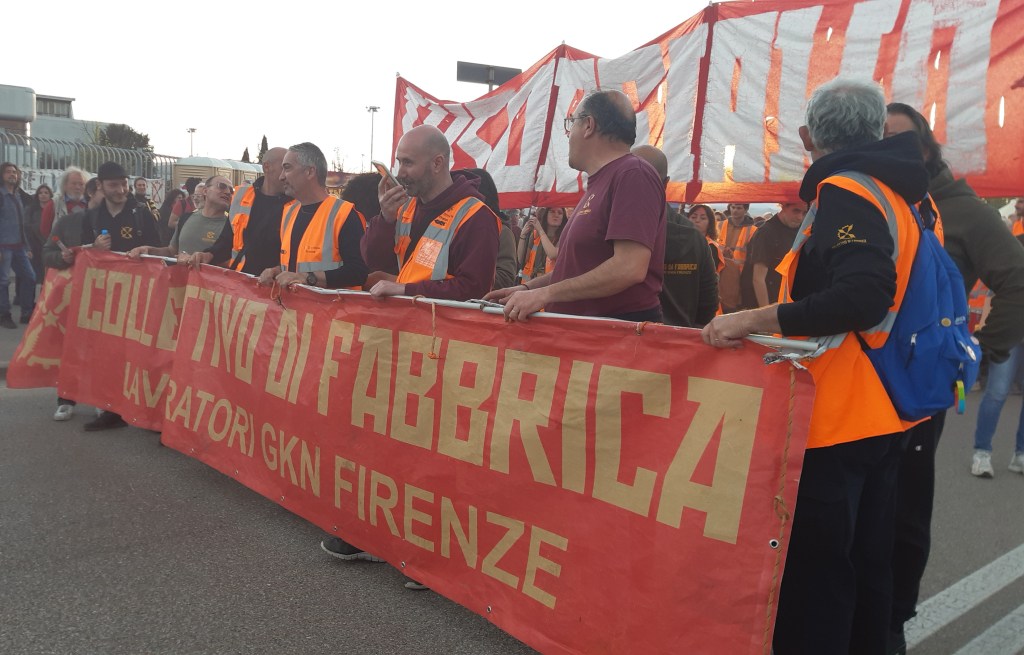
Shop stewards from the ex-GKN workers’ collective at Campi Bisenzio, Florence, leading 5,000 marchers in the latest demonstration of support. The large banner bears their slogan, Insorgiamo (Let Us Rise Up)Image by Hilary Horrocks
The demonstration at the weekend was called by the Collective in response to the cutting off of electricity to the plant by management stooges, part of a campaign of intimidation against a Festival of Working Class Literature held outside the factory at the weekend. But the Festival – attended by thousands of predominantly young people, went ahead, with impressive sessions by committed speakers on working-class writing internationally.
The Collective is appealing for financial support and for subscriptions to a co-operative ownership scheme for the factory.
The video is a recording of a Climate Justice Coalition webinar on the GKN worker’s struggle.
For more on the GKN occupation and a link to the REELNews video check out this post.
On 9 July 2021, Melrose Industries announced the closure of its GKN Driveline (formerly FIAT) factory of car axles in Campi di Bisenzio, Florence, and the layoff of its workers (more than 400). While in many such cases the workers and unions settle for negotiating enhanced redundancy benefits, the GKN Factory Collective took over the plants and kick-started a long struggle against decommissioning. However, what makes the Ex GKN Florence dispute really unique is the strategy adopted by the workers, who sealed an alliance with the climate justice movement by drafting a conversion plan for sustainable, public transport and demanding its adoption. Such a strategy engendered a cycle of broad mobilisations – repeatedly bringing tens of thousands to the streets – so that the dispute is still open, and the permanent sit-in at the factory remains until today.
The workers were meant to be finally dismissed on 1 January 2024. The GKN Factory Collective had thus turned new year’s eve into a final call to action to defend their conversion plan. Such a pressure from below probably played a role in the labour court’s decision, announced on 27 December 2023, to overturn the layoffs for the second time. The 31 December 2023 concert in the factory and the subsequent nocturnal march across Campi Bisenzio’s industrial area became a mass mobilisation to relaunch the workers’ current plan to set up a cooperative for the production of cargo bikes and solar panels, as part of a broader vision for a worker-led ecological transition.
This project needs material solidarity now – over 600,000 euros have been collected by the popular shareholding campaign to launch the co-operative, moving closer and closer to the target of one million euros. All information on how to contribute, individually or as an organisation, can be found at the website www.insorgiamo.org.
We were invited to contribute to a panel on North Sea Transition at the conference ‘Working for Climate Justice: trade unions in the front line against climate change’ at Toynbee Hall in East London on 27th of October.
Aberdeen – image by Pete Cannell CC0
Since we launched in the autumn of 2017 Scot.E3’s emphasis has been on building capacity for a worker led transition with a focus on workplace and community organising. Arguing for the rapid phase out of North Sea Oil and Gas has formed a central part of our campaigning. The Sea Change report, published in 2019, remains very relevant. It shows how switching from oil and gas to wind and solar would create a big net increase in jobs in Scotland and failing to make this transition would mean that targets to cut carbon emissions would not be met.
It’s very important that the climate movement has embraced the significance of North Sea oil and gas and a just transition for workers in the fossil fuel industries. That wasn’t so much the case in 2017. But two critical and closely linked challenges remain:
How do we build a mass movement with powerful roots in every workplace and working-class community that pushes for the necessary changes?
How do we engage workers in the energy sector, who are very aware that change is needed, but have very little confidence that it will be socially just?
For more than fifty years the big oil and gas companies have used their operations in the UK sector of the North Sea to blaze a trail for what we have come to know as neoliberalism; establishing practices that have been copied and taken up internationally. Outsourcing, multiple layers of subcontracting, anti-union policies and the use of blacklists. At the same time the so-called free ‘market’ has been featherbedded by massive state subsidies which have exceeded taxation revenue.
The onshore construction industry has been on the same journey. In Scotland the Construction Rank and File group has grown a new network through taking the construction industry using direct action tactics, picketing sites, and building combative organisation from the ground up. Just under a year ago two Unite activists, working on the new high voltage transmission lines from the Moray Firth to central Scotland were sacked for their union activity just before Christmas. However, after the Rank and File group picketed the main subcontractor and Scottish and Southern Energy they were reinstated with full back pay. The group has been a consistent supporter of Scot.E3 and have very publicly advocated for the importance of building worker organisation to ensure that the energy transition is a just transition.
Despite many analysts and some industry insiders warning that oil and gas is an increasingly risky investment global levels of investment are high and currently booming while the industry remains determined to squeeze as much oil and gas out as it can out of the North Sea. Among Westminster’s policy turns there has been a consistent adherence to the North Sea transition deal which describes in broad terms how that it is to be achieved. The Scottish Government and the offshore trade unions remain signed up to the ‘transition’ deal. Pursuing this path means that investment in hydrogen and CCS is prioritised at the expense of renewables, condemning UK consumers to a high cost and uncertain future and undermining progress to a genuine energy transition. There’s no evidence that big oil has any particular commitment to the North Sea, and they must know that hydrogen for domestic heating is hugely problematic, but they are very keen to stick with false solutions that are compatible with the existing infrastructure and networks of fossil capital.
The cost-of-living crisis isn’t over. However, to date, the climate and workers movements have failed to nail the intimate connection between fuel and food poverty and the oil and gas industry. Perhaps there’s a lesson here. At a time when we face a drawn-out existential crisis there is a need for new ways of organising that bring unions and communities together in common understanding and common struggle. There are some examples of what this might begin to look like. In Scotland Edinburgh Trade Unions in Communities provides an innovative model, while in France social movement trade unionism is having an impact.
Yesterday (9th August) campaigners from Climate Camp, This is Rigged and Scot.E3 were outside the office of Environmental Consultants Ironside Farrar in Edinburgh. Ironside Farrar have been commissioned to produce a masterplan as part of the rezoning of St Fitticks Park in Torry into an industrial Energy Transition Zone (ETZ). The protest is part of an ongoing campaign to persuade the workers at Ironside Farrar to direct their skills towards projects that contribute to a socially just transition. Mike Downham spoke at the protest. There will be another protest at the Ironside Farrar office next Wednesday 16th August from 8.30am.
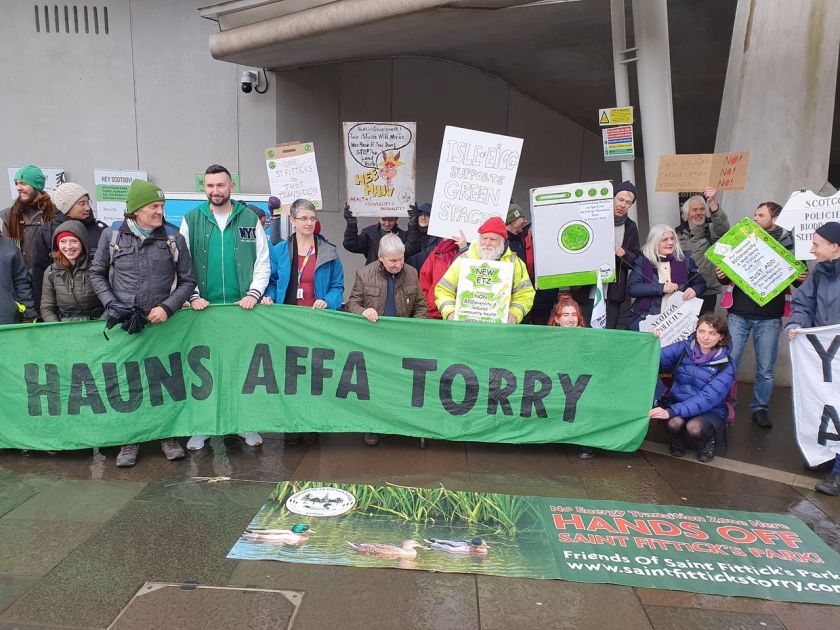
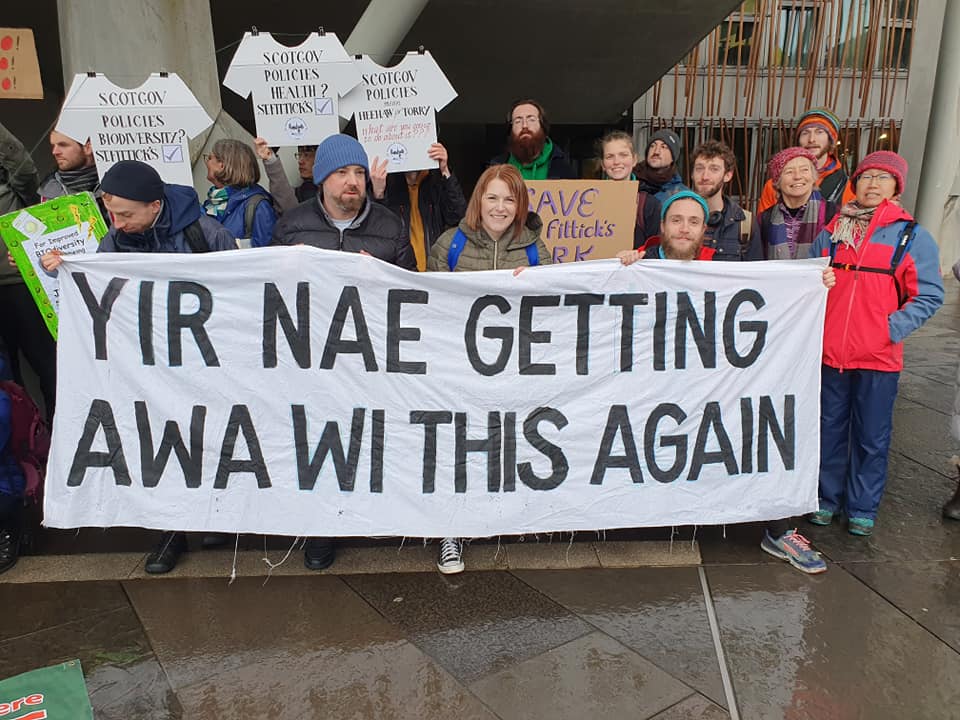
St Fitticks campaigners at the Scottish Parliament earlier this year
SPEECH OUTSIDE IRONSIDE FARRAR OFFICE 9TH AUGUST 2023
Welcome – and thanks for joining us this morning.I thought I would tell you why we’re here. This is the head office of Environmental Consultants Ironside Farrar – though the door doesn’t say that. We’re here to call on the employees of Ironside Farrar to boycott all further work for ETZ, the company oil tycoon Ian Wood set up to industrialise a large part of St. Fittick’s Park in Torry as an “Energy Transition Zone”. He then commissioned Ironside Farrar to get Planning Permission.
Torry is a suburb of Aberdeen, though it used to be a fishing and boat-building village just across the Dee from Aberdeen City. Then with the discovery of North Sea oil and gas in the 70s most of the village was bulldozed to make space for a Shell oil and gas terminal.
Since then Torry has been dumped time after time with the industrial development that other parts of Aberdeen don’t want – a landfill site, an industrial harbour where the Park used to come down to the beach at Niggs Bay, an incinerator close to the school, and now this threat to the Park which the Torry community cherish as their last green space. The threat to their community is huge. Ian Wood’s money persuaded Aberdeen City Council, who had previously invested much public money in improving the Park, to do a U-turn and re-zone it for industrial development. And Ian Wood’s money persuaded the Scottish Government not to intervene.
Ian Wood says the ETZ will contribute massively to bringing down carbon emissions, but much of the vague talk about what he wants to do is about developing Carbon Capture and Hydrogen technologies both of which are scams. This is in fact an attempt at a land-grab to justify continuing to extract oil and gas from the North Sea and fill the pockets of share-holders and directors in the Oil and Gas Industry.
Torry is about as disadvantaged a community as it gets, with appalling health statistics, appalling air quality and few employment opportunities. Despite this they are rising up and fighting for their lives against this plan to industrialise their Park.
Saving St. Fittick’s Park is exceptionally important, for three reasons:
If it’s industrialised it will represent a huge win for the Oil and Gas Industry and delay phasing out oil and gas extraction from the North Sea
It will destroy the significant biodiversity which has developed in the Park as a result of a lot of hard work and fundraising by the Torry community over the past 20 years.
And it will further sicken and impoverish the people who live in Torry. It’s this last which is arguably the most important of the three. Because if we don’t protect and prioritise the poorer communities up the north east coast of Scotland we’re done for. It’s these communities who can force significant change.
Two big things have happened in the six weeks since we started this campaign, which make Saving St. Fittick’s Park even more important. Climate has broken down across the world at a speed which wasn’t anticipated. Southern Europe and North Africa are on fire, and unprecedented floods in central China have displaced 100,000 people. The second thing is that the Westminster Government has decided to grant at least 100 new drilling licences in the North Sea. That these things can happen at the same time shows just how strong our governments are committed to fossil capital.
I’ll end by quoting a few things from the booklet The Declaration of Torry, a product of The Torry Peoples Assembly in May: on the back of this booklet they commit themselves to six actions:
We will do everything to stop the land grab
We will continue to use our Park and increase its already immeasurable value
We demand the incinerator be decommissioned
We will seek support to set up a Torry Retrofit Project to insulate our homes
We insist on a just and fair energy transition
We will strengthen collaboration within our community and with others in Scotland and beyond
And inside the front cover of the booklet, most powerfully:
THIS IS OUR LAND AND NO ONE ELSE’S
THIS LAND BELONGS TO THOSE WHO CARE FOR IT
Just one thing to leave you with. The people arriving for work this morning are highly trained and have knowledge and skills which will be essential when we’ve made the transition to clean energy. They know about tipping points in global heating, and about the complex relationships which underpin biodiversity. Ever since we started this campaign, we’ve been respectful to these workers, seeing them as part of the solution, not part of the problem.
At the same time they must surely understand the enormity of what Ian Wood is planning in Torry. They have the power between them to Save St. Fittick’s Park, by boycotting further work for ETZ. Even if they aren’t in the team working for ETZ, they can bring Ironside Farrar to a standstill by collectively withdrawing their labour.
Scot.E3 campaigns for a worker led just transition that would require at least 100,000 new climate jobs in Scotland. In our view the draft plan contains material that is useful and will be necessary as part of the energy transition that is needed. We particularly welcome the draft plan’s suggestion that the Scottish Government should not support any further exploration or development of oil and gas fields – this is vital and needs to be followed through. But overall, the draft plan aims for too little and too slowly, and it fails to provide a coherent strategy to reduce emissions and reshape the Scottish economy.
The plan is flawed in several fundamental ways:
It relies on the private sector to a achieve its ambitions.
It follows the strategy outlined in Offshore UK’s North Sea Transition deal which aims for net zero emissions achieved through the large-scale implementation of carbon capture and storage.
It accepts the hype around hydrogen uncritically.
Mass scale retrofitting and decarbonising domestic heating and cooking is not given enough priority.
There is no clear plan for expanding public transport systems.
There is no strategy for creating a resilient smart energy grid that would integrate local community energy initiatives with large scale wind, tidal, hydro, and solar.
It accepts the concept of net zero when we the climate science tells us we should be aiming for real zero.
It fails to consider how a national energy company (Scottish Climate Service) could drive forward a strategy for zero emissions and harness the skills and creativity of the energy sector’s current workforce or the many thousands of young people who are required to make a sustainable energy sector a reality.
Notes
Points 1 and 8. Public versus private. As a campaign Scot.E3 believes that the oil and gas industry aim to extract the maximum profit from its existing business and to maintain the power and influence which it established through the 20th century and into the 21st. The infrastructure and practices of what Andreas Malm calls Fossil Capital are incompatible with a sustainable renewable economy. We understand that not everyone would agree with this analysis. However, the scale and scope of the economic transition that is required is unprecedented. The nearest comparisons – transitions to war economies in the UK and the US between 1939 and 1945, and the US New Deal in the 1930’s, depended on strategic planning, public control and high degrees of regulation over the private sector. The Scottish government’s objectives for a just transition can only be met by a much higher level of public investment, democratic control, and regulation than the energy plan proposes.
Points 2 and 3. Rejecting the false solutions contained in the North Sea Transition Deal. In brief the North Sea transition deal (written by the oil and gas industry and endorsed by Holyrood, Westminster, and the Offshore trade unions) is a plan to maintain oil and gas production from the North Sea for as long as possible, and certainly beyond 2050. Carbon capture and a hydrogen economy are central to the plan. There is place for carbon capture when we’ve ended fossil fuel emissions and can focus on repairing the damage created by global temperature rise. And there is a place for hydrogen as a fuel in a small number of important but specialised applications. However, the energy plan’s proposals for prioritising carbon capture, and for making Scotland a world leader in hydrogen production, direct the focus of the plan away from the necessary investment into decarbonising energy production and use right now, and make it much more difficult to achieve the energy transition that we need. Carbon capture at large scale is an unproven technology, while producing green hydrogen is highly inefficient and requires very large amounts of green electricity. A recent report, The Future of Home Heating by the Imperial College Energy Futures Lab notes that ‘Hydrogen production would be best used strategically and its deployment prioritised in sectors which are hard to electrify or decarbonise such as heavy industry, shipping, aviation and heavy transport.’
Point 4. Retrofitting. Energy for domestic heating and cooking in Scotland is mainly supplied via the natural gas network and currently accounts for more than 20% of emissions. The level of emissions could be significantly reduced through improving standards of insulation. Action on building regulations for new builds is possible straight away and amendments to guidance and regulations for the insulation of the existing housing stock to include the new breathable insulation materials that are now available (for example the hemp based materials produced in the Scottish Borders) could also be made very rapidly. A mass campaign of retrofitting requires coordinated action and investment that involves the development of skilled direct works teams in every council area and the resourcing of Further Education Colleges to provide good quality training. At the same time the transition from gas to electricity needs to be coordinated with the timescale for the rundown of North Sea gas production. Retrofitting creates new jobs and has the potential to enhance the health and well-being of the Scottish population. Action now, with investment designed to ensure that no one is excluded is a critical part of a just transition and can win hearts and minds to the project of transforming the economy.
Point 5. Public Transport. Simply replacing petrol and diesel vehicles by electric vehicles will not remove all emissions, will increase demand for scarce and environmentally damaging resources and perpetuate inequality. A sustainable energy plan requires large-scale improvements in public transport networks.
Point 6. Developing a smart grid. This is a surprising omission from the draft plan. A smart grid that includes large scale wind, solar, hydro and tidal energy sources combined with a network of community-based energy schemes and storage that includes local district heating schemes is technically feasible and would ensure that the system is resilient in the face of varying climatic conditions and demand.
Point 7. Net Zero. In practice net zero has become part of the set of false solutions used by the fossil fuel industries to delay real action on emissions. It is bound up with arguments for carbon capture and carbon offsetting. The latter has done almost nothing to actually reduce emissions (see for example Dyke, Watson and Knorr – ‘Climate Scientists: Net Zero is a dangerous trap) and often creates social problems in the private takeover of land for monoculture forests or other crops. We would argue that an effective energy plan requires a critical position on net zero and setting the objective as absolute zero emissions. The only way to achieve real zero in the context of the climate emergency is to phase out oil and gas quickly, starting now, and to invest heavily in renewable sources of energy.
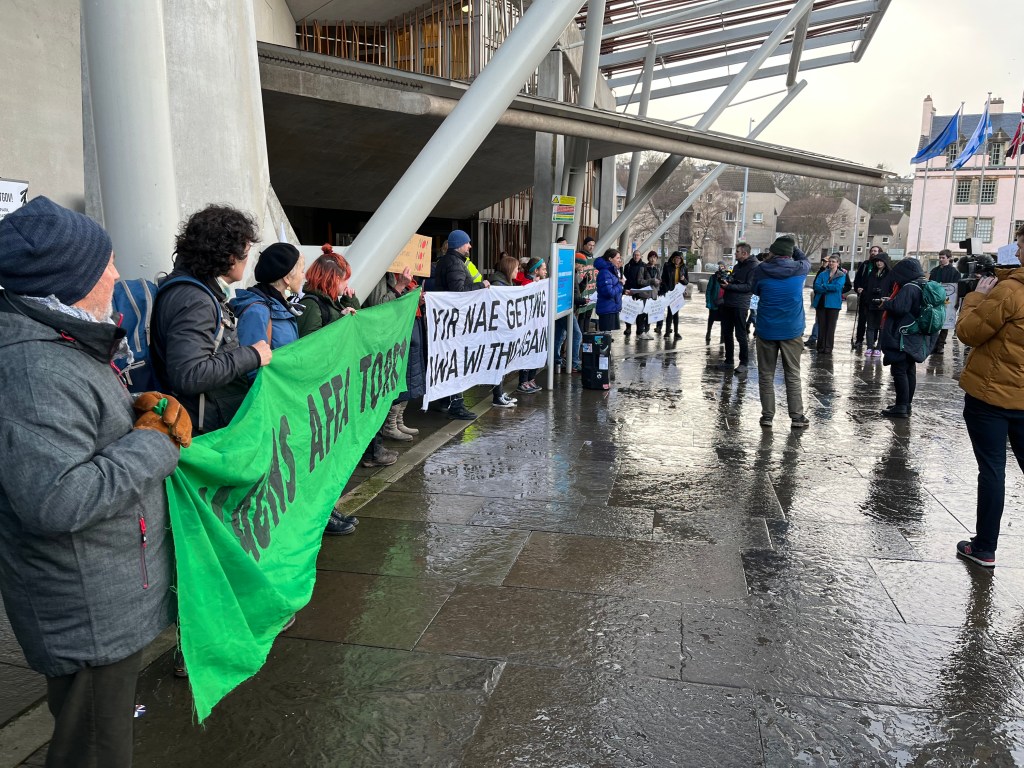
Demonstrating outside the Scottish Parliament in January 2023
Campaigners in Torry are still waiting on the Scottish Government announcement that was expected back in January. Each month it has been put back another 28 days and is now due on 6th May. If the government gives the go ahead to the current plans for the ETZ (Energy Transition Zone) it will be a decisive step down a road that panders to the oil and gas industry and has nothing to with social justice. St Fitticks Park, which the plans would take over for industrial use, is the only green space in a working class area that suffered from decades of pollution as a result of the oil and gas industry. Most recently a new Energy from Waste incinerator, built close to a primary school, has led to a further deterioration in living conditions.
This film from REELNews highlights the issues involved and the resistance of the local community. Please share it widely.
In the film it’s noted that it’s not clear what use the new industrial zone will be put to. However, since the film was made campaigners have found evidence that there will be a large hydrogen storage facility – with 80% blue hydrogen and 20% green – that will be used to convert the cooking and heating supply for 20,000 social housing tenants in Aberdeen. If this goes ahead not only will Torry lose it’s green space many of its residents will be locked in to a very expensive energy future.
St Fitticks deserves to be a national campaign. The issues it raises around social justice, the use of hydrogen and carbon capture are national issues and they expose the weaknesses and contradictions in Scottish Government Energy Policy.
Share this post – support the St Fitticks campaigners.
Read more detail and watch video from the campaign here and here.
Around 80 people, with a strong contingent from Aberdeen, rallied at the Scottish Parliament yesterday to demand that the Scottish Government stops developments in Torry, Aberdeen that would see the end of St Fitticks park, a hugely important green space in a heavily built up area. The message from the protestors was that there’s no justice if ‘transition’ is driven by the Oil Industry seeking new sources of profit at the expense of working people and the environment.
The protestors called for supporters to text, tweet and use every available means to tell Minister Tom Arthur and your local MSP to order the removal of the rezoning of St Fittick’s Park from Aberdeen’s new Local Development Plan.
An international conference in Brussels organised by the Rosa Luxemburg Foundation 27-28 June
Ellie Harrison (Get Glasgow Moving) and Mike Downham (ScotE3), representing their organisations in the Free Our City coalition which campaigns for free, publicly owned, democratically controlled buses across Greater Glasgow, were invited to speak at this conference as a result of contacts made during COP26. They also showed the Reel News film of the Free Our City protest during the COP as previously published on this Blog.
Here Mike Downham summarises his reactions to the conference:
It was a privilege and a pleasure to be invited to speak at this conference and to get to know in the evenings the other speakers from Germany, France, Spain, Italy, Hungary and Brazil.
The lid on the coffin of cars was firmly nailed down, whether powered by a combustion engine or by electricity. It was clearly demonstrated that if cars continue to be produced there is no way that carbon emissions can be reduced in time to avoid a more than 1.5 degree rise in global temperature or that levels of poverty will fall in time to prevent societal chaos, despite the huge effort by car manufacturers to greenwash electric cars. We were able to point out that in any case only 49% of households in Glasgow have access to a car – that figure predating the price rise in cars and the cost of living crisis.
The EU’s carbon emissions discourse has been reduced to targets and choice of technology, with little reference to just transition for the millions of car manufacturing workers across Europe – 800,000 in Germany alone – nor to the transformation needed, especially in the way we move about our cities. Furthermore the emissions targets look less and less realistic.
Moving to mass transport is as urgent as stopping oil and gas extraction. Free public transport is also a more immediately attractive concept for large numbers of people than doing without oil and gas.
Three expert speakers (Ellie Harrison of Get Glasgow Moving, Alana Dave of the International Transport Workers Federation, and Mario Candeias of the Rosa Luxemburg Foundation) told us exactly what needs to be done about public transport – above all that it needs to be publicly owned, democratically controlled, integrated in a way that gets people quickly to where they want to go, and free.
Electric Bus pixabay.com CC0
Key to the transformation of transport are the highly developed skills, self-esteem and producer pride of car production workers. These skills are needed in the production of electric buses, trains, bicycles and ships. Some but not all workers will need new training, giving them the choice to remain within the transport sector or into other carbon negative sectors like renewable energy, or carbon neutral jobs in public services.
Transport needs to be seen as a common good and a right. Mobility poverty is as urgent an issue as fuel poverty and food poverty, though in Brazil, where there are 30 million hungry people, transformation of transport will inevitably take longer to achieve, even if Lula regains power.
Once again we know what to do – that’s not the issue – the issue is how to achieve the power to get it done. But transport workers have more power than most other workers, both because so many people rely on them in their day-to-day lives, and because many of their skills are hard to replace – witness the current RMT rail workers strikes, and the Rolls Royce workers in East Kilbride who grounded half the Chilean Air Force in 1974.
Mario Candeias speaks of a pathway to power:
MOVEMENTS → STATE INTERVENTION → PUBLIC OWNERSHIP → INDUSTRIAL STRUCTURAL CHANGE OVERSEEN REGIONALLY BY WORKERS AND USERS
The question is what movements? He suggests partnerships between existing trade unions and civil society organisations. In my opinion movements which can reach sufficient scale fast enough are more likely to arise from new formations, especially those led by young people currently active for climate justice. These are currently targeting their civil disobedience on oil, gas and coal production sites, recognising that opposing forces largely reside in the fossil fuel industries. Will they also see the need to target car production sites to challenge the huge power of Volkswagen, Daimler and BMW?
These discussions were taking place in Brussels, where it’s estimated that there are between 15,000 and 30,000 lobbyists – that’s between 20 and 40 per Member of the European Parliament. Of these 87.5% represent capital interests.
The most encouraging thing for me was to have two days in international company – the first non-remote opportunity for me since before the pandemic. I was left reflecting about the central importance of workers and communities united across borders in opposing the power of capital. The EU is perhaps an object lesson about how not to deal with borders – the old issue of merging economically, but retaining political independence. The speaker from Hungary described his country as in a “German trap”, German companies using cheaper Hungarian labour for their assembly lines for both cars and weapons.
Further reading – English copies of these three booklets, all published by the Rosa Luxemburg Foundation, are available free in limited numbers. If you’re interested please contact me first at mandrdownham@phonecoop.coop
Switching Lanes by Mario Candeias, 2022
The European Car Lobby by Tobias Haas and Hendrick Sander, 2019
ScotE3 will have a stall at the Scottish Trades Union Congress in Aberdeen for 25th – 27th April. We’ve produced a leaflet for the delegates. The text is reproduced here.
Fuel Poverty
Everyone knows that we are in a cost-of-living crisis. Most of us in Scotland rely on natural gas for cooking and heating and North Sea gas is a guided missile sent into every home in the country which will drive thousands of new people into poverty and will kill the most vulnerable. Oil and gas producers are making mega profits and demanding money with menaces. They’ve unilaterally torn up the social contract that they operate under and have weaponised gas. The 54% increase on 1st April will be followed by another steep rise later this year.
Before this happened around a quarter of Scots lived in fuel poverty. As a result of the price rises, hundreds of thousands more will be dragged into a position where they are forced to make impossible choices between food and heating. The response from the Tories has been derisory. Their so-called Energy Security Plan does nothing to tackle immediate hardship and doubles down on the most expensive energy options for the longer term – nuclear, oil and gas, hydrogen for heating and carbon capture and storage.
Business as usual
There is a simple reason why the Tories have made these choices. In the face of the climate and cost of living crises they’ve chosen to protect the interests of big oil. It’s not just that they won’t tax the enormous profits that are being made from North Sea Oil and Gas – it’s that they are following the logic of the oil industry’s ‘North Sea Transition Deal’.
A phony deal
The Deal aims to continue the exploitation of North Sea oil and gas up to and beyond 2050. It talks about a net-zero oil and gas basin where the greenhouse gas emissions from the oil and gas would be captured and stored. This is not going to happen, certainly not in the next few decades, and the consequence will be that the UK will fail to meet its contribution to restricting global temperature rises.
Maintaining profits – wasting resources
Following the ‘Transition Deal’ drives high-cost energy options at every step and leaves working people to pay the price. Under the UK government plan, most of the electricity produced by the new nuclear power stations will be required to produce the hydrogen for domestic heating. Using electricity to produce hydrogen for domestic heating at large scale is hugely inefficient. Moreover, nuclear produces much more carbon emissions over its lifecycle than wind or solar.
There is an alternative. Electricity produced by wind and solar is already much cheaper than that produced by nuclear, oil and gas and the costs of renewables continue to fall. The money the Tories want to spend on new nuclear is enough to retrofit most homes across the UK – creating jobs, improving health and well-being, and cutting energy demand. Moreover, an economy based on renewables results in many more jobs than the fossil fuel and nuclear options.
A challenge for the trade union movement
Right now, industry, unions and both the Westminster and Holyrood governments are signed up to the North Sea Transition deal. It’s time for a decisive shift in policy. Just transition, indeed arguably any transition that restricts temperature rises to 1.5 degrees, is incompatible with the ‘North Sea Transition Deal’.
A new policy for the union movement
Tackling the cost-of-living crisis and the climate crisis means breaking the partnership with big oil that is inherent in the Transition Deal and campaigning for an end to the development of new North Sea oil and gas and the rapid planned phase out of existing fields. Large-scale investment in renewables and a massive programme of retrofitting would result in lower energy prices and reduced carbon emissions. A serious plan would include support for the oil and gas work force while they transition to new jobs and ramping up options for reskilling, education and training in the new industries.
No more subsidies
The oil and gas industry has been subsidised heavily over the lifetime of the North Sea. The subsidies must stop. Working people are suffering because what they pay for energy fuels super profits for big oil and goes into the pockets of the richest in society whose wealth grows as hedge funds speculate on the oil market. There’s plenty
of money to pay for an energy transition.
Among the components of a new policy for the workers movement should be:
Massive investment in wind, solar and tidal energy.
Large-scale expansion of energy storage options.
No more North Sea development.
Taking the North Sea into public ownership and beginning a planned phase out of production.
Support for oil and gas workers to transition to new jobs.
Regulate energy prices to consumers and tax big oil and the rich to end the cost-of-living crisis.
COP26 gave us a glimpse of the potential power when the workers movement and the climate movement come together. Together we can win.
About ScotE3
Check out our website at https://scote3.net The resources page includes short briefings designed to be used in the workplace and created under an open license so that you can modify and adapt them providing you acknowledge ScotE3 as the original source of the material. We are keen to produce more briefings and we’d welcome suggestions for new briefings and updates to existing ones. We can also provide speakers for trade union branch meetings and discussions.
Yesterday (6th April) the UK Government announced a new ‘British Energy Security Strategy’. The shape of the strategy isn’t a surprise with many of the elements being trailed in recent weeks. Put simply the strategy is a disaster. It’s a recipe for failing to meet UK greenhouse gas emission targets and ignores the recommendations of the IPCC report that was published earlier in the week (4th April).
This post is a first response, and we will share more detailed analysis in the weeks to come.
The government’s press release notes that the strategy involves an ‘ambitious, quicker expansion of nuclear, wind, solar, hydrogen, oil and gas, including delivering the equivalent to one nuclear reactor a year instead of one a decade.’
Note the ‘expansion of oil and gas’. The aim will be to accelerate the approval of new oil and gas fields in the North Sea and west of Shetland. Essentially, it’s a doubling down on the oil industries so called ‘North Sea Transition Deal’. The aim of the deal is to make the North Sea a ‘net-zero’ oil and gas basin by 2050 – but this can only happen if carbon capture and storage can be developed and introduced at large scale, which is as yet uncertain.
Hydrogen is part of the oil industry strategy – the aim of the transition deal is for hydrogen to replace North Sea gas in domestic and commercial heating systems – these currently account for more than 20% of UK greenhouse gas emissions. The strategy talks about hydrogen supplying around 10% of energy needs. What it doesn’t say is that producing hydrogen by splitting methane or water is an enormously inefficient process and so a very significant proportion of all the new electricity produced from nuclear, wind, solar and oil and gas will be needed to produce the hydrogen!
After a period of equivocating on nuclear power it’s now back at the centre of the strategy. No figures are given, but if we extrapolate from the cost of the current Hinkley C project the proposed developments will cost around £150 billion. The government refers to nuclear as clean and safe. It is neither. This blog has looked at the arguments about nuclear elsewhere. It’s a hugely expensive form of energy, high risk with long construction times and a history of cost overruns and serious and unresolved problems with radioactive waste.
The new strategy says nothing about reducing energy demand through insulating new buildings and retrofitting existing housing stock. Retrofitting the majority of UK housing is estimated to cost around £160 billion – this is roughly what the new nuclear programme will cost. So, it seems like their plan is to construct large scale nuclear plants whose output will then provide the energy that is lost through the walls and roofs of homes, office and factories.
The supposed rationale for the new strategy is energy security. Currently working people are paying the price for the super profits being earned by the oil and gas sector. Led by that sector the strategy opts for a future of high energy prices – continuing oil and gas and new nuclear. Renewable costs continue to decrease, nuclear energy costs continue to rise. Currently renewable electricity is 6 times cheaper than gas and the gap is even bigger between the cost of renewables and the cost of nuclear.
Wind turbines near Carberry – image Pete Cannell CC0
It will be interesting to hear the response from the Scottish Government. Until now Holyrood has been firmly signed up the North Sea Transition Deal and the oil industry agenda, but it has had a firm position of no new nuclear. Similarly, it is now crunch time for the trade unions who have advocated just transition while endorsing the Transition Deal Strategy. The argument at root has been over jobs. It has been the case for a long time now that large-scale investment in renewables creates far more jobs than the same investment in nuclear. Yesterday’s strategy announcement means in effect no transition and no justice. There is an ever more urgent need for the workers movement and the climate movement to work together in opposition to the new strategy (really just the old strategy with more investment in false solutions). Less than 24 hours after its release the strategy has been widely criticised but we will need to do more than oppose this latest attempt at preserving an unacceptable status quo and reject the North Sea transition deal in its entirety.














 Employment, Energy and Environment