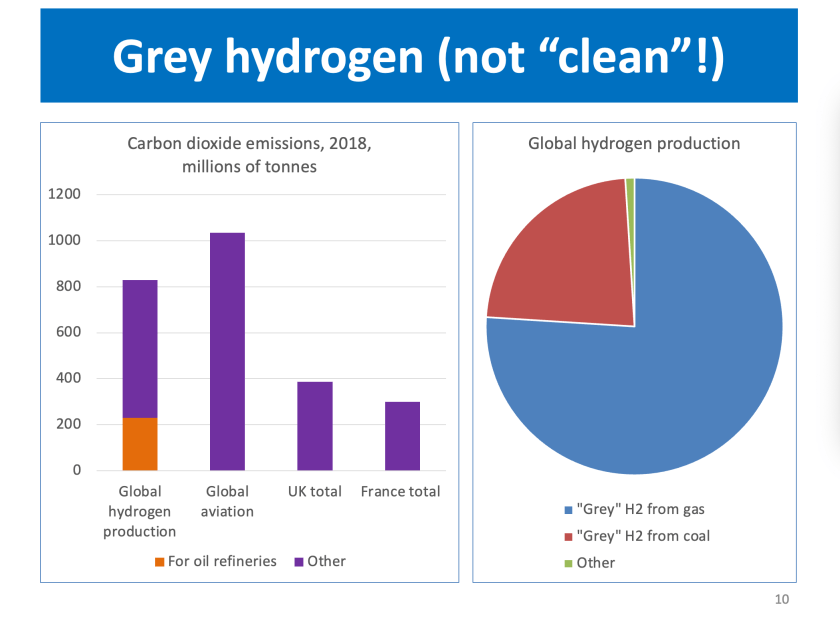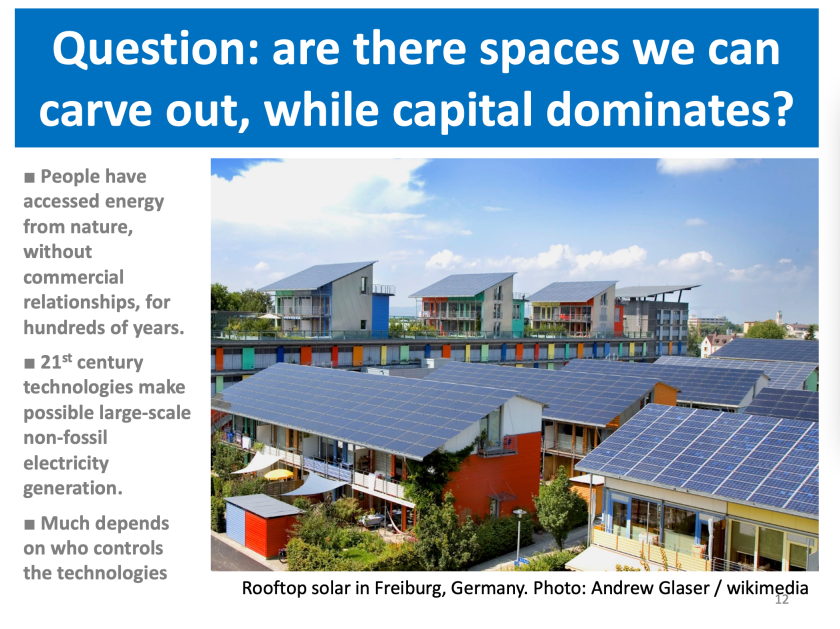
The slides from Simon Pirani’s talk at the Scot.E3 conference
Simon edits the People and Nature blog and is the author of Burning Up – a global history of fossil fuel consumption. In the introductory session of the conference he argued that Climate Change is an injustice multiplier and that Net Zero and Technological Transition are frauds. He asked how do we defend workers’ rights in the climate emergency and whether there are spaces we can carve out while capital dominates.
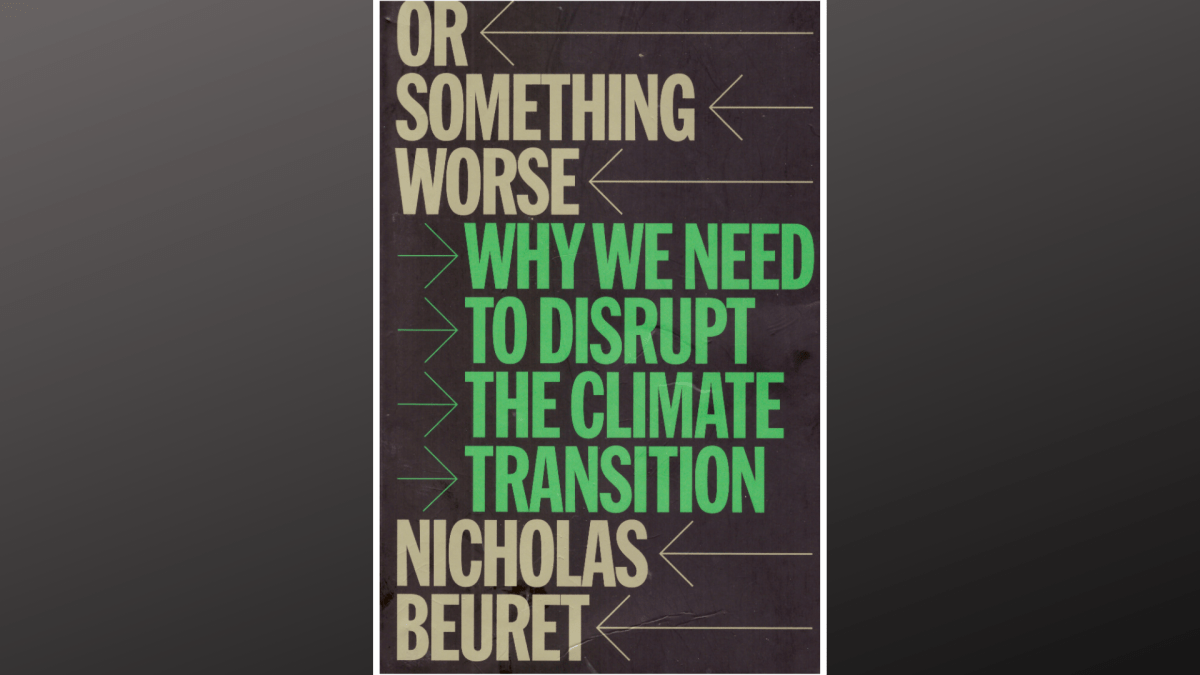
Simon Pirani reviews More, More and More: an all-consuming history of energy
Review by Simon Pirani of More, More and More: an all-consuming history of energy, by Jean-Baptiste Fressoz (Allen Lane, 2024). This article was first published on the People and Nature blog.
We really are in climate trouble now. The intergovernmental climate agreements, for whatever they were worth, are in peril. The target of limiting global heating to 1.5 degrees is effectively lost. A more chaotic global order beckons, as Trump lashes out furiously at the international institutions the declining USA so long dominated.
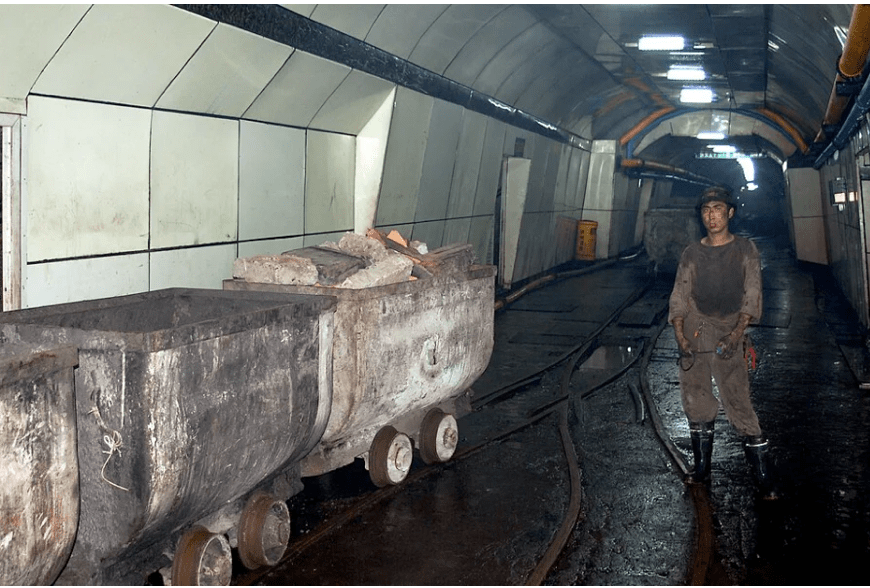
A coal miner in Xingtai, China, which now burns coal at 15 times the rate that Britain did in the 19th century / Photo: Wikimedia commons
New rounds of fossil-fuelled capital expansion threaten. AI and other technologies, far from helping, turn the screw of rising energy consumption. And pathetic, shameful politicians assure us that capital will meet the challenge with its “energy transition”.
Jean-Baptiste Fressoz’s wonderful book shows how the whole idea of “energy transition” is deceitful and dangerous – “bad history”, on which we can not base our visions of the future. If we are to find real answers to the climate crisis, we will need better understandings of energy and material dynamics than that.
There are two main parts to Fressoz’s argument. First, he shows how clunky, stagist simplifications, such as “transitions”, have distorted historians’ understanding of changes in technologies and fuel uses. False assumptions about past “energy transitions” are used to support comforting but illusory narratives about how we might move away from fossil fuels.
Second, he explains how, in the 1970s and 80s, a future “energy transition” – a shift of technologies, firstly to nuclear power – became the dominant, false “solution” to global heating, largely at the bidding of the US ruling elite. He interrogates the ideological prejudices that influenced the economists, energy analysts and other scholars who fed this narrative, and shows how it took hold – albeit not unchallenged – in the Intergovernmental Panel on Climate Change (IPCC) in the 1990s.
Energy history
The first part of the argument concerns tonnes of wood, coal, oil and other energy carriers. In the popular imagination, and the work of some careless historians, wood was displaced by coal in the late eighteenth and early nineteenth centuries, and coal by oil in the twentieth. But that’s not what happened.
Far from wood being left behind by coal and oil, in the twentieth century more was consumed than ever, in buildings, railways, crates, barrels, cardboard, paper – and pit props in coal mines. Far from coal being left behind in the “age of oil”, global production and consumption has risen in the twenty-first century to unprecedented heights.
“After two centuries of ‘energy transitions’, humanity has never burned so much oil and gas, so much coal and so much wood”, Fressoz writes (page 2). China now burns coal at about 15 times the rate that Britain did at the height of its “age of coal”.
That’s the “More, more and more” of the book’s title. But this is not just about quantity; it is also about the complexity of energy systems in which wood, coal, oil and other materials are used in increasingly interdependent ways.
To underline the point about wood and coal, Fressoz describes the heavy dependence of twentieth-century coal mines on the availability of wood for pit props. “Without abundant wood, Europe would simply have had no coal, and hence little or no steam, little or no steel and few or no railways”, he writes (page 55).” Things have changed, but this is not a transition, he insists: “rather, we should be talking about a symbiotic relationship that intensified during the nineteenth century, followed by a gradual disengagement that really began in the second half of the twentieth century.”
Even now, hundreds of millions of people rely on woody biomass for basic fuel needs; in Africa’s big cities, charcoal is a fuel of choice – two or three times more energy-dense than wood, and transported by oil-fuelled vehicles. “This new energy system is based on a combination of wood, muscle power and oil”, Fressoz writes (page 124).
Women workers loading timber for pit props in the UK in 1943. Photo: Imperial War Museum
Neither does it mean much to talk about a “transition” from coal to oil, Fressoz insists. While the wood-coal symbiosis weakened in the late twentieth century, the coal-oil symbiosis became stronger. More steel from coal-fired furnaces was needed to extract and transport oil, and to build hundreds of millions of oil-consuming cars and other oil-driven machinery. Conversely, mining coal from huge open-cast operations, and transporting it ever-greater distances, needed oil.
If the coal-to-oil “transition” did not happen, then the fashionable idea that it reshaped the relationship between labour movements and political power makes no sense. Fressoz offers an iconoclastic take-down of this false logic.
His bluntest questions are for Timothy Mitchell, who argues in Carbon Democracy: political power in the age of oil (2011) that the workers’ movement’s advance in Europe and America in the late nineteenth and early twentieth century was closely linked to coal miners’ economic power, while oil, extracted with significant capital and minimal labour, largely undermined labour.
Carbon Democracy’s “enthusiastic reception in the academic world testifies to an appetite for materialist explanations of politics and a paradoxical lack of interest in the history of production”, Fressoz writes (page 86).
‘Energy transition’ as politics
The second part of Fressoz’s argument concerns “energy transition” as a political discourse centred on technological innovation, an ideological cable that binds together governments’ “climate policies” and corporations’ PR fables.
He starts in the USA in the 1920s, when the apparently eccentric technocratic movement urged “transition” from capitalism to a society based on the most efficient use of energy and labour, through the rational deployment of technology.
In the 1940s came the atom bomb, which helped the US achieve unparalleled geopolitical and economic dominance. Its nuclear scientists found themselves in an unusually privileged position. In this milieu, long-term energy forecasting was all the rage – firstly, to convince politicians of the benefits of generous state investment in nuclear power, and, specifically, in breeder reactors that promised to produce new nuclear fuel more rapidly than they burned it.
Fressoz shows how nuclear lobbying sat comfortably with neo-Malthusian ideas about resources, including fossil fuel resources, running out due to population growth. Into this mix of ruling-class ideology, and the science influenced by it, came the issue of climate change:
Because the nuclear lobby was defending a very long-term technological option – the fast-breeder reactor – it produced a dystopian and innovative futurology, focusing not only on the end of fossil fuels, but also, as early as 1953, on global warming (page 154).
In the 1960s and 70s, “energy transition” was brought into wider public discourse, together with a new discursive battering-ram: “energy crisis”. That was a misnomer for the 1973 oil price shock, when social and political ferment in the Middle East and Latin America, culminating in oil company nationalisations and a partial boycott of sales to the USA, forced a shift in the terms of trade in the oil-producing nations’ favour. Fressoz argues that the “energy crisis” had already been invented by the nuclear lobby in the late 1960s: the battles over oil made it taken-for-granted common sense.
Energy system forecasting, too, went mainstream in the 1970s, thanks to the oil price shock and advances in computing. Fressoz shows that the computer models often focused on one technology superceding another, e.g. nuclear over oil, rather than the cumulative expansion of energy supply in the context of capitalist economic growth. He critiques the work of the Italian nuclear physicist Cesare Marchetti, who pointed to energy systems’ inertia, and argued that we could learn more about the future from historical statistics than from models that sketched a transition to nuclear dominance.
Fressoz concludes that, for half a century, energy research has focused too much on technological innovation and too little on the persistence of old technologies.
Even today, the many studies of technological diffusion hinder our understanding of the climate challenge. On the one hand, […] they say nothing about the disappearance of the old, making the assumption – implicit or explicit and in any case unjustified – that this would be symmetrical with the diffusion of the new. On the other hand, […] since energies and materials are in symbiosis as much as in competition, we simply cannot use a technological substitution model to understand their dynamics. Nonetheless, the experts are still comforted by the upturn in the diffusion curve for wind and solar power, as if it were equivalent to the disappearance of fossil fuels. (pages 178-9).
Who cares about the history of research, now we are confronted by climate crisis? We all should, because – as Fressoz shows in a fiercely polemical chapter on the IPCC – the technology-focused futurology summoned up by the “atomic Malthusians” of the 1950s, and written in computer code by the energy forecasters of the 1970s, now walks tall across the pages of the scientific reports on which the international climate talks rely.
By the 1990s, “a neo-Malthusian technological futurology for rich countries had suddenly become a safeguard plan for the entire planet … How was this scientific and political scandal possible?” Fressoz asks (page 180).
In the 1980s, as the climate scientists’ understanding of global heating improved, and fossil fuel burning confirmed as indubitably the main cause, it became clear that energy policy goals had to shift. The move away from fossil fuels had to be faster, not because of a Malthusian exhaustion of resources, but because of the damage done by the global economy’s constant expansion.
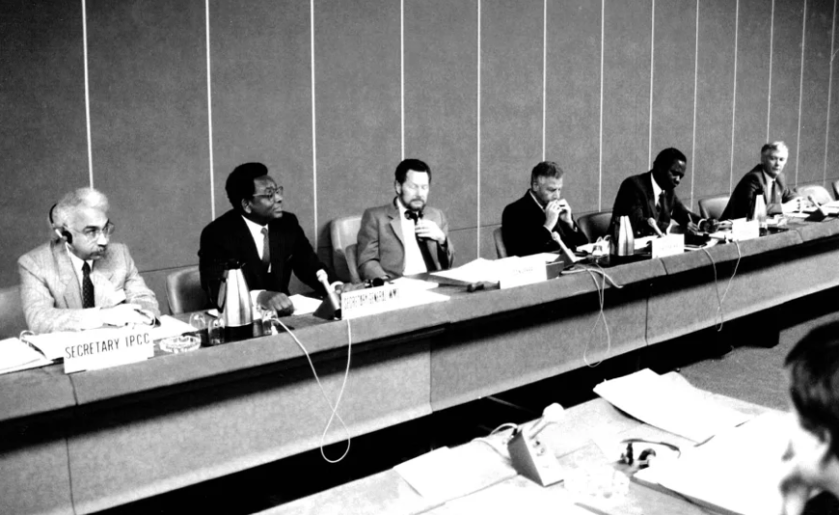
A meeting of the Intergovernmental Panel on Climate Change in the 1980s. Photo from the Geneva Environment Network
Corporate technological “solutions” to the 1970s “energy crisis” were now repurposed for this real climate crisis, Fressoz argues. The Nobel-prize-winning economist William Nordhaus, who sketched out the economic-growth-plus-innovation strategies that heavily influenced the IPCC, has much to answer for.
Fressoz quotes the minutes of the 1979 World Climate Conference in Geneva, at which oil company representatives talked of a long transition away from fossil fuels (to 2100), mainly by way of technological innovation, and many prominent scientists agreed – until the nuclear physicist David Rose warned that Nordhaus’s approach, of postponing the transition until new technologies and new capital made it less painful, was “the perfect recipe for climate disaster” (page 190).
Fressoz describes how scientists, engineers, and social and political researchers sometimes resisted, cut across, worked alongside, or capitulated to the ideological pressure of capital. Or complicated combinations. I hope this account will be read, and thought about, by activists who in Extinction Rebellion’s heyday coined the slogan “listen to the science”, as though “the science” is a deity existing above and independently of the societies we live in and the rapacious capital that dominates them. It is not.
By 1988, when the IPCC’s Working Group III was set up, with a brief to advise governments on mitigating climate change, the aim of those governments, the US’s in particular, “was to regain control over international climate experts, who were quick to brandish emission-reduction targets without weighing up their economic effects” (page 199).
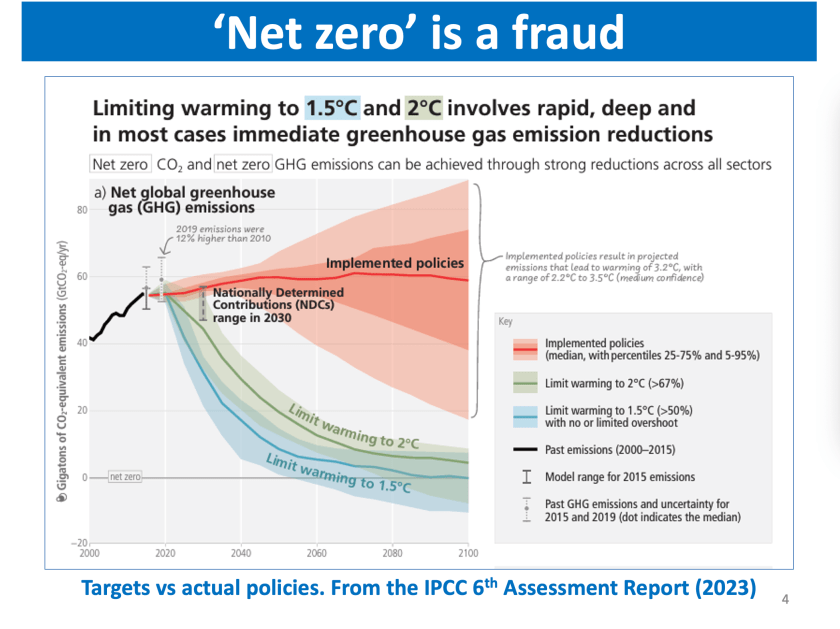
Did they bring the scientists to heel? Yes and no. In the run-up to the Paris climate conference in 2015, scenarios mapping slow progress were superceded by those envisaging rapid decarbonisation, in line with the 1.5 degree target adopted. But, as Fressoz shows, the most powerful governments had meanwhile proceeded in practice with the slowest decarbonisation trajectories.
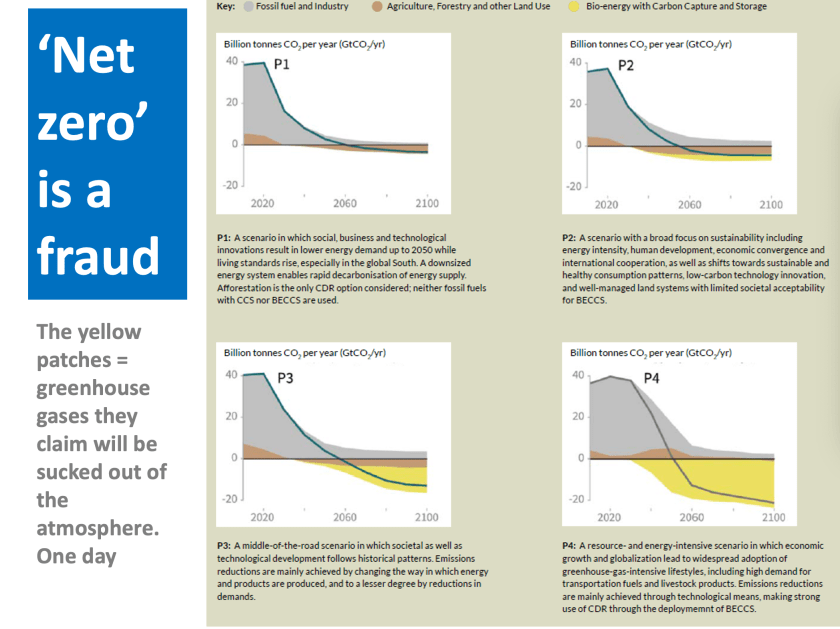
As the gap between these pathways and reality widened, it was filled with a new technofix – “negative emissions” technologies such as carbon removal, that would help achieve “net zero”.
Without saying so, without discussing it, in the 1980s and 1990s, the industrial countries chose – if that word has any meaning – growth and global warming, and gave in to adaptation. […] Populations were not consulted, especially those who will be and already are the victims (page 211).
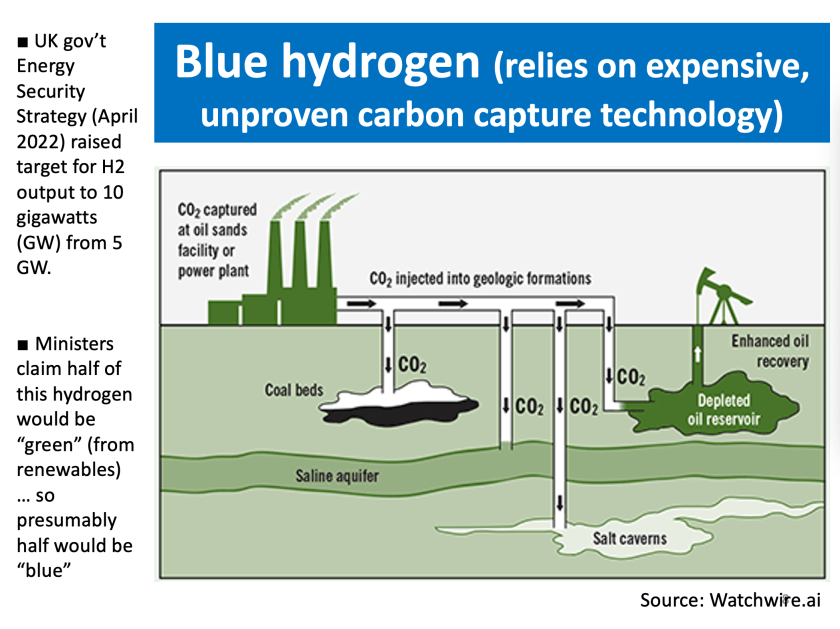
Fressoz concludes that the concept of “transition”, which lives on in the current obsession with carbon capture and storage, hydrogen and other false “solutions”, is “the ideology of capital in the twenty-first century. It turns evil into cure, polluting industries into the green industries of the future and innovation into our lifeline.” (page 220).
Past, present and future
To make the change that Fressoz suggests is needed – that is, to move away from fossil fuels by a deep restructuring of the economy – would require “a powerful coalition to impose its will, to make history in the most radical sense”, the economic historian Adam Tooze argues in an earlier review of More, More and More. But, he adds, “formulated this way, it can’t help but seem hopelessly out of reach”.
Maybe stabilising the temperature at 1.5 degrees above pre-industrial levels is out of reach, Tooze continues, but to assess the possibilities of the present moment, we need to look at the progress of decarbonisation so far: “it is change on a scale that would have been thought impossible until quite recently”.
Fressoz, by contrast, stresses that what looks like decarbonisation may not be. Historically, symbiosis between fuels took precedence over substitution. “The problem is that such symbiotic relationships still exist between ‘green’ technologies and fossil fuels”, he responded to Tooze in a letter (go via that link and scroll down to the end to see it).
In my view, that symbiosis is reinforced by the narrative of technological transition. And Fressoz further considers that narrative in an article just published in the academic journal Energy Research & Social Science.
He starts with Working Group III’s latest (2022) report, which mentions “technology” 2111 times, “innovation” 1667 times and “hydrogen” 1096 times – as against 232 mentions of “sufficiency”, 29 of “degrowth” (mostly in the references), and three of “prohibition”.
Fressoz proposes that this “technocentric focus” is caused first, because universities and research institutes “almost by design” prioritise novelty (e.g., focusing on hydrogen when sufficiency is more likely to matter for decarbonisation); second, research funding structures and intellectual property frameworks push scientists to work with industry researchers who are constrained by their corporate funders; and third, the way the IPCC itself operates.
He suggests that a milestone for mitigation expertise “will be the recognition that global carbon neutrality by 2050 or 2070 is not simply challenging but technologically impossible”. Accepting the impossibility of net-zero targets is “essential to freeing climate expertise from misplaced optimism and technological illusions”.
To my mind, the problem runs even deeper than this: we need to consider the ways in which the international climate talks, and the IPCC’s work, are not only part of the solution but also part of the problem. This involves questions about political power and its relation to capital.
Fressoz’s work, and his exchange with Tooze, make me think of four crucial research questions. First, we need a real assessment of current decarbonisation progress, as Tooze suggests – but conducted with an approach alert to the danger that e.g. expanding renewable electricity generation, desirable as that is, in the context of headlong economic expansion and capital accumulation may not result in any decarbonisation at all.
Second, we need to ask what a movement to forestall and obstruct that form of expansion could look like, given the global social and political conditions. Third, how can the fight against “technophilia” and technofixes be conducted most effectively? And fourth, what is our assessment of the international climate talks, and the relationship between science and political power around the IPCC?
This in turn begs another question raised in More, More and More: the position of researchers – whether historians and humanities scholars or scientists and engineers – in relation to power and capital. We are not neutral either.
At that time I was four years’ retired, after 40 years as an offshore oilworker. I was experiencing a personal renaissance, as Extinction Rebellion (XR) crashed onto the streets.
My article wasn’t particularly radical or controversial. Certainly not to most XR rebels who were its target audience. And it still today, at least in part, reflects what is a fairly mainstream position in the climate movement.
I wasn’t really focussed on XR’s demands as such – e.g. getting the government to “tell the truth”. Even then I wasn’t convinced that that was very likely, but I certainly didn’t disagree. I knew next to nothing about the popular assemblies that XR was calling for, or about whether Net Zero was remotely achievable by 2025.
But I’d been hugely impressed by the way Extinction Rebellion had burst onto the scene, blocking bridges over the Thames the year before. That’s when I’d become aware of the movement.
By this time, I was troubled about global warming and thought that it would take the masses to intervene in this existential issue. Really all I wanted to do was to bring my own experience to bear on the situation.
I’d been flabbergasted that many rebels I’d spoken to had little awareness of the North Sea oilfield’s existence.
I felt that the “fossil fuels” that were understood to be the major source of greenhouse gases when burned, were in fact still pretty much a “concept” – something in their heads, rather than real stuff mined by real people in our patch.
My article called on the climate movement to turn towards the oil workers with a call for a “just transition”.
Just transition of course was not my formulation, but was a concept that I swallowed whole, and expected would appeal to the offshore oil workforce on some level and might be the basis for workers to mobilise around.
This, after all, was the workforce that had engaged in a huge struggle after the 167 deaths by burning and drowning on the Piper Alpha platform, albeit 30 years previously.
In what now seems like an age since 2019, we’ve seen virtually no response from oil and gas workers, despite a concerted turn towards them by parts of the climate movement.
Perhaps the one concrete thing is that we know that they would be more than happy to transfer from offshore oilfield to offshore wind field … if they can keep the lifestyle and the wages.
But the workers are still in lock step with their trade unions (the minority that are actually organised) and with their employers, with Big Oil globally, and with our government.
Short of a massive storm event on the North Sea creating another major tragedy, it’s hard to see this unholy alliance unravelling any time soon.
But while I’m not embarrassed by the 2019 article, I don’t think it reflects the reality we’re experiencing, never mind the future we’re facing. That is why I came back and asked Simon for the use of his blog again.
Right now, everywhere, we have an accelerating pattern of disasters, intermittently destroying lives and the natural environment and by all accounts driving the tendency towards mass extinctions of species.
We’ve seen a succession of global heating-induced disasters rock the planet. The floods in Pakistan, the fires in the Amazon, and today in California, stand out for me. It’s relentless. You’ll have your own list.
Can I tell the future? Well obviously not. But, as far as any layman can understand the climate science consensus, it seems that we’re way way further down the road to a radically different global climate, and massive changes to local weather that cause mayhem and misery.
My characterisation of the industry/government strategy as “business as usual” was, and remains, accurate, I think.
The court decision last week, that the process that gave the go-ahead for the development of the Rosebank and Jackdaw fields on the North Sea was unlawful, should pose absolutely no problem for the industry that was complicit in the hanging of Ken Saro-wiwa, and has been involved in human and ecological atrocities across the globe.
Not much of a problem either, I’d have thought, for Rachel Reeves and Sir Starmer with their Growth & Growth & Growth mantra.
The concept of a transition – never mind “just” – from fossil fuels to renewables, led in any part by the massed ranks of the proletariat self-organised in the offshore unions, now looks like an ongoing exercise in self delusion.
Long before XR was set up, in 1989-90, I was desperate to get some sort of an idea of the nature of the relationship of oil and capitalism – something that might inform me whether the rank and file Offshore Industry Liaison Committee (OILC) could chew what we’d bitten off by organising strikes and platform occupations after the Piper Alpha disaster. [Note. Here is an interview with Neil about this, and an archive of the rank and file paper he edited, Blowout.]
I was looking for some sort of an understanding of the possibilities and opportunities. Where did any of this lead?
Thirty-five years later, and along comes Adam Hanieh with his book Crude Capitalism: oil, corporate power and the making of the world market (reviewed here and here). He says, as I read him, that the capital system and fossil fuels are inextricably entwined.
His book begs the question, at least for me, of the likelihood that the capital system can turn off oil and gas, and replace the world’s energy needs from renewables, before climate chaos becomes the norm.
The vision this question conjures up, in my imagination, is of someone ripping out their own heart with one hand, while trying to construct a replacement organ with the other.
Meanwhile Jean-Baptiste Fressoz tells us, in his book More and More and More: an all-consuming history of energy (Allen Lane, 2024), that that holy grail of the climate movement, a “transition” to renewables, is in fact a pipe dream, a chimera.
There never was, it seems, in human history a precedent – an energy transition – corresponding in any way to the fantasy we hold of fossil fuels being replaced by renewables. Oil didn’t replace coal. Coal didn’t replace wood. It’s just been “more and more and more”.
The history, Fressoz insists, is of “symbiotic” relationships. Burning coal leads to using (more) wood. The exploitation of oil and gas drives (more) wood and (more) coal to be used, and crucially, renewable energy adds to and encourages the use of (more) wood and coal and oil and gas in such a way that Fressoz sees no plausible scenario where global heating might remain within 1.5, or 2.0 degrees C.
We’re looking at “three degrees C – a catastrophic increase” he says. “How can we make do with less and less and less?” he asks.
And Brett Christophers, in his book The Price is Wrong: why capitalism won’t save the planet (reviewed here) challenges another growing orthodoxy. The idea is firmly out there that now that the price of renewables is right, that renewables are “cheaper” than fossil fuels.
This, the argument goes, will inevitably, according to the laws of the market, mean that renewables will supplant fossil fuels. Only who would have guessed that in fact “the price is wrong”, and that all along it’s been profits, not prices, that drive capitalism?
Let’s suppose that you’ve checked out these authors for yourself, and found that my very crude argument, largely drawn from my reading of them, casts reasonable doubt on the idea that there is a snowball’s chance in hell of the current “powers that be” getting us out of this mess.
Then your next step might be to have a look around for the Leninist parties that are going to wrest global power from the current crop of megalomaniacs and oligarchs and downright genocidal bastards. Where are the forces that will lead us over the barricades, kalashnikovs in hand, to capture the state (everywhere) and plan our way out of this one?
Perhaps that’s not the place to look. Perhaps it’s going to be more complicated.
If you are, like I am, disabused of almost every certainty you ever held dear, then there is at least one step that might help us “take care of ourselves”. No! This is not about Lush bath bombs (if they are still a thing). It’s not about playing Radio 3 in the mornings instead of exploding from bed shouting and swearing at Radio 4’s climate-deniers-lite.
April 2012: Volunteers running a centre where Hurricane Sandy survivors could stock up on staples. Photo by Liz Roll/ Creative Commons
“Taking Care of Ourselves in a World on Fire” is the subtitle of Adam Greenfield’s book Lifehouse (Verso, 2024). The “care” he’s talking about is putting human need, human relations and self organisation at the centre of our practice – in a period when it would seem that we are going to have to learn to survive and make worthwhile lives with less and less and less.
And all this in the face of escalating climate emergencies and the inevitable breakdowns they provoke.
The book is rooted in Greenfield’s own experience as part of Occupy Sandy, which had morphed out of Occupy Wall Street, organising relief to the victims of the hurricane that hit New York in 2012.
He draws material together from the way people have been self organising in the face of inadequate official support, abandonment and just downright open hostility, in places as disparate as Rojava in Kurdistan; Jackson, Mississippi, in the USA; Greece in 2010, during the debt crisis that exploded health care; and in California, where the Black Panthers organised from the late 60s to the early 80s.
The book is “optimistic”, not “hopeful”. Greenfield inveighs against hope, and lays out a rationale and a blueprint for a practice, and a physical space, that offers us a place to organise and the chance of shelter and community and dignity.
This is a rant, not a series of book reviews. And it may turn out to be no more prescient than that one from 2019.
But is Greenfield, broadly speaking, right? No point in just hoping so. The point of his book is, it seems to me, not just to understand the world but to change it. I’ve heard that somewhere before. A first step might be to have a look.
After more than 3 years in occupation, the Florence GKN workers’ fight to save jobs and develop alternative production continues as an inspiration to workers and climate campaigners everywhere.
This article by Pete Cannell was first published on the rs21 website.
COP26 in November 2021 represented a moment when the climate and workers movements in Britain converged. The process of building for the huge demonstrations in Glasgow put the idea of ‘worker-led just transition’ to a sustainable economy firmly on the agenda. But that slogan hides real issues about what should be done. And in 2024, rather than workers driving just transition plans forward, we see big job losses in Port Talbot and now confirmation from Petroineos that the Grangemouth oil refinery will be closed in 2025 with the loss of around 500 jobs.
But it doesn’t have to be this way and we no longer have to look back for inspiration to the 1970s and the Lucas Plan for alternative production. In Italy the workers at the GKN factory in Florence are waging an inspirational campaign to save jobs and establish alternative production.
Until 1994, GKN Florence was a Fiat factory. The workers, members of the CGIL union, had a tradition of organising within the factory and standing in solidarity with other struggles. Ownership passed to the British firm GKN, and by 2019 when GKN sold the factory to Melrose, a Britain-based investment company, there were more than 400 workers engaged in producing components for the car industry – including most of the big luxury brands.
The Melrose takeover was controversial and workers suspected that there were plans to asset strip. They were right and on 9 July 2021 the whole workforce were sacked by email. The workers’ response was to occupy and organise through a process which they describe as permanent assembly. Their initial demands were for the sackings to be rescinded and after a demonstration of 40,000 on 21 September the courts ruled that the sackings were inadmissible. So formally they had their jobs, but Melrose had no intention of restarting production.
Two weeks later the workers joined an even bigger Fridays for Future demonstration of 50,000 in Milan. This was the start of an intense dialogue with climate activists. What to produce and why? Over the autumn the GKN workers worked on a plan for sustainable transport, converting the factory to produce cargo bikes and solar panels. By December the plan was complete and then Melrose sold the plant to a new owner. It rapidly became clear that the change of ownership was aimed at conning the workforce. There was no new investment and by August 2022 it was clear that there was no intention of restarting production in any form. Moreover, the new owner stopped paying wages. From August 2022 to July 2023 the workers received no wages and because they were under contract they were unable to claim unemployment benefit. Some were forced to resign – at the same time a system of social mutual aid was developed to sustain those continuing the occupation.
At the end of 2023 the workers once more faced formal dismissal and yet again mass mobilisation and demonstration on New Years eve pushed back the threat.
By itself the bare narrative of events testifies to the GKN workers commitment and resolve. However, these facts miss the dynamism and creativity of their response. The engagement with the climate movement was the catalyst for developing the plan for alternative production. The workers are clear that simply reopening the factory with new products is not possible. They know that they can’t build an island of sustainable production in an ocean of capitalism. They are clear that in the end it’s not just about GKN but developing collective production models that inspire similar struggles in multiple other sites. They also understand that cargo bikes are currently a niche product – selling either to well-off individuals who can afford the high price tags or enabling the exploitation of precariously employed delivery workers. Similarly, current practices in the production of solar panels are highly centralised, and entail rotten working conditions and little consideration of recycling and waste disposal.
The workers’ response is to think about and campaign for approaches that are networked into horizontal local energy communities. They are producing prototype cargo bikes and working with local networks and campaigns to develop new models for use, and also evolving systems in which feedback from users shapes the next round of production. They’ve also pooled their practical knowledge with supportive academics from local universities who bring specialised theoretical knowledge to research and develop innovative and sustainable technical solutions driven by the social and political insights of users and workers.
In building solidarity, the workers have also placed the campaign for jobs and alternative production at the heart of wider social struggles. Their organising contributes to wider struggle and also learns from it. They have fought over migrant rights, workplace safety, anti-racism and anti-fascism. Most recently they have made common cause with the Palestine movement. In fighting for the regional government to back their plans for cooperative production under workers control, they set up an encampment outside the regional government buildings, later moving the camp to the centre of Florence.
Throughout 2024 they have campaigned for donations to a one million euro fund. This, together with political demands on the regional government and the state government, would enable production to restart. Under pressure from the support that GKN has built locally, the regional government has given ground to the workers. The Italian government under Meloni is hostile, characterising the workers as undisciplined hooligans. But if they can get cooperative production started Italian law insists that the national government should contribute. The million euro target has essentially been met. Contributors to the fund – union branches, campaign groups and others – are entitled to a vote in the assemblies which will determine the future trajectory of the plant.
Over the weekend of 11-13 October in Florence, there will be a mass demonstration led by Fridays for Future on the 11th, an open assembly in the factory on the 12th, and finally on Sunday 13th an assembly for ‘shareholders’. The objective is cooperative production under workers control, linked through democratic processes and democratic decision making to local communities, and national and international networks.
Thanks to REELNews for their reporting and their help with this post. REELnews are organising a trade union delegation to Florence for the 11-13 October demonstration and assemblies.
On 17th September ScotE3 teamed up with REELnews to screen their documentaries on GKN where the workers fighting for jobs and a sustainable future have been in occupation for more than three years.
At least two Scottish union branches have bought shares in the cooperative – many more can do so. There will be a delegation from the UK going to the occupation assembly in Florence on 13 October – if you are based in Scotland and interested in going please use the contact form to get back to us.
Not enough people know about this inspirational struggle so we are sharing the videos and some of the text from the REELnews site to spread the word. Please share on social media, raise the issue in your union branch or climate group and think about ways of giving practical solidarity – including raising money to take out a share in the collective enterprise.
The three videos together chart the course of the occupation – the third is the most recent and if you only have time for one it’s the one to watch but for the full story do watch all three.
GKN factory occupation needs YOUR help to start green production under workers control
GKN Workers start hunger strike for a worker led transition in the most important struggle in Europe
GKN Florence: 3 years of permanent assembly, leading the way in bottom up worker led just transition
The following text thanks to REELnews
The most important struggle in Europe This July, workers at the GKN automotive engineering plant in Florence, Italy passed an incredible three years in permanent assembly – by some way the longest factory occupation in Italian history.
That would be historic enough in itself – but what started out as a standard industrial dispute to save jobs has transformed into a visionary rank and file worker led movement for just transition, with a reindustrialisation plan to move from producing parts for luxury cars, to solar panels and cargo bikes. All under workers control, and for the benefit of the community, not for profit.
They know that for this struggle to succeed and be part of a proper transition to ecological, non-exploitative production that benefits workers and communities and not the rich, the whole world has to change around the factory. So through mass assemblies of workers, a movement has been built that is challenging the capitalist model – in a country that has a far-right government. The occupied GKN factory is now acting as a focal point for all struggles to converge; not only to take serious action to combat climate change, but to support refugees, support the struggle for a Free Palestine, show solidarity with trans people under attack from the government, provide solidarity with anti-fascist campaigns and much more.
There have been enormous strides in the past few months. The regional government is now accepting that public intervention could be possible to buy the factory off the current owners and hand it to the workers; they now need to find the technical means to do it. The workers are producing protoypes of the cargo bikes which are being tested out in Italy and beyond to fit them to people’s needs, and most importantly, are being used to hold mass meetings to work out what else need to change and be fought for to make them, together with buses and trains, part of a real transition to sustainable mobility.
But most incredibly, nearly €1million has already been raised to start production via their popular shareholder scheme. Every individual or group who buys shares becomes part of the assembly that will collectively run the factory if the workers win – and the first international assembly is due to be held in Florence on 12-13 October.
Win or lose, the GKN workers have created the blueprint for a just transition – and shown us all how to do it. But if they do win, it would create a laboratory from which we could start activating a just transition everywhere – as well as providing the hope of a positive future so essential for stopping the growth of the far-right.
That is why a GKN factory occupation – UK solidarity network has been set up, involving union activists from rail, education, construction, firefighting and delivery unions. (If you’re interested in coming, email us at info@reelnews.co.uk, and/or join the Facebook group here: https://www.facebook.com/groups/1032188728576043/).
Scotland’s only petrol refinery, based on the Firth of Forth at Grangemouth, is scheduled to close in 2025. The closure is not a cause for celebration by climate campaigners, it will be replaced by a new refinery in Antwerp and 500 workers at the Grangemouth site will lose their jobs. The closure is in no sense part of a transition away from Fossil Fuels and even less is it part of a just transition.
The march assembling outside the Grangemouth stadium – image Pete Cannell CC0
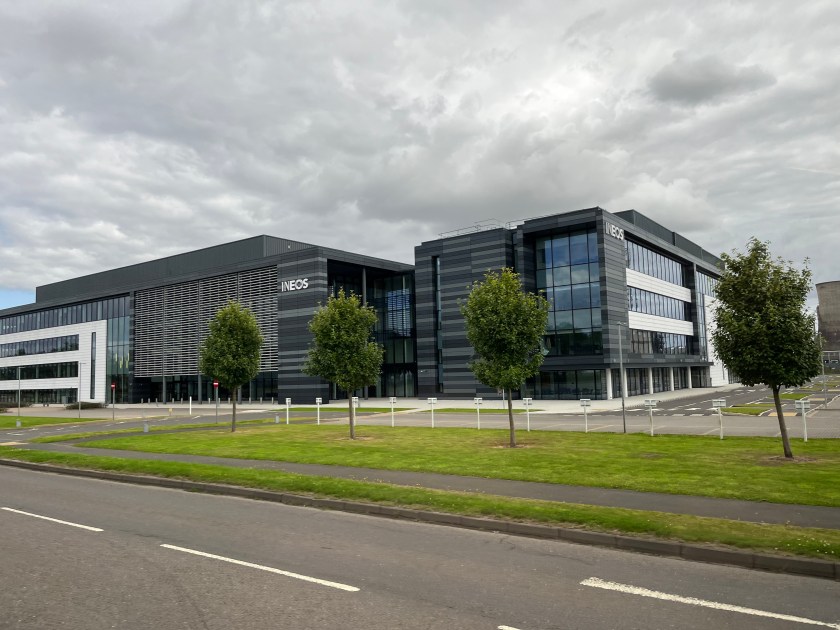
The huge 1700 acre Grangemouth site is owned by billionaire Jim Ratcliffe’s INEOS. They bought the Grangemouth petrochemical plant and the refinery from BP in 2005. Then in 2014 the company raided the pension fund originally established by BP and in turn de-recognised the plant unions. The refinery part of the site is now run by Petroineos, a joint venture between INEOS and the Chinese state-owned oil and gas company PetroChina.
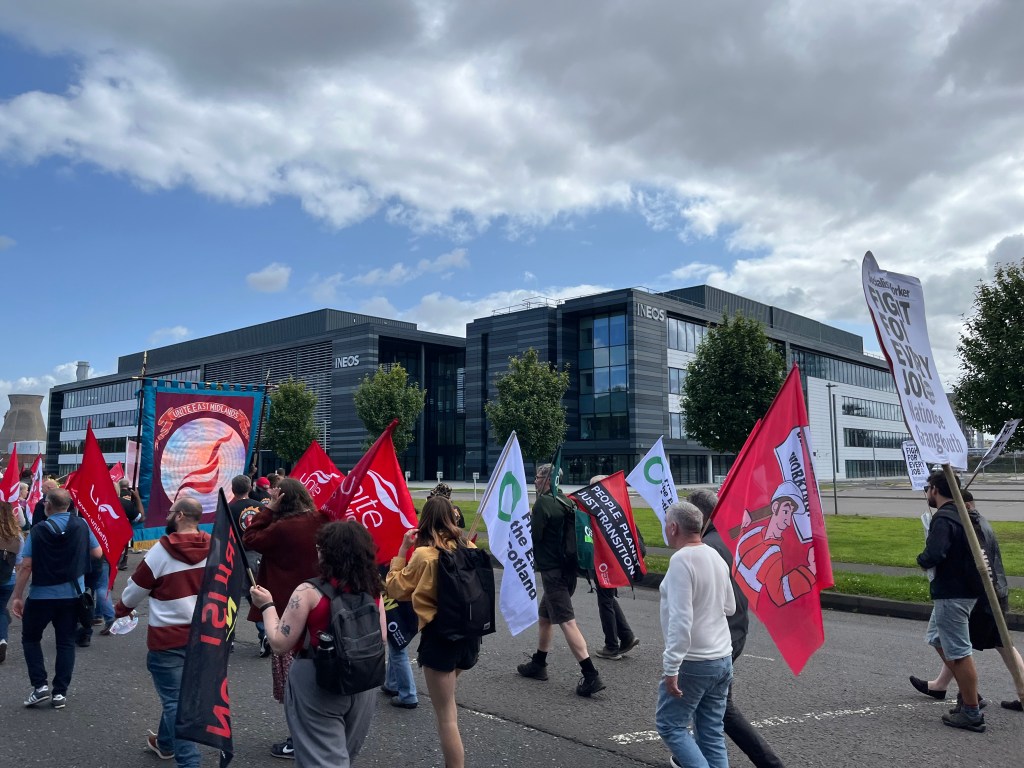
Unite, the main union at the refinery is leading a campaign to ‘Keep Grangemouth Working’. The union is calling for action to ‘Extend, Invest and Transition’. On 3August, they organised a march and rally starting from the Grangemouth stadium on the edge of the INEOS site. Around 600, including refinery workers and their families, and trade unionists from around Scotland and further afield marched to a rally held in a local park. There were a handful of climate activists.
At the rally Unite Scottish Regional Secretary Derek Thomson talked about how the union was campaigning locally to raise awareness of the impact that closure would have on jobs and the local economy. Unite believes that the new Labour Government may be able to persuade Ratcliffe to extend the life of the refinery. The Tories pledged to provide 700 million Euros in credit to support the development of the new Petroineos refinery in Antwerp and they think that if Labour were to question this it would provide leverage.
Grangemouth is a critical campaign for the climate movement. There are moments when decisions are made and actions taken, or not made and not taken, that then resonate through the movement and shape its future trajectory. If the Grangemouth refinery is closed it will be such a moment. In Scotland another such time was the failure to take the BiFab fabrication yards into public ownership in the autumn of 2017. The loss of 1400 jobs at BiFab offshore renewables technology yards discredited the idea that action over climate offers opportunities for employment. The closure of Grangemouth would be not just a blow to the workers, their families and the local economy, it would also send political shockwaves through the climate and workers movements.
On the march – image Pete Cannell CC0
At the rally on 3 August the speaker from Friends of the Earth Scotland received a great response from the Unite members in the crowd. It is important that the union and the Grangemouth workers see transition to a sustainable future as a positive goal. However, there is a real weakness in the current campaign. Unite’s strategy seems to be based on pressurising INEOS into extending the lifetime of the refinery. But there’s no evidence that Ratcliffe is interested in doing this or interested in planning for a sustainable transition. And it’s not that Grangemouth is unprofitable – simply that Antwerp would be more profitable. None of the speakers at the rally criticised INEOS. Implicitly or explicitly the focus was on partnership with the company.
At a time when all the indicators suggest that global heating is increasing faster than the most pessimistic predictions, companies like INEOS and BP are doubling down on investment in fossil fuels. They aim to make mega-profits while they can. In these circumstances, when action to decarbonise is overdue, working in partnership with big oil, while talking about the need for transition and social justice is simply greenwashing. It won’t save jobs, and it sets back progress towards transition.
So, what’s the alternative? Public ownership, and democratic planning that involves energy workers is essential. To build the mass campaign that could make this possible the unions and the climate movement need go beyond slogans.
The private sector is simply not capable of the kind of planning and coordination that is needed to save jobs and manage a just transition.
Convincing energy workers, winning hearts and minds and building the mass support for public ownership requires brutal clarity about what the oil and gas companies are doing. The profits they’ve made and continue to make, the huge subsidies they continue to attract and the way they expect us to clean up their mess. Grangemouth has been a site for petrochemicals for a hundred years. Without an enormously expensive cleanup the site is only suitable for industrial use.
Image Pete Cannell CC0
Partnership with INEOS is a dead end. The company has no loyalty or regard for the workers or the local population. There’s no guarantee if the refinery closes in 2025 that the rest of the operations on the site will continue much longer, and with it, the loss of over 2,500 jobs. Ratcliffe expects us to pay the huge cost of cleaning up the site. And the residents of Grangemouth having lived with the stink and pollution of the plant for decades will remain with a toxic legacy.
But to win hearts and minds and build the campaign there also needs to be a plan for change. The vast site at Grangemouth could become a hub for a wide range of renewable technologies. There’s room to establish new facilities, there’s good communications by land and via the Firth of Forth and there is an established workforce and a cluster of further and higher education institutions in the region that could support the development of a new low carbon economy.
The nature of the plan matters. At the Grangemouth rally – ex-MP and deputy leader of the Alba Party, Kenny MacAskill argued that Grangemouth could prosper through the development of green hydrogen and carbon capture and storage. But these are the solutions that are promoted by Offshore Energy UK, the organisation that represents the interests of the UK oil and gas sector. Both technologies may have some use in the future but the industry focus on them right now is aimed at maintaining oil and gas production, and the infrastructure and systems that support it, for as long as possible. Opportunities for rapid progress lie in Wind, Solar, Wave and Tidal technologies together with energy storage and a new smart distribution grid. Ending partnership between unions and big oil also requires a new and critical view of what technologies support jobs and employment and support rapid decarbonisation and a break from the fake self-serving solutions that are advanced by the oil and gas industry. Which technologies are prioritised is not simply a technical choice but also highly political.
There will be a protest outside the SSE AGM in opposition to the company’s disastrous plans for a new gas burning power station in Peterhead.
SSE already owns the existing power station in Peterhead, which is Scotland’s biggest polluter. A new plant will lock people in Scotland into reliance on expensive and polluting gas for decades – well past the Scottish Government’s 2045 net zero target.
SSE’s Annual General Meeting is for the company to celebrate their huge profits and their expansion plans.
We want to make sure that their bosses and shareholders know that people are not happy about their plans for new fossil fuel infrastructure, so we will be holding a demonstration outside the Concert Hall venue. It will be a family friendly protest, and everyone is welcome!
Here are some train times that will get you in by train if you’re coming from: Aberdeen – 9.44 train gets into Perth at 11.15am Glasgow – 10.07 train gets into Perth at 11.11am Edinburgh – 9.39 train gets into Perth at 11.06am Dundee – 10.55 train gets into Perth at 11.15am
Thanks to Friends of the Earth Scotland for this information
On 4 July, the climate-trashing Tory government will be replaced, as good as certainly by Keir Starmer’s “changed” Labour party.
For all its talk of “green prosperity”, Labour plans to work closely with the corporations that profit from North Sea oil and gas and from generating electricity – and who intend to produce, and use, fossil fuels for as long as they can.
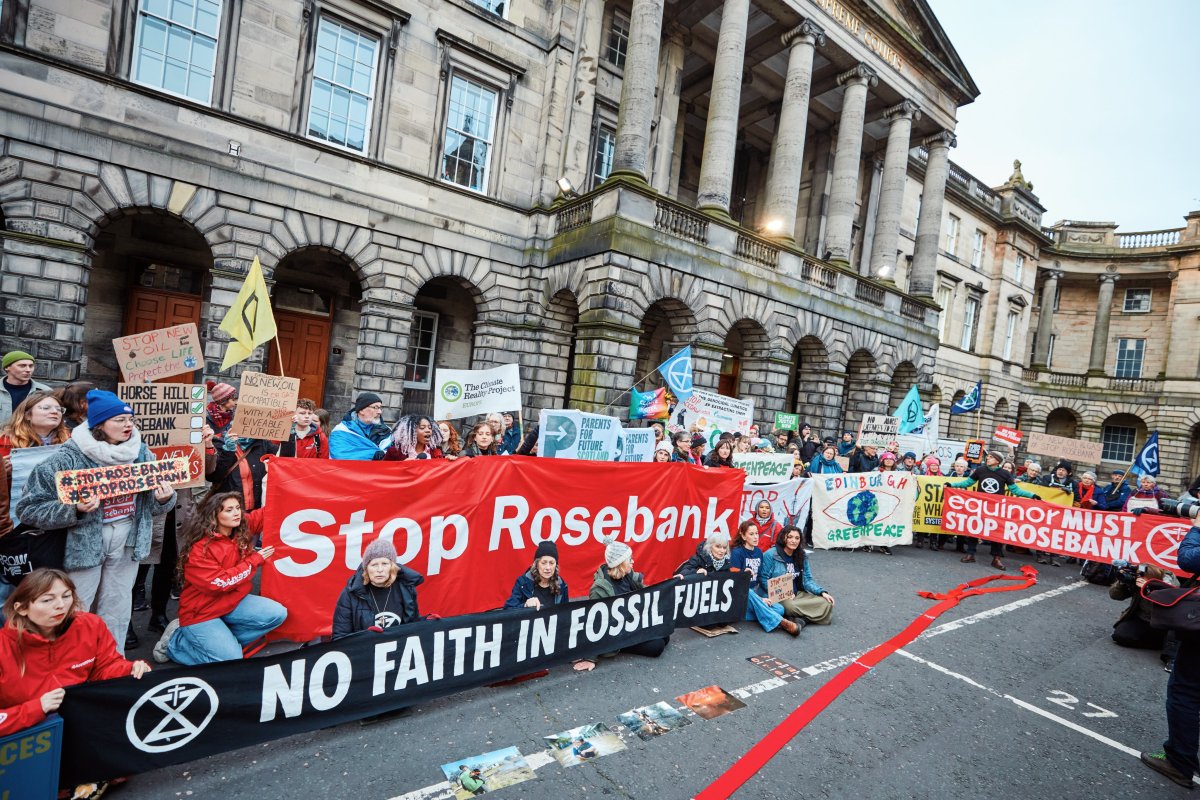
A protest at government offices against the Rosebank oil field project, January 2023. Photo by Steve Eason
Labour’s plans for cutting greenhouse gas emissions from homes and cars are hopelessly timid, because of its conviction that private business does it best.
Under Labour, we will in my view make progress against social injustice and climate change only insofar as social movements and the labour movement:
(i) confront and confound the government, and
(ii) show that action on climate change, far from costing ordinary people money as the extreme right claim, is 100% compatible with combating social inequalities.
In this article I try to identify the likely battlegrounds between our movements and a Starmer-led Labour government:
Fossil fuel production and the path away from it (part 1); electricity generation at national (part 2) and local (part 3) levels; avoiding false technofixes (part 4); and changing the way energy is used in homes and transport (part 5). Part 6 is about bringing these separate, but connected, issues together.
1. Transition away from fossil fuel production on the North Sea
The election-time slanging match about the North Sea’s future has featured politicians’ and union leaders’ cynicism at its worst. In opposition to this, our movement needs serious conversation about how to fight for working people’s livelihoods and run down oil and gas production simultaneously.
The political war of words has focused on Labour’s commitment not to issue new licences to explore for oil and gas in the North Sea.
The Scottish National Party, which fears losing parliamentary seats to Labour, has lashed out with a claim – shown by BBC Verify to be false – that this would cost “100,000 jobs”. This is “a clear about-face” from the SNP, which last year “committed to a built-in bias against granting new licences”, the Politico web site reported.
“Exaggeration and misinformation helps no-one”, given the urgent need for “a clear-eyed conversation about how to ensure that Scottish workers benefit from the transition away from oil and gas”, Tessa Khan of the climate advocacy group Uplift said.
But exaggeration and misinformation is exactly what leaders of the Unite union, which represents many North Sea workers, contributed. They withheld support for Labour’s manifesto, because of its North Sea policy (as well as for much better reasons, such as its employment policies) and endorsed SNP leader John Swinney’s nonsense.
Unite leader Sharon Graham suggests that a ban on oil and gas licences is the main threat to North Sea jobs. That is not true. It usually takes more than ten years from licence issue for a field to start production, so there is only a very indirect connection. In recent years oil corporations’ decisions to slim down their North Sea operations has posed a far more immediate threat.
If Labour reverses its ban on new licences, the only beneficiaries will be those corporations – while the planetary disaster threatened by climate change would come one step closer, as the heads of the UN and International Energy Agency have pointed out. Indeed there is a powerful case for scrapping the already-granted licence for the giant Rosebank field.
Unite says it wants to “see the money and the plan” for the transition away from oil and gas. But as its leaders well know, plans already exist.
The Sea Change report, published five years ago, showed how the North Sea workforce could expand, with investment in wind power and other renewables. The oil companies and Tory government have other ideas, set out in the North Sea Transition Deal – which proposes spending £15 billion on their pet technofixes, carbon capture and hydrogen. (See also part 4 below.)
The Green New Deal Rising group disrupted an event sponsored by oil industry lobbyists at the Labour party conference in October last year. Photo by Jess Hurd
Unite, along with other unions, accepts these false solutions, and calls for investment in hydrogen and carbon capture, as well as wind power.
Perhaps we should be talking about “rupture, rather than transition”, he said, to make gains for social justice and tackling climate change. This starts with uniting oil workers and Scottish working-class communitiesmore broadly. This is the conversation we urgently need.
At a recent gathering of trade unionists concerned with climate policy, Pete Cannell of the campaign group Scot E3 argued that, given the dominance of this technofix narrative, “it’s legitimate to ask whether ‘just transition’ is any longer the right framing”.
2. Public ownership in the electricity system
Labour will set up a “publicly-owned clean power company”, GB Energy, paid for by a windfall tax on oil and gas producers. But GB Energy will own few, if any, electricity generation assets and will focus on partnerships with private capital. Labour also plans to leave the electricity transmission and distribution grids in private hands, and to leave largely unchanged the neoliberal electricity market rules that allowed corporations to reap billions by impoverishing households in the 2022 “energy crisis”.
Labour intends to capitalise GB Energy with £8.3 billion over the next five years: £3.3 billion for a potentially useful Local Power Plan (see part 3 below), and £5 billion to “co-invest in new technologies” including floating offshore wind and hydrogen, and “scale and accelerate mature technologies” including wind, solar and nuclear.
Labour’s loud claim that GB Energy will “lower [electricity] bills because renewables are cheaper than gas” is not credible. This would require, at least, an investment far greater than £5 billion, allied to a root-and-branch overhaul of electricity markets.
More likely, GB Energy will, at best, fund new technologies that financial markets prefer not to risk their own money on – or even follow in the footsteps of Tony Blair’s disastrous Private Finance Initiative, with which corporations milked billions from the NHS. The Guardian, apparently briefed by Keir Starmer’s team, reported that GB Energy will probably start with “investments alongside established private sector companies”, including the chronically over-budget Hinkley Point, Sizewell C and Wylfa nuclear projects.
The Greens and others slammed Starmer, when he finally clarified on 31 May that GB Energy will essentially be an investment vehicle. But a trenchant critique had already been published last year: Unite’s Unplugging Energy Profiteers report, which warned that “unless combined with a public purchasing monopoly, or significant market reform intervention, [GB Energy] will have no impact on distorted pricing in the wholesale market”, and “by concentrating very limited resources on de-risking experimental forms of generation, GB Energy will use public resources to underwrite and further increase future potential profits for the private sector”.
Unite, and the Trades Union Congress, call for public ownership to be extended not only in electricity generation, but also in the supplybusiness and in transmission and distribution networks. Labour madesimilar calls in 2019, but has now ditched them.
Underinvestment in these networks is a scandal as damaging as the water companies’ rip-off: tens of billions of pounds’ worth of network upgrades are needed to facilitate renewable generation and close the gap on missed climate targets.
The National Grid’s Nechells electricity substation near Birmingham
Already, there are 10+year queues for renewables to be connected to the grid; house-builders are fitting climate-trashing gas boilers because they can not access electricity for heat pumps; battery storage lies unusedbecause companies’ computer systems are out of date … all while distribution networks paid out £3.6 billion in dividends to shareholders in 2017-21.
The system is in such a state that even Rishi Sunak’s dysfunctional government took regulatory powers away from National Grid and put them in the Future System Operator. Nick Winser, the electricity network commissioner, warned the government that unchanged, the system would leave “clean, cheap domestic energy generation standing idle, potentially for years”. “Very few new transmission circuits have been built in the last 30 years”, he said: unless jolted, companies could take up to 14 years to build them.
To make the electricity network fit for the transition away from fossil fuels, wider public ownership is crucial. Our movement needs to work out how to coordinate the fight for it.
3. Community energy and decentralised renewables
Labour promises to spend £3.3 billion on a Local Power Plan, under which GB Energy will “partner with energy companies, local authorities and cooperatives to develop up to 8GW of cheaper, cleaner power by 2030”. Up to 20,000 renewable projects will return “a proportion” of their profits back to communities. But “the detail on these plans is sparse”, the New Statesman reported – and so it is surely up to community organisations and the labour movement to discuss effective ways this money could be spent.
Until now, central government has been a wrecking ball for community energy. In 2015, it changed planning rules, effectively blocking onshore wind projects. In 2019, it scrapped the feed-in tariff paid for electricity supplied to the grid from small-scale renewables. And for years – as decentralised renewables technology leaped forward internationally – it ignored calls to overhaul market rules. Small renewables projects were locked out of the grid by the need for a £1 million + licence, and other obstructions.
The Green New Deal all-party parliamentary group last year called for the regulatory system to be turned upside down, to end its bias in favour of the “big five” generators. It proposed a “European style ‘right of local supply’”; changes to rules on planning and public procurement; mandatory transparency of grid data; and other measures.
Such changes would make it possible to replicate the success of Energy Local in Bethesda, north Wales, which supplies locally-produced hydro power to households at below-grid prices. In April, the Common Wealth think tank proposed a “public-commons partnership” as the institutional form under which local authorities could develop such projects.
All this will take a fight, though. Otherwise, electricity corporates will spread their tentacles into decentralised renewables, as they are doing in the US and Australia.
Furthermore, we need to overcome the official labour movement’s residual reluctance to support community energy projects. The TUC’s recent renewables policy paper, which lists offshore wind, wave, nuclear and “zero carbon hydrogen” (?) as energy technologies – but not decentralised wind and solar – is, unfortunately, indicative.
Decentralised renewables, developed with cooperative, community and local authority forms of ownership and governance, can help to break corporate control of electricity provision, and open the way to democratise and decommodify it.
4. Opposing false technological solutions
False technofixes, including hydrogen and carbon capture, use and storage (CCUS) feature prominently in Labour’s election manifesto – the outcome of lobbying by the oil industry, for which they comprise a survival strategy. Nuclear power – expensive, dangerous, and beloved of the military – is there too, grabbing funds from proven, socially useful technologies such as home insulation, public transport and decentralised renewable power.
While the case against nuclear has been made, and the false logic of CCUS exposed, over decades, the drive for hydrogen is more recent: it is the oil companies’ alternative to electricity-centred decarbonisation. Energy systems researchers argue that, while hydrogen may be needed in future e.g. for steelmaking or energy storage, it will never be suitable for home heating, and hardly ever for transport.
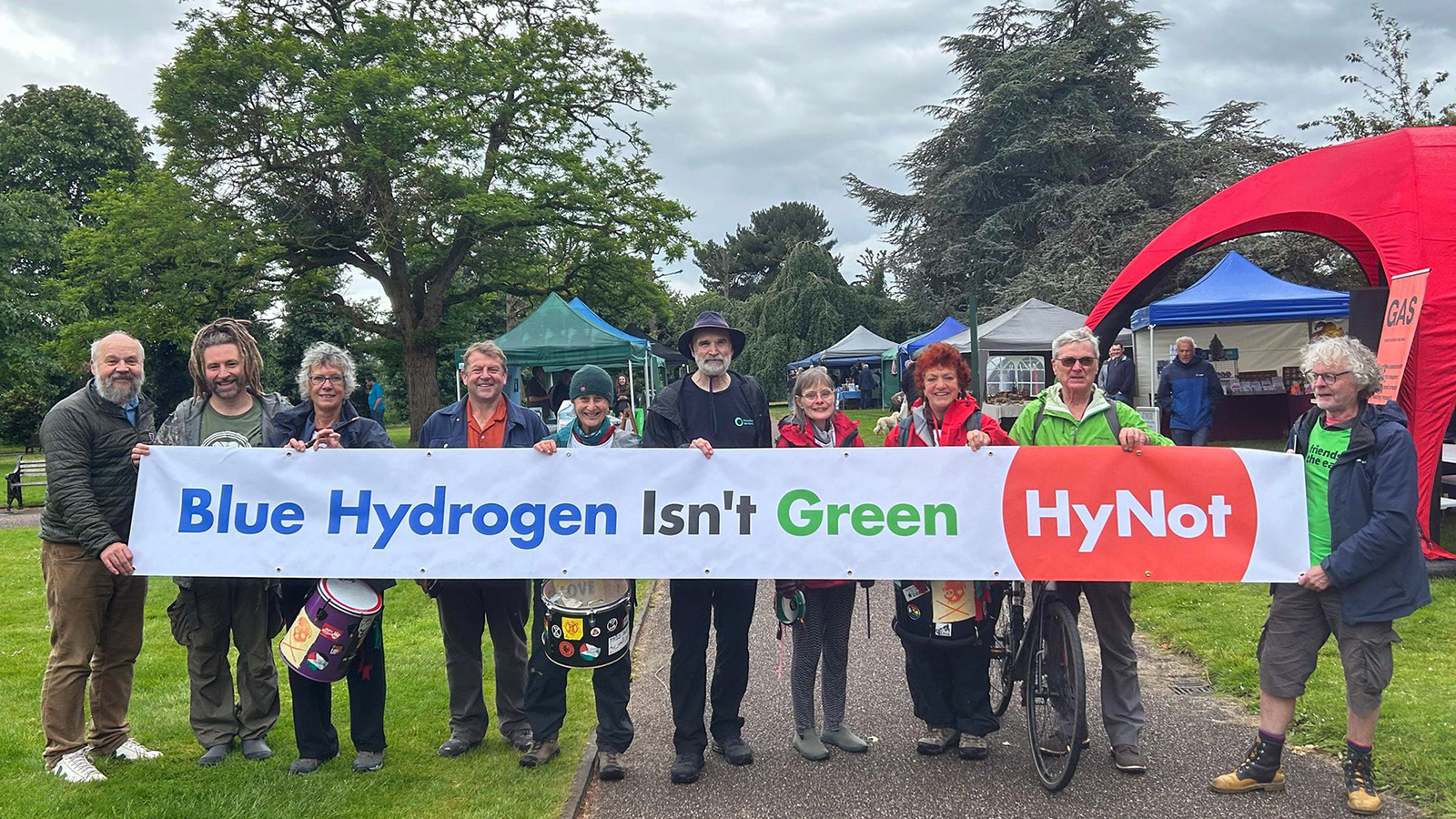
Demonstration by HyNot, which opposes hydrogen for home heating, at the Green Expo UK in Cheshire, last week. Photo from HyNot twitter feed
The Tory government has invested heavily in hydrogen, and the 2023 Energy Act provided a framework for its commercial development. But attempts to bribe communities into testing it out for home heating have hit setbacks. A planned test at Whitby, Merseyside, was cancelled last year after vigorous opposition by local residents and the HyNot campaign group. This year a second planned test at Redcar, Yorkshire, and a thirdone in Fife, Scotland, were both postponed.
Catherine Green Watson of HyNot said: “These postponements are great progress for our campaign. But on Merseyside we still have strong local political support for hydrogen in industry, which should not be the priority. Instead, we need to concentrate on upgrading the electricity grid.”
We need a discussion in the labour movement and social movements about the social role of these technologies. We could work towards unity around the principle that they should not receive state funding that could go to quicker, more effective decarbonisation paths.
5. Energy use in our homes and transport
Labour has scaled back its promises to invest in its Warm Homes Plan that will fund grants and low-interest loans for insulating homes and replacing gas boilers with heat pumps. Shadow energy secretary Ed Miliband last year talked about “up to £6 billion a year”; by the time Labour’s manifesto was published last week, this had shrunk to “an additional £6.6 billion over the course of the next parliament” (that is, over five years). Talk of upgrading 19 million homes had stopped; now it’s 5 million.
Labour has stuck with commitments to take railways back into public ownership, and to support municipal ownership and franchising of bus services. But it is also promising to “forge ahead with new roads”, and keep the transport system centred on private cars, at a time when researchers argue that this cuts dangerously across tackling climate change.
If Labour sticks to this course, determined by its neoliberal fiscal rules and by corporate lobbying, then key opportunities to cut UK carbon emissions, while improving people’s lives, will be missed. Researchers have been screaming for years that insulation and heat pumps, and superceding the car-centred transport system with better, cheaper public transport, are desperately needed to decarbonise homes and transport, the two largest sources of greenhouse gas emissions.
Battles on effective energy conservation in homes, transport and throughout the economy are part of the war to limit climate change.
Labour’s commitments are too timid to reverse the disasters caused by Tory policies. In the decade from 2012, annual completions of home insulation upgrades fell by nine tenths. The measures announced by government last year would take 190 years to improve the energy efficiency of the UK housing stock and 300 years to hit the government’s own targets for reducing fuel poverty, National Energy Action stated.
As for roads, the government could cancel the £10 billion Lower Thames Crossing scheme, final approval of which has been delayed until October, and apply to all future projects the principle adopted by the Welsh government – that they can only go ahead if compatible with climate policy.
Labour may not only fail to deal with these gigantic sources of carbon emissions, but actually open up new ones. A grim example is Labour’s threat to overrule communities who question tech corporations who want to build fuel-guzzling data centres – which will help trash climate targets, to the benefit of those corporations alone.
6. Bringing the issues together
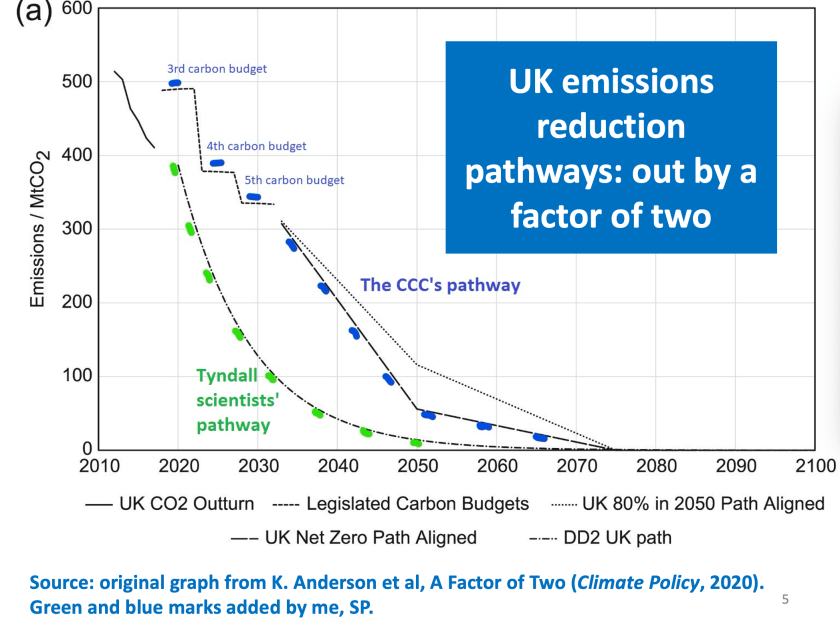
The stakes are high. Every new assessment by climate scientists underlines the conclusion reached by leading British researchers four years ago: that the UK’s decarbonisation targets are half as stringent as they need to be, to make a fair contribution to tackling global heating. The government’s own climate change committee says non-power sectors of the economy need to decarbonise four times faster than they are doing.
Tackling climate change, while reversing the effects of 14 years of neoliberal austerity policies, will not be easy. Indeed, Labour does not intend to: both decarbonisation and social policy will be subordinated to their fiscal rules.
The labour movement and social movements need to challenge and push back Labour’s pro-fossil-fuel, pro-austerity approach.
We need to unite our forces and find the pressure points – be it saying “no”, to the Lower Thames Crossing project and similar, or finding openings for collective action, e.g. in the Local Power and Warm Homes plans.
To act effectively on climate, we need to keep in mind the necessity of holistic solutions, and reject illusory technofixes and greenwash narratives that claim to reduce emissions with one hand, and pour them into the atmosphere with the other. SP, 18 June 2024.
This article was first published on the People and Nature site. Republished here with thanks.
We were invited to contribute to a workshop on fossil fuels and developing a workers’ plan for just transition held in London on 13 April 2024 by the Campaign Against Climate Change Trade Union Group. This is a summary of the contribution made by Pete Cannell – responses to this piece would be very welcome.
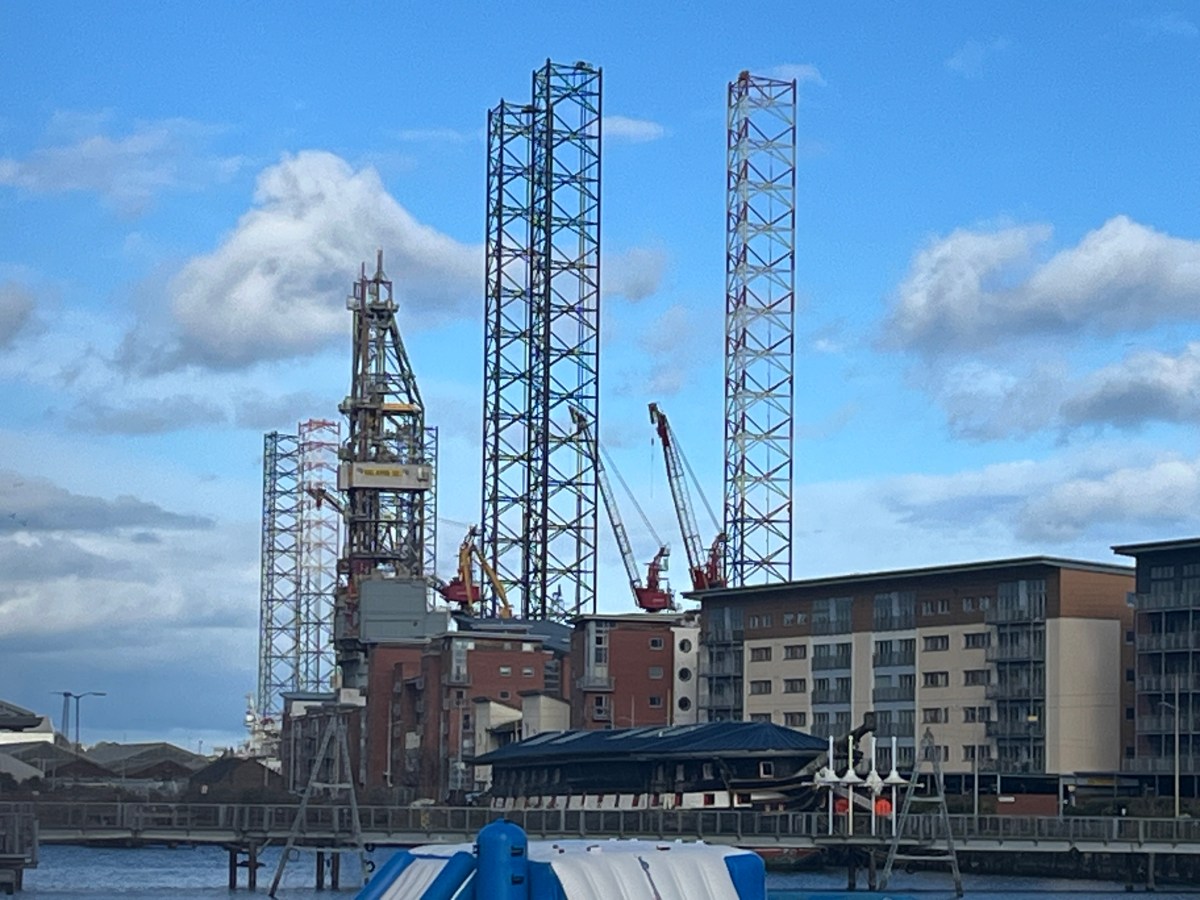
Dundee Harbour – image by Pete Cannell CC0
The previous speakers have talked about some of the very important practical issues that are central to enabling a transition to a sustainable zero carbon economy. There’s plenty of evidence to show that phasing out oil and gas combined with serious investment in renewables creates more jobs. The Sea Change report, published in 2019, shows how switching from oil and gas to wind and solar would create a big net increase in jobs and how failing to make this transition would mean that targets to cut carbon emissions would not be met.
Similarly, home insulation, retrofitting and replacing gas with electricity for heating and cooking is essential, but critically dependent on a skilled workforce.
This workshop is framed around developing a workers plan for just transition. I would argue that the main elements of such a plan are in place. That being the case in the rest of this contribution I’d like to talk about why there’s not yet a simple consensus about a plan. Having a plan is clearly necessary, and critical to being credible in the eyes of working people who are not yet convinced.
In one sense we’ve made serious progress in the last five or so years, it’s now common sense in the climate movement to talk about the role of workers and the need for a just transition. I think in this respect COP26 in Glasgow was a watershed moment. But ironically in practical terms, in terms of action I think we’ve gone backwards in the same period. So, for example, the number of workers in renewables in Scotland is about the same now as it was in 2014. In the eyes of many workers talk of just transition looks like hot air. And in the hands of right-wing populist politicians, it fuels arguments that the climate crisis is not a problem and climate action is a threat. So, there’s a real danger that repetition of just transition, in the absence tangible steps that improve lives and livelihoods, becomes a form of greenwashing.
So, while we need consensus on what to do for me the 64,000-dollar question is
How do we build a mass movement with powerful roots in every workplace and working-class community that has the power to make the necessary changes happen?
I think the climate movement often underestimates the extent to which commitment to the North Sea and to the interests of the big oil and gas companies shapes and directs climate policy. Westminster, Holyrood, the energy sector trade unions and the oil and gas industry work in partnership through what used to be called Oil and Gas UK and has now been rebranded as Offshore Energies UK. They are all signed up to the North Sea Transition Deal and it essentially guides their actions. So, for example it’s hard to find a serious analyst who things hydrogen for domestic heating and cooking makes sense but using hydrogen in this way remains a key plank of policy for both Westminster and Holyrood. And while it does other options are not pursued. Why? Because hydrogen together with Carbon Capture and Storage is the best option for Fossil Capital that wants to maintain existing market dominance, infrastructure and (not least) profits.
For more than fifty years the big oil and gas companies have used their operations in the UK sector of the North Sea to blaze a trail for what we have come to know as neoliberalism; establishing practices that have been copied and taken up internationally. Outsourcing, multiple layers of subcontracting, vicious anti-union policies and the use of blacklists. At the same time the so-called free ‘market’ has been featherbedded by massive state subsidies which have exceeded taxation revenue.
In the old saying – if we had a choice – we wouldn’t start from here. All the evidence is that we are just going past the 1.5degree threshold and the scientific evidence is that change is taking place more rapidly than anticipated. This while the Scottish government which has been strong on rhetoric but feebly reliant on the market for action is judged to be a long way for reaching its targets and Westminster gives the green light for maintaining oil and gas production. And the most important unions remain wedded to a policy of partnership with the energy industry. To answer my earlier question, that partnership, is why we don’t have consensus about a plan. It’s the partnership that pulls in Unite, RMT and GMB behind CCS, Hydrogen and Nuclear.
In this context I think it’s legitimate to ask whether just transition is any longer the right framing for what we want or need.
We need to be clear about what we want to happen and largely that thinking is in place. But to make it happen – perhaps what we should now be talking about is rupture rather than transition. And the power to make that rupture resides within the working class.
North Sea workers are key, but the oil industry has been successful at keeping their organisation fractured and largely ineffective. I think it’s most likely that oil workers will become active participants in the rupture we need only if the mass movement we need is built across all sectors and in working class communities.
And if we are to win that mass participation then there’s no place for partnership with Fossil capital – and that means some very sharp arguments within our movement.
Hilary Horrocks reports from Florence where sacked GKN workers continue to fight to keep their workplace open under public ownership and workers’s control.
Five thousand supporters joined a march in Campi Bisenzio, near Florence, on Saturday evening (6 April 2024), organised by the sacked workers at the huge GKN factory who have been fighting for two-and-a-half years to keep their workplace open under public ownership and workers’ control Their campaign has argued, with the participation of academic researchers, for a just transition towards the production of socially useful items such as cargo bikes and solar panels, vital in the battle to save the climate. The dispute and the occupation of the factory continues, since an Italian labour court ruled against the final attempt to dismiss the 400 GKN employees just before the deadline of 1 January this year, but the workers are not receiving any wages.
Shop stewards from the ex-GKN workers’ collective at Campi Bisenzio, Florence, leading 5,000 marchers in the latest demonstration of support. The large banner bears their slogan, Insorgiamo (Let Us Rise Up)Image by Hilary Horrocks
The demonstration at the weekend was called by the Collective in response to the cutting off of electricity to the plant by management stooges, part of a campaign of intimidation against a Festival of Working Class Literature held outside the factory at the weekend. But the Festival – attended by thousands of predominantly young people, went ahead, with impressive sessions by committed speakers on working-class writing internationally.
The Collective is appealing for financial support and for subscriptions to a co-operative ownership scheme for the factory.
The video is a recording of a Climate Justice Coalition webinar on the GKN worker’s struggle.