Stop Cambo

Both the UK and Scottish governments remain committed to continuing extraction of North Sea Oil and Gas. Carbon emission from the burning of these fuels are more than five times those of the whole Scottish economy. Yet these emissions are not included in Scottish or UK targets for emissions reduction. The assumption is that other countries will cut usage and the market will then drive down demand or, and more often, that we can carry on producing willy nilly but consumers will find ways of capturing the carbon. Both of these events are deferred into the future and exploration and development of new fields continues. The Sea Change report shows how these plans are incompatible with a zero carbon economy and with a just transition.

Thanks to Friends of the Earth Scotland for these notes on the latest development west of Shetland.

  • Oil giant Shell and Siccar Point Energy are seeking permission from the UK Government to develop the Cambo oil field, West of Shetland, just months ahead of COP26. In the first phase, due to start in 2025, the companies expect to extract 150 million barrels of oil – the emissions equivalent of 16 coal-fired power plants running for a year. They anticipate operating the Cambo field, which contains 800 million boe, until 2050, by which time Britain has pledged to be net carbon neutral.
  • The Cambo Field is the second largest oil and gas development waiting for approval and once up and running is set to be the fifth largest producer in the North Sea. If approved, Cambo Field will be the first UK project to get the green light since the International Energy Agency Net Zero report calling for no new investment in oil and gas starting this year and the Shell ruling mandating the company to slash carbon emissions 45% by 2030. 
  • The UK Government is currently expected to give its final approval on the project over the next six to eight weeks. Moving forward with the Cambo Field contradicts the findings of the IEA’s net zero report and is incompatible with limiting warming to the Paris Agreement target of 1.5C. 
  • The climate impacts of opening the Cambo Oil field would be devastating. In the first phase alone, developers want to extract 150million barrels of oil; the emissions from which are equivalent to running a coal-fired power station for 16 years. The field is expected to operate until 2050 – the point by which your government has committed to reaching net zero emissions.  And this is just the beginning. Cambo Field is only one of many oil and gas projects waiting for government approval that have the potential to extract 1.7 billions barrels of oil. 
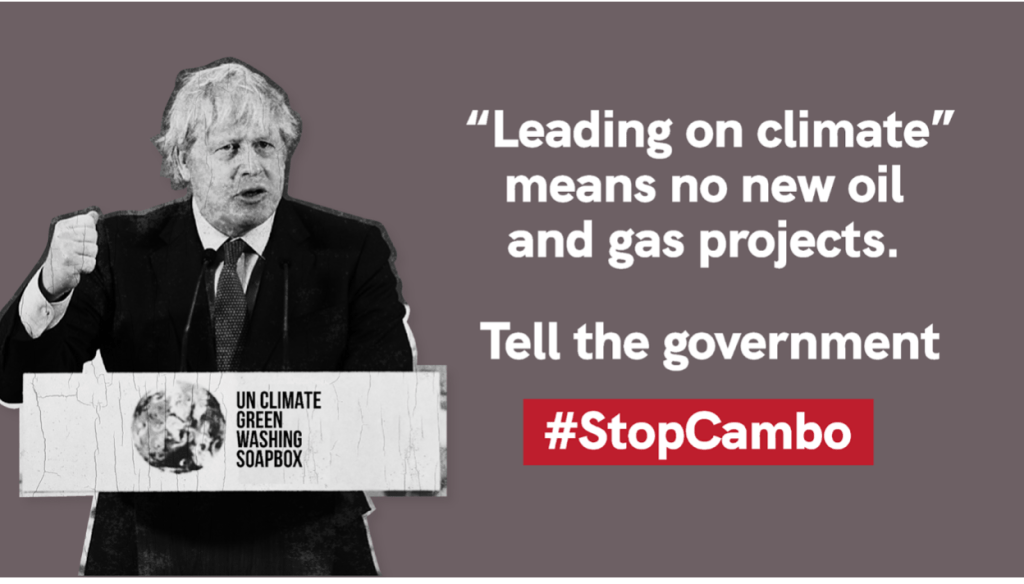
  • Approving the Cambo field will be a massive failure of UK climate leadership and threatens to undermine the success of the crucial UN climate talks. In just a few months, the eyes of the world will turn to the UK as the hosts of the UN climate talks in Glasgow. Approving the Cambo field will send a clear message that this government is not serious about climate action and not willing to do its part to phase out support for oil and gas. If the UK keeps extracting oil and gas, how can it expect other countries to do anything different?
  • The International Energy Agency has stated that to meet the 1.5°C target in the Paris Agreement, there should be no more new investment in oil, gas, or coal. Further, the recent UK Climate Change Committee assessment clearly laid out that current UK policies are far from delivering the UK’s climate goals. The amount of oil and gas in already operating fields in the UK will exceed our share of emissions in relation to the Paris climate goals. The world cannot afford to open new fossil fuel frontiers. This starts with rejecting the Cambo Field.
  • If Boris Johnson is serious about being a climate leader, he must reject Cambo, all new fossil fuel developments and support a just transition for oil and gas workers and impacted communities. It’s time to end the UK government’s support for maximising the economic recovery of oil & gas and commit instead to a rapid and fair energy transition. With the right policy support, the UK could create three jobs in clean energy for every oil & gas job at risk. We need a clear, credible plan to wind down production and deliver a just transition that is driven by oil and gas workers, their unions and affected communities. 
  • The Cambo Field will bring few jobs, little tax and a potentially huge clean up bill for the public purse. Contracts for construction and installation have been awarded to overseas firms, meaning the bulk of jobs will be outside of the UK. As part of a global oil market 80% of UK crude is currently exported, and so this field would not contribute significantly to UK energy security. Siccar Point Energy, who owns the majority stake in the proposed field, paid no net tax between 2015 and 2019, instead receiving £41mn from the government to cover decommissioning costs. Meanwhile, the complexity of the field and high cost of operating in the West of Shetland makes the project high risk, with similar projects suffering from large cost overruns that have driven producers to bankruptcy.

Climate organising in the workplace

Here’s the video of Ian Allinson’s introduction to a discussion on organising in the workplace that we held on 25th June 2021. Ian is a former Fujitsu shop steward who ran as a candidate for the Unite union general secretary in the last election.

Ian share this guide to workplace action and the law: https://rebrand.ly/guide-climate-strike-law

In his introduction he drew on ideas from Jane McAlevey. sfbbooks has copies of two of her books on special offer:

Raising expectations and raising hell – £7

No Shortcuts – £8

email sfbbooks@gmail.com to order (Postage extra)

New poll highlights training needs of offshore workers

Thanks to Platform for sharing this:

Off the back of last year’s impactful survey and report OFFSHORE: Workers’ views on industry conditions and the energy transition, Friends of the Earth Scotland, Platform and Greenpeace are today releasing the results of a poll showing what workers want to change in the offshore energy industry, supported by RMT and Unite Scotland.

One of the key issues we heard from oil and gas workers in Offshore was the high cost of training, borne by workers as more and more are forced into short-term contracts, posed a barrier to moving easily between similar offshore jobs in renewables as well as oil and gas.

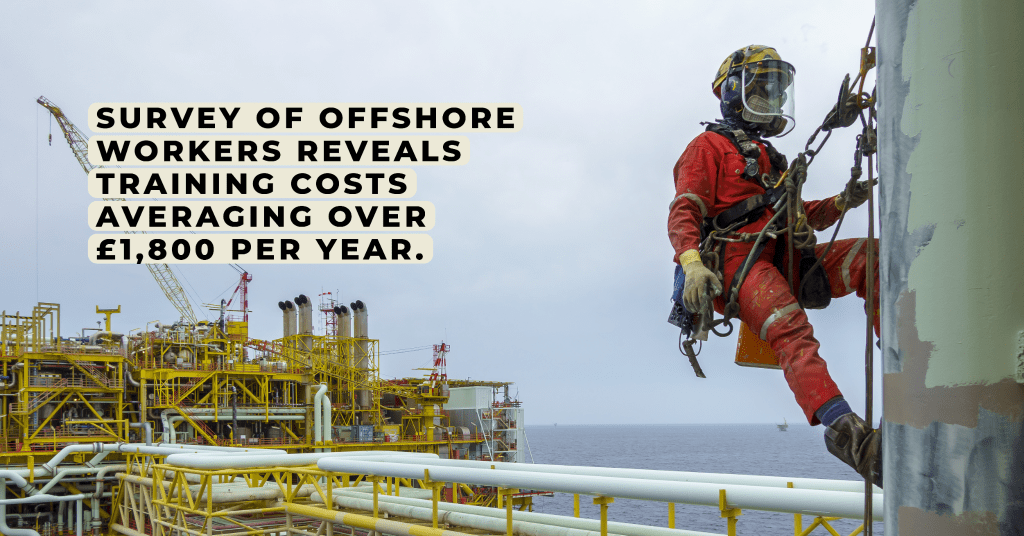
This new survey shows that these workers are paying an average of over £1,800 a year in training costs, and among more results that:

  • 97% are concerned about the UK’s offshore energy industry training costs
  • 74.5% are employed ad-hoc as contractors
  • 65% said their employer contributed 0% to their training costs including safety and first aid training in the past two years, which is up from 45% before 2015

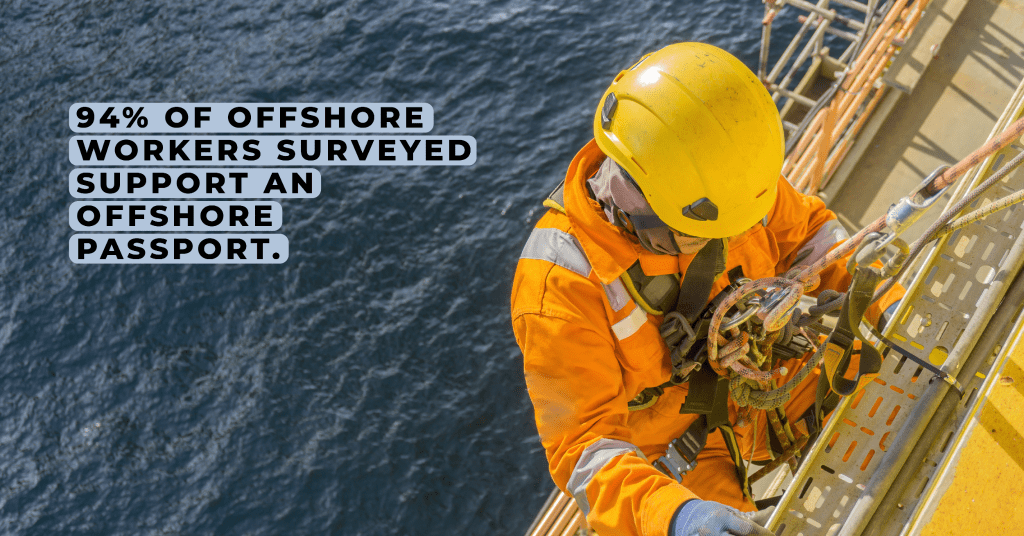
94% of respondents said they would support an offshore passport, which licences accredited workers to work offshore in any sector through a cross-industry minimum training requirement.

Carbon Capture – video

Jess Cowell from Friends of the Earth Scotland introduced a discussion on Carbon Capture and Storage at a Scot.E3 public meeting on Friday 18th June.

Thanks to Sally from Biofuels Watch for these useful links:

1) Drax admits to environmental campaigners that its carbon capture and storage claims are not based on real world evidence: https://www.biofuelwatch.org.uk/2021/drax-plcs-carbon-capture-claims-not-based-on-any-real-world-evidence-company-reveals-to-campaigners/

2) Written responses from Drax to environmental campaigners during Drax’s BECCS public consultation in March which reveal that Drax’s “BECCS assumptions are not based on trials” & its BECCS pilot project with C-Capture was not using ‘proven technology’: https://www.biofuelwatch.org.uk/2021/drax-beccs-response/


3) Conflict of interest concerns over Rebecca Heaton’s role at Drax and her membership of the Climate Change Committee which is advising the UK Government on BECCS policy: https://www.ft.com/content/36c582e9-24af-425b-8952-054153ac5609


4) Why BECCS is a false climate solution: https://www.scotsman.com/news/opinion/burning-trees-will-not-save-us-climate-crisis-richard-dixon-3112293

You can download the Scot.E3 briefing on Bio Energy with Carbon Capture and storage from this sites resources page.

Andreas Malm and Wim Carton have also published an interesting paper on the political economy of carbon capture. You can download it here.

Pittsburgh – Green New Deal Declaration

There is a growing network of campaigns for a Green New Deal in the United States. This is an example from a newly established campaign in Pittsburgh Pennsylvania. They are keen to get feedback from the wider network in the US and internationally.

G7 – the world is watching

Scot.E3 has signed up to a statement on the G7 summit that is taking place in Cornwall between the 11th – 13th of June. Please follow the link and add your name and if possible get your organisation to sign too.

G7 the world is watching

The countries meeting at the G7 in Cornwall between June 11th -13th comprise just 10% of the world’s population but hold 62% of the world’s wealth and spend more on their militaries than the rest of the world put together.  

They are responsible for 

 – the lions share of historical carbon emissions  

–  and are still investing over $100 billion a year into coal, gas and oil. 

If the world is to avoid catastrophic climate breakdown the G7 meeting needs not only to commit to 

– single mindedly going flat out for domestic transition to sustainability, but also to  

– stop financing and subsidising fossil fuels and 

– pay its dues to the international community;  including the $100 billion a year pledged at Copenhagen for the developing world to cope both with immediate climate impacts and to develop without fossil fuels and 

– seek global co-operation not conflict. 

Claims to “global leadership” will be judged the world over against these benchmarks.  

I/we call on the G7 to meet them 

The online link can be found here

Scot.E3 is also part of the Edinburgh COP 26 Coalition which is organising for a solidarity rally at the Scottish Parliament at 11am on Saturday 12th June

Hydrogen – green gas or greenwash

Thanks to the People and Nature blog for alerting us to this excellent short video which sums up many of the reasons why the hype that surrounds hydrogen is so misguided. You can find links to a couple of longer articles on this issue on our ‘further reading‘ page and to blog posts here and here.

Green Jobs in Scotland – a review

In April the Scottish Trades Union Congress (STUC) published a new report ‘Green Jobs in Scotland’. written by Transition Economics.  The headline finding is that the decarbonisation of the Scottish economy could lead to 367,000 new jobs.  That’s about 16% of the number of workers employed currently in Scotland.  

The jobs message is powerful but it’s not new.  More than a decade ago the ‘Million Climate Jobs’ pamphlet looked at how large numbers of new jobs are essential to the transition to a zero-carbon economy. It estimated that a million new jobs are needed across the UK; scaled by population size this means around 100,000 jobs for Scotland.  This prediction was confirmed by a December 2018 report by the Green European foundation, which provides regional estimates for job creation in Scotland.  Six months later the Sea Change report showed how a planned run down of North Sea Oil and Gas could mean many more, new, skilled jobs in renewables.  The STUC report adds to this body of evidence. However, the challenge remains for trade unionists and climate campaigners alike to take the evidence, make it widely known and build a mass movement to make it happen.  

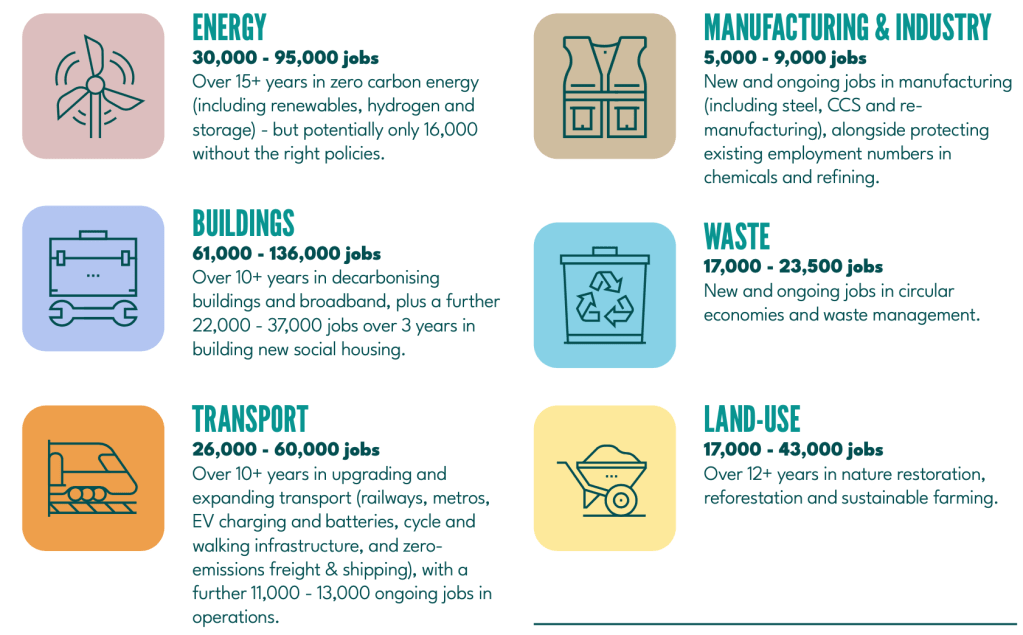
Green Jobs in Scotland comprises 103 pages of densely packed analysis covering six broad sectors of the Scottish economy.  It’s important to note that it is not a critique of either the Scottish or UK’s policies on climate.  It takes as given, for example, the fact that both governments’ have strategies based on large scale use of carbon capture and storage.  What it does do, sector by sector, is take current targets and policy recommendations and analyse in detail what needs to change for decarbonisation targets to be achieved.  The graphic illustrates how, in the best case scenario, 367,000 new jobs would be distributed across six major industry sectors.  

The report repays careful reading, not just because it provides solid evidence to back up the case for climate jobs, but also because, working within mainstream assumptions about the economy it shines a light on significant dangers along the road to transition.  

The Transition Economics team highlight the inadequacy of current climate action plans and argue that for targets to be achieved the Scottish Government’s timeline to meet its 2045 targets needs to be revised

Scotland’s net zero emissions by 2045 target, decarbonisation has to accelerate.

They also make it clear that, to date, the promise of jobs has been illusory. Indeed, job numbers in the renewable sector have been in decline.  This is a direct result of policies that have relied on the market.  And the report makes it clear, that while with the right policies and funding in place, 367,000 new jobs in the Scottish economy is a possible outcome, without such policies the number of new jobs might be as low as 156,000.  It concludes that 

… it is also possible for Scotland to decarbonise without significant domestic job creation – and that those jobs created could be primarily precarious and under-paid. 

The report gives examples of the consequences of giving free rein to the private sector. For example, in offshore wind and solar 

… employment in renewable energy …has been below standard. Jobs tend not to be unionised, and there have been reports of large multinational energy utilities like EDF trying to avoid unionisation of their (new) renewables divisions, despite union recognition across the rest of the company. The wind power Sector Deal created by the UK Government excludes any provision for trade unions. This adds to significant Health & Safety concerns with wind power, repeated violations, and recent deaths amongst onshore wind workers.

An investigation revealed that migrant workers hired to work on crane ships and guard vessels for offshore windfarm construction and offshore cable-laying sites were paid a fraction of the minimum wage and made to work more than 12 hours a day – both at the Beatrice site and others.  Instead of ensuring acceptable labour standards, the UK government has now repeatedly extended a waiver work for permit requirements in the wind sector to facilitate the employment of foreign crews – raising concerns about poor safety and human rights conditions for migrant workers, as well as concerns about local jobs and training opportunities in the sector.

Throughout, the report assumes that climate projects will be undertaken by the private sector with public participation.  The role for participation is to set policy goals, make investments and provide some level of regulation – legislation on fair work practices for example.  One example that is given notes that there are serious skill shortages in some sectors and recommends a co-ordinated approach to skills provision for the climate transition through the creation of a new public body – Climate Skills Scotland.  The new organisation’s role would be


to play a co-ordinating and pro-active role to work with existing providers (e.g. FE colleges) to quickly roll out the new qualifications required. 

So essentially, public participation means supporting and facilitating the private sector.  But given the track record of the private sector there must be grounds for questioning whether this level of participation is adequate. It’s clearly right to suggest, as the report does, that there is no certainty that the headline figure of almost 400,000 jobs will be achieved, or that jobs will be unionised and provide good pay and conditions.  Even if both Holyrood and Westminster step up the pace and address investment in the projects outlined in the report, the private sector will still be driven by profit maximisation.  That’s why renewable job numbers in Scotland have declined, why renewable projects source production on the other side of the world resulting in massive carbon footprints, and why wage rates and working conditions are driven to the bottom.  Scot.E3 argues that public participation is not enough to ensure that we meet zero carbon targets or to ensure that the jobs that accrue from transition are good jobs.  We need public ownership and democratic control.   

Finally, the report touches upon three areas which, in our view, require urgent attention if Scotland’s roadmap for transition to zero carbon can have any credibility.  The first of these is North Sea Oil and Gas.  Most oil and gas production is not included in Scottish emissions figures or in targets for emissions reductions. The report notes that:

Scotland’s oil and gas output is equivalent to an additional 180.3 MtCO2e when used, more than four times greater than Scotland’s own greenhouse gas emissions [our emphasis].  

These uncounted emissions represent a whole herd of elephants in the room and must be addressed as part of a planned, coordinated and just transition.  This requires a sharp shift from the current policy, espoused by both Holyrood and Westminster, of maximum economic recovery of North Sea hydrocarbons.  It also requires a break with the long-term partnership with big oil which has been cemented over 50 years by massive subsidies from the public purse and is now driving the policy focus on hydrogen production in order to sustain the industries dominant economic position.  

The report is critical of a focus on hydrogen production from oil (blue hydrogen), arguing that it could delay progress with green hydrogen produced by electrolysing water. However, in line with its overall concentration on existing government policy it fails to look at the serious criticisms that have been made of zero carbon plans that foreground hydrogen.  

Finally, the report notes how the private companies contracted to build energy from waste plants have tried to drive through serious cuts in pay and working conditions.  However, it is uncritical of a strategy that requires a continual stream of waste for burning (and thus generating greenhouse gas emissions) for decades to come) and is incompatible with a zero-carbon transition and the Scottish Government’s aspirations for a circular economy.

Free Our City – protest

There will be a protest on Tuesday 8th June at 12 noon in George Square against Glasgow City Council’s stealthy collusion with the Scottish Government in a last-ditch attempt to block the introduction of a new free bus service across Greater Glasgow – for details see this post.

Free, decarbonised, integrated, Covid-safe, publicly owned, worker-and-user-controlled public transport is the most immediately possible and effective way to address all elements of the current crisis – climate, Covid, poverty, exclusion, inequality.

The time and date of the protest have been timed to coincide with a critical Council meeting on its Climate Emergency Implementation Plan

Please turn up and spread the word. Wear masks and observe social distancing.

Paid to Pollute

A court case launched today against the UK Government that exposes the billions it gives to the oil and gas industry. The case is supported by the Paid To Pollute campaign, a new initiative coordinated by Uplift and endorsed by a number of organisations including Greenpeace UK, Platform London, Oil Change International, Friends of the Earth Scotland, Friends of the Earth England, Wales and Northern Ireland, UK Student Climate Network, Parents For Future, Fridays For Future Scotland, Extinction Rebellion, and Mothers Rise Up.

From it’s beginning more than 50 years ago oil and gas extraction from the North Sea has been heavily subsidised by the taxpayer. To find out more about the UK’s North Sea oil tax regime, which has handed super-profits to international oil companies while the taxpayer now foots the bill for decommissioning, you can read the featured report on our North Sea Oil and Gas page.