Earlier in the year we held an online public meeting with speakers from the Mossmorran Action Group. Prior to Covid19 Climate Camp Scotland were planning their summer action around Mossmorran. Limitations on social contact have made the original plans impossible but Climate Camp are continuing to campaign for action on Mossmorran. On Sunday at Midday there will be protests at SEPA (Scottish Environmental Protection Agency) offices around Scotland. The action will continue via social media on Monday; for more details go to the Facebook event or read the action briefing document.
We held our latest organising meeting on 23rd July. It was a chance to catch up and share ideas. You can find the full list of actions here and if there are particular actions that you would like to get involved with please do email us.
Part of the discussion focussed on the impact of Covid19 on the Scottish economy. We will soon be publishing an extended article on the importance of the education sector in the transition to a zero carbon economy – in light of this it’s very important to support education workers who are fighting to keep their jobs. Edinburgh Napier University is the first to announce that it is looking for compulsory redundancies. Do sign and share the petition in support of Napier staff.
In Glasgow jobs at First Bus are under threat – Get Glasgow Moving are looking for support for their campaign to take Glasgow bus services into public ownership. You can sign their petition here.
We are planning two public meetings, one on Ineos and one on a Worker Led Just Transition – watch this space for dates and further details.
Leeds TUC’s Environmental sub-committee held a webinar recently on ‘Alternative ways to decarbonise our heating systems’ – the video includes a lot of useful information and some sharp critique of the idea that’ blue hydrogen’ could be a way forward.
This video has Professor Andy Stirling and Dr Phil Johnstone, in conversation with CND Chair Dave Webb, about the connections between the UK’s nuclear weapons programme and nuclear power. Their research shows that the sole case for nuclear power is to subsidise nuclear weapons production. Electricity consumers are paying for the high cost of nuclear generated electricity and thereby subsidising research that is used by the military to maintain the nuclear weapons programme. The argument that Nuclear Power is ‘climate friendly and necessary’ is a convenient afterthought to disguise the real reasons for developing it.
Yesterday saw the publication of ‘Towards a robust, resilient wellbeing economy for Scotland’. The report was written by the Advisory Group on Economic Recovery with a remit to make recommendations to the Scottish Government. As Ben Wray notes in today’s edition of Source Direct the report is strong on buzzwords but devoid of real urgency and concrete proposals. The end of this week is also the deadline for submissions to the Just Transition Commission. As a contribution to this debate we publish the near final draft of Scot.E3’s submission, which makes the case for radical and immediate action on the climate crisis.
Climate Crisis
There has been a yawning gap between the Scottish Government’s rhetoric on the climate crisis and its actions. Vaunted cuts in domestic greenhouse gas emissions are almost entirely attributable to the greening of electricity production and the export of emissions as a result of deindustrialization. To date the Scottish Government’s actions have failed to measure up to the urgency of the crisis.
Covid19
However, the impact of Covid19 on society and the economy provides an opportunity to take decisive action. Job losses in the North Sea oil and gas sector, as a result of the impact on oil and gas prices, are already significant and are increasing rapidly. There have been layoffs before , however, this time round many analysts are predicting that the sector is unlikely to bounce back. These redundancies will have a direct additional effect on employment in the supply chain and an indirect effect on local economies, particularly in North East Scotland. The North Sea is only part of a much larger employment crisis in Scotland that includes tourism, some sectors of manufacturing, education and retail.
The economic and social dislocation of Covid19 is having a massive impact on the lives and livelihoods of working people in Scotland and across the world. Attempting to reset the economy to its pre-pandemic state at a time of climate crisis is madness. Millions of working people will bear the brunt of hardship, unemployment, sickness, stress and anxiety, and precious time to act on a Just Transition to a new sustainable economy will be lost.
The time to act is now
Many of those being made redundant in Scotland, oil and gas workers, engineers at Rolls Royce, have skills and experience that are needed to develop a new sustainable economy. They represent a precious resource. Yet if climate action is deferred, their knowledge and skills will be lost. Meanwhile, those who have lost their jobs, together with their families, and communities will have repeated the experience of mining communities in the 1980s. If these workers are not supported now it will be so much harder to win the case that Just Transition is possible.
Around the world responses to Covid19 have demonstrated that rapid action and mobilisation of human and material resources by governments is possible at a time of crisis. We suggest that the Commission recommends that the Scottish Government should learn from international responses to the pandemic and tackle the Climate Crisis and ‘recovery’ from the pandemic with the same urgency.
Public information on the nature of the crisis and the policies being adopted will be crucial in winning hearts and minds. But Just Transition has to go beyond rhetoric – people will not be convinced unless there is clear evidence at every stage that Just Transition is underpinned by actions that have social justice at their heart. But it should also be based on the premise that while the crisis is global, Scotland has a significant role to play. We are a country rich in sustainable energy resources. We have workers with exceptional skills and experience. We have a historic obligation as part of a British state that contributed massively to the accumulation of greenhouse gases in the atmosphere over the last two centuries.
Establish a Scottish Climate Service
The JCT Interim report noted that climate action needs to be planned, systemic and coordinated across the whole of the country. The private sector simply can’t do this, the public sector can. However, planning requires appropriate infrastructure. One component of this, the National Investment Bank, is in place – but its role needs to be much expanded. The mooted State Energy Company, as another supplier in the energy marketplace is inadequate. It should be replaced by a vertically integrated, publicly run organization that is involved in every aspect of energy; generation, distribution and supply. The third necessary component is integrated research, education and training, planning, monitoring and evaluation. Scotland has rich potential in this respect. The knowledge and creativity from Universities and Colleges, think tanks like Common Weal, unions, workers, communities and climate activists can contribute to a democratic, open and coordinated planning process. All three components might be seen as part of a Scottish Climate Service.It is perfectly possible to initiate effective action to reduce carbon emissions now. We have the scientific knowledge and technical expertise. A great deal of work has already been done on the steps that can be taken immediately. Our Common Home – Common Weal’s costed blueprint for a Green New Deal for Scotland – is an example. There will be need for debate and development of the details. Critically investment should be into technology that exists and that provides solutions that are effective now. New and unproven technologies like CCS should have a low priority (reversing what seems to be current practice).
Core principles that should underpin recommendations to the Scottish Government
End support for maximum economic extraction from the North Sea and begin a managed and rapid phase out of North Sea Oil and Gas through public control of oil and gas production and processing
Take INEOS’s Grangemouth facilities into public control
Support the workers who are losing their jobs in the North Sea with guaranteed income and fully funded support for retraining
Planning, action and investment for Just Transition should start now – establish a Scottish Climate Service
Ensure that social justice is at the heart of transition. Social justice requires the protection of lives and livelihoods, working with BAME communities to end environmental racism, the creation of a gender equal economy and a focus on further improvement of air pollution in our cities
Democracy and accountability – involve energy sector workers, climate activists, workers and communities in the process of building the new sustainable Scottish economy
Creation of 100,000+ climate jobs – these are jobs that ensure reductions in greenhouse gas emissions (energy, transport, housing, home insulation, a new smart grid …) and jobs that are neutral with respect to emissions but contribute to health and well-being (care, health, education, recreation, nature conservation, local food production)
Ensure the safety of workers in all industries – no one should be penalized for refusing to put themselves in an unsafe working environment
A massive expansion in opportunities for education and training in all of the disciplines and skills required for transition – keep full time education free and make part-time education opportunities free for all
Public control over an expanded and integrated free public transport system
Comments on this submission are very welcome as are reactions to the Advisory Group report. Use the contact tab to get in touch.
In the region of 10m people in the UK could be said to be living in ‘Food Poverty’ or find it difficult to obtain sufficient healthy and affordable food. This will have worsened under the Coronavirus lockdown.
The link between income (wage) poverty and food poverty has been important to Governments since people moved from the land in the early years of industrialisation. Wages had to be kept low to guarantee profits but workers who were too poor to buy expensive food in urban areas wouldn’t be able to work. Industrial capitalists were big supporters of the repeal of the Corn Laws, that was protecting high prices of food grown in Britain.
In more recent times Governments and Agri-business have conspired to make ‘cheap’ food available with the help of the oligopolistic supermarkets. Cheap often meaning low on nutrition and high on additives. This suits the (big) agri-producers and retailers and allows neo-liberal governments to avoid dealing with the income issue. It also loads the production side in favour of large-scale production reliant on farming methods that are dangerous to both the environment and people’s health. For example, 13 dairy firms worldwide are responsible for more greenhouse gas emissions than the UK.
The ‘Brexit’ impact on food and agriculture, therefore, is not just any immediate impact of a no deal. The big danger is a ‘free trade’ deal with the US. This would set us (both as producers and consumers) back decades in our quest for sustainable and healthy food supplies.
Geraldine Clayton looks at the urgency of building a new green economy post pandemic and reviews the Absolute Zero report, which was published in November 2019.
Discussions are now underway on how best to restart our economy after the coronavirus crisis. There is much to play for, and many groups and organisations have taken the message they want from the present crisis. We all, however, want to build a more efficient and less fragile economy than that which came about after the banking crash. For this to happen we will need a skilled workforce spread across the country able to take on the challenges ahead. The answer is surely in the regional planning and industrial strategies we can use to revitalise communities across the country by working towards a real zero carbon future.
In the world of finance, investors are now looking towards green policies for economic recovery. Unless policy makers put these at the top of the agenda we will be jumping from the coronavirus frying pan into the climate change fire. We need to be making structural changes now; investing in the supply chain for a green economy, changing legislation and regulation, and implementing an environment-led stimulus package. Putting the energy sector into some form of public ownership would place workers and communities at the centre of the recovery through public enterprise strategies and regional planning. The Scottish government could take advantage of the fact that EU state aid rules have been largely suspended to take over strategic sectors of the economy such as clean energy production. This would provide badly needed revenue. Profits would not be going onto the balance sheets of companies owned in this country and subject to future takeover activity, or to overseas investors. By acting now will we be advancing progress on tackling the climate emergency. But there is no time to waste. The government must either lead from the front or it will become irrelevant to the changes taking place around it.
What better way to build the economy than around tasks such as retro-fitting insulation for energy saving, getting rid of old gas boilers, building district heating systems, smartening up the grid, and developing, manufacturing and installing the new technologies we will need to conform to our carbon reduction targets?
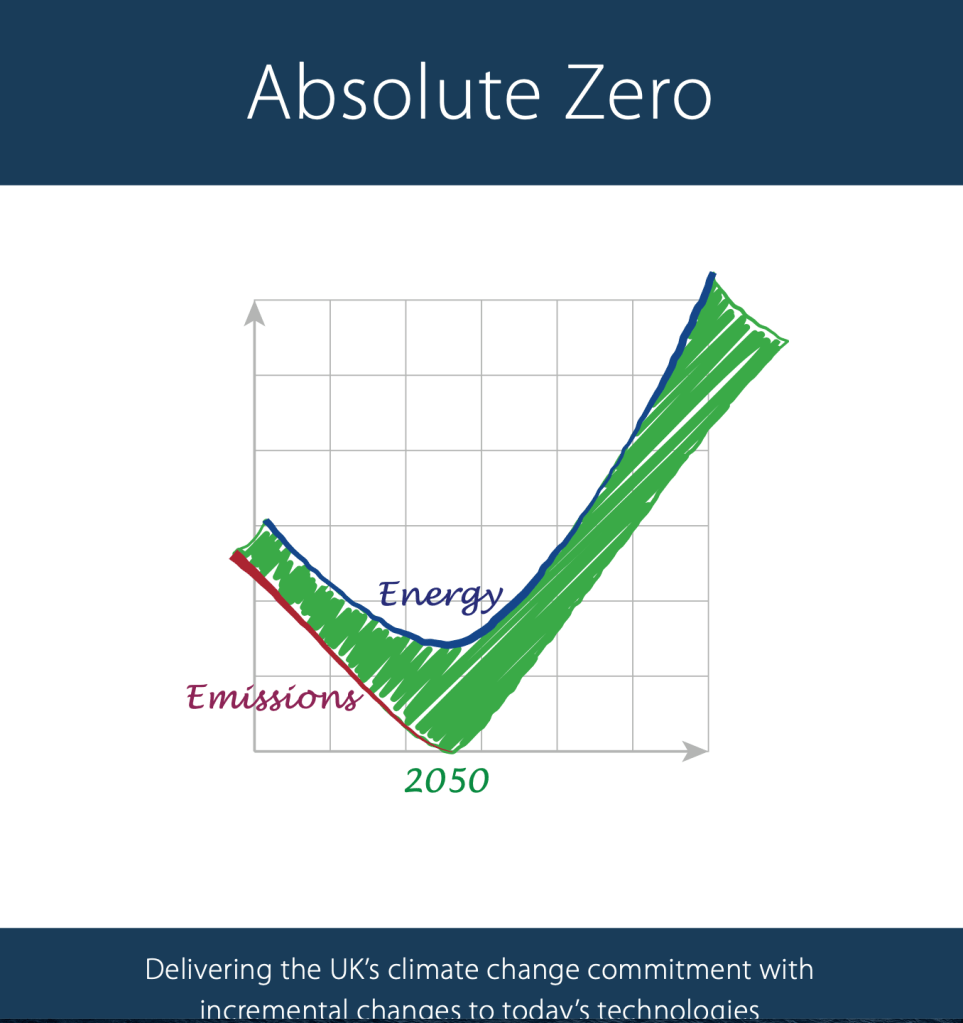
The UK FIRES ‘Absolute Zero’ report which came out last November, written across five universities in the UK, funded by the government and endorsed by the House of Lords, states that we need to be out of fossil fuels by 2029, including that used in shipping and aviation. The only exception to this will be for a limited amount of oil to be used in the making of some plastics.
Screenshot of the cover page of the Absolute Zero report
Sad to say the oil majors and fossil fuel companies, while publicly endorsing the need to act on Climate Change, are at the same time massively increasing their investments in a huge expansion of oil and gas extraction. They are putting themselves forward as the solution, when they are a major part of the problem.
The industry spends a lot of money and effort on lobbying. They have set up a network of supposedly independent organisations around the world whose job it is to lobby policy makers with positions that run counter to a lot of the top line statements of the major companies. This practice is known as ‘astroturfing’. It’s a murky business, but thanks to a determined group of academics, journalists and investigators some of these activities have been exposed. Another strategy is to hide behind trade organisations. Cross sector industry bodies tend to adopt the positions of their most vocal members, often fossil fuel related companies. The other majority members tend to stay silent, so these stances prevail. Trades associations have been weaponized by the fossil fuel companies to allow them to outsource the ‘negative stuff’. These, along with other lobbying strategies, have hindered governments globally in their efforts to implement policies aimed at allowing us to reach our climate change targets. The industry says its position on climate change is transparent and clear, yet their lobbying activities tell another story. Added to that, years of suggested solutions based on breakthrough technologies, including projects such as Carbon Capture and Storage (CCS), and on market driven fixes like carbon markets have held us back from dealing with the ecological tsunami which could soon overtake us. For years the industry has proposed these types of solutions, and has been asking governments for money for funding CCS and other projects. These solutions are expensive and up until now none of these schemes has been proven to work at scale.
The Absolute Zero report states “The target of zero emissions is absolute. There are no negative emissions options or meaningful carbon emissions offsets. The UK is responsible for all emissions, including imported goods and international flights and shipping.” “Breakthrough technologies cannot be deployed at the scale needed rapidly enough.” We are concerned that most plans for dealing with climate change depend on breakthrough technologies, so will not be delivered in time. Until we wake up to the fact that breakthrough technologies will not arrive fast enough we cannot even begin having the right discussion.”
The stark reality is that the carbon to CO2 ratio is 1:3.7, which means that to stick to absolute zero emissions, for every ton of carbon we burn, we would have to take 3.7 tons of CO2 out of the atmosphere. (Professor Miles Allan , in ‘The Life Scientific’ on Radio 4).
The current crisis has exposed the cracks in our system, and we now have a clearer understanding of what an emergency is. Even the super-rich cannot escape in any meaningful sense. Our life support systems are under threat, and there is a danger we could soon reach the point where, in a world in which biodiversity loss is amplified by climate change, there will be no turning back. Coronavirus will be brought under control eventually, but environmental collapse will be permanent from a human perspective.
If the fossil fuel industry wants to sell its product it should demonstrate that it can be used safely, and that the industry can clean up its own mess. It cannot do either. The fact that the industry spends so much time and effort in lobbying demonstrates that its arguments are weak. These arguments include;
“We can’t get out of oil and gas because if we do, production will be taken up by the ‘bad’ producers, such as Russia and Saudi Arabia. Our oil is good oil.”
The Deep Water Horizon well was exploratory at the time of the disaster, but the oil destined for production would presumably have gone under the heading ‘good oil’. Would the people of the Niger Delta, who have lost much of their livelihoods to oil pollution think Shell’s oil is ‘good oil’? It takes nine times more land to produce a barrel of oil on the US mainland than it does in Russia or Saudi Arabia because of the amount that is recovered from fracking. That is neither environmentally nor financially sound. We have a moratorium in Scotland on onshore fracking, but companies such as INEOS are pushing hard to have the moratorium overturned. In any case, the ‘chemically enhanced’ treatments used in oil recovery to get that ‘extra bit’ of oil out of a well are now standard practice across the world, including in the North Sea.
Many people still believe we import much of our gas supply from Russia. In fact we weaned ourselves off Russian gas years ago, and now import only a tiny fraction from there. Most of our gas comes from Norway, while the Norwegians obtain their own domestic power from hyrdro-electricity.
We were fed a similar line regarding the ethics of supplying arms during the seventies and eighties by the arms industry, who told us that if British companies stopped selling weapons this would allow the ‘wicked’ arms sellers to take over. Decades later the world is still awash with arms, and we are entering into yet another arms race. Oil, and the rights of access to it have both stimulated and fueled conflicts for a very long time now. But natural resources for clean energy are spread across the planet. There is no point in fighting for the wind, the sun or underground and airborne heat sources.
“We need to produce more oil and gas to save on expensive importing.”
Oil and gas is bought and sold on the world’s markets, so the oil produced here will go to the highest bidder. A report in January 2019 from the UK’s National Audit Office estimated the costs of dismantling offshore oil and gas infrastructure in the North Sea over the next twenty-five years could exceed £240 billion, most of which will be funded by the taxpayer. When this, along with the tax handouts and generous benefits handed out to companies are taken into account, the product appears to be rather expensive.
“We have the skills and the technological know-how to solve the problem of climate change.”
They are right, but it’s time for the industry to put their money where their mouth is. Their biggest resource lies in their workforce, who have families, and like us are hoping to live in a world where the future will be safe for their children and grandchildren. This is a truly solvable problem, and the fossil fuel companies have the resources, capital, cash flow and engineering capability to make this happen. Together they account for 10% of the world’s economy. But it requires the whole industry to clean up its waste rather than hoping someone else will do it for them.
“We will still need a mix of fuels by 2050”
Just listen to the science.
The sharp drop in the price of oil allows us to see what will happen in the future. The value of these companies lies in the value of their oil, and they have tanks of it. The days of peak oil have gone, but still many of them continue to take on debt to enable them to carry on with exploration and drilling. Offshore drilling tends to be done at greater depths than previously, and in more hazardous conditions. Clean-up operations will become much more difficult and expensive in the future. Oil leaks have increased recently, including in the North Sea, and the oil companies have been told to clean up their act. Climate change means insurance firms will be hit with increasing claims related to extreme weather, and fossil fuel companies will lose their value as the world implements increasingly urgent climate targets.
The Arctic is now being viewed as one of the most lucrative places for fossil fuel investment, but oil production in the area is beset with environmental dangers. Protection treaties have not been agreed for oil and mineral extraction in the Arctic, and there are no safety protocols in place for the region. The detrimental effects of oil spills in such a cold climate will be many times longer lasting than in temperate areas (think how much longer things last when kept in your fridge or freezer). The Deepwater Horizon disaster was estimated to have cost $100 billion to clear up. Any such occurrences in the Arctic region could be much costlier and more damaging to the environment. Shell, to its credit, has said it will not explore in the region until regulatory measures are put in place, but many other companies are keen to get started.
For pension funds and other investors, oil dividends and investments have up until now been safe and lucrative, but this cannot continue. Shell has for the first time in decades cut its shareholder dividends, and BP has seen a sharp drop in profits. Over the past three to five years global stock indexes without fossil fuel holdings have held steady with, and even out-performed otherwise identical indexes that include fossil fuel companies. Fossil fuel companies once led the economy and the world stock markets. They now lag.
According to the Institute for Energy, Economics and Financial Analysis, trustees face growing fiduciary pressure to divest from fossil fuels due to volatile revenues, limited growth opportunities and a negative outlook. Scottish local government pension funds have been advised by the Scottish Local Government Fiduciary Duty Guidance Advisory Board that pension committees may take environmental social and governance considerations into account in relation to investments if the financial performance of that investment may be impacted as a result of any particular environmental, social and governance considerations. Legal & General has put climate change risk as its top concern in terms of profit warnings.
Oil tends to mirror the stock market’s rise and fall, so it’s not a particularly good investment in a properly diversified portfolio. The value of these companies is bound to crash. We don’t know when this will happen, but we know it will.
Fossil fuel and aviation companies are currently asking the government for yet more handouts and tax breaks. The UK already has some of the lowest oil tax rates in the world. Last year Shell paid no tax at all on its UK operations. They already receive handsome tax breaks on investments and decommissioning, but the taxpayer can no longer keep on funding private businesses only to see them create more costs in the future in the form of climate impacts. The UK should remove all incentives and tax breaks from oil and gas extraction and redirect them to funding a just transition. Money spent on green initiatives will provide decent training and employment opportunities and help small and start-up businesses which are well placed to deploy new technologies. Given the right policies, job creation in clean energy industries will exceed affected oil and gas jobs more than three times over. These opportunities will be spread across the UK.
Our situation regarding climate change and loss of biodiversity is very serious indeed. We are closer to a real tipping point than we think. The stimulus packages released now hold the key as to whether this coronavirus crisis delays or advances progress on tackling the climate emergency. As the saying goes, why not make an opportunity out of a crisis? After all, I don’t think we will get another chance.
Platform recently released a survey for workers in the oil and gas industry, its supply chain, and relevant bodies that interact with both. Its objective is:
To find out how the oil crisis and Covid19 has impacted job security and work conditions
To understand what a ‘Just Transition’ means for oil and gas workers.
If you are a worker in any of the industries that Platform would like to talk to please take a few minutes to complete the survey.
In the final part of his four part post on food production and just transition Mike Downham puts forward some ideas for the demands we should fight for and how to organise. We’d welcome comments and responses to this important discussion. You can read or download the full text here.
Demands
Choosing and formulating demands has to be collective. If a large number of people, all of whom can see the benefits of winning the demands, haven’t been involved in the process, the demands will fail. This is so obvious that it might not seem worth pointing out, but a lot of GND proposals have fallen into the trap of making detailed proposals drawn up by a small number of well-intentioned activists.
A further general point about demands is that addressing them to governments is only part of their purpose. Equally or more important is that they should reach the whole of society – workers, Unions, civil society organisations and the general public. It helps in formulating them to remember that. The purpose of demands, beyond whatever response governments make or don’t make to them, is to increase the size, diversity and solidarity of the mass movement, giving it something concrete and specific to come behind.
With regard to local food production, it’s enough for now to suggest that we need two sets of demands, one about making land available and one about educational opportunities.
Land demands will need to take land reform much further than the pallid 2003 Right to Buy Act. It’s common knowledge that land ownership in Scotland is more archaic and more unjust than in any other industrialised country in the world. For lots of reasons on top of local food production, any GND needs to confront that fundamental class issue head-on. It would not be difficult to construct an immediate demand that landowners should be compelled to relinquish tenure on a quota of their land for allotments or community gardens or educational gardens or farms producing for the local market, as long as each proposal fulfilled centrally specified conditions.
Educational demands will need to cover classroom and kitchen staffing levels in schools, teacher training, and higher education course choices and staffing, formulated in discussion with workers and their trade unions. Given the recent strong protests of unionised college and university workers, we are in a good position to discuss with these workers and their unions whether this is the moment to demand that higher education should be taken back into public ownership.
Both land and educational changes will have to be anchored by state intervention, and democratically controlled at a local level. Our demands must include these conditions.
Organisation
In considering how we should organise to achieve these demands the overriding point is urgency. The urgency of climate change is widely accepted, and we can’t afford to take our eye off the climate emergency just because air quality and carbon emissions have improved dramatically through lockdowns – though this does show what can be achieved by states when their backs are against the wall. The point is also being made by a lot of people and organisations that if we’re determined not to go back to the same normal once the pandemic is under control, we should start now to get together and say whatever it is we want to say about the new normal. It could take years, with further catastrophic waves of infection, before the pandemic is under control. We absolutely shouldn’t wait to act until then. Even these few weeks before the possibility of a second wave of infection in Scotland mustn’t be wasted.
An additional point argument for urgency in relation to Scotland’s food strategy is the growing prospect of a no-deal Brexit, which could leave the shelves of supermarkets empty again, and not just transiently.
But how do we get together? Building community knowledge, consciousness and solidarity in the context of neoliberalism can take years. In Jackson, Mississippi, they’ve been at it for 40 years. The poor neighbourhoods of North Edinburgh have been at it for at least 10. We don’t have time for that. But the pandemic has created a unique context, in which governments across the world are in a weaker position, and communities in a stronger one, than at any point in the history of industrial capitalism. One immediate opportunity in Scotland is to build on the mutual solidarity networks which have mushroomed during lockdown. Some of these networks are new, while some developed from previous neighbourhood organisations. Other groups are likely to emerge as the full economic consequences of the pandemic bite. As the structure of the economy has changed over the last 50 years, with workplaces that are smaller and often distant from where the workers live, some people working from home, and the predominance of services over production, it’s become clear that we have to organise not only where we work, but also where we live. So we need to join and become active in any local formations which are concerned about the future for working class people, and for most of us there are or will soon be opportunities to do that. And we shouldn’t see existing legislation, including the legal obligations of Local Authorities, as things which can’t be swept away by a mass movement.
More will have to be done about Scotland’s food than the development of local food production. That was illustrated by the traffic chaos in Glasgow last week on the day 31 Macdonald’s drive-ins opened. But development of local food production, as an integral part of a Green New Deal focussed on both a Just Transition and a Just Recovery, bringing with it jobs and training and neighbourhood solidarity, is a good place to start. We can take on Macdonalds and intensive farming later.
In this penultimate part of his extended article Mike Downham looks at different forms of local food production. Production and local democracy are fundamental to radical change. Tomorrows final instalment explores demands and organisation.
I’ll consider local food production under four headings: allotments, school gardens, community gardens, and farms.
Allotments
Allotments have a long and mostly successful history. In 1908 the Small Holdings and Allotments Act placed a duty on local authorities to provide sufficient allotments, according to demand. Originally a plot was defined as 250 square metres, based on the area needed to produce enough vegetables for a family of four. With the escalation of land prices and the erosion of local authority funding by central government, local authorities, desperate to sell land they owned, fell behind with provision. This led to waiting times of as long as 10 years in some places. Length of waiting list became a criterion for additional provision, but with the loophole that there was no statutory timescale within which local authorities were expected to meet their obligation to increase provision. By 2007 most local authorities had responded to unmet demand by simply halving the size of plots. Communities responded by trying to persuade private landowners to lease land to associations of local residents. Their efforts often failed, or leases were grudgingly granted with conditions slanted to suit the changing whims of landlords. Private sites are now common but the people working them often experience insecurity of tenure.
Individual plots are relatively affordable, at around £50 a year, paid to the site Association, who pays the landowner. Though plots are worked individually, sites are in practice usually strongly collective in the sharing of knowledge, skills, implements, plants and seeds. For many plot-holders they are an important place of belonging.
For some people, particularly those living on their own or without children, a 250 metre plot is too big, and plots are often halved. Others, who have developed the knowledge and skills needed to produce reliably good crops of vegetables and fruit on every inch of their plots, would like to expand. “I just wish my plot was bigger” they say.
School gardens
School children love to garden. Without necessarily articulating it they recognise that growing veg and fruit isn’t just play but an opportunity to contribute their work to necessary production. Even nursery children can contribute significantly, their small fingers well-suited to sowing seeds, planting out seedlings and fine weeding. You have to be 5 or 6 before you can wheel a barrow, usually best if you have a partner to help you not to cowp your load of muck before you get to your destination. Digging straight trenches in gangs works well with older children. All ages like watering and love harvesting. Even weeding, notoriously unpopular, turns out to be satisfying if the task of clearing a specific area is shared between the right number of hands or hoes.
The learning opportunities in all this are enormous – I’ve heard primary teachers say they can teach everything on the curriculum while children are working in a veg garden – plants, wildlife, habitats, ecosystems, climate, weather, maths, history, the meaning of work … and of course food.
But there are certain conditions for making school gardens a success which these days often don’t exist. The first of these is that the garden has to be significantly productive. Too often school gardens are side-lined to an area which is too small, may be shaded and impoverished by trees, bushes or hedges, and may be badly drained.
Secondly, there needs to be a teacher or a parent who has gardening knowledge and skills, and the time available to plan and work the garden with the children. There’s often no teacher in the school with the necessary skills and knowledge, and anyway their timetable may not give them enough time or flexibility to devote to learning in the garden. Parents sometimes or grand parents often come to the rescue, but they are increasingly unlikely to be able to give enough time now that two or more jobs per family is the norm, the grandparents preoccupied with caring for the pre-school children.
Thirdly, the whole educational experience in relation to food only has an impact if children have the opportunity to prepare and eat the food they’ve helped to grow, as experienced by children growing up on farms or in families with allotments or veg gardens at home. Most larger primary schools have their own kitchens where the school meals are prepared. Many of these schools have school gardens, but few if any of these gardens yield enough produce to contribute significantly to meals in the school.
Secondary schools contract out the preparation of their meals, so students who don’t have the privilege of living in families which produce vegetables are one further step removed from the experience of preparing food from vegetables they’ve helped to grow.
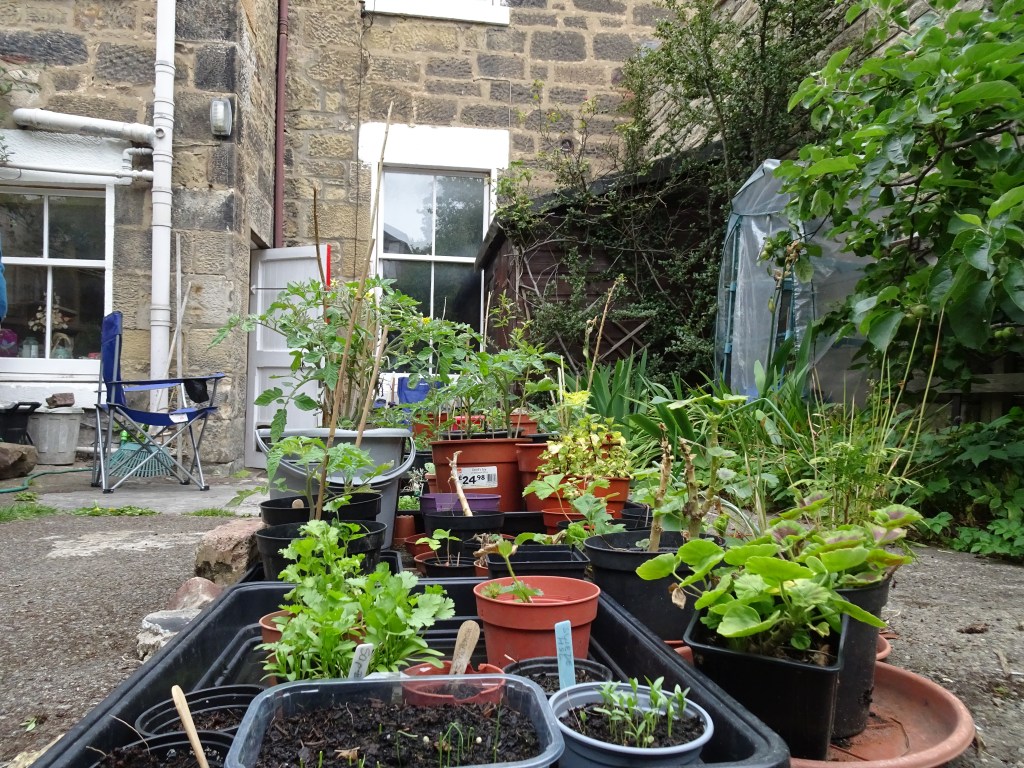
Image: Pete Cannell CC0
Community Gardens
The current community gardening movement in Scotland began in the late 60s with a renewed interest in green spaces in cities. As health and social issues for working class people have escalated during the neoliberal period, so has the number of urban community gardens.
Though there is much diversity in the design and aims of these gardens, the main driver has been social or therapeutic, rather than scale of production. In terms of physical and mental health, community adhesion and organisation, and as habitats for wildlife, community gardens have become important for a large number of communities.
Among the many benefits of community gardens, the therapeutic opportunity they offer to people with mental health issues stands out as a priority. At this moment there’s a conjuncture between on the one hand a new wave, precipitated by lockdown, in the epidemic of mental health issues spawned by neoliberalism 40 years ago and inflamed over the last ten of those years by austerity; and on the other hand the dialectic response to that epidemic now emerging in the revolutionary form of tearing up 60 years of psychiatry. Community gardens have the potential to play an important part in the new multidisciplinary mental health service.
But most community gardens are not productive to a significant scale. One reason for this is that they are generally sited on land whose fertility and soil structure have been compromised by previous industrial use. They are physically hard to work, and fertility isn’t easy to restore unless there is a farm or stable nearby. As with education, the health and social benefits of growing fruit and vegetables are enhanced if production is significant in relation to use by the number of people involved
Farms
By ‘farm’ I mean any area of land for commercial food production too large to be farmed by hand, whatever its acreage. Defining a farm according to its acreage isn’t helpful because production methods depend on what is being produced, which in turn depends on the quality of the particular piece of land. It’s perfectly possible to raise a cow, a few sheep or goats, or hens on an acre of poor land without mechanisation or draft animal power, but very difficult to grow vegetables or fruit by hand on an acre of good land, unless it’s in a walled garden or covered by greenhouses or polytunnels. The term ‘market garden’, which attempted to capture 1-10 acres of land good enough for the production of vegetables and fruit, was never well-defined and has fallen out of use. With the escalation of land commodification, if you google ‘smallholdings’ you are offered for sale at extortionate prices every manner of land which can just about get away with not being called a garden along with a house. In the Highlands and Islands we also have crofts, which, despite their importance to remote communities and in relation to the radical legislation governing their land tenure, I’ll leave to one side because they aren’t able to contribute significantly to food production for urban populations by virtue of their location.
Farms, so defined, will play a highly significant part in a radical GND. Scotland is particularly well provided with land and climate suitable for growing vegetables, fruit and cereals in the east and for raising cattle and sheep in the west. Much of this land is close enough to the centres of population to supply locally, and the quantity of food production land is adequate for the size of Scotland’s population. There are not many countries in the world which are in this fortunate position. In this context agricultural skills and knowledge have remained strong despite industrialisation. Exceptional skills in low-cost field-scale vegetable production have developed in the face of low profitability, absence of subsidies (in contrast to other agricultural products) and increasingly fickle weather as a result of global warming.
Yet a staggering 80% of food is imported (that’s a UK-wide figure – I’m not aware of a separate figure for Scotland but there’s no reason to think it would be much different). The chief reason for this mismatch is of course the global commodification of food. What determines the food we eat isn’t where it comes from, how healthy it is, or the impacts of its production and distribution on carbon emissions and biodiversity, but how profitable it is to the big food corporations.
But the other big reason we don’t eat more food produced in Scotland is the price of land. If people had affordable access to land, we could have more allotments, more community gardens sited on good growing land, not the left-over, infertile land which nobody wants, and bigger and better school gardens.
And if affordable land was available we could have more farms producing for the local market, with lots of new job opportunities – a range of jobs all of which would be satisfying because they have a close connection to a product essential to society, and which would include jobs to suit people with different physical and mental abilities . We could have farms of 1 to 5 acres for people who want to have a go at producing food commercially for the first time, whether young people looking to make farming their career, or people who have lost their jobs or never had one, or retirees, or people ready to expand from a successful allotment or community garden. We could have community-run 10-acre farms acting as local food hubs, providing training, advice, start-off tools, seeds and plants for a local network of allotments, community gardens, school gardens and small farms, as well as producing for the local market. We could have larger farms for secondary schools and colleges, as common in the days before land prices exploded.
In the final part of this article to be published on 13th June Mike looks the kinds of demands we can raise and how we organise . If you’d rather read the full text of the article you can find it here.




 Employment, Energy and Environment