Friday 1st February, 7pm at Lochgelly Town Hall, Bank Street KY5 9
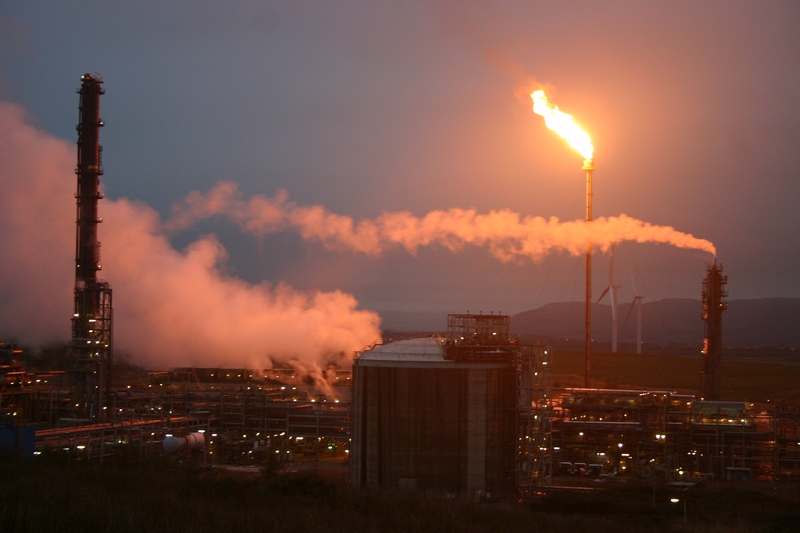
This is a really important meeting. According to the Scottish Environmental ProtectionAgency (SEPA) the ExxonMobil plant at Mossmorran in Fife is the second biggest emitter of greenhouse gases in Scotland – only the INEOS complex at Grangemouth is a bigger polluter. People living in the vicinity of the plant have suffered from excessive flaring and poor air quality for a long time. The Mossmorran Action group has been campaigning for a resolution to these issues. George Kerevan has recently written about the ways in which SEPA has failed to respond adequately to their concerns.
The plant is currently being returned to operation after a shut down in August 2019. Flaring and pollution has been at a high level and yesterday around 170 workers walked off the site to highlight concerns over working conditions and safety. There needs to urgent action to protect the health and safety of local residents and workers. But in light of the climate crisis Mossmorran must also be part of a plan for a rapid phased run down of the Scottish petrochemical industry in which the workers are supported in a just transition to new sustainable jobs – part of the just transition that is so urgently needed.
We recently published the Scot.E3 contribution to the XR “Oil & Gas” Public Meeting held in the Garnethill Multicultural Centre, Glasgow on Saturday January 25. Thanks to Neil Rothnie for this much more comprehensive report.
Rather than try and summarise the individual contributions by invited speakers and the discussions from the work groups, I’ll try and give a sense of what I thought the meeting achieved.
It was, it seemed to me, a success. It was well attended. Maybe 60 odd people? Men and women were fairly equally represented and there was a wide range of ages amongst those attending, though we were predominantly young. The speakers were good, the meeting attentive and discussion lively.
The success of the meeting owes much to the fact that it took place at the end of the month long Rig Rebellion 2 which, receiving considerable media attention, had brought the issue of fossil fuel production in UK into sharp focus. This meant that the struggle to end fossil fuel production on our patch was no longer just a theoretical question. We are engaged. This was reflected in the meeting.
The meeting was facilitated by Dario Kenner, active in XR Families in London who had travelled up with partner and two toddlers – an expression of seriousness if I ever did see one. Dario is author of “Carbon Inequality: The role of the richest in climate change” (Routledge, 2019). He’s also co-author with Rupert Read of a memo to XR. I’ve appended it. Dario’s presence, more than any argument, shouts that the struggle to decarbonise the economy, to take on the polluters, is a UK issue as part of a global issue. Certainly not a Scottish issue. No more than XR Aberdeen can be expected to shoulder the burden of confronting Big Oil, XR Scotland do not have the resources to take on the UK’s major polluters and chief source of UK’s greenhouse gasses. We are part of a movement that spans the whole of the UK.
A very personal message from a rebel “allegedly” involved in the most ambitious of the Rig Rebellion 2 actions was delivered to the meeting. It placed central stage, the issue of civil disobedience and direct action against the polluters, and nailed, as central to the struggle for survival, the end of fossil fuel production. Our speaker challenged the web of relationships in which oil and gas worker, rebels and the myriad other victims of climate change are caught up, in a toxic system built on misinformation, social conditioning, debt, powerlessness, privilege, excuses and ignorance. Rig Rebellion 2 means that no longer is the discussion about the future of North Sea oil & gas to be solely the property of industry and Government. The text will be appended if legal advice allows.
My ideas/comment on what the meeting achieved borrows heavily from the contributions of the two main speakers. Ryan Morrison from Friends of the Earth Scotland talked us, at breakneck speed, through the FotE sponsored “Sea Change” report , and Pete Cannell from Scot E3 took the discussion on to how we respond to this crisis. I’ve tried to reflect, as best I could, what came out of the group discussion I was involved in, and/or had notes from.
The big lie at the centre of today’s, still restricted, public discussion about global warming and species extinction is laid out clearly in Sea Change as presented to the meeting by Ryan. We can’t avoid climate chaos without tackling global warming. We can’t stay “well below” 2 degrees of warming without decarbonising the global economy. That is, not without the planned rundown of the source of greenhouse gasses – fossil fuel production. (North Sea oil & gas on our patch). And we can’t decarbonise the economy by following the “magic thinking” of industry and Government (Pete Cannell) who want business as usual and the maximum economic recovery of every barrel of oil & gas under the North Sea. 20 billion barrels more is the industry’s guesstimate. This gives us warning of what the industry plan is globally.
The issue of a “just transition” is central to the struggle to end fossil fuel production, and it’s not just about providing well paid jobs in renewables for workers who stand to lose well paid jobs in oil & gas, important as this is. Just transition is seen very differently in the global south (Ryan) and when we get the chance to explore this when activists from throughout the global south descend on Glasgow for COP26 later this year, we can show no more solidarity than be seen to be fighting to end to fossil fuel production in the global north starting with on our own patch, the North Sea.
The meeting took the discussion forward from the understanding that the Sea Change report gives us. Direct action is crucial in applying pressure on industry and Government and as Rig Rebellion 2 did, bringing the issue centre stage. But it is not in itself enough if the mass of people only look on – scared. The ideas of a just transition must become the common sense of society. (Pete) But to do that the ideas need to be sharply defined, not just the easy ones like why the oil & gas needs to stay in the ground, but those that confront the smoke and mirrors employed by industry and Government to justify business as usual. We need to understand carbon capture and storage (discussed by Ryan). If, as widely suspected, it cannot be delivered at anything like the scale required, then we need to be able to expose this with thoroughly researched materials and in a clear and concise fashion.
Multi billion pound taxpayer subsidies (our money) is handed to the industry by a Government whose ear they have. The threat of job losses in oil & gas that the industry say would accompany the ending of such subsidies and the ludicrous industry claim that they are ready to deliver net zero as a part of the solution as they continue business as usual. (Ryan). Our answer is the massive expansion of renewables during (and financed by) the end to subsidies to the oil & gas, and the planned run down of the industry starting now. This could leave us with a world class green energy industry to replace oil & gas. Otherwise where would we be in 2050 if this ludicrous plan for “maximum economic recovery” is allowed to proceed. Apart from fire fighting the results of another 30 years of full on fossil fuel greenhouse gas emissions, we’d still have a reliance on oil & gas from wherever, when the North Sea fields have been pumped dry.
The weakness in the regulatory regime that encourages the misuse of migrant labour who are paid a fraction of the UK minimum wage in the offshore renewables industry was noted. (Ryan) A practice they no doubt learned from offshore oil decommissioning. The Sea Change report puts trade union organisation at the centre of a just transition to renewables, though this, given the state of trade unionism on the North Sea, is problematic.
When we confront Big Oil in Dundee and Aberdeen as we have begun to do, who are we actually speaking to? We challenge the industry’s vice grip on a media traditionally prepared to repeat any old nonsense that flows from oil company PR. But we’re also speaking to wider society. Those working in the industry might be the last people to be convinced, but they need to know that the energy transition is inevitable one way or another, and that their intervention will be crucial in determining whether it is to be fair to them or not. They also need to know they do not have a veto. All our grandchildren must have a future.
The discussion is impossible for me to record in any readable form. I’m here setting down some of the ideas that emerged from the contributions of our speakers and from the workgroups I have notes from. This is obviously not definitive and my be controversial. It’s not the final say and can only at best provide a framework for further more concrete planning if, as I hope, an Oil & Gas Working Group can be set up to carry forward what the Rig Rebellions have started.
Although direct action can’t stop oil & gas production, it can identify Big Oil as the problem and can generate press interest and effectively open the issues to public scrutiny. Maybe we can call our self Big Oil’s Big Nuisance. That’s a joke! But not for the industry who spend big keeping everyone “on message”.
Only as the role fossil fuels plays in generating greenhouse gasses and climate change becomes “common sense” in society (throughout the UK) can pressure be progressively brought to bear on Government and industry and finance to begin the mass expansion of renewable energy in sync with the rundown of oil & gas production.
The voice of even a small minority of oil & gas workers prepared to speak out on the issue of just transition and a future for their grandchildren would have a powerful effect and therefore outreach amongst this group is particularly important. But whatever they want to say, the workforce must be encouraged to say it. It is the workforce who will be forced to transition sooner or later, in a planned or a chaotic way. They need to intervene if it is going to be anything like fair to them. The last time there was an energy transition the coal miners and there families and communities, were shafted.
Amongst the citizens of Aberdeen, and amongst oil & gas workers, is where there is likely to be maximum pushback against these ideas, and has to be where we do our most serious listening. They will tell us where our arguments are weakest. Aberdeen also provides us with potential allies amongst those sections of the population who live amongst oil wealth and the high prices it generates, but who are living without oil wages. Making common purpose with them in the Oil Capital of Europe will bring the spotlight on the iniquity of the system and the nature of Big Oil. The transition is inevitable. But the industry, left to its own devices, will leave that city with little of value. What it threatens to leave society with is mass extinction of species
Research into carbon capture and storage, and hydrogen production, pushed as solutions to global warming needs to be accessed and turned into outreach material.
Imaginative materials allowing us to interact with citizens and oil & gas workers will be needed.
Media penetration will be important.
Should it be decided that an Oil & Gas Working Group be established to take this discussion further and make concrete plans, I think one of it’s first tasks will be how it can penetrate XR UK Circles, and challenge them to take responsibility for encouraging the whole movement to see ending oil & gas production from the under North Sea, and a major upscaling of renewable energy production, as a major strategical aim for the movement. This will need the whole movement with all its skills and operating at its regenerative best. UK’s greenhouse gas reserves/emissions are not a Scottish issue. XR UK must be challenged to encourage a movement wide campaign.
None of this is possible unless the necessity becomes “common sense”. Outreach is fundamental.
This is the year of COP26 in Glasgow. Let us show our solidarity with the activists from the Global South who come to Scotland. Let them see our determination to end fossil fuel production in the UK. We can organise transport and hospitality for Nigerian and other activists from around the world who may want to share our action and give their own message to Shell (and others) in Aberdeen, one of the the Oil Capitals of the Global North.
The North Sea hydrocarbon reserves are among the most expensive and most technically difficult in the world. They are also short-medium life reserves compared with larger landmass oilfields.
Anticipating these disincentives, the incoming Labour governments of 1964-69 and 1974-79 with the state-owned BNOC and British Gas companies decided to make them more attractive for licenced operators by zero valuing to hydrocarbon assets thus avoiding the usual auction bidding process that would entail up-front purchase and risk acceptance by prospective extraction companies.
Then taxation rates on oil/gas extracted were relaxed to a very minimum as an incentive subsidy on future exploration and extraction activities. These arrangements- along with wholesale privatisation in 1980- meant that high profits were assured at low taxation rates and with the burden of risk and asset write-off being shouldered entirely by the taxpayer.
Also, these arrangements allowed for profligate extraction with value worthless assets being frittered away when the operational conditions got too difficult.
Unlike Norway– and many other oil and gas nation-states, no sovereign wealth fund was created on the back of oil/gas profit taxes- which in the case of Norway, has resulted in the biggest such fund for social welfare and public infrastructure in the world. So with Scottish territorial waters accounting for over 70% of UK oil and gas fields, little in the way- other than employment- of benefit has resulted/been accrued for the Scottish people.
Now Climate Change imperatives are bearing-down on all countries signed up to the IPOCC targets on carbon emissions targets- but yet ALL reliable sources producing estimates on oil (in particular) output and demand/consumption set targets well above limits required to bring about anything like a global temperature slow-down.
Also, the estimates for Scottish offshore- and fracked gas onshore- extraction fly clearly in the face of the Scottish government targets for a green neutral to zero-economy by 2030.
And also, also, it is clear that despite over 40 years of offshore hydrocarbon extraction- the living standards of the Scottish population- already low in comparison with much of the EU as well as many regions of the UK as a whole- have continued to fall and have continued downwards while the offshore company profits have continued upwards. Essentially we have had subsidies and tax breaks for the rich oil companies and merciless market rigour for the poorest consumers.
Global oil prices (to which gas is pegged) continue to be volatile- but with an OPEC cartel of some 20 countries which are hydrocarbon exporting economic mono-cultures- future price wars- like the one in 2014 which saw 75,000 job losses in the North Sea- make any future dependence on the industry both a climate change folly and an economically ruinous strategy.
Oil and gas over-production is already upon us and any future development- such as the West of Shetland fields- is both unsustainable AND a waste of opportunities to create a green and socially equitable political economy for Scotland.
Dr Brian Parkin, Senior research fellow (Energy Economics), Leeds University
Following actions in Dundee (see video) and at First Ministers Questions Glasgow XR held a well attended meeting on the 25th January. The meeting began with contributions from XR activists, Friends of the Earth Scotland and ScotE3, before breaking into discussion groups. The remainder of the post reproduces the text of the ScotE3 contribution in which we shared some thoughts on strategies for achieving a just transition to a zero carbon economy.
ScotE3 campaigns for the importance of climate jobs. Jobs that are critical to the economic transformation that is needed to prevent a climate catastrophe. In Scotland 100,000 of these jobs are needed . However, to date we are not doing well. According to the Office of National Statistics the UK’s green economy has shrunk since 2014. The number of people employed has declined as has the number of green businesses. This is true UK wide and in Scotland. It’s no wonder that some representatives of unions that organise workers in the hydrocarbon sector pour scorn on talk of a just transition.
The Sea Change report makes it clear that unless we phase out North Sea Oil and Gas the UK will produce far more green house gas emissions than is compatible with restricting global temperature rise to 1.5 degrees. But we have a huge challenge; the big energy companies are still committed to maximising extraction of oil and gas and so are the Holyrood and Westminster governments. Just a year ago when the discovery of new oil and gas reserves east of Aberdeen was announced energy Minister Paul Wheelhouse highlighted,
the significant potential for oil and gas which still exists beneath Scotland’s waters.
He added:
Scotland’s offshore oil and gas industry has an important role to play with up to 20 billion barrels of oil equivalent remaining under the North Sea and in the wider basin and discoveries such as this help to support security of supply as we make the transition to a low carbon energy system.
Just this week the Africa summit in London ended with the Westminster Government pledging £2 billion to projects concerned with fossil fuel extraction.
From the outset North Sea has been a bonanza for the oil companies. Nigel Lawson, now a prominent climate change denier, was Chancellor of the Exchequer in 1986 and said then
the whole outstanding success of the North Sea is based on the fact that it is the freest petroleum province in the world
He meant of course almost complete freedom for the oil companies – few if any benefits accrued to society as a whole and even centres of the industry like Aberdeen were then, and remain, centres of acute inequality.
So we need a rapid phasing out of North sea Oil and Gas. How can we overcome the powerful vested interests that oppose this and at the same time protect the lives and livelihoods of the workers in the industry. Theer is no evidence that the private sector can lead such a transition. The public sector has to take the initiative – and in Scotland that means a much more ambitious role for a state energy company and the new national investment bank. However, for this to happen we need a powerful movement of movements that has deep roots throughout Scotland.
To grow the movement and force the pace of change clarity of ideas is essential. We don’t have all the answers but the core issues around climate jobs and just transition are clear. So we need to patiently and persistently explain why hydrocarbons need to stay in the ground, why we need zero carbon, why the counter proposals from the industry are a dangerous diversion and how a just transition would have a positive impact on working people.
Reaching the audience we need goes hand in hand with maximising pressure on the energy corporations and local and national government. Much of this will be through all kinds of direct action. There have been some brilliant examples already but we need much more.
Direct action is necessary but not enough. The power to force a transition can only come from a mass movement and to build the movement we need to win hearts and minds. This means reaching out into unions, communities and community organisations with a vision of just transition that goes beyond simply defending existing jobs and embraces practical steps that have direct and understandable benefits for working class people across Scotland and beyond. We need win people to a positive vision of transition, but more than that we need to win them to be active agents in the transition: part of a movement of rebels, not just on the streets, but in workplaces and communities. So as we plan actions we always need to think about how to reach new audiences – through stalls, street leafleting, public and workplace meetings and patient door to door leafleting debate and discussion. It may be that some of those who work in the industry will be the last to be convinced (although that’s not inevitable – our opponents are the same corporations that drive down their wages and conditions and play fast and loose with health and safety). But if they are unconvinced we need to aim for a situation where climate justice is common sense to millions and where the people that oil workers meet in the pub, out shopping, their kids and relatives, are all won to the need for transition.
With the COP being held in Glasgow this year we have a huge opportunity to build outwards and take a massive step forward in creating a campaign for transition that is unstoppable.
One of the workshop streams at the Scot.E3 conference in November focused on Oil and Gas and Just Transition for workers involved with the North Sea. Stephen McMurray summarises the discussion that took place.
The oil and gas group included Simon Pirani, author of Burning Up: a global history of fossil fuel consumption, and a retired oil worker now campaigning with XR and ScotE3. The initial discussions included how we start to phase out oil and gas extraction. The main policy suggestions included ending subsidies to the oil and gas industries and ending licences for oil and gas exploration.
There was an interesting debate about whether the government should set a date to end oil and gas, for example in 2030. On a positive note, it may stop companies exploring for oil and gas well before 2030. On a more negative note, it may encourage companies to seek to maximise output and increase carbon emissions before 2030.
Earlier in the conference, we had watched a series of short films by REEL News. One of the films illustrated that companies were increasingly turning to automation and subsequently reducing their workforce. This led to a discussion considering that research should be undertaken into the impact of automation into the oil and gas industries. Furthermore, it would be useful for REEL News to make a film of the North Sea and show their films on the impacts of oil and gas to oil workers.
There was a general feeling that there was a lack of information for oil and gas workers in relation to training for new industries, and that a just transition conference should be held in Aberdeen for oil and gas workers. There was also a discussion on how we engage with suppliers to the oil and gas industries so they are included in a just transition. Additionally, it was not clear that the Scottish Government had produced a post-oil industrial strategy, and there was a need to give presentations at universities for the need to move to careers post carbon.
Finally, there was an agreement that we need to bring the rebellion to the oil and gas industries and that we need a massive confrontation with big oil in Aberdeen during COP26 when it comes to Glasgow next year.
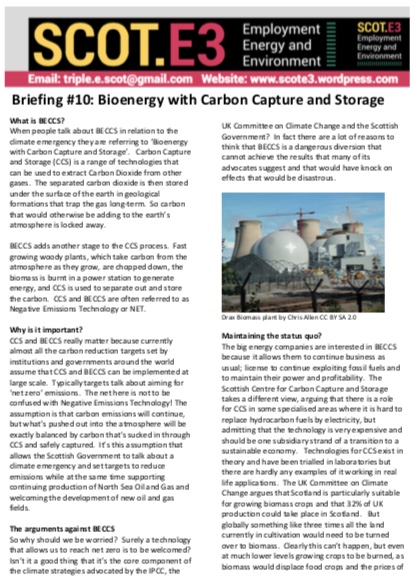
The latest ScotE3 takes a critical look at BECCS – Bioenergy with Carbon Capture and Storage. Like all the ScotE3 briefings it is designed as a short, and hopefully clear, introduction to the topic. We welcome feedback and ideas for improvement.
When people talk about BECCS in relation to the climate emergency they are referring to ‘Bioenergy with Carbon Capture and Storage’. Carbon Capture and Storage (CCS) is a range of technologies that can be used to extract Carbon Dioxide from other gases. The separated carbon dioxide is then stored under the surface of the earth in geological formations that trap the gas long-term. So carbon that would otherwise be adding to the earth’s atmosphere is locked away.
BECCS adds another stage to the CCS process. Fast growing woody plants, which take carbon from the atmosphere as they grow, are chopped down, the biomass is burnt in a power station to generate energy, and CCS is used to separate out and store the carbon. CCS and BECCS are often referred to as Negative Emissions Technology or NET.
Why is it important?
CCS and BECCS really matter because currently almost all the carbon reduction targets set by institutions and governments around the world assume that CCS and BECCS can be implemented at large scale. Typically targets talk about aiming for ‘net zero’ emissions. The net here is not to be confused with Negative Emissions Technology! The assumption is that carbon emissions will continue, but what’s pushed out into the atmosphere will be exactly balanced by carbon that’s sucked in through CCS and safely captured. It’s this assumption that allows the Scottish Government to talk about a climate emergency and set targets to reduce emissions while at the same time supporting continuing production of North Sea Oil and Gas and welcoming the development of new oil and gas fields.
The arguments against BECCS
So why should we be worried? Surely a technology that allows us to reach net zero is to be welcomed? Isn’t it a good thing that it’s the core component of the climate strategies advocated by the IPCC, the UK Committee on Climate Change and the Scottish Government? In fact there are a lot of reasons to think that BECCS is a dangerous diversion that cannot achieve the results that many of its advocates suggest and that would have knock on effects that would be disastrous.
Maintaining the status quo?
The big energy companies are interested in BECCS because it allows them to continue business as usual; license to continue exploiting fossil fuels and to maintain their power and profitability. The Scottish Centre for Carbon Capture and Storage takes a different view, arguing that there is a role for CCS in some specialised areas where it is hard to replace hydrocarbon fuels by electricity, but admitting that the technology is very expensive and should be one subsidiary strand of a transition to a sustainable economy. Technologies for CCS exist in theory and have been trialled in laboratories but there are hardly any examples of it working in real life applications. The UK Committee on Climate Change argues that Scotland is particularly suitable for growing biomass crops and that 32% of UK production could take place in Scotland. But globally something like three times all the land currently in cultivation would need to be turned over to biomass. Clearly this can’t happen, but even at much lower levels growing crops to be burned, as biomass would displace food crops and the prices of staple foods would increase forcing the poorest further into hunger and starvation.
Restoring ecosystems that capture carbon
Forests are a very important way in which carbon is removed from the atmosphere; about 25% of current emissions are taken up. However, worldwide forests are under threat and clear cutting of forests to grow soya and other crops for meat production causes around 10% of global carbon emissions. An end to deforestation and proactively working to re-establish natural forests could have a big impact on carbon reduction. Trees are important but not just any trees. When monoculture plantations replace trees – for example Palm Oil the same land area is much less efficient at absorbing carbon. BECCS often assumes clearance of existing forest for monoculture cultivation of biomass. And there are many other serious impacts: displacement of indigenous communities, destruction of ecosystems and of pesticides.
Separating out carbon dioxide from other gases or from the atmosphere is an energy intensive process so it’s expensive financially and in terms of our overall energy budget. Operating at large scale might reduce the cost per ton of carbon but it would still need very large amounts of clean energy.
Scotland has a number of locations where the underground rock formations are suitable for underground storage of carbon dioxide. Many parts of the world do not. Proponents of CCS suggest that carbon storage could be a profitable new industry – however, long distance transport of captured gas would also require a lot of clean energy.
System change
Ultimately, however, the problem with BECCS and CCS is political. Governments and corporations favour it as a solution because it seems to allow existing infrastructure and power relationships to be preserved. It suggests that climate catastrophe can be averted by technical fixes.
Even if the technology works and can be introduced rapidly and at scale it seems highly unlikely that it can mitigate emissions sufficiently to avoid going well beyond a 1.5 degree rise. However, for as long as CCS remains the main plank of mainstream strategies it diverts action and investment away from sustainable strategies that we know could work. And it acts as a barrier to the systemic change that is required to save the planet.
All our material is published under a CC0 public domain license (unless otherwise stated. You are welcome to share, reuse and reversion. This briefing draws heavily on a FOE(S) and FOE(international) webinar.
Daisy Jamieson was the third contributor to Scot.E3’s Glasgow public meeting on stopping North Sea oil and gas. In her talk Daisy reflected on the importance of just transition. Part 1 of the public meeting can be viewed here and part 2 here.
The second contributor to the discussion at the Glasgow Scot.E3 meeting on phasing out North Sea Oil and Gas was Mike Downham on behalf of Scot.E3. You can watch the video or read the text of Mike’s talk below. (See the first contribution from Ryan Morrison here).
STOPPING NORTH SEA OIL AND GAS EXTRACTION 24.9.19
Thank you, Ryan, for giving us such a clear explanation of the Sea Change report. If some of you haven’t had a chance to read the report, I recommend that you do. It’s quite something. Not only is this new research a vital contribution to the Climate Crisis, but the report is unusually well-argued, well-written and well-illustrated. What’s more, it offers the reader three choices within the same download – a half-page outline, a seven-page summary, and a 62-page full version.
Fundamentally the report says four things:
The quantity of oil and gas still available in the North Sea is huge, and to go on with the current Government and industry policy of extracting it indefinitely will lead to disaster levels of global warming.
Shifting Scotland’s energy strategy to renewables is not only feasible but would create more than three times the number of current jobs in North Sea extraction.
Here’s a roadmap of how to make this change, starting now.
If we don’t start along that road now, escalating climate change will soon force governments to shut down extraction suddenly, with dire consequences for the 40,000 North Sea workers and their communities.
We chose the first word of the title of tonight’s meeting because ‘Stopping’ has two meanings. It can mean beginning to stop doing something, and Sea Change tells us exactly why and how this has to be done in the North Sea. But it can also mean stopping someone else from doing something. In the case of stopping North Sea oil and gas extraction the someone else we have to stop is the extraction corporations. These are giants – giants in terms of financial turnover, and in terms of profit. And because of the huge profitability they can see ahead, as reserves of oil and gas run down and demand gets stronger, they are literally hell-bent to get ahead of their competitors and extract every last drop.
These are the people we have to overcome. And we have no choice except to overcome them because they are responsible for a large proportion of the world’s carbon emissions. What they extract inevitably gets burned. ExxonMobil for example, just one of the giants, is responsible for carbon emissions equivalent to those produced by the whole of Germany. (And, as an aside, to park for another meeting, these are one and the same people as those driving the case for the jargon-wrapped Bio-Energy-with-Carbon-Capture-and-Storage idea, which is nothing more than a huge scam and primarily an excuse to carry on extracting fossil fuels.)
It’s critical I think that we understand exactly what we’re up against. In a market economy based on the assumption that economic growth can continue indefinitely, money is power. Power flows from money in many ways, but the biggest of these is the stranglehold big companies have over national governments. All governments need capital for investment and economic development. When capital is privately owned, and once capital controls had been removed, as they were first in the US in 1974, then in the UK in 1979, and across the rest of Europe and Japan in the 80s, there has been nothing to stop companies moving out of one country into another where labour is cheaper, for example, or government subsidies bigger, or environmental regulation weaker. Large companies have been given the power to sanction government policy. No government can dare to challenge them for fear that they’ll take their money out of the country.
ScotE3 recognises the scale of the challenge to stop extraction, at the same time seeing it as an absolute necessity if we’re to limit global warming to a 1.5 degree rise. We see ourselves as a component of a movement which focusses on social justice and working class action, and we have a special interest in a just and rapid transition from North Sea oil and gas to renewables as Scotland’s exclusive source of energy. We gather and share information, hold public meetings and conferences, and support climate protests and campaigns wherever they emerge, most recently the student strikers and their worker and trade union supporters, Extinction Rebellion, Fife Ready for Renewal, and Friends of the Earth Scotland. You can see all this, as well as a draft manifesto, on the ScotE3 website – there should be a card on your seat giving the website address. Have a look if you can at the blog, and at some of the Briefings – for example Briefing 7 on fuel poverty in Scotland. If you’d like to join the ScotE3 mailing list, we’ll pass a sheet round later.
Interest in ScotE3’s contribution to the movement is growing fast this year, judging by numbers attending meetings and supporting protests, and by website hits. But for the movement to be able to stand up to and defeat the extraction corporations, it has to become very large – a mass movement across Scotland – and it has to be fronted by all those workers who are at risk of losing their North Sea jobs, standing in solidarity with the even larger number of workers who have already been pushed to the bottom of society with jobs that are underpaid, insecure and monotonous, and who struggle on a daily basis to keep their families housed, fed and warm. The power of this mass of workers lies in their ability to withdraw their labour and to bring Scotland’s economy to a stop. This power is even greater than the power of the extraction corporations. The giants can’t be stopped by appeals to reason and morality. Reason and morality have long-since ceased to have any part in their thinking. They can’t be stopped by the heroism of a small number of people – the truly heroic Greta Thunberg has always made this point. They can only be stopped by a vey large number of workers who are prepared to withdraw their labour. In the face of that, the corporations are powerless. And as we witnessed on Friday, when the school strikers mobilised an estimated four million people, the global mass movement, now crucially involving workers and unions, is growing fast.
How much can we expect from governments? This has always been a key question for movements aiming to bring about radical change, and it’s a key question now for the climate movement. Even governments seen at the time as left-wing have failed large movements in the past, most notoriously in Germany, when in 1914 the Social Democratic Government, despite massive popular protest, compromised and failed to take its opportunity to prevent the first world war. And the story of Allende’s government in Chile in1973 carries much the same general message. But could this Scottish Government be different? Could it come behind the things the Sea Change report recommends it should do? And could that Government act quickly enough in the context of the climate emergency?
On the same day the UK Prime Minister announced that parliament would be prorogued, it wasn’t much noticed that the Scottish Greens announced their radical proposals for a Green New Deal. They gave this summary of their proposals:
Scotland can
Redirect massive investment into low carbon industries
Grow a world-leading low carbon manufacturing sector
Restore our natural environment
Give everyone a warm home
And provide access to cheap, reliable and green transport.
But to do this we have to ditch neoliberal economics for good.
At the heart of a Scottish Green New Deal is a belief that the Scottish Government can and must take a direct role, working in partnership with citizens, communities, and companies to deliver the change Scotland and the planet so urgently needs
It would be nice to think that tomorrow, when the Scottish Parliament debates the final version of the Climate Bill, it will take notice of the Greens’ recommendations, take notice of the Sea Change report, and insert into the Bill a commitment to phase out North Sea oil and gas extraction, to do that rapidly and to start now.
But it’s highly unlikely the Government will do any such thing tomorrow, and highly likely that we’ll be left looking at a weak and ambiguous Bill based on long-term targets. Governments like long-term targets – they can get away with missing them.
There are three reasons that the Scottish Government is unlikely to commit to rapid phase-out of North Sea extraction. First, remember that business, particularly large business like the oil and gas extraction corporations, has a stranglehold on governments. If the Scottish Government committed to phasing out North Sea extraction quickly, the corporations would immediately withdraw their support for the Government and for the SNP – support which the Government can’t do without. The second reason, a reflexion of the first, is that the SNP remains committed to continuing economic growth, as made clear by their so-called Sustainable Growth Commission. The third reason is that only the UK Government has the power to stop North Sea extraction, because it issues the licenses for exploration and the permits for extraction. And it would be about as sound a bet as you could make that this UK Government won’t stop issuing the licences and permits in the foreseeable future.
So what are we to do? The Sea Change report is clear about this when it says: “We need a new approach to economic development, industrial policy and ownership, which emphasises local democracy and workforce participation.” Exactly. But I submit that we need also to get real and realise that we aren’t going to get this radical approach from the Scottish Government, nor the UK Government, nor from any government across the globe by reasoning with them, appealing to their morality, or being polite. After all, how long have governments been meeting at international COPS to reach agreement about actions against global warming, and what impact have those meetings had so far? The answers are 27 years and none. In fact, global carbon emissions have risen by an eyewatering 60% since those meetings began, and are still rising.
Does this mean we should turn our backs on the Scottish Government at this point? I suggest not. History shows us that making specific and feasible demands on governments, even if they take no notice, is a good strategy for growing the mass movement to the point where it realises it has to take power into its own hands. In Scotland at this particular point I suggest we could make three demands on the Government, if their Climate Bill turns out this week to be as inadequate as we expect. These demands are firmly based on the climate movement’s in-depth work over recent years. As well as being focussed and feasible, they directly address the current most desperate issues for millions of working people – fuel poverty, poverty in general, and jobs which are badly paid, insecure and unsatisfying.
An immediate programme for the insulation and draught-proofing of all homes, public buildings and businesses, as recommended in the One Million Climate Jobs booklet produced by the Campaign Against Climate Change (2014).
An immediate nationwide Free Public Transport system, as described and argued for by the Scottish Socialist Party since 2007, and now by the Scottish Greens (2019)
We will make it clear to the Scottish Government that we won’t take no for an answer, confident in the new-found strength and breadth of the global movement for democracy, as more and more people, after 40 miserable neoliberal years, seek to break with the Economy of Madness and with the Politics of Division. That movement has been boosted today by the UK Supreme Court ruling.
I want to end by arguing that Scotland has exceptional opportunities to make an immediate and significant contribution to the global climate crisis.
Scotland’s exceptional opportunities are technical, geographical and political.
Technically, the skills of North Sea extraction workers are largely those needed for the expansion and further development of renewables, and in the work to make all buildings across Scotland more energy efficient. The Sea Change report is strong on this point, providing a lot of new detail, effectively illustrated with diagrams, about how the various skills of North Sea workers overlap with the new skills needed. The report estimates that there is a significant skills-overlap for at least 68% of North Sea workers, probably more. This isn’t only about just transition for existing workers and their communities. The skills and experience of these workers are vitally necessary for rapid transition. If we had to recruit and train a whole new generation of workers, we’d miss the only window of opportunity to reduce emissions in time to limit global warming to a 1.5 degree rise.
Geographically, Scotland’s opportunities are huge. Its long, windy coastline, large tides, strong currents, Atlantic rollers and mountains favour between them off-shore wind, tidal, wave and hydro development.
Politically, Scotland has several characteristics which make radical change more possible. It’s a small country. It has an independence movement with a long history. And it has a very long history of protest against its exploitative southern neighbour – going back 800 years, from William Wallace to Robert the Bruce, to the Jacobite rising, to resisters of the Highland Clearances for agrarian capitalists, to the Clydeside Rising against grinding poverty under the heel of industrial capitalism in 1919 – a centenary celebrated vigorously this year by thousands. Under the heel of neoliberalism protest, especially strike, has been made more difficult, but how much longer will the people of Scotland put up with the dismissive disrespect of this UK Government?
You may be thinking that Scotland on its own can hardly have much impact on global emissions, and of course you’d be right. But another exceptional thing about Scotland is that internationalism is embedded in its culture. This goes back a long way too, but you only have to look at the EU referendum result to see that internationalism is still alive and well in Scotland. It can no longer be denied that Scotland has scandalously racist elements. But one of the most frequently brandished placards by the School Climate Strikers on Saturday in both Glasgow and Edinburgh proclaimed “Climate Refugees Are Welcome”. And last year Green MSP Ross Greer made a well-argued pitch for devolution of immigration and asylum powers, received well in Scotland, but not of course in Westminster.
In the context of its international reputation and relationships, if Scotland can stop North Sea oil and gas extraction, it could have a significant influence on governments and anti-fossil-fuel movements across the world as an example of what can be done
The 20th century Gallic poet Sorley MacLean predicted that Scotland would eventually rise in response to its centuries of oppression. In his poem The Cuillin, written in 1943, but not widely available in translation until the 70’s, he says:
Beyond the lochs
of the blood of the children
of men
Beyond the frailty of the plain
and the labour of the mountain
Beyond poverty,
consumption, fever, agony
Beyond hardship, wrong
tyranny, distress
Beyond misery, despair,
hatred, treachery
Beyond guilt and
defilement
Watchful, heroic,
the Cuillin is seen
rising on the other side of
sorrow
Sorley MacLean’s life spanned most of the 20th century. In that century, we learned many things about how to change human society and about how not to change it. The biggest thing we learned was that only a mass democratic movement is capable of forcing radical change, and that because of their numbers, their ability to withdraw their labour collectively, and their commitment driven by daily hardship, the organised working-class majority plays the decisive role. With 540,000 members the Scottish Trade Unions Congress has embarked on work to chart a route to a carbon-free society while advancing workers’ interests. Can the Scottish TUC act as a meeting point for the forces of workers, students, greens, socialists and the Extinction Rebellion?
As we all know we have no time to lose. Naomi Klein gave a new twist to the urgency in her recent book On Fire. She says: “It just so happens that we are all alive at the last possible moment when changing course can mean saving lives on a truly unimaginable scale.”


 Employment, Energy and Environment

.jpg)
.jpg)