One of the workshop streams at the Scot.E3 conference in November focused on Oil and Gas and Just Transition for workers involved with the North Sea. Stephen McMurray summarises the discussion that took place.
The oil and gas group included Simon Pirani, author of Burning Up: a global history of fossil fuel consumption, and a retired oil worker now campaigning with XR and ScotE3. The initial discussions included how we start to phase out oil and gas extraction. The main policy suggestions included ending subsidies to the oil and gas industries and ending licences for oil and gas exploration.
There was an interesting debate about whether the government should set a date to end oil and gas, for example in 2030. On a positive note, it may stop companies exploring for oil and gas well before 2030. On a more negative note, it may encourage companies to seek to maximise output and increase carbon emissions before 2030.
Earlier in the conference, we had watched a series of short films by REEL News. One of the films illustrated that companies were increasingly turning to automation and subsequently reducing their workforce. This led to a discussion considering that research should be undertaken into the impact of automation into the oil and gas industries. Furthermore, it would be useful for REEL News to make a film of the North Sea and show their films on the impacts of oil and gas to oil workers.
There was a general feeling that there was a lack of information for oil and gas workers in relation to training for new industries, and that a just transition conference should be held in Aberdeen for oil and gas workers. There was also a discussion on how we engage with suppliers to the oil and gas industries so they are included in a just transition. Additionally, it was not clear that the Scottish Government had produced a post-oil industrial strategy, and there was a need to give presentations at universities for the need to move to careers post carbon.
Finally, there was an agreement that we need to bring the rebellion to the oil and gas industries and that we need a massive confrontation with big oil in Aberdeen during COP26 when it comes to Glasgow next year.
We are really pleased that Simon Pirani will be speaking at the Scot.E3 conference on 16th November. Simon is the author of ‘Burning Up: A Global History of Fossil Fuel Consumption’ (Pluto, 2018). Here’s a video of him speaking about the book:
Daisy Jamieson was the third contributor to Scot.E3’s Glasgow public meeting on stopping North Sea oil and gas. In her talk Daisy reflected on the importance of just transition. Part 1 of the public meeting can be viewed here and part 2 here.
The second contributor to the discussion at the Glasgow Scot.E3 meeting on phasing out North Sea Oil and Gas was Mike Downham on behalf of Scot.E3. You can watch the video or read the text of Mike’s talk below. (See the first contribution from Ryan Morrison here).
STOPPING NORTH SEA OIL AND GAS EXTRACTION 24.9.19
Thank you, Ryan, for giving us such a clear explanation of the Sea Change report. If some of you haven’t had a chance to read the report, I recommend that you do. It’s quite something. Not only is this new research a vital contribution to the Climate Crisis, but the report is unusually well-argued, well-written and well-illustrated. What’s more, it offers the reader three choices within the same download – a half-page outline, a seven-page summary, and a 62-page full version.
Fundamentally the report says four things:
The quantity of oil and gas still available in the North Sea is huge, and to go on with the current Government and industry policy of extracting it indefinitely will lead to disaster levels of global warming.
Shifting Scotland’s energy strategy to renewables is not only feasible but would create more than three times the number of current jobs in North Sea extraction.
Here’s a roadmap of how to make this change, starting now.
If we don’t start along that road now, escalating climate change will soon force governments to shut down extraction suddenly, with dire consequences for the 40,000 North Sea workers and their communities.
We chose the first word of the title of tonight’s meeting because ‘Stopping’ has two meanings. It can mean beginning to stop doing something, and Sea Change tells us exactly why and how this has to be done in the North Sea. But it can also mean stopping someone else from doing something. In the case of stopping North Sea oil and gas extraction the someone else we have to stop is the extraction corporations. These are giants – giants in terms of financial turnover, and in terms of profit. And because of the huge profitability they can see ahead, as reserves of oil and gas run down and demand gets stronger, they are literally hell-bent to get ahead of their competitors and extract every last drop.
These are the people we have to overcome. And we have no choice except to overcome them because they are responsible for a large proportion of the world’s carbon emissions. What they extract inevitably gets burned. ExxonMobil for example, just one of the giants, is responsible for carbon emissions equivalent to those produced by the whole of Germany. (And, as an aside, to park for another meeting, these are one and the same people as those driving the case for the jargon-wrapped Bio-Energy-with-Carbon-Capture-and-Storage idea, which is nothing more than a huge scam and primarily an excuse to carry on extracting fossil fuels.)
It’s critical I think that we understand exactly what we’re up against. In a market economy based on the assumption that economic growth can continue indefinitely, money is power. Power flows from money in many ways, but the biggest of these is the stranglehold big companies have over national governments. All governments need capital for investment and economic development. When capital is privately owned, and once capital controls had been removed, as they were first in the US in 1974, then in the UK in 1979, and across the rest of Europe and Japan in the 80s, there has been nothing to stop companies moving out of one country into another where labour is cheaper, for example, or government subsidies bigger, or environmental regulation weaker. Large companies have been given the power to sanction government policy. No government can dare to challenge them for fear that they’ll take their money out of the country.
ScotE3 recognises the scale of the challenge to stop extraction, at the same time seeing it as an absolute necessity if we’re to limit global warming to a 1.5 degree rise. We see ourselves as a component of a movement which focusses on social justice and working class action, and we have a special interest in a just and rapid transition from North Sea oil and gas to renewables as Scotland’s exclusive source of energy. We gather and share information, hold public meetings and conferences, and support climate protests and campaigns wherever they emerge, most recently the student strikers and their worker and trade union supporters, Extinction Rebellion, Fife Ready for Renewal, and Friends of the Earth Scotland. You can see all this, as well as a draft manifesto, on the ScotE3 website – there should be a card on your seat giving the website address. Have a look if you can at the blog, and at some of the Briefings – for example Briefing 7 on fuel poverty in Scotland. If you’d like to join the ScotE3 mailing list, we’ll pass a sheet round later.
Interest in ScotE3’s contribution to the movement is growing fast this year, judging by numbers attending meetings and supporting protests, and by website hits. But for the movement to be able to stand up to and defeat the extraction corporations, it has to become very large – a mass movement across Scotland – and it has to be fronted by all those workers who are at risk of losing their North Sea jobs, standing in solidarity with the even larger number of workers who have already been pushed to the bottom of society with jobs that are underpaid, insecure and monotonous, and who struggle on a daily basis to keep their families housed, fed and warm. The power of this mass of workers lies in their ability to withdraw their labour and to bring Scotland’s economy to a stop. This power is even greater than the power of the extraction corporations. The giants can’t be stopped by appeals to reason and morality. Reason and morality have long-since ceased to have any part in their thinking. They can’t be stopped by the heroism of a small number of people – the truly heroic Greta Thunberg has always made this point. They can only be stopped by a vey large number of workers who are prepared to withdraw their labour. In the face of that, the corporations are powerless. And as we witnessed on Friday, when the school strikers mobilised an estimated four million people, the global mass movement, now crucially involving workers and unions, is growing fast.
How much can we expect from governments? This has always been a key question for movements aiming to bring about radical change, and it’s a key question now for the climate movement. Even governments seen at the time as left-wing have failed large movements in the past, most notoriously in Germany, when in 1914 the Social Democratic Government, despite massive popular protest, compromised and failed to take its opportunity to prevent the first world war. And the story of Allende’s government in Chile in1973 carries much the same general message. But could this Scottish Government be different? Could it come behind the things the Sea Change report recommends it should do? And could that Government act quickly enough in the context of the climate emergency?
On the same day the UK Prime Minister announced that parliament would be prorogued, it wasn’t much noticed that the Scottish Greens announced their radical proposals for a Green New Deal. They gave this summary of their proposals:
Scotland can
Redirect massive investment into low carbon industries
Grow a world-leading low carbon manufacturing sector
Restore our natural environment
Give everyone a warm home
And provide access to cheap, reliable and green transport.
But to do this we have to ditch neoliberal economics for good.
At the heart of a Scottish Green New Deal is a belief that the Scottish Government can and must take a direct role, working in partnership with citizens, communities, and companies to deliver the change Scotland and the planet so urgently needs
It would be nice to think that tomorrow, when the Scottish Parliament debates the final version of the Climate Bill, it will take notice of the Greens’ recommendations, take notice of the Sea Change report, and insert into the Bill a commitment to phase out North Sea oil and gas extraction, to do that rapidly and to start now.
But it’s highly unlikely the Government will do any such thing tomorrow, and highly likely that we’ll be left looking at a weak and ambiguous Bill based on long-term targets. Governments like long-term targets – they can get away with missing them.
There are three reasons that the Scottish Government is unlikely to commit to rapid phase-out of North Sea extraction. First, remember that business, particularly large business like the oil and gas extraction corporations, has a stranglehold on governments. If the Scottish Government committed to phasing out North Sea extraction quickly, the corporations would immediately withdraw their support for the Government and for the SNP – support which the Government can’t do without. The second reason, a reflexion of the first, is that the SNP remains committed to continuing economic growth, as made clear by their so-called Sustainable Growth Commission. The third reason is that only the UK Government has the power to stop North Sea extraction, because it issues the licenses for exploration and the permits for extraction. And it would be about as sound a bet as you could make that this UK Government won’t stop issuing the licences and permits in the foreseeable future.
So what are we to do? The Sea Change report is clear about this when it says: “We need a new approach to economic development, industrial policy and ownership, which emphasises local democracy and workforce participation.” Exactly. But I submit that we need also to get real and realise that we aren’t going to get this radical approach from the Scottish Government, nor the UK Government, nor from any government across the globe by reasoning with them, appealing to their morality, or being polite. After all, how long have governments been meeting at international COPS to reach agreement about actions against global warming, and what impact have those meetings had so far? The answers are 27 years and none. In fact, global carbon emissions have risen by an eyewatering 60% since those meetings began, and are still rising.
Does this mean we should turn our backs on the Scottish Government at this point? I suggest not. History shows us that making specific and feasible demands on governments, even if they take no notice, is a good strategy for growing the mass movement to the point where it realises it has to take power into its own hands. In Scotland at this particular point I suggest we could make three demands on the Government, if their Climate Bill turns out this week to be as inadequate as we expect. These demands are firmly based on the climate movement’s in-depth work over recent years. As well as being focussed and feasible, they directly address the current most desperate issues for millions of working people – fuel poverty, poverty in general, and jobs which are badly paid, insecure and unsatisfying.
An immediate programme for the insulation and draught-proofing of all homes, public buildings and businesses, as recommended in the One Million Climate Jobs booklet produced by the Campaign Against Climate Change (2014).
An immediate nationwide Free Public Transport system, as described and argued for by the Scottish Socialist Party since 2007, and now by the Scottish Greens (2019)
We will make it clear to the Scottish Government that we won’t take no for an answer, confident in the new-found strength and breadth of the global movement for democracy, as more and more people, after 40 miserable neoliberal years, seek to break with the Economy of Madness and with the Politics of Division. That movement has been boosted today by the UK Supreme Court ruling.
I want to end by arguing that Scotland has exceptional opportunities to make an immediate and significant contribution to the global climate crisis.
Scotland’s exceptional opportunities are technical, geographical and political.
Technically, the skills of North Sea extraction workers are largely those needed for the expansion and further development of renewables, and in the work to make all buildings across Scotland more energy efficient. The Sea Change report is strong on this point, providing a lot of new detail, effectively illustrated with diagrams, about how the various skills of North Sea workers overlap with the new skills needed. The report estimates that there is a significant skills-overlap for at least 68% of North Sea workers, probably more. This isn’t only about just transition for existing workers and their communities. The skills and experience of these workers are vitally necessary for rapid transition. If we had to recruit and train a whole new generation of workers, we’d miss the only window of opportunity to reduce emissions in time to limit global warming to a 1.5 degree rise.
Geographically, Scotland’s opportunities are huge. Its long, windy coastline, large tides, strong currents, Atlantic rollers and mountains favour between them off-shore wind, tidal, wave and hydro development.
Politically, Scotland has several characteristics which make radical change more possible. It’s a small country. It has an independence movement with a long history. And it has a very long history of protest against its exploitative southern neighbour – going back 800 years, from William Wallace to Robert the Bruce, to the Jacobite rising, to resisters of the Highland Clearances for agrarian capitalists, to the Clydeside Rising against grinding poverty under the heel of industrial capitalism in 1919 – a centenary celebrated vigorously this year by thousands. Under the heel of neoliberalism protest, especially strike, has been made more difficult, but how much longer will the people of Scotland put up with the dismissive disrespect of this UK Government?
You may be thinking that Scotland on its own can hardly have much impact on global emissions, and of course you’d be right. But another exceptional thing about Scotland is that internationalism is embedded in its culture. This goes back a long way too, but you only have to look at the EU referendum result to see that internationalism is still alive and well in Scotland. It can no longer be denied that Scotland has scandalously racist elements. But one of the most frequently brandished placards by the School Climate Strikers on Saturday in both Glasgow and Edinburgh proclaimed “Climate Refugees Are Welcome”. And last year Green MSP Ross Greer made a well-argued pitch for devolution of immigration and asylum powers, received well in Scotland, but not of course in Westminster.
In the context of its international reputation and relationships, if Scotland can stop North Sea oil and gas extraction, it could have a significant influence on governments and anti-fossil-fuel movements across the world as an example of what can be done
The 20th century Gallic poet Sorley MacLean predicted that Scotland would eventually rise in response to its centuries of oppression. In his poem The Cuillin, written in 1943, but not widely available in translation until the 70’s, he says:
Beyond the lochs
of the blood of the children
of men
Beyond the frailty of the plain
and the labour of the mountain
Beyond poverty,
consumption, fever, agony
Beyond hardship, wrong
tyranny, distress
Beyond misery, despair,
hatred, treachery
Beyond guilt and
defilement
Watchful, heroic,
the Cuillin is seen
rising on the other side of
sorrow
Sorley MacLean’s life spanned most of the 20th century. In that century, we learned many things about how to change human society and about how not to change it. The biggest thing we learned was that only a mass democratic movement is capable of forcing radical change, and that because of their numbers, their ability to withdraw their labour collectively, and their commitment driven by daily hardship, the organised working-class majority plays the decisive role. With 540,000 members the Scottish Trade Unions Congress has embarked on work to chart a route to a carbon-free society while advancing workers’ interests. Can the Scottish TUC act as a meeting point for the forces of workers, students, greens, socialists and the Extinction Rebellion?
As we all know we have no time to lose. Naomi Klein gave a new twist to the urgency in her recent book On Fire. She says: “It just so happens that we are all alive at the last possible moment when changing course can mean saving lives on a truly unimaginable scale.”
Scot.E3 public meeting at Kinning Park Complex, 43 Cornwall Street, Glasgow G41 1BA, 7pm Tuesday 24th September.
Ryan Morrison from Friends of the Earth Scotland will speak about Friends of the Earths co-authored report ‘Sea Change’ which shows how a rapid phase out of carbon extraction from the North Sea and investment in renewables could safeguard the livelihoods of those working in the oil and gas sector and create many more jobs. Other speakers include young climate activists and Mike Downham from Scot.E3. Tickets from Eventbrite.
One of the lead stories on the BBC today is the UK’s oil and gas industry assertion that the best response to tackling greenhouse gas emissions is to continue production at maximum levels. Oil and Gas UK’s “Roadmap to 2035” argues consumption would remain above the levels they could produce.
Neil Rothnie, life long offshore oil worker and activist, argues the case for an end to business as usual and a just transition out of hydrocarbon production in the North Sea.
Both the UK oil industry and Government seem to think that new licenses should be issued and oil and gas exploration on the North Sea stepped up. The industry estimates that 20 billion bbls of fossil fuel remain under the North Sea. No one in authority seems to think that these reserves should not be fully exploited.
This begs the questions;
If a policy of business as usual is to be applied to the North Sea, why then should Saudi Arabian, Gulf of Mexico, Venezuelan, Sakhalin, Nigerian and other hydrocarbon reserves not also be fully exploited?
What would the effect of producing all the world’s oil and gas be on global warming and climate change?
The Scottish Government seem to be prepared to try and lead us to an independent Scotland based on a carbon economy. According to the First Minister, Scotland’s carbon emissions would increase if oil production from the North Sea was stopped. This only makes any kind of sense if there is to be no transition to a renewable energy system to replace fossil fuel from the North Sea.
Despite government complacency, the oil industry will come under increasing pressure – financial and political – to reduce and eventually end hydrocarbon production, though perhaps not till it’s too late to avoid catastrophic climate change if the politicians and industry leaders have their way.
The past practice of both oil industry and Government suggests that the workforce, offshore and onshore, will then be abandoned to their own devices, creating the sort of wilderness in the North East of Scotland that the UK coalfields became when there was no just transition from coal. Energy workers and their families from all over the UK would then be very badly affected. Though this time it looks as though they won’t suffer in isolation if climate science predictions are realised.
The unjust transition from coal wasn’t inevitable. The miners and their families were punished for standing up to Thatcher’s plans to cripple organised labour. Offshore employers wanted anyone but ex-miners with their tradition of struggle, on the North Sea, and the unions failed to step up to the mark. This time it has to be different for everyone’s sake.
A just transition to renewable energy could be planned and enacted starting now. New oil and gas exploration could immediately be stopped and a planned rundown of hydrocarbon production and a massive development of renewable resources begun now.
Not a penny of the oil windfall has so far been saved for the peoples of the UK. Is it not now imperative that all (declining) oil profits must be immediately re-invested in developing the renewables energy sector? Retraining of the oil industry workforce is a must where there is an expected skills gap in a much-expanded renewables sector. The current oil and gas workforce can and should be re-deployed to replace the fossil fuel that we can no longer afford to produce. Without a just transition to renewable energy from sun, wind and wave, we are fucked.
Our children and grandchildren deserve more from us than business as usual. They and the rest of the remaining life on the planet need a chance of a future that does not include the misery of living through a global meltdown.
Mike Downham notes the publication of the Scottish Green Party’s proposals for a Green New Deal and the need to step up the action on climate at this time of political and constitutional crisis.
On the same day that the Government announced the proroguing of parliament, the Scottish Greens launched their proposals for a Green New Deal. Climate change remains the most urgent of all the issues pressing down on us, and the Green New Deal initiative gives us a concrete opportunity to flex our muscles in the new context of Westminster collapse.
So the people have finally had enough of this UK Government. Its decision to trash democracy left a governing vacuum. Yesterday’s broad-based and widespread protests shows the potential to fill that vacuum and take control. Kicked off by the proroguing of parliament, the protests have escalated to articulate anger against austerity cuts, privatisation and the whole political position of the Tory Party.
The Scottish Greens give this summary of their proposals:
Scotland can
Redirect massive investment into low carbon industries
Grow a world-leading low carbon manufacturing sector
Restore our natural environment
Give everyone a warm home
And provide access to cheap, reliable and green transport.
But to do this we have to ditch neoliberal economics for good.
At the heart of a Scottish Green New Deal is a belief that the Scottish Government can and must take a direct role, working in partnership with citizens, communities, and companies to deliver the change Scotland and the planet so urgently needs.
Rather than pick holes in these proposals, we can build on them by making three immediate demands. Demands which are focussed, achievable and directly address key desperate needs of working-class people – fuel poverty, poverty in general, and the need for jobs which are properly rewarded, secure and satisfying.
The three demands emerge naturally from the climate movement’s in-depth work over recent years:
We demand an immediate programme for the insulation and draught-proofing of all homes, public buildings and businesses, as recommended in the One Million Climate Jobs booklet produced by the Campaign Against Climate Change (2014).
We demand an immediate nationwide Free Public Transport system, as argued for by the Scottish Socialist Party since 2007, and now by the Scottish Greens (2019)
We will make it clear that we won’t take no for an answer, confident in the new-found breadth of the movement for democracy and for a break with the Economy of Madness and the Politics of Division.
Sea Change: Climate Emergency, Jobs and Managing the Phase Out of UK Oil and Gas Extraction
Introduction
Sea Change highlights the tremendous potential for a just transition and in outlining the scale of the potential increase in new climate jobs provides convincing evidence that trade unions, activists, politicians and economists can utilise in designing a sustainable economy.
Bella Caledonia calls the report a ‘landmark’. A landmark is defined as a’ turning point’ or a ‘critical point.’ However, as the report is released there are very mixed messages from policy makers. On the one hand the declaration of climate emergency by the Scottish Government and many local authorities and on the other the Oil and Gas Authority press release on 10thJuly 2019 announcing new licences for exploration and exploitation of hydrocarbons.
The Gas discovery by the Chinese State Owned CNOOC in January this year is said to be the largest in over a decade. Exxon Mobil and Shell and other oil companies are busy extolling the virtues of Natural Gas, greenwashing thus
No word of emissions of methane (research is currently underway to assess methane emission underestimated previously in the North Sea). As we know methane is a potent greenhouse gas and natural gas is not a ‘bridge’ fuel as the report emphasises.
‘One that ensures no individual or community suffers economically or socially as old jobs end and new jobs are created’.
Sea Change makes it clear that a just transition to renewable energy is manifestly possible with the potential that three new climate jobs could be created for every North Sea job at risk.
Just transition is the way to win hearts and minds and the Sea Change report gives an informed and detailed bridge to that improved working and living environment. An effective campaign is needed to turn around the Oil and Gas Authority (OAG) insistence on opening up applications for the 32ndround of licensing.
Alternatives
To end fossil fuel dependence and move to the alternative, a clean and safe working and sustainable environment, will not be easy. However the structured and planned transition that Sea Change describes cannot be ignored. The report notes that oil and gas was developed with Government support and intervention. Indeed the big energy companies continue to attract subsidy for their hydrocarbon activities. It argues that it is now high time for intervention and investment to enable a renewable transformation.
Sea Change is an outstanding analysis of the importance of energy at the ‘production’ level and has relevance in the systemic changes required, in public ownership, in governance and accountability and in designing new social models. The report further illustrates a point also made by Asbjørn Wahl that solutions cannot be made on an environmental/scientific analysis alone. Action is required to change the power imbalance nationally and internationally.
The need to end extraction
Sea Change documents the current impact of North Sea Oil and Gas and demonstrates in the starkest terms that the continued practice of Maximum Economic Recovery (MER) Is incompatible with the Climate Change Act and emissions reduction. Mary Church Head of Campaigns at FoE (Scotland) puts it succinctly
‘ Climate Science is clear that we urgently need to phase out fossil fuels, yet the government and big oil companies are doing everything they can to squeeze every drop out of the North Sea … we must ban further exploration and redirect the vast subsidies propping up extraction towards creating decent jobs in a clean energy economy.’
The report finds that:
The Uk ‘s 5.7 billion barrels of oil and gas in already operating oil and gas fields will exceed the UK’s share of carbon emissions agreed in the Paris Climate goals. Currently Government and industry aim to extract 20 billion barrels.
The additional oil and gas extraction enabled by recent subsidies will add twice as much carbon to the atmosphere as the phase out of coal power saves.
Given the right policies, clean industries could create more than three jobs for every North Sea oil job lost.
The authors call for the withdrawal of the OAG authority’s 32ndlicensing round. They recommend that the UK and Scottish Governments work with affected communities and trade unions in a managed phase out of North Sea oil and gas, investing in education, retraining and reskilling (although it is acknowledged that many existing jobs are highly skilled and transferable) and influencing the priorities of the Scottish National Investment Bank with a significant degree of public ownership. Infrastructure costs can be met with a rapid phase out of oil subsidies underpinned by a fiscal policy of support for clean energy to at least the level to which the oil and gas industry have been supported.
Otherwise the future looks bleak. The report notes that
Offshore oil industry increasingly pressurised (See RMT union’s report on North Sea working conditions)
Renewables – currently no significant UK jobs creation with manufacturing jobs going overseas
Oil and Gas extraction from newly developed fields would push the world beyond climate limits
In short, the Westminster and HolyroodGovernments face a choice between two pathways to stay in climate limits.
Deferred Collapse: Continue to pursue Maximum Extraction through subsidies until worsening climate impacts force rapid action to cut emissions globally. The UK Oil industry collapses pushing workers out of work in a short space of time.
Managed Transition. Stop approving licensing permits and tax breaks and phase out extraction.
Climate jobs
The report argues that a National Energy Strategy can mean an energy transformation that meets climate commitments while protecting livelihoods and economic well being. Local manufacturing and workforce participation needs to guide this transformation with new approaches in economic development, strong trade union rights and sectoral bargaining.
‘Clearly it is an ambitious project to transform the UK energy sector within a couple of decades, just as the rapid development of the North Sea was an ambitious project …’
The report models the impact on the oil and gas workforce of ending the development of new fields. Taking into account the jobs created through decommissioning and forecast retirement in the existing workforce, it estimates that 40,000 existing oil workers (direct and support chain) may need to be in a different job by 2030. To examine the scale of jobs that can be created in compatible clean energy industries and the level of policy ambition necessary, it models the numbers of new jobs that would be created in offshore wind, marine renewables and energy efficiency retrofits, sectors that have strong overlaps with existing oil and gas skills and finds that the number of jobs created will be at least three times more than the number lost.
Social Justice
The report also highlights the international justice commitment to ensure transition is fastest in wealthier countries and end operations, which harm poor communities and workers (Jake Molloy in the RMT report notes the harsh working conditions for Asian migrant workers in decommissioning in the North Sea for as little as around £3 an hour). Decommissioning should be paid for by oil companies and decommissioning plans should detail and provide for a Just Transition for workers.
Overall, Just Transition plans, guided by climate limits, should provide structured pathways for the existing workforce, new workers and communities. Terms and conditions of workers must be safeguarded and accountability to trade unions and local stakeholders in place.
Finally, the authors report that in other policy arenas restrictions on the supply of harmful substances (e.g. ozone depleting chemicals and asbestos) targeted the substances, whereas with fossil fuels only measures to slow the consumption have been taken leaving the market to determine extraction. This is beginning to change. It is to be hoped the banning of fracking in Scotland and UK wide in future will serve as an example of legislative measures to make unsafe practices unlawful.
It is worth noting that the authors place no great faith in carbon negative strategies such as capture and storage. While these technologies may have their place in future developments, philosophy of enabling business as usual must be guarded against. To finish with the words of the authors
‘Oil and Gas sucks investment …’
Investment in renewables could swiftly move us to reduction in emissions within climate limits.
‘Today’s decisions shape the long term energy future’.
EDF renewables have the contract for the new Neart na Gaoithe offshore wind farm. Although the turbines will be located around 15.5 km off the Fife coast the company plans to source much of the infrastructure for the site from South East Asia.
The project aims to generate 450MW of renewable energy (enough to power all of Edinburgh) – this makes the decision to manufacture the jackets that the turbines rest on in the far east and then ship them around the world all the more ludicrous. It will create huge additional carbon emissions – the STUC reckons this would be the equivalent of putting 35,000 additional petrol or diesel cars on the road.
Simply on the basis of its carbon footprint, the argument for dropping the EDF plan and building the jackets at the BiFab yards in Fife is incontestable. But in the context of a climate emergency it also raises other fundamental issues about how Scotland plays its part in the transition to a zero carbon economy. Mary Church, Head of Campaigns at Friends of the Earth Scotland puts the case very well:
We urgently need to build the clean energy economy in Scotland to do our fair share of tackling the climate emergency. But the new clean economy must be created in a way that ensures the benefits and costs are shared fairly, both internationally and here in Scotland.
…
Crucially, it also means losing the opportunity to create decent manufacturing work in Fife, that could help kick start the badly need Just Transition for workers and communities currently dependent on high carbon industries here in Scotland.
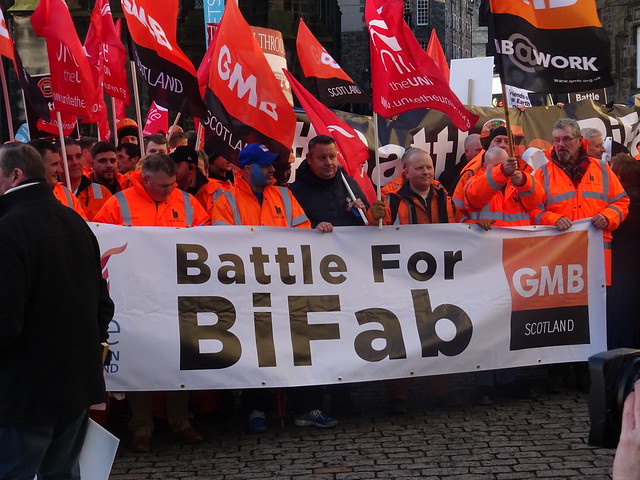
The skills of the BiFab workers are critical to a Just Transition. Fundamentally this is about social justice and about the contribution that Scotland can make to the global response to the climate crisis. We have abundant resources for sustainable energy production and workers with the skills required to build the new sustainable economy. However, if we are serious about dealing with a climate emergency it is essential to develop policy and institutions that enable public control and accountability.
The STUC together with Unite the Union and the GMB have launched a campaign, ‘Fife – ready for renewal’ to bring the work to Fife. And Nicola Sturgeon is backing appeals to EDF to move production to the BiFab yards. This is really welcome. But taking the climate emergency seriously surely requires going beyond call to the ‘social conscience’ of the big energy companies. There is a pressing need to develop a publicly owned energy company. Such a company could invest in production through new offshore wind, wave and tidal, take control of the grid and update it with new subsea connections and a smart distribution system and end the dependency on the market.
The UK’s 5.7 billion barrels of oil and gas in already-operating oil and gas fields will exceed the UK’s share in relation to Paris climate goals – whereas industry and government aim to extract 20 billion barrels;
Recent subsidies for oil and gas extraction will add twice as much carbon to the atmosphere as the phase-out of coal power saves;
Given the right policies, job creation in clean energy industries will exceed affected oil and gas jobs more than threefold.
Recommendations to the UK and Scottish Governments include:
Stop issuing licenses and permits for new oil and gas exploration and development, and revoke undeveloped licenses;
Rapidly phase out all subsidies for oil and gas extraction, including tax breaks, and redirect them to fund a Just Transition;
Enable rapid building of the clean energy industry through fiscal and policy support to at least the extent they have provided to the oil industry, including inward investment in affected regions and communities;
Open formal consultations with trade unions to develop and implement a Just Transition strategy for oil-dependent regions and communities.
We hope to publish a longer review of the report in the near future. However, in the meantime we strongly recommend downloading, reading and sharing the PDF.

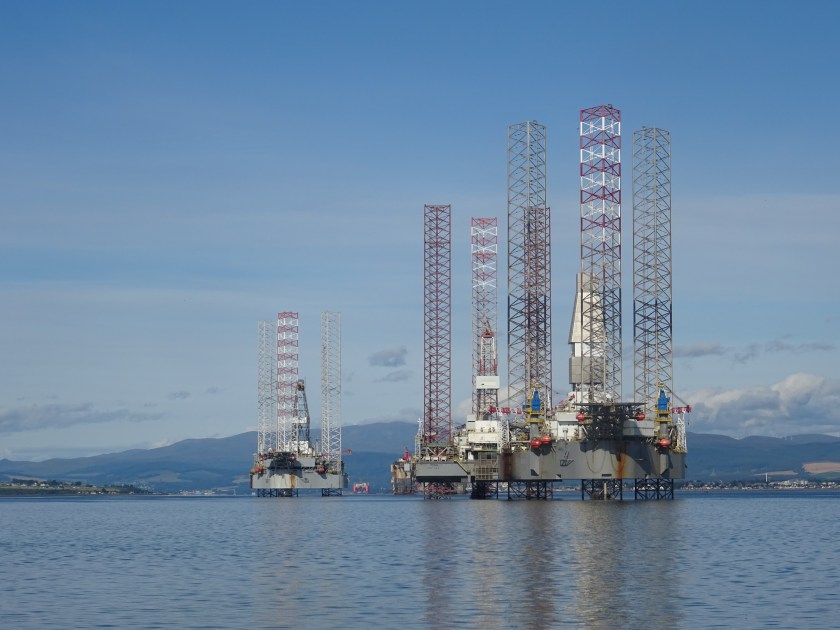
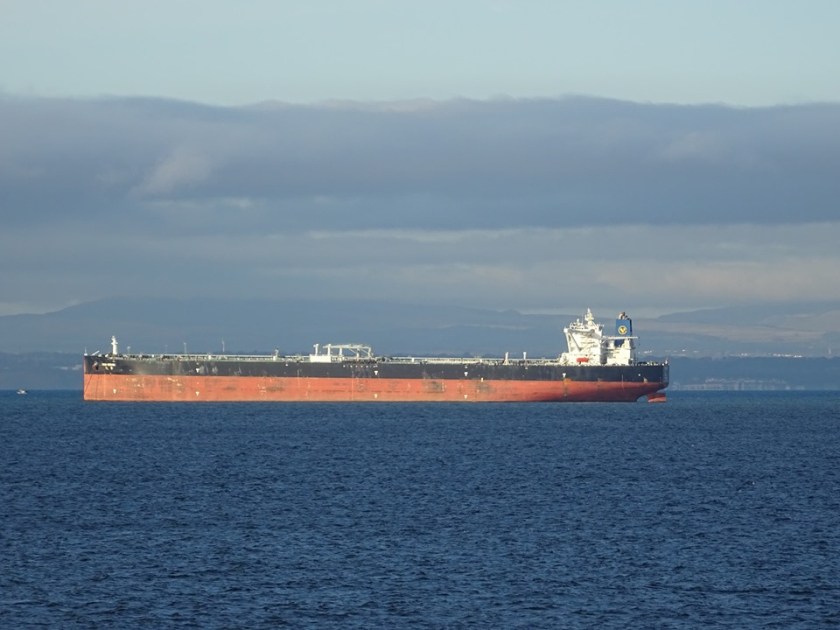
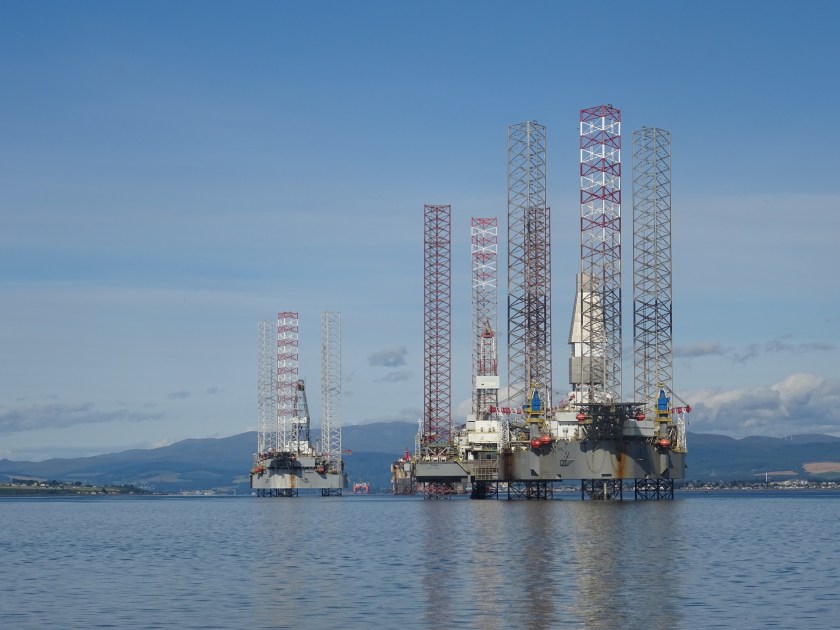 Our children and grandchildren deserve more from us than business as usual. They and the rest of the remaining life on the planet need a chance of a future that does not include the misery of living through a global meltdown.

 Employment, Energy and Environment