REELnews hosted film and discussion on the GKN factory occupation
Reel News is a London based activist video collective, using film to help bring about social change. In a world where everyone is increasingly affected by pandemics, climate change, austerity and war, we work with the growing number of campaigns (often ignored by mainstream media) which are not only fighting back, but winning too – not just in the UK, but across the world.
At our 2025 conference Shaun from REELnews ran two film workshops that took an in depth look at the GKN occupation in Italy. Workers at GKN have been fighting for three years to save jobs after their factory was shut down. In the course of the struggle they’ve devised and implemented inspirational plans for alternative production and built alliances with social movements regionally and internationally.
With the help of REELnews who have produced a series of brilliant videos about GKN we’ve covered the story of the occupation on this website. For background check out ‘This is what worker led just transition looks like’ . But do also look at the coverage on the REELnews site.
Links to useful resources from the Scot.E3 conference workshop on organising at work
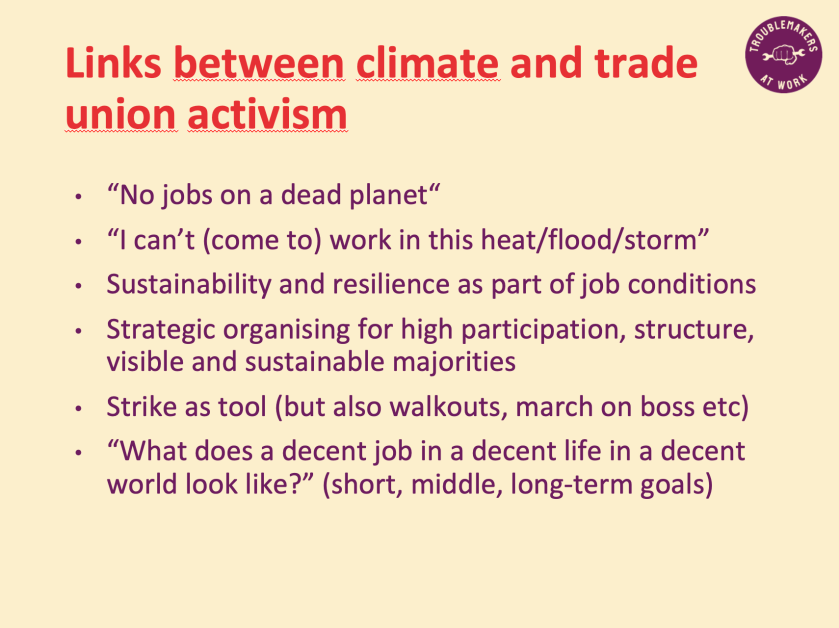
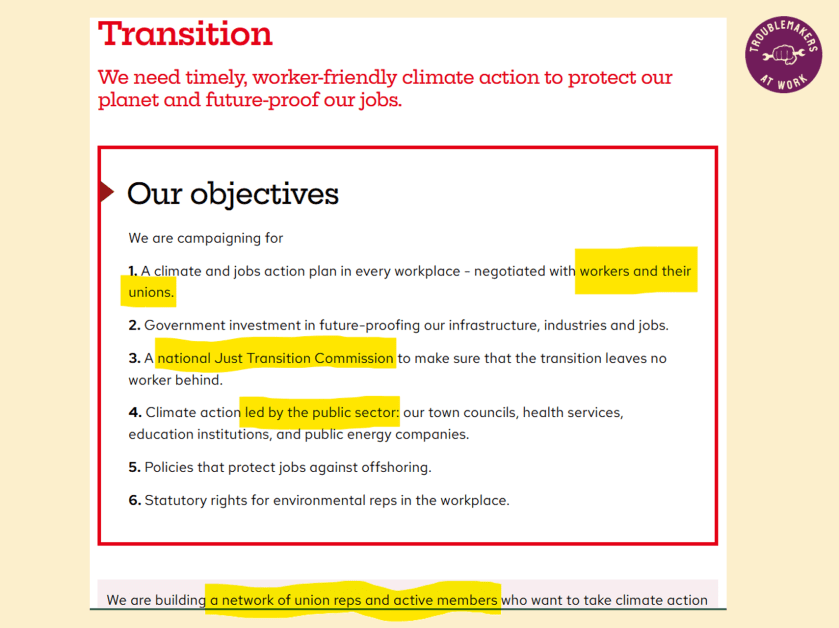
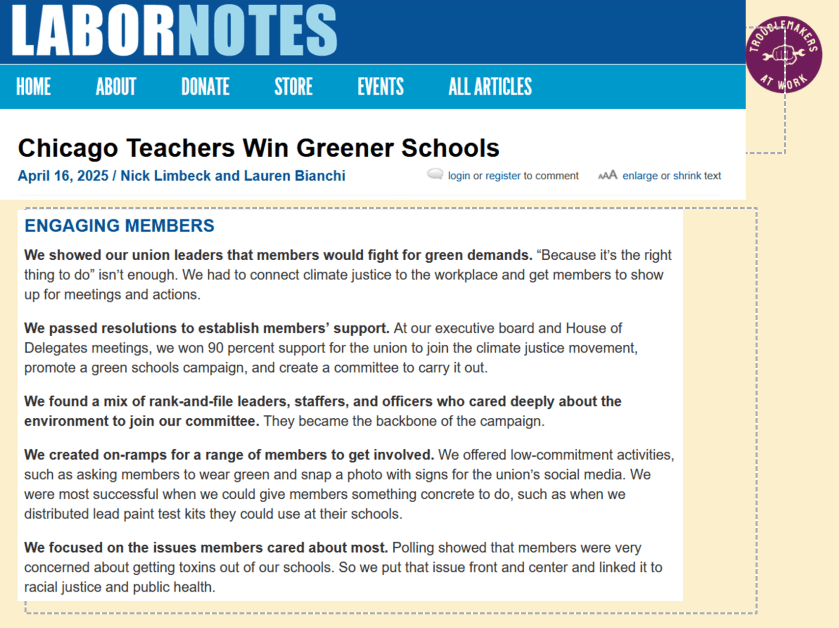
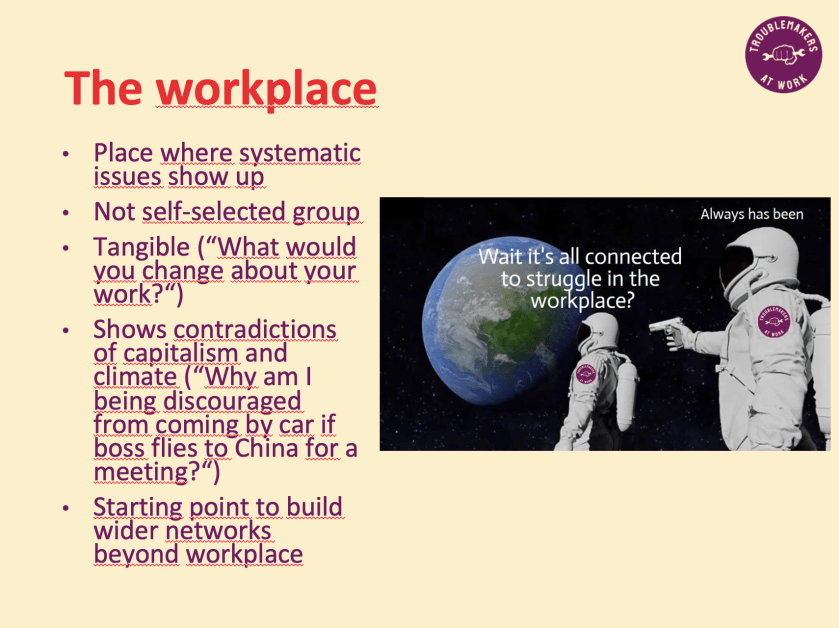
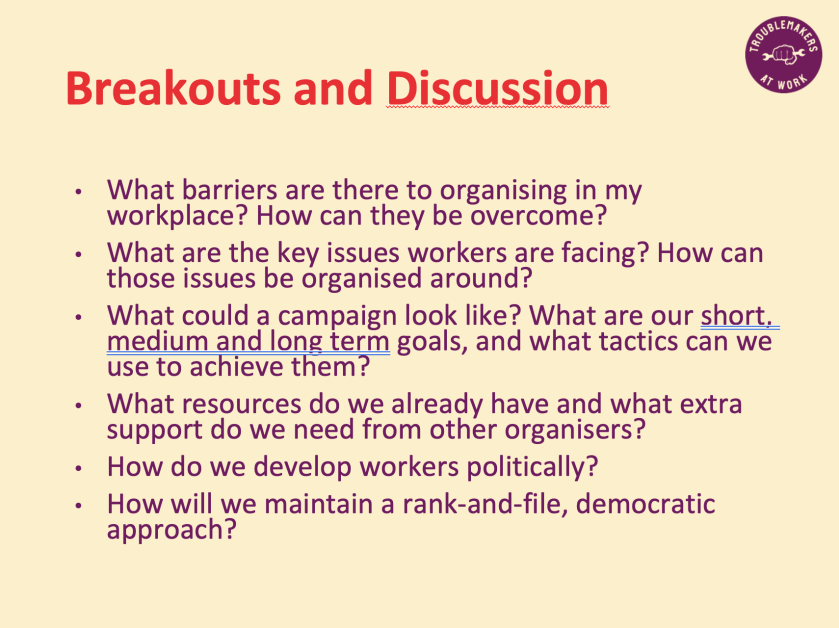
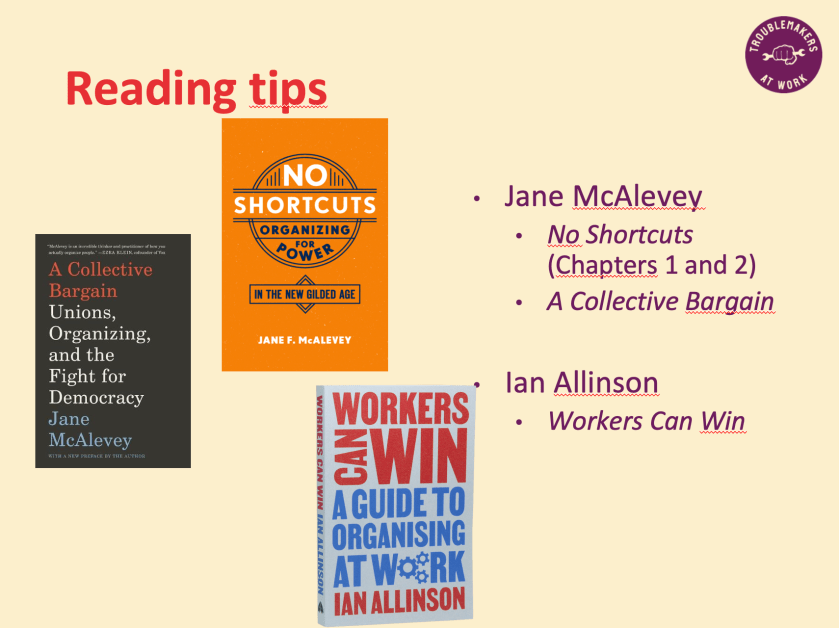
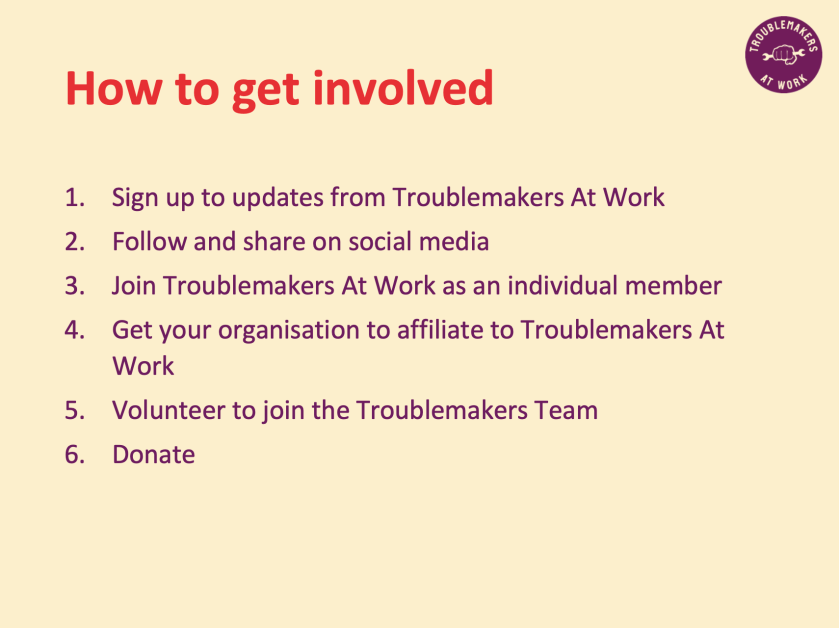
At the Scot.E3 conference on 18 October Sally Heier facilitated a workshop on taking climate issues into the workplace. These are her slides.
If you’re in a workplace we’d encourage you to join the Troublemakers network. Troublemakers holds meetings and conferences that bring together people who are organising at rank and file level in their workplace.
You might also like to look at the Workers Can Win website which is packed with useful information about organising.
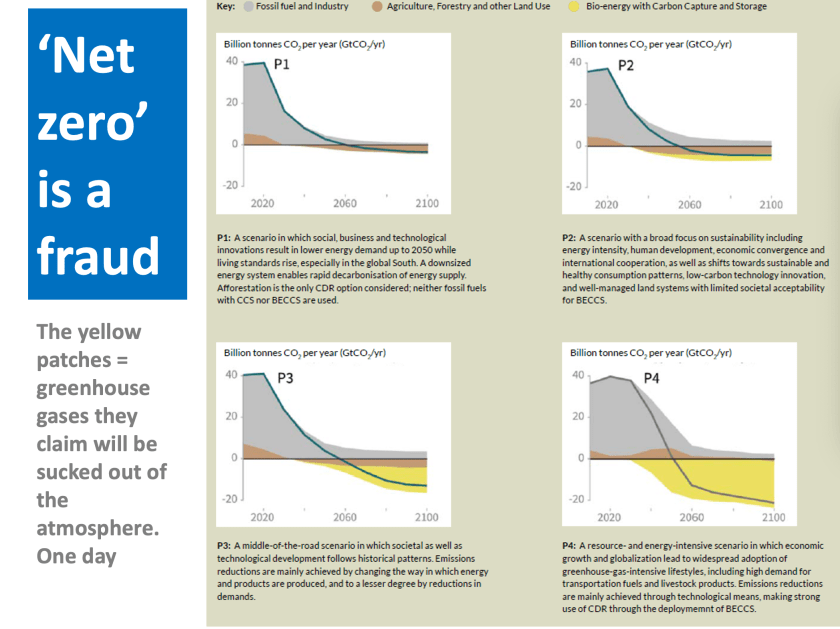
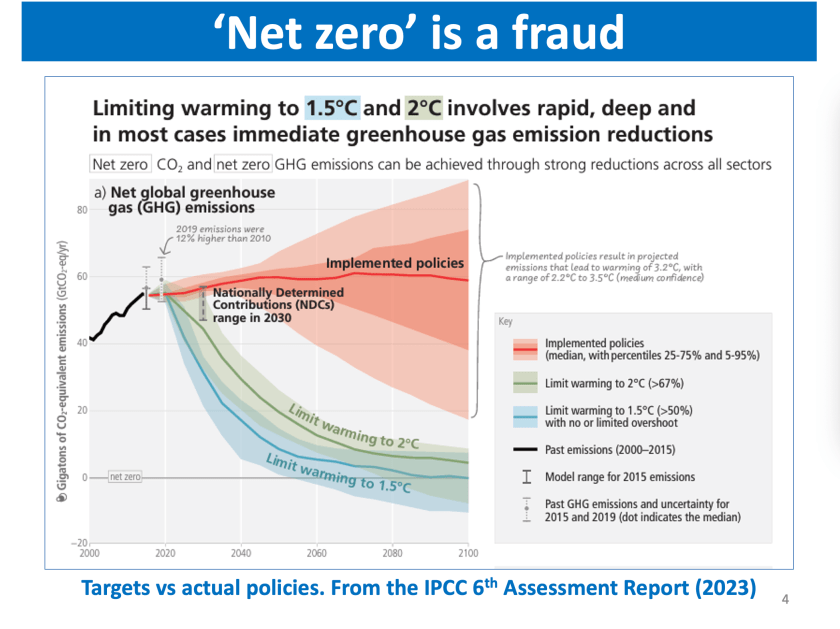
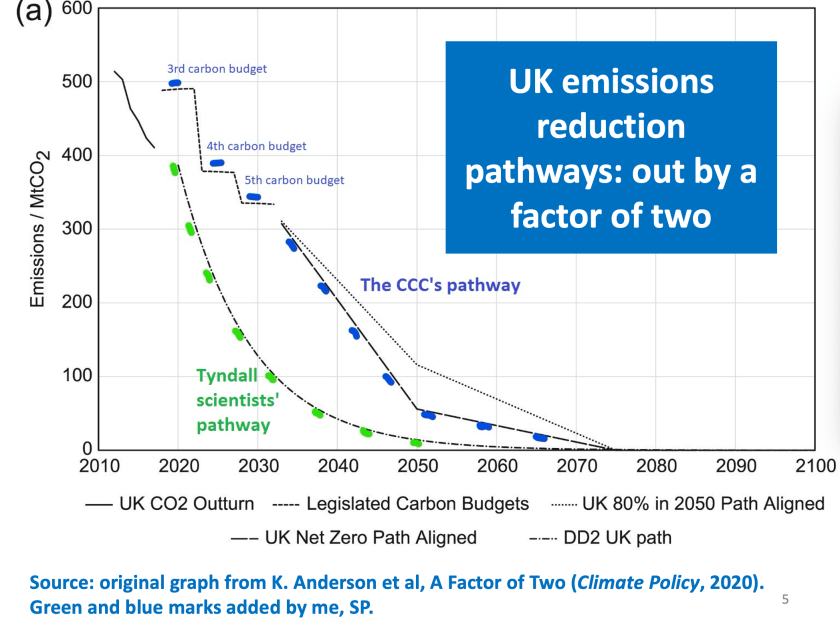
The slides from Simon Pirani’s talk at the Scot.E3 conference
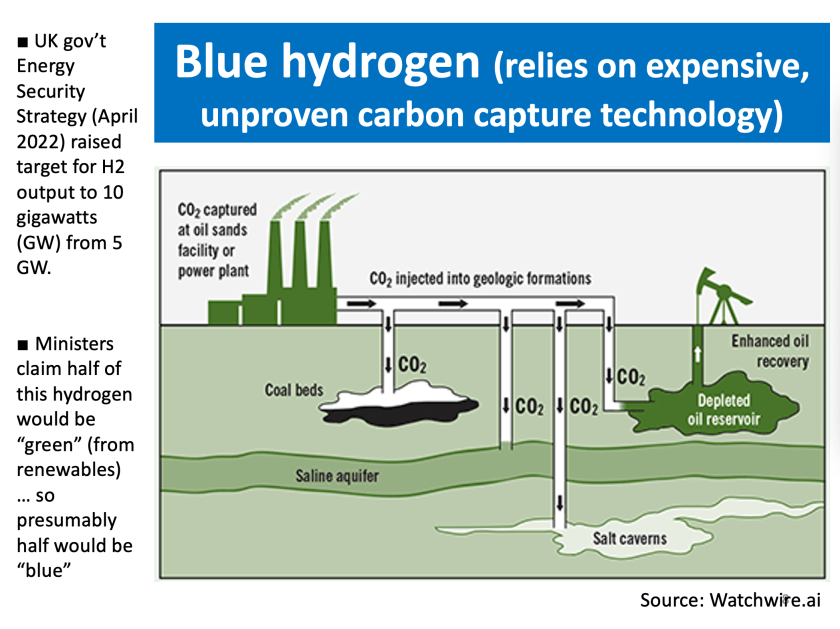
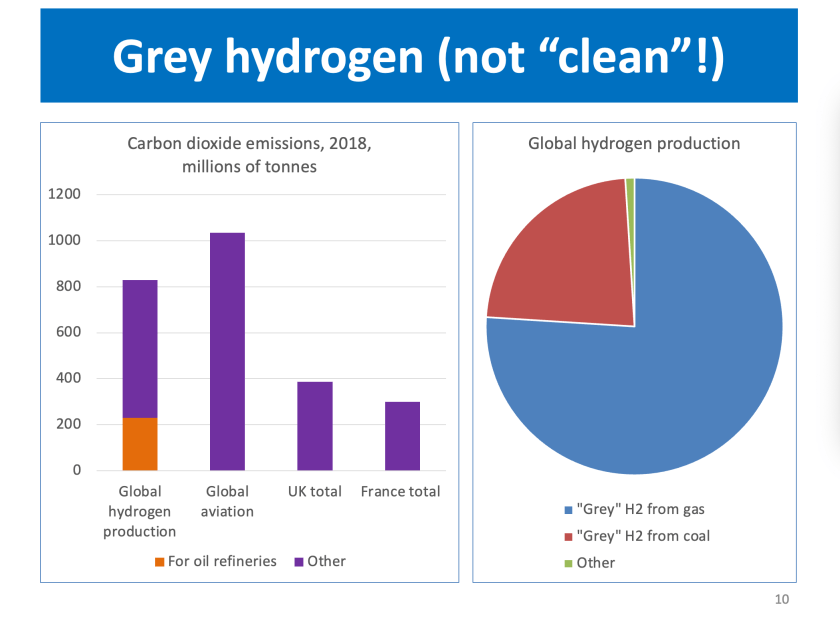
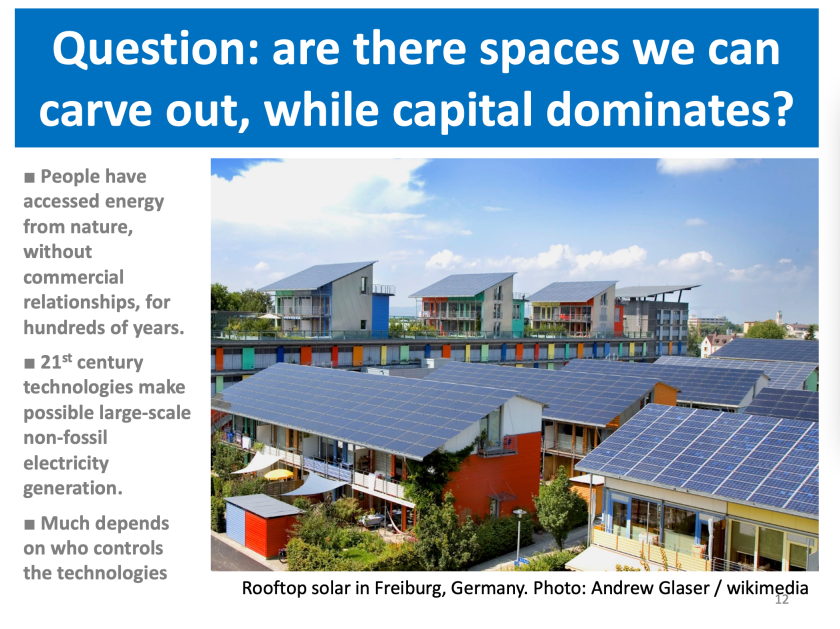
Simon edits the People and Nature blog and is the author of Burning Up – a global history of fossil fuel consumption. In the introductory session of the conference he argued that Climate Change is an injustice multiplier and that Net Zero and Technological Transition are frauds. He asked how do we defend workers’ rights in the climate emergency and whether there are spaces we can carve out while capital dominates.
Ideological delusions and military secrecy that this generated has left Britain with one of the most uneconomic and unreliable power generation liabilities on the planet
The second part of an article by Scot.E3 activist Brian Parkin which was first published on the rs21 website on August 18, 2023. It (and the first part) provides useful background for the discussion on nuclear power that took place on October 18 2025 at the Scot.E3 conference.
In the first part of this short series, Brian Parkin showed how Britain’s nuclear power programme was a consequence of a nuclear weapons project intended to maintain Britain as a top flight imperialist nation. Here he explains how the ideological delusions and military secrecy that this generated has left Britain with one of the most uneconomic and unreliable power generation liabilities on the planet.
British governments after 1945 pursued a consensus of national recovery based on the re-energising of a depleted economy via new technologies and a welfare state social contract, to drive up productivity and profits to a level capable of sustaining Britain as a world power.
But the post-war ‘spheres of influences agreement’ of 1945 between the USA, Russia and Britain rapidly gave way to the Cold War and a new arms race. The Cold War divided the world into two armed camps, and with the formation of NATO in 1949, much of western Europe fell under the leadership of the USA against the Soviet Union and its Warsaw Pact allies. A year later, with the outbreak of the Korean War, it became clear that sections of the US military were lobbying for the use of nuclear weapons as first strike options.
What was clear within this new order was that Britain’s sphere of influence had dissipated into that marked out by the US nuclear super-power. But Britain nevertheless persisted with its own atomic bomb programme, as well as a V bomber programme as the means of delivering it. For Britain’s cold warriors, this was central to a military first-strike nuclear capacity which would keep them on a par with the USA. As the armed forces Chiefs of Staff Committee put it: ‘If we did not develop megaton weapons (hydrogen bombs), we would sacrifice immediately, and in perpetuity, our status as a first-class power’
Imperialism, independence and isotopes
This ambition was under-written by a total of six Magnox reactors – two at Calder Hall (now Sellafield) and four at Chapelcross in Dumfries – which were central to western plutonium production for H-bombs. By 1958 these reactors had a total capacity of 250 Mw of electrical output. But like the commercial Magnox stations to follow, these reactors proved at times to be unreliable, and the technology posed dangerous challenges. And while Britain was a useful source of cheap plutonium, the USA harboured doubts regarding Britain’s ability to sustain both the empire and a first strike nuclear capability.
Then in 1958, the first British H-bomb test took place on Christmas Island in the Pacific. This was followed by an amendment of the US-UK Mutual Defence Agreement, mainly as a means of controlling British nuclear activity by limiting its share of targets within USSR airspace. For a while the plutonium deal with the US remained a one-way street, until UK nuclear strategy became based almost entirely on H-bombs. This now meant the Britain becoming dependent on the US for its supply of tritium (an isotope of hydrogen) necessary for completing the reaction implosion, and thereby boosting the nuclear yield. This was the first stage in the unravelling of the myth of Britain’s ‘independent’ nuclear weapons.
Perhaps the most farcical aspect of the nuclear ‘special relationship’ was the complete American control over Operation Blue Danube – the joint USA-UK European nuclear attack plan. This gave the USA the power of veto over any first strike by the RAF. Overall American command of Nuclear Forces Europe meant that all nuclear weapons, even those at RAF V bomber bases, were in practice American property. All nuclear weapons manuals, fuses, fuse locks and fuse codes were kept in a secure vault on the RAF base, and the agreement provided that ‘…in the event of any RAF personnel attempting to obtain any secured items without superior and strategic authorisation, the [American] marine guards should exercise the duty to shoot (him/her/them) dead’.
Uncritical accountancy
Following the successful production of plutonium from the initial Magnox reactors, the Labour governments of the 1960s decided to proceed with a large-scale civil nuclear power programme. Any doubts regarding the costs of this venture were set aside by the strategic ‘need’ for plutonium, and the belief in nuclear power as protection against a possible miners’ strike. Given such strategic values, even the most basic cost-benefit analysis was regarded as wholly unnecessary.
But in 1988 all of the UK’s nuclear power secrets fell onto the desks of the National Union of Mineworkers Research Department, with the performance and costs of every reactor revealed. They showed that Magnox units constructed under ‘even under the most favourable and lowest Treasury discount (interest) rates, had at best performed at twice the cost of coal-fired stations’. They were hopelessly inefficient, in large part due to inherent design flaws such as fuel-rod alloys with a tendency to react explosively on contact with water, and graphite cores which could start to burn at high reactor temperatures. For these reasons, Magnox stations had never run at full capacity.
The figures were even more dismal for the second generation of Advanced Gas (cooled) Reactors (AGRs). Intended to run continually while being re-fuelled, these reactors experienced both fuel rod and control rod jamming. Steam temperatures were rarely optimal and heat exchangers often over-heated. These flaws combined to make them impossible to run at anything like full capacity, with utilisation sometimes as low as 18%. EDF, which would later take them over for almost nothing, described them as ‘basket cases’. One Treasury official in the run-up to electricity privatisation described them as ‘…the most expensive engineering folly ever under-written by the UK taxpayer’.
The dog and the lamp-post: the US-UK special relationship
The super-power dreams embodied in the V bombers had quickly foundered on Russian advances in air defence. With the shooting down of a US spy-plane high over central Russia in 1960, it was clear that no RAF plane with atom-bombs was going to reach its target. In a way this suited some American strategic thinking, as shown by a White House directive of April 1961 which called for a ‘downgrading’ of the ‘special relationship’ and for ‘forcing a greater UK integration into Europe’.
This allied integration could best be hurried by ‘not prolonging the UK bomber force’– a task quickly achieved through the American failure to complete air-launched missiles upon which the RAF pinned its future strategic role: first Bluestreak (abandoned in 1960) and then the Skybolt (scrapped 1961). But the US was sensitive regarding ‘The UK’s loss of prestige and self-esteem’, hence the sop to share in its Polaris nuclear submarine deterrent, by basing the American vessels at Holy Loch, just 25 miles from Glasgow.
Privatising Prometheus
The eventual privatisation of the UK electricity industry went ahead in 1990, but only on the basis of the government footing the bill for untold nuclear liabilities, and the power stations themselves being split between two companies: Magnox Ltd, a wholly government operation set up prior to the oldest stations being handed over to a Nuclear Decommissioning Agency; and EDF, which acquired the AGRs for a notional peppercorn price, and was also allowed to operate its own power sales company.
The British nuclear power project arose from what was essentially an imperialist H-bomb imperative. As such, it escaped any public economic scrutiny. Instead, it became a key component of the post-1945 great British super-power illusion. Failures in the Magnox reactors were denied because their main job was to produce plutonium for the British nuclear ‘deterrent’. That same arrogant disregard of accountability and high secrecy still marks the nuclear power project to this day.
And now of the AGR fleet, only Heysham 2, Hartlepool and Torness remain in operation, up to 2028, at which point the highly subsidised Pressurised Water Reactor at Sizewell B (the only one ever built in Britain) will be the only pre-privatisation nuclear station left running. When they close, the costs of decommissioning will fall to the tax-payer, a bill that may well run into the next century. But we can be certain of one thing: the plutonium breeding reliabilities of Calder Hall, Chapelcross and the undisclosed number of ‘civil’ Magnox’s. Because somewhere at the leaking, creaking and decaying Sellafield complex, there are 139 metric tonnes of the deadliest material known to humankind with a half-life of 82 million years.
Why is nuclear power, a persistently failed energy technology, still so important to the British ruling class.
This article by Scot.E3 activist Brian Parkin was first published on the rs21 website on July 22, 2023. It (and its second part) provides useful background for the discussion on nuclear power that took place on October 18 2025 at the Scot.E3 conference.
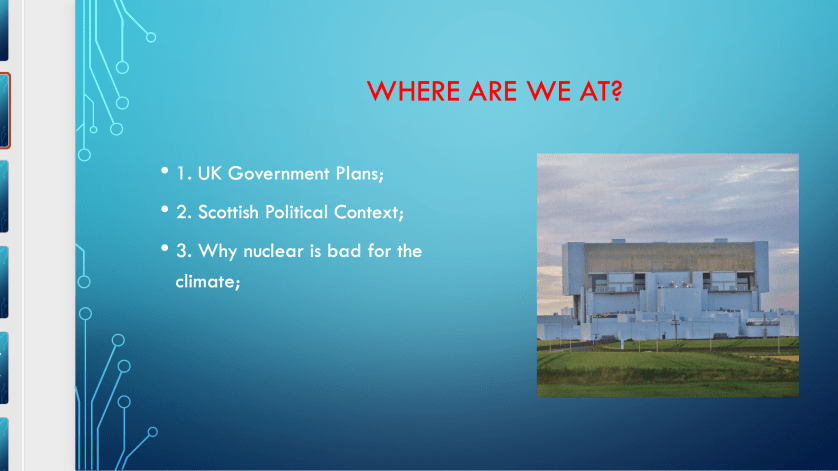
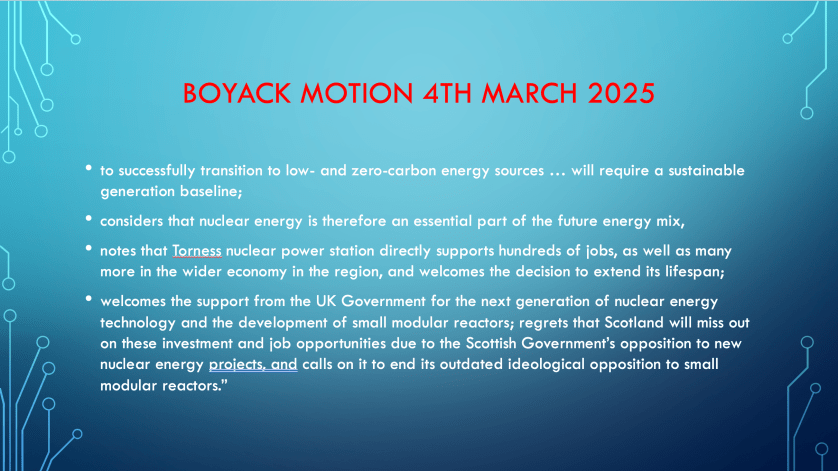
Torness – the remaining operational nuclear power plant in Scotland
After seventy years of scientific effort and countless investments, the holy grail of ‘electricity too cheap to meter’ remains as elusive as ever. Here Brian Parkin searches for reasons why a persistently failed energy technology is still so important to the British ruling class.
The Attlee Labour government of 1945-50 was committed to both a radical social policy programme at home and a colonial-imperialist continuity project abroad – the latter very much approved of by the British ruling class. Before the end of World War II, allied summit conferences at Moscow, Tehran and Yalta had produced a post-war agreement on ‘spheres of influence’ where the USA, USSR and Britain would control their respective allies, colonies, protectorates or dominions as spoils from their joint wartime efforts. But this was not an alliance of equals: the USSR was economically devastated, Britain was economically exhausted, while the USA was on the edge of what was to become the biggest and most protracted economic boom in the history of capitalism.
The USA had also, via the ‘Manhattan programme’, acquired the most devastating weapon ever – the nuclear bomb. Despite the involvement of UK scientists, the USA was initially not prepared to share its bomb making secrets with Britain. And furthermore, the USA was against the UK and France retaining their colonial empires.
A whiff of hydrogen
A clandestine British nuclear programme had begun in 1940, and with the involvement of British scientists in the US nuclear project, the idea of ‘catching up with the Yanks’ almost counterbalanced the losing of empire, and led to hopes of a recovery of imperial status by other means. So it was not long before construction began on a nuclear facility at Windscale in Cumbria (renamed Sellafield in 1981), along with what was initially the highly secret facility at Aldermaston in Berkshire.
These developments arose from a secret decision taken by a small meeting – GEN 75, in January 1947 – when despite an austerity economy it was agreed that the UK should defy the USA’s intransigence and go ahead with its own nuclear weapons programme. As Ernest Bevan, Foreign Secretary and former right wing union boss said: We’ve got to have this thing over here. We’ve got to have the bloody Union Jack on top of it!’
By 1950 a reactor at Windscale had produced highly fissionable uranium235 (the ‘active ingredient’ of an atomic bomb), and by 1952 had produced enough for the first British bomb test on October 3 that year. Then, by stepping up its Magnox reactor programme, Britain was able to produce sufficient plutonium239 for a hydrogen bomb test on May 15 1957. But this came at a high cost. On October 10 1957 Unit One of a Magnox reactor core became over-critical, to the extent that its graphite core caught fire, and for three days released the highly dangerous isotope iodine131 to the outside atmosphere, which on a conservative estimate caused over 400 cancer deaths.
News of this incident was kept confidential, mainly to prevent information getting to a USA government unconvinced that Britain would be a reliable nuclear partner. This was a particularly important as by then a considerable proportion of the plutonium for the USA’s weapons programme was coming from the UK Magnox reactors.
Meanwhile…British insecurity
In 1945, largely at the instigation of the USA, the United Nations held its inaugural session in California. As the war’s biggest victor, the USA wanted to legislate for a world fit for American capitalism. The United Nations gave this a semblance of legitimacy, though it was dominated by a Security Council mostly composed of American allies. And although Britain was on the Council, fear for its fading imperial lustre spurred the Labour government to press ahead to become a paid-up member of the ‘nuclear club’.
But nuclear club membership was nothing without a means of delivery. So in 1947 the government instructed the Royal Air Force to issue specifications and tenders for a new generation of jet-powered long-range, high altitude bombers capable of carrying and dropping nuclear bombs on what, by now, were going to be Russian targets.
Thunderbirds are GO! Britain’s ‘V Force’
By 1952 the UK’s first nuclear-capable bomber – the Vickers Valiant – flew. At that time, the intention was to keep at the forefront of a Western first-strike nuclear alliance, while never forgetting the longer-range requirements of rule over what was left of the empire, and the Commonwealth – hence the presence of V bombers in Rhodesia (the colonial name for Zimbabwe) and Malaysia as late as the mid-1960’s.
By 1964, the RAF had an incredible 159 total of Valiant, Vulcan and Victor bombers, each capable of being airborne in three minutes and in Russian airspace within 72 minutes. However, Russian air-defences had improved to the extent that the V bombers’ maximum altitudes rendered them sitting ducks by around 1965. So then a medium-range series of joint US/UK air launched missiles was considered, only for the US to pull out of the project. The Vulcans last flew in the Falklands war in 1982, carrying out a long-range and not very successful bombing of Port Stanley Airport, before being taken out of service.
‘Atoms for Peace’
On August 27 1957, a small Magnox reactor on the Calder Hall site at Windscale had some of its secondary coolant steam diverted through a turbine to mark the beginning of the world’s civil nuclear power age. The initial contribution to the National Grid was an intermittent four megawatts (then enough to power some 4,000 homes). The idea of nuclear power from a weapons grade plutonium reactor had arisen due to the sheer waste heat given off, and the huge effort required in cooling the process to a safe level.
This ‘seminal’ event was the first step to what was untruthfully called a peaceful civil nuclear power age. What it rather was, was the continuation of a plutonium programme with a significant power byproduct. The military-civil linkage was still intact – as was the superpower nuclear delusion which had spawned it.
Hedging the nuclear bet
The modest Calder Hall event gave rise to a speculative frenzy of nuclear optimism. The very idea of power from nuclear fission created an aura of technological supremacy, and the illusion that Britain could become a leadership nation unafraid of the challenges of power and the military means of exercising it. Because something like that kind of ideological hubris must have fuelled what came next.
In 1959 it was agreed to proceed with a nuclear power programme with a technology ‘proved’ by the Magnox experience at Windscale. This meant a generation of new reactors fuelled by ‘natural’ uranium with graphite moderated cores and with a primary carbon dioxide cooling system. But although the main aim of the new Magnox stations was the production of electricity, some plutonium would be a secondary byproduct.
At this point it is worth recalling the political/economic situation the fading British empire had to face. In 1956, a failed military intervention by Britain and France had failed to resolve the ‘Suez crisis’, sparked by the fear of losing of the Suez canal as a gateway to Asia and Gulf oil supplies. At this point a government committee decided that for energy security reasons, it was decided that Britain would require 6,000 megawatts of nuclear capacity by 1965.
This bizarre reasoning – Britain did not use oil for power generation – was primarily rooted in a ruling class paranoia, which saw nuclear power capacity as protection against a possible miners’ strike. Here nuclear power provided balm to a fading imperial delusion and a deep and abiding fear of organised labour. In Part 2 we shall see how ignorance, hubris and fear continue to fuel the British nuclear tragi-comedy.
A message from the organisers of the Earth Social conference – timed to take place in Colombia as COP28 takes place in Dubai.
It boils down to whether we are honest with ourselves, or not. UN climate summits are a joke that continue to push the bounds of absurdity. Since they began, yearly global emissions have increased by more than two-thirds. Worse still, no plans have been made to phase out fossil fuels. Should we be surprised when industry lobbyists continue to dominate conferences? Can we expect anything different from this next summit, taking place in a petro-state, chaired by an oil company boss… Are we expected to buy into this charade…?
We, on the other hand, are climate realists. We see where we are being led. We know we need to apply the emergency brake to avoid earth system collapse. That’s why we refuse to participate in a process of trading empty promises any longer.
That’s why we are inviting climate realists to the Earth Social Conference in Casanare, Colombia, from 5th-10th December 2023.
Join us to build the collective force we need in order to pull the emergency break.
Although the conference is in person in Columbia on 7th December it is possible to join some of the sessions by Zoom. Click here to go to the conference website and register.
The conference, organised by the Global Climate Jobs network, took place in Amsterdam over three days from the 7th of October. Two of us from Scot.E3 attended. These are my personal notes and reflections on the discussion that took place.
At the end of the conference
The Global Climate Jobs network brings together campaigning organisations from around the world. What glues them together is the idea that the necessary transition to a zero-carbon economy is both political and practical and requires a huge expansion in jobs that are central to the new economy – in energy production, transport etc. This idea centres campaigning on social justice, a worker led transition and building working class power.
The global reach of the network was underlined by the diversity of the attendance – including groups from Columbia, Mexico, USA, South Africa, Tanzania, England, Scotland, Norway, the Nederlands, Germany, France, Belgium, Luxemburg, Portugal, Spain, Austria, Italy, Turkey and the Philippines.
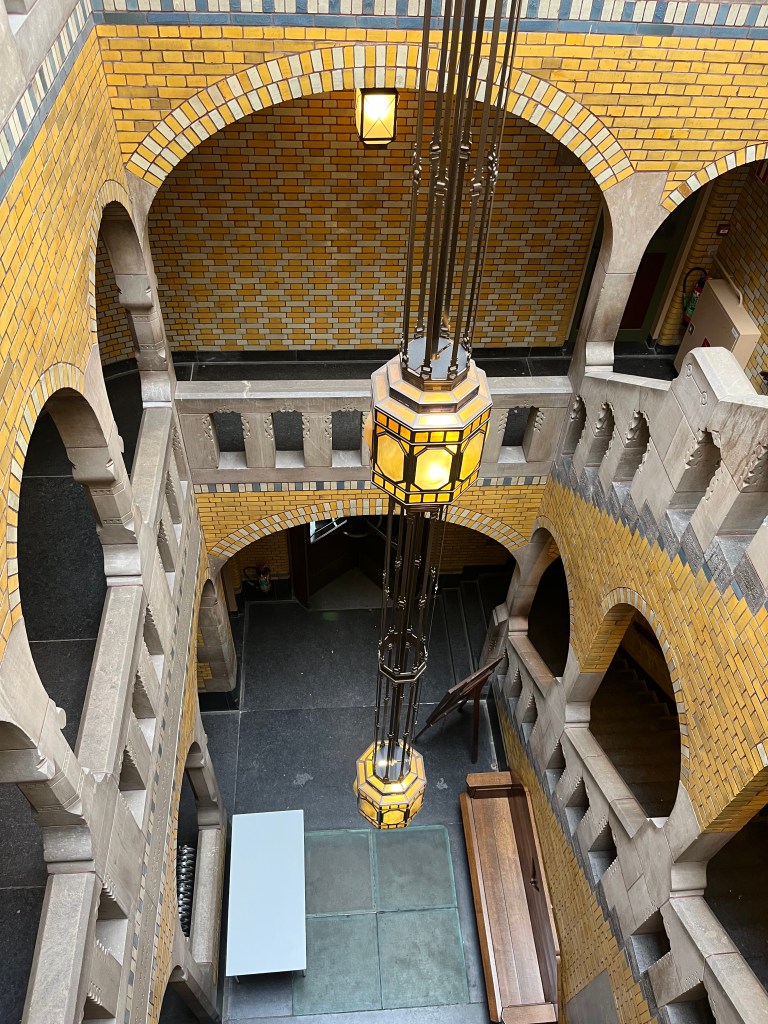
The venue for the conference was split between two spaces – a social centre, once a church, squatted more than two decades ago and now legalised and a wonderful building ‘De Burcht’ that was once the headquarters of the Amsterdam diamond workers union. The picture shows something of the beauty of the building but its history is also inspirational. In the 19th century there were around 10,000 diamond workers. They were divided by gender and religion. However, after a major strike which brought the entire workforce together a single union was created and commissioned the building.
De Brucht – image by Pete Cannell CC0
Here are some of my highlights from the plenary sessions.
Leonor, from the Portuguese group Climaximo, talked about how the cost-of-living crisis runs side by side with the intensifying climate crisis. She argued that building a mass movement to stop climate collapse requires an organisational culture of a different kind – flexible, learning and always thinking about the next steps. Bringing the labour and climate movements together is key. All of this needs a high level of ambition and a clear focus on building social power to stop climate change. We need to be ready to take risks and accelerate our learning cycles. We’ll make mistakes but we must not repeat mistakes. We have seen mass movements rise very fast and we have seen dominant ideas change very quickly – we need to envisage this and think of strategies that can make it happen.
Working people are struggling daily to get by – a programme to tackle the climate crisis is a programme to improve lives and livelihoods. We need to dare to win power – these ideas need to explode in society and go mainstream.
Sean Sweeney from Trade Unions for Energy Democracy (TUED) noted that trade unions in the north wanted/want to get a seat at the table of the transition. TUED argues that being at the table is not fine. While renewables have expanded so has the use of fossil fuel. Radical restructuring is needed. The problem is a capitalist system that burns fossil fuels for profit. We need a programme/pathway – a plan of action and crucially we need public ownership of energy. It’s evident that all the countries who say they have targets for net zero will not achieve them. The solutions we need are not compatible with a system of growth and accumulation. Public ownership and control is essential.
Plenary Notes
Jonathan Neale started his contribution by saying that the evidence for climate change is increasing fast. Most people think something must be done. He argued that the climate movement must change – we have to go for concrete solutions. Stop fossil fuels. Make them illegal. Cover the world with renewable energy. Governments need to do this. Every worker in old industries gets a new job with the climate service. Once we win it in one country it’s easier to spread. It requires a mass grass roots campaign that must go everywhere. It’s serious project and not about having a good policy, we have to persuade a mass movement to fight for it. We need to persuade the climate movement. People say we must not divide the movement, but he asserted that there is no other solution on offer. The just transition is the only transition on the table. It requires winning majorities – not diluting politics – persuading people that on this we are right. We need action – direct action. Every time workers are losing their jobs, we need action/occupations etc. to insist that they must have climate jobs. Occupation for demands that we can win. We need our own shock doctrine – organising at the grass roots for the things that people need in heat waves, floods – we have to march and protest in the teeth of disaster – no one left behind. Fund raising events when catastrophes are elsewhere. The time for dishonest promises is past. This is a long struggle – explosive growth sometimes – slow at others. We can’t afford to wait to see that their promises are lies in 2040 – we have to start now on the scale that is necessary. Winning once makes it easier elsewhere. In global south renewable energy is needed to grow to meet their needs. From here to this vision is a huge jump but it must be done.
The theme of public ownership was reinforced by a speaker from Colombia. She started by saying that it is the capitalist system (imperialism) that is to blame and we need to be clear about this. With a progressive government in office Columbia is for the first time looking at the possibility of change. The country is highly indebted. Renewable energy has increased but is almost entirely in the hands of private companies that are propped up and subsidised by public resources. Carbon emissions are principally from land use and deforestation – Columbia is a producer of primary raw materials. Transition requires public ownership and social control. Just transition is a question of rethinking the role of the state and the working class. She argued that large scale utilities are essential – things like roof top solar contribute but can’t be the answer on the scale that’s needed. In Latin America – this is a moment when it is necessary fight for public power.
Some of the contributions reflected significant rethinking in the climate movement. A contributor from XR in the Nederlands talked about how the focus of direct action has changed in recent months. There has been action against a private jet terminal and action at a big steel plant. This shift stems from frustration that labour and climate movements are not working together against common enemy while NGOs talk about capitalism but not about class struggle so much. There has been progress in building a climate justice network in the Nederland’s largest trade union. A contribution from Friends of the Earth (Nederlands) remarked on an ongoing shift from consumerist demands to more concrete demands and demands on big polluting companies. But most of these actions have been from the outside – with the consequence that workers see this as attacks on them. And may have increased their resistance to climate transition agenda. Workers were arguing against CCS and for hydrogen and electricity – but climate movement more impatient – no dialogue – need to engage more directly with the workers and not with the trade union bureaucracy. This point was echoed by another contributor who had been involved in producing the Platform report on the views of offshore workers in the UK sector of the North Sea. Platform worked with the offshore unions to reach the workers who contributed to the report. The findings of the report were powerful but mostly the unions have done nothing with them. She argued that it will often be necessary to bypass union officials to speak directly to workers.
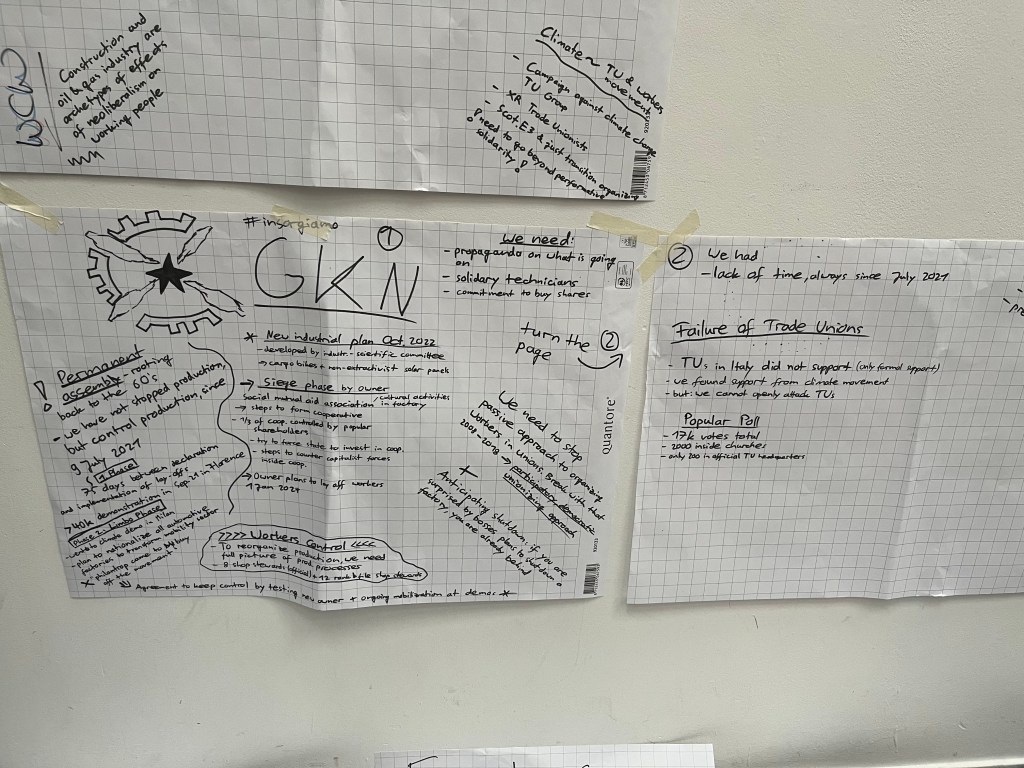
On the second day of the conference, I helped present and facilitate a workshop on the strike wave in Britain put on by the socialist group rs21. We explored the scale of the movement and attempts to align it with the environmental movement. This provoked a lively discussion and people gave examples from 7-8 different countries of experiments in aligning the workers and environmental movement, including pushing for the wider ecosocialist political struggle. As part of the workshop, we hosted a representative from the Italian GKN Collective. GKN is a British owned company in the automotive and aerospace sector. Faced with a decision to close the factory the Italian workers occupied in 2021 and have stayed in occupation ever since. They are now fighting to control it; they’ve retooled the machinery and aim to convert it to renewable transport production led by workers. It’s quite shameful that this occupation has not received more support and solidarity in the UK. Coverage in English is very limited but you can read more here.
Workshop notes
I’ve tried to focus on the main themes of the conference but there was much more and much deserving of separate and more detailed reports. The accounts of social movement trade unionism in France were impressive. German delegates spoke about their public transport campaign #wirfahrenzusammen – we’re driving together. Joint activity bringing the youth strike movement together with public transport strikers and public transport users. Safe Landing ran a workshop on workers assemblies. There was intensive discussion of what we mean by just transition and workshops on global debt, the East African Crude Oil pipeline (EACOP), the upcoming European elections, political strikes and how to build on them and how to understand and make an impact on local and global supply chains.
You can find the recordings of all the panels and a selection of workshop sessions here:
We know that the points of convergence between the labor and the climate movements are immense, but that several challenges lie ahead of us. It is nevertheless of extreme importance and urgency to cut emissions and do so by drawing on plans that are created by the workers and communities and in regard to their interests and needs.
Often, we do know what work needs to be carried out in order to cut emissions, but workers are being left out of the discussion and climate science is being disregarded. We need to build a movement that not only is capable of setting its own program, but that has the power to implement it.
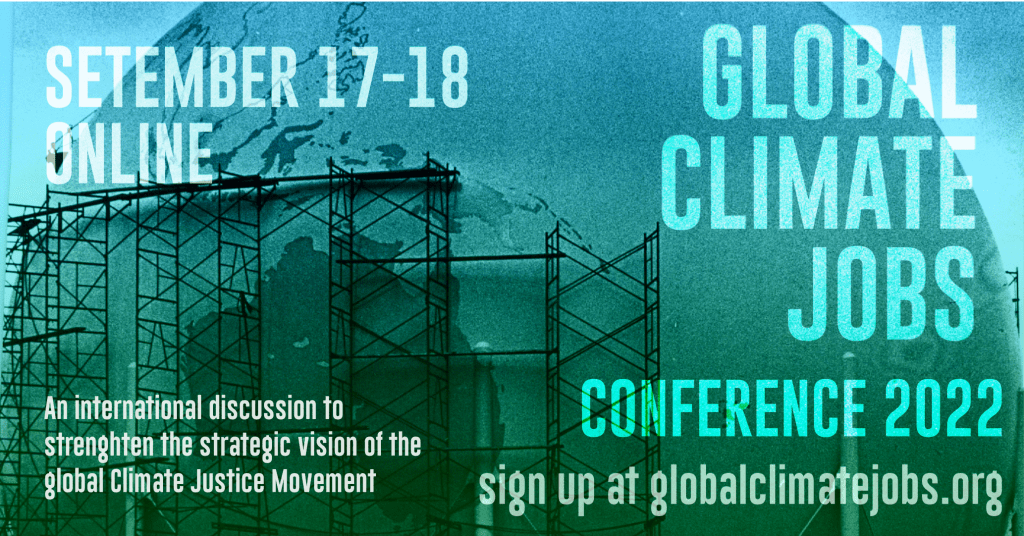
As so, we are bringing together people from all around the world, and bringing together the labor and climate movements to discuss how we win a program that can allow us to stop climate collapse. Join us for two days of thematic sessions about the strategies, technical and social perspectives, and challenges we face in building Climate Jobs Campaigns.
Invited speakers:
Negrai Adve;
Max Ajl;
Chris Baugh;
Jeremy Brecher;
Leonor Canadas;
Claire Cohen;
Rehad Desai;
Patricia De Marco;
Suzanne Jeffries;
Paul Le Blanc;
Josua Mata;
Suda Sim Meriç;
Jonathan Neale;
Andreas Yetterstad
Schedule
All the sessions will be recorded and available online. Sessions will be 1 hour and 30 minutes and will be composed of a introduction by the invited speakers and a workshop space between the participants.
Saturday, September 17
12:00 GMT [5 pm ET] – General Session: Strategic Orientation
14:00 GMT [7 pm ET] – Special Sessions
1) Building Climate Jobs Movements
2) Food and Farming
16.00 GMT [11 pm ET] – Special Sessions
1) Ecofeminism
2) Racism and Refugees
Sunday, September 18
12.00 GMT [5 pm ET] – General Session: Workers in the Fossil Fuel industry
14.00 GMT [7 pm ET] – Special Sessions
1) Cutting Emissions
2) Resilience
16.00 GMT [11 pm ET] – General Session: Summing Up
The Global Climate Jobs Network is organising an online international conference Friday June 3 to Sunday June 5, 2022. This will be online to make it easy for activists and organisations to participate from all over the world.
Themes
The theme is Climate Jobs, Climate Crisis and Green New Deals. But we are open to sessions on related topics linked to community, union and other climate justice struggles. If you are not sure if your topic would fit, send it anyway and we can chat it over.
Who
Our Global Climate Jobs Network will be coordinating the conference. But we want organisations to propose and present your own sessions.
We are looking for sessions from different organisations, from national unions to local branches, from international networks to national campaigns. From environmental and climate justice community campaigns to local Fridays for the Future groups, student unions, social movements, feminist and LGBT groups, faith groups, farmers and fisherfolk organisations and Green New Deal campaigns and from groups of scientists and engineers.
We especially want to provide a platform for those fighting for climate justice now and we particularly want to hear about the struggles of the peoples of Africa, Asia and Latin America.
How
You can run a session based on your own organisation or you can put forward speakers and we will link them up with speakers from other organisations on similar themes or from the same country.
We also want to encourage artistic sessions using, music, film, and anything that tells your story and makes the event more like an online festival of resistance, ideas and solidarity.
You can propose sessions in any language, and you can propose two sessions in different languages.
We will timetable all the sessions and try to arrange them so you can follow different themes.
Sessions will last 75 minutes. We suggest no more than three speakers, and at least half of the time is taken up by contributions from the audience and in breakout groups. If you have three speakers, please have at least one be a woman. If you cannot find an appropriate woman speaker, please write to us and we will try to put you in touch with someone.
What’s Next
To propose a session or a speaker, to ask a question or talk to someone on the organising committee, please write to: Climatejobs2022@aol.com
Sponsoring Groups (list in formation):
Global Climate Jobs Network
Climaximo (Portugal)
ScotE3 (Employment, Energy and Environment – trade union and environmental activists in Scotland)
Review of African Political Economy
AIDC (Alternative Information and Development Centre – South Africa)
Million Climate Jobs Campaign (South Africa)
Pittsburgh Green New Deal (USA)
SENTRO (Sentro ng mga Nagkakaisa at Progresibong Manggagawa – labour federation in Philippines)
























 Employment, Energy and Environment