2019 Conference Report – Climate Rebels

The first two sessions of the conference aimed to set the scene for the discussion on the politics and practice of just transition that followed.  First up was Shaun Day from REEL News.  The idea of just transition has deep roots in the USA and goes back to the 1990’s.

In 2018, Reel News went on a 14 week tour of North America to look at grassroots struggles around climate change, particularly struggles around a “just transition” from fossil fuels to renewable energy, where workers and communities control the process so that they benefit from the transition, and around “just recovery” – recovery from extreme weather events which do not exacerbate current inequalities.
The documentary films that they made, while in the US, record inspiring and visionary struggles all over the continent, led by working class communities of colour, with people organising just transitions and just recoveries themselves.

Shaun showed short extracts from eight of the American Climate Rebels films:

Building a social and solidarity economy in Jackson, Mississippi 

Taking on the oil giant Chevron in Richmond, California

Fighting injustice, pollution, environmental damage and police oppression in Los Angeles

People United for Sustainable Housing in Buffalo

Kentucky Miners fighting for renewable energy

Towards a zero carbon, zero waste city – New York

Hurricane Harvey – just recovery in Texas

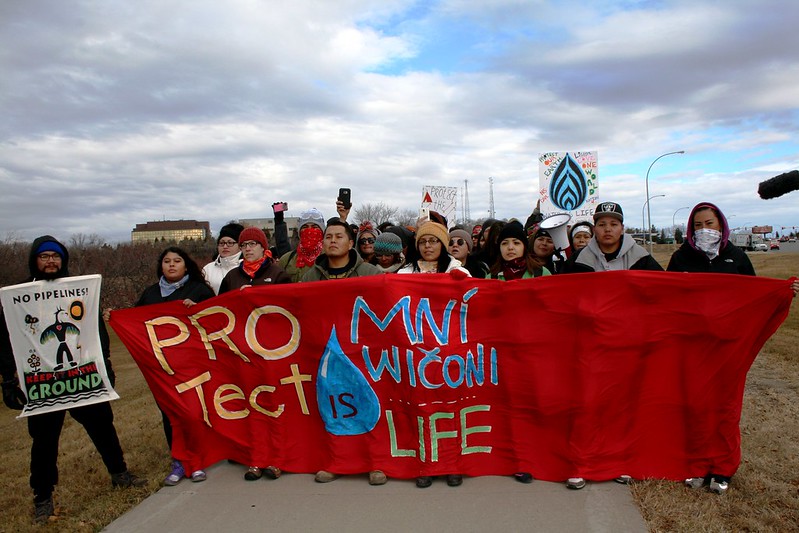
Minnesota – stopping the tar sands pipeline

31203810245_c4e9f25179_c

Image by Leslie Peterson CC BY NC 2.0  Stand with Standing Rock

Climate Strike – Friday 29th November

Friday 29th November is the date of the next round of Youth Climate Strikes. There are demonstrations in towns and cities throughout Scotland – you can find the details on the SYCS website and share the events on social media from their Facebook page. The September strikes saw the development of workplace solidarity with a range of actions from lunchtime meetings to walkouts. November 29th is an opportunity to build on this. UCU members working in a number of Scottish universities will be on strike over pay and pensions on the 29th and the UCU is encouraging their members to go from their picket lines to join the climate protests. This is a great opportunity for workers in other unions to show practical solidarity with the UCU and the school students.

Check out our previous post on arguing for solidarity action in the workplace.

48765693228_bc6737968b_c


More on BECCS and geoengineering

A few days ago we published Scot.E3’s Briefing #10 on Bioenergy with Carbon Capture and Storage (BECCS).  In the briefing we take a critical view of BECCS.  A newly published book by Holly Jean Buck – ‘After Geoengineering’ (Verso 2019) takes a more positive view. As a contribution to the debate on this important issue we republish (with permission) a detailed review and critique of ‘After Geoengineering’ from the PeopleandNature blog.  The review concludes by noting that

The best way to challenge corporations and governments is to make this discussion our own, rather than their property. Then we will be better armed in battles over political choices that we hope not only to influence, but to take into our hands. 

Geoengineering: let’s not get it back to front

We need to talk about geoengineering. Badly. To do so, I suggest two ground rules.

First, when we imagine futures with geoengineering, whether utopian or dystopian, let’s talk about the path from the present to those futures.

Second, if society is to protect itself from dangerous global warming, it will most likely combine a whole range of different methods; there is no silver bullet. So we need to discuss geoengineering together with other actions and technologies, not in isolation.

In After Geoengineering, Holly Buck urges social movements and climate justice militants to engage with geoengineering, rather than rejecting it. She questions campaigners’ focus on mitigation, i.e. on measures such as energy conservation and renewable electricity generation that reduce greenhouse gas emissions.
ccs-protest

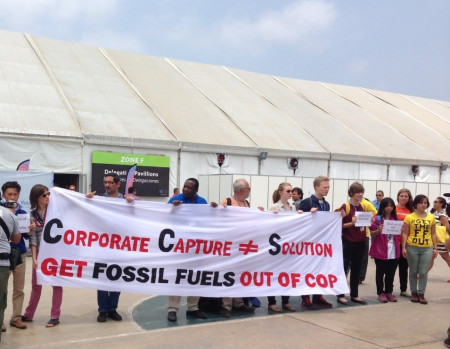
Civil society groups protesting at the UN climate talks in Lima, Peru, in 2014, when fossil fuel companies organised sessions on carbon capture and storage. Photo by Carol Linnitt from the DeSmog Blog.

Buck offers a clear, jargon-free review of technologies, from afforestation and biochar that some climate campaigners embrace, to solar radiation management, the last word in technofixes that is broadly reviled. She intersperses her narrative with fictional passages, warning of the pitfalls of “mathematical pathways or scenarios, behind which are traditions of men gaming our possible futures” (p. 48).

But one of Buck’s key arguments – that we will reach a point where society will collectively “lose hope in the capacity of current emissions-reduction measures to avert climate upheaval”, and “decide that something else must be tried” (pp. 1-2) – cuts right across both my ground rules.

Buck asks: are we at the point […] where “the counterfactual scenario is extreme climate suffering” and therefore “it is worth talking about more radical or extreme measures [than mitigation]”, such as geoengineering? “Deciding where the shift – the moment of reckoning, the desperation point – lies is a difficult task” (p. 4).

This is a false premise, in my view, for three reasons.

First: we can not, and will not for the foreseeable future, perceive this “desperation point” as a moment in time. For island nations whose territory is being submerged, for indigenous peoples in the wildfire-ravaged Amazon, for victims of hurricanes and crop failures, the point of “extreme climate suffering” has already passed. For millions in south Asian nations facing severe flooding, it is hovering very close. For others living on higher ground, particularly in the global north, it may not arrive for years, perhaps even decades. If we take action, it will hopefully never arrive in its more extreme forms. This slow-burning quality of climate crisis is one of the things that makes it hard to deal with.

Second: at no point in the near future will “we” easily be able to take decisions on geoengineering – particularly the large-scale techniques – collectively. Political fights over geoengineering are pitting those with power and wealth against the common interest, and it’s hard to see how it could be otherwise.

Buck writes: “There will be a moment where ‘we’, in some kind of implied community, decide that something else [other than mitigation] must be tried” (p. 2). But she doesn’t probe who this “we” is, or spell out the implications of the fact that, in the class society in which we live, power is appropriated from the “implied community” by the state, acting in capital’s interests.

We can only decide, to the extent that we challenge their power. We can not free technologies from that context without freeing ourselves from it.

Third: the political fights actually unfolding are not about “geoengineering vs extreme climate suffering”, but about “geoengineering vs measures to cut greenhouse gas emissions”.

Carbon capture and storage (CCS) is lauded by the fossil fuel industry as an alternative to cutting fossil fuel use; Bioenergy with carbon capture and storage (BECCS) is included in the Intergovernmental Panel on Climate Change (IPCC) scenarios in order to cover up governments’ failure to reduce emissions; research funds that go to technofixes such as ocean fertilisation and solar radiation management (SRM), that sit easily with centralised state action, do not go to decentralised technologies that have democratic potential.

Buck believes that, despite these current clashes, we can uncover ways of using geoengineering for the common good. For example, she writes of expensive and unproven techniques for direct removal of carbon from the atmosphere:

We have to move from reflexive opposition of new technologies toward shaping them in line with our demands and alternative visions (p. 206).

Shape technologies in line with our visions of a socially just society? Yes, certainly. Start with direct carbon removal or CCS? Absolutely not.

We should focus, first, on technologies that produce non-fossil energy, and those that cut fossil fuel use in first-world economies and the energy-intensive material suppliers in the global south that feed them. We need also to understand technologies of adaptation to a warmed-up world (e.g. flood defences and how they can work for everyone, and not just the rich).

old-testament

On the global climate strike, 20 September, in London

As for technologies that suck carbon from the atmosphere, if they can be used in the common interest at all, it should be a matter of principle that “soft” local technologies (e.g. afforestation and biochar) be researched and discussed in preference to big interventionist technologies like SRM.

I will expand these arguments with reference to three themes: (1) the current treatment of geoengineering techniques by governments and companies; (2) whether, and why, we should start with “soft” and local technologies, as opposed to big ones; and (3) how we might compare geoengineering with mitigation technologies.

Geoengineering, states and companies

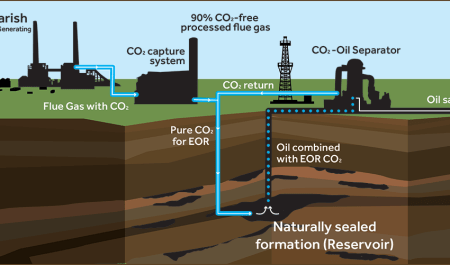
The dangers inherent in Buck’s approach are nowhere clearer than with CCS. This technique extracts carbon dioxide from wherever it is emitted, e.g. power stations’ smokestacks, with “scrubbers” (often using adsorbent chemicals). The CO2 is then trapped, liquefied and transported to a site nearby to be stored.

CCS was developed by oil companies more than 40 years ago in the USA, as a technique for Enhanced Oil Recovery (EOR), i.e. squeezing extra barrels of oil out of a depleting reservoir. The captured carbon is pumped into oil reservoirs to increase the pressure, and increase the volume of oil that could be pumped to the surface.

More recently, CCS has been used to trap carbon dioxide emissions at power stations and other industrial sites. But it is so complex, and so expensive, that its supporters say it can not yet be applied at large scale. It has never lived up to decades of talk about its potential.

Buck, displaying a super-optimism that strains credibility, writes:

Perhaps industry’s failure to make use of this technology could even be an opportunity to redirect it for more progressive ends (p. 124).

Linking it with biofuel production is “an opportunity to appropriate this group of techniques for redistributive ends” – which would require “an appetite for paying for and living with expensive infrastructure – and for making bright, clear distinctions regarding how and why it is built” (p. 127).

Who will steer the introduction of geoengineering techniques? Buck argues that:

If there’s no progressive vision about how to use CCS, […] the oil companies can essentially take us hostage (p. 203).

To advance an alternative vision to the companies’ would require a price on carbon, she argues (p. 204); a discussion about nationalising oil companies (p. 206); and a movement to demand carbon removal from the state, linking it to an end to subsidies for fossil fuels (p. 207).

This logic is back-to-front. 

CCS, unlike renewable electricity generation and a string of proven mitigation technologies, will require years of development before it can work at large scale and in a manner that makes any economic sense.

Moreover, CCS’s function is to remove carbon dioxide already produced by economic activity.

So in every situation, the first question to ask about it is: is there not a way to avoid emitting the carbon dioxide in the first place?

Let’s imagine an optimistic scenario, in which, in a western oil producing country, e.g. the USA or UK, a social democratic or left-leaning government, committed to serious action on climate change, is elected. The oil companies find themselves fighting a desperate battle to protect their practices and profits; a progressive, working-class movement seeks to control and contain them.

That movement will surely put stopping fossil fuel subsidies at the top of its list of demands. Some sections of it might demand carbon taxes (and some oil companies are already reconciled to these). At best, some of the oil companies will be nationalised.

But then we will surely face struggle over what to do with the funds freed up by an end to subsidies, and what to do with companies over which the state has taken control. Should funds be invested in CCS development? Or in proven technologies that can slash fossil fuel demand? Should oil companies be directed to use their engineering capacity to develop CCS? Or to use it to complete the decarbonisation of electricity generation and start working on other economic sectors?
wa_parrish_eor-850x501

Carbon Capture and Storage with Enhanced Oil Recovery. From the Power Engineering International web site

If there is a situation where CCS research would be preferred, I can not imagine it. And Buck didn’t spell one out in her book.

One difficulty I had with Buck’s argument is that in a crucial section on CCS (pp. 133-137), she discusses it together with direct capture of carbon dioxide from the atmosphere, a different technique (also currently too expensive to be operable at any scale). Her interest in the latter relates to a possible future need to draw carbon dioxide down from the atmosphere more rapidly than can be done with other “softer” technologies (biochar, afforestation, etc).

This is something we might have to worry about in many years’ time, and I don’t want to speculate about it now.

If there is a situation where CCS research would be preferred, I can not imagine it. And Buck didn’t spell one out in her book.

One difficulty I had with Buck’s argument is that in a crucial section on CCS (pp. 133-137), she discusses it together with direct capture of carbon dioxide from the atmosphere, a different technique (also currently too expensive to be operable at any scale). Her interest in the latter relates to a possible future need to draw carbon dioxide down from the atmosphere more rapidly than can be done with other “softer” technologies (biochar, afforestation, etc).

This is something we might have to worry about in many years’ time, and I don’t want to speculate about it now.

But Buck sees both technologies as a way of reforming oil companies, in the course of implementing a Green New Deal in the USA, i.e. as a current political issue. Direct air capture could “breach the psychic chain between CCS and fossil fuels”, she suggests (p. 127).

Now? Or in many years’ time? After our movement has grown strong enough to stop fossil fuel subsidies, or even to nationalise oil companies? Or before? Timing and sequencing matter.

Given that CCS and direct air capture are both monstrously expensive and many never work at scale, and given the emergency nature of climate action, proven mitigation and renewable electricity generation technologies should be our priority. That’s the quickest way of reducing the amount of greenhouse gases in the atmosphere. If that doesn’t fit with oil companies as presently constituted, tough on them.

The other potential use of CCS that Buck discusses is in conjunction with bioenergy (BECCS). CCS with fossil-fueled processes only saves the carbon those processes have produced, and is at best carbon-neutral. BECCS is seen as potentially carbon-negative, i.e. it could leave the atmosphere with less carbon than it started with. Plants naturally capture carbon as they grow; if they are used for fuel, with CCS, that carbon is also captured and stored.

BECCS is unproven to work at scale, in part because it would need massive amounts of land to grow the crops, presenting a potential threat to hundreds of millions of people who live by farming.

The principal practical use of BECCS so far has been by the IPCC: by including wildly exaggerated estimates of BECCS use, they have made their scenarios for avoiding dangerous climate change add up, without too rapid a transition away from fossil fuels.

This use – or rather, misuse – of BECCS has provoked outrage from climate scientists since the IPCC’s fifth assessment report was published in 2014. (See e.g. here.)

One team of climate scientists who double-checked the calculations, led by Sabine Fuss at the Mercator Research Institute in Berlin, concluded that the IPCC projections of BECCS’s potential was probably between twice and four times what is physically possible.

The best estimates Fuss and her colleagues could make for the sustainable global potential of negative emission technologies were: 0.5-3.6 billion tonnes of carbon dioxide removal per year (GtCO2/yr) for afforestation and reforestation, 0.5-5 GtCO2/yr for BECCS, 0.5-2 GtCO2/yr for biochar, 2-4 GtCO2/yr for enhanced weathering, 0.5-5 GtCO2/yr for direct air capture of carbon and 0-5 GtCO2/yr for soil carbon squestration.

Fuss and her colleagues wrote that they share “the widespread concern that reaching annual deployment scales of 10-20 GtCO2/yr via BECCS at the end of the 21st century, as is the case in many [IPCC] scenarios, is not possible without severe adverse side effects.”

And that’s putting it in polite, scholarly language.

Buck does not discuss this dispute, perhaps the sharpest public rift between the IPCC and the climate scientists on whose work it relies. She only comments in passing that, to answer why the concept of BECCS has any life in it, “possible answers include” that “modelers needed a fix for the models, and BECCS seemed the most plausible” (p. 64). That’s wildly understated.

Further on, Buck speculates that “deployment [of BECCS] at climate-significant scales would be a massive feat of social engineering”, which would imply “a different politics” under which people who live on and work the land own the resources for production (pp. 68-69).

Again, this argument is back-to-front. 

I embrace the idea of speculating about a post-capitalist future in which industrial agriculture, along with other monstrosities, has been overcome. And I would not exclude the idea that BECCS in some form might be part of it. But long before we get to that stage, there is the current battle to be fought: we need to join with the many honest climate scientists who have denounced the fraudulent use of BECCS in the IPCC’s scenarios; to expose its use as a cover for pro-fossil-fuel government policies; and address the climate policy priorities those governments seek to avoid. Now, BECCS is not one of these.

Big and small, “hard” and “soft”

The geoengineering technologies discussed by Buck range from those that are by their nature local, small-scale and “soft”, to the largest, “hardest” technologies such as SRM. At the furthest “soft” end is biochar, a process by which biomass (crop residues, grass, and so on) is combusted at low temperatures (pyrolysis) to make charcoal, which can be mixed into soils or buried, to store the carbon. Afforestation is also on the “soft” end of the scale, as are some ocean farming techniques. Buck also points to some significant local, if not “soft”, techniques, such as engineering specific glaciers to prevent them from melting (pp. 247-248).

directaircapture-2-768x428

Direct Air Capture, used with Enhanced Oil Recovery. Cartoon from the GeoEngineering monitor web site

Buck is sceptical of some claims made for the potential of afforestation, and I am too. But her appeals to social movements to engage, instead, with big and “hard” technologies left me unconvinced.

“The shortcomings of large infrastructure projects have generated suspicion about megaprojects, suspicion which may be transferred to solar geoengineering” (p. 45), she writes. Quite rightly so, I say.

Degrowth advocates, Buck complains, believe that “technologically complex systems beget technocratic elites: fossil fuels and nuclear power are dangerous because sophisticated technological systems managed by bureaucrats will gradually become less democratic and egalitarian” (p. 160). The belief that big technological systems “result in a society divided into experts and users […] limits the engagement of degrowth thinking with many forms of carbon removal, which is unfortunate” (p. 161).

What about the substantial issue? Don’t sophisticated technological systems managed by bureaucrats really become less democratic and egalitarian? Aren’t the degrowth advocates right about that? Hasn’t nuclear power, for example, shown us that?

Arguments similar to Buck’s about geoengineering techniques – that, if they were controlled differently, could be of collective benefit, and so on – have long been made about nuclear power, the second largest source of near-zero-carbon electricity after hydro power. But experience shows that nuclear’s scale has made it intrinsically anti-collective: in our hierarchical society, it has only been, and could only have been, developed by the state and large corporations. From where I am standing, SRM and CCS look much the same.

Take another technology that is in a sense both big and small: the internet. Its pioneers saw its huge democratic potential as a tool of communication, but as it has grown, under corporate and state control, it has become an instrument of state surveillance, corporate control and mind-bending marketing techniques.

For Buck, the internet of the early 2000s was “new and transformative, before we knew it would give us so many cat videos and listicles and trolls”. She appeals to critics of geoengineering, who “tend to locate the psychological roots of climate engineering in postwar, big science techno-optimism”, to think of it instead as “a phenomenon born of the early 2000s, a more globalist moment” (p. 44).

I do not recognise, in the early 2000s, this moment of hope for the internet or for “globalism”. The terrorist attack on the USA on 11 September 2001 marked the end of a desperate game of catch-up, played by US regulatory agencies against the Silicon Valley entrepreneurs: it prompted demands by the security agencies that the state’s focus shift from stopping the tech giants hoovering up information, to insisting they share that information with the state.

frage_3

The Boundary Dam carbon capture project in Saskatchewen, Canada, one of the small number of existing CCS projects

All restraints on the invasion of personal privacy were removed. In China, the state is now combining the same technologies with facial recognition software to take control over citizens to a new level. (Shoshana Zuboff writes about this in her book The Age of Surveillance Capitalism.)

A range of socialist writers from Andre Gorz onwards have theorised the way that technology is shaped by capitalism and can not be seen as inherently progressive. A new generation of technological determinists such as Alex Williams and Nick Srnicek, and Leigh Phillips, have offered a challenge to this tradition (which has left me completely unconvinced).

A serious discussion of geoengineering will necessarily be contextualised by consideration of these underlying issues about technology.

To my mind, socialist and collectivist politics can embrace “soft” and small technologies more easily than large ones, because they can more easily be used independently of structures of power and wealth. In many cases, e.g. electricity networks, we may well find ourselves advocating a combination of big and small technologies. But if we envisage socialism as a process that resists and eventually supercedes the state and big corporations, then in principle those technologies that can only be mobilised by the state and big corporations, such as nuclear power – and the big “hard” forms of geoengineering – present greater problems to us.

Which technologies? That’s a political battle

Buck argues that “a world patterned around carbon removal would be similar to one that’s committed itself to deep decarbonisation and extreme mitigation”, but had gone one step further. On the other hand, she writes that “regeneration, removal, restoration and so forth [her descriptive categories for a range of geoengineering techniques] bring a different narrative than mitigation, and perhaps a different politics”. It might be easier to “build a broader coalition around regeneration”, although, or perhaps because, “the goal is more drastic” (p 192).

To point to geoengineering advocacy as an alternative, preferable to mitigation (i.e. reduction of carbon emissions), carries a great danger of playing into the hands of corporate and government opponents of action.

Who, in the here and now, will comprise this “broader coalition” to consider geoengineering? According to Noah Deich of Carbon 180, who is quoted by Buck (p. 246):

[T]here’s the global Paris Agreement community [?], as well as energy, mining and agriculture, all of whom need to embrace carbon removal, ‘not as a scary transformation for their business, but really the natural evolution for where they need to go to increase prosperity. To serve their customers, employees, shareholders, all of these key stakeholders better. It needs to come from the top down.’

This version of geoengineering advocacy, which seeks to combine it with satisfying corporate needs to “serve stakeholders better”, scares me stiff. How can it be anything but craven greenwash?

Buck is not herself advocating such alliances. But she clearly sides with big and “hard” technologies against small, “soft” ones.

She derides supporters of regenerative agriculture for their “determined post-truth faith in soils”, which, she fears, “could contribute to a failure to invest in other technologies that are also needed for this gargantuan carbon removal challenge” (p. 116).

Why send more funds the way of big technologies? Already, “eco-system based approaches”, including afforestation and regenerative agriculture, only get 2.5% of global climate finance, Buck has reported a few pages earlier (p. 96).

Soft” afforestation and biochar, or “hard” CCS and SRM? Buck cites a research group headed by Detlef van Vuuren of Utrecht university in the Netherlands, who proposed that the 1.5 degrees C target could be met with minimal amounts of BECCS and other types of carbon dioxide removal. (Reported herefull article (restricted access) here.) They propose a larger programme of afforestation, and more rapid expansion of renewables-generated electricity, than in the IPCC scenarios. Van Vuuren and his colleagues also factor in lifestyle changes, including an overhaul of food processing towards lab-grown meat.

Buck is sceptical about the prospect of this “dramatic transformation”, as opposed to a focus on carbon removal – although she concludes that it should be “a vibrant matter of debate” (p. 109). And I agree with her there. But still more important is a related debate that is absent from her book: the potential of energy conservation, rather than carbon removal, in the fight against dangerous climate change, which has been downplayed in the IPCC’s reports for years.

By energy conservation I mean the overhaul of the big technological systems that wolf down fossil-fuel-produced energy. This involves other dramatic transformations: of industrial, transport and agricultural practices, and in the way people live – particularly in the cities of the global north where transport systems are based on cars (or, now, SUVs), people are encouraged to consume some goods (e.g. hamburgers) unhealthily and excessively, and live in heat-leaking, energy-inefficient buildings.

These transformations could not only forestall dangerous climate change, but also make lives better and more fulfilling.

An indication of energy conservation potential is provided by a group of energy specialists, headed by Arnalf Grubler of the International Institute for Applied Systems Analysis in Austria, who last year published a scenario suggesting that the 1.5 degree target, along with sustainable development goals, could be met entirely by energy conservation.

The point is not that one of these groups of technology researchers is 100% right as against another group. Rather, that to inform a serious discussion on these issues among people who are concerned about social justice and climate justice, we need to consider the relative advantages and disadvantages not only of different types of geoengineering, but of energy conservation measures too.

The best way to challenge corporations and governments is to make this discussion our own, rather than their property. Then we will be better armed in battles over political choices that we hope not only to influence, but to take into our hands. GL, 1 November 2019.

Combining climate justice and social justice

Thanks to everyone who contributed to yesterday’s Scot.E3 conference.  We’ll be posting videos and reports of the discussion over the next few days.  Here we repost (in slightly edited form) an article by Pete Cannell from the latest Scottish Left Review that provides some background to the discussion at the conference.

On October 11th 2015 I was one among several thousand linking arms across the Forth Road Bridge. Hands Over Our Forth (HOOF) was meant to be the latest stage in a mass campaign to stop underground coal gasification (UCG) by burning the coal seams under the Forth. However, just before the event the Scottish Government announced that UCG would not go ahead. So the demo became a celebration. It was an assembly like no other environmental protest I’ve ever been on. Diverse, militant and embedded in the working class communities of Fife and the Lothians. When we formed my local group in Portobello, ‘Our Forth Against Unconventional Gas’, no one knew about UCG, but a whole host of local people, including ex-miners (appalled at the stupidity of setting fire to coal seams) quickly spread the word and through imaginative campaigning and direct action we won.

A great deal has happened in the four years since HOOF, much of it in the last year; XR has injected urgency into climate campaigning, the school student strikes have been inspirational and put the idea of collective action back on the agenda. Yet all of this has been against the backdrop of accelerating rates of carbon emissions and new evidence of the severity of the climate crisis.

ScotE3 was initiated by a small group of rank and file trade unionists (mainly working in construction and defence) and activists like myself keen to find a way of taking climate action into workplaces and working class communities. We were inspired by the Million Climate Jobs programme for a transition to a sustainable economy and by the struggles for just transition taking place in working class and indigenous communities in the US and elsewhere.

After working together on a submission to the Scottish Government’s energy consultation, we began by producing briefing documents that aimed to frame the politics and practice of transition in ways that related to trade unionists. The lived experience of our class is that change usually means paying the price for the problems of the rich and powerful. The havoc wreaked by pit closures and the end of coal still scars communities across. Scotland. The message we want to get across is that a just transition, based on the million climate jobs strategy, means more employment not less, better transport, more comfortable homes and a future for our children and grandchildren.

It’s a big step forward that issues of social justice have become prominent in the climate movement and reference to just transition is now routine in the climate movement. The challenge, however, is to articulate the ideas implicit in just transition in ways that can engage working class people who are rightly cynical about the promises of politicians and expect that they will be asked to pay the price for transition. Just transition is usually framed in terms of ensuring that the lives and livelihoods of those currently dependent on work in the hydrocarbon sector are protected as we transition to zero carbon. This is absolutely correct, but in our view the definition needs to go broader and deeper.   The skills and knowledge of those currently working in the oil and gas and defence sector are critical to the rapid transition that is required. The new climate jobs need to be on decent terms and conditions – not the short-term agency contracts that are more and more prevalent in these sectors.   An effective transition needs to work for the bulk of the population and not just for the rich and powerful. So it needs to tackle the gross inequality that has been a feature of the last few decades of neoliberalism.   Moreover, it also needs to encompass free movement given that the impact of climate change is, and will be, experienced most rapidly and in its most extreme form in the global south.

In November 2018 we held our first conference at which the participants spent the day working on a practical manifesto for just transition. A diverse set of participants found common cause about what needs to be done. The harder question, which we returned to at the 2019 year conference, is how to make just transition real. Not just because a just transition is the right thing to do; it’s the only way to build the kind of mass campaign that’s needed. Reliance on market solutions has led to a world teetering on the edge of catastrophe. The alternative requires us to take the spirit of rebellion into every aspect of our lives, health, transport, housing … to demand action and to not take no for an answer.

hoof3-920x481

Common Weal’s Green New Deal campaign

The final speaker session of the ScotE3 conference on 16th November will see Jonathon Shafi from Common Weal talking about their new campaign for a Green New Deal for Scotland – Our Common Home

You can register for the conference on Eventbrite or simply register on the day at St Ninian’s Hall, Greyfriars Charteris Centre, 138/140 Pleasance, Edinburgh EH8 9RR.  Doors open at 9.30am and the conference starts at 10am.

32388000023_3e75d08013_c


Conference creche deadline

In order to ensure that we have the right level of support on the day of the ScotE3 conference we are not able to take creche bookings after 5pm on Wednesday 13th.  If you want to book a creche place please email triple.e.scot@gmail.com before then.

conference flyerv3

From arms to renewables

At the 2018 Scot.E3 conference we were fortunate to have a contribution from Andrew Feinstein from Corruption Watch and author of ‘The Shadow World – Inside the Global Arms Trade’.  Andrew made the case that ending the arms economy should be an integral part of a broader strategy of tackling the climate crisis.  In the course of the year this topic has been raised again at meetings that we’ve held or participated in.  Some people have argued that whatever your opinion on the arms trade – taking arms divestment on board at the same time as taking measures to decarbonize is a distraction.  Others have supported Andrew’s view and in the course of this debate the outline of a more developed and strategic view has emerged.  We hope that this can be developed further in the course of the 2019 conference.

This autumn a number of peace organisations have joined up with Extinction Rebellion to organise around XR Peace.  The London October rebellion included a number of actions highlighting the links between war and the environment.  XR Peace has focused on the massive carbon footprint of the military, the environmental devastation cause by war and social and economic upheavals as a result of climate change as a cause of conflict.

In the discussions that we have been involved in throughout the year other reasons for including arms and ‘defence’ divestment in our strategy have emerged.  The first is very pragmatic.  There is a pressing need to switch from energy systems that produce green house gases (carbon emissions) to zero carbon technologies.  These technologies exist and it perfectly possible to implement them.  But to make the transition at the speed that is required requires the skills and labour of a large number of engineers, electricians and other specialists.  Most of these jobs will have to be done by people already in the workforce.  Some of them work in oil and gas and as these carbon-based sources of energy are phased out they can be redeployed in the new renewable industries.  But there are not enough people in oil and gas – we also need the skills of those currently employed in the military industrial complex.  Shifting from arms to renewables is morally right but it’s also an economic imperative if we want to prevent catastrophic climate change.

DSC03194

Image: Pete Cannell CC0

There are of course other economic reasons too.  Levels of investment and state support for the arms trade and for the military are huge.  Our economies are distorted by the privileged position that the major arms companies (along with the big energy corporations) occupy.  These privileges go hand in glove with eye watering levels of corruption and huge levels of corporate lobbying with a revolving door through which politicians and executives continually move and switch roles.  It’s these relationships which actively oppose realistic attempts to take action over climate and as a movement we need to demand that state support and investment ends, lobbying stops and arrangements are put in place for a rapid shift to sustainable and ethical employment for those who work in these industries.   These demands have a particular resonance in Scotland where the Trident nuclear system and arms manufacturing have had a disproportionate impact on our economy.

Trident_boat

Image: Wikimedia Commons

Borders and the Climate Emergency

The climate emergency is forcing ever-greater numbers of people to migrate, Ida Picard analyses the function that borders play in extinction capitalism and argues that we must be uncompromising in calling for all borders to go.  This post was first published at http://www.rs21.org.uk 

There will be an opportunity to discuss some of the issues raised in this article at the Scot.E3 conference this weekend in Edinburgh. Find out more about the conference here.  Book for the conference on Eventbrite and email triple.e.scot@gmail.com if you want to book one or more crèche places.

It is extremely welcome that climate change has moved so far up the agenda and is now being discussed outside of the circles traditionally concerned with it. However, climate change and its crises need to be seen in connection with other elements of capitalist crisis, such as imperialism, austerity and the border regime, to name just a few.

barb-30178_1280

Capitalism is crisis

In order to bring these other aspects into focus it is useful to begin by examining on a general level certain aspects of capitalist production. The capitalist mode of production is dependent on continuously escalating the extraction of natural resources, thereby necessitating the non-stop rise of greenhouse gas emissions, pollution and environmental degradation.

Realistically, without ending capitalism, we have no chance of halting or reversing the complete breakdown of the world’s ecosystems. Within our current economic order major petroleum companies are able to manipulate and to a large extent control state policies and act as stakeholders in international agreements, avoiding liability for damage done to people living near pipelines and other oil facilities.

All the big petroleum companies have entire departments dedicated to lobbying states. In addition, states in capitalism are locked in to the pursuit of the maximisation of national economic growth. And so, within this one example, we can see how the reciprocal dependence between fossil capital and the state locks in a logic of climate breakdown.

As Brian Parkin has put it:

It is both an irony and a paradox that [within capitalism] we have developed the scientific means of understanding both the causes and possible means of reducing climate change, whilst being locked into a mode of production for which the appetite for petroleum remains insatiable. 

Meanwhile, the numbers of people displaced across the world over continues to grow. The UN is predicting 200 million climate refugees by 2050, or as they call it ‘persons displaced in the context of disasters and climate change’.

However, when we talk about climate refugees we should not think just about people having to relocate due to floods, droughts or other extreme climate phenomena. We must go further and include among climate refugees people moving due to conflict over resources, food insecurity, imperialist wars and economic migration in the wake of whole areas of the world being rapidly made uninhabitable.

It is becoming increasingly evident that more and more people will be forced to flee circumstances which make life unsustainable, whilst there exists a relationship between capital and the state system which guarantees the increasingly intense exploitation of human labour power and degradation of the world’s resources.

Extractivism and border regimes

In this context – the role of the state as a ‘container’ of the crisis facing us starts to become clear. While the pressure builds and breakdown looms, Western states including Britain are fortifying their borders, as border controls creep ever deeper into all strata of our societies.

Borders perform a crucial function: border regimes ensure that the crisis appears ‘contained’ through the regimentation and control of citizenship and the movement of people.

At the same time, borders represent an attempt to maintain the global division of labour through creating areas of the world where social reproduction is significantly cheaper, that is, where the wages and the maintenance costs of the labour force are lower, and where workers are unable to travel between areas of the world to seek better pay and conditions.

This division of labour structures the world in such a way that entire sections of the economy are particularly specialised. Extractive industries, such as oil drilling or coal mining, destroy the capacity to produce in any other way, by polluting the soil, destroying the conditions of production, or simply driving out competing forms of capital. These same regions are also dependent on certain markets, which make up the ‘other side’ of this division of labour.

For example, highly intensive mineral mining in Africa depends on and supports global supply chains for phones made in China and then sold in Europe. This means that entire areas of the world have become less and less able to provide for the varied needs of populations who live there.

Borders reinforce this division by regulating the flow of commodities between these different poles and tying people to particular areas of the world. We also see that extractive industries often provide the majority of the funding for those same militias who police the borders and control the supplies of resources, in part because they tend to deliver higher rates of profit than other forms of production, and are oriented around simple labour processes which are easy to control and securitise.

In Sudan, for instance, the Janjaweed militia get most of their revenue from the Sudanese oil fields, but also from the European Union, which pays them to violently enforce its borders and stop desperate people trying to reach crossing points into Europe.

This interdependence of extractive industry, borders and the repressive state machine is highly significant. For decades, people have been fleeing the wars in the Middle East waged over one of the world’s petroleum hubs, or moving away from areas of the world made uninhabitable or unable to support its population by extractive capital.

Internal borders

The border also creates and reinforces a division of labour within Britain. The border regime determines which people have the ‘right’ to work, or to claim benefits, or even to reside in the country. In reality, under capitalism, no-one can live without a wage, and so many migrants are forced to accept illegal contracts paying less than minimum wage, or are frightened into not demanding better pay and conditions by the threat of deportation and criminalisation.

However, even sections of the left still fail to show the basic political solidarity needed against the border and against these racist divisions. The border is, in many ways, a microcosm of the global division of labour, which structures the capitalist mode of production that is destroying the planet. The border regime even mirrors many of the practices of colonial control, previously tested on colonised peoples, such as surveillance methods, violent repression, detention without trial and accusations of subversion.

The solidification of the border regimes in the UK, Europe and the US cannot be analysed without recognising that the borders imposed on the world through colonialism and imperialism are arbitrary and unstable, and that the global ravages of capitalism – in the form of imperialism – is creating conditions from which people will necessarily need to move.

Fighting the state on the territory of our borders, calling for an end to borders altogether, has long been seen as an extremely radical demand – maybe more polemical than real. But with the climate breakdown this is no longer so.

‘Overpopulation’

Often, however – conversations about climate change centre not on the ravages of capital, but instead the supposed ravages of people. This can be demonstrated with reference to two different, but related, examples. The first is ‘overpopulation’ – a bogeyman for the climate crisis which is shared across the political spectrum, from mass-murdering fascists to David Attenborough.

This idea that it is ‘people’ exhausting the world’s resources, and that these resources can never grow at the same rate as the human population, is not a new argument. Thomas Malthus (1766-1834) called for population control for poor people, whose ‘overpopulation’, he claimed, led to a host of societal ills.

457px-Thomas_Malthus

Wikipedia

The same arguments are used today, primarily against ‘populations’ in the Global South: climate change is caused by ‘too many people’ and in particular, the ‘too many people’ who live outside the West. Marx himself addressed this argument several times – particularly as it relates to Ireland. In volume one of Capital (1867) he wrote:

As appetite grows with eating, English rentiers and capitalists will continue to discover that Ireland with three and a half million people, still continues to be miserable, miserable because she is overpopulated. Therefore Ireland’s depopulation must go still further, in order that she may fulfil her true destiny: to be a sheep walk and cattle pasture for English capitalists!

Ireland was not overpopulated – neither is the global south overpopulated today. Capital is, however, over-extracting and overproducing. In the same way that English capitalists restructured the Irish economy to gear it towards the wool trade and meat production, large parts of the world are made uninhabitable through organising local economies for the production of commodities for export on the world market rather than for the reproduction of the population.

Put more specifically, areas of the world are only overpopulated insofar as their whole ecosystems become organised to produce certain commodities for international markets.

These global markets are what cause people to have to move. When capital is ‘booming’ there is huge demand for labour, when it is bust those populations are no longer required. This explains, in part, the change in attitude in Western Europe towards migration in the last 50 years. In the post-war period European markets demanded more labourers. European states were happy to bring labourers in from the colonies, at worse pay and in poorer conditions than the native population.

Of course, now, in the context of climate breakdown and imperialist warfare, the situation is different. In the same way the Malthusians argued that it is people draining the natural resources of the world, people in the West are describing those who migrate here as draining the resources of our nation states or national economies. The broader point here is that we cannot talk in abstract terms about overpopulation: economic conditions always underpin state responses to migration.

Voices within the environmental movement use these arguments too. For example, Rupert Read, who recently went on Question Time as a spokesperson for Extinction Rebellion has written that ‘mass migration’ reduces social cohesion. He argues that it makes the development of ‘the increasingly collaborative, progressive economy we need to become greener’ impossible, and he has argued against moving people from areas where they would have a low environmental footprint to high impact areas like the West.

This is thinly veiled racism, the belief that some people simply belong in poorer and more exploited parts of the world. It is also part of what fuels a growing number of eco-fascists. It relies on an essentialist, racist view of environmentalism, which views environmental politics as being about retreating back to our ‘original’ homelands and living separated by race.

Climate justice is migrant justice

While many on the left have been unacceptably slow at accepting that responding to climate change must be a key part of our internationalism and international solidarity as socialists and anti-capitalists, there are some very positive examples too.

A few weeks ago, an environmental group named Bristol Rising Tide occupied part of the Home Office’s depot in Portishead with Reclaim the Power, stopping Immigration Enforcement vans for leaving. Similarly, the Stansted 15 action, where activists blocked a deportation plane from taking off, was organised in large part by individuals who had learnt the techniques of airport protest from (and within) the climate movement. During the school strike in September, migrant solidarity groups including Lesbians and Gays Support the Migrants organised a bloc, using the slogan ‘climate justice is migrant justice’.

While, for now, we are not feeling the sharpest edge of climate change in this country and are in some ways separated from those who are, those of us who consider ourselves to be anti-capitalist must recognise that climate change, as with capitalism itself, binds together each place, each person, and each contradiction.

This worldwide ecological breakdown – and the ravages of imperialism, of transnational petro-capital, of increasingly militarised border regimes across the world – cannot be addressed by disorganised legalistic proposals. The Paris Accord, the Supreme Court, and even the Labour Party will not save us from climate breakdown, because they are embedded in the logic of the same system that drives exploitation and imperialism. For the same reason they will certainly not save those forced to migrate through imperialist wars, breakdown of ecological systems or deepening poverty.

This is not an argument for abandoning our responsibility for fighting our own states – we must struggle for a breaking down of the border regime.

But it should come as no surprise to socialists and communists that the world is facing a breaking point: we have always known that capitalism leads to constant crisis, misery and war.

For so many across the world, the catastrophe is already here, it has already been going on for much longer than climate change has been on the agenda in the Western world. Climate change is simply demonstrating that it is completely untenable to continue to organise the world this way.


Building the movement: challenges and opportunities

In the second session of our conference on Saturday 16th November Simon Pirani and Mary Church will take a look at the challenges we face locally and internationally.   This, together with session one on American Climate Rebels will form the backdrop to discussion during the rest of the day.

At last year’s conference we worked together to draft a climate jobs manifesto. In the twelve months since November 2018 there have been hugely significant developments driven by the Youth Climate Strikers and the growth of XR. However, we still have a long way to go. This year we hope to take the discussion forward by looking at the politics and practice of building a mass social movement that has climate justice at its heart.

Find out more about the 2019 conference here.  Book for the conference on Eventbrite and email triple.e.scot@gmail.com if you want to book one or more crèche places.

48765693228_bc6737968b_c

REEL News at Scot.E3 conference

Shaun Dey from REEL News will introduce the first session at the Scot.E3 conference on 16th November in Edinburgh In 2018. Reel News went on a 14 week tour of North America to look at grassroots struggles around climate change, particularly struggles around a “just transition” from fossil fuels to renewable energy, where workers and communities control the process so that they benefit from the transition, and around “just recovery” – recovery from extreme weather events which do not exacerbate current inequalities. Shaun will introduce video clips from a range of inspiring struggles by unions, indigenous communities and people of colour in the US as a starter for the discussion and debate for the rest of the day.

Find out more about the conference here.  Book for the conference on Eventbrite and email triple.e.scot@gmail.com if you want to book one or more crèche places.

Here’s one of the longer videos from REEL News’ American Climate Rebels series