On 17th September ScotE3 teamed up with REELnews to screen their documentaries on GKN where the workers fighting for jobs and a sustainable future have been in occupation for more than three years.
At least two Scottish union branches have bought shares in the cooperative – many more can do so. There will be a delegation from the UK going to the occupation assembly in Florence on 13 October – if you are based in Scotland and interested in going please use the contact form to get back to us.
Not enough people know about this inspirational struggle so we are sharing the videos and some of the text from the REELnews site to spread the word. Please share on social media, raise the issue in your union branch or climate group and think about ways of giving practical solidarity – including raising money to take out a share in the collective enterprise.
The three videos together chart the course of the occupation – the third is the most recent and if you only have time for one it’s the one to watch but for the full story do watch all three.
GKN factory occupation needs YOUR help to start green production under workers control
GKN Workers start hunger strike for a worker led transition in the most important struggle in Europe
GKN Florence: 3 years of permanent assembly, leading the way in bottom up worker led just transition
The following text thanks to REELnews
The most important struggle in Europe This July, workers at the GKN automotive engineering plant in Florence, Italy passed an incredible three years in permanent assembly – by some way the longest factory occupation in Italian history.
That would be historic enough in itself – but what started out as a standard industrial dispute to save jobs has transformed into a visionary rank and file worker led movement for just transition, with a reindustrialisation plan to move from producing parts for luxury cars, to solar panels and cargo bikes. All under workers control, and for the benefit of the community, not for profit.
They know that for this struggle to succeed and be part of a proper transition to ecological, non-exploitative production that benefits workers and communities and not the rich, the whole world has to change around the factory. So through mass assemblies of workers, a movement has been built that is challenging the capitalist model – in a country that has a far-right government. The occupied GKN factory is now acting as a focal point for all struggles to converge; not only to take serious action to combat climate change, but to support refugees, support the struggle for a Free Palestine, show solidarity with trans people under attack from the government, provide solidarity with anti-fascist campaigns and much more.
There have been enormous strides in the past few months. The regional government is now accepting that public intervention could be possible to buy the factory off the current owners and hand it to the workers; they now need to find the technical means to do it. The workers are producing protoypes of the cargo bikes which are being tested out in Italy and beyond to fit them to people’s needs, and most importantly, are being used to hold mass meetings to work out what else need to change and be fought for to make them, together with buses and trains, part of a real transition to sustainable mobility.
But most incredibly, nearly €1million has already been raised to start production via their popular shareholder scheme. Every individual or group who buys shares becomes part of the assembly that will collectively run the factory if the workers win – and the first international assembly is due to be held in Florence on 12-13 October.
Win or lose, the GKN workers have created the blueprint for a just transition – and shown us all how to do it. But if they do win, it would create a laboratory from which we could start activating a just transition everywhere – as well as providing the hope of a positive future so essential for stopping the growth of the far-right.
That is why a GKN factory occupation – UK solidarity network has been set up, involving union activists from rail, education, construction, firefighting and delivery unions. (If you’re interested in coming, email us at info@reelnews.co.uk, and/or join the Facebook group here: https://www.facebook.com/groups/1032188728576043/).
New Reel News film out today with all the details of this visionary struggle,as GKN workers mark three years in occupation with an incredible outdoor concert followed by a huge demonstration through the centre of the city – at 2 o’clock in the morning ….and with major steps forward in the most important just transition struggle anywhere in Europe, we’re asking for your help to fund a rank and file contingent to go over to Florence for the first international shareholders assembly.
For more details and how to join the delegation to the international assembly in Florence on 12/13 October 2024 co to the REEL News website
This ScotE3 article was first published in the August edition of the Scottish Rank and File Newsletter
The built environment accounts for 40% of end use carbon emissions. So, construction has a big part to play in tackling the climate crisis. Most of the emission reductions need to come through retrofitting the existing housing stock.
Campaigns in Edinburgh, Glasgow and elsewhere have highlighted the importance of retrofitting, the impact it could have on jobs for construction workers and on the quality of life of residents – particularly the hundreds of thousands current living in fuel poverty.
But there’s a real problem – both the Scottish Government and Local Authorities have no plans for large scale retrofitting in the next decade and they believe that the private sector will drive the transition. As University of Westminster researcher into the construction industry Linda Clarke says, this ‘is a sector beset with problems, not least low levels of unionisation in much of the private sector apart from engineering construction. Over half the workforce is classified as ‘self-employed’ for tax purposes, most firms (c. 97%) are SMEs – many of which are micro firms, the subcontracting chain can be very extensive, including labour-only subcontracting, and there are massive ‘skill’ shortages.’ And on top of all this there is no training infrastructure.
Retrofitting the Scottish housing stock requires planning, coordination and a big input from Further Education Colleges to provide the necessary skills training. Private construction firms have little interest in this. In ScotE3’s view it’s essential that construction workers and climate campaigners come together to campaign for the rebuilding of Direct Labour Organisations in every local authority. As Linda Clarke says ‘… DLOs, … operating on a non-for-profit basis, politically accountable, unionised, inclusive, offering secure, employment and good working conditions, and providing monitored work experience for trainees, are an obvious way to carry out large-scale retrofitting.’
Matthew Huber and Fred Stafford’s insistence that “electricity is poised to be a central site of political struggle in the twenty-first century” (2023, 65) is welcome and timely. But the approach they set out in “Socialist Politics and the Electricity Grid,” in Catalyst journal, is flawed. They argue that the basis for a socialist energy supply system is centralised electricity generation, primarily from nuclear power; that renewable electricity generation should play only a minor role; and that decentralised renewables are unworthy of support, for both technological and political reasons. Indeed, Huber adds, in an article on the Unherd website (2023), neoliberalism fostered decentralised renewables while undermining centralised generation, and socialists seduced by “green” renewables have unwittingly become neoliberalism’s allies.
“Make war on the nuclear monster”. More details in caption at the end
In this response, I suggest, first, that nuclear power has overcome none of the problems that led several generations of socialists to oppose it (links with the military, absence of waste disposal, and so on), and that it features only in the most impoverished views of the transition away from fossil fuels and the most conservative, state-centred versions of socialism. Second, I discuss the decades-long trend towards decentralisation of electricity networks – a reality for which Huber and Stafford fail to account. I argue that our focus should shift away from outworn pro-nuclear arguments towards a discussion of whether, and how, socialism can challenge capital’s control of electricity technologies, including decentralised renewables, and turn them to our advantage. Third, I challenge Huber and Stafford’s claims that renewables are, by comparison to nuclear, inherently inimical to labour organisation and to public forms of ownership. Finally, I question the misrepresentations on which Huber relies in an account of the relationship through history of energy technologies and neoliberalism. I build on arguments presented previously (Pirani 2023a, 2023b, 2023c.)
Nuclear and renewables
In their Catalyst article, Huber and Stafford (2023, 75) write: “From a socialist perspective aiming for reliable nonstop, zero-carbon power, nuclear energy would be the foundation of the grid.” The risks associated with nuclear are exaggerated in popular attitudes; problems with radioactive waste have been “overstated.” They do not engage with researchers of nuclear who assert that there is: (1) no long-term solution to the waste problem; (2) that there is “no working deep repository for high level waste anywhere”, despite limited progress in Finland and Sweden (Cullen 2021); (3) that a solution is “decades away”; and (4) that plans for new nuclear in the UK should be frozen “until we have a geological disposal facility”, which is timetabled for the 2040s but likely to take longer (Laville 2022).
Huber and Stafford pass over in silence the way that nuclear power implies and requires a strong state, and its close connection with the military – an omission all the more remarkable, given the occupation since 2022 of Europe’s largest nuclear plant, at Zaporizhzhia, by the Russian army, which bears responsibility for the collapse of the nearby Kakhovka hydro plant (Glantz et al. 2023). For the rich tradition of socialist writing on technology, the nuclear-military connection is not only about such “accidents,” but about deeper-going economic and technological relationships. Only nuclear reactors produce the fissile material needed for nuclear bombs; military imperatives shape national industrial supply chains more broadly; the overlaps in education, design, research and security are all extensively researched. Civilian nuclear power has been in long-term decline due to its high cost, but has proved “surprisingly resilient” to market conditions in a limited group of countries, due to this interdependence (Stirling and Johnstone 2018).
Ultimately, the way socialists see nuclear power is bound up with our views of potential post-capitalist futures. Huber and Stafford’s vision (2023, 79) is “of ‘big public power’, in which the public sector would subsidise the mass buildout of large-scale zero-carbon energy generation infrastructure including nuclear power and, where geography suits, renewables.” Against this, I commend the view held by Cullen (2021) that nuclear power is “antithetical to the world we want to see. From its origin as a figleaf to distract us from the grim truth of mutually assured destruction, to its recent resurrection as a bogus solution to climate change, it is inherently bound up with violent state forms and paranoid and secretive hierarchies.”
Views of nuclear also vary according to our approaches to the transition away from fossil fuels. The two most vital changes needed are: (1) to transform the way final energy is used (e.g. by insulating homes to reduce the need for heating, improving public transport to reduce the need for cars, ending wasteful forms of consumption), and (2) to reduce throughput of energy in technological systems (e.g. by replacing gas boilers with heat pumps). The remaining energy required must be produced with non-fossil-fuel technologies, of which renewables and nuclear are the most developed. The copious scenario analysis literature shows that climate change can only be dealt with in the course of deep-going social transformations (Grubler et al. 2018, van Vuuren et al. 2018, Allwood et al. 2019). For socialists these transformations are bound up with overcoming and superceding capitalism (Pirani 2018, Pirani, 2023a).
For the present discussion, there are three relevant points that I would like to emphasise. First, climate change deprives us of time. Nuclear power stations take many years to build, while decentralised renewable energy systems do not. Second, the future of electricity networks must be considered in the context of broader economic changes overshadowed by climate change, and the need for transforming final energy use and reducing throughput, mentioned above. (In his writing on “degrowth,” discussed elsewhere, Huber (2022, 31-32 and 162-175) has remained agnostic on energy consumption and throughput scenarios.) Third, highly flexible electricity networks are both necessary for reducing throughput and transforming final energy use – and, happily, also facilitate decentralised renewables. Integrating nuclear power stations that generate large, unchanging quantities of electricity into such networks may be less easy.
Under the present political conditions, in which labour movements and social movements are struggling for change under capitalism, choices made by the state about which energy resources to invest in do matter. Huber and Stafford (2023, 78) advocate opting for nuclear, despite the extraordinary expense: it “needs socialism to grow – or at least a form of public investment that socialises the costs of construction and does not privatise the gains.” The corollary should be spelled out: resources invested in nuclear would not be invested in renewables.
Discussions among socialists would benefit from greater attention to the transition scenarios mentioned above, which afford a way into some of the social and technological issues. It would also be worthwhile to develop a socialist critique of “100 percent renewables” scenarios (i.e. models depicting hypothetical paths towards electricity networks run solely from renewable electricity, without any fossil fuels or nuclear) developed by researchers from engineering and scientific backgrounds (Pirani 2023d). Huber and Stafford, characteristically, dismiss these scenarios as “largely based on the models of one researcher, Mark Z. Jacobson.” They are mistaken. A recent survey covered the work of some thirteen research teams (Heard et al. 2017, Brown et al. 2018).
Renewables and network integration
Huber and Stafford (2023, 65-66) propose “core principles” on which to base a socialist approach to electricity. They argue that electricity should be produced as a public good, rather than a commodity, that control by capital will always subvert this goal, and that for this reason “public or alternative ownership structures” are crucial. All this is welcome. Further, they propose that electricity is a “complex material system of production,” conducive to socialist planning, which “consequently requires a deep materialist understanding of how it works and how it might be transformed.” In my view, the conclusions they draw from this – that this understanding points toward “the importance of centralised, large-scale reliable power generation like hydroelectric dams and nuclear power, as opposed to decentralised, small-scale and intermittent forms of power like rooftop solar panels” – need to be challenged.
Huber and Stafford refer repeatedly to the supposed threat to electricity systems from decentralised renewables: intermittency “creates unavoidable problems for grid planning”; when there is too much wind and solar, that leads to curtailment, and when there is too little, electricity prices go up. They highlight the dangers of blackouts to “the very survival of the system,” but, unfortunately, remain silent on the fact that the world’s most devastating electricity blackouts (Puerto Rico 2017, Bangladesh 2022, Pakistan 2023) occurred in fossil-fuel-dominated networks for reasons that had nothing to do with renewables. They claim, mistakenly, that it is “still not clear how [renewables] can provide reliable power for the entire grid the way centralised power plants do today.”
These assertions are disproved by reality. While renewables’ share of global primary energy supply remains pitifully small, renewables generate a substantial share of electricity in a significant number of rich countries. Wind and solar account for 41 percent, 40 percent and 35 percent respectively of electricity generated in Germany, the UK and Spain, three of the largest European economies, and 43 percent in California, which consumes more electricity than most nations. Denmark generates 61 percent of its electricity from wind and solar and 23 percent from modern biofuel use. Variable renewables’ share of electricity generation in Scotland averaged 60 percent in 2019-21. This expansion of renewables, that like fossil fuels and nuclear are predominantly controlled by corporations and the state, is fraught with dangers, not least to the people of countries being plundered for minerals used in equipment manufacture. Grid integration, though, is less a danger, and more an engineering challenge (Pirani 2023b).
Wherever variable renewables expand, network upgrades are required. In particular, grids supplied by a large proportion of renewable generation need more, and newer, ways to store energy and to ensure grid stability. Because electricity grids are controlled by capital, just as the power stations are, the infrastructure investment needed to modernise them lags far behind the shift towards renewables in power generation. The most common problems caused by this failure to modernise are shortages of transmission and storage capacity (see e.g. IRENA 2023b, 11-14). The chronic level of curtailment of wind power in China in the late 2010s is noteworthy; so is the success of electricity transmission and distribution companies in fixing it (Chen et al. 2022) In the USA and Europe, the years-long queues for electricity generators to get a grid connection have become public scandals (Rand et al. 2022) But the underlying cause of poor infrastructure is not renewable technologies, but underinvestment. And the cause of that is, often, neoliberalism.
As for Huber and Stafford’s point that wholesale electricity prices may rise when less power than expected comes from wind – well, that’s how (pending improved weather forecasting) markets regulate supply and demand. (The example they cite, of too little wind in Europe in December 2022, is factually incorrect. See Pirani 2023b, section 2.4.) The problem is not the wind, it is the way markets function.
Not only does Huber and Stafford’s “deep materialist understanding” fail to explain what is going on in Scotland, California, and elsewhere; it also omits any account of the trends over several decades towards decentralisation of electricity networks, and, more recently, from uni-directional to multi-directional operation. The networks installed in rich countries in the first half of the 20th century, and across much of the global south in the second half, were designed to carry electricity in one direction: mostly from big coal, gas and nuclear power stations, to users. Peak centralisation was in the 1970s. Combined heat and power plants, and power stations using combined-cycle gas turbines (CCGT) built in the 1980s and 90s were smaller; wind and solar plants, even utility-scale ones, smaller still. (Patterson 1999, 68-70, 72-75, 114-116; IRENA 2023a, 17-18, 64-66).
As the number and type of electricity sources increases, networks adapt to manage their inputs, in the context of the “third industrial revolution,” that started with semiconductors and gave rise to a new generation of technology, including personal computers, mobile phones and the internet. The next big change, now getting underway, is towards flows of electricity in multiple directions, with the potential for microgrids, including those using direct current only, and for supply by decentralised generators to local users. These changes raise vital political issues, including: (1) whether these decentralised technologies, which are largely but not completely developing under corporate and state control, have the potential to enhance, and be strengthened by, forms of social ownership and control, to work towards the decommodification of electricity; and (2) whether co-ops, community energy projects and municipal ownership forms may be stepping stones in these directions (Pirani 2023b.)
Huber and Stafford’s concern that the addition of renewables disrupts an existing system might have made sense ten or more years ago. But the technology – if not the economics – of electricity networks has moved on. Rather than engage with this reality, it is unfortunate that they fall back on the following polemical misrepresentations:
□ They quote Mark Nelson, a consultant and nuclear advocate, to the effect that “claiming cheap renewables are a viable solution for our grid system is like claiming flimsy tents are a viable solution for the housing crisis.” They incorrectly describe Nelson as an “energy analyst,” imputing to his words an authority they do not have.
□ Huber and Stafford claim that “cheap prices of renewable energy don’t include the transmission lines to their remote locales or the costly back-up required when the weather isn’t favourable,” and that “the limited use value of solar and wind” leads to “broader system costs” not covered by renewable generators. They ignore the complexities of the integration into grids of variable renewables, and the substantial body of research of the costs (e.g. Heptonstall and Gross 2021, IEA/NEA 2020, Elliott 2020, 7-9). They misrepresent modelling by Robert Idel to create an exaggerated impression of renewables costs. (For details, see Pirani, 2023a, “Note: infrastructure costs.”) The simplified framing of renewables as an economic burden to an existing system has long been a staple of fossil-fuel-based generators’ propaganda, answered by mainstream energy economists with proposals for market reform and by socialists with calls for public ownership and decommodification. It has no place in a serious discussion.
□ Huber and Stafford pay unwarranted attention to the microscopic portion of off-grid solar in the global North, writing: “While the Elon Musks of the world hawk the benefits of ‘delinking’ from the grid through the individual purchases of rooftop solar equipment and battery storage, we must fight for the expansion of electricity as universal public infrastructure.” Yes, Elon Musk is a dangerous clown, and, yes, a small number of rich households may see rooftop solar as the road to a reactionary, isolationist, off-grid existence. But in the big picture, they are irrelevant. The overwhelming majority of rooftop solar, whether household, municipal or corporate, is connected to the grid. All these solar panels are part of a universal infrastructure. The barriers to that infrastructure being geared to use, and not profit, is not that the panels are decentralised, but that neither panels nor networks are publicly or commonly owned and controlled.
It would be regrettable if discussion among socialists were to be dominated by outdated pro-nuclear arguments, rather than by the real-world problems in electricity networks and other energy systems posed by climate change and the crises of capital. Collectively we should develop a critique of the work by engineers in politically mainstream contexts who assume markets as a key regulating mechanism (e.g. Cochran et al. 2014, Kroposki et al. 2017, Hanna et al. 2018), and build on arguments for greater public control (Elliott 2017, Elliott 2020, Kristov 2019). Research by a group of European scholars on the potential for flexible grids and decentralised renewables to open the way to forms of common ownership and to decommodification of electricity deserves our attention (Giotitsas et al. 2020; Giotitsas et al. 2022; Kostakis et al. 2020). They envisage “commons-based peer production,” under which “smart” technology is used not to trade electricity as a commodity but to share it as a common good; they show how software technologies that currently “align with the existing liberalised market with ancillary and balancing services” also “open up the possibility for democratising electricity if governed as a commons.”
Renewables, labour and socialism
Matthew Huber proposes that (i) renewable electricity generation is, by its nature, hostile to working-class organisation in a way that nuclear and hydro are not; (ii) decentralised technologies are poorly suited to public ownership, and that using them to enhance forms of social ownership at sub-national level is a blind alley; (iii) in any case such “localism” is at odds with Marxism; and (iv) there is a split in “the Left” between traditional labour unions that go with centralised generation, and “environmentalists and ecosocialists” who like decentralised renewables. I suggest that each link in this logical chain is broken.
Let us take up some of these arguments, which are important to the direction of the climate justice and labour movements.
Is electricity from renewables hostile to working-class organisation?
Huber (2023) writes, on the Unherd web site, that, in the USA in the 1980s, “the shift away from utilities and towards decentralised merchant generation explicitly undermined the labour unions who had built up their power under the older, established utility system. […] It is much easier to organise workers in centralised power plants than scattered solar and wind farms whose [sic], after all, only provide temporary construction jobs.”
The message – that solar and wind are bad for unions, large nuclear and hydro are good for unions – is oversimplified. The break-up of the US utility system did indeed damage the unions, with the loss of 150,000 unionised jobs (Beder 2003, 125). But renewables played a negligible part: those merchant generators used gas and some nuclear instead. And there was a context, which Huber does not mention: the gigantic, global shifts in labour markets that has made precariousness the “normal condition of labour under capitalism,” especially outside the rich world and among women in rich countries (Huws 2019, 51-66).
It is not in dispute that many renewable energy and other “green tech” companies are ferociously anti-union, just as many nuclear companies are anti-union. Huber and Stafford (2023) point to energy sector unions that favour nuclear, and argue that we should “listen to what these workers and unions say.” Yes, we should. But we should also probe the extent to which unions really speak for workers. And we should confront the reality that in this case, as in others, there may be tensions between some workers’ sectional interests and the aims of the workers’ movement more widely.
Are decentralised technologies poorly suited to public ownership?
In his article for Unherd, and his book on climate change, Huber shows little sympathy for the widespread movement towards co-operative and municipal ownership of electricity generation, facilitated by renewables technologies. He opposes the “localist path” as a matter of principle. It is “deeply at odds with the traditional Marxist vision of transforming social production,” he writes (2022, 250). And to drive the point home: “Duke Energy does not care if you set up a locally owned micro-grid.” It should be noted, first, that the “traditional Marxist vision” had a far more generous attitude to coops: in his classic critique of utopian socialism, Friedrich Engels (1882) went out of his way to welcome Robert Owen’s co-ops, envisaged as “transition measures to the complete communistic organisation of society,” for having “given practical proof that the merchant and the manufacturer are socially quite unnecessary.”
Second, and relevant to 21st century practice, the limits to the potential of co-ops and municipal forms of ownership of electricity generation have not yet been sufficiently tested. The valuable contributions to discussion of this include: (1) the assessment by Trade Unions for Energy Democracy of the damage done to co-ops and community energy projects in Europe by pro-business market regulation (Sweeney et al. 2020); (2) commentary on the legislation passed in New York directing the municipal power company to plan, build and operate renewables projects (Dawson 2023); and (3) research on the damaging impact of state and corporate power on efforts to use co-operative and community energy forms to advance electrification in developing countries (Baker 2023, Ulsrud 2020). Huber’s blanket rejection of “localism” obstructs these important discussions, and offers a conservative view of socialism as something brought about primarily or only by state action at national level.
Is localism at odds with Marxism?
In his polemic against “localism,” Huber (2022, 250) writes that “capitalism produces the material basis for emancipation through the development of large-scale and ever-more centralised industry.” Marx, he writes, explained that capitalism “tends to centralise capital through the ‘expropriation of many capitalists by a few’. But through this centralisation process, production itself becomes more and more socialised.” This is a misunderstanding of Marx’s point, in my view. When writing about the expropriation of many capitalists by a few, he was referring to the centralising effect of money capital and the development of corporations. But it was the socialised nature of production under capitalism, not centralisation as such, that in Marx’s view laid the basis for social ownership and control. To conclude from this a principled approval of “centralisation” makes little sense. To transpose it to a 21st century context, to claim that Marxism embraces the physical centralisation of electricity generation, makes even less sense.
Is there a split between labour and ecosocialists over decentralised renewables?
For Huber and Stafford (2023, 67), those who see potential for building elements of opposition to capitalism in co-ops, community energy projects or municipal ownership of decentralised renewables, are on the wrong side of a political divide. They see a “split within the capitalist class” between “historically embedded investor-owned utilities” who claim a commitment to reliability, and “industrial consumers of electricity” who seek flexible supply contracts and “emphasise their green credentials.” This split, they write, is replicated in “the Left”: “traditional labour unions” are siding with utilities, and therefore with centralised generation, while “environmentalists and ecosocialists” are with “renewable energy producers, Google and increased marketisation of electricity.”
This is a contrived argument. The division between US utilities and industrial electricity consumers is not one of principle, it is simply sellers vs buyers. And the identification of more renewables with “increased marketisation” is a myth: the fastest expansion of renewable generation is in China, one of the most heavily regulated electricity markets on earth. As for the supposed alliance between “environmentalists and ecosocialists” with “increased marketisation”, “Google,” and so on, this is a declaration of guilt by association.
Renewables and neoliberalism
So powerful is his crusading fervour against decentralised renewables, that Huber (2023) does the following: (i) paints decentralisation as a product of neoliberalism; (ii) claims inherent links between renewables and private capital, and between nuclear and public ownership; and (iii) sees environmentalists and leftists who embrace renewable electricity dragged along behind an “anti-social [neoliberal] reaction against society itself.” None of this withstands scrutiny.
Is decentralisation a product of neoliberalism?
Huber writes that, in the 1970s and 80s, neoliberalism set out to demolish “large, rigid institutions” of the post-war boom – unions, universities, even monopolistic corporations – “in favour of smaller, more flexible production guided by a decentralised price mechanism.” He argues that this supposed “decentralisation” underpinned the rise of renewable electricity generation. But even in its use of price mechanisms, neoliberalism was the very opposite of “decentralised.” The weapons it wielded on behalf of big, centralised corporations included deregulation of finance capital, by such measures as abolition of capital controls and expansion of offshore financial zones. Financial markets were “globalised,” in many cases subordinating national markets to internationally-determined prices.
Huber cites the neoliberal ideologue Friedrich Hayek writing about “decentralised planning.” But those words tell us little about the neoliberalism that actually existed, which Marxists long ago understood as a “political project to re-establish the conditions for capital accumulation and to restore the power of economic elites” rather than a “utopian project to realise a theoretical design [of markets],” (Harvey 2005, 12-19; Cahill and Konings 2017, 94-98).
Are renewables inherently suited to private capital?
Huber also writes that neoliberal ideology “seized the [US] electricity sector” in the late 1970s; for neoliberals, electric utilities “epitomised the kind of inflexible and corrupt institutions targeted for demolition”; environmentalist ideology of the time, epitomised by Amory Lovins’s “soft energy path,” “conformed to this neoliberal critique of ‘big’ and ‘centralised’ utilities.” Thus, “against a complex and centrally-planned system, ‘grassroots’ local communities aspired to get off the grid entirely,” while at the policy level a “vision of a decentralised renewable-powered utopia actually accompanied a broader project of electricity deregulation” under president Jimmy Carter.
First, let us put aside local communities who aspired to get off grid. They are interesting for the history of counter-culture, but irrelevant to energy policy.
Second, recall the context for the neoliberal reforms in the US electricity sector: the “energy crisis” caused by the assertion of pricing power by Middle Eastern oil producers in 1973, and the dominant capitalist powers’ alarm at the shifting terms of trade. This produced a politically-driven investment boom in nuclear and other non-fossil energy that overlapped with market liberalisation.
Third, the technological development of wind turbines was taken on by the state, via NASA; the speculative wind “boom” that followed during the 1980s was a footnote in the story of electricity, that produced less per year than one typical power station’s output; and while as Huber notes neoliberal market reform helped the corporations who dabbled in wind, it was a tax dodge (the Energy Tax Act) that was decisive. When this subsidy was junked, the “boom” collapsed (Owens 2019, Newton 2015). Only in the 2000s did wind power expand significantly in the USA.
Huber’s “new class of capitalists building renewable energy projects,” who “need not care about the grid as a social system” is, at least in the 1980s and 90s, a phantom. His connection between Lovins’s (1979) “soft energy paths” argument (which in the 1970s was anyway focused on energy conservation and cogeneration, and not on renewable power), Carter’s market reforms, and the expansion of decentralised renewables a quarter of a century later, is a specious construct.
Yes, the market reforms weakened the utilities and reinforced wholesale electricity markets. Gas rose, coal retreated. But the overarching theme is not decentralisation, but neoliberal support for gigantic corporations, including the construction companies and nuclear generators whose lobbying led to a massive excess of generating capacity (Pope 2008.)
To tell this story as one in which renewables are identified with neoliberalism, and nuclear with public power, is to rewrite history in the service of ecomodernist ideology.
A brief glance outside the USA confirms that, as a rule in the 20th century, wind and solar technologies were developed by the state and by social movements; private capital only moved in later. In Denmark, the world’s leading developer of wind power, the initial impetus came from a community movement based on co-ops; later, the state, having accepted the dominance of wind power, brought in the corporations. In Germany, a parliamentary alliance of greens and social democrats gave the initial impetus, through state subsidies. Since the 2010s, China, where state direction of industrial policy is anything but neoliberal, has been overwhelmingly dominant in the production, export and deployment of renewable technologies (Maegaard 2013; Morris and Jungjohann 2016; Pirani 2023b.)
Leftists, environmentalists and a reaction against society
Huber also writes, with reference to the 1980s: “[I]f most of the 20th century was about large-scale social integration of complex industrial societies, the neoliberal turn represents an anti-social reaction against society itself. For parts of the right, there was ‘no such thing’ as society, only individuals. But the environmental Left made a comparable turn: large-scale complex industrial society was rejected in favour of a small-scale communitarian localism. In this framework, ‘communities’ could opt out of society and usher in democratic control over energy, food and life.”
Huber evidences this colourful denunciation by quoting the German philosopher Rudolf Bahro (“we must build up areas liberated from the industrial system”) – an absurd own goal, since, however widely you define the “left,” Bahro, by his own account and those of his colleagues, had in the 1980s long ceased to be part of it (Hart and Mehle 1998).
In contrast to Bahro’s drift to anti-industrial environmentalism, there is a wealth of socialist writing that saw capitalist social relations as the underlying cause of the 1970s “energy crisis” and environmental crises. Examples include the Italian autonomists who urged a “post-nuclear transition” that presupposed transforming “not only energy use but also the capitalist mode of production and social organisation” (Sapere 1985, 71), and the American writer Barry Commoner (1990, 193) who thought of environmentalism in terms of “transformation of the present structure of the technosphere,” in the context of social change.
André Gorz
Even André Gorz (1987, 19), perhaps the 1980s’ most forceful socialist proponent of decentralised energy, saw its development as inextricably bound up with social transformation. He wrote that objections could be raised to a focus on such technologies, on the grounds that “it is impossible to change the tools without transforming society as a whole.” “This objection is valid, providing it is not taken to mean that societal change and the acquisition of state power must precede technological change. For without changing the technology, the transformation of society will remain formal and illusory.”
It is to be hoped that collectively, we will develop a socialist approach to electricity systems, including the problems that decentralised renewables pose, in the context of the struggles for social justice and to tackle climate change. A robust critique of our above-mentioned predecessors would strengthen the foundations of such an approach. Huber’s misrepresentations of these writers as allies of neoliberalism is an unwelcome obstruction to such a critique that should be moved out of the way.
Conclusions
Renewable electricity generation is not perfect — the social and environmental impacts of its materials supply chains are only the most obvious of its drawbacks. But it operates without fossil fuels or carbon emissions. Unlike nuclear power, it is (i) free of inherent links with fearsome state structures and the military, and (ii) highly compatible with more flexible networks, reductions in throughput and rapid changes in energy end-use that are the most important ways of reducing greenhouse gas emissions. The increasing decentralisation of electricity generation is not perfect either. It is a technological change that has been in progress for decades, in the context of the “third industrial revolution.” Huber and Stafford ignore this process, and suggest, mistakenly, that technological decentralisation equals political decentralisation, and that both are somehow inimical to working-class organisation and socialism. They ignore, too, the rich history of socialist writing on technology and its relationship to society, to construe a false alliance between nuclear power and working-class interests. To support this, Huber offers a sketched history of renewable electricity generation, rewritten to depict it as a child of neoliberalism, that is replete with distortions.
A starting-point for discussion on the role of electricity systems in the transition away from fossil fuels, and in struggles against capitalism, in my view, is an assessment of the technological changes underway, and the corrosive effect of the corporate and state interests under whose control it is taking place. Perspectives and policies must be considered together with the need for transformation of energy end use, for reduction of throughput and for the supply of electricity to the hundreds of millions of people who do not have it. In rich countries the potential of co-operative, municipal and other forms of public ownership must continue to be tested, alongside traditional demands for public ownership. Finally, the interests of workers directly employed by electricity companies must be considered not sectionally but as part of the broader working-class and societal interest.
□ With thanks to Daniel Faber and Marty deKadt for their comments on the draft of this article. All opinions expressed and mistakes made are mine. Simon Pirani.
A mural declaring war on the “nuclear monster”, in Italy in the 1970s, with a demonstration going past. The mural is signed by Autonomia Operaia. Reproduced from a publication of the time, on the Tactical Media Crew web site
References
Allwood, J.M. et al. 2019. Absolute Zero: Delivering the UK’s climate change commitment with incremental changes to today’s technologies (University of Cambridge)
Baker, Lucy. 2023. “New frontiers of electricity capital: energy access in sub-Saharan Africa,” New Political Economy 28.2: 206-222.
Beder, Sharon. 2003. Power Play: the fight to control the world’s electricity New York: The New Press.
Brown, T.W. et al. 2018. “Response to ‘Burden of proof’,” Renewable and Sustainable Energy Reviews 92, 834-847.
Cahill, Damien and Martijn Konings. 2017. Neoliberalism London: Polity.
Chen, Hao et al. 2022. “Winding down the wind power curtailment in China,” Renewable and Sustainable Energy Reviews 167: 112725.
Gorz, André. 1987. Ecology as Politics. London: Pluto Press.
Grubler, Arnalf et al. 2018. “A low energy demand scenario for meeting the 1.5°C target and sustainable development goals without negative emission technologies,” Nature Energy 3: 515-527.
Hart, James and Ullrich Melle. 1998. “On Rudolf Bahro,”Democracy and Nature 11/12.
Harvey, David. 2005. A Brief History of Neoliberalism. Oxford: Oxford University Press.
Heard, B.P. et al. 2017. “Burden of proof: a comprehensive review of the feasibility of 100% renewable-electricity systems,” Renewable and Sustainable Energy Reviews, 1122-1133.
Heptonstall, Philip and Robert Gross. 2021. “A systematic review of the costs and impacts of integrating variable renewables into power grids,” Nature Energy 6: 72-83
Huber, Matthew. 2022. Climate Change as Class War: building socialism on a warming planet. London: Verso.
IRENA. 2023a. Renewables 2023 Global Status report: Energy Supply module.
IRENA. 2023b. Renewables Global Status Report 2023: Energy Systems and Infrastructure module.
Kostakis, Vasily, et al. 2020. “From private to public governance: the case for reconfiguring energy systems as a commons,” Energy Research & Social Science 70: 101737.
Kristov, Lorenzo. 2019. “The Bottom-Up (R)Evolution of the Electric Power System: the Pathway to the Integrated-Decentralized System,” IEEE Power & Energy, March-April, 42-49.
Kroposki, B. et al. 2017. “Achieving a 100% renewable grid,” IEEE Power & Energy magazine, March-April, 61-73.
Lovins, Amory. 1979. Soft Energy Paths. New York: Harper & Row.
Maegaard, Preben. 2013. “Towards public ownership and popular acceptance of renewable energy for the common good,” in Preben Maegaard, Anna Krenz and Wolfgang Palz, Wind Power for the World: international reviews and developments. London: Taylor & Francis.
Morris, Craig and Arne Jungjohann. 2016. Energy Democracy: Germany’s Energiewende to Renewables. New York: Springer.
Newton, David. 2015. Wind Energy. A reference handbook Santa Barbara: ABC-CLIO.
Owens, Brandon. 2019. The Wind Power Story: a century of innovation that reshaped the global energy landscape. New York: Wiley/ IEEE Press.
Sapere. 1985. “Energy and the Capitalist Mode of Production” in: Les Levidow and Bob Young (eds.), Science, Technology and the Labour Process. London: Free Association Books.
Stirling, Andy and Phil Johnstone. 2018. A Global Picture of Industrial Interdependencies Between Civil and Military Nuclear Infrastructures. SPRU Working Paper 2018-13.
Sweeney, Sean et al. 2020. Transition in Trouble? The rise and fall of “community energy” in Europe. New York: Trade Unions for Energy Democracy.
Ulsrud, Kirsten. 2020. “Access to electricity for all and the role of decentralised solar power in sub-Saharan Africa,” Norwegian Journal of Geography 74.1: 54-63.
van Vuuren et al., D.P. 2018. “Alternative pathways to the 1.5°C target reduce the need for negative emission technologies,” Nature Climate Change 8: 391-397.
SUPPORT LOCHEND RESIDENTS DEMANDING FAIR RETROFITS: PROTEST AT EDINBURGH CITY CHAMBERS
Edinburgh City Chambers 10am Tuesday 27th August. (Meet outside Cafe Nero from 9:30)
Lochend is in the midst of a Council-led repair and retrofit project (“MTIS”) covering more than 400 homes, work that’s desperately needed to address years of neglect, reduce fuel poverty and climate-proof our community. But the Council’s plan leaves working class flat owners facing vast invoices, private tenants risking eviction, and social tenants missing out too when their neighbours can’t afford to pay.
In one of the most deprived areas of Edinburgh, this is not what climate justice looks like. Members of Lochend Living Rent have been campaigning for a retrofit programme done with us not to us, with enough support to ensure no-one is forced into poverty or out of their home. It’s vital the Council gets this right, now, before it rolls the scheme out to other communities.
Please join us at the City Chambers as we demand a real just transition for Lochend and beyond!
Reclaim The Power had planned to hold a protest camp near the Drax power station in Yorkshire from 8th – 13th August. Before the camp could begin the police made over twenty arrests and impounded tents, cooking equipment and a wheelchair accessible trackway. As a result the camp was unable to go ahead.
At the same time climate think tank Ember produced a report showing that Drax, which burns wood pellets imported from North America to generate electricity, was Britain’s single largest carbon emitter in 2023. Drax has received billions in subsidies since it started to switch from coal to biomass in 2012. In 2023 it was responsible for 11.5m tonnes of CO2, nearly 3% of the UK’s total carbon emissions.
Last week our peaceful camp was shut down by the police, acting as Drax’s private security.
A roundup of everything they have done to shut us down: 🚨 Over 20 people were arrested 🏠 Homes were raided across the UK 💻 Personal tech was seized 🚐 Vehicles have been impounded ⛺ All of the kit needed to set up camp has been seized
We are angry, but we are not giving up. To keep up the fight against Drax we need to replace what was seized, fund travel costs for arrestees and pay to get our vehicles back.
Scotland’s only petrol refinery, based on the Firth of Forth at Grangemouth, is scheduled to close in 2025. The closure is not a cause for celebration by climate campaigners, it will be replaced by a new refinery in Antwerp and 500 workers at the Grangemouth site will lose their jobs. The closure is in no sense part of a transition away from Fossil Fuels and even less is it part of a just transition.
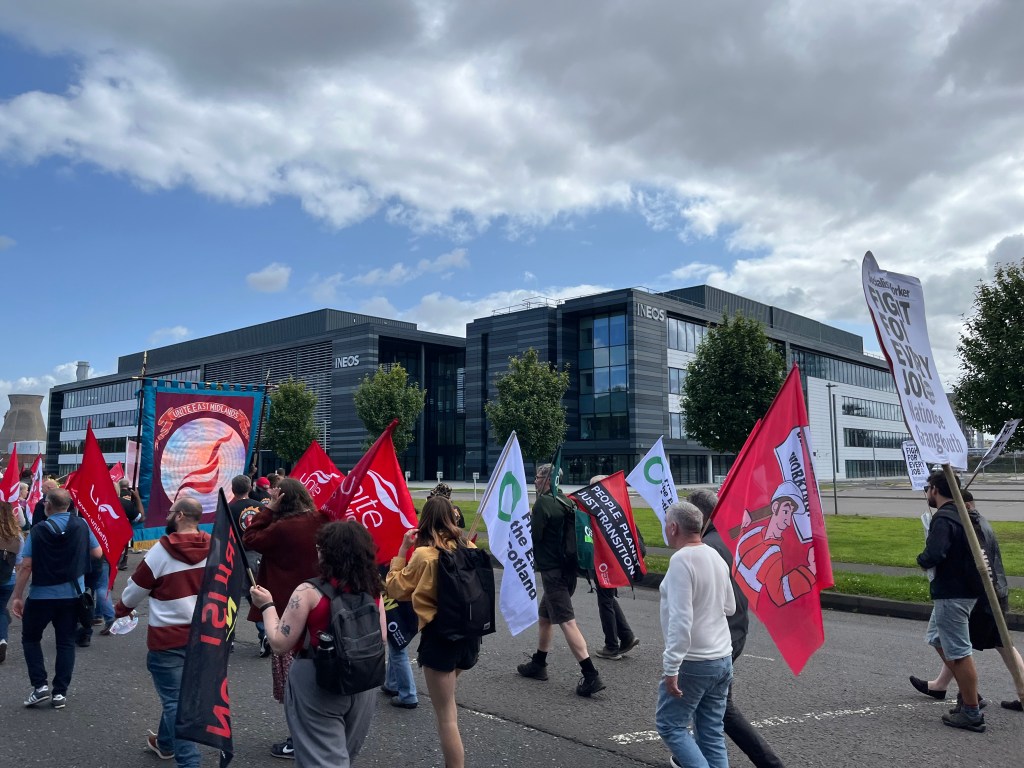
The march assembling outside the Grangemouth stadium – image Pete Cannell CC0
The huge 1700 acre Grangemouth site is owned by billionaire Jim Ratcliffe’s INEOS. They bought the Grangemouth petrochemical plant and the refinery from BP in 2005. Then in 2014 the company raided the pension fund originally established by BP and in turn de-recognised the plant unions. The refinery part of the site is now run by Petroineos, a joint venture between INEOS and the Chinese state-owned oil and gas company PetroChina.
Unite, the main union at the refinery is leading a campaign to ‘Keep Grangemouth Working’. The union is calling for action to ‘Extend, Invest and Transition’. On 3August, they organised a march and rally starting from the Grangemouth stadium on the edge of the INEOS site. Around 600, including refinery workers and their families, and trade unionists from around Scotland and further afield marched to a rally held in a local park. There were a handful of climate activists.
At the rally Unite Scottish Regional Secretary Derek Thomson talked about how the union was campaigning locally to raise awareness of the impact that closure would have on jobs and the local economy. Unite believes that the new Labour Government may be able to persuade Ratcliffe to extend the life of the refinery. The Tories pledged to provide 700 million Euros in credit to support the development of the new Petroineos refinery in Antwerp and they think that if Labour were to question this it would provide leverage.
Grangemouth is a critical campaign for the climate movement. There are moments when decisions are made and actions taken, or not made and not taken, that then resonate through the movement and shape its future trajectory. If the Grangemouth refinery is closed it will be such a moment. In Scotland another such time was the failure to take the BiFab fabrication yards into public ownership in the autumn of 2017. The loss of 1400 jobs at BiFab offshore renewables technology yards discredited the idea that action over climate offers opportunities for employment. The closure of Grangemouth would be not just a blow to the workers, their families and the local economy, it would also send political shockwaves through the climate and workers movements.
On the march – image Pete Cannell CC0
At the rally on 3 August the speaker from Friends of the Earth Scotland received a great response from the Unite members in the crowd. It is important that the union and the Grangemouth workers see transition to a sustainable future as a positive goal. However, there is a real weakness in the current campaign. Unite’s strategy seems to be based on pressurising INEOS into extending the lifetime of the refinery. But there’s no evidence that Ratcliffe is interested in doing this or interested in planning for a sustainable transition. And it’s not that Grangemouth is unprofitable – simply that Antwerp would be more profitable. None of the speakers at the rally criticised INEOS. Implicitly or explicitly the focus was on partnership with the company.
At a time when all the indicators suggest that global heating is increasing faster than the most pessimistic predictions, companies like INEOS and BP are doubling down on investment in fossil fuels. They aim to make mega-profits while they can. In these circumstances, when action to decarbonise is overdue, working in partnership with big oil, while talking about the need for transition and social justice is simply greenwashing. It won’t save jobs, and it sets back progress towards transition.
So, what’s the alternative? Public ownership, and democratic planning that involves energy workers is essential. To build the mass campaign that could make this possible the unions and the climate movement need go beyond slogans.
The private sector is simply not capable of the kind of planning and coordination that is needed to save jobs and manage a just transition.
Convincing energy workers, winning hearts and minds and building the mass support for public ownership requires brutal clarity about what the oil and gas companies are doing. The profits they’ve made and continue to make, the huge subsidies they continue to attract and the way they expect us to clean up their mess. Grangemouth has been a site for petrochemicals for a hundred years. Without an enormously expensive cleanup the site is only suitable for industrial use.
Image Pete Cannell CC0
Partnership with INEOS is a dead end. The company has no loyalty or regard for the workers or the local population. There’s no guarantee if the refinery closes in 2025 that the rest of the operations on the site will continue much longer, and with it, the loss of over 2,500 jobs. Ratcliffe expects us to pay the huge cost of cleaning up the site. And the residents of Grangemouth having lived with the stink and pollution of the plant for decades will remain with a toxic legacy.
But to win hearts and minds and build the campaign there also needs to be a plan for change. The vast site at Grangemouth could become a hub for a wide range of renewable technologies. There’s room to establish new facilities, there’s good communications by land and via the Firth of Forth and there is an established workforce and a cluster of further and higher education institutions in the region that could support the development of a new low carbon economy.
The nature of the plan matters. At the Grangemouth rally – ex-MP and deputy leader of the Alba Party, Kenny MacAskill argued that Grangemouth could prosper through the development of green hydrogen and carbon capture and storage. But these are the solutions that are promoted by Offshore Energy UK, the organisation that represents the interests of the UK oil and gas sector. Both technologies may have some use in the future but the industry focus on them right now is aimed at maintaining oil and gas production, and the infrastructure and systems that support it, for as long as possible. Opportunities for rapid progress lie in Wind, Solar, Wave and Tidal technologies together with energy storage and a new smart distribution grid. Ending partnership between unions and big oil also requires a new and critical view of what technologies support jobs and employment and support rapid decarbonisation and a break from the fake self-serving solutions that are advanced by the oil and gas industry. Which technologies are prioritised is not simply a technical choice but also highly political.
There will be a protest outside the SSE AGM in opposition to the company’s disastrous plans for a new gas burning power station in Peterhead.
SSE already owns the existing power station in Peterhead, which is Scotland’s biggest polluter. A new plant will lock people in Scotland into reliance on expensive and polluting gas for decades – well past the Scottish Government’s 2045 net zero target.
SSE’s Annual General Meeting is for the company to celebrate their huge profits and their expansion plans.
We want to make sure that their bosses and shareholders know that people are not happy about their plans for new fossil fuel infrastructure, so we will be holding a demonstration outside the Concert Hall venue. It will be a family friendly protest, and everyone is welcome!
Here are some train times that will get you in by train if you’re coming from: Aberdeen – 9.44 train gets into Perth at 11.15am Glasgow – 10.07 train gets into Perth at 11.11am Edinburgh – 9.39 train gets into Perth at 11.06am Dundee – 10.55 train gets into Perth at 11.15am
Thanks to Friends of the Earth Scotland for this information
We’re pleased to be able repost this from South Lakes Against Climate Change. The campaign against the West Cumbria coal mine had been fighting for the last decade. The case for the mine has been in tatters for a long time.
Protest at the site of the proposed mine – image by Pete Cannell CC0
The Secretary of State (SoS) of Levelling Up Housing and Communities (LUHC) has accepted that there was an “error in Law” in the previous decision to grant planning permission for the mine. The Government will therefore not be defending the decision, made in December 2022, to grant planning permission for the new mine, and will argue that it should be quashed.
In a reasoned and careful “Statement of Reasons” the SoS explains that the re-assessment is the result of the Supreme Court’s recent judgement on the “Finch v Surrey County Council” case. It is now clear that the combustion emissions, i.e. from the use of the Cumbrian coal, should have been assessed as an indirect effect of the new extraction in the Environmental Impact Assessment.
If that is agreed by the Court, the planning application goes back to the SoS to make a fresh decision.
This is HUGE news. We don’t know what West Cumbria Mining will do, but we are pretty sure that the Hearing of our legal challenges will open on the 16th July as scheduled. Only the Court can quash the planning consent, and that is what we are hoping for.
On 4 July, the climate-trashing Tory government will be replaced, as good as certainly by Keir Starmer’s “changed” Labour party.
For all its talk of “green prosperity”, Labour plans to work closely with the corporations that profit from North Sea oil and gas and from generating electricity – and who intend to produce, and use, fossil fuels for as long as they can.
A protest at government offices against the Rosebank oil field project, January 2023. Photo by Steve Eason
Labour’s plans for cutting greenhouse gas emissions from homes and cars are hopelessly timid, because of its conviction that private business does it best.
Under Labour, we will in my view make progress against social injustice and climate change only insofar as social movements and the labour movement:
(i) confront and confound the government, and
(ii) show that action on climate change, far from costing ordinary people money as the extreme right claim, is 100% compatible with combating social inequalities.
In this article I try to identify the likely battlegrounds between our movements and a Starmer-led Labour government:
Fossil fuel production and the path away from it (part 1); electricity generation at national (part 2) and local (part 3) levels; avoiding false technofixes (part 4); and changing the way energy is used in homes and transport (part 5). Part 6 is about bringing these separate, but connected, issues together.
1. Transition away from fossil fuel production on the North Sea
The election-time slanging match about the North Sea’s future has featured politicians’ and union leaders’ cynicism at its worst. In opposition to this, our movement needs serious conversation about how to fight for working people’s livelihoods and run down oil and gas production simultaneously.
The political war of words has focused on Labour’s commitment not to issue new licences to explore for oil and gas in the North Sea.
The Scottish National Party, which fears losing parliamentary seats to Labour, has lashed out with a claim – shown by BBC Verify to be false – that this would cost “100,000 jobs”. This is “a clear about-face” from the SNP, which last year “committed to a built-in bias against granting new licences”, the Politico web site reported.
“Exaggeration and misinformation helps no-one”, given the urgent need for “a clear-eyed conversation about how to ensure that Scottish workers benefit from the transition away from oil and gas”, Tessa Khan of the climate advocacy group Uplift said.
But exaggeration and misinformation is exactly what leaders of the Unite union, which represents many North Sea workers, contributed. They withheld support for Labour’s manifesto, because of its North Sea policy (as well as for much better reasons, such as its employment policies) and endorsed SNP leader John Swinney’s nonsense.
Unite leader Sharon Graham suggests that a ban on oil and gas licences is the main threat to North Sea jobs. That is not true. It usually takes more than ten years from licence issue for a field to start production, so there is only a very indirect connection. In recent years oil corporations’ decisions to slim down their North Sea operations has posed a far more immediate threat.
If Labour reverses its ban on new licences, the only beneficiaries will be those corporations – while the planetary disaster threatened by climate change would come one step closer, as the heads of the UN and International Energy Agency have pointed out. Indeed there is a powerful case for scrapping the already-granted licence for the giant Rosebank field.
Unite says it wants to “see the money and the plan” for the transition away from oil and gas. But as its leaders well know, plans already exist.
The Sea Change report, published five years ago, showed how the North Sea workforce could expand, with investment in wind power and other renewables. The oil companies and Tory government have other ideas, set out in the North Sea Transition Deal – which proposes spending £15 billion on their pet technofixes, carbon capture and hydrogen. (See also part 4 below.)
The Green New Deal Rising group disrupted an event sponsored by oil industry lobbyists at the Labour party conference in October last year. Photo by Jess Hurd
Unite, along with other unions, accepts these false solutions, and calls for investment in hydrogen and carbon capture, as well as wind power.
Perhaps we should be talking about “rupture, rather than transition”, he said, to make gains for social justice and tackling climate change. This starts with uniting oil workers and Scottish working-class communitiesmore broadly. This is the conversation we urgently need.
At a recent gathering of trade unionists concerned with climate policy, Pete Cannell of the campaign group Scot E3 argued that, given the dominance of this technofix narrative, “it’s legitimate to ask whether ‘just transition’ is any longer the right framing”.
2. Public ownership in the electricity system
Labour will set up a “publicly-owned clean power company”, GB Energy, paid for by a windfall tax on oil and gas producers. But GB Energy will own few, if any, electricity generation assets and will focus on partnerships with private capital. Labour also plans to leave the electricity transmission and distribution grids in private hands, and to leave largely unchanged the neoliberal electricity market rules that allowed corporations to reap billions by impoverishing households in the 2022 “energy crisis”.
Labour intends to capitalise GB Energy with £8.3 billion over the next five years: £3.3 billion for a potentially useful Local Power Plan (see part 3 below), and £5 billion to “co-invest in new technologies” including floating offshore wind and hydrogen, and “scale and accelerate mature technologies” including wind, solar and nuclear.
Labour’s loud claim that GB Energy will “lower [electricity] bills because renewables are cheaper than gas” is not credible. This would require, at least, an investment far greater than £5 billion, allied to a root-and-branch overhaul of electricity markets.
More likely, GB Energy will, at best, fund new technologies that financial markets prefer not to risk their own money on – or even follow in the footsteps of Tony Blair’s disastrous Private Finance Initiative, with which corporations milked billions from the NHS. The Guardian, apparently briefed by Keir Starmer’s team, reported that GB Energy will probably start with “investments alongside established private sector companies”, including the chronically over-budget Hinkley Point, Sizewell C and Wylfa nuclear projects.
The Greens and others slammed Starmer, when he finally clarified on 31 May that GB Energy will essentially be an investment vehicle. But a trenchant critique had already been published last year: Unite’s Unplugging Energy Profiteers report, which warned that “unless combined with a public purchasing monopoly, or significant market reform intervention, [GB Energy] will have no impact on distorted pricing in the wholesale market”, and “by concentrating very limited resources on de-risking experimental forms of generation, GB Energy will use public resources to underwrite and further increase future potential profits for the private sector”.
Unite, and the Trades Union Congress, call for public ownership to be extended not only in electricity generation, but also in the supplybusiness and in transmission and distribution networks. Labour madesimilar calls in 2019, but has now ditched them.
Underinvestment in these networks is a scandal as damaging as the water companies’ rip-off: tens of billions of pounds’ worth of network upgrades are needed to facilitate renewable generation and close the gap on missed climate targets.
The National Grid’s Nechells electricity substation near Birmingham
Already, there are 10+year queues for renewables to be connected to the grid; house-builders are fitting climate-trashing gas boilers because they can not access electricity for heat pumps; battery storage lies unusedbecause companies’ computer systems are out of date … all while distribution networks paid out £3.6 billion in dividends to shareholders in 2017-21.
The system is in such a state that even Rishi Sunak’s dysfunctional government took regulatory powers away from National Grid and put them in the Future System Operator. Nick Winser, the electricity network commissioner, warned the government that unchanged, the system would leave “clean, cheap domestic energy generation standing idle, potentially for years”. “Very few new transmission circuits have been built in the last 30 years”, he said: unless jolted, companies could take up to 14 years to build them.
To make the electricity network fit for the transition away from fossil fuels, wider public ownership is crucial. Our movement needs to work out how to coordinate the fight for it.
3. Community energy and decentralised renewables
Labour promises to spend £3.3 billion on a Local Power Plan, under which GB Energy will “partner with energy companies, local authorities and cooperatives to develop up to 8GW of cheaper, cleaner power by 2030”. Up to 20,000 renewable projects will return “a proportion” of their profits back to communities. But “the detail on these plans is sparse”, the New Statesman reported – and so it is surely up to community organisations and the labour movement to discuss effective ways this money could be spent.
Until now, central government has been a wrecking ball for community energy. In 2015, it changed planning rules, effectively blocking onshore wind projects. In 2019, it scrapped the feed-in tariff paid for electricity supplied to the grid from small-scale renewables. And for years – as decentralised renewables technology leaped forward internationally – it ignored calls to overhaul market rules. Small renewables projects were locked out of the grid by the need for a £1 million + licence, and other obstructions.
The Green New Deal all-party parliamentary group last year called for the regulatory system to be turned upside down, to end its bias in favour of the “big five” generators. It proposed a “European style ‘right of local supply’”; changes to rules on planning and public procurement; mandatory transparency of grid data; and other measures.
Such changes would make it possible to replicate the success of Energy Local in Bethesda, north Wales, which supplies locally-produced hydro power to households at below-grid prices. In April, the Common Wealth think tank proposed a “public-commons partnership” as the institutional form under which local authorities could develop such projects.
All this will take a fight, though. Otherwise, electricity corporates will spread their tentacles into decentralised renewables, as they are doing in the US and Australia.
Furthermore, we need to overcome the official labour movement’s residual reluctance to support community energy projects. The TUC’s recent renewables policy paper, which lists offshore wind, wave, nuclear and “zero carbon hydrogen” (?) as energy technologies – but not decentralised wind and solar – is, unfortunately, indicative.
Decentralised renewables, developed with cooperative, community and local authority forms of ownership and governance, can help to break corporate control of electricity provision, and open the way to democratise and decommodify it.
4. Opposing false technological solutions
False technofixes, including hydrogen and carbon capture, use and storage (CCUS) feature prominently in Labour’s election manifesto – the outcome of lobbying by the oil industry, for which they comprise a survival strategy. Nuclear power – expensive, dangerous, and beloved of the military – is there too, grabbing funds from proven, socially useful technologies such as home insulation, public transport and decentralised renewable power.
While the case against nuclear has been made, and the false logic of CCUS exposed, over decades, the drive for hydrogen is more recent: it is the oil companies’ alternative to electricity-centred decarbonisation. Energy systems researchers argue that, while hydrogen may be needed in future e.g. for steelmaking or energy storage, it will never be suitable for home heating, and hardly ever for transport.
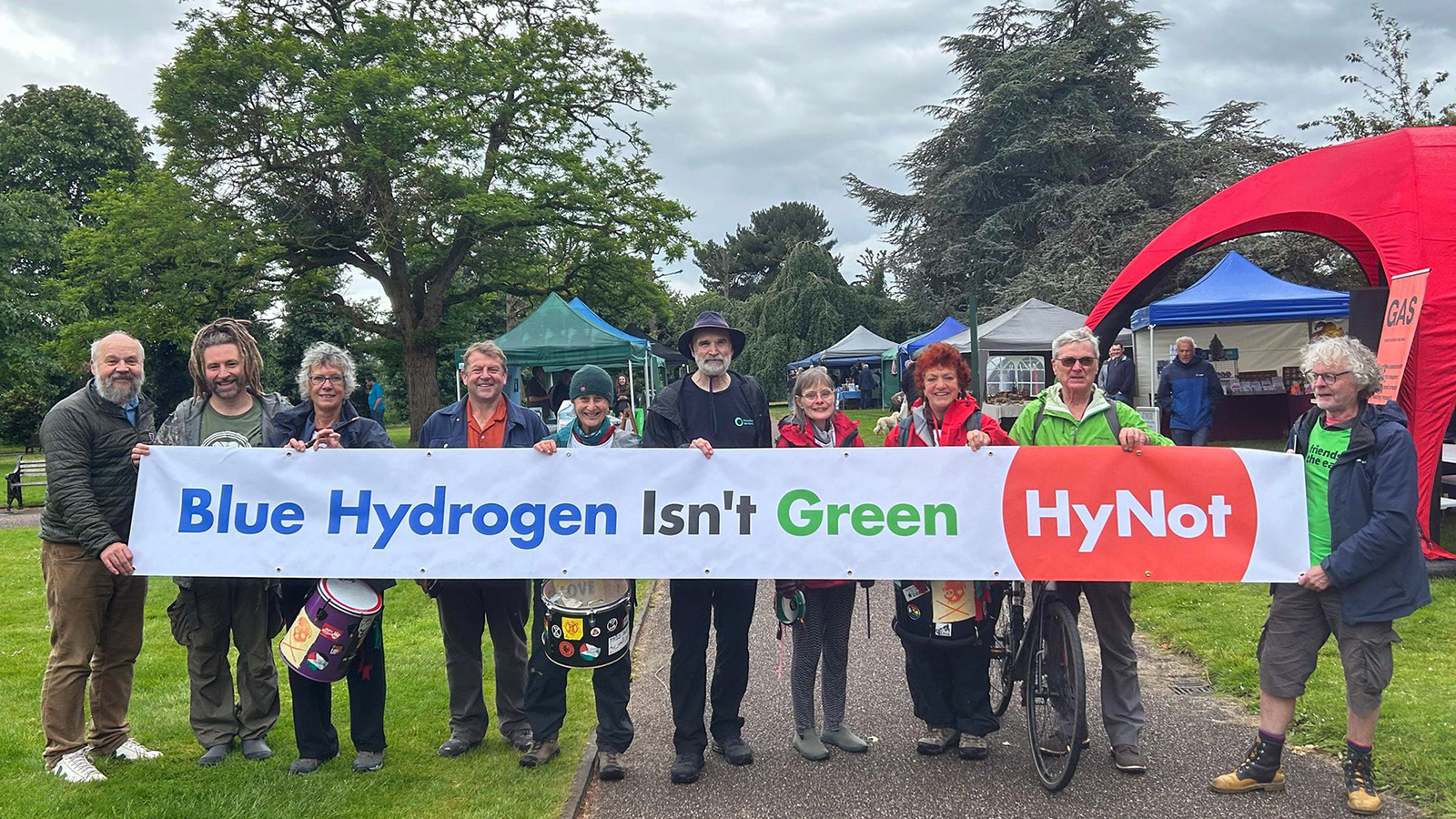
Demonstration by HyNot, which opposes hydrogen for home heating, at the Green Expo UK in Cheshire, last week. Photo from HyNot twitter feed
The Tory government has invested heavily in hydrogen, and the 2023 Energy Act provided a framework for its commercial development. But attempts to bribe communities into testing it out for home heating have hit setbacks. A planned test at Whitby, Merseyside, was cancelled last year after vigorous opposition by local residents and the HyNot campaign group. This year a second planned test at Redcar, Yorkshire, and a thirdone in Fife, Scotland, were both postponed.
Catherine Green Watson of HyNot said: “These postponements are great progress for our campaign. But on Merseyside we still have strong local political support for hydrogen in industry, which should not be the priority. Instead, we need to concentrate on upgrading the electricity grid.”
We need a discussion in the labour movement and social movements about the social role of these technologies. We could work towards unity around the principle that they should not receive state funding that could go to quicker, more effective decarbonisation paths.
5. Energy use in our homes and transport
Labour has scaled back its promises to invest in its Warm Homes Plan that will fund grants and low-interest loans for insulating homes and replacing gas boilers with heat pumps. Shadow energy secretary Ed Miliband last year talked about “up to £6 billion a year”; by the time Labour’s manifesto was published last week, this had shrunk to “an additional £6.6 billion over the course of the next parliament” (that is, over five years). Talk of upgrading 19 million homes had stopped; now it’s 5 million.
Labour has stuck with commitments to take railways back into public ownership, and to support municipal ownership and franchising of bus services. But it is also promising to “forge ahead with new roads”, and keep the transport system centred on private cars, at a time when researchers argue that this cuts dangerously across tackling climate change.
If Labour sticks to this course, determined by its neoliberal fiscal rules and by corporate lobbying, then key opportunities to cut UK carbon emissions, while improving people’s lives, will be missed. Researchers have been screaming for years that insulation and heat pumps, and superceding the car-centred transport system with better, cheaper public transport, are desperately needed to decarbonise homes and transport, the two largest sources of greenhouse gas emissions.
Battles on effective energy conservation in homes, transport and throughout the economy are part of the war to limit climate change.
Labour’s commitments are too timid to reverse the disasters caused by Tory policies. In the decade from 2012, annual completions of home insulation upgrades fell by nine tenths. The measures announced by government last year would take 190 years to improve the energy efficiency of the UK housing stock and 300 years to hit the government’s own targets for reducing fuel poverty, National Energy Action stated.
As for roads, the government could cancel the £10 billion Lower Thames Crossing scheme, final approval of which has been delayed until October, and apply to all future projects the principle adopted by the Welsh government – that they can only go ahead if compatible with climate policy.
Labour may not only fail to deal with these gigantic sources of carbon emissions, but actually open up new ones. A grim example is Labour’s threat to overrule communities who question tech corporations who want to build fuel-guzzling data centres – which will help trash climate targets, to the benefit of those corporations alone.
6. Bringing the issues together
The stakes are high. Every new assessment by climate scientists underlines the conclusion reached by leading British researchers four years ago: that the UK’s decarbonisation targets are half as stringent as they need to be, to make a fair contribution to tackling global heating. The government’s own climate change committee says non-power sectors of the economy need to decarbonise four times faster than they are doing.
Tackling climate change, while reversing the effects of 14 years of neoliberal austerity policies, will not be easy. Indeed, Labour does not intend to: both decarbonisation and social policy will be subordinated to their fiscal rules.
The labour movement and social movements need to challenge and push back Labour’s pro-fossil-fuel, pro-austerity approach.
We need to unite our forces and find the pressure points – be it saying “no”, to the Lower Thames Crossing project and similar, or finding openings for collective action, e.g. in the Local Power and Warm Homes plans.
To act effectively on climate, we need to keep in mind the necessity of holistic solutions, and reject illusory technofixes and greenwash narratives that claim to reduce emissions with one hand, and pour them into the atmosphere with the other. SP, 18 June 2024.
This article was first published on the People and Nature site. Republished here with thanks.














 Employment, Energy and Environment