Blog

Building the movement: challenges and opportunities

In the second session of our conference on Saturday 16th November Simon Pirani and Mary Church will take a look at the challenges we face locally and internationally.   This, together with session one on American Climate Rebels will form the backdrop to discussion during the rest of the day.

At last year’s conference we worked together to draft a climate jobs manifesto. In the twelve months since November 2018 there have been hugely significant developments driven by the Youth Climate Strikers and the growth of XR. However, we still have a long way to go. This year we hope to take the discussion forward by looking at the politics and practice of building a mass social movement that has climate justice at its heart.

Find out more about the 2019 conference here.  Book for the conference on Eventbrite and email triple.e.scot@gmail.com if you want to book one or more crèche places.

48765693228_bc6737968b_c

REEL News at Scot.E3 conference

Shaun Dey from REEL News will introduce the first session at the Scot.E3 conference on 16th November in Edinburgh In 2018. Reel News went on a 14 week tour of North America to look at grassroots struggles around climate change, particularly struggles around a “just transition” from fossil fuels to renewable energy, where workers and communities control the process so that they benefit from the transition, and around “just recovery” – recovery from extreme weather events which do not exacerbate current inequalities. Shaun will introduce video clips from a range of inspiring struggles by unions, indigenous communities and people of colour in the US as a starter for the discussion and debate for the rest of the day.

Find out more about the conference here.  Book for the conference on Eventbrite and email triple.e.scot@gmail.com if you want to book one or more crèche places.

Here’s one of the longer videos from REEL News’ American Climate Rebels series


Towards Net Zero?

On the 7th February 2019 Edinburgh City Council resolved to declare a climate emergency. On the 25th October Edinburgh City Council’s Policy and Sustainability met to consider a draft report from the Place-Based Climate Action Network (P-CAN) research project on Achieving Net Zero in the City of Edinburgh. The report will form the basis for discussion of an action plan at the February 2020 meeting of the committee.

In this post Pete Cannell gives a personal response to the report. We hope to publish further contributions on this important topic and we welcome comments, responses to the questions he poses and further contributions.

It’s important and encouraging that, in response to pressure from the School Student strikers, XR and the wider movement, Edinburgh City Council is set to discus actions to reduce carbon emissions. This post takes a critical look at the report that forms the basis for the council’s discussions.

‘Achieving Net Zero in the City of Edinburgh’ is a technical report that summarises research undertaken by the Edinburgh Centre for Carbon Innovation (ECCI), drawing on expertise from the University of Edinburgh and the University of Leeds. Net zero means that carbon emissions from activity in Edinburgh are balanced by an equal amount of carbon being removed from the atmosphere. The net zero target applies to emissions from within the local authority boundaries. Critically, however, some emissions, most notably those from aviation are not included.

The cost-benefit analysis used by the research team is based on the same methodology that was used in the Stern Review on the Economics of Climate Change that was published in 2006.

The report notes that Edinburgh’s baseline emissions have declined by 40.3% since 2001. This reduction is almost entirely a result of changes in the way that Scotland’s electricity is generated with coal fired power stations closing down and replacement by renewables – primarily wind. Renewables are now such an important part of the grid that there is little scope for further reduction from this source.

The report models three scenarios for how much energy use and emissions could be reduced by 2030:

1. A 56% reduction in carbon emissions as a result of ‘cost effective’ investments amounting to £3.976 billion over the next 11 years. The savings resulting from these investments would repay the investment in 7.5 years and continue to generate savings thereafter.

2. A 62% reduction as a result of ‘cost neutral’ investments of £7.492 billion over the 11 years to 2030 that would be paid back in savings over 12.5 years.

3. A 67% reduction exploiting the full technical potential of the different mitigation measures proposed. This is estimated to require investment of at least £8.135 billion with the cost neutral pay back extending to 16.1 years.

The figures aggregate emission reduction strategies across multiple sectors – commercial, transport, domestic and industrial and the report provides some detailed proposals for the kinds of investment that needs to be made in each of these.

The report is honest about the scale of the technical and investment challenge but confines consideration of politics and strategy to the observation that:

Whilst the opportunities outlined here are all feasible and ‘win-wins’ for stakeholder groups across the city, they will require near-immediate and unequivocal support from institutions and the public.

Will the City Council’s action plan be framed in a way that faces up to the urgency of the crisis and wins unequivocal support? And will it address the gap between the reductions proposed in the report and net zero? Climate campaigners have a critical role to play here. We have a responsibility to build a movement embedded in working class communities across the city that is active, restless, rebellious and probes, questions and criticizes at every stage and every step. And we need to develop a collective understanding of how actions to reduce emissions and the unequivocal support of the mass of the population are achieved and built through democratic engagement and a focus on social justice.

There are a host of questions that we need to address. In the hope of starting a debate I’ll mention just a few!

The activities of the city council are responsible for only a small percentage of Edinburgh’s emissions. So how does an effective action plan ensure that the investment into emissions reductions envisaged by ‘Towards Net Zero’ take place across all areas of energy consumption? How does a council action plan leverage action across the whole city? Clearly there’s a role for regulation – for example imposing building regulations that mandate carbon neutral new builds. There’s also a case for investment in large-scale public initiatives – for example building insulation.

‘Towards Net Zero’ focuses on a cost benefit approach together with the implementation of existing low carbon technologies – and holds out the promise that in future emerging technologies will bridge the gap to net zero. Is this an appropriate methodology in the face of an existential crisis? Can it actually work? It’s not business as usual but it suggests that conventional methods together with technology can achieve net zero. So is net zero achievable without system change? And if it’s not, what does system change look like?

Treating carbon reduction as an issue about investment and technology may also hide real issues of policy. So for example business and tourism planning in Edinburgh have both had huge impact on how and where we live, the distances we travel to work and how we travel. As Edinburgh’s workforce is pushed further outside the city boundaries to find affordable accommodation the carbon footprint of our daily working lives has grown. But the ‘Towards Net Zero’ effectively excludes these issues, as it does the massive rise in aviation emissions, which are so strongly linked to current planning priorities. So while we can commend the City Council’s steps towards an action plan there is a powerful case for integrated planning across the region and for new policy frameworks for housing, health, work, transport and tourism that centre on zero carbon and social justice.

2018-07-04 12.45.17

Image: Pete Cannell, CC0

There is an opportunity to discuss the issues raised in this post at the  Scot.E3 conference that takes place on 16th November.  Book for the conference on Eventbrite and email triple.e.scot@gmail.com if you want to book one or more crèche places.

Building Worker Power

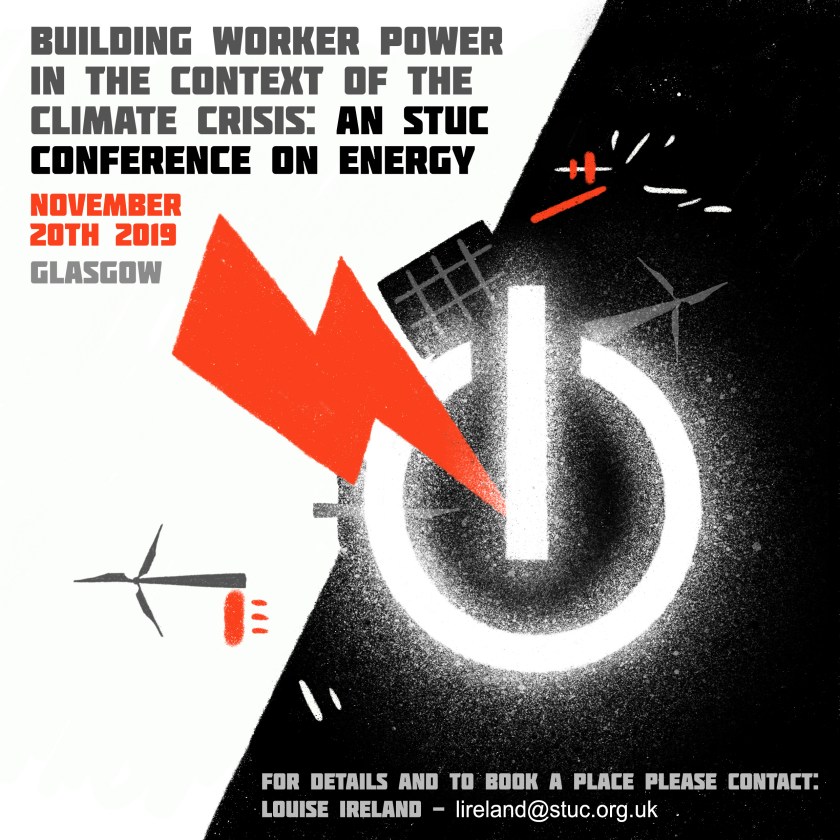
On the Wednesday following the ScotE3 conference on Saturday 16th November the Scottish Trades Union Congress is holding an important event in Glasgow. Contact Louise Ireland, lireland@stuc.org.uk for booking details,

 Building Worker Power in the Context of the Climate Crisis: An STUC Energy Conference

 Wednesday 20th November, 2019

9.00 am – 4.30 pm

The Lighthouse, Mitchell Lane, Glasgow

energy graphic

Common Weal launch Green New Deal

This Saturday Common Weal is launching their report on a Green New Deal for Scotland.  The event is at The Arches in Glasgow – more details and booking via Eventbrite through this link.  This promises to be an important contribution to the developing debate on how we tackle the climate crisis.

Jonathan Shafi from Common Weal is one of the speakers at the Scot.E3 conference on 16th November.  Book for the conference on Eventbrite and email triple.e.scot@gmail.com if you want to book one or more crèche places.
75649403_2991480460922938_217794553174818816_n

Degrowth and the Green New Deal

Gareth Dale spoke on this topic in Edinburgh earlier in the month at an event organised by the Edinburgh World Justice Festival.  You can watch a video of the talk here.  He has now published an essay on the same topic on the Ecologist website.  It’s well worth reading.

47300368512_53d689c96c_c

Image by nrkbeta CC BY SA 2.0 https://www.flickr.com/photos/nrkbeta/47300368512 Alexandria Ocasio-Cortez @ SXSW 2019

Saturday 16th November is the Scot.E3 conference. Check out the details on the ScotE3 home page. Bookings can be made on Eventbrite at https://www.eventbrite.co.uk/e/just-transition-employment-energy-and-environment-2019-tickets-68768192515  and there’s also a Facebook Event at  https://www.facebook.com/events/1133891030332559/  If you are in position to share the event it would be really helpful.


Draft conference programme available

The programme for the Scot.E3 conference on Saturday 16th November is now available for viewing and download.

Bookings can be made on Eventbrite at https://www.eventbrite.co.uk/e/just-transition-employment-energy-and-environment-2019-tickets-68768192515  and there’s also a Facebook Event at  https://www.facebook.com/events/1133891030332559/  If you are in position to share the event it would be really helpful.

69334497_2150087728621957_2172063732950106112_n

Upcoming events

Saturday 26th October: Scot.E3 will have a stall at the Radical Independence Conference, which takes place at the Radisson Blu Hotel in Glasgow – you can browse and pick up copies of briefings.

Saturday 2nd November:  Scot.E3 will have a stall at the Edinburgh EcoFair – which takes place at Out of the Blue (Drill Hall) in Dalmeny Street.  We still need people to help with the stall on the day – if you’re free for an hour or two your help would be much appreciated.

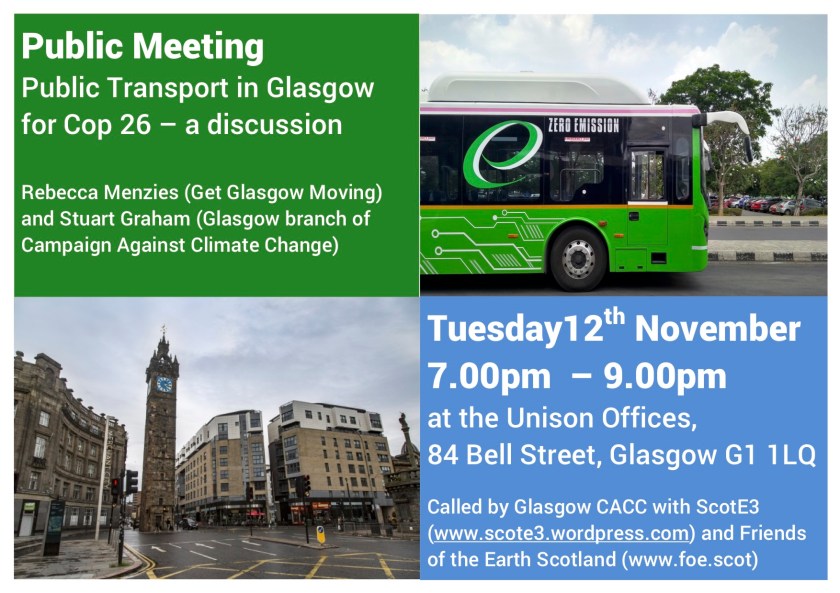
Tuesday 12th November:  We are co hosting a meeting on Public Transport in Glasgow and the 2020 COP with Glasgow CACC and FOE. Speakers are Rebecca Menzies from ‘Get Glasgow Moving’ and Stuart Graham (Glasgow CACC). 7pm at the Unison offices, 84 Bell Street G1 1LQ

And of course Saturday 16th November is the Scot.E3 conference. Bookings can be made on Eventbrite at https://www.eventbrite.co.uk/e/just-transition-employment-energy-and-environment-2019-tickets-68768192515  and there’s also a Facebook Event at  https://www.facebook.com/events/1133891030332559/  If you are in position to share the event it would be really helpful.

flyer

New Briefing on BECCS

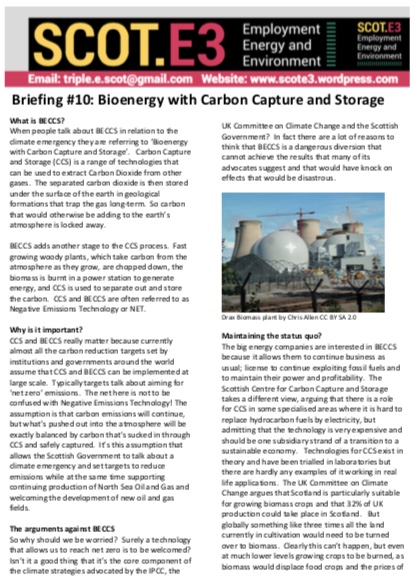
The latest ScotE3 takes a critical look at BECCS – Bioenergy with Carbon Capture and Storage.  Like all the ScotE3 briefings it is designed as a short, and hopefully clear, introduction to the topic.  We welcome feedback and ideas for improvement.

You can read the text of the briefing below and download the full pdf from the resources page.

briefing 10 graphic for blog

What is BECCS?

When people talk about BECCS in relation to the climate emergency they are referring to ‘Bioenergy with Carbon Capture and Storage’.   Carbon Capture and Storage (CCS) is a range of technologies that can be used to extract Carbon Dioxide from other gases.  The separated carbon dioxide is then stored under the surface of the earth in geological formations that trap the gas long-term.  So carbon that would otherwise be adding to the earth’s atmosphere is locked away.

BECCS adds another stage to the CCS process.  Fast growing woody plants, which take carbon from the atmosphere as they grow, are chopped down, the biomass is burnt in a power station to generate energy, and CCS is used to separate out and store the carbon.  CCS and BECCS are often referred to as Negative Emissions Technology or NET.

Why is it important?

CCS and BECCS really matter because currently almost all the carbon reduction targets set by institutions and governments around the world assume that CCS and BECCS can be implemented at large scale.  Typically targets talk about aiming for ‘net zero’ emissions.  The net here is not to be confused with Negative Emissions Technology! The assumption is that carbon emissions will continue, but what’s pushed out into the atmosphere will be exactly balanced by carbon that’s sucked in through CCS and safely captured.  It’s this assumption that allows the Scottish Government to talk about a climate emergency and set targets to reduce emissions while at the same time supporting continuing production of North Sea Oil and Gas and welcoming the development of new oil and gas fields.

The arguments against BECCS

So why should we be worried?  Surely a technology that allows us to reach net zero is to be welcomed?  Isn’t it a good thing that it’s the core component of the climate strategies advocated by the IPCC, the UK Committee on Climate Change and the Scottish Government?  In fact there are a lot of reasons to think that BECCS is a dangerous diversion that cannot achieve the results that many of its advocates suggest and that would have knock on effects that would be disastrous.

Maintaining the status quo?

The big energy companies are interested in BECCS because it allows them to continue business as usual; license to continue exploiting fossil fuels and to maintain their power and profitability.  The Scottish Centre for Carbon Capture and Storage takes a different view, arguing that there is a role for CCS in some specialised areas where it is hard to replace hydrocarbon fuels by electricity, but admitting that the technology is very expensive and should be one subsidiary strand of a transition to a sustainable economy.   Technologies for CCS exist in theory and have been trialled in laboratories but there are hardly any examples of it working in real life applications.  The UK Committee on Climate Change argues that Scotland is particularly suitable for growing biomass crops and that 32% of UK production could take place in Scotland.   But globally something like three times all the land currently in cultivation would need to be turned over to biomass.  Clearly this can’t happen, but even at much lower levels growing crops to be burned, as biomass would displace food crops and the prices of staple foods would increase forcing the poorest further into hunger and starvation.

Restoring ecosystems that capture carbon

Forests are a very important way in which carbon is removed from the atmosphere; about 25% of current emissions are taken up.  However, worldwide forests are under threat and clear cutting of forests to grow soya and other crops for meat production causes around 10% of global carbon emissions.   An end to deforestation and proactively working to re-establish natural forests could have a big impact on carbon reduction.  Trees are important but not just any trees.  When monoculture plantations replace trees – for example Palm Oil the same land area is much less efficient at absorbing carbon.  BECCS often assumes clearance of existing forest for monoculture cultivation of biomass.  And there are many other serious impacts: displacement of indigenous communities, destruction of ecosystems and of pesticides.

Separating out carbon dioxide from other gases or from the atmosphere is an energy intensive process so it’s expensive financially and in terms of our overall energy budget.   Operating at large scale might reduce the cost per ton of carbon but it would still need very large amounts of clean energy.

Scotland has a number of locations where the underground rock formations are suitable for underground storage of carbon dioxide.  Many parts of the world do not.  Proponents of CCS suggest that carbon storage could be a profitable new industry – however, long distance transport of captured gas would also require a lot of clean energy.

System change

Ultimately, however, the problem with BECCS and CCS is political.  Governments and corporations favour it as a solution because it seems to allow existing infrastructure and power relationships to be preserved.  It suggests that climate catastrophe can be averted by technical fixes.

Even if the technology works and can be introduced rapidly and at scale it seems highly unlikely that it can mitigate emissions sufficiently to avoid going well beyond a 1.5 degree rise.  However, for as long as CCS remains the main plank of mainstream strategies it diverts action and investment away from sustainable strategies that we know could work.  And it acts as a barrier to the systemic change that is required to save the planet.

All our material is published under a CC0 public domain license (unless otherwise stated.  You are welcome to share, reuse and reversion.  This briefing draws heavily on a FOE(S) and FOE(international) webinar. 


New version of nuclear briefing

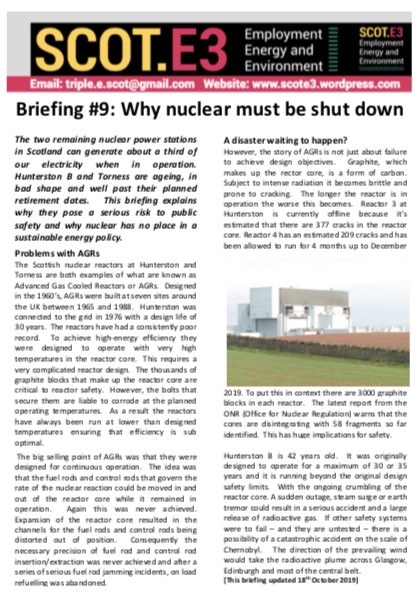
An updated version is now available of our briefing on the dangers posed by the damaged Hunterston nuclear reactors and the reasons why nuclear power has no part to play in decarbonising the Scottish economy.  We’ve reproduced the text here and you can download the briefing from our resources page.

revised briefing 9 image

The two remaining nuclear power stations in Scotland can generate about a third of our electricity when in operation.  Hunterston B and Torness are ageing, in bad shape and well past their planned retirement dates.   This briefing explains why they pose a serious risk to public safety and why nuclear has no place in a sustainable energy policy.

Problems with AGRs

The Scottish nuclear reactors at Hunterston and Torness are both examples of what are known as Advanced Gas Cooled Reactors or AGRs.  Designed in the 1960’s, AGRs were built at seven sites around the UK between 1965 and 1988.  Hunterston was connected to the grid in 1976 with a design life of 30 years.  The reactors have had a consistently poor record.  To achieve high-energy efficiency they were designed to operate with very high temperatures in the reactor core.  This requires a very complicated reactor design.  The thousands of graphite blocks that make up the reactor core are critical to reactor safety.  However, the bolts that secure them are liable to corrode at the planned operating temperatures.  As a result the reactors have always been run at lower than designed temperatures ensuring that efficiency is sub optimal.

The big selling point of AGRs was that they were designed for continuous operation.  The idea was that the fuel rods and control rods that govern the rate of the nuclear reaction could be moved in and out of the reactor core while it remained in operation.  Again this was never achieved.  Expansion of the reactor core resulted in the channels for the fuel rods and control rods being distorted out of position.  Consequently the necessary precision of fuel rod and control rod insertion/extraction was never achieved and after a series of serious fuel rod jamming incidents, on load refuelling was abandoned.

A disaster waiting to happen?

However, the story of AGRs is not just about failure to achieve design objectives.  Graphite, which makes up the rector core, is a form of carbon. Subject to intense radiation it becomes brittle and prone to cracking.  The longer the reactor is in operation the worse this becomes.  Reactor 3 at Hunterston is currently offline because it’s estimated that there are 377 cracks in the reactor core. Reactor 4 has an estimated 209 cracks and has been allowed to run for 4 months up to December

To put this in context there are 3000 graphite blocks in each reactor. The latest report from the ONR (Office for Nuclear Regulation) warns that the cores are disintegrating with 58 fragments so far identified. This has huge implications for safety.

Hunterston B is 42 years old.  It was originally designed to operate for a maximum of 30 or 35 years and it is running beyond the original design safety limits.  With the ongoing crumbling of the reactor core. A sudden outage, steam surge or earth tremor could result in a serious accident and a large release of radioactive gas.  If other safety systems were to fail – and they are untested – there is a possibility of a catastrophic accident on the scale of Chernobyl.   The direction of the prevailing wind would take the radioactive plume across Glasgow, Edinburgh and most of the central belt.

Torness

Torness started producing electricity in 1988 and was scheduled to close in 2023. Owners, EDF Energy recently extended this date to 2030.  It shares problems of cracking in the graphite core with Hunterston and in addition has had to close down on several occasions in the last decade as a result of jellyfish and seaweed clogging the secondary seawater cooling systems.

We don’t need nuclear

In the past Scotland has generated an energy surplus.  In 1989 primary energy capacity in Scotland was 45% more than the level of demand.  The margins are now much narrower.  Reliance on ageing nuclear capacity rather than planning for non-nuclear green alternatives could result in a shortfall in supply in the future.  We can decarbonise through further development of wind, solar, wave and tidal energy. Nuclear is unnecessary, expensive, poses a high risk to health and wellbeing and only exists because it is essential to the nuclear arms programme.  Retention of current nuclear capacity is not only high risk but also acts as a barrier to the development of a long-term sustainable system of energy production.

Urgent need for action

EDF want to keep operating both reactors at Hunterston. They have redefined the ‘safe’ limit for the number of permitted cracks in the cores.   But the level of risk is just too high.  The Westminster Government and EDF are desperate to get Hunterston back on line.  Tory policy of building new reactors, rather than investing in renewables, is in tatters as first Toshiba and now Hitachi back out of new build in Cumbria and Wales.  The projected cost of energy from the planned Hinckley C reactor far exceeds the cost of wind and solar.

We need to see the end of nuclear as part of a shift to a sustainable economy.  The role of a national investment bank and a national energy company is crucial in making a rapid move to clean, safe energy.  In the process more than 100,000 new climate jobs could be created in Scotland.  While current discussion of these initiatives by the Scottish Government is welcome a much greater sense of urgency and a commitment to a climate jobs strategy is required.  Closing Hunterston can be step one in building the campaign is that’s required.