Blog

New version of nuclear briefing

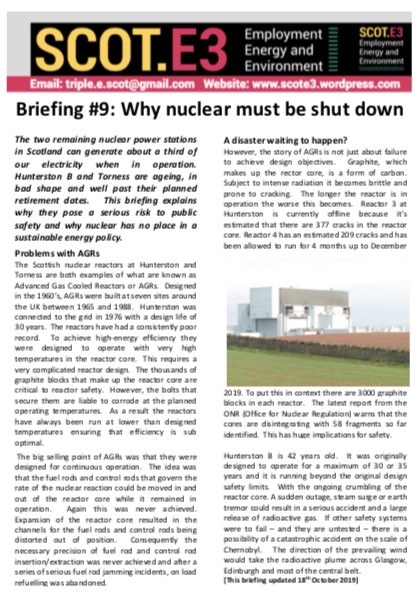
An updated version is now available of our briefing on the dangers posed by the damaged Hunterston nuclear reactors and the reasons why nuclear power has no part to play in decarbonising the Scottish economy.  We’ve reproduced the text here and you can download the briefing from our resources page.

revised briefing 9 image

The two remaining nuclear power stations in Scotland can generate about a third of our electricity when in operation.  Hunterston B and Torness are ageing, in bad shape and well past their planned retirement dates.   This briefing explains why they pose a serious risk to public safety and why nuclear has no place in a sustainable energy policy.

Problems with AGRs

The Scottish nuclear reactors at Hunterston and Torness are both examples of what are known as Advanced Gas Cooled Reactors or AGRs.  Designed in the 1960’s, AGRs were built at seven sites around the UK between 1965 and 1988.  Hunterston was connected to the grid in 1976 with a design life of 30 years.  The reactors have had a consistently poor record.  To achieve high-energy efficiency they were designed to operate with very high temperatures in the reactor core.  This requires a very complicated reactor design.  The thousands of graphite blocks that make up the reactor core are critical to reactor safety.  However, the bolts that secure them are liable to corrode at the planned operating temperatures.  As a result the reactors have always been run at lower than designed temperatures ensuring that efficiency is sub optimal.

The big selling point of AGRs was that they were designed for continuous operation.  The idea was that the fuel rods and control rods that govern the rate of the nuclear reaction could be moved in and out of the reactor core while it remained in operation.  Again this was never achieved.  Expansion of the reactor core resulted in the channels for the fuel rods and control rods being distorted out of position.  Consequently the necessary precision of fuel rod and control rod insertion/extraction was never achieved and after a series of serious fuel rod jamming incidents, on load refuelling was abandoned.

A disaster waiting to happen?

However, the story of AGRs is not just about failure to achieve design objectives.  Graphite, which makes up the rector core, is a form of carbon. Subject to intense radiation it becomes brittle and prone to cracking.  The longer the reactor is in operation the worse this becomes.  Reactor 3 at Hunterston is currently offline because it’s estimated that there are 377 cracks in the reactor core. Reactor 4 has an estimated 209 cracks and has been allowed to run for 4 months up to December

To put this in context there are 3000 graphite blocks in each reactor. The latest report from the ONR (Office for Nuclear Regulation) warns that the cores are disintegrating with 58 fragments so far identified. This has huge implications for safety.

Hunterston B is 42 years old.  It was originally designed to operate for a maximum of 30 or 35 years and it is running beyond the original design safety limits.  With the ongoing crumbling of the reactor core. A sudden outage, steam surge or earth tremor could result in a serious accident and a large release of radioactive gas.  If other safety systems were to fail – and they are untested – there is a possibility of a catastrophic accident on the scale of Chernobyl.   The direction of the prevailing wind would take the radioactive plume across Glasgow, Edinburgh and most of the central belt.

Torness

Torness started producing electricity in 1988 and was scheduled to close in 2023. Owners, EDF Energy recently extended this date to 2030.  It shares problems of cracking in the graphite core with Hunterston and in addition has had to close down on several occasions in the last decade as a result of jellyfish and seaweed clogging the secondary seawater cooling systems.

We don’t need nuclear

In the past Scotland has generated an energy surplus.  In 1989 primary energy capacity in Scotland was 45% more than the level of demand.  The margins are now much narrower.  Reliance on ageing nuclear capacity rather than planning for non-nuclear green alternatives could result in a shortfall in supply in the future.  We can decarbonise through further development of wind, solar, wave and tidal energy. Nuclear is unnecessary, expensive, poses a high risk to health and wellbeing and only exists because it is essential to the nuclear arms programme.  Retention of current nuclear capacity is not only high risk but also acts as a barrier to the development of a long-term sustainable system of energy production.

Urgent need for action

EDF want to keep operating both reactors at Hunterston. They have redefined the ‘safe’ limit for the number of permitted cracks in the cores.   But the level of risk is just too high.  The Westminster Government and EDF are desperate to get Hunterston back on line.  Tory policy of building new reactors, rather than investing in renewables, is in tatters as first Toshiba and now Hitachi back out of new build in Cumbria and Wales.  The projected cost of energy from the planned Hinckley C reactor far exceeds the cost of wind and solar.

We need to see the end of nuclear as part of a shift to a sustainable economy.  The role of a national investment bank and a national energy company is crucial in making a rapid move to clean, safe energy.  In the process more than 100,000 new climate jobs could be created in Scotland.  While current discussion of these initiatives by the Scottish Government is welcome a much greater sense of urgency and a commitment to a climate jobs strategy is required.  Closing Hunterston can be step one in building the campaign is that’s required.

A Planet to Win

Pete Cannell reviews a new book from Verso – ‘A planet to win: why we need a green new deal’.

Scan

A Planet to Win: Why We Need a Green New Deal

Kate Aronoff, Alyssa Battistoni, Daniel Aldana Cohen and Thea Riofrancos

Verso 2019

A You Gov Blue poll of US voters in March 2019 found that 59% supported the idea of a Green New Deal.  ‘A Planet to Win – Why We Need a Green New Deal’ is a highly readable explanation of what the Green New Deal represents and the challenges that have to be overcome to implement it.  The book focuses on what needs to be done in the US over the next decade (a small quibble – some references to the UK are not entirely accurate) but it’s highly recommended for a UK audience.  Not least because the authors are absolutely clear about the necessity for system change.  They share the view expressed by Naomi Klein in the introduction that ‘The promise of the Green New Deal is that climate crisis is an opportunity to build a better world’.

The authors believe that radical change is essential and that such change ‘only happens when millions of people are organizing, striking and marching, shaping politics and the economy from below’.  They argue that the transition to a sustainable economy has to be driven by mass action, contesting power and ending social inequality.  They are also clear-eyed about the challenges that we face in building such a movement.  They situate the Green New Deal in the context of more than 40 years of neo-liberalism when living standards for many Americans have been at best stagnant and during which inequality has grown.  Moreover, they take on the issues of power in society.  Understanding that big business will be as vicious in defence of the status quo as they have been in attacking the US Labour Movement.  They argue that there are two essential tasks.  Breaking down the divide between the labour and climate movements and at the same time rebuilding the strength, vitality and combativity of the former.  Most of the book is devoted to providing arguments that will convince trade unionists of the necessity for action and more generally to win the movement to an understanding that collective action rather than individual sacrifice is what is required in the face of an existential crisis.

UK readers may be less familiar with the original New Deal.  The Great Depression had a devastating impact on the US economy with many millions thrown out of work.  The New Deal was a programme of public works, reforms and regulations that aimed to put people back to work.  It was implemented on a mass scale. “Workers hired under the Works Progress Administration constructed 651,000 miles of highway … 125,000 public buildings including 41,300 schools, and 469 airports.  They built 8,000 parks and 18,000 playgrounds and athletics fields.”  And it was popular.  The authors of ‘A Planet to Win’ understand that the New Deal was designed to save capitalism not to bury it.  However, they make use of it to illustrate how rapid action on a massive scale is possible.  The history of the New Deal also informs their emphasis on job creation and job guarantees that extend far beyond workers in the carbon based industries.  Indeed they stress that it was about social reproduction as well as production and argue that in the 21stcentury jobs in care, health and education are critical to a just transition.

Perhaps the best thing about this book is its relentless focus on the politics of climate action and the need for climate justice.  It rejects strategies that ignore the need to address social inequality and simply rely on technical fixes.  It argues that we need systemic change.  The technology exists, what’s needed is the political will to push change through in a short period of time.  Here the book is at its’ weakest.  I think this reflects a more general weakness of the socialist left.  Recognising the need for radical democracy and rebuilding collective organisation and the collective power of the working class is necessary.  The book is good on this.  Recognising that big business and the giant energy corporations have to be brought to book is also critical and again the authors are clear about this.  What’s less clearly articulated is the role of the state in relation to capital.  The US Green New Deal is radical and takes on board race and gender in a way that the original New Deal did not.  In considering options for sustainability it recognises the impact on the global of additional demand for natural resources but it as primarily a national strategy.  It has little to say on the military industrial complex.  The US military has a huge carbon footprint.  If the Pentagon were a country it would be number 55 in the world for carbon emissions.  But even more critical to a strategy for system change the giant military corporations dominate the industrial economy, exert a stranglehold on research and development and monopolise skills and knowledge essential for transition.  Just like the energy companies their hold must be broken.

Quite rightly the authors of ‘A planet to win’ are critical of those who would like to cherry pick some elements of the Green New Deal while trying to maintain the status quo. They argue that the real fantasy is that half measures, preserving business as usual, can work.  An effective strategy implies a radical Green New Deal.

Whether we like it or not the global climate crisis is coincident with a global crisis of organisation on the left.  The nature of both crises is deeply influenced by the last four decades of neo-liberalism.   The urgency of the climate crisis presents unique challenges and opportunities. So for example, in the US, at the same time as public policy is set on a path of rapidly increasing fossil fuel production, the movement for a Green New Deal is growing rapidly.  For the first time in decades ‘socialism’ is back on the agenda.  This book is a valuable contribution to the first faltering steps to build out of the marginalisation of the left.   A different kind of economy is not only necessary it is possible.

This article was first posted on http://www.rs21.org.uk


The politics and practice of just transition

On Wednesday 16th October, 7.30pm we have a public meeting/discussion as part of the Edinburgh World Justice Festival 

We plan to explore what is meant by justice transition and reflect on the need to develop the definition.  There’ll also be some film clips on struggles for just transition around the world.

We’ll finish with discussion on making just transition core to the politics and practice of the movement.  Who we need to reach, how we can reach them and what are the priorities for action.

IMG_4675


Asad Rehman speaking on Climate Justice

Climate Justice is the theme of this year’s Edinburgh World Justice Festival held at various venues in Edinburgh between 28th September and 19th October.  Among the speakers at the conference held on Saturday 12th October was Asad Rehman from War in Want.  The video is just over 20 minutes and is highly recommended.

Update on the November conference

We are really pleased that Simon Pirani will be speaking at the Scot.E3 conference on 16th November.  Simon is the author of ‘Burning Up: A Global History of Fossil Fuel Consumption’ (Pluto, 2018).  Here’s a video of him speaking about the book:


The risks from Hunterston B

Elsewhere on this blog and in Briefing number 9 we have made the case for the permanent closure of Hunterston B – arguing that nuclear power has no place in a sustainable energy future.  We are pleased to be able to share this video of Rob Edwards talking at an Edinburgh CND meeting as part of the 2019 Edinburgh World Justice Festival.  Rob’s talk provides up to date information on the current status of the two nuclear reactors at Hunterston.


Edinburgh World Justice Festival

The Edinburgh World Justice Festival (EWJF) began on 28th September and runs through to the 19th October.  This year the theme of the festival is Climate Justice.  ScotE3 is contributing a meeting on Wednesday 16th October when we’ll be looking at climate activism around the world and how we can make the idea of a just transition real for working class communities and organisations.  Obviously we hope you’ll come to the meeting on the 16th but do check out the nineteen other events including the conference on 12th October and the the Bookfair on 19th October.

homescreen

Stopping Oil and Gas Part 3

Daisy Jamieson was the third contributor to Scot.E3’s Glasgow public meeting on stopping North Sea oil and gas. In her talk Daisy reflected on the importance of just transition.  Part 1 of the public meeting can be viewed here and part 2 here.