Blog

Scotland’s North Sea Oil and Gas workers: the fight for a Just Transition: Part 2 – The Final Storm?

Oil Rig at sea during a storm (iStock).

Climate crises, Covid-19 and a looming global recession: how many more storms can the N Sea oil and gas industry take? In part one of this report, published in April 2020, Brian Parkin looked at the combined impacts of the Covid-19 pandemic and a world economic downturn on the UK offshore oil and gas industry. In this brief second paper, he looks at the emerging trends from the second half of 2020 onwards and how the global hydrocarbons sector will face up to a post-Covid-19 world in which renewables may well begin to dictate the shape of energy things to come.

50… and nearly out

The North Sea oil and gas industry, in defiance of many forecasts and expectations, is now 50 years old. At the time of its baptism, governments were obsessed with balance of payments columns as well as the commitment to the post-war social compact of an economy run at levels of full employment. It was also a shared view that with an unshakeable belief in government intervention and technological innovation, things could be done.

Initial interest in UK offshore (North Sea and UK Irish Sea sectors) lay in the deposits of natural gas and the potential for a reliable and long-term resource of energy for, initially, domestic (household) consumers. The growing estimates from c.1970 onwards also promised a resource that could be extended to industrial space heating and manufacturing processes. Regarding oil, it was clear from early chemical analysis that UKCS crude oil was unsuitable for refining into the Heavy Fuel Oil required for power generation, and so the North Sea offered nothing in the way of breaking energy dependency on indigenous coal- and the National Union of Mineworkers.

However, oil from the Forties- and a little later- the Brent fields provided an ideal crude grade suitable for refining into the required range of transport fuels. The value of this asset though, was not appreciated until the global oil shock of 1972, when a largely Arab dominated OPEC punished the Western economies for their alignment with Israel in the Yom Kippur war. 

In terms of petroleum supply security, the North sea has paid off. For the better part of half a century the UK has enjoyed near total security of indigenous supply. Apart from the 1984-85 miners’ strike when the UK government had to fuel the coal- fired power stations with Heavy Fuel Oil- which cannot be refined from North Sea crudes- almost all oil crudes (and distillates for aviation fuel)- have come from the North Sea. And even now, with North Sea oil capacity falling, the UK remains 95% petroleum self-sufficient.

Global oil … passing its prime?

As we have previously noted, all fossil fuels have been under the pressure of a climate consensus to conform to COlimits by reducing production as well as emissions from production operations. The response of the oil and gas companies as well as the OPEC cartel has been- with some success- to lobby governments as well as attempting to massage public opinion away from climate concerns. To these ends they have now failed. But as ever resourceful, the oil – and also gas – interests have been redeploying their considerable financial interest elsewhere – albeit grudgingly. After years of ‘scientific’ misinformation and fake data, the oil and gas industry faces an irreversible shift in both public opinion and scientific consensus.

At 2015 the view of the oil and gas lobby was that demand for petroleum would begin to peak in the early 2030’s – albeit tapering off slowly into the future. But by 2019 the industry had significantly changed its forecasts. Even before the combined whammy of the onset of a world economic turndown and the Covid-19 pandemic, BP, Shell, TotalDNV-GL, the IEA[1] and OPEC[2] had come to the uncomfortable conclusion that oil peak demand had already been reached. Big oil exceptions to this forecast have remained as the US giants, Exxon/Mobil and Chevron, who have both continued to set aside some $30 billion investment capital in further oil exploration and developments[3].

As early as 2016, Shell had established its New Energy Divisiona new venture into renewables generation, high capacity batteries, grid management and hydrogen. This has come at the expense of tar sands investment and shale oil extraction and refining. The company has also undertaken a major restructuring in order to free up capital investment for diversification into non-petroleum activities.

Also in October 2019, BP declared its intention to be a zero-carbon operation by 2030. And, in that year, BP entered into a $1.1 billion joint venture with Equinor Energy for the purpose of becoming a major player in offshore wind power[4]. This was with the expectation of offshore wind appreciating six-fold to 190 Gwe installed by 2030[5]. (But just to get things in proportion, the OECD now estimates that globally there will have to be a $6.3 trillion per annum investment to convert energy systems into renewables in order to meet the 1.5oC climate mitigation target for 2030[6].

The repo-man cometh

With financial data changing almost frantically day by day, it is not easy to reach a reliable estimate of the overall health of the global oil industry. Nevertheless, recent figures show the overall scene against which the North Sea industry fares. But first some raw data:

RankCountryMbpd
1USA15,043
2Saudi Arabia11,800
3Russia10,800
15Norway1,649
21UK940
Oil production million barrels per day (Mbpd) by country 2019[7] (96 producers)

The global daily production for 2019-20 was 80,622,000 bpd of which 68% was produced by the top 10 producers with an overlapping 44% produced by OPEC member states. The average output for the top 3 producers was 11 mbpd. By the beginning of 2020 the same producers had an average output of 12.3 mbpd – a significant overproduction given the emerging market conditions for the year.

With signs of a global economic recession as early as September 2019, it was clear that at 15.043 mbpd, the US was entering 2020 at a significant rate of over-production. The sustained production rate of the previous year began to depress the world traded price of oil to an unsustainably low level for many OPEC+Russia producers – hence the output war of OPEC to depress output in order to increase prices. But within weeks it was clear that such a strategy was failing – hence the output switch to increase production in order to break the back of the relatively high cost US shale oil sector.

But within weeks of this price/output war, the already global markets were hit by the Covid-19 pandemic – with the second week in April seeing the price of West Texas Intermediate (WTI) fall to minus $40 dollars per barrel. After several weeks of price bounces, the world traded price of the Brent and WTI grades settled at just below $35 per barrel. Since then a fitful recovery has seen North Sea Brent begin to trade at around $40 per barrel- a price that barely covers the combined production and development costs of c.$38 pb[8].

Much regarding the likely fortunes of the North Sea oil and gas industry was covered in the first paper[9] but if we want to examine the drive behind the global plight of the hydrocarbon industries, it would be better to look at the biggest producer and consumer of oil and gas- the USA. 

When the bottom of the oil market fell through the floor in 2014 it was the US with some 25% of its oil and gas production from shale ‘plays’ that took the greatest hit. Since then, and not without considerable help from the US Treasury, the US has bounced back to be the biggest hydrocarbon player in the world – and with a Congressional act in 2016, a net exporter of oil and gas into the world market. And prior to the combined recession/Covid crisis, even the shale extraction sector was doing well at an oil price of c.£65 pb.


http://www.sjvgeology.org/history/gushers_world.html

Immediately prior to March 2020 most US producers could break even at a $46> pb price. But in order to kick-start the many needed DUC’s (Developed but Uncompleted wells) required to maintain medium-term production, an additional $6.00 pb was required. Also, at that time it was reckoned that the bullish confidence of the industry was waning with an estimated 66% of oil company CEO’s of the view that 2020 had seen the peak in oil demand coming and going[10]. Consequently, by April the fall in demand in the US had resulted in a 20% excess in capacity with a subsequent registration in Chapter 11 bankruptcy protection orders. If we want to measure the historical scale of this default, then the post-2014 crash of 2016 would be a good comparison:

2016 oil bankruptcy debt                   $56.8 bn 

2020 oil bankruptcy to date              $89 bn

Expected 2020 debt                           $134 bn

Furthermore, on the current market estimates it is expected that a further roll-over debt of at least £100 bn can be expected to the end of the 2020-21 financial year. Also, although the number of individual bankruptcies are so far lower, the capital size per company failure is much higher. In 2016 the failures amounted to $56.8 billion. But in 2020 to date the total is $89 billion and is expected to reach $134 billion by the end of the year. And as each company has been debt financed with no failure insurance, it is reckoned that the banks would be lucky to recover 35 cents in the $US in the event of a winding-up order[11].

In conclusion, with no foreseeable growth in oil and gas demand and a totally unstable market deterring future field developments, a ‘self-levelling’ market price of <$40 pb- probably struck by the bigger OPEC members and the dominant oil companies, much of the worlds marginal reserve/high cost capacity will be squeezed out. Certainly, the crash to $35 pb is a price that even the bigger and lower cost producers would find it hard to live with. This much was revealed by the leaked news that OPEC’s leading member Saudi Arabia reckoned that a sustained price of $50 pb would be the most favourable price to 2030 in order to allow margins to cover the cost of future field developments[12].

But whatever, the enduring relationship between US big oil and the military-imperialist project is likely to see the hydrocarbon industry not go out quietly- particularly as the states of the Gulf Cooperation Council – and Exxon/Mobil insist on peak oil as far ahead as 2030. But those the Gods wish to destroy, they first make mad.

Beyond the North Sea

The economic viability of oil and gas have always been predicated on the myth that all other sources of energy are uncompetitive and/or only so in the distant future. Petroleum, of course is mainly used as a feed-stock for mainly transport fuels – crude oil for refining into petrol (gasoline) and condensates into diesel and aviation fuels.

And by far the largest contributor today of global COemissions derives from petroleum extracted transport fuels. But sticking with North Sea Brent as refined at Grangemouth (Petrochina) or Total’s Humber refineries we see the following product percentages:

Product% of crude refined[13]
Asphalt       0.7
Residues0.7>
Refinery Fuel1.85>
Liquid Natural Gas4.0
Aviation Fuel9.0
Diesel/Light Oil25.0
Petrochemicals13.0
Petrol45.0
Total Transport Fuels79.0
(It should also be noted that the Ineos plant in the Grangemouth complex processes methane for conversion into a feedstock for plastics manufacture)

Of course the fate of some 4,000 workers and their families at Grangemouth now hang in the balance with the likely demise of hydrocarbons- both as transport fuels and plastic materials.

In April 2020 the OECD anticipated a year in which at least 1 million oil and gas industry workers would lose their jobs – a calculation which must include many thousands of North Sea workers. But there does seem to be a levelling off – possibly due to a convergence of strategic thinking on the part of OPEC and the oil ‘majors’ that a sustainable price of $45 pd could be struck over the next period – a price that would strike out both the higher cost OPEC members as well as other high cost sectors such as US shale[13] and most deep water operations[14].

On the other hand, the anticipated rise in demand for more and more offshore wind capacity – ideal for Scottish waters – along with an expected Compound Annual Growth Rate of matching large scale lithium/ion battery capacity to match incoming wind/wave/tidal and solar units[15].

The future is full of dangers and hope- and if the rage generated by the threatened loss of 20,000 miners jobs in 1984 could the reproduced many times over again in order to demand a Just Transition for the threatened tens of thousands of oil and gas sector workers, then the future is full of hope.

Dr Brian Parkin, Edinburgh, November 2020.


[1] IEA- International Energy Agency

[2] Organisation of Petroleum Exporting Countries

[3] Oilprice News 10th Sept 2020

[4] Above company information Oilprice News 10th Sept 2020

[5] Bloomberg NFF Oct 2019

[6] OECD annual report 2018

[7] US Energy Information Administration (EIA) 31st March 2019

[8] UK Oil and Gas Sept 2019

[9] Brian Parkin Scot.E3 April 2020

[10] Oilprice News/Bloomberg Feb 12th 2020

[11] All figures Rystad Energy consultants October 20th 2020

[12] Irina Slav Oilprice News 5th October 2020

13] David Messeder, Bloomberg as reported in Oilprice 22nd October 2020

[14] Oilprice/Bloomberg/Wood McKenzie, May 20th as reported in Oilprice 20th May 2020

[15] Wood McKenzie 30th September 2020

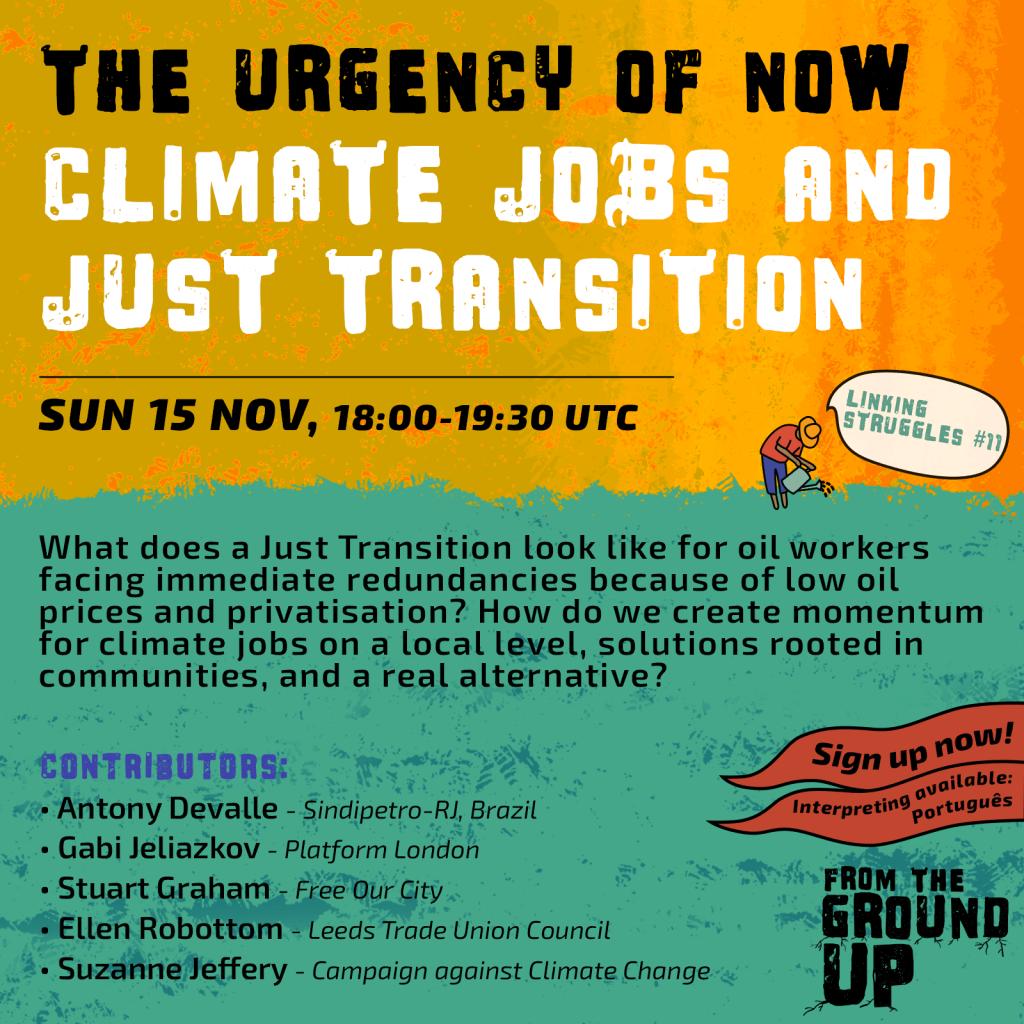
The Urgency of Now – Climate Jobs and Just Transition

The Cop26 Coalition is holding a global gathering from the 12th – 16th November.  Register here.

Scot.E3’s contribution to the gathering is ‘The Urgency of Now – Climate Jobs and Just Transition’ which takes place at 6pm on the 15th November.

The Covid-19 pandemic has intensified calls for a global Green New Deal – an urgent transformation of the global economy with massive investment to tackle climate change and address inequality. But what does a just transition look like for oil workers facing immediate redundancies because of low oil prices and privatisation? And with much wider unemployment expected, how do we take the initiative to create momentum for climate jobs on a local level, creating solutions rooted in communities and a real alternative?

This workshop draws on recent research with offshore oil and gas workers in Scotland. While many are looking for better job security, they are not being given a clear path to transfer their skills to renewable energy. The oil industry in Brazil also faces insecurity due to privatisation. Meanwhile, campaigns for free public transport in Glasgow and for a mass home retrofitting programme in Leeds are challenging the piecemeal approach taken by national government and calling for investment that meets the needs of local communities and creates climate jobs ‘from the ground up’. Workshop participants are invited to bring their experiences of mobilising for a just transition and climate jobs in their own sector / community.

All events will take place on Zoom and we will email through the relevant links beforehand when you register. You can get help installing zoom here. 

Contributors
Antony Devalle (Sindipetro-RJ, Brazil), Gabi Jeliazkov (Platform), Stuart Graham (FreeOurCity), Ellen Robottom (Leeds Trade Union Council)

Hydrogen for homes is a terrible idea. We should fight it

We’re pleased to be able to repost this article by Gabriel Levy which was first published on the People and Nature blog. Do check out the People and Nature site which has a wealth of useful and informative resources and follow the site on Twitter @peoplenature

A plan to pipe hydrogen, instead of natural gas, to millions of UK households is being pushed hard by the fossil fuel industry. It sounds “green” – but could wreck efforts to make homes truly zero carbon, using insulation and electric heat pumps.

Oil and gas companies support switching the gas grid to hydrogen, as a survival option in case of decarbonisation, as hydrogen is usually fabricated from gas.

But the hydrogen strategy cuts across the approach recommended for years by housing policy wonks and architects: to use insulation to slash the amount

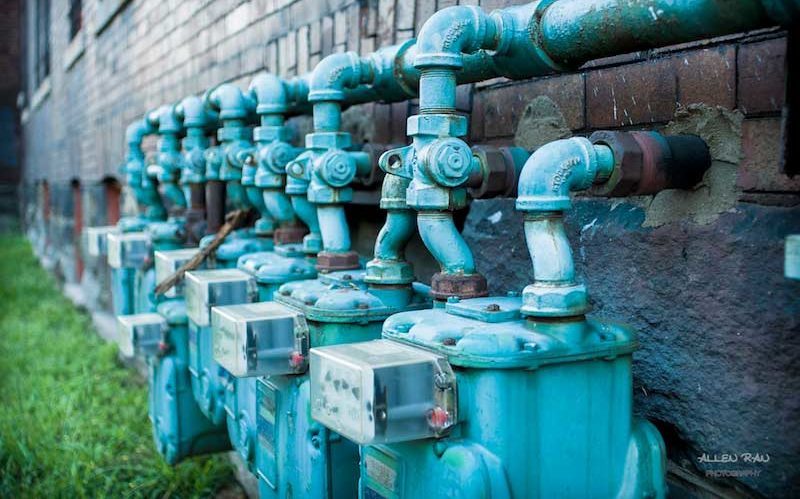
The gas grid: better to replace it with heat pumps. Photo by Ran-Allen / Creative Commons

of heat needed, and install electric pumps (which work like fridges in reverse).

Leeds Trades Union Council (TUC) last month launched a campaign in favour of retrofitting homes with high-quality insulation and heat pumps.

It’s an issue many people can unite around – those fighting for better housing and tenants’ rights, campaigners against fuel poverty, trades unionists fighting building industry cuts, and all of us who want to tackle climate change.

And there’s a choice to be made we cannot avoid.

If the gas grid is switched to hydrogen, that will block for good the electrification-and insulation approach, that heats homes better, more cheaply, with technology that we know works, and is truly zero-carbon. We cannot have it both ways.

We will be locked into extra dependency on fossil fuels, instead of speeding the shift away from them.

That gas-to-hydrogen switch is being planned in north-east England by Northern Gas Networks (NGN): its H21 project would convert 3.7 million homes and businesses by 2035, and 15.7 million by 2050. NGN is asking the government to fund an engineering study for it.

This article is a guide to the debates and to more information. It covers:

  • hydrogen and its drawbacks;
  • whole system solutions: existing technologies to decarbonise heating
  • the government’s no-strategy strategy and how we could resist it; and
  • industry lobbying.

There is a short appendix with a non-technical guide to the technologies.

Hydrogen and its drawbacks 

Hydrogen is touted as a “green” fuel internationally, because governments seek industry-friendly paths to decarbonisation, and oil and gas companies offer this false solution.

The International Energy Agency (IEA) last year published a report on hydrogen, which noted active support for it by the Chinese, Brazilian, Indian, Australian and many European governments.

In July this year, the European Commission published its “hydrogen strategy for a climate-neutral Europe”, which advocates state support for hydrogen to replace gas in industry and transport – but also mentions household heating as a possible use, as does the European Hydrogen Alliance’s declaration.

Much of this is based on a totally unproved assumption: that technology to produce zero-carbon hydrogen can be made to work at scale. That is a long way off, and may never happen. 

There are two supposedly carbon-free types of hydrogen: “blue” hydrogen made from natural gas, from which the carbon is removed and stored; and “green” hydrogen made by electrolysing water. Neither has ever been used at large scale.

At the moment, about 70 million tonnes of hydrogen is produced per year globally, and 98% of it is “grey” hydrogen, made from natural gas … without carbon capture. So it emits a huge amount of greenhouse gases – almost as much as the aviation industry. (See below for more details on the technologies.)

Large-scale “blue” or “green” hydrogen production is far away for three types of reasons.

  1. Cost. The European Commission estimates that “blue” hydrogen would cost €2 a kilogramme at today’s prices, and “green” hydrogen €2.50-€5.50/kg, compared to €1.50/kg for existing “grey” hydrogen.
  2. Technology. “Blue” hydrogen needs carbon capture and storage (CCS) technology that does not yet work at scale anywhere. Transporting hydrogen might not be the walk in the park that some companies claim, either, this presentation suggests.
  3. Resource use. “Green” hydrogen uses huge quantities of electricity and water.

Take the NGN project. It would by 2050 need 8 million tonnes of hydrogen per year, equivalent to 300 Terawatt hours (TWh) of electricity.

To supply that amount of “green” hydrogen, Friends of the Earth says,would need 140 Gigawatts (GW) of wind-powered electrolyser capacity – compared to a current total UK wind capacity of 22 GW (which supplies about one fifth of


The Sun in hydrogen light … but on earth, the hydrogen has to be released from compounds. Photo from the Science Museum

the UK’s electricity). Plus the same amount of water as is used by 1.2 million homes.

If “blue” hydrogen were used instead, 60 plants, as big as the world’s biggest, would have to be built … fitted with that CCS technology that is still in development.

I am not arguing that hydrogen – especially “green” hydrogen – could never be used, during and after the transition away from fossil fuels. But now, it is not a priority or a game-changer.

Today, most hydrogen is used in oil refining and fertiliser manufacture. Hopefully, much of this current use will disappear, along with fossil-fuelled industries. There may well be new uses, because low- or zero-carbon hydrogen might be the best substitute for fossil fuels e.g. to make steel. Hydrogen is also good for storing energy.

But why, in any sane world, would you start by searching for new ways to use hydrogen, as governments are trying to do now?

Why would you even think about using hydrogen to heat people’s homes – when technologies that work, that are already in use (retrofitting, electricity and heat pumps) could do the job better?

You wouldn’t.

Unless you were seeking ways of wringing the last few bits of profit out of oil and gas production.

Whole-systems solutions: existing technologies can decarbonise heating

There is nothing radical about proposing insulation and electric heat pumps to replace gas for households. Recent reports by the Institute for Public Policy Research (advocating a national investment programme), Friends of the Earth (reiterating the value of heat pumps against hydrogen) and the Carbon Trust (on London, arguing that “heat pumps are the primary technology choice”) make the case. For a working retrofitter’s view, see the Sure Insulation site.

Government and parliamentary reviews, too, have found that heat pumps and insulation are the way to go. (They have also looked at a hybrid heat pump system, in which a heat pump provides heat for 85% of the time, but switches to a gas boiler during colder periods.)

The government’s business and industry department (BEIS) did a big review of home heating options in 2018. It concluded that, first, there should be a “growth in no or low-regrets low carbon heating” measures, including heat pumps, biomass boilers and solar water heaters. But BEIS said that, long term, all technologies had to be looked at – and kept the hydrogen option open, by commissioning the engineering company Arup to do a feasability study.

The parliamentary Committee on Climate Change also did a big study on hydrogen in 2018, and concluded that it is “best used selectively, where it adds most value alongside widespread electrification” – and providing CCS could be got to work properly. Most urgent, the CCC pointed out, is “strategic certainty about how the decarbonisation of heat will be delivered in the UK”.

(The detailed analysis for the CCC was done at Imperial College. It showed that a hydrogen-based approach would be more expensive, especially if the aim were zero carbon, and that up-front investment makes more sense to stop emissions. There is more from Imperial on “smart and flexible heat” here.)

All this paperwork underlines that an integrated approach is needed. Buildings need to be upgraded and insulated; different types of heat pumps and different installation methods are called for; expertise and training have to be developed; in some areas, district heating networks make sense.

This is exactly the sort of thing local government has always done, and the neo-liberal assault on local government makes it harder. That’s discussed in research of heat systems governance by Janette Webb (see her articles including “New Lamps for Old”“Emerging linked ecologies for a national-scale retrofitting programme” and one on why heat decarbonisation cannot be done by markets).

The no-strategy strategy, and how to oppose it

In the face of this pile of evidence that, more than anything, home heating needs a strategy – the government has avoided adopting a strategy. It “has yet to make any firm decisions about which pathways it prefers”, this report on the Renewable Technology site explained in July.

The politics of this is very clear.

In the face of climate crisis, the government must choose between an integrated strategy, best implemented through local government, relying on existing technology … or a no-strategy strategy that takes the lead

Insulation works, and it cuts down the need for heat

from powerful private companies with unproven technology.

The no-strategy strategy fits with this government’s maniacal, neoliberal hatred of the public sector – one of its few ideological principles. That was what motivated its no-strategy strategy on coronavirus testing and tracing, with devastating results, costing tens of thousands of lives.

A heat decarbonisation strategy will have to be fought for in opposition to the government – just as health workers, scientists and others have had to fight for a coronavirus strategy.

This is why the Leeds TUC initiative, which appeals to local government to act, is welcome.

The Leeds TUC has recognised a techno-fix for what it is – damaging to society and the labour movement. Its campaign could be a focus for all who want to tackle dangerous climate change.

If you are in a trade union, an environmental campaign group or a community organisation, please discuss the Leeds TUC’s document and the actions it proposes.

If you are in a union, you could challenge trade union leaders’ support for the oil and gas industry’s hydrogen initiative.

Instead of such support, the labour movement should:

First, embrace technologies that are in society’s best interests – which for heat decarbonisation means retrofitted insulation and heat pumps;

Second, demand that firms producing filthy-dirty “grey” hydrogen take action to reduce the horrendous levels of greenhouse gas emissions they produce; and

Third, urge that future hydrogen use be limited to applications that are socially useful and don’t add to the climate crisis.

This approach could and should be part of a broader perspective of just transition, now starting to be discussed by workers on the North Seawhere the gas is produced.

Lobbying on steroids

The H21 project is at a crossroads. The companies who sponsor it – NGN, the gas network firm Cadent and the Norwegian oil company Equinor – got state funding for a series of initial reports: £9 million from the Ofgem Network Innovation Competition (NIC) in 2017, mainly to fund safety assessments; and another £6.8 million in 2019 to test the technology at a specially-built site at Spadeadam. (Update from a H21 manager here.)

But H21’s plea for a much larger dollop of state funding – £125 million, half the cost of a Front End Engineering and Design (FEED) study, originally scheduled to start this year – has not so far been heeded, despite the “urgency” explained in the H21 North of England report (available here, although temporarily (October 2020) missing).

Meanwhile, the government has announced another project – to support an industrial complex on Teesside, making “blue” hydrogen for transport – that could be an alternative source of demand for natural gas being pumped from the North Sea … and has as little as H21 to do with tackling the climate emergency.

Despite the question marks over H21, the oil and gas industry’s lobbying machine in support of hydrogen for heat decarbonisation is trundling on, with greater force than ever.

In July, the All Party Parliamentary Group on Hydrogen issued a reporturging “more ambitious” support for hydrogen, including “mandating hydrogen-ready boilers by 2025”.

And in August, the gas industry “scored a success in persuading the Environmental Audit Committee [of the House of Commons] to back its plans for using hydrogen […] in domestic heating”, the 100% Renewable UK blog reported.

The committee chair, Philip Dunne MP, deceitfully suggested that hydrogen is “the most cost-effective option” for “parts of the UK energy system”.

Tom Baxter, a chemical engineering researcher, questions the pro-hydrogen arguments in this article.

Gas network companies have also jumped on the post-Covid financing bandwagon, asking for a huge state hand-out for conversion to hydrogen. And cement manufacturers – who, like energy companies, need carbon capture and storage – have joined the queue for state funding.

These relentless lobbying efforts are funded by a range of companies including hydrogen, transport, carbon capture, gas network, engineering and chemical firms as well as oil and gas. Their greenwash proliferates through the Decarbonised Gas Alliance and Hydrogen Strategy Now.

Some good research on these lobbyists’ methods, by academics at Exeter University and Imperial College, warns of “the capacity that incumbents have to promote their storyline”.

Hydrogen. Quick technological catch-up  

Hydrogen is the most common, and lightest, element in the universe, but only exists on earth combined with other elements. People started fabricating hydrogen from compounds and using it e.g. for balloons in the nineteenth century. Today there are three main types of hydrogen:

■ “Grey” hydrogen. Fabricated by removing the hydrogen (H) from methane i.e. natural gas (CH4), or from coal. This is how 98% of hydrogen is currently made. It is extremely emissions-intensive. For every tonne of hydrogen made from gas, 10 tonnes of carbon dioxide (CO2) goes into the atmosphere;

The Petra Nova carbon capture and storage plant, recently mothballed. Photo by RM VM (creative commons)

hydrogenfor every tonne from coal, 19 tonnes of CO2.

The 70m tonnes of hydrogen produced in 2018 caused 830m tonnes of CO2 emissions, the IEA calculated. That’s a healthy chunk of the world total of 42 billion tonnes – about  the same as total emissions from Indonesia plus the UK – and nearly as much as the global aviation industry, which emitted 915m tonnes in 2019.

Most hydrogen produced now is used for oil refining, and ammonia production to make chemical fertilisers. Some is used as part of synthetic gas products, mainly for manufacturing steel, or methanol.

■ “Blue” hydrogen. In this process, instead of CO2 being emitted into the atmosphere, it is captured and stored. The capture process, steam reformation, is straightforward for about 70% of the emissions and gets really tricky above and beyond about 85%.

Steam reformation splits methane into CO2 and synthetic gas (carbon monoxide plus hydrogen); in the second stage, the synthetic gas is mixed with steam; more CO2 is removed and hydrogen produced. Other similar processes are partial oxidation, which uses oxygen in the air as an oxidant instead of steam, and autothermal reforming, which combines both methods.

Note on carbon capture and storage. This can also be used in gas- and coal-fired power stations. Usually the carbon is captured after the fuel has been burned. Then, as with carbon from hydrogen production, it has to be transported and stored. CCS has been in development for about 40 years, but there are still only 20 projects in development in the world. Only two of these ever actually functioned, and one of those two (Petra Nova in Texas) was mothballed in August. (A good analysis is here.) CCS is greenwashed as the key to “green power”. Some politicians, and some international climate talks documentation, claim that bioenergy with CCS could play a big role in global decarbonisation, but climate scientists and engineers think that is nonsense.

■ “Green” hydrogen. Produced by electrolysis of water. The electricity could come from fossil fuels (in which case it would not be green), nuclear power or renewables. The process is proven, but is very energy intensive and very inefficient.

If electricity from renewables were to be used, this could be the most “carbon light” way of producing hydrogen. But huge targets for “green” hydrogen production are sometimes published without being reconciled with other huge targets for renewably-produced electricity. Is producing hydrogen ever going to be the best way to use this electricity? The IEA says that just to produce the 70m tonnes of hydrogen the world economy uses annually would need 3600 TWh of electricity, more than total European consumption. The electrolysis also needs huge amounts of water – 9 litres for each kilo of hydrogen.

Gazprom, the Russian gas company, sees potential in producing hydrogen by methane pyrolysis, a related technology. GL, 30 October 2020.

Find out more about the Leeds TUC initiative:

■ Retrofit Leeds homes with high-quality insulation and heat pumps:  a plan and call to action, by Leeds TUC

■ Leeds trade unionists: zero carbon homes can help tackle climate change, by People & Nature

A watershed moment for Mossmorran

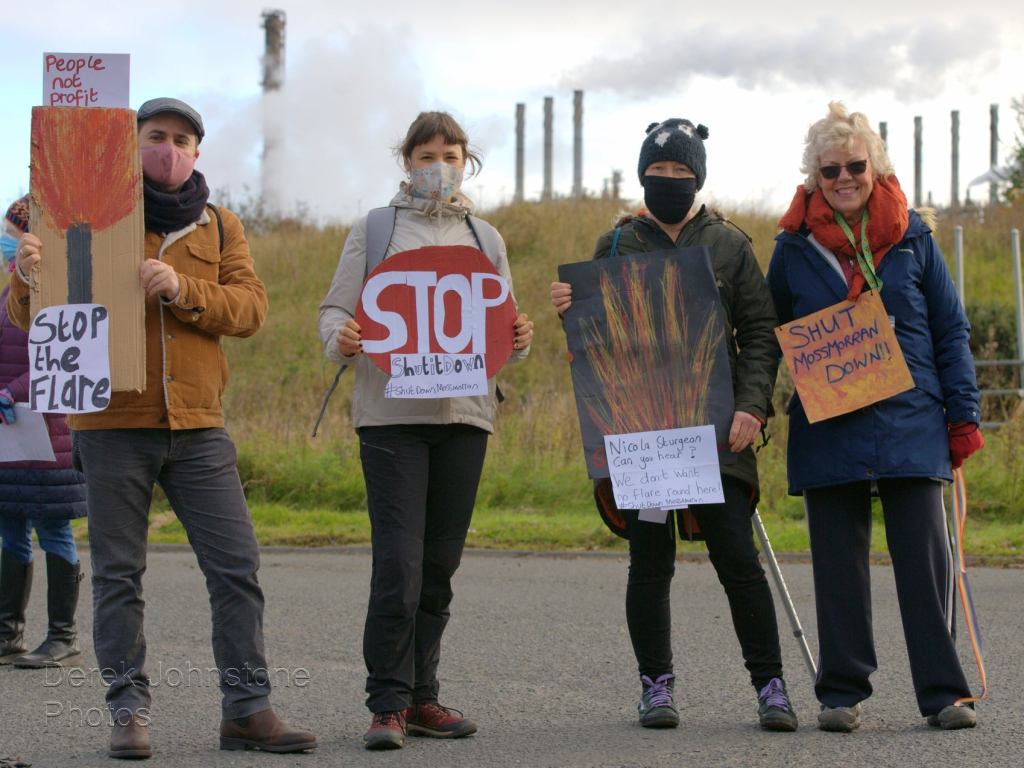
Following another intense period of flaring from the Exxon gas plant at Mossmorran we interviewed Linda Holt and James Glen from the Mossmorran Action Group who talked about the response from the communities living close to the plant and the wider significance of the campaign.

In Linda’s view ‘we’ve reached a watershed moment’ … ‘people have absolutely had enough – SEPA (the Scottish Environmental Protection Agency) were amazed at the number of complaints’ (more than 700).  She talks about the importance of the local demonstration at the plant on Saturday 17th October and the way in which views have shifted towards the necessity of closure.  In this context care for the livelihoods of the workers at the plant is critical.  Fife Council passed a motion about 15 months ago calling for an independent inquiry and for the start of work on just transition – this urgently needs to start happening.  However, the campaign still needs to win the support of the Scottish government who currently avoid any serious response by hiding behind SEPA.

Video update

There were protests at the gas plant and at the Scottish Parliament on October 17th

Shut Down Mossmorran: Solidarity Rally

Climate Camp Scotland have been doing great work campaigning around Mossmorran and supporting the Mossmorran Action Group. This is their appeal for solidarity action on Saturday 17th October, 11am at the Scottish Parliament:

Just two weeks ago, residents near the Mossmorran Plant run by Shell and Exxon suffered under the worst flaring so far. Residents have been complaining about flares, smell and air pollution for years, without anyone recognising the injustices done to their community. Enough is enough – this Saturday at 11am, locals will protest at the secondary gate at Mossmorran. Due to the current COVID-19 restrictions, we are unable to travel to Fife in support of local residents – but we will hold a solidarity rally at the Scottish Parliament to hold politicians to account over their failure to protect communities against Shell and Exxon’s environmental crimes.Shell and Exxon are the second worst polluter in Scotland after INEOS, and need to be shut down, both for their contributions to climate change and for polluting local communities, impacting those worst off the most. Stand in Solidarity with the Mossmorran Action Group, and help us shut down Exxon and Shell.

If you live in Fife, please support the protest at the Mossmorran Facility. If you’re in Edinburgh, come to the Scottish Parliament. If you’re from elsewhere, take a picture with a placard and send it to us, or tweet it at the Scottish government.

We are in a critical phase of a second Covid-19-wave. So please

  • Wear a mask
  • Maintain 2m Distancing 
  • Sanitise your hands after the protest
  • Do not attend the protest if you’re feeling unwell or showing symptoms
  • Do not leave your area for attending a protest

New website for North Sea workers

Press Release – Tuesday October 13

Today a new oil and gas workers’ website prises open a window onto the North Sea, allowing a view of the Gannet platform.

Last week, under conditions of intense radio silence, Gannet operator Shell carried out a major down-man due to an outbreak of COVID-19 on board the oil & gas production facility.

In this period of deadly pandemic and necessary transition from fossil to renewable energy, silence is not an option for those who stand to lose most.

Now energy workers on the North Sea have a new meeting place where conversation can take place, news and views can be exchanged and the industry can come under scrutiny.

https://oilandgasworkers.org has been set up by Scot.E3 – campaigners for climate jobs and a “just transition”.  The offshore workforce is invited to come together in conversation about the enormous changes facing their industry, their lives and the future of their families and communities.

The website and conversation follows up on the ground breaking work of oil watchdog “Platform”. Their recently published report “Offshore” surveyed the views of 1383 North Sea workers on industry conditions and the energy transition. The report gained wide publicity in the media last month and marks the first time the voices of oil & gas workers have been heard in this period of intense crisis in the industry.

Contact: oilandgasworkers.org@gmail.com

Screenshot from http://www.oilandgasworkers.org

Closing Down Big Oil

Closing Down Big Oil was our contribution to the Edinburgh World Justice Festival 2020. At the event on 9th October there were contributions from Andy Georghiou, Brian Parkin and Neil Rothnie. In this post we’ve collated video, audio, Powerpoint slides and links which give a flavour of the discussion.

Andy talked about the local and global role of INEOS and the importance of petrochemicals in the debate on just transition.

Brian gave an overview of the rise of big oil, its dominance in the twentieth century and the necessity for its demise in the twenty first.

Neil brought the discussion back to the importance of the North Sea for the campaign for a just transition to a sustainable economy here in Scotland

Here are Andy’s slides as a Power Point presentation

In this audio file Neil addresses a question about the role of XR

And in this audio file Andy addresses a question on greenwashing and reflects on the overall discussion

Further reading:

September 2020 Oil and Gas Workers report – a review and links to the full report are on this blog – click here

The Sea Change report on North Sea transition and implications for employment

Some background to the Scottish National Investment Bank is here, while some questions and criticisms of how it is likely to be run can be found here and a recent article by George Kerevan is here.

Action on Mossmorran

The last few days have seen a recurrence of flaring at the Mossmorran gas plant in Fife. Fumes have drifted across the Forth forcing residents in North Edinburgh to close windows. More than 700 complaints have been submitted to the Scottish Environmental Protection Agency. Join the campaign calling for the stricter enforcement and protection for those living in the neighbourhood of the plant. In our view a plan for phased closure of the plant is needed as part of a just green transition. We republish here the video we held with speakers from the Mossmorran Action Group earlier this year.

Nuclear Power is not the answer

A response to Neil Mackay’s Big Read in the Herald from Stephen McMurray and Pete Cannell

The ‘Big Read’ in the Herald newspaper on Sunday 4th October was ‘The nuclear option – can atomic power save the human race from climate change?’.  In it, journalist Neil Mackay reviews a new book by US earth scientist James Lawrence Powell.  Powell argues that we are at a tipping point that will lead to runaway global temperature rises unless decisive action is taken to reduce greenhouse gas emissions to zero.  In this he is absolutely right.  However, he goes on to argue that achieving zero carbon by replacing fossil fuels with renewable energy technologies will take too long.  According to Mackay, Powell argues that achieving zero carbon in a decade by adopting renewables is just ‘infeasible’.  The only serious option is to produce all our energy needs by a massive expansion in the number of nuclear power plants.  Essentially, he says that we should use nuclear to buy time while renewable technologies are developed further.

Undoubtedly current energy needs could be met by nuclear.  But Powell himself concedes it would take at least 25 years for this level of capacity to be reached.  Indeed, construction timetables for nuclear power stations are notorious for length overruns.  

Powell is not alone in arguing for nuclear as the means to end the climate crisis.  However, in our view the nuclear strategy is profoundly mistaken.  

Nuclear power has always been entangled with nuclear weapons programmes.  The US ‘Atoms for Peace’ programme, launched at the height of the cold war promised a future of almost limitless energy. In truth the civilian reactors provided the raw material for a huge increase in the US nuclear arsenal.  By 1961 the US inventory of nuclear weapons was equivalent to 1,360,000 Hiroshima bombs.  In the US, the UK, Russia and elsewhere nuclear power has always been a necessary support for nuclear weapons.  In the UK context researchers at the University of Sussex Science Policy Research Unit have shown that the sole case for nuclear power is to subsidise nuclear weapons.  Electricity consumers are paying for the high cost of an industry that subsidises the military nuclear weapons programme.

Worldwide the number of operational nuclear plants is in long-term decline.  In part this is a response to Chernobyl and Fukushima, but it is also a result of the high cost of building new plants (not to mention the eyewatering sums needed for decommissioning plants at the end of their life).  Renewables are cheaper than nuclear power and the gap is growing year on year. 

Nuclear power is not zero carbon either.  Greenhouse gases are admitted at every stage of the lifespan of a nuclear power station.  The process of mining uranium and the process of milling and separating the uranium from the ore omits considerable carbon and is likely to be more energy intensive in the future. 

Powell has undoubtedly played an important role in arguing the case for rapid action in the face of the climate crisis.  He is a fine scientist.  However, in making the case for nuclear he employs inaccurate data and even worse judgement.  

He notes that in Sweden GDP and carbon emissions rose in lockstep until Sweden increase nuclear power generation at which point GDP started to grow faster than emissions.  We are meant to understand here that GDP is equivalent to wealth and that with nuclear we can have GDP growth and low emissions.  This is an argument that appeals to big business – it should be less appealing to the 99% for whom GDP growth in recent decades has gone along with increasing inequality.  

He dismisses renewables as being immature and not ready yet.  But serious studies around the world, including those by Commonweal in Scotland and the Centre for Alternative Technology in Wales, have shown that existing renewable technologies can achieve zero carbon.  The technologies that are not ready are those like Carbon Capture and Storage which are advocated by those who want to tackle the climate crisis while not making the radical changes in the economic system that a genuinely sustainable economy requires.

Inexcusably Powell plays down the issue of nuclear safety and Mackay repeats his figures without questioning them.  ‘Manual for Survival – A Chernobyl Guide to the Future’ by Kate Brown ought to be compulsory reading for anyone writing on this topic.  In a scrupulous forensic investigation, she uncovers the decades long efforts by the old Soviet Union and then the US to cover up the real impact of Chernobyl.  Rather than Powell’s 4 – 16 thousand deaths the true figure is most likely in the range 35 – 150,000.  And it remains the case that long-term safe storage of the radioactive by-products of nuclear power remains unsolved.

You might also like to read Not an Atom of Truth, which we published in June 2020

Obituary: Mike Cooley, architect and bee

Mike Cooley, engineer activist, socialist and technical visionary, died aged 86 on 4 September. Mike, once the elected president of trade DATA  the Draughtsmen and Allied Technicians Association, was a dogged fighter for union democracy and the maximum possible degree of union member participation. Here Brian Parkin, Scot.E3 activist, pays tribute to an inspiring trade union ‘leader’ who combined modesty with an urgent sense of the need to overcome worker alienation and redirect production to meeting the requirements of humanity. This article was first posted on the rs21 website.

Mike Cooley

I first met Mike Cooley at a union young members school in 1968. At that time the world was alight with the prospect for revolutionary change: Vietnam, insurrectionary struggles in France, the women’s movement, Stonewall, the Black Power Olympics, the North of Ireland civil rights movement and increasingly politicised strikes here in Britain – and here, in a posh and stuffy hotel in central London, a quietly spoken, impeccably polite Irish lay union official in a crumpled suit and tie addressed a room full of young workers on why all of these world events were linked to our world of work and the alienated nature of our employment.

Mike was a union official – but unlike most of the others he was an elected workplace rep. He worked as a senior development engineer at Lucas Aerospace. Once a member of the British Communist Party, he had resigned over the increasingly undemocratic, respectable and parliamentary shell that that organisation had become. But he was not in the least inclined to join what he saw as a largely student-based Trotskyist revolutionary left; rather, as he was influenced by ‘Third World’ national liberation struggles, he became a founding member of the Maoist Communist Party of Great Britain (Marxism-Leninism).

Instantly this put him at odds with the official Communist Party, who had long coveted the control of what they rightly saw as an increasingly militant white-collar union. This was partly because Cooley was instinctively a genuine advocate of union democracy, but also because he was openly prepared to work alongside other revolutionary activists (mainly the International Socialists).

The bigger picture

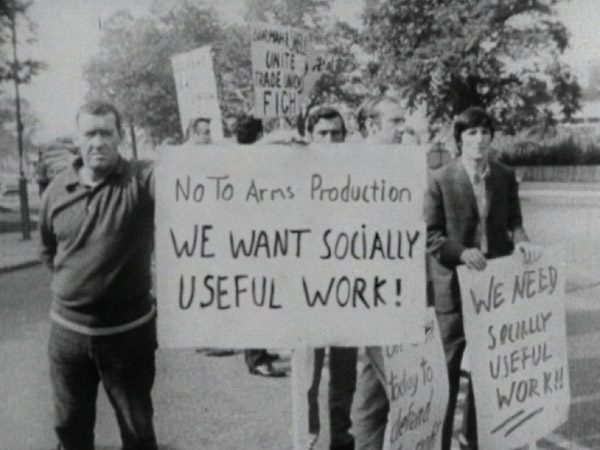
Like many workers in electronic engineering in the early 1970’s, Mike Cooley and his fellow workers found themselves increasingly working in what was an extensive web of ‘defence’ manufacturing. And also, with the early stages of digital engineering processes, they were facing a growing wave of job losses. In anticipation of this threat, Mike, as convenor of the national shop stewards committee at Lucas Aerospace drew up a plan to redirect arms-dedicated design and production to peaceful ends. The ‘Lucas Plan’ grew outwards with the intention of embracing workers in other companies and industries.

At this time, I was a young union rep in a workplace that was to some extent involved in the chain of arms production – but as a member of the Socialist Workers Party, I was strongly dissuaded from getting involved in Lucas Plan activities, which my industrial organiser dismissed as ‘utopian’. Nonetheless, despite my otherwise impeccable commitment to revolutionary discipline, I remained part of the Lucas Plan network. Then in 1980, Mike Cooley wrote his first book, Architect or Bee?: the Human  Price of Technology.In the book’s introduction he wrote the words that inaugurated the opening of a Lucas Plan conference: ‘We have, for example, control systems that can guide a missile to another continent with extraordinary accuracy, yet blind and disabled people stagger around our cities in much the same way as they did in medieval times.’

But realising that humanity and vision needed to be united the means of transforming dreams into reality, he rapidly set about establishing a network by which the ingenuity of workers – in conjunction with community groups and radical scientists – could identify essential needs and harness productive technology to meet them. Hence designs and prototypes for portable dialysis machines and heart resuscitation equipment small enough for paramedics to use at the point of emergency need.

Recognition

Despite the indifference of the union bureaucracy (as well as the Labour government of the late 1970s) to the Lucas Plan – mainly because it was a rank-and-file initiative – Mike pressed on, and in 1981 he was asked to form a social enterprise board for the Greater London Council for the purpose of setting up worker co-operatives aimed at harnessing new technologies for the purpose of training up a new generation of technology enthusiasts – often alienated young people who had received little formal education – dedicated to the application of science to human need.

Throughout his working life, he remained a Marxist, dedicated to challenging and overthrowing the lot of most workers as alienated and degraded labour. He had an infinite faith in the creative capacities of humankind, taking inspiration from wonders of the past such as the huge medieval cathedrals that were in large part the products of worker genius, designed and realised by proto-guilds that would one day become proto-unions.

Questions

Within his union, Mike often found himself on the wrong side of an opportunist and undemocratic bureaucracy when it came to awkward questions, not least on the thorny ‘Irish Question’. Born in County Galway, he was a lifelong admirer of James Connolly – a Scottish-born revolutionary who championed the cause of a united and independent Ireland. Fully aware of how the politics of all of this would rankle with the mainly Orange union membership at the massive Shorts Harland and Wolff yards in Belfast, Mike would calmly – often while under quite abusive attack – explain how all workers could never benefit from the British imperialist project that was a Northern Ireland of six counties divorced from the Republic. And this was always done without making one ounce of concession to the Catholic church – which he would then go on to condemn for its denial of abortion and contraception rights.

Also in 1972, at the time of the Upper Clyde Shipbuilders yards’ occupation, when both the TUC and the Communist Party called for nationalisation as a panacea, Mike stood up at our union conference and posed another option. Quoting (again) James Connolly, he warned: ‘The police are nationalised, the army are nationalised- and even the hangman is nationalised. And none of them are socialist.’ He was speaking in support of the amendment that the yards should be nationalised ‘under workers’ control.’

The man

I last met Mike at a university conference in 2007. I approached him with some timidity but needlessly so, as he instantly recognised me. As ever he was warm and smiling, and with incredible precision he recalled both the good and the not-so-good times in the union. But what I noticed about him was a total absence of bitterness or rancour – which made me recall that in all those years I had known him, he had never raised his voice nor sworn at anyone in even the most bitter of disputes. And as ever, he was both optimistic and enthusiastic for our collective future.

Later, in his 2018 swan-song ode to humanity Delinquent genius: The Strange Affair of Man and his Technology, he disputed as inevitable the further de-skilling of labour, writing: ‘I disagree. The script for this finale can still be written.’ In reference to the book’s title, and in line with his own lifelong commitment to women’s liberation, he added: ‘And I do mean “man” and not humanity for it is a relationship from which women have been largely excluded – and this to disastrous effect.’

Mike Cooley, engineer, socialist and dreamer, born 23 March 1934; died 4 September 2020