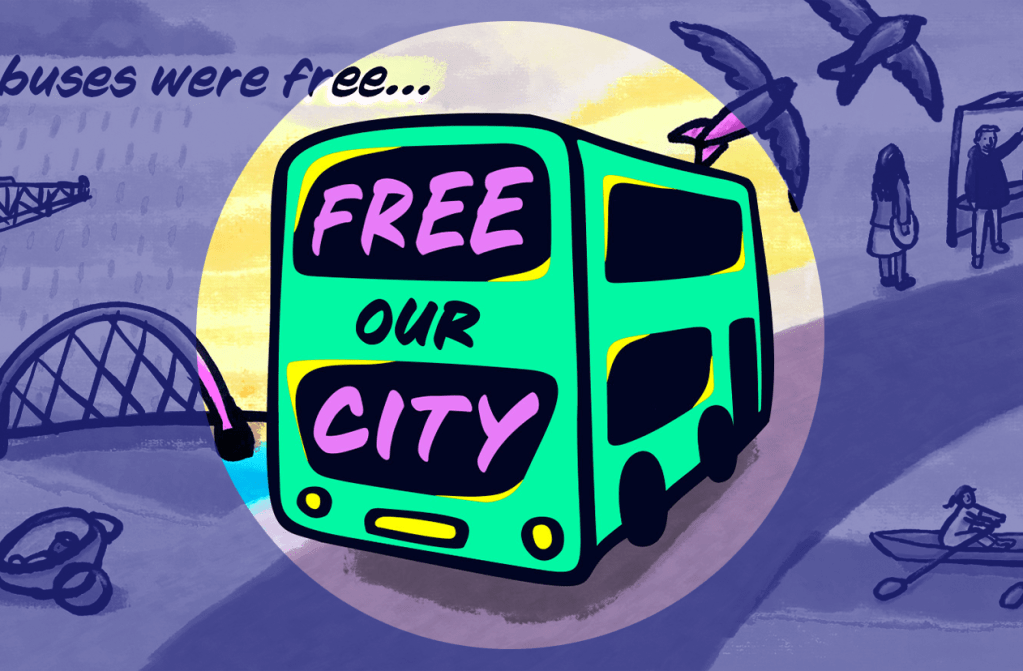
Scot.E3 is a sponsor and supporter of Free Our City – the campaign for free public transport in Glasgow. This is the campaign’s response to a consultation by Glasgow City Council.
Dear Sustainable Glasgow team,
Please accept this as Free Our City’s response to your consultation on the Climate Emergency Implementation Plan.
Founded in September 2020, Free Our City is a new coalition of community organisations, local trade unions and environmental groups, campaigning for a world class, fully-integrated public transport network which is free and the point of use.
Free public transport is already in place in hundreds of forward-thinking towns and cities across the world from Tallinn in Estonia, Calais in France and Kansas City in the US – where this policy is rightly seen as the only realistic way of addressing persistent poverty and inequalities and tackling the climate emergency with the urgency that we need.
The Free Our City coalition’s aim is to bring these brilliant examples from around the world to Glasgow, to raise our city’s ambitions (please read our manifesto attached). We were inspired by the Recommendations of the Climate Emergency Working Group (CEWG), which were approved by Glasgow City Council on 26 September 2019. These included the commitment to:
“engage with interested local authorities and other stakeholders and undertake a formal assessment of the potential for making the transition to a public transport system that is free to use” (Recommendation 20)
As well as the commitments to investigate the new powers available in the Transport (Scotland) Act 2019 – for re-regulating buses using ‘franchising’ and for greater public ownership – as the most efficient and affordable way to deliver a fully-integrated public transport network, with the potential to become fare-free (Recommendations 17 and 19).
Responding to the launch of Free Our City in September 2020, a spokesperson for Glasgow City Council acknowledged that without utilising these new powers, free public transport would not be “viable”. They said:
“At the very least, it would require public ownership – the alternative being taxpayers write a blank cheque for private operators, with little say in the service.” Quoted in The Herald, 6 September 2020
Further to this, on 29 October 2020, Glasgow City Council approved a motion “welcoming” the Free Our City campaign (see full text below). We therefore fully-expected the CEWG’s Recommendations on public transport to be at the heart of the “major transformative action” proposed by the Council’s Climate Emergency Implementation Plan (CEIP).
Unfortunately, the CEIP’s proposed actions on transport lack any ambition. Instead of the CEWG’s Recommendations to fully-utilise the new powers available in the Transport (Scotland) Act 2019, the CEIP has opted to ‘explore these issues’ through:
“ongoing work on Bus Service Improvement Partnerships, as required by the Transport (Scotland) Act 2019 and Transport Scotland funding programmes.” (p.60)
Firstly, it is untrue that Bus Service Improvement Partnerships (BSIPs) are “required” by the Transport Act: BSIPs are just one of several options now available to local authorities, and they are the one least likely to deliver the changes we need. Despite the excellent Recommendations of the CEWG, and previous commitments made in the Council’s Strategic Plan (Priority 57), the Council appears to be actively choosing the option to “write a blank cheque for private operators, with little say in the service”.
Nowhere in the CEIP is there any indication of the need to regulate and reduce bus fares, when it is obvious that this is what is necessary to “tackle persistent issues of poverty and deprivation in the city” (p.12) and build a “just and more equal city” (p.7), and to encourage those accustomed to driving to give up their cars. Fare reductions on the scale that we need are just not possible through the ‘partnership’ model, as private operators will never voluntarily agree to anything that threatens their shareholders’ profit.
Why should Glasgow’s poorest people be faced with single bus fares of £2.50 on privatised First Glasgow, when fares in Edinburgh are only £1.80 on publicly-owned Lothian Buses, and fares in London are only £1.50 on buses regulated by Transport for London? And when people in Kansas City, Tallinn, Calais, Dunkirk and many other places can travel around their local areas for free?
We fundamentally reject the CEIP’s proposed actions on transport. Instead we demand that the Council works with SPT to deliver the following actions that are the our route map to the free public transport that we need:
Re-regulate the region’s buses using new ‘franchising’ powers – plan the network properly to reach isolated communities and to integrate seamlessly with other transport modes (trains and Subway). Impose an immediate cap on fares.
Set-up a new publicly-owned bus company for Greater Glasgow and start taking over routes one-by-one, or buy-out First Glasgow.
Once costs have been brought under control, we can begin to roll out free fares for all (we currently give more than £300 million in public subsidies to private bus companies annually in Scotland and deregulation and privatisation is a really inefficient way of using this).
Unless the Council actually commits to the “major transformative action” necessary to sort out our incoherent and overpriced public transport network – learning from the best examples from towns and cities around the world – then the ambition to become “one of the most sustainable cities in Europe” (p.6) is just laughable.
We look forward to hearing the outcomes of the consultation and to seeing the Council act to deliver a public transport network which works in the interests of our city’s people and our environment.
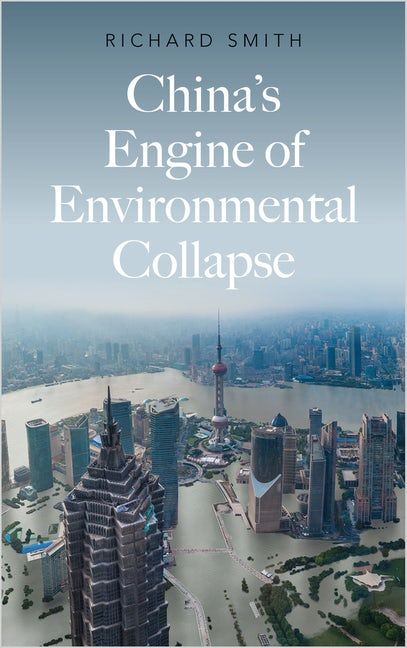
Two recent posts on the People and Nature blog take a look at China’s plans for post Covid recovery and at the new book by US activist Richard Smith – ‘China’s Engine of Environmental Collapse’. The first post picks up on work from Carbon Brief who analyse China’s plans for reviving the economy. Just as after the 2008 crash the emphasis is on high carbon energy and infrastructure project that will put three times as much cash into fossil fuel projects as into renewable energy. These plans are completely incompatible with Xi Jinping’s aims for climate neutrality by 2060. Smith’s book provides the context and shows how China’s role as workshop for the world has resulted in extreme environmental degradation – severely impacting on the health and welfare of the population.
In this post Scot.E3 activist Ann Morgan shares the letter she has written to Fiona Hyslop, Cabinet Secretary for Economy, Fair work and Culture. Add your voices to Ann’s.
Loch Lomond by Pete Cannell CC0
Dear Fiona Hyslop,
I have lived in West Dunbartonshire mostly all my life (I am now retired and live in Govan) and retain links with family, friends and community organisations. I have followed and participated in the Save Loch Lomond campaign. The campaign currently highlights the possibility of a planning application by Lomond Banks, subsidiary of Flamingo Land and the extension of the exclusivity agreement, effectively excluding alternative community led proposals for the site and for job creation.
I wish to comment both on the ecological impact on the site and provide examples of sustainable climate jobs.
I do so as a participant in SCOT.E3 (Employment, Energy, Environment) and as a member of Unite the Union (retired members). I am active in a number of local community projects including food -growing and provision and I am keen to share the successes of initiatives with other communities, including the Leamy Foundation /Growing West Dunbartonshire Project. I am not commenting on behalf of these agencies but draw on my research and activism within them to outline objections and alternatives to the proposed developments at the lochside.
The Scottish Government declared a Climate Emergency in April 2019. Emissions reductions targets include reductions of 70% by 2030. This declaration must be followed by action.
Allan McQuade of Scottish Enterprise, in reference to the proposal, talks of sustainability and syas that the fight against climate change as ‘central to everything we do.’
Action must be two-fold, Protective and proactive.
Protection around biodiversity is of paramount importance. The State of Nature Report (a collaboration between conservation and research organisations) reported in 2019.The report contains the best available data on Scotland’s biodiversity. Key findings show 49% of species have decreases in abundance with 11% threatened with extinction. The First Minister in response states that Scotland must lead the way in facing the challenges to biodiversity.
With the above in mind, I request that the cabinet minister considers the impact on biodiversity on the National Park environment. Specifically, on the impact on Drumkinnin Woods within the West Riverside site. This is erroneously referred to as a Brownfield Site. It is part of the National Park. The stated aim of the designated Loch Lomond and the Trossachs National Park is to conserve and enhance the natural and cultural heritage of the area.
The proposed development is at odds with the Scottish Government and National Park aims. The ecological impact would
Endanger wildlife-insects, birds, trees and water species. Woodlands and rivers are especially vulnerable.
The impacts arise from noise, light, traffic emissions and increased pollution.
The above are exacerbated when there is a high concentration of visitors in the one area. Sustainable Tourism encourages movement, public transport use with rover tickets and electric people carrier hire. Single car use and enabling by large car parking space must be disincentivised.
The FM also describes in the annual Programme for Government that it is a key aim of the Scottish Government to empower communities. The retention of the exclusivity agreement contradicts this aim. Under the Nature Conservation (Scotland)Act 2004 public bodies in Scotland have a duty to further conservation in biodiversity.
My involvement with Scot.E3 has given me insight into the potential for Climate Jobs (see 1 million Jobs pamphlet). Specific to Scotland a just transition could include advancing regional specific renewables energy, district heating and a programme of retro fitting and new build housing and public building with apprenticeship skills in insulation, joinery, roofing, glazing and heating, linking with schools and further education. My perspective, shared with environmental groups, is that this type of job creation is both more sustainable and career focused than many jobs in the hospitality sector, often minimum waged or even zero hours contracts and seasonal. That said, there are ways to encourage sustainable and responsible tourism with quality training for those seeking careers in the tourism. It is of concern that the original proposal carried none of these assurances. Any development with employment opportunities must adhere to the principles outlined in the Fair Work Convention.
Finally, the experience of the pandemic has greatly impacted on local and global tourism. There are scientists, ecologists, biologists, economists and epidemiologists (David Attenborough included) who are warning of future pandemics, with potential of more virulent strains. The current variant is concerning with increased contagion /transmission.
Rob Wallace, evolutionary biologist, charts the link between habitat destruction, biodiversity loss and the increase in zoonotic transmission of infection. Again, this points to the important of biodiversity protection. Tourism is of course both impacted by and causal in transmission. Therefore, a rethink on safety in travel and transit will be required for tourist dependent development. Linked with emission reduction this presents as an opportunity to put environmental protection as Allan McQuade asserts, central in Scottish Enterprise approval.
The fragility of tourism as well as its importance to the Scottish Economy is recognised. Within this perspective, social justice with environmental integrity is required.
Ex North Sea oil worker Neil Rothnie asks why the Scottish Government’s updated climate plan is so quiet on North Sea oil and gas. This piece was published as a letter in the Herald newspaper on 30th December 2020
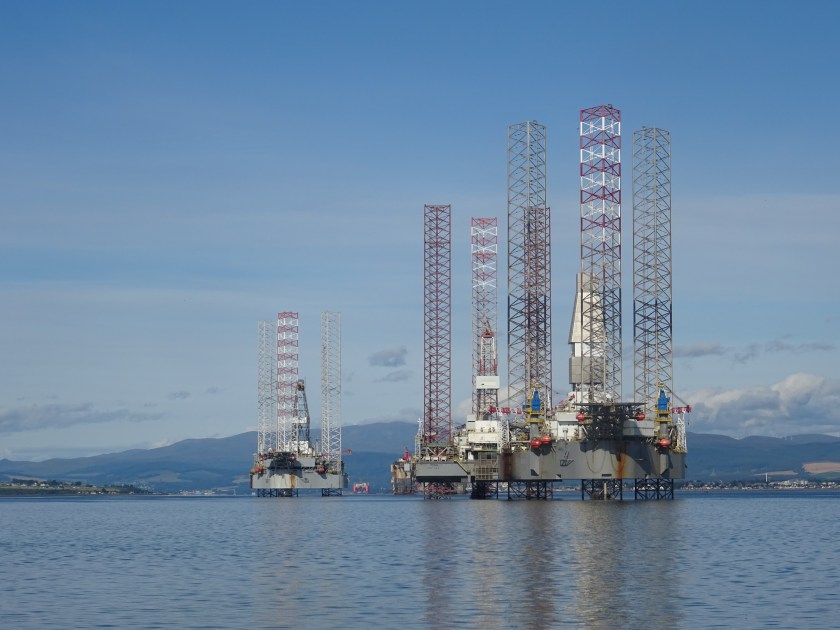
Image – Dornoch Firth, Pete Cannell CC0
SCOTTISH Climate Change Secretary Roseanna Cunningham, has been giving her opinion on the Government’s updated Climate Change Plan. But nowhere in her Herald on Sunday article (“‘COP26 is a chance for us all to play our part in debate’”, December 20), or even in the plan itself, do we get a glimpse of the reality of climate change.
Climate change is increasingly experienced by people across the globe as extreme weather events that are already destroying lives. It’s experienced by the natural world as rising temperatures, the melting of ice and the destruction of habitats and the threat of species extinctions.
There’s no sense of this in the report. The term “climate change” is scattered throughout it like punctuation marks, and carries about as much meaning as a comma.
There is scientific consensus about climate change. It’s caused by burning fossil fuels which give rise to greenhouse gases (carbon emissions) that cause the atmosphere to heat, and progressively destabilise global climates.
The oil industry, and the North Sea where 75 per cent of the UK’s carbon emissions originate, have been “disappeared” from the Government’s plan. It’s one area where the UK and Scottish governments are completely in step. Their plan for the North Sea is “Maximising Economic Recovery”. And if that isn’t clear enough, just think, “business as usual”.
Maybe you thought that a climate change plan might concentrate on how we might replace fossil fuel production with renewable energy production in a planned way, that protects the workers, their families and communities by helping them transition to work in a sustainable industry.
But no. Oil and gas must stay, and stay in the hands of the giant corporations, and suffer the vagaries of a basket case of an oil market that gives us periodic price collapses and catapults thousands of workers onto the dole. Twelve thousand have gone so far this time. Another 18,000 or so expected to go soon.
Now it seems, our new future best friends are to be “hydrogen” and “carbon capture”. We’re to continue sucking the hydrocarbons from under the North Sea, then spend a fortune taking the carbon out, leaving hydrogen. Then we’ll pump the carbon back under the North Sea. Is this feasible at scale? Globally?
A third of North Sea gas comes ashore at St Fergus where by 2024 we “could” be able to remove 340,000 tons of carbon dioxide a year – a measly one 800th of the 280 million tons of greenhouse gasses that were produced by burning North Sea oil and gas last year.
Is Ms Cunningham going to be standing alongside UK Minister Alok Sharma to welcome the COP26 circus to Glasgow this coming year? If so, what leadership is she going to be showing Saudi, Russian, US and Nigerian delegates? Should they follow our lead and maximise economic recovery of their own oil and gas resources? And hope to decarbonise it and pump the carbon back underground?
The updated Climate Change Plan does not look like the Government has the measure of carbon emissions or the oil and gas industry. They all need public scrutiny.
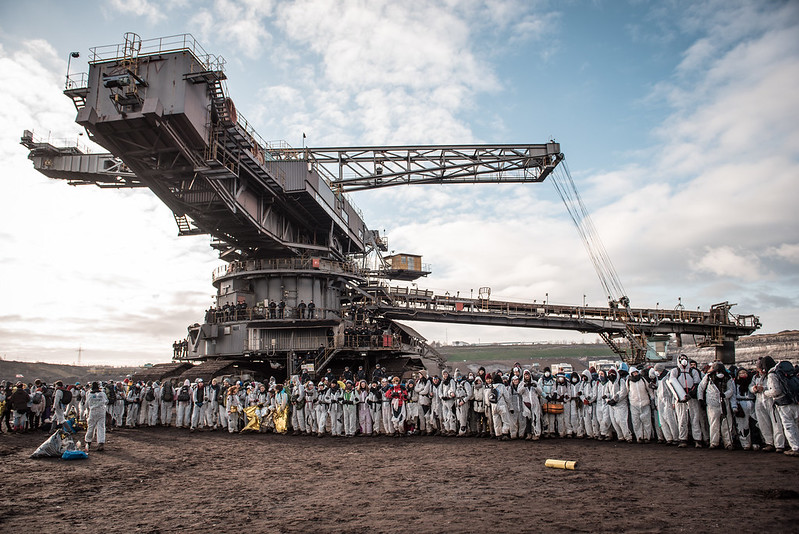
Ende Gelände activists targeting a coal mine in 2019. Photo: Tim Wagner/Flickr
Harry Holmes reviews Andreas Malm’s ‘How to Blow Up a Pipeline’. Harry argues that the book gives a balanced assessment of the conditions which make sabotage, vandalism, and other forms of strategic direct action necessary in a warming world. This review was first published by Bright Green and has also been reposted on the rs21 website. Malm’s book is designed to provoke debate on strategy and tactics and we would welcome further contributions on these issues.
How to Blow Up a Pipeline starts with what will be a familiar image for many. It’s the yearly climate negotiations, activists have streamed towards the conference space, pleading with representatives to ratchet up their ambition to tackle the climate crisis. People block city traffic with banners, with activists dancing and playing music in the reclaimed streets. The next day brings a giant public theatre performance, with environmentalists pretending to be animals run over by cars whilst ‘negotiators’ walk around with signs saying ‘blah blah blah’.
Was this a collection of Extinction Rebellion activists performing and blocking traffic? Was it even earlier, in 2015 at the Paris negotiations? Maybe it’s 2009, during the economic crisis and the Copenhagen conference? No, this image comes all the way from COP1, the climate conference that started it all – in the lost world that was 1995.
Speaking straight from his experiences of this first COP, Andreas Malm’s recollection of these early climate protests indicates a wider malaise – a certain sluggishness of environmental strategy. Despite the growth in awareness around the climate crisis and the rapid increase in the number of people organising for environmental justice, there has been limited change in the actions climate groups are willing to take to defend life.
In How to Blow Up a Pipeline, Malm has written a short and gripping manifesto which aims to wrench the climate movement out of its complacency. By convincingly arguing against movements’ dogmatic attachment to milquetoast non-violence, Malm makes clear that as the climate crisis escalates so too must the tactics of those seeking to defend life. Not content with simply dispelling the misguided understandings of pacifism environmentalists hold, How to Blow Up a Pipeline gives a balanced assessment of the conditions which make sabotage, vandalism, and other forms of strategic direct action necessary in a warming world. Coming out of the pandemic, with movements regrouping and attempting to navigate the mess that is the 2020s, this book is the shock to the system the world needs.
Beginning with the pacifism many climate movements advocate, a significant portion of this book is dedicated to dispelling the often ahistorical, whitewashed, and faulty justifications given for non-violence. To do this, Malm separates these arguments for non-violence into two forms; a moral pacifism focused on the wrongness of violence from an ethical perspective and a strategic pacifism centred on the advantages to environmental movements from committing to non-violence.
Learning to defend ourselves
It becomes clear that Malm has little time for the first form of pacifism. He turns to the case of Mohammad Rafiq, a 65 year old who stopped a right-wing terrorist attack on an Oslo mosque in 2019. As the gunman entered the building, the pensioner ran at him, tackling the would-be shooter to the ground where, with the help from other nearby men, they disarmed and beat the attacker. Malm points out that such self-defensive actions and any similar attempts to defend from far-right violence are unacceptable from the perspective of moral pacifism. With the struggle against the climate crisis being understood as a similarly defensive movement, focused on protecting life, Malm argues moral pacifism should hold little sway as a dogma. It risks being too rigid in the face of the escalating need to act in life’s defence.
Environmentalists’ deluded reading of the history of social change is not confined to past lifetimes either. Malm points out how groups like XR continue to invoke recent events, like the Poll Tax Rebellion of the early 1990s, as inspiration for non-violent ‘civil disobedience’, despite the Poll Tax famously being scrapped as riots rolled through London. Such a reading of history is not only one sided, but an act of positive erasure – an erasure which works to the detriment of the environmental movement’s strategic horizon.
Finding the radical flank
Looking at each of these past movements, Malm doesn’t reject the importance of the non-violent element. In fact, he suggests the opposite, the existence of a radical flank willing to commit acts of violence combined with a growing mass of non-violent organisers made change possible. Non-violence allows movements to grow larger quickly, it can secure sympathetic coverage in the public eye, and it can prevent government escalation. Because of this, non-violence always has a role.
Of course, no history of environmental movements would be complete without an assessment of the violent direct action of groups like Earth First! and similar Liberation Fronts in the 1980s to 2000s, who were responsible for the destruction of many a logging site. Malm suggests that their ultimate collapse was, at least in part, due to the lack of a wider mass movement where they could position as the radical flank. Malm’s polemical insight is that mass non-violence is the necessary condition for the impactful escalation to violent tactics and today, with climate strikes and Extinction Rebellions aplenty, we are not short of mass non-violent movements.
In short, it is not either/or but both, together in an escalating cycle. Malm argues the current environmental movement’s failure to accept the potential co-existence of both violence and non-violence reflects the wider collapse in revolutionary politics since the 1980s. In response to this collapse:
We have to learn how to fight all over again, in what might be the most unpropitious moment so far in the history of human habitation on this planet.
To begin these wide-ranging strategic conversations about fighting the climate crisis, Malm suggests focusing on two general goals – there is a need to announce and enforce a growing prohibition on new emitting devices, as well as rapidly reducing the lifetime of the polluting infrastructure and devices which already operate. The question, when bringing these general ideas down to Earth, is how precisely the environmental movement may go about this?
Building on Henry Shue’s distinction between luxury and subsistence emissions, Malm points to the increasingly violent role of luxury emissions, and the urgent need to focus efforts on these devices, whether SUVs or planes. There are several clear arguments given for focusing action on luxury devices, these are worth listing in full, albeit paraphrased:
As the effects of climate change are here, the harm from these luxury devices should be understood as immediate.
Luxury emitting devices like planes and cars allow the super-rich to also be hypermobile and escape the effects of climate change.
The ideological role of these devices is the championing of destructive lifestyles.
There is an ethical cost of how the money could have been better spent mitigating and adapting society to climate change.
In any reduction of emissions, it is better to reduce luxury emissions first rather than those necessary to secure subsistence.
Finally, and perhaps most crucially for Malm’s argument, there is the supremely demoralising role that these devices play. After all, if we cannot even get rid of SUV’s how are we meant to move towards a sustainable society?
Recognising this, Malm points to the need for violence to not just include the strategies of sabotage preventing new fossil fuel infrastructure from being built. It should also encompass the ways in which sabotage ‘can be done softly, even gingerly.’ Pointing to the mass movement in Sweden which deflated the wheels of SUVs during the night, Malm argues environmentalists should be comfortable engaging in extensive acts of vandalism targeting the luxury devices common in the Global North. Such violence would show how the ‘rich cannot have the right to combust others to death’, as well as preventing new emissions.
Unleashing new tactics
In opening up the horizon beyond non-violence, Malm invokes a further difficulty – precisely under what conditions does violence become necessary? What form might violence take? How to Blow Up a Pipeline makes clear that violence constitutes attacks on property, coming under the messy monikers like sabotage, vandalism, and demolition. This book is unequivocal that this does not extend to people or animals, nor property which is necessary for their subsistence. This still leaves much on the table, but Malm’s book should be read as a defence of destruction to property in a similar school as that of Osterweil’s In Defence of Looting.
Malm invokes scholars of direct action like William Smith, whose research points to important conditions which should be met for the successful escalation from non-violence. For Smith, escalation succeeds only if action would stop something which would likely cause harm, where mellower non-violent tactics have been exhausted, and where action is based on some wider ideal or charter, such as the Paris Agreement. Malm makes clear his view that these conditions are largely met for most fossil fuel infrastructure.
There are still several objections to escalation which could be posed. One is that governments have supremacy when it comes to repression and violence. As a result, escalation from the environmental movement could result in extreme crackdowns from states across the world. Malm accepts this asymmetry in power, in fact he suggests that it extends far beyond the ability of the state to commit violence. However, Malm points out that there is no law that this asymmetry ‘can never be overturned from below.’ Fighting climate change is a David vs Goliath fight in every sphere, whether economic, social, or militaristic. If we accept asymmetry as an argument against moving beyond non-violence, it would also mean abandoning nearly every climate struggle.
So Malm turns to the crucial argument many make for non-violence, that of popular support. The old story goes that abandoning non-violence leads to declining public opinion and a collapsing movement replete with infighting. Violent acts would be a ‘negative radical flank’, cutting into the wider non-violent movement. On the first issue of public opinion, Malm argues the role of social movements is not to take ‘an existing level of consciousness as a given, but rather to stretch it.’ Violence needs to stretch and drag society forward. This means that violent actions should be clearly explainable and acceptable in their wider context, with Malm suggesting perhaps the best strategy is to lie in wait for the next extreme weather event to strike at luxury emissions. With regards to the collapsing movement, Malm argues that the radical flank must simultaneously be prepared to be disowned by the wider movement, whilst also being receptive enough that in the case of either escalating repression or public backlash it can call off its actions.
The New Climate Laboratories
With regards to this last point, how are these contradictory characteristics to be satisfied? Being able to balance the tightrope of competing arguments for and against escalation is not something that Malm can answer in around 150 pages. In such a short work, one is left desiring the detail, the roadmap, where in practice the neat lines Malm draws can be observed. These will never appear, as only practice and thought together can bring this flourishing. What How to Blow Up a Pipeline does is effectively indicate strategic considerations and reflections which must be borne out in the practices of climate movements. There is no perfect tactic, no silver bullet, only a magazine of possible actions which environmentalists need to constantly assess as the crisis gets worse.
Malm puts his faith most of all in the climate camp movements like Ende Gelände and Reclaim the Power, where activists come together in mass numbers to shut down fossil fuel infrastructure. These camps can be built easily, allowing the movement to spread horizontally whilst also being planned well in advance. As the number of attendees rises, so too does the capacity to outmanoeuvre police and disrupt fossil fuel infrastructure. Malm invokes these spaces as the ‘unrivalled laboratory for learning this fight.’ If environmentalists are to develop the strategic acumen to pull the breaks on emissions, then what is need is a proliferation of these camps and any other equivalent ‘laboratories’ – we need spaces where climate activists can come together to learn and act with a sense of militancy. In the 2020s, Malm’s book points to the need to let a thousand laboratories bloom.
The final pages of How to Blow Up a Pipeline reflect on the opposite tendency to such escalating militancy – a climate fatalism which presents breakdown as inevitable. Many writers are encouraging society to ‘learn how to die’ and bring a deep pessimism about our capacity to change course. Whether in the work of Franzen, Scranton, or others, Malm rejects their pessimistic understandings of society’s future as that of a particular class interest. It is comforting for the rich of the Global North, unable to accept their need to change production and consumption, to ‘project this weakness of the flesh onto society’ and doom it to climate collapse. What is harder is internalizing the continued need for resistance.
With every part per million counting, with every stopped pipeline saving lives, and with every minute counting, the truth is the opposite of what the climate fatalists suggest. Looking to those who died in the Warsaw Ghetto uprising or who resisted within the extermination camps, Malm invokes the continued gesture of struggle against all odds. As Malm puts it:
Precisely the hopelessness of the situation constituted the nobility of this resistance. The rebels affirmed life so extraordinarily robustly because death was certain and still they fought on. It can never, ever be too late for that gesture. If it is too late for resistance to be waged within a calculus of immediate utility, the time has come for it to vindicate the fundamental values of life, even if it only means crying out to the heavens.
One hopes, like Malm, that it does not come to this, that we come to tackle the climate crisis with the ambition it needs before such hopeless struggle is necessary. What How to Blow Up a Pipeline does is act as a rallying cry for a climate movement far too comfortable in its ways, at a time where bold action is more than overdue.
How to blow up a pipeline is published by Verso at the beginning of January 2021 – we will have a small number of copies available for £10 (including UK postage). To enquire or order use the contact form.
Just over a month ago we welcomed the establishment of the Zero Covid campaign. Throughout 2020 we’ve published posts looking at the challenge of organising for a just and sustainable transition at a moment when we face continuing threat from Covid 19, the likelihood of more pandemics in the future.
With the permission of the author, Christian Zeller, we are pleased to republish an article that looks at the need to apply the principles that inform the Zero Covid campaign internationally. It originally appeared in German and has been kindly translated by the author with further editing by Terry Conway.
On 19 December, scientists launched an international appeal for thecontainment of the Covd-19 pandemic throughout Europe.[1]Trade unions,liberation movements and socialist organisations should unreservedly support this call and enrich it with a socio-ecological programme of demands. On this basis and inspired by the campaign #ZeroCovid recently launched in England, Wales, and Scotland they should launch mass campaigns throughout Europe.
The authors of the appeal note that European governments have so far failed to formulate a common vision for dealing with the pandemic. However, in order to fight the pandemic effectively, a common European strategy is urgently needed. This is the only way to keep the borders open. The vaccines will take some time to get the pandemic under control, probably not before the end of 2021. The authors formulate a clear and immediate societal goal: every single SARS-CoV-2 infection in Europe must be traceable. To achieve this goal, the authors call for the implementation of a three-step strategy.
1. Firstly, reduce infections to a maximum of 10 Covid–19 cases per million people per day. This requires decisive action and in-depth interventions. To avoid a ping-pong effect between countries and regions, the measures to reduce the number of cases must be enforced in all European countries as quickly and as synchronised as possible.
2. Secondly, once this first step has been achieved, the restrictions can be gradually relaxed. The low case numbers must be maintained in the long term with a control strategy – at least 300 tests per million inhabitants per day. Local outbreaks must be contained immediately and vigorously, if necessary through regional lockdowns.
3. Thirdly, a common long-term vision must be developed. Context-specific regional and national action plans should be developed based on European targets. These include screening and vaccination strategies, protection of at-risk groups and support for people who are particularly affected by the pandemic.
This goal and the strategy of this appeal are to be fully supported from an ecosocialist and emancipatory perspective. Why does such a massive containment of the pandemic to only a very few infections make sense? Five arguments:
As the spread of a virus increases, so does the frequency of its mutation. Only with the lowest possible number of infections can mutations of the virus be kept so low that their unexpected consequences can be adequately controlled by society.
The ideology of herd immunity is inhuman and reactionary. The scientific evidence is overwhelming that such a strategy would lead to a social catastrophe with SARS-CoV-2. The vaccination campaigns will only achieve their effect after a significant delay towards the end of 2021. The vaccinations will take place very unevenly, geographically and socially, reflecting imperialist relations and the lack of social justice on a global scale.
The much-vaunted protection of at-risk groups is an illusion. In European countries, about a quarter of people belong to a high-risk group or are in close contact with people at risk (a high proportion of people over 65, workers in health and social care, family members, friends, etc.). So many people cannot be specially protected or even shielded. The course of the pandemic and the helplessness of the authorities reveal this very brutally. Moreover, it would be neither acting on the principles of solidarity nor socially appropriate, but rather extremely selective to simply isolate the sick and elderly for months or even years and exclude them from social life.
Only a containment of the pandemic to a very few cases would make it possible to prevent the burdens and consequential costs from being disproportionately borne by workers, the most exploited and the poor, and especially women. The radical containment of the pandemic must be a central concern of the organisations of the workers’, women’s and anti-racist movements. The pandemic is exposing class relations, gender relations and racism more starkly than ever.
Imperialist countries can contain the spread of the virus through technical and social means, with lockdowns, closures, and targeted restrictions. This requires social and political will. In the emerging and poor countries, especially in the huge urban agglomerations and megacities, such a radical containment strategy is almost impossible because of poverty, living conditions and lack of infrastructure. That is why imperialist countries also have a global responsibility.
It is obvious that the balance of power at this moment is not sufficient to enforce this orientation towards near eradication of the virus. Nevertheless, these arguments must be raised. An ecosocialist orientation consists precisely in overcoming the apparent economic constraints and making what seems socially unrealistic conceivable and realisable. Large sections of the left denounce the authoritarian tendencies of governments’ pandemic policies. This is of course correct. But this democratic argumentation only makes sense if one recognises the fundamental challenge of the pandemic for people’s health and at the same time defines and supports the goal of radically containing the spread of the SARS-Cov-2 virus. To insist only on individual liberties is tantamount to reactionary libertarianism.
With the above-mentioned appeal, numerous natural and medical scientists are actively intervening in a central social debate. They are thus acting more directly politically than many trade unions and left-wing parties, which, after almost a year of the Covid-19 pandemic, have still not managed to define a clear policy about the spread of the SARS-CoV-2 virus. In order to develop joint health policy initiatives, it is useful to start a dialogue with these researchers. In Germany, some of them have already spoken out, in April and September, with valuable opinions about how to combat the pandemic.[2]
However, this appeal leaves out key social and economic concerns that need to be raised in order to make this strategy one based on solidarity and to convince working-class people of the necessary measures. Governments are expanding their repressive apparatus, forcing people to restrict their social life and at the same time doing everything to satisfy the interests of capital. The pandemic affects people extremely unequally, globally and in every society. The restrictive measures taken by governments are exacerbating social inequality and social discrimination.
The pandemic reveals the social misery of our societies.
The foremost aim of governments’ measures so far is to defend competitiveness and thus the profitability of companies in the sectors of the economy they consider important. Covertly, most European governments have in mind the hazy goal of a slowed down herd immunity. In doing so, governments are complicit in the deaths of several hundred thousand people in Europe. Economic interests come first. Some liberal representatives of capital openly express this “balancing of interests”.
Governments have allowed and continue to allow the spread of infection until the health system is on the verge of collapse. In doing so, they deliberately plan for the physical and psychological exhaustion of health workers. They are counting on a massive vaccination campaign to end the pandemic. But this will take time and many people are sceptical about the hasty vaccination campaign. Moreover, the vaccines currently being approved have only been tested for giving immunity. It is not yet known to what extent they also prevent someone from being a carrier.
Verena Kreilinger, Winfried Wolf and I have already described in detail in our book Corona, Krise, Kapital. Plädoyer für eine solidarische Alternative in den Zeiten der Pandemie (Corona, Crisis, Capital: A plea for an alternative based on solidarity in times of pandemic) [3] the failure of the EU in the fight against the pandemic and called for a joint response based on solidarity. There has never been a European pandemic strategy. This is logical because the EU is not a community of solidarity but an institution for intensifying competition. Therefore, no solidarity-based impulses can be expected from the EU in the future.
What is serious, however, is the failure of the trade unions and socialist parties, which have never even proposed the rudiments of a solidarity-based European pandemic strategy. Worse still, neither The Left Party in Germany nor any other socialist or left party in Europe of any weight have been able to set a clear goal for combating the pandemic in its own country. Why don’t the Left Party in Germany and similar political forces in other European countries demand clearly and simply that infections must immediately be reduced to a level so that every single infection can be traced?
This is necessary to ensure the health of the population. Why is the workers movement unable to stand up unconditionally for the health of wage earners? Is it because the trade unions subordinate themselves to the economic interests of big companies or certain sections of the economy and fear that they cannot effectively defend workers against corporate blackmail and layoffs?
The huge health disaster is now leading a growing number of people in England, Wales, and Scotland to bring a radical perspective to the social debate. Trade unionists, social health activists and activists from various movements, as well as ecosocialists, launched a campaign in November under the slogan Zero Covid to eradicate the spread of the virus as far as possible. Socialists in Ireland also support this position. Whether this will broaden into a mass campaign remains to be seen. In any case, it makes sense for socialist organisations in other countries to take up these issues. The pan-European call by academics now offers the chance to broaden this discussion.
Trade unions, liberation movements, and socialist organisations must unreservedly support the international initiative presented here and set out a socio-ecological programme of demands. These include:
Lockdowns, closures, and measures to contain the pandemic must involve all areas of society – production, transport, consumption, and leisure – based on the principles of solidarity. Areas of the economy that are not immediately necessary for society should be temporarily restricted or shut down if necessary if the restrictions help to quickly contain the spread of the virus. This is especially true for meat factories, large warehouses and all businesses where employees have to work in close proximity to each other.
The entire health and care sector must be expanded immediately and sustainably and strengthened with an expansion of the workforce. Wages must be raised significantly.
All privatisation in the health and care sector must be stopped immediately. Hospital financing based on the number of cases must be replaced by a system based on solidarity and needs.
There must be no rescue packages for companies that help to maintain sectors that are socially and ecologically nonsensical (e.g. the aviation and automotive industries). Instead, a socio-ecological restructuring fund should be set up to co-finance industrial conversion and decommissioning
Workers must be protected against unemployment. Unemployment benefits should be increased. Cultural workers and micro-enterprises must be directly supported.
The measures to contain the spread of the virus hit the already disadvantaged the hardest. This discrimination must be countered with appropriate measures (smaller groups in nurseries and schools, opening vacant hotels for families in overcrowded flats and for refugees, etc., see also Kreilinger, Wolf, Zeller 2020).
The measures to contain the pandemic must be financed by society through a solidarity levy on inheritances, large incomes and corporate profits and assets.
Vaccines must be a global public good for all humanity. Therefore, patents must be abolished. People in poor countries must have the same right to vaccination as people in imperialist countries.
The trade unions should immediately initiate an open discussion process with workers in workplaces in compliance with the pandemic precautionary measures to design and implement joint steps “from below” against the pandemic in workplaces, in public transport, and at home. In dialogue with the feminist movement, refugee solidarity groups, the tenants’ movement, and the climate movement, as well as the scientific community, an effective programme to fight the pandemic based on solidarity can be developed and realised. Governments will not protect the people; the people need to protect each other both against the pandemic and against the unjust measures of governments.
Christian Zeller is the author and co-author of two recently published books in German.
Kreilinger, Verena; Wolf, Winfried und Zeller, Christian (2020): Corona, Krise, Kapital. Plädoyer für eine solidarische Alternative in Zeiten der Pandemie. Köln: Papyrossa, 277 S.
Zeller, Christian (2020): Revolution für das Klima. Warum wir eine ökosozialistische Alternative brauchen. München: Oekom Verlag, 248 S.
[1] Contain COVID-19. A joint statement of scientists from all across Europe. Calling for Pan-European commitment for rapid and sustained reduction in SARS-CoV-2 infections. 19 Decembers 2020 https://www.containcovid-pan.eu/.
[2] Kleiner, Matthias; Neugebauer, Reimund; Stratmann, Martin und Wiestler, Otmar D.: Strategies to contain the COVID-19 pandemic.A statement by the presidents of the non-university research organizations based on mathematical analyses of the data situation, April 28th 2020, Wissenschaftsgemeinschaft Gottfried Wilhelm Leibniz e.V., Fraunhofer-Gesellschaft zur Förderung der angewandten Forschung e.V., Max-Planck-Gesellschaft zur Förderung der Wissenschaften e. V., Helmholtz-Gemeinschaft Deutscher Forschungszentren e. V. https://www.helmholtz-hzi.de/fileadmin/user_upload/Aktuelles/News_Pressemitteilungen/2020/PDFs/29042020_statement_COVID-19.pdf. Meyer-Hermann, Michael; Pigeot, Iris; Priesemann, Viola und Schöbel, Anita (2020): Adaptive strategies to contain the COVID 19 epidemic. April 28th 2020, Wissenschaftsgemeinschaft Gottfried Wilhelm Leibniz e.V., Fraunhofer-Gesellschaft zur Förderung der angewandten Forschung e.V., Max-Planck-Gesellschaft zur Förderung der Wissenschaften e. V., Helmholtz-Gemeinschaft Deutscher Forschungszentren e. V. https://www.fraunhofer.de/content/dam/zv/en/press-media/2020/april/adaptive-strategies-to-contain-the-covid-19-epidemic.pdf. Kleiner, Matthias; Neugebauer, Reimund; Stratmann, Martin und Wiestler, Otmar D.: Together we can do it: Each individual contribution protects health, society, and the economy. A statement by the presidents of the non-university research organizations on the COVID-19 epidemic based on mathematical analyses of the data situation. September 24, 2020, Wissenschaftsgemeinschaft Gottfried Wilhelm Leibniz e.V., Fraunhofer-Gesellschaft zur Förderung der angewandten Forschung e.V., Max-Planck-Gesellschaft zur Förderung der Wissenschaften e. V., Helmholtz-Gemeinschaft Deutscher Forschungszentren e. V. https://www.helmholtz-hzi.de/en/news-events/news/view/article/complete/gemeinsam-koennen-wir-es-schaffen-jeder-einzelne-beitrag-schuetzt-gesundheit-gesellschaft-und-wirtsc/.
[3] Kreilinger, Verena; Wolf, Winfried und Zeller, Christian (2020): Corona, Krise, Kapital. Plädoyer für eine solidarische Alternative in Zeiten der Pandemie. Köln: Papyrossa, 277 S.
We republish this article with thanks from the excellent People and Nature blog (well worth following) – it has also been reposted by the Ecologist.
The UK paid Royal Dutch Shell $116 million of tax rebates in 2019, while the company reported $92.1 billion revenues in the UK for the year.
Internationally, Shell made pre-tax profits of $25.5 billion in 2019, and paid $7.8 billion income tax and $5.9 billion royalties, in dozens of countries. But the UK, France, South Africa and Indonesia handed money back to Shell.
Shell and BP’s rebates are part of the hugely generous system of tax breaks for North Sea producers, linked to the decommissioning of declining oil fields (and analysed last year in the Sea Change report by Platform, Oil Change International and Friends of the Earth).
These are subsidies to fossil fuel production, running into billions of pounds, devised by a Tory government that claims to be taking action on climate change.
And the problem runs deeper. North Sea oil production has since the 1980s been taxed with profit-based, rather than resource-based, methods, which gave the international companies access to the resources in the ground on unprecedentedly favourable terms.
The central role of these tax arrangements in the neoliberal “process of redefinition of the economic frontiers of the state” was analysed in this article by Juan Carlos Boué, published by Scot.E3, the just transition campaign group. The UK tax model was promoted across the world and “destabilised many key petroleum producers, whose governments found themselves starved of fiscal income”, Boué argues.
This is all politically relevant right now, as trade unionists and environmentalists seek ways to unite to ensure a just transition away from oil and gas production on the North Sea.
There have been some vital steps forward in recent weeks.
In September, a report compiled by Platform, Friends of the Earth Scotland and Greenpeace gave voice to North Sea workers’ views on just transition. It was based on a survey of 1383 workers, all in upstream oil and gas.
The report showed that most people who actually work on the North Sea (91% of respondents) had never even heard the term “just transition” – a reminder of the yawning gap between working people on one hand and political, academic, trade union and “left” circles on the other.
The report – which was greeted by the Rail Maritime and Transport (RMT) union – also showed that North Sea workers definitely embrace the idea of moving out of oil and gas production and into offshore wind, in particular,
Oil and wind. Photos by Berardo62 (oil) and David Dixon / Creative Commons
and other twenty-first century ways of doing things in general. The respondents were overwhelmingly positive about retraining and moving to other industries, and offshore wind was the favourite choice.
On a webinar arranged by Platform last week, three offshore workers gave their views, together with a trade union official (Jake Molloy of the RMT), a Labour politician (Lewis MacDonald, Member of Scottish parliament) and an energy researcher (Anna Markova, Transition Economics).
The workers spoke of the hardship and demoralisation caused when the oil price falls and big companies shed labour, which they have been doing throughout the coronavirus pandemic. The high level of casualisation on the North Sea makes matters worse.
Workers who hope to move to offshore wind jobs are further aggrieved by an unjust, bureaucratic qualifications regime. They are required to pay for re-training courses from their own pockets – at the very moment when they are looking for a job and short of money. Many companies add insult to injury by requiring them to do e.g. basic safety training that covers issues they have learned over decades offshore.
The webinar provided space to reflect on what a worker-led just transition would look like. Jake Molloy of RMT pointed to the huge job, now starting, of decommissioning old oil rigs. “The steel should be recycled and used for wind turbines”, he suggested. (He said similar things when addressing the Scottish TUC recently. See this recording, at 4 hours 52 minutes.)
Such suggestions will take on meaning if they are linked to calls for public ownership, and for an end to the subsidies paid to oil and gas producers, in my view.
Only public corporations, acting in the interests of society as a whole and not for profit, would be able to act on proposals such as Molloy’s. Running down oil and gas production, and decarbonising the economy, needs integrated approaches by entities that take full account of the social and climate consequences of their actions.
Only moves towards public ownership can challenge the energy companies who see the North Sea as one part of their global operations, and use their lobbying power to mould the tax regime to their interests.
At last week’s webinar, repeated mention was made of work that could be done in the UK, e.g. building and repairing rigs and wind turbines, being done elsewhere.
There is a danger of the labour movement approaching this as a competition between workers in different places, going back along the road trod by Gordon Brown, with his notorious call for “British jobs for British workers”.
This can only feed the divisive nationalism and protectionism to which the Johnson government appeals.
A campaign for public ownership, by contrast, highlights the fact that the state can be used to challenge the power of multinational capital and constrain its exploitation of working people and of natural resources.
It highlights the fact that state action could run down oil and gas production on the North Sea, expand electricity generation from renewable sources, and develop other industries in the areas where communities now rely on employment offshore.
A campaign for public ownership to underpin a just transition could start to challenge the multinational oil companies and their accomplices in government, and unite offshore workers with school students and all those demanding rapid action to stop dangerous climate change. GL, 15 December 2020.
■ As the discussion on just transition got started in Scotland, Shell’s truth-bending claims that it is doing something about climate change have been taking a beating. Several senior executives in its renewables energy business have quit, amid what the Financial Times reported is “frustration” at the minute quantity of investment in non-carbon technologies. Two big court cases against Shell by Friends of the Earth Netherlands are close to their conclusion. The first is to compel the company to clean up the damage it has done over decades to the Niger Delta, in Nigeria, where it produces oil. The second case is aimed at forcing Shell to reduce its carbon emissions.
We’ve published a number of posts on Covid and Climate, most recently ‘Covid, Climate and Transition’. Graham Checkley continues this theme reflecting on the links between ecology, environment and pandemics.
Habitat destruction has been pointed out, by both the UN and the World Health Organization, as a major contributing factor behind pandemics. In such situations we see displaced and stressed animals, carrying their own viruses and probably sick, coming in to contact with new potential hosts, including humans. It is not only the animals that are stressed; people, driven off their land and deprived of any other food, can end up eating dangerously prepared and already diseased meat.
Nature does not usually do things this way; a common analogy for the relationship between species is a long, slow, evolutionary arms race between predator and prey, sometimes, oddly, to mutual advantage. But there is a potential for violent change, and from an evolutionary point-of-view it is nothing personal, just a virus living through a period of mass species extinction by evolving to use a novel new host, all 8 billion of us. Avian flu, Ebola, HIV and SARS have all jumped the species gap from their original host to humans; Covid-19 is only the latest virus to do this, and with global habitat destruction it will not be the last.
While the habitat destruction in Africa, Brazil and China makes the headlines, something just as terrible is happening here in Britain, a few trees at a time.
The report from the state of nature partnership for the UK in 2019 documents that 15% of UK species are threatened with at least local extinction, and that 41% have decreased in abundance over the last 50 years. Perhaps most alarming is the 60% drop in UK priority species over that period, species identified as key indicators of the health of UK biodiversity; what this means in practice is that our habitat is becoming less species rich and as a result less resilient to change.
Habitat loss is a major factor here, putting pressure on wildlife as thousands of hectares of farmland, woodland and wetland are built on every year to meet the needs of our increasingly urbanised population. However, it is local government policy that is driving that urban sprawl, a policy with an emphasis on city centre offices, shops, cafes, restaurants, hotels, Airbnb, student accommodation and no affordable housing. Family home in Edinburgh? You need to move out to East Lothian and commute.
How things often are: Graham Checkley
At a more detailed level we see one development project after another leading to habitat destruction. While the most infamous have been the destruction of ancient woodland for the HS2 rail project and the conversion of SSSI protected dune systems into golf courses, we also see proposals for a theme park on Swanscombe Marshes and the building of a dual carriageway through bat habitat in Norfolk. But perhaps the most bizarre and revealing piece of un-joined-up thinking is a proposed development in Edinburgh, felling more than 800 trees to create a new green corridor walking and cycle pathway; a development green-washed by planting 5000 new trees, aka trees moved there from a nursery that may never grow to maturity and do their bit to combat climate change. In other words, a net loss of trees. It is perhaps not surprising to discover that biodiversity is a declining government priority, with expenditure in this area dropping by 42% in 5 years; it now stands at 0.02% of GDP.
However, the good news is that good work is still being done. Local Ranger Services still look after important biodiversity sites, public groups participate in such work both physically and financially, and conservation groups can still celebrate major achievements in habitat restoration and species re-introduction. Similarly, some species have benefited from improved legal protection under EU law, but Boris Johnson wants to see an end to that.
But why does it have to be such a struggle? Surely the science tells us that we need a healthy ecosystem to avoid pandemics, and aren’t we all in this together?
I believe that the answer goes back to the question of the 8 billion hosts; not all hosts are born equal. Covid-19 has proved to be a disease spread by the rich that kills the poor; a president who catches it is guaranteed a place in hospital, a slum resident is not. The rich can afford to self-isolate, the front-line worker cannot. So, for the rich few of the 8 billion it is just a case of hanging out by their personal pool until they can get a private vaccination for this pandemic, and for the one after that, and for the one after that, and… Also, many of them have money invested in mining companies, where environmental destruction comes as standard. Given a choice between green and money, well, money will pay for that emergency bunker and the security guards to go with it.
So, if this explains the, at best, indifference of the rich, what about our elected representatives? There are some good ones who lobby to see the right thing done, but they are mostly mesmerized by the money, and trees do not pay council tax. Decades of cuts have made councils very developer friendly when it comes to planning regulations and decisions; they will enforce the letter of the law, but why should a little less woodland matter?
If we don’t force system change, the system will produce pandemic purgatory.
A joint statement by trade unions GMB Scotland and Unite said BiFab’s administration exposed the “myth of Scotland’s renewables revolution as well as a decade of political hypocrisy and failure, in Scotland and the rest of the UK.”
GMB Scotland secretary Gary Smith and Unite Scotland secretary Pat Rafferty added that the workers and communities dependent on the yards had “fought so hard for a future”.
The Scottish Parliament vote calls on the government to take a number of actions – including that the government produces a report by January that sets out steps to ensure future renewable work comes to Scottish fabrication yards. If BiFab is lost it’s a tragedy for the workforce and for workers in the sector more generally. It’s also a major setback on the path to a sustainable economy. Transition requires skilled workers and infrastructure. BiFab should be part of that.
Scot.E3 has argued consistently that the only effective way to develop a serious plan for transition is through public planning and public control. Taking BiFab into public ownership could be a first step. One thing is clear that to get the Scottish Government to take this seriously and to respond to the motion extra parliamentary pressure is required. A new UN report shows how the big energy companies are doubling down on fossil fuel extraction. It’s time to turn the tide – if not now when!
That the Parliament believes that Scotland has the potential to lead Europe’s green energy revolution over the coming decades; further believes that, in the context of the COVID-19 pandemic and job losses, green jobs will be central to creating new employment and training opportunities across Scotland; considers that, with the support of the workforce and their trades unions, the maximum effort has to be made to secure wind farm contracts for Scottish manufacturing companies; notes that, in open competition, BiFab won a £30 million contract to build turbine jackets for the NnG North Sea wind farm, work that could have started in January 2021, but has been prevented from going ahead with this; condemns the Scottish Government’s decision to withdraw the financial guarantee that was needed to enable this work to go ahead, thus risking Scotland’s reputation as a new green investment hub, and further condemns the Scottish Government’s failure to produce any legal opinion to justify its claim that support for BiFab was against the law; calls on it to act now to secure the future of the Burntisland Methil and Arnish yards, and the jobs that depend on them; further calls on it to talk to the workforce’s representatives and to ask for the help of the UK Government through the joint working party to urgently negotiate with EDF and Saipem to find a solution that ensures that the NnG contract for eight wind turbine platforms is carried out in the yards, and, with Glasgow being the venue of the COP26 summit in December 2021, calls for a concrete plan to be published in January by the Scottish Government that ensures that future work on renewables comes to Scottish yards, and further calls on the Scottish Government to ensure that these policy commitments on renewables are part of a coherent industrial strategy for the post-COVID-19 era.
The non-profit organisation, Platform, commissioned Transition Economics to conduct an analysis of investments by Scottish local government pension funds in fossil fuel companies. The analysis reveals that £194 million was wiped off Scottish council pension funds due to their oil and gas investments crashing over the past three years. This post summarising the Platform report is reprinted from a press release by Friends of the Earth Scotland.
The largest losers were Strathclyde Pension Fund which lost £46,374,450, Lothian Pension Fund which lost £36,077,023 and Falkirk Council’s Pension Fund which saw losses of £34,769,723. These amount to losses of £626 per member of the Strathclyde Fund and £429 per member of the Lothian Fund.
This analysis concluded that, across the UK, local authority pension funds could have lost at least £1.75 billion in value over the past three years as a result of retaining their investments in just nine oil & gas companies.
In 2018 the advisory board for Scotland’s local government pensions began investigating major reform. A full merger was being considered and could improve transparency and make it easier to pursue ethical investments. As this would require legislative change it could be an issue in the 2021 Scottish elections.
Divest Strathclyde is a Glasgow-based campaign for fossil-free local government pensions. Sally Clark from Divest Strathclyde said:
“We have repeatedly presented the Strathclyde Pension Fund with evidence demonstrating the dangers of continued fossil fuel investments and the need to rapidly decarbonise the fund. This loss is the direct result of a conscious failure to act, causing harm to the finances of pension holders by continuing to invest in fossil fuel extraction companies that are poor investments and endanger all our futures through exacerbating climate change.”
“This news is a further demonstration that fossil fuel investments are neither good for the planet nor our pensions. Forward looking pension funds can instead support the transition to a more sustainable Scotland, investing in sectors that will enhance the wellbeing of citizens while ensuring good returns for pensions holders.”
Robert Noyes, Platform, responsible for the data said: “It is well past time for pension funds to drop oil and gas stocks, both for the climate and their future valuation. Funds like Strathclyde, Lothian and Falkirk lost tens of millions by sticking with BP and Shell. They should have listened to divest campaigners. Instead, the burden is being dumped on the public, pensioners and the Global South.”
Losses of Scottish local government funds
Strathclyde Pension Fund: £46,374,450 Lothian Pension Fund: £36,077,023 Falkirk Council Pension Fund: £34,769,723 Tayside Pension Fund: £30,005,131 North East Scotland Pension Fund: £15,780,431 Dumfries and Galloway Pension Fund: £13,506,338 Highland Council Pension Fund: £11,650,109 Fife Council Pension Fund: £2,356,219 Scottish Borders Pension Fund: £1,968,406 Orkney Islands Council Pension Fund: £1,625,133
Total: 194,112,963
Shetland Islands Pension Fund were excluded from analysis due to lack of data on direct equity holdings in oil & gas companies
Scottish losses by percentage value of the total pension fund: Falkirk Council Pension Fund 1.69 % Dumfries and Galloway Pension Fund 1.62 % Tayside Pension Fund 0.88% Highland Council Pension Fund 0.66 % Lothian Pension Fund 0.49 % Orkney Islands Council Pension Fund 0.48 % North East Scotland Pension Fund 0.39 % Scottish Borders Pension Fund 0.30 % Strathclyde Pension Fund 0.24 % Fife Council Pension Fund 0.11 %
Divest Strathclyde campaign for the Strathclyde Pension Fund to divest from the fossil fuel industry and invest in environmentally and financially sustainable alternatives.
Platform London is a research and advocacy organisation with a focus on energy system change, that supports campaigns to divest local government pension funds out of fossil fuels.
Friends of the Earth Scotland is: * Scotland’s leading environmental campaigning organisation * An independent Scottish charity with a network of thousands of supporters and active local groups across Scotland * Part of the largest grassroots environmental network in the world, uniting over 2 million supporters, 75 national member groups, and 5,000 local activist groups.