Review | All In -a revolutionary theory to stop climate collapse

Portuguese ecosocialists Climaximo argue for a strategy of rupture in the face of climate collapse. Pete Cannell reviews a new book which lays out their case.

In the last few years, the Portuguese ecosocialist collective Climaximo has been one of the most dynamic and creative parts of the European climate movement.  Two years ago, the group made a sharp shift in its strategy and tactics, declaring that ‘the governments and the corporations declared war against the people and the planet’.  All In: a revolutionary theory to stop climate collapse, written by two Climaximo activists, Mariana Rodrigues and Sinan Eden, is an explanation of the Climaximo approach and a call to action. It’s an unusual book. You may find parts hard to follow. You’ll almost certainly find that it includes things you disagree with. I don’t think the authors will mind that. What they are concerned to do is to win a case for their key propositions about the problems we face and what is to be done. 

First the issue:

‘Everyone in the movement is more and more aware of two sets of information. The first is that the capitalist system is the root cause of the climate crisis and has absolutely no perspective of solving it. The logical consequence is that the task of any movement informed by climate justice is to dismantle capitalism. The second is the threat of runaway warming cascading to climate chaos. In other words: urgency.’

Mariana and Sinan argue that most people deal with one or other of these propositions but not both. They provide withering assessments of the movement as it is. They argue that existing climate campaigns generally end up becoming ‘every small decrease in emissions matters’ campaigns. Implicit in their assessment is a critique of NGOs who often talk about system change but whose practice is limited to demanding change within the existing system.  On the other hand, they see the revolutionary left as clear about capitalism’s responsibility but failing to reflect the urgency of the crisis in their organising. It’s important to note that these judgements are made by insiders and activists not by detached academic commentators.

Underpinning the book is an assumption that whether or not there was once a pathway to a zero-carbon economy through some form of highly regulated capitalism, as global temperatures break the 1.5 degree increase set by the Paris COP and carbon emissions continue to rise, that path, if it were ever possible, is foreclosed. 

The authors aim to develop a theory of change and an organisational model that can combine tackling the revolutionary overthrow of capitalism with the urgency that the climate crisis provides.  They acknowledge that embracing both objectives can be daunting. They suggest that many movement organisers avoid even confronting this by focusing on limited and short-term objectives – effectively sidelining the systemic challenge that we face. They also argue that ‘not enough new generation organisers are learning from historical experience, limiting their attention to specific interpretations of specific examples’.

Taking all of this into account, the middle section of the book examines multiple historic examples of ‘successful’ movements for change, with brief descriptors and classification into different explicit or implicit theories of change.  The overt aim is to develop a sense that contemporary movements have a rich history that should be engaged with. Mariana and Sinan encourage the reader to dig deeper.  While I understand the reason for spending time on these examples, I found this the least convincing part of the book.  In part this is down to my disagreement with the way in which some events are characterised. No distinction is made between political and social revolution. And there’s an uncritical framing of the 20th century as a period when for some decades more than half of the world was ‘socialist’. This opens serious questions. Why were these ‘socialist’ states so appalling in terms of environmental practice? If they were a new mode of production how did capitalism return?  But perhaps I’m being over-critical, the authors are clear that their aim is to get activists interrogating and learning from past struggles.

‘Look, all these people were thinking about the questions we have now, and they answered them, sometimes it even worked, and many times it worked better than whatever we have done so far. If we can spark such genuine curiosity, we shall be satisfied.’ 

In the final part of the book the authors turn to what is to be done. Essentially, they call for organisations to take the same turn as Climaximo, recognise that we are in a situation where the capitalist class are determined to hang on to a system that is trashing the planet and then act accordingly. There are two basic propositions. Firstly, the climate crisis is a global problem. 

Globalisation is the material process through which imperialism is integrated into a world system.’

Secondly, global capitalism has created its own gravedigger, a global working class. This is summarised as: 

At this moment of history, there is a global working class confronting globalised capital.’

Both propositions are common currency on the left. But the conclusion that Climaximo draw, and that Mariana and Sinan develop, is not simply ‘build the revolutionary party’ although they are clear that the goal is revolution. Their proposed strategy is a brutally honest attempt to chart a path forward in a context which we wouldn’t have chosen as a starting point and where older models of ‘party’ building are inadequate. It takes for granted that there are many campaigns, movements, groups, and parties too, that could form the nucleus of the mass campaign that we need. 

The core idea is the development of the ‘movement as party’. Some of the language is opaque so what follows is my interpretation. The aim is to build what Mariana and Sinan call a global movement ecosystem. What defines the parts of the ecosystem is a clear class-based focus on getting rid of capitalism.  Tactics and ways of organising will vary by, and within, different locations, but following the example of Climaximo, the components of the ‘movement as party’ will have declared a climate emergency within their organisation. They will have accepted the basic propositions and most importantly they will have adapted their practice to align with them. The authors note that:

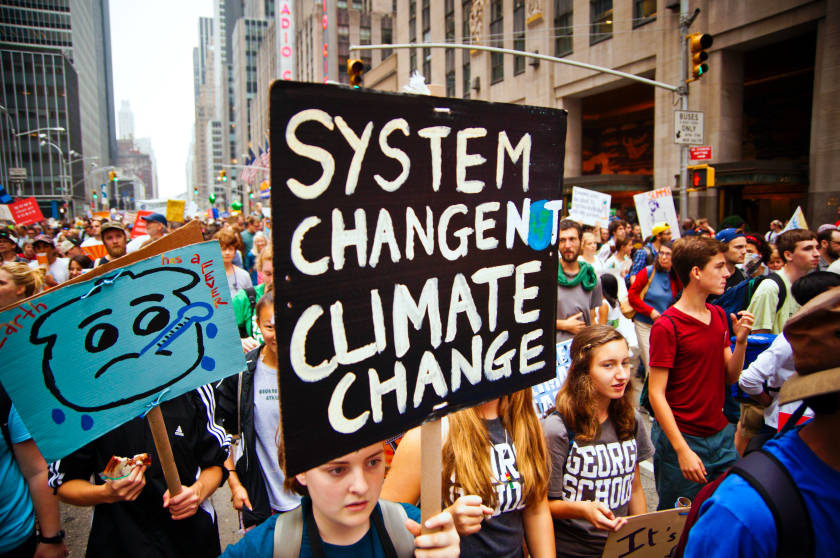
Surely, we can have many plans, contingent on various possibilities. But we need those plans, anti-capitalist plans, actually-dismantling-capitalism-in-the-short-term kind of plans. ‘System change not climate change’ is not an agitation tool anymore, it’s a directive for our generation. 

They argue that:

‘… in a state of climate emergency, we need to take risks – a lot of them: political, strategic, organizational, tactical, personal and emotional risks. We cannot afford to lose everything without having really risked to win. We need to fail forward, we need to be intentional and attentive in our failures.’

They explain that:

By intentional failure we mean knowing what we are trying out and what risks we are taking. By attentive failure, we mean having specific collective processes in place to learn from the experience and share it.’ 

Climaximo’s understanding of class is based on the ecofeminist ideas of Stefania Barca which sees those involved in care work, work which contributes to social reproduction and the continuation of human life as integral to the working class. They note that:

Historically, marginalisation of reproductive work and metabolic work has accompanied marginalisation by gender, race and ethnicity.’ 

Critically this is a global working class which confronts the global issue of climate crisis.  Mariana and Sinan stress that building a global movement is not an optional extra but a key part of building the ‘movement as party’. They insist that it’s not just a theoretical position but a practical one and argue that organising in a climate emergency means devoting perhaps 25 per cent of an organisation’s capacity to international work. In this respect Climaximo has an exemplary record, being central to the organisation of the Global Climate Jobs Conference in Amsterdam in 2023 and the counter-COP Earth Social Conference.

‘All In’ wrestles with questions that should be on the minds of everyone who is concerned about the state of the world we live in. What it proposes may not be ‘the answer’ but it should make you think and it concludes by setting a challenge – ‘Will we dare to win?’ 

Check out the All In website and order the book.

A version of this review was also published on the rs21 website.

One of the author’s Sinan spoke at a book launch co-sponsored by ScotE3

Review | Lifehouse -taking care of ourselves in a world on fire

Adam Greenfield argues that the key battles over climate are lost and activists should focus on adapting to the results of that failure. Pete Cannell responds that the only possible choice is to keep fighting for social change.

A version of this review was first published on the rs21 website.

In October 2012 hurricane Sandy wrought havoc on the eastern seaboard of the US. The storm surge overwhelmed New York’s sea defences and destroyed the homes and livelihoods of many thousands of working-class New Yorkers. The response of the city authorities was slow and totally inadequate. In its place, networks built a year earlier through Occupy Wall Street stepped in to mount a huge programme of mutual aid which became known as Occupy Sandy. Adam Greenfield, the author of Lifehouse, was one of the volunteers.

Hurricane Sandy flooding – image by David Shankbone (Creative Commons)

2024 was the first year that global average temperatures exceeded pre-industrial levels by 1.5°. Each year since 2022, global average temperatures have increased at an unprecedented rate. Year on year, global heating is matching the most extreme end of the range of possibilities predicted by climate scientists. And, while energy generated from solar and wind power increases apace, fossil fuel use is at an all-time high and greenhouse gas emissions continue to rise. Even if there were a massive shift to a low carbon economy tomorrow, rising temperatures, extreme weather and rising sea levels are baked into the global system for decades, probably centuries, to come. 

In his new book Lifehouse: Taking Care of Ourselves in a World on Fire Greenfield responds to this scenario by arguing that attempts to mitigate climate change have failed.  He makes three assumptions:

that a so-called ‘green energy transition’ will not take place in time to prevent the most consequential drivers of change from happening; that reparative ’geoengineering’  will not be attempted at the necessary scale or, if attempted, will not work as intended; and that in the time available to us, we will not invent some other technology capable of siphoning carbon from the atmosphere at the necessary scale, and rescuing ourselves that way.

Considering this, he calls on activists to redirect their efforts to adapting to the inevitable consequences of that failure. The core of the book draws on his experience of Occupy Sandy, the ideas of social theorist Murray Bookchin and other examples of collective social organisation including the Black Panthers and Rojava. 

Providing our own commons

The climate movement has always included activists who have argued for a return to nature, a retreat to a rural life that would involve rejecting all aspects of modernity. Greenfield’s position is different.  He recognises that most of the world’s population live in big urban centres and will likely continue to do so.  Building on his Occupy Sandy experience he suggests that every area needs to develop a Lifehouse, a building or complex of buildings that would form a focus for mutual aid, care and support for the local community – a place to meet and organise, find and share skills, grow food, provide medical services and much more. In any given urban area there would be many such sites. 

Greenfield expects that the deepening impact of the climate crisis will have a disrupting effect on the operation of the complex interconnected system that is 21st century capitalism.  This is certainly true. He also assumes that the retreat from state provision of public services that has developed in the neo-liberal era will continue.  He argues that:

if the state withdraws from [the provision of public goods] then there is only one possible response, which is for populations to self-organize to provide their own commons.

Accepting this, Greenfield then pays little attention to the state as he develops the Lifehouse concept.  I think this a profound mistake for reasons which I will attempt to address in the rest of this review. 

Greenfield’s articulation of Bookchin’s ideas recognises real problems with the Lighthouse model.  He notes that local systems of mutual aid may well be predicated on exclusivity, racist or misogynist ideas. Clearly the survivalist movement in the US is an example of this.  And in response to the cost-of-living crisis in Britain the far right was, and remains, proactive in setting up food banks and spaces where people could seek support.  His response is to suggest that the Lifehouse model should include an assumption of connectedness or confederation with other Lifehouses. He also notes that Lifehouses are likely to attract hostile responses from the state or from non-state reactionary forces. Again, I think this is right. While states welcome some forms of substitution for welfare services – typically charity run food banks and other services – they are much less keen on initiatives that involve collective working-class organisation.

The repressive state

The Lifehouse model assumes explicitly that it is possible to organise outside the state and alongside the state.  Greenfield argues that we should start building Lifehouses now. But almost everywhere that brings you up against a state that is increasingly repressive and intolerant of dissent, in a context of militarism, racism, misogyny and transphobia and the growth of the far right.  If we forswear mitigation and throw all our energies into adaptation it seems to me that we are in effect surrendering the ground to reaction. Greenfield notes at one point that a dystopian future might yet include small, favoured patches of relative normality, refuges for the rich. We can be sure that such enclaves would be armed to the teeth. On the other hand, if we focus on adaptation and turn to building Lifehouses our small patches of mutual aid and cooperation would have no such defence.

I want to argue that the alternative is to take system change seriously. That means breaking and replacing the capitalist system.  I’m conscious that here and now that might seem as utopian as the idea that we can remodel the world as a connected web of confederated Lifehouses.  I’m open to the idea that a sustainable world might look something like Adam Greenfield’s vision.  But the key challenge is surely how we can turn the world upside down and end the system which is driving us to disaster?  And here socialists have a historic responsibility.  

It’s clear that the climate crisis is systemic. The capitalist system has driven huge increases in material wealth through the exploitation of human labour and through commodification of the environment and material world. The system depends on continual growth and is incompatible with sustainable existence on a finite world. Revolutionary socialists have always argued that if those who labour seize the means of production, the fruits of human labour could be shared equally.  We talk about a world to win that could provide comfort, leisure and security for all. Today, however, the world we inherit is one where, as a result of the environmental damage caused by two centuries of industrial capitalism, the conditions of human existence are far more inhospitable than was the case previously.  The socialist revolution would necessarily apply the emergency brake to runaway climate change, but it can’t stop the damage that has already been done. The conditions for human existence in a world without capitalism will present a challenge for survival. Many of the world’s major cities will be underwater, there will be mass migration as some areas become too hot for human habitation and food production will be under huge strain in a world where extreme weather events are far more frequent. 

Socialists can’t promise a future of what has been called ‘fully automated luxury communism’. But we can expose the lies and deceptions of mainstream bourgeois governments and the far-right populists who are jockeying to replace them with the promise of a return to some earlier and mythical time of comfort and security. No such promise is possible in a world on fire.  Of course, exposing the lies is only possible if there are demonstrably possible alternatives and that’s our task to develop and popularise. 

The global working class

The wealth of the capitalist ruling class is built on the labour of generations of workers around the world and the blood and bones of the untold millions who were murdered through war and colonisation as capitalism spread around the globe. It is a system of great power and sometimes open, sometimes concealed, brutality. However, it depends for its existence on a global working class. Moreover, in this era of late capitalism it depends critically on complex systems and long global supply chains that can break if key workers withdraw their labour or under the impact of extreme weather events.  It’s brittle and vulnerable. That’s why Adam Greenfield’s argument for giving up on mitigation is so wrong.

Winning political arguments about who’s to blame for the crisis and how to ensure a secure future for all is not easy. In hard times it’s necessary for the left to articulate ‘freedom dreams’. Part of the argument has to be about a new economy that provides that security. But it also needs explicit recognition that the system that puts profit before the lives of people and trashes the life chances of future generations has to end. Achieving that goal requires a compelling vision and building collective power in workplaces and communities around the world. Along the way some states may be forced to make concessions and take mitigating action – but the only sustainable end game is the overthrow of those states.

This critique of Lifehouse is not an attack on mutual aid.  Practices of mutual aid are a vital and necessary part of working-class resistance – most notably in the urban centres of the global south. At times they may be essential to sustain class struggle and community survival but always against the state. To build sustainable centres for collective support and organisation requires the development of networks of resistance built through class struggle.  And if we do that then we can aspire to so much more.


Lifehouse: Taking Care of Ourselves in a World on Fire
Adam Greenfield

More To Lose Than Our Chains

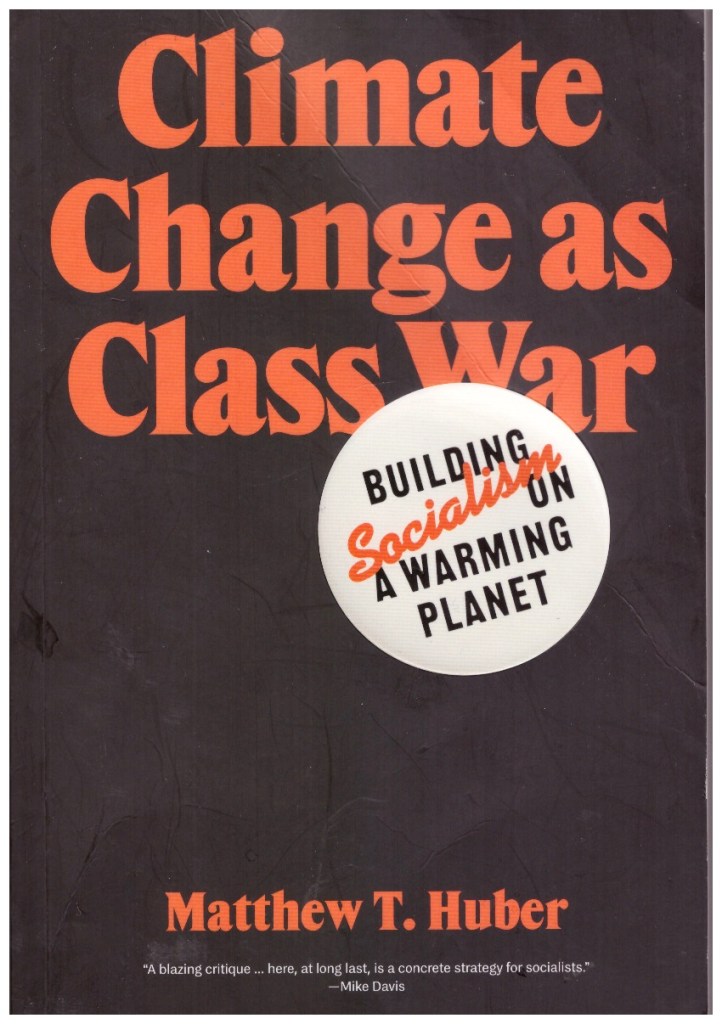
Mike Downham and Pete Cannell review CLIMATE CHANGE AS CLASS WAR by Matthew T. Huber: Verso 2022

A couple of weeks ago one of us had the opportunity to join an early morning direct action outside the SSE offices in Glasgow. The action, called by Unite rank-and-file construction workers and the Black List Support Group was against the dismissal on Christmas Eve of high-voltage electrician Greig McArthur by Kirby Engineering, an SSE subcontractor. No reason was given for the dismissal, but it followed closely on McArthur’s request for recognition of Unite as the negotiating Union in his workplace. The direct action, which consisted of about 20 of us with leaflets, banners and a film-crew outside the main entrance, resulted in McArthur’s reinstatement. No attempt was made to enter the building, but the perceived threat of entry resulted in the main entrance doors being locked, and visible panic of staff in the foyer as they directed arriving employees to the back entrance of the building. On the back of this win, against one of the five big energy companies in the UK, McArthur’s branch is organising a combine of all electrical and mechanical workers in Scotland to not only push for recognition but also for proper wages and conditions.

Click here to watch video (7 mins 41 secs)

As the power of rank-and-file of workers grows, the seizure of the means of production of energy and its distribution moves from being a pipe-dream to something highly possible. Nothing less than public ownership and democratic control of energy is necessary to prevent climate chaos. It’s the only way we can decarbonise energy in time, and the only way we can make sure that workers in the energy sector have secure jobs with proper wages and conditions – two goals which are inextricably linked.

When so much is at stake, when there’s so little time, and when left politics, nationally and globally, remains so weak, it’s inevitable that this will be a time when many people suggest different strategies. None of them will have all the answers. Rather than accept or reject a particular view-point, we need to discuss the strengths and weaknesses of each proposal and evolve a strategy which is truly collective. Discussion of each contribution to the debate is an opportunity to move forward to address the most urgent issue of our time. In our view Mathew Huber’s book Climate Change as Class War has significant strengths but also significant weaknesses. First, we’ll discuss the strengths.

Urgency

Huber writes with refreshing urgency. In his first paragraph he reminds us that

in 2018 the IPCC gave us 12 years (now eight!) to implement rapid far-reaching and unprecedented changes in all aspects of society

Scientists are saying that humanity must unite and face what could be its last fight.

Capitalism

It’s also helpful to be reminded that capitalism has made human emancipation possible because on the one hand it has developed production to the necessary level, and on the other hand it has created a class which has the collective power to emancipate.

Seizing the means of production

This is the focus of Huber’s call to action – as it surely must be for any successful and sustainable climate strategy. The only solution is for global production to become socially coordinated. We need to seize the means of production of energy, housing, transport and food so that they can all be decarbonised.

 Reconciliation with nature

Also unarguable is Huber’s contention that the working class, now the vast majority of humanity, is most critically separated from the land, so that its livelihood no longer has a direct relationship with nature. The working class is entirely dependent on a wage for survival. This social coordination of global production, Huber says, needs to be entrenched in a reconciliation of humanity’s relationship with nature.

Species solidarity

Social coordination of production, Huber says, also needs to be rooted in “species solidarity” – which looks beyond international solidarity towards a world ethos

where workers in all countries recognise that the very conditions for species survival are at stake, and that survival depends on defeating the small minority of our species who control production

Encouragement

Recognising the daunting scale of the difficulties ahead of us, Huber encourages us by pointing to the current growth of strikes in the US. Here in the UK, we are also seeing a big resurgence of strike action. Particularly inspiring is the intensification of strikes by NHS workers  – 
Click here to watch video (8 mins 24 secs)

At the same time, we should keep in mind that most strike action is still dominated by a trade union leadership who are concerned to operate within the straitjacket of anti-union law, desperate to get to the negotiating table and ready to compromise on agreements that don’t meet the needs of their members and fail to tackle systemic issues that underpin appalling working conditions. At the moment we don’t have a strong enough rank and file to resist these poor compromises and operate independently of the leadership.
Huber also offers the encouraging point that the increasingly stark indifference of the wealthy and powerful to working-class well-being is creating increased militancy. He reminds us too that the working class in the US was able to turn round quickly it’s powerlessness in the late 1920s and early 1930s into power which forced the New Deal of 1933-36.


Where to start?
It’s also helpful to be given suggestions of where to make a start. Huber suggests reviving the simple demand of public good over private profit. And he goes to some length to argue his case that we should start by seizing the means of production and distribution of electricity.
But there are also significant weaknesses in Huber’s book:

Repetition
Huber sets out his arguments four times – in a long introductory chapter, then in a chapter dedicated to each main argument, then in a Conclusion at the end of each chapter, and in a final chapter headed Conclusions. This makes the book a bit of a slog for the reader. It could have been a shorter and more easily digestible book. Moreover, the multiple Conclusions are not always consistent with each other (see the next point).


Professional Class
Huber devotes a whole section to his theory that there is a distinct “Professional Class” and that its class interests determine the politics of the climate movement. This argument is not convincing. He seems confused between the idea that almost anyone with a degree is in this class, or whether it’s only some people, particularly lawyers and managers, who occupy contradictory class positions. Furthermore, the Professional Class concept doesn’t survive into the conclusive final chapter, where it gets no mention at all.
It’s true, though Huber doesn’t specifically mention this, that in the US non-profit organisations tend to dominate social movements and struggles. They often have shed-loads of money and pay their employees fat salaries. But does this constitute a distinct class? In contrast, Cooperation Jackson made the political decision not to be a non-profit, based on years of activism in organisations where nobody was paid (see Michael Haber’s Breaking Out of the Nonprofit Industrial Complex).
US exceptionalism
The concept of a Professional Class is perhaps, at least partially, an example of US exceptionalism. Although Huber recurrently and correctly emphases that climate solutions have to be global, he sometimes slips into assuming that the US context is representative of the global context. For example, the considerable detail he goes into about the electricity sector in the US may not be transposable to the electricity sectors of other nations. And levels of unionisation vary widely internationally.


Workers’ Power and State Power
Huber argues that organised workers have the potential power to force a transition into new sustainable forms of production. To shift from potential power to actual power he advocates a rank-and-file strategy (RFS). The case for building from the grass roots is clearly made – however, the politics of the strategy and the relationship between the rank and file and the union leadership is less clearly articulated. Is the RFS a means to an end – a reinvigorated union movement – or should it be more than that? Put simply the strategy seems to be that a resurgent working class can force change through the ballot box and then the state can take the decisive action required to transform the economy.


In conclusion
Climate Change as Class War is a valuable contribution to the debate about building the power to avert a climate catastrophe. It asks the right questions and does the movement a service in putting production under capitalism at the centre of its concerns. However, in our view, its critique of the politics of the climate movement is undermined by a concentration on the material interests of a so-called professional class. Important questions about why the left internationally is at such low ebb; about the relationship between social movements, parties and working class organisation; and about the role of trade union bureaucracies are not addressed.

We have a small number of copies of the book available at the reduced price of £11 – use the contact on the menu to get in touch if you are interested in a copy.

Fossil fuel systems and how to change them

Simon Pirani is the author of ‘Burning Up – A Global History of Fossil Fuel Consumption’* – Simon recently spoke on Fossil Fuel Systems at one of. series of events discussion issues around ecosocialism. The video of his introduction provides a very clear and comprehensive account of how fossil fuel systems are embedded in modern capitalist economies and of the challenges of breaking from an economic system based on these fuels.

Simon blogs at the People and Nature website which carries lots of articles that will be of interest to followers of Scot.E3.

* we have a small number of copies of Simon’s book available at the reduced price of £11 (postage extra) – email triple.e.scot@gmail.com if you’d be interested in a copy.

The power to change the system

Another contribution to our ongoing thread of debate about ‘what next after COP26’.  This post from Sara Bennet, Raymond Morrell and Pete Cannell, based on a revised and updated version of an article originally published on the rs21 and Conter websites, is intended as a contribution to that debate.  It looks the rising level of industrial militancy in the UK and discusses the importance of this for developing a movement that has the power to force the kind of system change that we need to avert climate catastrophe.

The imperative for the COP 26 conference was to agree actions that ensure that greenhouse gas emissions (mainly CO2 and methane) are cut rapidly to restrict average global temperature increase to 1.5 degrees centigrade.  It failed to do that.  This is the latest in a long line of failures.  Carbon emissions have increased almost every year that COP talks have taken place since the first conference in Berlin in 1995.   In 2020, despite reduced economic activity because of lockdown, the concentration of carbon dioxide in the atmosphere rose faster than the average for the previous decade.  2021 is set to see the second biggest ever increase in CO2 emissions.    The aggregate increase in parts per million of CO2 in the atmosphere since 1995 exceeds the total increase over the previous 200 years.  A staggering lack of impact that is pushing humanity close to the edge of runaway global heating.

Nevertheless, despite the failure of the COP, there are reasons to be hopeful.  Glasgow was the focus for a diverse and dynamic series of protests that took place in more than 300 locations around the world.  There has been a convergence in understanding of the science and economics of the crisis between climate activists and scientists and researchers.  So for example, the IPCC reports are produced by consensus among scientists from around the world. The physical science section of the latest report was published in August 2021.  It highlights the chasm between the reductions in greenhouse gases that need to happen and the reality of continuing increases.  Increases that reflect the fact that while investments in renewables have grown, that growth is outstripped by new investments in fossil fuels.  The second and third sections of the report were not due for release until 2022 but, in an unprecedented move, scientists have leaked drafts of the texts. Essentially the message is that restricting the average rise in global temperatures to 1.5 degrees by the end of the century is only possible if there are fundamental changes to the way economic and social activity is organised around the world.  Quite simply the message is that business as usual, based on the assumption that the market will drive a transition to a low carbon economy, is just not an option.  

But in essence COP26 stuck with business as usual.  So how do we build a movement that is powerful enough to drive through system change in the face of opposition from the rich and powerful?

Over 100,000 marched in Vancouver in solidarity with the youth of the world in the September 27 Climate Strike. Image by Chris Yakimov CC BY-NC 2.0

Part of the story of the Glasgow COP is the strikes and threats of strikes by Scottish workers.  The industrial action by ScotRail workers that would have paralysed Scotland’s rail network while the COP took place was called off after the RMT union reached a settlement over a one-year agreement.  But in a separate dispute strikes by workers on the night sleeper trains from Scotland to England went ahead as did action by Glasgow refuse workers, members of the GMB union.  It was important that the COP coalition that brought together activists to protest and demonstrate at the COP provided open and consistent support for the strikers.

Image by superalbs CC BY-SA 4.0

For too long the demand for a worker-led just transition has been abstract and disconnected from any sense of working-class agency.  While climate activists have promoted the idea, concrete examples of class action have been lacking.  So, whilst climate change has moved up the agenda of most trade unions in Britain, the disconnect between economics and broader politics continues to exert an influence over trade union engagement in the climate question.  For example, the GMB has turned its back on meaningful action with its support for fracking.  It also supports an approach to mixed-energy provision which may appear like a step in the right direction but allows the status quo to continue under the guise of sounding more balanced.  Meanwhile Unite, which represents members working in some of the key ecologically damaging sectors, opposes fracking.  However, it has often passed sensible-sounding policies around supporting climate jobs while simultaneously limiting their effectiveness by being unable to think beyond the immediacy of job provision, such as its position in favour of Gatwick airport expansion position.

Trade unions’ main role, of course, is to defend workers, their jobs and working conditions. However, this has too often led to a narrow focus, and a determination to defend the climate-damaging jobs that in time will simply undermine the very existence of such jobs in the future. Jobs in these polluting sectors have often also tended to be more highly skilled with a history of organisation. They also wield some power within the union structure. Due to their importance in terms of UK manufacturing and output, they have also been some of the worst affected by partnership arrangements, which basically attempt to convince workers that their interests align with their bosses. 

When climate activists see unions acting in this way, it can breed a sense of cynicism, and to regarding the those working in these sectors as part of the problem, rather than as key to the solution. However, workers are right to insist that there will be meaningful and sustainable jobs for them and future generations. What’s more, increasing numbers of workers within and outside these sectors realise that time is up. These are workers that could and should be at the heart of planning what a real just transition would look like: which skills it could retain and build on, how to transfer them to building a viable future. 

Things are changing.  Four decades of neo-liberalism have resulted in grotesque levels of inequality.  So, for example lorry drivers pay has remained stagnant while working conditions declined, and workloads grew.  This is mirrored across society.  The accumulated impact of these trends, compounded by the pandemic, is reflected in staff shortages in key sectors from transport to care.  In this context workers are starting to organise, take action and win.  

Whether or not the anger that these actions represent, and the confidence they engender, can generalise beyond immediate economic demands to grapple with the need for system change depends on the way in which political ideas develop in both the trade union and climate movements.  Not least, a worker-led transition requires new forms of organisation at the base and a rejection of employer partnership.  

Objectively the conditions are favourable for this to develop.  Marxist Ecologist John Bellamy Foster argues that the existential threat posed by the climate crisis can create a revolutionary situation in which the struggle for freedom (from oppression, poverty and more) and the struggle for necessity (survival in the face of climate chaos) coincide.   Such a formulation may seem like an impossible step from the action of rail workers and council workers in Scotland – yet building a movement that can achieve system change (necessity) will be one of many steps and reversals – sometimes slow – sometimes rapid.   

For many, perhaps most climate activists, the IPCC’s conclusions are old news.  It is precisely because of the way in which, year on year, world leaders have jetted into the latest COP and made decisions predicated on the assumption that the market is sacrosanct that so many have concluded that system change is the only answer.  The slogan ‘System Change Not Climate Change’ is ever present on climate protests worldwide.  But what the slogan means and how the change is achieved is less clear.  Will capitalist enterprises respond to ethical imperatives or is state regulation required to force changed behaviour?  Can a system driven by profit and capital accumulation ever coexist with a sustainable zero carbon economy?  Or do we need a much more fundamental reorganisation of society? And at the same time, given the strength of fossil capital – structured through a century of exploitation of coal and oil and resting on vast resources of wealth and power – where is the power to make this happen?

The beginnings of the answer to that question of the power to change the system are evident in the rise of the school student strike movement around the world, the mass demonstrations that preceded the global pandemic and on the streets in Glasgow this month.  But, apart from a moment two decades ago when the turtles and the teamsters marched together, organised workers have largely been absent from the stage.  This why the industrial action around the Glasgow COP is so important.  

In the aftermath of the COP a priority for climate activists must be to actively lend their support to striking workers, whether it be the refuse collectors in Glasgow and Brighton, the HGV drivers nationally or bus and rail workers. Supporting road haulage might on the surface seem contradictory to the fight against climate change but ultimately the change we need will come from below, with unity across the struggles being of paramount importance. Likewise, we need to see trade unionists march with their banners alongside climate activists at COP26 and beyond. The fights for decent jobs and a decent environment are not in opposition: they are one and the same. 

Writing about how neo-liberalism and its consequences can be overturned, Panagiotis Sotiris talks about “productive reconstruction”.  

We must think of “productive reconstruction” not as “a return to growth” but as a process of transformation and intense confrontation with capital, based upon public ownership, self-management, and forms of workers’ control. It has to be a process of experimentation and learning.

This seems like a pretty good agenda for both the climate and workers’ movements.

Lighting a spark: How to Blow Up a Pipeline

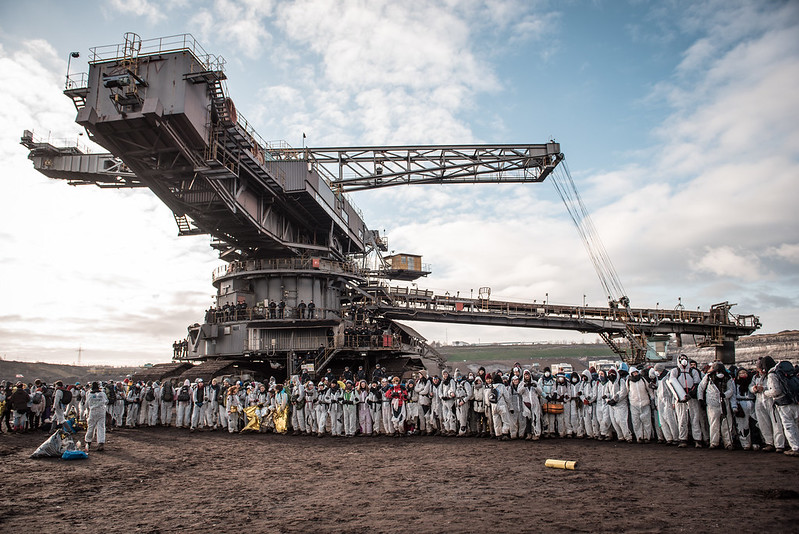
Ende Gelände activists targeting a coal mine in 2019. Photo: Tim Wagner/Flickr

Harry Holmes reviews Andreas Malm’s ‘How to Blow Up a Pipeline’. Harry argues that the book gives a balanced assessment of the conditions which make sabotage, vandalism, and other forms of strategic direct action necessary in a warming world. This review was first published by Bright Green and has also been reposted on the rs21 website. Malm’s book is designed to provoke debate on strategy and tactics and we would welcome further contributions on these issues.

How to Blow Up a Pipeline starts with what will be a familiar image for many. It’s the yearly climate negotiations, activists have streamed towards the conference space, pleading with representatives to ratchet up their ambition to tackle the climate crisis. People block city traffic with banners, with activists dancing and playing music in the reclaimed streets. The next day brings a giant public theatre performance, with environmentalists pretending to be animals run over by cars whilst ‘negotiators’ walk around with signs saying ‘blah blah blah’.

Was this a collection of Extinction Rebellion activists performing and blocking traffic? Was it even earlier, in 2015 at the Paris negotiations? Maybe it’s 2009, during the economic crisis and the Copenhagen conference? No, this image comes all the way from COP1, the climate conference that started it all – in the lost world that was 1995.

Speaking straight from his experiences of this first COP, Andreas Malm’s recollection of these early climate protests indicates a wider malaise – a certain sluggishness of environmental strategy. Despite the growth in awareness around the climate crisis and the rapid increase in the number of people organising for environmental justice, there has been limited change in the actions climate groups are willing to take to defend life.

In How to Blow Up a Pipeline, Malm has written a short and gripping manifesto which aims to wrench the climate movement out of its complacency. By convincingly arguing against movements’ dogmatic attachment to milquetoast non-violence, Malm makes clear that as the climate crisis escalates so too must the tactics of those seeking to defend life. Not content with simply dispelling the misguided understandings of pacifism environmentalists hold, How to Blow Up a Pipeline gives a balanced assessment of the conditions which make sabotage, vandalism, and other forms of strategic direct action necessary in a warming world. Coming out of the pandemic, with movements regrouping and attempting to navigate the mess that is the 2020s, this book is the shock to the system the world needs.

Beginning with the pacifism many climate movements advocate, a significant portion of this book is dedicated to dispelling the often ahistorical, whitewashed, and faulty justifications given for non-violence. To do this, Malm separates these arguments for non-violence into two forms; a moral pacifism focused on the wrongness of violence from an ethical perspective and a strategic pacifism centred on the advantages to environmental movements from committing to non-violence.

Learning to defend ourselves

It becomes clear that Malm has little time for the first form of pacifism. He turns to the case of Mohammad Rafiq, a 65 year old who stopped a right-wing terrorist attack on an Oslo mosque in 2019. As the gunman entered the building, the pensioner ran at him, tackling the would-be shooter to the ground where, with the help from other nearby men, they disarmed and beat the attacker. Malm points out that such self-defensive actions and any similar attempts to defend from far-right violence are unacceptable from the perspective of moral pacifism. With the struggle against the climate crisis being understood as a similarly defensive movement, focused on protecting life, Malm argues moral pacifism should hold little sway as a dogma. It risks being too rigid in the face of the escalating need to act in life’s defence.

Environmentalists’ deluded reading of the history of social change is not confined to past lifetimes either. Malm points out how groups like XR continue to invoke recent events, like the Poll Tax Rebellion of the early 1990s, as inspiration for non-violent ‘civil disobedience’, despite the Poll Tax famously being scrapped as riots rolled through London. Such a reading of history is not only one sided, but an act of positive erasure – an erasure which works to the detriment of the environmental movement’s strategic horizon.

Finding the radical flank

Looking at each of these past movements, Malm doesn’t reject the importance of the non-violent element. In fact, he suggests the opposite, the existence of a radical flank willing to commit acts of violence combined with a growing mass of non-violent organisers made change possible. Non-violence allows movements to grow larger quickly, it can secure sympathetic coverage in the public eye, and it can prevent government escalation. Because of this, non-violence always has a role.

Of course, no history of environmental movements would be complete without an assessment of the violent direct action of groups like Earth First! and similar Liberation Fronts in the 1980s to 2000s, who were responsible for the destruction of many a logging site. Malm suggests that their ultimate collapse was, at least in part, due to the lack of a wider mass movement where they could position as the radical flank. Malm’s polemical insight is that mass non-violence is the necessary condition for the impactful escalation to violent tactics and today, with climate strikes and Extinction Rebellions aplenty, we are not short of mass non-violent movements.

In short, it is not either/or but both, together in an escalating cycle. Malm argues the current environmental movement’s failure to accept the potential co-existence of both violence and non-violence reflects the wider collapse in revolutionary politics since the 1980s. In response to this collapse:

We have to learn how to fight all over again, in what might be the most unpropitious moment so far in the history of human habitation on this planet.

To begin these wide-ranging strategic conversations about fighting the climate crisis, Malm suggests focusing on two general goals – there is a need to announce and enforce a growing prohibition on new emitting devices, as well as rapidly reducing the lifetime of the polluting infrastructure and devices which already operate. The question, when bringing these general ideas down to Earth, is how precisely the environmental movement may go about this?

Building on Henry Shue’s distinction between luxury and subsistence emissions, Malm points to the increasingly violent role of luxury emissions, and the urgent need to focus efforts on these devices, whether SUVs or planes. There are several clear arguments given for focusing action on luxury devices, these are worth listing in full, albeit paraphrased:

  • As the effects of climate change are here, the harm from these luxury devices should be understood as immediate.
  • Luxury emitting devices like planes and cars allow the super-rich to also be hypermobile and escape the effects of climate change.
  • The ideological role of these devices is the championing of destructive lifestyles.
  • There is an ethical cost of how the money could have been better spent mitigating and adapting society to climate change.
  • In any reduction of emissions, it is better to reduce luxury emissions first rather than those necessary to secure subsistence.
  • Finally, and perhaps most crucially for Malm’s argument, there is the supremely demoralising role that these devices play. After all, if we cannot even get rid of SUV’s how are we meant to move towards a sustainable society?

Recognising this, Malm points to the need for violence to not just include the strategies of sabotage preventing new fossil fuel infrastructure from being built. It should also encompass the ways in which sabotage ‘can be done softly, even gingerly.’ Pointing to the mass movement in Sweden which deflated the wheels of SUVs during the night, Malm argues environmentalists should be comfortable engaging in extensive acts of vandalism targeting the luxury devices common in the Global North. Such violence would show how the ‘rich cannot have the right to combust others to death’, as well as preventing new emissions.

Unleashing new tactics

In opening up the horizon beyond non-violence, Malm invokes a further difficulty – precisely under what conditions does violence become necessary? What form might violence take? How to Blow Up a Pipeline makes clear that violence constitutes attacks on property, coming under the messy monikers like sabotage, vandalism, and demolition. This book is unequivocal that this does not extend to people or animals, nor property which is necessary for their subsistence. This still leaves much on the table, but Malm’s book should be read as a defence of destruction to property in a similar school as that of Osterweil’s In Defence of Looting.

Malm invokes scholars of direct action like William Smith, whose research points to important conditions which should be met for the successful escalation from non-violence. For Smith, escalation succeeds only if action would stop something which would likely cause harm, where mellower non-violent tactics have been exhausted, and where action is based on some wider ideal or charter, such as the Paris Agreement. Malm makes clear his view that these conditions are largely met for most fossil fuel infrastructure.

There are still several objections to escalation which could be posed. One is that governments have supremacy when it comes to repression and violence. As a result, escalation from the environmental movement could result in extreme crackdowns from states across the world. Malm accepts this asymmetry in power, in fact he suggests that it extends far beyond the ability of the state to commit violence. However, Malm points out that there is no law that this asymmetry ‘can never be overturned from below.’ Fighting climate change is a David vs Goliath fight in every sphere, whether economic, social, or militaristic. If we accept asymmetry as an argument against moving beyond non-violence, it would also mean abandoning nearly every climate struggle.

So Malm turns to the crucial argument many make for non-violence, that of popular support. The old story goes that abandoning non-violence leads to declining public opinion and a collapsing movement replete with infighting. Violent acts would be a ‘negative radical flank’, cutting into the wider non-violent movement. On the first issue of public opinion, Malm argues the role of social movements is not to take ‘an existing level of consciousness as a given, but rather to stretch it.’ Violence needs to stretch and drag society forward. This means that violent actions should be clearly explainable and acceptable in their wider context, with Malm suggesting perhaps the best strategy is to lie in wait for the next extreme weather event to strike at luxury emissions. With regards to the collapsing movement, Malm argues that the radical flank must simultaneously be prepared to be disowned by the wider movement, whilst also being receptive enough that in the case of either escalating repression or public backlash it can call off its actions.

The New Climate Laboratories

With regards to this last point, how are these contradictory characteristics to be satisfied? Being able to balance the tightrope of competing arguments for and against escalation is not something that Malm can answer in around 150 pages. In such a short work, one is left desiring the detail, the roadmap, where in practice the neat lines Malm draws can be observed. These will never appear, as only practice and thought together can bring this flourishing. What How to Blow Up a Pipeline does is effectively indicate strategic considerations and reflections which must be borne out in the practices of climate movements. There is no perfect tactic, no silver bullet, only a magazine of possible actions which environmentalists need to constantly assess as the crisis gets worse.

Malm puts his faith most of all in the climate camp movements like Ende Gelände and Reclaim the Power, where activists come together in mass numbers to shut down fossil fuel infrastructure. These camps can be built easily, allowing the movement to spread horizontally whilst also being planned well in advance. As the number of attendees rises, so too does the capacity to outmanoeuvre police and disrupt fossil fuel infrastructure. Malm invokes these spaces as the ‘unrivalled laboratory for learning this fight.’ If environmentalists are to develop the strategic acumen to pull the breaks on emissions, then what is need is a proliferation of these camps and any other equivalent ‘laboratories’ – we need spaces where climate activists can come together to learn and act with a sense of militancy. In the 2020s, Malm’s book points to the need to let a thousand laboratories bloom.

The final pages of How to Blow Up a Pipeline reflect on the opposite tendency to such escalating militancy – a climate fatalism which presents breakdown as inevitable. Many writers are encouraging society to ‘learn how to die’ and bring a deep pessimism about our capacity to change course. Whether in the work of Franzen, Scranton, or others, Malm rejects their pessimistic understandings of society’s future as that of a particular class interest. It is comforting for the rich of the Global North, unable to accept their need to change production and consumption, to ‘project this weakness of the flesh onto society’ and doom it to climate collapse. What is harder is internalizing the continued need for resistance.

With every part per million counting, with every stopped pipeline saving lives, and with every minute counting, the truth is the opposite of what the climate fatalists suggest. Looking to those who died in the Warsaw Ghetto uprising or who resisted within the extermination camps, Malm invokes the continued gesture of struggle against all odds. As Malm puts it:

Precisely the hopelessness of the situation constituted the nobility of this resistance. The rebels affirmed life so extraordinarily robustly because death was certain and still they fought on. It can never, ever be too late for that gesture. If it is too late for resistance to be waged within a calculus of immediate utility, the time has come for it to vindicate the fundamental values of life, even if it only means crying out to the heavens.

One hopes, like Malm, that it does not come to this, that we come to tackle the climate crisis with the ambition it needs before such hopeless struggle is necessary. What How to Blow Up a Pipeline does is act as a rallying cry for a climate movement far too comfortable in its ways, at a time where bold action is more than overdue.

How to blow up a pipeline is published by Verso at the beginning of January 2021 – we will have a small number of copies available for £10 (including UK postage). To enquire or order use the contact form.

LOCAL FOOD PRODUCTION – PART 4

In the final part of his four part post on food production and just transition Mike Downham puts forward some ideas for the demands we should fight for and how to organise. We’d welcome comments and responses to this important discussion. You can read or download the full text here.

Demands

Choosing and formulating demands has to be collective. If a large number of people, all of whom can see the benefits of winning the demands, haven’t been involved in the process, the demands will fail. This is so obvious that it might not seem worth pointing out, but a lot of GND proposals have fallen into the trap of making detailed proposals drawn up by a small number of well-intentioned activists. 

A further general point about demands is that addressing them to governments is only part of their purpose. Equally or more important is that they should reach the whole of society – workers, Unions, civil society organisations and the general public. It helps in formulating them to remember that. The purpose of demands, beyond whatever response governments make or don’t make to them, is to increase the size, diversity and solidarity of the mass movement, giving it something concrete and specific to come behind.   

With regard to local food production, it’s enough for now to suggest that we need two sets of demands, one about making land available and one about educational opportunities.

Land demands will need to take land reform much further than the pallid 2003 Right to Buy Act. It’s common knowledge that land ownership in Scotland is more archaic and more unjust than in any other industrialised country in the world. For lots of reasons on top of local food production, any GND needs to confront that fundamental class issue head-on. It would not be difficult to construct an immediate demand that landowners should be compelled to relinquish tenure on a quota of their land for allotments or community gardens or educational gardens or farms producing for the local market, as long as each proposal fulfilled centrally specified conditions.    

Educational demands will need to cover classroom and kitchen staffing levels in schools, teacher training, and higher education course choices and staffing, formulated in discussion with workers and their trade unions. Given the recent strong protests of unionised college and university workers, we are in a good position to discuss with these workers and their unions whether this is the moment to demand that higher education should be taken back into public ownership.

Both land and educational changes will have to be anchored by state intervention, and democratically controlled at a local level. Our demands must include these conditions. 

Organisation

In considering how we should organise to achieve these demands the overriding point is urgency. The urgency of climate change is widely accepted, and we can’t afford to take our eye off the climate emergency just because air quality and carbon emissions have improved dramatically through lockdowns – though this does show what can be achieved by states when their backs are against the wall. The point is also being made by a lot of people and organisations that if we’re determined not to go back to the same normal once the pandemic is under control, we should start now to get together and say whatever it is we want to say about the new normal. It could take years, with further catastrophic waves of infection, before the pandemic is under control. We absolutely shouldn’t wait to act until then. Even these few weeks before the possibility of a second wave of infection in Scotland mustn’t be wasted.

An additional point argument for urgency in relation to Scotland’s food strategy is the growing prospect of a no-deal Brexit, which could leave the shelves of supermarkets empty again, and not just transiently.  

But how do we get together? Building community knowledge, consciousness and solidarity in the context of neoliberalism can take years. In Jackson, Mississippi, they’ve been at it for 40 years. The poor neighbourhoods of North Edinburgh have been at it for at least 10. We don’t have time for that. But the pandemic has created a unique context, in which governments across the world are in a weaker position, and communities in a stronger one, than at any point in the history of industrial capitalism.  One immediate opportunity in Scotland is to build on the mutual solidarity networks which have mushroomed during lockdown. Some of these networks are new, while some developed from previous neighbourhood organisations. Other groups are likely to emerge as the full economic consequences of the pandemic bite. As the structure of the economy has changed over the last 50 years, with workplaces that are smaller and often distant from where the workers live, some people working from home, and the predominance of services over production, it’s become clear that we have to organise not only where we work, but also where we live. So we need to join and become active in any local formations which are concerned about the future for working class people, and for most of us there are or will soon be opportunities to do that. And we shouldn’t see existing legislation, including the legal obligations of Local Authorities, as things which can’t be swept away by a mass movement.

More will have to be done about Scotland’s food than the development of local food production. That was illustrated by the traffic chaos in Glasgow last week on the day 31 Macdonald’s drive-ins opened. But development of local food production, as an integral part of a Green New Deal focussed on both a Just Transition and a Just Recovery, bringing with it jobs and training and neighbourhood solidarity, is a good place to start. We can take on Macdonalds and intensive farming later.

You can read or download the full text here.

Image by Joe Brusky System Change Not Climate Change CC-BY-NC 2.0

What will a return to ‘normality’ mean to us?

Mike Downham responds to the recent post on Pandemic, Climate Crisis and the threat of a return to ‘normal’.

Pete Cannell (5th April) has helpfully spelled out what a return to normality after the pandemic will mean to the ruling elite. But what will it mean to the rest of us?

Even at this relatively early stage of a crisis likely to go on for many months, I hear people talking about the things they don’t want to go back to after it’s all over. Most commonly people talk about how society has suddenly become kinder, and how they don’t want to go back to a less kind way of life where they are less well-connected with their neighbours, work too hard, delegate so much of the care and education of their kids, and are dependent on long and insecure supply chains for their food.

Not all people feel the same of course – confusion and fear can readily overcome any other feelings.  We don’t know yet whether tendencies like these will grow and spread. But if they do, they could turn out to be important. The biggest crisis we face is not this pandemic, despite all the loss and suffering it has produced and will go on producing, perhaps to a scale we can’t yet imagine, particularly in the global south. The biggest crisis we face is climate change. We know we have to achieve radical and systemic change if we are to slow down global warming.  We will have the best chance of achieving that change if we keep track of the new aspirations which people develop in the face of this pandemic.

Radical change won’t happen, we have to make it happen. But, for the first time in our lifetimes, history is on our side. Pete quoted Arundhati Roy in his piece. Here is something else she said, lifted from Annie Morgan’s post on 18th March: 

A new world is not only possible, she is on her way.  On a quiet day, I can hear her breathing’.

Joe Brusky – System Change not Climate Change CC BY-NC 2.0

Climate Crisis and Pandemic – Building for a Different Future

The first of our series of online meetings on the politics of climate crisis at a time of pandemic took place on the evening of April 5th; climate jobs campaigner Jonathan Neale introduced the discussion.  You can watch Jonathan’s introduction on the YouTube video.  There were 25 people linked in to the Zoom meeting and Jonathan’s introduction led to a wide-ranging discussion that looked at the importance of social solidarity and collective action, immediate priorities in the midst of the pandemic, how we can understand the links between the current crisis and the simultaneous crisis of climate, democracy and state surveillance and the importance of developing politics, practice and networks of resistance in the here and now.  If you would like to share your response to Jonathan’s talk do get in touch by emailing triple.e.scot@gmail.com – we are very keen to encourage a debate on these issues on this website and elsewhere.

This changes everything

Mike Downham reflects on discussion at a recent Scot.E3 organising meeting.

This piece began as a report on a ScotE3 discussion about its forward strategy at an organising meeting on 19th March. The meeting had been planned before COVID-19 had become the over-riding priority. By the time we met, it had. For most of us it was our first Zoom meeting.

Over the week since we met, events have moved more quickly and more significantly than in any of the 4,213 weeks I’ve been alive and aware (too young to be aware of the outbreak of World War 2, and too distracted as a medical student  to be fully aware of the Cuban Missile Crisis.). So this report has become an attempt to develop the main points which emerged from our discussion in the light of the subsequent escalation of COVID-19 – an escalation in terms of the spread of the disease, the number of deaths, Government intervention, and the response of communities and activists.

coronavirus-4833754_1920

The key points which emerged from our discussion that night were that the COVID-19 pandemic is laying bare the contradictions in the capitalist system;  and that increased consciousness of these contradictions among working-class people, already noticeable, has the potential to build to a point where those people will collectively insist on fundamental change.

What are the contradictions in the capitalist system which the pandemic is particularly exposing? Above all, the vulnerability of our health and social care infrastructure as a result of market-led policies over recent years has become blatantly obvious. The NHS has about 5,000 ventilators, and we are predicted to need around 100,000 within the next few weeks – this despite a flu pandemic exercise run by Government three years ago which pointed to the need to increase ventilator capacity. The Government took no action. On top of that it’s now widely known that the Government, as recently as a month ago, was prepared to sacrifice older people to save the shareholders. Though it became politically impossible for them to hold tightly to that strategy, it still informs their inadequate and confused public health interventions.

The economic impacts of the epidemic are likely to be as big for working-class people as the health impacts. Yet the Government’s income-support interventions have been slow to emerge, inadequate and confused. What for example is an ‘essential job’? Essential for who?

Food will inevitably become scarce soon, particularly but not only for those with least money.  The official figure for the percentage of food the UK imports is 50%. But this is a figure massaged by the inclusion of foods processed in the UK. If ingredients for the processing are included, the real figure is around 80%. A lot of that comes from Europe. Wholesale prices of the fruit and vegetables we import from Europe are rocketing in the context of the pandemic, some of them have already risen by 100%. Wherever food comes from it has to be distributed and many of the waggon drivers come from central Europe. Homegrown fruit and vegetables are threatened by the shortage of harvesters, most of whom also come from Europe.

What are the signs of increased consciousness of these contradictions? Already many people are expressing lack of confidence in the Government. That, to date, 600,000 people have responded to the call for volunteers to help the NHS is a sign that people recognise just how under-resourced the service is. At this point the Government is arguing that the scale and severity of COVID-19 was unpredictable, but as the facts emerge about their inaction in the face of what became known to them from the experience of China and other far-eastern countries, this argument will be seen through, especially by the new volunteers as they experience working at the front line. The vigorous responses of local mutual aid associations will lead to increased confidence and a growing collective consciousness about the way working class people have been failed, particularly as people lose loved ones and as their economic conditions deteriorate. Workers are standing up for their rights for protection from Coronavirus infection in their workplaces – at Moy Park poultry processing plant, Northern Ireland’s biggest employer, 1,000 workers have walked out.

ScotE3’s primary aim is to contribute to the building of a mass movement to achieve a Just Transition from North Sea oil and gas to renewable sources of energy within a timeframe which prevents catastrophic climate change. The COVID-19 pandemic, despite its devastating outcomes, which have now become inevitable, offers an opportunity for ScotE3 to support the growing consciousness of the way the capitalist system is threatening the very survival of working-class people. We can support the generalisation of that consciousness, so that it extends to an understanding of the urgency of Just Transition. As one of our members put it recently:

Oil & gas need to go the way coal went, but this time without victimising the workers and their communities…The people, if they get the facts, will not allow either the industry or the Government to lead us into a future that condemns our grandchildren.

We are well placed to continue to contribute strongly to a Just Transition movement, despite the restrictions of the pandemic, given our emphasis on providing high-quality information widely available online, and the diversity and depth of the experience of our membership. The pandemic will make it more possible for us to promote radical solutions, above all the need to replace the capitalist system. The COVID-19 pandemic should inform all our activities, the resources we work on, and the politics of the material we publish. The pandemic is the new prism through which we should view everything.