Post-election battlegrounds for climate and social justice 

On 4 July, the climate-trashing Tory government will be replaced, as good as certainly by Keir Starmer’s “changed” Labour party.

For all its talk of “green prosperity”, Labour plans to work closely with the corporations that profit from North Sea oil and gas and from generating electricity – and who intend to produce, and use, fossil fuels for as long as they can.

A protest at government offices against the Rosebank oil field project, January 2023. Photo by Steve Eason

Labour’s plans for cutting greenhouse gas emissions from homes and cars are hopelessly timid, because of its conviction that private business does it best.

Under Labour, we will in my view make progress against social injustice and climate change only insofar as social movements and the labour movement:

(i) confront and confound the government, and

(ii) show that action on climate change, far from costing ordinary people money as the extreme right claim, is 100% compatible with combating social inequalities.

In this article I try to identify the likely battlegrounds between our movements and a Starmer-led Labour government:

Fossil fuel production and the path away from it (part 1); electricity generation at national (part 2) and local (part 3) levels; avoiding false technofixes (part 4); and changing the way energy is used in homes and transport (part 5). Part 6 is about bringing these separate, but connected, issues together.

1. Transition away from fossil fuel production on the North Sea

The election-time slanging match about the North Sea’s future has featured politicians’ and union leaders’ cynicism at its worst. In opposition to this, our movement needs serious conversation about how to fight for working people’s livelihoods and run down oil and gas production simultaneously.

The political war of words has focused on Labour’s commitment not to issue new licences to explore for oil and gas in the North Sea.

The Scottish National Party, which fears losing parliamentary seats to Labour, has lashed out with a claim – shown by BBC Verify to be false – that this would cost “100,000 jobs”. This is “a clear about-face” from the SNP, which last year “committed to a built-in bias against granting new licences”, the Politico web site reported.

“Exaggeration and misinformation helps no-one”, given the urgent need for “a clear-eyed conversation about how to ensure that Scottish workers benefit from the transition away from oil and gas”, Tessa Khan of the climate advocacy group Uplift said.

But exaggeration and misinformation is exactly what leaders of the Unite union, which represents many North Sea workers, contributed. They withheld support for Labour’s manifesto, because of its North Sea policy (as well as for much better reasons, such as its employment policies) and endorsed SNP leader John Swinney’s nonsense.

Unite leader Sharon Graham suggests that a ban on oil and gas licences is the main threat to North Sea jobs. That is not true. It usually takes more than ten years from licence issue for a field to start production, so there is only a very indirect connection. In recent years oil corporations’ decisions to slim down their North Sea operations has posed a far more immediate threat.

If Labour reverses its ban on new licences, the only beneficiaries will be those corporations – while the planetary disaster threatened by climate change would come one step closer, as the heads of the UN and International Energy Agency have pointed out. Indeed there is a powerful case for scrapping the already-granted licence for the giant Rosebank field.

Unite says it wants to “see the money and the plan” for the transition away from oil and gas. But as its leaders well know, plans already exist.

The Sea Change report, published five years ago, showed how the North Sea workforce could expand, with investment in wind power and other renewables. The oil companies and Tory government have other ideas, set out in the North Sea Transition Deal – which proposes spending £15 billion on their pet technofixes, carbon capture and hydrogen. (See also part 4 below.)

The Green New Deal Rising group disrupted an event sponsored by oil industry lobbyists at the Labour party conference in October last year. Photo by Jess Hurd

Unite, along with other unions, accepts these false solutions, and calls for investment in hydrogen and carbon capture, as well as wind power. 

Perhaps we should be talking about “rupture, rather than transition”, he said, to make gains for social justice and tackling climate change. This starts with uniting oil workers and Scottish working-class communitiesmore broadly. This is the conversation we urgently need.  

At a recent gathering of trade unionists concerned with climate policy, Pete Cannell of the campaign group Scot E3 argued that, given the dominance of this technofix narrative, “it’s legitimate to ask whether ‘just transition’ is any longer the right framing”.

2. Public ownership in the electricity system

Labour will set up a “publicly-owned clean power company”, GB Energy, paid for by a windfall tax on oil and gas producers. But GB Energy will own few, if any, electricity generation assets and will focus on partnerships with private capital. Labour also plans to leave the electricity transmission and distribution grids in private hands, and to leave largely unchanged the neoliberal electricity market rules that allowed corporations to reap billions by impoverishing households in the 2022 “energy crisis”. 

Labour intends to capitalise GB Energy with £8.3 billion over the next five years: £3.3 billion for a potentially useful Local Power Plan (see part 3 below), and £5 billion to “co-invest in new technologies” including floating offshore wind and hydrogen, and “scale and accelerate mature technologies” including wind, solar and nuclear.

Labour’s loud claim that GB Energy will “lower [electricity] bills because renewables are cheaper than gas” is not credible. This would require, at least, an investment far greater than £5 billion, allied to a root-and-branch overhaul of electricity markets.

More likely, GB Energy will, at best, fund new technologies that financial markets prefer not to risk their own money on – or even follow in the footsteps of Tony Blair’s disastrous Private Finance Initiative, with which corporations milked billions from the NHS. The Guardian, apparently briefed by Keir Starmer’s team, reported that GB Energy will probably start with “investments alongside established private sector companies”, including the chronically over-budget Hinkley Point, Sizewell C and Wylfa nuclear projects.

The Greens and others slammed Starmer, when he finally clarified on 31 May that GB Energy will essentially be an investment vehicle. But a trenchant critique had already been published last year: Unite’s Unplugging Energy Profiteers report, which warned that “unless combined with a public purchasing monopoly, or significant market reform intervention, [GB Energy] will have no impact on distorted pricing in the wholesale market”, and “by concentrating very limited resources on de-risking experimental forms of generation, GB Energy will use public resources to underwrite and further increase future potential profits for the private sector”.

Unite, and the Trades Union Congress, call for public ownership to be extended not only in electricity generation, but also in the supplybusiness and in transmission and distribution networks. Labour madesimilar calls in 2019, but has now ditched them.

Underinvestment in these networks is a scandal as damaging as the water companies’ rip-off: tens of billions of pounds’ worth of network upgrades are needed to facilitate renewable generation and close the gap on missed climate targets.

The National Grid’s Nechells electricity substation near Birmingham

Already, there are 10+year queues for renewables to be connected to the grid; house-builders are fitting climate-trashing gas boilers because they can not access electricity for heat pumps; battery storage lies unusedbecause companies’ computer systems are out of date … all while distribution networks paid out £3.6 billion in dividends to shareholders in 2017-21.

The system is in such a state that even Rishi Sunak’s dysfunctional government took regulatory powers away from National Grid and put them in the Future System Operator. Nick Winser, the electricity network commissioner, warned the government that unchanged, the system would leave “clean, cheap domestic energy generation standing idle, potentially for years”. “Very few new transmission circuits have been built in the last 30 years”, he said: unless jolted, companies could take up to 14 years to build them.

To make the electricity network fit for the transition away from fossil fuels, wider public ownership is crucial. Our movement needs to work out how to coordinate the fight for it.

3. Community energy and decentralised renewables

Labour promises to spend £3.3 billion on a Local Power Plan, under which GB Energy will “partner with energy companies, local authorities and cooperatives to develop up to 8GW of cheaper, cleaner power by 2030”. Up to 20,000 renewable projects will return “a proportion” of their profits back to communities. But “the detail on these plans is sparse”, the New Statesman reported – and so it is surely up to community organisations and the labour movement to discuss effective ways this money could be spent.  

Until now, central government has been a wrecking ball for community energy. In 2015, it changed planning rules, effectively blocking onshore wind projects. In 2019, it scrapped the feed-in tariff paid for electricity supplied to the grid from small-scale renewables. And for years – as decentralised renewables technology leaped forward internationally – it ignored calls to overhaul market rules. Small renewables projects were locked out of the grid by the need for a £1 million + licence, and other obstructions.

The Green New Deal all-party parliamentary group last year called for the regulatory system to be turned upside down, to end its bias in favour of the “big five” generators. It proposed a “European style ‘right of local supply’”; changes to rules on planning and public procurement; mandatory transparency of grid data; and other measures.

Such changes would make it possible to replicate the success of Energy Local in Bethesda, north Wales, which supplies locally-produced hydro power to households at below-grid prices. In April, the Common Wealth think tank proposed a “public-commons partnership” as the institutional form under which local authorities could develop such projects.

All this will take a fight, though. Otherwise, electricity corporates will spread their tentacles into decentralised renewables, as they are doing in the US and Australia.

Furthermore, we need to overcome the official labour movement’s residual reluctance to support community energy projects. The TUC’s recent renewables policy paper, which lists offshore wind, wave, nuclear and “zero carbon hydrogen” (?) as energy technologies – but not decentralised wind and solar – is, unfortunately, indicative.

Decentralised renewables, developed with cooperative, community and local authority forms of ownership and governance, can help to break corporate control of electricity provision, and open the way to democratise and decommodify it.

4. Opposing false technological solutions

False technofixes, including hydrogen and carbon capture, use and storage (CCUS) feature prominently in Labour’s election manifesto – the outcome of lobbying by the oil industry, for which they comprise a survival strategy. Nuclear power – expensive, dangerous, and beloved of the military – is there too, grabbing funds from proven, socially useful technologies such as home insulation, public transport and decentralised renewable power.

While the case against nuclear has been made, and the false logic of CCUS exposed, over decades, the drive for hydrogen is more recent: it is the oil companies’ alternative to electricity-centred decarbonisation. Energy systems researchers argue that, while hydrogen may be needed in future e.g. for steelmaking or energy storage, it will never be suitable for home heating, and hardly ever for transport. 
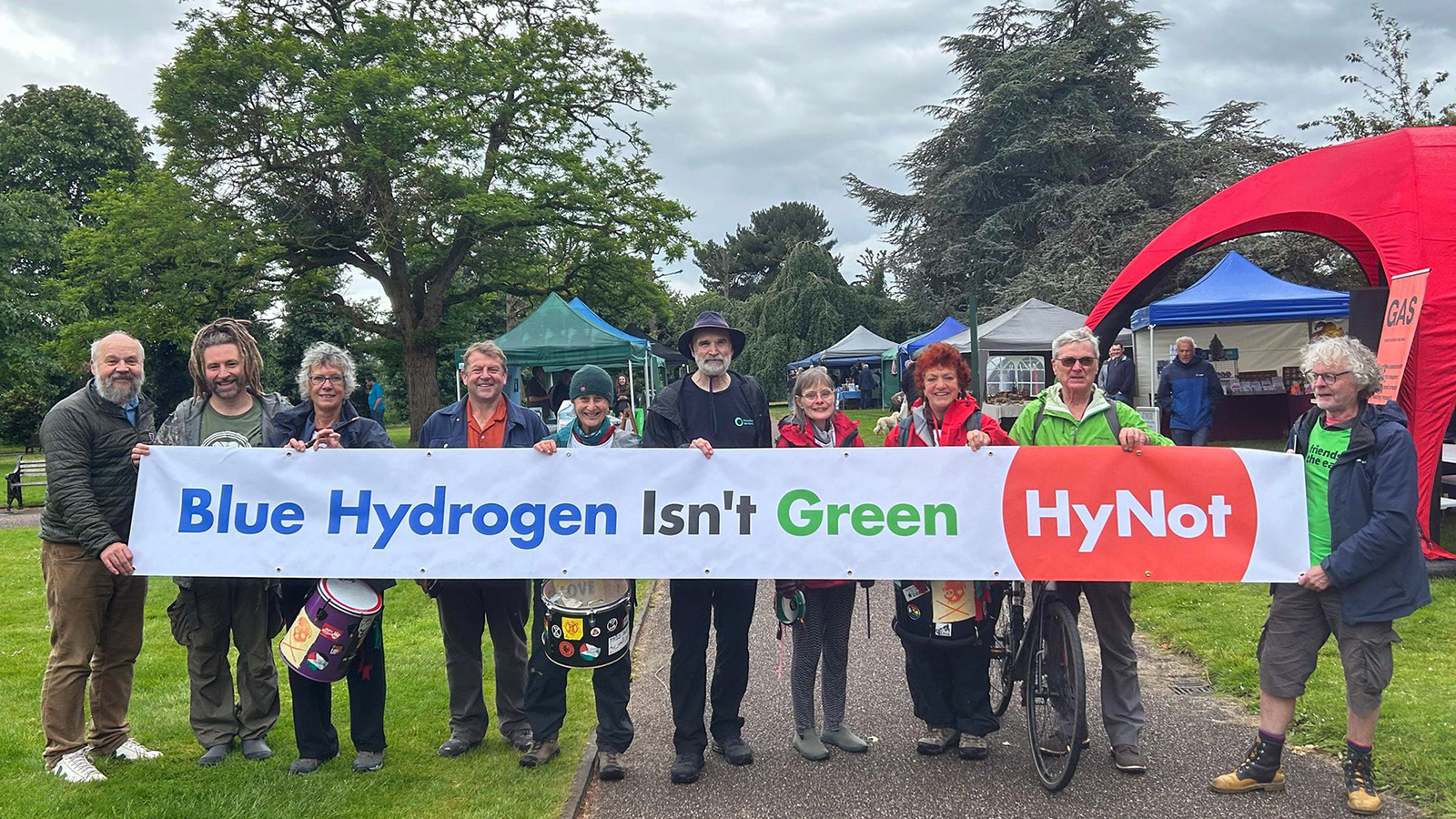
Demonstration by HyNot, which opposes hydrogen for home heating, at the Green Expo UK in Cheshire, last week. Photo from HyNot twitter feed

The Tory government has invested heavily in hydrogen, and the 2023 Energy Act provided a framework for its commercial development. But attempts to bribe communities into testing it out for home heating have hit setbacks. A planned test at Whitby, Merseyside, was cancelled last year after vigorous opposition by local residents and the HyNot campaign group. This year a second planned test at Redcar, Yorkshire, and a thirdone in Fife, Scotland, were both postponed.   

Catherine Green Watson of HyNot said: “These postponements are great progress for our campaign. But on Merseyside we still have strong local political support for hydrogen in industry, which should not be the priority. Instead, we need to concentrate on upgrading the electricity grid.”

We need a discussion in the labour movement and social movements about the social role of these technologies. We could work towards unity around the principle that they should not receive state funding that could go to quicker, more effective decarbonisation paths.

5. Energy use in our homes and transport 

Labour has scaled back its promises to invest in its Warm Homes Plan that will fund grants and low-interest loans for insulating homes and replacing gas boilers with heat pumps. Shadow energy secretary Ed Miliband last year talked about “up to £6 billion a year”; by the time Labour’s manifesto was published last week, this had shrunk to “an additional £6.6 billion over the course of the next parliament” (that is, over five years). Talk of upgrading 19 million homes had stopped; now it’s 5 million.

Labour has stuck with commitments to take railways back into public ownership, and to support municipal ownership and franchising of bus services. But it is also promising to “forge ahead with new roads”, and keep the transport system centred on private cars, at a time when researchers argue that this cuts dangerously across tackling climate change.

If Labour sticks to this course, determined by its neoliberal fiscal rules and by corporate lobbying, then key opportunities to cut UK carbon emissions, while improving people’s lives, will be missed. Researchers have been screaming for years that insulation and heat pumps, and superceding the car-centred transport system with better, cheaper public transport, are desperately needed to decarbonise homes and transport, the two largest sources of greenhouse gas emissions.

Battles on effective energy conservation in homes, transport and throughout the economy are part of the war to limit climate change.

Labour’s commitments are too timid to reverse the disasters caused by Tory policies. In the decade from 2012, annual completions of home insulation upgrades fell by nine tenths. The measures announced by government last year would take 190 years to improve the energy efficiency of the UK housing stock and 300 years to hit the government’s own targets for reducing fuel poverty, National Energy Action stated.

As for roads, the government could cancel the £10 billion Lower Thames Crossing scheme, final approval of which has been delayed until October, and apply to all future projects the principle adopted by the Welsh government – that they can only go ahead if compatible with climate policy.  

Labour may not only fail to deal with these gigantic sources of carbon emissions, but actually open up new ones. A grim example is Labour’s threat to overrule communities who question tech corporations who want to build fuel-guzzling data centres – which will help trash climate targets, to the benefit of those corporations alone.

6. Bringing the issues together

The stakes are high. Every new assessment by climate scientists underlines the conclusion reached by leading British researchers four years ago: that the UK’s decarbonisation targets are half as stringent as they need to be, to make a fair contribution to tackling global heating. The government’s own climate change committee says non-power sectors of the economy need to decarbonise four times faster than they are doing.

Tackling climate change, while reversing the effects of 14 years of neoliberal austerity policies, will not be easy. Indeed, Labour does not intend to: both decarbonisation and social policy will be subordinated to their fiscal rules.

The labour movement and social movements need to challenge and push back Labour’s pro-fossil-fuel, pro-austerity approach.  

We need to unite our forces and find the pressure points – be it saying “no”, to the Lower Thames Crossing project and similar, or finding openings for collective action, e.g. in the Local Power and Warm Homes plans.

To act effectively on climate, we need to keep in mind the necessity of holistic solutions, and reject illusory technofixes and greenwash narratives that claim to reduce emissions with one hand, and pour them into the atmosphere with the other. SP, 18 June 2024.

Eco Ableism is not the answer

Stephen McMurray argues that the climate movement needs to be a movement rooted in social justice, not one that falls into the trap of individualism and promoting policies which increase exclusion.  

With the COP conference taking place in Glasgow in Autumn 2021, there has been renewed focus on tackling climate change, particularly given the severe fires and floods which have affected many parts of the world.  There are however, concerns that policies which are aimed at reducing the emissions of greenhouse gases, may have a negative impact on the lives of people with disabilities.

Ableism is the discrimination or prejudice against people with disabilities in favour of non-disabled people. Eco ableism is defined as a failure by environmental activists to recognise that many of the climate actions they are promoting make life harder for people with disabilities.

Action to tackle climate change requires a wide range of policies and actions to reduce the emissions of greenhouse gases.  These include changing the way we travel and the way we generate and use energy. However, there is a danger that such policies could further marginalise people with disabilities.  This has been illustrated in Edinburgh, which introduced ‘Spaces for People’ in reaction to the Covid-19 pandemic.  Bollards were introduced to separate cyclists from vehicles and pavements widened.

Edinburgh Morningside: Copyright M J Richardson and licensed for reuse under this Creative Commons Licence.

Whilst improving cycling and walking routes to encourage people to cycle and walk more is vital in reducing transport emissions, there is evidence that they have made it harder for people with disabilities getting around.  Restricting parking with bollards and introducing double yellow lines has made it much harder for people with disabilities who rely on motorised vehicles to get shopping and socialise.

RNIB Scotland and the Edinburgh Access Panel have expressed serious concern over the introduction of floating bus stops, as it means that people with disabilities will have to cross cycle lanes to get on and off buses.  This is particularly worrying for people with visual impairments. 

Eco ableism is linked into the neoliberal agenda of tackling climate change by individualism.  That individual actions can influence the market and effectively tackle climate change. This ignores the reality that just 100 companies are responsible for 71% of global emissions.  Individualism can also be tied into victim blaming.  Many people with disabilities are limited in the individual actions they can take.  

There remain difficulties, for example in using public transport.  Only 80 out of 270 London Underground stations feature some form of step-free access. Furthermore, there is the issue of planning ahead to organise the wheelchair ramp and the worry that a member of staff won’t turn up on either end of the journey[ii].

With buses as well, wheelchair spaces are often taken by buggies, leading to tensions and arguments. This is despite a court ruling that drivers should ask passengers to make way for wheelchairs.   This can put wheelchair users off public transport and more reliant on private vehicles.

Much of the advice given to individuals to reduce their energy use is in the form of turning down the heating and watching what we eat.  However, many people with disabilities struggle to keep warm due to limited mobility and may require special diets, therefore reducing their choices.  A home insulation programme is desperately needed to reduce energy use and bills.  People with limited mobility should be prioritised.  

Even when it comes to electric cars, people with disabilities face challenges. Research found that there was concern in relation to; lifting the charge cable from the boot, manoeuvring the cable to the charge point, space or trip hazards around the car and charger, charging points not designed for wheelchair users and lack of public charging points.   

The challenge therefore, is to design the charging of electric cars to be accessible as possible.  There is a definite need to greatly increase the need of charging points.  Ideally, these should include disabled parking bays in the street, hospitals, GPs, supermarkets, and shopping centres.

The climate movement needs to be a movement rooted in social justice, not one that falls into the trap of individualism and promoting policies which increase exclusion.  Just as we should strive for a just transition for workers and communities, we should strive for policies that not only reduce greenhouse gas emissions, but also increase social justice and inclusion. 


This changes everything

Mike Downham reflects on discussion at a recent Scot.E3 organising meeting.

This piece began as a report on a ScotE3 discussion about its forward strategy at an organising meeting on 19th March. The meeting had been planned before COVID-19 had become the over-riding priority. By the time we met, it had. For most of us it was our first Zoom meeting.

Over the week since we met, events have moved more quickly and more significantly than in any of the 4,213 weeks I’ve been alive and aware (too young to be aware of the outbreak of World War 2, and too distracted as a medical student  to be fully aware of the Cuban Missile Crisis.). So this report has become an attempt to develop the main points which emerged from our discussion in the light of the subsequent escalation of COVID-19 – an escalation in terms of the spread of the disease, the number of deaths, Government intervention, and the response of communities and activists.

coronavirus-4833754_1920

The key points which emerged from our discussion that night were that the COVID-19 pandemic is laying bare the contradictions in the capitalist system;  and that increased consciousness of these contradictions among working-class people, already noticeable, has the potential to build to a point where those people will collectively insist on fundamental change.

What are the contradictions in the capitalist system which the pandemic is particularly exposing? Above all, the vulnerability of our health and social care infrastructure as a result of market-led policies over recent years has become blatantly obvious. The NHS has about 5,000 ventilators, and we are predicted to need around 100,000 within the next few weeks – this despite a flu pandemic exercise run by Government three years ago which pointed to the need to increase ventilator capacity. The Government took no action. On top of that it’s now widely known that the Government, as recently as a month ago, was prepared to sacrifice older people to save the shareholders. Though it became politically impossible for them to hold tightly to that strategy, it still informs their inadequate and confused public health interventions.

The economic impacts of the epidemic are likely to be as big for working-class people as the health impacts. Yet the Government’s income-support interventions have been slow to emerge, inadequate and confused. What for example is an ‘essential job’? Essential for who?

Food will inevitably become scarce soon, particularly but not only for those with least money.  The official figure for the percentage of food the UK imports is 50%. But this is a figure massaged by the inclusion of foods processed in the UK. If ingredients for the processing are included, the real figure is around 80%. A lot of that comes from Europe. Wholesale prices of the fruit and vegetables we import from Europe are rocketing in the context of the pandemic, some of them have already risen by 100%. Wherever food comes from it has to be distributed and many of the waggon drivers come from central Europe. Homegrown fruit and vegetables are threatened by the shortage of harvesters, most of whom also come from Europe.

What are the signs of increased consciousness of these contradictions? Already many people are expressing lack of confidence in the Government. That, to date, 600,000 people have responded to the call for volunteers to help the NHS is a sign that people recognise just how under-resourced the service is. At this point the Government is arguing that the scale and severity of COVID-19 was unpredictable, but as the facts emerge about their inaction in the face of what became known to them from the experience of China and other far-eastern countries, this argument will be seen through, especially by the new volunteers as they experience working at the front line. The vigorous responses of local mutual aid associations will lead to increased confidence and a growing collective consciousness about the way working class people have been failed, particularly as people lose loved ones and as their economic conditions deteriorate. Workers are standing up for their rights for protection from Coronavirus infection in their workplaces – at Moy Park poultry processing plant, Northern Ireland’s biggest employer, 1,000 workers have walked out.

ScotE3’s primary aim is to contribute to the building of a mass movement to achieve a Just Transition from North Sea oil and gas to renewable sources of energy within a timeframe which prevents catastrophic climate change. The COVID-19 pandemic, despite its devastating outcomes, which have now become inevitable, offers an opportunity for ScotE3 to support the growing consciousness of the way the capitalist system is threatening the very survival of working-class people. We can support the generalisation of that consciousness, so that it extends to an understanding of the urgency of Just Transition. As one of our members put it recently:

Oil & gas need to go the way coal went, but this time without victimising the workers and their communities…The people, if they get the facts, will not allow either the industry or the Government to lead us into a future that condemns our grandchildren.

We are well placed to continue to contribute strongly to a Just Transition movement, despite the restrictions of the pandemic, given our emphasis on providing high-quality information widely available online, and the diversity and depth of the experience of our membership. The pandemic will make it more possible for us to promote radical solutions, above all the need to replace the capitalist system. The COVID-19 pandemic should inform all our activities, the resources we work on, and the politics of the material we publish. The pandemic is the new prism through which we should view everything.


Just Transition Commission Interim Report

The Just Transition Commission began its work in 2019.   Established by Scottish Ministers its remit is to advise on how just transition principles can be applied to climate change action in Scotland.  It is tasked to complete a final report with recommendations for Scottish Ministers by January 2021.  The Commission published an interim report on 26th February 2020.

Commissio interim cover

The interim report has four main themes:

  1. Planning Ahead
  2. Public engagement
  3. Bringing equity to the heart of climate change policies
  4. Opportunities and the need for immediate action

The report notes that since the Commission began its work both the Climate Change (Emission Reduction Targets) (Scotland) Act and Scottish National Investment Bank Bill include reference to just transition principles. However, it is critical of a lack of action by the Scottish Government and highlights opportunities that have not been taken.  The closure of the coal-fired power station at Longannet is cited as a case where the local community in Kincardine contest the view of Fife Council and other agencies that the closure was well managed and socially just.

There is a strong emphasis from the Commission on the need for strategic vision that cuts across sectors and for government leadership and direction.   It contends that the task of making strategic progress across sectors

… cannot be left to enterprise agencies or indeed companies themselves. There is a crucial need for Government leadership.

Further, it argues that the Scottish Government shouldn’t wait for its  2021 report before acting, stating that

We firmly believe that all decisions taken by Government in the year ahead need to be made with a view to supporting a just transition for Scotland. We don’t want Government to wait for our final report to begin planning how a just transition will be achieved.

It notes that current planning approaches are insufficiently rigorous and suggests that all Scottish Government funded investments should be prioritised against inclusive, net-zero economy outcomes.  Planning is essential if we are to avoid the kind of unjust transition that has characterised previous major economic transitions.

While arguing for a much more proactive role for the Scottish Government the interim report doesn’t make recommendations for how a state energy company could be used to drive transition. It’s to be hoped that the final report will say more about this.

While it is critical of lack of action and leadership from the Scottish Government, the interim report is weak on the role of public ownership and democratic engagement.  The former is largely neglected while the latter is viewed in terms of  consultation – there’s no real sense that system change is on the agenda.  This is most evident in the way that the report approaches North Sea Oil and Gas.  The  oil industry’s  Vision 2035 and associated roadmap are mentioned without criticism.  The truth is that aiming for the  North Sea to become the ‘first net-zero carbon hydrocarbon basin’  means continuing extraction and carbon capture and storage on a massive scale.

‘Just Transition’ was prominent at COP24 in Katowice – developed by the workers movement and climate activists – it has been partially co-opted by corporations and government agencies.  It’s critical that the climate movement defends the radical core of the concept.  If social justice is not central to transition then it will not be possible to build the scale of social mobilisation that is needed and the risk of a climate catastrophe is magnified.  Here in Scotland we need to put social justice at the heart of our actions as we build the climate movement and mobilise for COP26.  The Just Transition Commission is asking for civil society to submit their views as it works through 2020 and prepares its recommendations for Ministers.  We should do that.  But even more important is raising the level of mobilisation so that the pressure for action becomes irresistible, system change is on the agenda and corporate greenwashing is exposed as a desperate attempt to cling on to business as usual.


Public transport use in Scotland in decline

The decision by the Scottish Government to extend free bus travel to under 19 year olds is a small but positive step.  However, the latest Transport for Scotland Report published yesterday (27th February 2020) shows that the number of bus journeys undertaken is continuing to fall while car usage is rising.  The steepest fall in bus use is in the Highlands and Islands while the decline is least in South East Scotland.  The data in the report doesn’t break down regions by public transport provider but the relatively small decline in the South East is almost certainly a result of increased numbers using publicly run Lothian Buses.

In 2107 transport accounted for 36.8% of Scotland’s total greenhouse gas emissions.  Cars were the biggest contributor accounting for almost 40% of the total.  Cutting the use of polluting car transport is a critical part of shifting to a zero carbon future.  Simply replacing petrol and diesel by electric would put huge pressure on natural resources that are in short supply and whose extraction causes major environmental damage.  The answer must surely be a comprehensive, flexible and well connected public transport system that has electric buses as a key component and is free to users.  There is good evidence that low or free fares results in a massive increase in public transport use.

800px-Lothian_Buses_Envrio400XLB_1071

One of Lothian’s new 100 seat Envrio400XLB buses.  CC-BY-SA 4.0

Solidarity with the Wet’suwet’en!

Sunday 1st March, 2pm – 3pm at the east end of Princes Street, Edinburgh (opposite Balmoral Hotel)

Scot.E3 has called a protest in solidarity with indigenous land defenders in the Wet’suwet’en territory of British Columbia.  They are protesting against the construction of a new gas pipeline across their land.  The construction project breaks the Canadian constitution, however, the protests have been met with harsh repression by Royal Canadian Mounted Police.  There has been solidarity action across Canada.

At a time of climate crisis we should be phasing out oil and gas.  The Wet’suwet’en protesters are in the front line of our common struggle for a sustainable future.

‘It’s a whole damn army up there. They’ve got guns on, they’ve got tactical gear on. They look like they’re ready for war.’
– Wet’suwet’en hereditary Chief Woos (Frank Alec).

Donate to the Unist’ot’en 2020 Legal Fund

More information at the supporter toolkit site 

Canadian Facebook Page

UK Campaign Facebook Page 

At the time of writing the Edinburgh solidarity event has been cohosted by: Friends of the Earth Scotland, Young Friends of the Earth Scotland, People and Planet Edinburgh, rs21 Scotland, Edinburgh Youth Climate Strike and Extinction Rebellion Edinburgh

There is also a protest in London at Canada House on the same day.

86376680_3023080517751404_488089137308499968_o

Climate Learning Week

UCU, NUS and other organisations have got together to produce themed resources on the climate crisis.  The aim is to get as many schools, colleges and universities as possible using the resources in the week 10th – 14th February.  The resources are relevant and useable at any time and we’ve added the link to the Resources page on this site.  If you are a student or work in education do check them out and think about how they can be used in your institution.

climate learning week

Climate emergency – a model motion

New Year 2020 is a critical time to be taking the campaign for climate action into our workplaces.  Below we’ve pasted a model motion that can be used or adapted in your own workplace context.  (You can also download a PDF here and a Word version here.  If you have already raised a similar motion in your workplace we’d love to hear about it and would be pleased to share the text (with permission) so that others can build on your experience.  We think there’s a particular case for developing clear policies in education, from school through to university, and would be really interested to get feedback on particular demands and actions for the education sector.  Please send feedback to triple.e.scot@gmail.com 

Draft model motion 

This (branch/region/committee/trades council/union/conference) notes the urgent need for action on the climate emergency, both in response to existing negative impacts such as extreme weather, fires, droughts, floods and loss of habitat and species; and to avoid the catastrophic and irreversible climate damage which people increasingly realise the world is on course for, after the 2018 Intergovernmental Panel on Climate Change (IPCC) report.

We recognise that big business, the military and the richest individuals are responsible for the vast majority of climate change, yet the global working class and poor are disproportionately at risk. A just transition (that protects the lives, livelihoods and rights of the poor and disadvantaged) to a decarbonised economy is not only right, but is the only way the movement against climate chaos will secure the mass support needed to win, and avoid a rich minority protecting themselves at the expense of the planet and the vast majority of people.

We congratulate the school students striking around the world for real climate action and welcome the decision of the TUC to support them and call for a solidarity stoppage. We note that many workers did strike on 20 September 2019, despite Britain’s repressive legislation, by campaigning to pressure employers not to apply sanctions to climate strikers.

We note that there is discussion about the possibility of making Friday 1 May 2020, traditionally International Workers’ Day, also a climate strike. We note that the UN ‘COP’ climate change conferences have become a major focus for campaigners, that COP26 will be taking place in Glasgow from 9-20 November 2020, and that many organisations are already making plans.

We resolve to:

  1. Publicly state our support and solidarity with the climate strikers and the wider movement for rapid and effective climate action
  2. Invite climate strikers to speak at our meeting
  3. Educate our members about the climate emergency
  4. Give practical support to the climate strikes, without adults taking it over. This will include asking schools and local authorities to commit to imposing no sanctions against striking students, promoting the strikes on social media, encouraging members to attend, taking our flags or banner if agreed with the strikers. If requested, it could include co-hosting events, providing sound systems, staging and stewards, using our public liability insurance, help with press releases or police liaison.
  5. Support workers joining climate strikes and maximise member involvement
  6. Work with other local labour movement and environmental organisations to arrange discussions locally and within workplaces about practically how workers and unions can learn from 20 September, join climate strikes or show solidarity
  7. Promote through the labour and climate movements the idea of making 1 May 2020 a climate strike as well as International Workers’ Day
  8. Organise to make COP26 in Glasgow, 9-20 November 2020, a major focus of campaigning for effective action on the climate emergency
  9. Call on employers and local authorities to declare a climate emergency and involve workers and communities in planning, implementing and monitoring to rapidly achieve zero carbon emissions, including ending investments in fossil fuels
  10. Call on employers to recognise union green/environmental reps and give them work time for their activities
  11. Create climate action groups at workplace level and within union structures
  12. Look for opportunities for unions, communities and the climate movement to work together, for example for improved housing and public transport
  13. Call on unions and the TUC to back the climate strikes, call and build action
  14. Call on our union to carry out a major exercise to understand the potential positive and negative impacts of the climate crisis and responses to it on employment
  15. Campaign for a legal right to strike and to repeal all legislation that makes it harder to strike over climate
  16. Discuss what climate-related demands to include in collective bargaining, including ones which could be the basis of a lawful “trade dispute” under current legislation and to call on our union to produce guidance on this
  17. Ensure that unions are visible as relevant and useful organisations within the climate movement and that participants are encouraged to join a union
  18. Demand massive public investment in the jobs required to address climate emergency, including massive improvements in renewable energy, housing and public transport
  19. Send this motion to our local trades union council, up through our union structure, and to local SNP, Labour Party and Green Party branches

DSC03423


Energy efficient housing

The announcement by Paul Wheelhouse that the Scottish government will work on new regulations to ensure that new homes use renewable or low carbon energy sources for heating is a small but welcome step in the right direction.  However, the timescale for action is disappointingly unambitious; the new measures are not planned to be implemented until 2024.  Setting a much shorter deadline would send a message to private sector builders and local authorities that ‘climate emergency’ is exactly what it says. In housing, as elsewhere, action needs to be take place on the shortest time lines possible.

Let’s up the pressure for a mass public programme of retrofitting existing houses to be energy efficient.  This is a necessary step and in addition the climate jobs and the improvements in living conditions that it would generate would have a massive impact on people’s attitude to the climate emergency and what needs to be done.  It would be just transition in practice.

Passivhaus_section_en

Passive House, Image CC BY SA 3.0

Housing and climate action

One of the workshop streams at the Scot.E3 conference in November was devoted to housing. This report is from Mike Downham who was one of the facilitators of the discussion.  

  1. Housing in Scotland is a disgrace – from the Muirhead tower blocks to new-build. A participant from Hungary, who has been in Glasgow for a year or so and has had extreme difficulties in finding somewhere to live and which is affordable to heat, said that Scotland’s housing compares very badly with Hungary’s, which at least has thick walls. “You’ve got to do something about it”.
  2. Student housing. The Universities are supplying student housing which is unaffordable except for wealthy students, mostly from the Far East, and make it difficult for most students to find less expensive accommodation. There has been a lot of public criticism about students having such high quality housing, while many citizens are homeless. But the reality is that the majority of students have huge difficulties in finding housing they can afford to rent and heat. It’s not unusual for them to end up on someone else’s sofa.
  3. Commodification of housing since 1980 is at the root of the housing crisis in Scotland. Housing policy has been primarily aimed at growing the national economy, instead of housing being recognised as a human right.
  4. What we can do together towards a just transition in Scotland’s Housing:
  • Demand that Councils bring building standards up to passive-house specifications and replace building control jobs lost in the name of austerity, without which new housing can’t be adequately inspected. These changes are perfectly feasible for Councils.
  • Put pressure on the Scottish Government to ensure that the new Scottish Investment Bank will direct enough funding to build the new houses needed (this is urgent – the Scottish Investment Bank Bill is going through parliament now).
  • Put pressure on Pension Funds to invest in housing.
  • Support grass-roots protest as demonstrated by Living Rent’s support for Muirhouse tenants, which started with door-knocking to get all tenants’ views.
  • Suggest to XR that they target some of their direct action on grass-roots projects such as Muirhouse
  • Suggest that grass-roots projects such as Muirhouse deliver their demands to the COP 26 – to both the formal and the alternative meetings.
  • Keep in our sites the eventual objective of a National Housing Company through which communities will choose the type of housing, local facilities and green species they need
  1. Climate is just one part of the wider argument – so the challenge for the Climate Movement is to build links with all other movements concerned with social injustice.
  2. “We need to close this down” – just as we would have no hesitation in doing if there was a proposal to build an asbestos factory at the end of our street. Though this was said in respect of the climate polluters, the fact that it was said in a discussion on Housing, Health and Fuel Poverty suggests that it should be our approach to all forms of social and planetary injustice.

Construction_of_the_passive_house_10_(18696022004)

Image (Construction of the Passive House) CC BY SA 2.0 from Sustainable Sanitation Alliance