Sea Change

This week has seen the publication of an important report on North Sea oil and gas.  ‘Sea Change – climate emergency, jobs and managing the phase-out of UK oil and gas extraction’.  The report is co-published by Platform, Oil Change International and Friends of the Earth Scotland. It finds that

  • The UK’s 5.7 billion barrels of oil and gas in already-operating oil and gas fields will exceed the UK’s share in relation to Paris climate goals – whereas industry and government aim to extract 20 billion barrels;
  • Recent subsidies for oil and gas extraction will add twice as much carbon to the atmosphere as the phase-out of coal power saves;
  • Given the right policies, job creation in clean energy industries will exceed affected oil and gas jobs more than threefold.

Recommendations to the UK and Scottish Governments include:

  • Stop issuing licenses and permits for new oil and gas exploration and development, and revoke undeveloped licenses;
  • Rapidly phase out all subsidies for oil and gas extraction, including tax breaks, and redirect them to fund a Just Transition;
  • Enable rapid building of the clean energy industry through fiscal and policy support to at least the extent they have provided to the oil industry, including inward investment in affected regions and communities;
  • Open formal consultations with trade unions to develop and implement a Just Transition strategy for oil-dependent regions and communities.

We hope to publish a longer review of the report in the near future.  However, in the meantime we strongly recommend downloading, reading and sharing the PDF.

2018-07-19 08.57.05


NFLA Seminar on just transition

On Friday 10th May I attended the Nuclear Free Local Authorities (NFLA) Scotland Spring Seminar in Dundee on behalf of Scot.E3. The subject of the seminar was ‘Dealing With Climate Change, Just Transition and Divestment Issues’.

The four presentations grappled with issues of just transition and sustainability from a local authority perspective:

You can use the hyperlinks to access the presentations. NFLA have also produced a useful briefing on some of these issues – ‘Climate Emergency’ Declarations and the practicalities in Local Authority Action to go ‘Carbon Neutral’

Eileen Cook

46798793304_28f8245813_z


A SHOCK TO THE SYSTEM

An Energy Policy Consultation paper – A shock to the system – the case for a publicly owned and democratically accountable Scottish energy company

In 2014 the Scottish government initiated an energy policy review. The purpose of this review was to examine the present state of Scotland’s energy economy and consider future options in the light of both a looming climate crisis and also the optimum strategy for replacing ageing fossil fuel and nuclear generating capacity with a range of renewable technologies.

In 2017 in order to ensure employment and fuel poverty issues were taken into account in this review, an infant SCOT.E3 decided to submit its own paper in an attempt to ensure that a full spectrum of related energy and environmental issues were incorporated into a memorandum of evidence.

Yet five years on and despite an almost universal acknowledgement of an accelerating climate crisis, little has been done- in practical terms- to address an impending environmental disaster and its related social and economic consequences. Also, within the intervening period, we have seen the commercial collapse of the BiFab renewable power technology company at Burntisland as well as the continued interest of the petro-chemical company Ineos in activating its shale gas fracking options to the point that it will feel confident to test the validity of the current Scottish governments ‘anti-fracking’ moratorium.

So it is against this present uncertainty that SCOT.E3 is now initiating another energy policy review to which it invites all interested parties to participate. The aim of this exercise is to re-examine the range of issues needed to be addressed; a renewable energy economy and the availability of appropriate technologies, the issue of fuel poverty and affordability of energy, energy efficiency, energy related employment and just transition possibilities regarding current energy and defence related employment, improvement of housing stock and carbon neutral public transport systems- to name but a few.

And as can be seen from the attached paper, SCOT.E3 have made a start in outlining the historical record of electricity generation and supply in Scotland in order to reinforce the case for a major stage in meeting Scotland’s forthcoming energy and environmental needs- a long promised Scottish state owned energy company.

We are therefore inviting you to participate in this exercise by adding your comments and/or contributions under the section headings so far left blank. This is to ensure that any report fully takes into account the range of opinions that truly reflect the technical and scientific know-how- as well as the concerns of environmental, community and trade union campaigns and interests engaged in these vital and urgent issues.

In order to ensure that this exercise is properly democratic, it is our intention to hold a consultative meeting for all consultees in the near future, as well as a major workshop type conference in the autumn.

We hope that you find the introductory notes both useful and of interest and we look forward to hearing from you in the near future. For any further information please contact:

SCOT.E3 at www.scote3.wordpress.com, email triple.e.scot@gmail.com 

Untitled

Notes and actions from the April organising meeting

Notes from Scot.E3 Edinburgh organising meeting180419

  • Attending PS, ZT, CM, PC, EC, BP – apologies from KW, WB, SB, MD
  • Agreed to rewrite the preamble to the article that responds to criticisms of Just Transition in the light of the new STUC statement on climate action and publish it on the blog.
  • The leaflet we distributed on the first day of the STUC in Dundee was well received.Thanks to SCND for hosting the fringe meeting on jobs, divestment and sustainability that we spoke at – about 30 people attended.  We also joined a discussion organised by the STUC with young people from recent climate action.
  • Throughout the meetingideas for further briefings/resources/blog posts came up in discussion. These included:
  • The case for taking INEOS into public ownership
  • Sustainable housing
  • Divestment, nuclear decommissioning and a sustainable future
  • Why nuclear shouldn’t be part of a just transition
  • A critical look at energy from waste schemes

If you are interested in contributing to any of these please let us know.

  • There will be a climate bloc on Edinburgh May Day (4thMay) – we are working with Friends of the Earth Scotland to build this. PC will check whether we can organise a meeting for people on it to attend afterwards possibly at the May Day Bookfair at the Leith Community Centre, Sunday 5th
  • We still need to find a couple of people who can take the Scot.E3 banner through to the Glasgow May Day march (5thMay). The banner will be on the Edinburgh march on the 4th, can anyone take the banner through to Glasgow for this given that we also have to cover the Leith event.
  • We’ve been invited to speak at the Edinburgh Green Party meeting, 7.30pm at the Augustine Church on 25thApril – PC to speak.
  • Edinburgh City Council Climate emergency meeting 25thApril, 6pm at the City Chambers Scot.E3 have been asked to host a table – WB taking responsibility for this but others welcome – you’ll need to register at this Eventbrite link https://www.eventbrite.co.uk/e/climate-emergency-action-needed-6pm-thur-25-apr-edinburgh-city-chambers-tickets-59567249246
  • Nuclear Free Local Authorities Scotland seminar on climate change, just transition and divestment issues, Dundee City Chambers, 10th May – EC going to this
  • State Energy Company

Urban change in a time of climate crisis

Housing is a central issue in the transition to a long term sustainable economy.  As a group Scot.E3 has produced resources on Fuel Poverty and we are currently working on more resources that look at how passive houses and a mass campaign of home insulation could contribute to a just transition while at the same time as improving the quality off people’s lives.  We’re pleased to publish a post by Save Leith Walk activist Ian Hood on the work that the campaign has done to think about the future of hosing in their area.
43291439955_b92aa80253_z

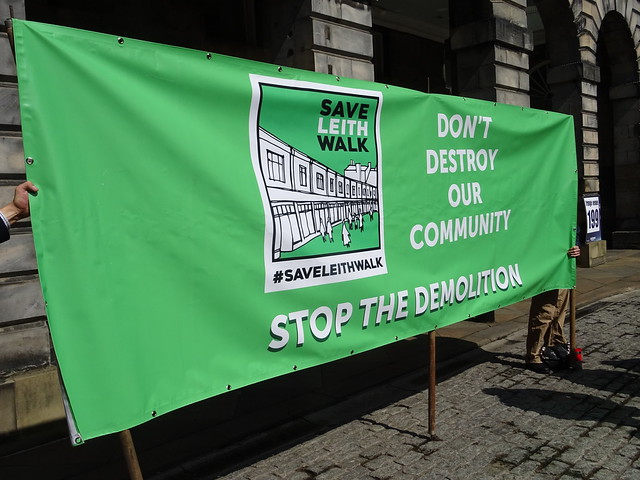
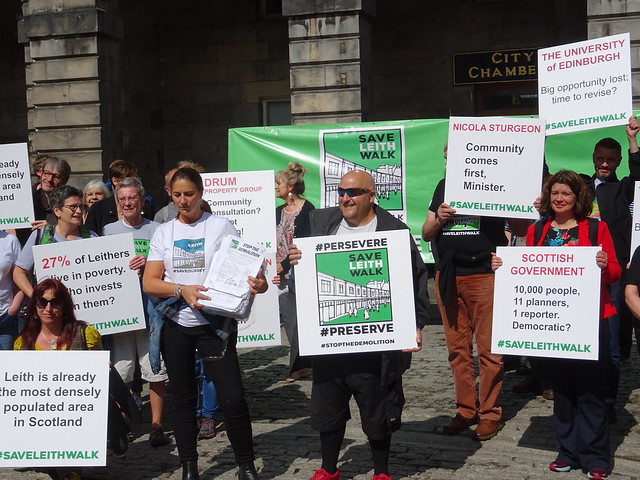
Early in 2018, it became clear that developers wanted to demolish a long parade of shops in Leith Walk and replace it with a student accommodation.  A popular local campaign emerged to challenge this and in January 2019 Edinburgh Council agreed that the building should not be demolished and that the proposed development was unacceptable.  Planning Permission was refused.

But the campaign has always been about more than just opposing the wishes of developers.  To be successful in the long run we need to promote an alternative vision, one that reflects the needs of the local community and can take it forward.

Over the last year campaign members have spoken to thousands of local workers and residents about what is important to them. We have directly canvassed the opinions of hundreds of local people about their preferences for new development in the Leith Walk area.   This was followed up by a local community planning workshop that looked at the needs and wishes of people who lived in the area.

And at the heart of the emerging view was the sense that any new development had to be both sustainable and promote strong environmental values.

We did not create a single business plan or an architectural map for developers.  We identified the three different elements that can contribute to the vision.  Sketch maps that illustrate each of these were drawn up.   The need for more social housing dominated in all of the visions and also important were business space, community support and green space.

Running through the core of the vision is the idea that ecological and environmental issues are not add ons at the end of a planning process but integral to any design.
blog image leith

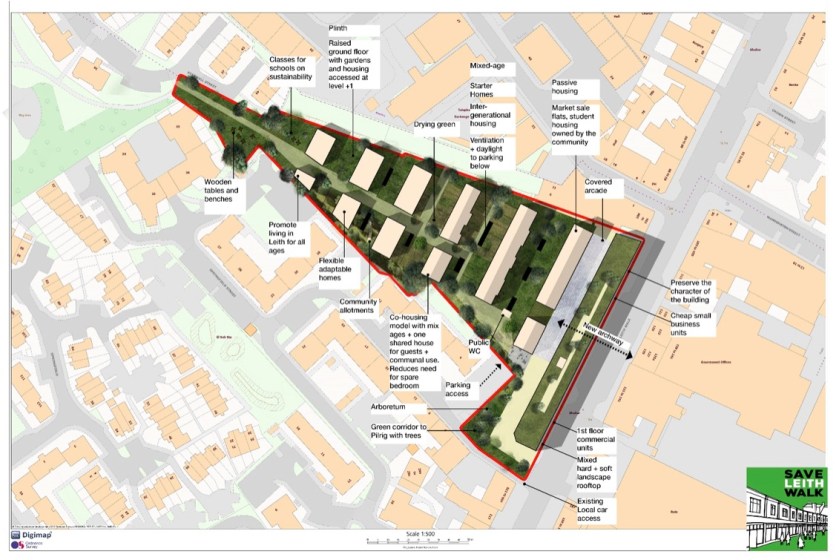
Community Housing (see image above) faces up to the long term problem of housing provision in Leith and provides a range of solutions to housing need.  Building diverse housing that allows people to live and play together strengthens our communities in fundamental ways.

  • Opening up to the Leith Walk community by creating new access through the centre of the building.
  • A covered walkway could be created at the rear of the building bringing the housing units into connection with the sandstone building.
  • Up to Eleven housing blocks in different sizes and shapes could be built in the land behind offering a range of housing opportunities including
    • Open Market homes,
    • intergenerational housing,
    • flexible and adaptable homes,
    • co-housing models
  • Designed to the Passive Housing standards making environmentally friendly homes.
  • Living walls could blend the development into the surrounding space
  • There could be a shared guest house and other community space reducing the need for spare rooms and encouraging sharing.
  • Affordable student housing owned by the community.

Community Cohesion is about strengthening community links and helping people to focus on the challenges that affect them and develop new skills to tackle them.   It can create a new vision of community where people from different racial, class, gender, age and religious backgrounds are partners in their own futures.

  • A refreshed building, made Green Energy resilient.
  • New opportunities to existing businesses and new small, low cost starter units.
  • Blocks of colony style eco homes consisting of 1, 2 and 3 bedroom flats to allow for real flexibility over time.Social housing block providing accessible housing for older people and disabled people.
  • A Community Event Centre that could offer classes and social opportunities.
  • Opportunities for beehives, public artworks, fruit trees, bench seating. And an open air market.

Community Enterprise addresses the challenge of how to create employment opportunities in Leith that meet the demands of the global market.  It recognises that businesses are stronger when cooperation and mutual support are part of a shared value basis.  Working together to create jobs, new business and entrepreneurial opportunities can transform our community.

  • The building would be refreshed, upgrading it with an accessible green roof and additional business pods.
  • The existing shops and business would be revitalised to offer opportunities to existing businesses as well as offering small, low cost starter units.
  • Design attention to wellbeing and support for locals. A community bakery could be integral part of the building to allow people to come together, to bake bread together and to share bread together.
  • A social enterprise and community space to train and share business skills including incubator units for creative, media, IT and other businesses.
  • A block of open market starter, eco homes with space for new businesses
  • Additional green space with open meadows planted with wildflowers, recreational natural green space, community orchard, accessible allotments, beehives and vegetable gardens.

Our vision seeks to build on the strength of the existing community and to create new ways of bringing people together.  They can enhance the area, preserve its diversity and inclusivity, and contribute towards Leith having a bright future in the 21stcentury.

The Stead’s Place site is too small to contain all of these solutions but we will work with other sites and local stakeholders over the next few months to develop our plans.

Urban development today in the light of a real Climate Crisis needs to work with people’s needs and not be imposed by profit seekers.   Single sites cannot be allowed to simply focus on one issue, retail, student accommodation, tourism but must integrate different part of the community’s need into a coherent vision.

We have started that work and welcome the support of others in continuing to develop this vision.

Ian Hood

Save Leith Walk

For More Information and contact us

Email:  Info@saveleithwalk.org

Web:www.saveleithwalk.org
30329970098_c74bb057ff_z

Climate Jobs and a mass movement

The Scottish Trades Union Congress is meeting in Dundee from 15th – 17th April.  We reprint the text of our leaflet here.

We have the technological knowledge to make a rapid transition to a sustainable economy.  What’s missing is political will.  The politics of transition is as critical as the technology.

Urgent action

The recent IPCC report highlights the urgent need for action.  It’s important that the Scottish Government has set up the Just Transition Commission. However, the Energy Bill and other legislation going through the parliament falls far short of what’s required.  Just transition isn’t an abstract idea.  It means understanding that working people, their lives, livelihoods, skills and commitment are central to tackling the climate crisis.

Climate Jobs

The UN and national governments around the world have put their faith in the market.  This approach has failed – carbon emissions are rising faster than at any time in human history. But there is an alternative.  The Campaign Against Climate Change’s Million Climate Jobs plan outlines a detailed practical blueprint for transition.  This would involve large scale programmes of publicly funded investment creating new jobs, protecting the livelihoods of those who will move from oil, gas and defence industriesto new jobs – Improving the lives of the bulk of the population through better insulated homes and improved public transport.

Just Transition

Only right wing ideologues now deny climate change. But beyond a relatively small layer of activists most people feel disconnected and powerless.  The challenge is to link the necessary steps to the immediacy of working class lives.  Workers in defence, construction and hydrocarbons are key. Their skills are needed to build the new and democratic economy.  Yet at present they work in sectors that have seen a huge increase in agency workers and worsening pay and conditions.

The stakes couldn’t be higher – the lives and welfare of our children and grandchildren are at stake.  Trade unions are crucial in shaping the kind of mass movement that can prevent climate catastrophe and ensure that the transition to a sustainable economy is just.

Fringe Meeting

Developing Sustainable and Socially Useful Jobs in Today’s Economy
Wednesday April 17 at 1230pm
Committee Room 2 City Chambers
Pete Roche – research officer  – Nuclear Free Local Authorities
Speaker from Scot.E3
Meeting organised by Scottish CND

scote3-sq-logo


STUC Fringe Meeting

The Scottish Trades Union Congress meets at the Caird Hall in Dundee from 15th – 17th April.  Scot.E3 is contributing to one of the fringe meetings:

Developing Sustainable and Socially Useful Jobs in Today’s Economy 
Wednesday April 17 at 1230pm
Committee Room 2 City Chambers
Pete Roche – research officer  – Nuclear Free Local Authorities
Speaker from Scot.E3
Meeting organised by Scottish CND

wind-energy-488534_1280

American Climate Rebels

A post from REEL News

In 2018, Reel News went on a 14 week tour of North America to look at grassroots struggles around climate change, particularly struggles around a “just transition” from fossil fuels to renewable energy, where workers and communities control the process so that they benefit from the transition, and around “just recovery” – recovery from extreme weather events which do not exascerbate current inequalities.

What we found were inspiring and visionary struggles all over the continent, led by working class communities of colour, with people organising just transitions and just recoveries themselves. Now, we’ll be presenting what we found in the form of a weekly online 11 episode series starting on Sunday April 14th – 7pm UK time, 3pm New York City time, Midday California time.

Episode 1 is about Alberta, Canada, where the long oil sands boom  has come to an end. Falling oil prices are leading to thousands of job losses – which has started a serious conversation in the labour movement about transitioning away from oil to renewables. The need is becoming more urgent as the big oil sands companies look to maximise profits and slash even more jobs through automation. This film looks at a number of initiatives, the history of oppression of First Nations people to get the resources in the first place, and a rare chance to hear from oil sands workers themselves, including women and First Nations workers.

With the current growing uprising over climate change giving renewed hope, we’re hoping that this will not only inspire you further – but will also help a little in putting the idea of just transition at the forefront of the movement.

First Stage Debate on the new Climate Bill

The Scottish Government’s new Climate Bill has it’s first stage debate at Holyrood on Tuesday 2nd April.  As it stands the bill is severely lacking in ambition and fails to measure up to the challenge set by the recent IPCC report.  Rather than take large scale action over the next decade the bill sets the target of a 90% cut in greenhouse gas emissions by 2050.  This is simply not good enough.  ScotE3 supports the rally outside the Parliament that has been called for 12.30pm on the 2nd.

47102675951_1f8112fcbe_z

Action points and information from the March 21st Scot.E3 meeting

Action

Climate Jobs Bloc on the Edinburgh and Glasgow May Day marches (4thMay Edinburgh, 5thMay Glasgow).  PC and KW to liaise over text of invite to unions and environmental activists to join the march.  PS has spoken to graphic designer about producing artwork for a climate jobs banner.

On Sunday May 5th there will be a Book fair at the Kirkgate Community Centre in Leith as part of the May Day events.  We could have a side room to show films/ hold discussions.  Agreed that perhaps we should have two fixed times for discussion.  REEL News may be able to attend. More details to follow.

BP explained about the ‘Lucas Plan’ group in England. We’ve been invited to speak on Just Transition at a conference in Manchester on April 13th.  BP can attend – DS may also be able to – anyone not at the meeting who is interested in going please email to let us know.

Draft of blog post responding to the GMB’s criticism of the Just Transition Commission is now complete – agreed to circulate more widely and then publish after any further amendments are made.

STUC conference in Dundee 15th – 17thApril.  We’ll speak at a joint fringe meeting with Scottish CND. Joe Pisani has agreed to speak. PC will check if it’s possible to have another contribution to say something about ScotE3.  Agreed that we should prioritise having a woman speaker for this.  Please let us know if you are going to be at the conference or can attend to help with leafleting.

We’ve been invited to speak to the Edinburgh Green Party on Climate Jobs and Just Transition on Thursday 25 April.  Agreed that it would be useful to focus on these issues in terms of local action – eg housing.   We can do this as a collective contribution rather than just one voice so if you’d be interested in helping please email.

Agreed to publicise and support the Climate Rally at the Scottish Parliament on 2ndApril, 12.30 to 2pm as MSPs discuss the new Climate Bill.

Agreed that discussion on an autumn conference should be a main agenda point at the next organising meeting

Agreed that over the next few days we would work on two new blog posts/briefings – one on the Energy from Waste Schemes that are currently being built and one on the proposed State Energy Company – if you’d like to contribute to either of these projects please email to let us know.

Information

It’s planned that the next Glasgow meeting will be a public meeting on Public ownership.

Glasgow activists are looking to source Scot.E3 tee-shirts

Recent posts on the Scot.E3 blog include ‘Reflections on BiFab’, ‘Unlocking the jobs potential of zero carbon’ and “Fuel Poverty, Energy and the fight for Climate Jobs’

After it’s first meeting future meetings of the Just Transition Commission will be on themed topics.

Next School Students Strikes are Friday 12 April