For a European strategy against the pandemic. Let’s support the initiative from science!

Just over a month ago we welcomed the establishment of the Zero Covid campaign.  Throughout 2020 we’ve published posts  looking at the challenge of organising for a just and sustainable transition at a moment when we face continuing threat from Covid 19, the likelihood of more pandemics in the future.  

With the permission of the author, Christian Zeller, we are pleased to republish an article that looks at the need to apply the principles that inform the Zero Covid campaign internationally.  It originally appeared in German and has been kindly translated by the author with further editing by Terry Conway.

On 19 December, scientists launched an international appeal for the containment of the Covd-19 pandemic throughout Europe.[1] Trade unions, liberation movements and socialist organisations should unreservedly support this call and enrich it with a socio-ecological programme of demands. On this basis and inspired by the campaign #ZeroCovid recently launched in England, Wales, and Scotland they should launch mass campaigns throughout Europe.

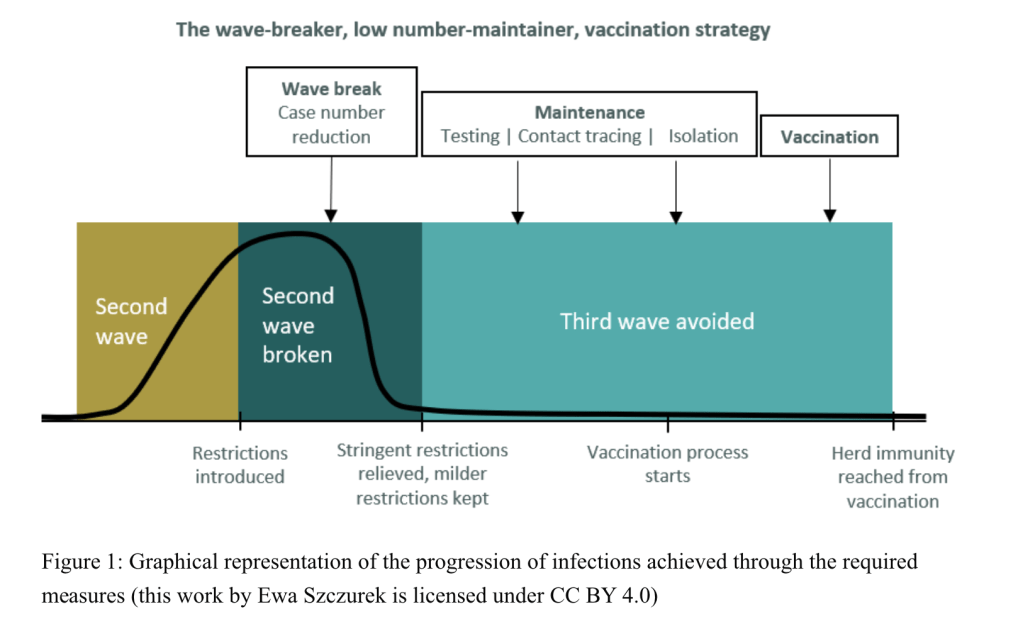
The authors of the appeal note that European governments have so far failed to formulate a common vision for dealing with the pandemic. However, in order to fight the pandemic effectively, a common European strategy is urgently needed. This is the only way to keep the borders open. The vaccines will take some time to get the pandemic under control, probably not before the end of 2021. The authors formulate a clear and immediate societal goal: every single SARS-CoV-2 infection in Europe must be traceable. To achieve this goal, the authors call for the implementation of a three-step strategy.

1. Firstly, reduce infections to a maximum of 10 Covid–19 cases per million people per day. This requires decisive action and in-depth interventions. To avoid a ping-pong effect between countries and regions, the measures to reduce the number of cases must be enforced in all European countries as quickly and as synchronised as possible.

2. Secondly, once this first step has been achieved, the restrictions can be gradually relaxed. The low case numbers must be maintained in the long term with a control strategy – at least 300 tests per million inhabitants per day. Local outbreaks must be contained immediately and vigorously, if necessary through regional lockdowns.

3. Thirdly, a common long-term vision must be developed. Context-specific regional and national action plans should be developed based on European targets. These include screening and vaccination strategies, protection of at-risk groups and support for people who are particularly affected by the pandemic.

This goal and the strategy of this appeal are to be fully supported from an ecosocialist and emancipatory perspective. Why does such a massive containment of the pandemic to only a very few infections make sense? Five arguments:

  • As the spread of a virus increases, so does the frequency of its mutation. Only with the lowest possible number of infections can mutations of the virus be kept so low that their unexpected consequences can be adequately controlled by society.
  • The ideology of herd immunity is inhuman and reactionary. The scientific evidence is overwhelming that such a strategy would lead to a social catastrophe with SARS-CoV-2. The vaccination campaigns will only achieve their effect after a significant delay towards the end of 2021. The vaccinations will take place very unevenly, geographically and socially, reflecting imperialist relations and the lack of social justice on a global scale.
  • The much-vaunted protection of at-risk groups is an illusion. In European countries, about a quarter of people belong to a high-risk group or are in close contact with people at risk (a high proportion of people over 65, workers in health and social care, family members, friends, etc.). So many people cannot be specially protected or even shielded. The course of the pandemic and the helplessness of the authorities reveal this very brutally. Moreover, it would be neither acting on the principles of solidarity nor socially appropriate, but rather extremely selective to simply isolate the sick and elderly for months or even years and exclude them from social life.
  • Only a containment of the pandemic to a very few cases would make it possible to prevent the burdens and consequential costs from being disproportionately borne by workers, the most exploited and the poor, and especially women. The radical containment of the pandemic must be a central concern of the organisations of the workers’, women’s and anti-racist movements. The pandemic is exposing class relations, gender relations and racism more starkly than ever.
  • Imperialist countries can contain the spread of the virus through technical and social means, with lockdowns, closures, and targeted restrictions. This requires social and political will. In the emerging and poor countries, especially in the huge urban agglomerations and megacities, such a radical containment strategy is almost impossible because of poverty, living conditions and lack of infrastructure. That is why imperialist countries also have a global responsibility.

It is obvious that the balance of power at this moment is not sufficient to enforce this orientation towards near eradication of the virus. Nevertheless, these arguments must be raised. An ecosocialist orientation consists precisely in overcoming the apparent economic constraints and making what seems socially unrealistic conceivable and realisable. Large sections of the left denounce the authoritarian tendencies of governments’ pandemic policies. This is of course correct. But this democratic argumentation only makes sense if one recognises the fundamental challenge of the pandemic for people’s health and at the same time defines and supports the goal of radically containing the spread of the SARS-Cov-2 virus. To insist only on individual liberties is tantamount to reactionary libertarianism. 

With the above-mentioned appeal, numerous natural and medical scientists are actively intervening in a central social debate. They are thus acting more directly politically than many trade unions and left-wing parties, which, after almost a year of the Covid-19 pandemic, have still not managed to define a clear policy about the spread of the SARS-CoV-2 virus. In order to develop joint health policy initiatives, it is useful to start a dialogue with these researchers. In Germany, some of them have already spoken out, in April and September, with valuable opinions about how to combat the pandemic.[2]
However, this appeal leaves out key social and economic concerns that need to be raised in order to make this strategy one based on solidarity and to convince working-class people of the necessary measures. Governments are expanding their repressive apparatus, forcing people to restrict their social life and at the same time doing everything to satisfy the interests of capital. The pandemic affects people extremely unequally, globally and in every society. The restrictive measures taken by governments are exacerbating social inequality and social discrimination. 

The pandemic reveals the social misery of our societies.

The foremost aim of governments’ measures so far is to defend competitiveness and thus the profitability of companies in the sectors of the economy they consider important. Covertly, most European governments have in mind the hazy goal of a slowed down herd immunity. In doing so, governments are complicit in the deaths of several hundred thousand people in Europe. Economic interests come first. Some liberal representatives of capital openly express this “balancing of interests”.

Governments have allowed and continue to allow the spread of infection until the health system is on the verge of collapse. In doing so, they deliberately plan for the physical and psychological exhaustion of health workers. They are counting on a massive vaccination campaign to end the pandemic. But this will take time and many people are sceptical about the hasty vaccination campaign. Moreover, the vaccines currently being approved have only been tested for giving immunity. It is not yet known to what extent they also prevent someone from being a carrier.

Verena Kreilinger, Winfried Wolf and I have already described in detail in our book Corona, Krise, Kapital. Plädoyer für eine solidarische Alternative in den Zeiten der Pandemie (Corona, Crisis, Capital: A plea for an alternative based on solidarity in times of pandemic) [3] the failure of the EU in the fight against the pandemic and called for a joint response based on solidarity. There has never been a European pandemic strategy. This is logical because the EU is not a community of solidarity but an institution for intensifying competition. Therefore, no solidarity-based impulses can be expected from the EU in the future. 

What is serious, however, is the failure of the trade unions and socialist parties, which have never even proposed the rudiments of a solidarity-based European pandemic strategy. Worse still, neither The Left Party in Germany nor any other socialist or left party in Europe of any weight have been able to set a clear goal for combating the pandemic in its own country. Why don’t the Left Party in Germany and similar political forces in other European countries demand clearly and simply that infections must immediately be reduced to a level so that every single infection can be traced? 

This is necessary to ensure the health of the population. Why is the workers movement unable to stand up unconditionally for the health of wage earners? Is it because the trade unions subordinate themselves to the economic interests of big companies or certain sections of the economy and fear that they cannot effectively defend workers against corporate blackmail and layoffs?

The huge health disaster is now leading a growing number of people in England, Wales, and Scotland to bring a radical perspective to the social debate. Trade unionists, social health activists and activists from various movements, as well as ecosocialists, launched a campaign in November under the slogan Zero Covid to eradicate the spread of the virus as far as possible. Socialists in Ireland also support this position. Whether this will broaden into a mass campaign remains to be seen. In any case, it makes sense for socialist organisations in other countries to take up these issues. The pan-European call by academics now offers the chance to broaden this discussion. 

Trade unions, liberation movements, and socialist organisations must unreservedly support the international initiative presented here and set out a socio-ecological programme of demands. These include:

  • Lockdowns, closures, and measures to contain the pandemic must involve all areas of society – production, transport, consumption, and leisure – based on the principles of solidarity. Areas of the economy that are not immediately necessary for society should be temporarily restricted or shut down if necessary if the restrictions help to quickly contain the spread of the virus. This is especially true for meat factories, large warehouses and all businesses where employees have to work in close proximity to each other.
  • The entire health and care sector must be expanded immediately and sustainably and strengthened with an expansion of the workforce. Wages must be raised significantly.
  • All privatisation in the health and care sector must be stopped immediately. Hospital financing based on the number of cases must be replaced by a system based on solidarity and needs.
  • There must be no rescue packages for companies that help to maintain sectors that are socially and ecologically nonsensical (e.g. the aviation and automotive industries). Instead, a socio-ecological restructuring fund should be set up to co-finance industrial conversion and decommissioning
  • Workers must be protected against unemployment. Unemployment benefits should be increased. Cultural workers and micro-enterprises must be directly supported.
  • The measures to contain the spread of the virus hit the already disadvantaged the hardest. This discrimination must be countered with appropriate measures (smaller groups in nurseries and schools, opening vacant hotels for families in overcrowded flats and for refugees, etc., see also Kreilinger, Wolf, Zeller 2020).
  • The measures to contain the pandemic must be financed by society through a solidarity levy on inheritances, large incomes and corporate profits and assets.
  • Vaccines must be a global public good for all humanity. Therefore, patents must be abolished. People in poor countries must have the same right to vaccination as people in imperialist countries. 

The trade unions should immediately initiate an open discussion process with workers in workplaces in compliance with the pandemic precautionary measures to design and implement joint steps “from below” against the pandemic in workplaces, in public transport, and at home. In dialogue with the feminist movement, refugee solidarity groups, the tenants’ movement, and the climate movement, as well as the scientific community, an effective programme to fight the pandemic based on solidarity can be developed and realised. Governments will not protect the people; the people need to protect each other both against the pandemic and against the unjust measures of governments.

Christian Zeller is the author and co-author of two recently published books in German.

Kreilinger, Verena; Wolf, Winfried und Zeller, Christian (2020): Corona, Krise, Kapital. Plädoyer für eine solidarische Alternative in Zeiten der Pandemie. Köln: Papyrossa, 277 S.
Zeller, Christian (2020): Revolution für das Klima. Warum wir eine ökosozialistische Alternative brauchen. München: Oekom Verlag, 248 S.

[1] Contain COVID-19. A joint statement of scientists from all across Europe. Calling for Pan-European commitment for rapid and sustained reduction in SARS-CoV-2 infections. 19 Decembers 2020 https://www.containcovid-pan.eu/.

[2] Kleiner, Matthias; Neugebauer, Reimund; Stratmann, Martin und Wiestler, Otmar D.: Strategies to contain the COVID-19 pandemic. A statement by the presidents of the non-university research organizations based on mathematical analyses of the data situation, April 28th 2020, Wissenschaftsgemeinschaft Gottfried Wilhelm Leibniz e.V., Fraunhofer-Gesellschaft zur Förderung der angewandten Forschung e.V., Max-Planck-Gesellschaft zur Förderung der Wissenschaften e. V., Helmholtz-Gemeinschaft Deutscher Forschungszentren e. V. https://www.helmholtz-hzi.de/fileadmin/user_upload/Aktuelles/News_Pressemitteilungen/2020/PDFs/29042020_statement_COVID-19.pdf. Meyer-Hermann, Michael; Pigeot, Iris; Priesemann, Viola und Schöbel, Anita (2020): Adaptive strategies to contain the COVID 19 epidemic. April 28th 2020, Wissenschaftsgemeinschaft Gottfried Wilhelm Leibniz e.V., Fraunhofer-Gesellschaft zur Förderung der angewandten Forschung e.V., Max-Planck-Gesellschaft zur Förderung der Wissenschaften e. V., Helmholtz-Gemeinschaft Deutscher Forschungszentren e. V. https://www.fraunhofer.de/content/dam/zv/en/press-media/2020/april/adaptive-strategies-to-contain-the-covid-19-epidemic.pdf. Kleiner, Matthias; Neugebauer, Reimund; Stratmann, Martin und Wiestler, Otmar D.: Together we can do it: Each individual contribution protects health, society, and the economy. A statement by the presidents of the non-university research organizations on the COVID-19 epidemic based on mathematical analyses of the data situation. September 24, 2020, Wissenschaftsgemeinschaft Gottfried Wilhelm Leibniz e.V., Fraunhofer-Gesellschaft zur Förderung der angewandten Forschung e.V., Max-Planck-Gesellschaft zur Förderung der Wissenschaften e. V., Helmholtz-Gemeinschaft Deutscher Forschungszentren e. V. https://www.helmholtz-hzi.de/en/news-events/news/view/article/complete/gemeinsam-koennen-wir-es-schaffen-jeder-einzelne-beitrag-schuetzt-gesundheit-gesellschaft-und-wirtsc/.

[3] Kreilinger, Verena; Wolf, Winfried und Zeller, Christian (2020): Corona, Krise, Kapital. Plädoyer für eine solidarische Alternative in Zeiten der Pandemie. Köln: Papyrossa, 277 S.

North Sea and Just Transition – let’s talk about public ownership

We republish this article with thanks from the excellent People and Nature blog (well worth following) – it has also been reposted by the Ecologist.

The UK paid Royal Dutch Shell $116 million of tax rebates in 2019, while the company reported $92.1 billion revenues in the UK for the year.

Internationally, Shell made pre-tax profits of $25.5 billion in 2019, and paid $7.8 billion income tax and $5.9 billion royalties, in dozens of countries. But the UK, France, South Africa and Indonesia handed money back to Shell.

The figures were published last month by Shell. The UK tax rebate to Shell also shows up in the UK Extractive Industries Transparency Initiative (EITI) report, published last week, along with a smaller £14.7 million tax rebate to BP.

At least the UK’s upstream oil industry as a whole paid some tax in 2019 – £1.43 billion – unlike 2015 and 2016, when the Treasury paid out more 

in rebates than it collected in tax (as shown in this earlier EITI report).

Shell and BP’s rebates are part of the hugely generous system of tax breaks for North Sea producers, linked to the decommissioning of declining oil fields (and analysed last year in the Sea Change report by Platform, Oil Change International and Friends of the Earth).

These are subsidies to fossil fuel production, running into billions of pounds, devised by a Tory government that claims to be taking action on climate change.

And the problem runs deeper. North Sea oil production has since the 1980s been taxed with profit-based, rather than resource-based, methods, which gave the international companies access to the resources in the ground on unprecedentedly favourable terms.

The central role of these tax arrangements in the neoliberal “process of redefinition of the economic frontiers of the state” was analysed in this article by Juan Carlos Boué, published by Scot.E3, the just transition campaign group. The UK tax model was promoted across the world and “destabilised many key petroleum producers, whose governments found themselves starved of fiscal income”, Boué argues.

This is all politically relevant right now, as trade unionists and environmentalists seek ways to unite to ensure a just transition away from oil and gas production on the North Sea. 

There have been some vital steps forward in recent weeks.

In September, a report compiled by Platform, Friends of the Earth Scotland and Greenpeace gave voice to North Sea workers’ views on just transition. It was based on a survey of 1383 workers, all in upstream oil and gas.

The report showed that most people who actually work on the North Sea (91% of respondents) had never even heard the term “just transition” – a reminder of the yawning gap between working people on one hand and political, academic, trade union and “left” circles on the other.

The report – which was greeted by the Rail Maritime and Transport (RMT) union – also showed that North Sea workers definitely embrace the idea of moving out of oil and gas production and into offshore wind, in particular,

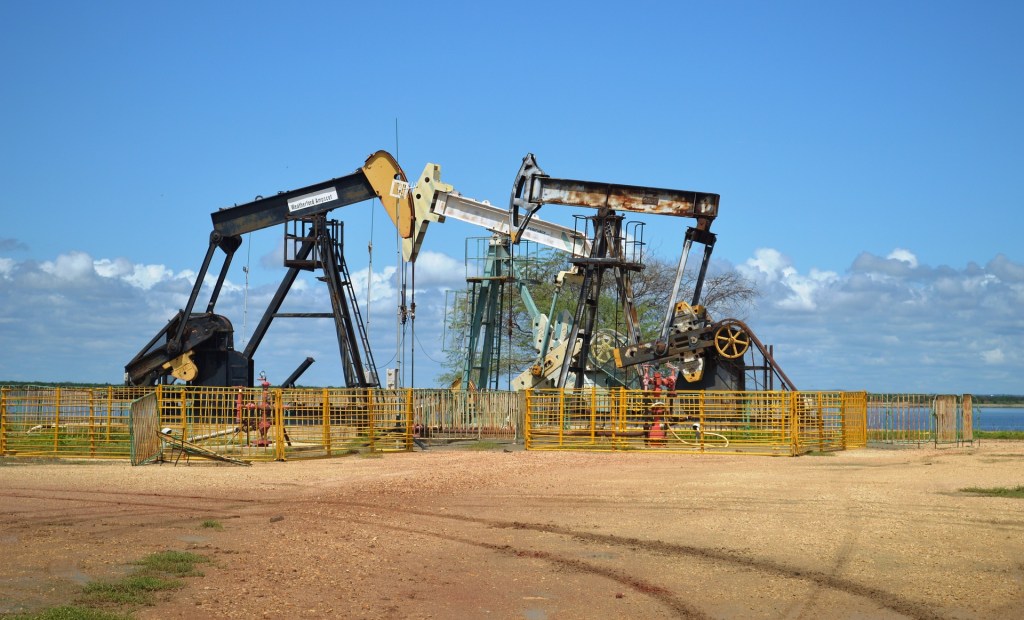
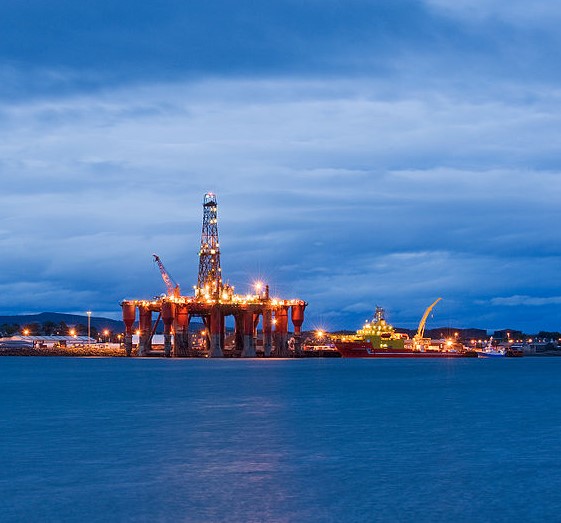
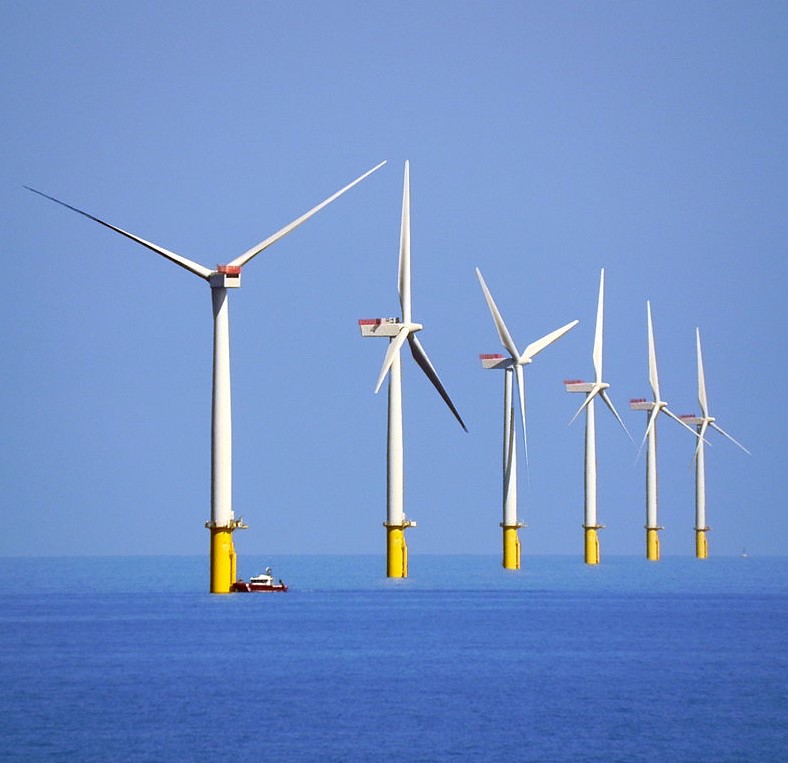
Oil and wind. Photos by Berardo62 (oil) and David Dixon / Creative Commons

and other twenty-first century ways of doing things in general. The respondents were overwhelmingly positive about retraining and moving to other industries, and offshore wind was the favourite choice.

On a webinar arranged by Platform last week, three offshore workers gave their views, together with a trade union official (Jake Molloy of the RMT), a Labour politician (Lewis MacDonald, Member of Scottish parliament) and an energy researcher (Anna Markova, Transition Economics).

The workers spoke of the hardship and demoralisation caused when the oil price falls and big companies shed labour, which they have been doing throughout the coronavirus pandemic. The high level of casualisation on the North Sea makes matters worse.

Workers who hope to move to offshore wind jobs are further aggrieved by an unjust, bureaucratic qualifications regime. They are required to pay for re-training courses from their own pockets – at the very moment when they are looking for a job and short of money. Many companies add insult to injury by requiring them to do e.g. basic safety training that covers issues they have learned over decades offshore.

The webinar provided space to reflect on what a worker-led just transition would look like. Jake Molloy of RMT pointed to the huge job, now starting, of decommissioning old oil rigs. “The steel should be recycled and used for wind turbines”, he suggested. (He said similar things when addressing the Scottish TUC recently. See this recording, at 4 hours 52 minutes.)

Such suggestions will take on meaning if they are linked to calls for public ownership, and for an end to the subsidies paid to oil and gas producers, in my view.

Only public corporations, acting in the interests of society as a whole and not for profit, would be able to act on proposals such as Molloy’s. Running down oil and gas production, and decarbonising the economy, needs integrated approaches by entities that take full account of the social and climate consequences of their actions.

Only moves towards public ownership can challenge the energy companies who see the North Sea as one part of their global operations, and use their lobbying power to mould the tax regime to their interests.

At last week’s webinar, repeated mention was made of work that could be done in the UK, e.g. building and repairing rigs and wind turbines, being done elsewhere.

There is a danger of the labour movement approaching this as a competition between workers in different places, going back along the road trod by Gordon Brown, with his notorious call for “British jobs for British workers”.

This can only feed the divisive nationalism and protectionism to which the Johnson government appeals.

A campaign for public ownership, by contrast, highlights the fact that the state can be used to challenge the power of multinational capital and constrain its exploitation of working people and of natural resources.

It highlights the fact that state action could run down oil and gas production on the North Sea, expand electricity generation from renewable sources, and develop other industries in the areas where communities now rely on employment offshore.

A campaign for public ownership to underpin a just transition could start to challenge the multinational oil companies and their accomplices in government, and unite offshore workers with school students and all those demanding rapid action to stop dangerous climate change. GL, 15 December 2020.

■ As the discussion on just transition got started in Scotland, Shell’s truth-bending claims that it is doing something about climate change have been taking a beating. Several senior executives in its renewables energy business have quit, amid what the Financial Times reported is “frustration” at the minute quantity of investment in non-carbon technologies. Two big court cases against Shell by Friends of the Earth Netherlands are close to their conclusion. The first is to compel the company to clean up the damage it has done over decades to the Niger Delta, in Nigeria, where it produces oil. The second case is aimed at forcing Shell to reduce its carbon emissions.

Further Reading

What the BiFab disaster tells us about class rule – Scot.E3

Bifab- time for action – Scot.E3

Crisis, North Sea oil and Covid 19 – Platform

North Sea oil and gas: the elephant in the room – People & Nature, October 2019

BiFab goes into administration

Yesterday the Scottish Parliament Voted by 61 Votes to 60 to condemn the government’s failure to save BiFaband calling for specific actions to save the yards.  The motion is reproduced below.  Today the firm was put into administration.

A joint statement by trade unions GMB Scotland and Unite said BiFab’s administration exposed the “myth of Scotland’s renewables revolution as well as a decade of political hypocrisy and failure, in Scotland and the rest of the UK.”

GMB Scotland secretary Gary Smith and Unite Scotland secretary Pat Rafferty added that the workers and communities dependent on the yards had “fought so hard for a future”.

The Scottish Parliament vote calls on the government to take a number of actions – including that the government produces a report by January that sets out steps to ensure future renewable work comes to Scottish fabrication yards.  If BiFab is lost it’s a tragedy for the workforce and for workers in the sector more generally.  It’s also a major setback on the path to a sustainable economy.  Transition requires skilled workers and infrastructure.  BiFab should be part of that.  

Scot.E3 has argued consistently that the only effective way to develop a serious plan for transition is through public planning and public control.  Taking BiFab into public ownership could be a first step.  One thing is clear that to get the Scottish Government to take this seriously and to respond to the motion extra parliamentary pressure is required.  A new UN report shows how the big energy companies are doubling down on fossil fuel extraction.  It’s time to turn the tide – if not now when!

See recent articles on BiFab here and here.

Photo by Pete Cannell CC0

The motion

That the Parliament believes that Scotland has the potential to lead Europe’s green energy revolution over the coming decades; further believes that, in the context of the COVID-19 pandemic and job losses, green jobs will be central to creating new employment and training opportunities across Scotland; considers that, with the support of the workforce and their trades unions, the maximum effort has to be made to secure wind farm contracts for Scottish manufacturing companies; notes that, in open competition, BiFab won a £30 million contract to build turbine jackets for the NnG North Sea wind farm, work that could have started in January 2021, but has been prevented from going ahead with this; condemns the Scottish Government’s decision to withdraw the financial guarantee that was needed to enable this work to go ahead, thus risking Scotland’s reputation as a new green investment hub, and further condemns the Scottish Government’s failure to produce any legal opinion to justify its claim that support for BiFab was against the law; calls on it to act now to secure the future of the Burntisland Methil and Arnish yards, and the jobs that depend on them; further calls on it to talk to the workforce’s representatives and to ask for the help of the UK Government through the joint working party to urgently negotiate with EDF and Saipem to find a solution that ensures that the NnG contract for eight wind turbine platforms is carried out in the yards, and, with Glasgow being the venue of the COP26 summit in December 2021, calls for a concrete plan to be published in January by the Scottish Government that ensures that future work on renewables comes to Scottish yards, and further calls on the Scottish Government to ensure that these policy commitments on renewables are part of a coherent industrial strategy for the post-COVID-19 era.

What the BiFab disaster tells us about class rule

In the first of what we hope will be a series of further perspectives on BiFab following the article we posted six days ago David Jamieson argues that capitalists and their institutions are not in a serious conflict over the failing ‘just transition‘ in Scotland. David is editor of the Conter website and his article was first published there.

The tragic saga of the BiFab yards at Burntisland, Methil and Arnish goes on – but for how much longer? The Scottish Trade Union Federation reacted with vehemence to the Scottish Government last week (24 November) “as it sneaked out a joint statement with the UK Government on pulling the plug on Bifab and breaking promises to keep unions informed of developments”. The vaunted ‘Just Transition’ has been flushed.

The first things that we learn on this recognition are obvious: capitalism will generate a chaotic response to climate change and environmental destruction, one that will only feebly mitigate its effects. Further, this transition will be organised to benefit capital, create new transnational production networks (that will damage the environment) and will be borne on the backs of workers, who will variously lose work, be exploited in the new industries, or see their communities pulverised by the collapse of old industries and the extractive qualities of the new.

Perhaps the less commonly understood are the organic links between different nodes and actors in the system. It has been common for politicians, trade unionists and activists to seek out responsibility for the industrial carnage by dividing-out responsibility between the triad of actors; the EU, the UK Government and the Scottish Government (a fourth of we count the profit seeking of the private firms).

In recent weeks Scottish Green MSP Ross Greer suggested EU state aid rules did not preclude government action to save the yards, the GMB union demanded to see the legal judgement (as well they should) the Scottish Government alleged informed them of the limits of their action. Meanwhile, Sundry Scottish nationalists repeated the now well-worn approach of blaming Westminster exclusively, while some Scottish Labour activists pretended things might be significantly different were their party in charge at Holyrood.

It’s one thing to apportion blame where it is merited. It is another to raise this portioning to a pathology, with mutually guilty actors redefined as healthy and malicious to serve a wider (but shallow) political perspective.

In one sense, it is absolutely true that EU state aid rules can be got around when the political will exists, especially when both the London and Edinburgh governments, whether they like it or not, are soon to leave the bloc. But this misunderstands the relations between the EU and its member states. The EU is not a ‘transnational’ organisation that submerges national sovereignty beneath a common project. It is an organisation of class rule, just as the national governments that operate within its structures.

As such, there is an organic unity between Brussels and London, Paris, Berlin and Athens. Brussels can expect national governments to adopt an appropriate attitude to state aid rules (varying in implementation from powerful Berlin to relative supplicant Athens with everywhere else in between) understanding that the lineage of power between these elite actors is coherent and conjoined.

In the case of Scotland and the Bifab yards, the EU provides the excuse (governments can only supply so much finance to industrial ventures under these circumstances) and the Scottish Government, aware that rules and instituted authorities are negotiable (as elsewhere on the continent – not least Germany) opts for full and grovelling supplicancy. This happens for reasons both domestic and foreign. The foreign policy terms are obvious enough – the SNP leadership wants to align an independent (and devolved) Scotland with Brussels, and wants to signal submission to rules in advance. Additionally, as is common across the EU, the Scottish Government doesn’t want to encourage demands for the protection of jobs and industries in Scotland – particularly when industries like North Sea oil are shedding jobs rapidly.

These attempts at distributing criticism to sub-factions of the ruling class have become commonplace on the left in recent years. It is this projection that has led to the abundance of adjectives before the words ‘capitalist’ and ‘capitalism’: disaster capitalists, neoliberal capitalism, late capitalism, fossil capitalism. Finance capitalism is counter-posed unhelpfully to productive capitalism. Whole new strata of ‘oligarchs’ with ‘dark money’ are constructed.

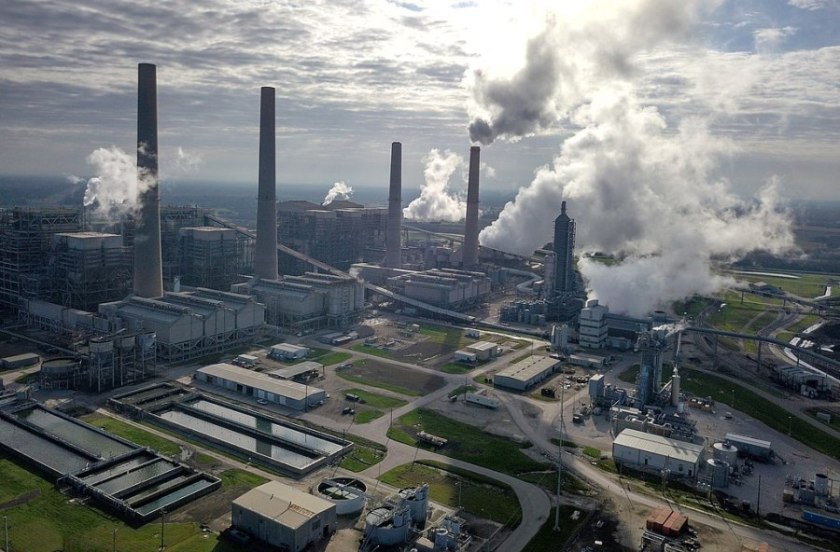
Oil refinery http://www.pixabay.com CC0

It is no bad thing that, for the purposes of analysis, we can identify sub-categories of broader class structures. But this is most often done to ignore the organic totality of the capitalist system – its highly evolved capacity to manage internal divisions and reproduce a coherent social order – and to appeal to more rational or even moral elements in the establishment.

In a recent analysis for the Guardian George Monbiot made this case explicit by distinguishing “housetrained capitalism” which “seeks an accommodation with the administrative state, and benefits from stability, predictability and the regulations that exclude dirtier and rougher competitors” from a more pernicious “warlord capitalism”. These housetrained capitalists are the same who for decades have viciously de-regulated British society, leading to an utterly dysfunctional state incapable of a robust response to the pandemic. They are the majority capitalist bloc who support the continued attacks on workers in Rishi Sunak’s latest pay freeze. But in the minds of Guardian writers they ought to be protected from a dangerous insurgency of their peers.

It’s time to take capitalism seriously. That means not separating it out into ‘bad’ and ‘good’ (or simply ‘less bad’) factions and institutional centres. The temptation to do so is a conservative one; those who no longer believe in a mass, democratic challenge from the base of society typically look up to competing factions at the pinnacle. But the fundamental division is society is not between capitalist factions marshalling vying visions of their rule, but between all the elements of their class and those who produce the wealth of society, but do not control it.

‘Green Industrial Revolution’? Not with this plan

Boris Johnson’s ten point plan has received largely uncritical responses from the main stream media. We’re pleased to repost here the Campaign Against Climate Change’s ten point response. We welcome other contributions that develop or extend this critique.

We’ve had the big announcement: Boris Johnson’s ten point plan for a ‘Green Industrial Revolution’. But following initial positive headlines, the details start trickling out. £12 billion was announced, but just £3 billion, it emerges, is new money. This is paltry. Other countries have already made much larger commitments, including Germany’s green stimulus of over €40bn and France around €35bn. 

Most importantly, how does it stack up compared to the scale of the task facing us? Two years on from the IPCC’s ground-breaking report calling for an urgent transformation of the global economy to stay within 1.5C above pre-industrial levels, global emissions are still (excluding the limited impact of the pandemic) on an upward trend. As temperatures continue to rise, sea level rise is accelerating as polar ice melts. And in the background a steady stream of records broken for ‘natural’ disasters like hurricanes and wildfires, hitting the poorest hardest. 

The UK’s carbon budgets reflect out of date targets, an 80% cut in emissions by 2050. Previous policy failure means we are nowhere near on track to even stay within these deficient targets. This latest set of announcements is therefore doubly inadequate. It leaves a major hole in meeting even these out of date commitments. However we don’t just need to close that gap. Last year the government set a new climate commitment of ‘net-zero’ carbon by 2050. In relation to this new target, the gap is even greater. But unfortunately even ‘net zero by 2050’ doesn’t cut it. We need to act even faster than 2050 to be compatible with the Paris Climate Agreement.

Meanwhile, we also face a devastating pandemic leaving in its wake widespread unemployment. Now is the time for a real climate jobs programme to tackle the climate and jobs crises.

What would a real 10 point plan to tackle the climate crisis look like?

1. A comprehensive approach

Climate change cannot be tackled as an add-on, or a piecemeal approach that takes us one step forward, two steps back. We need a commitment that every economic policy, every spending commitment, every piece of legislation, will put us on track for a safer future, not jeopardise it by locking us in to business as usual. 

If the government had really taken on board the scale of the crisis, it would be rethinking the policies of unconditional corporate bailouts, planning deregulation, aviation expansion, road building, stifling onshore wind. It would not be giving a £16.5 billion windfall to military spending.

2. Meeting the needs of both people and planet  

Austerity has left us, more than ever, with a grossly unequal society with continued deep inequalities in race, gender and for disabled people. Underfunded public services are struggling. The move towards a zero carbon society must also ensure access to food, healthcare, education, income, job security, good, affordable, housing, clean and affordable energy and heat, public transport, clean air and green spaces for everyone.

There is huge public support to ‘build back better’ as part of recovery from the pandemic, investing in public services and frontline workers. Instead, a public sector pay freeze is being mooted. These are the wrong priorities: we need huge investment and expansion in the public sector and the people who work in it. 

3. ‘New Deal’ levels of spending

Boris Johnson has tried to compare his plans to Franklin Roosevelt’s New Deal. In today’s money, Roosevelt’s spending programme amounted to about £4,300 – for every American living through the turmoil of the Great Depression. In contrast £12 billion is about £180 each.

Our own ‘One Million Climate Jobs’ report or Green New Deal plans give more of a sense of the levels of investment and ambition needed if the government is taking this seriously. Other recent analyses include an IPPR report which estimates that £33 billion a year in additional annual investment is needed to meet the government’s net zero target, creating 1.6 million jobs, including £8 billion on homes and buildings and £10.3 billion on transport.

The pandemic has shown that money can be found. It has been found for other spending, including billions to private companies for medical supply and services in contracts awarded with no oversight, regulation or transparency. These are the sums of money that now need to be directed into tackling the climate crisis, sums that can actually make an impact in reducing emissions and would truly justify the term New Deal.

4. Not relying on techno-fixes that don’t solve the problem

There are valuable technologies that help us cut waste and greenhouse gas emissions. But those we’d call ‘techno-fixes’ are a double-edged sword. Despite serious drawbacks, these pull resources away from proven solutions (for example onshore wind and solar are not even mentioned in Johnson’s plan). They often support the continuation of fossil fuel infrastructure, and give a sense of false security about the need to radically cut energy use. Boris Johnson’s ten point plan overly relies on these techno-fixes which seriously undermine any genuine and far reaching attempt to transition the economy.

There is more detail below about why we are concerned about the emphasis on hydrogen, carbon capture and storage and nuclear energy. The promotion of ‘Jet Zero’ (zero carbon flying) also hides the fact that the scope for genuine decarbonisation of aviation is limited and the pursuit of ‘sustainable aviation growth a mirage. There should be no further airport expansion in a serious plan to tackle the climate crisis. While not mentioned explicitly in this latest plan, biofuels and biomass (burning wood for power) also fall into the same category – unsustainable while subsidised as ‘green’ technology. 

5. Provide decent, well paid, secure jobs

With a wide range of sectors hit by the pandemic, unemployment is expected to rise in 2021 to levels not seen since the 1980s. The transition to a zero carbon economy needs a workforce, but opportunities are being lost even when the investment is made. Manufacturing contracts for offshore wind supply have not been used to provide work for a skilled workforce in Scotland. Instead Scottish workers who could have been making the infrastructure needed for offshore wind have been made redundant. We need a proper climate jobs strategy, not a piecemeal approach rooted in a market based thinking. A strategy which is driven by understanding of the huge transition that is needed across manufacturing, transport, agriculture, construction, insulation, managing our land and biodiversity, in training and education. And one which seeks to create well paid secure jobs across these sectors to meet this challenge.

 The difficulties and delays with the recent Green Homes Grant are a warning example of what happens without this strategic approach including workforce skills. Trade unions have a key role. There are more accidents in non-unionised offshore wind jobs than there are in offshore oil. A worker-led Just Transition is needed. As set out in the One Million Climate Jobs report, a National Climate Service could take on key aspects of the transition to zero carbon, providing well paid, secure, flexible, permanent jobs in the public sector.

6. Keep it in the ground: phase out fossil fuel extraction 

Extraordinarily, the UK’s Infrastructure Act introduced in 2015 a legal obligation to maximise economic recovery of oil and gas. It was clear then, and even clearer now that we can’t continue fossil fuel extraction. Keeping the planet safe means leaving remaining fossil fuels in the ground. 

The oil and gas industry has already been hit hard by the economic impacts of the pandemic. We need instead a just transition for oil and gas workers as part of a strategy to phase out UK fossil fuel extraction. Many of these workers could be and want to be retrained to be part of a new offshore wind industry. 

We also need an immediate end to the anomaly whereby the UK offers billions of pounds of taxpayers’ money in financial support to companies that bid for work on fossil fuel projects overseas 

7. Tackling car dependency and increasing public transport, walking and cycling

The transport sector accounts for around a third of emissions in the UK. Surface transport alone represents around a quarter of our total emissions, while air pollution is a serious health problem. So far, electric vehicles have barely made a dent (less than 2% of new car sales), while SUVs represent over 40% of new cars sold.

But this cannot be solved by a simple like-for-like switch to electric vehicles. We need a property resourced and integrated public transport system under democratic public ownership. Alongside this, we need a reallocation of road space in towns and cities away from cars to walking, cycling and public transport, and a presumption in favour of development that reduces travel.

These changes would not just benefit our climate: the social inclusion and health benefits would be huge. It is shocking that the £27 billion currently intended for road building, which will significantly worsen our climate crisis, is far more than the entire ‘green industrial revolution’ budget touted as tackling the climate crisis. 

8. Decent homes for all

We do need a programme of mass retrofitting our homes and buildings to be warm and energy-efficient, but it must be much more ambitious. We also need to be wary of corner cutting which does little other than inflate the profits of companies.  Poorly fitted cavity wall insulation has been a scandal affecting thousands of homes with damp and mould, while post-Grenfell, there are still tower blocks with unsafe cladding. This is an example of where a National Climate Service could ensure high standards of work by employing a well trained public sector workforce with the goal of delivering warm homes and energy use reduction rather than quick and easy profits at the taxpayers expense. 

It is much easier and cheaper to build homes and public or commercial buildings to near-zero carbon energy standards, than it is to retrofit. The scrapping of the Zero Carbon Homes standard in 2015 was a huge step back, and proposed new energy standards are totally inadequate. One of the major problems facing the UK is a lack of affordable housing, in particular social housing. We need to invest in jobs to ensure decent homes for all – quite literally ‘build back better’.

9. Land use and agriculture

With the UK’s biodiversity in crisis, and agriculture a significant source of greenhouse gas emissions, it is not simply a matter of ‘plant more trees’. Alongside reforestation and protecting habitats, we need to consider land ownership, the vital role of access to nature for all, even and especially in urban environments and the potential of rewilding. Meanwhile, we are still waiting for the government to take the simple step of banning peat burning, an easy climate win which appears to be being blocked by grouse shooting interests.

There is huge potential for agriculture which is better both for climate and biodiversity. The government has been remarkably reluctant to promote, for both climate and health reasons, a dietary shift to reduce meat and dairy consumption. Without forgetting, when talking about diet, that the obesity crisis still coexists with real food poverty in one of the world’s richest nations.

With food and environmental standards likely to be a casualty of post-Brexit trade deals, it is clear that our unhealthy food system also has implications for workers rights and animal welfare. The prospect of further zoonotic diseases – and future pandemics – cannot now be ignored. Land use, our food system and biodiversity have to be a key part of any climate strategy. 

10. Climate justice beyond our borders

Any real climate policy must be rooted in climate justice. This is a global problem and the UK has a historically disproportionate contribution to the climate crisis. As well as doing our fair share in reducing domestic emissions, the UK’s policies must address this historic responsibility. 

The goods we import, as well as having their own carbon footprint, may also hide ecosystem destruction and exploitation of workers. So do the deals made by UK banks, pension funds and insurance companies. There must be no ‘solutions’ for this part of the world which rest on further damage and explotation of nature and people in other parts of the world, whether that be in mineral extraction or land grabs for carbon ‘offsetting’. Solutions must be rooted in climate justice, collaboration and internationalism. 

We need a real climate jobs plan, a real Just Transition, a real Green New Deal.

Techno-fixes – what’s the problem?

Carbon capture and storage technology (CCS) has promised to make fossil fuel burning environmentally friendly by capturing carbon dioxide from the smokestack emissions of power stations or industrial plants. However, additional fossil fuel burning is needed for energy to capture the carbon. The new funding promises to bring the total government funding back to £1 billion – the same amount promised for a pilot that was suddenly cancelled at the last minute in 2015. But CCS technology still has not been successfully scaled up elsewhere, with problems of finding reliable storage for the captured CO2. Certainly for power plants it seems more an attempt to continue fossil fuel production than a significant climate solution.

Hydrogen sounds like a great idea – a fuel that when burned, produces only water. But so-called ‘blue’ hydrogen is produced from fossil fuels and requires carbon capture and storage. It has been heavily promoted by gas companies. Meanwhile green hydrogen, generated from renewables, also has significant limitations. It is approximately 4-5 times less efficient than using renewable power directly because you have to convert power to a gas and back into power, and will probably take around 10 years to generate at scale. Hydrogen may have a place in the zero carbon economy for some hard-to-decarbonise uses.  But the idea that it is a cost or energy efficient way to heat the nation’s homes – and could be rolled out in the time needed – seems far less plausible. 

Nuclear is a dangerous, unnecessary and expensive diversion which will pull away investment from safe and cheap renewable energy which could come on stream quickly.

BiFab – time for action

On November 16th, 2017, hundreds of workers at the BiFab fabrication yards in Fife marched down Edinburgh’s Royal Mile towards the Scottish Parliament in a magnificent show of determination to save their jobs.  Three years on, and despite nearly £54 million investment from the Scottish Government, the hope raised on that day lies in tatters.  BiFab could have been a milestone on the path to a zero-carbon economy.  Instead, it stands as a warning that should not be ignored. 

REEL News reported on BiFab in November 2017

In this post I tell the story of BiFab and argue for the importance of a radically different approach.

BiFab was founded in Fife in 2001.  Initially based at Burntisland, it expanded to take over the huge construction yard just up the coast at Methil and the Arnish yard on the Isle of Lewis.  The company played a significant part in fabricating platforms for the development of the west of Shetland oil and gas fields.  As demand declined it began manufacturing jackets for offshore wind installations. 

In 2016 the company won a £100 million order to manufacture jackets for the Beatrice windfarm in the Moray Firth.  The November 2017 crisis was sparked by cash flow problems linked to this contract.  At this point the company employed around 1400 workers, although notably 1200 of these were on agency contacts rather than direct employees.  All these jobs were at risk.

BiFab workers responded by occupying the yards, ensuring that no valuable equipment could be removed, and, on the 16th November, they marched on the Scottish Parliament.  The Scottish Government stepped in, providing a £15 million loan that ensured that the firm avoided going into administration.  The occupations ended and work on the jackets for Beatrice resumed.  But the relief was short lived.  The Beatrice contract was nearly complete, there was nothing else in the order book, and agency contracts were just not renewed.  The workforce was scattered to the winds.

Photo by Pete Cannell CC0

In April 2018 the Scottish Government brokered a take over of the company.  The new owners were DF Barnes, a subsidiary of the Edmonton based Canadian company DV Driver.  The Herald on Sunday has recently revealed that DV Driver obtained ownership for £1.  The Government retained a minority stake.

Since the takeover, opportunities to build jackets for major new North Sea windfarms have been up for grabs.  One of these, ‘Neart na Gaoithe’, is just a few miles off the Fife coast from the BiFab yard at Methil.  Another, Seagreen, which, when complete, will be the biggest in Scottish waters, is just a bit further north, off the coast of Angus.  But contracts have gone to overseas yards in Spain, Indonesia, the UAE and China.

So, despite a Scottish Government investment that may reach £52.4 million, BiFab is close to total collapse.  The Scottish and UK Governments argue that despite, or because, of their stake in the firm, European competition rules made it impossible for them to guarantee the BiFab bids.  

The trade unions representing BiFab workers have contested this view. The Courier newspaper noted on October 29th that 

In a legal opinion for the GMB and Unite trade unions, Lord Davidson has described the Scottish Government’s reasoning as “remarkable”, given the looming end of the Brexit transition period and suggested Scottish ministers could have deferred any decision until after Brexit on December 31.

This legal view is clearly true; however, focusing on interpretations of the law misses much more important issues.  The Scottish Government is firmly wedded to the idea that the transition to a zero-carbon economy can be carried through by private enterprise. BiFab is just one of many examples of how this approach fails.  Bids are allocated primarily on price and when the ‘cheapest’ bidder is located on the other side of the world that’s the one that’s chosen.  The fact that this results in massive carbon emissions as jackets are shipped to the coast of Scotland isn’t factored in.  Equally important the bidding system favours international companies that operate on a world stage and take no responsibility for joined up planning of transition in the local economies from which they profit.  

To achieve zero carbon, we need much shorter supply chains, so that construction, energy generation and consumption are brought much closer together.  Demanding that the manufacture of jackets and wind turbines takes place in Scotland is not about putting Scottish workers first but a necessity for the rational use of resources.  Different locations offer different combinations of renewable energy resources, but sustainable energy production is necessary everywhere.  Tackling the climate crisis requires local and global perspectives.  Climate jobs are needed in every part of the world.  It’s important to stress that while construction and energy production should be as local as possible – international solidarity requires that knowledge should be shared freely and that financial and material support is provided to countries in the global south.  This of course is the opposite of what happens now as new innovations are locked into commercial patents.  

Leaving transition to the market relies on the expectation that multiple independent decisions made by individual companies on the basis of maximising profit will achieve the goal of a zero-carbon economy.  It’s an incredibly inefficient approach.  Consider wind, a resource that’s abundant in Scotland.  There has been a rapid growth in offshore wind powered electricity generation but at the same time the numbers working in renewables in Scotland has fallen, reducing local skills and knowledge and impacting on local economies.  A partial transition but one that has been inherently unjust, and which puts obstacles in the path of the full transition that we need.

For the sake of the climate that our children will inherit and for the lives and livelihoods of the present generation there’s a pressing need for trade unionists and climate activists to campaign together for a new approach that integrates social justice with real, immediate practical actions to tackle the climate crisis.  This means:

  • Systematic planning at local and national levels to plan a rapid transition to zero carbon.
  • Large scale public investment in new democratically controlled public enterprises to implement these plans.

These demands may seem a long way off.  But we’ve seen during the pandemic that, when there’s political will, things that would have been considered impossible become possible.  Old laws are thrown out and new laws are written.  We’ve also seen how in the face of a crisis public systems deliver and private companies rake in profits and fail.  

The first and immediate step should be an emergency action plan that takes the BiFab yards into public ownership, reemploys the workforce and puts the skills and knowledge of the workers at the heart of a sustained commitment to develop the yards as hubs for the engineering initiatives that are essential to a worker led just transition.

Pete Cannell (November 25th, 2020)

Large scale investment in Carbon Capture is a dangerous diversion

This site has published a number of articles on Carbon Capture and we have also produced a two-page briefing on BECCS (Bioenergy with Carbon Capture and Storage). 

The excellent People and Nature blog has recently published a really useful addition to the debate in the form of a review of a paper on Carbon Capture and Storage by June Sekera, a public policy analyst, and Andreas Lichtenberger, an ecological economist.

Here are some headlines from the report:

Carbon dioxide removal (CDR) systems, touted as techno-fixes for global warming, usually put more greenhouse gases into the air than they take out.

Carbon capture and storage (CCS), which grabs carbon dioxide (CO2) produced by coal- or gas-fired power stations, and then uses it for enhanced oil recovery (EOR), emits between 1.4 and 4.7 tonnes of the gas for each tonne removed.

Direct air capture (DAC), which sucks CO2 from the atmosphere, emits 1.4-3.5 tonnes for each tonne it recovers, mostly from fossil fuels used to power the handful of existing projects.

And if Carbon Capture were to be used at large scale things get much worse.

To capture 1 gigatonne of CO2 (1 GtCO2, just one-fortieth of current global CO2 emissions) would need nearly twice the amount of wind and solar electricity now produced globally. The equipment would need a land area bigger than the island of Sri Lanka and a vast network of pipelines and underground storage facilities.

We strongly recommend reading the full review.

The original paper – “Assessing Carbon Capture: public policy, science and societal need”, by June Sekera, a public policy analyst, and Andreas Lichtenberger, an ecological economics researcher – is free to download on the Biophysical Economics and Sustainability web site.

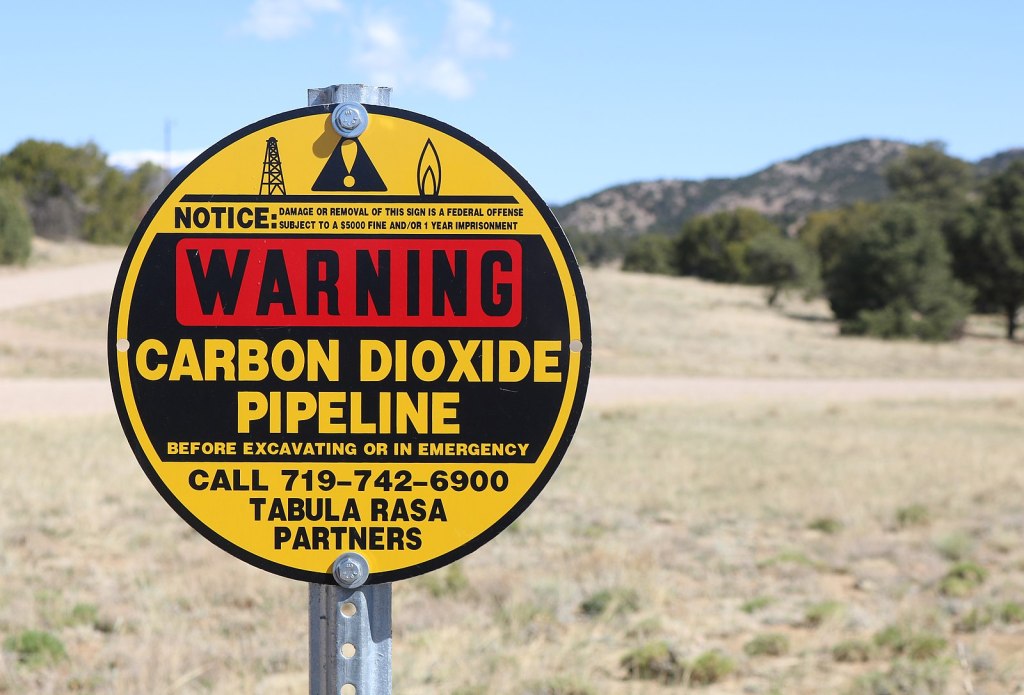
A metal sign warning of a buried carbon dioxide pipeline, located near the intersection of county roads 520 and 521 in Huerfano County, Colorado. Image by Jeffre Beall CC BY 4.0

Scotland’s North Sea Oil and Gas workers: the fight for a Just Transition: Part 2 – The Final Storm?

Oil Rig at sea during a storm (iStock).

Climate crises, Covid-19 and a looming global recession: how many more storms can the N Sea oil and gas industry take? In part one of this report, published in April 2020, Brian Parkin looked at the combined impacts of the Covid-19 pandemic and a world economic downturn on the UK offshore oil and gas industry. In this brief second paper, he looks at the emerging trends from the second half of 2020 onwards and how the global hydrocarbons sector will face up to a post-Covid-19 world in which renewables may well begin to dictate the shape of energy things to come.

50… and nearly out

The North Sea oil and gas industry, in defiance of many forecasts and expectations, is now 50 years old. At the time of its baptism, governments were obsessed with balance of payments columns as well as the commitment to the post-war social compact of an economy run at levels of full employment. It was also a shared view that with an unshakeable belief in government intervention and technological innovation, things could be done.

Initial interest in UK offshore (North Sea and UK Irish Sea sectors) lay in the deposits of natural gas and the potential for a reliable and long-term resource of energy for, initially, domestic (household) consumers. The growing estimates from c.1970 onwards also promised a resource that could be extended to industrial space heating and manufacturing processes. Regarding oil, it was clear from early chemical analysis that UKCS crude oil was unsuitable for refining into the Heavy Fuel Oil required for power generation, and so the North Sea offered nothing in the way of breaking energy dependency on indigenous coal- and the National Union of Mineworkers.

However, oil from the Forties- and a little later- the Brent fields provided an ideal crude grade suitable for refining into the required range of transport fuels. The value of this asset though, was not appreciated until the global oil shock of 1972, when a largely Arab dominated OPEC punished the Western economies for their alignment with Israel in the Yom Kippur war. 

In terms of petroleum supply security, the North sea has paid off. For the better part of half a century the UK has enjoyed near total security of indigenous supply. Apart from the 1984-85 miners’ strike when the UK government had to fuel the coal- fired power stations with Heavy Fuel Oil- which cannot be refined from North Sea crudes- almost all oil crudes (and distillates for aviation fuel)- have come from the North Sea. And even now, with North Sea oil capacity falling, the UK remains 95% petroleum self-sufficient.

Global oil … passing its prime?

As we have previously noted, all fossil fuels have been under the pressure of a climate consensus to conform to COlimits by reducing production as well as emissions from production operations. The response of the oil and gas companies as well as the OPEC cartel has been- with some success- to lobby governments as well as attempting to massage public opinion away from climate concerns. To these ends they have now failed. But as ever resourceful, the oil – and also gas – interests have been redeploying their considerable financial interest elsewhere – albeit grudgingly. After years of ‘scientific’ misinformation and fake data, the oil and gas industry faces an irreversible shift in both public opinion and scientific consensus.

At 2015 the view of the oil and gas lobby was that demand for petroleum would begin to peak in the early 2030’s – albeit tapering off slowly into the future. But by 2019 the industry had significantly changed its forecasts. Even before the combined whammy of the onset of a world economic turndown and the Covid-19 pandemic, BP, Shell, TotalDNV-GL, the IEA[1] and OPEC[2] had come to the uncomfortable conclusion that oil peak demand had already been reached. Big oil exceptions to this forecast have remained as the US giants, Exxon/Mobil and Chevron, who have both continued to set aside some $30 billion investment capital in further oil exploration and developments[3].

As early as 2016, Shell had established its New Energy Divisiona new venture into renewables generation, high capacity batteries, grid management and hydrogen. This has come at the expense of tar sands investment and shale oil extraction and refining. The company has also undertaken a major restructuring in order to free up capital investment for diversification into non-petroleum activities.

Also in October 2019, BP declared its intention to be a zero-carbon operation by 2030. And, in that year, BP entered into a $1.1 billion joint venture with Equinor Energy for the purpose of becoming a major player in offshore wind power[4]. This was with the expectation of offshore wind appreciating six-fold to 190 Gwe installed by 2030[5]. (But just to get things in proportion, the OECD now estimates that globally there will have to be a $6.3 trillion per annum investment to convert energy systems into renewables in order to meet the 1.5oC climate mitigation target for 2030[6].

The repo-man cometh

With financial data changing almost frantically day by day, it is not easy to reach a reliable estimate of the overall health of the global oil industry. Nevertheless, recent figures show the overall scene against which the North Sea industry fares. But first some raw data:

RankCountryMbpd
1USA15,043
2Saudi Arabia11,800
3Russia10,800
15Norway1,649
21UK940
Oil production million barrels per day (Mbpd) by country 2019[7] (96 producers)

The global daily production for 2019-20 was 80,622,000 bpd of which 68% was produced by the top 10 producers with an overlapping 44% produced by OPEC member states. The average output for the top 3 producers was 11 mbpd. By the beginning of 2020 the same producers had an average output of 12.3 mbpd – a significant overproduction given the emerging market conditions for the year.

With signs of a global economic recession as early as September 2019, it was clear that at 15.043 mbpd, the US was entering 2020 at a significant rate of over-production. The sustained production rate of the previous year began to depress the world traded price of oil to an unsustainably low level for many OPEC+Russia producers – hence the output war of OPEC to depress output in order to increase prices. But within weeks it was clear that such a strategy was failing – hence the output switch to increase production in order to break the back of the relatively high cost US shale oil sector.

But within weeks of this price/output war, the already global markets were hit by the Covid-19 pandemic – with the second week in April seeing the price of West Texas Intermediate (WTI) fall to minus $40 dollars per barrel. After several weeks of price bounces, the world traded price of the Brent and WTI grades settled at just below $35 per barrel. Since then a fitful recovery has seen North Sea Brent begin to trade at around $40 per barrel- a price that barely covers the combined production and development costs of c.$38 pb[8].

Much regarding the likely fortunes of the North Sea oil and gas industry was covered in the first paper[9] but if we want to examine the drive behind the global plight of the hydrocarbon industries, it would be better to look at the biggest producer and consumer of oil and gas- the USA. 

When the bottom of the oil market fell through the floor in 2014 it was the US with some 25% of its oil and gas production from shale ‘plays’ that took the greatest hit. Since then, and not without considerable help from the US Treasury, the US has bounced back to be the biggest hydrocarbon player in the world – and with a Congressional act in 2016, a net exporter of oil and gas into the world market. And prior to the combined recession/Covid crisis, even the shale extraction sector was doing well at an oil price of c.£65 pb.


http://www.sjvgeology.org/history/gushers_world.html

Immediately prior to March 2020 most US producers could break even at a $46> pb price. But in order to kick-start the many needed DUC’s (Developed but Uncompleted wells) required to maintain medium-term production, an additional $6.00 pb was required. Also, at that time it was reckoned that the bullish confidence of the industry was waning with an estimated 66% of oil company CEO’s of the view that 2020 had seen the peak in oil demand coming and going[10]. Consequently, by April the fall in demand in the US had resulted in a 20% excess in capacity with a subsequent registration in Chapter 11 bankruptcy protection orders. If we want to measure the historical scale of this default, then the post-2014 crash of 2016 would be a good comparison:

2016 oil bankruptcy debt                   $56.8 bn 

2020 oil bankruptcy to date              $89 bn

Expected 2020 debt                           $134 bn

Furthermore, on the current market estimates it is expected that a further roll-over debt of at least £100 bn can be expected to the end of the 2020-21 financial year. Also, although the number of individual bankruptcies are so far lower, the capital size per company failure is much higher. In 2016 the failures amounted to $56.8 billion. But in 2020 to date the total is $89 billion and is expected to reach $134 billion by the end of the year. And as each company has been debt financed with no failure insurance, it is reckoned that the banks would be lucky to recover 35 cents in the $US in the event of a winding-up order[11].

In conclusion, with no foreseeable growth in oil and gas demand and a totally unstable market deterring future field developments, a ‘self-levelling’ market price of <$40 pb- probably struck by the bigger OPEC members and the dominant oil companies, much of the worlds marginal reserve/high cost capacity will be squeezed out. Certainly, the crash to $35 pb is a price that even the bigger and lower cost producers would find it hard to live with. This much was revealed by the leaked news that OPEC’s leading member Saudi Arabia reckoned that a sustained price of $50 pb would be the most favourable price to 2030 in order to allow margins to cover the cost of future field developments[12].

But whatever, the enduring relationship between US big oil and the military-imperialist project is likely to see the hydrocarbon industry not go out quietly- particularly as the states of the Gulf Cooperation Council – and Exxon/Mobil insist on peak oil as far ahead as 2030. But those the Gods wish to destroy, they first make mad.

Beyond the North Sea

The economic viability of oil and gas have always been predicated on the myth that all other sources of energy are uncompetitive and/or only so in the distant future. Petroleum, of course is mainly used as a feed-stock for mainly transport fuels – crude oil for refining into petrol (gasoline) and condensates into diesel and aviation fuels.

And by far the largest contributor today of global COemissions derives from petroleum extracted transport fuels. But sticking with North Sea Brent as refined at Grangemouth (Petrochina) or Total’s Humber refineries we see the following product percentages:

Product% of crude refined[13]
Asphalt       0.7
Residues0.7>
Refinery Fuel1.85>
Liquid Natural Gas4.0
Aviation Fuel9.0
Diesel/Light Oil25.0
Petrochemicals13.0
Petrol45.0
Total Transport Fuels79.0
(It should also be noted that the Ineos plant in the Grangemouth complex processes methane for conversion into a feedstock for plastics manufacture)

Of course the fate of some 4,000 workers and their families at Grangemouth now hang in the balance with the likely demise of hydrocarbons- both as transport fuels and plastic materials.

In April 2020 the OECD anticipated a year in which at least 1 million oil and gas industry workers would lose their jobs – a calculation which must include many thousands of North Sea workers. But there does seem to be a levelling off – possibly due to a convergence of strategic thinking on the part of OPEC and the oil ‘majors’ that a sustainable price of $45 pd could be struck over the next period – a price that would strike out both the higher cost OPEC members as well as other high cost sectors such as US shale[13] and most deep water operations[14].

On the other hand, the anticipated rise in demand for more and more offshore wind capacity – ideal for Scottish waters – along with an expected Compound Annual Growth Rate of matching large scale lithium/ion battery capacity to match incoming wind/wave/tidal and solar units[15].

The future is full of dangers and hope- and if the rage generated by the threatened loss of 20,000 miners jobs in 1984 could the reproduced many times over again in order to demand a Just Transition for the threatened tens of thousands of oil and gas sector workers, then the future is full of hope.

Dr Brian Parkin, Edinburgh, November 2020.


[1] IEA- International Energy Agency

[2] Organisation of Petroleum Exporting Countries

[3] Oilprice News 10th Sept 2020

[4] Above company information Oilprice News 10th Sept 2020

[5] Bloomberg NFF Oct 2019

[6] OECD annual report 2018

[7] US Energy Information Administration (EIA) 31st March 2019

[8] UK Oil and Gas Sept 2019

[9] Brian Parkin Scot.E3 April 2020

[10] Oilprice News/Bloomberg Feb 12th 2020

[11] All figures Rystad Energy consultants October 20th 2020

[12] Irina Slav Oilprice News 5th October 2020

13] David Messeder, Bloomberg as reported in Oilprice 22nd October 2020

[14] Oilprice/Bloomberg/Wood McKenzie, May 20th as reported in Oilprice 20th May 2020

[15] Wood McKenzie 30th September 2020

The Urgency of Now – Climate Jobs and Just Transition

The Cop26 Coalition is holding a global gathering from the 12th – 16th November.  Register here.

Scot.E3’s contribution to the gathering is ‘The Urgency of Now – Climate Jobs and Just Transition’ which takes place at 6pm on the 15th November.

The Covid-19 pandemic has intensified calls for a global Green New Deal – an urgent transformation of the global economy with massive investment to tackle climate change and address inequality. But what does a just transition look like for oil workers facing immediate redundancies because of low oil prices and privatisation? And with much wider unemployment expected, how do we take the initiative to create momentum for climate jobs on a local level, creating solutions rooted in communities and a real alternative?

This workshop draws on recent research with offshore oil and gas workers in Scotland. While many are looking for better job security, they are not being given a clear path to transfer their skills to renewable energy. The oil industry in Brazil also faces insecurity due to privatisation. Meanwhile, campaigns for free public transport in Glasgow and for a mass home retrofitting programme in Leeds are challenging the piecemeal approach taken by national government and calling for investment that meets the needs of local communities and creates climate jobs ‘from the ground up’. Workshop participants are invited to bring their experiences of mobilising for a just transition and climate jobs in their own sector / community.

All events will take place on Zoom and we will email through the relevant links beforehand when you register. You can get help installing zoom here. 

Contributors
Antony Devalle (Sindipetro-RJ, Brazil), Gabi Jeliazkov (Platform), Stuart Graham (FreeOurCity), Ellen Robottom (Leeds Trade Union Council)

Hydrogen for homes is a terrible idea. We should fight it

We’re pleased to be able to repost this article by Gabriel Levy which was first published on the People and Nature blog. Do check out the People and Nature site which has a wealth of useful and informative resources and follow the site on Twitter @peoplenature

A plan to pipe hydrogen, instead of natural gas, to millions of UK households is being pushed hard by the fossil fuel industry. It sounds “green” – but could wreck efforts to make homes truly zero carbon, using insulation and electric heat pumps.

Oil and gas companies support switching the gas grid to hydrogen, as a survival option in case of decarbonisation, as hydrogen is usually fabricated from gas.

But the hydrogen strategy cuts across the approach recommended for years by housing policy wonks and architects: to use insulation to slash the amount

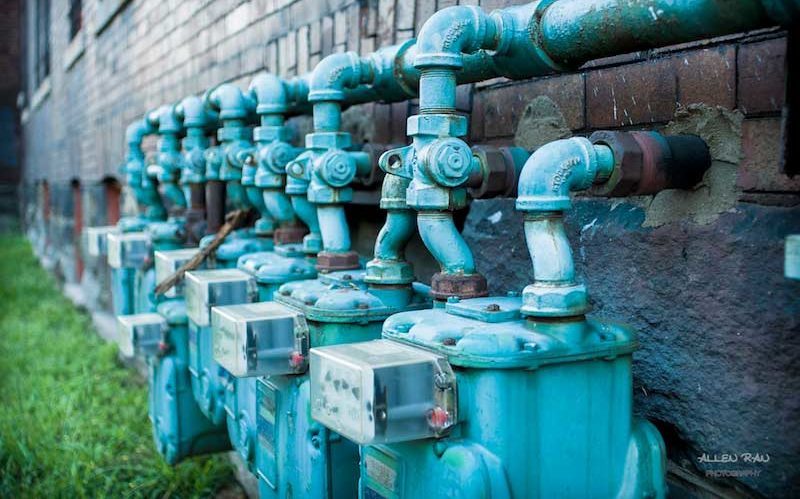
The gas grid: better to replace it with heat pumps. Photo by Ran-Allen / Creative Commons

of heat needed, and install electric pumps (which work like fridges in reverse).

Leeds Trades Union Council (TUC) last month launched a campaign in favour of retrofitting homes with high-quality insulation and heat pumps.

It’s an issue many people can unite around – those fighting for better housing and tenants’ rights, campaigners against fuel poverty, trades unionists fighting building industry cuts, and all of us who want to tackle climate change.

And there’s a choice to be made we cannot avoid.

If the gas grid is switched to hydrogen, that will block for good the electrification-and insulation approach, that heats homes better, more cheaply, with technology that we know works, and is truly zero-carbon. We cannot have it both ways.

We will be locked into extra dependency on fossil fuels, instead of speeding the shift away from them.

That gas-to-hydrogen switch is being planned in north-east England by Northern Gas Networks (NGN): its H21 project would convert 3.7 million homes and businesses by 2035, and 15.7 million by 2050. NGN is asking the government to fund an engineering study for it.

This article is a guide to the debates and to more information. It covers:

  • hydrogen and its drawbacks;
  • whole system solutions: existing technologies to decarbonise heating
  • the government’s no-strategy strategy and how we could resist it; and
  • industry lobbying.

There is a short appendix with a non-technical guide to the technologies.

Hydrogen and its drawbacks 

Hydrogen is touted as a “green” fuel internationally, because governments seek industry-friendly paths to decarbonisation, and oil and gas companies offer this false solution.

The International Energy Agency (IEA) last year published a report on hydrogen, which noted active support for it by the Chinese, Brazilian, Indian, Australian and many European governments.

In July this year, the European Commission published its “hydrogen strategy for a climate-neutral Europe”, which advocates state support for hydrogen to replace gas in industry and transport – but also mentions household heating as a possible use, as does the European Hydrogen Alliance’s declaration.

Much of this is based on a totally unproved assumption: that technology to produce zero-carbon hydrogen can be made to work at scale. That is a long way off, and may never happen. 

There are two supposedly carbon-free types of hydrogen: “blue” hydrogen made from natural gas, from which the carbon is removed and stored; and “green” hydrogen made by electrolysing water. Neither has ever been used at large scale.

At the moment, about 70 million tonnes of hydrogen is produced per year globally, and 98% of it is “grey” hydrogen, made from natural gas … without carbon capture. So it emits a huge amount of greenhouse gases – almost as much as the aviation industry. (See below for more details on the technologies.)

Large-scale “blue” or “green” hydrogen production is far away for three types of reasons.

  1. Cost. The European Commission estimates that “blue” hydrogen would cost €2 a kilogramme at today’s prices, and “green” hydrogen €2.50-€5.50/kg, compared to €1.50/kg for existing “grey” hydrogen.
  2. Technology. “Blue” hydrogen needs carbon capture and storage (CCS) technology that does not yet work at scale anywhere. Transporting hydrogen might not be the walk in the park that some companies claim, either, this presentation suggests.
  3. Resource use. “Green” hydrogen uses huge quantities of electricity and water.

Take the NGN project. It would by 2050 need 8 million tonnes of hydrogen per year, equivalent to 300 Terawatt hours (TWh) of electricity.

To supply that amount of “green” hydrogen, Friends of the Earth says,would need 140 Gigawatts (GW) of wind-powered electrolyser capacity – compared to a current total UK wind capacity of 22 GW (which supplies about one fifth of


The Sun in hydrogen light … but on earth, the hydrogen has to be released from compounds. Photo from the Science Museum

the UK’s electricity). Plus the same amount of water as is used by 1.2 million homes.

If “blue” hydrogen were used instead, 60 plants, as big as the world’s biggest, would have to be built … fitted with that CCS technology that is still in development.

I am not arguing that hydrogen – especially “green” hydrogen – could never be used, during and after the transition away from fossil fuels. But now, it is not a priority or a game-changer.

Today, most hydrogen is used in oil refining and fertiliser manufacture. Hopefully, much of this current use will disappear, along with fossil-fuelled industries. There may well be new uses, because low- or zero-carbon hydrogen might be the best substitute for fossil fuels e.g. to make steel. Hydrogen is also good for storing energy.

But why, in any sane world, would you start by searching for new ways to use hydrogen, as governments are trying to do now?

Why would you even think about using hydrogen to heat people’s homes – when technologies that work, that are already in use (retrofitting, electricity and heat pumps) could do the job better?

You wouldn’t.

Unless you were seeking ways of wringing the last few bits of profit out of oil and gas production.

Whole-systems solutions: existing technologies can decarbonise heating

There is nothing radical about proposing insulation and electric heat pumps to replace gas for households. Recent reports by the Institute for Public Policy Research (advocating a national investment programme), Friends of the Earth (reiterating the value of heat pumps against hydrogen) and the Carbon Trust (on London, arguing that “heat pumps are the primary technology choice”) make the case. For a working retrofitter’s view, see the Sure Insulation site.

Government and parliamentary reviews, too, have found that heat pumps and insulation are the way to go. (They have also looked at a hybrid heat pump system, in which a heat pump provides heat for 85% of the time, but switches to a gas boiler during colder periods.)

The government’s business and industry department (BEIS) did a big review of home heating options in 2018. It concluded that, first, there should be a “growth in no or low-regrets low carbon heating” measures, including heat pumps, biomass boilers and solar water heaters. But BEIS said that, long term, all technologies had to be looked at – and kept the hydrogen option open, by commissioning the engineering company Arup to do a feasability study.

The parliamentary Committee on Climate Change also did a big study on hydrogen in 2018, and concluded that it is “best used selectively, where it adds most value alongside widespread electrification” – and providing CCS could be got to work properly. Most urgent, the CCC pointed out, is “strategic certainty about how the decarbonisation of heat will be delivered in the UK”.

(The detailed analysis for the CCC was done at Imperial College. It showed that a hydrogen-based approach would be more expensive, especially if the aim were zero carbon, and that up-front investment makes more sense to stop emissions. There is more from Imperial on “smart and flexible heat” here.)

All this paperwork underlines that an integrated approach is needed. Buildings need to be upgraded and insulated; different types of heat pumps and different installation methods are called for; expertise and training have to be developed; in some areas, district heating networks make sense.

This is exactly the sort of thing local government has always done, and the neo-liberal assault on local government makes it harder. That’s discussed in research of heat systems governance by Janette Webb (see her articles including “New Lamps for Old”“Emerging linked ecologies for a national-scale retrofitting programme” and one on why heat decarbonisation cannot be done by markets).

The no-strategy strategy, and how to oppose it

In the face of this pile of evidence that, more than anything, home heating needs a strategy – the government has avoided adopting a strategy. It “has yet to make any firm decisions about which pathways it prefers”, this report on the Renewable Technology site explained in July.

The politics of this is very clear.

In the face of climate crisis, the government must choose between an integrated strategy, best implemented through local government, relying on existing technology … or a no-strategy strategy that takes the lead

Insulation works, and it cuts down the need for heat

from powerful private companies with unproven technology.

The no-strategy strategy fits with this government’s maniacal, neoliberal hatred of the public sector – one of its few ideological principles. That was what motivated its no-strategy strategy on coronavirus testing and tracing, with devastating results, costing tens of thousands of lives.

A heat decarbonisation strategy will have to be fought for in opposition to the government – just as health workers, scientists and others have had to fight for a coronavirus strategy.

This is why the Leeds TUC initiative, which appeals to local government to act, is welcome.

The Leeds TUC has recognised a techno-fix for what it is – damaging to society and the labour movement. Its campaign could be a focus for all who want to tackle dangerous climate change.

If you are in a trade union, an environmental campaign group or a community organisation, please discuss the Leeds TUC’s document and the actions it proposes.

If you are in a union, you could challenge trade union leaders’ support for the oil and gas industry’s hydrogen initiative.

Instead of such support, the labour movement should:

First, embrace technologies that are in society’s best interests – which for heat decarbonisation means retrofitted insulation and heat pumps;

Second, demand that firms producing filthy-dirty “grey” hydrogen take action to reduce the horrendous levels of greenhouse gas emissions they produce; and

Third, urge that future hydrogen use be limited to applications that are socially useful and don’t add to the climate crisis.

This approach could and should be part of a broader perspective of just transition, now starting to be discussed by workers on the North Seawhere the gas is produced.

Lobbying on steroids

The H21 project is at a crossroads. The companies who sponsor it – NGN, the gas network firm Cadent and the Norwegian oil company Equinor – got state funding for a series of initial reports: £9 million from the Ofgem Network Innovation Competition (NIC) in 2017, mainly to fund safety assessments; and another £6.8 million in 2019 to test the technology at a specially-built site at Spadeadam. (Update from a H21 manager here.)

But H21’s plea for a much larger dollop of state funding – £125 million, half the cost of a Front End Engineering and Design (FEED) study, originally scheduled to start this year – has not so far been heeded, despite the “urgency” explained in the H21 North of England report (available here, although temporarily (October 2020) missing).

Meanwhile, the government has announced another project – to support an industrial complex on Teesside, making “blue” hydrogen for transport – that could be an alternative source of demand for natural gas being pumped from the North Sea … and has as little as H21 to do with tackling the climate emergency.

Despite the question marks over H21, the oil and gas industry’s lobbying machine in support of hydrogen for heat decarbonisation is trundling on, with greater force than ever.

In July, the All Party Parliamentary Group on Hydrogen issued a reporturging “more ambitious” support for hydrogen, including “mandating hydrogen-ready boilers by 2025”.

And in August, the gas industry “scored a success in persuading the Environmental Audit Committee [of the House of Commons] to back its plans for using hydrogen […] in domestic heating”, the 100% Renewable UK blog reported.

The committee chair, Philip Dunne MP, deceitfully suggested that hydrogen is “the most cost-effective option” for “parts of the UK energy system”.

Tom Baxter, a chemical engineering researcher, questions the pro-hydrogen arguments in this article.

Gas network companies have also jumped on the post-Covid financing bandwagon, asking for a huge state hand-out for conversion to hydrogen. And cement manufacturers – who, like energy companies, need carbon capture and storage – have joined the queue for state funding.

These relentless lobbying efforts are funded by a range of companies including hydrogen, transport, carbon capture, gas network, engineering and chemical firms as well as oil and gas. Their greenwash proliferates through the Decarbonised Gas Alliance and Hydrogen Strategy Now.

Some good research on these lobbyists’ methods, by academics at Exeter University and Imperial College, warns of “the capacity that incumbents have to promote their storyline”.

Hydrogen. Quick technological catch-up  

Hydrogen is the most common, and lightest, element in the universe, but only exists on earth combined with other elements. People started fabricating hydrogen from compounds and using it e.g. for balloons in the nineteenth century. Today there are three main types of hydrogen:

■ “Grey” hydrogen. Fabricated by removing the hydrogen (H) from methane i.e. natural gas (CH4), or from coal. This is how 98% of hydrogen is currently made. It is extremely emissions-intensive. For every tonne of hydrogen made from gas, 10 tonnes of carbon dioxide (CO2) goes into the atmosphere;

The Petra Nova carbon capture and storage plant, recently mothballed. Photo by RM VM (creative commons)

hydrogenfor every tonne from coal, 19 tonnes of CO2.

The 70m tonnes of hydrogen produced in 2018 caused 830m tonnes of CO2 emissions, the IEA calculated. That’s a healthy chunk of the world total of 42 billion tonnes – about  the same as total emissions from Indonesia plus the UK – and nearly as much as the global aviation industry, which emitted 915m tonnes in 2019.

Most hydrogen produced now is used for oil refining, and ammonia production to make chemical fertilisers. Some is used as part of synthetic gas products, mainly for manufacturing steel, or methanol.

■ “Blue” hydrogen. In this process, instead of CO2 being emitted into the atmosphere, it is captured and stored. The capture process, steam reformation, is straightforward for about 70% of the emissions and gets really tricky above and beyond about 85%.

Steam reformation splits methane into CO2 and synthetic gas (carbon monoxide plus hydrogen); in the second stage, the synthetic gas is mixed with steam; more CO2 is removed and hydrogen produced. Other similar processes are partial oxidation, which uses oxygen in the air as an oxidant instead of steam, and autothermal reforming, which combines both methods.

Note on carbon capture and storage. This can also be used in gas- and coal-fired power stations. Usually the carbon is captured after the fuel has been burned. Then, as with carbon from hydrogen production, it has to be transported and stored. CCS has been in development for about 40 years, but there are still only 20 projects in development in the world. Only two of these ever actually functioned, and one of those two (Petra Nova in Texas) was mothballed in August. (A good analysis is here.) CCS is greenwashed as the key to “green power”. Some politicians, and some international climate talks documentation, claim that bioenergy with CCS could play a big role in global decarbonisation, but climate scientists and engineers think that is nonsense.

■ “Green” hydrogen. Produced by electrolysis of water. The electricity could come from fossil fuels (in which case it would not be green), nuclear power or renewables. The process is proven, but is very energy intensive and very inefficient.

If electricity from renewables were to be used, this could be the most “carbon light” way of producing hydrogen. But huge targets for “green” hydrogen production are sometimes published without being reconciled with other huge targets for renewably-produced electricity. Is producing hydrogen ever going to be the best way to use this electricity? The IEA says that just to produce the 70m tonnes of hydrogen the world economy uses annually would need 3600 TWh of electricity, more than total European consumption. The electrolysis also needs huge amounts of water – 9 litres for each kilo of hydrogen.

Gazprom, the Russian gas company, sees potential in producing hydrogen by methane pyrolysis, a related technology. GL, 30 October 2020.

Find out more about the Leeds TUC initiative:

■ Retrofit Leeds homes with high-quality insulation and heat pumps:  a plan and call to action, by Leeds TUC

■ Leeds trade unionists: zero carbon homes can help tackle climate change, by People & Nature