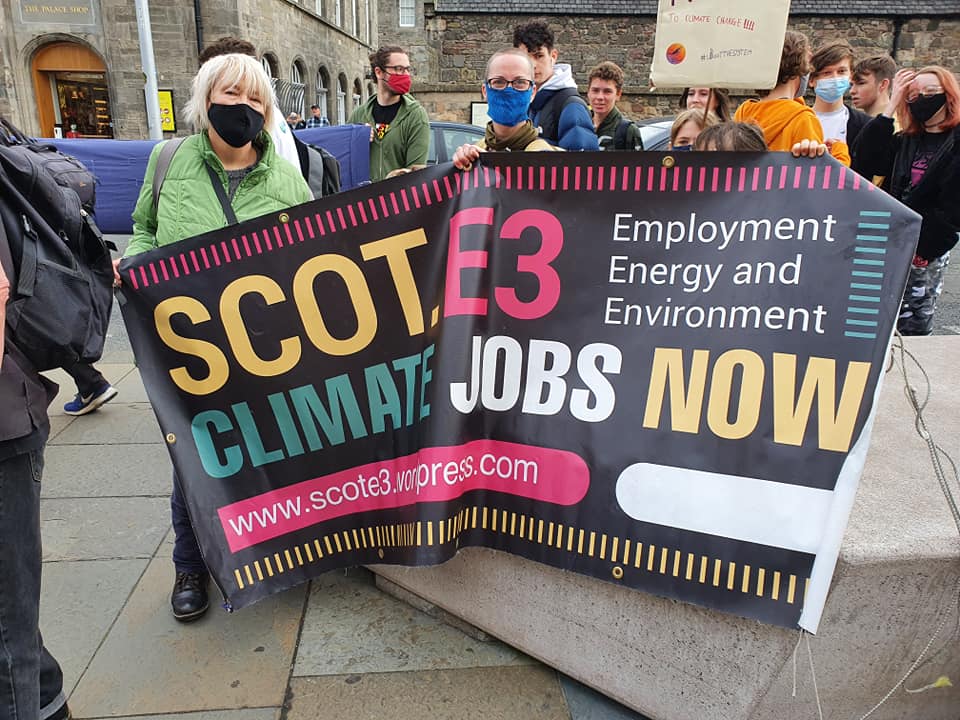
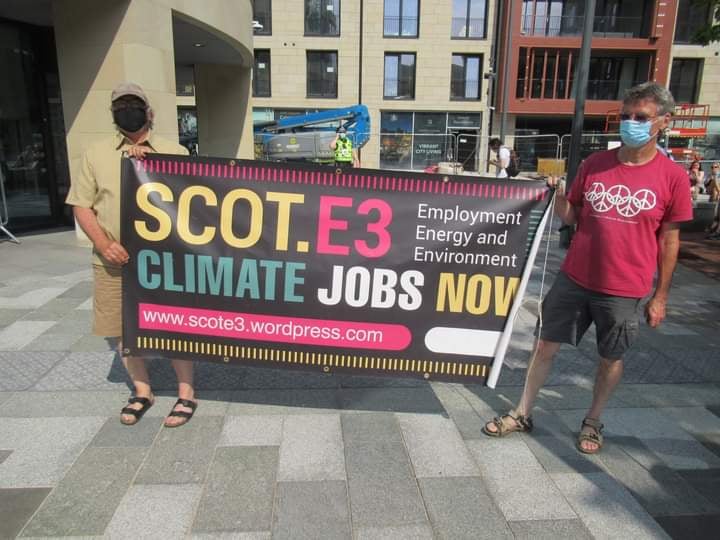
Scot.E3 is collaborating with other climate jobs campaigns to organise this event at 415pm on November 9th at COP26
There are currently over a dozen national climate jobs campaigns around the world, as well as further green new deal proposals. The articulation between the climate justice movement and the labour movement is, at this moment, still in its early steps and the pandemic has not promoted any sort of coalescence. The Corona Crisis is not an external event, but part of capitalist over-consumption of nature. Climate jobs are therefore one of the key components of any programatic and political alliance between climate and workers movements. Capitalism has no plan but collapse, so we need a plan from below. To overcome the climate crisis we need a political program for society, and workers in all sectors need to be involved in shaping a livable future for humanity, which will take a lot of work!
November 9
4:15 pm UTC+0
Albany Centre. 44 Ashley Street, Glasgow, G3 6DS United Kingdom
Contributors:
Emma Cockburn (Scot3E – Scotland),
Nuria Blázquez (Ecologistas en Acción – Spain),
Jonathan Neale (One Million Climate Jobs – UK),
João Camargo (Global Climate Jobs / Empregos para o Clima – Portugal)
Online:
Josua Mata (Sentro – Philippines)
Julia Kaiser (Students for Future, TV N 2020 – Germany)
Jean-Claude Simon (Transform Europe! – Denmark)
Ditthi Bhattacharya (New Trade Union Initiative – India)
Alongside our friends from the Portuguese Climate Jobs campaign Climaximo , and a host of other organisations, Scot.E3 is supporting the Fifth International Ecosocialist Encounters conference which takes place in Lisbon from 21st to 23rd January 2022.
Find out more on the conference website – but here’s the brief description.
The climate crisis is worsening before our eyes at an accelerating pace.
While the flames of overwhelming fires consume our earth, more and more people are getting expelled from their lands so that extractive and emissions increasing projects can take place, pushing us towards the abyss of climate chaos. As heat waves are getting more intense all around the world, increasingly more people are left in unemployment and precariousness due to the escalating economic and social crisis that the capitalist management of the pandemic worsened. As the seas rise and climate catastrophes such as violent storms, droughts and hurricanes threaten even more populations, the violence towards the already marginalized bodies of our societies increases and access to essential services, such as housing, energy, food, health and water keeps being denied, giving place to the accumulation of profit instead of securing life.
The newest IPCC report confirms what we already knew: in less than two decades we will reach the 1.5ºC temperature limit of global warming whereupon the worst climate phenomena become even more uncontrollable, unless we take urgent and drastic action now.
Capitalist elites keep applying the same profit accumulation mechanisms that have led us here in the first place, creating the illusion that something is being done to fight the climate crisis while taking advantage of all these crisis as new opportunities to amplify profit, militarize and privatize essential life services.
We did not create this scenario nor did we choose to be living in the major civilizational crisis of our times, but we do have the responsibility to stop the climate crisis, leaving no one behind.
If decades of worsening climate, economic and social crisis created by capitalist business as usual have taught us anything, it is that we ourselves have to assume the political and social mission of reaching climate and social justice on the deadline defined by the climate science.
Since 2014, ecosocialists, ecofeminists, peasants, trade unionists, several social movements and political organizations have been gathering on the international ecosocialist encounters to collectively imagine and set in motion an ecosocialist alternative to the abyss towards which the capitalism and climate collapse push us. In 2018, we started from the understanding of ecosocialism as a critical political theory and practice, which sets itself the joint task of dismantling capitalism, productivism and inequality, and constructing the alternative that can produce ecosocial justice. It does so by addressing at the same time the crucial issues of the purpose of economy and work, of production and social reproduction, the ownership of the means of production, the sharing of essential commons and solidar democratic decision-making. At the same time, it bears in mind the restoration of our wounded ecosystems.
In 2022, on the 5th International Ecosocialist Encounters, we start from all this understandings to seek more answers and collectively built a stronger international articulation, capable of fighting the major crisis of our times.
Together we will envision the ecosocialist world we need, starting to shape with which tools and strategies we can achieve it.
Stephen McMurray argues that the climate movement needs to be a movement rooted in social justice, not one that falls into the trap of individualism and promoting policies which increase exclusion.
With the COP conference taking place in Glasgow in Autumn 2021, there has been renewed focus on tackling climate change, particularly given the severe fires and floods which have affected many parts of the world. There are however, concerns that policies which are aimed at reducing the emissions of greenhouse gases, may have a negative impact on the lives of people with disabilities.
Ableism is the discrimination or prejudice against people with disabilities in favour of non-disabled people. Eco ableism is defined as a failure by environmental activists to recognise that many of the climate actions they are promoting make life harder for people with disabilities.
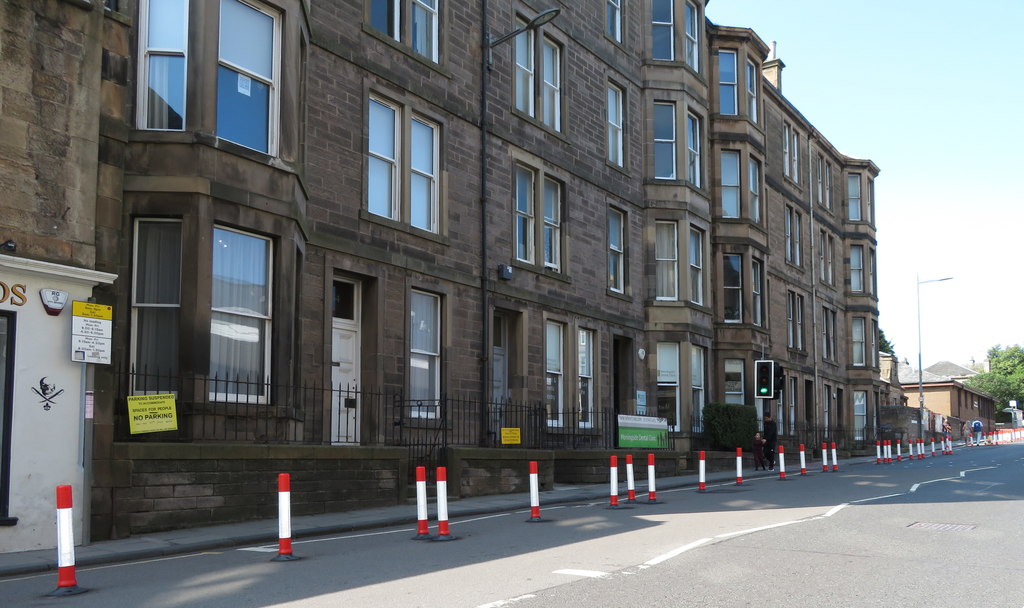
Action to tackle climate change requires a wide range of policies and actions to reduce the emissions of greenhouse gases. These include changing the way we travel and the way we generate and use energy. However, there is a danger that such policies could further marginalise people with disabilities. This has been illustrated in Edinburgh, which introduced ‘Spaces for People’ in reaction to the Covid-19 pandemic. Bollards were introduced to separate cyclists from vehicles and pavements widened.
Whilst improving cycling and walking routes to encourage people to cycle and walk more is vital in reducing transport emissions, there is evidence that they have made it harder for people with disabilities getting around. Restricting parking with bollards and introducing double yellow lines has made it much harder for people with disabilities who rely on motorised vehicles to get shopping and socialise.
RNIB Scotland and the Edinburgh Access Panel have expressed serious concern over the introduction of floating bus stops, as it means that people with disabilities will have to cross cycle lanes to get on and off buses. This is particularly worrying for people with visual impairments.
Eco ableism is linked into the neoliberal agenda of tackling climate change by individualism. That individual actions can influence the market and effectively tackle climate change. This ignores the reality that just 100 companies are responsible for 71% of global emissions. Individualism can also be tied into victim blaming. Many people with disabilities are limited in the individual actions they can take.
With buses as well, wheelchair spaces are often taken by buggies, leading to tensions and arguments. This is despite a court ruling that drivers should ask passengers to make way for wheelchairs. This can put wheelchair users off public transport and more reliant on private vehicles.
Much of the advice given to individuals to reduce their energy use is in the form of turning down the heating and watching what we eat. However, many people with disabilities struggle to keep warm due to limited mobility and may require special diets, therefore reducing their choices. A home insulation programme is desperately needed to reduce energy use and bills. People with limited mobility should be prioritised.
Even when it comes to electric cars, people with disabilities face challenges. Research found that there was concern in relation to; lifting the charge cable from the boot, manoeuvring the cable to the charge point, space or trip hazards around the car and charger, charging points not designed for wheelchair users and lack of public charging points.
The challenge therefore, is to design the charging of electric cars to be accessible as possible. There is a definite need to greatly increase the need of charging points. Ideally, these should include disabled parking bays in the street, hospitals, GPs, supermarkets, and shopping centres.
The climate movement needs to be a movement rooted in social justice, not one that falls into the trap of individualism and promoting policies which increase exclusion. Just as we should strive for a just transition for workers and communities, we should strive for policies that not only reduce greenhouse gas emissions, but also increase social justice and inclusion.
Scot.E3 has endorsed this campaign to repeal the anti trade union laws:
Workers need the right to strike for climate justice – repeal the anti-union laws** A joint statement from Earth Strike: Empower the Unions and Free Our Unions. Please add your or your organisation’s name! **
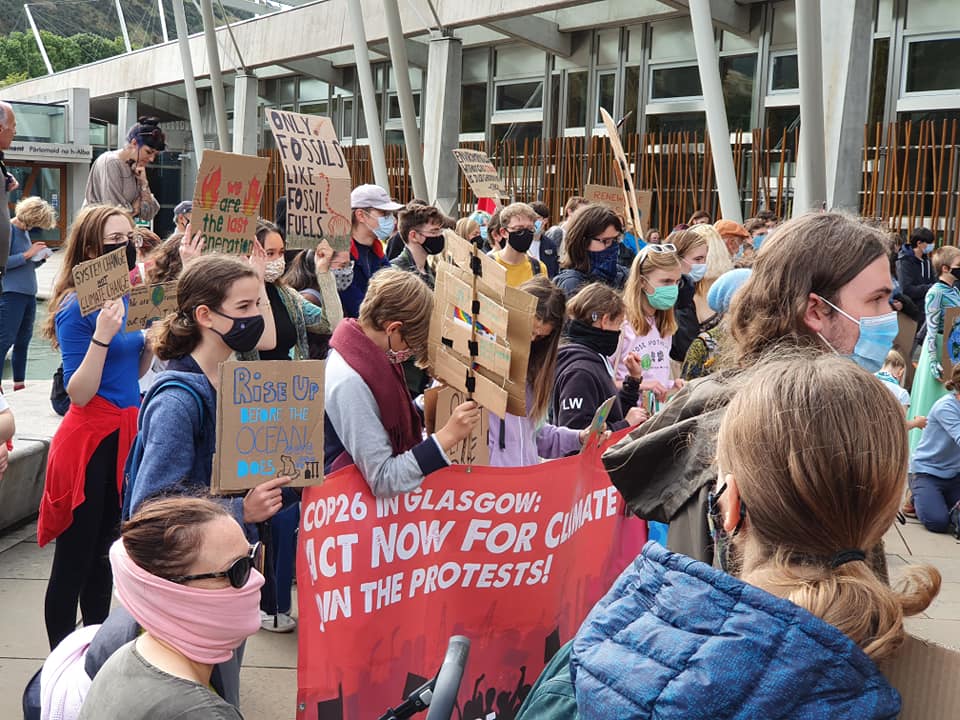
On 24 September, young people around the world struck for the climate. The youth climate strikes are vibrant and inspiring. They are also powerful: because they are defiant, because they are disruptive, because they are young people leveraging their collective power. Most of the strikers are too young to vote or hold political office, but by striking they are exercising power.
We want workers of all ages to follow the youth strikers’ lead. Workers have huge power, we need to use it! We need workers’ action to defend ourselves against the environmental dangers and deteriorating conditions brought about by the climate crisis. We need action to challenge and confront bosses and governments who care far more about profit than the planet and its people. It is time to revive the proud history of industrial struggles over social and political issues, including environmental ones – from the New South Wales building labourers’ “Green Bans” to the Lucas Plan.
For decades workers in the UK have been fenced in by multiple laws which make quick and effective strike action difficult, and action over political issues like climate change more difficult still. Workers do and will continue to defy the anti-union laws; but these laws have helped weaken the culture of organisation, direct action and solidarity.
We call on all organisations who seriously want to fight climate change to fight and vocally demand the abolition of all anti-union laws and their replacement with strong legal rights for workers and unions – including rights to strike freely at will, in solidarity with others and for political demands, and to picket freely.
We call on the whole labour movement to support the youth climate strikers in any way it can.
This post by Ian Campbell was first published in the British Medical Journal (BMJ) in response to a joint editorial published by the BMJ and other journals on the climate emergency. There was no coverage of carbon budgets (to show the urgency) or of the problem of widespread self-censoring that has been identified by Scientists for Global Responsibility.We repost it here with permission from Ian and from the BMJ.
The UK’s share of the Paris-compliant global carbon budget will be used up in 3.3 years
How urgent is an “emergency”? The word usually implies that immediate action is needed, but in the two years since the declarations of a climate emergency by many national and local administrations following the 2019 street protests, there has been little effective action. In some countries, e.g. the UK, fossil fuel use has even been encouraged by measures such as further road building. It is all a long way from the “rapid and far-reaching transitions”, taking just a few years, that was envisaged by the IPCC SR15 report of 2018, which sparked the street protests.
We can quantify the urgency of the climate emergency in terms of the residual carbon budget – i.e. how much more CO2 can be dumped into the atmosphere without a major risk of exceeding 1.5°C global warming – and how soon this budget will be used up at current emission rates. It turns out that the UK’s fair share of the global carbon budget will be used up in 3.3 years. The maths are simple, but this timescale of 3.3 years is so far from what is being discussed, even in your editorial, that it is worth explaining the calculations in detail, as follows, so that readers can check for themselves.
The 2021 IPCC AR6 report (Table SPM.2 p38) gives 400 billion tonnes CO2 as the global carbon budget to keep global warming to less than 1.5°C with 67% confidence. This is from the start of 2020. With a world population close to 8 billion, and using an assumption of global equity, this is 50 tonnes per person on the planet as a lifetime limit. The UK’s current CO2emissions are around 10 tonnes per person per year, according to a WWF report (Figure 21, p46). So the UK’s 50 tonnes per person will be used up in 5 years from January 2020, i.e. in December 2024, which is 3.3 years from now.
This should not come as a surprise to people in the UK since similar calculations were done by the Tyndall Centre after the 2018 SR15 report, and are readily available for each UK local authority. These typically give a fair share of the global carbon budget as running out in 7 years from 2020 at current emission rates – the period is 7 rather than 5 years since the local authority data provided by BEIS is incomplete in not including emissions that are embedded in imports. Despite being so readily available, these reports have been almost completely ignored.
Why is the need for radical change (emission cuts of double digit percentages per year) not common knowledge? Firstly, the UK Government promotes its Net Zero 2050 plan as a satisfactory solution, but the Government is not being sufficiently transparent that emissions from aviation, shipping and imports are excluded, or about the implications of the commitment to global equity, or about the feasibility of the implied technological solutions. Many commentators repeat the Government’s claims without challenge, but youth climate activists see through them and are speaking up about the deceits. Secondly, for various reasons, many climate scientists and many NGOs are self-censoring about the size and urgency of the changes needed – it is easier to campaign against the expansion of a particular airport than to explain the blunt truth that any leisure flying using fossil fuels is incompatible with a lifetime personal carbon budget of 50 tonnes CO2, since a reliable food supply and keeping warm are much higher priorities.
Yet another COP may help, but what is really needed is for everyone to tell the truth about the climate emergency so that it is treated as an emergency, and to call out misinformation and deceits whoever makes them (however uncomfortable that is), as is advocated by Scientists for Global Responsibility in their Science Oath. It is clear that we cannot rely on governments to take the right decisions by themselves, however much they are urged to. It is up to citizens to be much more involved in policy making, and health professionals with their independence and their experience in making and explaining tough choices are well placed to make a major contribution to this.
We’ve added a really useful report by the Coal Action Network to our Further Reading Page. ‘Coal in Steel – problems and solutions‘ takes a detailed look at the ways in which carbon emissions can be reduced by alternative methods that break the steel industries reliance on coal.
The report argues that decarbonisation can be achieved by:
Decarbonisation of the steel sector could be achieved through:
increased use of electric arc furnaces and recycled scrap— already happening in the UK.
using direct reduced iron production with green hydrogen in place of coke (which is produced from metallurgical coal). The HYBRIT project aims to do this at a commercial scale in Sweden by 2026, having made their first delivery of fossil free steel in August 2021.3
reducing steel consumption through more efficient design of buildings, cars, energy infrastructure, and consumer products. Promoted by The Use Less Group at Cambridge University.
Climate jobs and green new deal movements are springing up around the world. This is a call for papers for an international conference on the technical aspects of the jobs that will be necessary, in 10th, 11th and 12th March 2022.
The conference will be on zoom, over three days, and contributors will be able to participate from all continents. We want papers from engineers, scientists, system modellers, designers, architects, planners, educators and trainers, foresters, soil scientists, trade union researchers, NGO researchers and other specialists.
The Climate Jobs Approach
We want contributors to think about the technical and technological implications of a “climate jobs” approach. This approach involves several features:
Massive government spending on public sector, direct employment to make possible reductions of 95% in CO2 emissions, and deep reductions in other emissions, within 20 years. In South Africa or Britain, this would be something like one million jobs a year, or in the United States 8 million jobs.
People who lose their jobs in old, high carbon industries would be guaranteed training and well paid, permanent work in climate jobs.
The work would begin from year one, starting with training a new workforce and shovel ready projects. Over twenty years many new technologies would become possible.
Public sector bodies would share intellectual property across borders.
Profits would be less important. Technologies that are necessary but currently “unrealistic”, could be developed rapidly at scale even if the cost was very high for many years. For example, alternative methods of making steel, substitutes for cement, or expensive forms of renewable energy like marine power and concentrated solar could enter mass production.
We could also move beyond the market, with regulations of many sorts. So we could think about the sort of rail, bus and electric system needed if all flights of 5,000 kilometres or less were banned. Or what could be done if we banned the manufacture of concrete, or F-gases?
Or contributors to think about the details, and the implications, of a building code that required new buildings to have greatly reduced energy use, and to burn no fossil fuels for heating or cooking. In this, we would like not only papers that argue this would be a good idea but think about how that code would be worded in different places, and what technologies and materials would be required, and what research would be required.
For more information about the conference, possible topics, how to participate and the deadline for submitting abstracts please download the full call for papers.
On the 20th September 2021 we cohosted with Lighthouse Books a discussion on the recently published book ‘Crude Britannia – how oil shaped a nation’. The discussion was introduced by Terry Macalister one of the books authors. This is the video of Terry’s introduction.
For anyone after a copy of the book, you can order Crude Britannia from the Lighthouse website & get 15% off using the code SCOT-E-THREE
Since declaring a climate emergency in 2019, the UK’s developed oil and gas reserves have increased by 800 million barrels of oil and gas, bringing UK developed reserves to 6.55 billion barrels.
UK law and Scottish Government policy of Maximising Economic Recovery, which requires every last drop to be drilled from the North Sea, would triple UK emissions from oil and gas.
To limit warming to the Paris Agreement goal of 1.5ºC no new oil & gas fields, including Cambo, can be licensed or developed and North Sea production must be wound down in the next decade.
In line with equity, the UK – as a wealthy nation with high historic emissions and low economic dependence on oil revenues – should phase out of oil and gas faster than countries for which it would be much harder. Not all of the 6.55 billion barrels in currently producing or under developed reserves can be extracted – some will have to close early, before fully extracting their reserves.
Every delay damages the prospects of a well-planned and just transition for workers and communities currently reliant on the industry.
We plan to publish a more detailed review of the report and if you would like to contribute your thoughts on the issues that it raises please do get in touch.
1. Leafletting workplaces We want to use our general briefing on COP 26 to get back to proactive workplace leafletting. If you’d like hard copies of the briefing, you can download and print yourself or just email and say how many you need, and we can put them in the post. Use them in your workplace. Or if you’d like to help by leafletting outside a workplace near you, we can put you in touch with others local to you if you need help and we can provide posters with QR codes that some people going in to work may prefer to use rather than taking a physical copy.
3. Glasgow Assembly The COP Coalition’s 2nd Glasgow Assembly is Sunday 19th September, 12 – 4pm – more details on Facebook
4. Recent Blog Posts Recent posts include updated the textbriefings on Trident and on Fuel Poverty, plus posts on Cambo, Covid and Climate and more. Find the blog here.
Outside the new UK Government headquarters in Edinburgh – photo CC0, public domain