How urgent is an “emergency”?

This post by Ian Campbell was first published in the British Medical Journal (BMJ) in response to a joint editorial published by the BMJ and other journals on the climate emergency.  There was no coverage of carbon budgets (to show the urgency) or of the problem of widespread self-censoring that has been identified by Scientists for Global Responsibility.  We repost it here with permission from Ian and from the BMJ.

The UK’s share of the Paris-compliant global carbon budget will be used up in 3.3 years

How urgent is an “emergency”? The word usually implies that immediate action is needed, but in the two years since the declarations of a climate emergency by many national and local administrations following the 2019 street protests, there has been little effective action. In some countries, e.g. the UK, fossil fuel use has even been encouraged by measures such as further road building. It is all a long way from the “rapid and far-reaching transitions”, taking just a few years, that was envisaged by the IPCC SR15 report of 2018, which sparked the street protests.

We can quantify the urgency of the climate emergency in terms of the residual carbon budget – i.e. how much more CO2 can be dumped into the atmosphere without a major risk of exceeding 1.5°C global warming – and how soon this budget will be used up at current emission rates. It turns out that the UK’s fair share of the global carbon budget will be used up in 3.3 years. The maths are simple, but this timescale of 3.3 years is so far from what is being discussed, even in your editorial, that it is worth explaining the calculations in detail, as follows, so that readers can check for themselves. 

The 2021 IPCC AR6 report (Table SPM.2 p38) gives 400 billion tonnes CO2 as the global carbon budget to keep global warming to less than 1.5°C with 67% confidence. This is from the start of 2020. With a world population close to 8 billion, and using an assumption of global equity, this is 50 tonnes per person on the planet as a lifetime limit. The UK’s current CO2emissions are around 10 tonnes per person per year, according to a WWF report (Figure 21, p46). So the UK’s 50 tonnes per person will be used up in 5 years from January 2020, i.e. in December 2024, which is 3.3 years from now. 

This should not come as a surprise to people in the UK since similar calculations were done by the Tyndall Centre after the 2018 SR15 report, and are readily available for each UK local authority. These typically give a fair share of the global carbon budget as running out in 7 years from 2020 at current emission rates – the period is 7 rather than 5 years since the local authority data provided by BEIS is incomplete in not including emissions that are embedded in imports. Despite being so readily available, these reports have been almost completely ignored.

Photo by Marina Leonova on Pexels.com

Why is the need for radical change (emission cuts of double digit percentages per year) not common knowledge? Firstly, the UK Government promotes its Net Zero 2050 plan as a satisfactory solution, but the Government is not being sufficiently transparent that emissions from aviation, shipping and imports are excluded, or about the implications of the commitment to global equity, or about the feasibility of the implied technological solutions. Many commentators repeat the Government’s claims without challenge, but youth climate activists see through them and are speaking up about the deceits. Secondly, for various reasons, many climate scientists and many NGOs are self-censoring about the size and urgency of the changes needed – it is easier to campaign against the expansion of a particular airport than to explain the blunt truth that any leisure flying using fossil fuels is incompatible with a lifetime personal carbon budget of 50 tonnes CO2, since a reliable food supply and keeping warm are much higher priorities. 

Yet another COP may help, but what is really needed is for everyone to tell the truth about the climate emergency so that it is treated as an emergency, and to call out misinformation and deceits whoever makes them (however uncomfortable that is), as is advocated by Scientists for Global Responsibility in their Science Oath. It is clear that we cannot rely on governments to take the right decisions by themselves, however much they are urged to. It is up to citizens to be much more involved in policy making, and health professionals with their independence and their experience in making and explaining tough choices are well placed to make a major contribution to this. 

Decarbonising Steel Production

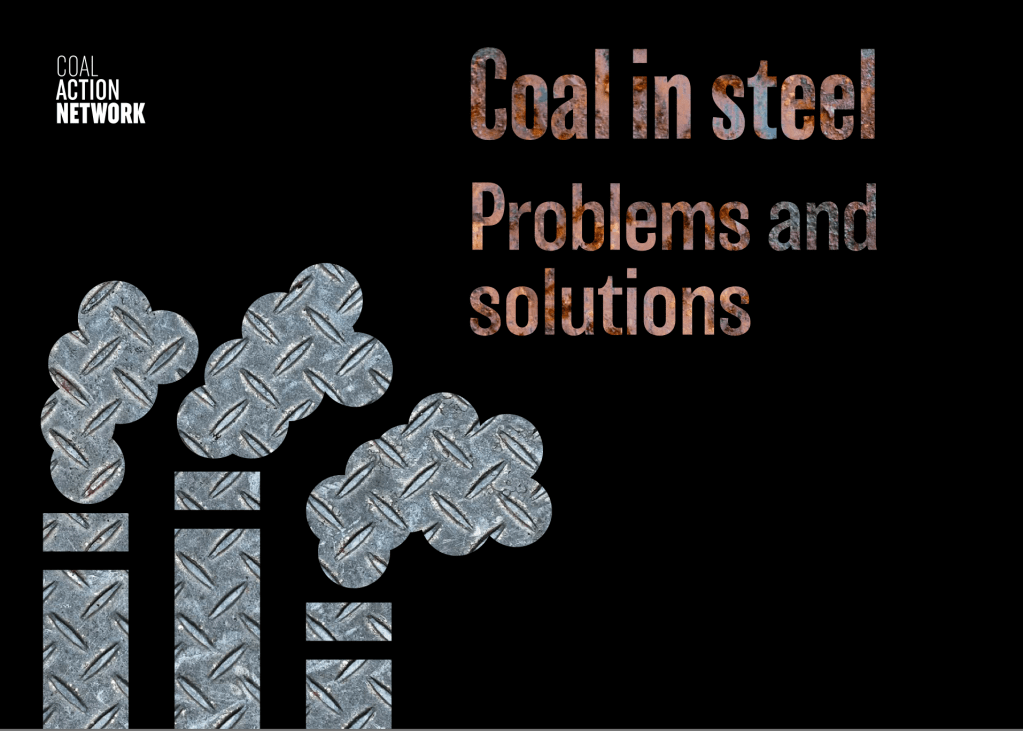
We’ve added a really useful report by the Coal Action Network to our Further Reading Page.Coal in Steel – problems and solutions‘ takes a detailed look at the ways in which carbon emissions can be reduced by alternative methods that break the steel industries reliance on coal.

The report argues that decarbonisation can be achieved by:

Decarbonisation of the steel sector could be achieved through:

  •  increased use of electric arc furnaces and recycled scrap— already happening in the UK.
  • using direct reduced iron production with green hydrogen in place of coke (which is produced from metallurgical coal). The HYBRIT project aims to do this at a commercial scale in Sweden by 2026, having made their first delivery of fossil free steel in August 2021.3
  •  reducing steel consumption through more efficient design of buildings, cars, energy infrastructure, and consumer products. Promoted by The Use Less Group at Cambridge University.

Global Climate Jobs Network – Technical Conference

ScotE3 has been working with other organisations in the Global Climate Jobs Network, the Alternative Information and Development Centre (South Africa) and Climaximo and Empregos para o Clima (Portugal), on a proposal for a technical conference to be held in March 2022.

Call for Papers

Climate jobs and green new deal movements are springing up around the world. This is a call for papers for an international conference on the technical aspects of the jobs that will be necessary, in 10th, 11th and 12th March 2022.

The conference will be on zoom, over three days, and contributors will be able to participate from all continents. We want papers from engineers, scientists, system modellers, designers, architects, planners, educators and trainers, foresters, soil scientists, trade union researchers, NGO researchers and other specialists.

The Climate Jobs Approach

We want contributors to think about the technical and technological implications of a “climate jobs” approach. This approach involves several features:

Massive government spending on public sector, direct employment to make possible reductions of 95% in CO2 emissions, and deep reductions in other emissions, within 20 years. In South Africa or Britain, this would be something like one million jobs a year, or in the United States 8 million jobs.

People who lose their jobs in old, high carbon industries would be guaranteed training and well paid, permanent work in climate jobs.

The work would begin from year one, starting with training a new workforce and shovel ready projects. Over twenty years many new technologies would become possible.

Public sector bodies would share intellectual property across borders.

Profits would be less important. Technologies that are necessary but currently “unrealistic”, could be developed rapidly at scale even if the cost was very high for many years. For example, alternative methods of making steel, substitutes for cement, or expensive forms of renewable energy like marine power and concentrated solar could enter mass production.

We could also move beyond the market, with regulations of many sorts. So we could think about the sort of rail, bus and electric system needed if all flights of 5,000 kilometres or less were banned. Or what could be done if we banned the manufacture of concrete, or F-gases?

Or contributors to think about the details, and the implications, of a building code that required new buildings to have greatly reduced energy use, and to burn no fossil fuels for heating or cooking. In this, we would like not only papers that argue this would be a good idea but think about how that code would be worded in different places, and what technologies and materials would be required, and what research would be required.

For more information about the conference, possible topics, how to participate and the deadline for submitting abstracts please download the full call for papers.

Crude Britannia

On the 20th September 2021 we cohosted with Lighthouse Books a discussion on the recently published book ‘Crude Britannia – how oil shaped a nation’. The discussion was introduced by Terry Macalister one of the books authors. This is the video of Terry’s introduction.

For anyone after a copy of the book, you can order Crude Britannia from the Lighthouse website & get 15% off using the code SCOT-E-THREE

Watershed – the turning point for North Sea Oil and the just transition

Today saw the publication of an important new report from Friends of the Earth Scotland and Oil Change International

Key messages from the report include:

  • Since declaring a climate emergency in 2019, the UK’s developed oil and gas reserves have increased by 800 million barrels of oil and gas, bringing UK developed reserves to 6.55 billion barrels.
  • UK law and Scottish Government policy of Maximising Economic Recovery, which requires every last drop to be drilled from the North Sea, would triple UK emissions from oil and gas
  • To limit warming to the Paris Agreement goal of 1.5ºC no new oil & gas fields, including Cambo, can be licensed or developed and North Sea production must be wound down in the next decade
  • In line with equity, the UK – as a wealthy nation with high historic emissions and low economic dependence on oil revenues – should phase out of oil and gas faster than countries for which it would be much harder. Not all of the 6.55 billion barrels in currently producing or under developed reserves can be extracted – some will have to close early, before fully extracting their reserves.
  • Every delay damages the prospects of a well-planned and just transition for workers and communities currently reliant on the industry.

We plan to publish a more detailed review of the report and if you would like to contribute your thoughts on the issues that it raises please do get in touch.

Scot.E3 September Update

  1. Leafletting workplaces
  2. Aberdeen event
  3. Glasgow Assembly
  4. Recent blog posts

 
1. Leafletting workplaces
We want to use our general briefing on COP 26 to get back to proactive workplace leafletting. If you’d like hard copies of the briefing, you can download and print yourself or just email and say how many you need, and we can put them in the post.  Use them in your workplace.  Or if you’d like to help by leafletting outside a workplace near you, we can put you in touch with others local to you if you need help and we can provide posters with QR codes that some people going in to work may prefer to use rather than taking a physical copy.  
 
2. Aberdeen Event
Neil Rothnie is speaking at an Aberdeen Event, Green Tease, Energy Politics and Just Transition, 1 – 3pm on Saturday 4th September
 
3. Glasgow Assembly
The COP Coalition’s 2nd Glasgow Assembly is Sunday 19th September, 12 – 4pm – more details on Facebook
 
4. Recent Blog Posts
Recent posts include updated the textbriefings on Trident and on Fuel Poverty, plus posts on Cambo, Covid and Climate and more.  Find the blog here.

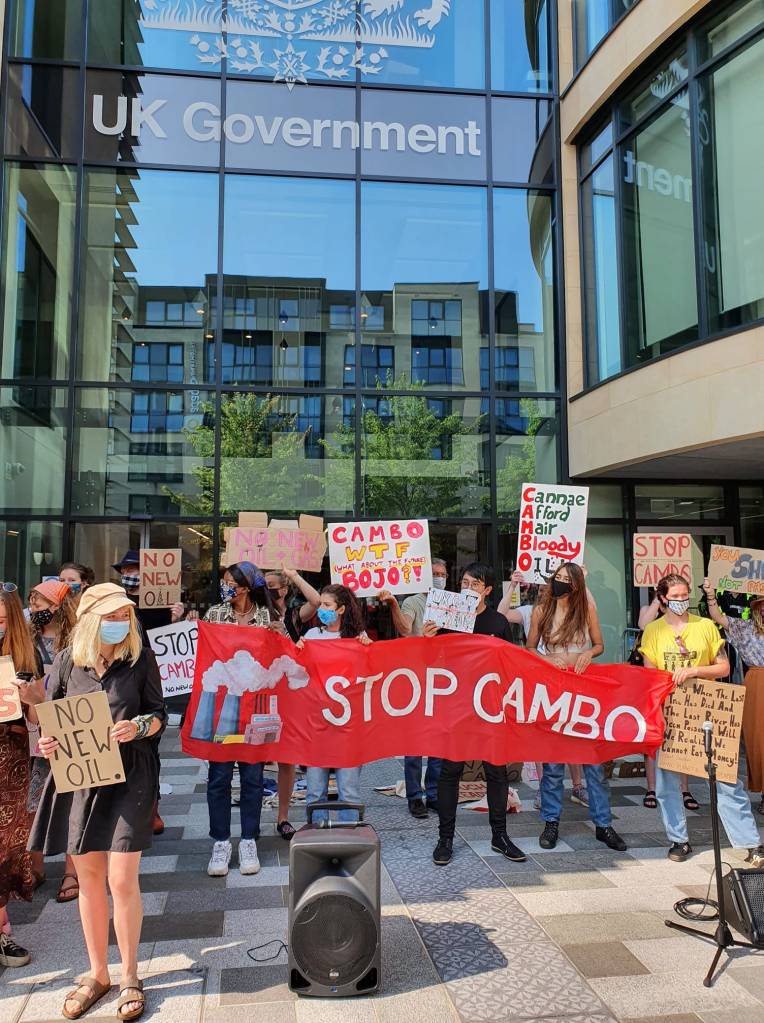
Outside the new UK Government headquarters in Edinburgh – photo CC0, public domain


Facing Catastrophe

An opinion piece by Mike Downham that looks at the twin challenges of Covid and Climate and the role of the big corporations. A version of this article is also published in the the Scottish Socialist Voice newspaper.

It’s been said before but let me say it again: COVID IS NOT OVER!

This bears repeating because we’ve fallen into a deep pit of thinking that there’s no viable alternative – that our daily lives have to be like this – and taking at face value what those in power tell us. We keep falling back on trying to persuade and negotiate with them. This is a trap deliberately set for us by those who have the power at this point in history – the big corporations, served by their political lackeys in governments across the world, particularly in the Global North. 

The corporations are a consequence and integral part of the capitalist economy, which is, as encapsulated by Asbjorn Wahl:

 A system which is geared towards making profits rather than producing use value; dependent on economic growth; a system exploiting workers and over-exploiting natural resources – one that is also about to destroy planet earth as a place to live for future generations. 

This week’s IPCC report says that the impacts of this destruction – floods, fires, droughts, heat which humans can’t survive – are now being experienced in every region of the world. Glasgow experienced unprecedented flooding on the same day the report was published. 

Image by Pierre Banoori CC BY-SA 3.0

The report concludes that we are set to overshoot the critical 1.5 degree rise around 2030 – a decade earlier than their previous prediction. Only a huge reduction in greenhouse gas emissions over the next 10 years can save us.

In relation to the pandemic, the pharmaceutical companies want us to rely solely on their vaccines to stop the pandemic. No pandemic in human history has been stopped by vaccines alone – simple public health measures to cut down the spread of infection have always been necessary. But social distancing isn’t a source of profit, and ventilating buildings doesn’t need new technology.

In relation to global warming, which is now set to kill 100s of millions of us (the global death count for the virus is ‘only’ 4+ million so far), the Oil and Gas companies want us to go on burning fossil fuels down to the last drop, while they prepare to replace or compensate for these fuels with energy sources and technologies which will be equally profitable and every bit as exploitative

Trapped as we’ve been, we keep trying to negotiate with these companies and with the governments who serve them. Given the huge current imbalance of power between them and us, this amounts to inaudible whispering down the barrel of a gun.

The Zero Covid Scotland campaign has drawn a line under its attempts to negotiate with the Scottish Government. Just as the only way to avoid catastrophic climate change is to slash emissions, the only way to prevent more deaths and more suffering from Covid is to eliminate the virus. Slashing emissions and eliminating the virus are both entirely possible.

Image by Pete Linforth – Public Domain

Jonathan Neale (his book Fight the Fire published in February can be downloaded free from The Ecologist website) said at an event in Scotland last week that when you are faced with catastrophe the only way out is to build a mass movement of those most threatened by that catastrophe – a movement which starts by focussing on keeping each other alive.

The Zero Covid Scotland Campaign is planning to contribute in a small way to a movement to keep each other alive from Covid infection by inviting a range of people who have been most impacted by Covid to give evidence at a Public Hearing on Saturday 4th September, staring at 11.00am. You can register in advance for this event here.

After registering, you’ll receive a confirmation email containing information about joining the meeting.

In the same way that eliminating the virus is the way of keeping each other alive from Covid, the way of keeping each other alive from global warming is climate jobs. This isn’t a new idea – thanks mainly to Jonathan Neale through the Campaign Against Climate Change it’s been around for more than ten years. But it’s been considerably developed through research in terms of how it would work, what kinds of jobs we are talking about (above all good, secure jobs), how many jobs (latest calculations for Scotland come to more than 100,000), and what training would be necessary. Climate jobs are the solution because they are the only way we can simultaneously and quickly slash emissions and keep our economy going so that we don’t have to drop our standard of living.

There’s a third specific catastrophe facing many people in Scotland – the loss of huge numbers of jobs in the North Sea Oil and Gas industry. There’s a sort of “offshore-so-not-affecting-most-of-us’ blind eye being turned on this by people in Scotland, led astray by our governments. But it’s already a reality for around 30,000 redundant workers, their families, and their communities. Unless something is done quickly it will affect at least 100,000. If you add this number of redundant workers to a society the size of Scotland’s which already features inadequate services, inadequate housing, and inadequate income support, in the middle of a lethal pandemic, to speak of keeping each other alive isn’t an exaggeration. Moreover, at the end of September, on the verge of winter and with the Covid epidemic still raging, the UK Government is set to terminate furlough, reduce Universal Credit back to its insulting pre-pandemic level and increase the cap on energy prices to an unprecedented figure. This amounts to a perfect storm for less well-off people.

The solution to the catastrophe facing offshore workers also lies again in climate jobs, specifically in the sectors of renewable energy, public transport, and heating efficiency, where a majority of offshore workers already have the right skills and experience. We can’t achieve energy transition in the short time we have available without the skills and experience of offshore workers.

Unfortunately, there’s an elephant in the room in relation to climate jobs and a transition to them. Just as we need to go on (to every one we meet regardless of their politics) about Covid and elimination and about climate change and climate jobs, we also need to speak of this elephant, which is the trade unions. 

As Wahl points out it’s entirely understandable how the trade unions have got into the fix that they now find themselves in. 70 or so years ago they had a place at the bargaining table with employers and governments because they had shown how they could disrupt the capitalist economy by withdrawing their labour. But the balance of power today is such that they don’t have a place at the table any longer. To win it back they need to demonstrate again that they are prepared to stop the train in its tracks. Unless the unions shift their perspective, the workers will leave them and set up their own collective arrangements

We mustn’t be fooled. The corporations which hold the power have no motivation to make concessions at this critical point in history. They are prepared to accept whatever number of deaths and however much suffering it takes to remain profitable. They are fatally hooked on the system they’ve created.

No new North Sea development

Speaking on behalf of the UK Government last week Alok Sharma said that the world is “dangerously close” to running out of time to stop a climate catastrophe.  Sharma would have already seen the now published IPCC report which makes it abundantly clear that this is the case.  Politicians use ‘we’ and ‘the world’ as if lack of action is a responsibility that we all share equally.  He went on to state that “We can’t afford to wait two years, five years, 10 years – this is the moment …” But in March 2021 the UK government signed up to a North Sea Transition Deal, designed by the oil and gas sector that essentially puts off the action we need for another three decades.  Opening a new oilfield is part of the plan and despite his rhetoric Sharma is right behind it.  This is why the campaign to stop the Cambo field is so important.  Pete Cannell explores the political importance of the campaign in this post.  A version of the post was published previously on the rs21 website.

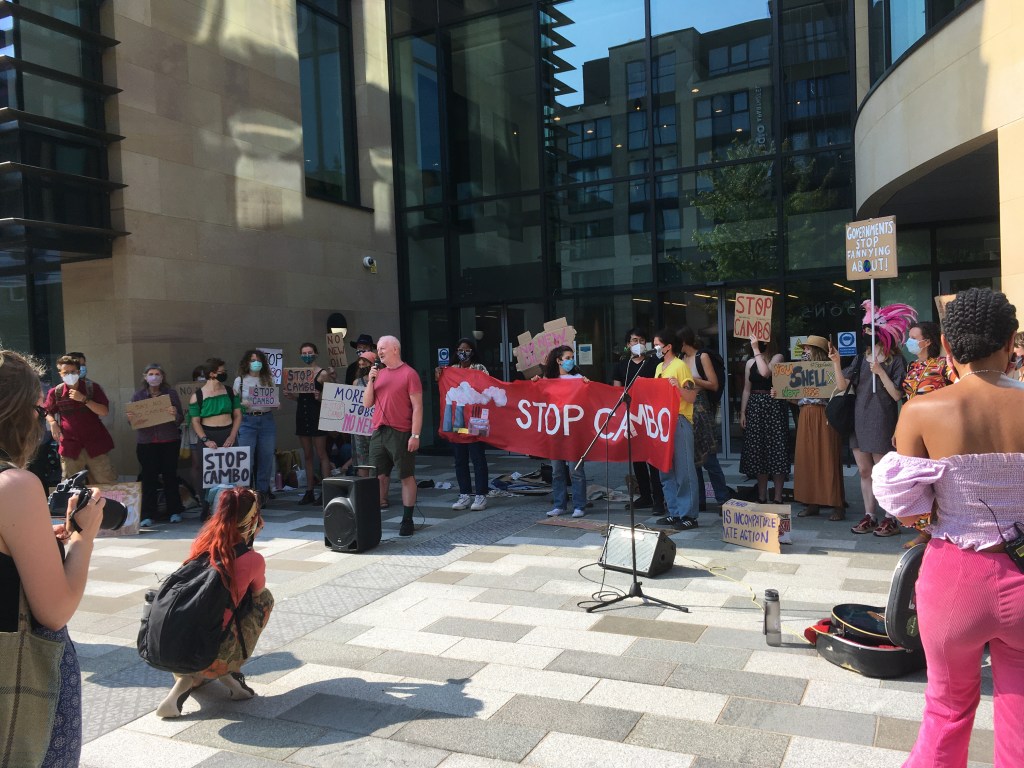
On Monday 19th July twelve climate activists blocked the entrance to the UK Government hub in Edinburgh, demanding that plans to give the green light for a new oilfield west of Shetland be scrapped.  Later in the day they were joined by another 200 ‘Stop Cambo’ protestors.  

Shell and Siccar Point Energy are asking the UK Government for permission to develop the Cambo oil field.  Production is scheduled to start in 2025 and in phase 1 the two companies expect to extract 150 million barrels of oil – the emissions equivalent of 16 coal-fired power plants running for a year.  In total the new field contains the equivalent 800 million barrels of oil. 

With the United Nations Climate talks, COP 26, due to start in just over 3 months’ time the Stop Cambo campaign is shining a harsh light on what passes for UK climate policy.  Throughout the year Westminster has been ramping up announcements on ‘Net Zero’ climate initiatives.  We’ll see many more in the run up to the COP.  You might think that developing a new, deep water, oil field would fit uncomfortably with all of this.  And indeed, some critics are calling out Boris Johnson for hypocrisy.  But the truth is that giving the green light for a new oil field is no aberration or hypocritical deviation from otherwise well-intentioned policies.  On the contrary it’s a core part of UK and Scottish government policy that aims at maximum economic extraction of hydrocarbons from the North Sea.  And as such it provides a critical lens through which all this year’s announcements should be viewed.

The blueprint behind Tory plans is not hard to find.  It was released earlier this year without a fanfare.  On the 21st of March, Oil and Gas UK published the North Sea Transition Deal, a plan for continuing exploitation of North Sea Oil and Gas to 2050 and beyond.  The deal is a tripartite arrangement between the big oil and gas companies and the UK and Scottish governments. It maps out a plan to continue extracting oil and gas from the North Sea.  The idea is that at some point in the future carbon capture and carbon offsetting will allow the government to claim that they have achieved Net Zero.  In this world Net Zero doesn’t mean the end of oil and gas production.  The theory is that the carbon contained in the oil and gas extracted from the North Sea is either trapped in underground storage or compensated for by carbon retention measures elsewhere.  

The whole concept of Net Zero as developed in the Transition Deal is deeply flawed.  For a start, UK and Scottish emissions reduction targets don’t include the carbon extracted from the North Sea.  These greenhouse gas emissions are attributed to users of the products that derive from the oil and gas.  So, Oil and Gas UK can talk blithely about a zero carbon North Sea oil sector because it takes no responsibility for end use.  But even if you accept the bizarre logic of extracting hydrocarbons while taking no responsibility for a large part of the emissions you produce, the core technology that underpins carbon capture is speculative and untested.   Currently, there is nowhere in the world where carbon capture and storage operate at large scale.  And even if it can be made to work at large scale there will be many more years of greenhouse gas emissions before it has a serious impact.

Alongside continuing use of fossil fuels and carbon capture the North Sea Transition Deal also reserves a key role for hydrogen in transport and in domestic heating.  Some of the hydrogen will be ‘blue’ produced from hydrocarbons, some ‘green’ the result of electrolysis of water.   Without carbon capture ‘blue’ hydrogen is a major source of carbon emissions.  ‘Green’ hydrogen, produced using electricity generated from renewables, is carbon free but immensely inefficient, requiring a huge ramping up of electricity production from wind, tidal and solar power.  There’s certainly a place for green hydrogen in a renewable energy mix but only where direct use of electricity is impractical.  From any other perspective except that of an oil and gas company direct use of renewably generated electricity makes obvious sense.

The Sea Change report, published in May 2019, shows how continuing production of North Sea oil and gas is incompatible with meeting the UK’s climate targets, let alone meeting the UK’s historical responsibility to the global south as one of the biggest emitters of greenhouse gases over the last two centuries.  The report also shows how a planned, and rapid, shut down of North Sea operations could maximise employment opportunities in renewable energy.  

It was striking that all the speakers at the Stop Cambo rally highlighted the need for workers to be at the centre of the transition away from oil and gas.  Just Transition has become the common sense of climate activists in Scotland.  And climate is finally on the agenda of the trade union movement.  At the Scottish Trades Union Congress in April three of the composited motions focused on the issue.  But there is a real challenge here.   The STUC motions proposed by Unite, GMB, Prospect and the RMT tail the business-as-usual agenda that is driven by Oil and Gas UK and supported by Westminster and Holyrood – support for continuing extraction of oil and gas, carbon capture and a hydrogen economy.  There’s a need for a sharp debate. The politics and practice of transition can’t be ducked by either climate activists or workers.  

Even if the untested technologies on which Oil and Gas UK’s strategy is based work, Net Zero will not mean no net emissions, but simply shift responsibility for emissions elsewhere, often to the global south.  And business-as-usual also means a continuing drive for profit maximisation, low wages, and precarious employment.   Just Transition is not possible on the back of the North Sea Transition deal.  

For Just Transition to become more than a slogan, we need to win workers to the need for mass working class action over climate.  At this moment in our history class and climate are deeply intermeshed. Fighting for a future for our children and grandchildren with a transition strategy that provides a real chance of avoiding a climate catastrophe goes hand in hand with winning decent jobs and conditions, fighting racism and gender oppression and building workers’ power.  The need is obvious, but the politics of how to make it happen is critical and requires a break with the union/employer partnership approach which underlies existing trade union policy.

Cambo is just one more piece in the jigsaw of the fossil fuel economy that needs to be dismantled.  However, the decision to go ahead or not is politically important.  Boris Johnson wants to milk the UK’s hosting of COP26 for all its worth.  It will be embarrassing if developing new oil and gas fields is foregrounded in news from the COP, and that may mean a decision is postponed until 2022.  Not because the UK is out of line with the other industrialised nations participating in the COP.  Relying on carbon capture and other techno fixes is in line with the thinking that has informed the COP process over the years.  A public outcry over Cambo in the run up to COP26 can help blow away the mist of greenwashing that will be generated around the Glasgow talks and help to push the climate and union movements in the direction of a radical worker led strategy for system change not climate change.  

Fuel Poverty Update

The latest of the ScotE3 briefings to be updated is Briefing 7 which looks at Fuel Poverty. A week ago the UK Energy Regulator ‘OFGEN’ raised the price cap which governs electricity and gas prices for consumers. There will be sharp increases in gas prices in particular. The raising of the cap is good news for the energy companies and very bad news for the poor. There is no doubt that in the context of rising unemployment there will be an increase in already unacceptably high levels of fuel poverty.

Here’s the text of Briefing 7. You can download the briefing to read, print and distribute.

Fuel poverty kills

In Scotland, almost 25% of households live in fuel poverty and just over 12% are in extreme fuel poverty.  Households in extreme fuel poverty are disproportionately represented in rural Scotland Older people living in rural Scotland are particularly hard hit. Every year thousands die because of fuel poverty – in 2018/19 excess winter mortality was 2060 – the death toll can be more than twice as high in cold winters. [Please note that at the time of writing all the data available predated Covid 19 – the pandemic is likely to have increased the figures we quote here.]

Rising fuel prices

From 2006 – 2016, Gas and Electricity prices rose by 71% and 62% respectively. Between 2017and 2020 electricity prices increased by a further 8% in real terms while gas prices fell by a similar amount. Gas prices are more volatile and steep price rises are taking place in 2021.   Throughout Britain, it would cost £3billion – £8billion to end fuel poverty – a fraction of the cost of tax avoidance or defence.

A new policy

In June 2019 the Scottish Parliament passed a new act setting statutory targets for reducing fuel poverty.  The bill is necessary and welcome but falls short of what is needed.  Rightly it highlights the impact of fuel poverty on the most vulnerable in society. Low income, high-energy costs and 

poorly insulated housing result in this appalling situation where families, young people, elderly, disabled and many working people, cannot afford adequate warmth.  It also notes how measures to alleviate fuel poverty can have a positive impact on carbon emissions and create new jobs and links these measures to decarbonisation and the new Just Transitions Commission.

Lack of ambition

The new act sets interim targets for reducing fuel poverty to 15% of households by 2030 and final targets for 2040.  In light of the climate threat we face this is way too slow.  The act is sketchy on how targets will be achieved.  Moreover, there is no recognition of the impending crisis of energy capacity in Scotland, which, if not addressed, will further impact heavily on the poorest, weakest and elderly in our communities.  Some of these weaknesses could have been addressed in a Final Fuel Poverty Strategy that was due to be published u=in September 2020.  However, this was put on hold because of Covid and is yet to be published.

Climate action

There is no reason why Scotland could not produce an energy surplus.  There is an abundance of renewable resources to hand.   In light of the recent UN report, and the latest science, what’s needed is an integrated policy that aims for a zero carbon economy by 2030.  Such a policy would eliminate fuel poverty and create many thousands of new jobs.

A mass insulation campaign

In its ‘One Million Climate Jobs Pamphlet’, the Campaign Against Climate Change (CACC) notes that 

Three quarters of emissions from houses and flats … are caused by heating air and water. To reduce this we need to insulate and draught- proof the buildings, and replace inefficient boilers. This can cut the amount of energy used to heat the home and water by about 40% and delivers the double-whammy of reducing energy costs and helping mitigate the scourge of fuel poverty. 

Based on these CACC estimates, which are for the whole of the UK, a campaign to properly insulate all homes in Scotland would employ around 20,000 construction workers for the next 20 years.  This doesn’t account for additional jobs in education, training and manufacture that would spin off from such an endeavour.  Through this carbon dioxide emissions from homes would be cut by 95%.   We could ensure that all new houses are effectively carbon neutral.  The technology exists – there are examples of ‘passive houses’ that use very little energy. 

New Technologies 

The current costs for fossil fuel power range from 4p -12p per kilowatt-hour. Inter renewable energy agency (IREA) state that renewable energy will cost 2p – 7p with the best onshore wind and solar photovoltaic projects expected to deliver electricity for 2p or less.  Renewable energy is necessary for a sustainable future and it is cheaper than fossil fuels.  Current Westminster Government policy – notably the subsidy ban for new onshore wind farms – is impeding the shift to renewables. The ban could add £1billion onto fuel bills.

No Fracking

For the moment fracking is off the agenda in Scotland.  The result of a magnificent campaign of resistance.  But INEOS continues to import fracked gas from the US.  This has to stop.

No market solution

Fuel Poverty is a direct result of the ”wrecking ball” of market forces dominating our need for energy to give us warmth, light and sustenance. In the pursuit of profit, the use of fossil fuels adds to the catastrophe of climate change.

We have the technology and skills to stop this madness and misery through a radical shift in Energy policy that would combine sustainable and renewable resources dedicated to social need.  Tackling climate change would go hand in hand with creating additional jobs, eliminating fuel poverty, and improving health and well-being.  To make this happen we need the kind of focus and the level of investment that has only normally applied at times of war.  Ending the use of fossil fuels over a short period is practically possible provided there is the political will.

Mossmorran Climate Camp

A photo report by Callum from the weekend’s climate camp at Mossmorran

And another from Neil

For more about Mossmorran check out this report of our public meeting with the Mossmorran Action Group or search the site for the several other articles we’ve published in the last two years.