REELNews Xmas appeal

Crunch time for GKN, the most advanced worker led transition struggle in history 

XMAS APPEAL: Crunch time for GKN, the most advanced worker led transition struggle in history 

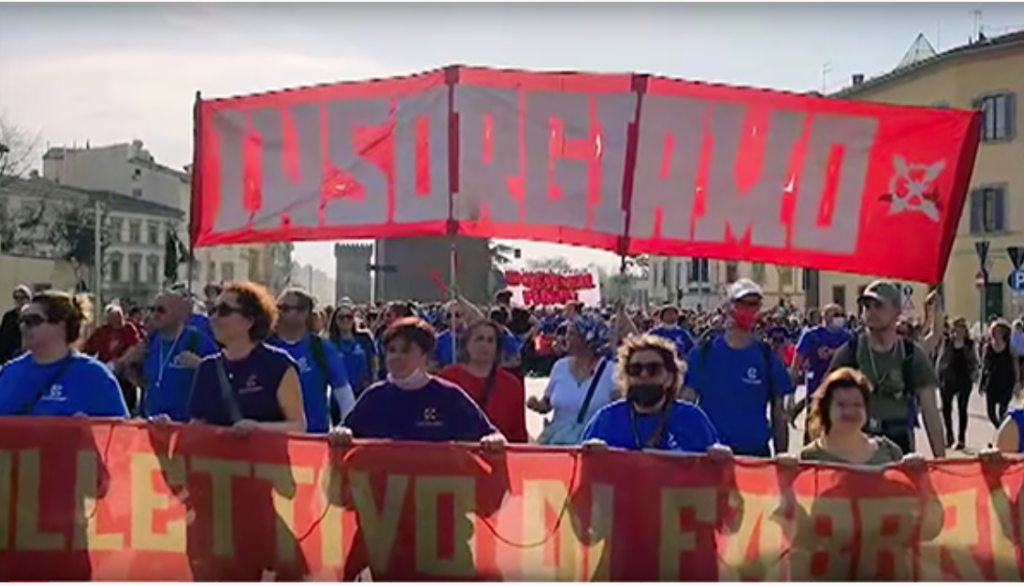
The battle by ex-GKN workers in Florence to convert their autoparts factory to zero carbon production under workers control is at a critical stage – and you can help. Find out how below and watch a video of the story of this historic struggle so far – PLUS the latest from the most important strike in Britain, a siginificant victory for education workers in Bristol, and what you can do to help prisoners on hunger strike for Palestine
GKN: Cash urgently needed to start production under workers control

Click here to watch video of the story so far (30 min version)
Click here to watch 5 min version

Those of you who have been following the incredible just transition struggle of ex-GKN workers in Florence (and if you haven’t, you can catch up by watching the video above) will know that the regional council have been stalling on their commitment to put together a consortium to buy the factory off the current owners and hand it to the workers to produce cargo bikes and solar panels – all under workers control, and for the benefit of communities, not for profit.

Now, after delaying the process for months – increasing the suffering of the workers who have now had no wages for 15 months – it’s fallen apart.

The main reason seems to be the drive to war and the increase of arms spending across Europe, with most of the banks who agreed to fund the project now demanding that the workers produce weapons rather than zero carbon products based on equality and social justice. And as the workers point out, “the former GKN is an example they can’t afford. Because a conscious community, insurgent, through the convergence of social and climate justice shows that an alternative would be possible.”

So now the workers have made the decision to go it alone and do everything themselves. Which means raising substantial sums of money from our own workers organisations, social movements and civil society.

CLICK HERE TO READ FULL STATEMENT AND EXPLANATION BY THE WORKERS


WHAT YOU CAN DO TO HELP

1) Make a donation to the workers’ crowdfunder, which has a target of 2 million euros. You can make a donation by clicking here. So if you were looking for somewhere to donate to for Xmas, this is the place!

2) If your trade union branch or organisation, or a collection of individuals can afford 500 euros, that’ll buy you a share in the workers cooperative and be part of the assembly that will collectively run the factory if the workers win.
CLICK HERE TO BUY A SHARE

IMPORTANT: IF YOUR GROUP HAS ALREADY PLEDGED TO BUY A SHARE, CLICK ON THE LINK ABOVE TO PAY THE 500 EUROS FOR IT

And a warning: 
the form to buy shares is not easy to fill in. Having just done it to buy the share for the UK rank and file workers delegation that visited Florence last year, we can give you some help below; if you’re still having trouble, please feel free to email us at info@reelnews.co uk and we can talk you through it.

If you’re not in Italy, fill it in as an individual, not as an organisation. If you try to do it as, for example, a trade union branch, you’ll get a load of questions that are impossible to answer because our union branches are not set up in the same way legally as Italian union branches. So you’ll have to pick a trusted individual who doesn’t mind paying the 500 euros out of their personal bank account and then getting it back from the branch.

Most of the questions are meaningless – but what you answer doesn’t matter. The questions are obiously geared to a generic shareholder issue for companies – but don’t worry about the fact that none of the answer choices fit your situation, just pick anything – the answers seem to be completely irrelevant, so for example there’s no need to reveal your financial circumstances.

When you get to the page that says “send link to continue on your phone, or scroll down to continue, choose the phone option. You’ll findthat it’s actually impossible to scroll down, so in fact you have to continue you on your phone – which is actually just to take a picture of your passport as proof of identity. Once you’ve done that, it’ll return you to your computer.

Once you’ve finished this part, you’ll have to wait for another email to set up payment. This comes in a few minutes, but then once you’ve set up payment (bank transfer seems to be easiest), you’ll have to wait for up to 48 hours for it all to be cleared to actually transfer the 500 euros.

Hopefully that hasn’t put any of you off! But if it feels daunting, please get in touch – we’ve done it and can help you do it very quickly. 

We’ll leave the last word to the workers: “After 4 years of struggle, 15 months without a salary, and 8 months of unemployment, all may seem lost. But at the same time, it may all be enough to claim that, “after all, we won”. The lessons we can learn from this struggle are enormous, its historical legacy will not fade away, and its example will speak for years to come. Then, why insist (on continuing the struggle)? Because we cannot afford to lose this fight and “they” cannot afford to let us win. Because it started with the “simple” aim to keep the factory open, but ended up exposing every “systemic” issue that is dragging us towards the catastrophe today.”

Crunch time for ex-GKN workers and their just transition plan

Italian workers who occupied a GKN factory to oppose closure went on to make a plan which shows what a just transition can look like. Now it is time to support their plans to start production.

Italian workers who occupied a GKN factory to oppose closure went on to make a plan which shows what a just transition can look like. Now it is time to support their plans to start production.

Matthew Crighton reports on the latest developments.

See previous articles on this site on the workers’struggle here and here.

Workers at GKN near Florence occupied the factory against closure over 3 years ago and are still there, after winning 6 legal cases including successful challenges to the lay-offs. They have been sustained by cycles of mobilisation by supporters across Tuscany giving solidarity and practical donations.

The strong trade union organisation in the plant didn’t just oppose closure of their factory, they decided to build a case for re-opening with a plan for socially-useful production, rather than servicing the luxury car manufacturers. Pooling their expertise and reaching outwards, they now have a plan for just transition to make solar panels and cargo bikes.

I was pleased to join a UK delegation to the Solidarity Assembly at the site on 13 October and a public event on the day before about convergence between the trade union and climate movements and even got to speak at it. More of the detail of their story is covered in the articles to which there are links below so here I will just summarise the current situation which we learnt about.

About one third of the original 400 workers are still taking part, now organised into the GFF Collective. After a series of sales, neither GKN nor Melrose, the company which bought from it, are now involved and the workers’ struggle to retain employment has become focused on their plan to re-start production, not of the luxury car parts which GKN made, but products of vital importance for the transition to zero carbon – cargo bikes and solar panels, includingrefurbishment of old panels. This was prepared in consultation with the climate movement in Italy and potential users of the products and its purpose is seen as leading a switch to reindustrialisation through addressing environmental crisis.

The Regional Council of Tuscany has given this plan some support but it has not taken the key next step to provide the Collective with working capital. The most recent development has been that the factory site has been sold again to property companies and the workers fear that they intend to use if for warehousing, retail or housing. As a result, they are looking for options of other sites for their collective enterprise while not giving up on the first one.

The Collective launched an appeal for funds and in particular for the purchase of shareholdings. Two UNISON branches in Scotland have committed to do this and I was able to act for them at the Assembly and report back. The good news which we received is that the Collective has been successful in reaching its target of 1 million euros.

The worrying news was that the Tuscany Regional Council still has no timetable for passing the decision which can enable it to give the funding and support needed. In this light, the Collective’s resolution to the Assembly both set a deadline at which, if there is still not a decision, it will have to reconsider the viability of its plan; and set a target for further fundraising of another 1 million euro.

As things stand at the end of October, the workers have three demands:

  • Pay unpaid salaries to the workers
  • Administration by the national government: the Government is asked to appoint a special receiver to the company
  • That the regional government buys the factory off the current owners and hands it over to the workers to run themselves under workers’ control

The deadline which they have set is 15 November and the date of the next mobilisation and an assembly at which the situation can be re-assessed in 17 November. As the Collective says “It will be a celebration for the start of the plan or anger against an entire system”.

It was inspiring to witness workers reaching out to the climate movement and solidarity received in return. As the attendance showed this has been a rallying point for the left in Tuscany, Italy and wider in Europe.

I was able to bring our experiences in Scotland, of Friends of the Earth and STUC setting up the Just Transition Partnership, to the audience. I emphasised what each movement has learnt from the other and the need for a foundation of respect between them. I was pleased that the next day, Greta Thunberg spoke on the same theme of building a mass movement of workers who want to stop climate change and environmentalist in solidarity with workers struggles.

The ex-GKN workers need solidarity and have a call out to buy shares to raise working capital for their cooperative. The shareholding appeal remains open and also straight donations can be made – see below*. Lastly, this inspiring example and lessons from it need to be widely known. Speakers can be provided.

Here are articles about it:

Rebirth or Surrender – 14 October 2024 – in Italian but Google can translate

The Italian Workers Occupying Against Climate Crisis – 11 October 2024

The GKN Workers Fight Continues – 13 March 2024  – Red Pepper

Facebook Group: GKN Factory Occupation – UK Solidarity Network

Key Learnings:

  • The inspirational impact of workers acting to defend their jobs, to defend the planet and transform the economy.
  • A concrete example of joint work between trade union and climate movements, at activist and formal levels – there is lots for activists in the UK to learn about this…
  • The inertia which arises from neither the trade union structures nor the local government being ready with support for this kind of initiative
  • The need for workers in all industrial enterprises to be thinking ahead and preparing just transition plans
  • The shift from a dispute with an employer about closure to a workers plan for production requires a new combination of skills, organising capacity and resources – fundraising for industrial production, securing a site, arranging finance and organising a workforce while continuing the political struggle is a big challenge
  • The importance of solidarity for keeping this going.

Matthew Crighton

matthewcrighton@gmail.com

* Donations can be made by single or continuous bank transfer to the following Banca Etica current account in the name of Soms Pinerolo IBAN IT81 E050 1801 0000 0002 0000 339 BIC ETICIT22XXX

Solidarity with GKN workers – join r+f delegation to Florence

From REELNews

GKN: Rank and file trade union delegation to Florence, are you interested?

Reel News are planning a rank and file trade union delegation from the UK to visit the GKN factory in Florence; not just to show solidarity to this important struggle, but also to spread the workers’ visionary ideas back here. And with thousands of jobs under threat at Port Talbot steel works (of which more below), and Grangemouth oil refinery due to close in 2025 with the loss of another 400 jobs, we can all learn a lot from what’s happening at GKN.

Many of us have been warning for years that if we don’t start planning a just transition away from fossil fuel production, it’ll be imposed on us – and thousands of workers will be thrown on the scrapheap. Now that’s starting to happen, it’s never been more urgent to fight for the alternative: a green future that would create literally millions of jobs globally as well as saving the ones currently under threat.

We’re still waiting to hear back from the GKN workers when would be a good time to visit, but at the moment we’re thinking maybe mid April, depending on how things develop. We want to time the visit for either a big mobilisation/demonstration, and/or if they actually start production under workers control. So the timing might well change. But for the moment, get in touch at info@reelnews.co.uk if someone from your workplace is interested in coming – and especially if you want to help with organising the trip too.

Obviously we’re looking at taking workers directly involved in fossil fuel industries, but every sector needs to make plans for a just transition (click here for a film detailing ideas that came out of a union workshop on a just transition for the hospitality sector for example), so please get in touch if you’re interested wherever you work.

The bosses have now agreed to delay the sackings until at least June 2024, after a NYE party packed out the factory with 7,000 people; and in the past month they’ve DOUBLED the money raised in popular shares to over 600,000 euros.

So now the workers have extended the share scheme until June – and are now very confident they can raise the full million euros. So if your trade union branch, organisation, or even a group of friends want to support this visionary project, there’s still plenty of time. Share packages start from 500 euros.

You can find details of how to take part here, and see the end of the video for more ways you can help. As the workers say, they can’t create an alternative model to capitalist fossil fuel production in just one factory – but they can create an example of what is possible.

Climate emergency – a model motion

New Year 2020 is a critical time to be taking the campaign for climate action into our workplaces.  Below we’ve pasted a model motion that can be used or adapted in your own workplace context.  (You can also download a PDF here and a Word version here.  If you have already raised a similar motion in your workplace we’d love to hear about it and would be pleased to share the text (with permission) so that others can build on your experience.  We think there’s a particular case for developing clear policies in education, from school through to university, and would be really interested to get feedback on particular demands and actions for the education sector.  Please send feedback to triple.e.scot@gmail.com 

Draft model motion 

This (branch/region/committee/trades council/union/conference) notes the urgent need for action on the climate emergency, both in response to existing negative impacts such as extreme weather, fires, droughts, floods and loss of habitat and species; and to avoid the catastrophic and irreversible climate damage which people increasingly realise the world is on course for, after the 2018 Intergovernmental Panel on Climate Change (IPCC) report.

We recognise that big business, the military and the richest individuals are responsible for the vast majority of climate change, yet the global working class and poor are disproportionately at risk. A just transition (that protects the lives, livelihoods and rights of the poor and disadvantaged) to a decarbonised economy is not only right, but is the only way the movement against climate chaos will secure the mass support needed to win, and avoid a rich minority protecting themselves at the expense of the planet and the vast majority of people.

We congratulate the school students striking around the world for real climate action and welcome the decision of the TUC to support them and call for a solidarity stoppage. We note that many workers did strike on 20 September 2019, despite Britain’s repressive legislation, by campaigning to pressure employers not to apply sanctions to climate strikers.

We note that there is discussion about the possibility of making Friday 1 May 2020, traditionally International Workers’ Day, also a climate strike. We note that the UN ‘COP’ climate change conferences have become a major focus for campaigners, that COP26 will be taking place in Glasgow from 9-20 November 2020, and that many organisations are already making plans.

We resolve to:

  1. Publicly state our support and solidarity with the climate strikers and the wider movement for rapid and effective climate action
  2. Invite climate strikers to speak at our meeting
  3. Educate our members about the climate emergency
  4. Give practical support to the climate strikes, without adults taking it over. This will include asking schools and local authorities to commit to imposing no sanctions against striking students, promoting the strikes on social media, encouraging members to attend, taking our flags or banner if agreed with the strikers. If requested, it could include co-hosting events, providing sound systems, staging and stewards, using our public liability insurance, help with press releases or police liaison.
  5. Support workers joining climate strikes and maximise member involvement
  6. Work with other local labour movement and environmental organisations to arrange discussions locally and within workplaces about practically how workers and unions can learn from 20 September, join climate strikes or show solidarity
  7. Promote through the labour and climate movements the idea of making 1 May 2020 a climate strike as well as International Workers’ Day
  8. Organise to make COP26 in Glasgow, 9-20 November 2020, a major focus of campaigning for effective action on the climate emergency
  9. Call on employers and local authorities to declare a climate emergency and involve workers and communities in planning, implementing and monitoring to rapidly achieve zero carbon emissions, including ending investments in fossil fuels
  10. Call on employers to recognise union green/environmental reps and give them work time for their activities
  11. Create climate action groups at workplace level and within union structures
  12. Look for opportunities for unions, communities and the climate movement to work together, for example for improved housing and public transport
  13. Call on unions and the TUC to back the climate strikes, call and build action
  14. Call on our union to carry out a major exercise to understand the potential positive and negative impacts of the climate crisis and responses to it on employment
  15. Campaign for a legal right to strike and to repeal all legislation that makes it harder to strike over climate
  16. Discuss what climate-related demands to include in collective bargaining, including ones which could be the basis of a lawful “trade dispute” under current legislation and to call on our union to produce guidance on this
  17. Ensure that unions are visible as relevant and useful organisations within the climate movement and that participants are encouraged to join a union
  18. Demand massive public investment in the jobs required to address climate emergency, including massive improvements in renewable energy, housing and public transport
  19. Send this motion to our local trades union council, up through our union structure, and to local SNP, Labour Party and Green Party branches

DSC03423


Energy efficient housing

The announcement by Paul Wheelhouse that the Scottish government will work on new regulations to ensure that new homes use renewable or low carbon energy sources for heating is a small but welcome step in the right direction.  However, the timescale for action is disappointingly unambitious; the new measures are not planned to be implemented until 2024.  Setting a much shorter deadline would send a message to private sector builders and local authorities that ‘climate emergency’ is exactly what it says. In housing, as elsewhere, action needs to be take place on the shortest time lines possible.

Let’s up the pressure for a mass public programme of retrofitting existing houses to be energy efficient.  This is a necessary step and in addition the climate jobs and the improvements in living conditions that it would generate would have a massive impact on people’s attitude to the climate emergency and what needs to be done.  It would be just transition in practice.

Passivhaus_section_en

Passive House, Image CC BY SA 3.0

Phasing Out Oil and Gas

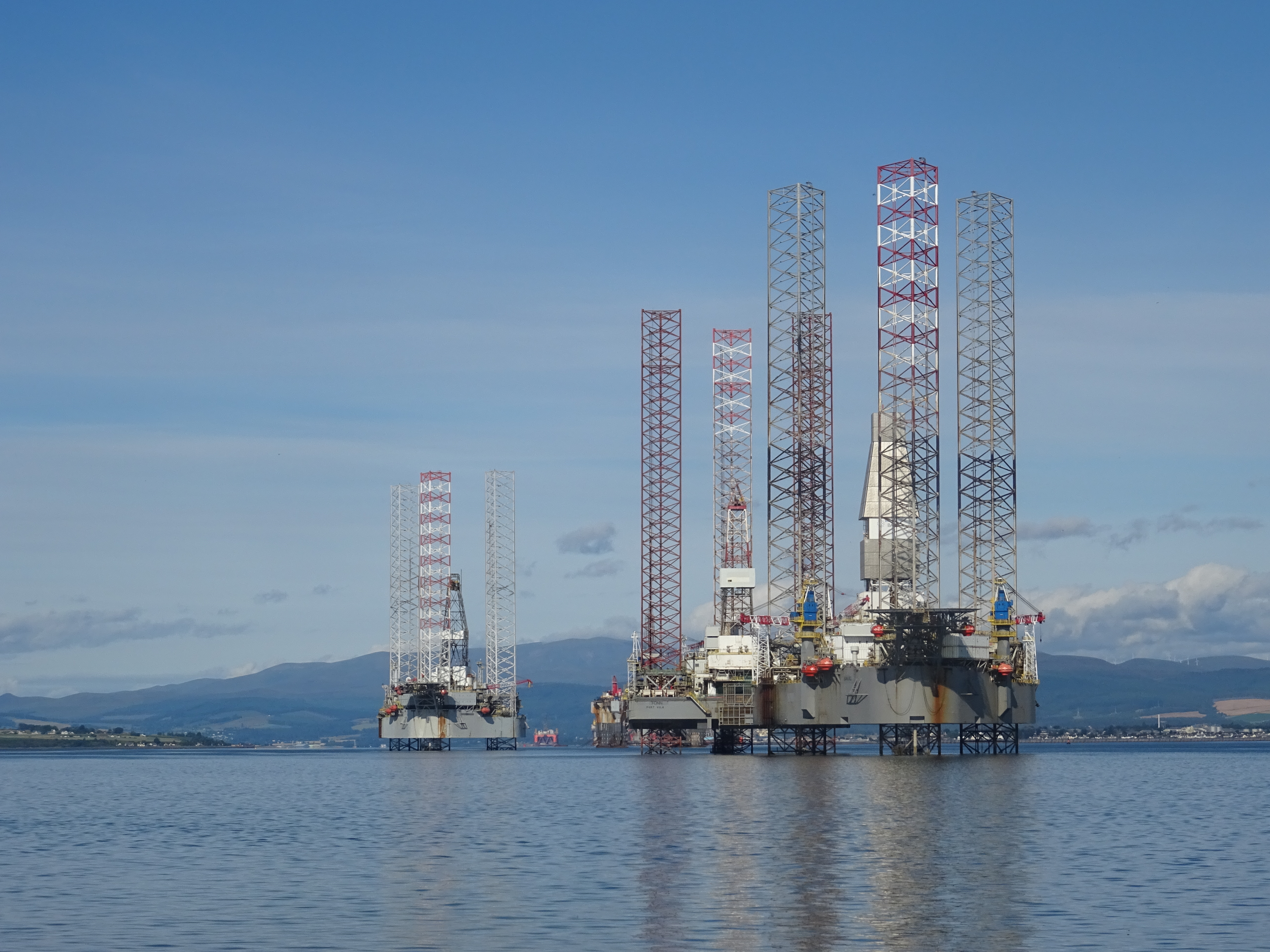
One of the workshop streams at the Scot.E3 conference in November focused on Oil and Gas and Just Transition for workers involved with the North Sea.   Stephen McMurray summarises the discussion that took place.  

The oil and gas group included Simon Pirani, author of Burning Up: a global history of fossil fuel consumption, and a retired oil worker now campaigning with XR and ScotE3. The initial discussions included how we start to phase out oil and gas extraction. The main policy suggestions included ending subsidies to the oil and gas industries and ending licences for oil and gas exploration.

There was an interesting debate about whether the government should set a date to end oil and gas, for example in 2030. On a positive note, it may stop companies exploring for oil and gas well before 2030. On a more negative note, it may encourage companies to seek to maximise output and increase carbon emissions before 2030.

Earlier in the conference, we had watched a series of short films by REEL News. One of the films illustrated that companies were increasingly turning to automation and subsequently reducing their workforce. This led to a discussion considering that research should be undertaken into the impact of automation into the oil and gas industries. Furthermore, it would be useful for REEL News to make a film of the North Sea and show their films on the impacts of oil and gas to oil workers.

There was a general feeling that there was a lack of information for oil and gas workers in relation to training for new industries, and that a just transition conference should be held in Aberdeen for oil and gas workers. There was also a discussion on how we engage with suppliers to the oil and gas industries so they are included in a just transition. Additionally, it was not clear that the Scottish Government had produced a post-oil industrial strategy, and there was a need to give presentations at universities for the need to move to careers post carbon.

Finally, there was an agreement that we need to bring the rebellion to the oil and gas industries and that we need a massive confrontation with big oil in Aberdeen during COP26 when it comes to Glasgow next year.

2018-07-19 08.57.05

Housing and climate action

One of the workshop streams at the Scot.E3 conference in November was devoted to housing. This report is from Mike Downham who was one of the facilitators of the discussion.  

  1. Housing in Scotland is a disgrace – from the Muirhead tower blocks to new-build. A participant from Hungary, who has been in Glasgow for a year or so and has had extreme difficulties in finding somewhere to live and which is affordable to heat, said that Scotland’s housing compares very badly with Hungary’s, which at least has thick walls. “You’ve got to do something about it”.
  2. Student housing. The Universities are supplying student housing which is unaffordable except for wealthy students, mostly from the Far East, and make it difficult for most students to find less expensive accommodation. There has been a lot of public criticism about students having such high quality housing, while many citizens are homeless. But the reality is that the majority of students have huge difficulties in finding housing they can afford to rent and heat. It’s not unusual for them to end up on someone else’s sofa.
  3. Commodification of housing since 1980 is at the root of the housing crisis in Scotland. Housing policy has been primarily aimed at growing the national economy, instead of housing being recognised as a human right.
  4. What we can do together towards a just transition in Scotland’s Housing:
  • Demand that Councils bring building standards up to passive-house specifications and replace building control jobs lost in the name of austerity, without which new housing can’t be adequately inspected. These changes are perfectly feasible for Councils.
  • Put pressure on the Scottish Government to ensure that the new Scottish Investment Bank will direct enough funding to build the new houses needed (this is urgent – the Scottish Investment Bank Bill is going through parliament now).
  • Put pressure on Pension Funds to invest in housing.
  • Support grass-roots protest as demonstrated by Living Rent’s support for Muirhouse tenants, which started with door-knocking to get all tenants’ views.
  • Suggest to XR that they target some of their direct action on grass-roots projects such as Muirhouse
  • Suggest that grass-roots projects such as Muirhouse deliver their demands to the COP 26 – to both the formal and the alternative meetings.
  • Keep in our sites the eventual objective of a National Housing Company through which communities will choose the type of housing, local facilities and green species they need
  1. Climate is just one part of the wider argument – so the challenge for the Climate Movement is to build links with all other movements concerned with social injustice.
  2. “We need to close this down” – just as we would have no hesitation in doing if there was a proposal to build an asbestos factory at the end of our street. Though this was said in respect of the climate polluters, the fact that it was said in a discussion on Housing, Health and Fuel Poverty suggests that it should be our approach to all forms of social and planetary injustice.

Construction_of_the_passive_house_10_(18696022004)

Image (Construction of the Passive House) CC BY SA 2.0 from Sustainable Sanitation Alliance  


Energy from Waste

On of the issues that came up in discussion at the recent Scot.E3 conference was ‘Energy from Waste’.  There is large-scale investment in this technology taking place across the UK.  We agreed to produce a briefing on the topic.  What follows is the text of the first draft of the briefing.  We are also developing further resources that will be added to the Resources page on this site.  We’d welcome comments on the text and ideas for useful resources that we could link to.

There are a large number of Energy from Waste (EFW) projects planned across the UK.  By the end of 2017 there were nearly 120 EFW proposals at various planning stages. Sixteen of these are in Scotland. In this briefing we take a critical look at Energy from Waste and ask whether it has a place in a strategy for a zero carbon Scotland.

Energy from Waste Projects

At first sight, the term ‘Energy from Waste’ appears to be all things green. It suggests a new and rational way of ‘treating’ the ever-growing mountains of waste that are an inevitable by-product of our throwaway society.  It invites the idea of a ‘green energy’ that has been derived from what would otherwise be a possibly harmful and long-term environmental problem. When the alternatives proposed are either a long-term toxic and smelly and unsightly landfill problem or a health-threatening incineration route, then EFW appears to be a sensible choice.

Behind the EFW hype, which many UK local authorities have accepted, there is a fog of confusion regarding the most optimal waste management solutions; whether they be recycling or minimising the production of waste at source – both options are ruled out by market driven/low cost and value-for-money economics.

Landfill

Since 1945 the volume of disposable waste per household in the UK has multiplied threefold. Over the years, the local authorities have traditionally chosen landfill disposal as the preferred waste ‘treatment’ route.  However, landfill, demands considerable land acreage and depth and entails significant public health risks as well as potentially long-term hazards for the environment. Aside from smell and vermin nuisance, landfill sites- even the best managed ones- constitute over time- a high risk of biological and toxin leaching into surface soils and ground-waters.  Methane from decomposition also adds to greenhouse gas emissions.

For all of these reasons, waste management authorities have either been incentivised away from landfill by grants for recycling- or more often – ‘disincentivised’ in the way of increasingly punitive landfill taxes. First introduced in the 1970’s, landfill taxes have been subsequently reinforced by EU directive-and as alternative waste ‘treatment’ technologies have fallen in capital cost, so landfill taxes have risen.

landfill-879437_960_720

Landfill tax per tonne

2010      £63.00

2018      £88.95

2019-20 £94.15

Tax policies make EFW-type waste treatment strategies appear attractive- particularly because in exchange for a penalty for handling waste, there is an income from generating electricity.

EFW technologies

There are a number of EFW technologies on offer but all share the same objective of converting solid (or in some cases, liquid/sludge) waste into energy for the production of electricity.

Typically, an EFW plant is based on an incinerator chamber into which is fed solid waste.  The upper walls of the chamber comprise water-filled tubes in which super-heated steam is produced for a steam turbine that in turn produces electricity.

Steam is also captured from the waste feed system. If the plant is fitted with what is called a ‘back-pressure’ steam turbine, then high-pressure hot water can be distributed to local industrial and residential heating networks in what is called a Combined Heat and Power (CHP) system.

However, as such plant is typically fed unsorted, or semi-sorted waste with a low calorific value, the combustion process will be ‘boosted’ with an additional combustion element in the form of natural gas or diesel oil. Less typical EFW technologies with little application to date, are the various gasification processed that involve the digestion of biological waste- usually food or agricultural wastes which are then converted into a ‘bio-gas’ which via a gas turbine is converted into a higher electricity output. In some processes, the waste is heat-treated anaerobically – i.e. in low oxygen conditions- (pyrolysis) to produce a synthetic ‘natural’ gas.

All EFW systems discharge exhaust gases. The principal emission is carbon dioxide but there are also emissions of nitrogen dioxide.  Quenching water can contain uncombusted toxins and  solid wastes in the form of light ash or clinker have to be disposed of safely.

5668478_c75f25e1_1024x1024

Image M J Richardson, CC BY-SA 2.0 https://www.geograph.org.uk/photo/5668478

Renewable energy?

EFW systems add greenhouse gases to the atmosphere through the process itself and also through large-scale transport of waste to the incinerators (mostly by road).  They are a response to the perceived problem of landfill rather than tackling systems that produce unrecyclable waste.  To operate efficiently EFW plants require a continuing supply of waste at or around current levels.  Scotland produces around 1.6 million tonnes of combustible municipal waste per year, if current plans come to fruition this means and awful lot of capacity chasing a very finite amount of waste. Local authorities could be tied in to contracts to supply waste for the next thirty or forty years.   This could pose a real threat to the commitment to recycle plastics and other recoverable materials out of the waste treatment stream. The Scottish Environmental Protection Agency notes that EFW is not a renewable energy source but claims that because it can be substituted for fossil fuel electricity production it forms an important part of the Scottish Strategy for sustainable energy!

DSC03194

Alternative Strategy needed

Energy from Waste is not green and not sustainable.  It undermines attempts to reuse and recycle and it has a significant carbon footprint through transport of waste to centralised sites and through the greenhouse emissions from the burning of waste.

Investment in Energy from waste should be reallocated to genuinely sustainable technologies aimed at cutting greenhouse gas emissions, which also provide opportunities for jobs in construction and better opportunities for long-term employment.

Further reading

For further information on Energy from Waste go to www.scote3.wordpress.com and click on the Resources tab in the menu.  This briefing is one in a series produced by Scot.E3.

2019 Conference Report – Simon Pirani

In the second plenary session of the conference Simon Pirani and Mary Church reflected on the growth of the climate movement and the challenges we face. This post includes video of most of Simon’s contribution. He began by reflecting on the connections between some of the struggles for just transition highlighted in the REEL News films and the onslaught on working class communities that took place in the Miner’s Strike of 1984/5. Miners were fighting for their communities and lives and livelihoods. He argued that in the context of climate crisis we are defending communities no less than we were in 1984/1985.

Simon was clear that there is a still an argument to win. Some trade unionists suggest that jobs and climate action are in opposition. He argued that this a false choice – without system change we face disaster on an unimaginable scale – our fight is for effective action and social justice. Each depends on the other.

Building Worker Power

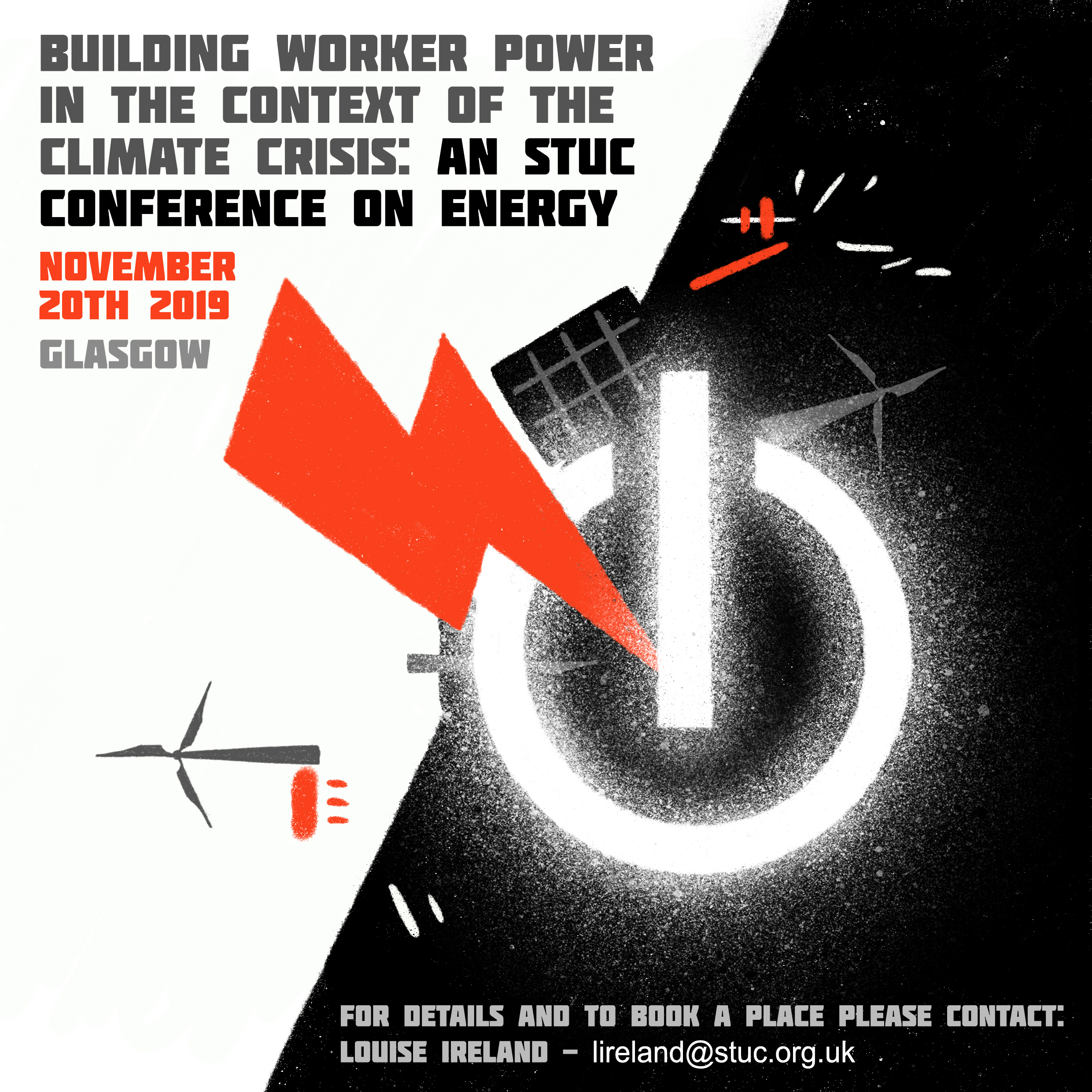
On the Wednesday following the ScotE3 conference on Saturday 16th November the Scottish Trades Union Congress is holding an important event in Glasgow. Contact Louise Ireland, lireland@stuc.org.uk for booking details,

 Building Worker Power in the Context of the Climate Crisis: An STUC Energy Conference

 Wednesday 20th November, 2019

9.00 am – 4.30 pm

The Lighthouse, Mitchell Lane, Glasgow

energy graphic