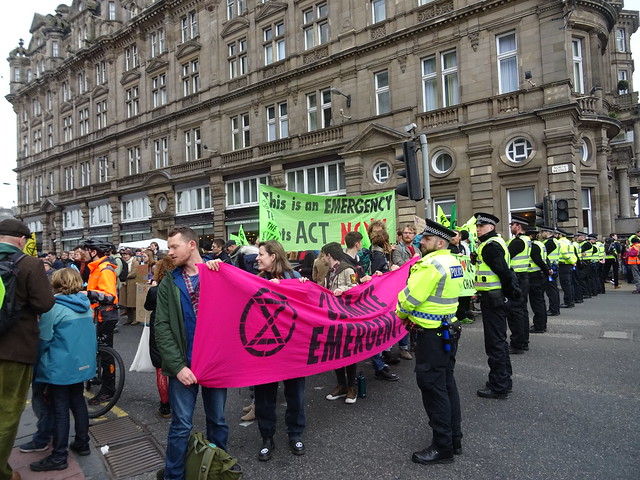
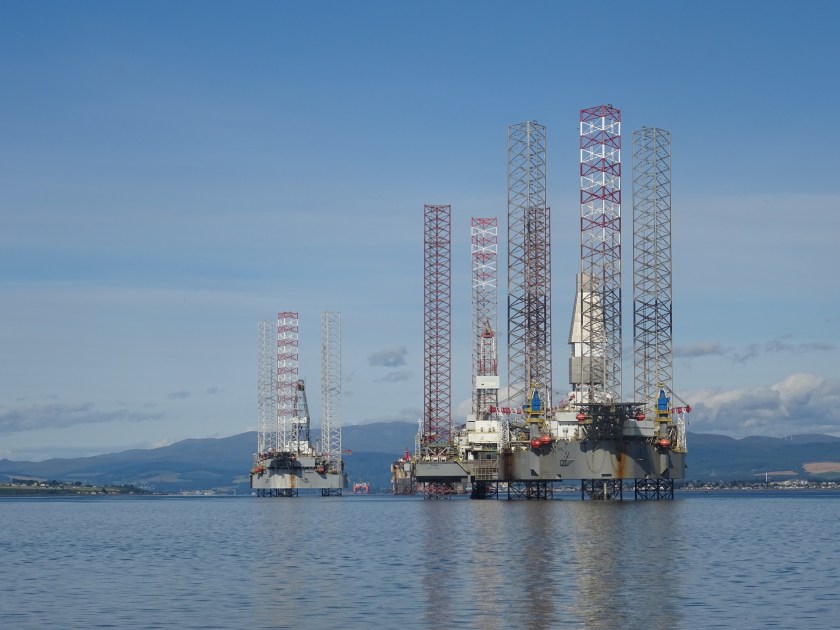
Harland and Wolff: occupying for nationalisation, jobs and the climate

As workers at Belfast’s Harland and Wolff shipyard fight to save their jobs, demanding nationalisation as the employer goes into administration, Brian Parkin from ScotE3 reports on the response from the UK Construction Rank and File group, argues for solidarity and highlights links with action to tackle the climate emergency.  This article was first published on http://www.rs21.org.uk

The mighty shipyard of Harland and Wolff, whose enormous cranes, Samson and Goliath, dominate the Belfast skyline, is now facing the final phase of closure. Most famed for being the shipyard that built the ill-fated Titanic, these yards and their local supply companies employed up to 30,000 workers at their peak. Now, after repeated capacity and job-sheddings, only 121 workers remain.

The remaining workers have been given redundancy notices, but have said no to the supposed inevitability of market forces and the whims of hedge-fund capital. In a bid to save their jobs, they have mounted a workplace occupation. These men and women of the Unite and GMB unions are not looking back to the days of mighty ocean liners and battleships. Instead, they have evaluated the productive assets of the yards and have seen them as part of the vital industrial capacity that can begin to turn the tide in the battle against climate change. They have combined their technical skills with their knowledge of the Harland and Wolff production potential with a vision of how they can fabricate the structures and internals of wave, wind and tidal units that can harness the vast renewable resources that can provide clean, affordable and abundant energy.

All too aware of empty promises and crocodile tears of politicians and would-be investors, the workforce have played their ultimate hand: they have occupied and taken over the means of production in order to prevent asset strippers and bailiffs moving in and destroying further the productive potential of their sole means of production – and with it the hope of clean energy technologies so badly needed as climate change accelerates.

But these workers cannot fight alone. So far their unions have promised official support. But that support will be conditional – until a prospective bidder comes along with the any rescue bid inevitably demanding further flexibility and productivity promises of the workforce. Which is why the example of the UK Construction Rank and File in promising solidarity is so important. And now, within weeks of the global climate strikes and protests on 20 September, the climate change movement has a concrete example to put workers’ action centre stage.

Harland and Wolff and an emerging campaign of former BiFab workers in Fife are at last bringing together the issues of jobs worth having within a campaign for a planet capable of being saved.

The UK Construction Rank and File passed the following motion at its annual general meeting on Saturday 3 August:

  1. The Annual General Meeting of the UK Construction workers rank and File note the heroic factory occupation of the Harland and Wolff plant in Belfast in their bid to save jobs.
  2. We further note their demand that the present plant and jobs therein be turned over to the production of renewable energy technologies that will not only meet the growing demand for clean renewable sources of energy, but will also make a vital contribution to the fight against impending and potentially catastrophic climate change.
  3. In their present struggle the H&W workers are showing the way by which in the fight for jobs, the conversion of employment and means of production can be redeployed into both socially and environmentally dedicated ends.
  4. We commend the leadership on Unite for the official support that they are extending to the H&W occupation and call upon the wider labour movement to take up the fight for jobs, communities and the energy needs and environmental responsibilities of future generations.
  5. Furthermore, we urge all workers to support next month’s climate strikes and protests, both as a show of solidarity with H&W, but as a sign of the commitment to the working class’s vital role in the fight against climate change and our planets environment and eco-systems.
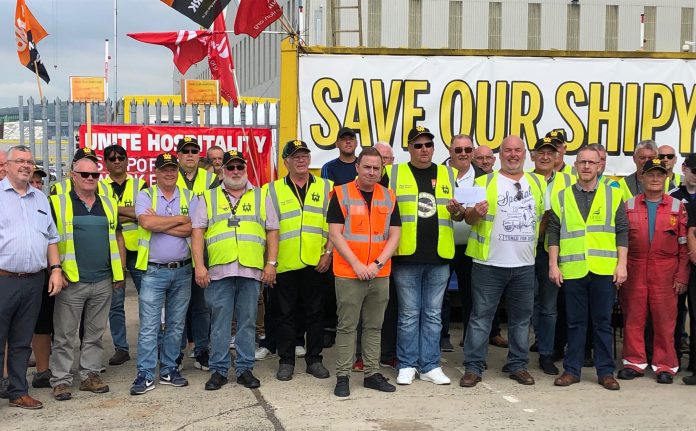
Save-Our-Shipyard-e1565021353605-696x431Photo: Unite construction branch on twitter

Confronting corporate power

A month ago we reported on the launch of the “Fife Ready For Renewal” campaign to insist that production work for the new Neart na Gaoithe wind farm should take place at the currently unoccupied Bifab yards in Burntisland and Methil.  On Friday 5th July the campaign stepped up a notch when 100 pickets assembled in Edinburgh.

IMG_4674Ex-Bifab workers, reps of 5 or 6 unions, School Strikers, ScotE3,  Friends of the Earth and others surrounded the EDF Renewables HQ in Morrison Street, Edinburgh. An expert bugler, echoing his fanfares round the tall buildings, attracted a lot of passing attention. No uniformed police. Four School Strikers were lined up behind a very long banner. They were shy so we got them to go to the front. Good speeches. The plan had been to present a letter to EDF, listing questions and demands. But we arrived to find their door locked. So the questions and demands were magicked onto two long scrolls, which were displayed at the front of the protest and photographed. Then it was decided we should march round the side of the building  to see if there was a back door open so the original letter could be presented. There was a back door – a big revolving one, behind which four large security guards retreated when they saw us coming – a lot of loud music and chanting by this time on a good PA system. Good large flags, multiplied by reflexion in glass walls. Two people were allowed inside to give the letter to the guards, then one worker managed to push his way backwards through the door with a big flag, which he waved at us through the glass with a big smile, while the guards pinioned him. There was a point when it looked as if the crowd would push through the door, but not this time. The guards nudged the worker back though the door, then decided to lock it. This was the best bit – a guard on his knees inside struggling to lock the door with a ground-bolt, but failing to get any of his big bunch of keys to fit. This gave a great photo opportunity, and was greeted with hilarity by the crowd, who offered technical training for EDF workers.
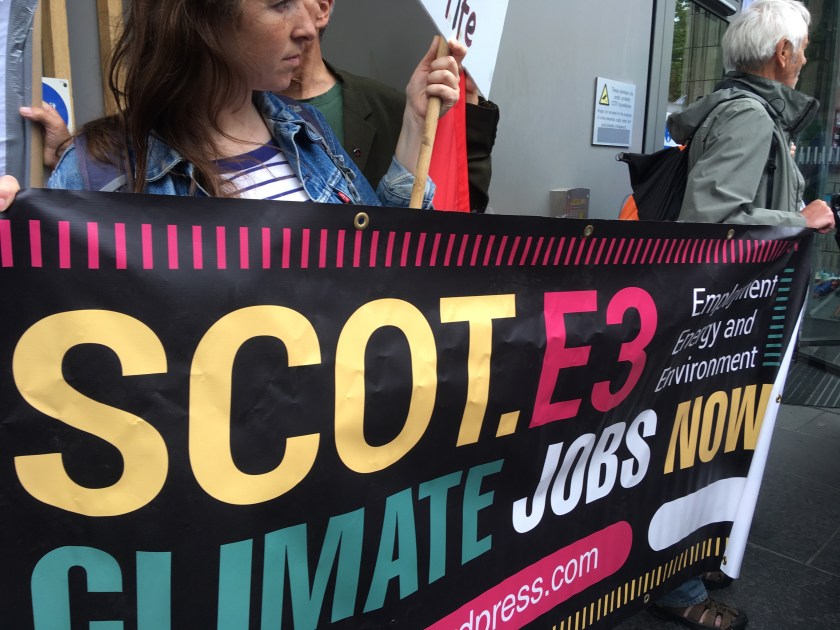
IMG_4675Thanks to Mike and Eileen for words and images.

Climate Emergency – model motion

Youth Strike For Climate are calling for support for their actions – there will be global climate strikes in September.  Please raise this motion (adapt it for your circumstances if necessary) and raise it in your union branch, community group or political party branch. You can download and editable version here.

Climate emergency – model motion

This (branch/region/trades council/union/conference) notes the urgent need for action on the climate emergency, both in response to existing negative impacts such as extreme weather, fires, droughts, floods and loss of habitat and species; and to avoid the catastrophic and irreversible climate damage which people increasingly realise the world is on course for, after the 2018 Intergovernmental Panel on Climate Change (IPCC) report.

We recognise that big business, the military and the richest individuals are responsible for the vast majority of climate change, yet the global working class and poor are disproportionately at risk. A just transition is essential, not only because it is right, but because it is the only way the movement against climate chaos will secure the mass support needed to win and avoid a rich minority protecting themselves at the expense of the planet and the vast majority of people.

We congratulate the school students striking around the world for real climate action. We resolve to:

  1. Publicly state our support and solidarity with the climate strikers
  2. Invite climate strikers to speak at our meeting
  3. Give practical support to the climate strikes, without adults taking it over. This will include asking schools to commit to imposing no sanctions against striking students, promoting the strikes on social media, encouraging members to attend, taking our flags or banner if agreed with the strikers, providing megaphones and stewards if requested
  4. Support the call for workers to join the climate strike in September and to maximise member involvement
  5. Work with other local labour movement and environmental organisations to arrange discussions locally and within workplaces about practically how workers and unions can join the climate strike or show solidarity
  6. Call on employers and local authorities to declare a climate emergency and involve workers and communities in planning, implementing and monitoring to rapidly achieve zero carbon emissions, including ending investments in fossil fuels
  7. Call on employers to recognise union green/environmental reps and give them work time for their activities
  8. Call on unions the STUC and TUC to back the climate strikes, call and build action
  9. Demand massive public investment in the jobs required to address climate emergency, including massive improvements in renewable energy, housing and public transport
  10. Send this motion to our local trades council, up through our union structure, to the local Labour Party and local SNP branch.
  11. Affiliate to Scot.E3 (Employment, Energy and Environment) http://www.scote3.wordpress.com

No_Planet_B_-_Climate_emergency_-_Melbourne_-MarchforScience_on_-Earthday_(34077455041)

June organising meeting

We will be meeting at 7pm at the Edinburgh Peace and Justice Centre on Wednesday 19th  June.  The draft agenda includes discussion and organising on:

Our contribution to the Edinburgh World Justice Festival (28th September – 19th October) which this year has a theme of Climate Action and Social Justice.

The Fife Ready for Renewal Meeting in Buckhaven on 20 June

Taking forward action and writing on: Climate Justice, Defence Divestment and links to Climate Action, Re-engineering the grid for a sustainable future, State Energy Company

These are open meetings and anyone who wants to get involved is welcome.  If you want to add items to the agenda please use the contact form of email directly to triple.e.scot@gmail.com

open-ideas_0

Image CC-BY-SA https://www.jisc.ac.uk/blog/open-science-many-hands-make-light-work-17-aug-2015

Climate Camp

We’ll be running a workshop at the XR Climate Campo at Holyrood on Monday evening (17th June), 7pm – it’s on ‘Climate jobs, just transition and building a movement with social justice at its heart’ – do come along if you can and in any case support the Climate Camp – on this week from this evening until Thursday.

47570064912_7c65f72a1b_z

Report on the May Common Space Forum

Mike Downham attended the Forum which was part of a week of discussion sponsored by Common Space and was held at the Kinning Park Complex in Glasgow.  Here’s his reflection on the meeting which has also been published as a latter on Common Space.

Some meetings about changing society defy themselves by their structure. You know the sort of thing – too many speakers, speaking for too long, protected by a top table, with time only for a few questions (not comments) from the floor, to which each of the speakers gives pontifical answers. Then suddenly there’s a rush to close the meeting, and we all go home frustrated and disempowered.

Not so last night’s Common Space Forum. Rather more than half the time given to the 50 or so participants, the majority of whom took the opportunity to speak with impressive commitment and from a wide range of experience. The three ‘speakers’ reduced to respondents, asked well-prepared questions by a facilitator. Their answers strikingly non-sectarian, based on their respective experiences as Friends of the Earth activist, Extinction Rebellion activist, and Professor of ‘tools of persuasion’. The whole show felt like a re-run for a new and fair society.

Between us, for sure, there’s no problem about articulating both the nature of the emergency and a vision of where we need to get to. The issue is the bridge in between. But I went away optimistic and a lot clearer about bridges we can build together:

  • Make specific demands to the Scottish Government about what we want – for example a publicly owned, democratically accountable Scottish State Energy Company; the closure of North Sea oil and gas extraction; a just transition for workers and communities.
  • Make specific demands to the Scottish Government about what we absolutely don’t want – for example the Growth Commission’s economic plan; distant targets; fracking.
  • Don’t take no for an answer.
  • Acknowledge the importance in the mass movement of emotional response to the climate emergency, especially anger and fear (we got into a whole new dimension here, largely missing before the XR)
  • Know that we can do it

There was much talk about having so little time. The persuasion prof recommended we focus on Government ministers – not enough time to persuade the masses – but later somewhat contradicted himself by saying that people are quick to come behind issues of fairness. Surely we need to do both – hold ministers to account, right now, and continue to work in whatever ways available to us to build the mass movement, readying it to take the lead if ministers fail us.

The hall at Kinning Park Centre is large – plenty of room for an elephant. The elephant last night, sitting just behind us – you could smell him – was class. For all the talk of fairness, and of poverty, especially fuel poverty, there was no explicit class analysis. And yet what got us into this emergency was generations of exploitation of a huge number of people by a small number of people. We need to acknowledge this and keep our eye on it in everything we do, if we’re to understand what we’re up against. And because the people feeling the most pain will in the end be decisive in our fight for a fairer world.

45316192525_8c6ea31023_z

Image by Takver, Flickr, CC BY SA 2.0

Sea Change

This week has seen the publication of an important report on North Sea oil and gas.  ‘Sea Change – climate emergency, jobs and managing the phase-out of UK oil and gas extraction’.  The report is co-published by Platform, Oil Change International and Friends of the Earth Scotland. It finds that

  • The UK’s 5.7 billion barrels of oil and gas in already-operating oil and gas fields will exceed the UK’s share in relation to Paris climate goals – whereas industry and government aim to extract 20 billion barrels;
  • Recent subsidies for oil and gas extraction will add twice as much carbon to the atmosphere as the phase-out of coal power saves;
  • Given the right policies, job creation in clean energy industries will exceed affected oil and gas jobs more than threefold.

Recommendations to the UK and Scottish Governments include:

  • Stop issuing licenses and permits for new oil and gas exploration and development, and revoke undeveloped licenses;
  • Rapidly phase out all subsidies for oil and gas extraction, including tax breaks, and redirect them to fund a Just Transition;
  • Enable rapid building of the clean energy industry through fiscal and policy support to at least the extent they have provided to the oil industry, including inward investment in affected regions and communities;
  • Open formal consultations with trade unions to develop and implement a Just Transition strategy for oil-dependent regions and communities.

We hope to publish a longer review of the report in the near future.  However, in the meantime we strongly recommend downloading, reading and sharing the PDF.

2018-07-19 08.57.05


NFLA Seminar on just transition

On Friday 10th May I attended the Nuclear Free Local Authorities (NFLA) Scotland Spring Seminar in Dundee on behalf of Scot.E3. The subject of the seminar was ‘Dealing With Climate Change, Just Transition and Divestment Issues’.

The four presentations grappled with issues of just transition and sustainability from a local authority perspective:

You can use the hyperlinks to access the presentations. NFLA have also produced a useful briefing on some of these issues – ‘Climate Emergency’ Declarations and the practicalities in Local Authority Action to go ‘Carbon Neutral’

Eileen Cook

46798793304_28f8245813_z


A SHOCK TO THE SYSTEM

An Energy Policy Consultation paper – A shock to the system – the case for a publicly owned and democratically accountable Scottish energy company

In 2014 the Scottish government initiated an energy policy review. The purpose of this review was to examine the present state of Scotland’s energy economy and consider future options in the light of both a looming climate crisis and also the optimum strategy for replacing ageing fossil fuel and nuclear generating capacity with a range of renewable technologies.

In 2017 in order to ensure employment and fuel poverty issues were taken into account in this review, an infant SCOT.E3 decided to submit its own paper in an attempt to ensure that a full spectrum of related energy and environmental issues were incorporated into a memorandum of evidence.

Yet five years on and despite an almost universal acknowledgement of an accelerating climate crisis, little has been done- in practical terms- to address an impending environmental disaster and its related social and economic consequences. Also, within the intervening period, we have seen the commercial collapse of the BiFab renewable power technology company at Burntisland as well as the continued interest of the petro-chemical company Ineos in activating its shale gas fracking options to the point that it will feel confident to test the validity of the current Scottish governments ‘anti-fracking’ moratorium.

So it is against this present uncertainty that SCOT.E3 is now initiating another energy policy review to which it invites all interested parties to participate. The aim of this exercise is to re-examine the range of issues needed to be addressed; a renewable energy economy and the availability of appropriate technologies, the issue of fuel poverty and affordability of energy, energy efficiency, energy related employment and just transition possibilities regarding current energy and defence related employment, improvement of housing stock and carbon neutral public transport systems- to name but a few.

And as can be seen from the attached paper, SCOT.E3 have made a start in outlining the historical record of electricity generation and supply in Scotland in order to reinforce the case for a major stage in meeting Scotland’s forthcoming energy and environmental needs- a long promised Scottish state owned energy company.

We are therefore inviting you to participate in this exercise by adding your comments and/or contributions under the section headings so far left blank. This is to ensure that any report fully takes into account the range of opinions that truly reflect the technical and scientific know-how- as well as the concerns of environmental, community and trade union campaigns and interests engaged in these vital and urgent issues.

In order to ensure that this exercise is properly democratic, it is our intention to hold a consultative meeting for all consultees in the near future, as well as a major workshop type conference in the autumn.

We hope that you find the introductory notes both useful and of interest and we look forward to hearing from you in the near future. For any further information please contact:

SCOT.E3 at www.scote3.wordpress.com, email triple.e.scot@gmail.com 

Untitled