Pete Cannell looks at the way in which the climate crisis and militarism are intertwined
Annual global expenditure on arms and warfare is of the same order of magnitude as the best estimates of the annual funding required to make a worldwide transition to a zero-carbon economy.
The US military-industrial complex is by far the biggest component producer of carbon emissions. It’s hard to get completely accurate figures since around the world nations simply fail to report carbon emissions from their armed forces or conceal the emissions under other headings. And generally, they are given a free ride – scientific reports – for example the IPCC reports on the state of the climate – scarcely mention the impact of military emissions. But it’s estimated that the military contribute something like five and a half per cent of global emissions – more than all the carbon emissions from Russia. Military kit is heavy, expensive and fuel greedy. To travel 1km a Humvee armoured car produces ten times the carbon emissions of an average car, an F35 jet aircraft as much as one hundred cars and one of the new British aircraft carriers is equivalent to five thousand five hundred cars. Around the world there are big increases in military expenditure taking place – the increases proposed for NATO amount to the equivalent emissions of 200 million tonnes of carbon dioxide (CO2e).
When weapon systems are deployed and used the environmental cost is magnified. Looking at the use of arms in Gaza since 7 October 2023, One Earth found that 99% of emissions were due to Israel amounting to more than 1.8 million tonnes CO2e. Total emissions from the onslaught on this tiny area exceeded the combined annual total of Costa Rica and Estonia. But these totals are tiny compared with the carbon cost of rebuilding Gaza which is reckoned to be around 29.4 million tonnes CO2e. And of course, the environmental impact is not just about carbon emissions. It includes pollution, poisoning through residues from shells and explosives and contamination of ground water. Low level nuclear radiation from the dust produced using depleted Uranium shells is still causing deaths and birth defects in Iraq more than two decades after the second Iraq war. Then there’s the degradation of the natural environment and agricultural land which in its turn adds to climate emissions.All of this highlights the importance of the military as a significant contributor to carbon emission and environmental destruction.
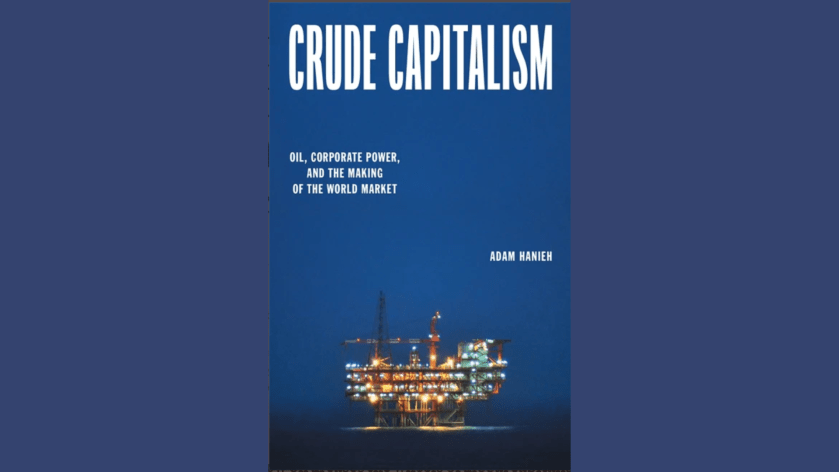
However, I’d argue that most important is the structural role that arms production has in the global capitalist economy. Scotland is a good case study. The arms industry, including the nuclear base on the Clyde, is quite small in terms of numbers employed and even in terms of its percentage of GDP. But it has a status that no other industry has – access to and support from government. Investment is prioritised above the threat of climate change. above that for climate. Indeed, the latter is left to the private sector or marginalised. The skills needed to work in the industry are often transferable to renewables and the building of a sustainable economy. The arms industry is centralised, securitised, secretive and immune to oversight and criticism – all this justified by appeals to the ideology of national interest. More generally the arms industry is at the intersection of global capitalism, imperialism, and environmental destruction. The deep connections between middle east oil and gas (and its impact on the environment) and the arms trade are clearly drawn out in Adam Hanieh’s Crude Capitalism
Paul Atkin replies to an interview with the GMB union’s General Secretary Gary Smith in the Spectator.
In agreeing to be interviewed by the Spectator under the title “the folly of Net Zero” GMB General Secretary Gary Smith lets his members down; not least because remarks like these from a leading trade unionist help give Rishi Sunak encouragement to accelerate his retreat from the government’s already inadequate climate targets.
The phrase “the folly of Net Zero” makes as much sense as “the folly of getting into the lifeboats when the ship is sinking”.
Difficulties in making a transition to sustainability does not mean that making it isn’t essential, and the faster we move the less damage is done. We can see that damage all around us even now.
Gary doesn’t seem to get this, any more than Rishi Sunak does, and he latches on to some of the same lines as the PM does, albeit with a more pungent turn of phrase. To go through these point by point, quotes are either directly from Gary Smith or the Spectator.
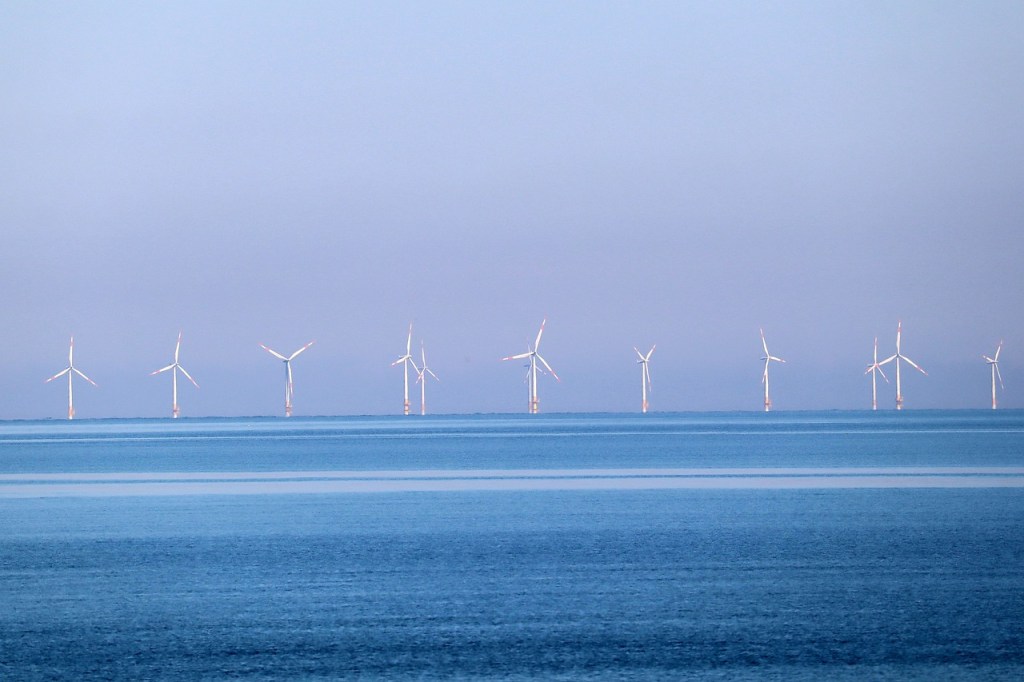
Image from pixabay.com CC0
Auctions for offshore wind power
“Now there will be no bids for the next round of licences because the wind industry can’t afford to put up the projects”
The article starts with an odd bit of misdirection, that echoes the entire right-wing press, on the results of the latest round Contracts for Difference auction for new electricity generation. This focusses on the absence of offshore wind bids at the strike price of £44 per Megawatt hour. The way the Spectator puts it is “The government and the renewables lobby hoped that a successful auction would show that wind power could compete with fossil fuels”. The fact is that it already does. There were no bids from fossil fuel sources at this price either; and the successful bids were all from renewable sources.
24 onshore wind projects
1 Remote Island wind project
56 Solar projects
3 Geothermal projects
11 Tidal stream projects.
These are slated to produce 3.7GW of power. So, renewables 95: Fossil Fuels 0. It’s quite clear which source is heading for the relegation zone. And the International Energy Agency has just reported that electricity generation from fossil fuel sources declined by 7.4% in the whole OECD in the year to September, so this is happening in every developed country.
“Starmer’s 2030 deadline is impossible, I don’t even worry about it”
With 5GW of potential offshore wind projects not coming online, due to rising raw material and interest rate charges increasing costs beyond the auction price, you have to wonder if the government set this up to fail. With the current wholesale electricity price set at over £80 per Kilowatt hour, there was a lot of room to set a price (perhaps around £60 per KWH as suggested by the industry) that could have brought this on stream, and still cut the cost of electricity for customers. This will have a knock-on effect on bills and supply chain jobs – which have been projected on the basis of a tripling of UK offshore wind by 2030 – and choke them off unless the momentum is restored at the next auction. Anyone concerned about jobs in the supply chain will be campaigning between now and then to make sure this is the case.
The stop-go market driven model embodied in the CfD system makes a consistent plan for energy transition vulnerable and chaotic. To take this process by the scruff of the neck and drive it through at the scale and pace that we need requires, as UNITE successfully argued at the TUC, public ownership of energy.
Undersea cables
“The National Grid can’t get undersea cables, There are 4 suppliers of cables in the globe, they’re all booked out to 2030”
If you are concerned with cutting carbon emissions and growing jobs, this is an argument for campaigning for more investment in cable laying and the jobs that go with them, not accepting current limited capacity as an insuperable obstacle. A very good use for some of that £28 billion Labour is pledged to ramp up to.
North Sea drilling
“There will be more drilling in the North Sea”
Senior figures in the unions can’t afford to ignorethe scientific reports on this matter. They are not ambiguous. NO new oil and gas exploration is compatible with Net Zero. 60% of existing reserves have to be kept in the ground to avoid catastrophic consequences. Weaning ourselves off fossil fuels requires unions to fight for a just transition as rapidly as possible for their members in the oil and gas sector. Spinning a delusion that everything can carry on as it is, will speed us to a point at which sustaining jobs will be the least of our problems.
Renewables lobby
“The renewables lobby is very wealthy and powerful. I think people on the left, for good intentions, have got hoodwinked into a lot of this”
This is a breathtaking inversion of reality. How “wealthy and powerful” is the “renewables lobby” compared to the fossil fuel companies? Octopus compared to Shell? Vesta compared to BP, or Aramco, or Exxon? According to the IMF, last year total fossil fuel subsidies were $7 Trillion. 7.1% of global GDP. That’s power. That’s wealth. We should note that this is $3 Trillion more than the total that would be needed globally to get us on track for sustainable development. Shell is now casually projecting that Net Zero will only be possible sometime in the 22nd century if they have their way, with no accounting at all for the social, economic and political consequences of that. Gary sees these companies as “people who we can work with” without reflecting that, since they have known about climate change for fifty years and tried to cover it up, with no “good intentions” at all, that hoodwinking is a large part of what they do.
UK net zero targets
“We’ve cut carbon emissions by decimating working class communities
Who does he mean by “we”? A better word would be “they”. The succession of Tory governments, in all their various guises, since 2010 have been bad for climate breakdown and the working class. They have put business imperatives (profit) above sustainability, and dumped costs of transition downwards onto those least able to afford it. Two examples. Insulation and solar energy installation fell off a cliff when the Tories “cut the green crap”, leading to thousands of lost jobs and higher bills as a result.
Green levies
“Green levies are a modern-day poll tax”
It’s also the case that, because it was the Tories, the schemes they had were skewed to subsiding the sort of consumers who could afford the upfront investment; while dumping the costs on everyone else’s bills. Hence Gary’s complaint that this was ‘disproportionately paid for by the poorest’. Quite so, but the answer to that is not to scrap insulation and solar panel installation altogether, but to approach it as a social mission to upgrade the “leaky, freezing council house(s)” that need it most first, and do it through Direct Labour run by Local Authorities; thereby creating jobs, cutting fuel poverty and improving health, as well as cutting energy demand and therefore emissions. Win, win, win.
Green Jobs
“It’s usually a man in a rowing boat sweeping up the dead birds”
Given that there were 19,600 jobs directly in offshore wind in 2022, and another 11,500 in the supply chain, that’s quite a lot of rowing boats. 30% of these are in Scotland. 15% in Yorkshire and Humber. If considering bird fatalities, Gary might note that in this study from the US, “for every one bird killed by a wind turbine, nuclear and fossil fuel powered plants killed 2,118 “. If we go for nuclear and stick with fossil fuels, we’re going to need a bigger boat.
According to Prof Sir Jim McDonald, president of the Royal Academy of Engineering, 30,000 new skilled workers would be required to retrofit buildings, while 60,000 technicians would have to be on hand to go one step further and install energy efficient heating systems in homes, offices and factories, with intensive training required. This is an extremely conservative estimate given that it can take four skilled workers six months to do a thorough retrofit on a house. In their latest Climate Jobs Report the Campaign Against Climate Change Trade Union Group argues that two million jobs will be required to deal with all 27 million homes and public buildings that need retrofitting if it were to be addressed seriously with the level of investment that’s needed.
That’s an awful lot of new jobs. Were the GMB to campaign for this, positively and proactively, some of these new workers might join.
Nuclear energy
“Smith is broadly positive about the future of green energy and sees Hinckley Point as a success story”
The argument that new nuclear is the core of future “green energy” is not consistent with any concern for impact on energy bills. The strike price for electricity generated by Hinckley Point is £93.50 per KWh. More than double the price at the last CFD auction and a third more than Offshore wind companies were pitching. This will go onto electricity bills and hit the poorest hardest. Small Modular Reactors are projected to be even more costly. So, whatever the green merits or otherwise of nuclear, it is not compatible with the concern for costs to customers that is foregrounded in his argument against “green levies”.
Hydrogen
Gary also argues for hydrogen, in general terms in this article. Elsewhere the GMB has pushed hard for hydrogen to be used as a mass replacement for natural gas for domestic cooking and heating. This is a complete non-starter on grounds of cost, emissions and safety. Unless the hydrogen is produced by renewable energy, the carbon emissions produced in making it are greater than if you just use natural gas in the first place. To produce sufficient hydrogen for mass domestic use using renewable energy would need far more wind farms than Gary is prepared to contemplate as a realistic possibility. Hydrogen has a role in some hard to decarbonise industrial sectors, so any green hydrogen we produce should be kept for that. It will be an expensive and precious resource that we should use accordingly. You have to add to that the concerns about how flammable the stuff is in a domestic context. As hydrogen is much lighter and more flammable than natural gas, the possibility of leaks and fires is much greater, so the existing infrastructure would need significant upgrading. A recent government report concluded that hydrogen in the home would be four times more dangerous than natural gas. A job creation scheme for the Fire Brigade perhaps, but probably one they’d rather not have. That’s why people selected to trial it as a cooking and heating tool in Ellesmere Port rebelled against the prospect of a domestic Hindenburg disaster* in their kitchen, leading to the pilot project having to be scrapped. Many gas fitters are less than happy at the prospect of working with hydrogen for domestic heating or cooking for the same reason.
China and supply chains
“We’ve become increasingly dependent on China because we can’t secure our energy future”
Gary’s position on trade and supply chains is contradictory. The GMB has argued for a “Great British Supply Chain”, with an almost autarkic vision of everything from widgets to jackets to turbines being built here, and for the CFD auctions to be stopped until one is established. At the same time, he quite rightly says he is “not a protectionist”, because workers lose out. But also, that the UK can’t do what the US is doing with the Inflation Reduction Act because it does not have a major reserve currency; which does not quite add up. He objects to the Tory approach for its “ideological bent” to neo liberal globalisation and buying the goods from the cheapest source, but also objects to imports from China as a “non-market economy” that “distorts the world economy”.
Gary seems to accept that China’s “non market economy” is more efficient at producing the necessary goods than the UK neo liberal economy is. In the case of energy, this is probably because they are investing more than twice as much in renewable energy generation than the EU and USA combined, and the UK lags behind both of these. Whether you agree with China’s definition of itself as “Socialist with Chinese characteristics”, or argue that it is a form of “state capitalism”, there’s no doubt that their state directed investment and coordination of state companies, academia and the private sector is beginning to produce the necessary goods at the necessary speed and scale. Just as well, because getting their dependence on coal down fast is crucial for all of us and, again according to theInternational Energy Agency, both possible and happening.
And that brings us to the paradox of Gary’s position. To develop a comparable supply chain here would require investment on that scale. But he claims that investment even on the smaller scale being carried out in the US is beyond the UK’s capacity. To deploy the £28 billion that Labour projects that it will ramp up to (which will be comparable to the US and EU, so therefore about half the Chinese level) would either require direct state investment through newly created nationalised industries, or you have to bribe a multinational, which at the moment is “free money” that comes with no government stake or even a say for the workforce or affected communities. Tata is doing rather well out of this at the moment, with half a billion for an electric arc steel furnace in Port Talbot and another 600 million for their EV plant in Swindon. Gary’s complaint that the redundancies that come with this deal at Port Talbot shows that Just Transition is “fantasy land” undercuts the position that his members would expect him to take alongside the other affected unions – for a say in the transition, for investment in a wider range of viable technologies to sustain volume steel making and the jobs that go with it. If this is a “fantasy” then so is any prospect of defending those jobs.
The reality is that “British” manufacturing is, for the most part, owned by multinationals and might be better understood as “production in Britain”. It also shows that companies like these and the Fossil Fuel majors in the North Sea about whom Gary argues “we’ve got to stop seeing them as the enemy and we’ve got to start seeing them as people who we can work with”, do not return the favour, and shut the unions out whenever they can.
More positively, it should be noted that high quality locally produced goods are not solely dependent on the national market and can also be exported, and companies based here, whoever owns them, do that too. In 2017, according to the Renewables UK Export Nation Reportthis included “an extraordinarily wide variety of goods and services, including supplying, installing and maintaining onshore wind turbines and components, designing gearboxes, manufacturing offshore wind turbine blades and steelwork, supplying and laying underwater power cables, installing, inspecting and maintaining offshore wind farms, providing helicopters, crew and vessels, developing wave and tidal energy projects and providing components for the marine energy industry, as well as designing software, conducting geological surveys, monitoring wildlife, and providing financial and legal services”. With properly targeted and coordinated R&D producing patents as part of a proper industrial strategy, there is a lot of room for growth in all of this, which matters for the sector because most of the growth in it will be “in Asia”.
“Failing to prepare is preparing to fail.” Benjamin Franklin
Transition and jobs growth will only happen if there is investment at scale and speed. Seeking to “moderate” Labour’s policy so that the investment doesn’t happen, means there will be no growth in jobs either. Without plans, and without union engagement in making them, we will stagnate at best. That is what we should be concentrating on now, so that mobilising people for transitions in their communities and workplaces that will cut their bills, boost jobs and cut our carbon emissions fast becomes part of the election campaign to drive the Tories out of office and cement Labour in government into actions that drive that forward.
*I was once told at a SERA meeting by a representative of the Hydrogen industry that the reason the Hindenburg burned so fiercely was not because of the highly flammable gas that it was filled with, but because of the lacquer that was painted on the outside of the dirigible. He did this with a straight face.
We’re very pleased to publish this post by Les Levidow, Open University, les.levidow@open.ac.uk
With the slogan, ‘Our Climate:Our Homes’, the Scottish Trades Union Congress (STUC) led a multi-stakeholder proposal for a ‘whole house retrofit’ approach for decarbonising heat in homes. It included civil society groups such as the Poverty Alliance, Living Rent tenants’ organizations and Friends of the Earth. They jointly demanded substantial funds and new state structures, especially a National Infrastructure Company and municipal energy companies. This plan would provide numerous unionised, green jobs for high-quality retrofits. These measures would be necessary to avoid the limitations and failures of the UK government’s retrofit initiative (STUC, 2021).
This extended a previous proposal, coordinated by Common Weal (2019 et al.). It contributed to a broader plan: a ‘Green New Deal for Scotland’. As regards the institutional means, ‘genuine public-good private-public partnerships should be developed, but government should also intervene directly where it needs to’ (Common Weal, 2019: 104). This section draws on an interview with two authors of those reports (Stuart Graham of the Glasgow TUC and Craig Dalzell of Common Weal, 10.03.2022).
For an adequate retrofit programme, a major obstacle has been Glasgow’s neoliberal policy framework, dating from at least the 1980s. It has structured public expenditure as new markets aiming to incentivise entrepreneurialism and to attract business investment. This framework had generally diminished decision-making capacity of the public sector (Boyle et al., 2008). Given that neoliberal framework of the local authority, its retrofitting plan soon conflicted with the labour movement agenda prioritising the public good.
In 2021 the Scottish government funded the Glasgow City Region to retrofit homes and substitute renewable energy systems for natural gas. Sufficient for a half-million houses, the funds were meant for jointly addressing fuel poverty, heat efficiency and decarbonisation (Sandlands, 2021). Glasgow City Region announced an ambitious plan to retrofit the housing stock by 2032 (Glasgow City Region, 2021a). This was part of the Glasgow Green Deal, which promised many benefits such as ‘ensuring a fairer and more equal economy’ (Glasgow City Council, 2021).
Glasgow City Council organised a 3-day event raising several challenges of a retrofit programme. According to the Council, suitable technology was already available to scale up retrofit. But the programme would need ‘collaboration between government, industry and training providers to realise Glasgow’s aspiration of carbon neutrality by 2030’. An initial pilot was to retrofit the city’s iconic tenement blocks. For the Low Carbon Homes agenda, the Council’s experts mentioned issues such as social justice and fuel poverty (LCH, 2021). The plans for Glasgow to host CoP26 in November 2021 intensified debate on decarbonisation, strengthening the impetus for the government’s plans and promises.
Neoliberal obstacles
Their institutional framework posed several obstacles to a worthwhile, credible retrofit programme. A full retrofit programme may need until at least 2040. Yet the Scottish government made a firm financial commitment only for the 2021-2026 Parliamentary term.
This short timescale provided a weak incentive for business investment in the necessary skills and local manufacturing capacity, whose gaps were well known (CXC, 2022). According to a retrofit programme manager, ‘The existing short-term funding streams do not give businesses the long-term confidence of a multi-year pipeline of work that will encourage the acceleration and expansion of business investment in the skills of their staff and manufacturing capability (Glasgow City Region, 2021b: 2). Under those inadequate arrangements, a retrofit programme would depend on the current long supply chains, especially imported expertise, equipment and materials. Alternatively, the government could make a commitment to create local manufacturing capability, as a crucial basis to realise the local economic and environmental benefits (Common Weal, 2019a).
Energy performance standards were also weak or doubtful. Initial negotiations with contractors agreed pilot projects at a high standard of energy efficiency, such as Passivhaus in some cases (Paciaroni, 2021; Wilson, 2021). By contrast, the overall programme set a minimal standard, Energy Performance Certificate (EPC) level C. This would mean upgrading approximately a half-million units that were at a lower standard.
However, this basis would not guarantee any specific standard in practice. According to some experts, the EPC is simply an administrative compliance method, not an energy efficiency measure or predictor, partly because the outcome depends on each householder’s behaviour (quoted in LGHPC, 2021: 6). Whatever the modest gain, it may be superseded later by a higher standard, thus requiring an extra upgrade at a greater overall cost.
A comprehensive programme would need householders’ enthusiasm, based on seeing initial retrofits visibly saving heat costs in other households. This has been one reason for a ‘fabric first’ approach, i.e. installing effective insulation before alternative heat sources in order to maximise their benefit from the start. This is necessary but insufficient because a ‘fabric first’ approach prioritises technical considerations. By contrast, ‘an occupant-centred “folk first” approach may justify overcoming financial and related barriers which themselves do far more to restrict the choice of options for improving energy efficiency’ (CommonWeal et al., 2019: 3).
Such barriers feature the Energy Performance Certificate (EPC) level C. Why did Glasgow’s programme adopt this? As one driver, a minimal standard simplifies competitive tendering, the wider neoliberal regime which has driven the overall retrofit programme. This creates competition among organizations that instead could cooperatively raise standards on a case-by-case basis. According to a housing association, ‘The funding is not being allocated strategically. Funding is still allocated through a bid process, which means that we are competing against other organisations’ (quoted in LGHPC, 2021: 19). According to the relevant Minister, ‘innovative collective models of transition may play an important role in increasing the pace of retrofit’ (Harvie, 2022). Yet any such model has been constrained by the regime of competitive tendering, which can be understood as a techno-market fix.
As a related obstacle, a competitive call favours large foreign companies with administrative capacity for the necessary documentation but perhaps minimal standards for energy efficiency. Price competition can drive down quality in practice. Competitive tendering excludes and/or fragments small local suppliers which have skills for higher standards. This arrangement deters the large-scale cooperative programme that would be necessary for the greater skills investment, mutual learning and differentiated approach to the diverse building types (Glasgow TUC-Common Weal interview, 10.03.2022). In those ways the programme’s public-good benefits have been limited by Glasgow’s decades-old neoliberal regime (Boyle et al., 2008; Webb, 2019).
Like many cities, Glasgow has lacked the skills for normal repair and maintenance of the housing stock, much less for new skills. So a strong incentive would be necessary for workers to learn retrofitting skills. As the labour movement proposal had said, ‘Scaling up delivery poses a huge skills challenge, particularly given the large number of self-employed contractors understandably reluctant to take time out of being paid to learn new skills’ (STUC, 2021: 3).
In 2021 Glasgow initiated such a training programme, but it had little take-up, for several reasons. The Scottish government’s low, short-term financial commitment has provided a weak incentive for building-trades workers to take up the opportunity. As a plausible disadvantageous scenario, some workers who already have building skills (such as electricians or plumbers) could obtain retrofit training, find that the programme is short-lived and then have difficulties returning to their original trade. Such doubts have been voiced as reasons for little interest in the training opportunity (Glasgow TUC-Common Weal interview, 10.03.2022).
Public-good alternative
In 2019 Common Weal, a Scottish ‘think and do tank’, had anticipated such obstacles and so proposed a comprehensive decarbonisation plan. It lay within a broader Common Home Plan, also called a Green New Deal for Scotland. This would provide a comprehensive alternative to Glasgow’s techno-market fix.
As a key message of the Common Home Plan,
You’re not powerless….. We’re going to show how a Green New Deal for Scotland will not just save the world but will benefit our country, our communities and you individually. Better food, better homes, better jobs, cleaner air, less waster and pollution and an economy based on repairing the things that we need rather than throwing away things that we don’t need…. By leading as an example, by coming up with the solutions and then exporting our skills and our innovations to others we can bring the word with us rather than sitting back or asking the world to stop so that we can catch up (Source News, 2019).
Rather than try to drive GDP growth, this plan promotes an economy of sufficiency. It invites people to help create the necessary innovation, which prioritises repair, refurbishment, digital services and better resource use (Common Weal, 2019).
For decarbonising heat in houses, the plan identified many ways to replace natural gas, reduce GHG emissions and address fuel poverty. Ideally, district heating systems would distribute surplus heat at low cost. Heat pumps would have a stronger rationale in rural areas, though also a wider relevance. By contrast, the gas industry agenda for CCS-hydrogen ‘poses serious risks to the decarbonisation of Scottish energy supplies’ (Common Weal et al., 2019: 8).
Image by Pete Cannell – Air Source Heat Pump on Shetland CC0
This had significant differences from prevalent decarbonisation agendas. While they depend on future techno-solutions, this one is ‘based almost entirely on current or old technology’. The dominant ‘market-pricing-and-subsidy regime’ would increase inequality, so this plan emphasises public-sector responsibility (ibid: 11). This change would be necessary so that state procurement becomes a true public service, beyond the transactional-based profit-oriented economy.
Its plan outlined many inherent complexities of decarbonising heat in houses, as stronger grounds for state-led institutional change, in particular: ‘Set up a National Housing Company to retrofit all existing houses to achieve 70-90 per cent thermal efficiency. Change building regulations and invest in domestic supply chains to make almost all new construction materials in Scotland either organic or recycled’ (Common Weal, 2019: 39).
It also made specific proposals for low-carbon heat sources. Given several disadvantages of electricity-based heat, the report promoted district heating systems as cheap, viable means to deliver renewable heat to homes (Common Weal, 2020b). For both those aspects, public-sector responsibility would be necessary to implement effective solutions and overcome potential obstacles, as the reports emphasised.
Those proposals had anticipated limitations that later arose in the Scottish government’s 2021 retrofit programme and Glasgow City Region’s role. In response, the labour movement network tried to persuade the Scottish government to establish the necessary long-term commitment, higher standards and institutional framework, including a National Infrastructure body for overall decarbonisation. Likewise they tried to persuade the City Council to replace the competitive tendering regime with a more flexible basis that would facilitate more diverse bids and raise quality standards.
Although technical studies per se cannot overcome the problem, they can help identify institutional weaknesses and policy obstacles. Solutions need political changes which can drive economic change towards shorter, high-quality supply chains supporting long-term skilled livelihoods. The necessary political changes would depend on a high-profile campaign that links issues such as labour standards, housing quality, environmental protection, fuel poverty, etc.
As a potential means to link such groups and issues, the campaign ScotE3 (employment, energy and environment) was already advocating climate jobs within a Just Transition framework. It was initiated by trade unionists and climate activists, ‘keen to find a way of taking climate action into workplaces and working class communities’. Alongside its positive proposals are attacks on false solutions, especially a CCS-hydrogen technofix for decarbonising fossil fuels. The latter has been a basis for the North Sea Transition Deal, endorsed by the Scottish government (Scot.E3, 2021).
Scotland has a special opportunity for a socially just, environmentally sustainable decarbonisation agenda. This is partly due to its devolution arrangements, with a larger budget and greater legal powers than the UK’s regional authorities. Yet the Scottish government has made false promises, such as through its neoliberal retrofit framework or hypothetical technofixes, thereby avoiding responsibility for decarbonisation. By default, these promises may be accepted by a passive public – unless opposed by a strong alliance for climate justice.
As the Glasgow case shows, a Green (New) Deal has become a widespread banner, attracting divergent agendas for a retrofit programme. These promote divergent sociotechnical forms, linking technical standards with different social orders, especially a rivalry between market-competition versus community-worker cooperation. To realise the potential benefits, a public-good agenda would need to undermine and displace the dominant policy framework.
Author’s note:
This blog piece comes from my book chapter on Green New Deal agendas. It starts by comparing US and UK nation-wide agendas, especially trade-union pressures to endorse false solutions (also in Levidow, 2022). Then it analyses GND local agendas to decarbonise heat by retrofitting houses, e,.g. from Leeds Trades Council (2020), followed by the Glasgow case – as below.
Boyle, M., McWilliams, C. and Rice, G. 2008. The spatialities of actually existing neoliberalism in Glasgow, 1977 to present, Geografiska Annaler: Series B, Human Geography 90(4) 313-325.
An international conference in Brussels organised by the Rosa Luxemburg Foundation 27-28 June
Ellie Harrison (Get Glasgow Moving) and Mike Downham (ScotE3), representing their organisations in the Free Our City coalition which campaigns for free, publicly owned, democratically controlled buses across Greater Glasgow, were invited to speak at this conference as a result of contacts made during COP26. They also showed the Reel News film of the Free Our City protest during the COP as previously published on this Blog.
Here Mike Downham summarises his reactions to the conference:
It was a privilege and a pleasure to be invited to speak at this conference and to get to know in the evenings the other speakers from Germany, France, Spain, Italy, Hungary and Brazil.
The lid on the coffin of cars was firmly nailed down, whether powered by a combustion engine or by electricity. It was clearly demonstrated that if cars continue to be produced there is no way that carbon emissions can be reduced in time to avoid a more than 1.5 degree rise in global temperature or that levels of poverty will fall in time to prevent societal chaos, despite the huge effort by car manufacturers to greenwash electric cars. We were able to point out that in any case only 49% of households in Glasgow have access to a car – that figure predating the price rise in cars and the cost of living crisis.
The EU’s carbon emissions discourse has been reduced to targets and choice of technology, with little reference to just transition for the millions of car manufacturing workers across Europe – 800,000 in Germany alone – nor to the transformation needed, especially in the way we move about our cities. Furthermore the emissions targets look less and less realistic.
Moving to mass transport is as urgent as stopping oil and gas extraction. Free public transport is also a more immediately attractive concept for large numbers of people than doing without oil and gas.
Three expert speakers (Ellie Harrison of Get Glasgow Moving, Alana Dave of the International Transport Workers Federation, and Mario Candeias of the Rosa Luxemburg Foundation) told us exactly what needs to be done about public transport – above all that it needs to be publicly owned, democratically controlled, integrated in a way that gets people quickly to where they want to go, and free.
Electric Bus pixabay.com CC0
Key to the transformation of transport are the highly developed skills, self-esteem and producer pride of car production workers. These skills are needed in the production of electric buses, trains, bicycles and ships. Some but not all workers will need new training, giving them the choice to remain within the transport sector or into other carbon negative sectors like renewable energy, or carbon neutral jobs in public services.
Transport needs to be seen as a common good and a right. Mobility poverty is as urgent an issue as fuel poverty and food poverty, though in Brazil, where there are 30 million hungry people, transformation of transport will inevitably take longer to achieve, even if Lula regains power.
Once again we know what to do – that’s not the issue – the issue is how to achieve the power to get it done. But transport workers have more power than most other workers, both because so many people rely on them in their day-to-day lives, and because many of their skills are hard to replace – witness the current RMT rail workers strikes, and the Rolls Royce workers in East Kilbride who grounded half the Chilean Air Force in 1974.
Mario Candeias speaks of a pathway to power:
MOVEMENTS → STATE INTERVENTION → PUBLIC OWNERSHIP → INDUSTRIAL STRUCTURAL CHANGE OVERSEEN REGIONALLY BY WORKERS AND USERS
The question is what movements? He suggests partnerships between existing trade unions and civil society organisations. In my opinion movements which can reach sufficient scale fast enough are more likely to arise from new formations, especially those led by young people currently active for climate justice. These are currently targeting their civil disobedience on oil, gas and coal production sites, recognising that opposing forces largely reside in the fossil fuel industries. Will they also see the need to target car production sites to challenge the huge power of Volkswagen, Daimler and BMW?
These discussions were taking place in Brussels, where it’s estimated that there are between 15,000 and 30,000 lobbyists – that’s between 20 and 40 per Member of the European Parliament. Of these 87.5% represent capital interests.
The most encouraging thing for me was to have two days in international company – the first non-remote opportunity for me since before the pandemic. I was left reflecting about the central importance of workers and communities united across borders in opposing the power of capital. The EU is perhaps an object lesson about how not to deal with borders – the old issue of merging economically, but retaining political independence. The speaker from Hungary described his country as in a “German trap”, German companies using cheaper Hungarian labour for their assembly lines for both cars and weapons.
Further reading – English copies of these three booklets, all published by the Rosa Luxemburg Foundation, are available free in limited numbers. If you’re interested please contact me first at mandrdownham@phonecoop.coop
Switching Lanes by Mario Candeias, 2022
The European Car Lobby by Tobias Haas and Hendrick Sander, 2019
New nuclear power stations are central to the UK government’s new energy strategy. Some influential environmentalists like George Monbiot support nuclear as part of tackling the climate crisis and the Intergovernmental Committee on Climate Change (IPCC) argue that globally by 2050 energy production should 70% renewables and 30% nuclear. So why do we say that there should be no role for nuclear? In this briefing we explore the arguments around nuclear and demolish some of the myths about nuclear power.
A military technology
The raw material for nuclear weapons is produced in nuclear reactors. In the US, the UK, Russia civil nuclear power was developed after the second world war to support nuclear weapons programmes. Researchers at the University of Sussex Science Policy Research Unit have shown that to this day the main role of nuclear power in the UK main has been to subsidise nuclear weapons. Electricity consumers have paid the price through higher costs, providing a hidden subsidy for the nuclear weapons programme.
Chernobyl CC0 pixabay.com
High cost
Nuclear power costs two to three times as much per unit of electrical energy than offshore wind. Onshore wind and solar is even cheaper. These comparisons don’t include the cost of decommissioning old nuclear power stations (which takes many decades) or the cost of safely storing the radioactive waste that they generate (which is necessary for thousands of years). These additional costs are born by consumers and taxpayers.
Long construction times
Since 2011 construction has started on 57 nuclear power plants around the world. Ten years later only 15 are operational, with many incurring long delays and massive overruns on predicted costs. Even advocates of nuclear power argue that it would take around 25 years for new nuclear to make a significant impact to global energy production.
Carbon free? Not at all!
To widespread consternation, the European Commission recently declared nuclear a green technology. Clearly nuclear reactions don’t generate greenhouse gases. However, it’s a myth that nuclear is a carbon free resource. Uranium mining, plant construction, which requires large amounts of concrete, and decommissioning are all carbon intensive. A 2017 report by WISE International estimated nuclear lifecycle emissions at 88–146 grams of carbon dioxide per kilowatt hour. More than ten times higher than wind with lifecycle emissions power of about 5–12 grams. Uranium fuel is scarce and carbon emissions from mining will rise as the most easily recoverable ores are mined out.
Safety
The consequences of nuclear accidents are severe. Proponents of nuclear power downplay the impact of the Chernobyl disaster in 1986 and argue that the number of deaths was small. In a scrupulous investigation, Kate Brown author of ‘Manual for Survival – A Chernobyl Guide to the Future’ has researched the decades long efforts by the old Soviet Union, and then the US, to cover up the impact of Chernobyl. She estimates that the true figure for deaths is in the range 35 – 150,000. Many nuclear plants (like Fukushima) are built close to the sea to provide water for cooling. increasingly these reactors will be at risk as sea levels rise.
CCO pixabay.com
Environmental impact
About 70% of uranium mining is carried out on the land of indigenous people. Mining and leaks of radiation have had a devastating effect on the environment in these areas. Building more nuclear power will result in more leakage of radioactive materials into the environment and more workers exposed to unsafe conditions and preventable deaths.
Small modular reactors
Rolls Royce is pushing for the development of small modular nuclear reactors as a response to the climate crisis. It’s argued that they could be built more quickly although this is unproven. In addition to sharing all the negative features of larger reactors, new research at Stanford University suggests that smaller reactors are less efficient and produce up to 35 times the amount of low-level radioactive waste and 30 times the amount of long lived waste compared with larger reactors.
Scotland
While Westminster is planning huge investments, the Scottish Government is currently opposed to new nuclear generation. Nevertheless, Scotland has more licensed nuclear installations per head of population than anywhere else in the world. Only one of these, Torness, is currently generating electricity, and it is scheduled to shut down in 2028. There will be strong pressure on the Scottish government to buy in to a new generation of reactors.
Alternatives
Advocates of nuclear power argue that nuclear is essential to the energy transition we need because, unlike wind and solar, it is not dependent on the weather or the time of day and so can provide a reliable base load. There are alternatives – more investment in tidal generation could also support based load supply – and the development of a smart grid involving multiple types of storage – pumped hydro, local heat pumps and battery could ensure an energy supply system that is resilient. Developing these systems alongside wind and solar would enable the energy system to be transformed much more rapidly than is possible with nuclear. A nuclear strategy is just too slow to meet the urgent need to reduce carbon emissions over the next decade. And the big sums of money being channelled in to nuclear divert investment from renewables and prevent that rapid and necessary transition.
Briefing #14 on climate, fuel poverty and the cost of living is now available for download. As with all the our briefings you are welcome to use and adapt the briefing content – attribution to https://scote3.net is appreciated.
The content of the briefing is reproduced below.
Climate, fuel poverty & the cost of living
Fuel poverty kills
Prior to the latest crisis almost 25% of households in Scotland lived in fuel poverty and just over 12% were in extreme fuel poverty. Households in extreme fuel poverty are disproportionately represented in rural Scotland. Older people living in rural Scotland are particularly hard hit. Every year thousands die because of fuel poverty – in 2018/19 excess winter mortality (that’s in comparison with the average winter mortality for the previous five years) was 2060 – the death toll can be more than twice as high in cold winters. Around 85% of households in the UK rely on gas for heating and cooking. The huge hike in gas prices is going to make an already unacceptable situation much, much worse.
Rising fuel prices
Gas and electricity prices have been rising faster than inflation for a long time. From 2006 – 2016, Gas prices rose by 71% and Electricity 62%. Between 2017 and 2020 electricity prices increased by a further 8% in real terms while gas prices fell by a similar amount. But gas prices are extremely volatile. Since 2019 the wholesale price has almost trebled.
Gas consumption fell by just over 2% in 2020, a consequence of lockdowns around the world. In 2021 there was a rebound with consumption increasing by 4.6% because of increased economic activity and several extreme weather events worldwide. The cost of producing gas is about the same this year as it was last year and the year before. So why has the price rocketed up? Prior to 1987 the EU designated natural gas a premium fuel that should be reserved for home heating. Now 60% of gas is used to generate electricity. Britain used to have significant storage capability. This was abandoned in favour of allowing the market to deliver gas as needed. These changes have been a disaster. Gas is traded on the spot market with hedge funds gambling on future prices. As a result, the cost of an essential utility is determined by a casino where traders rake in massive profits while consumers pay the price.
Lack of ambition
In June 2019 the Scottish Parliament passed a new act setting statutory targets for reducing fuel poverty. Rightly it highlights the impact of fuel poverty on the most vulnerable in society. Low-income, high-energy costs, and poorly insulated housing result in the appalling situation where families, young people, elderly, disabled and many working people, cannot afford adequate warmth. The new act sets interim targets for reducing fuel poverty to 15% of households by 2030 and final targets for 2040. Considering the cost of living and climate crises we face this is too slow and not enough. The act failed to address the threat posed by a chaotic market. From April 2022 annual bills will increase by an average of almost £700. Further increases are expected later in the year. The numbers in fuel poverty are set to rise well above the current level.
Fossil fuels cost the earth
Both Holyrood and Westminster remain committed to the maximum economic extraction of oil and gas from the North Sea. The big energy companies are making billions in extra profits out of the crisis. North Sea oil and gas operates under a regime of very low taxation. With prices high companies will be doubling down on plans to open new gas fields. If this happens there is no chance of meeting the reductions in greenhouse gas emissions that are essential. We argue that there are two essential steps. The first is to protect all those who are in fuel poverty and stop more people joining them. A windfall tax on profiteers will help with this but should not be mistaken for a long-term solution – and the scale of the problem is so large that it requires significant redistribution with higher taxes on the rich and much more support for the poor. These are necessary short-term steps to prevent large scale misery, deprivation and increased winter deaths. But a secure future for us all rests on gas being taken out of the market, with North Sea and North Atlantic oil and gas taken into public ownership and control. With public control it then becomes possible to plan for the phase out of fossil fuels from the North Sea. In the process we cut greenhouse gas emissions and replace expensive gas heating by cheaper renewables. The interests of working people and the need to protect the planet are aligned.
A mass insulation campaign
In its ‘One Million Climate Jobs Pamphlet’, the Campaign Against Climate Change (CACC) notes that
Three quarters of emissions from houses and flats … are caused by heating air and water. To reduce this we need to insulate and draught- proof the buildings, and replace inefficient boilers. This can cut the amount of energy used to heat the home and water by about 40% and delivers the double-whammy of reducing energy costs and helping mitigate the scourge of fuel poverty.
Based on these CACC estimates, which are for the whole of the UK, a campaign to properly insulate all homes in Scotland would employ around 20,000 construction workers for the next 20 years. This doesn’t account for additional jobs in education, training and manufacture that would spin off from such an endeavour. Through this carbon dioxide emissions from homes would be cut by 95%. We could ensure that all new houses are effectively carbon neutral. The technology exists – there are examples of ‘passive houses’ that use very little energy. Insulation together with the steady replacement of gas boilers by affordable heat pumps is the solution to cutting the energy demands of domestic heating. Hydrogen is not a solution (see Briefing #13).
Image by Pete Cannell CC0 Public Domain
New Technologies
The current costs for fossil fuel power range from 4p -12p per kilowatt-hour. Inter renewable energy agency (IREA) state that renewable energy will cost 2p – 7p with the best onshore wind and solar photovoltaic projects expected to deliver electricity for 2p or less. Renewable energy is necessary for a sustainable future, and it is cheaper than fossil fuels. Current Westminster Government policy – notably the subsidy ban for new onshore wind farms – is impeding the shift to renewables.
No Fracking
For the moment fracking is off the agenda in Scotland. The result of a magnificent campaign of resistance. But INEOS continues to import fracked gas from the US. This has to stop.
In conclusion
Fuel Poverty and the cost-of-living crisis are the direct result of the “wrecking ball” of market forces dominating our need for energy to give us warmth, light and sustenance. In the pursuit of profit, the use of fossil fuels adds to the catastrophe of climate change.
We have the technology and skills to stop this madness and misery through a radical shift in Energy policy that would combine sustainable and renewable resources dedicated to social need. Tackling climate change would go hand in hand with creating additional jobs, eliminating fuel poverty, and improving health and well-being. To make this happen we need the kind of focus and the level of investment that has only normally applied at times of war. Ending the use of fossil fuels over a short period is practically possible provided there is the political will.
Some of the material in this briefing also appears in Briefing #7 – Fuel Poverty
About Scot E3
Scot.E3 is a group of rank and file trade unionists, activists and environmental campaigners. In 2107 we made a submission to the Scottish Government’s Consultation on a Scottish Energy Strategy. Since then we have been busy producing and sharing leaflets and bulletins.
We believe there is a compelling case for a radical shift in energy policy. Looming over us there is the prospect of catastrophic climate change, which will wreck the future for our children and grandchildren.
We have the knowledge and the skills to make a difference to people’s lives in the here and now. A sustainable future requires a coherent strategy for employment, energy and the environment. We need a sense of urgency. We need a coordinated strategy and massive public investment.
Mike Downham reflects on the impact of Covid, the aftermath of COP26 and what we might do differently in future.This article was first published inScottish Socialist Voice.
It’s nearly two long years since we began to become aware of the potential scale and danger of the new virus. At that point some prescient people suggested that how we reacted to the pandemic would be a rehearsal for our performance in the forthcoming big show of climate breakdown.
This wasn’t the first time ‘rehearsal’ had been used for how we organise on the left. John Berger described every act of resistance as a rehearsal. Colin Barker called his 1987 book about the uprisings in France, Chile, Portugal, Iran and Poland between 1968 and 1980 Revolutionary Rehearsals. And he used this title again in his subsequent book Revolutionary Rehearsals in the Neoliberal Age, written jointly with Gareth Dale and Neil Davidson published this year – posthumously for both Colin and Neil – which describes the uprisings in Eastern Europe, South Africa, Indonesia, Argentina, Bolivia, Venezuela, Sub-Saharan Africa and Egypt since 1989.
It’s reasonable I think to say that we’ve made a right mess of the Covid rehearsal. Had we known two years ago what we know today, we would have learnt our lines and our cues more thoroughly. What we know today is that 9,634 people in Scotland have died; that the majority of these snuffed-out lives have been among the poor, the disabled and the marginalised; that 99,000 people in Scotland are living with Long Covid; that about 10% of children who catch the virus go on to have disabling poor health for weeks or months; and that the NHS has broken down.
That the NHS has actually broken down, no longer something we just fear might happen, was brought home to me this week by hearing about a middle-aged woman in the Paisley area with an 18-month history of severe neck pain who waited so long for surgery that she’s been forced to give up her job as a care-worker, then lost her home because she couldn’t keep up with her mortgage repayments. Not that this is the only tragic story about NHS failure we could tell between us.
Now the omicron variant (whether or not it turns out to be as bad as feared – we’ll have to wait a week or so before we know) is shouting at us from the wings, telling us that if we allow the virus to spread, whether in Scotland’s communities, schools and workplaces in an incompletely vaccinated population, or in largely unvaccinated countries sent to the back of the queue because they can’t pay, sooner or later we’re going to get a variant which will evade current vaccines.
And yet the cues were there in the script from the beginning. If we’d read it and learned it we’d have known we couldn’t trust the governments of wealthy counties, including Scotland, to not rely so heavily on vaccines, or to prioritise supply and reduce the cost of vaccines for poor countries, because these governments are locked into a system where profit trumps health. Yesterday’s top news was about Pfizer rubbing its hands as it suggested that annual vaccination was likely to be necessary – without mention of the financial and logistical implications of vaccinating eight billion people annually. Pfizer is relishing not only the prospect of a limitless market but also that it has outcompeted AstraZeneca both technically and in its propaganda.
Just as profit trumps health, so that the ruling classes allow the Covid virus to spread, it also trumps the devastating impacts of global heating which are unfolding for all humanity. COP26 has finally made it clear that neither wealthy governments nor the oil and gas corporations are going to take effective action in relation to global heating, despite being fully aware of and no longer denying the scale of the impacts which will result from their inactivity.
How can it be that one small fraction of human beings can inflict such suffering on the rest of their species? Andreas Malm and colleagues, in their new book White Skin, Black Fuel try to explain:
They are not perturbed by the smell from the blazing trees. They do not worry at the site of islands sinking; they do not run from the roar of approaching hurricanes; their fingers never need to touch the stalks from withered harvests; their mouths do not become sticky and dry after a day with nothing to drink … After the past three decades, there can be no doubt that the ruling classes are constitutionally incapable of responding to the catastrophe in any other way than by expediting it; of their own accord, under their inner compulsion, they can do nothing but burn their way to the end.
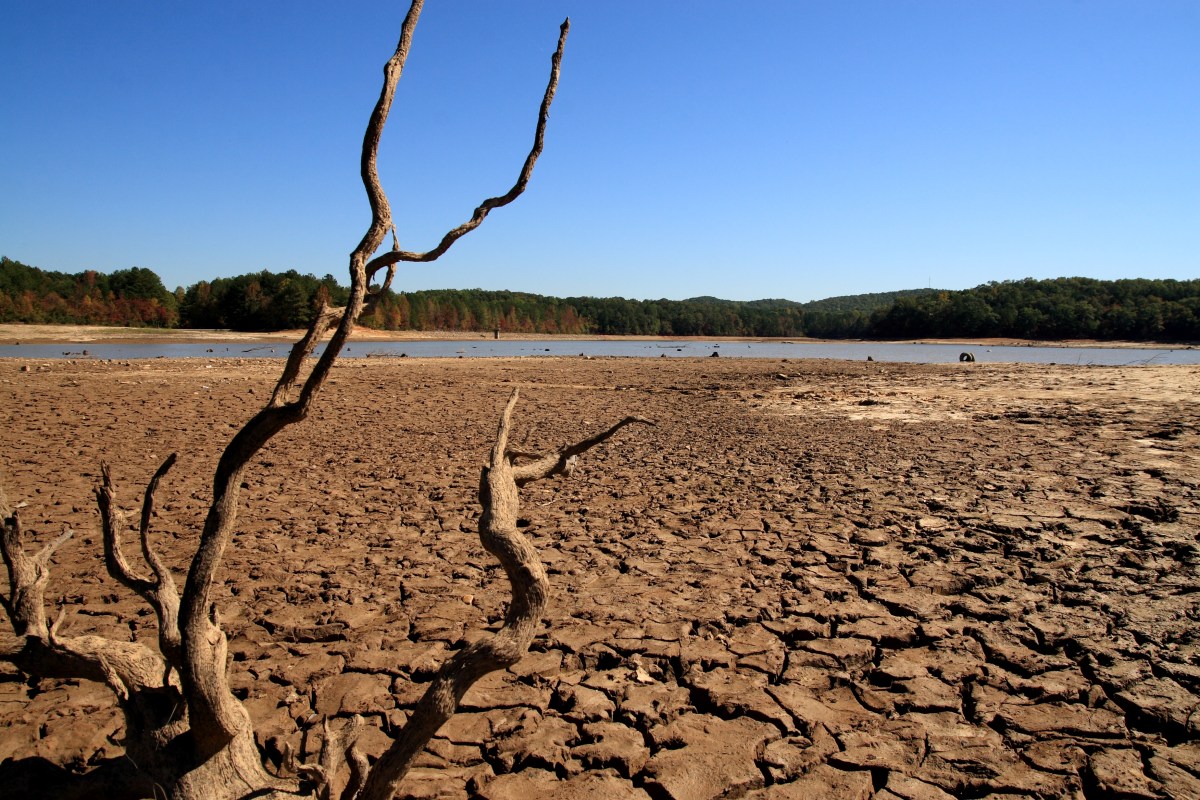
The lake at Sweetwater Creek State Park Lithia Springs GA is one of the sources that Georgia residents are dependent on for drinking water Image by Global Water PartnershipCC BY-NC-SA 2.0
As we get our last call to take the stage in the climate crisis, what have we learned from the Covid rehearsal? What are our lines and what are our most critical cues?
The best approach to these questions may be to ask first what mistakes we made in the rehearsal, to avoid making them again. We should perhaps beware of:
Knocking politely on town-hall and parliament doors asking the politicians to do things few of them can even contemplate doing
One-off marches and protests which aren’t part of a charted programme of resistance
Loosely knit coalitions, which dilute militancy with compromise
Hoping to build a social democratic party which could win at the ballot-box
Organising strictly within our political silos, whether parliamentary parties, or revolutionary groups, or single-issue institutions
Underestimating the extent to which the ruling classes have stifled trade union power so that collective withdrawal of labour is no longer the readily available weapon it used to be
How then can we organise, if not in these ways? First, the Covid pandemic is far from over – in fact it can be said to be at a critical point, with the prospect that vaccines may not protect us, and that relying on vaccines alone is not sustainable. We’ll only be able to overcome this pandemic through traditional public health measures, delivered through a greatly expanded and well-resourced public health service. This is what we can start turning our attention to and fighting for. Covid is offering us the experience of another rehearsal, the key changes needed to address both Covid and climate becoming more clearly the same – rolling out and investing heavily in existing technologies instead of switching to uncertain ones. Vaccination on its own becomes the equivalent of Carbon Capture and Storage, both of them profitable for the ruling classes but disastrous for the rest of us.
Second, COP26 has shown us that targeted and sustained direct action works. The Indian farmers, after a year’s disruptive presence in Delhi, during which 700 of them died at the hands of the police, have won a historic victory. The first thing Modi did when he returned from Glasgow was to announce that he was going to withdraw the three laws against which the farmers had been protesting. Two weeks later Shell announced that they are giving up their ten-year plan to extract oil and gas from the Cambo field. This is a huge victory for the Stop Cambo! campaign – a direct result of its persistent visibility in Westminster over the last year, then its strong performance at the COP in Glasgow.
But in the midst of our celebrations of these two wins, we can see that the farmers are continuing to swamp Delhi. They want to see the three laws actually withdrawn, not just hear a promise. It’s probable that even then they will continue their protest for further, more systemic changes. Stop Cambo! knows too that it must not relax. There’s still Siccar Point Energy to unseat (the majority partner in the development of the Cambo field), and there’s the UK Government to force into a decision that no extraction license will be granted. A win is the cue to increasing the strength of a protest, not to ending it.
Third, we would do well at this point to start discussing what so far we’ve shunned: how are we to oppose the state oppression which is bound to escalate in relation to increased direct action? Is XR right to remain adamant about non-violence? Or did Mandela have a point when he said “The attacks of the wild beast cannot be averted with only bare hands”?
The major disaster in British Columbia a week ago has been conspicuously under-reported in the UK, whether in the interests of those who want to minimise concerns about climate change, or as part of the British exceptionalism which increasingly dominates our mainline media.
A key feature of the disaster is that much of its devastation has impacted on already impoverished First Nations communities, many of whom are without power, short of food and shelter, and cut off by roads made impassable by huge landslides.
It’s also clear that increased run-off following the forest fire-storms in a uniquely hot summer has contributed to the flooding and landslides.
Large numbers of dairy cows have been swept away, to the extent that there’s a widespread shortage of milk in western Canada.
Thanks to the People and Nature blog for alerting us to this excellent short video which sums up many of the reasons why the hype that surrounds hydrogen is so misguided. You can find links to a couple of longer articles on this issue on our ‘further reading‘ page and to blog posts here and here.
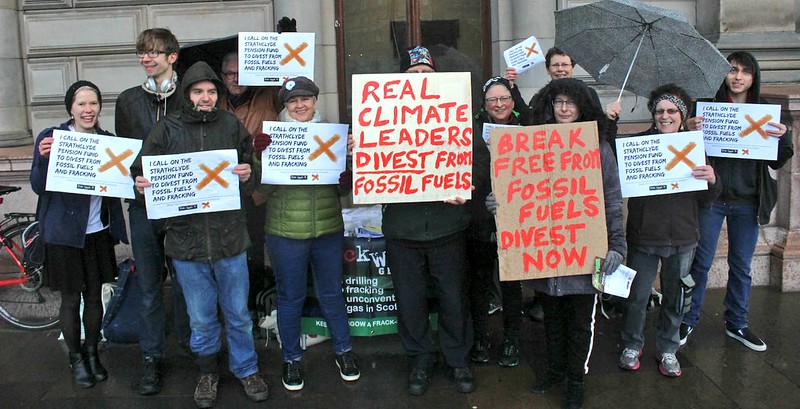
On April 1st Glasgow City Council will be debating whether to end investing pension funds in fossil fuels. If successful, this will be a big step forward for divestment campaigns. The motion is proposed by the Green Party and we post their press statement below.
Image from Friends of the Earth Scotland on Flickr CC BY SA 2.0
Scottish Green Party 25/03/2021Glasgow City Council to vote for end to fossil fuel investments. Today will see the publication of a motion by Scottish Green party councillors in Glasgow for the Council to commit to ending its pension fund investments in fossil fuels. At present the Strathclyde Pension Fund, which GCC is part of, has over £500 million worth of holdings in fossil fuel companies. The motion, included below, is part of the budget agreement between the SNP administration the Scottish Green Party, so is expected to pass with overwhelming support when the vote takes place on April 1st.Green Party Councillor Kim Long, who will be moving the motion on April 1st, said: “It makes no sense, financially or ethically, to continue to invest in the fossil fuels that are destroying our planet. We know that in Glasgow, the climate crisis will impact the poorest communities the hardest – and all the money the city plans to spend on mitigating this damage is wasted if we keep pouring money into the very thing we know is making the problem worse. But this is also an opportunity – local government pension funds are the single biggest public store of wealth in Scotland. We need to stop fuelling the crisis, and instead invest in a Green recovery to create the fairer, greener Glasgow we need. “Isla Scott from Divest Strathclyde, which supports the move, said: “We urge Councillors and the Strathclyde Pension Fund (SPF) committee to show climate leadership as we head towards COP26 and to commit to start divesting immediately. The continued investment of over £500 million in fossil fuels is abhorrent and cannot be justified in a climate crisis. Furthermore, it risks pensioners’ money being lost in stranded assets, money that could be better invested in funding climate solutions and a just transition to a green economy. We will continue to campaign for divestment for as long as the SPF continues to fund the breakdown of our climate.” The motion is below.
Council.
Recalls its previous support for a transformative Green New Deal to respond to the climate and ecological emergencies;
Believes that a Green New Deal for the city region will require massive investment, and that the Council’s own pension investments could play an important part in that; Recognises that the Strathclyde Pension Fund supports low carbon initiatives through its direct investment portfolio, but is concerned that the Fund retains large holdings, worth in excess of £500 million last year, in fossil fuel industries that are driving the climate and ecological emergencies and perpetuating global inequalities;.
Notes the Council’s fiduciary duty as administering authority for the Strathclyde Pension Fund must be paramount in all decision making around the pension fund. Further notes the calls made over many years from campaigners on the issue of fossil fuel divestment and notes that many other major public and private institutions have already made and acted on commitments to fossil fuel divestment, demonstrating leadership on the climate emergency at the same time as protecting the long-term interests of their individual investors;.
Believes that in the year of the COP26 climate summit, when the eyes of the world will be on Glasgow, the city and its institutions must show climate leadership; and therefore.
Resolves to write to the Strathclyde Pension Fund committee, asking that it make a formal commitment to fossil fuel divestment prior to COP26, with the intention of divesting completely as quickly as possible, and no later than 2029; and that it further considers how it can reinvest the Pension Fund Members’ hard-earned money to drive a green recovery for the Glasgow region.
Andrew Smith Communications Officer Scottish Greens 0141 321 7940 07800 972393









 Employment, Energy and Environment