Housing is a central issue in the transition to a long term sustainable economy. As a group Scot.E3 has produced resources on Fuel Poverty and we are currently working on more resources that look at how passive houses and a mass campaign of home insulation could contribute to a just transition while at the same time as improving the quality off people’s lives. We’re pleased to publish a post by Save Leith Walk activist Ian Hood on the work that the campaign has done to think about the future of hosing in their area.
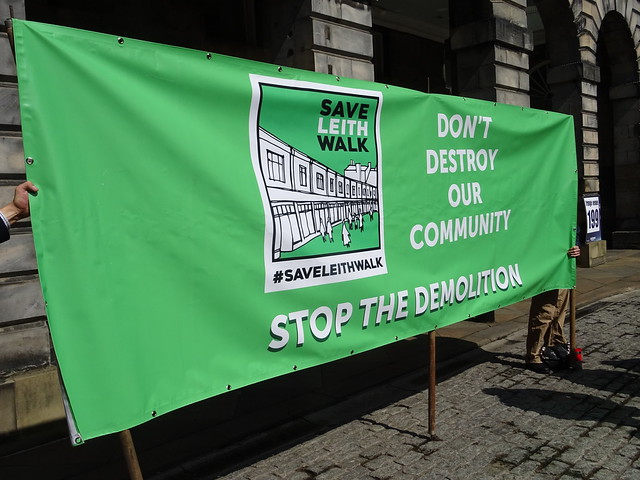
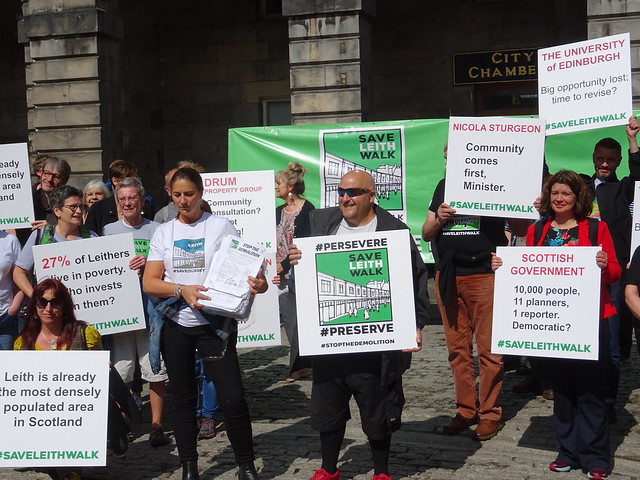
Early in 2018, it became clear that developers wanted to demolish a long parade of shops in Leith Walk and replace it with a student accommodation. A popular local campaign emerged to challenge this and in January 2019 Edinburgh Council agreed that the building should not be demolished and that the proposed development was unacceptable. Planning Permission was refused.
But the campaign has always been about more than just opposing the wishes of developers. To be successful in the long run we need to promote an alternative vision, one that reflects the needs of the local community and can take it forward.
Over the last year campaign members have spoken to thousands of local workers and residents about what is important to them. We have directly canvassed the opinions of hundreds of local people about their preferences for new development in the Leith Walk area. This was followed up by a local community planning workshop that looked at the needs and wishes of people who lived in the area.
And at the heart of the emerging view was the sense that any new development had to be both sustainable and promote strong environmental values.
We did not create a single business plan or an architectural map for developers. We identified the three different elements that can contribute to the vision. Sketch maps that illustrate each of these were drawn up. The need for more social housing dominated in all of the visions and also important were business space, community support and green space.
Running through the core of the vision is the idea that ecological and environmental issues are not add ons at the end of a planning process but integral to any design.
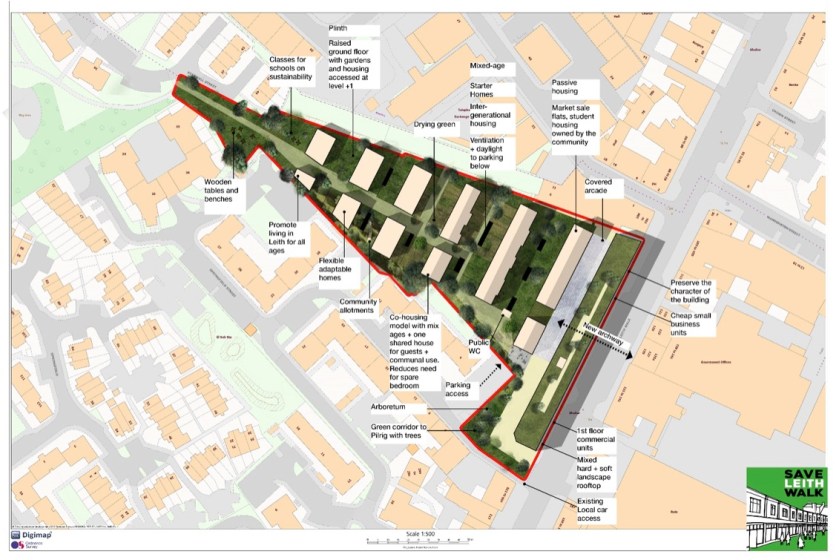
Community Housing (see image above) faces up to the long term problem of housing provision in Leith and provides a range of solutions to housing need. Building diverse housing that allows people to live and play together strengthens our communities in fundamental ways.
- Opening up to the Leith Walk community by creating new access through the centre of the building.
- A covered walkway could be created at the rear of the building bringing the housing units into connection with the sandstone building.
- Up to Eleven housing blocks in different sizes and shapes could be built in the land behind offering a range of housing opportunities including
- Open Market homes,
- intergenerational housing,
- flexible and adaptable homes,
- co-housing models
- Designed to the Passive Housing standards making environmentally friendly homes.
- Living walls could blend the development into the surrounding space
- There could be a shared guest house and other community space reducing the need for spare rooms and encouraging sharing.
- Affordable student housing owned by the community.
Community Cohesion is about strengthening community links and helping people to focus on the challenges that affect them and develop new skills to tackle them. It can create a new vision of community where people from different racial, class, gender, age and religious backgrounds are partners in their own futures.
- A refreshed building, made Green Energy resilient.
- New opportunities to existing businesses and new small, low cost starter units.
- Blocks of colony style eco homes consisting of 1, 2 and 3 bedroom flats to allow for real flexibility over time.Social housing block providing accessible housing for older people and disabled people.
- A Community Event Centre that could offer classes and social opportunities.
- Opportunities for beehives, public artworks, fruit trees, bench seating. And an open air market.
Community Enterprise addresses the challenge of how to create employment opportunities in Leith that meet the demands of the global market. It recognises that businesses are stronger when cooperation and mutual support are part of a shared value basis. Working together to create jobs, new business and entrepreneurial opportunities can transform our community.
- The building would be refreshed, upgrading it with an accessible green roof and additional business pods.
- The existing shops and business would be revitalised to offer opportunities to existing businesses as well as offering small, low cost starter units.
- Design attention to wellbeing and support for locals. A community bakery could be integral part of the building to allow people to come together, to bake bread together and to share bread together.
- A social enterprise and community space to train and share business skills including incubator units for creative, media, IT and other businesses.
- A block of open market starter, eco homes with space for new businesses
- Additional green space with open meadows planted with wildflowers, recreational natural green space, community orchard, accessible allotments, beehives and vegetable gardens.
Our vision seeks to build on the strength of the existing community and to create new ways of bringing people together. They can enhance the area, preserve its diversity and inclusivity, and contribute towards Leith having a bright future in the 21stcentury.
The Stead’s Place site is too small to contain all of these solutions but we will work with other sites and local stakeholders over the next few months to develop our plans.
Urban development today in the light of a real Climate Crisis needs to work with people’s needs and not be imposed by profit seekers. Single sites cannot be allowed to simply focus on one issue, retail, student accommodation, tourism but must integrate different part of the community’s need into a coherent vision.
We have started that work and welcome the support of others in continuing to develop this vision.
Ian Hood
Save Leith Walk
For More Information and contact us
Email: Info@saveleithwalk.org
Web:www.saveleithwalk.org

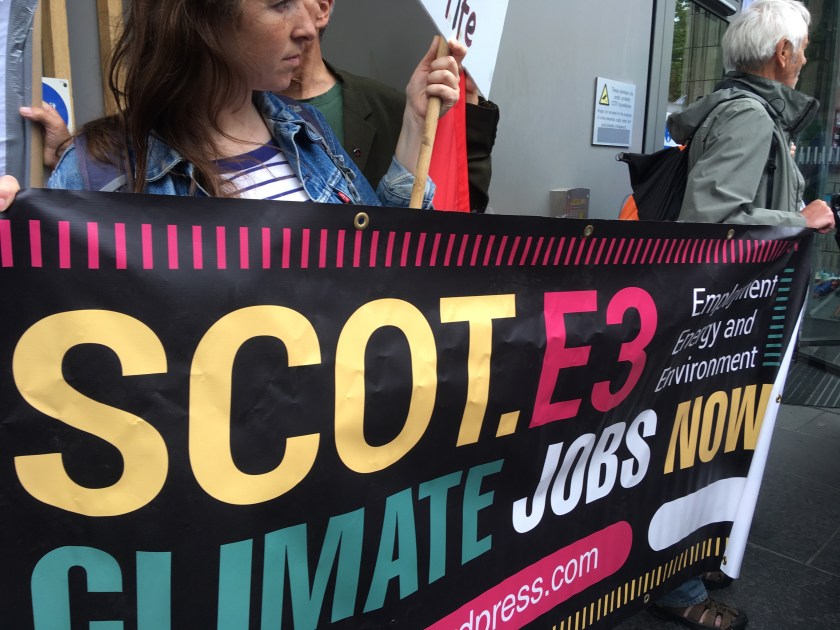

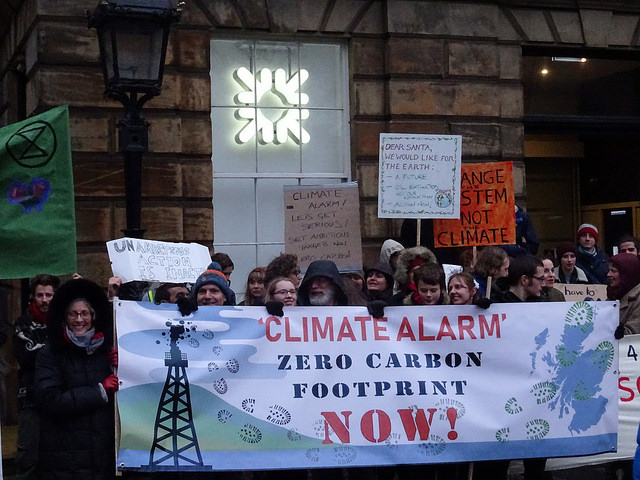
 Ex-Bifab workers, reps of 5 or 6 unions, School Strikers, ScotE3, Friends of the Earth and others surrounded the EDF Renewables HQ in Morrison Street, Edinburgh. An expert bugler, echoing his fanfares round the tall buildings, attracted a lot of passing attention. No uniformed police. Four School Strikers were lined up behind a very long banner. They were shy so we got them to go to the front. Good speeches. The plan had been to present a letter to EDF, listing questions and demands. But we arrived to find their door locked. So the questions and demands were magicked onto two long scrolls, which were displayed at the front of the protest and photographed. Then it was decided we should march round the side of the building to see if there was a back door open so the original letter could be presented. There was a back door – a big revolving one, behind which four large security guards retreated when they saw us coming – a lot of loud music and chanting by this time on a good PA system. Good large flags, multiplied by reflexion in glass walls. Two people were allowed inside to give the letter to the guards, then one worker managed to push his way backwards through the door with a big flag, which he waved at us through the glass with a big smile, while the guards pinioned him. There was a point when it looked as if the crowd would push through the door, but not this time. The guards nudged the worker back though the door, then decided to lock it. This was the best bit – a guard on his knees inside struggling to lock the door with a ground-bolt, but failing to get any of his big bunch of keys to fit. This gave a great photo opportunity, and was greeted with hilarity by the crowd, who offered technical training for EDF workers.

 Employment, Energy and Environment