Join the Friends of St Fittick’s Park for a demonstration to protect St Fittick’s Park in Torry from industrialisation.
Join the Friends of St Fittick’s Park for a demonstration to protect St Fittick’s Park in Torry from industrialisation.
The last remaining greenspace in Torry is under threat from a bogus “Energy Transition Zone” factory.
Aberdeen City Council are deciding on a planning permission in principle application that will deprive the wildlife in the park and the people of Torry, our much-loved environmental haven.
Come along to tell the council they’re nae getting awa wi it this time! They must reject the ETZ application.
We invite everyone to wear blue to create a wave of people and to show the flood waters in St Fittick’s Park are rising, a key reason why the application should be rejected.
Watery-related props are welcomed.
Meet at Marischal College, Broad St, Aberdeen, 7 Nov. at 9 am before we ‘flow’ over to the Town House.
Scotland’s only petrol refinery, based on the Firth of Forth at Grangemouth, is scheduled to close in 2025. The closure is not a cause for celebration by climate campaigners, it will be replaced by a new refinery in Antwerp and 500 workers at the Grangemouth site will lose their jobs. The closure is in no sense part of a transition away from Fossil Fuels and even less is it part of a just transition.
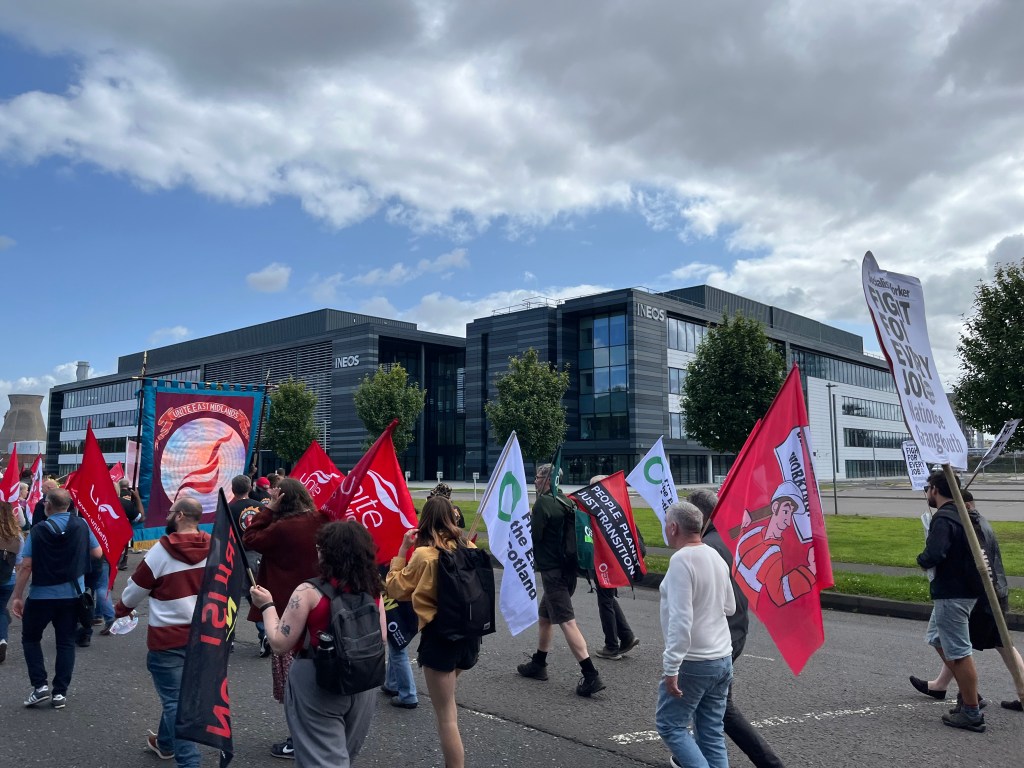
The march assembling outside the Grangemouth stadium – image Pete Cannell CC0
The huge 1700 acre Grangemouth site is owned by billionaire Jim Ratcliffe’s INEOS. They bought the Grangemouth petrochemical plant and the refinery from BP in 2005. Then in 2014 the company raided the pension fund originally established by BP and in turn de-recognised the plant unions. The refinery part of the site is now run by Petroineos, a joint venture between INEOS and the Chinese state-owned oil and gas company PetroChina.
Unite, the main union at the refinery is leading a campaign to ‘Keep Grangemouth Working’. The union is calling for action to ‘Extend, Invest and Transition’. On 3August, they organised a march and rally starting from the Grangemouth stadium on the edge of the INEOS site. Around 600, including refinery workers and their families, and trade unionists from around Scotland and further afield marched to a rally held in a local park. There were a handful of climate activists.
At the rally Unite Scottish Regional Secretary Derek Thomson talked about how the union was campaigning locally to raise awareness of the impact that closure would have on jobs and the local economy. Unite believes that the new Labour Government may be able to persuade Ratcliffe to extend the life of the refinery. The Tories pledged to provide 700 million Euros in credit to support the development of the new Petroineos refinery in Antwerp and they think that if Labour were to question this it would provide leverage.
Grangemouth is a critical campaign for the climate movement. There are moments when decisions are made and actions taken, or not made and not taken, that then resonate through the movement and shape its future trajectory. If the Grangemouth refinery is closed it will be such a moment. In Scotland another such time was the failure to take the BiFab fabrication yards into public ownership in the autumn of 2017. The loss of 1400 jobs at BiFab offshore renewables technology yards discredited the idea that action over climate offers opportunities for employment. The closure of Grangemouth would be not just a blow to the workers, their families and the local economy, it would also send political shockwaves through the climate and workers movements.
On the march – image Pete Cannell CC0
At the rally on 3 August the speaker from Friends of the Earth Scotland received a great response from the Unite members in the crowd. It is important that the union and the Grangemouth workers see transition to a sustainable future as a positive goal. However, there is a real weakness in the current campaign. Unite’s strategy seems to be based on pressurising INEOS into extending the lifetime of the refinery. But there’s no evidence that Ratcliffe is interested in doing this or interested in planning for a sustainable transition. And it’s not that Grangemouth is unprofitable – simply that Antwerp would be more profitable. None of the speakers at the rally criticised INEOS. Implicitly or explicitly the focus was on partnership with the company.
At a time when all the indicators suggest that global heating is increasing faster than the most pessimistic predictions, companies like INEOS and BP are doubling down on investment in fossil fuels. They aim to make mega-profits while they can. In these circumstances, when action to decarbonise is overdue, working in partnership with big oil, while talking about the need for transition and social justice is simply greenwashing. It won’t save jobs, and it sets back progress towards transition.
So, what’s the alternative? Public ownership, and democratic planning that involves energy workers is essential. To build the mass campaign that could make this possible the unions and the climate movement need go beyond slogans.
The private sector is simply not capable of the kind of planning and coordination that is needed to save jobs and manage a just transition.
Convincing energy workers, winning hearts and minds and building the mass support for public ownership requires brutal clarity about what the oil and gas companies are doing. The profits they’ve made and continue to make, the huge subsidies they continue to attract and the way they expect us to clean up their mess. Grangemouth has been a site for petrochemicals for a hundred years. Without an enormously expensive cleanup the site is only suitable for industrial use.
Image Pete Cannell CC0
Partnership with INEOS is a dead end. The company has no loyalty or regard for the workers or the local population. There’s no guarantee if the refinery closes in 2025 that the rest of the operations on the site will continue much longer, and with it, the loss of over 2,500 jobs. Ratcliffe expects us to pay the huge cost of cleaning up the site. And the residents of Grangemouth having lived with the stink and pollution of the plant for decades will remain with a toxic legacy.
But to win hearts and minds and build the campaign there also needs to be a plan for change. The vast site at Grangemouth could become a hub for a wide range of renewable technologies. There’s room to establish new facilities, there’s good communications by land and via the Firth of Forth and there is an established workforce and a cluster of further and higher education institutions in the region that could support the development of a new low carbon economy.
The nature of the plan matters. At the Grangemouth rally – ex-MP and deputy leader of the Alba Party, Kenny MacAskill argued that Grangemouth could prosper through the development of green hydrogen and carbon capture and storage. But these are the solutions that are promoted by Offshore Energy UK, the organisation that represents the interests of the UK oil and gas sector. Both technologies may have some use in the future but the industry focus on them right now is aimed at maintaining oil and gas production, and the infrastructure and systems that support it, for as long as possible. Opportunities for rapid progress lie in Wind, Solar, Wave and Tidal technologies together with energy storage and a new smart distribution grid. Ending partnership between unions and big oil also requires a new and critical view of what technologies support jobs and employment and support rapid decarbonisation and a break from the fake self-serving solutions that are advanced by the oil and gas industry. Which technologies are prioritised is not simply a technical choice but also highly political.
On 4 July, the climate-trashing Tory government will be replaced, as good as certainly by Keir Starmer’s “changed” Labour party.
For all its talk of “green prosperity”, Labour plans to work closely with the corporations that profit from North Sea oil and gas and from generating electricity – and who intend to produce, and use, fossil fuels for as long as they can.
A protest at government offices against the Rosebank oil field project, January 2023. Photo by Steve Eason
Labour’s plans for cutting greenhouse gas emissions from homes and cars are hopelessly timid, because of its conviction that private business does it best.
Under Labour, we will in my view make progress against social injustice and climate change only insofar as social movements and the labour movement:
(i) confront and confound the government, and
(ii) show that action on climate change, far from costing ordinary people money as the extreme right claim, is 100% compatible with combating social inequalities.
In this article I try to identify the likely battlegrounds between our movements and a Starmer-led Labour government:
Fossil fuel production and the path away from it (part 1); electricity generation at national (part 2) and local (part 3) levels; avoiding false technofixes (part 4); and changing the way energy is used in homes and transport (part 5). Part 6 is about bringing these separate, but connected, issues together.
1. Transition away from fossil fuel production on the North Sea
The election-time slanging match about the North Sea’s future has featured politicians’ and union leaders’ cynicism at its worst. In opposition to this, our movement needs serious conversation about how to fight for working people’s livelihoods and run down oil and gas production simultaneously.
The political war of words has focused on Labour’s commitment not to issue new licences to explore for oil and gas in the North Sea.
The Scottish National Party, which fears losing parliamentary seats to Labour, has lashed out with a claim – shown by BBC Verify to be false – that this would cost “100,000 jobs”. This is “a clear about-face” from the SNP, which last year “committed to a built-in bias against granting new licences”, the Politico web site reported.
“Exaggeration and misinformation helps no-one”, given the urgent need for “a clear-eyed conversation about how to ensure that Scottish workers benefit from the transition away from oil and gas”, Tessa Khan of the climate advocacy group Uplift said.
But exaggeration and misinformation is exactly what leaders of the Unite union, which represents many North Sea workers, contributed. They withheld support for Labour’s manifesto, because of its North Sea policy (as well as for much better reasons, such as its employment policies) and endorsed SNP leader John Swinney’s nonsense.
Unite leader Sharon Graham suggests that a ban on oil and gas licences is the main threat to North Sea jobs. That is not true. It usually takes more than ten years from licence issue for a field to start production, so there is only a very indirect connection. In recent years oil corporations’ decisions to slim down their North Sea operations has posed a far more immediate threat.
If Labour reverses its ban on new licences, the only beneficiaries will be those corporations – while the planetary disaster threatened by climate change would come one step closer, as the heads of the UN and International Energy Agency have pointed out. Indeed there is a powerful case for scrapping the already-granted licence for the giant Rosebank field.
Unite says it wants to “see the money and the plan” for the transition away from oil and gas. But as its leaders well know, plans already exist.
The Sea Change report, published five years ago, showed how the North Sea workforce could expand, with investment in wind power and other renewables. The oil companies and Tory government have other ideas, set out in the North Sea Transition Deal – which proposes spending £15 billion on their pet technofixes, carbon capture and hydrogen. (See also part 4 below.)
The Green New Deal Rising group disrupted an event sponsored by oil industry lobbyists at the Labour party conference in October last year. Photo by Jess Hurd
Unite, along with other unions, accepts these false solutions, and calls for investment in hydrogen and carbon capture, as well as wind power.
Perhaps we should be talking about “rupture, rather than transition”, he said, to make gains for social justice and tackling climate change. This starts with uniting oil workers and Scottish working-class communitiesmore broadly. This is the conversation we urgently need.
At a recent gathering of trade unionists concerned with climate policy, Pete Cannell of the campaign group Scot E3 argued that, given the dominance of this technofix narrative, “it’s legitimate to ask whether ‘just transition’ is any longer the right framing”.
2. Public ownership in the electricity system
Labour will set up a “publicly-owned clean power company”, GB Energy, paid for by a windfall tax on oil and gas producers. But GB Energy will own few, if any, electricity generation assets and will focus on partnerships with private capital. Labour also plans to leave the electricity transmission and distribution grids in private hands, and to leave largely unchanged the neoliberal electricity market rules that allowed corporations to reap billions by impoverishing households in the 2022 “energy crisis”.
Labour intends to capitalise GB Energy with £8.3 billion over the next five years: £3.3 billion for a potentially useful Local Power Plan (see part 3 below), and £5 billion to “co-invest in new technologies” including floating offshore wind and hydrogen, and “scale and accelerate mature technologies” including wind, solar and nuclear.
Labour’s loud claim that GB Energy will “lower [electricity] bills because renewables are cheaper than gas” is not credible. This would require, at least, an investment far greater than £5 billion, allied to a root-and-branch overhaul of electricity markets.
More likely, GB Energy will, at best, fund new technologies that financial markets prefer not to risk their own money on – or even follow in the footsteps of Tony Blair’s disastrous Private Finance Initiative, with which corporations milked billions from the NHS. The Guardian, apparently briefed by Keir Starmer’s team, reported that GB Energy will probably start with “investments alongside established private sector companies”, including the chronically over-budget Hinkley Point, Sizewell C and Wylfa nuclear projects.
The Greens and others slammed Starmer, when he finally clarified on 31 May that GB Energy will essentially be an investment vehicle. But a trenchant critique had already been published last year: Unite’s Unplugging Energy Profiteers report, which warned that “unless combined with a public purchasing monopoly, or significant market reform intervention, [GB Energy] will have no impact on distorted pricing in the wholesale market”, and “by concentrating very limited resources on de-risking experimental forms of generation, GB Energy will use public resources to underwrite and further increase future potential profits for the private sector”.
Unite, and the Trades Union Congress, call for public ownership to be extended not only in electricity generation, but also in the supplybusiness and in transmission and distribution networks. Labour madesimilar calls in 2019, but has now ditched them.
Underinvestment in these networks is a scandal as damaging as the water companies’ rip-off: tens of billions of pounds’ worth of network upgrades are needed to facilitate renewable generation and close the gap on missed climate targets.
The National Grid’s Nechells electricity substation near Birmingham
Already, there are 10+year queues for renewables to be connected to the grid; house-builders are fitting climate-trashing gas boilers because they can not access electricity for heat pumps; battery storage lies unusedbecause companies’ computer systems are out of date … all while distribution networks paid out £3.6 billion in dividends to shareholders in 2017-21.
The system is in such a state that even Rishi Sunak’s dysfunctional government took regulatory powers away from National Grid and put them in the Future System Operator. Nick Winser, the electricity network commissioner, warned the government that unchanged, the system would leave “clean, cheap domestic energy generation standing idle, potentially for years”. “Very few new transmission circuits have been built in the last 30 years”, he said: unless jolted, companies could take up to 14 years to build them.
To make the electricity network fit for the transition away from fossil fuels, wider public ownership is crucial. Our movement needs to work out how to coordinate the fight for it.
3. Community energy and decentralised renewables
Labour promises to spend £3.3 billion on a Local Power Plan, under which GB Energy will “partner with energy companies, local authorities and cooperatives to develop up to 8GW of cheaper, cleaner power by 2030”. Up to 20,000 renewable projects will return “a proportion” of their profits back to communities. But “the detail on these plans is sparse”, the New Statesman reported – and so it is surely up to community organisations and the labour movement to discuss effective ways this money could be spent.
Until now, central government has been a wrecking ball for community energy. In 2015, it changed planning rules, effectively blocking onshore wind projects. In 2019, it scrapped the feed-in tariff paid for electricity supplied to the grid from small-scale renewables. And for years – as decentralised renewables technology leaped forward internationally – it ignored calls to overhaul market rules. Small renewables projects were locked out of the grid by the need for a £1 million + licence, and other obstructions.
The Green New Deal all-party parliamentary group last year called for the regulatory system to be turned upside down, to end its bias in favour of the “big five” generators. It proposed a “European style ‘right of local supply’”; changes to rules on planning and public procurement; mandatory transparency of grid data; and other measures.
Such changes would make it possible to replicate the success of Energy Local in Bethesda, north Wales, which supplies locally-produced hydro power to households at below-grid prices. In April, the Common Wealth think tank proposed a “public-commons partnership” as the institutional form under which local authorities could develop such projects.
All this will take a fight, though. Otherwise, electricity corporates will spread their tentacles into decentralised renewables, as they are doing in the US and Australia.
Furthermore, we need to overcome the official labour movement’s residual reluctance to support community energy projects. The TUC’s recent renewables policy paper, which lists offshore wind, wave, nuclear and “zero carbon hydrogen” (?) as energy technologies – but not decentralised wind and solar – is, unfortunately, indicative.
Decentralised renewables, developed with cooperative, community and local authority forms of ownership and governance, can help to break corporate control of electricity provision, and open the way to democratise and decommodify it.
4. Opposing false technological solutions
False technofixes, including hydrogen and carbon capture, use and storage (CCUS) feature prominently in Labour’s election manifesto – the outcome of lobbying by the oil industry, for which they comprise a survival strategy. Nuclear power – expensive, dangerous, and beloved of the military – is there too, grabbing funds from proven, socially useful technologies such as home insulation, public transport and decentralised renewable power.
While the case against nuclear has been made, and the false logic of CCUS exposed, over decades, the drive for hydrogen is more recent: it is the oil companies’ alternative to electricity-centred decarbonisation. Energy systems researchers argue that, while hydrogen may be needed in future e.g. for steelmaking or energy storage, it will never be suitable for home heating, and hardly ever for transport.
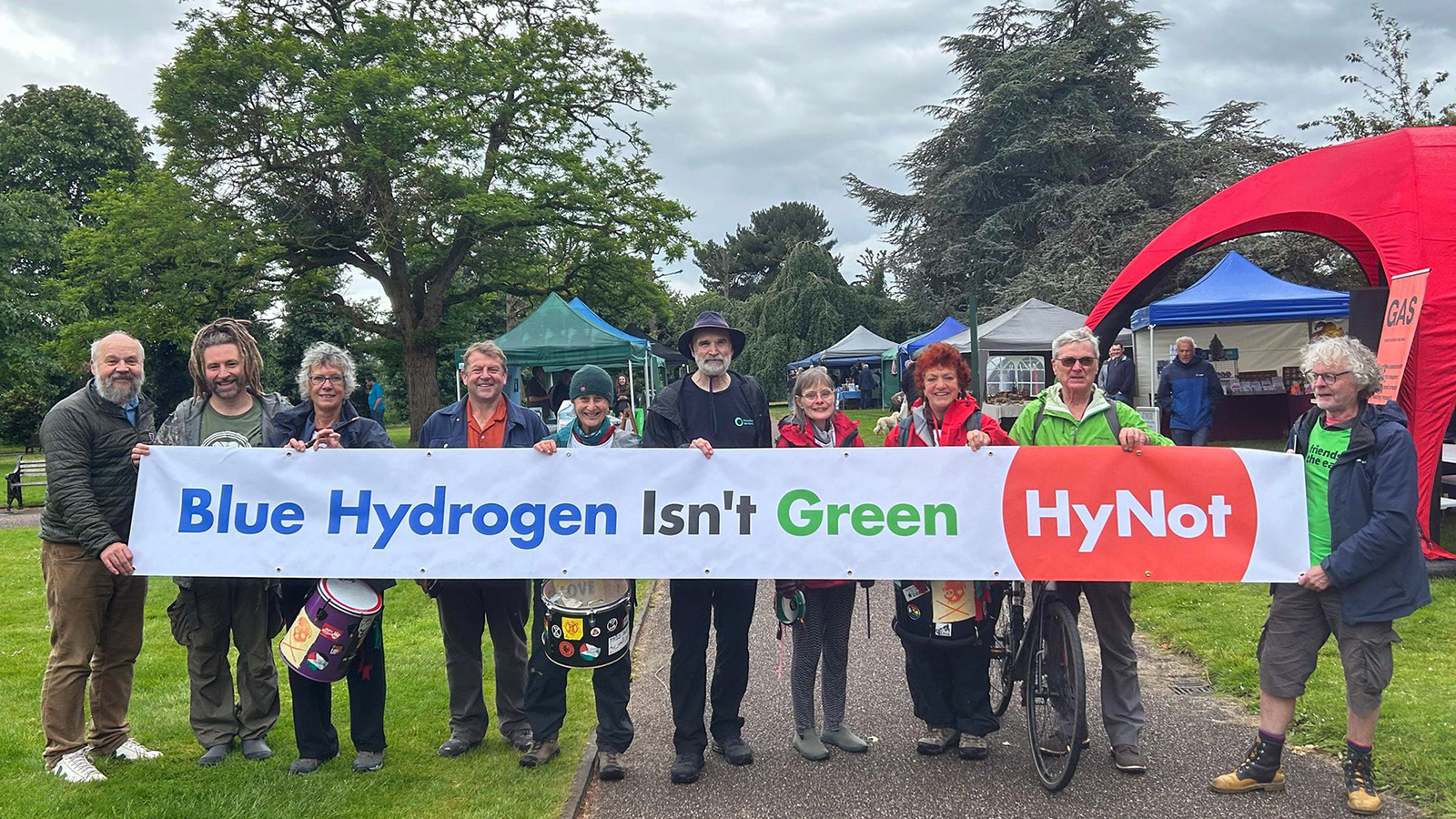
Demonstration by HyNot, which opposes hydrogen for home heating, at the Green Expo UK in Cheshire, last week. Photo from HyNot twitter feed
The Tory government has invested heavily in hydrogen, and the 2023 Energy Act provided a framework for its commercial development. But attempts to bribe communities into testing it out for home heating have hit setbacks. A planned test at Whitby, Merseyside, was cancelled last year after vigorous opposition by local residents and the HyNot campaign group. This year a second planned test at Redcar, Yorkshire, and a thirdone in Fife, Scotland, were both postponed.
Catherine Green Watson of HyNot said: “These postponements are great progress for our campaign. But on Merseyside we still have strong local political support for hydrogen in industry, which should not be the priority. Instead, we need to concentrate on upgrading the electricity grid.”
We need a discussion in the labour movement and social movements about the social role of these technologies. We could work towards unity around the principle that they should not receive state funding that could go to quicker, more effective decarbonisation paths.
5. Energy use in our homes and transport
Labour has scaled back its promises to invest in its Warm Homes Plan that will fund grants and low-interest loans for insulating homes and replacing gas boilers with heat pumps. Shadow energy secretary Ed Miliband last year talked about “up to £6 billion a year”; by the time Labour’s manifesto was published last week, this had shrunk to “an additional £6.6 billion over the course of the next parliament” (that is, over five years). Talk of upgrading 19 million homes had stopped; now it’s 5 million.
Labour has stuck with commitments to take railways back into public ownership, and to support municipal ownership and franchising of bus services. But it is also promising to “forge ahead with new roads”, and keep the transport system centred on private cars, at a time when researchers argue that this cuts dangerously across tackling climate change.
If Labour sticks to this course, determined by its neoliberal fiscal rules and by corporate lobbying, then key opportunities to cut UK carbon emissions, while improving people’s lives, will be missed. Researchers have been screaming for years that insulation and heat pumps, and superceding the car-centred transport system with better, cheaper public transport, are desperately needed to decarbonise homes and transport, the two largest sources of greenhouse gas emissions.
Battles on effective energy conservation in homes, transport and throughout the economy are part of the war to limit climate change.
Labour’s commitments are too timid to reverse the disasters caused by Tory policies. In the decade from 2012, annual completions of home insulation upgrades fell by nine tenths. The measures announced by government last year would take 190 years to improve the energy efficiency of the UK housing stock and 300 years to hit the government’s own targets for reducing fuel poverty, National Energy Action stated.
As for roads, the government could cancel the £10 billion Lower Thames Crossing scheme, final approval of which has been delayed until October, and apply to all future projects the principle adopted by the Welsh government – that they can only go ahead if compatible with climate policy.
Labour may not only fail to deal with these gigantic sources of carbon emissions, but actually open up new ones. A grim example is Labour’s threat to overrule communities who question tech corporations who want to build fuel-guzzling data centres – which will help trash climate targets, to the benefit of those corporations alone.
6. Bringing the issues together
The stakes are high. Every new assessment by climate scientists underlines the conclusion reached by leading British researchers four years ago: that the UK’s decarbonisation targets are half as stringent as they need to be, to make a fair contribution to tackling global heating. The government’s own climate change committee says non-power sectors of the economy need to decarbonise four times faster than they are doing.
Tackling climate change, while reversing the effects of 14 years of neoliberal austerity policies, will not be easy. Indeed, Labour does not intend to: both decarbonisation and social policy will be subordinated to their fiscal rules.
The labour movement and social movements need to challenge and push back Labour’s pro-fossil-fuel, pro-austerity approach.
We need to unite our forces and find the pressure points – be it saying “no”, to the Lower Thames Crossing project and similar, or finding openings for collective action, e.g. in the Local Power and Warm Homes plans.
To act effectively on climate, we need to keep in mind the necessity of holistic solutions, and reject illusory technofixes and greenwash narratives that claim to reduce emissions with one hand, and pour them into the atmosphere with the other. SP, 18 June 2024.
This article was first published on the People and Nature site. Republished here with thanks.
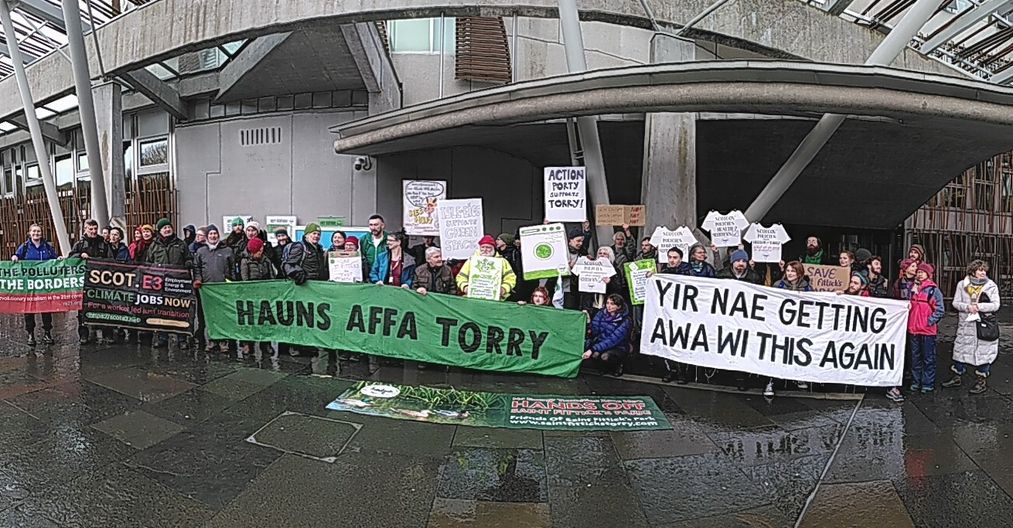
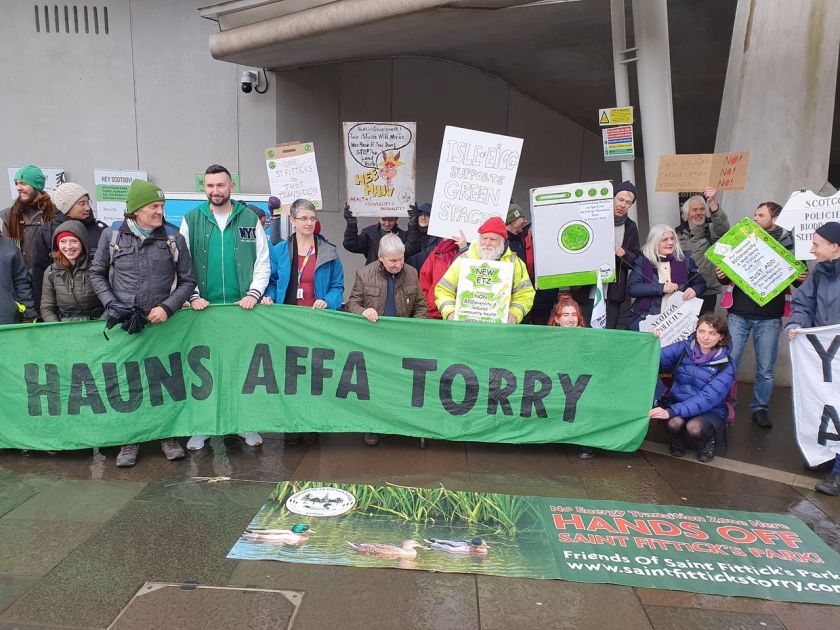
Demonstrating outside the Scottish Parliament in January 2023
Campaigners in Torry are still waiting on the Scottish Government announcement that was expected back in January. Each month it has been put back another 28 days and is now due on 6th May. If the government gives the go ahead to the current plans for the ETZ (Energy Transition Zone) it will be a decisive step down a road that panders to the oil and gas industry and has nothing to with social justice. St Fitticks Park, which the plans would take over for industrial use, is the only green space in a working class area that suffered from decades of pollution as a result of the oil and gas industry. Most recently a new Energy from Waste incinerator, built close to a primary school, has led to a further deterioration in living conditions.
This film from REELNews highlights the issues involved and the resistance of the local community. Please share it widely.
In the film it’s noted that it’s not clear what use the new industrial zone will be put to. However, since the film was made campaigners have found evidence that there will be a large hydrogen storage facility – with 80% blue hydrogen and 20% green – that will be used to convert the cooking and heating supply for 20,000 social housing tenants in Aberdeen. If this goes ahead not only will Torry lose it’s green space many of its residents will be locked in to a very expensive energy future.
St Fitticks deserves to be a national campaign. The issues it raises around social justice, the use of hydrogen and carbon capture are national issues and they expose the weaknesses and contradictions in Scottish Government Energy Policy.
Share this post – support the St Fitticks campaigners.
Read more detail and watch video from the campaign here and here.
Taking the Fight for St Fittick’s Park to Parliament
THURS, 12 JANUARY 2023 1.30pm
At the Scottish Parliament – Holyrood, Edinburgh
This post is a copy of the call from Aberdeen campaigners
Come and join people from Torry and the Friends of St Fitticks Park, outside the Scottish Parliament to demand the government uses its powers to stop the industrialisation of the last remaining accessible greenspace in Torry, Aberdeen.
Meet and hear directly from the people who will be most affected by the reckless plans. And the why destroying a thriving and much loved greenspace is not the answer for Aberdeen’s, or indeed Scotland’s energy transition.
Why are we at the Parliament?
Time is running out. The minister for Planning, Tom Arthur has until Monday 16th January to use his powers to direct Aberdeen City Council’s new development plan is changed to ensure St Fitticks Park is protected from an unjust corporate land grab in the name of energy transition. For more details visit here: https://saintfittickstorry.com
We need as many locals and friends of the park to demand the Scottish Government acts in the interest of people and not profit.
For those travelling from Aberdeen the Friends of St Fitticks Park will provide free coach travel for the day. Booking details will be released early in the new year, but you can provisionally book places by emailing FriendsofStFitticksPark@proton.me .
This post is a report of the Scot.E3 public meeting held on 24th October 2022. It includes videos from the meeting and links to resources and further information about the St Fitticks Campaign. Please share widely.
The meeting began with a contribution from Ishbel Shand from the Save St Fitticks Campaign
You can read a written version of Ishbel’s contribution here
Pete Cannell followed up with a short contribution on the North Sea oil and gas industry
The two speakers were followed by a wide ranging discussion which is summarised in the following account:
At the ScotE3 public meeting on 24th October “St.Fittick’s Park – Defeat the Oilogarchy” Ishbel Shand, on behalf of the Save St.Fittick’s Park campaign in Aberdeen, reminded us that nearly a century ago Antonio Gramsci, writing from a fascist prison cell, said “The old world is dying, the new is struggling to be born. We live in a time of monsters.” You can watch the whole of Ishbel’s speech about the history and current significance of St.Fittick’s Park on the YouTube link above. It’s a compelling story not to be missed.
Pete Cannell spoke next, on behalf of ScotE3. He emphasised in particular the catastrophic nature of the North Sea Transition Deal, agreed in March last year and flouted as the first agreement “between the government of a G7 country and its oil and gas production community”. Almost unbelievably this Deal has been signed up to by the Scottish Government and by the Unions which represent the oil and gas workers. More oil and gas, nuclear, and hydrogen for heating. This is a disaster for the climate – particularly in terms of investment. It’s what underpins the Cost of Living Crisis because energy prices would inevitably remain high – much higher than would be the case with renewable sources of energy. It would also be a disaster for jobs – preserving the status quo for jobs is the worst-case scenario, defying any chance of a just transition. You can watch Pete’s presentation on the second YouTube link.
We had hoped for a speaker from Climate Camp, who sited their annual camp this year in St.Fittick’s Park and illegally occupied the site of the old fishing and boat-building village of Torry, destroyed to make way for oil and gas industrialisation. Unfortunately no-one from Climate Campaign was available for this meeting, but their name was on the lips of many participants as a model of how to respect local communities rather than impose on them.
The bulk of the meeting was given to general discussion. Many good points were made, including:
The oil and gas industry has never brought anything positive to the Torry community
There is a parallel between the threatened industrialisation of St.Fittick’s with the Bo’ness road in Grangemouth, which physically divides the local community and threatens the health of that community with air pollution from traffic congestion.
There is also a parallel with the Buckie community’s fight to save the Slochy Wloods
The potential power of communities is huge when they come together to fight – for example the success last year, at enormous personal costs, of the Ujaama indigenous communities in securing land rights in Tanznia.
There is a fundamental democratic deficit which in general communities face.
There’s not just one unaccountable Goliath faced by the David of the Torry community but four – One North East, oil tycoon Ian Wood’s company which will control the development of an “Energy Transition Zone”; Aberdeen Harbour; Ironside Farrar, the environmental consultants tasked with drawing up a “master plan”; and Aberdeen City Council and its Local Development Plan.
Artists/musicians recently performed 45 minutes of songs and poetry at the new Arts Centre in Banchory
Films, short and long, have been made about St. Fittick’s.
University students are giving St. Fittick’s magnificent support
Those of us who don’t live in Aberdeen need to extend the Local actions of the Torry Community to National actions and solidarity across Scotland, through spreading the word far and wide about the threat to St. Fittick’s.
We all need too to take opportunities to spread the St. Fittick’s story internationally.
There’s a need for more radical change than just fighting for “renewables” – a term which can conceal negative elements – for example the jackets for off-shore turbines are plastic and the blades are steel.
The Cost of Living Crisis is fundamental in that it has the potential to mobilize nearly everyone.
The Scotland-wide COP 27 mobilisation is at 12noon on Saturday 12th November in Edinburgh. People from Aberdeen wanting to join this rally were encouraged to accept hospitality from those members of ScotE3 based in Edinburgh.
Yes, this is a time of monsters, but it’s also a time of jewels. St. Fittick’s Park itself is a jewel, as is the current response of the campaign to the threat of industrialising the Park.
The chair ended the meeting with this quote from Ishbel, which emphasises the often-neglected but fundamental significance of the Nature Crisis in all our current struggles:
We can choose to continue with the old dying world of exploitation of people and nature for short-term financial gain. Or we can choose to repair and nurture our damaged environment and learn to live within the constraints that nature imposes.
The film about Old Torry is particularly moving. The Aberdeen Social Centre have a complete collection of issues of the “Aberdeen People’s Press” from the period.. One Old Torry resident, with a compulsory purchase order on her home, laments that the same Council that wouldn’t allow her to put in new windows because of the historic importance of her house are now going to bull-doze it, because Shell want the land.
A link to Mike Downham’s post on St Fitticks on this site
Yesterday (6th April) the UK Government announced a new ‘British Energy Security Strategy’. The shape of the strategy isn’t a surprise with many of the elements being trailed in recent weeks. Put simply the strategy is a disaster. It’s a recipe for failing to meet UK greenhouse gas emission targets and ignores the recommendations of the IPCC report that was published earlier in the week (4th April).
This post is a first response, and we will share more detailed analysis in the weeks to come.
The government’s press release notes that the strategy involves an ‘ambitious, quicker expansion of nuclear, wind, solar, hydrogen, oil and gas, including delivering the equivalent to one nuclear reactor a year instead of one a decade.’
Note the ‘expansion of oil and gas’. The aim will be to accelerate the approval of new oil and gas fields in the North Sea and west of Shetland. Essentially, it’s a doubling down on the oil industries so called ‘North Sea Transition Deal’. The aim of the deal is to make the North Sea a ‘net-zero’ oil and gas basin by 2050 – but this can only happen if carbon capture and storage can be developed and introduced at large scale, which is as yet uncertain.
Hydrogen is part of the oil industry strategy – the aim of the transition deal is for hydrogen to replace North Sea gas in domestic and commercial heating systems – these currently account for more than 20% of UK greenhouse gas emissions. The strategy talks about hydrogen supplying around 10% of energy needs. What it doesn’t say is that producing hydrogen by splitting methane or water is an enormously inefficient process and so a very significant proportion of all the new electricity produced from nuclear, wind, solar and oil and gas will be needed to produce the hydrogen!
After a period of equivocating on nuclear power it’s now back at the centre of the strategy. No figures are given, but if we extrapolate from the cost of the current Hinkley C project the proposed developments will cost around £150 billion. The government refers to nuclear as clean and safe. It is neither. This blog has looked at the arguments about nuclear elsewhere. It’s a hugely expensive form of energy, high risk with long construction times and a history of cost overruns and serious and unresolved problems with radioactive waste.
The new strategy says nothing about reducing energy demand through insulating new buildings and retrofitting existing housing stock. Retrofitting the majority of UK housing is estimated to cost around £160 billion – this is roughly what the new nuclear programme will cost. So, it seems like their plan is to construct large scale nuclear plants whose output will then provide the energy that is lost through the walls and roofs of homes, office and factories.
The supposed rationale for the new strategy is energy security. Currently working people are paying the price for the super profits being earned by the oil and gas sector. Led by that sector the strategy opts for a future of high energy prices – continuing oil and gas and new nuclear. Renewable costs continue to decrease, nuclear energy costs continue to rise. Currently renewable electricity is 6 times cheaper than gas and the gap is even bigger between the cost of renewables and the cost of nuclear.
Wind turbines near Carberry – image Pete Cannell CC0
It will be interesting to hear the response from the Scottish Government. Until now Holyrood has been firmly signed up the North Sea Transition Deal and the oil industry agenda, but it has had a firm position of no new nuclear. Similarly, it is now crunch time for the trade unions who have advocated just transition while endorsing the Transition Deal Strategy. The argument at root has been over jobs. It has been the case for a long time now that large-scale investment in renewables creates far more jobs than the same investment in nuclear. Yesterday’s strategy announcement means in effect no transition and no justice. There is an ever more urgent need for the workers movement and the climate movement to work together in opposition to the new strategy (really just the old strategy with more investment in false solutions). Less than 24 hours after its release the strategy has been widely criticised but we will need to do more than oppose this latest attempt at preserving an unacceptable status quo and reject the North Sea transition deal in its entirety.
I suppose I just thought that campaigning amongst armament workers and on behalf of armament workers would be likely to be difficult in terms of how we might begin to “actually” impact global heating. I know that if we weren’t building all this military shit and jetting it all over the world and destroying humans and other productive forces with it, then we would avoid putting a lot of carbon into the atmosphere. It’s just that I’ve never considered that it was an issue that you might be able to intervene in quite the same way as I think we might be able to when it comes to oil and gas production.
The issue of oil and gas is looming ever larger in the consciousness of the climate movement. It’s way, way higher than it was when I discovered XR in 2019. When I took part in the London Rebellion it was hard to get a sensible conversation about oil and gas and the North Sea was a very nebulous “concept” for many. Look at the movement today with Stop Cambo. If reporting on mainstream media is anything to go by it’s beginning to exercise thoughts in layers way beyond just the activists and the scientists now. Interestingly the only people who dare not mention oil & gas is the COP. I don’t know if any of this is true about the military complex.
But I can see that from the perspective of jobs, and that’s how the discussion was framed, there’s pretty much no difference in making “demands” about just transitioning armaments workers and oil workers into renewables and other sustainable work.
But I can’t see how it would ever be likely to be more than just a “demand” in the case of armaments workers. In the case of oil workers I have, as you know, an idea that a mass intervention amongst oil workers is a crucial first step if we’re ever going to get to the point where we try to choke off oil and gas production – the absolute first and crucial necessity of a movement that has any hope of abating climate change in the face of this system. There has to be a time and it has to come very soon when the licence society gives the industry to produce fossil fuels is withdrawn. Who is going to force that issue?
I don’t know if a part of all this that as oil is is all I’ve ever known/done, oil is all I can ever really see. The opposite was surely very widely the truth for the bulk of the population until very recently. I think that’s changing.
But I’m beginning to realise that what I see as the impossibility of armaments workers turning their weapons into ploughshares, is what others see as impossible when the issue of confronting/challenging the oil and gas workers. I can see why people think it’s a very long shot to imagine that they’ll either participate in the ending of oil and gas production. But I think that least they can be neutralised, picketed at the heliports and stopped from producing the oil. For how long? And anyway! They need to be informed of the science and we can’t rely on the media to do that.
These two issues, fossil fuel and the armaments/military complex, seem to be of different orders (qualitatively and quantitatively) in the context of tackling climate change. Fossil fuel production seems to me to be primary. Once the fossil fuels are out of the ground, they are pollution – they will be burned/processed. Being used to build and deploy military hardware is just (just?) the path the pollution takes to get into the atmosphere. Or do we think that realistically we can take on the military complex and somehow stop it, and therefore stop the demand for fossil fuel?
They (?) take fossil fuels out of the ground and then make fortunes on it. They need to keep taking it out of the ground to keep making fortunes – to keep feeding the beast. So they are endlessly imaginative in finding new and more extravagant and destructive ways of using it. It looks like a real madness. to me. The thing is that they can’t turn this hellish roundabout off themselves. But turned off it will have to be if life is to survive, inasmuch as I understand the science.
Capitalism is the problem. But to a great extent isn’t the oil industry pretty much the same thing as capitalism (?) . . the same thing as climate change? The military complex surely is just (just again?) how they regulate capitalism – keep the imperialistic plunder going and ensure that the trade routes remain open to keep that wealth flowing north, and in the process provide an ever-renewing market for the oil. I never did get my head round the concept of a permanent arms economy – it was an idea touted by a political tendency I was taught was beyond the pale. But I guess I’m stumbling along in the same neck of the woods here.
Obviously, the military complex is a huge issue for humanity, but I just don’t see how you tackle it head on with any hope of affecting climate change. On the other hand, if you end oil you end capitalism (don’t ask me to prove that – I was hoping someone else would though) and then you have at least a fighting chance (is that a pun) of ending the military complex. The other way round it’s even clearer. You don’t stop oil and life on earth is in danger. However, you frame it you need to stop oil.
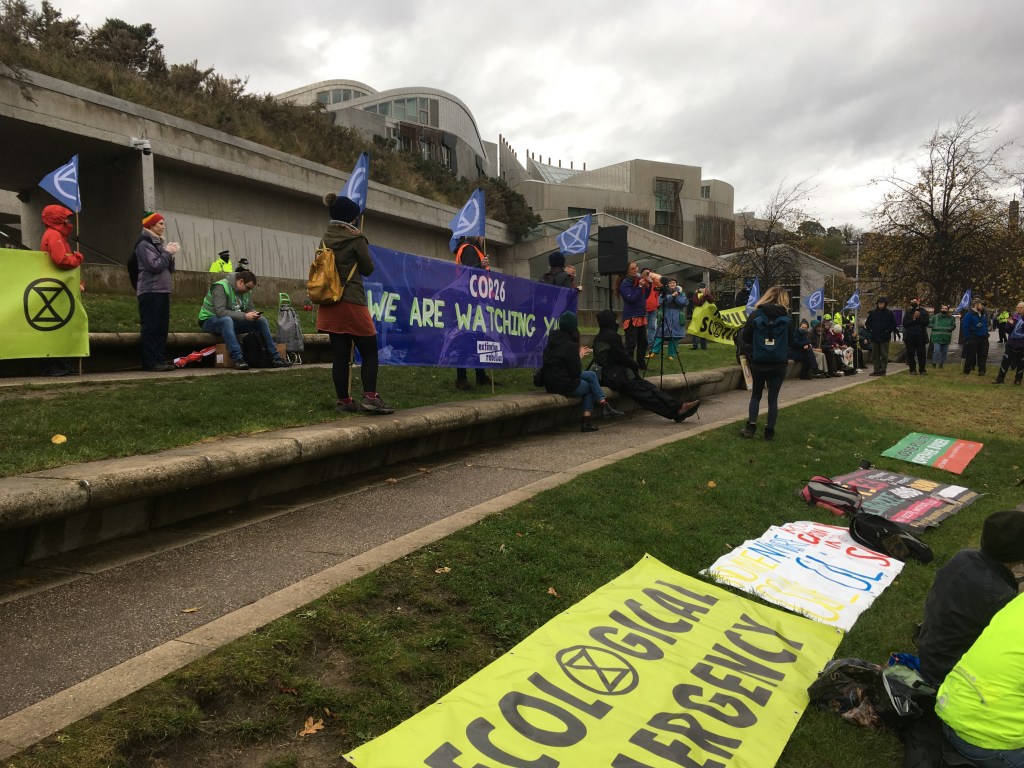
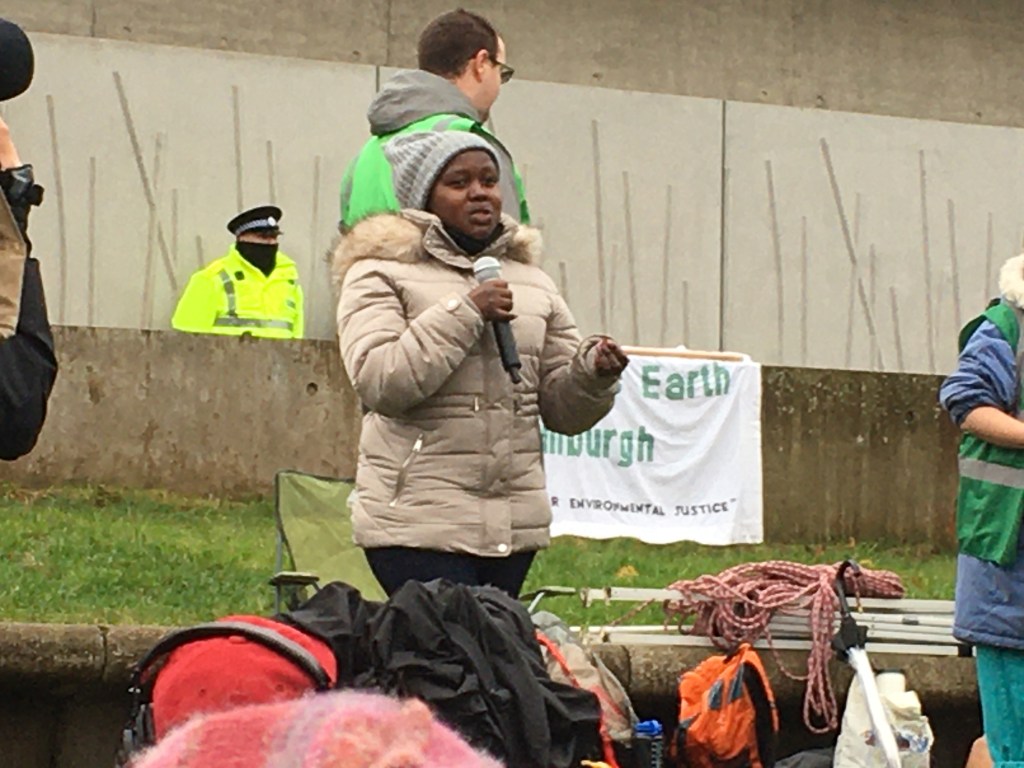
As the climate talks were starting in Glasgow, the Edinburgh COP26 Coalition and Edinburgh XR held a march of around 400 people from the Meadows to the Scottish Parliament – ending with a rally at the parliament. Speakers included a young activist from Kenya, Friends of the Earth, the Edinburgh Muslim Women’s Association and many more. Ex oil worker Neil Rothnie spoke for Scot.E3.
Stephen McMurray argues that the climate movement needs to be a movement rooted in social justice, not one that falls into the trap of individualism and promoting policies which increase exclusion.
With the COP conference taking place in Glasgow in Autumn 2021, there has been renewed focus on tackling climate change, particularly given the severe fires and floods which have affected many parts of the world. There are however, concerns that policies which are aimed at reducing the emissions of greenhouse gases, may have a negative impact on the lives of people with disabilities.
Ableism is the discrimination or prejudice against people with disabilities in favour of non-disabled people. Eco ableism is defined as a failure by environmental activists to recognise that many of the climate actions they are promoting make life harder for people with disabilities.
Action to tackle climate change requires a wide range of policies and actions to reduce the emissions of greenhouse gases. These include changing the way we travel and the way we generate and use energy. However, there is a danger that such policies could further marginalise people with disabilities. This has been illustrated in Edinburgh, which introduced ‘Spaces for People’ in reaction to the Covid-19 pandemic. Bollards were introduced to separate cyclists from vehicles and pavements widened.
Whilst improving cycling and walking routes to encourage people to cycle and walk more is vital in reducing transport emissions, there is evidence that they have made it harder for people with disabilities getting around. Restricting parking with bollards and introducing double yellow lines has made it much harder for people with disabilities who rely on motorised vehicles to get shopping and socialise.
RNIB Scotland and the Edinburgh Access Panel have expressed serious concern over the introduction of floating bus stops, as it means that people with disabilities will have to cross cycle lanes to get on and off buses. This is particularly worrying for people with visual impairments.
Eco ableism is linked into the neoliberal agenda of tackling climate change by individualism. That individual actions can influence the market and effectively tackle climate change. This ignores the reality that just 100 companies are responsible for 71% of global emissions. Individualism can also be tied into victim blaming. Many people with disabilities are limited in the individual actions they can take.
With buses as well, wheelchair spaces are often taken by buggies, leading to tensions and arguments. This is despite a court ruling that drivers should ask passengers to make way for wheelchairs. This can put wheelchair users off public transport and more reliant on private vehicles.
Much of the advice given to individuals to reduce their energy use is in the form of turning down the heating and watching what we eat. However, many people with disabilities struggle to keep warm due to limited mobility and may require special diets, therefore reducing their choices. A home insulation programme is desperately needed to reduce energy use and bills. People with limited mobility should be prioritised.
Even when it comes to electric cars, people with disabilities face challenges. Research found that there was concern in relation to; lifting the charge cable from the boot, manoeuvring the cable to the charge point, space or trip hazards around the car and charger, charging points not designed for wheelchair users and lack of public charging points.
The challenge therefore, is to design the charging of electric cars to be accessible as possible. There is a definite need to greatly increase the need of charging points. Ideally, these should include disabled parking bays in the street, hospitals, GPs, supermarkets, and shopping centres.
The climate movement needs to be a movement rooted in social justice, not one that falls into the trap of individualism and promoting policies which increase exclusion. Just as we should strive for a just transition for workers and communities, we should strive for policies that not only reduce greenhouse gas emissions, but also increase social justice and inclusion.













 Employment, Energy and Environment