
The first of our series of online meetings on the politics of climate crisis at a time of pandemic took place on the evening of April 5th; climate jobs campaigner Jonathan Neale introduced the discussion. You can watch Jonathan’s introduction on the YouTube video. There were 25 people linked in to the Zoom meeting and Jonathan’s introduction led to a wide-ranging discussion that looked at the importance of social solidarity and collective action, immediate priorities in the midst of the pandemic, how we can understand the links between the current crisis and the simultaneous crisis of climate, democracy and state surveillance and the importance of developing politics, practice and networks of resistance in the here and now. If you would like to share your response to Jonathan’s talk do get in touch by emailing triple.e.scot@gmail.com – we are very keen to encourage a debate on these issues on this website and elsewhere.
Blog
Pandemic, climate crisis and why a return to ‘normal’ is a threat to us all
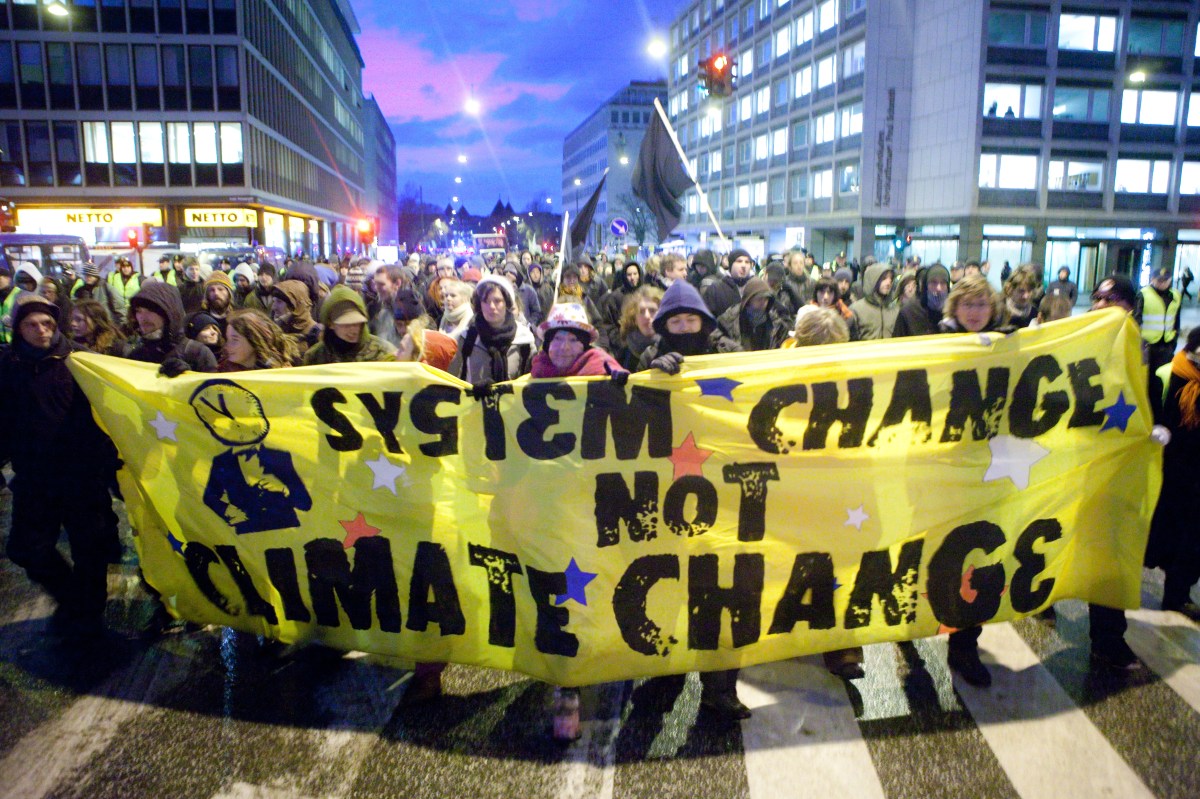
In what we hope will be a series of articles on the intersection of pandemic, lockdown, economic disruption and climate action, Pete Cannell reflects on what a return to ‘normality’ might mean.
It’s so easy in the present circumstance to talk about ‘when things return to normal’. At an interpersonal level this is clearly important and we all look forward to the end of social distancing. However, at the level of society, of politics and economics, it’s another matter altogether.
“In the midst of this terrible despair, it offers us a chance to rethink the doomsday machine we have built for ourselves. Nothing could be worse than a return to normality.” – Arundhati Roy
For a brilliant exposition of what ‘normal’ means for the poor and oppressed around the world do watch this discussion between Naomi Klein and Keeanga Yamahtta Taylor.
The pandemic has shone a harsh light on the way that society operates ‘normally’. It’s clear that while we can all catch Covid-19 we are not all in it together. The impact of the virus is expressed through the distorting lens of the gross inequalities that exist within and between countries. In the UK we are seeing how the impact of neo-liberal policies on the NHS has meant that we have been unprepared for a pandemic, which public health experts have been predicting for a long time. We have a government at Westminster which having failed to prepare as the pandemic loomed then first planned to let it rip in the interest of’ ‘herd immunity’, ostensibly in the name of science, but truly in a vain attempt to keep the economy going. In just a few days they were forced into containment mode through ‘lockdown’ as numbers of infections spiraled upwards.
In the context of the last two decades what the Tory government is doing with the economy is astonishing. Government ministers told us that running the economy is just like running your weekly budget and that cuts in public services and infrastructure were unavoidable because debt must be avoided at all costs. This was always economic nonsense. Yet now the same politicians are injecting hundreds of billions of pounds into the economy. Such has been the turn round that at the daily pandemic briefing Matt Hancock could announce a £13 billion write off of English NHS trust debts as if it were just routine. We’ve been here before. In 2008 our money propped up the banks while real wages fell and social services were ravaged. This time the sums of money are even larger but the intention is the same. In a briefing for The Source, Ben Wray describes how the current bail out is primarily aimed at keeping big business and the banks afloat. Throughout the twists and turns of government policy the objective of maintaining existing relationships of wealth and power has remained constant.
If current economic plans remain on the course that the Tories have set post-pandemic normality will be restored for the 1%. There will be an even greater concentration of wealth and power as mega companies like Amazon thrive whilst small businesses go to the wall. For the rest of us a return to ‘normal’ will mean more austerity, higher prices, shortages of food and large-scale unemployment. This is bad news for all of us and horrifying for the most vulnerable.
As the Coronavirus crisis unfolds the climate crisis continues to deepen. In the short term lower economic activity is reducing greenhouse gas emissions but the government’s economic plan for recovery, for a return to ‘normal’ that bails out the airlines, banks and big energy corporations, will rapidly ramp up emissions again. Over the next few months the climate movement needs to have an intense discussion on the politics of a sustainable path that tackles both the pandemic and sets a course for zero carbon. The terrain on which we make demands has shifted. Self evidently the money for transition is there – the money allocated by the advanced economies to finance the bailout is of the same order as what is needed to build a new economic system based on renewable technology. So right now we need to develop and popularise a set of demands that clearly articulate how the money should be spent.

The North Sea is a good example. With oil and gas prices falling we are likely to see a new wave of job losses and new developments like the fields west of Shetland are likely to stop. Current government plans for a return to normal would see cash going to the energy companies to salvage these projects. Surely we should demand that the money goes to supporting the laid off workers, to a rapid expansion of retraining opportunities in further and higher education and investment in sustainable projects on a large scale.
There’s much more to say about this but I hope this article contributes to a necessary debate about the way ahead. We need clear demands so that we can build mass pressure for action.
This changes everything
Mike Downham reflects on discussion at a recent Scot.E3 organising meeting.
This piece began as a report on a ScotE3 discussion about its forward strategy at an organising meeting on 19th March. The meeting had been planned before COVID-19 had become the over-riding priority. By the time we met, it had. For most of us it was our first Zoom meeting.
Over the week since we met, events have moved more quickly and more significantly than in any of the 4,213 weeks I’ve been alive and aware (too young to be aware of the outbreak of World War 2, and too distracted as a medical student to be fully aware of the Cuban Missile Crisis.). So this report has become an attempt to develop the main points which emerged from our discussion in the light of the subsequent escalation of COVID-19 – an escalation in terms of the spread of the disease, the number of deaths, Government intervention, and the response of communities and activists.

The key points which emerged from our discussion that night were that the COVID-19 pandemic is laying bare the contradictions in the capitalist system; and that increased consciousness of these contradictions among working-class people, already noticeable, has the potential to build to a point where those people will collectively insist on fundamental change.
What are the contradictions in the capitalist system which the pandemic is particularly exposing? Above all, the vulnerability of our health and social care infrastructure as a result of market-led policies over recent years has become blatantly obvious. The NHS has about 5,000 ventilators, and we are predicted to need around 100,000 within the next few weeks – this despite a flu pandemic exercise run by Government three years ago which pointed to the need to increase ventilator capacity. The Government took no action. On top of that it’s now widely known that the Government, as recently as a month ago, was prepared to sacrifice older people to save the shareholders. Though it became politically impossible for them to hold tightly to that strategy, it still informs their inadequate and confused public health interventions.
The economic impacts of the epidemic are likely to be as big for working-class people as the health impacts. Yet the Government’s income-support interventions have been slow to emerge, inadequate and confused. What for example is an ‘essential job’? Essential for who?
Food will inevitably become scarce soon, particularly but not only for those with least money. The official figure for the percentage of food the UK imports is 50%. But this is a figure massaged by the inclusion of foods processed in the UK. If ingredients for the processing are included, the real figure is around 80%. A lot of that comes from Europe. Wholesale prices of the fruit and vegetables we import from Europe are rocketing in the context of the pandemic, some of them have already risen by 100%. Wherever food comes from it has to be distributed and many of the waggon drivers come from central Europe. Homegrown fruit and vegetables are threatened by the shortage of harvesters, most of whom also come from Europe.
What are the signs of increased consciousness of these contradictions? Already many people are expressing lack of confidence in the Government. That, to date, 600,000 people have responded to the call for volunteers to help the NHS is a sign that people recognise just how under-resourced the service is. At this point the Government is arguing that the scale and severity of COVID-19 was unpredictable, but as the facts emerge about their inaction in the face of what became known to them from the experience of China and other far-eastern countries, this argument will be seen through, especially by the new volunteers as they experience working at the front line. The vigorous responses of local mutual aid associations will lead to increased confidence and a growing collective consciousness about the way working class people have been failed, particularly as people lose loved ones and as their economic conditions deteriorate. Workers are standing up for their rights for protection from Coronavirus infection in their workplaces – at Moy Park poultry processing plant, Northern Ireland’s biggest employer, 1,000 workers have walked out.
ScotE3’s primary aim is to contribute to the building of a mass movement to achieve a Just Transition from North Sea oil and gas to renewable sources of energy within a timeframe which prevents catastrophic climate change. The COVID-19 pandemic, despite its devastating outcomes, which have now become inevitable, offers an opportunity for ScotE3 to support the growing consciousness of the way the capitalist system is threatening the very survival of working-class people. We can support the generalisation of that consciousness, so that it extends to an understanding of the urgency of Just Transition. As one of our members put it recently:
Oil & gas need to go the way coal went, but this time without victimising the workers and their communities…The people, if they get the facts, will not allow either the industry or the Government to lead us into a future that condemns our grandchildren.
We are well placed to continue to contribute strongly to a Just Transition movement, despite the restrictions of the pandemic, given our emphasis on providing high-quality information widely available online, and the diversity and depth of the experience of our membership. The pandemic will make it more possible for us to promote radical solutions, above all the need to replace the capitalist system. The COVID-19 pandemic should inform all our activities, the resources we work on, and the politics of the material we publish. The pandemic is the new prism through which we should view everything.
Coronavirus Capitalism
Naomi Klein’s Case for Transformative Change Amid Coronavirus Pandemic
Action notes and an appeal for help
The minutes and action points from our March organising meeting are now available for viewing or download.
There were two particular actions that we would really appreciate your help with.
We have taken out a subscription to the Zoom online conferencing platform and we plan to hold regular online public events. Please email suggestions for topics and for speakers to triple.e.scot@gmail.com. If you would like to offer to do a presentation yourself do let us know. We’re aware that online meetings may be a new experience for some people or you may not be familiar with Zoom. There is a now a simple guide to accessing Zoom meetings on this site.
We have five new briefings in production
- The role of Hydrogen in a sustainable economy
- Organising at work
- The COPs and COP 26 – a guide
- Is nuclear part of a sustainable solution?
- Decarbonising Transport.
If you know of good resources on any of these topics and can share links or references that would be really helpful. Our aim when we produce briefings is to develop a concise summary of the issues on 2 sides of A4 with links to further readings and resources via the website. If you’ve an interest in one or more of the topics and would like to link up with 2 or three others to help write the briefing and collate the web links do let us know. You can just email us at triple.e.scot@gmail.com
Finally if you have ideas for other topics that would work in the briefing format or for updates to existing briefings do get in touch.
March organising meeting
Thursday 19th March – 7.30pm by Zoom click here for details of how to join
If you are new to online meetings there is a simple guide to joining Zoom meetings here.
Draft Agenda
Reports from activity over the last month including:
- North Sea Oil and Gas report
- Meetings that we’ve attended
- Wet’suwet’en solidarity
- Funding application
- Ineos and fracking
- International Climate Jobs Conference
- COP 26
Discussion on strategy and direction
Organising meetings and events in the new circumstances of Covid 19 – ideas for online meetings – other ways of reaching and engaging people
Fringe meeting at STUC – report on progress and decision on how we proceed
Developing new materials for the website – priorities – getting people to provide material for the briefings and act as authors/ reviewers

A Green New Deal for Scotland
The Common Home Plan: A Green New Deal for Scotland
Reflections on the plan dubbed ‘This is how we save the world’.
Common Weal’s Green New Deal for Scotland was launched in November 2109. A costed plan for a transition to a zero carbon economy, it is an important contribution to the debate about just transition. Previously we’ve published a summary review of the plan by Pete Roche from Nuclear Free Local Authorities and a video of Tiffany Kane from Common Weal https://wp.me/p8FiJr-cE. In this post Annie Morgan takes a critical look at the plan from an internationalist perspective. Annie writes:
There is much that is commendable and doable in the Common Home Plan. However, there is a lack of an international perspective.
‘No man is an island entire of itself, every man is a piece of the continent, a part of the main‘
(John Donne. Devotions upon Emergent Occasions (1624))
Donne’s writings from 400 years ago have a prescience similar to John McGrath’s play ‘The Cheviot, the Stag and the Black, Black Oil’, in our theatres again this year. Donne compares people to countries and his writing is a plea for recognition of our inter connectedness. The poem is an argument against isolationism and has resonance today in terms of climate change (or as some would say, climate chaos, since change may not describe the devastation already occurring). McGrath’s play is testimony to the centuries old exploitation of people, landscape, land and resources that has blighted Scotland. Therefore the Common Weal collective are quite right to assert that our land isn’t ‘natural’ nor is it ‘well stewarded’ (Page 57). The proposals for land reform, national planning approach, reforestation regenerative/agroecological methods are excellent. Careful planning is demonstrated.
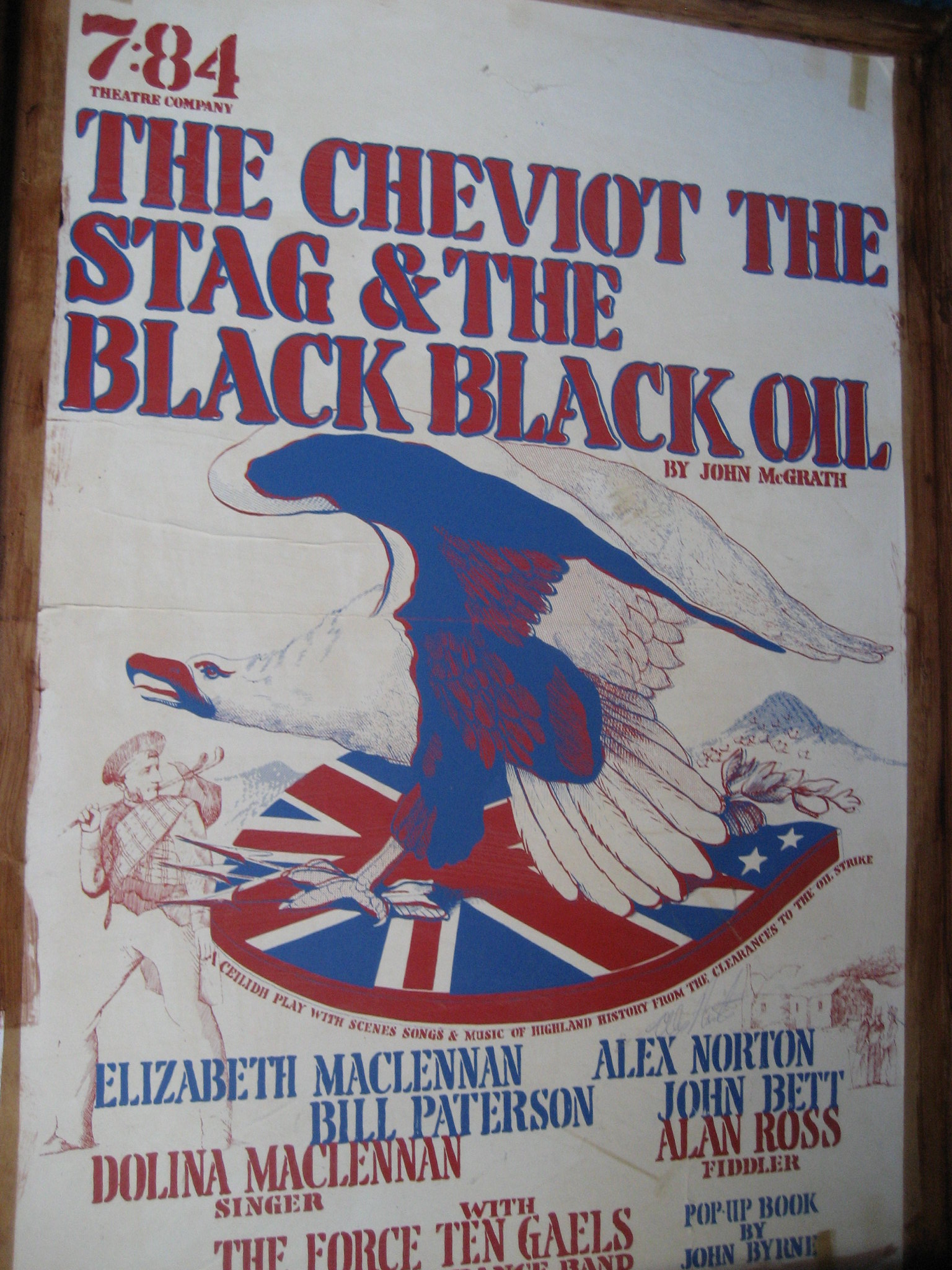
The Cheviot,the Stag and the Black Black Oil Poster Abbey Theatre Dublin 1974 CC BY 2.0
However, there are considerations in the global context that impact on the implementation of the plan. I explore these below.
In Common Dreams Brian Tokar summarises the problems inherent in the global capitalist economy. I have added to the list.
- Metals, mineral extraction and exploitation of mining workers and communities
- Oil, gas, coal burning is still dominant and in the control of multi national corporations.
- Food insecurity exacerbated by climate change
- Neo-liberal doctrine dominance, read privatisation, deregulation and ‘free’ markets.
- International Monetary Fund/World Bank/World Trade Organisation stranglehold with continued imposition of structural adjustment programmes (now referred to as Extended Credit Facility)
- Rise of right wing /fascist governments and influence aided even encouraged by global powers
These all demonstrate that the Common Weal assertion that ‘negotiations at an international level’ are unrealistic, sits alongside, but at odds with Asbjørn Wahl’s perspective on a clear policy on energy (the main source of emissions and global warming). He argues for a move from market oriented ‘green growth’ towards a position ‘anchored in the need to reclaim energy in public ownership and democratic control’. The Common Weal report, while consistently and rightly calling for Public Ownership, does not consider the required programmatic shift at a global level. Asbjørn calls for the work of Trade Unions for Energy Democracy and the Global Climate Jobs Network and allied networks to be recognised. Allied groups could include environmental agencies, Climate Activist groups such as Extinction Rebellion, Friends of the Earth and others, ScotE3, the Scottish Trade Union Congress and Trade Unions, Common Weal, students and workers. An international solidarity ethos as described by War on Want would recognise the consequences of climate damage particularly for vulnerable groups and working people and that climate chaos is impacting both here in Scotland/UK and worldwide.
Another impact of IMF imposed programmes is that impoverished countries have to compete with each other, leading to massive over production and lowering prices. Thus cheap imports in the Global North clog Landfills after short-term use. Examples include the clothing industry (Fast Fashion -the Global Rag Trade), plastic toys, household items and trainers. This inhibits the progress to the circular economy, rightly called for by the Common Weal team. A walk round any shopping centre/recycle centre/landfill will highlight the slow progress towards halting the throw away mindset. Communities in the Global South must be supported in their human rights to sustainability.
That business as usual is the predominant response by both governments is the concern. This is illustrated below in consideration of current energy policy. Peter Roche does a good job of reviewing favourably, the Common Weal Plan for a Green New Deal. However, I will highlight, some of what may be considered ‘ omissions’. I have conflated the categories of Buildings, Energy and Electricity into one section on energy. I further highlight the international context. I will pay particular attention to Carbon Capture and Storage (CCS) and Carbon Usage and Storage with reference to the Common Weal comment that CCS is unproven at scale, risks leakage and prolongs unnecessary use of hydrocarbons. This is totally correct but Energy Voice in 27/11/2019 announced ‘Ground Breaking New CCS charter agreed by the Scottish Government and the Oil sector.’ No progress to public ownership there and the oil giants are calling the shots. We will have to work hard and quickly if we have any chance of reversing this strategy, which lies at the heart of energy policy in Scotland. More below.
- Energy
New models of public ownership are required to combat the corrupting influence of the extremely powerful extractive industries. The Scottish Trade Unions Congress (STUC) will debate Public Ownership at a Conference this May . The Common Home Plan steers clear of prescriptive political solutions. In doing so there are two problems; firstly, the reality of the political context in Scotland, UK and secondly, the power of multi-national corporations. Brexit compounds this. In addition, the lack of detail in the ‘how to’ increase the role of the public sector is problematic. The plan rightly advises and gives practical means of public sector borrowing, ‘quantitative easing’, or new money with progressive taxation to repay but does not expand on how to reverse the current ownership arrangement. Energy policy itself remains largely reserved to Westminster. Increased self determination and progress to Independence will be necessary to realise a Scottish Green New Deal, a sentiment that is expressed in the Commonweal plan.
The current political reality is found in the on going influence of a neo- liberal outlook (Growth Commission), the limited commitment to public ownership at state/nationalisation level for energy and the lack of a municipalisation strategy for heating /transport. Thus great ideas around district heating and integrated, connected public transport may be neglected. The Common Weal plan alongside the ‘Sea Change’ report demonstrates the increased number of climate jobs, which can be created in the transition to a low carbon economy. The time is now to push for strategies to implement a Just Transition.
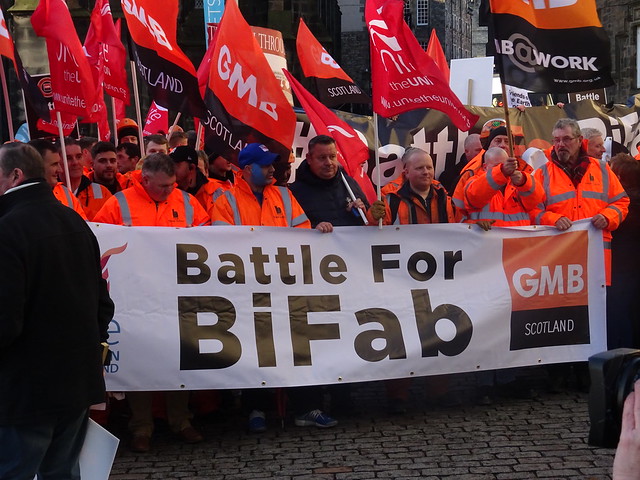
The current lack of commitment to public ownership, not least in the refusal to take the Caley rail depot in North Glasgow into public ownership, the refusal to support the Bi-fab workers and the chaotic ownerships of energy provision and renewables in Scotland points to a near future lack in public investment. Pat Rafferty of Unite outlines the ‘ smorgasbord’ of foreign ownership in the energy sector – ironically sometimes European state owned. The Bi-Fab story highlights the need for government action-EDF (French) awarded the contract to Siapem (Italian) who subcontracted the manufacture of wind farm jackets to Indonesia to be shipped back to Scotland with a small number of jackets to be made in the Methil yard. This type of globalisation with companies chasing cheap ‘Global South’ labour must end; decommissioning, arduous work on rigs in the North Sea, is undertaken by migrant workers, paid a pittance.
Furthermore the lack of progress to ‘ Green Jobs’ is undermining union confidence and support in a Just transition with unfortunate calls for retention of Hunterston Nuclear facility, continued Oil and Gas extraction, continued subsidies to ‘Defence ‘ (the Arms Trade) and the biggie – Trident.
The Common Weal plan does an excellent job of costing the transition in a supplementary booklet. However, I would argue that current subsidies to the Oil and Gas industries, to the Arms Traders, to the Trident obscenity both in financial and moral terms, and in the deployment of blue hydrogen with Carbon Capture Usage and Storage which is underway will continue to seriously damage the public purse. Alongside divestment, a challenge to the Oil industry’s dominance in Carbon Capture Usage and Storage is an urgent priority.
Patrick Harvie (Scottish Greens) noted that
‘Entrusting Climate Change Policy to the Oil and Gas industry is comparable to entrusting Public Health to the Tobacco Industry‘ (paraphrasing exchange during FM question time (September 2019)).
The Royal Society of Edinburgh (hardly a left wing think tank) predicts £20-£30 billion costs for the scaling up of the new technologies. Bio energy with CCS is also of concern with Drax in England in the forefront; expensive and likely to drain money from other ecological restoration projects. The Common Weal plan conflates the Hydrogen economy into the most environmentally responsible type – Green Hydrogen. Oilrigs could be used in the manufacturing of green hydrogen by electrolysis using seawater and wind energy. However grey hydrogen and blue hydrogen; the grey reforming from ‘natural’ gas (methane), and the blue meaning storing the resulting CO2 beneath the North Sea, is the favoured option at Government and Scottish Investment Bank level. Common Weal note that Scotland is in the forefront of the hydrogen transformation and the Levenmouth project and Orkney green hydrogen developments are welcome. Fuel cells for transport could play an important role in decarbonisation (Aberdeen buses already using them). However, the reality is that the St.Fergus operation (Blue Hydrogen/ CCS) is well underway and scheduled to come online in 2024. Shell, Total, SSE and Chrysoar have signed up to the ‘agreement’ with the Scottish Government. Pale blue dot, the Oil and Gas Technology Centre and Peterhead Port Authority are the partners in North East CCUS Enterprise (NECCUS). The £275 million CCS project underway by Acorn will be scaled up. Note the cynical use of greenwashing titles and images – Acorn and Pale blue dot; a tree, the Earth from the Voyager photograph. Paul Wheelhouse, Scottish Government Energy Minister declared his delight at the Alliance, adding that CCS was essential for Scotland to reach net zero emissions by 2045.
In contrast, Equinor (Norway state) lobbying of the German Government has failed and green over blue has prevailed. These discussions are absent from the report, yet they are vital – the Commonweal plan aims to encourage responsible trade ( export) in renewable fuel. Further research on the role of hydrogen and potential for export is required.
2. Food
Our Common Home suggests that Scotland could move towards self-sufficiency in food production needs qualification. Certainly localised and seasonal production in restored soils with good stewardship and land reform can be highly effective in climate mitigation. However, available arable land, renewable energy usage, peatlands, wetland, rewilding are all to be considered. Natural Carbon sinks/trees/hemp also require growing space.
Moreover the IMF/World Bank continues their imposition of structural adjustment/cash crops on the majority world, its practice for decades. If the ‘Global North’ quickly reduces imports without expanding fairer trade and enabling counties globally to be more self sufficient (as they were once and know how to be) there will be increased food insecurity. Insecurity made worse with crop failures, lower yields, petroleum based fertilisers, geo engineering and so on. Again this is a call for an interdependent, intersectional, Internationalist understanding.
3.Transport
The transport section of the Common Weal plan has proposals for decarbonisation, city and town planning, to have local facilities and encourage active travel /recharging infrastructure/discouraging air travel and so on. The call for a National Transport Company is welcome. However again there is little detail on moving towards public ownership for public transport. We require increased public transit – reliable, with greater frequency, convenient and integrated for workplace/hospital/education; these details are missing. Hopefully the proposed National Transport Company would look at details – for example, expanding underground for Glasgow and expanding rail for passenger and freight throughout Scotland. A move towards fare free transport to impact on individual car use will necessitate a reversal of private ownership. The recently announced free fares for under 18’s are welcome but will do little to decrease car use. Democratic ownership as described by Andrew Cumbers is also important. Lothian buses, although Council owned, has not considered drivers conditions sufficiently and Edinburgh remains at the top of congested cities in the UK. (TomTom traffic index January 2020). Improved communal transit is vital in reducing emissions and a National Transport Strategy vital to impact on car culture, that is, to reduce individual car use.
The other categories around resource use and producer responsibility could be enhanced by a consideration of the Lucas Plan and the democratisation of the economy with bus driver input to developing integrated routes, engineering workers in heating and so on. I had a very enlightening conversation with a heating engineer who was fixing my central heating, very knowledgeable on renewables, and I was thinking it would be excellent to have workers input in think tanks and climate activism. Communities also need to be actively engaged in a path towards greener energy. Common Weal is well placed alongside climate groups to be encouraging community involvement.
War on Want have good examples of communities fighting back against the ‘Free Trade’ doctrine and privatisation agenda. The current pandemic of the Covid virus may impact on the neo liberal trade agenda. It is important that changes in trade are explored from a Global Justice perspective. Examples are the Bolivian Alliance ALBA and La Via Campesina. It is hope that delegations from the majority world will be able to attend alternative conferences at Cop26 in Glasgow. We can learn and adapt strategies.
Finally, the above by no means seeks to undermine the good work and intentions of the Common Weal think and action tank and their supporters. I will finish on a further example of War on Want’s request to consider the ways in which we can lessen the impact on communities in our move towards sustainability in towns, cities and countryside. The Common Weal plan considers recycling in the sense of failure and rightly calls for a circular economy. This article asks for awareness on the obstacles to the realisation of this circular and sharing economy within a capitalist, always for profit, paradigm. Thus, yes, we have to have optimism that a different world is possible while recognising the long ecological revolution it will take (see John Bellamy Foster). This does not imply that we can procrastinate. The 2020’s is the Climate decade. Now or never! Therefore, one last example of the here and now , what we can do while building for the society outlined into Common Home Plan. Jake Molloy of the RMT Union calls for large recycling hubs for steel, glass, vehicle chassis, brick and concrete. War on Want call this Urban Mining. Landfill mining also: electronic waste is full of precious metals – Anthropogenic waste (all the pollution from human activity) can be recycled to reduce raw extraction. Now there is a transition idea – one that would be labour intensive (that’s a good thing -more jobs!).
Finishing with a quote from Arundhati Roy, Indian Activist and writer.
‘A new world is not only possible, she is on her way. On a quiet day , I can here her breathing’.
Just Transition Commission Interim Report
The Just Transition Commission began its work in 2019. Established by Scottish Ministers its remit is to advise on how just transition principles can be applied to climate change action in Scotland. It is tasked to complete a final report with recommendations for Scottish Ministers by January 2021. The Commission published an interim report on 26th February 2020.
The interim report has four main themes:
- Planning Ahead
- Public engagement
- Bringing equity to the heart of climate change policies
- Opportunities and the need for immediate action
The report notes that since the Commission began its work both the Climate Change (Emission Reduction Targets) (Scotland) Act and Scottish National Investment Bank Bill include reference to just transition principles. However, it is critical of a lack of action by the Scottish Government and highlights opportunities that have not been taken. The closure of the coal-fired power station at Longannet is cited as a case where the local community in Kincardine contest the view of Fife Council and other agencies that the closure was well managed and socially just.
There is a strong emphasis from the Commission on the need for strategic vision that cuts across sectors and for government leadership and direction. It contends that the task of making strategic progress across sectors
… cannot be left to enterprise agencies or indeed companies themselves. There is a crucial need for Government leadership.
Further, it argues that the Scottish Government shouldn’t wait for its 2021 report before acting, stating that
We firmly believe that all decisions taken by Government in the year ahead need to be made with a view to supporting a just transition for Scotland. We don’t want Government to wait for our final report to begin planning how a just transition will be achieved.
It notes that current planning approaches are insufficiently rigorous and suggests that all Scottish Government funded investments should be prioritised against inclusive, net-zero economy outcomes. Planning is essential if we are to avoid the kind of unjust transition that has characterised previous major economic transitions.
While arguing for a much more proactive role for the Scottish Government the interim report doesn’t make recommendations for how a state energy company could be used to drive transition. It’s to be hoped that the final report will say more about this.
While it is critical of lack of action and leadership from the Scottish Government, the interim report is weak on the role of public ownership and democratic engagement. The former is largely neglected while the latter is viewed in terms of consultation – there’s no real sense that system change is on the agenda. This is most evident in the way that the report approaches North Sea Oil and Gas. The oil industry’s Vision 2035 and associated roadmap are mentioned without criticism. The truth is that aiming for the North Sea to become the ‘first net-zero carbon hydrocarbon basin’ means continuing extraction and carbon capture and storage on a massive scale.
‘Just Transition’ was prominent at COP24 in Katowice – developed by the workers movement and climate activists – it has been partially co-opted by corporations and government agencies. It’s critical that the climate movement defends the radical core of the concept. If social justice is not central to transition then it will not be possible to build the scale of social mobilisation that is needed and the risk of a climate catastrophe is magnified. Here in Scotland we need to put social justice at the heart of our actions as we build the climate movement and mobilise for COP26. The Just Transition Commission is asking for civil society to submit their views as it works through 2020 and prepares its recommendations for Ministers. We should do that. But even more important is raising the level of mobilisation so that the pressure for action becomes irresistible, system change is on the agenda and corporate greenwashing is exposed as a desperate attempt to cling on to business as usual.
Edinburgh Wet’suwet’en Solidarity
The peak winds from Storm Jorge hit central Edinburgh as we gathered to send a message of solidarity to the Wet’suwet’en this afternoon. Gusts of over 80 km per hour destroyed our main banner and numbers were depressed by the extreme conditions but more than 20 of us stood firm in solidarity. Most passers by were unaware of what is happening in British Columbia but we got a good reception with many people stopping to talk. The protest was called by Scot.E3 and supported by Friends of the Earth Scotland, Young Friends of the Earth Scotland, Global Justice Now Scotland, rs21 Scotland, People and Planet Edinburgh, Edinburgh Youth Climate Strike, Green Anti-capitalist Front and XR Edinburgh. The breadth of support provides a good basis for continuing solidarity actions as we build for mass mobilisation at COP 26 in Glasgow later in the year.
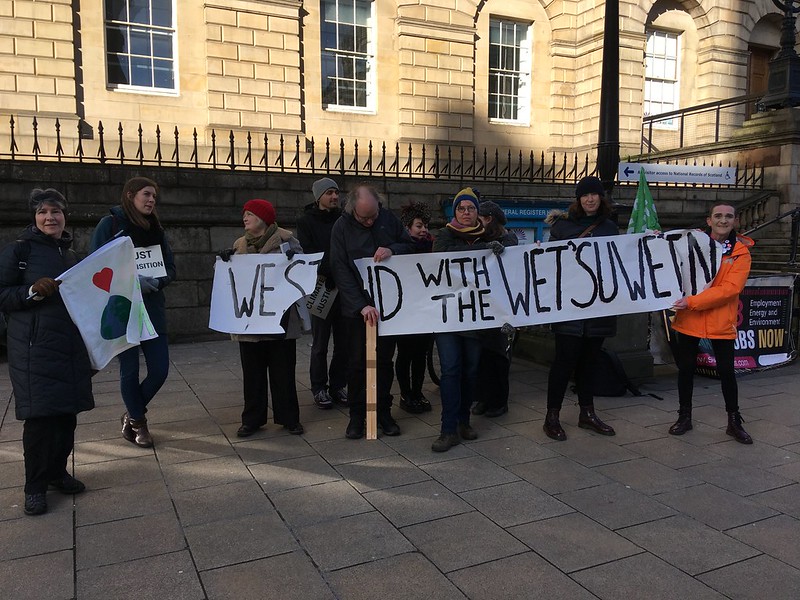
Images by Eileen Cook and Pete Cannell CC0
Donate to the Unist’ot’en 2020 Legal Fund
More information at the supporter toolkit site
Canadian Facebook Page
UK Campaign Facebook Page
Public transport use in Scotland in decline
The decision by the Scottish Government to extend free bus travel to under 19 year olds is a small but positive step. However, the latest Transport for Scotland Report published yesterday (27th February 2020) shows that the number of bus journeys undertaken is continuing to fall while car usage is rising. The steepest fall in bus use is in the Highlands and Islands while the decline is least in South East Scotland. The data in the report doesn’t break down regions by public transport provider but the relatively small decline in the South East is almost certainly a result of increased numbers using publicly run Lothian Buses.
In 2107 transport accounted for 36.8% of Scotland’s total greenhouse gas emissions. Cars were the biggest contributor accounting for almost 40% of the total. Cutting the use of polluting car transport is a critical part of shifting to a zero carbon future. Simply replacing petrol and diesel by electric would put huge pressure on natural resources that are in short supply and whose extraction causes major environmental damage. The answer must surely be a comprehensive, flexible and well connected public transport system that has electric buses as a key component and is free to users. There is good evidence that low or free fares results in a massive increase in public transport use.

One of Lothian’s new 100 seat Envrio400XLB buses. CC-BY-SA 4.0
 Employment, Energy and Environment
