Don’t Bank on the Bomb Scotland has produced an excellent new report that looks at the links between nuclear weapons, tackling the climate crisis and degradation of the environment. Written by Linda Pearson the report collects together a wealth of useful links for anti-war and climate campaigners alike. The aim of the report is ‘to highlight the connections between climate change, nuclear weapons, militarism, environmental destruction, racism, gender inequalities and social injustice in order to build a broad-based movement that can challenge existing power structures and bring about systemic change’.
Scot.E3 from its formation has argued that defence divestment needs to be part of the transition to a sustainable zero carbon economy. We agree with Don’t Bank on the Bomb that ‘… any Green New Deal plans should include a transition away from military production, as well as a transition away from fossil fuels’.
The new report highlights the expenditure of huge sums of money on ‘modernising’ nuclear arsenals around the world. The nuclear industry (military and civilian) is perhaps the most centralised and authoritarian manifestation of the military-industrial complex. We would argue that it’s not simply that the money spent on nukes should be spent on developing a new sustainable economy; the nuclear industry and arms manufacture more generally distorts economic and social choices and constrains civil liberties. The skills of engineers and scientists that could be devoted to productive, environmentally useful activity are instead harnessed to a system that produces waste, trashes the environment and risks all our lives. The report highlights the interconnections between the drive for profit, the impact of climate change and increased military tensions. One example of this is the race for commercial and military dominance of the Arctic.
Nuclear Weapons, the Climate and Our Environment – screen shot
Further Reading:
Scot.E3 Briefing Scotland Deindustrialisation and Diversification
Alexander Dennis, based in Falkirk, is internationally important as a manufacturer of double decker buses. In the wake of Covid19 it faces a short-term decline in orders. The response of its new owners, Canadian firm NFI, is to cut 650 jobs.
Clean, sustainable public transport is a critical part of the transition to a zero-carbon economy and Alexander Dennis is a world leader in building all-electric and hydrogen powered buses. The skills of the workforce at Alexander Dennis will be essential in reshaping the way we use energy, the way we produce and the way we live in response to the climate crisis. Sacking 650 workers will blight lives, wreck futures and set back the struggle for a just transition to a new sustainable economy.
In an excellent article in today’s Source Direct Ben Wray notes that the company is asking the government to buy the buses that private operators are not buying at the moment. We do need government action, but as we argued recently in ‘Save Lives, Save Jobs, Save the Planet’ such action needs to be planned and systemic. It needs to tackle issues of safe public transport and it needs to look forward to the zero-carbon future. The private sector is incapable of this kind of joined up thinking. Saving jobs, skills and livelihoods at Alexander Dennis should be seen as part of the broader campaign of taking public transport into public control.
All the signs are, however, that any Scottish Government action is unlikely to measure up to either the immediate crisis in Falkirk or the longer-term crisis of climate. There is a huge gap between the government’s rhetoric on just transition and just recovery and their actions. So how do we turn this round? I’d argue that to make progress we need to think in terms of a ‘worker led just transition’. It’s hard, but collectively we need to take every opportunity to turn the slogan into real action. At a time of public health and climate crisis, when the wealth of the super-rich is rocketing up, and the Westminster government is spending billions on contracts to their friends and bailouts to big business, redundancies in carbon-saving jobs are unacceptable. One option would be for Alexander Dennis workers to refuse to accept redundancy and occupy the factory. Combined with a public campaign for socially useful production as a part of a just transition this would have huge resonance in Scottish society and could provide common cause to the trade union and climate movements. The 1971 occupation of Upper Clyde Shipbuilders is a model – but this could be so much bigger.
Save Lives, Save Jobs, Save the Planet
Support Alexander Dennis Workers
Take Public Transport and Public Transport vehicle production into public ownership
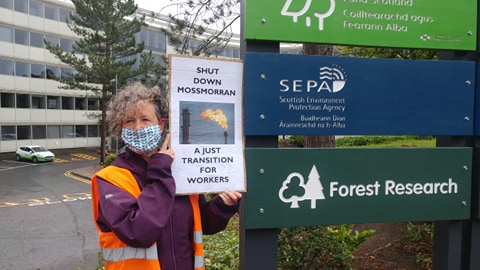
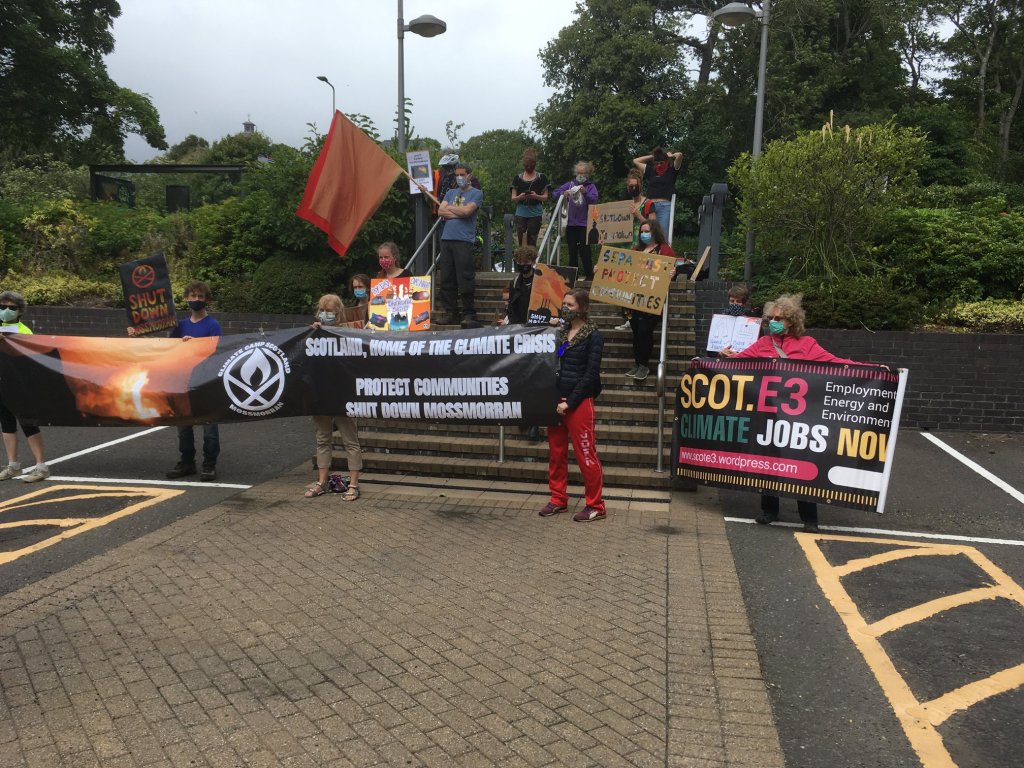
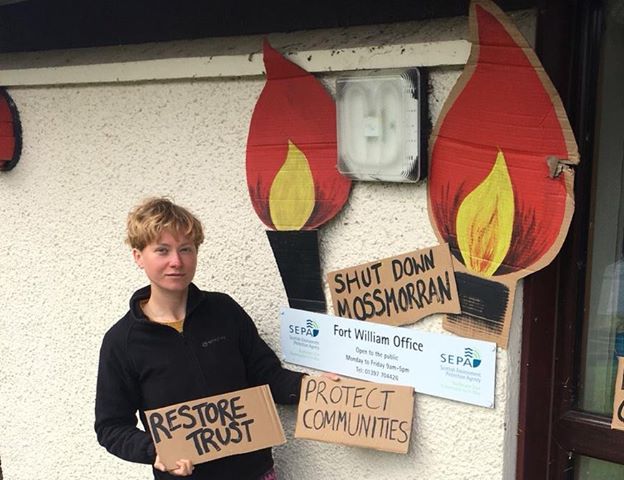
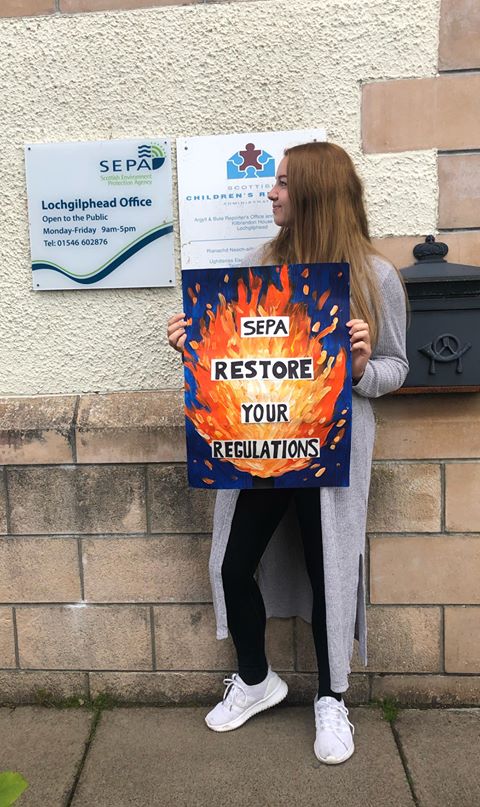
Protests organised by Climate Camp Scotland, calling for SEPA to protect local communities in Fife, take action on flaring at Mossmorran and demanding the rapid closure of Exxon and Shell’s gas plants took place across Scotland took place on Sunday 26th July
Earlier in the year we held an online public meeting with speakers from the Mossmorran Action Group. Prior to Covid19 Climate Camp Scotland were planning their summer action around Mossmorran. Limitations on social contact have made the original plans impossible but Climate Camp are continuing to campaign for action on Mossmorran. On Sunday at Midday there will be protests at SEPA (Scottish Environmental Protection Agency) offices around Scotland. The action will continue via social media on Monday; for more details go to the Facebook event or read the action briefing document.
We held our latest organising meeting on 23rd July. It was a chance to catch up and share ideas. You can find the full list of actions here and if there are particular actions that you would like to get involved with please do email us.
Part of the discussion focussed on the impact of Covid19 on the Scottish economy. We will soon be publishing an extended article on the importance of the education sector in the transition to a zero carbon economy – in light of this it’s very important to support education workers who are fighting to keep their jobs. Edinburgh Napier University is the first to announce that it is looking for compulsory redundancies. Do sign and share the petition in support of Napier staff.
In Glasgow jobs at First Bus are under threat – Get Glasgow Moving are looking for support for their campaign to take Glasgow bus services into public ownership. You can sign their petition here.
We are planning two public meetings, one on Ineos and one on a Worker Led Just Transition – watch this space for dates and further details.
Leeds TUC’s Environmental sub-committee held a webinar recently on ‘Alternative ways to decarbonise our heating systems’ – the video includes a lot of useful information and some sharp critique of the idea that’ blue hydrogen’ could be a way forward.
This video has Professor Andy Stirling and Dr Phil Johnstone, in conversation with CND Chair Dave Webb, about the connections between the UK’s nuclear weapons programme and nuclear power. Their research shows that the sole case for nuclear power is to subsidise nuclear weapons production. Electricity consumers are paying for the high cost of nuclear generated electricity and thereby subsidising research that is used by the military to maintain the nuclear weapons programme. The argument that Nuclear Power is ‘climate friendly and necessary’ is a convenient afterthought to disguise the real reasons for developing it.
77 pages of neoliberal propaganda, with passing references to climate change, inequality and racism to soothe the voters – all empty rhetoric, devoid of any proposals on how to address these social injustices other than through increased, top-down private sector activity.
But what else did we expect from a group of eight people hand-picked by a Government wedded to ‘Sustainable’ Growth (sustainable for capitalists) and to extracting the last drops of oil and gas from the North Sea, and which put profit before people’s lives by obsequiously following the UK Government’s response to the Covid-19 epidemic? 4,878 people have died in Scotland as a result of the epidemic at the last count on 16th June. People are still dying as the report is published.
That Graham Smith, previously General Secretary of the Scottish trade Unions Conference, which represents more than 500,000 workers, has put his name to this report is an ultimate manifestation of the successful co-option by neoliberal governments of the trade union bureaucracy.
On Just Transition we’re given “There is the jeopardy, as well as the opportunity, of the transition associated with climate change”, along with carbon capture and storage in the North Sea, and “positive behavioural change”.
This is not the time to “recast a new model”, or to follow “abstract arguments around the creation of new institutions”. By which the Group presumably means a National Climate Service, consisting of the National Investment Bank, a publicly owned Energy Company, and the creation of 100,000 carbon saving or carbon neutral jobs essential for improving the quality of life for people across Scotland, with training opportunities for all those who have lost their jobs as a result of the pandemic, the many more who will soon lose their jobs as the recession bites, and those who didn’t have a job to start with.
Instead we should rely on the “might of the private sector” to create more jobs, because (logically?) that’s where 79% of jobs currently are. The “backdrop” is “constrained public sector resources”, which we know is nonsense.
This has to be based, the Report says, on “transforming some aspects of the relationship between business and the Scottish Government” a relationship which is working “reasonably well for financial services, agriculture and renewables”, but not well enough in other sectors. “If one party in a relationship says it’s not working, it isn’t. This could be “an opportunity for the Government to draw on businesses to second senior executives”. The Group reminds the Government that an election isn’t far away, so it had better get on with improving its relationship with business if it doesn’t want to lose its voters. The tone is overbearing, arrogant and amounts to bullying.
Apart from the pressure of elections, and the need to create more private sector jobs fast, there’s no hurry. Change will take time and will rely on “patient capital”. We need to build an attractive prospectus for inward investment. We also need to develop a new “pragmatic approach to regulation and planning”, for which read privatisation.
Overall, “recovery” is taken to mean recovering growth, sticking to the 2015 Scottish Economy Strategy with its ambition for Scotland to reach the top quartile of OECD countries, as measured by GDP.
There is much further detail in the Report but given that the principles are set in the four pages of the Foreword, it’s questionable whether it’s helpful to study the proposals further.
The underbelly of the report which we can focus on is the triad of trusting the private sector to alleviate social injustice, which history has demonstrated time and again fails; the lack of urgency in relationship to global warming; and a top-down approach as opposed to grassroots leadership, which history has plenty to say about too.
So here, in the flesh, is the “madness”, that ScotE3 and many others have warned against. If we allow these recommendations to fool us, and don’t promote alternative, coherent and more attractive recommendations quickly, we will have lost any possibility of slowing down global warming, and of effectively addressing poverty, inequality and social justice in general. We know, already knew, that only a mass movement will save us against significant attacks from capitalism, of which this Report is the latest.
Matthew Crighton’s view of the report: Green Recovery – what a disappointment
Yesterday started with hearing on Radio 4 the Pope say that the recovery must be ‘just and equitable’. He called for integrity not hypocrisy from politicians. Then came Mark Carney on how getting to net zero is part of the solution to the crisis, for companies as well as countries. He reminded us that net zero is ‘the law of the land’. Would these two be the warm-up acts to the revelation of truly transformative recommendations from the Advisory Group on Economic Recovery?
Image: Public Domain CC0
What a let down, then, to hear at lunchtime from ex-banker Benny Higgins who chaired the Group, set up “to advise the government on actions for economy recovery but also to build a fairer, greener and more equal society”(Nicola Sturgeon 17 April). There were lots of words from him and Nicola, but little useful content that I could find.
There are mentions of inequality in this report – but not one of them comes in the Recommendations! Nothing here for the Pope.
There is a section on prioritisation and delivery of green investments. It reads quite well – but it stands on its own and doesn’t permeate into any of the other recommendations. This is ticking the green box, not delivering a green recovery. The authors haven’t grasped the zero carbon imperative which Carney reminded us of. Instead of using the recovery to drive urgent decarbonisation action, they want to use green investments to boost the economic recovery which is the subject of the other 23 recommendations.
Left to Benny Higgins and his crew, that would be a very conventional recovery. One good thing is that it does call for a boost to investment levels, but it has no suggestions about how to do that apart from asking Westminster for more funds or borrowing powers. No plan for Scottish Green Bonds here, no call for a massive increase in the capitalisation of the Scottish National Investment Bank, just a suggestion that it should invest in housing – which looks dangerously like a dilution of its commitment to funding a Just Transition.
It’s a set of headings taken from the conventional economic development text book which has brought us to the dire state our economy was in before Coronavirus. Why set up an Advisory Group when you have Scottish Enterprise to write this stuff, and do a better job? It’s as if a Green New Deal had never been proposed!
One idea which got some attention is a business-led Scottish Jobs Guarantee scheme which would offer employment for at least 2 years to 16-25 year olds. This is a worthy objective but it misunderstands the challenge. It’s based on the Edinburgh Guarantee, an excellent initiative to address problems of a relatively small layer of young people not in education, employment or training at a time when unemployment was relatively low. We are, however, facing a scenario in which businesses of all sizes will be struggling to retain existing employees, let alone take on new youngsters.
The reference point has to be the mass unemployment of the 1980s and 1990s and the appropriate responses have to include a publicly-led intermediate labour market programme – a Future Green Jobs programme which funds rate-for-the-job employment in green projects to give people skills needed in decarbonising the economy. Not just for young people, there must be a clear offer to the adults who lose their jobs as recession bites. Apart from the expansion of PACE services, which support people facing redundancies, and platitudes about skills and lifelong learning this report offers nothing to them. The Advisory Group doesn’t even want to try a Universal Basic Income.
Disappointed doesn’t do justice to my feelings about this report! Instead of being the climax of a gig with the Pope and Mark Carney as warm-up acts, this was like an embarrassing local band trying to sound like they could share a stage with the stars but fumbling their words and striking some discordant notes as well.
Now that this report has come, and will probably sink without trace, we need to look forward to something sharper and more radical from the Just Transition Commission (it’s Call for Evidence is open until 30 June). And we need to continue to press for the Scottish Government to come forward with a list of specific programmes and policies which can make a difference, like a massive energy efficiency programme for our cold and draughty homes. Nicola Sturgeon can still bring on policies for a just and green recovery but she won’t find much in this report to help her.
Yesterday saw the publication of ‘Towards a robust, resilient wellbeing economy for Scotland’. The report was written by the Advisory Group on Economic Recovery with a remit to make recommendations to the Scottish Government. As Ben Wray notes in today’s edition of Source Direct the report is strong on buzzwords but devoid of real urgency and concrete proposals. The end of this week is also the deadline for submissions to the Just Transition Commission. As a contribution to this debate we publish the near final draft of Scot.E3’s submission, which makes the case for radical and immediate action on the climate crisis.
Climate Crisis
There has been a yawning gap between the Scottish Government’s rhetoric on the climate crisis and its actions. Vaunted cuts in domestic greenhouse gas emissions are almost entirely attributable to the greening of electricity production and the export of emissions as a result of deindustrialization. To date the Scottish Government’s actions have failed to measure up to the urgency of the crisis.
Covid19
However, the impact of Covid19 on society and the economy provides an opportunity to take decisive action. Job losses in the North Sea oil and gas sector, as a result of the impact on oil and gas prices, are already significant and are increasing rapidly. There have been layoffs before , however, this time round many analysts are predicting that the sector is unlikely to bounce back. These redundancies will have a direct additional effect on employment in the supply chain and an indirect effect on local economies, particularly in North East Scotland. The North Sea is only part of a much larger employment crisis in Scotland that includes tourism, some sectors of manufacturing, education and retail.
The economic and social dislocation of Covid19 is having a massive impact on the lives and livelihoods of working people in Scotland and across the world. Attempting to reset the economy to its pre-pandemic state at a time of climate crisis is madness. Millions of working people will bear the brunt of hardship, unemployment, sickness, stress and anxiety, and precious time to act on a Just Transition to a new sustainable economy will be lost.
The time to act is now
Many of those being made redundant in Scotland, oil and gas workers, engineers at Rolls Royce, have skills and experience that are needed to develop a new sustainable economy. They represent a precious resource. Yet if climate action is deferred, their knowledge and skills will be lost. Meanwhile, those who have lost their jobs, together with their families, and communities will have repeated the experience of mining communities in the 1980s. If these workers are not supported now it will be so much harder to win the case that Just Transition is possible.
Around the world responses to Covid19 have demonstrated that rapid action and mobilisation of human and material resources by governments is possible at a time of crisis. We suggest that the Commission recommends that the Scottish Government should learn from international responses to the pandemic and tackle the Climate Crisis and ‘recovery’ from the pandemic with the same urgency.
Public information on the nature of the crisis and the policies being adopted will be crucial in winning hearts and minds. But Just Transition has to go beyond rhetoric – people will not be convinced unless there is clear evidence at every stage that Just Transition is underpinned by actions that have social justice at their heart. But it should also be based on the premise that while the crisis is global, Scotland has a significant role to play. We are a country rich in sustainable energy resources. We have workers with exceptional skills and experience. We have a historic obligation as part of a British state that contributed massively to the accumulation of greenhouse gases in the atmosphere over the last two centuries.
Establish a Scottish Climate Service
The JCT Interim report noted that climate action needs to be planned, systemic and coordinated across the whole of the country. The private sector simply can’t do this, the public sector can. However, planning requires appropriate infrastructure. One component of this, the National Investment Bank, is in place – but its role needs to be much expanded. The mooted State Energy Company, as another supplier in the energy marketplace is inadequate. It should be replaced by a vertically integrated, publicly run organization that is involved in every aspect of energy; generation, distribution and supply. The third necessary component is integrated research, education and training, planning, monitoring and evaluation. Scotland has rich potential in this respect. The knowledge and creativity from Universities and Colleges, think tanks like Common Weal, unions, workers, communities and climate activists can contribute to a democratic, open and coordinated planning process. All three components might be seen as part of a Scottish Climate Service.It is perfectly possible to initiate effective action to reduce carbon emissions now. We have the scientific knowledge and technical expertise. A great deal of work has already been done on the steps that can be taken immediately. Our Common Home – Common Weal’s costed blueprint for a Green New Deal for Scotland – is an example. There will be need for debate and development of the details. Critically investment should be into technology that exists and that provides solutions that are effective now. New and unproven technologies like CCS should have a low priority (reversing what seems to be current practice).
Core principles that should underpin recommendations to the Scottish Government
End support for maximum economic extraction from the North Sea and begin a managed and rapid phase out of North Sea Oil and Gas through public control of oil and gas production and processing
Take INEOS’s Grangemouth facilities into public control
Support the workers who are losing their jobs in the North Sea with guaranteed income and fully funded support for retraining
Planning, action and investment for Just Transition should start now – establish a Scottish Climate Service
Ensure that social justice is at the heart of transition. Social justice requires the protection of lives and livelihoods, working with BAME communities to end environmental racism, the creation of a gender equal economy and a focus on further improvement of air pollution in our cities
Democracy and accountability – involve energy sector workers, climate activists, workers and communities in the process of building the new sustainable Scottish economy
Creation of 100,000+ climate jobs – these are jobs that ensure reductions in greenhouse gas emissions (energy, transport, housing, home insulation, a new smart grid …) and jobs that are neutral with respect to emissions but contribute to health and well-being (care, health, education, recreation, nature conservation, local food production)
Ensure the safety of workers in all industries – no one should be penalized for refusing to put themselves in an unsafe working environment
A massive expansion in opportunities for education and training in all of the disciplines and skills required for transition – keep full time education free and make part-time education opportunities free for all
Public control over an expanded and integrated free public transport system
Comments on this submission are very welcome as are reactions to the Advisory Group report. Use the contact tab to get in touch.
In the region of 10m people in the UK could be said to be living in ‘Food Poverty’ or find it difficult to obtain sufficient healthy and affordable food. This will have worsened under the Coronavirus lockdown.
The link between income (wage) poverty and food poverty has been important to Governments since people moved from the land in the early years of industrialisation. Wages had to be kept low to guarantee profits but workers who were too poor to buy expensive food in urban areas wouldn’t be able to work. Industrial capitalists were big supporters of the repeal of the Corn Laws, that was protecting high prices of food grown in Britain.
In more recent times Governments and Agri-business have conspired to make ‘cheap’ food available with the help of the oligopolistic supermarkets. Cheap often meaning low on nutrition and high on additives. This suits the (big) agri-producers and retailers and allows neo-liberal governments to avoid dealing with the income issue. It also loads the production side in favour of large-scale production reliant on farming methods that are dangerous to both the environment and people’s health. For example, 13 dairy firms worldwide are responsible for more greenhouse gas emissions than the UK.
The ‘Brexit’ impact on food and agriculture, therefore, is not just any immediate impact of a no deal. The big danger is a ‘free trade’ deal with the US. This would set us (both as producers and consumers) back decades in our quest for sustainable and healthy food supplies.


.jpg)






 Employment, Energy and Environment