Solidarity with stop the Cumbrian Coal Mine Campaigners
Keep the carbon in the soil: Scientists across the globe are clear that if we are to prevent catastrophic global warming then we can’t continue to develop new oil fields and dig new coal mines.
Coal energy has the highest carbon footprint of all energy types.
In December 2022 the Westminster government gave the green light for the development of a new coal mine at Whitehaven on the Cumbrian coast. The decision flies in the face of statements made by the Tories took while the UK hosted COP 26 in Glasgow. But post-COP and during an ongoing cost of living crisis their mantra has become ‘energy security’. This apparently justifies opening a new licensing round for North Sea oil and gas, massive investment in nuclear and a U-turn on coal. As we write this it looks likely that the Tories will use their majority in the House of Commons to strike out a Lords amendment that would ban all new coal mining.
The new mine is intended to supply coal that can be processed into coke for use by the UK steel industry. Tory ministers argue that coke is essential for steel production and that domestic production will cut the carbon emissions resulting from the transportation necessary for imported coal. But the focus of the two major UK steel producers is on decarbonising steel production by using green hydrogen, moreover the Cumbrian coal is unsuitable for steel production:
‘The UK steel industry has been clear that the coal from the West Cumbria mine has limited potential due to its high sulphur levels,” said Chris McDonald, chief executive of the Materials Processing Institute, which serves as the UK’s national centre for steel research.’
So, in reality, the government’s arguments are simply a poor attempt at greenwashing. It’s estimated that if the project goes ahead around 83% of the 2.8 million tonnes of coal extracted each year will be exported. They talk about it being a Net Zero coalfield. It’s the same sleight of hand as they use to argue that the North Sea will become a Net Zero oil and gas producing area. You electrify the industrial processed required for extraction, offset other emissions and don’t count the carbon embedded in the coal (or oil) because that’s the responsibility of the end user! All in all It looks like the government’s coalition to go ahead is an entirely political strategy aimed at pushing back genuine action on climate in favour of the big corporate interests that dominate energy production.
Lord Deben, Tory chair of the UK Climate Change Committee stated in June 2022 that:
‘As far as the coal mine in Cumbria is concerned, let’s be absolutely clear, it is absolutely indefensible. First of all, 80% of what it produces will be exported, so it is not something largely for internal consumption. It is not going to contribute anything to our domestic needs in the terms we’re talking about, the cost of energy and the rest.’
The other argument used by ministers, however, is one that we do need to take seriously. Whitehaven is a one-time coal and iron mining town and currently has high levels of deprivation. Proponents of the mine say that it will guarantee 500 jobs for 50 years. Putting the investment required for the mine into almost any other form of local economic activity would produce more jobs and certainly investing in renewables in the Whitehaven area would provide, more and more long-term sustainable jobs. But while local people have no faith in their being such investment the pull of the mine remains attractive.
Two court cases aimed at stopping the mine are due to be heard near the end of October 2023. In the meantime, a coalition of national and local environmental organisations are organising resistance. On Saturday 22nd July there will be a day of action in Whitehaven with a rally, leafletting and door to door conversations with local people.
We want to coordinate solidarity contingents from Scotland. If you are able to join It would be very helpful if you could answer these three questions.
I am interested in joining the delegation to Whitehaven on 22nd July. I could provide a car and take passengers. If it’s an option, I would prefer to stay overnight and return on Sunday 23rd.
Please reply to triple.e.scot@gmail.com (you can use the contact form on this site if you wish) and cc edinburghclimatecoalition@gmail.com
Scot.E3 campaigns for a worker led just transition that would require at least 100,000 new climate jobs in Scotland. In our view the draft plan contains material that is useful and will be necessary as part of the energy transition that is needed. We particularly welcome the draft plan’s suggestion that the Scottish Government should not support any further exploration or development of oil and gas fields – this is vital and needs to be followed through. But overall, the draft plan aims for too little and too slowly, and it fails to provide a coherent strategy to reduce emissions and reshape the Scottish economy.
The plan is flawed in several fundamental ways:
It relies on the private sector to a achieve its ambitions.
It follows the strategy outlined in Offshore UK’s North Sea Transition deal which aims for net zero emissions achieved through the large-scale implementation of carbon capture and storage.
It accepts the hype around hydrogen uncritically.
Mass scale retrofitting and decarbonising domestic heating and cooking is not given enough priority.
There is no clear plan for expanding public transport systems.
There is no strategy for creating a resilient smart energy grid that would integrate local community energy initiatives with large scale wind, tidal, hydro, and solar.
It accepts the concept of net zero when we the climate science tells us we should be aiming for real zero.
It fails to consider how a national energy company (Scottish Climate Service) could drive forward a strategy for zero emissions and harness the skills and creativity of the energy sector’s current workforce or the many thousands of young people who are required to make a sustainable energy sector a reality.
Notes
Points 1 and 8. Public versus private. As a campaign Scot.E3 believes that the oil and gas industry aim to extract the maximum profit from its existing business and to maintain the power and influence which it established through the 20th century and into the 21st. The infrastructure and practices of what Andreas Malm calls Fossil Capital are incompatible with a sustainable renewable economy. We understand that not everyone would agree with this analysis. However, the scale and scope of the economic transition that is required is unprecedented. The nearest comparisons – transitions to war economies in the UK and the US between 1939 and 1945, and the US New Deal in the 1930’s, depended on strategic planning, public control and high degrees of regulation over the private sector. The Scottish government’s objectives for a just transition can only be met by a much higher level of public investment, democratic control, and regulation than the energy plan proposes.
Points 2 and 3. Rejecting the false solutions contained in the North Sea Transition Deal. In brief the North Sea transition deal (written by the oil and gas industry and endorsed by Holyrood, Westminster, and the Offshore trade unions) is a plan to maintain oil and gas production from the North Sea for as long as possible, and certainly beyond 2050. Carbon capture and a hydrogen economy are central to the plan. There is place for carbon capture when we’ve ended fossil fuel emissions and can focus on repairing the damage created by global temperature rise. And there is a place for hydrogen as a fuel in a small number of important but specialised applications. However, the energy plan’s proposals for prioritising carbon capture, and for making Scotland a world leader in hydrogen production, direct the focus of the plan away from the necessary investment into decarbonising energy production and use right now, and make it much more difficult to achieve the energy transition that we need. Carbon capture at large scale is an unproven technology, while producing green hydrogen is highly inefficient and requires very large amounts of green electricity. A recent report, The Future of Home Heating by the Imperial College Energy Futures Lab notes that ‘Hydrogen production would be best used strategically and its deployment prioritised in sectors which are hard to electrify or decarbonise such as heavy industry, shipping, aviation and heavy transport.’
Point 4. Retrofitting. Energy for domestic heating and cooking in Scotland is mainly supplied via the natural gas network and currently accounts for more than 20% of emissions. The level of emissions could be significantly reduced through improving standards of insulation. Action on building regulations for new builds is possible straight away and amendments to guidance and regulations for the insulation of the existing housing stock to include the new breathable insulation materials that are now available (for example the hemp based materials produced in the Scottish Borders) could also be made very rapidly. A mass campaign of retrofitting requires coordinated action and investment that involves the development of skilled direct works teams in every council area and the resourcing of Further Education Colleges to provide good quality training. At the same time the transition from gas to electricity needs to be coordinated with the timescale for the rundown of North Sea gas production. Retrofitting creates new jobs and has the potential to enhance the health and well-being of the Scottish population. Action now, with investment designed to ensure that no one is excluded is a critical part of a just transition and can win hearts and minds to the project of transforming the economy.
Point 5. Public Transport. Simply replacing petrol and diesel vehicles by electric vehicles will not remove all emissions, will increase demand for scarce and environmentally damaging resources and perpetuate inequality. A sustainable energy plan requires large-scale improvements in public transport networks.
Point 6. Developing a smart grid. This is a surprising omission from the draft plan. A smart grid that includes large scale wind, solar, hydro and tidal energy sources combined with a network of community-based energy schemes and storage that includes local district heating schemes is technically feasible and would ensure that the system is resilient in the face of varying climatic conditions and demand.
Point 7. Net Zero. In practice net zero has become part of the set of false solutions used by the fossil fuel industries to delay real action on emissions. It is bound up with arguments for carbon capture and carbon offsetting. The latter has done almost nothing to actually reduce emissions (see for example Dyke, Watson and Knorr – ‘Climate Scientists: Net Zero is a dangerous trap) and often creates social problems in the private takeover of land for monoculture forests or other crops. We would argue that an effective energy plan requires a critical position on net zero and setting the objective as absolute zero emissions. The only way to achieve real zero in the context of the climate emergency is to phase out oil and gas quickly, starting now, and to invest heavily in renewable sources of energy.
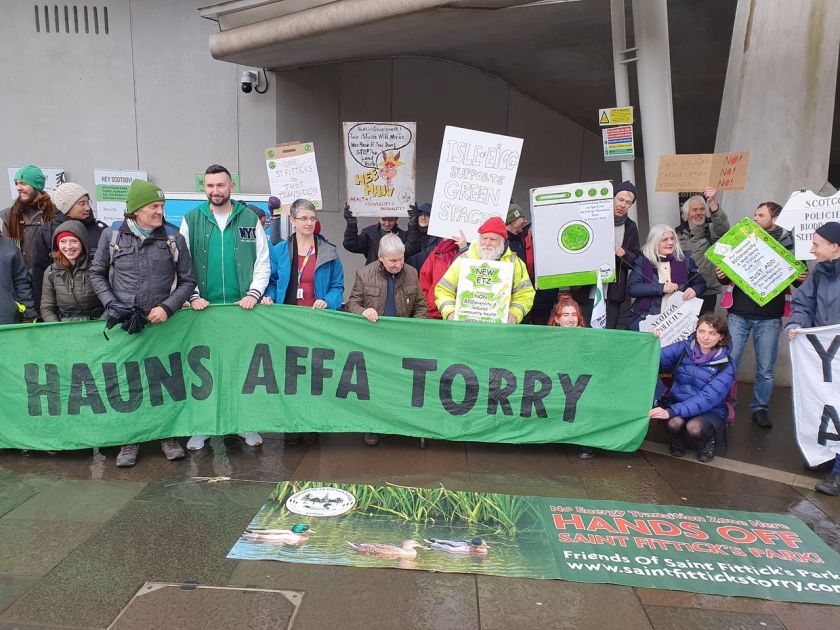
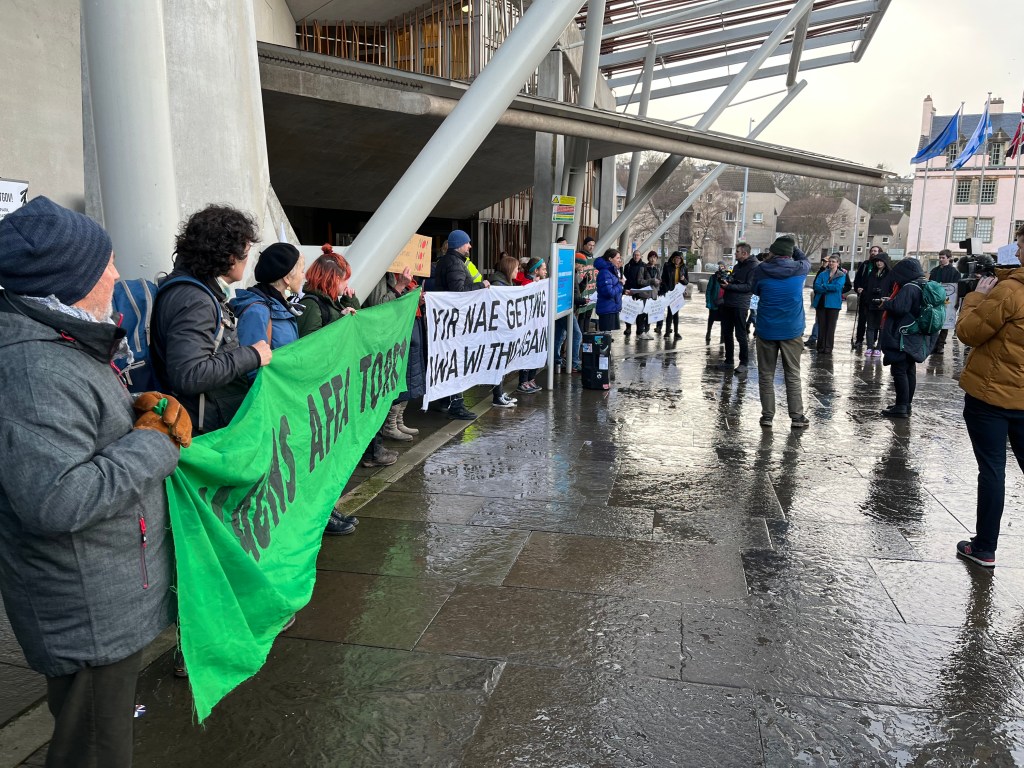
Demonstrating outside the Scottish Parliament in January 2023
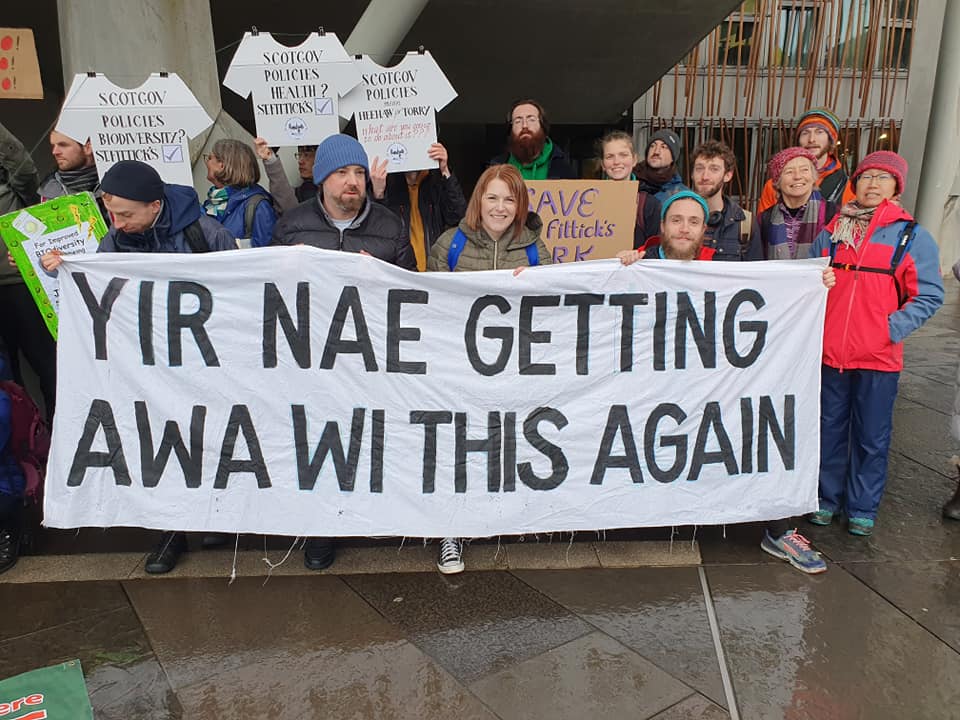
Campaigners in Torry are still waiting on the Scottish Government announcement that was expected back in January. Each month it has been put back another 28 days and is now due on 6th May. If the government gives the go ahead to the current plans for the ETZ (Energy Transition Zone) it will be a decisive step down a road that panders to the oil and gas industry and has nothing to with social justice. St Fitticks Park, which the plans would take over for industrial use, is the only green space in a working class area that suffered from decades of pollution as a result of the oil and gas industry. Most recently a new Energy from Waste incinerator, built close to a primary school, has led to a further deterioration in living conditions.
This film from REELNews highlights the issues involved and the resistance of the local community. Please share it widely.
In the film it’s noted that it’s not clear what use the new industrial zone will be put to. However, since the film was made campaigners have found evidence that there will be a large hydrogen storage facility – with 80% blue hydrogen and 20% green – that will be used to convert the cooking and heating supply for 20,000 social housing tenants in Aberdeen. If this goes ahead not only will Torry lose it’s green space many of its residents will be locked in to a very expensive energy future.
St Fitticks deserves to be a national campaign. The issues it raises around social justice, the use of hydrogen and carbon capture are national issues and they expose the weaknesses and contradictions in Scottish Government Energy Policy.
Share this post – support the St Fitticks campaigners.
Read more detail and watch video from the campaign here and here.
Glasgow City Council has decided to invest £75,000 in designing a pilot of free public transport, to include buses, trains and the Subway. This decision was a result of more than five years of campaigning by Get Glasgow Moving, strengthened over the last two years by Free Our City, a coalition of climate activists, trade unions and passenger groups.
Representatives of ScotE3, Glasgow Trades Council, Friends of the Earth Scotland, Migrants Organising for Rights and Empowerment, and Govan Community Council, all active members of the Free Our City Coalition, met last week with a Council officer and a representative of Stantec, the large transport consultancy company which won the commission to design a free public transport pilot, whose report to the Council is scheduled for June.
Free public transport, now available in many cities across the world, is vital for reducing Glasgow’s carbon emissions and the many inequalities which plague Glasgow. Get Glasgow Moving had already met separately with Stantec.
Free Our City made these main points to Stantec:
The pilot must be universal, including all households in Glasgow. Households often plan journeys with other households not in their locality. Anything less than a universal pilot will not provide a reliable evidence base.
It’s vital that Stantec develop the pilot as paving the way for free public transport for all in the longer term – otherwise the pilot will be pointless.
We suggested that the Council could buy out the private bus companies for the duration of the pilot, agreeing a price based on their current income (trains and the Subway are already publicly owned).
Stantec should identify funding opportunities from the Scottish Government for rolling out free public transport across Greater Glasgow – not just say to Glasgow City Council “this is how much it’ll cost”.
There are no examples of effective public transport under private ownership internationally, but plenty of examples under public ownership. Public ownership should be tightly connected to the understanding of how any full scheme could be delivered, as the cross-subsidy benefits of having a whole system under public ownership may reduce the total cost of a free scheme for which a franchise system may over-estimate the total cost.
We asked to be kept informed as they developed their project and offered to meet again.
Here’s the REEL News film of the Free Our City demonstration at the Glasgow COP
“Net Zero” was defined at the 2015 Climate Summit in Paris as “a balance between anthropogenic emissions by sources and removals by sinks of greenhouse gases”. So, for example, it would be OK to continue burning gas in power stations as long as all the carbon dioxide produced in the process is captured and permanently stored.
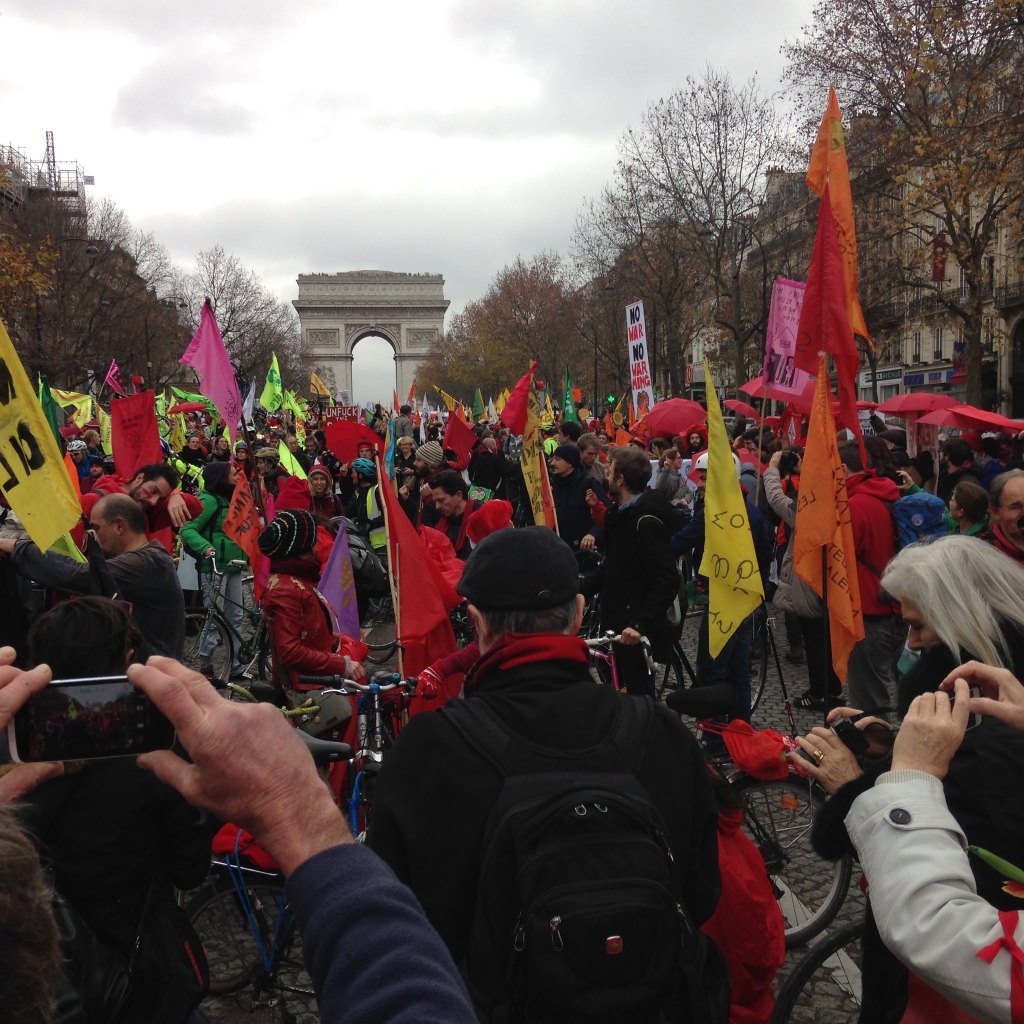
Paris COP 2015 – image by Pete Cannell CC0
Net Zero was an attempt to translate the temperature target of “well under a two degree rise above pre-industrial levels” into something countries could be held accountable for.
Since then governments have rushed to announce long-term Net Zero emissions goals. The Climate Change Committee has also fully embraced the Net Zero concept – hardly surprising because the members of the Committee are appointed by the UK and Devolved Governments.
As a result of these goals billions of dollars have been invested in research and development of low-carbon technologies , all of which face massive technological, economic and land use challenges when used at scale.
The Net Zero concept emerged in 2013 in the run-up to the Paris Summit, against the background of the collapse of the talks at Copenhagen in 2009. However well-intentioned the idea was, it’s notable that it arose among a group of 30 lawyers, diplomats, financiers and activists, who met at Glen House, a country estate in the Scottish Borders owned by a ‘green’ investment pioneer.
The current front runner technology, which governments are pinning their hopes on, is “Carbon Capture with Storage” (CCS). This is defined as “a process in which a relatively pure stream of carbon dioxide (CO2) from industrial and energy-related sources is separated (captured), conditioned, compressed and transported to a storage location for long-term isolation from the atmosphere”. The companies developing this technology are either the same companies which extract fossil fuels, or closely related to them financially.
CCS is an energy-hungry process and as such is not financially viable at scale for the companies experimenting with it. They are calling for government subsidies. In the US extracted carbon dioxide has been used to facilitate pumping in oil wells – a process known as “Enhanced Oil Recovery” – to close the energy gap, make CCS more financially viable, and enable the big energy companies to continue extracting fossil fuels.
On four related counts CCS is not in the interests of either people or the planet. First it requires too much energy; second it would need subsidising by tax-payers; third it would be controlled by giant corporations who already make obscene profits; and fourth it would be too slow to prevent catastrophic climate change.
In the UK at Drax Power Station – the site recently of vigorous strike action by the inadequately paid workers.
– biomass is being burnt and from time to time some of the emitted carbon is being captured in a process called Bioenergy and Carbon Capture (BECCS). A previous ScotE3 Briefing on BECCS explains why this is a crazy idea – primarily because it would require huge areas of land to be planted up with monoculture forests.
It’s clear then that both Net Zero and the technologies which underpin it are meaningless greenwash, being used to justify continued investment in fossil fuel extraction – an effective distraction from the urgent need to deliver sustained radical cuts to greenhouse gas emissions in a socially just way.
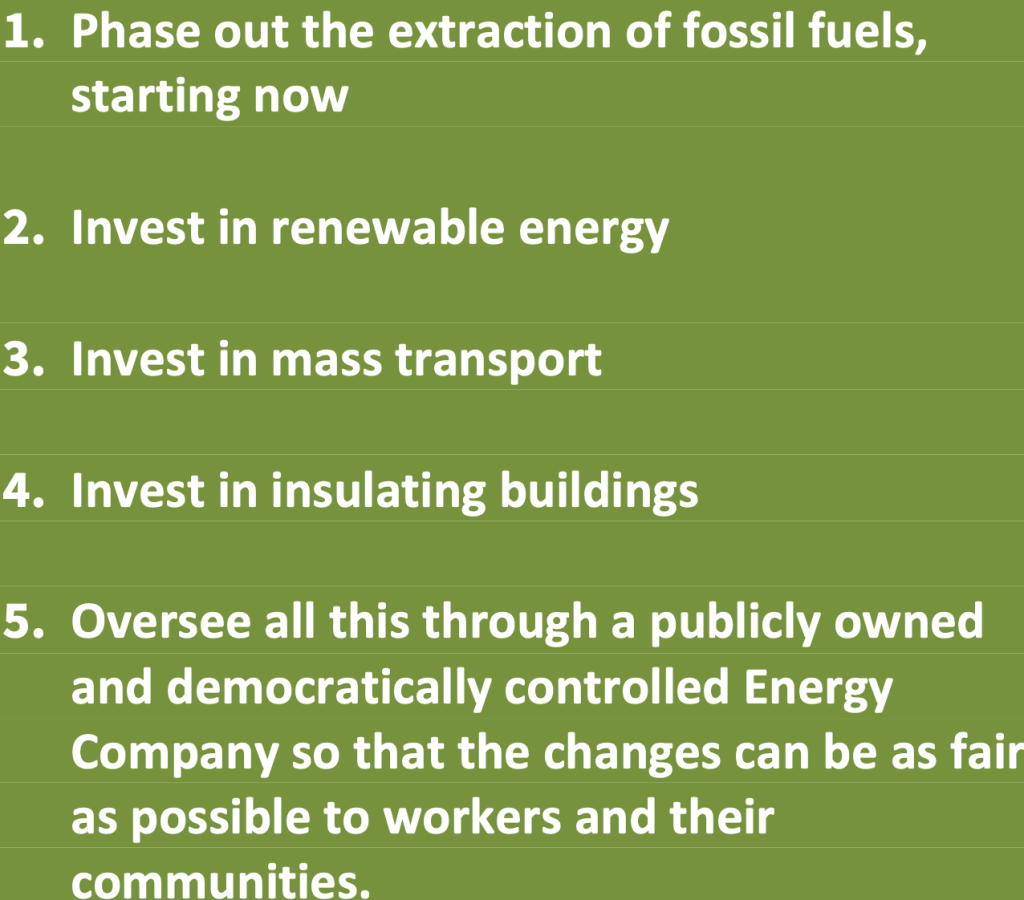
What’s needed is a Real Zero, not a Net Zero. We have the technology to achieve this – we don’t need new technology. This is what we need to do:
There is also set to be a huge government investment of £20bn in the Trojan Horse of carbon capture technology. This unproven, un-implemented technology is being promoted by big oil and gas businesses as a way to allow them to carry on as normal. It will be the oil and gas giants who yet again pocket public money.
That is why Environmental groups from across Scotland have called for a protest at: Thursday 30 March, 12.30 UK Government Offices, 1 Sibbald Walk EDINBURGH, EH8 8FTSupported by: Edinburgh Climate Coalition, Friends of the Earth Scotland, Stop Cambo, ScotE3 Bring placards, banners and friends!
Decisions made now will affect generations to come. Join the protest.
Mike Downham and Pete Cannell review CLIMATE CHANGE AS CLASS WARby Matthew T. Huber: Verso 2022
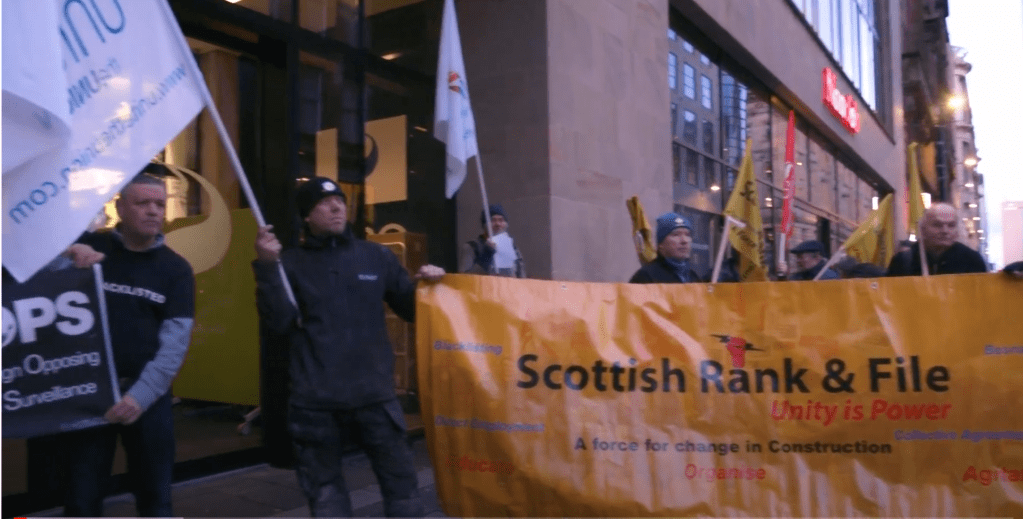
A couple of weeks ago one of us had the opportunity to join an early morning direct action outside the SSE offices in Glasgow. The action, called by Unite rank-and-file construction workers and the Black List Support Group was against the dismissal on Christmas Eve of high-voltage electrician Greig McArthur by Kirby Engineering, an SSE subcontractor. No reason was given for the dismissal, but it followed closely on McArthur’s request for recognition of Unite as the negotiating Union in his workplace. The direct action, which consisted of about 20 of us with leaflets, banners and a film-crew outside the main entrance, resulted in McArthur’s reinstatement. No attempt was made to enter the building, but the perceived threat of entry resulted in the main entrance doors being locked, and visible panic of staff in the foyer as they directed arriving employees to the back entrance of the building. On the back of this win, against one of the five big energy companies in the UK, McArthur’s branch is organising a combine of all electrical and mechanical workers in Scotland to not only push for recognition but also for proper wages and conditions.
As the power of rank-and-file of workers grows, the seizure of the means of production of energy and its distribution moves from being a pipe-dream to something highly possible. Nothing less than public ownership and democratic control of energy is necessary to prevent climate chaos. It’s the only way we can decarbonise energy in time, and the only way we can make sure that workers in the energy sector have secure jobs with proper wages and conditions – two goals which are inextricably linked.
When so much is at stake, when there’s so little time, and when left politics, nationally and globally, remains so weak, it’s inevitable that this will be a time when many people suggest different strategies. None of them will have all the answers. Rather than accept or reject a particular view-point, we need to discuss the strengths and weaknesses of each proposal and evolve a strategy which is truly collective. Discussion of each contribution to the debate is an opportunity to move forward to address the most urgent issue of our time. In our view Mathew Huber’s book Climate Change as Class War has significant strengths but also significant weaknesses. First, we’ll discuss the strengths.
Urgency
Huber writes with refreshing urgency. In his first paragraph he reminds us that
in 2018 the IPCC gave us 12 years (now eight!) to implement rapid far-reaching and unprecedented changes in all aspects of society
Scientists are saying that humanity must unite and face what could be its last fight.
Capitalism
It’s also helpful to be reminded that capitalism has made human emancipation possible because on the one hand it has developed production to the necessary level, and on the other hand it has created a class which has the collective power to emancipate.
Seizing the means of production
This is the focus of Huber’s call to action – as it surely must be for any successful and sustainable climate strategy. The only solution is for global production to become socially coordinated. We need to seize the means of production of energy, housing, transport and food so that they can all be decarbonised.
Reconciliation with nature
Also unarguable is Huber’s contention that the working class, now the vast majority of humanity, is most critically separated from the land, so that its livelihood no longer has a direct relationship with nature. The working class is entirely dependent on a wage for survival. This social coordination of global production, Huber says, needs to be entrenched in a reconciliation of humanity’s relationship with nature.
Species solidarity
Social coordination of production, Huber says, also needs to be rooted in “species solidarity” – which looks beyond international solidarity towards a world ethos
where workers in all countries recognise that the very conditions for species survival are at stake, and that survival depends on defeating the small minority of our species who control production
Encouragement
Recognising the daunting scale of the difficulties ahead of us, Huber encourages us by pointing to the current growth of strikes in the US. Here in the UK, we are also seeing a big resurgence of strike action. Particularly inspiring is the intensification of strikes by NHS workers – Click here to watch video (8 mins 24 secs)
At the same time, we should keep in mind that most strike action is still dominated by a trade union leadership who are concerned to operate within the straitjacket of anti-union law, desperate to get to the negotiating table and ready to compromise on agreements that don’t meet the needs of their members and fail to tackle systemic issues that underpin appalling working conditions. At the moment we don’t have a strong enough rank and file to resist these poor compromises and operate independently of the leadership. Huber also offers the encouraging point that the increasingly stark indifference of the wealthy and powerful to working-class well-being is creating increased militancy. He reminds us too that the working class in the US was able to turn round quickly it’s powerlessness in the late 1920s and early 1930s into power which forced the New Deal of 1933-36.
Where to start? It’s also helpful to be given suggestions of where to make a start. Huber suggests reviving the simple demand of public good over private profit. And he goes to some length to argue his case that we should start by seizing the means of production and distribution of electricity. But there are also significant weaknesses in Huber’s book:
Repetition Huber sets out his arguments four times – in a long introductory chapter, then in a chapter dedicated to each main argument, then in a Conclusion at the end of each chapter, and in a final chapter headed Conclusions. This makes the book a bit of a slog for the reader. It could have been a shorter and more easily digestible book. Moreover, the multiple Conclusions are not always consistent with each other (see the next point).
Professional Class Huber devotes a whole section to his theory that there is a distinct “Professional Class” and that its class interests determine the politics of the climate movement. This argument is not convincing. He seems confused between the idea that almost anyone with a degree is in this class, or whether it’s only some people, particularly lawyers and managers, who occupy contradictory class positions. Furthermore, the Professional Class concept doesn’t survive into the conclusive final chapter, where it gets no mention at all. It’s true, though Huber doesn’t specifically mention this, that in the US non-profit organisations tend to dominate social movements and struggles. They often have shed-loads of money and pay their employees fat salaries. But does this constitute a distinct class? In contrast, Cooperation Jackson made the political decision not to be a non-profit, based on years of activism in organisations where nobody was paid (see Michael Haber’s Breaking Out of the Nonprofit Industrial Complex). US exceptionalism The concept of a Professional Class is perhaps, at least partially, an example of US exceptionalism. Although Huber recurrently and correctly emphases that climate solutions have to be global, he sometimes slips into assuming that the US context is representative of the global context. For example, the considerable detail he goes into about the electricity sector in the US may not be transposable to the electricity sectors of other nations. And levels of unionisation vary widely internationally.
Workers’ Power and State Power Huber argues that organised workers have the potential power to force a transition into new sustainable forms of production. To shift from potential power to actual power he advocates a rank-and-file strategy (RFS). The case for building from the grass roots is clearly made – however, the politics of the strategy and the relationship between the rank and file and the union leadership is less clearly articulated. Is the RFS a means to an end – a reinvigorated union movement – or should it be more than that? Put simply the strategy seems to be that a resurgent working class can force change through the ballot box and then the state can take the decisive action required to transform the economy.
In conclusion Climate Change as Class War is a valuable contribution to the debate about building the power to avert a climate catastrophe. It asks the right questions and does the movement a service in putting production under capitalism at the centre of its concerns. However, in our view, its critique of the politics of the climate movement is undermined by a concentration on the material interests of a so-called professional class. Important questions about why the left internationally is at such low ebb; about the relationship between social movements, parties and working class organisation; and about the role of trade union bureaucracies are not addressed.
We have a small number of copies of the book available at the reduced price of £11 – use the contact on the menu to get in touch if you are interested in a copy.
Thanks to REEL News for this report and access to video from Friday’s direct action in Glasgow
Friday 13th Scottish Construction Rank and File take direct action in Glasgow
UNITE Scottish Construction rank and file and the Blacklist Support Group were celebrating a very significant victory after a campaign of direct action forced Scottish energy giant SSE to reinstate Greig McArthur, branch secretary of the biggest construction branch in Scotland, and two of his colleagues. They were disgracefully sacked two days before Christmas for seeking trade union recognition, despite being only weeks away from an agreement. Now that recognition agreement appears to be imminent – as well as full compensation for loss of earnings.
This is a particularly important victory as it is in the high voltage sector, a key sector in moving away from fossil fuels to renewable energy.
Here’s a video clip of Greig McArthur talking about the importance of the high voltage sector to the transition to a sustainable economy
Now Greig’s branch are organising a combine to not only push for recognition and proper wages and conditions across all renewable energy sectors, but to fight for proper wages and conditions in every single electrical and mechanical sector. They are also calling on the Scottish Government to put some teeth into their “Fair Work Convention” which calls for much better employment conditions, and to put guarantees of stable, well paid direct employment into their at present very weak Just Transition policy.
In addition they calling for UNITE Scotland to step up and start organising properly with the rank and file, something which has been sadly lacking. So the rank and file also visited another site to protest the excessive use of agency staff, and to start a campaign for an above inflation pay rise which should have been started by the union months ago. This is the start of a major campaign by the branch – and the next step is to elect officers to the new combine at a meeting on Saturday January 28th, which will also be a chance to come together to share ideas about winning on all the issues mentioned above. If you’re a construction worker in Scotland and you’re not already a member of the branch, this is the time to join (details at the end of the video) – and build a powerful combine to win.
This article by John Szabo and Gareth Dale was first published in shortened form in the Conversation and then on 13th January by the Ecologist. We are grateful to the authors and the Ecologist for their permission to publish it here.
The hydrogen economy appears to enjoying its great leap forward. Assuming its construction goes to plan, a €2.5bn undersea pipeline will from 2030 convey “green hydrogen” from Spain to France. It is one element in a hydrogen infrastructure package that the European Commission announced earlier this year.
In the USA, some power stations are being upgraded to allow hydrogen to be blended with fossil gas, and the Norwegian oil company Equinor is teaming up with Thermal SSE to build a 1,800MW “blue hydrogen” power plant in Britain. China, earlier this year, unveiled a long-term hydrogen plan which includes major technological and infrastructure investments.
If the number of projects is growing at pace, one may suppose, a large supply of the resource must exist somewhere. Well, it does and it doesn’t.
Decarbonise
Hydrogen is produced in multiple ways. A colour spectrum is used to render it simple. “Grey” and “brown/black” refer to hydrogen produced from fossil gas (methane) and coal (brown or black coal) respectively—a process that, for every ton of hydrogen, emits between ten and twelve tons of carbon dioxide for grey hydrogen or eighteen to twenty for brown.
“Blue” is the same process but filed under “low carbon” because the carbon dioxide is supposed to be captured and stored underground. “Green” hydrogen is conventionally defined as generated from renewable electricity passed through water to split it into hydrogen and oxygen.
When you zoom in on hydrogen’s “colours,” however, they appear slippery. The hydrogen economy is not a palette of technological options but a grey-brown oil refinery behind an eye-catching blue-green front gate. All the chatter is of the latter.
Green and blue hydrogen yield 11 million and 320,000 Google hits respectively, as against 95,000 for grey and 49,000 for brown. The reality curves in the opposite direction: only 0.04 per cent of hydrogen is green, and blue hydrogen is also less than one per cent. At least 96 per cent is grey or brown, most of which is used in oil refineries and for manufacturing ammonia and methanol.
It’s an enormous industry, responsible for emitting more carbon dioxide than all of Britain’s and France’s emissions combined. The test of any government or corporate hydrogen agenda, then, is the nature—or even the existence—of its plans to decarbonise the 96 per cent. In some cases this is beginning to happen. But if the focus is on producing more ‘blue’ and more ‘green’ for other purposes, something is amiss.
Failures
When you look closely at green hydrogen, some of it resolves into shades of grey. It’s not simply that its production is extremely energy-intensive or that in its double transformation—from electricity to hydrogen and thence to its final usage—so much energy is wasted.
It is partly that, if combusted, it emits nitrogen oxides, and also that, if scaled up to play a significant economic role by 2050 (as in recent projections by the International Energy Agency), its freshwater requirements will exceed one quarter of today’s global annual consumption, causing water stress in some regions.
Above all, green hydrogen is meaningfully green only if the renewable energy that generates it cannot be fed into the grid to replace power from gas or coal plants.
A similar but much more harmful trick of the light occurs with blue hydrogen. Look closely and you see that in reality it’s either chequered blue/grey or even blank, a mere fiction.
For hydrogen to be true blue, the emissions must be captured and securely stored. In theory, CCS is workable but nearly all plants use the captured carbon to pump more oil and many have been shut down as failures.
Blue hydrogen is still in its infancy and we don’t yet know whether most of the CCS costs will be loaded onto taxpayers, as the gas companies demand.
Price projections should be treated with the utmost scepticism. One boosterish paper cites blue hydrogen from Alberta (Canada) at $1.50 to $2.0 per kg. It adds that blue hydrogen production will help Canada achieve its decarbonisation goals.
In fact, research at Shell’s CCS plant in Alberta discovered that it emits more carbon than it captures. For the foreseeable future, this is not a “low carbon” product in any sense of the term. It is a hypothetical solution the costs of which remain unknown, as the development of projects has been slow and costly with few realised, while future operating costs are also unclear.
Electrolysers
Given the question marks that surround blue hydrogen, it’s widely hoped that a silver lining of today’s high gas prices will be that green hydrogen becomes cost competitive.
In terms of inputs, the green-blue price difference boils down to the cost of electricity versus fossil gas. With the global energy crisis exacerbated by Russia’s war on Ukraine, many are asking: will high gas prices favour green hydrogen? Spoiler alert: probably not.
In the EU, as in many economies, electricity pricing is based on the principle of marginal costs, and that usually means the price of power from fossil gas plants. When it is high, renewable electricity generators will seek to sell to the grid. In this way, blue and green prices are largely interwoven in the current market setup; their inputs move in sync.
Of course, there are geographical and temporal differences. During sunny spells, electricity prices may collapse as solar PV-based generation picks up.
This unlinks electricity and natural gas prices, but only momentarily, often only for a few hours—not enough to justify investment in electrolysers to produce green hydrogen. On the whole, the price gap between blue and green will remain fairly narrow until electricity markets are fundamentally restructured.
Transition
There’s worse. The high price of hydrocarbons has turbocharged the industry’s expansion. The US government is exhorting oil and fracking firms to ‘drill baby drill.’ Britain’s government has issued over one hundred additional licenses to drill. Colossal new fossil fuel investments have been announced across the Middle East and Africa.
All this will have long-term ramifications. First, in a few years when the new production comes on stream, and particularly if the current growth slowdown substantially depresses demand, gas and oil will again become cheaper—until the next price spike prompts new rounds of investment, and the infernal cycle continues.
Second, the owners of the new-drilled wells and other infrastructure will fight tooth and nail to defend those assets, and to stall the decarbonisation agenda. The peculiarity of hydrogen is that it is a means to both the stalling and the decarbonisation.
The latter can be simply stated. Green hydrogen will be important to the decarbonisation of certain sectors such as steel, and ammonia for fertilisers, and possibly shipping and trucking.
The role of hydrogen in stalling the transition is complex but no less important. It begins with the recognition that the fossil fuel corporations are rebranding themselves as agents of “carbon management.”
Ramping
The goals are to prevent their assets from getting stranded by repurposing them, above all by marketing grey and blue hydrogen as “bridge” fuels; to lock in hydrocarbon production for decades to come; and to defray the costs onto taxpayers.
For this, hydrogen offers the perfect vehicle, in view of its confusion of shades and colours. Fossil fuel interests use it to counter opposition to new investments in fossil gas through an aggressive marketing and lobbying campaign that presents a largely fictional substance, blue hydrogen, as a low-carbon “bridge” to an unspecified future genuinely-green transition.
Other sectors have joined the oil-led coalition. As the engineer Tom Baxter observes, it is seen by gas network operators and boiler manufacturers as their survival route.
Likewise, power utility companies are keen, as hydrogen’s inefficiencies mean they’ll sell more power. Relatively conservative trade unions, such as Britain’s GMB (General, Municipal, Boilermakers), are onboard too.
To tackle this stalling operation, a strong role for public policy is indispensable. Governments will need to regulate or tax carbon out of the market while simultaneously ramping up renewables.
Malign
Fiscal and subsidy schemes need to pivot from supporting fossil fuels to supporting renewables. The approach to electricity pricing must shift, to decouple the prices of electricity and fossil gas.
Instead of the marginal pricing system, it requires incentivising rewards for generators according to their average costs plus a slight surplus, either through a robustly regulated market system or by nationalising the energy companies and setting prices and production.
Such interventions would give green hydrogen a competitive advantage, one that can be furthered by other subsidies, such as tax credits on the model of the US Inflation Reduction Act. Above all, energy demand needs to be scaled down. The lower the demand, the less the upward pressure on price.
In any future energy system, hydrogen will have a role. But its expansion needs to be carefully designed, to prevent the promise of green hydrogen being mis-used, in opening the back door to its ecologically malign blue and grey cousins.
These Authors
John Szabo is a Fellow at the Institute of World Economics, Centre for Economic and Regional Studies as well as an Assistant Lecturer at the Department of Eötvös Loránd University International Relations and European Studies, Eötvös Loránd University. His research focuses on the energy-society nexus, especially in the context of the energy transition.
Gareth Dale teaches politics at Brunel University, and many of his articles appear on its website. He tweets at @Gareth_Dale.
If you’d like to read more you can look at the ScotE3 briefing – ‘The Use and Abuse of Hydrogen’ – the briefing can also be downloaded as a PDF for hard copy distribution.
Around 80 people, with a strong contingent from Aberdeen, rallied at the Scottish Parliament yesterday to demand that the Scottish Government stops developments in Torry, Aberdeen that would see the end of St Fitticks park, a hugely important green space in a heavily built up area. The message from the protestors was that there’s no justice if ‘transition’ is driven by the Oil Industry seeking new sources of profit at the expense of working people and the environment.
The protestors called for supporters to text, tweet and use every available means to tell Minister Tom Arthur and your local MSP to order the removal of the rezoning of St Fittick’s Park from Aberdeen’s new Local Development Plan.









 Employment, Energy and Environment