We are happy to share this article by Manal Shqair who is a founder of the Palestine COP 26 alliance.
Join the Scottish demonstration for Gaza – 1pm Saturday 2nd December – assemble on Regent Road – just up from Waterloo Place.
Human-induced climate change represents the biggest challenge and threat to living species and human existence. The climate crisis is deeply rooted in centuries of European colonialism intertwined with capitalism, which is rooted in white supremacy. The exploitation of the planet and its resources, dehumanization of colonized people and obliteration of their cultures, knowledge and lifestyle have been the foundation of colonialism. Israeli colonization of Palestine is among the living examples of how colonialism and environmental degradation are intertwined.
In the last two decades, the Gaza Strip has been facing severe effects of the climate crisis due to the inhumane Israeli blockade. With the incessant Israeli carpet bombing of Gaza since 7 October, the climate crisis is exacerbating threatening the lives of the 2.3 million people living there. According to the Euro-Med Human Rights Monitor, between October 7 and November 2, Israel dropped 25, 000 tons of explosives on the Gaza Strip, equivalent to two nuclear bombs.[1] Israeli excessive bombardment of the Gaza Strip has killed at least 13, 000, including at least 5, 500 children, and injured at least 30, 000 people.[2] Moreover, since October 7, Israel has been subjecting the territory to mass dehydration and starvation. The full extent of Israeli violence toll, including the resultant climate catastrophe is unclear yet.
Israel’s ability to dehydrate and starve 2.3 million people, half of them are children point to the decades-old Israeli policies and practices in terms of taking over and exploiting Palestinian natural resources, particularly land and water. For decades, before the assault on Gaza started, about 96% of Gaza’s water was unfit for human consumption due to Israeli siege and the acute power crisis. Israel has always denied Palestinians’ right to food sovereignty.[3] Since 2000, Israel has been gradually destroying Gaza’s agricultural land to establish buffer zones.[4]
In the occupied West Bank, Israel controls more than 87% of the Palestinian water resources and over 60% of fertile land in favor of illegal Israeli settlers, in an act of climate apartheid. Several agrarian communities in the West Bank are facing increased Israeli settler violence under the protection of the Israeli army to force them from their land.[5] So far since October 7, 16 Palestinian herding communities have been expelled from their land thanks to intensifying Israeli settler and army violence.[6] The displacement of these communities is a threat to the environment that is shaped by their sustainable environmental stewardship.
Palestinians are unable to adopt to and mitigate the climate crisis due to Israeli settler colonial policies, particularly the control of water and land. Simultaneously, Israel has been positing itself as an environmental steward and expert in agri-business, afforestation, water solutions and land efficiency. The Jewish National Fund (JNF) has been playing a key role in greenwashing Israeli apartheid settler colonialism. The JNF prides itself on planting millions of pine trees as an act of making ‘the desert bloom’ while in fact it has been a way to cover up destroyed Palestinian villages when Israel was created in 1948.
The struggle of the Palestinian people for climate and environmental justice is inextricably linked to the struggle for self-determination. Climate movements in the UK and beyond should recognize the centrality of the Palestinian struggle to reclaim and liberate their land and resources to the struggle for a just energy and agricultural transition amid the exacerbating climate crisis.
Support Palestine as a climate justice issue by:
Joining in the international call for an immediate ceasefire in the Gaza Strip and the provision of humanitarian aid, including water and food.
Supporting the Stop the JNF campaign, which seeks to revoke the charitable status of the JNF in the UK, as well as expose it role in the colonization of Palestine.
Adopting the BDS call for boycott, divestment and sanctions against Israel.
This article by Josh Moos and Gareth Dale was first published under a Creative Commons License in The Conversation on 28th November 2023
A Boeing 787 Dreamliner is set to take off from Heathrow on November 28 and head for JFK airport in New York, powered by so-called sustainable aviation fuel (SAF). According to its operator, Virgin Atlantic, the world’s “first 100% SAF flight” will mark “a historic moment in aviation’s roadmap to decarbonisation”.
It is proof of concept, we are led to believe, of the dawn of “guilt-free” flying. Unfortunately, we have been here before, and the results last time were anything but green.
Based on our research into how wealth and power shape the environment, we argue that continued growth of the aviation sector, as with the economy in general, is incompatible with preventing runaway climate change. The technology currently being developed by the aviation industry has zero chance of changing that. And the fuels being used in Virgin’s latest experiment are not significantly more sustainable than those in its previous attempt.
Virgin’s sustainability initiative dates back to the 2000s, when British business magnate Richard Branson was at the helm. In 2008, to some fanfare, a Virgin aircraft flew from London to Amsterdam using a fuel derived in part from palm oil and coconuts. Technically, the mission was a success, but the sustainability claims were laughable.
To have fuelled that short hop with 100% coconut oil would have consumed 3 million coconuts. The entire global crop would supply Heathrow for only a few weeks — and it is one of 18,000 commercial airports worldwide. Following this stunt, Virgin gave up on coconut oil.
Virgin’s latest flight is simply a repeat of 2008. It’s a smoke-and-mirrors exercise to convince governments that SAF will enable aviation to continue its relentless growth on a sustainable basis – and in this, it is succeeding.
Even waste products aren’t sustainable
Virgin’s defence rests on the claim that its new SAF no longer comes exclusively from crops. It is blended with waste products. One of the main suppliers for Virgin’s transatlantic flight is Virent, an organisation based in Wisconsin. Virent makes SAF from conventional sugars such as corn, mixed with wood, agricultural waste and used cooking oil.
As with coconuts, any crop grown for fuel competes with foodstuffs and pushes the agricultural frontier further into forests and peatlands, with large releases of carbon.
But what of the waste products? Surely reusing cooking oils offers a sustainable solution? Unfortunately, in a notoriously unregulated market, it seems not.
Another of Virgin’s suppliers, Neste, collects cooking oils from sources worldwide, including McDonald’s restaurants in the Netherlands and food processing plants in California, Oregon and Washington. The US Department of Agriculture alleges that some trade in SAF feedstocks – including from Indonesia to Neste’s refinery in Singapore – may be “fraudulent”.
Neste has denied the claim. But, even if its used cooking oil is entirely legitimate, there is still an allegation that palm oil from plantations responsible for tropical deforestation is being marketed as used cooking oil.
Virgin Atlantic maintains that the SAF it uses is made entirely from used cooking oil. However, if the aviation industry bets big on used cooking oil, it is feared it will turbocharge tropical logging and the extermination of the orangutan and countless other endangered species.
The real kicker is that even if all used cooking oils were traceable and sustainably sourced, they are not scalable. The US collects around 600,000 tonnes of used cooking oil each year. If every last drop were diverted to SAFs, it would meet at most 1% of America’s current aviation demand.
Capturing the White House
The problems of scalability, the competition of agricultural inputs with foodstuffs, forests and wildlife, and the carbon emissions that result from land use change are just three of the shortcomings that ensure SAFs will not be the magic bullet that the aviation industry would have us believe. Despite this, SAF fever has won over the White House.
The Inflation Reduction Act set targets for SAF production at 3 billion gallons by 2030 and 35 billion by 2050. These targets are fantasies. But, to the extent that they are approached, they will only add to the pressure on food prices and wildlife.
That SAF is being touted so zealously attests to the shortage of alternative technologies. Battery-powered planes are viable but only as short-haul “flying taxis” that compete with ground transport. The other panacea, hydrogen, confronts colossal technological and infrastructural barriers, problems of scalability, competing uses, and environmental concerns.
Tinkering with aircraft technology, such as engine size or wing shape has also faced diminishing returns. Efficiency improvements lag far behind the sector’s growth, which is why aviation emissions are still soaring.
Where do we go from here?
Ahead of the 2008 coconut-fuelled flight, Virgin’s chief executive Steve Ridgway explained its logic. He said the aviation industry needs “to be seen to be doing something”. Fifteen years on and the playbook remains the same.
The Virgin Atlantic SAF flight promises to rescue the airline from the threat of climate change, allowing them and their passengers to “keep calm and carry on”. In buying into this fantasy, governments give themselves an excuse to avoid taking climate breakdown seriously – an emergency that requires radical action if the planet is to remain habitable for humans.
This would begin, for short-haul, with ground-based alternatives. Within the US, many flights could be swiftly replaced by coach travel, and over a quarter of flights between EU destinations could be replaced by high-speed rail. For long-haul, the first step is demand management, which will expedite the use of virtual conferencing, marine transportation and other alternatives.
Developing alternatives would be practical, efficient and create jobs. And now is a good time to begin. Americans have been “falling out of love with flying” in recent years, in part due to large numbers of flight cancellations following bad weather, which is only likely to increase with climate breakdown.
As the weather chaos worsens, the aviation industry will find it harder to shrug off its responsibility through PR stunts and greenwashed gimmickry.
SSE and Equinor plan to build a new gas-fired power station at Peterhead in Aberdeenshire. The existing gas-fired power station in Peterhead is Scotland’s single biggest climate polluter. Building the new plant will increase pollution levels.
The so-called North Sea Transition deal between the UK and Scottish governments and the oil and gas industry is based on squeezing out every profitable drop of oil and gas from the North Sea. The Peterhead plant is part of this strategy. The investment that is planned should be directed into renewables.
The plan is up for approval by the Scottish government. Tell your MSP that rather than more gas we need investment in renewables, in retrofitting, in public transport and in a clean energy smart grid.
We were invited to contribute to a panel on North Sea Transition at the conference ‘Working for Climate Justice: trade unions in the front line against climate change’ at Toynbee Hall in East London on 27th of October.
Aberdeen – image by Pete Cannell CC0
Since we launched in the autumn of 2017 Scot.E3’s emphasis has been on building capacity for a worker led transition with a focus on workplace and community organising. Arguing for the rapid phase out of North Sea Oil and Gas has formed a central part of our campaigning. The Sea Change report, published in 2019, remains very relevant. It shows how switching from oil and gas to wind and solar would create a big net increase in jobs in Scotland and failing to make this transition would mean that targets to cut carbon emissions would not be met.
It’s very important that the climate movement has embraced the significance of North Sea oil and gas and a just transition for workers in the fossil fuel industries. That wasn’t so much the case in 2017. But two critical and closely linked challenges remain:
How do we build a mass movement with powerful roots in every workplace and working-class community that pushes for the necessary changes?
How do we engage workers in the energy sector, who are very aware that change is needed, but have very little confidence that it will be socially just?
For more than fifty years the big oil and gas companies have used their operations in the UK sector of the North Sea to blaze a trail for what we have come to know as neoliberalism; establishing practices that have been copied and taken up internationally. Outsourcing, multiple layers of subcontracting, anti-union policies and the use of blacklists. At the same time the so-called free ‘market’ has been featherbedded by massive state subsidies which have exceeded taxation revenue.
The onshore construction industry has been on the same journey. In Scotland the Construction Rank and File group has grown a new network through taking the construction industry using direct action tactics, picketing sites, and building combative organisation from the ground up. Just under a year ago two Unite activists, working on the new high voltage transmission lines from the Moray Firth to central Scotland were sacked for their union activity just before Christmas. However, after the Rank and File group picketed the main subcontractor and Scottish and Southern Energy they were reinstated with full back pay. The group has been a consistent supporter of Scot.E3 and have very publicly advocated for the importance of building worker organisation to ensure that the energy transition is a just transition.
Despite many analysts and some industry insiders warning that oil and gas is an increasingly risky investment global levels of investment are high and currently booming while the industry remains determined to squeeze as much oil and gas out as it can out of the North Sea. Among Westminster’s policy turns there has been a consistent adherence to the North Sea transition deal which describes in broad terms how that it is to be achieved. The Scottish Government and the offshore trade unions remain signed up to the ‘transition’ deal. Pursuing this path means that investment in hydrogen and CCS is prioritised at the expense of renewables, condemning UK consumers to a high cost and uncertain future and undermining progress to a genuine energy transition. There’s no evidence that big oil has any particular commitment to the North Sea, and they must know that hydrogen for domestic heating is hugely problematic, but they are very keen to stick with false solutions that are compatible with the existing infrastructure and networks of fossil capital.
The cost-of-living crisis isn’t over. However, to date, the climate and workers movements have failed to nail the intimate connection between fuel and food poverty and the oil and gas industry. Perhaps there’s a lesson here. At a time when we face a drawn-out existential crisis there is a need for new ways of organising that bring unions and communities together in common understanding and common struggle. There are some examples of what this might begin to look like. In Scotland Edinburgh Trade Unions in Communities provides an innovative model, while in France social movement trade unionism is having an impact.
The conference, organised by the Global Climate Jobs network, took place in Amsterdam over three days from the 7th of October. Two of us from Scot.E3 attended. These are my personal notes and reflections on the discussion that took place.
At the end of the conference
The Global Climate Jobs network brings together campaigning organisations from around the world. What glues them together is the idea that the necessary transition to a zero-carbon economy is both political and practical and requires a huge expansion in jobs that are central to the new economy – in energy production, transport etc. This idea centres campaigning on social justice, a worker led transition and building working class power.
The global reach of the network was underlined by the diversity of the attendance – including groups from Columbia, Mexico, USA, South Africa, Tanzania, England, Scotland, Norway, the Nederlands, Germany, France, Belgium, Luxemburg, Portugal, Spain, Austria, Italy, Turkey and the Philippines.
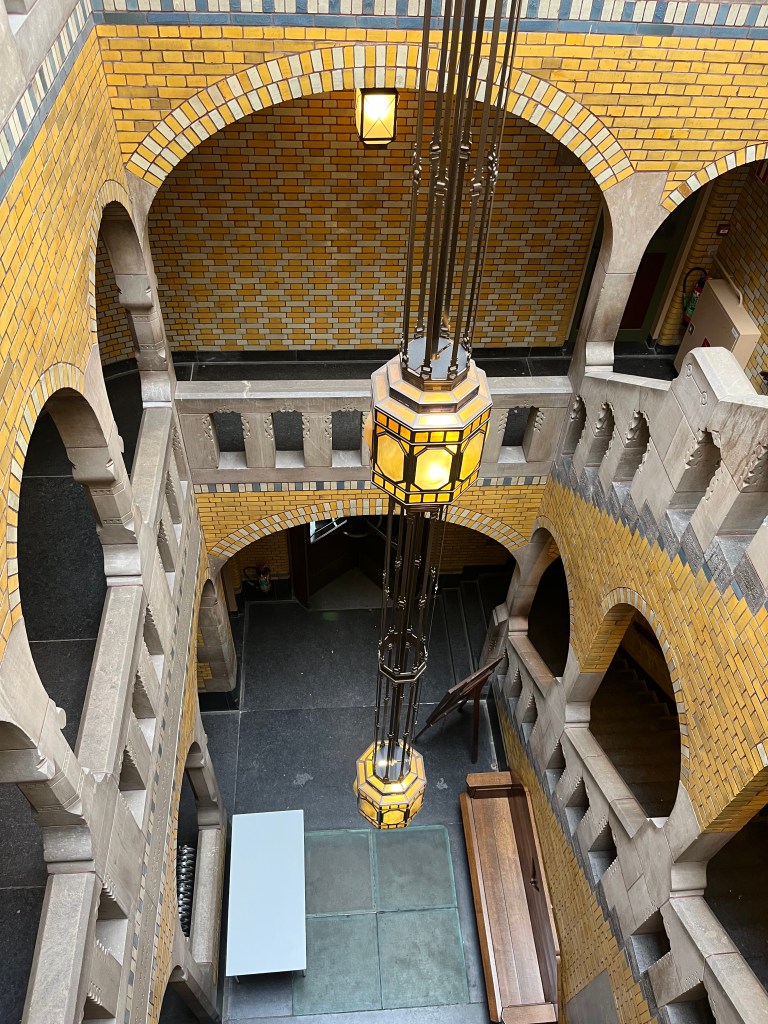
The venue for the conference was split between two spaces – a social centre, once a church, squatted more than two decades ago and now legalised and a wonderful building ‘De Burcht’ that was once the headquarters of the Amsterdam diamond workers union. The picture shows something of the beauty of the building but its history is also inspirational. In the 19th century there were around 10,000 diamond workers. They were divided by gender and religion. However, after a major strike which brought the entire workforce together a single union was created and commissioned the building.
De Brucht – image by Pete Cannell CC0
Here are some of my highlights from the plenary sessions.
Leonor, from the Portuguese group Climaximo, talked about how the cost-of-living crisis runs side by side with the intensifying climate crisis. She argued that building a mass movement to stop climate collapse requires an organisational culture of a different kind – flexible, learning and always thinking about the next steps. Bringing the labour and climate movements together is key. All of this needs a high level of ambition and a clear focus on building social power to stop climate change. We need to be ready to take risks and accelerate our learning cycles. We’ll make mistakes but we must not repeat mistakes. We have seen mass movements rise very fast and we have seen dominant ideas change very quickly – we need to envisage this and think of strategies that can make it happen.
Working people are struggling daily to get by – a programme to tackle the climate crisis is a programme to improve lives and livelihoods. We need to dare to win power – these ideas need to explode in society and go mainstream.
Sean Sweeney from Trade Unions for Energy Democracy (TUED) noted that trade unions in the north wanted/want to get a seat at the table of the transition. TUED argues that being at the table is not fine. While renewables have expanded so has the use of fossil fuel. Radical restructuring is needed. The problem is a capitalist system that burns fossil fuels for profit. We need a programme/pathway – a plan of action and crucially we need public ownership of energy. It’s evident that all the countries who say they have targets for net zero will not achieve them. The solutions we need are not compatible with a system of growth and accumulation. Public ownership and control is essential.
Plenary Notes
Jonathan Neale started his contribution by saying that the evidence for climate change is increasing fast. Most people think something must be done. He argued that the climate movement must change – we have to go for concrete solutions. Stop fossil fuels. Make them illegal. Cover the world with renewable energy. Governments need to do this. Every worker in old industries gets a new job with the climate service. Once we win it in one country it’s easier to spread. It requires a mass grass roots campaign that must go everywhere. It’s serious project and not about having a good policy, we have to persuade a mass movement to fight for it. We need to persuade the climate movement. People say we must not divide the movement, but he asserted that there is no other solution on offer. The just transition is the only transition on the table. It requires winning majorities – not diluting politics – persuading people that on this we are right. We need action – direct action. Every time workers are losing their jobs, we need action/occupations etc. to insist that they must have climate jobs. Occupation for demands that we can win. We need our own shock doctrine – organising at the grass roots for the things that people need in heat waves, floods – we have to march and protest in the teeth of disaster – no one left behind. Fund raising events when catastrophes are elsewhere. The time for dishonest promises is past. This is a long struggle – explosive growth sometimes – slow at others. We can’t afford to wait to see that their promises are lies in 2040 – we have to start now on the scale that is necessary. Winning once makes it easier elsewhere. In global south renewable energy is needed to grow to meet their needs. From here to this vision is a huge jump but it must be done.
The theme of public ownership was reinforced by a speaker from Colombia. She started by saying that it is the capitalist system (imperialism) that is to blame and we need to be clear about this. With a progressive government in office Columbia is for the first time looking at the possibility of change. The country is highly indebted. Renewable energy has increased but is almost entirely in the hands of private companies that are propped up and subsidised by public resources. Carbon emissions are principally from land use and deforestation – Columbia is a producer of primary raw materials. Transition requires public ownership and social control. Just transition is a question of rethinking the role of the state and the working class. She argued that large scale utilities are essential – things like roof top solar contribute but can’t be the answer on the scale that’s needed. In Latin America – this is a moment when it is necessary fight for public power.
Some of the contributions reflected significant rethinking in the climate movement. A contributor from XR in the Nederlands talked about how the focus of direct action has changed in recent months. There has been action against a private jet terminal and action at a big steel plant. This shift stems from frustration that labour and climate movements are not working together against common enemy while NGOs talk about capitalism but not about class struggle so much. There has been progress in building a climate justice network in the Nederland’s largest trade union. A contribution from Friends of the Earth (Nederlands) remarked on an ongoing shift from consumerist demands to more concrete demands and demands on big polluting companies. But most of these actions have been from the outside – with the consequence that workers see this as attacks on them. And may have increased their resistance to climate transition agenda. Workers were arguing against CCS and for hydrogen and electricity – but climate movement more impatient – no dialogue – need to engage more directly with the workers and not with the trade union bureaucracy. This point was echoed by another contributor who had been involved in producing the Platform report on the views of offshore workers in the UK sector of the North Sea. Platform worked with the offshore unions to reach the workers who contributed to the report. The findings of the report were powerful but mostly the unions have done nothing with them. She argued that it will often be necessary to bypass union officials to speak directly to workers.
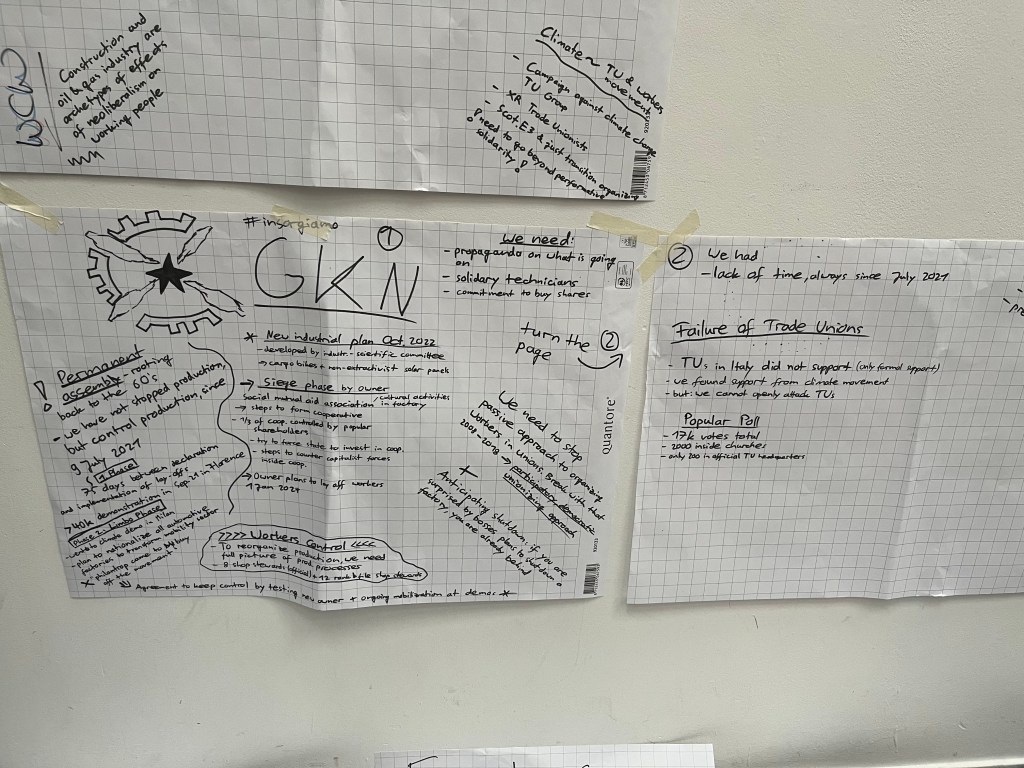
On the second day of the conference, I helped present and facilitate a workshop on the strike wave in Britain put on by the socialist group rs21. We explored the scale of the movement and attempts to align it with the environmental movement. This provoked a lively discussion and people gave examples from 7-8 different countries of experiments in aligning the workers and environmental movement, including pushing for the wider ecosocialist political struggle. As part of the workshop, we hosted a representative from the Italian GKN Collective. GKN is a British owned company in the automotive and aerospace sector. Faced with a decision to close the factory the Italian workers occupied in 2021 and have stayed in occupation ever since. They are now fighting to control it; they’ve retooled the machinery and aim to convert it to renewable transport production led by workers. It’s quite shameful that this occupation has not received more support and solidarity in the UK. Coverage in English is very limited but you can read more here.
Workshop notes
I’ve tried to focus on the main themes of the conference but there was much more and much deserving of separate and more detailed reports. The accounts of social movement trade unionism in France were impressive. German delegates spoke about their public transport campaign #wirfahrenzusammen – we’re driving together. Joint activity bringing the youth strike movement together with public transport strikers and public transport users. Safe Landing ran a workshop on workers assemblies. There was intensive discussion of what we mean by just transition and workshops on global debt, the East African Crude Oil pipeline (EACOP), the upcoming European elections, political strikes and how to build on them and how to understand and make an impact on local and global supply chains.
You can find the recordings of all the panels and a selection of workshop sessions here:
Paul Atkin replies to an interview with the GMB union’s General Secretary Gary Smith in the Spectator.
In agreeing to be interviewed by the Spectator under the title “the folly of Net Zero” GMB General Secretary Gary Smith lets his members down; not least because remarks like these from a leading trade unionist help give Rishi Sunak encouragement to accelerate his retreat from the government’s already inadequate climate targets.
The phrase “the folly of Net Zero” makes as much sense as “the folly of getting into the lifeboats when the ship is sinking”.
Difficulties in making a transition to sustainability does not mean that making it isn’t essential, and the faster we move the less damage is done. We can see that damage all around us even now.
Gary doesn’t seem to get this, any more than Rishi Sunak does, and he latches on to some of the same lines as the PM does, albeit with a more pungent turn of phrase. To go through these point by point, quotes are either directly from Gary Smith or the Spectator.
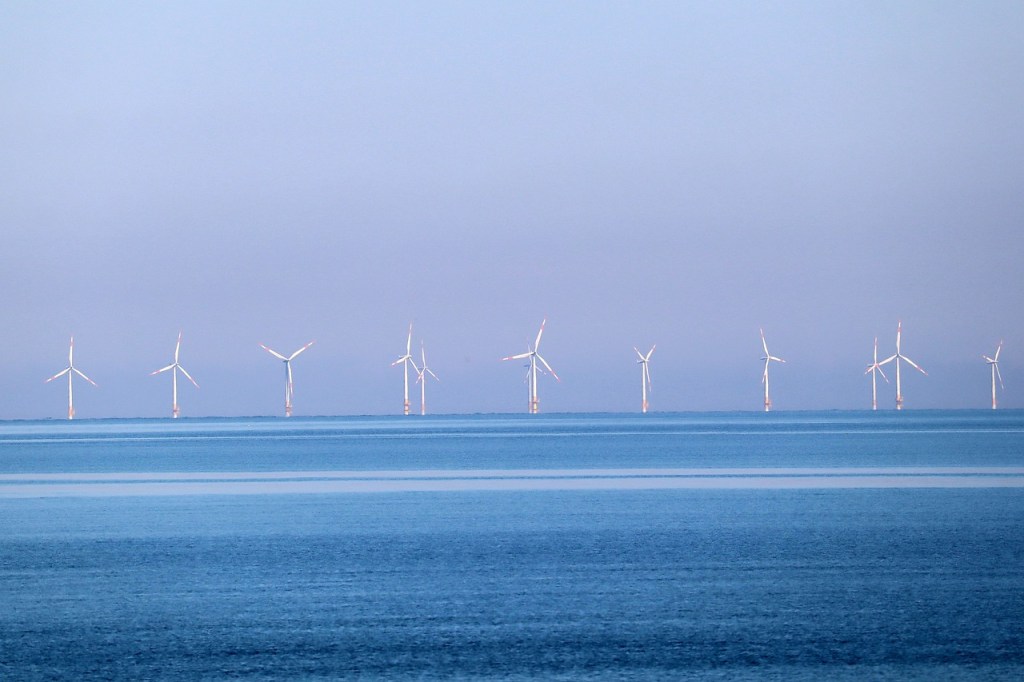
Image from pixabay.com CC0
Auctions for offshore wind power
“Now there will be no bids for the next round of licences because the wind industry can’t afford to put up the projects”
The article starts with an odd bit of misdirection, that echoes the entire right-wing press, on the results of the latest round Contracts for Difference auction for new electricity generation. This focusses on the absence of offshore wind bids at the strike price of £44 per Megawatt hour. The way the Spectator puts it is “The government and the renewables lobby hoped that a successful auction would show that wind power could compete with fossil fuels”. The fact is that it already does. There were no bids from fossil fuel sources at this price either; and the successful bids were all from renewable sources.
24 onshore wind projects
1 Remote Island wind project
56 Solar projects
3 Geothermal projects
11 Tidal stream projects.
These are slated to produce 3.7GW of power. So, renewables 95: Fossil Fuels 0. It’s quite clear which source is heading for the relegation zone. And the International Energy Agency has just reported that electricity generation from fossil fuel sources declined by 7.4% in the whole OECD in the year to September, so this is happening in every developed country.
“Starmer’s 2030 deadline is impossible, I don’t even worry about it”
With 5GW of potential offshore wind projects not coming online, due to rising raw material and interest rate charges increasing costs beyond the auction price, you have to wonder if the government set this up to fail. With the current wholesale electricity price set at over £80 per Kilowatt hour, there was a lot of room to set a price (perhaps around £60 per KWH as suggested by the industry) that could have brought this on stream, and still cut the cost of electricity for customers. This will have a knock-on effect on bills and supply chain jobs – which have been projected on the basis of a tripling of UK offshore wind by 2030 – and choke them off unless the momentum is restored at the next auction. Anyone concerned about jobs in the supply chain will be campaigning between now and then to make sure this is the case.
The stop-go market driven model embodied in the CfD system makes a consistent plan for energy transition vulnerable and chaotic. To take this process by the scruff of the neck and drive it through at the scale and pace that we need requires, as UNITE successfully argued at the TUC, public ownership of energy.
Undersea cables
“The National Grid can’t get undersea cables, There are 4 suppliers of cables in the globe, they’re all booked out to 2030”
If you are concerned with cutting carbon emissions and growing jobs, this is an argument for campaigning for more investment in cable laying and the jobs that go with them, not accepting current limited capacity as an insuperable obstacle. A very good use for some of that £28 billion Labour is pledged to ramp up to.
North Sea drilling
“There will be more drilling in the North Sea”
Senior figures in the unions can’t afford to ignorethe scientific reports on this matter. They are not ambiguous. NO new oil and gas exploration is compatible with Net Zero. 60% of existing reserves have to be kept in the ground to avoid catastrophic consequences. Weaning ourselves off fossil fuels requires unions to fight for a just transition as rapidly as possible for their members in the oil and gas sector. Spinning a delusion that everything can carry on as it is, will speed us to a point at which sustaining jobs will be the least of our problems.
Renewables lobby
“The renewables lobby is very wealthy and powerful. I think people on the left, for good intentions, have got hoodwinked into a lot of this”
This is a breathtaking inversion of reality. How “wealthy and powerful” is the “renewables lobby” compared to the fossil fuel companies? Octopus compared to Shell? Vesta compared to BP, or Aramco, or Exxon? According to the IMF, last year total fossil fuel subsidies were $7 Trillion. 7.1% of global GDP. That’s power. That’s wealth. We should note that this is $3 Trillion more than the total that would be needed globally to get us on track for sustainable development. Shell is now casually projecting that Net Zero will only be possible sometime in the 22nd century if they have their way, with no accounting at all for the social, economic and political consequences of that. Gary sees these companies as “people who we can work with” without reflecting that, since they have known about climate change for fifty years and tried to cover it up, with no “good intentions” at all, that hoodwinking is a large part of what they do.
UK net zero targets
“We’ve cut carbon emissions by decimating working class communities
Who does he mean by “we”? A better word would be “they”. The succession of Tory governments, in all their various guises, since 2010 have been bad for climate breakdown and the working class. They have put business imperatives (profit) above sustainability, and dumped costs of transition downwards onto those least able to afford it. Two examples. Insulation and solar energy installation fell off a cliff when the Tories “cut the green crap”, leading to thousands of lost jobs and higher bills as a result.
Green levies
“Green levies are a modern-day poll tax”
It’s also the case that, because it was the Tories, the schemes they had were skewed to subsiding the sort of consumers who could afford the upfront investment; while dumping the costs on everyone else’s bills. Hence Gary’s complaint that this was ‘disproportionately paid for by the poorest’. Quite so, but the answer to that is not to scrap insulation and solar panel installation altogether, but to approach it as a social mission to upgrade the “leaky, freezing council house(s)” that need it most first, and do it through Direct Labour run by Local Authorities; thereby creating jobs, cutting fuel poverty and improving health, as well as cutting energy demand and therefore emissions. Win, win, win.
Green Jobs
“It’s usually a man in a rowing boat sweeping up the dead birds”
Given that there were 19,600 jobs directly in offshore wind in 2022, and another 11,500 in the supply chain, that’s quite a lot of rowing boats. 30% of these are in Scotland. 15% in Yorkshire and Humber. If considering bird fatalities, Gary might note that in this study from the US, “for every one bird killed by a wind turbine, nuclear and fossil fuel powered plants killed 2,118 “. If we go for nuclear and stick with fossil fuels, we’re going to need a bigger boat.
According to Prof Sir Jim McDonald, president of the Royal Academy of Engineering, 30,000 new skilled workers would be required to retrofit buildings, while 60,000 technicians would have to be on hand to go one step further and install energy efficient heating systems in homes, offices and factories, with intensive training required. This is an extremely conservative estimate given that it can take four skilled workers six months to do a thorough retrofit on a house. In their latest Climate Jobs Report the Campaign Against Climate Change Trade Union Group argues that two million jobs will be required to deal with all 27 million homes and public buildings that need retrofitting if it were to be addressed seriously with the level of investment that’s needed.
That’s an awful lot of new jobs. Were the GMB to campaign for this, positively and proactively, some of these new workers might join.
Nuclear energy
“Smith is broadly positive about the future of green energy and sees Hinckley Point as a success story”
The argument that new nuclear is the core of future “green energy” is not consistent with any concern for impact on energy bills. The strike price for electricity generated by Hinckley Point is £93.50 per KWh. More than double the price at the last CFD auction and a third more than Offshore wind companies were pitching. This will go onto electricity bills and hit the poorest hardest. Small Modular Reactors are projected to be even more costly. So, whatever the green merits or otherwise of nuclear, it is not compatible with the concern for costs to customers that is foregrounded in his argument against “green levies”.
Hydrogen
Gary also argues for hydrogen, in general terms in this article. Elsewhere the GMB has pushed hard for hydrogen to be used as a mass replacement for natural gas for domestic cooking and heating. This is a complete non-starter on grounds of cost, emissions and safety. Unless the hydrogen is produced by renewable energy, the carbon emissions produced in making it are greater than if you just use natural gas in the first place. To produce sufficient hydrogen for mass domestic use using renewable energy would need far more wind farms than Gary is prepared to contemplate as a realistic possibility. Hydrogen has a role in some hard to decarbonise industrial sectors, so any green hydrogen we produce should be kept for that. It will be an expensive and precious resource that we should use accordingly. You have to add to that the concerns about how flammable the stuff is in a domestic context. As hydrogen is much lighter and more flammable than natural gas, the possibility of leaks and fires is much greater, so the existing infrastructure would need significant upgrading. A recent government report concluded that hydrogen in the home would be four times more dangerous than natural gas. A job creation scheme for the Fire Brigade perhaps, but probably one they’d rather not have. That’s why people selected to trial it as a cooking and heating tool in Ellesmere Port rebelled against the prospect of a domestic Hindenburg disaster* in their kitchen, leading to the pilot project having to be scrapped. Many gas fitters are less than happy at the prospect of working with hydrogen for domestic heating or cooking for the same reason.
China and supply chains
“We’ve become increasingly dependent on China because we can’t secure our energy future”
Gary’s position on trade and supply chains is contradictory. The GMB has argued for a “Great British Supply Chain”, with an almost autarkic vision of everything from widgets to jackets to turbines being built here, and for the CFD auctions to be stopped until one is established. At the same time, he quite rightly says he is “not a protectionist”, because workers lose out. But also, that the UK can’t do what the US is doing with the Inflation Reduction Act because it does not have a major reserve currency; which does not quite add up. He objects to the Tory approach for its “ideological bent” to neo liberal globalisation and buying the goods from the cheapest source, but also objects to imports from China as a “non-market economy” that “distorts the world economy”.
Gary seems to accept that China’s “non market economy” is more efficient at producing the necessary goods than the UK neo liberal economy is. In the case of energy, this is probably because they are investing more than twice as much in renewable energy generation than the EU and USA combined, and the UK lags behind both of these. Whether you agree with China’s definition of itself as “Socialist with Chinese characteristics”, or argue that it is a form of “state capitalism”, there’s no doubt that their state directed investment and coordination of state companies, academia and the private sector is beginning to produce the necessary goods at the necessary speed and scale. Just as well, because getting their dependence on coal down fast is crucial for all of us and, again according to theInternational Energy Agency, both possible and happening.
And that brings us to the paradox of Gary’s position. To develop a comparable supply chain here would require investment on that scale. But he claims that investment even on the smaller scale being carried out in the US is beyond the UK’s capacity. To deploy the £28 billion that Labour projects that it will ramp up to (which will be comparable to the US and EU, so therefore about half the Chinese level) would either require direct state investment through newly created nationalised industries, or you have to bribe a multinational, which at the moment is “free money” that comes with no government stake or even a say for the workforce or affected communities. Tata is doing rather well out of this at the moment, with half a billion for an electric arc steel furnace in Port Talbot and another 600 million for their EV plant in Swindon. Gary’s complaint that the redundancies that come with this deal at Port Talbot shows that Just Transition is “fantasy land” undercuts the position that his members would expect him to take alongside the other affected unions – for a say in the transition, for investment in a wider range of viable technologies to sustain volume steel making and the jobs that go with it. If this is a “fantasy” then so is any prospect of defending those jobs.
The reality is that “British” manufacturing is, for the most part, owned by multinationals and might be better understood as “production in Britain”. It also shows that companies like these and the Fossil Fuel majors in the North Sea about whom Gary argues “we’ve got to stop seeing them as the enemy and we’ve got to start seeing them as people who we can work with”, do not return the favour, and shut the unions out whenever they can.
More positively, it should be noted that high quality locally produced goods are not solely dependent on the national market and can also be exported, and companies based here, whoever owns them, do that too. In 2017, according to the Renewables UK Export Nation Reportthis included “an extraordinarily wide variety of goods and services, including supplying, installing and maintaining onshore wind turbines and components, designing gearboxes, manufacturing offshore wind turbine blades and steelwork, supplying and laying underwater power cables, installing, inspecting and maintaining offshore wind farms, providing helicopters, crew and vessels, developing wave and tidal energy projects and providing components for the marine energy industry, as well as designing software, conducting geological surveys, monitoring wildlife, and providing financial and legal services”. With properly targeted and coordinated R&D producing patents as part of a proper industrial strategy, there is a lot of room for growth in all of this, which matters for the sector because most of the growth in it will be “in Asia”.
“Failing to prepare is preparing to fail.” Benjamin Franklin
Transition and jobs growth will only happen if there is investment at scale and speed. Seeking to “moderate” Labour’s policy so that the investment doesn’t happen, means there will be no growth in jobs either. Without plans, and without union engagement in making them, we will stagnate at best. That is what we should be concentrating on now, so that mobilising people for transitions in their communities and workplaces that will cut their bills, boost jobs and cut our carbon emissions fast becomes part of the election campaign to drive the Tories out of office and cement Labour in government into actions that drive that forward.
*I was once told at a SERA meeting by a representative of the Hydrogen industry that the reason the Hindenburg burned so fiercely was not because of the highly flammable gas that it was filled with, but because of the lacquer that was painted on the outside of the dirigible. He did this with a straight face.
The next year is crucial in our long-running fight to take our buses back into public control. So we’re joining forces with trade unions, community councils, environmental groups, students and pensioners associations and more, to launch a new region-wide Better Buses for Strathclyde campaign. Our aim is to build support for taking back public control of our bus network across the 12 Strathclyde local authorities and we would like to invite you to be part of it. The campaign will launch publicly with a rally outside SPT Head office, 131 St Vincent St, Glasgow G2 5JF on FRIDAY 29 SEPTEMBER 2023, 9:30AM
Better Buses for Strathclyde is inspired by the success of the Better Buses for Greater Manchester campaign, which pushed their transport authority, TfGM, into bringing their region’s buses back into public control in order to deliver a fully-integrated, accessible and affordable public transport network called the Bee Network.
By bringing together bus users and employees from across Strathclyde’s 12 council areas, Better Buses for Strathclyde will put pressure on our regional transport authority, SPT, to utilise the new powers in the Transport (Scotland) Act 2019 to deliver a similar fully-integrated, accessible and affordable system for us – and on the Scottish Government to provide the funding required.
THE NEXT YEAR IS CRUCIAL
From September 2023 – March 2024, SPT is developing the new ‘Strathclyde Regional Bus Strategy’ which will set the direction of bus policy in our region for the next 15 years (until 2038).
This offers us a once-in-generation opportunity to end the chaos caused by bus deregulation (introduced by Thatcher in 1986), which has seen millions of miles of routes cut and fares hiked well above inflation.
We want to make sure that SPT’s strategy sets out ambitious plans to:
re-regulate the all private bus companies in our region (through ‘franchising’) so that it can plan routes to serve communities’ needs and connect seamlessly with trains, ferries and Glasgow’s Subway, with one simple, affordable ticket across all modes.
And to set-up a new publicly-owned bus company for Strathclyde (like Edinburgh’s Lothian Buses) which can start taking over routes and reinvesting profits back into expanding and improving our network.
Yesterday (9th August) campaigners from Climate Camp, This is Rigged and Scot.E3 were outside the office of Environmental Consultants Ironside Farrar in Edinburgh. Ironside Farrar have been commissioned to produce a masterplan as part of the rezoning of St Fitticks Park in Torry into an industrial Energy Transition Zone (ETZ). The protest is part of an ongoing campaign to persuade the workers at Ironside Farrar to direct their skills towards projects that contribute to a socially just transition. Mike Downham spoke at the protest. There will be another protest at the Ironside Farrar office next Wednesday 16th August from 8.30am.
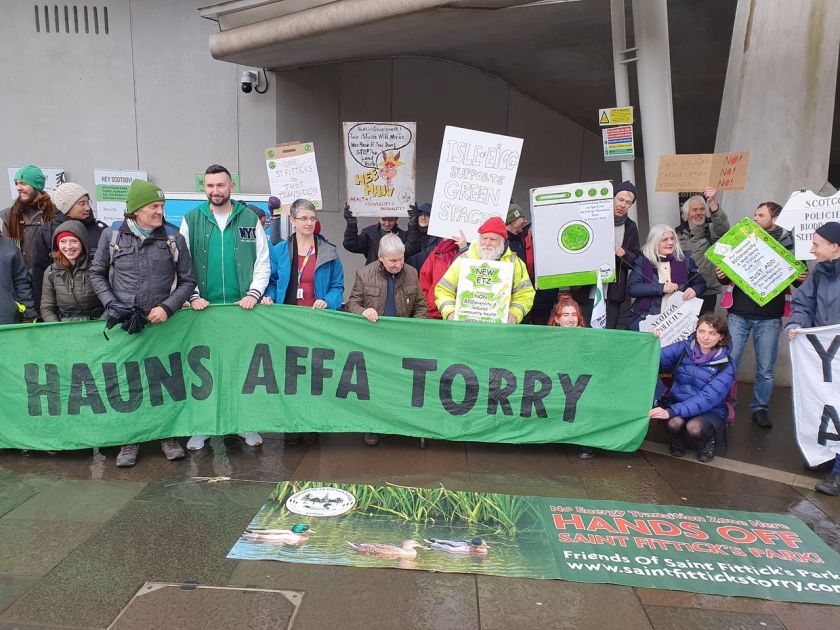
St Fitticks campaigners at the Scottish Parliament earlier this year
SPEECH OUTSIDE IRONSIDE FARRAR OFFICE 9TH AUGUST 2023
Welcome – and thanks for joining us this morning.I thought I would tell you why we’re here. This is the head office of Environmental Consultants Ironside Farrar – though the door doesn’t say that. We’re here to call on the employees of Ironside Farrar to boycott all further work for ETZ, the company oil tycoon Ian Wood set up to industrialise a large part of St. Fittick’s Park in Torry as an “Energy Transition Zone”. He then commissioned Ironside Farrar to get Planning Permission.
Torry is a suburb of Aberdeen, though it used to be a fishing and boat-building village just across the Dee from Aberdeen City. Then with the discovery of North Sea oil and gas in the 70s most of the village was bulldozed to make space for a Shell oil and gas terminal.
Since then Torry has been dumped time after time with the industrial development that other parts of Aberdeen don’t want – a landfill site, an industrial harbour where the Park used to come down to the beach at Niggs Bay, an incinerator close to the school, and now this threat to the Park which the Torry community cherish as their last green space. The threat to their community is huge. Ian Wood’s money persuaded Aberdeen City Council, who had previously invested much public money in improving the Park, to do a U-turn and re-zone it for industrial development. And Ian Wood’s money persuaded the Scottish Government not to intervene.
Ian Wood says the ETZ will contribute massively to bringing down carbon emissions, but much of the vague talk about what he wants to do is about developing Carbon Capture and Hydrogen technologies both of which are scams. This is in fact an attempt at a land-grab to justify continuing to extract oil and gas from the North Sea and fill the pockets of share-holders and directors in the Oil and Gas Industry.
Torry is about as disadvantaged a community as it gets, with appalling health statistics, appalling air quality and few employment opportunities. Despite this they are rising up and fighting for their lives against this plan to industrialise their Park.
Saving St. Fittick’s Park is exceptionally important, for three reasons:
If it’s industrialised it will represent a huge win for the Oil and Gas Industry and delay phasing out oil and gas extraction from the North Sea
It will destroy the significant biodiversity which has developed in the Park as a result of a lot of hard work and fundraising by the Torry community over the past 20 years.
And it will further sicken and impoverish the people who live in Torry. It’s this last which is arguably the most important of the three. Because if we don’t protect and prioritise the poorer communities up the north east coast of Scotland we’re done for. It’s these communities who can force significant change.
Two big things have happened in the six weeks since we started this campaign, which make Saving St. Fittick’s Park even more important. Climate has broken down across the world at a speed which wasn’t anticipated. Southern Europe and North Africa are on fire, and unprecedented floods in central China have displaced 100,000 people. The second thing is that the Westminster Government has decided to grant at least 100 new drilling licences in the North Sea. That these things can happen at the same time shows just how strong our governments are committed to fossil capital.
I’ll end by quoting a few things from the booklet The Declaration of Torry, a product of The Torry Peoples Assembly in May: on the back of this booklet they commit themselves to six actions:
We will do everything to stop the land grab
We will continue to use our Park and increase its already immeasurable value
We demand the incinerator be decommissioned
We will seek support to set up a Torry Retrofit Project to insulate our homes
We insist on a just and fair energy transition
We will strengthen collaboration within our community and with others in Scotland and beyond
And inside the front cover of the booklet, most powerfully:
THIS IS OUR LAND AND NO ONE ELSE’S
THIS LAND BELONGS TO THOSE WHO CARE FOR IT
Just one thing to leave you with. The people arriving for work this morning are highly trained and have knowledge and skills which will be essential when we’ve made the transition to clean energy. They know about tipping points in global heating, and about the complex relationships which underpin biodiversity. Ever since we started this campaign, we’ve been respectful to these workers, seeing them as part of the solution, not part of the problem.
At the same time they must surely understand the enormity of what Ian Wood is planning in Torry. They have the power between them to Save St. Fittick’s Park, by boycotting further work for ETZ. Even if they aren’t in the team working for ETZ, they can bring Ironside Farrar to a standstill by collectively withdrawing their labour.
Pete Cannell and Brian Parkin take a critical look at Sunak’s recent oil and gas announcement.
On Monday Rishi Sunak flew to Aberdeenshire by private jet to announce that at least one hundred new North Sea drilling licenses will be granted in the autumn. A policy described by junior energy minister Alex Bowie as “maxing out our oil and gas reserves”. At the same time Sunak gave the go ahead to the Acorn Carbon Capture and Storage (CCS) project to be based at St Fergus near Peterhead. Acorn will be one of four CCS projects in the UK – the other three are in England.
At a time when fires rage across Europe, and North America and floods wreak havoc in China and elsewhere, the new oil and gas licenses have received widespread criticism from climate campaigners, climate scientists, the Scottish Government and even some Tory MPs. Reactions to the CCS announcement are more mixed. SNP politicians have welcomed the announcement. Carbon Capture is prominent in the Scottish Government’s draft energy plans and Sunak argues that CCS will mean that the net zero by 2050 target is still in scope.
In our view both strands of Monday’s announcement represent Sunak paying his dues to the big oil and gas companies. In the rest of this article, we’ll explain why.
For months the Tories have argued that the cost-of-living crisis is the result of a crisis of energy sovereignty caused by the war in Ukraine. In fact, the price of gas had rocketed upwards before the war. There was no shortage of supply, since most of the gas used in the UK is piped from the North Sea. Compared with the rest of Europe the UK is unusually reliant on gas for home heating and cooking. There is a real problem here – the North Sea gas fields are nearing the end of their lifespan. So given there is an overwhelming need to reduce carbon emissions the obvious answer is to start now, planning for the future by electrifying the domestic heating system and insulating homes alongside a planned phase out of the use of gas. The Tories are doing none of this. On paper they still say they want to replace natural gas by hydrogen. But the weight of evidence that this would phenomenally expensive and a hugely inefficient use of electricity to generate the hydrogen means that they are rapidly backtracking.
So is Sunak’s plan to license more oil and gas fields going to keep people warm. Not at all. First the new fields contain more than 85% oil, not gas (see technical note below). That oil would be exported on the world market. Much of the gas is ‘sour’ – it has a high sulphur content – and is unsuitable for home heating. So, we have the worst of all possible worlds – continuing use of fossil fuels at large scale when the climate science says that the use must stop and the likelihood of very high fuel bills and insecurity of supply. Only big oil and their shareholders come well out of this – the rest of us and future generations pay the price.
A close look at Sunak’s plans for Carbon Capture and Storage is equally disturbing. The technology proposed for CCS is untested at scale. Even if the most optimistic targets for carbon sequestration are met, they represent a tiny fraction of the total carbon emissions from the North Sea. At present the only source of carbon dioxide at St Fergus is the gas stabilising plant. In the long-term Carbon Capture may be able to play a role in helping reduce the concentration of carbon dioxide in the atmosphere – but right now the priority must be to cut emissions rapidly. The £20 billion allocated by Westminster to the 4 CCS projects could be spent on expanding the production of renewable energy, home insulation and developing the electricity grid.
The parallels with the Cumbria Coalmine project are powerful. There we have the Tories supporting the exploitation of a fossil fuel, coal, which is not wanted by the steel industry. With the new licenses and CCS, we have a plan for energy security and net zero which delivers neither. Quite simply both represent political statements by the Tory Government that affirm their unswerving commitment to fossil capital.
Technical note:
The proposed Acorn (St Fergus) (and other) CCS plants are designed to be emissions source dedicated- i.e. they are intended to sequestrate carbon from say, a power station or chemical plant flue stack- not the ‘general’ atmosphere, and as such they are demonstration installations.
Apart from the Peterhead sour gas power station, the other nearby CO2 source is the St Fergus gas terminal which adds about 3-4% carbon to the overall gas/carbon penalty.
Total North Sea reserve gas content is about 27% (73% oil). The new blocks have a much lower gas composition c.12%.
The carbon contents of the different fuels (compared with coal) is:
Activists occupy tree outside Edinburgh offices in support of Torry community in Aberdeen. Press statement from This is Rigged
For more about Torry and the proposed Energy Transition Zone that will destroy St Fitticks park just scroll down or type “St Fitticks” in the search box.
Ironside Farrar, Environmental Consultants with offices in Edinburgh, Glasgow and Manchester were commissioned by Energy Transition Zone Ltd (ETZ Ltd) to produce a ‘Masterplan’ for the industrial development of parts of St. Fittick’s Park, Gregness and Doonies Farm in Aberdeen. They were also tasked with obtaining Planning Permission for this development. Ironside Farrar’s plans were presented to the Aberdeen City Council Management Planning Committee yesterday morning (29th June). The Council say they will adopt the ‘Masterplan’ as Planning Guidance.
On the same day, supporters of This Is Rigged went to the Edinburgh offices of Ironside Farrar and met with Julian Farrar, Managing Director of the company, to discuss the issues and request that Ironside Farrar withdraw from further work for ETZ Ltd, and that employees boycott all further work for ETZ Ltd for the following reasons:
St Fittick’s park is the last remaining green space in Torry, which is one of the country’s most deprived communities, where residents have a life expectancy ten years lower than people living in wealthier parts of Aberdeen. Commenting on the potential loss of the park, local doctors and nurses fighting to improve the health of the Torry community, say that industrialising any part of St. Fittick’s Park will be devastating for the health of that community.
In addition to its positive contribution to human health, St. Fittick’s Park is an oasis for wildlife, including many species of migrating birds, and Gregness and Doonies Farm support this wildlife as green corridors. In a recent article in the Guardian[1], journalist Tom wall suggested the park’s wetland is “perhaps Aberdeen’s most unlikely beauty spot. Reeds flap and bend in blasts of salt-edged wind. Grey and blue light catch in watery beds, where ducks dip and preen. Birds shelter in a young woodland of oak, dark green pine and silvery birch trees.”
It therefore makes no sense to destroy this important habitat while Scotland is in the midst of a biodiversity crisis. Furthermore, the wetlands and forest created 10 years ago in St. Fittick’s Park are already capturing carbon, and it is increasingly recognised that ecosystems like these even regulate local climate including rainfall.
The main purposes of the proposed Energy Transition Zone will be to develop carbon capture and hydrogen technologies, both of which are considered by leading scientists to be unproven and dangerous excuses for continued oil extraction and habitat destruction.[2]
In yesterday’s meeting, Julian Farrar was warned that being complicit in destroying the wetlands and woodland, both of which are vitally important green spaces and biodiversity sites that have taken years and a tens of thousands of community man-hours to create, would be seen as an act of immeasurable violence.
Ishbel Shand, member of the Friends of St.Fittick’s Park campaign said,
“The proposed industrial development is simply a land grab by the oil and gas industry to fill the pockets of their shareholders and directors.”
After leaving the meeting with Julian Farrar, This is Rigged activists Mike Downham and Tom Johnson decided to occupy a small tree outside the Ironside Farrar offices, and are there awaiting a response.
Mike Downham, a retired paediatrician and children’s DR said,
“There is a high incidence of asthma in children in Torry due to particulate matter air pollution from the nearby incinerator and the South Harbour industrial development. Further industrial development in this community would have a serious negative impact on the health of children in Torry.”
Following the meeting, Tom Johnson, a painter-decorator and This is rigged supporter who knows St. Fittick’s park well said,
“If Ironside Farrar were to pull out of the project at this stage, it would have a huge positive effect on the wellbeing and health of the Torry community – disempowered folk who have lost so much already. I mean, Imagine losing an entire bay – your access to the sea. And now forests they planted 10 years ago are to be ripped up and concreted over with “green” factories.”
“Julian Farrar explained to me that Ironside Farrar have reduced the amount of harm to be done in the park, but if they now come out against any destruction WHATSOEVER of these spaces, that will be a really bold statement of solidarity, and an action that shows their real concern for the environment, and people. We understand it’s difficult for a company to do something like that in current economic and political contexts, but to me Julian did seem to be uncomfortable with what’s going on with the ETZ.”










 Employment, Energy and Environment

