Briefing 16: oil and gas are costing us the earth

Here’s the text of out latest briefing on climate, oil and gas and the cost of living. You can download it here.

Cost of Living

Everyone knows that we are in a cost-of-living crisis.  Most of us in Scotland rely on natural gas for cooking and heating and North Sea gas is a guided missile sent into every home in the country which will drive thousands of new people into poverty and will kill the most vulnerable.  Oil and gas producers are making mega profits and demanding money with menaces.  

Before this happened around a quarter of Scots lived in fuel poverty.  As a result of the price rises hundreds of thousands more will be forced to make impossible choices between food and heating.  The response from the Tories has been derisory. Their so-called Energy Security Plan does nothing to tackle immediate hardship and doubles down on the most expensive energy options for the longer term – nuclear, oil and gas, hydrogen for heating and carbon capture and storage.  

Business as usual – the North Sea Transition Deal

There is a simple reason why the Tories have made these choices.  In the face of the climate and cost of living crises they’ve chosen to protect the interests of big oil.  It’s not just that they won’t tax the enormous profits that are being made from North Sea Oil and Gas – it’s that they are following the logic of the oil industry’s ‘North Sea Transition Deal’.  

A phony deal

The ‘Deal’ is a partnership between the UK and Scottish governments and the unions.  It aims to continue the exploitation of North Sea oil and gas up to and beyond 2050.  It talks about a net-zero oil and gas basin where the greenhouse gas emissions from the oil and gas would be captured and stored.  This is not going to happen, certainly not in the next few decades, and the consequence will be that the UK will fail to meet its contribution to restricting global temperature rises.  

Maintaining profits – wasting resources

Moreover, the ‘Transition Deal’ drives high-cost energy options at every step and leaves working people to pay the price.   The latest UK government energy strategy aligns entirely with the ‘Deal’. Most of the electricity produced by new nuclear power stations will be required to produce the hydrogen for domestic heating.  Using electricity to produce hydrogen for domestic heating at large scale is hugely inefficient.  Moreover, nuclear produces much more carbon emissions over its lifecycle than wind or solar.

Torness CC-BY-SA-4.0 Image by NH2501

The alternative

There is an alternative.  Electricity produced by wind and solar is already much cheaper than that produced by nuclear, oil and gas and the costs of renewables continue to fall.  The money the Tories want to spend on new nuclear is enough to retrofit most homes across the UK – creating jobs, improving health and well-being and cutting energy demand.  

An economy based on renewables results in many more jobs than the fossil fuel and nuclear options.

A challenge for the trade union movement

It’s time for a decisive shift in policy and end to partnership with the oil industry.  Just transition, indeed arguably any transition that restricts temperature rises to 1.5 degrees, is incompatible with the ‘North Sea Transition Deal’.  Sticking with the ‘Deal’ is a disaster for the planet and undermines the ability of the workers movement and the climate movement to build the power we need to win over climate and the cost of living.

A new policy for the union movement

Tackling the cost-of-living crisis and the climate crisis means breaking the partnership with big oil that is inherent in the Transition Deal and campaigning for an end to the development of new North Sea oil and gas and the rapid planned phase out of existing fields.  Large-scale investment in renewables and a massive programme of retrofitting would result in lower energy prices and reduced carbon emissions.   A serious plan would include support for the oil and gas work force while they transition to new jobs and ramping up options for reskilling, education and training in the new industries.

No more subsidies

The oil and gas industry has been subsidised heavily over the lifetime of the North Sea.  The subsidies must stop.  Working people are suffering because what they pay for energy fuels super profits for big oil and goes into the pockets of the richest in society whose wealth grows as hedge funds speculate on the oil market.  There’s plenty of money to pay for an energy transition.

Among the components of a new policy for the workers movement should be: 

Massive investment in wind, solar and tidal energy.

Large-scale expansion of energy storage options.

No more North Sea development. 

Taking the North Sea into public ownership and beginning a planned phased out of production.

Support for oil and gas workers to transition to new jobs.

Regulate energy prices to consumers and tax big oil and the rich to end the cost-of-living crisis.

COP26 gave us a glimpse of the potential power when the workers movement and the climate movement come together.  Together we can win.

COP27 ‘Don’t be fooled by Sisi’s climate lies’

A message from the Egypt Solidarity Campaign

Egyptian activists warn ahead of COP27 summit

As Egypt prepares to host the COP27 climate summit in November 2022, Egyptian activists have issued an urgent appeal to the global climate justice movement not to be taken in by the regime’s claims to speak on behalf of ordinary people in the Global South. In a statement published by Egypt Solidarity Initiative, the Egyptian Campaign for Climate and Democracy warns that the regime of Abdelfattah al-Sisi is planning to use the COP27 conference to burnish its reputation after presiding over a decade of brutal repression. 

“The aim of this greenwashing is twofold: first, to extract as much financial aid as possible from the rich industrialised countries. Most of this money will end up being syphoned out of the country into the bank accounts of Sisi and his generals in those same industrialised countries. Second, is to distract from his abysmal human rights record, and as usual, the leaders of the supposedly democratic Western governments will allow him to get away with it.” 

The Egyptian Campaign for Climate and Democracy

While the COP27 conference takes place, thousands of people have been jailed and abused for demanding basic democratic rights, including journalists, activists, academics and students. The response of the military regime to protests and campaigns related to environmental issues has been just as harsh, whether over plans to build coal-fired power stations, polluting industries or the destruction of green spaces. Climate justice movements attending the summit are likely to find themselves alongside ‘astroturf’ government-sponsored ‘climate campaigns.’ 

“No real Egyptian opposition activists will be allowed near Sharm El-Sheikh during the conference. It would be a shame if genuine global grassroots movements are fooled into taking part in such a state-orchestrated charade” 

The Egyptian Campaign for Climate and Democracy

This appeal follows a similar warning by jailed activist Alaa Abdelfattah, a British citizen who was convicted of ‘terrorism’ for posts on social media and other trumped charges. Alaa has been on hunger strike since 2 April to protest at the abusive conditions in prison. He is also calling for a consular visit from the British embassy. “Of all the countries to host [the COP27] they chose the one banning protest and sending everyone to prison, which tells me how the world is handling this issue. They’re not interested in finding a joint solution for the climate,” he told his sister during a prison visit. 

Writer and activist Naomi Klein has also sounded the alarm. “The international climate movement must start paying attention to what is happening in Egypt’s prisons,” she told the Guardian. “We cannot sleepwalk to Cop27 as if these are not crimes against humanity.”

The TUC has also called on the British government to hold the Egyptian regime to account during COP27 for its attacks on workers’ rights to organise. In a statement published in June, ahead of preparatory talks in Bonn ahead of the COP27 conference, the TUC said: 

“The Egyptian trade union organisations affiliated to the ITUC – the Egyptian Federation of Independent Trade Unions and the Egyptian Democratic Labour Congress – have faced repeated repression, with labour organisers forced to retire, limiting the unions’ ability to function. … Vital to tackling the climate emergency is the need for freedom of association and the rights of workers and communities to organise for change. Since seizing power, the Egyptian government has consistently demonstrated a disregard for human life and these fundamental freedoms. By hosting COP27 in Sharm el-Sheikh, the Egyptian government will have an unprecedented opportunity to greenwash its atrocious record in human rights”

TUC statement, 10 June 

What you can do: 

  • Read the full statement from Egyptian activists online here
  • Share with climate networks in your country and on social media 
  • Take action in solidarity with Egyptian political prisoners, write to your MP or government calling on them to demand the Egyptian regime releases political detainees and stops repressing protest.Go to FreeAlaa.net for more information on Alaa’s campaign. Find out more here about the cases of journalist and lawyer Hisham Fouad and Haitham Mohamedain.

The Transport Revolution

An international conference in Brussels organised by the Rosa Luxemburg Foundation 27-28 June

Ellie Harrison (Get Glasgow Moving) and Mike Downham (ScotE3), representing their organisations in the Free Our City coalition which campaigns for free, publicly owned, democratically controlled buses across Greater Glasgow, were invited to speak at this conference as a result of contacts made during COP26. They also showed the Reel News film of the Free Our City protest during the COP as previously published on this Blog.

Here Mike Downham summarises his reactions to the conference:

It was a privilege and a pleasure to be invited to speak at this conference and to get to know in the evenings the other speakers from Germany, France, Spain, Italy, Hungary and Brazil.

The lid on the coffin of cars was firmly nailed down, whether powered by a combustion engine or by electricity. It was clearly demonstrated that if cars continue to be produced there is no way that carbon emissions can be reduced in time to avoid a more than 1.5 degree rise in global temperature  or that levels of poverty will fall in time to prevent societal chaos, despite the huge effort by car manufacturers to greenwash electric cars. We were able to point out that in any case only 49% of households in Glasgow have access to a car – that figure predating the price rise in cars and the cost of living crisis.

The EU’s carbon emissions discourse has been reduced to targets and choice of technology, with little reference to just transition for the millions of car manufacturing workers across Europe – 800,000 in Germany alone – nor to the transformation needed, especially in the way we move about our cities. Furthermore the emissions targets look less and less realistic.

Moving to mass transport is as urgent as stopping oil and gas extraction. Free public transport is also a more immediately attractive concept for large numbers of people than doing without oil and gas.

Three expert speakers (Ellie Harrison of Get Glasgow Moving, Alana Dave of the International Transport Workers Federation, and Mario Candeias of the Rosa Luxemburg Foundation) told us exactly what needs to be done about public transport – above all that it needs to be publicly owned, democratically controlled, integrated in a way that gets people quickly to where they want to go, and free. 

Electric Bus pixabay.com CC0

Key to the transformation of transport are the highly developed skills, self-esteem and producer pride of car production workers. These skills are needed in the production of electric buses, trains, bicycles and ships. Some but not all workers will need new training, giving them the choice to remain within the transport sector or into other carbon negative sectors like renewable energy, or carbon neutral jobs in public services.

Transport needs to be seen as a common good and a right. Mobility poverty is as urgent an issue as fuel poverty and food poverty, though in Brazil, where there are 30 million hungry people, transformation of transport will inevitably take longer to achieve, even if Lula regains power.

Once again we know what to do – that’s not the issue – the issue is how to achieve the power to get it done. But transport workers have more power than most other workers, both because so many people rely on them in their day-to-day lives, and because many of their skills are hard to replace – witness the current RMT rail workers strikes, and the Rolls Royce workers in East Kilbride who grounded half the Chilean Air Force in 1974.

Mario Candeias speaks of a pathway to power: 

MOVEMENTS → STATE INTERVENTION → PUBLIC OWNERSHIP → INDUSTRIAL STRUCTURAL CHANGE OVERSEEN REGIONALLY BY WORKERS AND USERS

The question is what movements? He suggests partnerships between existing trade unions and civil society organisations. In my opinion movements which can reach sufficient scale fast enough are more likely to arise from new formations, especially those led by young people currently active for climate justice. These are currently targeting their civil disobedience on oil, gas and coal production sites, recognising that opposing forces largely reside in the fossil fuel industries. Will they also see the need to target car production sites to challenge the huge power of Volkswagen, Daimler and BMW? 

These discussions were taking place in Brussels, where it’s estimated that there are between 15,000 and 30,000 lobbyists – that’s between 20 and 40 per Member of the European Parliament. Of these 87.5% represent capital interests.

The most encouraging thing for me was to have two days in international company – the first non-remote opportunity for me since before the pandemic. I was left reflecting about the central importance of workers and communities united across borders in opposing the power of capital. The EU is perhaps an object lesson about how not to deal with borders – the old issue of merging economically, but retaining political independence. The speaker from Hungary described his country as in a “German trap”, German companies using cheaper Hungarian labour for their assembly lines for both cars and weapons.

Further reading – English copies of these three booklets, all published by the Rosa Luxemburg Foundation, are available free in limited numbers. If you’re interested please contact me first at mandrdownham@phonecoop.coop

Switching Lanes by Mario Candeias, 2022

The European Car Lobby by Tobias Haas and Hendrick Sander, 2019

Industry 4.0 by Christopher Wimmer 2019

Solidarity with the railworkers

We are pleased to republish this statement from the Climate Justice Coalition – please follow up on the suggested actions and share widely

Solidarity with RMT members – no Climate Justice without workplace justice

The Climate Justice Coalition stands in solidarity with RMT members taking industrial action to protect their pay, jobs and working conditions, and the wider fight to protect a public transport system for people – social need – not private greed.  Billions are being cut from our transport system at a time when we should be increasing investment to ensure a fully public, affordable, integrated, and sustainable transport system. 

Our railways are already being impacted by the effects of climate change, putting additional demands on a stretched workforce providing an essential public service.  This action by the Government is symptomatic of their disregard for the concerns of climate, environment, and workers.

As a coalition representing groups within climate and environmental campaigns, faith, race and social justice groups, and trade unions, we call on you all to support this struggle.  This includes adding our voices to resist the anti-trade union and worker narrative being driven by the Government in the mainstream media and publicise that it is their inaction and behaviour that is detrimental to people, not workers seeking justice.

Inaction on climate change is harming innocent people across the globe. Protecting the rights of workers and living standards must be a priority for the climate justice movement in fighting for a Just Transition to a zero-carbon economy.

We stand with the RMT to fight for their aims, and to campaign for a better deal for workers and a fairer, climate just, society.

Support the Strike:

💌 Write a letter of solidarity to the striking workers from your organisation, union branch or group: info@RMT.org.uk 

📣 Join a picket line! https://strikemap.co.uk/

🚋 Discuss the strike in your workplaces, communities, and coalition hubs. 

 Write to your MP: actionnetwork.org

Why nuclear is not the answer to the climate crisis

Our new briefing – number 15 – looks at nuclear power.

New nuclear power stations are central to the UK government’s new energy strategy. Some influential environmentalists like George Monbiot support nuclear as part of tackling the climate crisis and the Intergovernmental Committee on Climate Change (IPCC) argue that globally by 2050 energy production should 70% renewables and 30% nuclear.  So why do we say that there should be no role for nuclear?  In this briefing we explore the arguments around nuclear and demolish some of the myths about nuclear power.

A military technology

The raw material for nuclear weapons is produced in nuclear reactors.  In the US, the UK, Russia civil nuclear power was developed after the second world war to support nuclear weapons programmes.  Researchers at the University of Sussex Science Policy Research Unit have shown that to this day the main role of nuclear power in the UK main has  been to subsidise nuclear weapons.  Electricity consumers have paid the price through higher costs, providing a hidden subsidy for the nuclear weapons programme.

Chernobyl CC0 pixabay.com

High cost

Nuclear power costs two to three times as much per unit of electrical energy than offshore wind. Onshore wind and solar is even cheaper.  These comparisons don’t include the cost of decommissioning old nuclear power stations (which takes many decades) or the cost of safely storing the radioactive waste that they generate (which is necessary for thousands of years).  These additional costs are born by consumers and taxpayers.  

Long construction times

Since 2011 construction has started on 57 nuclear power plants around the world.  Ten years later only 15 are operational, with many incurring long delays and massive overruns on predicted costs.  Even advocates of nuclear power argue that it would take around 25 years for new nuclear to make a significant impact to global energy production.

Carbon free? Not at all!

To widespread consternation, the European Commission recently declared nuclear a green technology.  Clearly nuclear reactions don’t generate greenhouse gases.  However, it’s a myth that nuclear is a carbon free resource.  Uranium mining, plant construction, which requires large amounts of concrete, and decommissioning are all carbon intensive. A 2017 report by WISE International estimated nuclear lifecycle emissions at 88–146 grams of carbon dioxide per kilowatt hour. More than ten times higher than wind with lifecycle emissions power of about 5–12 grams. Uranium fuel is scarce and carbon emissions from mining will rise as the most easily recoverable ores are mined out.

Safety

The consequences of nuclear accidents are severe.  Proponents of nuclear power downplay the impact of the Chernobyl disaster in 1986 and argue that the number of deaths was small. In a scrupulous investigation, Kate Brown author of ‘Manual for Survival – A Chernobyl Guide to the Future’ has researched the decades long efforts by the old Soviet Union, and then the US, to cover up the impact of Chernobyl.  She estimates that the true figure for deaths is in the range 35 – 150,000.  Many nuclear plants (like Fukushima) are built close to the sea to provide water for cooling. increasingly these reactors will be at risk as sea levels rise.

CCO pixabay.com

Environmental impact

About 70% of uranium mining is carried out on the land of indigenous people. Mining and leaks of radiation have had a devastating effect on the environment in these areas. Building more nuclear power will result in more leakage of radioactive materials into the environment and more workers exposed to unsafe conditions and preventable deaths.  

Small modular reactors

Rolls Royce is pushing for the development of small modular nuclear reactors as a response to the climate crisis.  It’s argued that they could be built more quickly although this is unproven.  In addition to sharing all the negative features of larger reactors, new research at Stanford University suggests that smaller reactors are less efficient and produce up to 35 times the amount of low-level radioactive waste and 30 times the amount of long lived waste compared with larger reactors.

Scotland

While Westminster is planning huge investments, the Scottish Government is currently opposed to new nuclear generation.  Nevertheless, Scotland has more licensed nuclear installations per head of population than anywhere else in the world.  Only one of these, Torness, is currently generating electricity, and it is scheduled to shut down in 2028.  There will be strong pressure on the Scottish government to buy in to a new generation of reactors.

Alternatives

Advocates of nuclear power argue that nuclear is essential to the energy transition we need because, unlike wind and solar, it is not dependent on the weather or the time of day and so can provide a reliable base load.  There are alternatives – more investment in tidal generation could also support based load supply – and the development of a smart grid involving multiple types of storage – pumped hydro, local heat pumps and battery could ensure an energy supply system that is resilient.  Developing these systems alongside wind and solar would enable the energy system to be transformed much more rapidly than is possible with nuclear.  A nuclear strategy is just too slow to meet the urgent need to reduce carbon emissions over the next decade.  And the big sums of money being channelled in to nuclear divert investment from renewables and prevent that rapid and necessary transition.

Download this briefing.

Oil, gas and the cost of living

This post by Neil Rothnie was written as a letter to the Herald newspaper but the Herald declined to publish it

It’s North Sea gas price increases that are largely responsible for the cost of living crisis,  making energy bills unpayable for growing numbers of people. 

90% of the gas we use in our homes comes from the North Sea.  Wholesale gas prices  were soaring well before Russia invaded Ukraine.  So far Ukraine and Russia have  collaborated to keep most Russian gas flowing to Europe and finance both sides in this  war.  There have been no power outages or gas shortages in the UK or Europe. 

North Sea gas price increases have not been caused by rising costs of production.  There  have been no wage increases for oil and gas workers, and no new pipelines or gas  platforms built.   

So what are the sky high gas prices all about?  Supply and demand?  Prices pushed up  by a global shortage?  China, Japan and India, where it is claimed that there are gas  shortages, can’t access North Sea gas however much they’d be prepared to pay for  it.   There are not the facilities in Europe to liquify North Sea gas and there is not a fleet of  empty LNG tankers waiting to transport it to Asia.   

The oil companies either sell North Sea gas to us at prices people can afford or they drive  consumers into cold and hunger.  The choice they have made is clear.  Profits of Shell, BP  and Total in the first 3 months of this year are colossal – £7.5, £5 and £4 billion  respectively. 

Ordinary people can’t and won’t go on indefinitely paying for oil company  profiteering.  We can’t just live with the gas and electricity disconnections that are the  inevitable result of unaffordable bills.  Already Just Stop Oil and Extinction Rebellion are  justifiably on the streets engaged in civil disobedience aimed at the oil and gas industry.  Far more widespread civil disobedience is surely inevitable as people respond to cold and  hunger.  Remember the Poll Tax?   

Manipulating gas markets to impoverish your customers can’t in any way be described as  a “windfall”.  It’s an unprovoked and deadly attack by an industry whose time has passed,  and a one-off tax won’t cut the mustard.  

The plan to slash civil service jobs to free up the cash to meet the cost of living crisis is a  perverse response.  The industry needs to be taken out of the hands of our own  oligarchs.   The oil and gas that will have to be produced in the short term, needs to  finance the transition that will allow us to stay warm in our homes, and the planet to stay  cool enough to remain habitable. We need a plan to insulate our homes properly, and  massively expand wind and solar generation to heat and light our homes in a way that  doesn’t feed the climate crisis. 

This is the opposite of the current oil industry/Government plan to Maximise Economic  Recovery of North Sea oil and gas, ie, to produce and burn every barrel of hydrocarbon  they can turn a profit on – business as usual.

Oil and gas are costing us the earth

ScotE3 will have a stall at the Scottish Trades Union Congress in Aberdeen for 25th – 27th April. We’ve produced a leaflet for the delegates. The text is reproduced here.

Fuel Poverty

Everyone knows that we are in a cost-of-living crisis.  Most of us in Scotland rely on natural gas for cooking and heating and North Sea gas is a guided missile sent into every home in the country which will drive thousands of new people into poverty and will kill the most vulnerable.  Oil and gas producers are making mega profits and demanding money with menaces.  They’ve unilaterally torn up the social contract that they operate under and have weaponised gas.  The 54% increase on 1st April will be followed by another steep rise later this year.  

Before this happened around a quarter of Scots lived in fuel poverty.  As a result of the price rises, hundreds of thousands more will be dragged into a position where they are forced to make impossible choices between food and heating.  The response from the Tories has been derisory. Their so-called Energy Security Plan does nothing to tackle immediate hardship and doubles down on the most expensive energy options for the longer term – nuclear, oil and gas, hydrogen for heating and carbon capture and storage.
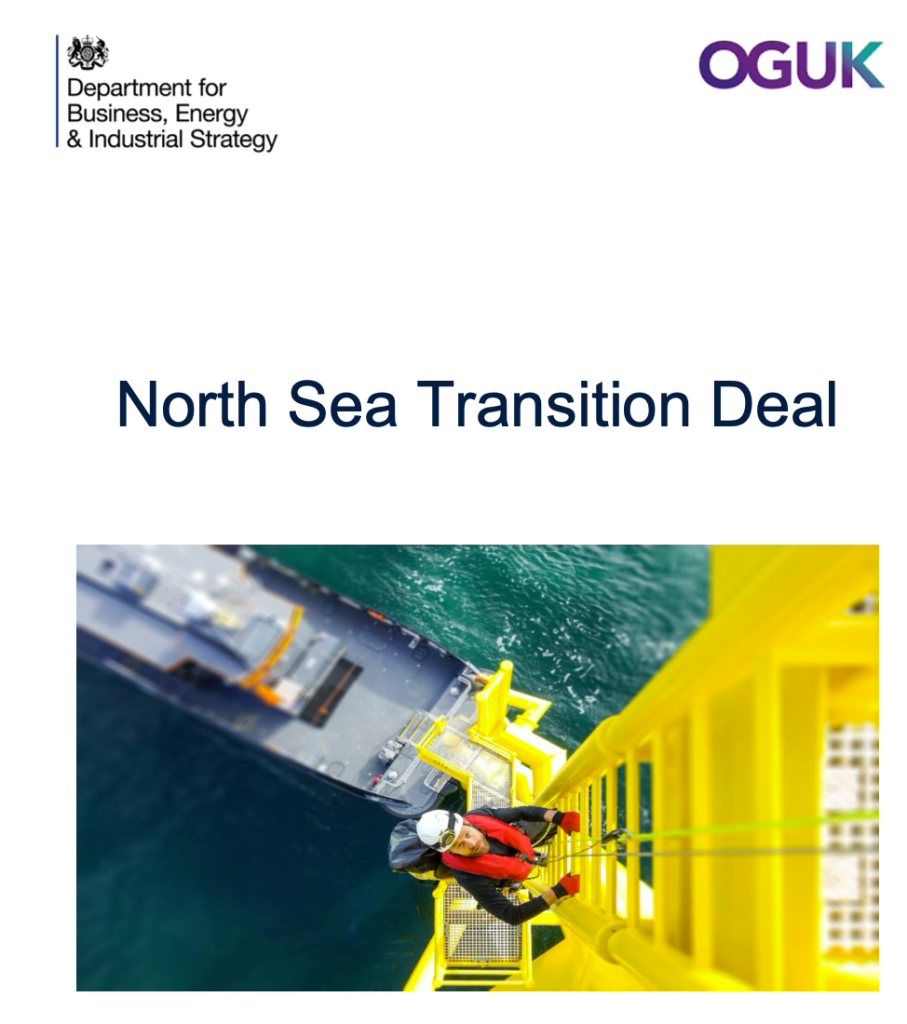
Business as usual

There is a simple reason why the Tories have made these choices.  In the face of the climate and cost of living crises they’ve chosen to protect the interests of big oil.  It’s not just that they won’t tax the enormous profits that are being made from North Sea Oil and Gas – it’s that they are following the logic of the oil industry’s ‘North Sea Transition Deal’.  

A phony deal

The Deal aims to continue the exploitation of North Sea oil and gas up to and beyond 2050.  It talks about a net-zero oil and gas basin where the greenhouse gas emissions from the oil and gas would be captured and stored.  This is not going to happen, certainly not in the next few decades, and the consequence will be that the UK will fail to meet its contribution to restricting global temperature rises.  

Maintaining profits – wasting resources

Following the ‘Transition Deal’ drives high-cost energy options at every step and leaves working people to pay the price.   Under the UK government plan, most of the electricity produced by the new nuclear power stations will be required to produce the hydrogen for domestic heating.  Using electricity to produce hydrogen for domestic heating at large scale is hugely inefficient.  Moreover, nuclear produces much more carbon emissions over its lifecycle than wind or solar.

http://www.pixabay.com CC0

The alternative

There is an alternative.  Electricity produced by wind and solar is already much cheaper than that produced by nuclear, oil and gas and the costs of renewables continue to fall.  The money the Tories want to spend on new nuclear is enough to retrofit most homes across the UK – creating jobs, improving health and well-being, and cutting energy demand.  Moreover, an economy based on renewables results in many more jobs than the fossil fuel and nuclear options.

A challenge for the trade union movement

Right now, industry, unions and both the Westminster and Holyrood governments are signed up to the North Sea Transition deal.  It’s time for a decisive shift in policy.  Just transition, indeed arguably any transition that restricts temperature rises to 1.5 degrees, is incompatible with the ‘North Sea Transition Deal’.  

A new policy for the union movement

Tackling the cost-of-living crisis and the climate crisis means breaking the partnership with big oil that is inherent in the Transition Deal and campaigning for an end to the development of new North Sea oil and gas and the rapid planned phase out of existing fields.  Large-scale investment in renewables and a massive programme of retrofitting would result in lower energy prices and reduced carbon emissions.   A serious plan would include support for the oil and gas work force while they transition to new jobs and ramping up options for reskilling, education and training in the new industries.

No more subsidies

The oil and gas industry has been subsidised heavily over the lifetime of the North Sea.  The subsidies must stop.  Working people are suffering because what they pay for energy fuels super profits for big oil and goes into the pockets of the richest in society whose wealth grows as hedge funds speculate on the oil market.  There’s plenty 

of money to pay for an energy transition.

Among the components of a new policy for the workers movement should be: 

Massive investment in wind, solar and tidal energy.

Large-scale expansion of energy storage options.

No more North Sea development. 

Taking the North Sea into public ownership and beginning a planned phase out of production.

Support for oil and gas workers to transition to new jobs.

Regulate energy prices to consumers and tax big oil and the rich to end the cost-of-living crisis.

COP26 gave us a glimpse of the potential power when the workers movement and the climate movement come together.  Together we can win.

About ScotE3

Check out our website at https://scote3.net The resources page includes short briefings designed to be used in the workplace and created under an open license so that you can modify and adapt them providing you acknowledge ScotE3 as the original source of the material.  We are keen to produce more briefings and we’d welcome suggestions for new briefings and updates to existing ones. We can also provide speakers for trade union branch meetings and discussions. 

Come along to our stall and have a chat.

Why workers and climate activists should reject the ‘British energy security strategy’

Yesterday (6th April) the UK Government announced a new ‘British Energy Security Strategy’.  The shape of the strategy isn’t a surprise with many of the elements being trailed in recent weeks.  Put simply the strategy is a disaster.  It’s a recipe for failing to meet UK greenhouse gas emission targets and ignores the recommendations of the IPCC report that was published earlier in the week (4th April).

This post is a first response, and we will share more detailed analysis in the weeks to come.  

The government’s press release notes that the strategy involves an ‘ambitious, quicker expansion of nuclear, wind, solar, hydrogen, oil and gas, including delivering the equivalent to one nuclear reactor a year instead of one a decade.’  

Note the ‘expansion of oil and gas’.  The aim will be to accelerate the approval of new oil and gas fields in the North Sea and west of Shetland.  Essentially, it’s a doubling down on the oil industries so called ‘North Sea Transition Deal’.  The aim of the deal is to make the North Sea a ‘net-zero’ oil and gas basin by 2050 – but this can only happen if carbon capture and storage can be developed and introduced at large scale, which is as yet uncertain.  

Hydrogen is part of the oil industry strategy – the aim of the transition deal is for hydrogen to replace North Sea gas in domestic and commercial heating systems – these currently account for more than 20% of UK greenhouse gas emissions.  The strategy talks about hydrogen supplying around 10% of energy needs.  What it doesn’t say is that producing hydrogen by splitting methane or water is an enormously inefficient process and so a very significant proportion of all the new electricity produced from nuclear, wind, solar and oil and gas will be needed to produce the hydrogen!

After a period of equivocating on nuclear power it’s now back at the centre of the strategy.   No figures are given, but if we extrapolate from the cost of the current Hinkley C project the proposed developments will cost around £150 billion.  The government refers to nuclear as clean and safe.  It is neither.  This blog has looked at the arguments about nuclear elsewhere.  It’s a hugely expensive form of energy, high risk with long construction times and a history of cost overruns and serious and unresolved problems with radioactive waste.   

The new strategy says nothing about reducing energy demand through insulating new buildings and retrofitting existing housing stock.  Retrofitting the majority of UK housing is estimated to cost around £160 billion – this is roughly what the new nuclear programme will cost.  So, it seems like their plan is to construct large scale nuclear plants whose output will then provide the energy that is lost through the walls and roofs of homes, office and factories.

The supposed rationale for the new strategy is energy security.  Currently working people are paying the price for the super profits being earned by the oil and gas sector.  Led by that sector the strategy opts for a future of high energy prices – continuing oil and gas and new nuclear.  Renewable costs continue to decrease, nuclear energy costs continue to rise.  Currently renewable electricity is 6 times cheaper than gas and the gap is even bigger between the cost of renewables and the cost of nuclear.   

Wind turbines near Carberry – image Pete Cannell CC0

It will be interesting to hear the response from the Scottish Government.  Until now Holyrood has been firmly signed up the North Sea Transition Deal and the oil industry agenda, but it has had a firm position of no new nuclear.  Similarly, it is now crunch time for the trade unions who have advocated just transition while endorsing the Transition Deal Strategy.  The argument at root has been over jobs.  It has been the case for a long time now that large-scale investment in renewables creates far more jobs than the same investment in nuclear.  Yesterday’s strategy announcement means in effect no transition and no justice.  There is an ever more urgent need for the workers movement and the climate movement to work together in opposition to the new strategy (really just the old strategy with more investment in false solutions).  Less than 24 hours after its release the strategy has been widely criticised but we will need to do more than oppose this latest attempt at preserving an unacceptable status quo and reject the North Sea transition deal in its entirety.