
Brian Parkin provides background on the proposed closure of the Exxon Mobile Plant at Mossmorran
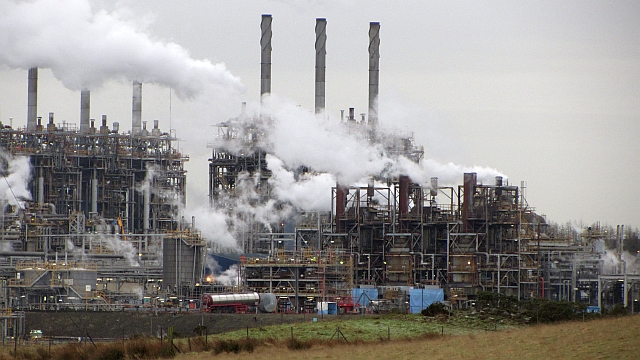
ExxonMobil has announced plans to close the Fife Ethylene Plant (FEP) at Mossmorran in Fife in February next year. Up to 400 jobs will be lost if the closure goes ahead.
The announced closure of the gas treatment plant closure may have consequences upstream for its supply terminal at St Fergus in Northern Aberdeenshire. St Fergus is the landfall terminal for all the gas produced in the Central and Northern UK Continental Shelf fields and the recently opened North Atlantic West of Shetland fields. It also receives gas from the Western Norwegian sector.
- Gas at St Fergus is primarily treated ‘fractioned’ to a standard acceptable for distribution through the UK National Transmission Authority network, which in turn supplies further treated gas into the National Grid. The treatment plant at Mossmorran receives the entirety of its ‘wet’ gas from St Fergus.
- The site and plant of Mossmorran is jointly owned and operated by Exxon/Mobil and Shell UK.
- The wet gas at Mossmorran is divided into two separate product streams:
- Shell separates liquids further to produce methane vial its Fife Natural Gas Plant which is sent into the National Grid network, as well as some chemical feed-stocks for export.
- Exxon/Mobil uses an ethylene plant to ‘fraction’ the wet gas into ethylene as a feed-stock for petro-chemicalproduction via its Fife Ethylene Plant as well as:
- Propane, butane and other liquid gases for further treatment for fuels and also grease and other lubricants.
- Last year Exxon/Mobil produced over 830,00 tonnes of ethylene, over 50% of which was exported to Europe and the US. Until recently Exxon/Mobil used a direct pipeline to Ineos Grangemouth plant.
Braefoot Bay is a private facility which handles almost all of the output of the two Mossmorran operations, and is presently at 85% capacity. It operates under the joint ownership of Exxon/Mobil and Shell UK and is entirely dependent on the export requirements of Mossmorran. The port has two jetties- a deep-water jetty capable of handling 40,000- 80,000 tonne vessels, and the smaller, for 5,000- 10,000 tonne tankers.
The main tanker loading is via floating ‘roof’ tanks are continuously ‘toped-up’ from large quayside storage tanks.
At Mossmorran, there are around 90 directly employed in control rooms and plant management. with most engineers, electrical and welders etc being subcontractors directly employed with Balfour Beatty. Virtually all Balfour Beatty workers are members of Unite.
Discover more from Employment, Energy and Environment
Subscribe to get the latest posts sent to your email.
 Employment, Energy and Environment