NFLA Seminar on just transition

On Friday 10th May I attended the Nuclear Free Local Authorities (NFLA) Scotland Spring Seminar in Dundee on behalf of Scot.E3. The subject of the seminar was ‘Dealing With Climate Change, Just Transition and Divestment Issues’.

The four presentations grappled with issues of just transition and sustainability from a local authority perspective:

You can use the hyperlinks to access the presentations. NFLA have also produced a useful briefing on some of these issues – ‘Climate Emergency’ Declarations and the practicalities in Local Authority Action to go ‘Carbon Neutral’

Eileen Cook

46798793304_28f8245813_z


Energy from Waste

The UK’s Green Investment Bank had a short and inglorious history; founded in 2012 it was privatised in 2017.  The private company is now called the Green Investment Group – a wholly owned financial arm of the Australian development company Macquarie. The company also owns the formerly US owned incineration company Wheelabrator.  The group is playing a role in energy from waste schemes.  In Scotland the Green Investment GroupIG has taken an equity risk of 50% capital in the Earl’s Gate EfW CHP project at Grangemouth. Wheelabrator incineration is at the heart of the project.  Earl’s Gate boasts the capacity to ‘treat’ more than 20% of Scotland’s municipal waste.  Local authorities are being drawn into long-term and dubious ‘green’ capital projects with virtually no public debate.

The evolution of the Green Investment Bank is a salutary lesson in what happens when policy initiatives are based on market ideology.

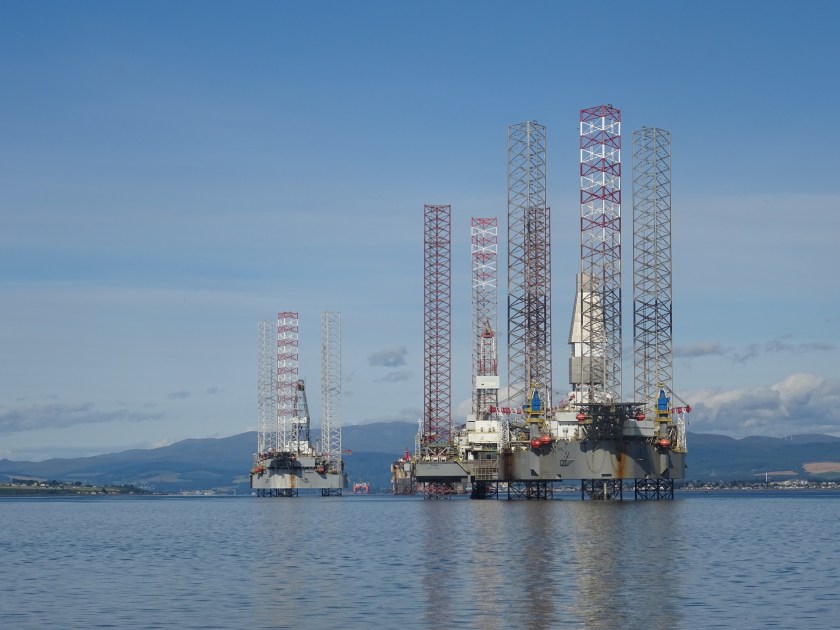
geograph-5887688-by-Derek-HarperImage by Derek Harper CC BY SA 2.0 https://www.geograph.org.uk/photo/5887688

A SHOCK TO THE SYSTEM

An Energy Policy Consultation paper – A shock to the system – the case for a publicly owned and democratically accountable Scottish energy company

In 2014 the Scottish government initiated an energy policy review. The purpose of this review was to examine the present state of Scotland’s energy economy and consider future options in the light of both a looming climate crisis and also the optimum strategy for replacing ageing fossil fuel and nuclear generating capacity with a range of renewable technologies.

In 2017 in order to ensure employment and fuel poverty issues were taken into account in this review, an infant SCOT.E3 decided to submit its own paper in an attempt to ensure that a full spectrum of related energy and environmental issues were incorporated into a memorandum of evidence.

Yet five years on and despite an almost universal acknowledgement of an accelerating climate crisis, little has been done- in practical terms- to address an impending environmental disaster and its related social and economic consequences. Also, within the intervening period, we have seen the commercial collapse of the BiFab renewable power technology company at Burntisland as well as the continued interest of the petro-chemical company Ineos in activating its shale gas fracking options to the point that it will feel confident to test the validity of the current Scottish governments ‘anti-fracking’ moratorium.

So it is against this present uncertainty that SCOT.E3 is now initiating another energy policy review to which it invites all interested parties to participate. The aim of this exercise is to re-examine the range of issues needed to be addressed; a renewable energy economy and the availability of appropriate technologies, the issue of fuel poverty and affordability of energy, energy efficiency, energy related employment and just transition possibilities regarding current energy and defence related employment, improvement of housing stock and carbon neutral public transport systems- to name but a few.

And as can be seen from the attached paper, SCOT.E3 have made a start in outlining the historical record of electricity generation and supply in Scotland in order to reinforce the case for a major stage in meeting Scotland’s forthcoming energy and environmental needs- a long promised Scottish state owned energy company.

We are therefore inviting you to participate in this exercise by adding your comments and/or contributions under the section headings so far left blank. This is to ensure that any report fully takes into account the range of opinions that truly reflect the technical and scientific know-how- as well as the concerns of environmental, community and trade union campaigns and interests engaged in these vital and urgent issues.

In order to ensure that this exercise is properly democratic, it is our intention to hold a consultative meeting for all consultees in the near future, as well as a major workshop type conference in the autumn.

We hope that you find the introductory notes both useful and of interest and we look forward to hearing from you in the near future. For any further information please contact:

SCOT.E3 at www.scote3.wordpress.com, email triple.e.scot@gmail.com 

Untitled

STUC Fringe Meeting

The Scottish Trades Union Congress meets at the Caird Hall in Dundee from 15th – 17th April.  Scot.E3 is contributing to one of the fringe meetings:

Developing Sustainable and Socially Useful Jobs in Today’s Economy 
Wednesday April 17 at 1230pm
Committee Room 2 City Chambers
Pete Roche – research officer  – Nuclear Free Local Authorities
Speaker from Scot.E3
Meeting organised by Scottish CND

wind-energy-488534_1280

American Climate Rebels

A post from REEL News

In 2018, Reel News went on a 14 week tour of North America to look at grassroots struggles around climate change, particularly struggles around a “just transition” from fossil fuels to renewable energy, where workers and communities control the process so that they benefit from the transition, and around “just recovery” – recovery from extreme weather events which do not exascerbate current inequalities.

What we found were inspiring and visionary struggles all over the continent, led by working class communities of colour, with people organising just transitions and just recoveries themselves. Now, we’ll be presenting what we found in the form of a weekly online 11 episode series starting on Sunday April 14th – 7pm UK time, 3pm New York City time, Midday California time.

Episode 1 is about Alberta, Canada, where the long oil sands boom  has come to an end. Falling oil prices are leading to thousands of job losses – which has started a serious conversation in the labour movement about transitioning away from oil to renewables. The need is becoming more urgent as the big oil sands companies look to maximise profits and slash even more jobs through automation. This film looks at a number of initiatives, the history of oppression of First Nations people to get the resources in the first place, and a rare chance to hear from oil sands workers themselves, including women and First Nations workers.

With the current growing uprising over climate change giving renewed hope, we’re hoping that this will not only inspire you further – but will also help a little in putting the idea of just transition at the forefront of the movement.

Action points and information from the March 21st Scot.E3 meeting

Action

Climate Jobs Bloc on the Edinburgh and Glasgow May Day marches (4thMay Edinburgh, 5thMay Glasgow).  PC and KW to liaise over text of invite to unions and environmental activists to join the march.  PS has spoken to graphic designer about producing artwork for a climate jobs banner.

On Sunday May 5th there will be a Book fair at the Kirkgate Community Centre in Leith as part of the May Day events.  We could have a side room to show films/ hold discussions.  Agreed that perhaps we should have two fixed times for discussion.  REEL News may be able to attend. More details to follow.

BP explained about the ‘Lucas Plan’ group in England. We’ve been invited to speak on Just Transition at a conference in Manchester on April 13th.  BP can attend – DS may also be able to – anyone not at the meeting who is interested in going please email to let us know.

Draft of blog post responding to the GMB’s criticism of the Just Transition Commission is now complete – agreed to circulate more widely and then publish after any further amendments are made.

STUC conference in Dundee 15th – 17thApril.  We’ll speak at a joint fringe meeting with Scottish CND. Joe Pisani has agreed to speak. PC will check if it’s possible to have another contribution to say something about ScotE3.  Agreed that we should prioritise having a woman speaker for this.  Please let us know if you are going to be at the conference or can attend to help with leafleting.

We’ve been invited to speak to the Edinburgh Green Party on Climate Jobs and Just Transition on Thursday 25 April.  Agreed that it would be useful to focus on these issues in terms of local action – eg housing.   We can do this as a collective contribution rather than just one voice so if you’d be interested in helping please email.

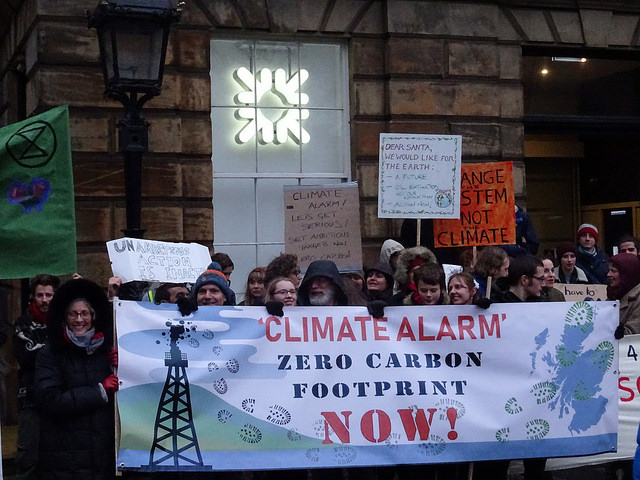
Agreed to publicise and support the Climate Rally at the Scottish Parliament on 2ndApril, 12.30 to 2pm as MSPs discuss the new Climate Bill.

Agreed that discussion on an autumn conference should be a main agenda point at the next organising meeting

Agreed that over the next few days we would work on two new blog posts/briefings – one on the Energy from Waste Schemes that are currently being built and one on the proposed State Energy Company – if you’d like to contribute to either of these projects please email to let us know.

Information

It’s planned that the next Glasgow meeting will be a public meeting on Public ownership.

Glasgow activists are looking to source Scot.E3 tee-shirts

Recent posts on the Scot.E3 blog include ‘Reflections on BiFab’, ‘Unlocking the jobs potential of zero carbon’ and “Fuel Poverty, Energy and the fight for Climate Jobs’

After it’s first meeting future meetings of the Just Transition Commission will be on themed topics.

Next School Students Strikes are Friday 12 April

Reflections on BiFab

…working people, their lives, livelihoods, skills and commitment are central to tackling the climate crisis …

Occupying for jobs

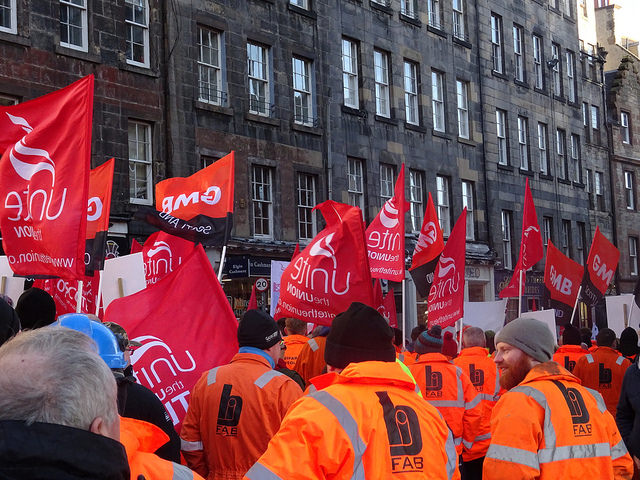
In December 2017 BiFab workers from Burntisland, Methil and Lewis staged the biggest industrial protest in Scotland for many years. With site occupations and a mass protest to Holyrood, they forced the Scottish government to secure funding for the remaining contracts building jackets for the new Moray Firth wind farm. For a brief moment it seemed that jobs had been saved and BiFab might become an exemplar of the much-needed transition from offshore oil and gas to wind and tidal energy.
26683868759_9d8dfe867c_z

Hopes dashed

Hope was short-lived. Of a workforce of 1,400, only some 390 workers were in direct employment: the rest were on short-term agency contracts. In early 2018 there was a rapid run down of employment as contracts were not renewed and the Moray Firth contract was completed. A Canadian company acquired BiFab and the Scottish government converted its loan into equity, but no new orders were found. By May 2018 only 43 workers were left and a further 35 redundancies meant that only a handful were left to maintain the yards.

The need for political intervention

Behind the scenes the new owners, with the support of the Scottish government have been bidding for contracts to produce turbine jackets and platforms for the new Moray East and Kincardine offshore wind developments. But this month hopes of renewed large-scale employment were dashed when it emerged that these contracts had gone to companies in the UAE, Belgium and Spain. All that remains is 82 jobs at Arnish on the Isle of Lewis. Unite Scotland Secretary Pat Rafferty commented:

“Ten years ago we were promised a ‘Saudi Arabia of Renewables’ but today we need political intervention to help level the playing field in Scottish offshore renewables manufacturing. The truth is that state funded European energy and engineering firms, backed by Far East finance and Middle East sovereign wealth funds, are carving-up thousands of jobs and billions of pounds from our renewables sector, and firms like BiFab are left fighting for scraps off our own table.”

Missed opportunity

We are at a critical moment, when rapid action to mitigate catastrophic climate change is essential. To move towards a zero carbon economy the marine engineering skills of the BiFab workers are vital. We know that transition needs around 100,000 new climate jobs in Scotland. BiFab is a missed opportunity for action that effectively sets us back by more than a thousand jobs.

A just transition

Could things have been different? For a few days in December 2017 the BiFab workers inspired many beyond their ranks. The Scottish government’s rapid response reflected the strength of feeling and the severity of the jobs crisis. But fatally it depended on the private sector. In our view the scale of the climate crisis cannot be left to the vagaries of the market. We are not alone in this view and indeed the Scottish Government’s proposal for a state run energy company is in part recognition that public intervention is required. However, the current proposals are limited to taking the role of an alternative energy supplier. Much more is needed. We argue for a strategic, integrated and planned approach that encompasses production, infrastructure and distribution. BiFab could have been the first building block of this strategy.

The point of this article, however, is not to muse about might have beens. The school student strikes and the growth of Extinction Rebellion have highlighted the need for urgent action. In our view urgency requires that every possibility for action be pursued. Just Transition isn’t an abstract idea. It means understanding that working people, their lives, livelihoods, skills and commitment are central to tackling the climate crisis. Vast sums of money were used to bail out the banks, trillions of dollars were spent on the wars in Iraq and Afghanistan – the cost of keeping the BiFab workers in publicly run, regulated and decently paid employment would have been trivial in comparison. Let’s learn from this and ensure that the agenda in the coming months becomes the creation of new jobs and not a lament for jobs laid waste.

37574204465_97e9e271a4_z


‘Unlocking the job potential of zero carbon’

‘Unlocking the job potential of zero carbon’ from the Green European Foundation is a valuable addition to the evidence base that a socially just transition to a zero carbon economy is practical and possible.   The authors model the impact on jobs, short-term (during the transition) and long term, of moving to zero carbon by 2030. The estimates they provide are conservative – they don’t consider the additional employment that would be created by the additional economic activity – they don’t consider jobs in the supply chain and they don’t include activity for which rigorous data is unavailable.

The new report’s approach is not identical to the work done by the Campaign Against Climate Change published in the Million Climate Jobs Pamphlet. However, their forecasts for the whole of the UK are very similar.   They expect 980,000 additional jobs will be required during the transition reducing to 710,000 after zero carbon is reached. New jobs are calculated on a regional basis with a full breakdown available in the report’s appendix. The number of new jobs during the transition is estimates as 60,946 falling to 26,905 in the long-term.

44414766780_2d28a453ac_z


Notes from the February organising meetings

We met on 20th February in Glasgow and 21st February in Edinburgh.  Here’s the composite notes of the discussion at the two meetings.  If you have any questions about any of the points or if you’d like to get involved in  any of the proposed activity do email on triple.e.scot@gmail.com

Action points and information from the February Scot.E3 meetings in Edinburgh and Glasgow

Proposals for new briefings including:

  • Public Ownership and the proposed state energy company (AM, Glasgow to contribute) – MD, Glasgow to contact Andy Cumbers to see if he would write something for the blog.
  • Update on Fuel Poverty (MT, Edinburgh to contribute)
  • Housing – PC, Edinburgh to contact SH and IW to seek advice, help and information.

Other action

  • GH, Glasgow to report back on Glasgow City Council and Climate Emergency Declaration
  • AM and GH talking to XR Glasgow with a view to organising a Scot.E3 presentation to the group, AM also talking to Unite activist group
  • Agreed to publicise and organise a climate jobs bloc (suggested by activists from FOE Scotland) on the Edinburgh and Glasgow May Day marches (4th and 5th May) – PC, Edinburgh to source banner and t-shirts
  • BP, Edinburgh is liaising with ‘Lucas Plan’ groups in England over ScotE3 representation at a divestment event and a possible joint autumn conference in Scotland
  • BP to produce a draft response to the GMB position on Just Transition
  • PC to send Climate Jobs manifesto to Just Transition commission and seek and opportunity to contribute to the discussion
  • School student strikes – we handed out cards with ScotE3 website details at the Edinburgh rally and they were very popular. We should repeat this on 15th March when the next strikes are due. CM and PC are involved in Our Forth who have organised a banner making session for school students in Portobello on 10th March
  • Scottish TUC conference in Dundee (15th – 17th April) – agreed to leaflet conference PC and BP available (other volunteers welcome) and to hold a fringe meeting if possible BP to contact JP to see if he can speak, PC to find venue – agreed to produce conference packs for delegates if possible
  • Continue to work on the climate jobs pamphlet

Information

Since the January meetings – we have had the opportunity to join the panel at a Just Transition event organised by Bella Caledonia and DeSmog UK and contribute to a Transitions Edinburgh event

It’s likely that a climate jobs and education motion will go to the EIS conference in June

Scottish CND are organising days of action in 2019 to highlight the ways money saved by scrapping the Trident nuclear weapon programme could be better spent on essential public services in Scotland. March – Housing, April – Climate, May – Jobs, June – Infrastructure, July – NHS, August – Education

Next meetings: Edinburgh – Thursday 21 March 7pm at the Quaker Meeting House, 7 Victoria Terrace. Glasgow date to be confirmed – likely to be topic based public meeting

40138052903_b01c86cc91_z

School students protest at Scottish Parliament – Feb 15th https://www.flickr.com/photos/petepolitics/sets/72157706685945575

More on Hunterston

On 10 January we wrote a short blog post on the dire state of the Hunterston B nuclear reactors and reported on a meeting where environmental radiologist Ian Fairlie spoke about the risk this poses to the population of central Scotland and beyond.

Ian Fairlie was back in Edinburgh on February 5th to provide an update on developments. Along with a colleague he had presented a technical report to the Office for Nuclear Regulation (ONR) – the regulatory body that has to give EDF permission to resume operations at Hunterston. The ONR agreed with the substance of his report. Apparently the inspection of the reactor core suggests that a small number of the graphite blocks have double cracks but more than expected have multiple cracks.   It also transpires that Hunterston in fact has only one safety back up system rather than two – as became the norm in the later Advanced Gas Cooled Reactors (AGRs). Overall the ONR’s view of the current state of the reactors is even bleaker than Ian Fairlie had suggested in January. And in the face of this EDF are lobbying for reducing the accepted risk factor for the reactors by a factor of a 1000.

There is almost no chance that the reactors will be restarted in March and April as EDF have stated. This gives more time to continue to raise awareness of the safety threat they pose and to get the Scottish Government onside in a campaign to ensure the reactors are never restarted. There is no immediate threat to jobs because it takes some years for the reactors to get to a state where decommissioning can begin. This is a test case for Just Transition, however, and we need to campaign that over time the workforce is supported to move into sustainable jobs.

As we mentioned in January EDF are hugely in debt. They are desperate to restart production – not least because they have problems with their other AGRs. So they will fight the closure of Hunterston. Adding to their problems though is that, unreported and unmarked in the mainstream media, the Tories at Westminster are in the midst of a U-turn on nuclear. Although for the moment they cling on to idea that Hinkley C can still be built.

To find out more about why Hunterston is so dangerous read our latest Briefing 9.

radioactive-39665_1280