
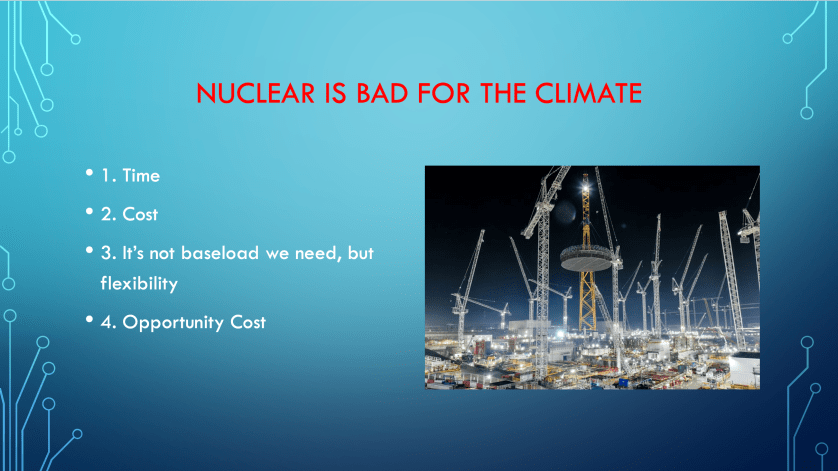
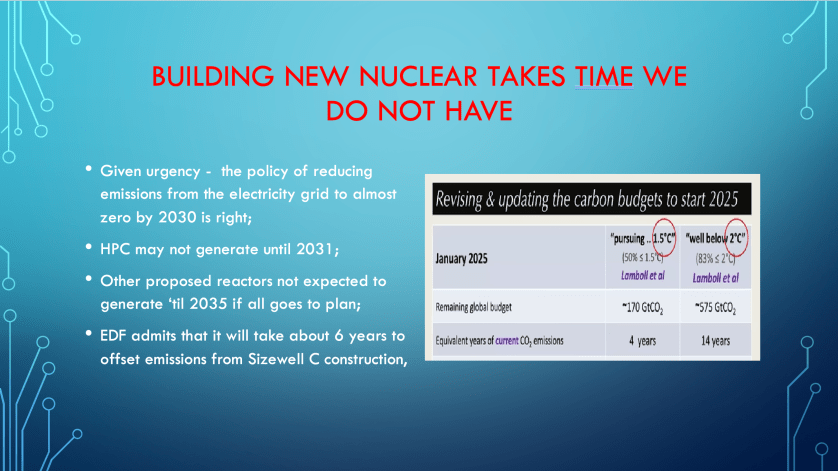
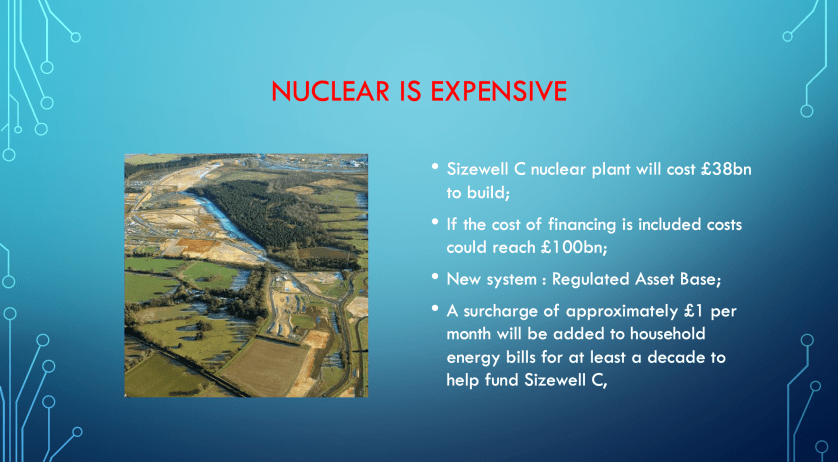
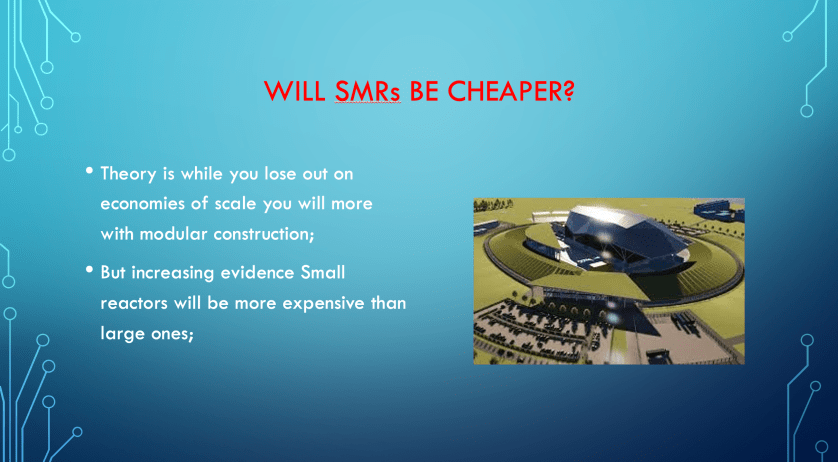
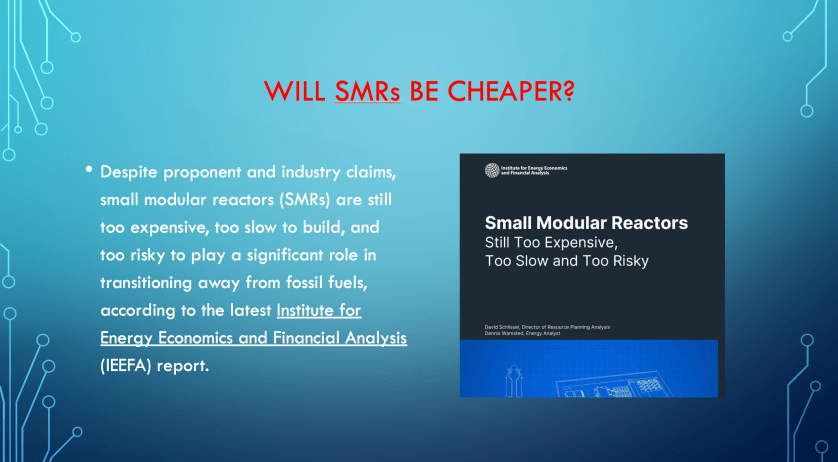
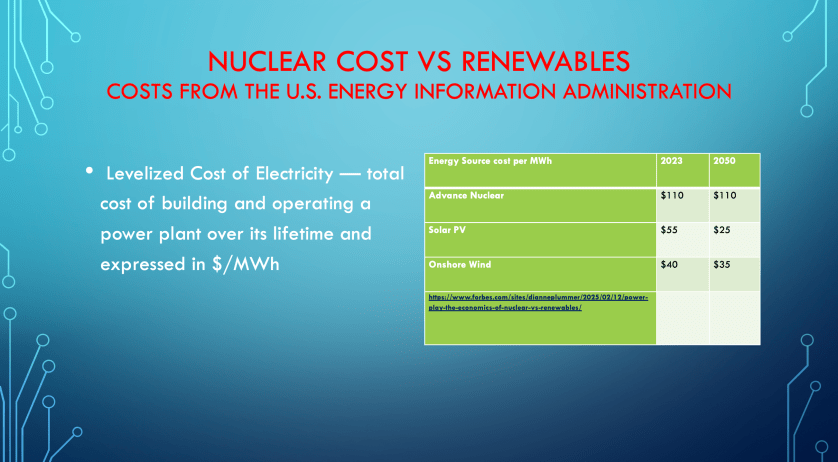
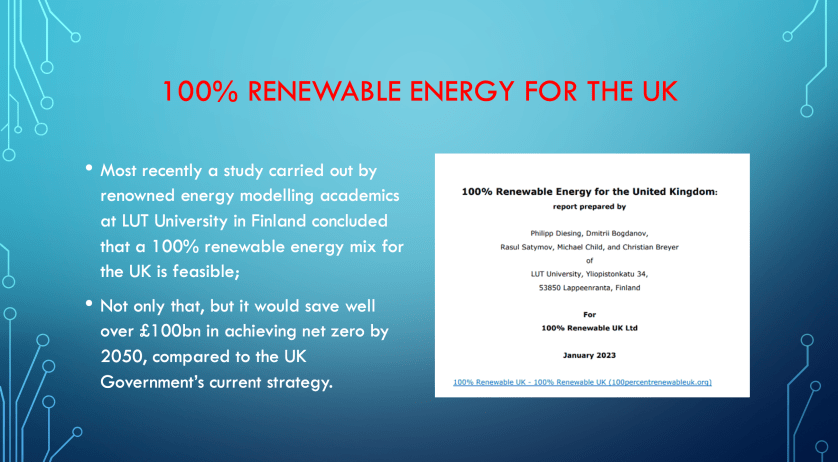
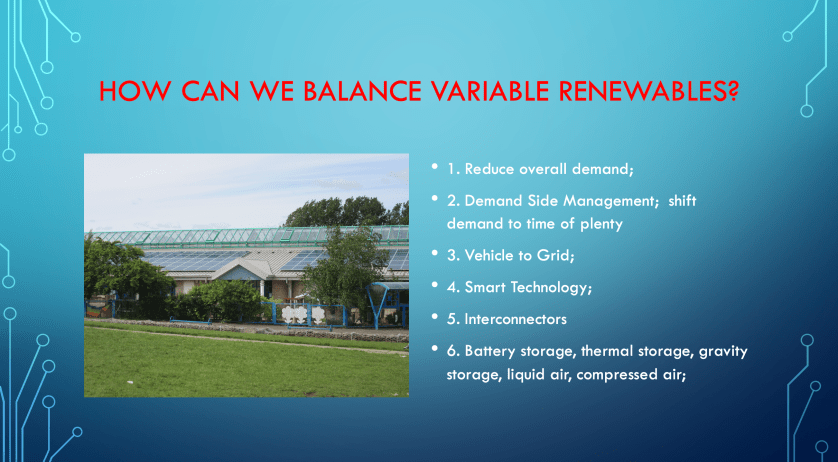
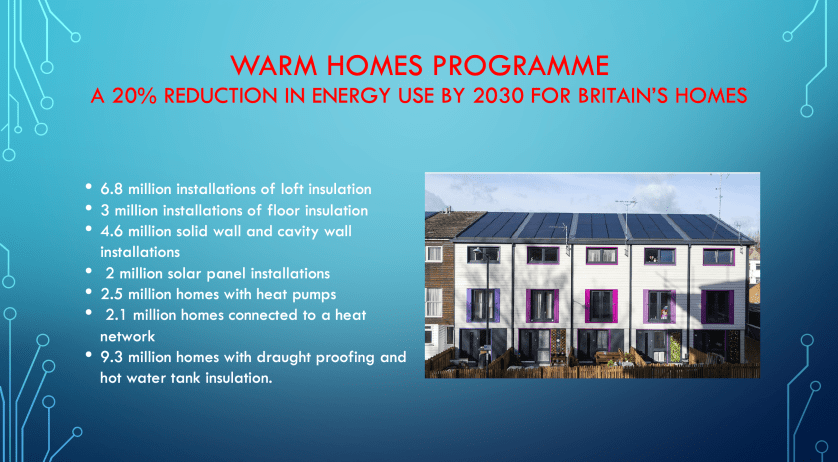
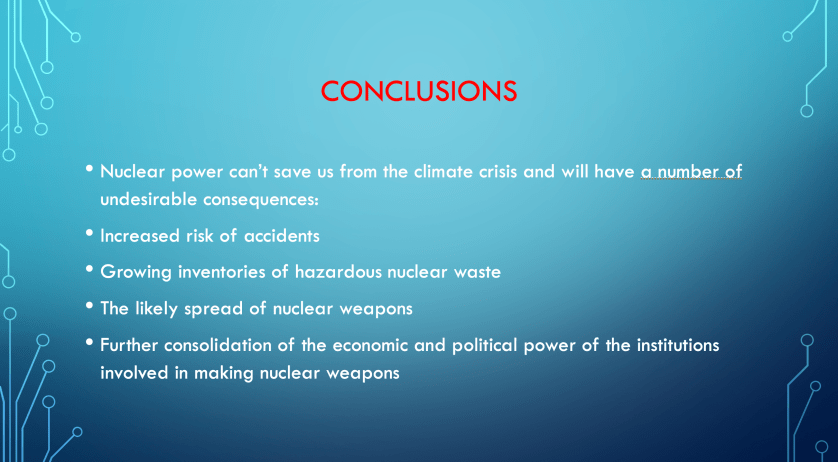
At the Scot.E3 conference in Edinburgh on 18 October 2025 – Pete Roche led a workshop on nuclear power. These are his slides.








Pete produces a news digest Daily Nuclear, Energy and Climate news you can subscribe to it here.

Pete Roche’s slides from the workshop on nuclear power at the Scot.E3 conference
At the Scot.E3 conference in Edinburgh on 18 October 2025 – Pete Roche led a workshop on nuclear power. These are his slides.
Pete produces a news digest Daily Nuclear, Energy and Climate news you can subscribe to it here.
Ideological delusions and military secrecy that this generated has left Britain with one of the most uneconomic and unreliable power generation liabilities on the planet
The second part of an article by Scot.E3 activist Brian Parkin which was first published on the rs21 website on August 18, 2023. It (and the first part) provides useful background for the discussion on nuclear power that took place on October 18 2025 at the Scot.E3 conference.
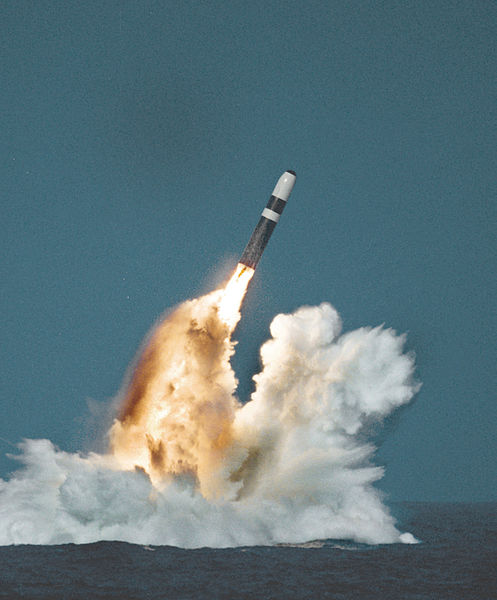
In the first part of this short series, Brian Parkin showed how Britain’s nuclear power programme was a consequence of a nuclear weapons project intended to maintain Britain as a top flight imperialist nation. Here he explains how the ideological delusions and military secrecy that this generated has left Britain with one of the most uneconomic and unreliable power generation liabilities on the planet.
British governments after 1945 pursued a consensus of national recovery based on the re-energising of a depleted economy via new technologies and a welfare state social contract, to drive up productivity and profits to a level capable of sustaining Britain as a world power.
But the post-war ‘spheres of influences agreement’ of 1945 between the USA, Russia and Britain rapidly gave way to the Cold War and a new arms race. The Cold War divided the world into two armed camps, and with the formation of NATO in 1949, much of western Europe fell under the leadership of the USA against the Soviet Union and its Warsaw Pact allies. A year later, with the outbreak of the Korean War, it became clear that sections of the US military were lobbying for the use of nuclear weapons as first strike options.
What was clear within this new order was that Britain’s sphere of influence had dissipated into that marked out by the US nuclear super-power. But Britain nevertheless persisted with its own atomic bomb programme, as well as a V bomber programme as the means of delivering it. For Britain’s cold warriors, this was central to a military first-strike nuclear capacity which would keep them on a par with the USA. As the armed forces Chiefs of Staff Committee put it: ‘If we did not develop megaton weapons (hydrogen bombs), we would sacrifice immediately, and in perpetuity, our status as a first-class power’
This ambition was under-written by a total of six Magnox reactors – two at Calder Hall (now Sellafield) and four at Chapelcross in Dumfries – which were central to western plutonium production for H-bombs. By 1958 these reactors had a total capacity of 250 Mw of electrical output. But like the commercial Magnox stations to follow, these reactors proved at times to be unreliable, and the technology posed dangerous challenges. And while Britain was a useful source of cheap plutonium, the USA harboured doubts regarding Britain’s ability to sustain both the empire and a first strike nuclear capability.
Then in 1958, the first British H-bomb test took place on Christmas Island in the Pacific. This was followed by an amendment of the US-UK Mutual Defence Agreement, mainly as a means of controlling British nuclear activity by limiting its share of targets within USSR airspace. For a while the plutonium deal with the US remained a one-way street, until UK nuclear strategy became based almost entirely on H-bombs. This now meant the Britain becoming dependent on the US for its supply of tritium (an isotope of hydrogen) necessary for completing the reaction implosion, and thereby boosting the nuclear yield. This was the first stage in the unravelling of the myth of Britain’s ‘independent’ nuclear weapons.
Perhaps the most farcical aspect of the nuclear ‘special relationship’ was the complete American control over Operation Blue Danube – the joint USA-UK European nuclear attack plan. This gave the USA the power of veto over any first strike by the RAF. Overall American command of Nuclear Forces Europe meant that all nuclear weapons, even those at RAF V bomber bases, were in practice American property. All nuclear weapons manuals, fuses, fuse locks and fuse codes were kept in a secure vault on the RAF base, and the agreement provided that ‘…in the event of any RAF personnel attempting to obtain any secured items without superior and strategic authorisation, the [American] marine guards should exercise the duty to shoot (him/her/them) dead’.
Following the successful production of plutonium from the initial Magnox reactors, the Labour governments of the 1960s decided to proceed with a large-scale civil nuclear power programme. Any doubts regarding the costs of this venture were set aside by the strategic ‘need’ for plutonium, and the belief in nuclear power as protection against a possible miners’ strike. Given such strategic values, even the most basic cost-benefit analysis was regarded as wholly unnecessary.
But in 1988 all of the UK’s nuclear power secrets fell onto the desks of the National Union of Mineworkers Research Department, with the performance and costs of every reactor revealed. They showed that Magnox units constructed under ‘even under the most favourable and lowest Treasury discount (interest) rates, had at best performed at twice the cost of coal-fired stations’. They were hopelessly inefficient, in large part due to inherent design flaws such as fuel-rod alloys with a tendency to react explosively on contact with water, and graphite cores which could start to burn at high reactor temperatures. For these reasons, Magnox stations had never run at full capacity.
The figures were even more dismal for the second generation of Advanced Gas (cooled) Reactors (AGRs). Intended to run continually while being re-fuelled, these reactors experienced both fuel rod and control rod jamming. Steam temperatures were rarely optimal and heat exchangers often over-heated. These flaws combined to make them impossible to run at anything like full capacity, with utilisation sometimes as low as 18%. EDF, which would later take them over for almost nothing, described them as ‘basket cases’. One Treasury official in the run-up to electricity privatisation described them as ‘…the most expensive engineering folly ever under-written by the UK taxpayer’.
The super-power dreams embodied in the V bombers had quickly foundered on Russian advances in air defence. With the shooting down of a US spy-plane high over central Russia in 1960, it was clear that no RAF plane with atom-bombs was going to reach its target. In a way this suited some American strategic thinking, as shown by a White House directive of April 1961 which called for a ‘downgrading’ of the ‘special relationship’ and for ‘forcing a greater UK integration into Europe’.
This allied integration could best be hurried by ‘not prolonging the UK bomber force’– a task quickly achieved through the American failure to complete air-launched missiles upon which the RAF pinned its future strategic role: first Bluestreak (abandoned in 1960) and then the Skybolt (scrapped 1961). But the US was sensitive regarding ‘The UK’s loss of prestige and self-esteem’, hence the sop to share in its Polaris nuclear submarine deterrent, by basing the American vessels at Holy Loch, just 25 miles from Glasgow.
The eventual privatisation of the UK electricity industry went ahead in 1990, but only on the basis of the government footing the bill for untold nuclear liabilities, and the power stations themselves being split between two companies: Magnox Ltd, a wholly government operation set up prior to the oldest stations being handed over to a Nuclear Decommissioning Agency; and EDF, which acquired the AGRs for a notional peppercorn price, and was also allowed to operate its own power sales company.
The British nuclear power project arose from what was essentially an imperialist H-bomb imperative. As such, it escaped any public economic scrutiny. Instead, it became a key component of the post-1945 great British super-power illusion. Failures in the Magnox reactors were denied because their main job was to produce plutonium for the British nuclear ‘deterrent’. That same arrogant disregard of accountability and high secrecy still marks the nuclear power project to this day.
And now of the AGR fleet, only Heysham 2, Hartlepool and Torness remain in operation, up to 2028, at which point the highly subsidised Pressurised Water Reactor at Sizewell B (the only one ever built in Britain) will be the only pre-privatisation nuclear station left running. When they close, the costs of decommissioning will fall to the tax-payer, a bill that may well run into the next century. But we can be certain of one thing: the plutonium breeding reliabilities of Calder Hall, Chapelcross and the undisclosed number of ‘civil’ Magnox’s. Because somewhere at the leaking, creaking and decaying Sellafield complex, there are 139 metric tonnes of the deadliest material known to humankind with a half-life of 82 million years.
Why is nuclear power, a persistently failed energy technology, still so important to the British ruling class.
This article by Scot.E3 activist Brian Parkin was first published on the rs21 website on July 22, 2023. It (and its second part) provides useful background for the discussion on nuclear power that took place on October 18 2025 at the Scot.E3 conference.

After seventy years of scientific effort and countless investments, the holy grail of ‘electricity too cheap to meter’ remains as elusive as ever. Here Brian Parkin searches for reasons why a persistently failed energy technology is still so important to the British ruling class.
The Attlee Labour government of 1945-50 was committed to both a radical social policy programme at home and a colonial-imperialist continuity project abroad – the latter very much approved of by the British ruling class. Before the end of World War II, allied summit conferences at Moscow, Tehran and Yalta had produced a post-war agreement on ‘spheres of influence’ where the USA, USSR and Britain would control their respective allies, colonies, protectorates or dominions as spoils from their joint wartime efforts. But this was not an alliance of equals: the USSR was economically devastated, Britain was economically exhausted, while the USA was on the edge of what was to become the biggest and most protracted economic boom in the history of capitalism.
The USA had also, via the ‘Manhattan programme’, acquired the most devastating weapon ever – the nuclear bomb. Despite the involvement of UK scientists, the USA was initially not prepared to share its bomb making secrets with Britain. And furthermore, the USA was against the UK and France retaining their colonial empires.
A clandestine British nuclear programme had begun in 1940, and with the involvement of British scientists in the US nuclear project, the idea of ‘catching up with the Yanks’ almost counterbalanced the losing of empire, and led to hopes of a recovery of imperial status by other means. So it was not long before construction began on a nuclear facility at Windscale in Cumbria (renamed Sellafield in 1981), along with what was initially the highly secret facility at Aldermaston in Berkshire.
These developments arose from a secret decision taken by a small meeting – GEN 75, in January 1947 – when despite an austerity economy it was agreed that the UK should defy the USA’s intransigence and go ahead with its own nuclear weapons programme. As Ernest Bevan, Foreign Secretary and former right wing union boss said: We’ve got to have this thing over here. We’ve got to have the bloody Union Jack on top of it!’
By 1950 a reactor at Windscale had produced highly fissionable uranium235 (the ‘active ingredient’ of an atomic bomb), and by 1952 had produced enough for the first British bomb test on October 3 that year. Then, by stepping up its Magnox reactor programme, Britain was able to produce sufficient plutonium239 for a hydrogen bomb test on May 15 1957. But this came at a high cost. On October 10 1957 Unit One of a Magnox reactor core became over-critical, to the extent that its graphite core caught fire, and for three days released the highly dangerous isotope iodine131 to the outside atmosphere, which on a conservative estimate caused over 400 cancer deaths.
News of this incident was kept confidential, mainly to prevent information getting to a USA government unconvinced that Britain would be a reliable nuclear partner. This was a particularly important as by then a considerable proportion of the plutonium for the USA’s weapons programme was coming from the UK Magnox reactors.
In 1945, largely at the instigation of the USA, the United Nations held its inaugural session in California. As the war’s biggest victor, the USA wanted to legislate for a world fit for American capitalism. The United Nations gave this a semblance of legitimacy, though it was dominated by a Security Council mostly composed of American allies. And although Britain was on the Council, fear for its fading imperial lustre spurred the Labour government to press ahead to become a paid-up member of the ‘nuclear club’.
But nuclear club membership was nothing without a means of delivery. So in 1947 the government instructed the Royal Air Force to issue specifications and tenders for a new generation of jet-powered long-range, high altitude bombers capable of carrying and dropping nuclear bombs on what, by now, were going to be Russian targets.
By 1952 the UK’s first nuclear-capable bomber – the Vickers Valiant – flew. At that time, the intention was to keep at the forefront of a Western first-strike nuclear alliance, while never forgetting the longer-range requirements of rule over what was left of the empire, and the Commonwealth – hence the presence of V bombers in Rhodesia (the colonial name for Zimbabwe) and Malaysia as late as the mid-1960’s.
By 1964, the RAF had an incredible 159 total of Valiant, Vulcan and Victor bombers, each capable of being airborne in three minutes and in Russian airspace within 72 minutes. However, Russian air-defences had improved to the extent that the V bombers’ maximum altitudes rendered them sitting ducks by around 1965. So then a medium-range series of joint US/UK air launched missiles was considered, only for the US to pull out of the project. The Vulcans last flew in the Falklands war in 1982, carrying out a long-range and not very successful bombing of Port Stanley Airport, before being taken out of service.
On August 27 1957, a small Magnox reactor on the Calder Hall site at Windscale had some of its secondary coolant steam diverted through a turbine to mark the beginning of the world’s civil nuclear power age. The initial contribution to the National Grid was an intermittent four megawatts (then enough to power some 4,000 homes). The idea of nuclear power from a weapons grade plutonium reactor had arisen due to the sheer waste heat given off, and the huge effort required in cooling the process to a safe level.
This ‘seminal’ event was the first step to what was untruthfully called a peaceful civil nuclear power age. What it rather was, was the continuation of a plutonium programme with a significant power byproduct. The military-civil linkage was still intact – as was the superpower nuclear delusion which had spawned it.
The modest Calder Hall event gave rise to a speculative frenzy of nuclear optimism. The very idea of power from nuclear fission created an aura of technological supremacy, and the illusion that Britain could become a leadership nation unafraid of the challenges of power and the military means of exercising it. Because something like that kind of ideological hubris must have fuelled what came next.
In 1959 it was agreed to proceed with a nuclear power programme with a technology ‘proved’ by the Magnox experience at Windscale. This meant a generation of new reactors fuelled by ‘natural’ uranium with graphite moderated cores and with a primary carbon dioxide cooling system. But although the main aim of the new Magnox stations was the production of electricity, some plutonium would be a secondary byproduct.
At this point it is worth recalling the political/economic situation the fading British empire had to face. In 1956, a failed military intervention by Britain and France had failed to resolve the ‘Suez crisis’, sparked by the fear of losing of the Suez canal as a gateway to Asia and Gulf oil supplies. At this point a government committee decided that for energy security reasons, it was decided that Britain would require 6,000 megawatts of nuclear capacity by 1965.
This bizarre reasoning – Britain did not use oil for power generation – was primarily rooted in a ruling class paranoia, which saw nuclear power capacity as protection against a possible miners’ strike. Here nuclear power provided balm to a fading imperial delusion and a deep and abiding fear of organised labour. In Part 2 we shall see how ignorance, hubris and fear continue to fuel the British nuclear tragi-comedy.
Simon Pirani reviews More, More and More: an all-consuming history of energy
Review by Simon Pirani of More, More and More: an all-consuming history of energy, by Jean-Baptiste Fressoz (Allen Lane, 2024). This article was first published on the People and Nature blog.
We really are in climate trouble now. The intergovernmental climate agreements, for whatever they were worth, are in peril. The target of limiting global heating to 1.5 degrees is effectively lost. A more chaotic global order beckons, as Trump lashes out furiously at the international institutions the declining USA so long dominated.
New rounds of fossil-fuelled capital expansion threaten. AI and other technologies, far from helping, turn the screw of rising energy consumption. And pathetic, shameful politicians assure us that capital will meet the challenge with its “energy transition”.
Jean-Baptiste Fressoz’s wonderful book shows how the whole idea of “energy transition” is deceitful and dangerous – “bad history”, on which we can not base our visions of the future. If we are to find real answers to the climate crisis, we will need better understandings of energy and material dynamics than that.
There are two main parts to Fressoz’s argument. First, he shows how clunky, stagist simplifications, such as “transitions”, have distorted historians’ understanding of changes in technologies and fuel uses. False assumptions about past “energy transitions” are used to support comforting but illusory narratives about how we might move away from fossil fuels.
Second, he explains how, in the 1970s and 80s, a future “energy transition” – a shift of technologies, firstly to nuclear power – became the dominant, false “solution” to global heating, largely at the bidding of the US ruling elite. He interrogates the ideological prejudices that influenced the economists, energy analysts and other scholars who fed this narrative, and shows how it took hold – albeit not unchallenged – in the Intergovernmental Panel on Climate Change (IPCC) in the 1990s.
The first part of the argument concerns tonnes of wood, coal, oil and other energy carriers. In the popular imagination, and the work of some careless historians, wood was displaced by coal in the late eighteenth and early nineteenth centuries, and coal by oil in the twentieth. But that’s not what happened.
Far from wood being left behind by coal and oil, in the twentieth century more was consumed than ever, in buildings, railways, crates, barrels, cardboard, paper – and pit props in coal mines. Far from coal being left behind in the “age of oil”, global production and consumption has risen in the twenty-first century to unprecedented heights.
“After two centuries of ‘energy transitions’, humanity has never burned so much oil and gas, so much coal and so much wood”, Fressoz writes (page 2). China now burns coal at about 15 times the rate that Britain did at the height of its “age of coal”.
That’s the “More, more and more” of the book’s title. But this is not just about quantity; it is also about the complexity of energy systems in which wood, coal, oil and other materials are used in increasingly interdependent ways.
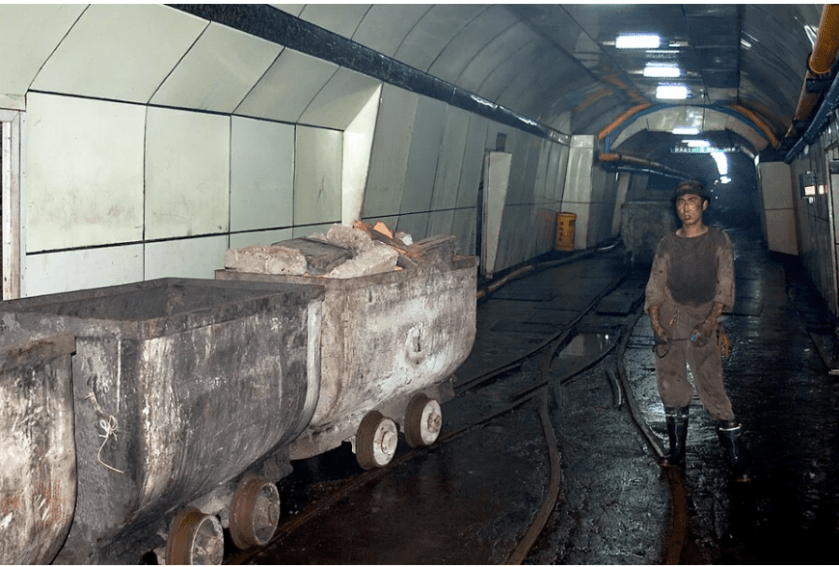
To underline the point about wood and coal, Fressoz describes the heavy dependence of twentieth-century coal mines on the availability of wood for pit props. “Without abundant wood, Europe would simply have had no coal, and hence little or no steam, little or no steel and few or no railways”, he writes (page 55).” Things have changed, but this is not a transition, he insists: “rather, we should be talking about a symbiotic relationship that intensified during the nineteenth century, followed by a gradual disengagement that really began in the second half of the twentieth century.”
Even now, hundreds of millions of people rely on woody biomass for basic fuel needs; in Africa’s big cities, charcoal is a fuel of choice – two or three times more energy-dense than wood, and transported by oil-fuelled vehicles. “This new energy system is based on a combination of wood, muscle power and oil”, Fressoz writes (page 124).

Neither does it mean much to talk about a “transition” from coal to oil, Fressoz insists. While the wood-coal symbiosis weakened in the late twentieth century, the coal-oil symbiosis became stronger. More steel from coal-fired furnaces was needed to extract and transport oil, and to build hundreds of millions of oil-consuming cars and other oil-driven machinery. Conversely, mining coal from huge open-cast operations, and transporting it ever-greater distances, needed oil.
If the coal-to-oil “transition” did not happen, then the fashionable idea that it reshaped the relationship between labour movements and political power makes no sense. Fressoz offers an iconoclastic take-down of this false logic.
His bluntest questions are for Timothy Mitchell, who argues in Carbon Democracy: political power in the age of oil (2011) that the workers’ movement’s advance in Europe and America in the late nineteenth and early twentieth century was closely linked to coal miners’ economic power, while oil, extracted with significant capital and minimal labour, largely undermined labour.
Carbon Democracy’s “enthusiastic reception in the academic world testifies to an appetite for materialist explanations of politics and a paradoxical lack of interest in the history of production”, Fressoz writes (page 86).
The second part of Fressoz’s argument concerns “energy transition” as a political discourse centred on technological innovation, an ideological cable that binds together governments’ “climate policies” and corporations’ PR fables.
He starts in the USA in the 1920s, when the apparently eccentric technocratic movement urged “transition” from capitalism to a society based on the most efficient use of energy and labour, through the rational deployment of technology.
In the 1940s came the atom bomb, which helped the US achieve unparalleled geopolitical and economic dominance. Its nuclear scientists found themselves in an unusually privileged position. In this milieu, long-term energy forecasting was all the rage – firstly, to convince politicians of the benefits of generous state investment in nuclear power, and, specifically, in breeder reactors that promised to produce new nuclear fuel more rapidly than they burned it.
Fressoz shows how nuclear lobbying sat comfortably with neo-Malthusian ideas about resources, including fossil fuel resources, running out due to population growth. Into this mix of ruling-class ideology, and the science influenced by it, came the issue of climate change:
Because the nuclear lobby was defending a very long-term technological option – the fast-breeder reactor – it produced a dystopian and innovative futurology, focusing not only on the end of fossil fuels, but also, as early as 1953, on global warming (page 154).
In the 1960s and 70s, “energy transition” was brought into wider public discourse, together with a new discursive battering-ram: “energy crisis”. That was a misnomer for the 1973 oil price shock, when social and political ferment in the Middle East and Latin America, culminating in oil company nationalisations and a partial boycott of sales to the USA, forced a shift in the terms of trade in the oil-producing nations’ favour. Fressoz argues that the “energy crisis” had already been invented by the nuclear lobby in the late 1960s: the battles over oil made it taken-for-granted common sense.
Energy system forecasting, too, went mainstream in the 1970s, thanks to the oil price shock and advances in computing. Fressoz shows that the computer models often focused on one technology superceding another, e.g. nuclear over oil, rather than the cumulative expansion of energy supply in the context of capitalist economic growth. He critiques the work of the Italian nuclear physicist Cesare Marchetti, who pointed to energy systems’ inertia, and argued that we could learn more about the future from historical statistics than from models that sketched a transition to nuclear dominance.
Fressoz concludes that, for half a century, energy research has focused too much on technological innovation and too little on the persistence of old technologies.
Even today, the many studies of technological diffusion hinder our understanding of the climate challenge. On the one hand, […] they say nothing about the disappearance of the old, making the assumption – implicit or explicit and in any case unjustified – that this would be symmetrical with the diffusion of the new. On the other hand, […] since energies and materials are in symbiosis as much as in competition, we simply cannot use a technological substitution model to understand their dynamics. Nonetheless, the experts are still comforted by the upturn in the diffusion curve for wind and solar power, as if it were equivalent to the disappearance of fossil fuels. (pages 178-9).
Who cares about the history of research, now we are confronted by climate crisis? We all should, because – as Fressoz shows in a fiercely polemical chapter on the IPCC – the technology-focused futurology summoned up by the “atomic Malthusians” of the 1950s, and written in computer code by the energy forecasters of the 1970s, now walks tall across the pages of the scientific reports on which the international climate talks rely.
By the 1990s, “a neo-Malthusian technological futurology for rich countries had suddenly become a safeguard plan for the entire planet … How was this scientific and political scandal possible?” Fressoz asks (page 180).
In the 1980s, as the climate scientists’ understanding of global heating improved, and fossil fuel burning confirmed as indubitably the main cause, it became clear that energy policy goals had to shift. The move away from fossil fuels had to be faster, not because of a Malthusian exhaustion of resources, but because of the damage done by the global economy’s constant expansion.
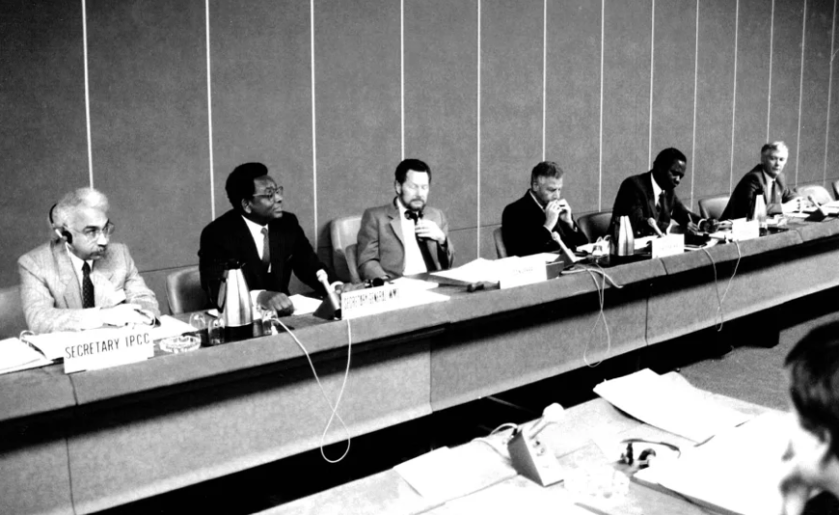
Corporate technological “solutions” to the 1970s “energy crisis” were now repurposed for this real climate crisis, Fressoz argues. The Nobel-prize-winning economist William Nordhaus, who sketched out the economic-growth-plus-innovation strategies that heavily influenced the IPCC, has much to answer for.
Fressoz quotes the minutes of the 1979 World Climate Conference in Geneva, at which oil company representatives talked of a long transition away from fossil fuels (to 2100), mainly by way of technological innovation, and many prominent scientists agreed – until the nuclear physicist David Rose warned that Nordhaus’s approach, of postponing the transition until new technologies and new capital made it less painful, was “the perfect recipe for climate disaster” (page 190).
Fressoz describes how scientists, engineers, and social and political researchers sometimes resisted, cut across, worked alongside, or capitulated to the ideological pressure of capital. Or complicated combinations. I hope this account will be read, and thought about, by activists who in Extinction Rebellion’s heyday coined the slogan “listen to the science”, as though “the science” is a deity existing above and independently of the societies we live in and the rapacious capital that dominates them. It is not.
By 1988, when the IPCC’s Working Group III was set up, with a brief to advise governments on mitigating climate change, the aim of those governments, the US’s in particular, “was to regain control over international climate experts, who were quick to brandish emission-reduction targets without weighing up their economic effects” (page 199).
Did they bring the scientists to heel? Yes and no. In the run-up to the Paris climate conference in 2015, scenarios mapping slow progress were superceded by those envisaging rapid decarbonisation, in line with the 1.5 degree target adopted. But, as Fressoz shows, the most powerful governments had meanwhile proceeded in practice with the slowest decarbonisation trajectories.
As the gap between these pathways and reality widened, it was filled with a new technofix – “negative emissions” technologies such as carbon removal, that would help achieve “net zero”.
Without saying so, without discussing it, in the 1980s and 1990s, the industrial countries chose – if that word has any meaning – growth and global warming, and gave in to adaptation. […] Populations were not consulted, especially those who will be and already are the victims (page 211).
Fressoz concludes that the concept of “transition”, which lives on in the current obsession with carbon capture and storage, hydrogen and other false “solutions”, is “the ideology of capital in the twenty-first century. It turns evil into cure, polluting industries into the green industries of the future and innovation into our lifeline.” (page 220).
To make the change that Fressoz suggests is needed – that is, to move away from fossil fuels by a deep restructuring of the economy – would require “a powerful coalition to impose its will, to make history in the most radical sense”, the economic historian Adam Tooze argues in an earlier review of More, More and More. But, he adds, “formulated this way, it can’t help but seem hopelessly out of reach”.
Maybe stabilising the temperature at 1.5 degrees above pre-industrial levels is out of reach, Tooze continues, but to assess the possibilities of the present moment, we need to look at the progress of decarbonisation so far: “it is change on a scale that would have been thought impossible until quite recently”.
Fressoz, by contrast, stresses that what looks like decarbonisation may not be. Historically, symbiosis between fuels took precedence over substitution. “The problem is that such symbiotic relationships still exist between ‘green’ technologies and fossil fuels”, he responded to Tooze in a letter (go via that link and scroll down to the end to see it).
In my view, that symbiosis is reinforced by the narrative of technological transition. And Fressoz further considers that narrative in an article just published in the academic journal Energy Research & Social Science.
He starts with Working Group III’s latest (2022) report, which mentions “technology” 2111 times, “innovation” 1667 times and “hydrogen” 1096 times – as against 232 mentions of “sufficiency”, 29 of “degrowth” (mostly in the references), and three of “prohibition”.
Fressoz proposes that this “technocentric focus” is caused first, because universities and research institutes “almost by design” prioritise novelty (e.g., focusing on hydrogen when sufficiency is more likely to matter for decarbonisation); second, research funding structures and intellectual property frameworks push scientists to work with industry researchers who are constrained by their corporate funders; and third, the way the IPCC itself operates.
He suggests that a milestone for mitigation expertise “will be the recognition that global carbon neutrality by 2050 or 2070 is not simply challenging but technologically impossible”. Accepting the impossibility of net-zero targets is “essential to freeing climate expertise from misplaced optimism and technological illusions”.
To my mind, the problem runs even deeper than this: we need to consider the ways in which the international climate talks, and the IPCC’s work, are not only part of the solution but also part of the problem. This involves questions about political power and its relation to capital.
Fressoz’s work, and his exchange with Tooze, make me think of four crucial research questions. First, we need a real assessment of current decarbonisation progress, as Tooze suggests – but conducted with an approach alert to the danger that e.g. expanding renewable electricity generation, desirable as that is, in the context of headlong economic expansion and capital accumulation may not result in any decarbonisation at all.
Second, we need to ask what a movement to forestall and obstruct that form of expansion could look like, given the global social and political conditions. Third, how can the fight against “technophilia” and technofixes be conducted most effectively? And fourth, what is our assessment of the international climate talks, and the relationship between science and political power around the IPCC?
This in turn begs another question raised in More, More and More: the position of researchers – whether historians and humanities scholars or scientists and engineers – in relation to power and capital. We are not neutral either.
□ The Earth and us: ways of seeing (a review of The Shock of the Anthropocene by Christophe Bonneuil and Jean-Baptiste Fressoz)
Linking local services and energy in Moray
A video about local fightback against cuts and the links to energy production. Produced by Moray Trades Union Council with support from the Scottish Trade Unions Congress
Portuguese ecosocialists Climaximo argue for a strategy of rupture in the face of climate collapse. Pete Cannell reviews a new book which lays out their case.
In the last few years, the Portuguese ecosocialist collective Climaximo has been one of the most dynamic and creative parts of the European climate movement. Two years ago, the group made a sharp shift in its strategy and tactics, declaring that ‘the governments and the corporations declared war against the people and the planet’. All In: a revolutionary theory to stop climate collapse, written by two Climaximo activists, Mariana Rodrigues and Sinan Eden, is an explanation of the Climaximo approach and a call to action. It’s an unusual book. You may find parts hard to follow. You’ll almost certainly find that it includes things you disagree with. I don’t think the authors will mind that. What they are concerned to do is to win a case for their key propositions about the problems we face and what is to be done.
First the issue:
‘Everyone in the movement is more and more aware of two sets of information. The first is that the capitalist system is the root cause of the climate crisis and has absolutely no perspective of solving it. The logical consequence is that the task of any movement informed by climate justice is to dismantle capitalism. The second is the threat of runaway warming cascading to climate chaos. In other words: urgency.’
Mariana and Sinan argue that most people deal with one or other of these propositions but not both. They provide withering assessments of the movement as it is. They argue that existing climate campaigns generally end up becoming ‘every small decrease in emissions matters’ campaigns. Implicit in their assessment is a critique of NGOs who often talk about system change but whose practice is limited to demanding change within the existing system. On the other hand, they see the revolutionary left as clear about capitalism’s responsibility but failing to reflect the urgency of the crisis in their organising. It’s important to note that these judgements are made by insiders and activists not by detached academic commentators.
Underpinning the book is an assumption that whether or not there was once a pathway to a zero-carbon economy through some form of highly regulated capitalism, as global temperatures break the 1.5 degree increase set by the Paris COP and carbon emissions continue to rise, that path, if it were ever possible, is foreclosed.
The authors aim to develop a theory of change and an organisational model that can combine tackling the revolutionary overthrow of capitalism with the urgency that the climate crisis provides. They acknowledge that embracing both objectives can be daunting. They suggest that many movement organisers avoid even confronting this by focusing on limited and short-term objectives – effectively sidelining the systemic challenge that we face. They also argue that ‘not enough new generation organisers are learning from historical experience, limiting their attention to specific interpretations of specific examples’.
Taking all of this into account, the middle section of the book examines multiple historic examples of ‘successful’ movements for change, with brief descriptors and classification into different explicit or implicit theories of change. The overt aim is to develop a sense that contemporary movements have a rich history that should be engaged with. Mariana and Sinan encourage the reader to dig deeper. While I understand the reason for spending time on these examples, I found this the least convincing part of the book. In part this is down to my disagreement with the way in which some events are characterised. No distinction is made between political and social revolution. And there’s an uncritical framing of the 20th century as a period when for some decades more than half of the world was ‘socialist’. This opens serious questions. Why were these ‘socialist’ states so appalling in terms of environmental practice? If they were a new mode of production how did capitalism return? But perhaps I’m being over-critical, the authors are clear that their aim is to get activists interrogating and learning from past struggles.
‘Look, all these people were thinking about the questions we have now, and they answered them, sometimes it even worked, and many times it worked better than whatever we have done so far. If we can spark such genuine curiosity, we shall be satisfied.’
In the final part of the book the authors turn to what is to be done. Essentially, they call for organisations to take the same turn as Climaximo, recognise that we are in a situation where the capitalist class are determined to hang on to a system that is trashing the planet and then act accordingly. There are two basic propositions. Firstly, the climate crisis is a global problem.
‘Globalisation is the material process through which imperialism is integrated into a world system.’
Secondly, global capitalism has created its own gravedigger, a global working class. This is summarised as:
‘At this moment of history, there is a global working class confronting globalised capital.’
Both propositions are common currency on the left. But the conclusion that Climaximo draw, and that Mariana and Sinan develop, is not simply ‘build the revolutionary party’ although they are clear that the goal is revolution. Their proposed strategy is a brutally honest attempt to chart a path forward in a context which we wouldn’t have chosen as a starting point and where older models of ‘party’ building are inadequate. It takes for granted that there are many campaigns, movements, groups, and parties too, that could form the nucleus of the mass campaign that we need.
The core idea is the development of the ‘movement as party’. Some of the language is opaque so what follows is my interpretation. The aim is to build what Mariana and Sinan call a global movement ecosystem. What defines the parts of the ecosystem is a clear class-based focus on getting rid of capitalism. Tactics and ways of organising will vary by, and within, different locations, but following the example of Climaximo, the components of the ‘movement as party’ will have declared a climate emergency within their organisation. They will have accepted the basic propositions and most importantly they will have adapted their practice to align with them. The authors note that:
Surely, we can have many plans, contingent on various possibilities. But we need those plans, anti-capitalist plans, actually-dismantling-capitalism-in-the-short-term kind of plans. ‘System change not climate change’ is not an agitation tool anymore, it’s a directive for our generation.
They argue that:
‘… in a state of climate emergency, we need to take risks – a lot of them: political, strategic, organizational, tactical, personal and emotional risks. We cannot afford to lose everything without having really risked to win. We need to fail forward, we need to be intentional and attentive in our failures.’
They explain that:
‘By intentional failure we mean knowing what we are trying out and what risks we are taking. By attentive failure, we mean having specific collective processes in place to learn from the experience and share it.’
Climaximo’s understanding of class is based on the ecofeminist ideas of Stefania Barca which sees those involved in care work, work which contributes to social reproduction and the continuation of human life as integral to the working class. They note that:
‘Historically, marginalisation of reproductive work and metabolic work has accompanied marginalisation by gender, race and ethnicity.’
Critically this is a global working class which confronts the global issue of climate crisis. Mariana and Sinan stress that building a global movement is not an optional extra but a key part of building the ‘movement as party’. They insist that it’s not just a theoretical position but a practical one and argue that organising in a climate emergency means devoting perhaps 25 per cent of an organisation’s capacity to international work. In this respect Climaximo has an exemplary record, being central to the organisation of the Global Climate Jobs Conference in Amsterdam in 2023 and the counter-COP Earth Social Conference.
‘All In’ wrestles with questions that should be on the minds of everyone who is concerned about the state of the world we live in. What it proposes may not be ‘the answer’ but it should make you think and it concludes by setting a challenge – ‘Will we dare to win?’
Check out the All In website and order the book.
A version of this review was also published on the rs21 website.
One of the author’s Sinan spoke at a book launch co-sponsored by ScotE3
Adam Greenfield argues that the key battles over climate are lost and activists should focus on adapting to the results of that failure. Pete Cannell responds that the only possible choice is to keep fighting for social change.
A version of this review was first published on the rs21 website.
In October 2012 hurricane Sandy wrought havoc on the eastern seaboard of the US. The storm surge overwhelmed New York’s sea defences and destroyed the homes and livelihoods of many thousands of working-class New Yorkers. The response of the city authorities was slow and totally inadequate. In its place, networks built a year earlier through Occupy Wall Street stepped in to mount a huge programme of mutual aid which became known as Occupy Sandy. Adam Greenfield, the author of Lifehouse, was one of the volunteers.

2024 was the first year that global average temperatures exceeded pre-industrial levels by 1.5°. Each year since 2022, global average temperatures have increased at an unprecedented rate. Year on year, global heating is matching the most extreme end of the range of possibilities predicted by climate scientists. And, while energy generated from solar and wind power increases apace, fossil fuel use is at an all-time high and greenhouse gas emissions continue to rise. Even if there were a massive shift to a low carbon economy tomorrow, rising temperatures, extreme weather and rising sea levels are baked into the global system for decades, probably centuries, to come.
In his new book Lifehouse: Taking Care of Ourselves in a World on Fire Greenfield responds to this scenario by arguing that attempts to mitigate climate change have failed. He makes three assumptions:
that a so-called ‘green energy transition’ will not take place in time to prevent the most consequential drivers of change from happening; that reparative ’geoengineering’ will not be attempted at the necessary scale or, if attempted, will not work as intended; and that in the time available to us, we will not invent some other technology capable of siphoning carbon from the atmosphere at the necessary scale, and rescuing ourselves that way.
Considering this, he calls on activists to redirect their efforts to adapting to the inevitable consequences of that failure. The core of the book draws on his experience of Occupy Sandy, the ideas of social theorist Murray Bookchin and other examples of collective social organisation including the Black Panthers and Rojava.
The climate movement has always included activists who have argued for a return to nature, a retreat to a rural life that would involve rejecting all aspects of modernity. Greenfield’s position is different. He recognises that most of the world’s population live in big urban centres and will likely continue to do so. Building on his Occupy Sandy experience he suggests that every area needs to develop a Lifehouse, a building or complex of buildings that would form a focus for mutual aid, care and support for the local community – a place to meet and organise, find and share skills, grow food, provide medical services and much more. In any given urban area there would be many such sites.
Greenfield expects that the deepening impact of the climate crisis will have a disrupting effect on the operation of the complex interconnected system that is 21st century capitalism. This is certainly true. He also assumes that the retreat from state provision of public services that has developed in the neo-liberal era will continue. He argues that:
if the state withdraws from [the provision of public goods] then there is only one possible response, which is for populations to self-organize to provide their own commons.
Accepting this, Greenfield then pays little attention to the state as he develops the Lifehouse concept. I think this a profound mistake for reasons which I will attempt to address in the rest of this review.
Greenfield’s articulation of Bookchin’s ideas recognises real problems with the Lighthouse model. He notes that local systems of mutual aid may well be predicated on exclusivity, racist or misogynist ideas. Clearly the survivalist movement in the US is an example of this. And in response to the cost-of-living crisis in Britain the far right was, and remains, proactive in setting up food banks and spaces where people could seek support. His response is to suggest that the Lifehouse model should include an assumption of connectedness or confederation with other Lifehouses. He also notes that Lifehouses are likely to attract hostile responses from the state or from non-state reactionary forces. Again, I think this is right. While states welcome some forms of substitution for welfare services – typically charity run food banks and other services – they are much less keen on initiatives that involve collective working-class organisation.
The Lifehouse model assumes explicitly that it is possible to organise outside the state and alongside the state. Greenfield argues that we should start building Lifehouses now. But almost everywhere that brings you up against a state that is increasingly repressive and intolerant of dissent, in a context of militarism, racism, misogyny and transphobia and the growth of the far right. If we forswear mitigation and throw all our energies into adaptation it seems to me that we are in effect surrendering the ground to reaction. Greenfield notes at one point that a dystopian future might yet include small, favoured patches of relative normality, refuges for the rich. We can be sure that such enclaves would be armed to the teeth. On the other hand, if we focus on adaptation and turn to building Lifehouses our small patches of mutual aid and cooperation would have no such defence.
I want to argue that the alternative is to take system change seriously. That means breaking and replacing the capitalist system. I’m conscious that here and now that might seem as utopian as the idea that we can remodel the world as a connected web of confederated Lifehouses. I’m open to the idea that a sustainable world might look something like Adam Greenfield’s vision. But the key challenge is surely how we can turn the world upside down and end the system which is driving us to disaster? And here socialists have a historic responsibility.
It’s clear that the climate crisis is systemic. The capitalist system has driven huge increases in material wealth through the exploitation of human labour and through commodification of the environment and material world. The system depends on continual growth and is incompatible with sustainable existence on a finite world. Revolutionary socialists have always argued that if those who labour seize the means of production, the fruits of human labour could be shared equally. We talk about a world to win that could provide comfort, leisure and security for all. Today, however, the world we inherit is one where, as a result of the environmental damage caused by two centuries of industrial capitalism, the conditions of human existence are far more inhospitable than was the case previously. The socialist revolution would necessarily apply the emergency brake to runaway climate change, but it can’t stop the damage that has already been done. The conditions for human existence in a world without capitalism will present a challenge for survival. Many of the world’s major cities will be underwater, there will be mass migration as some areas become too hot for human habitation and food production will be under huge strain in a world where extreme weather events are far more frequent.
Socialists can’t promise a future of what has been called ‘fully automated luxury communism’. But we can expose the lies and deceptions of mainstream bourgeois governments and the far-right populists who are jockeying to replace them with the promise of a return to some earlier and mythical time of comfort and security. No such promise is possible in a world on fire. Of course, exposing the lies is only possible if there are demonstrably possible alternatives and that’s our task to develop and popularise.
The wealth of the capitalist ruling class is built on the labour of generations of workers around the world and the blood and bones of the untold millions who were murdered through war and colonisation as capitalism spread around the globe. It is a system of great power and sometimes open, sometimes concealed, brutality. However, it depends for its existence on a global working class. Moreover, in this era of late capitalism it depends critically on complex systems and long global supply chains that can break if key workers withdraw their labour or under the impact of extreme weather events. It’s brittle and vulnerable. That’s why Adam Greenfield’s argument for giving up on mitigation is so wrong.
Winning political arguments about who’s to blame for the crisis and how to ensure a secure future for all is not easy. In hard times it’s necessary for the left to articulate ‘freedom dreams’. Part of the argument has to be about a new economy that provides that security. But it also needs explicit recognition that the system that puts profit before the lives of people and trashes the life chances of future generations has to end. Achieving that goal requires a compelling vision and building collective power in workplaces and communities around the world. Along the way some states may be forced to make concessions and take mitigating action – but the only sustainable end game is the overthrow of those states.
This critique of Lifehouse is not an attack on mutual aid. Practices of mutual aid are a vital and necessary part of working-class resistance – most notably in the urban centres of the global south. At times they may be essential to sustain class struggle and community survival but always against the state. To build sustainable centres for collective support and organisation requires the development of networks of resistance built through class struggle. And if we do that then we can aspire to so much more.
Lifehouse: Taking Care of Ourselves in a World on Fire
Adam Greenfield
This article is based on a talk by Simon Pirani at the energy campaigns strategy day, organised by the Campaign Against Climate Change in Leeds on 1 February 2025. It was first published on the People and Nature blog.
The “key questions” we hope to discuss today, listed in the agenda, include “how do we cut through with our demands for a clean energy system”, “how do we create the necessary alliances” and “how do we turn the tide of right-wing weaponisation and scapegoating of climate action”.
I will comment on these questions by taking a step back, and considering some underlying issues about how we understand the world – issues that we will come back to again and again, as we are trying to develop political strategies. I hope this is useful.
Some of this will sound general, some of it some of you know better than I do, but my idea is to try to allow us all to consider the basics that underlie all the hard campaigning work.
I will comment on six points: two on politics, two on energy systems, one on technologies, and one on campaigning proposals.
The economic system that we live under has a built-in requirement to expand. Capital needs to accumulate continuously. The government’s function is to facilitate that.
And so the government’s default positions on things that matter in terms of global warming – airports, road building, regulation of the building industry, North Sea oil, and so on – are anchored in its attitude to economic policy (all about “growth”), which serves the needs of capital. Capital, in its drive to expand, undermines and sabotages all climate targets.
We, the movement, must not lose sight of how this works. This is how we end up with the chancellor of the exchequer talking nonsense about electric planes and biofuels, to justify reviving the discredited, climate-trashing Heathrow third runway proposal.
Our understanding of the relationship of capital and the government is obviously relevant to our political strategy.
Take for example the 2008 Climate Change Act, arguably the best bit of legislation we have, under which the UK carbon budgets are set, and which many of us here have used as a political lever for our arguments. Actually it is a double-edged sword. The Act is used by many politicians as a cover behind which to abandon actions that would address climate change.
A starting-point for a critique of the Act is research conducted at the Tyndall Centre for Climate Change Research, and published in 2020, showing that if the UK sticks to its carbon budgets, it pours TWICE AS MUCH greenhouse gas into the atmosphere as it would under a fairly worked-out target.
The Climate Change Committee, supposedly “independent”, has always ducked the crucial question of what proportion of the global carbon budget it thinks the UK could fairly use. It considers what is “feasible”, not what is necessary.[1]
My conclusion from this is NOT that nothing can be done in the political sphere, but that we should recognise how the battlefield is actually set out. Strategies focused on convincing the government, without social movements behind them, will often fail.
In recent years it has become clearer that the oil and gas industry, and governments of fossil fuel producing countries, have to a large extent taken control of the annual conferences of the parties (COPs) through their lobbying machines.
We should not give an inch to the oil companies and their lobbyists. But, in fighting them, we should beware of the idea that the international climate talks set a standard that, without these recent changes, we could return to. That was never the case.
I am talking here about the political agreements made at the talks, not about the scientific research summed up in the reports of the International Panel on Climate Change, that we should all follow as closely as we can.
(When I gave this talk, the very valid point was made in discussion that we can not just “listen to the science”, as some environmentalists say. There is not one “science”: scientific interpretations are also shaped and influenced by social forces and power relations, by the society in which scientists live.)
The international climate agreements were always based on the false premise that there could be green growth. They always combined tolerance for vast subsidies to the fossil fuel industries with the fiction of carbon trading.
And it is not only the climate talks, but all the post-1945 international political institutions, that are in crisis. The weakening of these institutions by Trump, Netanyahu, Putin and others is the outcome of a long process, not the beginning. The outrage of COP talks being run by oil company executives and oil-producing countries’ dictators needs to be seen in this context.
A very real political consequence of all this is that some activists, confronted by the horrific scale of the climate crisis, conclude that the future will inevitably be worse than the present.
These are real fears. And against the background of these fears, e.g. in Extinction Rebellion and organisations that have grown out of it, some people articulate what I call disaster environmentalism, always emphasising the worst possible outcome and minimising our own agency.
This is a very important discussion, and I do not think people active in the labour movement can cut themselves off from it.
We also need to recognise that, as the consequences of climate change become much more visible – floods, wildfires and other disasters – we will see much more civil disobedience by climate activists, and much more state repression in response.
Defending those activists, even those whose methods we might not agree with, is central, in my view.
First, let’s question the whole idea of “energy transition”. It has been poisoned, distorted beyond recognition, with misuse by the representatives of capital. In their telling, this “transition” will be led by oil companies, car manufacturing companies, “big tech” and their technofixes.
If you think I am exaggerating, look at the way it was discussed during the prime minister’s visit to Saudi Arabia just before Christmas.
A valuable perspective on this is presented in a new book by the historian Jean-Baptiste Fressoz, More and More and More: an all-consuming history of energy. He shows that previous so-called “energy transition” were actually additions: coal burning did not replace wood burning, but added to it; oil did not replace coal, but added to it.
And certainly right now in China, the world leader in building renewable electricity generation capacity, those renewables are being added to a still-expanding mountain of coal, not replacing it.
A second concept we should question is that “energy” is an undifferentiated thing, bought and sold as a commodity. Energy, like labour, has been commodified over the past several hundred years, by capitalism. But that is not a permanent or natural state of affairs.
Our movement should aspire to the decommodification of energy; we should think of it as a common good that people should have access to by right.
How do we move in that direction? How do we start to disentangle the system that currently delivers energy to people in the form of electricity, heat, or motive power? I suggest we start by considering the technological systems through which fossil fuels are burned and turned into these things that people can use.
I mean technological systems in a very wide sense: not only power stations and electricity networks that burn gas and produce electricity, or petrochemical processing, but also industrial and agricultural systems, urban built environments, transport systems – that all run predominantly on fossil fuels.
These technological systems are embedded in social and economic systems, and stopping fossil fuel use will involve transforming all of these.
Thinking about it in this way, we can identify three ways of reducing fossil fuel use.[2] Starting at the end of the process, where the energy supplies people’s needs, these three ways are:
a. Changing the way that energy is used. For example, replacing car-based transport systems with systems based on public transport and active travel. People do things differently, and better, using far smaller quantities of energy carriers (that is fuels, or electricity or heat, different forms energy takes).
b. Reducing the throughput of energy through technological systems. For example, replacing gas-fired heating with heat pumps run with electricity. The same result is achieved, keeping homes warm, using a small fraction of the fossil fuels burned previously.
c. At the start of the process, replacing fossil fuel inputs with renewable inputs. This is capital’s favourite change, because it does not imply reducing throughput or people living differently. Nevertheless, in my view, we in the labour movement also favour it. For producing electricity and heat, it is quite straightforward. As you know, for other things, such as making steel, it is much trickier.
I suggest this framework because in our campaigning work we are hit with a constant barrage of nonsense about decarbonisation, such as we heard from the chancellor this week about electric planes and biofuels. None of us have to be engineers to answer this stuff, but we need robust analytical categories to work with.
In energy researchers’ jargon, the use to which energy is put at the end of these technological processes – getting from place to place using petrol, heating a room using gas – are called “energy services”. From the 1970s, environmentalists argued that the economy should focus on delivering these services with less energy throughput.
“Energy services” is not a term I would use uncritically. But it’s worth knowing that there are piles of research showing how these energy services can be provided, with a substantially lower throughput of energy carriers.
(Three different, and I think complementary, takes on the UK economy are the Absolute Zero report produced at the University of Cambridge, the Centre for Alternative Technology’s Zero Carbon Britain report and Shifting the Focus, published by the Centre for Research into Energy Demand Solutions.)
Because mainstream political discourse treats energy as a commodity, it also talks about supply and demand. Actually, demand for energy is a phantom.
No-one wants energy. What people, or companies, want is energy services. These are provided by energy carriers. We want heat, or light, or we want to get from one place to the other. If the technological systems, and the social and economic systems are changed, we can get these same outcomes using far less energy.
Furthermore, energy use is differentiated. The use of energy by a pensioner to keep warm can not be compared to the use of energy at a much greater rate for a company executive to take a plane flight, or a data centre to meet increased electricity demand for crypto currencies or AI.
This should be the starting point for our political strategy. We do not want demand reduction, as our right wing opponents claim. We want to use energy differently, as part of living differently – which is surely what the labour movement has always aspired to, long before the threat of global heating loomed in front of us.
Technologies are instruments of labour, used by people in taking from nature their means of subsistence and the material basis of their culture. But those processes go on in specific sets of social relations – for the last three centuries or so, dominated by capital.
Just as labour is shaped and controlled by social forces, so are technologies. So we should beware of thinking of technologies outside of their social context.
An example is the internet. It transformed communication and access to information in ways that have changed all our lives. But we can also see how, in the hands of powerful corporations, it is being used to reinforce the most dangerous changes in society – the growth of dictatorship, the defence of genocide, and deception and lying on an industrial scale. Witness, too, the frightful expansion of energy-intensive data centres, particularly to facilitate cryptocurrency use and AI.
In the energy sector, bad or questionable technologies are supported by capital for its own reasons: those on which attention are currently concentrated are carbon capture and storage, and hydrogen, the primary social functions of which are as survival strategies for oil companies.
Technologies that have the capacity to serve humanity – I am thinking here particularly of solar, including decentralised solar – are distrusted by capital, which seeks to control them.
As a movement, we need to develop our collective understanding of these technologies and our critique of them. A great example has been set by the informal group set up by campaigners and researchers working on CCS.
My conclusion from the last several years of campaigning on climate issues is: to get beyond the small number of people who have thought through the issues, we need to focus firstly on demonstrating the potential of policies that address both global warming on one hand, and social inequality on the other.
This is the way to counter the populist right wing narrative – which has also been taken up by Labour politicians and, on the issue of North Sea oil, even by union leaders – that action on climate change will inevitably hurt ordinary people.
Some exemplary campaigning, looking at how to move away from oil production on the North Sea without repeating the disaster that was visited on coal mining communities in the 1980s, has been done in Scotland. Another good example is the Energy for All campaign, launched by Fuel Poverty Action, which now has widespread support.
An example I know at first hand is that of our campaigns around transport issues in London. A couple of years ago we had to face the fact that our long-running campaign to stop the Silvertown tunnel, which will produce more road traffic and therefore more carbon emissions, had failed. The tunnel will open in April.
In discussions about how to keep together the unity and goodwill we had built up, a number of us felt that we should become more politically ambitious, not less, and advocate policies that clearly address social inequality at the same time as addressing climate and air pollution. This brought us to the demand for free public transport and the formation of Fare Free London.
Although this is a very new campaign, we have had nothing but positive responses, from unions representing transport workers and many other organisations.
We hope that, by shouting more loudly about this, we will cut right across the demoralising political diversion, launched by the populist right at the Uxbridge by-election and shamefully latched on to by some Labour right wingers, around the Ultra Low Emission Zone.
The call for free public transport flies in the face of thirty years of neoliberalism, opens the city to all and strikes a blow for social justice, and can also help to get cars off the road and make demonstrable progress towards decarbonisation. Nothing would make us happier than to see this issue taken up in other parts of the country and to move towards a Fare Free UK campaign. SP, 12 February 2025.
[1] The CCC does not say what proportion of the global budget it thinks the UK could fairly use. Instead it makes a political judgement about what a rich country, with a long history of fossil-fuel-infused imperialism, can manage. In its own words, it starts with what it deems to be “feasible limits for ambitious but credible emissions reductions targets in the near term” (Sixth Carbon Budget report, pages 319-325)
[2] I set out this argument in more detail in a talk at the Rosa Luxemburg foundation in Berlin, and in my book Burning Up: a global history of fossil fuel consumption
Sign the Energy for All petition
Scot.E3 has recently added its name to the list of organisations supporting the Energy for All manifesto.
You can add you support as an individual by signing the petition here.
These are the five points of the Energy for All Manifesto
Under Energy For All:
1. Each household will receive, free of charge, enough energy to ensure it can cover its needs. This includes for instance adequate heating, lighting, cooking, hot water, refrigeration, charging phone and digital connectivity, and where needed, hearing aids, medical equipment, stairlifts, and wheelchairs.
2. This free energy will be paid for by higher tariffs on usage exceeding what is needed, by windfall taxes on fossil fuel corporations, and by recouping the millions of pounds now spent daily on subsidising the fossil fuel industry.
3. UK housing will urgently be brought up to a standard where people are not made ill by their own homes. It is a scandal that homes in one of the world’s richest countries are the coldest and dampest in Europe. Safe, non-toxic, non-flammable insulation appropriate to the building, and sound heating systems must be installed by skilled workers in consultation with residents. All rented property must be kept in good repair. These measures will dramatically reduce the amount of energy required to meet provision number 1. They will put low income households on a par with better off neighbours who already need less energy, and it will greatly ease pressure on the NHS.
4. No household will be required to pay in advance for the energy they need by means of key or card prepayment meter in their home, or by means of a smart meter. There should be a permanent and statutory end to the installation of prepayment meters by court orders authorising intrusion in people’s homes, or remotely by smart meters set to prepayment mode. No one should be disconnected from vital supplies as a means of recovering debt.
5. There must be urgent attention to injustices in the energy pricing system. Including the relationship between pricing for electricity and for gas when renewable energy is cheaper, geographical discrepancies, exclusion of itinerant and some other communities from current benefits and provisions, unfairness in pricing for storage heaters, time of use payments and district heating, and the huge standing charges which presently penalise people who can only afford to use a little energy. Many of these issues, including the standing charge, will be resolved by Energy For All but they must be attended to while the new pricing system is brought in.
What has oil got to do with the history of the global capitalist economy? Pete Cannell reviews Adam Hanieh’s account.
Pete Cannell • January 19, 2025
What has oil got to do with the history of the global capitalist economy? Pete Cannell reviews Adam Hanieh’s account.
A version of this review was published originally on the rs21 website.
The first commercially successful oil well in California was tapped in 1876 at Pico Canyon in Los Angeles County. Oil extraction and oil profits spurred the rapid growth of the city of Los Angeles. As I write this review 150 years later, LA is on fire. Crude Capitalism – Oil, Corporate Power, and the Making of the World Market charts the development of the oil industry from its early beginnings and shows how its history is intermeshed with the development of the world economy. It’s a book about oil, about the climate crisis and the environment, about economics and the dynamics of the capitalist system. The Los Angeles fires are one more instance, and not even the most destructive, of the global impact of rising temperatures and changing weather patterns. If you want to understand how oil and capitalism link events in 1876 and 2025 and the forces that shaped and continue to shape our world, then Crude Capitalism is a must read.

In 1995 the rulers of the world met in Berlin, ostensibly to tackle the threat of global warming. In the following three decades more carbon dioxide has been added to the atmosphere than in the previous two hundred years. In the same period annual methane emissions have more than tripled. This exponential increase in greenhouse emissions should not be a surprise. Hanieh begins the first chapter of the book by noting that a decade before the first COP, the International Geosphere-Biosphere Programme (IGBP) was already investigating the connection between human activities and changes to the earth’s biological, chemical, and physical systems. When their report was published in 2004, they noted that
The second half of the twentieth century is unique in the entire history of human existence on Earth. Many human activities reached take-off points sometime in the twentieth century and have accelerated sharply towards the end of the century. The last 50 years have without doubt seen the most rapid transformation of the human relationship with the natural world in the history of humankind.1
Crude Capitalism sets out to explain why the mid-twentieth century was such a critical turning point and why despite decades of blah blah blah (to quote Greta Thunberg) the exponential increase in global greenhouse emissions continues.
The core of the book is a chronological account of the development of the oil industry from its early beginnings until the present day. The story begins in the United States in the late 1890s. The second chapter explains how the rapidly developing oil industry became dominated by huge vertically integrated corporations such as Standard Oil. The structure of the new industry owed a lot to the particularity of US property law. The oil majors consolidated their grip through cartels and oligopolistic structures. These modes of organisation were adopted internationally in the decades that followed. A theme that runs through the book is the way in which the oil industry has become global, growing and adapting and often acting as a trail blazer for innovation in organisation and new techniques of capitalist exploitation. An example of this, in the British context, is the privatisation of the North Sea oilfields, which was at the forefront of the neoliberal reconstruction of the British economy.
With World War I, the focus of the book moves to the Middle East and Russia. One of the great strengths of the book is the way in which it deals with imperialism and how economic and military competition ties the global oil industry and the global arms industry together in an embrace of exploitation and callous destruction of the environment and possibilities for genuine human development. World War I generated a massive increase in demand for oil. The British Navy transitioned to an oil-based fleet. Britain’s colonial activities in the Middle East and its role in dismantling the Ottoman empire were critical for Britain to meet its growing demand for oil. It met this demand by developing new oil fields in Iran and Iraq. Collaboration between US big oil and British colonial interests in this new arena of exploitation paved the way for the US majors to go global.
The real acceleration in oil production, chronicled brilliantly in the central part of this book, came after World War II, when European economies joined the developmental path already well established in the US. At this point, the use of oil as a feedstock for plastics and synthetic fertilisers took off on a mass scale. Oil’s initial success lay in its energy density – a given volume of oil provides far more energy than coal or wood – but over the course of the second half of the twentieth century the ubiquity of plastics meant that, in Hanieh’s words, ‘commodity production had become a derivative – or a by-product – of the production of energy.’ This transformation of commodity production to a system powered and based on oil remains the dominant system in the global economy. This continuing domination is the reason why greenhouse gas emissions continue to rise.
In the last decade the US has once again become the largest single national producer of oil and gas. Yet at the same time as the Chinese economy has grown, the centre of gravity of the global industry has shifted east to Asia and new interdependencies have grown between Asia and the Middle East. 22 years after George Bush declared victory in Iraq, the largest oilfield in that country is run by a private Chinese company. But there is also a shift in power from private to state capital: the three biggest oil firms in the world are owned by the Chinese and Saudi Arabian states.
Crude Capitalism is withering in its critique of the oil industry’s corporate greenwashing. Hanieh notes, for example, that BP’s erstwhile rebranding as ‘Beyond Petroleum’ involved spending ‘more on the corporate rebrand than it did on renewable energy.’ The rebrand was short-lived and while many of the big companies are increasing their investment in renewables the rate of increase in investment in hydrocarbons is even faster. Twelve of the biggest companies plan to spend more than $100 million a day on new hydrocarbon projects up to the end of the decade. In addition, the industry is using its power and wealth to push technofixes that are often of limited or no utility for reducing greenhouse gas emissions but allow for the continuation of the infrastructure and systemic economic relations of fossil capital. In Britain the industry body Offshore UK has rebranded itself as Energy UK and its focus on Carbon Capture and Storage and Hydrogen is slavishly followed by the British government.
Adam Hanieh is absolutely clear about the obstacle that big oil continues to present:
Oil, in other words, remains at the core of our economy and our energy systems; without dislodging it from this position there is no possibility of ensuring a future for humanity.
The strength of Crude Capitalism is that it shows how the oil industry is the result of a system that always puts profit first. The final paragraph sums it up:
We cannot behave as if the problem of capitalism does not exist, or can be ignored, or as if our current rulers can be convinced to take an alternative path through the sheer force of scientific evidence. This is an irrational economic system that pits the interests of a tiny few against the vast majority, and only by taking political and economic power away from the logic of the market will it be possible to build a different and better world.
[1] Will Steffen et al., Global Change and the Earth System: A Planet under Pressure, Berlin: Springer, 2004, 81.


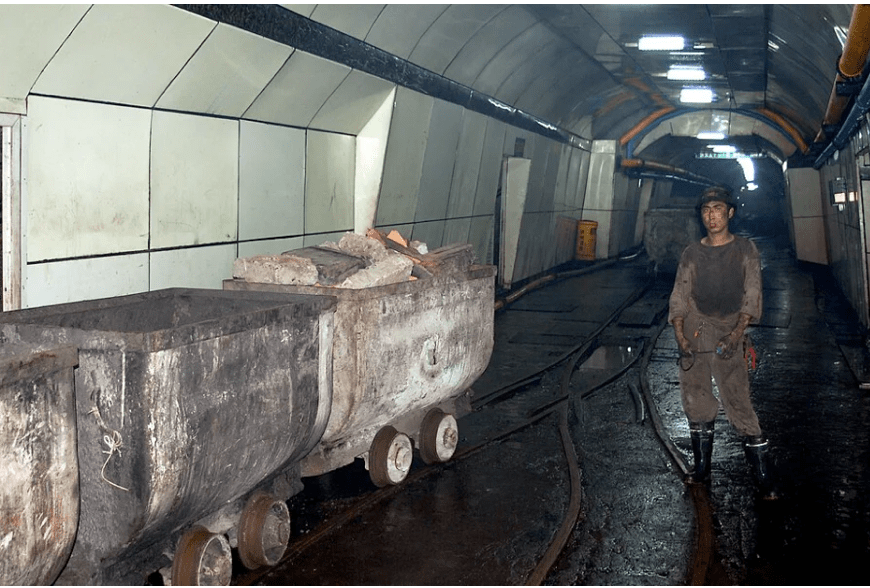


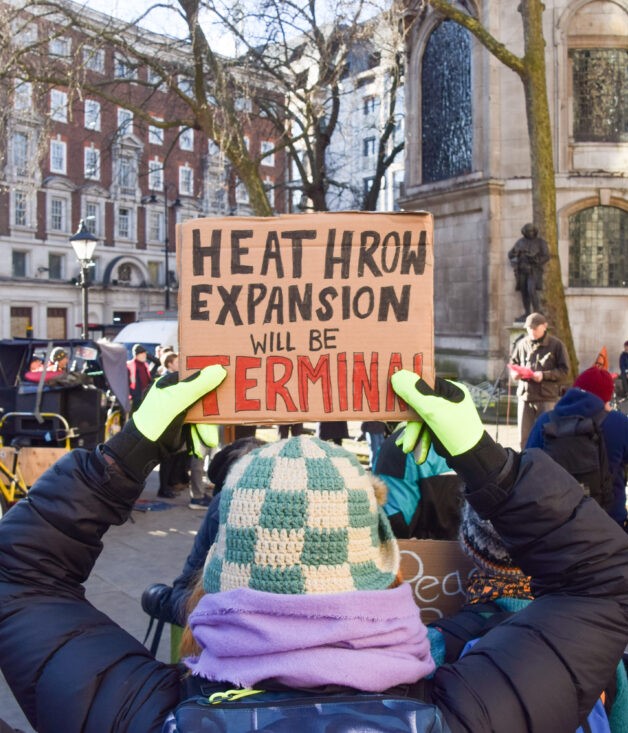
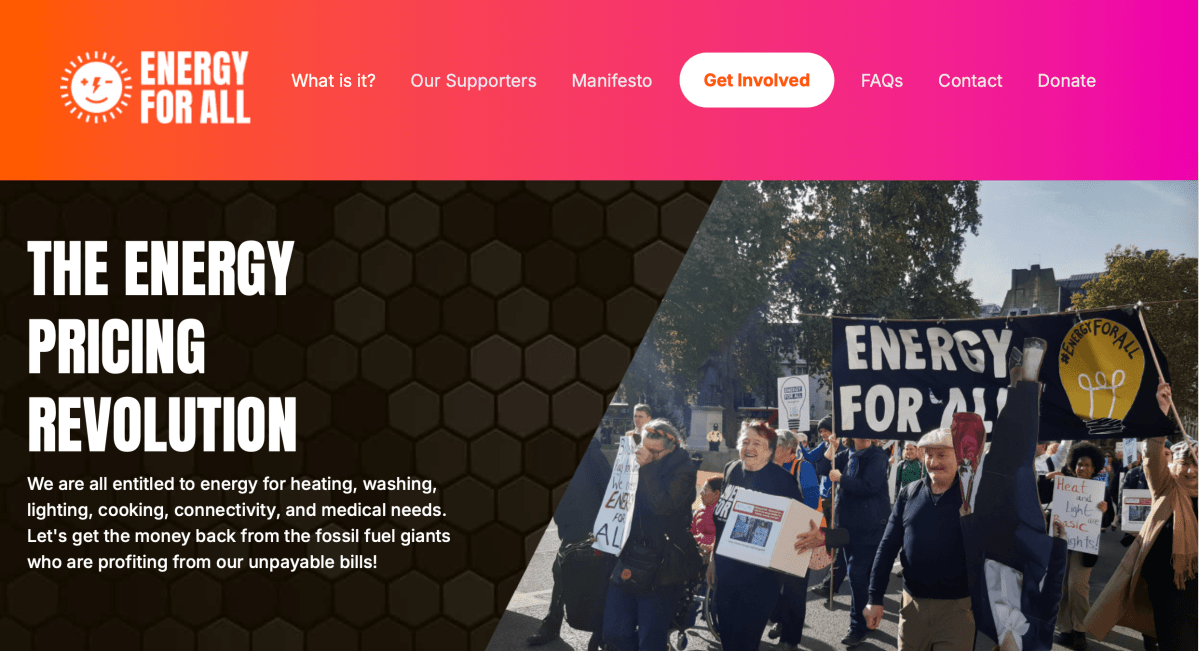
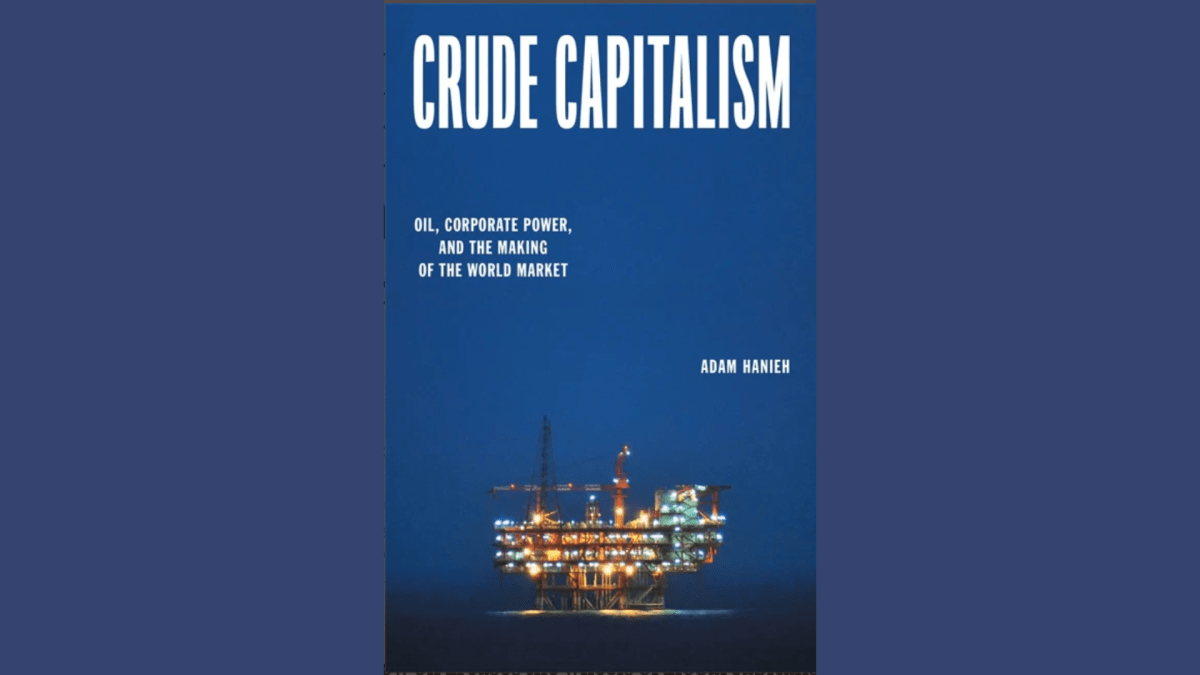
 Employment, Energy and Environment
