Yesterday (9th August) campaigners from Climate Camp, This is Rigged and Scot.E3 were outside the office of Environmental Consultants Ironside Farrar in Edinburgh. Ironside Farrar have been commissioned to produce a masterplan as part of the rezoning of St Fitticks Park in Torry into an industrial Energy Transition Zone (ETZ). The protest is part of an ongoing campaign to persuade the workers at Ironside Farrar to direct their skills towards projects that contribute to a socially just transition. Mike Downham spoke at the protest. There will be another protest at the Ironside Farrar office next Wednesday 16th August from 8.30am.
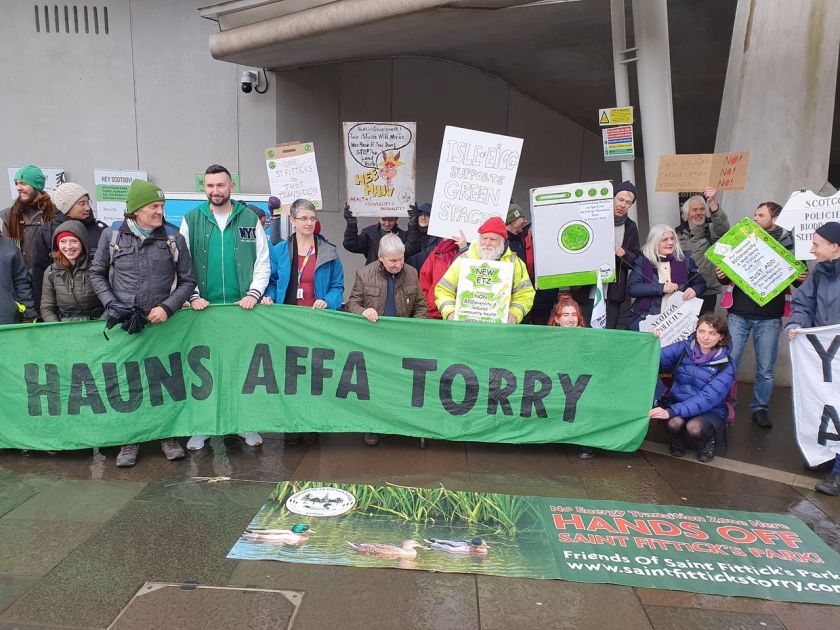
St Fitticks campaigners at the Scottish Parliament earlier this year
SPEECH OUTSIDE IRONSIDE FARRAR OFFICE 9TH AUGUST 2023
Welcome – and thanks for joining us this morning.I thought I would tell you why we’re here. This is the head office of Environmental Consultants Ironside Farrar – though the door doesn’t say that. We’re here to call on the employees of Ironside Farrar to boycott all further work for ETZ, the company oil tycoon Ian Wood set up to industrialise a large part of St. Fittick’s Park in Torry as an “Energy Transition Zone”. He then commissioned Ironside Farrar to get Planning Permission.
Torry is a suburb of Aberdeen, though it used to be a fishing and boat-building village just across the Dee from Aberdeen City. Then with the discovery of North Sea oil and gas in the 70s most of the village was bulldozed to make space for a Shell oil and gas terminal.
Since then Torry has been dumped time after time with the industrial development that other parts of Aberdeen don’t want – a landfill site, an industrial harbour where the Park used to come down to the beach at Niggs Bay, an incinerator close to the school, and now this threat to the Park which the Torry community cherish as their last green space. The threat to their community is huge. Ian Wood’s money persuaded Aberdeen City Council, who had previously invested much public money in improving the Park, to do a U-turn and re-zone it for industrial development. And Ian Wood’s money persuaded the Scottish Government not to intervene.
Ian Wood says the ETZ will contribute massively to bringing down carbon emissions, but much of the vague talk about what he wants to do is about developing Carbon Capture and Hydrogen technologies both of which are scams. This is in fact an attempt at a land-grab to justify continuing to extract oil and gas from the North Sea and fill the pockets of share-holders and directors in the Oil and Gas Industry.
Torry is about as disadvantaged a community as it gets, with appalling health statistics, appalling air quality and few employment opportunities. Despite this they are rising up and fighting for their lives against this plan to industrialise their Park.
Saving St. Fittick’s Park is exceptionally important, for three reasons:
If it’s industrialised it will represent a huge win for the Oil and Gas Industry and delay phasing out oil and gas extraction from the North Sea
It will destroy the significant biodiversity which has developed in the Park as a result of a lot of hard work and fundraising by the Torry community over the past 20 years.
And it will further sicken and impoverish the people who live in Torry. It’s this last which is arguably the most important of the three. Because if we don’t protect and prioritise the poorer communities up the north east coast of Scotland we’re done for. It’s these communities who can force significant change.
Two big things have happened in the six weeks since we started this campaign, which make Saving St. Fittick’s Park even more important. Climate has broken down across the world at a speed which wasn’t anticipated. Southern Europe and North Africa are on fire, and unprecedented floods in central China have displaced 100,000 people. The second thing is that the Westminster Government has decided to grant at least 100 new drilling licences in the North Sea. That these things can happen at the same time shows just how strong our governments are committed to fossil capital.
I’ll end by quoting a few things from the booklet The Declaration of Torry, a product of The Torry Peoples Assembly in May: on the back of this booklet they commit themselves to six actions:
We will do everything to stop the land grab
We will continue to use our Park and increase its already immeasurable value
We demand the incinerator be decommissioned
We will seek support to set up a Torry Retrofit Project to insulate our homes
We insist on a just and fair energy transition
We will strengthen collaboration within our community and with others in Scotland and beyond
And inside the front cover of the booklet, most powerfully:
THIS IS OUR LAND AND NO ONE ELSE’S
THIS LAND BELONGS TO THOSE WHO CARE FOR IT
Just one thing to leave you with. The people arriving for work this morning are highly trained and have knowledge and skills which will be essential when we’ve made the transition to clean energy. They know about tipping points in global heating, and about the complex relationships which underpin biodiversity. Ever since we started this campaign, we’ve been respectful to these workers, seeing them as part of the solution, not part of the problem.
At the same time they must surely understand the enormity of what Ian Wood is planning in Torry. They have the power between them to Save St. Fittick’s Park, by boycotting further work for ETZ. Even if they aren’t in the team working for ETZ, they can bring Ironside Farrar to a standstill by collectively withdrawing their labour.
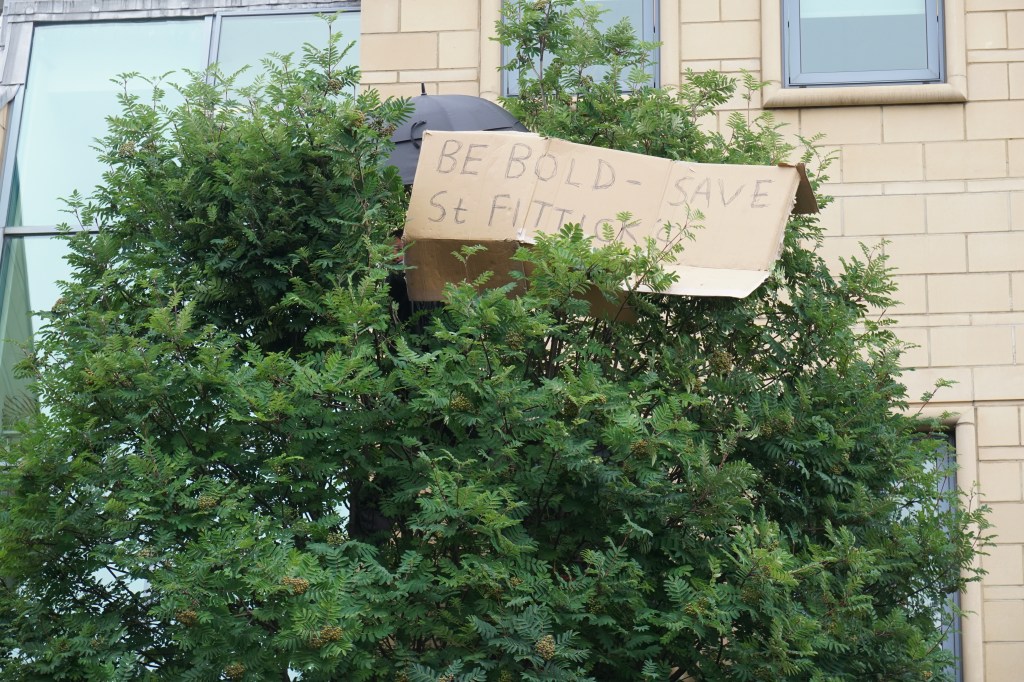
Activists occupy tree outside Edinburgh offices in support of Torry community in Aberdeen. Press statement from This is Rigged
For more about Torry and the proposed Energy Transition Zone that will destroy St Fitticks park just scroll down or type “St Fitticks” in the search box.
Ironside Farrar, Environmental Consultants with offices in Edinburgh, Glasgow and Manchester were commissioned by Energy Transition Zone Ltd (ETZ Ltd) to produce a ‘Masterplan’ for the industrial development of parts of St. Fittick’s Park, Gregness and Doonies Farm in Aberdeen. They were also tasked with obtaining Planning Permission for this development. Ironside Farrar’s plans were presented to the Aberdeen City Council Management Planning Committee yesterday morning (29th June). The Council say they will adopt the ‘Masterplan’ as Planning Guidance.
On the same day, supporters of This Is Rigged went to the Edinburgh offices of Ironside Farrar and met with Julian Farrar, Managing Director of the company, to discuss the issues and request that Ironside Farrar withdraw from further work for ETZ Ltd, and that employees boycott all further work for ETZ Ltd for the following reasons:
St Fittick’s park is the last remaining green space in Torry, which is one of the country’s most deprived communities, where residents have a life expectancy ten years lower than people living in wealthier parts of Aberdeen. Commenting on the potential loss of the park, local doctors and nurses fighting to improve the health of the Torry community, say that industrialising any part of St. Fittick’s Park will be devastating for the health of that community.
In addition to its positive contribution to human health, St. Fittick’s Park is an oasis for wildlife, including many species of migrating birds, and Gregness and Doonies Farm support this wildlife as green corridors. In a recent article in the Guardian[1], journalist Tom wall suggested the park’s wetland is “perhaps Aberdeen’s most unlikely beauty spot. Reeds flap and bend in blasts of salt-edged wind. Grey and blue light catch in watery beds, where ducks dip and preen. Birds shelter in a young woodland of oak, dark green pine and silvery birch trees.”
It therefore makes no sense to destroy this important habitat while Scotland is in the midst of a biodiversity crisis. Furthermore, the wetlands and forest created 10 years ago in St. Fittick’s Park are already capturing carbon, and it is increasingly recognised that ecosystems like these even regulate local climate including rainfall.
The main purposes of the proposed Energy Transition Zone will be to develop carbon capture and hydrogen technologies, both of which are considered by leading scientists to be unproven and dangerous excuses for continued oil extraction and habitat destruction.[2]
In yesterday’s meeting, Julian Farrar was warned that being complicit in destroying the wetlands and woodland, both of which are vitally important green spaces and biodiversity sites that have taken years and a tens of thousands of community man-hours to create, would be seen as an act of immeasurable violence.
Ishbel Shand, member of the Friends of St.Fittick’s Park campaign said,
“The proposed industrial development is simply a land grab by the oil and gas industry to fill the pockets of their shareholders and directors.”
After leaving the meeting with Julian Farrar, This is Rigged activists Mike Downham and Tom Johnson decided to occupy a small tree outside the Ironside Farrar offices, and are there awaiting a response.
Mike Downham, a retired paediatrician and children’s DR said,
“There is a high incidence of asthma in children in Torry due to particulate matter air pollution from the nearby incinerator and the South Harbour industrial development. Further industrial development in this community would have a serious negative impact on the health of children in Torry.”
Following the meeting, Tom Johnson, a painter-decorator and This is rigged supporter who knows St. Fittick’s park well said,
“If Ironside Farrar were to pull out of the project at this stage, it would have a huge positive effect on the wellbeing and health of the Torry community – disempowered folk who have lost so much already. I mean, Imagine losing an entire bay – your access to the sea. And now forests they planted 10 years ago are to be ripped up and concreted over with “green” factories.”
“Julian Farrar explained to me that Ironside Farrar have reduced the amount of harm to be done in the park, but if they now come out against any destruction WHATSOEVER of these spaces, that will be a really bold statement of solidarity, and an action that shows their real concern for the environment, and people. We understand it’s difficult for a company to do something like that in current economic and political contexts, but to me Julian did seem to be uncomfortable with what’s going on with the ETZ.”
Demonstrating outside the Scottish Parliament in January 2023
Campaigners in Torry are still waiting on the Scottish Government announcement that was expected back in January. Each month it has been put back another 28 days and is now due on 6th May. If the government gives the go ahead to the current plans for the ETZ (Energy Transition Zone) it will be a decisive step down a road that panders to the oil and gas industry and has nothing to with social justice. St Fitticks Park, which the plans would take over for industrial use, is the only green space in a working class area that suffered from decades of pollution as a result of the oil and gas industry. Most recently a new Energy from Waste incinerator, built close to a primary school, has led to a further deterioration in living conditions.
This film from REELNews highlights the issues involved and the resistance of the local community. Please share it widely.
In the film it’s noted that it’s not clear what use the new industrial zone will be put to. However, since the film was made campaigners have found evidence that there will be a large hydrogen storage facility – with 80% blue hydrogen and 20% green – that will be used to convert the cooking and heating supply for 20,000 social housing tenants in Aberdeen. If this goes ahead not only will Torry lose it’s green space many of its residents will be locked in to a very expensive energy future.
St Fitticks deserves to be a national campaign. The issues it raises around social justice, the use of hydrogen and carbon capture are national issues and they expose the weaknesses and contradictions in Scottish Government Energy Policy.
Share this post – support the St Fitticks campaigners.
Read more detail and watch video from the campaign here and here.
Mike Downham explains why the fight to save St Fitticks Park is so important.
As I write this (on 22nd September) the Scottish Government Reporter has announced her decision to confirm zoning changes in the Aberdeen Local Development Plan which would allow St. Fittick’s Park to be industrialised.
St. Fittick’s Park
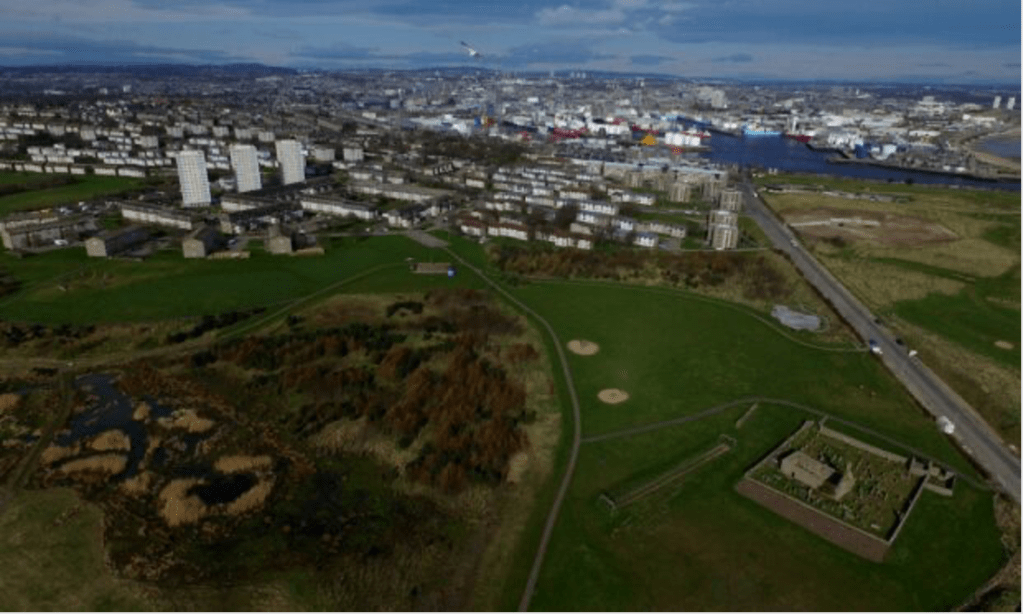
The 17-acre St. Fittick’s Park is owned by Aberdeen City Council and currently zoned as Greenbelt and part of the Greenspace Network. For centuries the land had been grazed by farm animals, until the 1960s when it became a rough field, much explored by children and known affectionately by the local community of Torry as “Our Fieldie”. The East Tullos burn which crosses the land had been channelised and over time became polluted with heavy metals and hydrocarbons.
About 20 years ago the Torry community came together to create a nature-based vision for a public park, with access paths and play equipment for children. £250,000 was raised to realise this vision, £168,000 by the community, with Aberdeen Council contributing the remainder. The new park was named St. Fittick’s because it includes a ruined church overlooking the North Sea at Nigg Bay. From here you can look across fields to the edge of Torry, and wonder how different this landscape must have looked when, according to legend, a religious foundation was established here by St Fittick in the mid 600s.
The story runs that St Fittick, an Irish monk, was thrown overboard by superstitious sailors when a storm blew up. He came ashore at Nigg Bay and established a church to give thanks for his salvation. Legend became history in the late 1100s when a chapel was built on the site of today’s ruins, under the auspices of Arbroath Abbey. This chapel was consecrated in 1242 by the Bishop of St Andrews David de Bernham, and continued to serve the local community until the Reformation.
In 2012 Aberdeen City Council carried out a city-wide greenspace assessment and identified St. Fittick’s Park as a priority for nature-based improvements. The Council commissioned a feasibility study for a project with three objectives: 1) Improve water quality of East Tullos Burn, 2) Improve
biodiversity and 3) Create a public amenity. Combining Aberdeen City Council funds with funds from SEPA, Aberdeen Greenspace, and others, £365,000 was spent to complete the project in 2014. Using a nature-based design, the burn was naturalised with meanders and aquatic and riparian vegetation and reedbeds and wetlands were added to provide habitat and help clean the water of pollution. The project installed 180,000 native wetland and wildflower plants, 20,000 square metres of wildflower seeding, extensive woodland planting on the adjacent upland slopes and 800m of access paths. The community got to work, in one day alone planting 10,000 trees.
The biodiversity and aesthetic beauty of the Park have significantly improved year on year over the last ten years. The Park is now well used and well loved, with school children, families and seasoned or budding naturalists enjoying this rich and diverse landscape. Many species of birds, amphibians, invertebrates and mammals are observed and studied.
This summer an MSc graduate of Aberdeen University carried out an aquatic biodiversity and water quality study of East Tullos Burn and found statistically and biologically significant improvements in the burn as a result of the restoration project, notably an increase in species abundance and richness, an increase in the dynamics and complexity of the food web, and improvements in water quality. Additional studies have found an explosion in biodiversity since the restoration was completed, including 115 plant species, 42 breeding bird species, including eight red listed and eight amber listed, and dozens of migratory species. Invertebrate surveys found over forty species of moth, 11 butterfly species, and a range of other invertebrates. Two invertebrates found on survey were nationally threatened species.
The Torry Community
St. Fittick’s Park is the last remaining accessible green space for a community of 10,000 people, in an area unfairly burdened by pollution, where few residents have private gardens. Before the advent of the Oil and Gas Industry, Torry was a centre for fishing, fish-processing, boat building and boat repair. Only the fish-processing remains. The old fishing village was destroyed in the 1970s to facilitate oil-related harbour developments.
An open letter from a local GP, signed by 22 doctors from across Aberdeen, points out that Torry is surrounded by two industrial harbours, an industrial estate, a railway line, a sewage works, landfill sites, a regional waste center, an incinerator that is currently being built, and one of the most polluted roads in Scotland. Much of the housing, the doctors say, is poor-quality – small, damp and affected by noise and light pollution. Residents frequently complain of high levels of exposure to antisocial behaviour. The doctors draw a comparison between the Aberdeen area of West End North, where the residents of two streets have exclusive access to 15 acres of mature riverside woodland, and the residents of the Torry community: “There is a 13-year difference in life expectancy between these two areas …The difference in healthy life expectancy is around twenty years. There is an eight-fold increase in the risk for someone in Torry being admitted to hospital with complications of chronic lung disease …Torry has a higher proportion of young people and children living in it … there is a significantly higher proportion of dependent children per household than in the rest of the city, and more often in single parent households. Child poverty is accordingly high. Access to private transport is less common in the area and access to distant green space is thus much more difficult …[Torry] also has the highest level of unemployment in the city. Median household income is more than four times greater in West End North … Rates of dental decay in Torry run at over 80% by the end of primary school. These schools have some of the lowest levels of attendance in the city. Teenage pregnancies are still more than twice the average for the city and around eight times more than for West End North. Prescriptions for antidepressant medication are more than twice those for West End North. Drug-related hospital stays are almost three-times the Scottish average, and drug overdoses are more frequent here than anywhere else in the city. There are also disproportionately high levels of domestic abuse and household fires.”
St Fittick’s Park, Torry, is being eyed for an energy transition zone business park. Photo by Kenny Elrick/DCT Media
The award-winning wetlands in St Fittick’s Park could be at risk if the ETZ goes ahead on the Torry site. Photo by Kath Flannery/DCT Media
The Threat
Now St. Fittick’s Park is under threat of industrial development, which would pave over with concrete a large part of the Park. Unbelievably, Aberdeen City Council has agreed with the Oil and Gas Industry to designate St. Fittick’s Park as an opportunity site for a new Energy Transition Zone (ETZ) in the local authority’s 2020 Proposed Local Development Plan. The Council and Energy Transition Zone Limited, the private partner in the proposed development, assert that industrial use of the park, adjacent to Aberdeen’s new South Harbour, is necessary to advance the North East’s transition to a low carbon economy. The new South Harbour itself is an affront to the biodiversity and well-being of the Torry area. As recently as one year ago, visitors to St. Fittick’s Park could walk along the shore of Nigg Bay and look out across the bay to the North Sea. Now this shore has been reduced to a placid pool blocked from the ocean by a high concrete wall.
The Enemy
But this proposal is only ‘unbelievable’ if you continue to think, as it was reasonable to think in the past, that our elected representatives, whether in local or national governments, are serving the interests of their electorates. These days it’s the big energy corporations with their huge wealth who run things – through lobbying and bribing our politicians, and through their control of the media so that we get to be told only their version of reality. In relation to the proposed Energy Transition Zone in Aberdeen it’s the oil tycoon Sir Ian Wood who is the mover and shaker. He got control of economic development in the city in 2016 via the City Region Deal. Wood chairs the development company Opportunity North East (ONE) which is pushing the ETZ. He has enormous influence on both Westminster and Holyrood. The Wood Review of 2014 led to the tax cuts for the Oil and Gas Industry and the principle “MaximizingEconomic Recovery of UK petroleum” in the Infrastructure Bill, 2015. Note the intentionally occult jargon of “Infrastructure Bill” and “Maximum Economic Recovery” – for which read extracting every last drop of oil and gas from the North Sea regardless of costs and climate impact. Inevitably Wood also has a huge influence on a Scottish Government which increasingly tails the Westminster Government in its energy policies. He is the man behind the plans to industrialise the park.
A Scam
If you look a little more closely at the purpose of the ETZ , you are told that “The project is based on using clean energy such as offshore wind, hydrogen and carbon capture and storage”, with a quote from Wood who says “We’ve got the opportunity in the north-east of Scotland to help balance the economy with a new industry, and at the same time, play a really significant role in one of the world’s greatest problems right now in global warming.” Wood said recently that it was only in the last two or three years that he realised that climate change was a serious problem.
This is a classic example of being told only his version of the story because in reality neither hydrogen or carbon capture and storage have any chance whatsoever in reducing global warming in the necessary time-scale, nor can they be described as ‘clean energy’. For simple explanations about hydrogen energy and carbon capture and storagesee Microsoft Word – briefing 13.docx (wordpress.com) and Microsoft Word – Briefing 10.docx (wordpress.com). In reality these technologies are fake tickets to allow the oil and gas companies to continue to pay their executives and their shareholders and to remain in business.
Collision of Crises
At St. Fittick’s Park we are seeing a head-on three-way collision between the Oil and Gas Industry, the Climate Crisis, and the Cost of Living Crisis. Neither the Climate Crisis nor the Cost of Living crisis can be sustainably resolved until extraction and burning of fossil fuels is stopped globally – see the report of a recent discussion which made this clear at North Sea Oil and Gas and the Cost of Living – Employment, Energy and Environment (scote3.net) . Stopping reliance on fossil fuels will mean different things for different countries, depending on their current energy sources. But for the UK and Scotland it’s primarily about stopping North Sea oil and gas extraction.
Collisions like this are of course not unique to Aberdeen. But what makes this one unusual is that it’s actually a four-way collision involving the Nature Crisis too, plus the visual proximity between a resource vital for Nature and a resource vital for the survival of the North Sea Oil and Gas Industry. This proximity makes obvious a choice which is often blurred by the topographical distances between the conflicting interests. Moreover in the case of St. Fittick’s Park it’s not only Nature which is being put under yet another threat which it can’t afford, but it’s also the well-being of one of the most deprived communities in Scotland.
The Nature Crisis
The Nature Crisis is often side-lined, especially at times like the present when human beings are facing multiple crises. Exploitation of Nature by man goes back to the Garden of Eden. But for the roughly two hundred years since the crescendo of industrialisation in the West, we’ve become more and more conditioned to the arrogant idea that other species are here only for our benefit. It’s arguable that this arrogance is the most fundamental reason for the mess humanity is in now. Places like St. Fittick’s can help us shift our mind-set towards thinking in terms of every non-human species being important in its own right – not only those species which benefit humanity or those which are threatened by extinction.
Large numbers of local community-driven initiatives, not necessarily as big or remarkable as the St. Fittick’s initiative, are more likely to make a real difference to biodiversity than top-down directives. The Scottish Government’s top-down Biodiversity Strategy Consultation closed a week ago, the Friends of St. Fittick’s Park having submitted a robust contribution. As well as telling the remarkable story of the Park’s restoration and enhanced biodiversity, the submission points out that the Scottish Government, led by the Scottish National Party for 15 years, has presided over a range of policies which have driven the current Nature emergency the Government is consulting about:
These policies have in common that they are designed to benefit wealthy people and are driven by profit. Some of these policies are entirely the Scottish Government’s responsibility, some are through collusion with the UK Government. Unless these policies are radically reformed any attempts to address the Nature Emergency will fail, sooner rather than later. The policies which have been most crippling for Nature include:
1. Land ownership
50% of Scotland’s private rural land is owned by 432 individuals, mostly large estate-owners and industrial-scale farmers. As historian James Hunter has said: “Scotland continues to be stuck with the most concentrated, most inequitable, most unreformed and most undemocratic landownership system in the entire developed world”. In addition nearly all public land is controlled by central or local government, not by local communities.
2. The sacrifice of biodiverse land for development
Weak regulation enables more and more biodiverse land to be paved over for industrial or unaffordable housing development.
3. Farm subsidies
Huge sums of money continue to be paid to farmers, particularly large livestock farmers, to boost their profitability. Further money is paid to mostly large farmers and estate owners to improve biodiversity, but most of these people are primarily concerned with increasing their wealth, both profits and land values. Biodiversity is not often their primary motivation.
4. Bioenergy with carbon capture (BECCS)
The Scottish Government remains wedded to the concept of planting up huge areas of land with monoculture fast-growing trees, even to felling more diverse forests to make way for these new plantations. The plan is to burn the timber from these new forests in power stations and deal with the carbon emitted by “Carbon Capture” – a process yet to be developed and tested at scale.
5. North Sea oil and gas extraction
The Scottish Government is also wedded to extracting every last drop of oil and gas from the North Sea. This has a negative impact on marine species; fuels, literally, global heating; and is responsible for the current cost of living crisis.
6. A one-nation perspective
The Scottish Government’s current proposals for addressing the nature emergency are an example of its tendency to think in terms of only one nation. Biodiversity has to be considered internationally. We should be thinking in terms of what Scotland can do to contribute to the efforts of other nations.
If the Nature Crisis was brought centre-stage two benefits, beyond enhanced biodiversity, could follow. First, at least some of the many people who care strongly about Nature, given information which would help them to recognise that profit for the wealthy is what drives the Nature, the Climate, the Cost of Living and the Poverty crises in common, they would be more likely to join the fight to stop North Sea oil and gas extraction, which is fundamental to all four crises in the UK and Scotland.
Second, young people and children are in general more and more aware of the devastation to Nature they see around them. These are the people who will sustain the fight for a better world long after our time is up. It was because the young people of the Climate Camp movement feel an urgency to stop this devastation that they based themselves in St. Fittick’s Park this summer. When they arrived they were shown round the Park, having to take care not to tread on abundant tiny frogs.
Children in particular tend to be alert to the Nature around them. The younger the children, the closer they are to the ground to make observations that we may not notice. A few weeks ago, at an Open Day for the Strathblane Wildlife Sanctuary (a much smaller and more recent initiative than St. Fittick’s Park), it was my pleasant job to lead tours of the site. For the first tour of the day ten pre-school children and ten parents turned up at the gate. The tour was led not by me but by the children, who ran ahead to point out lady-birds, slugs and molehills.
Our fight as adults must include ensuring that every child has the opportunity to explore wild land in their immediate neighbourhood.
If you want to join the fight to save St. Fittick’s Park by becoming a Friend of the Park please email


 Employment, Energy and Environment