‘Transition’ from oil? Our idea now looks like a delusion

NEIL ROTHNIE, retired oil worker and climate activist, reflects on his participation in Extinction Rebellion and what we have, and have not, achieved.

This post was first published on the People and Nature blog. If you’d like to respond to this article please use the contact form to get in touch.

“The rebellion starts here”, I wrote in October 2019. “There must be non violent direct action aimed at big oil, and targeting oil production.”

The article, North Sea oil and gas: the elephant in the room, was originally a leaflet that I took to London, to Extinction Rebellion’s festival of rebellion.

At that time I was four years’ retired, after 40 years as an offshore oilworker. I was experiencing a personal renaissance, as Extinction Rebellion (XR) crashed onto the streets. 

My article wasn’t particularly radical or controversial. Certainly not to most XR rebels who were its target audience. And it still today, at least in part, reflects what is a fairly mainstream position in the climate movement. 

I wasn’t really focussed on XR’s demands as such – e.g. getting the government to “tell the truth”.  Even then I wasn’t convinced that that was very likely, but I certainly didn’t disagree. I knew next to nothing about the popular assemblies that XR was calling for, or about whether Net Zero was remotely achievable by 2025.  

But I’d been hugely impressed by the way Extinction Rebellion had burst onto the scene, blocking bridges over the Thames the year before. That’s when I’d become aware of the movement.  

By this time, I was troubled about global warming and thought that it would take the masses to intervene in this existential issue. Really all I wanted to do was to bring my own experience to bear on the situation.

I’d been flabbergasted that many rebels I’d spoken to had little awareness of the North Sea oilfield’s existence.

I felt that the “fossil fuels” that were understood to be the major source of greenhouse gases when burned, were in fact still pretty much a “concept” – something in their heads, rather than real stuff mined by real people in our patch.  

My article called on the climate movement to turn towards the oil workers with a call for a “just transition”.

Just transition of course was not my formulation, but was a concept that I swallowed whole, and expected would appeal to the offshore oil workforce on some level and might be the basis for workers to mobilise around.  

This, after all, was the workforce that had engaged in a huge struggle after the 167 deaths by burning and drowning on the Piper Alpha platform, albeit 30 years previously.

In what now seems like an age since 2019, we’ve seen virtually no response from oil and gas workers, despite a concerted turn towards them by parts of the climate movement.

Perhaps the one concrete thing is that we know that they would be more than happy to transfer from offshore oilfield to offshore wind field … if they can keep the lifestyle and the wages.

But the workers are still in lock step with their trade unions (the minority that are actually organised) and with their employers, with Big Oil globally, and with our government. 

Short of a massive storm event on the North Sea creating another major tragedy, it’s hard to see this unholy alliance unravelling any time soon.  

But while I’m not embarrassed by the 2019 article, I don’t think it reflects the reality we’re experiencing, never mind the future we’re facing. That is why I came back and asked Simon for the use of his blog again.  

Right now, everywhere, we have an accelerating pattern of disasters, intermittently destroying lives and the natural environment and by all accounts driving the tendency towards mass extinctions of species. 

We’ve seen a succession of global heating-induced disasters rock the planet. The floods in Pakistan, the fires in the Amazon, and today in California, stand out for me. It’s relentless. You’ll have your own list.

Can I tell the future? Well obviously not. But, as far as any layman can understand the climate science consensus, it seems that we’re way way further down the road to a radically different global climate, and massive changes to local weather that cause mayhem and misery.  

My characterisation of the industry/government strategy as “business as usual” was, and remains, accurate, I think.  

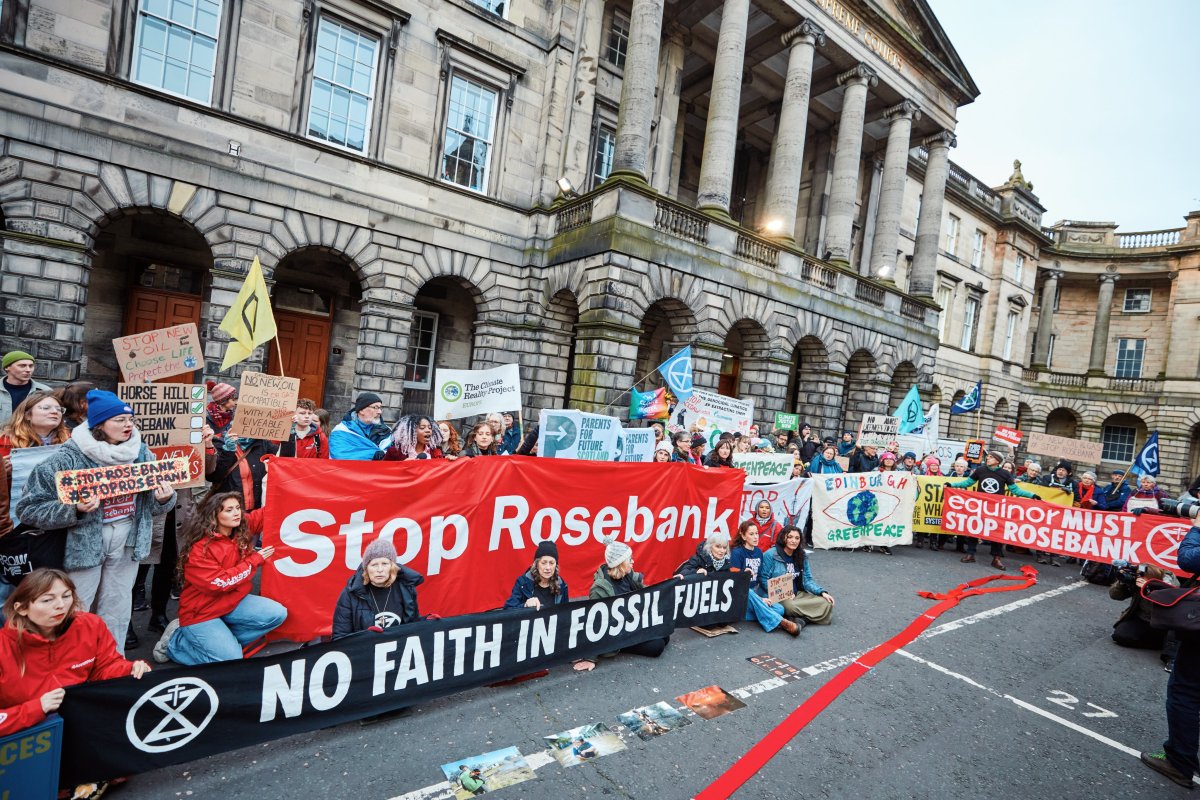
The court decision last week, that the process that gave the go-ahead for the development of the Rosebank and Jackdaw fields on the North Sea was unlawful, should pose absolutely no problem for the industry that was complicit in the hanging of Ken Saro-wiwa, and has been involved in human and ecological atrocities across the globe.  

Not much of a problem either, I’d have thought, for Rachel Reeves and Sir Starmer with their Growth & Growth & Growth mantra.  

The concept of a transition – never mind “just” – from fossil fuels to renewables, led in any part by the massed ranks of the proletariat self-organised in the offshore unions, now looks like an ongoing exercise in self delusion.

Long before XR was set up, in 1989-90, I was desperate to get some sort of an idea of the nature of the relationship of oil and capitalism – something that might inform me whether the rank and file Offshore Industry Liaison Committee (OILC) could chew what we’d bitten off by organising strikes and platform occupations after the Piper Alpha disaster. [Note. Here is an interview with Neil about this, and an archive of the rank and file paper he edited, Blowout.]

I was looking for some sort of an understanding of the possibilities and opportunities. Where did any of this lead? 

Thirty-five years later, and along comes Adam Hanieh with his book Crude Capitalism: oil, corporate power and the making of the world market (reviewed here and here). He says, as I read him, that the capital system and fossil fuels are inextricably entwined.

His book begs the question, at least for me, of the likelihood that the capital system can turn off oil and gas, and replace the world’s energy needs from renewables, before climate chaos becomes the norm.  

The vision this question conjures up, in my imagination, is of someone ripping out their own heart with one hand, while trying to construct a replacement organ with the other. 

Meanwhile Jean-Baptiste Fressoz tells us, in his book More and More and More: an all-consuming history of energy (Allen Lane, 2024), that that holy grail of the climate movement, a “transition” to renewables, is in fact a pipe dream, a chimera.  

There never was, it seems, in human history a precedent – an energy transition – corresponding in any way to the fantasy we hold of fossil fuels being replaced by renewables. Oil didn’t replace coal. Coal didn’t replace wood. It’s just been “more and more and more”.

The history, Fressoz insists, is of “symbiotic” relationships. Burning coal leads to using (more) wood. The exploitation of oil and gas drives (more) wood and (more) coal to be used, and crucially, renewable energy adds to and encourages the use of (more) wood and coal and oil and gas in such a way that Fressoz sees no plausible scenario where global heating might remain within 1.5, or 2.0 degrees C. 

We’re looking at “three degrees C – a catastrophic increase” he says. “How can we make do with less and less and less?” he asks.  

And Brett Christophers, in his book The Price is Wrong: why capitalism won’t save the planet (reviewed here) challenges another growing orthodoxy. The idea is firmly out there that now that the price of renewables is right, that renewables are “cheaper” than fossil fuels.  

This, the argument goes, will inevitably, according to the laws of the market, mean that renewables will supplant fossil fuels. Only who would have guessed that in fact “the price is wrong”, and that all along it’s been profits, not prices, that drive capitalism?

Let’s suppose that you’ve checked out these authors for yourself, and found that my very crude argument, largely drawn from my reading of them, casts reasonable doubt on the idea that there is a snowball’s chance in hell of the current “powers that be” getting us out of this mess.

Then your next step might be to have a look around for the Leninist parties that are going to wrest global power from the current crop of megalomaniacs and oligarchs and downright genocidal bastards. Where are the forces that will lead us over the barricades, kalashnikovs in hand, to capture the state (everywhere) and plan our way out of this one?

Perhaps that’s not the place to look. Perhaps it’s going to be more complicated.

If you are, like I am, disabused of almost every certainty you ever held dear, then there is at least one step that might help us “take care of ourselves”. No! This is not about Lush bath bombs (if they are still a thing). It’s not about playing Radio 3 in the mornings instead of exploding from bed shouting and swearing at Radio 4’s climate-deniers-lite.

April 2012: Volunteers running a centre where Hurricane Sandy survivors could stock up on staples. Photo by Liz Roll/ Creative Commons

“Taking Care of Ourselves in a World on Fire” is the subtitle of Adam Greenfield’s book Lifehouse (Verso, 2024). The “care” he’s talking about is putting human need, human relations and self organisation at the centre of our practice – in a period when it would seem that we are going to have to learn to survive and make worthwhile lives with less and less and less.  

And all this in the face of escalating climate emergencies and the inevitable breakdowns they provoke. 

The book is rooted in Greenfield’s own experience as part of Occupy Sandy, which had morphed out of Occupy Wall Street, organising relief to the victims of the hurricane that hit New York in 2012.  

He draws material together from the way people have been self organising in the face of inadequate official support, abandonment and just downright open hostility, in places as disparate as Rojava in Kurdistan; Jackson, Mississippi, in the USA; Greece in 2010, during the debt crisis that exploded health care; and in California, where the Black Panthers organised from the late 60s to the early 80s.  

The book is “optimistic”, not “hopeful”. Greenfield inveighs against hope, and lays out a rationale and a blueprint for a practice, and a physical space, that offers us a place to organise and the chance of shelter and community and dignity.

This is a rant, not a series of book reviews. And it may turn out to be no more prescient than that one from 2019. 

But is Greenfield, broadly speaking, right?  No point in just hoping so. The point of his book is, it seems to me, not just to understand the world but to change it. I’ve heard that somewhere before. A first step might be to have a look. 
Demonstration – save St Fitticks

Join the Friends of St Fittick’s Park for a demonstration to protect St Fittick’s Park in Torry from industrialisation.

Join the Friends of St Fittick’s Park for a demonstration to protect St Fittick’s Park in Torry from industrialisation.

The last remaining greenspace in Torry is under threat from a bogus “Energy Transition Zone” factory. 

Aberdeen City Council are deciding on a planning permission in principle application that will deprive the wildlife in the park and the people of Torry, our much-loved environmental haven.

Come along to tell the council they’re nae getting awa wi it this time! They must reject the ETZ application.

We invite everyone to wear blue to create a wave of people and to show the flood waters in St Fittick’s Park are rising, a key reason why the application should be rejected. 

Watery-related props are welcomed.

Meet at Marischal College, Broad St, Aberdeen, 7 Nov. at 9 am before we ‘flow’ over to the Town House.

Making just transition possible

Dundee Harbour – image by Pete Cannell CC0

The previous speakers have talked about some of the very important practical issues that are central to enabling a transition to a sustainable zero carbon economy. There’s plenty of evidence to show that phasing out oil and gas combined with serious investment in renewables creates more jobs.  The Sea Change report, published in 2019, shows how switching from oil and gas to wind and solar would create a big net increase in jobs and how failing to make this transition would mean that targets to cut carbon emissions would not be met.

Similarly, home insulation, retrofitting and replacing gas with electricity for heating and cooking is essential, but critically dependent on a skilled workforce. 

This workshop is framed around developing a workers plan for just transition. I would argue that the main elements of such a plan are in place.  That being the case in the rest of this contribution I’d like to talk about why there’s not yet a simple consensus about a plan.  Having a plan is clearly necessary, and critical to being credible in the eyes of working people who are not yet convinced.  

In one sense we’ve made serious progress in the last five or so years, it’s now common sense in the climate movement to talk about the role of workers and the need for a just transition.  I think in this respect COP26 in Glasgow was a watershed moment.  But ironically in practical terms, in terms of action I think we’ve gone backwards in the same period.  So, for example, the number of workers in renewables in Scotland is about the same now as it was in 2014.  In the eyes of many workers talk of just transition looks like hot air.  And in the hands of right-wing populist politicians, it fuels arguments that the climate crisis is not a problem and climate action is a threat.  So, there’s a real danger that repetition of just transition, in the absence tangible steps that improve lives and livelihoods, becomes a form of greenwashing. 

So, while we need consensus on what to do for me the 64,000-dollar question is 

How do we build a mass movement with powerful roots in every workplace and working-class community that has the power to make the necessary changes happen?

I think the climate movement often underestimates the extent to which commitment to the North Sea and to the interests of the big oil and gas companies shapes and directs climate policy.  Westminster, Holyrood, the energy sector trade unions and the oil and gas industry work in partnership through what used to be called Oil and Gas UK and has now been rebranded as Offshore Energies UK.  They are all signed up to the North Sea Transition Deal and it essentially guides their actions.  So, for example it’s hard to find a serious analyst who things hydrogen for domestic heating and cooking makes sense but using hydrogen in this way remains a key plank of policy for both Westminster and Holyrood.  And while it does other options are not pursued.  Why?  Because hydrogen together with Carbon Capture and Storage is the best option for Fossil Capital that wants to maintain existing market dominance, infrastructure and (not least) profits.

For more than fifty years the big oil and gas companies have used their operations in the UK sector of the North Sea to blaze a trail for what we have come to know as neoliberalism; establishing practices that have been copied and taken up internationally. Outsourcing, multiple layers of subcontracting, vicious anti-union policies and the use of blacklists.  At the same time the so-called free ‘market’ has been featherbedded by massive state subsidies which have exceeded taxation revenue.  

In the old saying – if we had a choice – we wouldn’t start from here.  All the evidence is that we are just going past the 1.5degree threshold and the scientific evidence is that change is taking place more rapidly than anticipated.  This while the Scottish government which has been strong on rhetoric but feebly reliant on the market for action is judged to be a long way for reaching its targets and Westminster gives the green light for maintaining oil and gas production.  And the most important unions remain wedded to a policy of partnership with the energy industry. To answer my earlier question, that partnership, is why we don’t have consensus about a plan.  It’s the partnership that pulls in Unite, RMT and GMB behind CCS, Hydrogen and Nuclear.

In this context I think it’s legitimate to ask whether just transition is any longer the right framing for what we want or need.  

We need to be clear about what we want to happen and largely that thinking is in place.  But to make it happen – perhaps what we should now be talking about is rupture rather than transition. And the power to make that rupture resides within the working class.

North Sea workers are key, but the oil industry has been successful at keeping their organisation fractured and largely ineffective.  I think it’s most likely that oil workers will become active participants in the rupture we need only if the mass movement we need is built across all sectors and in working class communities.  

And if we are to win that mass participation then there’s no place for partnership with Fossil capital – and that means some very sharp arguments within our movement.

Fossil Fuels and Right-Wing Populism

This post explores the way in which right wing populist parties use climate denial as a key part of their agenda.  In thinking about the topic, I found Andreas Malm’s excellent book ‘White Skin – Black Fuel on the danger of Fossil Fascism’ very helpful.  Early on in the book, Malm notes that: 

“All European far-right parties of political significance in the early twenty-first century expressed climate denial.”

The book weas written 3 years ago but it’s hard to think of more recent exceptions.  So, there’s definitely something to be explained here.

Clearly climate denial didn’t start with the rise of right-wing populism.  From the 1970’s onwards the major oil and gas companies, particularly Exxon, were researching the impact of greenhouse gas emissions on the environment and at the same time funding organisations like the Global Climate Coalition in the US whose role was to argue that pushing large amounts of CO2 into the atmosphere was not a problem.  Privately they knew from early on that fossil fuel extraction would have a devastating effect on the global climate.  In 1995 the GCC in an internal document wrote that 

“the potential impact of human emissions of greenhouse gases such as CO2 on climate is well established and cannot be denied”

but in public they denied it.  

As a strategy outright denial had its limitations.  The Kyoto protocol signed in 1997 marked the beginning of a new strategy – a shift from denial to greenwashing.  

The three core tenets of Kyoto are:

  1. Postpone the showdown with Fossil Fuels into distant future.
  2. Place no serious limits on fossil fuel extraction.
  3. New opportunities for generating profit.

In the UK, the industry’s plans for the North Sea are a good example of postponing any showdown with fossil fuels.  The strategy is based on continuing extraction through to and beyond 2050 and the development of a so-called net zero oil and gas basin.  Here net zero depends on heroic assumptions about techno-fixes such as carbon capture and storage combined with creative accountancy that ascribes all responsibility for the carbon in the oil and gas that’s produced to the users.  Globally there are virtually no regulatory limits on the production of fossil fuels.  It’s assumed that any run down will be as a result of market forces.  At the same time trading carbon permits has been highly profitable in financial terms and has allowed the industry to claim that the trade contributes to reducing carbon emissions.  There is next to no evidence that carbon trading and offsetting has reduced greenhouse gas emissions.

So as far as big business goes, we are still in the era of greenwashing.  Big oil and gas are at pains to argue that they want to protect the planet.  And almost all governments around the world are in lockstep with fossil fuel industry in this strategy.  Practically, depending on local circumstances the form that greenwashing takes varies, but everywhere it’s about maintaining or enhancing the profitability of fossil capital and preserving the existing infrastructure.  So, in the UK for example hydrogen is touted as the answer to domestic cooking and heating.  In the short to medium term this would probably mean higher carbon emissions than the existing use of natural gas and if ultimately the hydrogen was all green, i.e. produced by electrolysis it would be fantastically inefficient.  Requiring the use of up to seven times as much electricity than would be required to simply electrify cooking and heating.  But it’s attractive to the industry because it enables the continuation of existing economic and technical infrastructure.

The result of all this is that investment is skewed away from forms of energy use and production that are sustainable and rapidly achievable – and rather than supporting a just transition for workers and communities existing inequalities are maintained and ramped up. The ongoing cost of living crisis in which poor consumers of gas and electricity contribute to eye watering profits for energy producers and distributors is a case in point.

And it’s this that has provided fertile ground for right wing populist parties.

Five decades of neo-liberalism has syphoned money and resources from public to private and increased inequality everywhere so that working class people are anxious or scared about climate, cost of living, war, housing, growing old – in a world where the belief that their parents or grandparents had that things would be better for the next generation is dead.  Most people don’t trust established politicians – established parties offer variations on the same neo-liberal agenda.  Into this vacuum has stepped forms of right-wing populism that purport to offer alternatives to the ‘establishment’.

Right wing populism takes different forms – sometimes taking over long-established parties – Trump and the Republican Party in the US.  Or in the UK the continuing rise of right-wing populists as a major, perhaps majority faction within the Tory party.  Sometimes emerging from explicitly fascist formations, for example, Le Pen in France or Meloni in Italy.  And sometimes completely new organisations, for example the AfD in Germany.  None of them are into Greenwashing.  They are all about Climate Denial.

In Spain a prominent member of right wing populist party Vox explains climate change as 

“any change on the sun, the moon, the rotation of the earth, volcanoes and naturally occurring atmospheric phenomena but absolutely not on CO2 emitted by humans. It would, said Abascal, be ‘very arrogant’ to believe that humans could alter the climate. It would be ‘even more arrogant’ to think that the alteration could be rectified by ‘coercive laws and taxes’.”

The AfD in Germany has increased its influence through organising around climate issues, demonising perhaps the biggest climate movement around the world, foregrounding the cost-of-living crisis and agitating around the farmers protests.  Often supported and facilitated in this by the state and the police.

It’s obviously not just climate that is building the new far right.  Climate issues intersect with the legacy of neo-liberalism, migration and racism and the failure of the left to provide an alternative that speaks to working people’s insecurity and against individualistic solutions.  The far-right populists feed off social media fuelled confusion and conspiracies.  Very often angry or frightened people looking for answers find them in apparently anti-establishment and authoritative voices online.  

So, what’s to be done.  I think we can see the embryo of an alternative in the picket lines and in the huge response to the ongoing horror in Gaza.  It’s struck me standing on UCU picket lines last year, and then again in the last few months picketing and leafleting outside the Leonardo arms factory in Edinburgh, how many of the passing drivers beep their horns and wave.  Early in the morning many of them are white van drivers, very few of them will be in a union.  There’s are real possibility of breaking the rise of the populist right.  But if I’m right about why they’ve been able to build on climate I think part of what a revitalised left has to do is set it’s face firmly against partnership with fossil capital and clearly against solutions like CCS for continuing oil and gas production and hydrogen for domestic heating that preserve the power of fossil capital.  And that means for example that UNITE, RMT and GMB need to stop supporting the oil and gas industry’s North Sea transition deal.

Now new gas at Peterhead

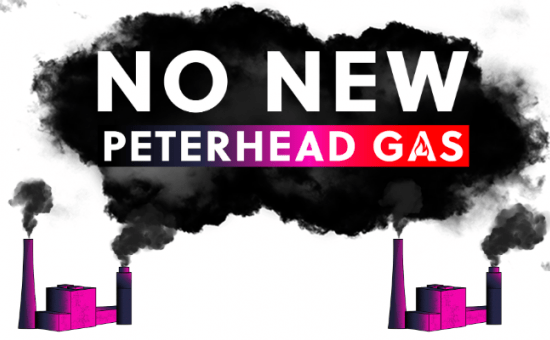
SSE and Equinor plan to build a new gas-fired power station at Peterhead in Aberdeenshire.  The existing gas-fired power station in Peterhead is Scotland’s single biggest climate polluter.  Building the new plant will increase pollution levels.  

The so-called North Sea Transition deal between the UK and Scottish governments and the oil and gas industry is based on squeezing out every profitable drop of oil and gas from the North Sea.  The Peterhead plant is part of this strategy.  The investment that is planned should be directed into renewables.

The plan is up for approval by the Scottish government.  Tell your MSP that rather than more gas we need investment in renewables, in retrofitting, in public transport and in a clean energy smart grid.

Sign the petition by Friends of the Earth Scotland.

North Sea Transition

We were invited to contribute to a panel on North Sea Transition at the conference ‘Working for Climate Justice: trade unions in the front line against climate change’ at Toynbee Hall in East London on 27th of October.

Aberdeen – image by Pete Cannell CC0

Since we launched in the autumn of 2017 Scot.E3’s emphasis has been on building capacity for a worker led transition with a focus on workplace and community organising.   Arguing for the rapid phase out of North Sea Oil and Gas has formed a central part of our campaigning.  The Sea Change report, published in 2019, remains very relevant.  It shows how switching from oil and gas to wind and solar would create a big net increase in jobs in Scotland and failing to make this transition would mean that targets to cut carbon emissions would not be met.

It’s very important that the climate movement has embraced the significance of North Sea oil and gas and a just transition for workers in the fossil fuel industries.  That wasn’t so much the case in 2017.  But two critical and closely linked challenges remain:

  • How do we build a mass movement with powerful roots in every workplace and working-class community that pushes for the necessary changes?
  • How do we engage workers in the energy sector, who are very aware that change is needed, but have very little confidence that it will be socially just?

For more than fifty years the big oil and gas companies have used their operations in the UK sector of the North Sea to blaze a trail for what we have come to know as neoliberalism; establishing practices that have been copied and taken up internationally.  Outsourcing, multiple layers of subcontracting, anti-union policies and the use of blacklists.  At the same time the so-called free ‘market’ has been featherbedded by massive state subsidies which have exceeded taxation revenue.  

The onshore construction industry has been on the same journey.  In Scotland the Construction Rank and File group has grown a new network through taking the construction industry using direct action tactics, picketing sites, and building combative organisation from the ground up. Just under a year ago two Unite activists, working on the new high voltage transmission lines from the Moray Firth to central Scotland were sacked for their union activity just before Christmas.  However, after the Rank and File group picketed the main subcontractor and Scottish and Southern Energy they were reinstated with full back pay.  The group has been a consistent supporter of Scot.E3 and have very publicly advocated for the importance of building worker organisation to ensure that the energy transition is a just transition.  

Despite many analysts and some industry insiders warning that oil and gas is an increasingly risky investment global levels of investment are high and currently booming while the industry remains determined to squeeze as much oil and gas out as it can out of the North Sea.   Among Westminster’s policy turns there has been a consistent adherence to the North Sea transition deal which describes in broad terms how that it is to be achieved.  The Scottish Government and the offshore trade unions remain signed up to the ‘transition’ deal.  Pursuing this path means that investment in hydrogen and CCS is prioritised at the expense of renewables, condemning UK consumers to a high cost and uncertain future and undermining progress to a genuine energy transition.   There’s no evidence that big oil has any particular commitment to the North Sea, and they must know that hydrogen for domestic heating is hugely problematic, but they are very keen to stick with false solutions that are compatible with the existing infrastructure and networks of fossil capital.

The cost-of-living crisis isn’t over.  However, to date, the climate and workers movements have failed to nail the intimate connection between fuel and food poverty and the oil and gas industry.  Perhaps there’s a lesson here.  At a time when we face a drawn-out existential crisis there is a need for new ways of organising that bring unions and communities together in common understanding and common struggle.  There are some examples of what this might begin to look like. In Scotland Edinburgh Trade Unions in Communities provides an innovative model, while in France social movement trade unionism is having an impact.

Calling on Ironside Farrar to cut ties with the Aberdeen ETZ

Yesterday (9th August) campaigners from Climate Camp, This is Rigged and Scot.E3 were outside the office of Environmental Consultants Ironside Farrar in Edinburgh. Ironside Farrar have been commissioned to produce a masterplan as part of the rezoning of St Fitticks Park in Torry into an industrial Energy Transition Zone (ETZ). The protest is part of an ongoing campaign to persuade the workers at Ironside Farrar to direct their skills towards projects that contribute to a socially just transition. Mike Downham spoke at the protest. There will be another protest at the Ironside Farrar office next Wednesday 16th August from 8.30am.

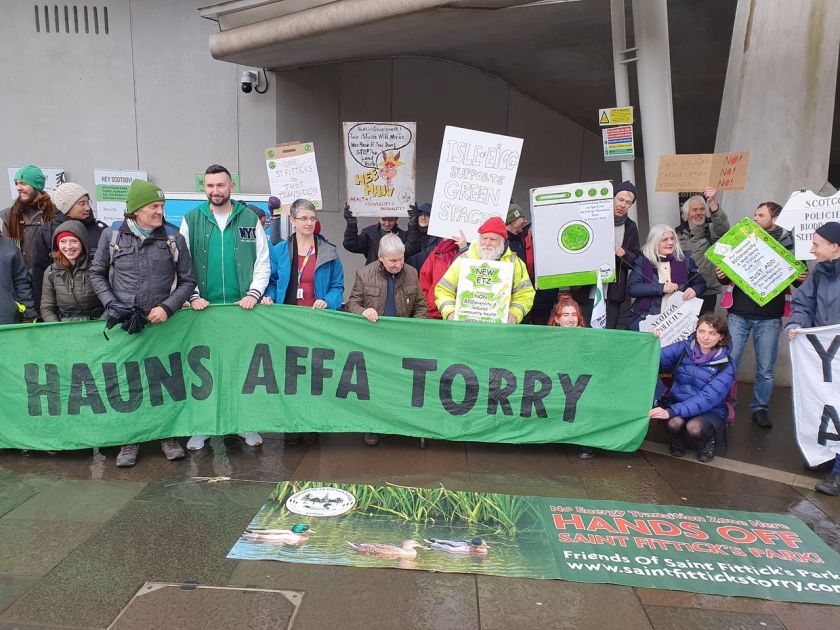
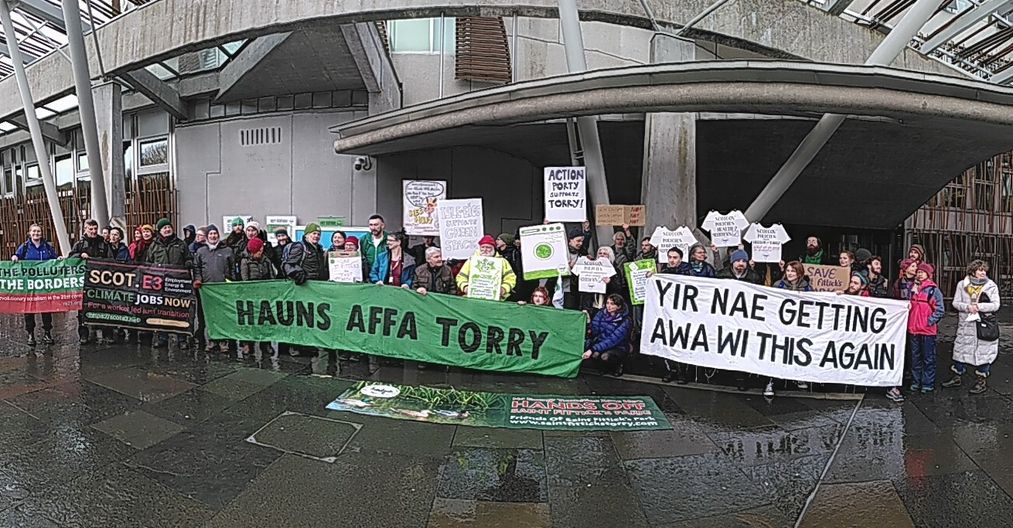
St Fitticks campaigners at the Scottish Parliament earlier this year

SPEECH OUTSIDE IRONSIDE FARRAR OFFICE 9TH AUGUST 2023

Welcome – and thanks for joining us this morning.I thought I would tell you why we’re here. This is the head office of Environmental Consultants Ironside Farrar – though the door doesn’t say that. We’re here to call on the employees of Ironside Farrar to boycott all further work for ETZ, the company oil tycoon Ian Wood set up to industrialise a large part of St. Fittick’s Park in Torry as an “Energy Transition Zone”. He then commissioned Ironside Farrar to get Planning Permission.

Torry is a suburb of Aberdeen, though it used to be a fishing and boat-building village just across the Dee from Aberdeen City. Then with the discovery of North Sea oil and gas in the 70s most of the village was bulldozed to make space for a Shell oil and gas terminal.

Since then Torry has been dumped time after time with the industrial development that other parts of Aberdeen don’t want – a landfill site, an industrial harbour where the Park used to come down to the beach at Niggs Bay, an incinerator close to the school, and now this threat to the Park which the Torry community cherish as their last green space. The threat to their community is huge. Ian Wood’s money persuaded Aberdeen City Council, who had previously invested much public money in improving the Park, to do a U-turn and re-zone it for industrial development. And Ian Wood’s money persuaded the Scottish Government not to intervene.

Ian Wood says the ETZ will contribute massively to bringing down carbon emissions, but much of the vague talk about what he wants to do is about developing Carbon Capture and Hydrogen technologies both of which are scams. This is in fact an attempt at a land-grab to justify continuing to extract oil and gas from the North Sea and fill the pockets of share-holders and directors in the Oil and Gas Industry.

Torry is about as disadvantaged a community as it gets, with appalling health statistics, appalling air quality and few employment opportunities. Despite this they are rising up and fighting for their lives against this plan to industrialise their Park.

Saving St. Fittick’s Park is exceptionally important, for three reasons:

  1. If it’s industrialised it will represent a huge win for the Oil and Gas Industry and delay phasing out oil and gas extraction from the North Sea
  2. It will destroy the significant biodiversity which has developed in the Park as a result of a lot of hard work and fundraising by the Torry community over the past 20 years.
  3. And it will further sicken and impoverish the people who live in Torry. It’s this last which is arguably the most important of the three. Because if we don’t protect and prioritise the poorer communities up the north east coast of Scotland we’re done for. It’s these communities who can force significant change.

Two big things have happened in the six weeks since we started this campaign, which make Saving St. Fittick’s Park even more important.  Climate has broken down across the world at a speed which wasn’t anticipated. Southern Europe and North Africa are on fire, and unprecedented floods in central China have displaced 100,000 people. The second thing is that the Westminster Government has decided to grant at least 100 new drilling licences in the North Sea. That these things can happen at the same time shows just how strong our governments are committed to fossil capital.

I’ll end by quoting a few things from the booklet The Declaration of Torry, a product of The Torry Peoples Assembly in May: on the back of this booklet they commit themselves to six actions:

  1. We will do everything to stop the land grab
  2. We will continue to use our Park and increase its already immeasurable value
  3. We demand the incinerator be decommissioned
  4. We will seek support to set up a Torry Retrofit Project to insulate our homes
  5. We insist on a just and fair energy transition
  6. We will strengthen collaboration within our community and with others in Scotland and beyond

 And inside the front cover of the booklet, most powerfully:

 THIS IS OUR LAND AND NO ONE ELSE’S

 THIS LAND BELONGS TO THOSE WHO CARE FOR IT

Just one thing to leave you with. The people arriving for work this morning are highly trained and have knowledge and skills which will be essential when we’ve made the transition to clean energy. They know about tipping points in global heating, and about the complex relationships which underpin biodiversity. Ever since we started this campaign, we’ve been respectful to these workers, seeing them as part of the solution, not part of the problem.

At the same time they must surely understand the enormity of what Ian Wood is planning in Torry. They have the power between them to Save St. Fittick’s Park, by boycotting further work for ETZ. Even if they aren’t in the team working for ETZ, they can bring Ironside Farrar to a standstill by collectively withdrawing their labour.

Sunak fiddles while Rhodes burns

Pete Cannell and Brian Parkin take a critical look at Sunak’s recent oil and gas announcement.

On Monday Rishi Sunak flew to Aberdeenshire by private jet to announce that at least one hundred new North Sea drilling licenses will be granted in the autumn.  A policy described by junior energy minister Alex Bowie as “maxing out our oil and gas reserves”.  At the same time Sunak gave the go ahead to the Acorn Carbon Capture and Storage (CCS) project to be based at St Fergus near Peterhead.  Acorn will be one of four CCS projects in the UK – the other three are in England.

St Fergus Gas Terminal © Ken Fitlike CC-BY-SA/2.0

At a time when fires rage across Europe, and North America and floods wreak havoc in China and elsewhere, the new oil and gas licenses have received widespread criticism from climate campaigners, climate scientists, the Scottish Government and even some Tory MPs.  Reactions to the CCS announcement are more mixed.  SNP politicians have welcomed the announcement.   Carbon Capture is prominent in the Scottish Government’s draft energy plans and Sunak argues that CCS will mean that the net zero by 2050 target is still in scope.  

In our view both strands of Monday’s announcement represent Sunak paying his dues to the big oil and gas companies.  In the rest of this article, we’ll explain why.  

For months the Tories have argued that the cost-of-living crisis is the result of a crisis of energy sovereignty caused by the war in Ukraine.  In fact, the price of gas had rocketed upwards before the war. There was no shortage of supply, since most of the gas used in the UK is piped from the North Sea.  Compared with the rest of Europe the UK is unusually reliant on gas for home heating and cooking.  There is a real problem here – the North Sea gas fields are nearing the end of their lifespan.  So given there is an overwhelming need to reduce carbon emissions the obvious answer is to start now, planning for the future by electrifying the domestic heating system and insulating homes alongside a planned phase out of the use of gas.  The Tories are doing none of this.  On paper they still say they want to replace natural gas by hydrogen.  But the weight of evidence that this would phenomenally expensive and a hugely inefficient use of electricity to generate the hydrogen means that they are rapidly backtracking.

So is Sunak’s plan to license more oil and gas fields going to keep people warm.  Not at all.  First the new fields contain more than 85% oil, not gas (see technical note below).  That oil would be exported on the world market.  Much of the gas is ‘sour’ – it has a high sulphur content – and is unsuitable for home heating.  So, we have the worst of all possible worlds – continuing use of fossil fuels at large scale when the climate science says that the use must stop and the likelihood of very high fuel bills and insecurity of supply.   Only big oil and their shareholders come well out of this – the rest of us and future generations pay the price.

A close look at Sunak’s plans for Carbon Capture and Storage is equally disturbing.  The technology proposed for CCS is untested at scale.  Even if the most optimistic targets for carbon sequestration are met, they represent a tiny fraction of the total carbon emissions from the North Sea.  At present the only source of carbon dioxide at St Fergus is the gas stabilising plant.  In the long-term Carbon Capture may be able to play a role in helping reduce the concentration of carbon dioxide in the atmosphere – but right now the priority must be to cut emissions rapidly.  The £20 billion allocated by Westminster to the 4 CCS projects could be spent on expanding the production of renewable energy, home insulation and developing the electricity grid.  

The parallels with the Cumbria Coalmine project are powerful.  There we have the Tories supporting the exploitation of a fossil fuel, coal, which is not wanted by the steel industry.  With the new licenses and CCS, we have a plan for energy security and net zero which delivers neither.  Quite simply both represent political statements by the Tory Government that affirm their unswerving commitment to fossil capital.

Technical note:

The proposed Acorn (St Fergus) (and other) CCS plants are designed to be emissions source dedicated- i.e. they are intended to sequestrate carbon from say, a power station or chemical plant flue stack- not the ‘general’ atmosphere, and as such they are demonstration installations.

Apart from the Peterhead sour gas power station, the other nearby CO2 source is the St Fergus gas terminal which adds about 3-4% carbon to the overall gas/carbon penalty.

Total North Sea reserve gas content is about 27% (73% oil). The new blocks have a much lower gas composition c.12%. 

The carbon contents of the different fuels (compared with coal) is:

Coal   97%

Oil       89%

Gas    35% max inc process penalty

Occupation in support of Torry community

Activists occupy tree outside Edinburgh offices in support of Torry community in Aberdeen. Press statement from This is Rigged

For more about Torry and the proposed Energy Transition Zone that will destroy St Fitticks park just scroll down or type “St Fitticks” in the search box.

Ironside Farrar, Environmental Consultants with offices in Edinburgh, Glasgow and Manchester were commissioned by Energy Transition Zone Ltd (ETZ Ltd) to produce a ‘Masterplan’ for the industrial development of parts of St. Fittick’s Park, Gregness and Doonies Farm in Aberdeen. They were also tasked with obtaining Planning Permission for this development. Ironside Farrar’s plans were presented to the Aberdeen City Council Management Planning Committee yesterday morning (29th June). The Council say they will adopt the ‘Masterplan’ as Planning Guidance.

On the same day, supporters of This Is Rigged went to the Edinburgh offices of Ironside Farrar and met with Julian Farrar, Managing Director of the company, to discuss the issues and request that Ironside Farrar withdraw from further work for ETZ Ltd, and that employees boycott all further work for ETZ Ltd for the following reasons:

St Fittick’s park is the last remaining green space in Torry, which is one of the country’s most deprived communities, where residents have a life expectancy ten years lower than people living in wealthier parts of Aberdeen. Commenting on the potential loss of the park, local doctors and nurses fighting to improve the health of the Torry community,  say that industrialising any part of St. Fittick’s Park will be devastating for the health of that community.

In addition to its positive contribution to human health, St. Fittick’s Park is an oasis for wildlife, including many species of migrating birds, and Gregness and Doonies Farm support this wildlife as green corridors. In a recent article in the Guardian[1], journalist Tom wall suggested the park’s wetland is “perhaps Aberdeen’s most unlikely beauty spot. Reeds flap and bend in blasts of salt-edged wind. Grey and blue light catch in watery beds, where ducks dip and preen. Birds shelter in a young woodland of oak, dark green pine and silvery birch trees.”

It therefore makes no sense to destroy this important habitat while Scotland is in the midst of a biodiversity crisis. Furthermore, the wetlands and forest created 10 years ago in St. Fittick’s Park are already capturing carbon, and it is increasingly recognised that ecosystems like these even regulate local climate including rainfall.

The main purposes of the proposed Energy Transition Zone will be to develop carbon capture and hydrogen technologies, both of which are considered by leading scientists to be unproven and dangerous excuses for continued oil extraction and habitat destruction.[2]

In yesterday’s meeting, Julian Farrar was warned that being complicit in destroying the wetlands and woodland, both of which are vitally important green spaces and biodiversity sites that have taken years and a tens of thousands of community man-hours to create, would be seen as an act of immeasurable violence.

Ishbel Shand, member of the Friends of St.Fittick’s Park campaign said,

“The proposed industrial development is simply a land grab by the oil and gas industry to fill the pockets of their shareholders and directors.”

After leaving the meeting with Julian Farrar, This is Rigged activists Mike Downham and Tom Johnson decided to occupy a small tree outside the Ironside Farrar offices, and are there awaiting a response.

Mike Downham, a retired paediatrician and children’s DR said,

“There is a high incidence of asthma in children in Torry due to particulate matter air pollution from the nearby incinerator and the South Harbour industrial development. Further industrial development in this community would have a serious negative impact on the health of children in Torry.”

Following the meeting, Tom Johnson, a painter-decorator and This is rigged supporter who knows St. Fittick’s park well said, 

“If Ironside Farrar were to pull out of the project at this stage, it would have a huge positive effect on the wellbeing and health of the Torry community – disempowered folk who have lost so much already. I mean, Imagine losing an entire bay – your access to the sea. And now forests they planted 10 years ago are to be ripped up and concreted over with “green” factories.”

“Julian Farrar explained to me that Ironside Farrar have reduced the amount of harm to be done in the park, but if they now come out against any destruction WHATSOEVER of these spaces, that will be a really bold statement of solidarity, and an action that shows their real concern for the environment, and people. We understand it’s difficult for a company to do something like that in current economic and political contexts, but to me Julian did seem to be uncomfortable with what’s going on with the ETZ.”


Our response to the Scottish Government energy consultation

This is our response to the Scottish Government’s consultation on a draft energy plan. The deadline for the consultation is 9th May 2023.

Response to the energy consultation from Scot.E3

Scot.E3 campaigns for a worker led just transition that would require at least 100,000 new climate jobs in Scotland.  In our view the draft plan contains material that is useful and will be necessary as part of the energy transition that is needed. We particularly welcome the draft plan’s suggestion that the Scottish Government should not support any further exploration or development of oil and gas fields – this is vital and needs to be followed through. But overall, the draft plan aims for too little and too slowly, and it fails to provide a coherent strategy to reduce emissions and reshape the Scottish economy.

The plan is flawed in several fundamental ways:

  1. It relies on the private sector to a achieve its ambitions.
  2. It follows the strategy outlined in Offshore UK’s North Sea Transition deal which aims for net zero emissions achieved through the large-scale implementation of carbon capture and storage.
  3. It accepts the hype around hydrogen uncritically.
  4. Mass scale retrofitting and decarbonising domestic heating and cooking is not given enough priority.
  5. There is no clear plan for expanding public transport systems.
  6. There is no strategy for creating a resilient smart energy grid that would integrate local community energy initiatives with large scale wind, tidal, hydro, and solar.
  7. It accepts the concept of net zero when we the climate science tells us we should be aiming for real zero.
  8. It fails to consider how a national energy company (Scottish Climate Service) could drive forward a strategy for zero emissions and harness the skills and creativity of the energy sector’s current workforce or the many thousands of young people who are required to make a sustainable energy sector a reality.

Notes

Points 1 and 8.  Public versus private.  As a campaign Scot.E3 believes that the oil and gas industry aim to extract the maximum profit from its existing business and to maintain the power and influence which it established through the 20th century and into the 21st.  The infrastructure and practices of what Andreas Malm calls Fossil Capital are incompatible with a sustainable renewable economy.  We understand that not everyone would agree with this analysis.  However, the scale and scope of the economic transition that is required is unprecedented.  The nearest comparisons – transitions to war economies in the UK and the US between 1939 and 1945, and the US New Deal in the 1930’s, depended on strategic planning, public control and high degrees of regulation over the private sector.   The Scottish government’s objectives for a just transition can only be met by a much higher level of public investment, democratic control, and regulation than the energy plan proposes.

Points 2 and 3.  Rejecting the false solutions contained in the North Sea Transition Deal. In brief the North Sea transition deal (written by the oil and gas industry and endorsed by Holyrood, Westminster, and the Offshore trade unions) is a plan to maintain oil and gas production from the North Sea for as long as possible, and certainly beyond 2050.   Carbon capture and a hydrogen economy are central to the plan.  There is place for carbon capture when we’ve ended fossil fuel emissions and can focus on repairing the damage created by global temperature rise.  And there is a place for hydrogen as a fuel in a small number of important but specialised applications.  However, the energy plan’s proposals for prioritising carbon capture, and for making Scotland a world leader in hydrogen production, direct the focus of the plan away from the necessary investment into decarbonising energy production and use right now, and make it much more difficult to achieve the energy transition that we need.  Carbon capture at large scale is an unproven technology, while producing green hydrogen is highly inefficient and requires very large amounts of green electricity.  A recent report, The Future of Home Heating by the Imperial College Energy Futures Lab notes that ‘Hydrogen production would be best used strategically and its deployment prioritised in sectors which are hard to electrify or decarbonise such as heavy industry, shipping, aviation and heavy transport.’ 

Point 4. Retrofitting.  Energy for domestic heating and cooking in Scotland is mainly supplied via the natural gas network and currently accounts for more than 20% of emissions.  The level of emissions could be significantly reduced through improving standards of insulation.  Action on building regulations for new builds is possible straight away and amendments to guidance and regulations for the insulation of the existing housing stock to include the new breathable insulation materials that are now available (for example the hemp based materials produced in the Scottish Borders) could also be made very rapidly.  A mass campaign of retrofitting requires coordinated action and investment that involves the development of skilled direct works teams in every council area and the resourcing of Further Education Colleges to provide good quality training.   At the same time the transition from gas to electricity needs to be coordinated with the timescale for the rundown of North Sea gas production.  Retrofitting creates new jobs and has the potential to enhance the health and well-being of the Scottish population.  Action now, with investment designed to ensure that no one is excluded is a critical part of a just transition and can win hearts and minds to the project of transforming the economy.

Point 5. Public Transport.  Simply replacing petrol and diesel vehicles by electric vehicles will not remove all emissions, will increase demand for scarce and environmentally damaging resources and perpetuate inequality.  A sustainable energy plan requires large-scale improvements in public transport networks. 

Point 6.  Developing a smart grid.  This is a surprising omission from the draft plan.  A smart grid that includes large scale wind, solar, hydro and tidal energy sources combined with a network of community-based energy schemes and storage that includes local district heating schemes is technically feasible and would ensure that the system is resilient in the face of varying climatic conditions and demand.

Point 7. Net Zero.  In practice net zero has become part of the set of false solutions used by the fossil fuel industries to delay real action on emissions.  It is bound up with arguments for carbon capture and carbon offsetting.  The latter has done almost nothing to actually reduce emissions (see for example Dyke, Watson and Knorr – ‘Climate Scientists: Net Zero is a dangerous trap) and often creates social problems in the private takeover of land for monoculture forests or other crops.  We would argue that an effective energy plan requires a critical position on net zero and setting the objective as absolute zero emissions.  The only way to achieve real zero in the context of the climate emergency is to phase out oil and gas quickly, starting now, and to invest heavily in renewable sources of energy.