Cutting green house gas emissions requires an army of new workers. Those workers need opportunities for training or (in the case of workers currently employed on North Sea oil and gas) retraining. But the jobs aren’t there – in fact the number of jobs in renewables is declining and the training is not happening. Pete Cannell digs into why this is the case and lays the blame firmly on strategies for transition that are concerned with maintaining profit and the preservation of the oil companies.
To be able to work offshore on oil and gas platforms or on offshore wind installations you need industry certification. Qualifications and certification for the Energy industry is controlled by an organisation called OPITO and courses are run by private sector trainers. Prices are high; the basic offshore skills course comes in at around £800.
In 2021 Platform and Friends of the Earth (Scotland) (FOE(S)) conducted a survey of oil and gas workers. One of the key messages from the survey was that if workers wish to shift to offshore wind, their oil and gas certificates are not recognised, and they have to pay for almost identical training that is validated for offshore renewables. This is a scandal, and its important that it has been publicised by FOE(S), Platform and others. They are campaigning for an Offshore Passport which would apply across both sectors and reduce costs to the workforce.
Bringing costs down for workers and making it easier to transition to renewables is welcome, but it’s not enough. There is an urgent need for the campaign to be widened.
To meet the target of restricting average global temperature rises to 1.5C there is a pressing need to start the phase out of North Sea oil and gas production and develop renewable substitutes. North Sea Oil and Gas needs to stay in the ground.
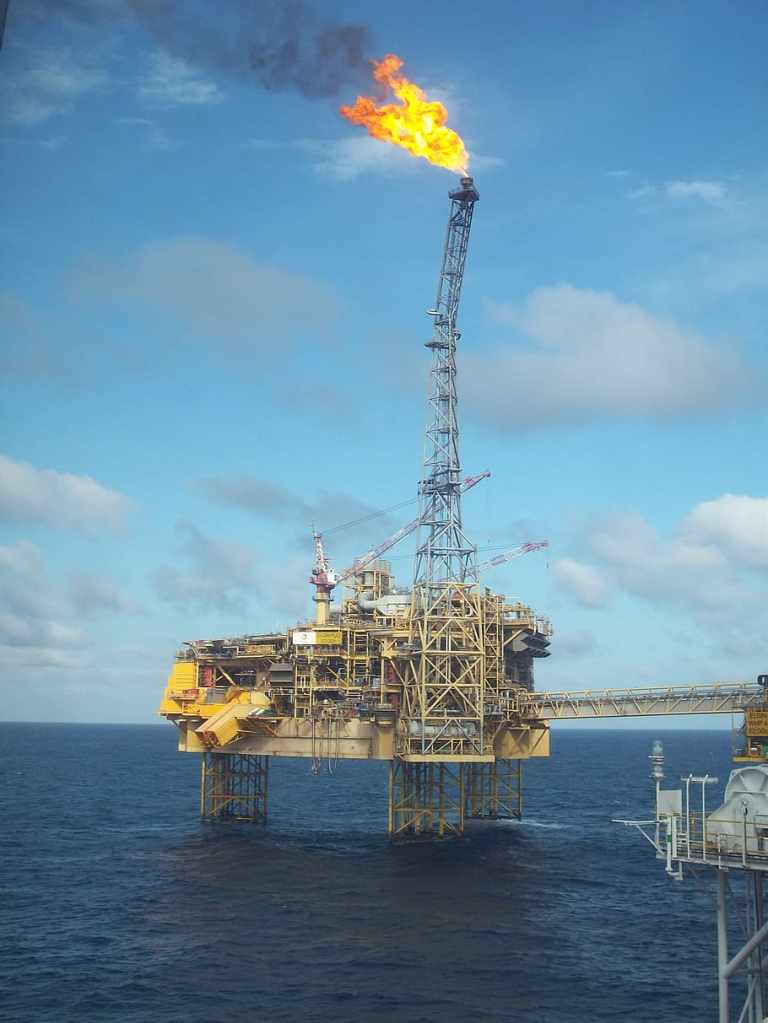
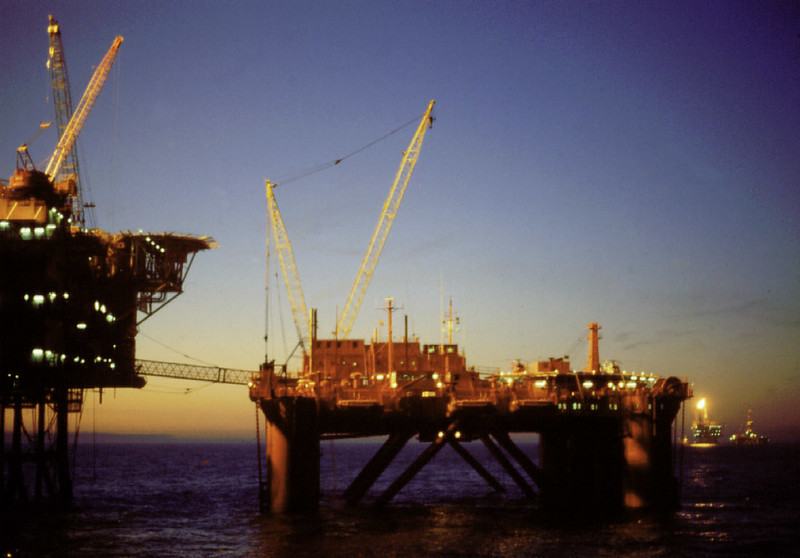
Elgin Franklin Image CC0 Public Domain
As activity on the North Sea runs down there needs to be a commensurate increase of activity in renewables – particularly wind and solar, home insulation and building a resilient smart grid to ensure reliable distribution of renewable electricity. All this new activity should mean new jobs. Right now, that’s just not happening. The Office of National Statistics reports that in Scotland between 2016 and 2020 jobs in renewable energy dropped by 14% to 20,500. Across the UK, between 2014 and 2020 the fall was 28,000 – ‘the steepest declines were in factories producing energy-efficient products, onshore wind, and solar energy’.
The decline in jobs is a direct result of the lack of coherent planning by governments at Westminster and Holyrood and their reliance on the oil and gas industry led North Sea Transition deal (published in 2021). While it sometimes looks as if governments don’t know what they’re doing, the Transition deal underpins every new policy initiative. In brief the deal means that climate action relies on the market and the private sector, that there will continuing extraction of oil and gas beyond 2050 and that we must hope that technological fixes are able to sequester some of the resulting green house gas emissions.
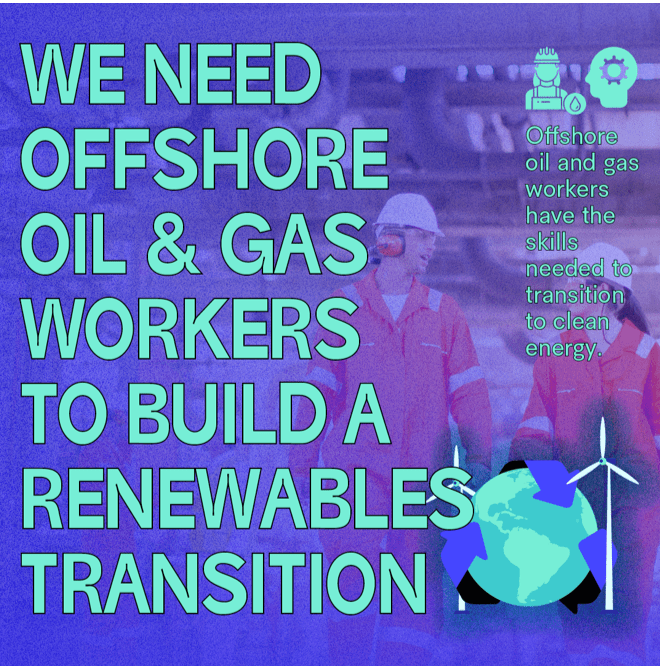
Offshore workers already have some of the skills that are central to the transition to a renewable economy. But as we’ve seen the energy sector skills body puts expensive barriers in the way of workers trying to make the transition. Other crucial jobs, for example in retrofitting (making existing houses more energy efficient), heat pump installation and district heating require new skills and retraining. But OPITO, the energy sector skills body (originally established by a Tory Government in 1991 along with a raft of other sector skills councils) is driven by the oil and gas industry and fully committed to the North Sea Transition deal. So, the skills training they offer supports an oil and gas industry perspective on how things should change, and their model of outsourced training paid for by the workers fits with the big oil and gas’s desire for an atomised workforce that pays for its own training. It’s worth looking at OPITO’s website, this is an industry body that does the industry’s bidding.
Bringing greenhouse gas emissions down to zero and building a new sustainable economy is critical to all our futures. Supporting North Sea Oil and Gas workers through the transition that this entails is both morally and practically essential. To avoid repeating the chaos and misery that afflicted coalfield communities when the pits closed, oil and gas workers who wish to should have the opportunity to apply their existing skills and retrain for the new economy. OPITO is not set up to support this, but the Further Education system is. The network of colleges across Scotland used to be at the centre of skills training and could be again.
Without a serious, planned, and large-scale programme for training and retraining there is no chance of a just transition, or a transition that takes place in time to avoid global temperature rises well in excess of 1.5oC. Currently the lack of such a programme is a barrier to action. In Edinburgh, for example, there is a campaign led by the Edinburgh Trades Union Council for retrofitting the housing stock. Edinburgh City Council insists that such a programme would need to be outsourced to private contractors and that a shortage of skilled workers would mean that only a few houses could be insulated.
The construction firms are not going to train more because the industry operates with layer upon layer of subcontractors. Moreover, there is strong evidence that even where firms can provide trained workers the level of training is inadequate and heat pumps are installed incorrectly and then fail to work properly.The introduction of sector skills councils in the UK, of which OPITO has emerged as one of the largest and most powerful, was part of the neo-liberal restructuring of the British economy. Collective organisation was anathema to the architects of the system – thus the focus on individuals paying for their own skills development. That needs to stop. And the new system, supported by the colleges, needs workers and workers organisations at the centre, high standards, enough time training for skills to be properly developed, together with jobs that provide decent pay and conditio
Friends of the Earth Scotland and Platform are launching a campaign for an Offshore Training Passport.
Here’s their rationale for the campaign:
What’s the issue?
Offshore oil and gas workers regularly pay thousands of pounds from their own pocket for their training and safety qualifications. Despite huge overlap, workers need to go through separate training for the oil and gas industry and the wind industry.
A Just Transition must include creating clear pathways for workers in high-carbon industries to bring their skills and experience into renewables.
The duplication of training is a major barrier to workers being able to bring their skills and experience from fossil fuels into renewable energy.
How can we fix it?
An Offshore Training Passport scheme would standardise training accreditation across the offshore oil and gas and offshore renewables industries where possible, reducing costs for workers by reducing the need for duplication of certificates and allowing workers to shift more easily between oil and gas and renewables.
A Just Transition must be shaped by the workers and communities who will be affected as we move from fossil fuels to renewables – the offshore workforce wants training barriers removed.
When surveyed, 94% of offshore workers supported an Offshore Training Passport
To find out how to support the campaign download the campaign toolkit which includes sample letters that can be sent to MSPs and MPs and material for social media.
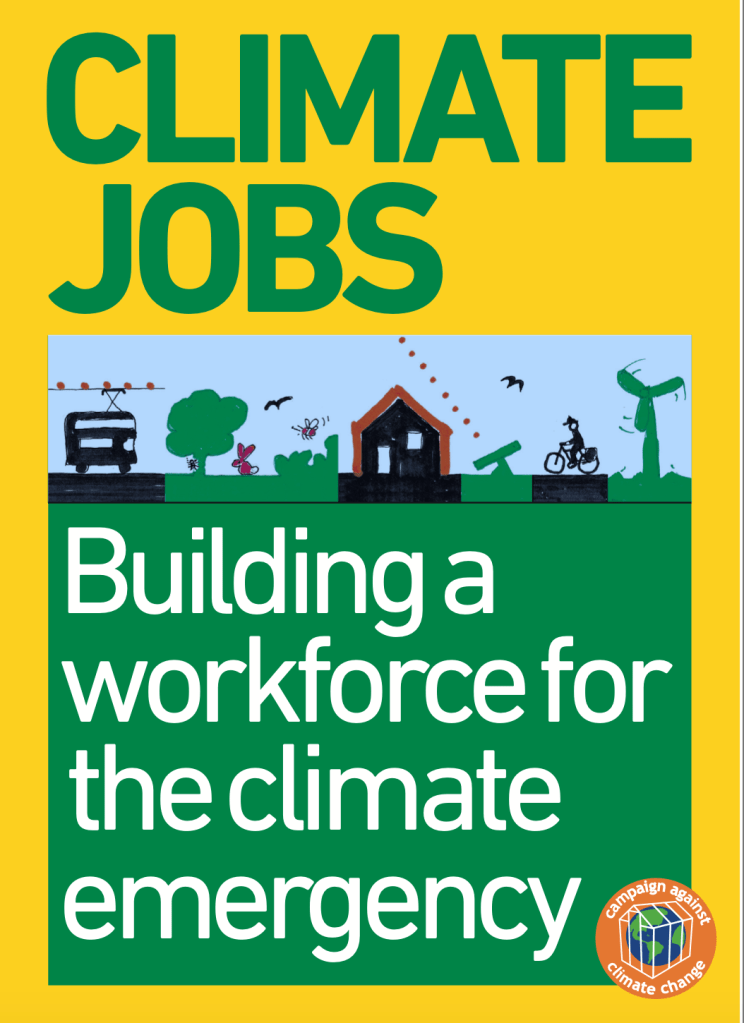
A new pamphlet, and accompanying technical resources, from the Campaign Against Climate Change Trade Union Group is indispensable reading for every trade unionist and climate activist.
It’s now 13 years since the One Million Climate Jobs pamphlet was published. The pamphlet’s proposition is a simple one – solving the climate crisis requires a rapid transition to a zero-carbon economy – transition involves ending economic activity in areas that create greenhouse gas emissions and hugely expanding the number of new jobs that are essential to a decarbonised economy – these jobs are what the pamphlet describes as ‘climate jobs’.
A focus on climate jobs is practical and political. It’s practical because an energy transition is simply impossible unless the jobs are created. So, the extent to which jobs are being created is a measure of progress. If there’s no evidence of jobs, then all the rhetoric about a climate emergency from politicians is just hot air and greenwashing. Scotland is a good example of this – we’re told that the Scottish Government has world leading policies – but there is no evidence of a growth in climate jobs, or of the planning and infrastructure required to support growth in climate of numbers. And while there is no evidence, it’s very hard to convince working class people that plans for dealing with the climate crisis will not have the same impact as past transitions. Many parts of Scotland are still deeply scarred by the transition from coal in the 1980s. So, to build the kind of powerful mass movement we need to drive an effective and socially just transition a sharp focus on climate jobs and the positive effects that transition would have on employment and quality of life is essential. It’s important to stress, however, that a socially just transition – system change in short – should also mean a re-evaluation of employment across the board. Social justice requires climate jobs, but it also requires that there are more jobs in health, care and education and these jobs that support social reproduction are valued much more highly.
Since the publication of ‘One Million Climate Jobs’ other studies have taken a similar approach to analysing what needs to be done to reach Zero Carbon. It’s striking that although methodologies have varied estimates of the number of climate jobs required for the UK and for regions of the UK are remarkably similar. The Green European Foundation’s regional focus is very helpful at understanding more localised impact. It provides data that enables estimates of the numbers of jobs in different sectors in Scotland to be made. Sea Changedemonstrates that phasing out North Sea oil could result in significantly more skilled jobs in renewables.
Nevertheless, ‘Climate Jobs – Building a Workforce for the Climate Emergency’ is a hugely valuable addition to the evidence base for organising and campaigning. It looks though a UK wide lens – and of course there will be regional variations – but the data and analysis on Energy Production, Housing, Transport and Decarbonising industrial processes provides a clear and accessible guide to what can be done using existing technology. The pamphlet also demolished the most common ‘false solutions’ (or greenwashing) that characterise so much of current government and industry priorities.
This pamphlet deserves to be used and shared widely. We will have copies on ScotE3 stalls, and you can order hard copies, download a PDF and access the back-up technical resources from the CACC TU website.
This is the slightly expanded text of a contribution that Pete Cannell (speaking for Scot.E3) made to a meeting organised by the global climate jobs network at the COP26 people’s summit.
Scotland is well placed to make a rapid transition to a zero-carbon economy. It is well endowed with natural resources for wind, wave, tidal and hydro power generation. Hydro power was developed in the 1950’s and sixties, more recently there has been some further development of local, small-scale hydro. Offshore and onshore wind power has developed rapidly, wave and tidal has seen very little investment. But Scotland also has a relatively strong representation of engineering skills among its workforces. These workers have skills in electrical, marine engineering, fabrication and so on – skills that are needed for the transition to a zero-carbon economy that needs to begin right now.
Most of these workers are currently employed in either the Oil and Gas sector or ‘Defence’. Sectors which are significantly larger as a proportion of the Scottish economy than they are of the UK as a whole.
The current state of play with climate jobs is disastrous. The policy of leaving transition to the market has resulted in declining numbers of jobs in renewables. We’ve written about the closure of facilities at BiFab and Machrihanish elsewhere on this site. At the same time there have been massive job losses in the North Sea and a long-term decline in engineering jobs in the defence sector. While there has been a massive increase in offshore wind generation the private sector has driven down wages and conditions, used low paid workers from around the world, shifted production to sites thousands of miles away and focused on profit maximisation rather than just transition.
There’s a lot more we could say about oil and gas but in the context of the other talks at this meeting we want to focus now on the arms trade. Britain is one of the biggest arms manufacturers in the world and Scotland has a disproportionately large share of this activity. It has been excellent that during this mobilisation around COP26 there has been a lot of discussion of the huge carbon emissions of the military.
In Scot.E3 we’ve argued for the need to go further – the military industrial complex in Scotland (and globally) acts as a barrier to transition. It thrives on public subsidy – far more than that provided for renewables. This is a characteristic it shares with the oil and gas sector. It distorts the economy, it’s secretive and hugely corrupt, dominates research agendas and monopolises skills and resources that should be directed to saving the planet.
We look forward to a day when the commitment and imagination of young people currently in school can be deployed to develop the kind of sustainable and socially just society that we are fighting for. But time is short, and we need to start the transition now with the skills and knowledge that are already available. To achieve climate justice and win the climate jobs we need it’s going to be necessary to force a radical shift of resources away from the defence sector as well as from oil and gas.
This article by Scot.E3 activists Brian Parkin and Pete Cannell was first published in the newsletter of the Scottish United Left. United Left is a self funded organisation for UNITE members, with the principal aim of promoting a socialist agenda within the Union
For the better part of a century Scotland has been energy self-sufficient. Since the end of World War 2 an ‘energy mix’ of coal, hydro, natural gas and nuclear provided an embarrassment of riches as far as power generation was concerned. Not only was Scotland power generation self-sufficient but it was also a net exporter of power to England and Northern Ireland via inter-connecter cables. But over the past decade, the picture has been changing radically.
Firstly, much of Scotland’s ‘thermal’ power plant- coal and nuclear has been retired– and the one gas-fired plant at Peterhead has been down-loaded; and without the fitting of carbon capture plant- it too, will be closed by 2025. Also, by 2030 Scotland’s remaining nuclear station at Torness should have closed. And despite a considerable investment programme in wind turbine construction it is conceivable that Scotland will be unable to meet its peak winter demand at times.
Climate crisis
The November COP 26 Climate summit in Glasgow will present evidence showing a worsening picture of runaway climate change due to the failure to control and reduce CO2 and other greenhouse emissions into the atmosphere. But even before the summit begins, many scientists and environmental activists have expressed doubts about any targets on greenhouse gasses being met. This is bad news which suggest that fundamental political changes are required in order to bring the world economy in line in order to prevent a global catastrophe. But rather than just await a solution from upon high, it is essential that wherever possible, climate crisis abatement strategies are undertaken now.
Scotland’s potential
Relative to much of the rest of Europe, Scotland is endowed with a combination of natural assets- which if harnessed responsibly- could turn the country into a showcase green energy economy. Scotland has one of the longest coastlines of any country in Europe- along with some of the most reliable wind resources- both on and off shore. Another exemplary energy resource is the Pentland Firth- the tidal stream straits between Northern Caithness and the Orkney Islands. It has been calculated that if a mere 20% of the straits energy could be captured then the power needs of Scotland could be met.
The social dimensions
Any radical shift in the economy is not possible without the jobs to achieve it and the democratic consensus to make it possible. But no such programme is possible unless there is a clear understanding that the status quo can no longer prevail. It is a status quo that is driven by a profit motive that denies both environmental responsibility and social justice. So while the planet overheats, the elderly and poor shiver. Therefore, we will need a Just Transition that will transfer and retrain workers from old sectors into building and maintaining the various component sectors of the green economy. There will be houses to upgrade to new thermal standards and new houses to build that incorporate those standards. New smart power distribution and supply systems will have to be built and maintained. Also the design and manufacture of new wind, tidal, wave technologies and supply systems will require a new generation of workers.
And beyond……
A truly green economy must also take into account the wider built environment- issues like clean free public transport and the redesign of energy efficient public amenities and enhanced cultural facilities. And Scotland which beyond its central belt has a dispersed population dependent on road transport- which raises the prospect of non-fossil fuel powered vehicles.
These and many other issues will present themselves as the transition towards a green energy economy nears. But it is essential that every stage of these transitions are the subject of truly democratic discussion that will at each stage raise the question of whether Scotland will remain part of a dire global problem- or a leading part of its solution.
Since declaring a climate emergency in 2019, the UK’s developed oil and gas reserves have increased by 800 million barrels of oil and gas, bringing UK developed reserves to 6.55 billion barrels.
UK law and Scottish Government policy of Maximising Economic Recovery, which requires every last drop to be drilled from the North Sea, would triple UK emissions from oil and gas.
To limit warming to the Paris Agreement goal of 1.5ºC no new oil & gas fields, including Cambo, can be licensed or developed and North Sea production must be wound down in the next decade.
In line with equity, the UK – as a wealthy nation with high historic emissions and low economic dependence on oil revenues – should phase out of oil and gas faster than countries for which it would be much harder. Not all of the 6.55 billion barrels in currently producing or under developed reserves can be extracted – some will have to close early, before fully extracting their reserves.
Every delay damages the prospects of a well-planned and just transition for workers and communities currently reliant on the industry.
We plan to publish a more detailed review of the report and if you would like to contribute your thoughts on the issues that it raises please do get in touch.
Neil Rothnie – ex oil worker and one time editor of the OILC newsletter Blowout spoke to a conference of people involved in the creative industries in Aberdeen on Saturday 4th September. He talked about the North Sea, climate jobs and just transition. We publish his contribution in full here.
I’ve been asked to speak because a large part of my life has revolved around struggle in the oil and gas industry. I spent my working life offshore, mostly on the North Sea, latterly in the Norwegian sector. On the whole I enjoyed my working life. I miss it a bit. But mainly the Norwegian bit.
In my early days in the industry, I was active in the Aberdeen Branch of the National Union of Seamen. And during the strikes and occupations led by the Offshore Industry Liaison Committee, in the wake of the Piper Alpha disaster, I founded and produced Blowout. At that time a “nasty scurrilous” tabloid that aspired to giving oil workers a voice.
I became the Secretary of the OILC branch of RMT after OILC “merged with” the Rail Maritime and Transport union, and I briefly represented RMT’s oil worker members on the executive of that union. I remain a member of the Norwegian union, Industri Energi.
I was inspired to join the struggle against climate change by Extinction Rebellion. I’m also active with ScotE3, campaigning for jobs and a just transition (the three Es in ScotE3 are employment, energy and environment). I’m speaking for neither of these organisations. I’m sure a lot of what I say here would get agreement from many, but not all, of the supporters of these two organisations.
As I understand climate science, it is fossil fuels that are very largely the source of the greenhouse gasses that are heating the environment and causing climate change and threatening the existence of much of life on the planet. For fossil fuel read oil & gas, at least for the purposes of this meeting.
So, I find myself back in a fight with the oil industry. In the wake of the Piper Alpha disaster, I struggled alongside the very best, and most conscious of the offshore workforce, many of whom were lifelong trade union members. Today I struggle alongside the very best, and most conscious of the youth, organised in Extinction Rebellion and in other civil society organisations, and with other old guys in ScotE3.
It’s a lifetime of work in the industry, and recent activity as a climate activist that informs my understanding of a “just transition”. Global heating and climate change is not the fault of oil and gas workers, and it isn’t/wasn’t the fault of the coal miners either.
That’s the good news.
This thought consoles me just before I try and get to sleep while trying to imagine my grandchildren having long, happy and fulfilled lives, sharing a planet teeming with life.
The bad news is that blameworthy or not, oil and gas workers are going to have to stop being oil and gas workers. Sooner rather than later if they share my concern for their own grandchildren. The solution it would seem is a “just transition”. I think we should have a look at the two parts of this “just transition” construct.
The transition! It’s already underway. And insofar as I understand the science, there’s no going back.
One possible outcome is that we’re going to complete that transition to a sustainable habitable world powered by renewable energy and a planet where we’ve stopped the practice of dumping greenhouse gas pollution into the atmosphere.
The alternative is that we’re going to transition to a largely uninhabitable world where the earth’s delicate ecological balance is disrupted, and enormous forces of nature are released, eventually taking humanity and the rest of life on the planet into a premature and manmade fifth mass extinction.
Transition, it seems to me, is not a choice. It’s begun. We’re in the process. We WILL transition to a planet beyond fossil fuel burning.
Mind you there’s a possibility that there just might not be people there to see it. But if we and lot of the rest of life on this planet are going to survive oil and gas is going to have to go and soon.
But what about the “just” bit of a “just transition”? Does “just” mean “fair”? I only ask because it renders my next question into English.
Fair to whom? Do we mean fair to our grandchildren and to their grandchildren? Those who are going to inherit the planet in whatever state we’re going to leave it? Do we mean fair to those who have spent their lives with little access to the fossil fuel energy that’s destabilising the planet? The very same people who are often at the sharp end of climate change? Do we mean fair to all other life forms on the planet? Or, as it’s usually understood in our corner of the globe, do we mean fair to the workers who currently produce and process the fossil fuels that have kept the lights on in the Global North? In the sense that oil and gas workers, and the communities in which they live, should not be dumped, as were the miners before them, when the UK transitioned from coal to gas in the 1980s and 90s?
Surely, we mean “fair” in all of the above senses of the word. But with, I think, an important qualification. “The transition” is primary.
Whether it is to be just or not, is entirely subordinate. No transition to renewables and the fairness or otherwise, really won’t matter a shit.
None of this means that I don’t think it matters what happens to oil and gas workers and the communities in which they live. But I think we should be clear that oil and gas workers and their families are not some sort of special case. The future for their grandchildren and their grandchildren’s grandchildren will ultimately be bound up with the future of ALL of our grandchildren.
There’s no special case, no “business as usual” scenario for the North Sea, where the transition doesn’t happen, and where oil and gas workers just keep on keeping on, producing fossil fuels. And the fairness or otherwise of the “transition” for oil and gas workers is going to be determined in some part by the stand taken by the workforce and their families and communities.
From the standpoint of a roughneck, or a scaffolder, or a caterer on an oil rig on the North Sea, this “business as usual” might well look, pretty damned attractive if you’re hanging on to even a precarious “ad hoc” job, and the alternative is a wage thousands of pounds a year less, and that’s if you could actually get a job ashore or in offshore renewables. In the same circumstances what would your initial reaction be? You’d have a bit more of the “business as usual” too, at least till you could plan your exit.
But what has “business as usual” really meant for offshore workers in the UK sector. Relatively good money! That’s true. But it’s been falling real wages and diminishing job security and major layoffs after successive oil price shocks going right back to 1986. You can have spent your whole working life on the North Sea and still be liable to arbitrary dismissal (I can explain the NRB later if anyone here is not familiar with it). And for many, work schedules in the UK sector are as ball bustlingly bad as ever. The boom days were pretty much over by the time Occidental killed 167 workers when they allowed Piper Alpha to blow up.
There are a lot of very good reasons for workers to get off the North Sea and into an industry with a future. The problem is how,and where, because the Government and the industry, are hanging on, as if to dear life, to a hydrocarbon future. Where is the clear plan to run down the industry and retrain and redeploy the workers in renewables, using the skills that they already have? And where is the plan for learning to live with the amount of renewable energy that we can reasonably expect to produce in the crucial near future? Which is what a Government and an industry would be doing if they gave a fuck for the workers, or the planet for that matter. .
And then there’s the offshore wind industry, driven by profit. They’ll have studied carefully how the oil companies have tackled decommissioning. They too would rather pay wage rates that might well allow a decent standard of living in Manilla, but certainly doesn’t cut it in Aberdeen or Middlesbrough or Burntisland. The workers who used to produce wind towers in Campeltown could tell you all about this. What we have instead of a plan for a just transition, is a deal between the Government and the industry to further support hydrocarbon production, to continue with “business as usual” on the North Sea, subsidised to the hilt by taxpayers’ money.
The end of oil and gas globally must look like the end of the world to the fossil fuel industry, the bankers who finance it, the traders who parasitise it and the politicians. Hopefully it’ll only be the end of a rotten and corrupt system.
The Government parrots the industry formula about oil and gas production being necessary “for decades to come”. They call their plan for the North Sea “maximising economic recovery”. Producing every barrel that they can turn a profit on. This perverse version of “business as usual” has been written into the UK’s statute books.
And it begs the question of whether our Government, hosts of COP26, self-anointed global leaders in the fight against climate change,are giving the nod here to maximising economic recovery of ALL oil and gas?
Globally?
I shouldn’t think Vlad the poisoner or the Crown Prince murderer need much encouragement to follow suite.
Central to the UK plan is one mitigation measure. It’s an expensive, energy guzzling technology that has been stalling for the last three decades, and which would require a 1000 fold increase in capacity worldwide to begin to address the situation. It’s called carbon capture and storage (CCS) and it’s linked to so called “blue” hydrogen production. CCS at scale is not even up and running in one single location in UK. It’s pretty much only commercially viable as a tool for producing even more oil and gas mainly in the States, and only then when oil and gas prices are high. CCS is beloved of the oil industry and the Government, but is “disappeared” by the media in much the same way as the North Sea itself is largely disappeared in public debate about global heating.
And the questions that never get asked?
Who’s going to pick up the bill for producing the hydrogen from natural gas and then capture and store this polluting waste product. The oil and gas industry itself? Not very likely! They don’t even pay for the oil. And they’re not going to pay to clean up much of their old hardware on the North Sea when its useful life is over.
The taxpayer is going to have the privilege of paying for a vast amount of the decommissioning of redundant platforms.
The polluter pays? Huh!
Putting the cost of hydrogen and carbon capture on top of the cost of production of oil and gas sounds very much like the kind of squeeze on profits that periodic oil price collapses have repeatedly given us. And the oil and gas workers know what happens every time the oil price falls and profits are squeezed. Investment dries up and the workers get dumped, and if they’re lucky, rehired at lower rates down the line.
If hydrogen and carbon capture and storage is a serious solution to global heating, then we need to know how much more fossil fuels will have to be produced to fuel this energy hungry process and how much carbon will be captured and stored and by whom on what timescale and at what cost, to whom. We need urgently to open a conversation with those, and I’m thinking here of the hugely respected climate scientist Myles Allen, who sees the transition led by the oil industry. Which sounds a lot to me like putting the fox in charge of the henhouse.
Although it’s not the oil workers’ responsibility alone to change this situation, they are first in the firing line, and what they do is going to be decisive in deciding whether the transition is going to be fair or “just” from their point of view. They can swallow the plan of Government and industry for continued exploration and development of new oil and gas fields. They might gamble that the industry will see them out and fuck the consequences for their grandchildren and the planet. They might opt for the “business as usual” option that gives them periodic job crashes and diminishing wages and conditions, and very likely future disasters and loss of life, and leaves them negotiating their escape from the industry alone as individuals. Certainly, the last time any significant section of oil and gas workers took up a struggle was over three decades ago after Occidental dispatched 167 workers on Piper Alpha.
Back then the official trade union movement completely failed to step up to the challenge. They were utterly useless, and it took the rank-and-file Offshore Industry Liaison Committee to try and ensure that Piper Alpha would never be repeated. But a quarter of a century later, French oil giant Total did exactly that. They presided over a complete breakdown of safety offshore, endangering the lives of the 267 men on Elgin and the Rowan Viking in 2012. Only luck stopped Total blowing up the Elgin complex with all hands onboard.
The Blowout publication never reported on the Elgin Blowout. That edition coincided with the 25th anniversary of Piper and would have seriously challenged the “never again” and the “we’ve learned our lesson” mantras.
So, who can predict what lies ahead, and what the workforce might, or might not do? We’ll no doubt get the measure of the offshore unions’ commitment to fighting climate change when we hear what their response to the proposed new Cambo oilfield West of Shetland will be.
Yesterday’s Just Transition Coalition Conference featuring the trade unions gave us a bit of a clue. The unions kept quiet on the issue.
But not one section of society alone is going to turn the climate crisis around. And the offshore worker is no more to blame than anyone else for the crisis, and no more responsible for solving it.
But if the oil and gas workers are to play a part in securing a just transition for themselves and their communities, they’ll certainly need all the support they can get.
The environmental movement have the responsibility for making sure that oil and gas workers have access to the science and an understanding of the role that fossil fuels play in global heating.
Creatives also have a role, maybe even some sort of responsibility here. And indeed this exhibition and related events suggests that this community is awake to oil and gas and its colossal implications locally, and for the planet. Maybe here in Aberdeen we’ve seen an end to an era, when for almost two decades, BP could sponsor the Grays’ School of Art degree show, drink their champagne in their own cosy enclosure, and with their own invited guests.
While BP were basking in the glow of appreciation from academia and creating a warm and fuzzy image in Aberdeen, they were breaking all the rules on the Deepwater Horizon where they killed 11 men, and in the process trashed the Gulf of Mexico with the world’s worst oil spill? I’m guessing BP’s paltry sponsorship money didn’t stretch to getting that years photography class from Garthdee over to Louisiana’s beaches. Not that that would have appreciably added to their 65 billion dollar costs that included a 4 billion dollar criminal penalty.
Andy Kennedy, old friend and neighbour, and one time tutor at Gray’s and known to a few of you here today, told me
Artists are encouraged to practice thinking, questioning, observing and reacting. It’s what they do.
He said,
Artists are supposed to upset the apple cart, knock on doors and ask for change
He said a lot of nice things about artists but these are the only bits I understood.Ah! Some of you do know him I see.
Maybe from here on in we’re likely to see, reflected in the degree show, a much more critical appreciation of the industry that’s dominated Aberdeen for the last 5 decades. Maybe that’s not how it works.
But at least creatives should be checking what is being funded by Oil and Gas, what if any hidden strings are attached, and ask themselves just what are the BPs and Shells of this world getting out of sponsorship of the arts.
We all, including the workers, will have to work out where we stand in this existential crisis. Nobody on this side of the fence is forcing the workers into a corner. It’s the climate crisis itself that’s doing that to all of us.
So, who knows whether the transition is going to be just? The brightest light in this gloom are the youth inspired by Greta Thunberg. They include the sons and daughters of oil workers, and they now find themselves on the front line of struggle. It’s their future that’s at stake. They are more likely than anyone to speak truth to the workers and to the industry.
The climate movement, armed by climate science, has a responsibility not to shy away from the very difficult questions posed by the transition for the industry workforce. The workers need to know the facts about climate change and fossil fuels. The workers and their communities will themselves have to come to terms with what continued hydrocarbon production means.
Maybe climate activists in Aberdeen and the North East bolstered by the creatives might consider opening their doors for a couple of days during the COP to activists who will be in Scotland from all over the global south.
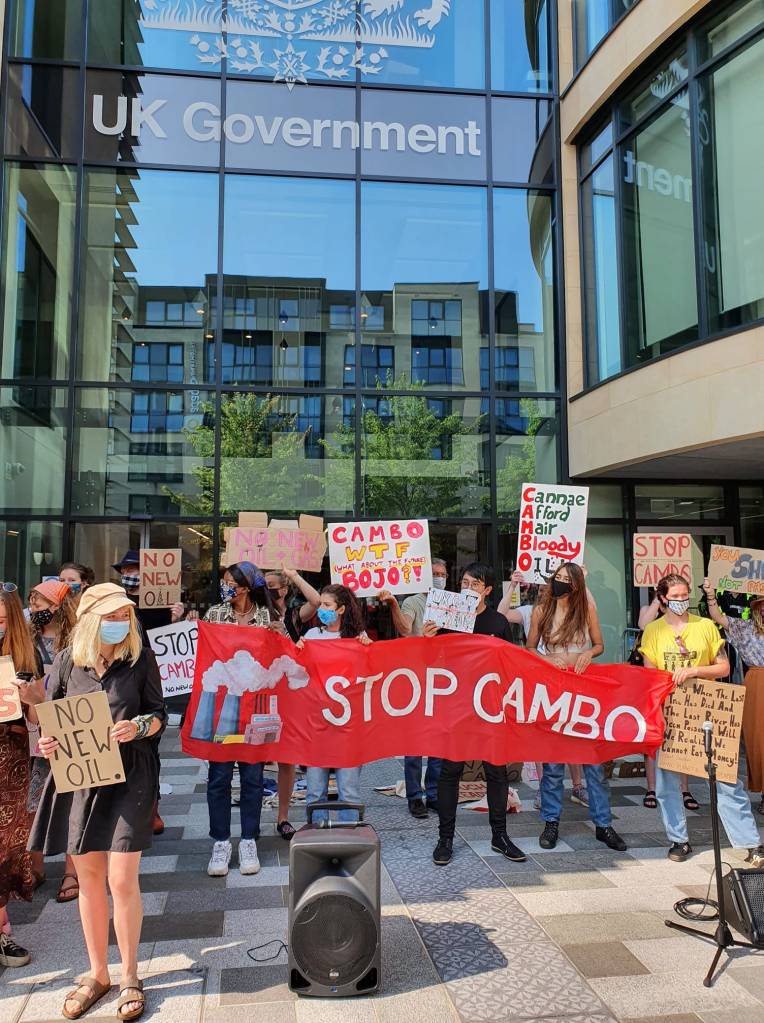
Maybe together we can challenge Shell, Siccar Point, and the Oil and Gas Authority in Aberdeen, and let them know what we think of their Cambo plans.
Maybe together we can get out to the heliports and into the city and open up a conversation with the oil workers about what would be a “just transition” for everyone, and how that might be achieved.
Maybe we can set the tone for a global conversation about the future of hydrocarbons.
Thanks to Friends of the Earth Scotland for sharing this call to action from a working class community in Aberdeen. Residents in Torry, just south of Aberdeen, are having their only green space threatened by an oil industry land grab in the name of ‘energy transition’. The group has been campaigning to protect their local park and for a just transition that meaningfully includes local communities.
The oil industry and Aberdeen City Council are planning to destroy a much-loved greenspace called St Fitticks Park, which lies in the heart of Torry, a community in the south of Aberdeen. The council, together with a consortium of oil companies and Aberdeen Harbour want to dig up the park and build an ‘Energy Transition Zone’. This project now also has funding from the Scottish Government.
St Fitticks Park is the main greenspace in Torry and is enjoyed by generations of Torry residents, as well as attracting people from outside the community due to its thriving wetland, which is a home to a variety wildlife.
A community group has formed to resist the proposals (The Friends of St Fitticks) and they have various plans to safeguard the future of the park. They support the idea of an energy transition zone in response to the climate emergency, but argue this should be located on vacant industrial land to the south and west of Torry, not on their beloved greenspace.
Unwanted industrial development has been imposed on the people of Torry down the years. In the 1970’s homes were demolished to make way for a harbour expansion to accommodate the new oil industry, but many people living in Torry have seen little economic benefit from an industry that dominates the city. So once again they are fighting one of the most powerful industries in the world.
On Saturday 28th August, local people will gather in the park for St Fitticks day. We need to show that the community has wider support and help them to get their message heard. Please show your solidarity with the people of Torry, by either:
A) Taking a photo with ’Save Saint Fitticks Park’ placards (on your own or with your group) in your local green space and posting on social media with #HandsOffStFitticks
B) Share the graphic on social media with #HandsOffStFitticks
Mike Downham reviews ‘Who wields the welding rod’ recently published in the London Review of Books
It’s impossible to do justice here to James Meek’s 12,000 word piece “Who holds the welding rod?” (LRB 15th July).
This exceptional investigation took journalist Meek to Hull, Campbeltown and remotely (because of Covid) to Vietnam through a Vietnamese researcher. The piece is threaded with the bitter experiences of many individual workers and an intimate account of the Campbeltown community’s past and present predicaments.
The story starts with a vivid picture of the voyage of a German-owned cargo ship loaded with wind towers which had left the Vietnamese port of Phu My in early April last year, arriving more than a month later in Hull.
The towers are massive. The hollow tapered columns, made of thick painted steel, are designed to be attached to the sea-bed, raising the turbines high enough above the sea for clearance of their huge blades. They are hundreds of feet tall and weigh hundreds of tonnes.
This shipment was destined for Hornsea Two in the North Sea, which will be the largest offshore windfarm in the world, scheduled to be operational next year.
The towers were made in a factory in Phu My by the Korean company CS Wind. The towers for Hornsea One were made by a CS wind factory in Campbeltown. CS wind doesn’t have a factory in Korea. Instead it has factories in Vietnam, Taiwan, Malaysia, China, Canada and Scotland (Campbeltown). It’s really one vast international factory. The factories in both Canada and Scotland have been closed down because CS wind said they couldn’t make a profit. In the year or so before closure working conditions in the Campbeltown factory deteriorated to such an extent that serious accidents, some of them permanently disabling, became common. Then 100 jobs were lost from a small remote town which offers few other employment opportunities.
The Scottish Government had made it attractive for CS Wind to start a factory in Campbeltown, though it could have invested instead in an available Scottish company. They chose the cheaper investment of a Korean company, knowing full well that the reason it was cheaper was that CS Wind pays its workers less and works them for longer hours. The jobs it provided people in Campbeltown, more like slave labour than jobs, lasted less than three years.
CS wind may sound powerful but it’s at the bottom of the pyramid of control in the wind industry. At the top are the project developers, who put up the money – companies like Orsted (controlled by the Danish government) and SSE (London-listed, Scotland-based). The project developers contract engineering companies to manufacture and install the turbines. In Europe and much of the world the dominant engineering players are Vestas (Danish) and Siemens-Gamesa (German-Spanish), both of whom manufacture the blades and the turbines themselves because they are high-value, and contract out the rest, including the wind towers.
Are the conflicting goals of cheap green energy, free trade and secure well-paid jobs irreconcilable? At one point Meek thinks they are. But later he says:
It shouldn’t be more important that the North Sea wind farms get built than that some of their towers are made by low-paid labourers working twelve-hour shifts, seven days a week; and yet the immense utopian project to decarbonise human activity forges ahead, while the equally utopian project to end the setting of ‘low income country’ worker against ‘high income country’ worker barely exists. The mad dream of a green energy transition might just be starting to come true, with much of the credit due to stubborn activists, clever engineers and a handful of far-sighted policymakers. But it is also happening for the unlikely reason that it has been redefined as a global capitalist-consumerist project. It realises utopian goals while simultaneously keeping stock-markets ticking over, making the rich richer and spreading a general sense of virtue. The system has been able to turn the green energy transition into a set of products – electric cars, solar panels, wind turbines – but the transition to a world of better-treated workers involves systemic changes that are the antithesis of commodification.
We have an internationalist movement to save humanity from climate. But we also have an internationalist movement to save humanity from capitalist exploitation. For the latter movement to win the struggle, as Meek concludes, a world factory like CS Wind’s demands a world trade union.
Both the UK and Scottish governments remain committed to continuing extraction of North Sea Oil and Gas. Carbon emission from the burning of these fuels are more than five times those of the whole Scottish economy. Yet these emissions are not included in Scottish or UK targets for emissions reduction. The assumption is that other countries will cut usage and the market will then drive down demand or, and more often, that we can carry on producing willy nilly but consumers will find ways of capturing the carbon. Both of these events are deferred into the future and exploration and development of new fields continues. The Sea Change report shows how these plans are incompatible with a zero carbon economy and with a just transition.
Thanks to Friends of the Earth Scotland for these notes on the latest development west of Shetland.
Oil giant Shell and Siccar Point Energy are seeking permission from the UK Government to develop the Cambo oil field, West of Shetland, just months ahead of COP26. In the first phase, due to start in 2025, the companies expect to extract 150 million barrels of oil – the emissions equivalent of 16 coal-fired power plants running for a year. They anticipate operating the Cambo field, which contains 800 million boe, until 2050, by which time Britain has pledged to be net carbon neutral.
The Cambo Field is the second largest oil and gas development waiting for approval and once up and running is set to be the fifth largest producer in the North Sea. If approved, Cambo Field will be the first UK project to get the green light since the International Energy Agency Net Zero report calling for no new investment in oil and gas starting this year and the Shell ruling mandating the company to slash carbon emissions 45% by 2030.
The UK Government is currently expected to give its final approval on the project over the next six to eight weeks. Moving forward with the Cambo Field contradicts the findings of the IEA’s net zero report and is incompatible with limiting warming to the Paris Agreement target of 1.5C.
The climate impacts of opening the Cambo Oil field would be devastating. In the first phase alone, developers want to extract 150million barrels of oil; the emissions from which are equivalent to running a coal-fired power station for 16 years. The field is expected to operate until 2050 – the point by which your government has committed to reaching net zero emissions. And this is just the beginning. Cambo Field is only one of many oil and gas projects waiting for government approval that have the potential to extract 1.7 billions barrels of oil.
Approving the Cambo field will be a massive failure of UK climate leadership and threatens to undermine the success of the crucial UN climate talks. In just a few months, the eyes of the world will turn to the UK as the hosts of the UN climate talks in Glasgow. Approving the Cambo field will send a clear message that this government is not serious about climate action and not willing to do its part to phase out support for oil and gas. If the UK keeps extracting oil and gas, how can it expect other countries to do anything different?
The International Energy Agency has stated that to meet the 1.5°C target in the Paris Agreement, there should be no more new investment in oil, gas, or coal. Further, the recent UK Climate Change Committee assessment clearly laid out that current UK policies are far from delivering the UK’s climate goals. The amount of oil and gas in already operating fields in the UK will exceed our share of emissions in relation to the Paris climate goals. The world cannot afford to open new fossil fuel frontiers. This starts with rejecting the Cambo Field.
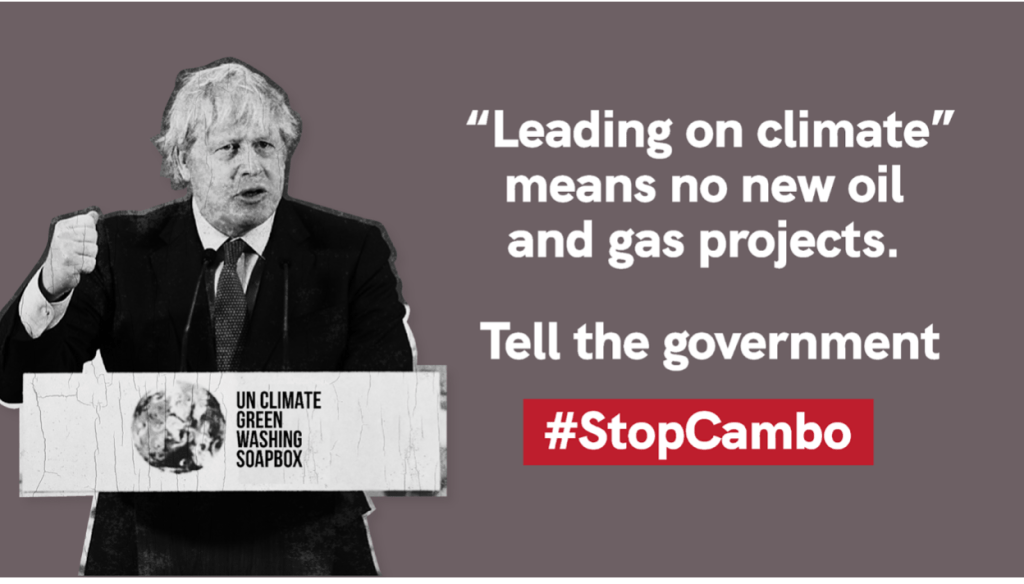
If Boris Johnson is serious about being a climate leader, he must reject Cambo, all new fossil fuel developments and support a just transition for oil and gas workers and impacted communities. It’s time to end the UK government’s support for maximising the economic recovery of oil & gas and commit instead to a rapid and fair energy transition. With the right policy support, the UK could create three jobs in clean energy for every oil & gas job at risk. We need a clear, credible plan to wind down production and deliver a just transition that is driven by oil and gas workers, their unions and affected communities.
The Cambo Field will bring few jobs, little tax and a potentially huge clean up bill for the public purse. Contracts for construction and installation have been awarded to overseas firms, meaning the bulk of jobs will be outside of the UK. As part of a global oil market 80% of UK crude is currently exported, and so this field would not contribute significantly to UK energy security. Siccar Point Energy, who owns the majority stake in the proposed field, paid no net tax between 2015 and 2019, instead receiving £41mn from the government to cover decommissioning costs. Meanwhile, the complexity of the field and high cost of operating in the West of Shetland makes the project high risk, with similar projects suffering from large cost overruns that have driven producers to bankruptcy.






 Employment, Energy and Environment