I suppose I just thought that campaigning amongst armament workers and on behalf of armament workers would be likely to be difficult in terms of how we might begin to “actually” impact global heating. I know that if we weren’t building all this military shit and jetting it all over the world and destroying humans and other productive forces with it, then we would avoid putting a lot of carbon into the atmosphere. It’s just that I’ve never considered that it was an issue that you might be able to intervene in quite the same way as I think we might be able to when it comes to oil and gas production.
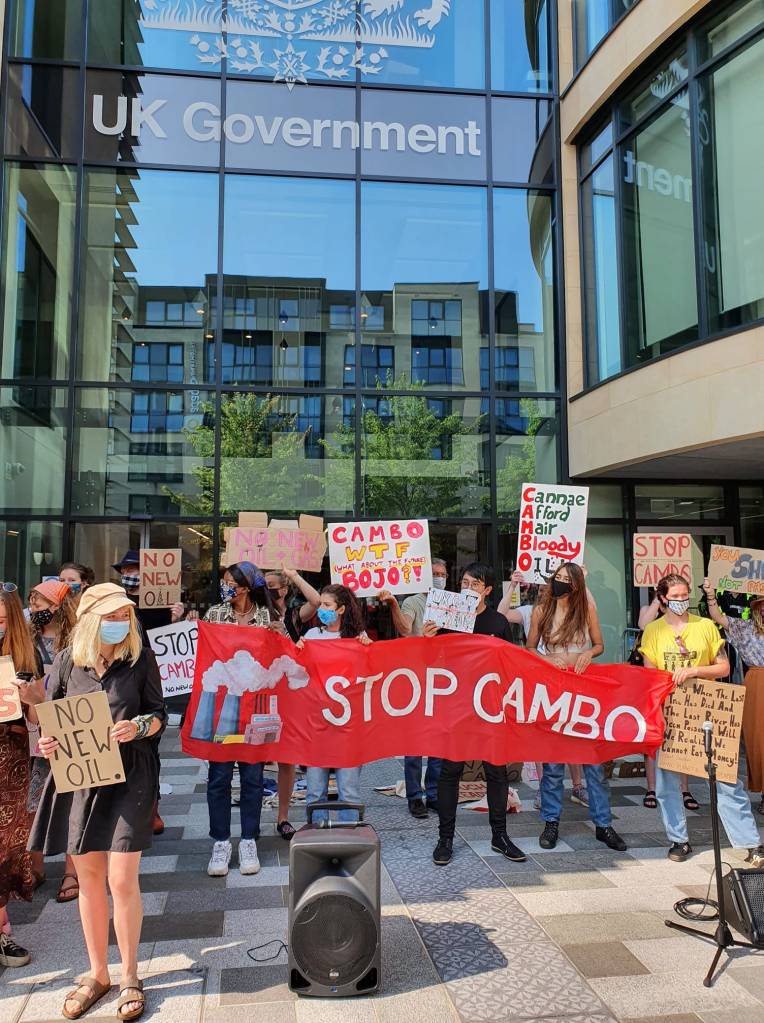
The issue of oil and gas is looming ever larger in the consciousness of the climate movement. It’s way, way higher than it was when I discovered XR in 2019. When I took part in the London Rebellion it was hard to get a sensible conversation about oil and gas and the North Sea was a very nebulous “concept” for many. Look at the movement today with Stop Cambo. If reporting on mainstream media is anything to go by it’s beginning to exercise thoughts in layers way beyond just the activists and the scientists now. Interestingly the only people who dare not mention oil & gas is the COP. I don’t know if any of this is true about the military complex.
But I can see that from the perspective of jobs, and that’s how the discussion was framed, there’s pretty much no difference in making “demands” about just transitioning armaments workers and oil workers into renewables and other sustainable work.
But I can’t see how it would ever be likely to be more than just a “demand” in the case of armaments workers. In the case of oil workers I have, as you know, an idea that a mass intervention amongst oil workers is a crucial first step if we’re ever going to get to the point where we try to choke off oil and gas production – the absolute first and crucial necessity of a movement that has any hope of abating climate change in the face of this system. There has to be a time and it has to come very soon when the licence society gives the industry to produce fossil fuels is withdrawn. Who is going to force that issue?
I don’t know if a part of all this that as oil is is all I’ve ever known/done, oil is all I can ever really see. The opposite was surely very widely the truth for the bulk of the population until very recently. I think that’s changing.
But I’m beginning to realise that what I see as the impossibility of armaments workers turning their weapons into ploughshares, is what others see as impossible when the issue of confronting/challenging the oil and gas workers. I can see why people think it’s a very long shot to imagine that they’ll either participate in the ending of oil and gas production. But I think that least they can be neutralised, picketed at the heliports and stopped from producing the oil. For how long? And anyway! They need to be informed of the science and we can’t rely on the media to do that.
These two issues, fossil fuel and the armaments/military complex, seem to be of different orders (qualitatively and quantitatively) in the context of tackling climate change. Fossil fuel production seems to me to be primary. Once the fossil fuels are out of the ground, they are pollution – they will be burned/processed. Being used to build and deploy military hardware is just (just?) the path the pollution takes to get into the atmosphere. Or do we think that realistically we can take on the military complex and somehow stop it, and therefore stop the demand for fossil fuel?
They (?) take fossil fuels out of the ground and then make fortunes on it. They need to keep taking it out of the ground to keep making fortunes – to keep feeding the beast. So they are endlessly imaginative in finding new and more extravagant and destructive ways of using it. It looks like a real madness. to me. The thing is that they can’t turn this hellish roundabout off themselves. But turned off it will have to be if life is to survive, inasmuch as I understand the science.
Capitalism is the problem. But to a great extent isn’t the oil industry pretty much the same thing as capitalism (?) . . the same thing as climate change? The military complex surely is just (just again?) how they regulate capitalism – keep the imperialistic plunder going and ensure that the trade routes remain open to keep that wealth flowing north, and in the process provide an ever-renewing market for the oil. I never did get my head round the concept of a permanent arms economy – it was an idea touted by a political tendency I was taught was beyond the pale. But I guess I’m stumbling along in the same neck of the woods here.
Obviously, the military complex is a huge issue for humanity, but I just don’t see how you tackle it head on with any hope of affecting climate change. On the other hand, if you end oil you end capitalism (don’t ask me to prove that – I was hoping someone else would though) and then you have at least a fighting chance (is that a pun) of ending the military complex. The other way round it’s even clearer. You don’t stop oil and life on earth is in danger. However, you frame it you need to stop oil.
Over the next few days we are keen to publish posts that reflect on COP 26. We’re particularly interested in articles that look at the challenge of movement building in the wake of COP. To kick things off we republish this article by Brendan Montague the editor of the Ecologist which was first published online under a CC BY 4.0 license in that magazine on 12th November.Send articles or ideas for articles to triple.e.scot@gmail.com
The COP26 conference has failed to usher in a new era where capital is constrained to prevent catastrophic climate breakdown.
The future was supposed to be copitalism: a new global economic paradigm where national governments work together through the United Nations (UN) Conference of the Parties (COP) process to limit emissions and prevent runaway climate breakdown – while leaving capitalism otherwise intact.
The climate conferences have taken place annually for a quarter of a century. The aim is to negotiate global emissions targets that will be translated into national policies. The high-water mark was the Paris Agreement of COP21 when the worlds’ leaders agreed to limit global heating to 1.5C.
The mechanism agreed was “nationally determined contributions” (NDCs). This means national governments are responsible for submitting commitments to cut emissions to the UN. The COP process is also supposed to include a “ratchet mechanism” where those government commitments are made increasingly ambitious.
Credibility
In order to deliver on the NDCs each country would have to use a combination of carrot – investment, incentives, tax cuts – and stick – regulation and taxation – to move capital away from fossil fuels and towards “green” technology and infrastructure. The most obvious and effective means of reducing emissions is a limit or stop on the exploitation of coal, oil and gas.
Thus, “copitalism” is designed to maintain the status quo except where specific economic activity drives us towards climate breakdown. Capital accumulation remains the logic of our economies. Economic growth is maintained, or profit is delivered by the distribution of wealth from the poorest to the richest. Corporations continue to deliver profits for shareholders. Social inequality deepens. Poverty grinds.
The Glasgow conference, COP26, was the first deadline for presidents and prime ministers to hand in their Paris Agreement homework. The problem is, reducing fossil fuel exploitation involves a confrontation with the wealthiest, most entrenched monopoly corporations in human history.
And even on its own terms, the outcomes from the COP process over the last two weeks are catastrophic. As Climate Action Tracker (CAT) reported during the conference: “The projected warming from current policies – not proposals, what countries are actually doing – is…at 2.7 ̊C with only a 0.2 ̊C improvement over the last year and nearly one degree above the net-zero announcements governments have made.”
The distressing truth is Copitalism should be a dystopian nightmare.
Bill Hare, the chief executive of Climate Analytics, a CAT partner organisation, has said: “It’s all very well for leaders to claim they have a net zero target, but if they have no plans as to how to get there, and their 2030 targets are as low as so many of them are, then frankly, these net zero targets are just lip service to real climate action. Glasgow has a serious credibility gap.”
The new promises emanating from Glasgow would reduce this warming by just 0.1C. As Climate Action Tracker has established, there is a “very big credibility gap” when it comes to net-zero policy. Life under such conditions will not be worth living for millions, if not billions, of people.
Damage
The primary weakness of the COP process is that even the best outcomes are, by design, not action but words. The conferences are focused on national governments setting out new commitments, always framed by deadlines years into the future. The politicians and their parties may not even be in power when those chickens come home to roost.
Those members of civil society paying the most attention – concerned citizens, protesters, charities and NGOs and the thousands of journalists – feel duty bound to celebrate and amplify the smallest successes from the COP process. There is a deep concern that the general public will become disheartened, climate anxiety will intensify and campaigners will switch off.
And so one of the major successes being touted at the conference is an agreement signed by 40 countries to phase out coal power by the 2030s for the coloniser economies and 2040s for the colonised, and to end all investment in new coal power generation. China has not agreed to reduce coal production and burning at home.
There has also been much fanfare about the surprise agreement between the United States – historically the largest contributor to climate breakdown – and China – currently the largest national contributor. But even here the response of many at COP26 has been characterised thus: “This was a stage-managed nothingburger. There was nothing new bar words, nothing on coal, finance or loss and damage.”
The problem is, climate breakdown is a physical reality.
Share price
A total of 88m barrels of oil were produced globally in 2020. The historically unprecedented international shutdown of production as a result of the global pandemic did not come close to reducing our use of oil by the levels necessary to prevent climate breakdown. Indeed, production was at a historic high of 95m barrels in 2019. There is no reason to believe it will not return to these suicidal levels in the coming years.
Further, a total of 159,610,000 tonnes of coal were produced globally in 2020. Again, the pandemic slowdown resulted in a dip in mining. But, even so, coal production globally is higher today than when the gavel was struck to mark the signing of the Paris Agreement in 2016. And bear in mind that there remains 1,074,108,000,000 tonnes of proven coal reserves around the world.
The actual introduction of a copitalist economy would inevitably result in coal, oil and gas becoming stranded assets. Those companies that hold these assets would not be able to exploit them, turning assets into sales into profits into dividends for shareholders. The share prices might not collapse, but they would certainly move. If capitalism works on any level, then it is that those with capital will only invest in companies that deliver a return on that investment.
CC0
The share prices of the major energy companies tell the same story. ExxonMobil currently has a market capitalisation of $281 billion. A share in the company today is worth $64 – indistinguishable from the price on the opening day of COP26 and well above the $35 price from this time last year. ExxonMobil shareholders do not fear copitalism.
Likewise, the share price of the Peabody Energy Corporation – the world’s largest private coal company – remains steady at $11, almost three times its value last year. Closer to home, shares in BP have risen from £2.36 each to £3.41 in the course of the last year, as the company recovers from the pandemic.
Campaigners
The justification for this political project is that the need to avert climate breakdown is so urgent and critical, and the likelihood of a wider and deeper political transformation of our societies and our economies is so remote, that the capitalists must be appeased while being persuaded that climate mitigation is in their interests as much as anyone else’s.
The problem with the capitalist project is that capitalists are not running the capitalist system, but perversely the capitalist system runs the capitalists. The corporate leadership of any country does not choose what or how it produces but instead is the flotsam of our societies willing to do anything to ride the wave of capitalist wealth-making at any cost.
Ben van Beurden, the chief executive of Shell, is a moral vacuum. But this is not a personal failing of a human being who just happens to have risen through the ranks of his corporation through hard work and diligence.
A capitalist logic has promoted those executives who deliver results, deliver profits, precisely by grinding the most out of the human and natural resources they control. No amount of evidence or hectoring can change van Beurden’s mind. And if it does, he will be out of a job.
The assembled delegates, the surrounding banks of NGO campaigners and exhausted journalists try to understand the daily shocks and disappointments of the COP process. It is assumed that a failure of understanding on the part of a particular leader – usually someone else’s leader – is the cause of failure at the conference. We are wedded to the idea of human agency, of powerful saviours, of national leaders.
Billionaires
The delegates of COP26 negotiating our collective future are hidden away in a cordoned off zone within the Blue Zone. More than 500 of those delegates are either directly within the employ of fossil fuel companies or delegates for government departments working with Big Coal, Oil and Gas. The NGOs and the journalists accredited to the zone are locked out of the real discussions, relying on press conferences for any crumbs of information.
The Blue Zone itself feels like a military encampment on the banks of the River Clyde. The fences tower overhead with delegates rushing through turnstiles guarded by security. The Green Zone along the road is entirely separate, but here the pavilions are dominated by National Grid, Unilever, Sainsbury’s and Microsoft. The message – that corporations are the solution – is not subtle. The Green Zone is open to the public, and school children tour the science museum styled displays.
Civil society is represented in Glasgow. But the COP26 Coalition is both physically and metaphorically cast into the hinterland in venues scattered across the living centre of the city of Glasgow. Here the science of climate change is understood and accepted, and the reality of the actual change needed to prevent calamity is discussed. The attendees are actual people from Glasgow.
The discussions at the venue in Adelaide Place were wide ranging and meaningful, taking in the Green New Deal, degrowth, Indigenous traditions, the threat of green colonialism, food sovereignty, international trade, and more. But the event seemed only to coincide with the COP negotiations happening less than two miles away. There seemed no possibility of these debates influencing the proceedings.
Copitalism should be a dystopian nightmare. The COP26 conferences are a political project aimed at maintaining as much as possible of our current global economic system. The billionaires will continue to make gargantuan profits, fuelling their intergalactic fantasies. At the same time, 15 million people have likely died from coronavirus and billions are denied a cheap vaccine to maintain the profits of the pharmaceutical industry.
Monsters
But the experience of COP26 during the last few days suggests that copitalism itself is an unachievable utopian dream, as vacuous as Charles Fourier’s vision of the oceans turning to lemonade. There is, alas, no real need for a neologism. Capitalism cannot allow copitalism to exist, such is its rapacious need for mountains and oceans of coal, oil and gas.
Barack Obama when president of the United States was instrumental in defusing the Paris Agreement and now calls on young people to protest for climate action. During his speech on Monday he made the following confession: “There are times where the future seems somewhat bleak. There are times where I am doubtful that humanity can get its act together before it’s too late, and images of dystopia start creeping into my dreams.”
The reality is that COP26 is failing because capitalism cannot allow copitalism to supersede. We cannot postpone the work of ending capitalism until after we have moved to avert climate breakdown. Because capitalism is climate breakdown. Ta’Kaiya Blaney of the Tla A’min Nation, the Indigenous activist told People’s Plenary meeting before a walkout today: “Cop26 is a performance. It is an illusion constructed to save the capitalist economy rooted in resource extraction and colonialism. I didn’t come here to fix the agenda – I came here to disrupt it.”
This argument does not have to be simplified for the public. We already know. As Cora, a 15-year-old member of Fridays For Future from Edinburgh said so eloquently this week: “Letting that kind of capitalist theatre run every COP? We are never going to see the change that we need now.”
But if copitalism is now an impossible utopia, is capitalism really the only game in town? Is it easier to imagine the end of the world than the end of the billionaire? Or is now the time for the climate movement to merge fully into the environment movement, the social justice movement, the (dare I say it) anti-capitalist movement so that we can aggregate our traumas, our grievances, our hopes, into something with the force and multitude that can begin to challenge the capitalist machine at the core of our misfortunes?
The famous quote from the Italian philosopher Antonio Gramsci also seems apposite right now. “The old world is dying and the new world struggles to be born. Now is the time of monsters.”
This is the slightly expanded text of a contribution that Pete Cannell (speaking for Scot.E3) made to a meeting organised by the global climate jobs network at the COP26 people’s summit.
Scotland is well placed to make a rapid transition to a zero-carbon economy. It is well endowed with natural resources for wind, wave, tidal and hydro power generation. Hydro power was developed in the 1950’s and sixties, more recently there has been some further development of local, small-scale hydro. Offshore and onshore wind power has developed rapidly, wave and tidal has seen very little investment. But Scotland also has a relatively strong representation of engineering skills among its workforces. These workers have skills in electrical, marine engineering, fabrication and so on – skills that are needed for the transition to a zero-carbon economy that needs to begin right now.
Most of these workers are currently employed in either the Oil and Gas sector or ‘Defence’. Sectors which are significantly larger as a proportion of the Scottish economy than they are of the UK as a whole.
The current state of play with climate jobs is disastrous. The policy of leaving transition to the market has resulted in declining numbers of jobs in renewables. We’ve written about the closure of facilities at BiFab and Machrihanish elsewhere on this site. At the same time there have been massive job losses in the North Sea and a long-term decline in engineering jobs in the defence sector. While there has been a massive increase in offshore wind generation the private sector has driven down wages and conditions, used low paid workers from around the world, shifted production to sites thousands of miles away and focused on profit maximisation rather than just transition.
There’s a lot more we could say about oil and gas but in the context of the other talks at this meeting we want to focus now on the arms trade. Britain is one of the biggest arms manufacturers in the world and Scotland has a disproportionately large share of this activity. It has been excellent that during this mobilisation around COP26 there has been a lot of discussion of the huge carbon emissions of the military.
In Scot.E3 we’ve argued for the need to go further – the military industrial complex in Scotland (and globally) acts as a barrier to transition. It thrives on public subsidy – far more than that provided for renewables. This is a characteristic it shares with the oil and gas sector. It distorts the economy, it’s secretive and hugely corrupt, dominates research agendas and monopolises skills and resources that should be directed to saving the planet.
We look forward to a day when the commitment and imagination of young people currently in school can be deployed to develop the kind of sustainable and socially just society that we are fighting for. But time is short, and we need to start the transition now with the skills and knowledge that are already available. To achieve climate justice and win the climate jobs we need it’s going to be necessary to force a radical shift of resources away from the defence sector as well as from oil and gas.
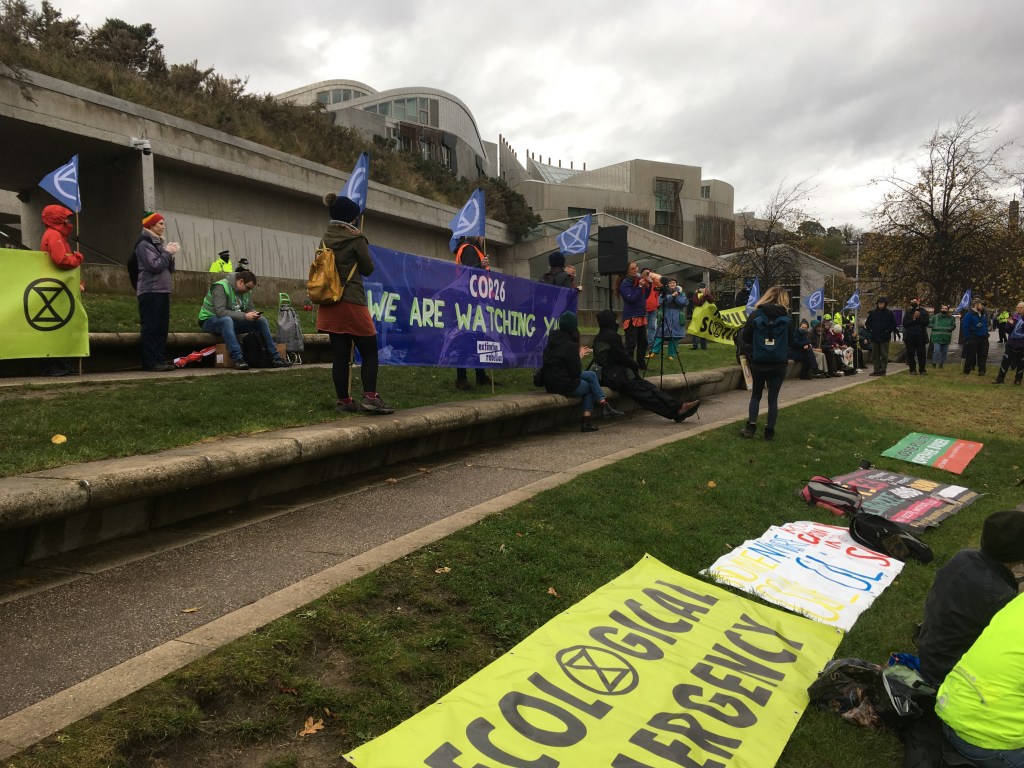
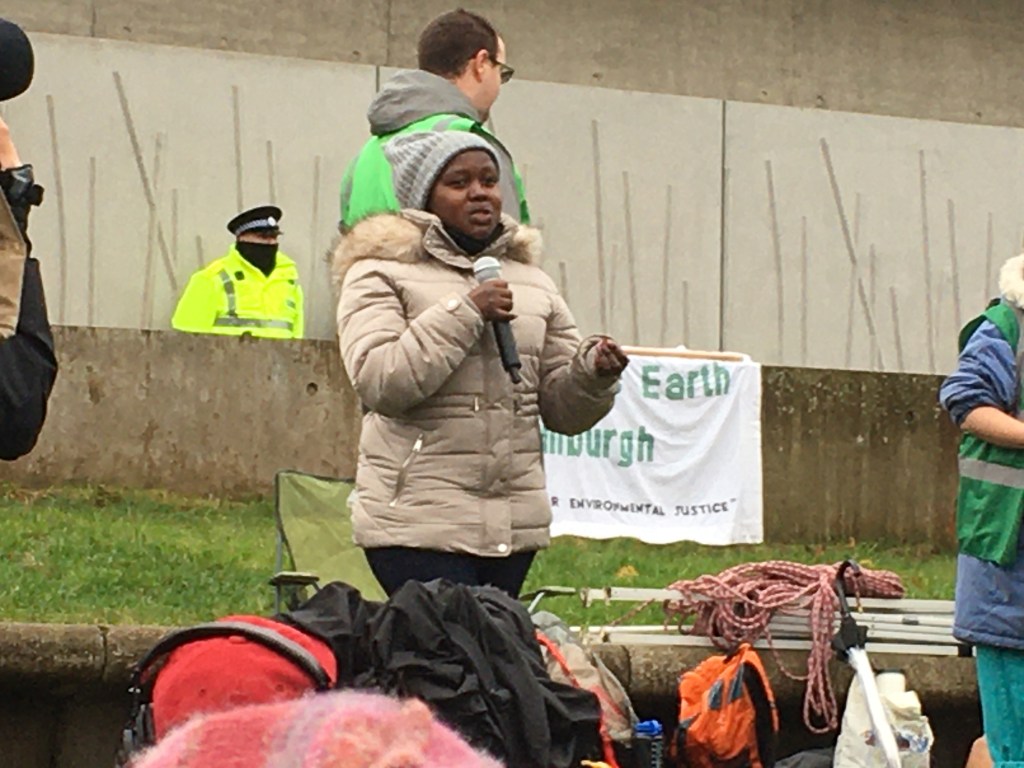
As the climate talks were starting in Glasgow, the Edinburgh COP26 Coalition and Edinburgh XR held a march of around 400 people from the Meadows to the Scottish Parliament – ending with a rally at the parliament. Speakers included a young activist from Kenya, Friends of the Earth, the Edinburgh Muslim Women’s Association and many more. Ex oil worker Neil Rothnie spoke for Scot.E3.
Scot.E3 is collaborating with other climate jobs campaigns to organise this event at 415pm on November 9th at COP26
There are currently over a dozen national climate jobs campaigns around the world, as well as further green new deal proposals. The articulation between the climate justice movement and the labour movement is, at this moment, still in its early steps and the pandemic has not promoted any sort of coalescence. The Corona Crisis is not an external event, but part of capitalist over-consumption of nature. Climate jobs are therefore one of the key components of any programatic and political alliance between climate and workers movements. Capitalism has no plan but collapse, so we need a plan from below. To overcome the climate crisis we need a political program for society, and workers in all sectors need to be involved in shaping a livable future for humanity, which will take a lot of work!
November 9
4:15 pm UTC+0
Albany Centre. 44 Ashley Street, Glasgow, G3 6DS United Kingdom
Contributors:
Emma Cockburn (Scot3E – Scotland),
Nuria Blázquez (Ecologistas en Acción – Spain),
Jonathan Neale (One Million Climate Jobs – UK),
João Camargo (Global Climate Jobs / Empregos para o Clima – Portugal)
Online:
Josua Mata (Sentro – Philippines)
Julia Kaiser (Students for Future, TV N 2020 – Germany)
Jean-Claude Simon (Transform Europe! – Denmark)
Ditthi Bhattacharya (New Trade Union Initiative – India)
Alongside our friends from the Portuguese Climate Jobs campaign Climaximo , and a host of other organisations, Scot.E3 is supporting the Fifth International Ecosocialist Encounters conference which takes place in Lisbon from 21st to 23rd January 2022.
Find out more on the conference website – but here’s the brief description.
The climate crisis is worsening before our eyes at an accelerating pace.
While the flames of overwhelming fires consume our earth, more and more people are getting expelled from their lands so that extractive and emissions increasing projects can take place, pushing us towards the abyss of climate chaos. As heat waves are getting more intense all around the world, increasingly more people are left in unemployment and precariousness due to the escalating economic and social crisis that the capitalist management of the pandemic worsened. As the seas rise and climate catastrophes such as violent storms, droughts and hurricanes threaten even more populations, the violence towards the already marginalized bodies of our societies increases and access to essential services, such as housing, energy, food, health and water keeps being denied, giving place to the accumulation of profit instead of securing life.
The newest IPCC report confirms what we already knew: in less than two decades we will reach the 1.5ºC temperature limit of global warming whereupon the worst climate phenomena become even more uncontrollable, unless we take urgent and drastic action now.
Capitalist elites keep applying the same profit accumulation mechanisms that have led us here in the first place, creating the illusion that something is being done to fight the climate crisis while taking advantage of all these crisis as new opportunities to amplify profit, militarize and privatize essential life services.
We did not create this scenario nor did we choose to be living in the major civilizational crisis of our times, but we do have the responsibility to stop the climate crisis, leaving no one behind.
If decades of worsening climate, economic and social crisis created by capitalist business as usual have taught us anything, it is that we ourselves have to assume the political and social mission of reaching climate and social justice on the deadline defined by the climate science.
Since 2014, ecosocialists, ecofeminists, peasants, trade unionists, several social movements and political organizations have been gathering on the international ecosocialist encounters to collectively imagine and set in motion an ecosocialist alternative to the abyss towards which the capitalism and climate collapse push us. In 2018, we started from the understanding of ecosocialism as a critical political theory and practice, which sets itself the joint task of dismantling capitalism, productivism and inequality, and constructing the alternative that can produce ecosocial justice. It does so by addressing at the same time the crucial issues of the purpose of economy and work, of production and social reproduction, the ownership of the means of production, the sharing of essential commons and solidar democratic decision-making. At the same time, it bears in mind the restoration of our wounded ecosystems.
In 2022, on the 5th International Ecosocialist Encounters, we start from all this understandings to seek more answers and collectively built a stronger international articulation, capable of fighting the major crisis of our times.
Together we will envision the ecosocialist world we need, starting to shape with which tools and strategies we can achieve it.
We’ve added a really useful report by the Coal Action Network to our Further Reading Page. ‘Coal in Steel – problems and solutions‘ takes a detailed look at the ways in which carbon emissions can be reduced by alternative methods that break the steel industries reliance on coal.
The report argues that decarbonisation can be achieved by:
Decarbonisation of the steel sector could be achieved through:
increased use of electric arc furnaces and recycled scrap— already happening in the UK.
using direct reduced iron production with green hydrogen in place of coke (which is produced from metallurgical coal). The HYBRIT project aims to do this at a commercial scale in Sweden by 2026, having made their first delivery of fossil free steel in August 2021.3
reducing steel consumption through more efficient design of buildings, cars, energy infrastructure, and consumer products. Promoted by The Use Less Group at Cambridge University.
Climate jobs and green new deal movements are springing up around the world. This is a call for papers for an international conference on the technical aspects of the jobs that will be necessary, in 10th, 11th and 12th March 2022.
The conference will be on zoom, over three days, and contributors will be able to participate from all continents. We want papers from engineers, scientists, system modellers, designers, architects, planners, educators and trainers, foresters, soil scientists, trade union researchers, NGO researchers and other specialists.
The Climate Jobs Approach
We want contributors to think about the technical and technological implications of a “climate jobs” approach. This approach involves several features:
Massive government spending on public sector, direct employment to make possible reductions of 95% in CO2 emissions, and deep reductions in other emissions, within 20 years. In South Africa or Britain, this would be something like one million jobs a year, or in the United States 8 million jobs.
People who lose their jobs in old, high carbon industries would be guaranteed training and well paid, permanent work in climate jobs.
The work would begin from year one, starting with training a new workforce and shovel ready projects. Over twenty years many new technologies would become possible.
Public sector bodies would share intellectual property across borders.
Profits would be less important. Technologies that are necessary but currently “unrealistic”, could be developed rapidly at scale even if the cost was very high for many years. For example, alternative methods of making steel, substitutes for cement, or expensive forms of renewable energy like marine power and concentrated solar could enter mass production.
We could also move beyond the market, with regulations of many sorts. So we could think about the sort of rail, bus and electric system needed if all flights of 5,000 kilometres or less were banned. Or what could be done if we banned the manufacture of concrete, or F-gases?
Or contributors to think about the details, and the implications, of a building code that required new buildings to have greatly reduced energy use, and to burn no fossil fuels for heating or cooking. In this, we would like not only papers that argue this would be a good idea but think about how that code would be worded in different places, and what technologies and materials would be required, and what research would be required.
For more information about the conference, possible topics, how to participate and the deadline for submitting abstracts please download the full call for papers.
Neil Rothnie – ex oil worker and one time editor of the OILC newsletter Blowout spoke to a conference of people involved in the creative industries in Aberdeen on Saturday 4th September. He talked about the North Sea, climate jobs and just transition. We publish his contribution in full here.
I’ve been asked to speak because a large part of my life has revolved around struggle in the oil and gas industry. I spent my working life offshore, mostly on the North Sea, latterly in the Norwegian sector. On the whole I enjoyed my working life. I miss it a bit. But mainly the Norwegian bit.
In my early days in the industry, I was active in the Aberdeen Branch of the National Union of Seamen. And during the strikes and occupations led by the Offshore Industry Liaison Committee, in the wake of the Piper Alpha disaster, I founded and produced Blowout. At that time a “nasty scurrilous” tabloid that aspired to giving oil workers a voice.
I became the Secretary of the OILC branch of RMT after OILC “merged with” the Rail Maritime and Transport union, and I briefly represented RMT’s oil worker members on the executive of that union. I remain a member of the Norwegian union, Industri Energi.
I was inspired to join the struggle against climate change by Extinction Rebellion. I’m also active with ScotE3, campaigning for jobs and a just transition (the three Es in ScotE3 are employment, energy and environment). I’m speaking for neither of these organisations. I’m sure a lot of what I say here would get agreement from many, but not all, of the supporters of these two organisations.
As I understand climate science, it is fossil fuels that are very largely the source of the greenhouse gasses that are heating the environment and causing climate change and threatening the existence of much of life on the planet. For fossil fuel read oil & gas, at least for the purposes of this meeting.
So, I find myself back in a fight with the oil industry. In the wake of the Piper Alpha disaster, I struggled alongside the very best, and most conscious of the offshore workforce, many of whom were lifelong trade union members. Today I struggle alongside the very best, and most conscious of the youth, organised in Extinction Rebellion and in other civil society organisations, and with other old guys in ScotE3.
It’s a lifetime of work in the industry, and recent activity as a climate activist that informs my understanding of a “just transition”. Global heating and climate change is not the fault of oil and gas workers, and it isn’t/wasn’t the fault of the coal miners either.
That’s the good news.
This thought consoles me just before I try and get to sleep while trying to imagine my grandchildren having long, happy and fulfilled lives, sharing a planet teeming with life.
The bad news is that blameworthy or not, oil and gas workers are going to have to stop being oil and gas workers. Sooner rather than later if they share my concern for their own grandchildren. The solution it would seem is a “just transition”. I think we should have a look at the two parts of this “just transition” construct.
The transition! It’s already underway. And insofar as I understand the science, there’s no going back.
One possible outcome is that we’re going to complete that transition to a sustainable habitable world powered by renewable energy and a planet where we’ve stopped the practice of dumping greenhouse gas pollution into the atmosphere.
The alternative is that we’re going to transition to a largely uninhabitable world where the earth’s delicate ecological balance is disrupted, and enormous forces of nature are released, eventually taking humanity and the rest of life on the planet into a premature and manmade fifth mass extinction.
Transition, it seems to me, is not a choice. It’s begun. We’re in the process. We WILL transition to a planet beyond fossil fuel burning.
Mind you there’s a possibility that there just might not be people there to see it. But if we and lot of the rest of life on this planet are going to survive oil and gas is going to have to go and soon.
But what about the “just” bit of a “just transition”? Does “just” mean “fair”? I only ask because it renders my next question into English.
Fair to whom? Do we mean fair to our grandchildren and to their grandchildren? Those who are going to inherit the planet in whatever state we’re going to leave it? Do we mean fair to those who have spent their lives with little access to the fossil fuel energy that’s destabilising the planet? The very same people who are often at the sharp end of climate change? Do we mean fair to all other life forms on the planet? Or, as it’s usually understood in our corner of the globe, do we mean fair to the workers who currently produce and process the fossil fuels that have kept the lights on in the Global North? In the sense that oil and gas workers, and the communities in which they live, should not be dumped, as were the miners before them, when the UK transitioned from coal to gas in the 1980s and 90s?
Surely, we mean “fair” in all of the above senses of the word. But with, I think, an important qualification. “The transition” is primary.
Whether it is to be just or not, is entirely subordinate. No transition to renewables and the fairness or otherwise, really won’t matter a shit.
None of this means that I don’t think it matters what happens to oil and gas workers and the communities in which they live. But I think we should be clear that oil and gas workers and their families are not some sort of special case. The future for their grandchildren and their grandchildren’s grandchildren will ultimately be bound up with the future of ALL of our grandchildren.
There’s no special case, no “business as usual” scenario for the North Sea, where the transition doesn’t happen, and where oil and gas workers just keep on keeping on, producing fossil fuels. And the fairness or otherwise of the “transition” for oil and gas workers is going to be determined in some part by the stand taken by the workforce and their families and communities.
From the standpoint of a roughneck, or a scaffolder, or a caterer on an oil rig on the North Sea, this “business as usual” might well look, pretty damned attractive if you’re hanging on to even a precarious “ad hoc” job, and the alternative is a wage thousands of pounds a year less, and that’s if you could actually get a job ashore or in offshore renewables. In the same circumstances what would your initial reaction be? You’d have a bit more of the “business as usual” too, at least till you could plan your exit.
But what has “business as usual” really meant for offshore workers in the UK sector. Relatively good money! That’s true. But it’s been falling real wages and diminishing job security and major layoffs after successive oil price shocks going right back to 1986. You can have spent your whole working life on the North Sea and still be liable to arbitrary dismissal (I can explain the NRB later if anyone here is not familiar with it). And for many, work schedules in the UK sector are as ball bustlingly bad as ever. The boom days were pretty much over by the time Occidental killed 167 workers when they allowed Piper Alpha to blow up.
There are a lot of very good reasons for workers to get off the North Sea and into an industry with a future. The problem is how,and where, because the Government and the industry, are hanging on, as if to dear life, to a hydrocarbon future. Where is the clear plan to run down the industry and retrain and redeploy the workers in renewables, using the skills that they already have? And where is the plan for learning to live with the amount of renewable energy that we can reasonably expect to produce in the crucial near future? Which is what a Government and an industry would be doing if they gave a fuck for the workers, or the planet for that matter. .
And then there’s the offshore wind industry, driven by profit. They’ll have studied carefully how the oil companies have tackled decommissioning. They too would rather pay wage rates that might well allow a decent standard of living in Manilla, but certainly doesn’t cut it in Aberdeen or Middlesbrough or Burntisland. The workers who used to produce wind towers in Campeltown could tell you all about this. What we have instead of a plan for a just transition, is a deal between the Government and the industry to further support hydrocarbon production, to continue with “business as usual” on the North Sea, subsidised to the hilt by taxpayers’ money.
The end of oil and gas globally must look like the end of the world to the fossil fuel industry, the bankers who finance it, the traders who parasitise it and the politicians. Hopefully it’ll only be the end of a rotten and corrupt system.
The Government parrots the industry formula about oil and gas production being necessary “for decades to come”. They call their plan for the North Sea “maximising economic recovery”. Producing every barrel that they can turn a profit on. This perverse version of “business as usual” has been written into the UK’s statute books.
And it begs the question of whether our Government, hosts of COP26, self-anointed global leaders in the fight against climate change,are giving the nod here to maximising economic recovery of ALL oil and gas?
Globally?
I shouldn’t think Vlad the poisoner or the Crown Prince murderer need much encouragement to follow suite.
Central to the UK plan is one mitigation measure. It’s an expensive, energy guzzling technology that has been stalling for the last three decades, and which would require a 1000 fold increase in capacity worldwide to begin to address the situation. It’s called carbon capture and storage (CCS) and it’s linked to so called “blue” hydrogen production. CCS at scale is not even up and running in one single location in UK. It’s pretty much only commercially viable as a tool for producing even more oil and gas mainly in the States, and only then when oil and gas prices are high. CCS is beloved of the oil industry and the Government, but is “disappeared” by the media in much the same way as the North Sea itself is largely disappeared in public debate about global heating.
And the questions that never get asked?
Who’s going to pick up the bill for producing the hydrogen from natural gas and then capture and store this polluting waste product. The oil and gas industry itself? Not very likely! They don’t even pay for the oil. And they’re not going to pay to clean up much of their old hardware on the North Sea when its useful life is over.
The taxpayer is going to have the privilege of paying for a vast amount of the decommissioning of redundant platforms.
The polluter pays? Huh!
Putting the cost of hydrogen and carbon capture on top of the cost of production of oil and gas sounds very much like the kind of squeeze on profits that periodic oil price collapses have repeatedly given us. And the oil and gas workers know what happens every time the oil price falls and profits are squeezed. Investment dries up and the workers get dumped, and if they’re lucky, rehired at lower rates down the line.
If hydrogen and carbon capture and storage is a serious solution to global heating, then we need to know how much more fossil fuels will have to be produced to fuel this energy hungry process and how much carbon will be captured and stored and by whom on what timescale and at what cost, to whom. We need urgently to open a conversation with those, and I’m thinking here of the hugely respected climate scientist Myles Allen, who sees the transition led by the oil industry. Which sounds a lot to me like putting the fox in charge of the henhouse.
Although it’s not the oil workers’ responsibility alone to change this situation, they are first in the firing line, and what they do is going to be decisive in deciding whether the transition is going to be fair or “just” from their point of view. They can swallow the plan of Government and industry for continued exploration and development of new oil and gas fields. They might gamble that the industry will see them out and fuck the consequences for their grandchildren and the planet. They might opt for the “business as usual” option that gives them periodic job crashes and diminishing wages and conditions, and very likely future disasters and loss of life, and leaves them negotiating their escape from the industry alone as individuals. Certainly, the last time any significant section of oil and gas workers took up a struggle was over three decades ago after Occidental dispatched 167 workers on Piper Alpha.
Back then the official trade union movement completely failed to step up to the challenge. They were utterly useless, and it took the rank-and-file Offshore Industry Liaison Committee to try and ensure that Piper Alpha would never be repeated. But a quarter of a century later, French oil giant Total did exactly that. They presided over a complete breakdown of safety offshore, endangering the lives of the 267 men on Elgin and the Rowan Viking in 2012. Only luck stopped Total blowing up the Elgin complex with all hands onboard.
The Blowout publication never reported on the Elgin Blowout. That edition coincided with the 25th anniversary of Piper and would have seriously challenged the “never again” and the “we’ve learned our lesson” mantras.
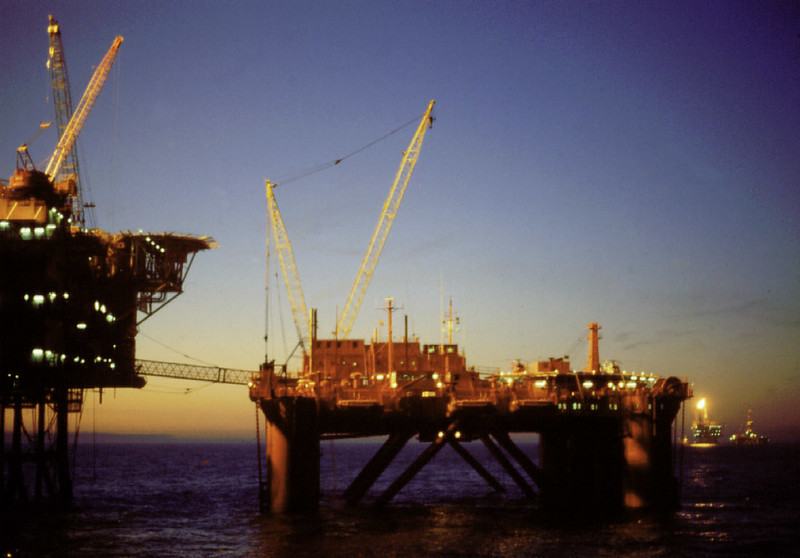
So, who can predict what lies ahead, and what the workforce might, or might not do? We’ll no doubt get the measure of the offshore unions’ commitment to fighting climate change when we hear what their response to the proposed new Cambo oilfield West of Shetland will be.
Yesterday’s Just Transition Coalition Conference featuring the trade unions gave us a bit of a clue. The unions kept quiet on the issue.
But not one section of society alone is going to turn the climate crisis around. And the offshore worker is no more to blame than anyone else for the crisis, and no more responsible for solving it.
But if the oil and gas workers are to play a part in securing a just transition for themselves and their communities, they’ll certainly need all the support they can get.
The environmental movement have the responsibility for making sure that oil and gas workers have access to the science and an understanding of the role that fossil fuels play in global heating.
Creatives also have a role, maybe even some sort of responsibility here. And indeed this exhibition and related events suggests that this community is awake to oil and gas and its colossal implications locally, and for the planet. Maybe here in Aberdeen we’ve seen an end to an era, when for almost two decades, BP could sponsor the Grays’ School of Art degree show, drink their champagne in their own cosy enclosure, and with their own invited guests.
While BP were basking in the glow of appreciation from academia and creating a warm and fuzzy image in Aberdeen, they were breaking all the rules on the Deepwater Horizon where they killed 11 men, and in the process trashed the Gulf of Mexico with the world’s worst oil spill? I’m guessing BP’s paltry sponsorship money didn’t stretch to getting that years photography class from Garthdee over to Louisiana’s beaches. Not that that would have appreciably added to their 65 billion dollar costs that included a 4 billion dollar criminal penalty.
Andy Kennedy, old friend and neighbour, and one time tutor at Gray’s and known to a few of you here today, told me
Artists are encouraged to practice thinking, questioning, observing and reacting. It’s what they do.
He said,
Artists are supposed to upset the apple cart, knock on doors and ask for change
He said a lot of nice things about artists but these are the only bits I understood.Ah! Some of you do know him I see.
Maybe from here on in we’re likely to see, reflected in the degree show, a much more critical appreciation of the industry that’s dominated Aberdeen for the last 5 decades. Maybe that’s not how it works.
But at least creatives should be checking what is being funded by Oil and Gas, what if any hidden strings are attached, and ask themselves just what are the BPs and Shells of this world getting out of sponsorship of the arts.
We all, including the workers, will have to work out where we stand in this existential crisis. Nobody on this side of the fence is forcing the workers into a corner. It’s the climate crisis itself that’s doing that to all of us.
So, who knows whether the transition is going to be just? The brightest light in this gloom are the youth inspired by Greta Thunberg. They include the sons and daughters of oil workers, and they now find themselves on the front line of struggle. It’s their future that’s at stake. They are more likely than anyone to speak truth to the workers and to the industry.
The climate movement, armed by climate science, has a responsibility not to shy away from the very difficult questions posed by the transition for the industry workforce. The workers need to know the facts about climate change and fossil fuels. The workers and their communities will themselves have to come to terms with what continued hydrocarbon production means.
Maybe climate activists in Aberdeen and the North East bolstered by the creatives might consider opening their doors for a couple of days during the COP to activists who will be in Scotland from all over the global south.
Maybe together we can challenge Shell, Siccar Point, and the Oil and Gas Authority in Aberdeen, and let them know what we think of their Cambo plans.
Maybe together we can get out to the heliports and into the city and open up a conversation with the oil workers about what would be a “just transition” for everyone, and how that might be achieved.
Maybe we can set the tone for a global conversation about the future of hydrocarbons.
An opinion piece by Mike Downham that looks at the twin challenges of Covid and Climate and the role of the big corporations. A version of this article is also published in the the Scottish Socialist Voice newspaper.
It’s been said before but let me say it again: COVID IS NOT OVER!
This bears repeating because we’ve fallen into a deep pit of thinking that there’s no viable alternative – that our daily lives have to be like this – and taking at face value what those in power tell us. We keep falling back on trying to persuade and negotiate with them. This is a trap deliberately set for us by those who have the power at this point in history – the big corporations, served by their political lackeys in governments across the world, particularly in the Global North.
The corporations are a consequence and integral part of the capitalist economy, which is, as encapsulated by Asbjorn Wahl:
A system which is geared towards making profits rather than producing use value; dependent on economic growth; a system exploiting workers and over-exploiting natural resources – one that is also about to destroy planet earth as a place to live for future generations.
This week’s IPCC report says that the impacts of this destruction – floods, fires, droughts, heat which humans can’t survive – are now being experienced in every region of the world. Glasgow experienced unprecedented flooding on the same day the report was published.
The report concludes that we are set to overshoot the critical 1.5 degree rise around 2030 – a decade earlier than their previous prediction. Only a huge reduction in greenhouse gas emissions over the next 10 years can save us.
In relation to the pandemic, the pharmaceutical companies want us to rely solely on their vaccines to stop the pandemic. No pandemic in human history has been stopped by vaccines alone – simple public health measures to cut down the spread of infection have always been necessary. But social distancing isn’t a source of profit, and ventilating buildings doesn’t need new technology.
In relation to global warming, which is now set to kill 100s of millions of us (the global death count for the virus is ‘only’ 4+ million so far), the Oil and Gas companies want us to go on burning fossil fuels down to the last drop, while they prepare to replace or compensate for these fuels with energy sources and technologies which will be equally profitable and every bit as exploitative
Trapped as we’ve been, we keep trying to negotiate with these companies and with the governments who serve them. Given the huge current imbalance of power between them and us, this amounts to inaudible whispering down the barrel of a gun.
The Zero Covid Scotland campaign has drawn a line under its attempts to negotiate with the Scottish Government. Just as the only way to avoid catastrophic climate change is to slash emissions, the only way to prevent more deaths and more suffering from Covid is to eliminate the virus. Slashing emissions and eliminating the virus are both entirely possible.
Jonathan Neale (his book Fight the Fire published in February can be downloaded free from TheEcologist website) said at an event in Scotland last week that when you are faced with catastrophe the only way out is to build a mass movement of those most threatened by that catastrophe – a movement which starts by focussing on keeping each other alive.
The Zero Covid Scotland Campaign is planning to contribute in a small way to a movement to keep each other alive from Covid infection by inviting a range of people who have been most impacted by Covid to give evidence at a Public Hearing on Saturday 4th September, staring at 11.00am. You can register in advance for this event here.
After registering, you’ll receive a confirmation email containing information about joining the meeting.
In the same way that eliminating the virus is the way of keeping each other alive from Covid, the way of keeping each other alive from global warming is climate jobs. This isn’t a new idea – thanks mainly to Jonathan Neale through the Campaign Against Climate Change it’s been around for more than ten years. But it’s been considerably developed through research in terms of how it would work, what kinds of jobs we are talking about (above all good, secure jobs), how many jobs (latest calculations for Scotland come to more than 100,000), and what training would be necessary. Climate jobs are the solution because they are the only way we can simultaneously and quickly slash emissions and keep our economy going so that we don’t have to drop our standard of living.
There’s a third specific catastrophe facing many people in Scotland – the loss of huge numbers of jobs in the North Sea Oil and Gas industry. There’s a sort of “offshore-so-not-affecting-most-of-us’ blind eye being turned on this by people in Scotland, led astray by our governments. But it’s already a reality for around 30,000 redundant workers, their families, and their communities. Unless something is done quickly it will affect at least 100,000. If you add this number of redundant workers to a society the size of Scotland’s which already features inadequate services, inadequate housing, and inadequate income support, in the middle of a lethal pandemic, to speak of keeping each other alive isn’t an exaggeration. Moreover, at the end of September, on the verge of winter and with the Covid epidemic still raging, the UK Government is set to terminate furlough, reduce Universal Credit back to its insulting pre-pandemic level and increase the cap on energy prices to an unprecedented figure. This amounts to a perfect storm for less well-off people.
The solution to the catastrophe facing offshore workers also lies again in climate jobs, specifically in the sectors of renewable energy, public transport, and heating efficiency, where a majority of offshore workers already have the right skills and experience. We can’t achieve energy transition in the short time we have available without the skills and experience of offshore workers.
Unfortunately, there’s an elephant in the room in relation to climate jobs and a transition to them. Just as we need to go on (to every one we meet regardless of their politics) about Covid and elimination and about climate change and climate jobs, we also need to speak of this elephant, which is the trade unions.
As Wahl points out it’s entirely understandable how the trade unions have got into the fix that they now find themselves in. 70 or so years ago they had a place at the bargaining table with employers and governments because they had shown how they could disrupt the capitalist economy by withdrawing their labour. But the balance of power today is such that they don’t have a place at the table any longer. To win it back they need to demonstrate again that they are prepared to stop the train in its tracks. Unless the unions shift their perspective, the workers will leave them and set up their own collective arrangements
We mustn’t be fooled. The corporations which hold the power have no motivation to make concessions at this critical point in history. They are prepared to accept whatever number of deaths and however much suffering it takes to remain profitable. They are fatally hooked on the system they’ve created.











 Employment, Energy and Environment
