GKN: Rank and file trade union delegation to Florence, are you interested?
Reel News are planning a rank and file trade union delegation from the UK to visit the GKN factory in Florence; not just to show solidarity to this important struggle, but also to spread the workers’ visionary ideas back here. And with thousands of jobs under threat at Port Talbot steel works (of which more below), and Grangemouth oil refinery due to close in 2025 with the loss of another 400 jobs, we can all learn a lot from what’s happening at GKN.
Many of us have been warning for years that if we don’t start planning a just transition away from fossil fuel production, it’ll be imposed on us – and thousands of workers will be thrown on the scrapheap. Now that’s starting to happen, it’s never been more urgent to fight for the alternative: a green future that would create literally millions of jobs globally as well as saving the ones currently under threat.
We’re still waiting to hear back from the GKN workers when would be a good time to visit, but at the moment we’re thinking maybe mid April, depending on how things develop. We want to time the visit for either a big mobilisation/demonstration, and/or if they actually start production under workers control. So the timing might well change. But for the moment, get in touch at info@reelnews.co.uk if someone from your workplace is interested in coming – and especially if you want to help with organising the trip too.
Obviously we’re looking at taking workers directly involved in fossil fuel industries, but every sector needs to make plans for a just transition (click here for a film detailing ideas that came out of a union workshop on a just transition for the hospitality sector for example), so please get in touch if you’re interested wherever you work.
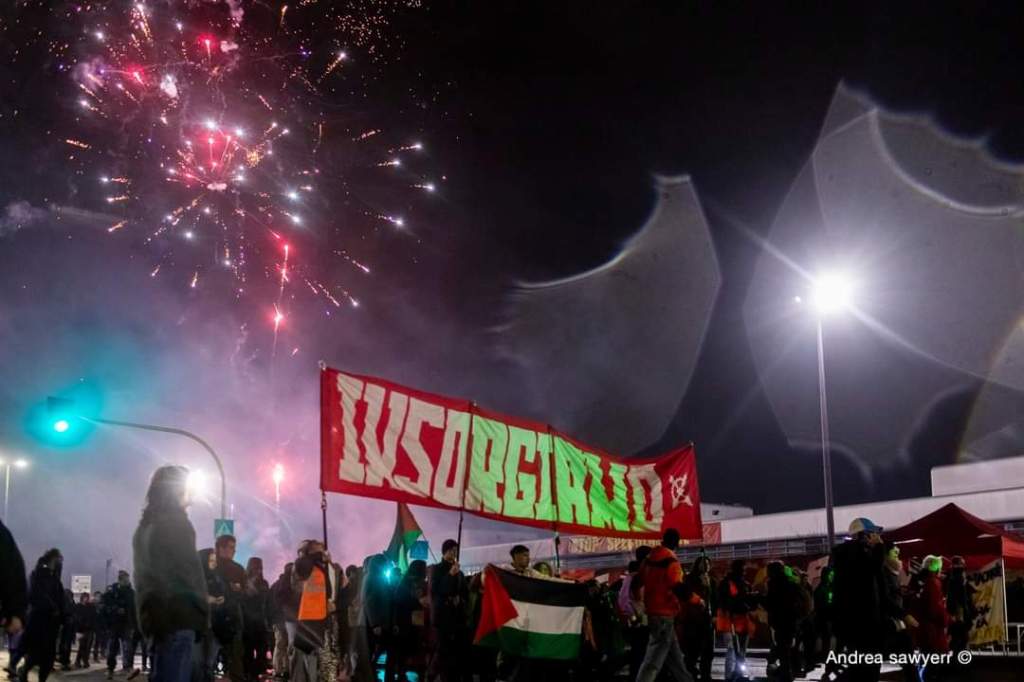
The bosses have now agreed to delay the sackings until at least June 2024, after a NYE party packed out the factory with 7,000 people; and in the past month they’ve DOUBLED the money raised in popular shares to over 600,000 euros.
So now the workers have extended the share scheme until June – and are now very confident they can raise the full million euros. So if your trade union branch, organisation, or even a group of friends want to support this visionary project, there’s still plenty of time. Share packages start from 500 euros.
You can find details of how to take part here, and see the end of the video for more ways you can help. As the workers say, they can’t create an alternative model to capitalist fossil fuel production in just one factory – but they can create an example of what is possible.
For more on the GKN occupation and a link to the REELNews video check out this post.
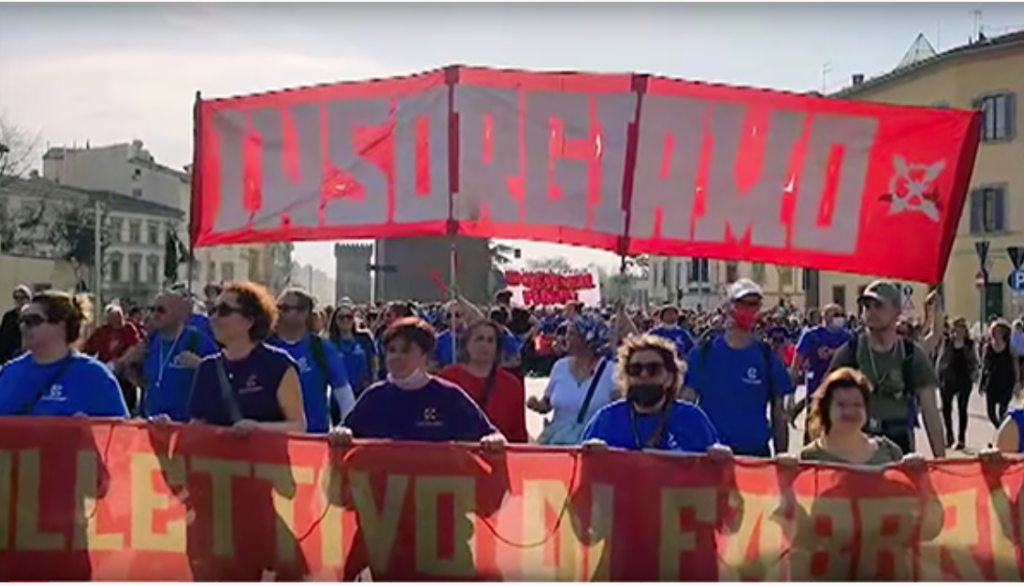
On 9 July 2021, Melrose Industries announced the closure of its GKN Driveline (formerly FIAT) factory of car axles in Campi di Bisenzio, Florence, and the layoff of its workers (more than 400). While in many such cases the workers and unions settle for negotiating enhanced redundancy benefits, the GKN Factory Collective took over the plants and kick-started a long struggle against decommissioning. However, what makes the Ex GKN Florence dispute really unique is the strategy adopted by the workers, who sealed an alliance with the climate justice movement by drafting a conversion plan for sustainable, public transport and demanding its adoption. Such a strategy engendered a cycle of broad mobilisations – repeatedly bringing tens of thousands to the streets – so that the dispute is still open, and the permanent sit-in at the factory remains until today.
The workers were meant to be finally dismissed on 1 January 2024. The GKN Factory Collective had thus turned new year’s eve into a final call to action to defend their conversion plan. Such a pressure from below probably played a role in the labour court’s decision, announced on 27 December 2023, to overturn the layoffs for the second time. The 31 December 2023 concert in the factory and the subsequent nocturnal march across Campi Bisenzio’s industrial area became a mass mobilisation to relaunch the workers’ current plan to set up a cooperative for the production of cargo bikes and solar panels, as part of a broader vision for a worker-led ecological transition.
This project needs material solidarity now – over 600,000 euros have been collected by the popular shareholding campaign to launch the co-operative, moving closer and closer to the target of one million euros. All information on how to contribute, individually or as an organisation, can be found at the website www.insorgiamo.org.
We were invited to contribute to a panel on North Sea Transition at the conference ‘Working for Climate Justice: trade unions in the front line against climate change’ at Toynbee Hall in East London on 27th of October.
Aberdeen – image by Pete Cannell CC0
Since we launched in the autumn of 2017 Scot.E3’s emphasis has been on building capacity for a worker led transition with a focus on workplace and community organising. Arguing for the rapid phase out of North Sea Oil and Gas has formed a central part of our campaigning. The Sea Change report, published in 2019, remains very relevant. It shows how switching from oil and gas to wind and solar would create a big net increase in jobs in Scotland and failing to make this transition would mean that targets to cut carbon emissions would not be met.
It’s very important that the climate movement has embraced the significance of North Sea oil and gas and a just transition for workers in the fossil fuel industries. That wasn’t so much the case in 2017. But two critical and closely linked challenges remain:
How do we build a mass movement with powerful roots in every workplace and working-class community that pushes for the necessary changes?
How do we engage workers in the energy sector, who are very aware that change is needed, but have very little confidence that it will be socially just?
For more than fifty years the big oil and gas companies have used their operations in the UK sector of the North Sea to blaze a trail for what we have come to know as neoliberalism; establishing practices that have been copied and taken up internationally. Outsourcing, multiple layers of subcontracting, anti-union policies and the use of blacklists. At the same time the so-called free ‘market’ has been featherbedded by massive state subsidies which have exceeded taxation revenue.
The onshore construction industry has been on the same journey. In Scotland the Construction Rank and File group has grown a new network through taking the construction industry using direct action tactics, picketing sites, and building combative organisation from the ground up. Just under a year ago two Unite activists, working on the new high voltage transmission lines from the Moray Firth to central Scotland were sacked for their union activity just before Christmas. However, after the Rank and File group picketed the main subcontractor and Scottish and Southern Energy they were reinstated with full back pay. The group has been a consistent supporter of Scot.E3 and have very publicly advocated for the importance of building worker organisation to ensure that the energy transition is a just transition.
Despite many analysts and some industry insiders warning that oil and gas is an increasingly risky investment global levels of investment are high and currently booming while the industry remains determined to squeeze as much oil and gas out as it can out of the North Sea. Among Westminster’s policy turns there has been a consistent adherence to the North Sea transition deal which describes in broad terms how that it is to be achieved. The Scottish Government and the offshore trade unions remain signed up to the ‘transition’ deal. Pursuing this path means that investment in hydrogen and CCS is prioritised at the expense of renewables, condemning UK consumers to a high cost and uncertain future and undermining progress to a genuine energy transition. There’s no evidence that big oil has any particular commitment to the North Sea, and they must know that hydrogen for domestic heating is hugely problematic, but they are very keen to stick with false solutions that are compatible with the existing infrastructure and networks of fossil capital.
The cost-of-living crisis isn’t over. However, to date, the climate and workers movements have failed to nail the intimate connection between fuel and food poverty and the oil and gas industry. Perhaps there’s a lesson here. At a time when we face a drawn-out existential crisis there is a need for new ways of organising that bring unions and communities together in common understanding and common struggle. There are some examples of what this might begin to look like. In Scotland Edinburgh Trade Unions in Communities provides an innovative model, while in France social movement trade unionism is having an impact.
The conference, organised by the Global Climate Jobs network, took place in Amsterdam over three days from the 7th of October. Two of us from Scot.E3 attended. These are my personal notes and reflections on the discussion that took place.
At the end of the conference
The Global Climate Jobs network brings together campaigning organisations from around the world. What glues them together is the idea that the necessary transition to a zero-carbon economy is both political and practical and requires a huge expansion in jobs that are central to the new economy – in energy production, transport etc. This idea centres campaigning on social justice, a worker led transition and building working class power.
The global reach of the network was underlined by the diversity of the attendance – including groups from Columbia, Mexico, USA, South Africa, Tanzania, England, Scotland, Norway, the Nederlands, Germany, France, Belgium, Luxemburg, Portugal, Spain, Austria, Italy, Turkey and the Philippines.
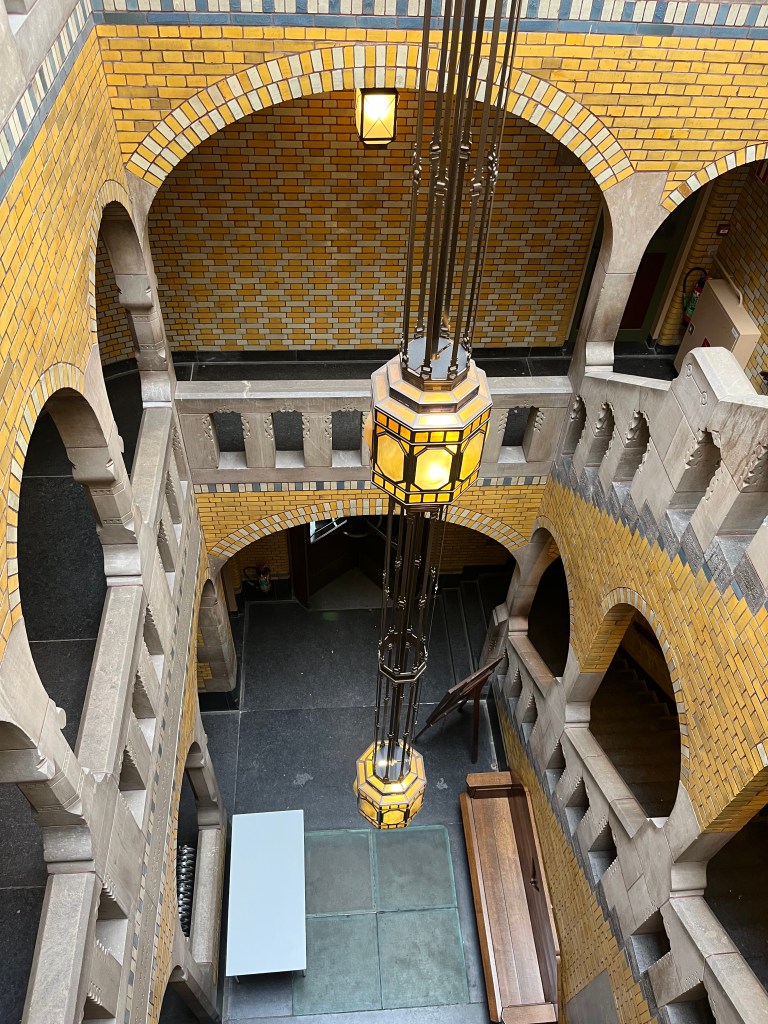
The venue for the conference was split between two spaces – a social centre, once a church, squatted more than two decades ago and now legalised and a wonderful building ‘De Burcht’ that was once the headquarters of the Amsterdam diamond workers union. The picture shows something of the beauty of the building but its history is also inspirational. In the 19th century there were around 10,000 diamond workers. They were divided by gender and religion. However, after a major strike which brought the entire workforce together a single union was created and commissioned the building.
De Brucht – image by Pete Cannell CC0
Here are some of my highlights from the plenary sessions.
Leonor, from the Portuguese group Climaximo, talked about how the cost-of-living crisis runs side by side with the intensifying climate crisis. She argued that building a mass movement to stop climate collapse requires an organisational culture of a different kind – flexible, learning and always thinking about the next steps. Bringing the labour and climate movements together is key. All of this needs a high level of ambition and a clear focus on building social power to stop climate change. We need to be ready to take risks and accelerate our learning cycles. We’ll make mistakes but we must not repeat mistakes. We have seen mass movements rise very fast and we have seen dominant ideas change very quickly – we need to envisage this and think of strategies that can make it happen.
Working people are struggling daily to get by – a programme to tackle the climate crisis is a programme to improve lives and livelihoods. We need to dare to win power – these ideas need to explode in society and go mainstream.
Sean Sweeney from Trade Unions for Energy Democracy (TUED) noted that trade unions in the north wanted/want to get a seat at the table of the transition. TUED argues that being at the table is not fine. While renewables have expanded so has the use of fossil fuel. Radical restructuring is needed. The problem is a capitalist system that burns fossil fuels for profit. We need a programme/pathway – a plan of action and crucially we need public ownership of energy. It’s evident that all the countries who say they have targets for net zero will not achieve them. The solutions we need are not compatible with a system of growth and accumulation. Public ownership and control is essential.
Plenary Notes
Jonathan Neale started his contribution by saying that the evidence for climate change is increasing fast. Most people think something must be done. He argued that the climate movement must change – we have to go for concrete solutions. Stop fossil fuels. Make them illegal. Cover the world with renewable energy. Governments need to do this. Every worker in old industries gets a new job with the climate service. Once we win it in one country it’s easier to spread. It requires a mass grass roots campaign that must go everywhere. It’s serious project and not about having a good policy, we have to persuade a mass movement to fight for it. We need to persuade the climate movement. People say we must not divide the movement, but he asserted that there is no other solution on offer. The just transition is the only transition on the table. It requires winning majorities – not diluting politics – persuading people that on this we are right. We need action – direct action. Every time workers are losing their jobs, we need action/occupations etc. to insist that they must have climate jobs. Occupation for demands that we can win. We need our own shock doctrine – organising at the grass roots for the things that people need in heat waves, floods – we have to march and protest in the teeth of disaster – no one left behind. Fund raising events when catastrophes are elsewhere. The time for dishonest promises is past. This is a long struggle – explosive growth sometimes – slow at others. We can’t afford to wait to see that their promises are lies in 2040 – we have to start now on the scale that is necessary. Winning once makes it easier elsewhere. In global south renewable energy is needed to grow to meet their needs. From here to this vision is a huge jump but it must be done.
The theme of public ownership was reinforced by a speaker from Colombia. She started by saying that it is the capitalist system (imperialism) that is to blame and we need to be clear about this. With a progressive government in office Columbia is for the first time looking at the possibility of change. The country is highly indebted. Renewable energy has increased but is almost entirely in the hands of private companies that are propped up and subsidised by public resources. Carbon emissions are principally from land use and deforestation – Columbia is a producer of primary raw materials. Transition requires public ownership and social control. Just transition is a question of rethinking the role of the state and the working class. She argued that large scale utilities are essential – things like roof top solar contribute but can’t be the answer on the scale that’s needed. In Latin America – this is a moment when it is necessary fight for public power.
Some of the contributions reflected significant rethinking in the climate movement. A contributor from XR in the Nederlands talked about how the focus of direct action has changed in recent months. There has been action against a private jet terminal and action at a big steel plant. This shift stems from frustration that labour and climate movements are not working together against common enemy while NGOs talk about capitalism but not about class struggle so much. There has been progress in building a climate justice network in the Nederland’s largest trade union. A contribution from Friends of the Earth (Nederlands) remarked on an ongoing shift from consumerist demands to more concrete demands and demands on big polluting companies. But most of these actions have been from the outside – with the consequence that workers see this as attacks on them. And may have increased their resistance to climate transition agenda. Workers were arguing against CCS and for hydrogen and electricity – but climate movement more impatient – no dialogue – need to engage more directly with the workers and not with the trade union bureaucracy. This point was echoed by another contributor who had been involved in producing the Platform report on the views of offshore workers in the UK sector of the North Sea. Platform worked with the offshore unions to reach the workers who contributed to the report. The findings of the report were powerful but mostly the unions have done nothing with them. She argued that it will often be necessary to bypass union officials to speak directly to workers.
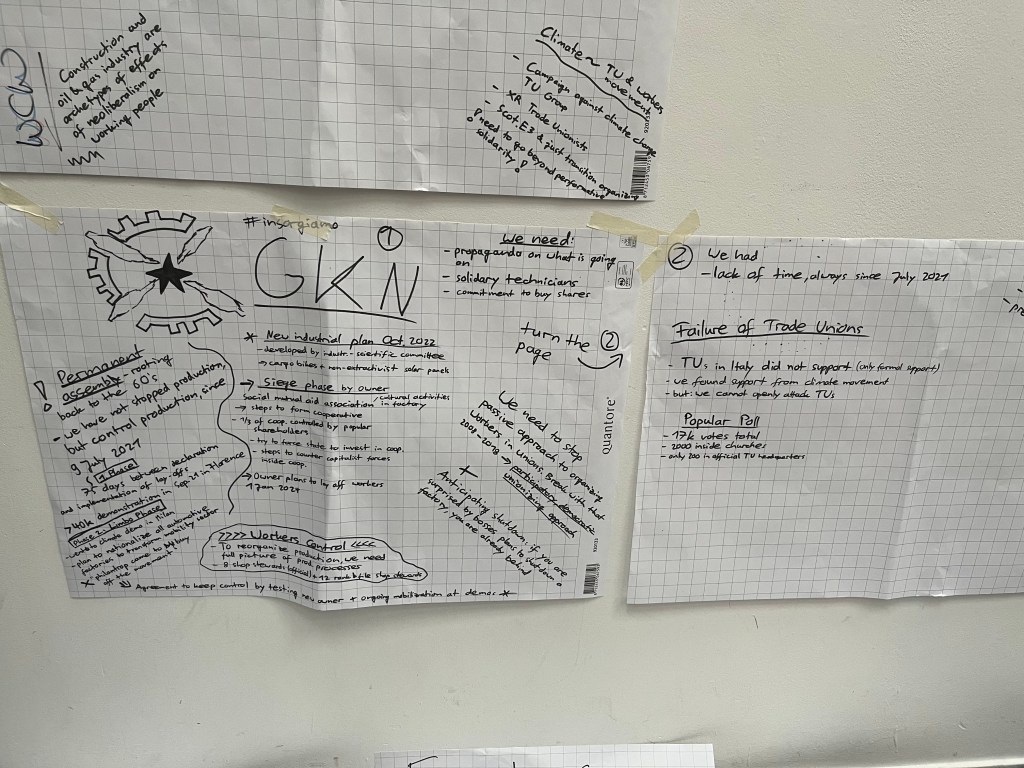
On the second day of the conference, I helped present and facilitate a workshop on the strike wave in Britain put on by the socialist group rs21. We explored the scale of the movement and attempts to align it with the environmental movement. This provoked a lively discussion and people gave examples from 7-8 different countries of experiments in aligning the workers and environmental movement, including pushing for the wider ecosocialist political struggle. As part of the workshop, we hosted a representative from the Italian GKN Collective. GKN is a British owned company in the automotive and aerospace sector. Faced with a decision to close the factory the Italian workers occupied in 2021 and have stayed in occupation ever since. They are now fighting to control it; they’ve retooled the machinery and aim to convert it to renewable transport production led by workers. It’s quite shameful that this occupation has not received more support and solidarity in the UK. Coverage in English is very limited but you can read more here.
Workshop notes
I’ve tried to focus on the main themes of the conference but there was much more and much deserving of separate and more detailed reports. The accounts of social movement trade unionism in France were impressive. German delegates spoke about their public transport campaign #wirfahrenzusammen – we’re driving together. Joint activity bringing the youth strike movement together with public transport strikers and public transport users. Safe Landing ran a workshop on workers assemblies. There was intensive discussion of what we mean by just transition and workshops on global debt, the East African Crude Oil pipeline (EACOP), the upcoming European elections, political strikes and how to build on them and how to understand and make an impact on local and global supply chains.
You can find the recordings of all the panels and a selection of workshop sessions here:
Here are a couple of the videos from the Global Climate Jobs conference that took place at the weekend. All of the plenary sessions are available on the network’s YouTube channel.
We know that the points of convergence between the labor and the climate movements are immense, but that several challenges lie ahead of us. It is nevertheless of extreme importance and urgency to cut emissions and do so by drawing on plans that are created by the workers and communities and in regard to their interests and needs.
Often, we do know what work needs to be carried out in order to cut emissions, but workers are being left out of the discussion and climate science is being disregarded. We need to build a movement that not only is capable of setting its own program, but that has the power to implement it.
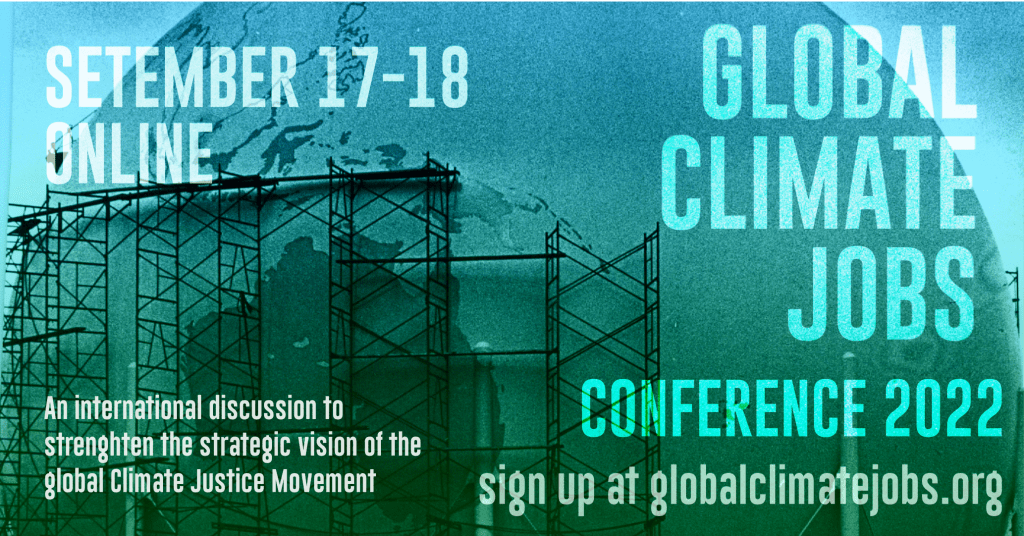
As so, we are bringing together people from all around the world, and bringing together the labor and climate movements to discuss how we win a program that can allow us to stop climate collapse. Join us for two days of thematic sessions about the strategies, technical and social perspectives, and challenges we face in building Climate Jobs Campaigns.
Invited speakers:
Negrai Adve;
Max Ajl;
Chris Baugh;
Jeremy Brecher;
Leonor Canadas;
Claire Cohen;
Rehad Desai;
Patricia De Marco;
Suzanne Jeffries;
Paul Le Blanc;
Josua Mata;
Suda Sim Meriç;
Jonathan Neale;
Andreas Yetterstad
Schedule
All the sessions will be recorded and available online. Sessions will be 1 hour and 30 minutes and will be composed of a introduction by the invited speakers and a workshop space between the participants.
Saturday, September 17
12:00 GMT [5 pm ET] – General Session: Strategic Orientation
14:00 GMT [7 pm ET] – Special Sessions
1) Building Climate Jobs Movements
2) Food and Farming
16.00 GMT [11 pm ET] – Special Sessions
1) Ecofeminism
2) Racism and Refugees
Sunday, September 18
12.00 GMT [5 pm ET] – General Session: Workers in the Fossil Fuel industry
14.00 GMT [7 pm ET] – Special Sessions
1) Cutting Emissions
2) Resilience
16.00 GMT [11 pm ET] – General Session: Summing Up
The Global Climate Jobs Network is organising an online international conference Friday June 3 to Sunday June 5, 2022. This will be online to make it easy for activists and organisations to participate from all over the world.
Themes
The theme is Climate Jobs, Climate Crisis and Green New Deals. But we are open to sessions on related topics linked to community, union and other climate justice struggles. If you are not sure if your topic would fit, send it anyway and we can chat it over.
Who
Our Global Climate Jobs Network will be coordinating the conference. But we want organisations to propose and present your own sessions.
We are looking for sessions from different organisations, from national unions to local branches, from international networks to national campaigns. From environmental and climate justice community campaigns to local Fridays for the Future groups, student unions, social movements, feminist and LGBT groups, faith groups, farmers and fisherfolk organisations and Green New Deal campaigns and from groups of scientists and engineers.
We especially want to provide a platform for those fighting for climate justice now and we particularly want to hear about the struggles of the peoples of Africa, Asia and Latin America.
How
You can run a session based on your own organisation or you can put forward speakers and we will link them up with speakers from other organisations on similar themes or from the same country.
We also want to encourage artistic sessions using, music, film, and anything that tells your story and makes the event more like an online festival of resistance, ideas and solidarity.
You can propose sessions in any language, and you can propose two sessions in different languages.
We will timetable all the sessions and try to arrange them so you can follow different themes.
Sessions will last 75 minutes. We suggest no more than three speakers, and at least half of the time is taken up by contributions from the audience and in breakout groups. If you have three speakers, please have at least one be a woman. If you cannot find an appropriate woman speaker, please write to us and we will try to put you in touch with someone.
What’s Next
To propose a session or a speaker, to ask a question or talk to someone on the organising committee, please write to: Climatejobs2022@aol.com
Sponsoring Groups (list in formation):
Global Climate Jobs Network
Climaximo (Portugal)
ScotE3 (Employment, Energy and Environment – trade union and environmental activists in Scotland)
Review of African Political Economy
AIDC (Alternative Information and Development Centre – South Africa)
Million Climate Jobs Campaign (South Africa)
Pittsburgh Green New Deal (USA)
SENTRO (Sentro ng mga Nagkakaisa at Progresibong Manggagawa – labour federation in Philippines)
Solidarity with rail, ferry and energy workers, members of the RMT union who are protesting on Monday 31st January in Edinburgh. Assemble 11am on the Waverley Station concourse.
This is the RMT press statement
28 January 2022 – RMT Press Office
Transport and energy workers to protest on 31 January in Edinburgh against betrayal of COP26 promises
Marking the three-month anniversary of the beginning of the COP26 Climate Conference – on 31st January – transport and energy workers are to march to the office of the First Minister Nicola Sturgeon to protest at the betrayal by the SNP / Green Government of commitments made to move towards a greener Scotland.
The protest by rail, ferry and energy workers who are members of the RMT will be the start of a concerted campaign to increase the pressure on politicians as the country approaches the local government elections in May.
The charge sheet against the Scottish Government includes:
• Instead of cutting climate change, the SNP/ Green Government is cutting rail services including rail ticket offices hours, timetables and infrastructure while the cost of rail travel is increasing at four times the rate of using a car. • Instead of securing our vital lifeline ferry services in the public sector, ministers appear to be paving the way for privatisation where profits will be put before people and climate. • Instead of helping guarantee the livelihoods of energy workers, ministers have sold Scotland’s renewable energy resources on the cheap to the likes of BP and Shell without securing supply chain jobs. RMT General Secretary Mick Lynch said: “COP26 started only three months ago but already the lofty rhetoric about fighting climate change seems a distant memory as we witness a betrayal of ambitions by the SNP / Green Government to move towards a greener Scotland.
“Instead of cutting climate change the Government is cutting rail services and ticket offices, threatening the privatisation of our lifeline ferry services and doing far too little to protect the livelihoods of energy workers and the vital service they provide.
“As the country approaches the local government elections in May this protest will be the start of a concerted campaign to persuade politicians to protect these services and jobs which are so vital to our local communities.”
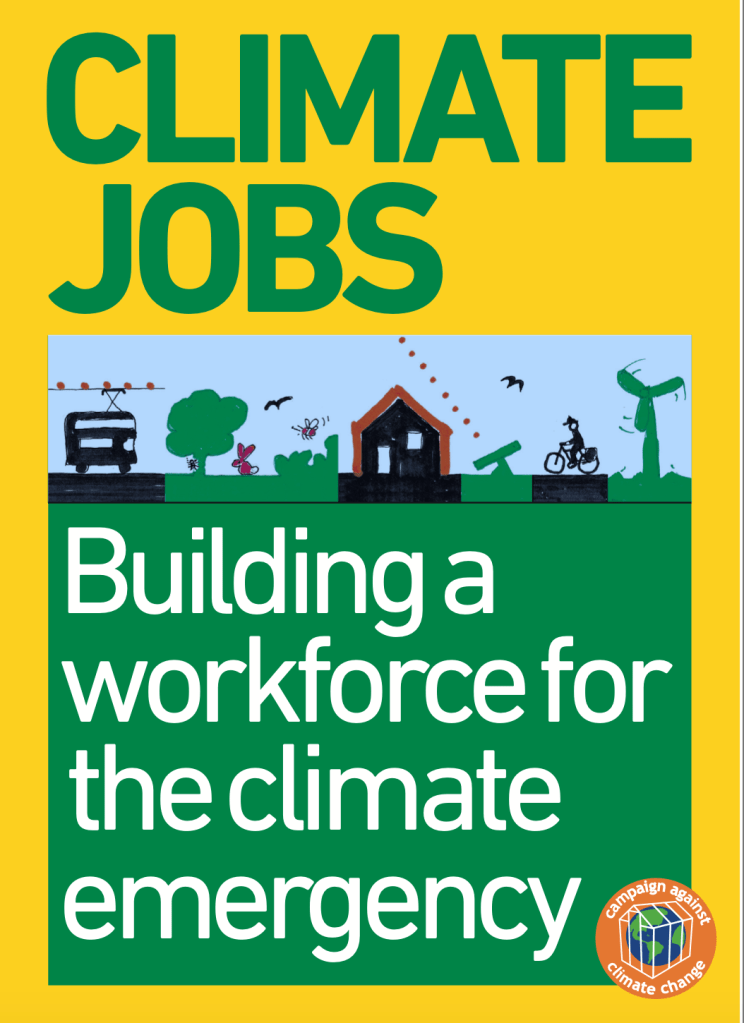
A new pamphlet, and accompanying technical resources, from the Campaign Against Climate Change Trade Union Group is indispensable reading for every trade unionist and climate activist.
It’s now 13 years since the One Million Climate Jobs pamphlet was published. The pamphlet’s proposition is a simple one – solving the climate crisis requires a rapid transition to a zero-carbon economy – transition involves ending economic activity in areas that create greenhouse gas emissions and hugely expanding the number of new jobs that are essential to a decarbonised economy – these jobs are what the pamphlet describes as ‘climate jobs’.
A focus on climate jobs is practical and political. It’s practical because an energy transition is simply impossible unless the jobs are created. So, the extent to which jobs are being created is a measure of progress. If there’s no evidence of jobs, then all the rhetoric about a climate emergency from politicians is just hot air and greenwashing. Scotland is a good example of this – we’re told that the Scottish Government has world leading policies – but there is no evidence of a growth in climate jobs, or of the planning and infrastructure required to support growth in climate of numbers. And while there is no evidence, it’s very hard to convince working class people that plans for dealing with the climate crisis will not have the same impact as past transitions. Many parts of Scotland are still deeply scarred by the transition from coal in the 1980s. So, to build the kind of powerful mass movement we need to drive an effective and socially just transition a sharp focus on climate jobs and the positive effects that transition would have on employment and quality of life is essential. It’s important to stress, however, that a socially just transition – system change in short – should also mean a re-evaluation of employment across the board. Social justice requires climate jobs, but it also requires that there are more jobs in health, care and education and these jobs that support social reproduction are valued much more highly.
Since the publication of ‘One Million Climate Jobs’ other studies have taken a similar approach to analysing what needs to be done to reach Zero Carbon. It’s striking that although methodologies have varied estimates of the number of climate jobs required for the UK and for regions of the UK are remarkably similar. The Green European Foundation’s regional focus is very helpful at understanding more localised impact. It provides data that enables estimates of the numbers of jobs in different sectors in Scotland to be made. Sea Changedemonstrates that phasing out North Sea oil could result in significantly more skilled jobs in renewables.
Nevertheless, ‘Climate Jobs – Building a Workforce for the Climate Emergency’ is a hugely valuable addition to the evidence base for organising and campaigning. It looks though a UK wide lens – and of course there will be regional variations – but the data and analysis on Energy Production, Housing, Transport and Decarbonising industrial processes provides a clear and accessible guide to what can be done using existing technology. The pamphlet also demolished the most common ‘false solutions’ (or greenwashing) that characterise so much of current government and industry priorities.
This pamphlet deserves to be used and shared widely. We will have copies on ScotE3 stalls, and you can order hard copies, download a PDF and access the back-up technical resources from the CACC TU website.
Another contribution to our ongoing thread of debate about ‘what next after COP26’. This post from Sara Bennet, Raymond Morrell and Pete Cannell, based on a revised and updated version of an article originally published on the rs21 and Conter websites, is intended as a contribution to that debate. It looks the rising level of industrial militancy in the UK and discusses the importance of this for developing a movement that has the power to force the kind of system change that we need to avert climate catastrophe.
Nevertheless, despite the failure of the COP, there are reasons to be hopeful. Glasgow was the focus for a diverse and dynamic series of protests that took place in more than 300 locations around the world. There has been a convergence in understanding of the science and economics of the crisis between climate activists and scientists and researchers. So for example, the IPCC reports are produced by consensus among scientists from around the world. The physical science section of the latest report was published in August 2021. It highlights the chasm between the reductions in greenhouse gases that need to happen and the reality of continuing increases. Increases that reflect the fact that while investments in renewables have grown, that growth is outstripped by new investments in fossil fuels. The second and third sections of the report were not due for release until 2022 but, in an unprecedented move, scientists have leaked drafts of the texts. Essentially the message is that restricting the average rise in global temperatures to 1.5 degrees by the end of the century is only possible if there are fundamental changes to the way economic and social activity is organised around the world. Quite simply the message is that business as usual, based on the assumption that the market will drive a transition to a low carbon economy, is just not an option.
But in essence COP26 stuck with business as usual. So how do we build a movement that is powerful enough to drive through system change in the face of opposition from the rich and powerful?
Over 100,000 marched in Vancouver in solidarity with the youth of the world in the September 27 Climate Strike. Image by Chris YakimovCC BY-NC 2.0
Part of the story of the Glasgow COP is the strikes and threats of strikes by Scottish workers. The industrial action by ScotRail workers that would have paralysed Scotland’s rail network while the COP took place was called off after the RMT union reached a settlement over a one-year agreement. But in a separate dispute strikes by workers on the night sleeper trains from Scotland to England went ahead as did action by Glasgow refuse workers, members of the GMB union. It was important that the COP coalition that brought together activists to protest and demonstrate at the COP provided open and consistent support for the strikers.
For too long the demand for a worker-led just transition has been abstract and disconnected from any sense of working-class agency. While climate activists have promoted the idea, concrete examples of class action have been lacking. So, whilst climate change has moved up the agenda of most trade unions in Britain, the disconnect between economics and broader politics continues to exert an influence over trade union engagement in the climate question. For example, the GMB has turned its back on meaningful action with its support for fracking. It also supports an approach to mixed-energy provision which may appear like a step in the right direction but allows the status quo to continue under the guise of sounding more balanced. Meanwhile Unite, which represents members working in some of the key ecologically damaging sectors, opposes fracking. However, it has often passed sensible-sounding policies around supporting climate jobs while simultaneously limiting their effectiveness by being unable to think beyond the immediacy of job provision, such as its position in favour of Gatwick airport expansion position.
Trade unions’ main role, of course, is to defend workers, their jobs and working conditions. However, this has too often led to a narrow focus, and a determination to defend the climate-damaging jobs that in time will simply undermine the very existence of such jobs in the future. Jobs in these polluting sectors have often also tended to be more highly skilled with a history of organisation. They also wield some power within the union structure. Due to their importance in terms of UK manufacturing and output, they have also been some of the worst affected by partnership arrangements, which basically attempt to convince workers that their interests align with their bosses.
When climate activists see unions acting in this way, it can breed a sense of cynicism, and to regarding the those working in these sectors as part of the problem, rather than as key to the solution. However, workers are right to insist that there will be meaningful and sustainable jobs for them and future generations. What’s more, increasing numbers of workers within and outside these sectors realise that time is up. These are workers that could and should be at the heart of planning what a real just transition would look like: which skills it could retain and build on, how to transfer them to building a viable future.
Things are changing. Four decades of neo-liberalism have resulted in grotesque levels of inequality. So, for example lorry drivers pay has remained stagnant while working conditions declined, and workloads grew. This is mirrored across society. The accumulated impact of these trends, compounded by the pandemic, is reflected in staff shortages in key sectors from transport to care. In this context workers are starting to organise, take action and win.
Whether or not the anger that these actions represent, and the confidence they engender, can generalise beyond immediate economic demands to grapple with the need for system change depends on the way in which political ideas develop in both the trade union and climate movements. Not least, a worker-led transition requires new forms of organisation at the base and a rejection of employer partnership.
Objectively the conditions are favourable for this to develop. Marxist Ecologist John Bellamy Foster argues that the existential threat posed by the climate crisis can create a revolutionary situation in which the struggle for freedom (from oppression, poverty and more) and the struggle for necessity (survival in the face of climate chaos) coincide. Such a formulation may seem like an impossible step from the action of rail workers and council workers in Scotland – yet building a movement that can achieve system change (necessity) will be one of many steps and reversals – sometimes slow – sometimes rapid.
For many, perhaps most climate activists, the IPCC’s conclusions are old news. It is precisely because of the way in which, year on year, world leaders have jetted into the latest COP and made decisions predicated on the assumption that the market is sacrosanct that so many have concluded that system change is the only answer. The slogan ‘System Change Not Climate Change’ is ever present on climate protests worldwide. But what the slogan means and how the change is achieved is less clear. Will capitalist enterprises respond to ethical imperatives or is state regulation required to force changed behaviour? Can a system driven by profit and capital accumulation ever coexist with a sustainable zero carbon economy? Or do we need a much more fundamental reorganisation of society? And at the same time, given the strength of fossil capital – structured through a century of exploitation of coal and oil and resting on vast resources of wealth and power – where is the power to make this happen?
The beginnings of the answer to that question of the power to change the system are evident in the rise of the school student strike movement around the world, the mass demonstrations that preceded the global pandemic and on the streets in Glasgow this month. But, apart from a moment two decades ago when the turtles and the teamsters marched together, organised workers have largely been absent from the stage. This why the industrial action around the Glasgow COP is so important.
In the aftermath of the COP a priority for climate activists must be to actively lend their support to striking workers, whether it be the refuse collectors in Glasgow and Brighton, the HGV drivers nationally or bus and rail workers. Supporting road haulage might on the surface seem contradictory to the fight against climate change but ultimately the change we need will come from below, with unity across the struggles being of paramount importance. Likewise, we need to see trade unionists march with their banners alongside climate activists at COP26 and beyond. The fights for decent jobs and a decent environment are not in opposition: they are one and the same.
We must think of “productive reconstruction” not as “a return to growth” but as a process of transformation and intense confrontation with capital, based upon public ownership, self-management, and forms of workers’ control. It has to be a process of experimentation and learning.
This seems like a pretty good agenda for both the climate and workers’ movements.








 Employment, Energy and Environment
