Sunak fiddles while Rhodes burns

Pete Cannell and Brian Parkin take a critical look at Sunak’s recent oil and gas announcement.

On Monday Rishi Sunak flew to Aberdeenshire by private jet to announce that at least one hundred new North Sea drilling licenses will be granted in the autumn.  A policy described by junior energy minister Alex Bowie as “maxing out our oil and gas reserves”.  At the same time Sunak gave the go ahead to the Acorn Carbon Capture and Storage (CCS) project to be based at St Fergus near Peterhead.  Acorn will be one of four CCS projects in the UK – the other three are in England.

St Fergus Gas Terminal © Ken Fitlike CC-BY-SA/2.0

At a time when fires rage across Europe, and North America and floods wreak havoc in China and elsewhere, the new oil and gas licenses have received widespread criticism from climate campaigners, climate scientists, the Scottish Government and even some Tory MPs.  Reactions to the CCS announcement are more mixed.  SNP politicians have welcomed the announcement.   Carbon Capture is prominent in the Scottish Government’s draft energy plans and Sunak argues that CCS will mean that the net zero by 2050 target is still in scope.  

In our view both strands of Monday’s announcement represent Sunak paying his dues to the big oil and gas companies.  In the rest of this article, we’ll explain why.  

For months the Tories have argued that the cost-of-living crisis is the result of a crisis of energy sovereignty caused by the war in Ukraine.  In fact, the price of gas had rocketed upwards before the war. There was no shortage of supply, since most of the gas used in the UK is piped from the North Sea.  Compared with the rest of Europe the UK is unusually reliant on gas for home heating and cooking.  There is a real problem here – the North Sea gas fields are nearing the end of their lifespan.  So given there is an overwhelming need to reduce carbon emissions the obvious answer is to start now, planning for the future by electrifying the domestic heating system and insulating homes alongside a planned phase out of the use of gas.  The Tories are doing none of this.  On paper they still say they want to replace natural gas by hydrogen.  But the weight of evidence that this would phenomenally expensive and a hugely inefficient use of electricity to generate the hydrogen means that they are rapidly backtracking.

So is Sunak’s plan to license more oil and gas fields going to keep people warm.  Not at all.  First the new fields contain more than 85% oil, not gas (see technical note below).  That oil would be exported on the world market.  Much of the gas is ‘sour’ – it has a high sulphur content – and is unsuitable for home heating.  So, we have the worst of all possible worlds – continuing use of fossil fuels at large scale when the climate science says that the use must stop and the likelihood of very high fuel bills and insecurity of supply.   Only big oil and their shareholders come well out of this – the rest of us and future generations pay the price.

A close look at Sunak’s plans for Carbon Capture and Storage is equally disturbing.  The technology proposed for CCS is untested at scale.  Even if the most optimistic targets for carbon sequestration are met, they represent a tiny fraction of the total carbon emissions from the North Sea.  At present the only source of carbon dioxide at St Fergus is the gas stabilising plant.  In the long-term Carbon Capture may be able to play a role in helping reduce the concentration of carbon dioxide in the atmosphere – but right now the priority must be to cut emissions rapidly.  The £20 billion allocated by Westminster to the 4 CCS projects could be spent on expanding the production of renewable energy, home insulation and developing the electricity grid.  

The parallels with the Cumbria Coalmine project are powerful.  There we have the Tories supporting the exploitation of a fossil fuel, coal, which is not wanted by the steel industry.  With the new licenses and CCS, we have a plan for energy security and net zero which delivers neither.  Quite simply both represent political statements by the Tory Government that affirm their unswerving commitment to fossil capital.

Technical note:

The proposed Acorn (St Fergus) (and other) CCS plants are designed to be emissions source dedicated- i.e. they are intended to sequestrate carbon from say, a power station or chemical plant flue stack- not the ‘general’ atmosphere, and as such they are demonstration installations.

Apart from the Peterhead sour gas power station, the other nearby CO2 source is the St Fergus gas terminal which adds about 3-4% carbon to the overall gas/carbon penalty.

Total North Sea reserve gas content is about 27% (73% oil). The new blocks have a much lower gas composition c.12%. 

The carbon contents of the different fuels (compared with coal) is:

Coal   97%

Oil       89%

Gas    35% max inc process penalty

Don’t let CCS dominate the climate action agenda in Scotland

Part of the coalition deal between the Scottish Greens and the SNP was the allocation of £500 million to support the creation of new sustainable jobs. There are indications that all of this funding may now go to CCS (Carbon Capture and Storage projects). One time chair of the Wood Group, Sir Ian Wood is a strong advocate of CCS and has been vocal in his criticism of the Westminster government’s failure to fund the Acorn CCS project in Scotland. The Wood Group lobbies and argues for CCS. Their website asserts that ‘If we are to achieve a net-zero world, carbon capture and storage infrastructure is a necessity and needs to scale up rapidly.’ Scot.E3 believes that CCS is a central plank of Oil and Gas UK’s strategy to continue the policy of maximum economic extraction of oil and gas from the North Sea. Choosing to spend the £500 million on CCS would constitute big step down a road that the Oil Industry wishes to travel and a setback for the campaign for a rapid just transition away from fossil fuels. There are many other projects that could be funded.

We are pleased to publish this post that has been submitted to the site. The author has asked to remain anonymous.

One of the SNP’s proposed solutions to climate change is Carbon Capture and Storage (CCS). This is very dangerous in our mission to decarbonise Scotland’s economy and provide other countries with the tools to do the same. On the face of it CCS may seem like another tool in the box to reduce carbon emissions, and that might be right if it weren’t for the very strong vested interests. 

There are very strong arguments that CCS can’t work for technical reasons – such as the inability to actually avoid the carbon being stored leaking. There are also strong economic reasons it can’t work – wind and solar are already cheaper than fossil fuels in most markets, with plenty of scope for further reduction. Adding an additional cost to the production of fossil fuel energy makes it even less competitive. 

Image Pete Cannell – View from Cromarty – CCO

So why are fossil fuel interests so keen on CCS?

There are two reasons why CCS is favoured by fossil fuel executives who want to portray themselves as concerned about climate change. The first is that it allows them to continue extraction of the oil and gas that their company’s valuations are based on. The second is that it distracts from other clean technologies that will actually decarbonise energy, such as renewables and storage. It does this by ‘crowding out’ renewables investment.

So CCS will do two things, even if it isn’t viable. It will allow more drilling for fossil fuels and it will divert investment from renewables and storage.  

The argument put forward by Oil and Gas UK is that CCS means we can continue to drill in Scottish waters and that those resources can be made ‘carbon neutral’ through CCS. 

The danger particularly comes because the UK Government has chosen not to support the Scottish CCS project. This has created an opportunity for the vested fossil fuel interests in Scotland to argue that the Scottish Government should use the money set aside for a worker-led just transition from oil and gas jobs should be diverted to supporting CCS. The £500m negotiated by the Greens as part of the coalition deal for clean jobs to replace oil and gas is now at risk from a dead-end technology that exists mainly to prevent the end of fossil fuel drilling. 

This illustrates exactly how CCS will crowd out renewables investment, but worse it will rob workers of the jobs that they need in truly clean industries. 

The fossil fuel industry tried the same approach with fracking in the last decade. We urgently need a campaign to persuade politicians who have fallen for the CCS lies and greenwash that this is another wrong turn. At the moment, that means SNP ministers and backbenchers.

END

There are other posts relevant to CCS on this site:

Video on carbon capture

Briefing on BECCS

Articles here and here

Large scale investment in Carbon Capture is a dangerous diversion

This site has published a number of articles on Carbon Capture and we have also produced a two-page briefing on BECCS (Bioenergy with Carbon Capture and Storage). 

The excellent People and Nature blog has recently published a really useful addition to the debate in the form of a review of a paper on Carbon Capture and Storage by June Sekera, a public policy analyst, and Andreas Lichtenberger, an ecological economist.

Here are some headlines from the report:

Carbon dioxide removal (CDR) systems, touted as techno-fixes for global warming, usually put more greenhouse gases into the air than they take out.

Carbon capture and storage (CCS), which grabs carbon dioxide (CO2) produced by coal- or gas-fired power stations, and then uses it for enhanced oil recovery (EOR), emits between 1.4 and 4.7 tonnes of the gas for each tonne removed.

Direct air capture (DAC), which sucks CO2 from the atmosphere, emits 1.4-3.5 tonnes for each tonne it recovers, mostly from fossil fuels used to power the handful of existing projects.

And if Carbon Capture were to be used at large scale things get much worse.

To capture 1 gigatonne of CO2 (1 GtCO2, just one-fortieth of current global CO2 emissions) would need nearly twice the amount of wind and solar electricity now produced globally. The equipment would need a land area bigger than the island of Sri Lanka and a vast network of pipelines and underground storage facilities.

We strongly recommend reading the full review.

The original paper – “Assessing Carbon Capture: public policy, science and societal need”, by June Sekera, a public policy analyst, and Andreas Lichtenberger, an ecological economics researcher – is free to download on the Biophysical Economics and Sustainability web site.

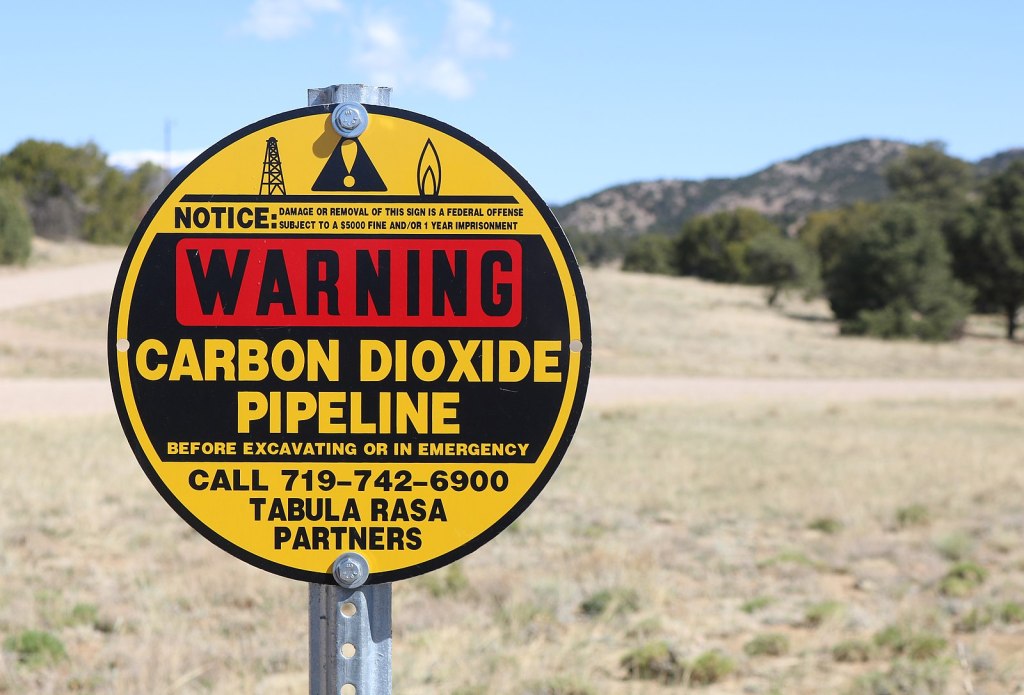
A metal sign warning of a buried carbon dioxide pipeline, located near the intersection of county roads 520 and 521 in Huerfano County, Colorado. Image by Jeffre Beall CC BY 4.0

New Briefing on BECCS

The latest ScotE3 takes a critical look at BECCS – Bioenergy with Carbon Capture and Storage.  Like all the ScotE3 briefings it is designed as a short, and hopefully clear, introduction to the topic.  We welcome feedback and ideas for improvement.

You can read the text of the briefing below and download the full pdf from the resources page.

briefing 10 graphic for blog

What is BECCS?

When people talk about BECCS in relation to the climate emergency they are referring to ‘Bioenergy with Carbon Capture and Storage’.   Carbon Capture and Storage (CCS) is a range of technologies that can be used to extract Carbon Dioxide from other gases.  The separated carbon dioxide is then stored under the surface of the earth in geological formations that trap the gas long-term.  So carbon that would otherwise be adding to the earth’s atmosphere is locked away.

BECCS adds another stage to the CCS process.  Fast growing woody plants, which take carbon from the atmosphere as they grow, are chopped down, the biomass is burnt in a power station to generate energy, and CCS is used to separate out and store the carbon.  CCS and BECCS are often referred to as Negative Emissions Technology or NET.

Why is it important?

CCS and BECCS really matter because currently almost all the carbon reduction targets set by institutions and governments around the world assume that CCS and BECCS can be implemented at large scale.  Typically targets talk about aiming for ‘net zero’ emissions.  The net here is not to be confused with Negative Emissions Technology! The assumption is that carbon emissions will continue, but what’s pushed out into the atmosphere will be exactly balanced by carbon that’s sucked in through CCS and safely captured.  It’s this assumption that allows the Scottish Government to talk about a climate emergency and set targets to reduce emissions while at the same time supporting continuing production of North Sea Oil and Gas and welcoming the development of new oil and gas fields.

The arguments against BECCS

So why should we be worried?  Surely a technology that allows us to reach net zero is to be welcomed?  Isn’t it a good thing that it’s the core component of the climate strategies advocated by the IPCC, the UK Committee on Climate Change and the Scottish Government?  In fact there are a lot of reasons to think that BECCS is a dangerous diversion that cannot achieve the results that many of its advocates suggest and that would have knock on effects that would be disastrous.

Maintaining the status quo?

The big energy companies are interested in BECCS because it allows them to continue business as usual; license to continue exploiting fossil fuels and to maintain their power and profitability.  The Scottish Centre for Carbon Capture and Storage takes a different view, arguing that there is a role for CCS in some specialised areas where it is hard to replace hydrocarbon fuels by electricity, but admitting that the technology is very expensive and should be one subsidiary strand of a transition to a sustainable economy.   Technologies for CCS exist in theory and have been trialled in laboratories but there are hardly any examples of it working in real life applications.  The UK Committee on Climate Change argues that Scotland is particularly suitable for growing biomass crops and that 32% of UK production could take place in Scotland.   But globally something like three times all the land currently in cultivation would need to be turned over to biomass.  Clearly this can’t happen, but even at much lower levels growing crops to be burned, as biomass would displace food crops and the prices of staple foods would increase forcing the poorest further into hunger and starvation.

Restoring ecosystems that capture carbon

Forests are a very important way in which carbon is removed from the atmosphere; about 25% of current emissions are taken up.  However, worldwide forests are under threat and clear cutting of forests to grow soya and other crops for meat production causes around 10% of global carbon emissions.   An end to deforestation and proactively working to re-establish natural forests could have a big impact on carbon reduction.  Trees are important but not just any trees.  When monoculture plantations replace trees – for example Palm Oil the same land area is much less efficient at absorbing carbon.  BECCS often assumes clearance of existing forest for monoculture cultivation of biomass.  And there are many other serious impacts: displacement of indigenous communities, destruction of ecosystems and of pesticides.

Separating out carbon dioxide from other gases or from the atmosphere is an energy intensive process so it’s expensive financially and in terms of our overall energy budget.   Operating at large scale might reduce the cost per ton of carbon but it would still need very large amounts of clean energy.

Scotland has a number of locations where the underground rock formations are suitable for underground storage of carbon dioxide.  Many parts of the world do not.  Proponents of CCS suggest that carbon storage could be a profitable new industry – however, long distance transport of captured gas would also require a lot of clean energy.

System change

Ultimately, however, the problem with BECCS and CCS is political.  Governments and corporations favour it as a solution because it seems to allow existing infrastructure and power relationships to be preserved.  It suggests that climate catastrophe can be averted by technical fixes.

Even if the technology works and can be introduced rapidly and at scale it seems highly unlikely that it can mitigate emissions sufficiently to avoid going well beyond a 1.5 degree rise.  However, for as long as CCS remains the main plank of mainstream strategies it diverts action and investment away from sustainable strategies that we know could work.  And it acts as a barrier to the systemic change that is required to save the planet.

All our material is published under a CC0 public domain license (unless otherwise stated.  You are welcome to share, reuse and reversion.  This briefing draws heavily on a FOE(S) and FOE(international) webinar. 


Carbon Capture and Storage

Mainstream policies on tackling the climate crisis centre round the possibilities of continuing to use hydrocarbons while reducing emissions through carbon capture and storage (CCS). The Scottish Government seems increasingly interested in this approach.  Over the next few weeks we want to promote critical discussion on CCS.  As a first step we are pleased to share the video of a webinar that FOE(Scotland) did with Friends of the Earth International on BECCS (bioenergy carbon and capture and storage).  Please comment and send ideas for more contributions and other resources that it would be useful to share.