Portuguese ecosocialists Climaximo argue for a strategy of rupture in the face of climate collapse. Pete Cannell reviews a new book which lays out their case.
In the last few years, the Portuguese ecosocialist collective Climaximo has been one of the most dynamic and creative parts of the European climate movement. Two years ago, the group made a sharp shift in its strategy and tactics, declaring that ‘the governments and the corporations declared war against the people and the planet’. All In: a revolutionary theory to stop climate collapse, written by two Climaximo activists, Mariana Rodrigues and Sinan Eden, is an explanation of the Climaximo approach and a call to action. It’s an unusual book. You may find parts hard to follow. You’ll almost certainly find that it includes things you disagree with. I don’t think the authors will mind that. What they are concerned to do is to win a case for their key propositions about the problems we face and what is to be done.
First the issue:
‘Everyone in the movement is more and more aware of two sets of information. The first is that the capitalist system is the root cause of the climate crisis and has absolutely no perspective of solving it. The logical consequence is that the task of any movement informed by climate justice is to dismantle capitalism. The second is the threat of runaway warming cascading to climate chaos. In other words: urgency.’
Mariana and Sinan argue that most people deal with one or other of these propositions but not both. They provide withering assessments of the movement as it is. They argue that existing climate campaigns generally end up becoming ‘every small decrease in emissions matters’ campaigns. Implicit in their assessment is a critique of NGOs who often talk about system change but whose practice is limited to demanding change within the existing system. On the other hand, they see the revolutionary left as clear about capitalism’s responsibility but failing to reflect the urgency of the crisis in their organising. It’s important to note that these judgements are made by insiders and activists not by detached academic commentators.
Underpinning the book is an assumption that whether or not there was once a pathway to a zero-carbon economy through some form of highly regulated capitalism, as global temperatures break the 1.5 degree increase set by the Paris COP and carbon emissions continue to rise, that path, if it were ever possible, is foreclosed.
The authors aim to develop a theory of change and an organisational model that can combine tackling the revolutionary overthrow of capitalism with the urgency that the climate crisis provides. They acknowledge that embracing both objectives can be daunting. They suggest that many movement organisers avoid even confronting this by focusing on limited and short-term objectives – effectively sidelining the systemic challenge that we face. They also argue that ‘not enough new generation organisers are learning from historical experience, limiting their attention to specific interpretations of specific examples’.
Taking all of this into account, the middle section of the book examines multiple historic examples of ‘successful’ movements for change, with brief descriptors and classification into different explicit or implicit theories of change. The overt aim is to develop a sense that contemporary movements have a rich history that should be engaged with. Mariana and Sinan encourage the reader to dig deeper. While I understand the reason for spending time on these examples, I found this the least convincing part of the book. In part this is down to my disagreement with the way in which some events are characterised. No distinction is made between political and social revolution. And there’s an uncritical framing of the 20th century as a period when for some decades more than half of the world was ‘socialist’. This opens serious questions. Why were these ‘socialist’ states so appalling in terms of environmental practice? If they were a new mode of production how did capitalism return? But perhaps I’m being over-critical, the authors are clear that their aim is to get activists interrogating and learning from past struggles.
‘Look, all these people were thinking about the questions we have now, and they answered them, sometimes it even worked, and many times it worked better than whatever we have done so far. If we can spark such genuine curiosity, we shall be satisfied.’
In the final part of the book the authors turn to what is to be done. Essentially, they call for organisations to take the same turn as Climaximo, recognise that we are in a situation where the capitalist class are determined to hang on to a system that is trashing the planet and then act accordingly. There are two basic propositions. Firstly, the climate crisis is a global problem.
‘Globalisation is the material process through which imperialism is integrated into a world system.’
Secondly, global capitalism has created its own gravedigger, a global working class. This is summarised as:
‘At this moment of history, there is a global working class confronting globalised capital.’
Both propositions are common currency on the left. But the conclusion that Climaximo draw, and that Mariana and Sinan develop, is not simply ‘build the revolutionary party’ although they are clear that the goal is revolution. Their proposed strategy is a brutally honest attempt to chart a path forward in a context which we wouldn’t have chosen as a starting point and where older models of ‘party’ building are inadequate. It takes for granted that there are many campaigns, movements, groups, and parties too, that could form the nucleus of the mass campaign that we need.
The core idea is the development of the ‘movement as party’. Some of the language is opaque so what follows is my interpretation. The aim is to build what Mariana and Sinan call a global movement ecosystem. What defines the parts of the ecosystem is a clear class-based focus on getting rid of capitalism. Tactics and ways of organising will vary by, and within, different locations, but following the example of Climaximo, the components of the ‘movement as party’ will have declared a climate emergency within their organisation. They will have accepted the basic propositions and most importantly they will have adapted their practice to align with them. The authors note that:
Surely, we can have many plans, contingent on various possibilities. But we need those plans, anti-capitalist plans, actually-dismantling-capitalism-in-the-short-term kind of plans. ‘System change not climate change’ is not an agitation tool anymore, it’s a directive for our generation.
They argue that:
‘… in a state of climate emergency, we need to take risks – a lot of them: political, strategic, organizational, tactical, personal and emotional risks. We cannot afford to lose everything without having really risked to win. We need to fail forward, we need to be intentional and attentive in our failures.’
They explain that:
‘By intentional failure we mean knowing what we are trying out and what risks we are taking. By attentive failure, we mean having specific collective processes in place to learn from the experience and share it.’
Climaximo’s understanding of class is based on the ecofeminist ideas of Stefania Barca which sees those involved in care work, work which contributes to social reproduction and the continuation of human life as integral to the working class. They note that:
‘Historically, marginalisation of reproductive work and metabolic work has accompanied marginalisation by gender, race and ethnicity.’
Critically this is a global working class which confronts the global issue of climate crisis. Mariana and Sinan stress that building a global movement is not an optional extra but a key part of building the ‘movement as party’. They insist that it’s not just a theoretical position but a practical one and argue that organising in a climate emergency means devoting perhaps 25 per cent of an organisation’s capacity to international work. In this respect Climaximo has an exemplary record, being central to the organisation of the Global Climate Jobs Conference in Amsterdam in 2023 and the counter-COP Earth Social Conference.
‘All In’ wrestles with questions that should be on the minds of everyone who is concerned about the state of the world we live in. What it proposes may not be ‘the answer’ but it should make you think and it concludes by setting a challenge – ‘Will we dare to win?’
Matthew Huber and Fred Stafford’s insistence that “electricity is poised to be a central site of political struggle in the twenty-first century” (2023, 65) is welcome and timely. But the approach they set out in “Socialist Politics and the Electricity Grid,” in Catalyst journal, is flawed. They argue that the basis for a socialist energy supply system is centralised electricity generation, primarily from nuclear power; that renewable electricity generation should play only a minor role; and that decentralised renewables are unworthy of support, for both technological and political reasons. Indeed, Huber adds, in an article on the Unherd website (2023), neoliberalism fostered decentralised renewables while undermining centralised generation, and socialists seduced by “green” renewables have unwittingly become neoliberalism’s allies.
“Make war on the nuclear monster”. More details in caption at the end
In this response, I suggest, first, that nuclear power has overcome none of the problems that led several generations of socialists to oppose it (links with the military, absence of waste disposal, and so on), and that it features only in the most impoverished views of the transition away from fossil fuels and the most conservative, state-centred versions of socialism. Second, I discuss the decades-long trend towards decentralisation of electricity networks – a reality for which Huber and Stafford fail to account. I argue that our focus should shift away from outworn pro-nuclear arguments towards a discussion of whether, and how, socialism can challenge capital’s control of electricity technologies, including decentralised renewables, and turn them to our advantage. Third, I challenge Huber and Stafford’s claims that renewables are, by comparison to nuclear, inherently inimical to labour organisation and to public forms of ownership. Finally, I question the misrepresentations on which Huber relies in an account of the relationship through history of energy technologies and neoliberalism. I build on arguments presented previously (Pirani 2023a, 2023b, 2023c.)
Nuclear and renewables
In their Catalyst article, Huber and Stafford (2023, 75) write: “From a socialist perspective aiming for reliable nonstop, zero-carbon power, nuclear energy would be the foundation of the grid.” The risks associated with nuclear are exaggerated in popular attitudes; problems with radioactive waste have been “overstated.” They do not engage with researchers of nuclear who assert that there is: (1) no long-term solution to the waste problem; (2) that there is “no working deep repository for high level waste anywhere”, despite limited progress in Finland and Sweden (Cullen 2021); (3) that a solution is “decades away”; and (4) that plans for new nuclear in the UK should be frozen “until we have a geological disposal facility”, which is timetabled for the 2040s but likely to take longer (Laville 2022).
Huber and Stafford pass over in silence the way that nuclear power implies and requires a strong state, and its close connection with the military – an omission all the more remarkable, given the occupation since 2022 of Europe’s largest nuclear plant, at Zaporizhzhia, by the Russian army, which bears responsibility for the collapse of the nearby Kakhovka hydro plant (Glantz et al. 2023). For the rich tradition of socialist writing on technology, the nuclear-military connection is not only about such “accidents,” but about deeper-going economic and technological relationships. Only nuclear reactors produce the fissile material needed for nuclear bombs; military imperatives shape national industrial supply chains more broadly; the overlaps in education, design, research and security are all extensively researched. Civilian nuclear power has been in long-term decline due to its high cost, but has proved “surprisingly resilient” to market conditions in a limited group of countries, due to this interdependence (Stirling and Johnstone 2018).
Ultimately, the way socialists see nuclear power is bound up with our views of potential post-capitalist futures. Huber and Stafford’s vision (2023, 79) is “of ‘big public power’, in which the public sector would subsidise the mass buildout of large-scale zero-carbon energy generation infrastructure including nuclear power and, where geography suits, renewables.” Against this, I commend the view held by Cullen (2021) that nuclear power is “antithetical to the world we want to see. From its origin as a figleaf to distract us from the grim truth of mutually assured destruction, to its recent resurrection as a bogus solution to climate change, it is inherently bound up with violent state forms and paranoid and secretive hierarchies.”
Views of nuclear also vary according to our approaches to the transition away from fossil fuels. The two most vital changes needed are: (1) to transform the way final energy is used (e.g. by insulating homes to reduce the need for heating, improving public transport to reduce the need for cars, ending wasteful forms of consumption), and (2) to reduce throughput of energy in technological systems (e.g. by replacing gas boilers with heat pumps). The remaining energy required must be produced with non-fossil-fuel technologies, of which renewables and nuclear are the most developed. The copious scenario analysis literature shows that climate change can only be dealt with in the course of deep-going social transformations (Grubler et al. 2018, van Vuuren et al. 2018, Allwood et al. 2019). For socialists these transformations are bound up with overcoming and superceding capitalism (Pirani 2018, Pirani, 2023a).
For the present discussion, there are three relevant points that I would like to emphasise. First, climate change deprives us of time. Nuclear power stations take many years to build, while decentralised renewable energy systems do not. Second, the future of electricity networks must be considered in the context of broader economic changes overshadowed by climate change, and the need for transforming final energy use and reducing throughput, mentioned above. (In his writing on “degrowth,” discussed elsewhere, Huber (2022, 31-32 and 162-175) has remained agnostic on energy consumption and throughput scenarios.) Third, highly flexible electricity networks are both necessary for reducing throughput and transforming final energy use – and, happily, also facilitate decentralised renewables. Integrating nuclear power stations that generate large, unchanging quantities of electricity into such networks may be less easy.
Under the present political conditions, in which labour movements and social movements are struggling for change under capitalism, choices made by the state about which energy resources to invest in do matter. Huber and Stafford (2023, 78) advocate opting for nuclear, despite the extraordinary expense: it “needs socialism to grow – or at least a form of public investment that socialises the costs of construction and does not privatise the gains.” The corollary should be spelled out: resources invested in nuclear would not be invested in renewables.
Discussions among socialists would benefit from greater attention to the transition scenarios mentioned above, which afford a way into some of the social and technological issues. It would also be worthwhile to develop a socialist critique of “100 percent renewables” scenarios (i.e. models depicting hypothetical paths towards electricity networks run solely from renewable electricity, without any fossil fuels or nuclear) developed by researchers from engineering and scientific backgrounds (Pirani 2023d). Huber and Stafford, characteristically, dismiss these scenarios as “largely based on the models of one researcher, Mark Z. Jacobson.” They are mistaken. A recent survey covered the work of some thirteen research teams (Heard et al. 2017, Brown et al. 2018).
Renewables and network integration
Huber and Stafford (2023, 65-66) propose “core principles” on which to base a socialist approach to electricity. They argue that electricity should be produced as a public good, rather than a commodity, that control by capital will always subvert this goal, and that for this reason “public or alternative ownership structures” are crucial. All this is welcome. Further, they propose that electricity is a “complex material system of production,” conducive to socialist planning, which “consequently requires a deep materialist understanding of how it works and how it might be transformed.” In my view, the conclusions they draw from this – that this understanding points toward “the importance of centralised, large-scale reliable power generation like hydroelectric dams and nuclear power, as opposed to decentralised, small-scale and intermittent forms of power like rooftop solar panels” – need to be challenged.
Huber and Stafford refer repeatedly to the supposed threat to electricity systems from decentralised renewables: intermittency “creates unavoidable problems for grid planning”; when there is too much wind and solar, that leads to curtailment, and when there is too little, electricity prices go up. They highlight the dangers of blackouts to “the very survival of the system,” but, unfortunately, remain silent on the fact that the world’s most devastating electricity blackouts (Puerto Rico 2017, Bangladesh 2022, Pakistan 2023) occurred in fossil-fuel-dominated networks for reasons that had nothing to do with renewables. They claim, mistakenly, that it is “still not clear how [renewables] can provide reliable power for the entire grid the way centralised power plants do today.”
These assertions are disproved by reality. While renewables’ share of global primary energy supply remains pitifully small, renewables generate a substantial share of electricity in a significant number of rich countries. Wind and solar account for 41 percent, 40 percent and 35 percent respectively of electricity generated in Germany, the UK and Spain, three of the largest European economies, and 43 percent in California, which consumes more electricity than most nations. Denmark generates 61 percent of its electricity from wind and solar and 23 percent from modern biofuel use. Variable renewables’ share of electricity generation in Scotland averaged 60 percent in 2019-21. This expansion of renewables, that like fossil fuels and nuclear are predominantly controlled by corporations and the state, is fraught with dangers, not least to the people of countries being plundered for minerals used in equipment manufacture. Grid integration, though, is less a danger, and more an engineering challenge (Pirani 2023b).
Wherever variable renewables expand, network upgrades are required. In particular, grids supplied by a large proportion of renewable generation need more, and newer, ways to store energy and to ensure grid stability. Because electricity grids are controlled by capital, just as the power stations are, the infrastructure investment needed to modernise them lags far behind the shift towards renewables in power generation. The most common problems caused by this failure to modernise are shortages of transmission and storage capacity (see e.g. IRENA 2023b, 11-14). The chronic level of curtailment of wind power in China in the late 2010s is noteworthy; so is the success of electricity transmission and distribution companies in fixing it (Chen et al. 2022) In the USA and Europe, the years-long queues for electricity generators to get a grid connection have become public scandals (Rand et al. 2022) But the underlying cause of poor infrastructure is not renewable technologies, but underinvestment. And the cause of that is, often, neoliberalism.
As for Huber and Stafford’s point that wholesale electricity prices may rise when less power than expected comes from wind – well, that’s how (pending improved weather forecasting) markets regulate supply and demand. (The example they cite, of too little wind in Europe in December 2022, is factually incorrect. See Pirani 2023b, section 2.4.) The problem is not the wind, it is the way markets function.
Not only does Huber and Stafford’s “deep materialist understanding” fail to explain what is going on in Scotland, California, and elsewhere; it also omits any account of the trends over several decades towards decentralisation of electricity networks, and, more recently, from uni-directional to multi-directional operation. The networks installed in rich countries in the first half of the 20th century, and across much of the global south in the second half, were designed to carry electricity in one direction: mostly from big coal, gas and nuclear power stations, to users. Peak centralisation was in the 1970s. Combined heat and power plants, and power stations using combined-cycle gas turbines (CCGT) built in the 1980s and 90s were smaller; wind and solar plants, even utility-scale ones, smaller still. (Patterson 1999, 68-70, 72-75, 114-116; IRENA 2023a, 17-18, 64-66).
As the number and type of electricity sources increases, networks adapt to manage their inputs, in the context of the “third industrial revolution,” that started with semiconductors and gave rise to a new generation of technology, including personal computers, mobile phones and the internet. The next big change, now getting underway, is towards flows of electricity in multiple directions, with the potential for microgrids, including those using direct current only, and for supply by decentralised generators to local users. These changes raise vital political issues, including: (1) whether these decentralised technologies, which are largely but not completely developing under corporate and state control, have the potential to enhance, and be strengthened by, forms of social ownership and control, to work towards the decommodification of electricity; and (2) whether co-ops, community energy projects and municipal ownership forms may be stepping stones in these directions (Pirani 2023b.)
Huber and Stafford’s concern that the addition of renewables disrupts an existing system might have made sense ten or more years ago. But the technology – if not the economics – of electricity networks has moved on. Rather than engage with this reality, it is unfortunate that they fall back on the following polemical misrepresentations:
□ They quote Mark Nelson, a consultant and nuclear advocate, to the effect that “claiming cheap renewables are a viable solution for our grid system is like claiming flimsy tents are a viable solution for the housing crisis.” They incorrectly describe Nelson as an “energy analyst,” imputing to his words an authority they do not have.
□ Huber and Stafford claim that “cheap prices of renewable energy don’t include the transmission lines to their remote locales or the costly back-up required when the weather isn’t favourable,” and that “the limited use value of solar and wind” leads to “broader system costs” not covered by renewable generators. They ignore the complexities of the integration into grids of variable renewables, and the substantial body of research of the costs (e.g. Heptonstall and Gross 2021, IEA/NEA 2020, Elliott 2020, 7-9). They misrepresent modelling by Robert Idel to create an exaggerated impression of renewables costs. (For details, see Pirani, 2023a, “Note: infrastructure costs.”) The simplified framing of renewables as an economic burden to an existing system has long been a staple of fossil-fuel-based generators’ propaganda, answered by mainstream energy economists with proposals for market reform and by socialists with calls for public ownership and decommodification. It has no place in a serious discussion.
□ Huber and Stafford pay unwarranted attention to the microscopic portion of off-grid solar in the global North, writing: “While the Elon Musks of the world hawk the benefits of ‘delinking’ from the grid through the individual purchases of rooftop solar equipment and battery storage, we must fight for the expansion of electricity as universal public infrastructure.” Yes, Elon Musk is a dangerous clown, and, yes, a small number of rich households may see rooftop solar as the road to a reactionary, isolationist, off-grid existence. But in the big picture, they are irrelevant. The overwhelming majority of rooftop solar, whether household, municipal or corporate, is connected to the grid. All these solar panels are part of a universal infrastructure. The barriers to that infrastructure being geared to use, and not profit, is not that the panels are decentralised, but that neither panels nor networks are publicly or commonly owned and controlled.
It would be regrettable if discussion among socialists were to be dominated by outdated pro-nuclear arguments, rather than by the real-world problems in electricity networks and other energy systems posed by climate change and the crises of capital. Collectively we should develop a critique of the work by engineers in politically mainstream contexts who assume markets as a key regulating mechanism (e.g. Cochran et al. 2014, Kroposki et al. 2017, Hanna et al. 2018), and build on arguments for greater public control (Elliott 2017, Elliott 2020, Kristov 2019). Research by a group of European scholars on the potential for flexible grids and decentralised renewables to open the way to forms of common ownership and to decommodification of electricity deserves our attention (Giotitsas et al. 2020; Giotitsas et al. 2022; Kostakis et al. 2020). They envisage “commons-based peer production,” under which “smart” technology is used not to trade electricity as a commodity but to share it as a common good; they show how software technologies that currently “align with the existing liberalised market with ancillary and balancing services” also “open up the possibility for democratising electricity if governed as a commons.”
Renewables, labour and socialism
Matthew Huber proposes that (i) renewable electricity generation is, by its nature, hostile to working-class organisation in a way that nuclear and hydro are not; (ii) decentralised technologies are poorly suited to public ownership, and that using them to enhance forms of social ownership at sub-national level is a blind alley; (iii) in any case such “localism” is at odds with Marxism; and (iv) there is a split in “the Left” between traditional labour unions that go with centralised generation, and “environmentalists and ecosocialists” who like decentralised renewables. I suggest that each link in this logical chain is broken.
Let us take up some of these arguments, which are important to the direction of the climate justice and labour movements.
Is electricity from renewables hostile to working-class organisation?
Huber (2023) writes, on the Unherd web site, that, in the USA in the 1980s, “the shift away from utilities and towards decentralised merchant generation explicitly undermined the labour unions who had built up their power under the older, established utility system. […] It is much easier to organise workers in centralised power plants than scattered solar and wind farms whose [sic], after all, only provide temporary construction jobs.”
The message – that solar and wind are bad for unions, large nuclear and hydro are good for unions – is oversimplified. The break-up of the US utility system did indeed damage the unions, with the loss of 150,000 unionised jobs (Beder 2003, 125). But renewables played a negligible part: those merchant generators used gas and some nuclear instead. And there was a context, which Huber does not mention: the gigantic, global shifts in labour markets that has made precariousness the “normal condition of labour under capitalism,” especially outside the rich world and among women in rich countries (Huws 2019, 51-66).
It is not in dispute that many renewable energy and other “green tech” companies are ferociously anti-union, just as many nuclear companies are anti-union. Huber and Stafford (2023) point to energy sector unions that favour nuclear, and argue that we should “listen to what these workers and unions say.” Yes, we should. But we should also probe the extent to which unions really speak for workers. And we should confront the reality that in this case, as in others, there may be tensions between some workers’ sectional interests and the aims of the workers’ movement more widely.
Are decentralised technologies poorly suited to public ownership?
In his article for Unherd, and his book on climate change, Huber shows little sympathy for the widespread movement towards co-operative and municipal ownership of electricity generation, facilitated by renewables technologies. He opposes the “localist path” as a matter of principle. It is “deeply at odds with the traditional Marxist vision of transforming social production,” he writes (2022, 250). And to drive the point home: “Duke Energy does not care if you set up a locally owned micro-grid.” It should be noted, first, that the “traditional Marxist vision” had a far more generous attitude to coops: in his classic critique of utopian socialism, Friedrich Engels (1882) went out of his way to welcome Robert Owen’s co-ops, envisaged as “transition measures to the complete communistic organisation of society,” for having “given practical proof that the merchant and the manufacturer are socially quite unnecessary.”
Second, and relevant to 21st century practice, the limits to the potential of co-ops and municipal forms of ownership of electricity generation have not yet been sufficiently tested. The valuable contributions to discussion of this include: (1) the assessment by Trade Unions for Energy Democracy of the damage done to co-ops and community energy projects in Europe by pro-business market regulation (Sweeney et al. 2020); (2) commentary on the legislation passed in New York directing the municipal power company to plan, build and operate renewables projects (Dawson 2023); and (3) research on the damaging impact of state and corporate power on efforts to use co-operative and community energy forms to advance electrification in developing countries (Baker 2023, Ulsrud 2020). Huber’s blanket rejection of “localism” obstructs these important discussions, and offers a conservative view of socialism as something brought about primarily or only by state action at national level.
Is localism at odds with Marxism?
In his polemic against “localism,” Huber (2022, 250) writes that “capitalism produces the material basis for emancipation through the development of large-scale and ever-more centralised industry.” Marx, he writes, explained that capitalism “tends to centralise capital through the ‘expropriation of many capitalists by a few’. But through this centralisation process, production itself becomes more and more socialised.” This is a misunderstanding of Marx’s point, in my view. When writing about the expropriation of many capitalists by a few, he was referring to the centralising effect of money capital and the development of corporations. But it was the socialised nature of production under capitalism, not centralisation as such, that in Marx’s view laid the basis for social ownership and control. To conclude from this a principled approval of “centralisation” makes little sense. To transpose it to a 21st century context, to claim that Marxism embraces the physical centralisation of electricity generation, makes even less sense.
Is there a split between labour and ecosocialists over decentralised renewables?
For Huber and Stafford (2023, 67), those who see potential for building elements of opposition to capitalism in co-ops, community energy projects or municipal ownership of decentralised renewables, are on the wrong side of a political divide. They see a “split within the capitalist class” between “historically embedded investor-owned utilities” who claim a commitment to reliability, and “industrial consumers of electricity” who seek flexible supply contracts and “emphasise their green credentials.” This split, they write, is replicated in “the Left”: “traditional labour unions” are siding with utilities, and therefore with centralised generation, while “environmentalists and ecosocialists” are with “renewable energy producers, Google and increased marketisation of electricity.”
This is a contrived argument. The division between US utilities and industrial electricity consumers is not one of principle, it is simply sellers vs buyers. And the identification of more renewables with “increased marketisation” is a myth: the fastest expansion of renewable generation is in China, one of the most heavily regulated electricity markets on earth. As for the supposed alliance between “environmentalists and ecosocialists” with “increased marketisation”, “Google,” and so on, this is a declaration of guilt by association.
Renewables and neoliberalism
So powerful is his crusading fervour against decentralised renewables, that Huber (2023) does the following: (i) paints decentralisation as a product of neoliberalism; (ii) claims inherent links between renewables and private capital, and between nuclear and public ownership; and (iii) sees environmentalists and leftists who embrace renewable electricity dragged along behind an “anti-social [neoliberal] reaction against society itself.” None of this withstands scrutiny.
Is decentralisation a product of neoliberalism?
Huber writes that, in the 1970s and 80s, neoliberalism set out to demolish “large, rigid institutions” of the post-war boom – unions, universities, even monopolistic corporations – “in favour of smaller, more flexible production guided by a decentralised price mechanism.” He argues that this supposed “decentralisation” underpinned the rise of renewable electricity generation. But even in its use of price mechanisms, neoliberalism was the very opposite of “decentralised.” The weapons it wielded on behalf of big, centralised corporations included deregulation of finance capital, by such measures as abolition of capital controls and expansion of offshore financial zones. Financial markets were “globalised,” in many cases subordinating national markets to internationally-determined prices.
Huber cites the neoliberal ideologue Friedrich Hayek writing about “decentralised planning.” But those words tell us little about the neoliberalism that actually existed, which Marxists long ago understood as a “political project to re-establish the conditions for capital accumulation and to restore the power of economic elites” rather than a “utopian project to realise a theoretical design [of markets],” (Harvey 2005, 12-19; Cahill and Konings 2017, 94-98).
Are renewables inherently suited to private capital?
Huber also writes that neoliberal ideology “seized the [US] electricity sector” in the late 1970s; for neoliberals, electric utilities “epitomised the kind of inflexible and corrupt institutions targeted for demolition”; environmentalist ideology of the time, epitomised by Amory Lovins’s “soft energy path,” “conformed to this neoliberal critique of ‘big’ and ‘centralised’ utilities.” Thus, “against a complex and centrally-planned system, ‘grassroots’ local communities aspired to get off the grid entirely,” while at the policy level a “vision of a decentralised renewable-powered utopia actually accompanied a broader project of electricity deregulation” under president Jimmy Carter.
First, let us put aside local communities who aspired to get off grid. They are interesting for the history of counter-culture, but irrelevant to energy policy.
Second, recall the context for the neoliberal reforms in the US electricity sector: the “energy crisis” caused by the assertion of pricing power by Middle Eastern oil producers in 1973, and the dominant capitalist powers’ alarm at the shifting terms of trade. This produced a politically-driven investment boom in nuclear and other non-fossil energy that overlapped with market liberalisation.
Third, the technological development of wind turbines was taken on by the state, via NASA; the speculative wind “boom” that followed during the 1980s was a footnote in the story of electricity, that produced less per year than one typical power station’s output; and while as Huber notes neoliberal market reform helped the corporations who dabbled in wind, it was a tax dodge (the Energy Tax Act) that was decisive. When this subsidy was junked, the “boom” collapsed (Owens 2019, Newton 2015). Only in the 2000s did wind power expand significantly in the USA.
Huber’s “new class of capitalists building renewable energy projects,” who “need not care about the grid as a social system” is, at least in the 1980s and 90s, a phantom. His connection between Lovins’s (1979) “soft energy paths” argument (which in the 1970s was anyway focused on energy conservation and cogeneration, and not on renewable power), Carter’s market reforms, and the expansion of decentralised renewables a quarter of a century later, is a specious construct.
Yes, the market reforms weakened the utilities and reinforced wholesale electricity markets. Gas rose, coal retreated. But the overarching theme is not decentralisation, but neoliberal support for gigantic corporations, including the construction companies and nuclear generators whose lobbying led to a massive excess of generating capacity (Pope 2008.)
To tell this story as one in which renewables are identified with neoliberalism, and nuclear with public power, is to rewrite history in the service of ecomodernist ideology.
A brief glance outside the USA confirms that, as a rule in the 20th century, wind and solar technologies were developed by the state and by social movements; private capital only moved in later. In Denmark, the world’s leading developer of wind power, the initial impetus came from a community movement based on co-ops; later, the state, having accepted the dominance of wind power, brought in the corporations. In Germany, a parliamentary alliance of greens and social democrats gave the initial impetus, through state subsidies. Since the 2010s, China, where state direction of industrial policy is anything but neoliberal, has been overwhelmingly dominant in the production, export and deployment of renewable technologies (Maegaard 2013; Morris and Jungjohann 2016; Pirani 2023b.)
Leftists, environmentalists and a reaction against society
Huber also writes, with reference to the 1980s: “[I]f most of the 20th century was about large-scale social integration of complex industrial societies, the neoliberal turn represents an anti-social reaction against society itself. For parts of the right, there was ‘no such thing’ as society, only individuals. But the environmental Left made a comparable turn: large-scale complex industrial society was rejected in favour of a small-scale communitarian localism. In this framework, ‘communities’ could opt out of society and usher in democratic control over energy, food and life.”
Huber evidences this colourful denunciation by quoting the German philosopher Rudolf Bahro (“we must build up areas liberated from the industrial system”) – an absurd own goal, since, however widely you define the “left,” Bahro, by his own account and those of his colleagues, had in the 1980s long ceased to be part of it (Hart and Mehle 1998).
In contrast to Bahro’s drift to anti-industrial environmentalism, there is a wealth of socialist writing that saw capitalist social relations as the underlying cause of the 1970s “energy crisis” and environmental crises. Examples include the Italian autonomists who urged a “post-nuclear transition” that presupposed transforming “not only energy use but also the capitalist mode of production and social organisation” (Sapere 1985, 71), and the American writer Barry Commoner (1990, 193) who thought of environmentalism in terms of “transformation of the present structure of the technosphere,” in the context of social change.
André Gorz
Even André Gorz (1987, 19), perhaps the 1980s’ most forceful socialist proponent of decentralised energy, saw its development as inextricably bound up with social transformation. He wrote that objections could be raised to a focus on such technologies, on the grounds that “it is impossible to change the tools without transforming society as a whole.” “This objection is valid, providing it is not taken to mean that societal change and the acquisition of state power must precede technological change. For without changing the technology, the transformation of society will remain formal and illusory.”
It is to be hoped that collectively, we will develop a socialist approach to electricity systems, including the problems that decentralised renewables pose, in the context of the struggles for social justice and to tackle climate change. A robust critique of our above-mentioned predecessors would strengthen the foundations of such an approach. Huber’s misrepresentations of these writers as allies of neoliberalism is an unwelcome obstruction to such a critique that should be moved out of the way.
Conclusions
Renewable electricity generation is not perfect — the social and environmental impacts of its materials supply chains are only the most obvious of its drawbacks. But it operates without fossil fuels or carbon emissions. Unlike nuclear power, it is (i) free of inherent links with fearsome state structures and the military, and (ii) highly compatible with more flexible networks, reductions in throughput and rapid changes in energy end-use that are the most important ways of reducing greenhouse gas emissions. The increasing decentralisation of electricity generation is not perfect either. It is a technological change that has been in progress for decades, in the context of the “third industrial revolution.” Huber and Stafford ignore this process, and suggest, mistakenly, that technological decentralisation equals political decentralisation, and that both are somehow inimical to working-class organisation and socialism. They ignore, too, the rich history of socialist writing on technology and its relationship to society, to construe a false alliance between nuclear power and working-class interests. To support this, Huber offers a sketched history of renewable electricity generation, rewritten to depict it as a child of neoliberalism, that is replete with distortions.
A starting-point for discussion on the role of electricity systems in the transition away from fossil fuels, and in struggles against capitalism, in my view, is an assessment of the technological changes underway, and the corrosive effect of the corporate and state interests under whose control it is taking place. Perspectives and policies must be considered together with the need for transformation of energy end use, for reduction of throughput and for the supply of electricity to the hundreds of millions of people who do not have it. In rich countries the potential of co-operative, municipal and other forms of public ownership must continue to be tested, alongside traditional demands for public ownership. Finally, the interests of workers directly employed by electricity companies must be considered not sectionally but as part of the broader working-class and societal interest.
□ With thanks to Daniel Faber and Marty deKadt for their comments on the draft of this article. All opinions expressed and mistakes made are mine. Simon Pirani.
A mural declaring war on the “nuclear monster”, in Italy in the 1970s, with a demonstration going past. The mural is signed by Autonomia Operaia. Reproduced from a publication of the time, on the Tactical Media Crew web site
References
Allwood, J.M. et al. 2019. Absolute Zero: Delivering the UK’s climate change commitment with incremental changes to today’s technologies (University of Cambridge)
Baker, Lucy. 2023. “New frontiers of electricity capital: energy access in sub-Saharan Africa,” New Political Economy 28.2: 206-222.
Beder, Sharon. 2003. Power Play: the fight to control the world’s electricity New York: The New Press.
Brown, T.W. et al. 2018. “Response to ‘Burden of proof’,” Renewable and Sustainable Energy Reviews 92, 834-847.
Cahill, Damien and Martijn Konings. 2017. Neoliberalism London: Polity.
Chen, Hao et al. 2022. “Winding down the wind power curtailment in China,” Renewable and Sustainable Energy Reviews 167: 112725.
Gorz, André. 1987. Ecology as Politics. London: Pluto Press.
Grubler, Arnalf et al. 2018. “A low energy demand scenario for meeting the 1.5°C target and sustainable development goals without negative emission technologies,” Nature Energy 3: 515-527.
Hart, James and Ullrich Melle. 1998. “On Rudolf Bahro,”Democracy and Nature 11/12.
Harvey, David. 2005. A Brief History of Neoliberalism. Oxford: Oxford University Press.
Heard, B.P. et al. 2017. “Burden of proof: a comprehensive review of the feasibility of 100% renewable-electricity systems,” Renewable and Sustainable Energy Reviews, 1122-1133.
Heptonstall, Philip and Robert Gross. 2021. “A systematic review of the costs and impacts of integrating variable renewables into power grids,” Nature Energy 6: 72-83
Huber, Matthew. 2022. Climate Change as Class War: building socialism on a warming planet. London: Verso.
IRENA. 2023a. Renewables 2023 Global Status report: Energy Supply module.
IRENA. 2023b. Renewables Global Status Report 2023: Energy Systems and Infrastructure module.
Kostakis, Vasily, et al. 2020. “From private to public governance: the case for reconfiguring energy systems as a commons,” Energy Research & Social Science 70: 101737.
Kristov, Lorenzo. 2019. “The Bottom-Up (R)Evolution of the Electric Power System: the Pathway to the Integrated-Decentralized System,” IEEE Power & Energy, March-April, 42-49.
Kroposki, B. et al. 2017. “Achieving a 100% renewable grid,” IEEE Power & Energy magazine, March-April, 61-73.
Lovins, Amory. 1979. Soft Energy Paths. New York: Harper & Row.
Maegaard, Preben. 2013. “Towards public ownership and popular acceptance of renewable energy for the common good,” in Preben Maegaard, Anna Krenz and Wolfgang Palz, Wind Power for the World: international reviews and developments. London: Taylor & Francis.
Morris, Craig and Arne Jungjohann. 2016. Energy Democracy: Germany’s Energiewende to Renewables. New York: Springer.
Newton, David. 2015. Wind Energy. A reference handbook Santa Barbara: ABC-CLIO.
Owens, Brandon. 2019. The Wind Power Story: a century of innovation that reshaped the global energy landscape. New York: Wiley/ IEEE Press.
Sapere. 1985. “Energy and the Capitalist Mode of Production” in: Les Levidow and Bob Young (eds.), Science, Technology and the Labour Process. London: Free Association Books.
Stirling, Andy and Phil Johnstone. 2018. A Global Picture of Industrial Interdependencies Between Civil and Military Nuclear Infrastructures. SPRU Working Paper 2018-13.
Sweeney, Sean et al. 2020. Transition in Trouble? The rise and fall of “community energy” in Europe. New York: Trade Unions for Energy Democracy.
Ulsrud, Kirsten. 2020. “Access to electricity for all and the role of decentralised solar power in sub-Saharan Africa,” Norwegian Journal of Geography 74.1: 54-63.
van Vuuren et al., D.P. 2018. “Alternative pathways to the 1.5°C target reduce the need for negative emission technologies,” Nature Climate Change 8: 391-397.
Another contribution to our ongoing thread of debate about ‘what next after COP26’. This post from Sara Bennet, Raymond Morrell and Pete Cannell, based on a revised and updated version of an article originally published on the rs21 and Conter websites, is intended as a contribution to that debate. It looks the rising level of industrial militancy in the UK and discusses the importance of this for developing a movement that has the power to force the kind of system change that we need to avert climate catastrophe.
Nevertheless, despite the failure of the COP, there are reasons to be hopeful. Glasgow was the focus for a diverse and dynamic series of protests that took place in more than 300 locations around the world. There has been a convergence in understanding of the science and economics of the crisis between climate activists and scientists and researchers. So for example, the IPCC reports are produced by consensus among scientists from around the world. The physical science section of the latest report was published in August 2021. It highlights the chasm between the reductions in greenhouse gases that need to happen and the reality of continuing increases. Increases that reflect the fact that while investments in renewables have grown, that growth is outstripped by new investments in fossil fuels. The second and third sections of the report were not due for release until 2022 but, in an unprecedented move, scientists have leaked drafts of the texts. Essentially the message is that restricting the average rise in global temperatures to 1.5 degrees by the end of the century is only possible if there are fundamental changes to the way economic and social activity is organised around the world. Quite simply the message is that business as usual, based on the assumption that the market will drive a transition to a low carbon economy, is just not an option.
But in essence COP26 stuck with business as usual. So how do we build a movement that is powerful enough to drive through system change in the face of opposition from the rich and powerful?
Over 100,000 marched in Vancouver in solidarity with the youth of the world in the September 27 Climate Strike. Image by Chris YakimovCC BY-NC 2.0
Part of the story of the Glasgow COP is the strikes and threats of strikes by Scottish workers. The industrial action by ScotRail workers that would have paralysed Scotland’s rail network while the COP took place was called off after the RMT union reached a settlement over a one-year agreement. But in a separate dispute strikes by workers on the night sleeper trains from Scotland to England went ahead as did action by Glasgow refuse workers, members of the GMB union. It was important that the COP coalition that brought together activists to protest and demonstrate at the COP provided open and consistent support for the strikers.
For too long the demand for a worker-led just transition has been abstract and disconnected from any sense of working-class agency. While climate activists have promoted the idea, concrete examples of class action have been lacking. So, whilst climate change has moved up the agenda of most trade unions in Britain, the disconnect between economics and broader politics continues to exert an influence over trade union engagement in the climate question. For example, the GMB has turned its back on meaningful action with its support for fracking. It also supports an approach to mixed-energy provision which may appear like a step in the right direction but allows the status quo to continue under the guise of sounding more balanced. Meanwhile Unite, which represents members working in some of the key ecologically damaging sectors, opposes fracking. However, it has often passed sensible-sounding policies around supporting climate jobs while simultaneously limiting their effectiveness by being unable to think beyond the immediacy of job provision, such as its position in favour of Gatwick airport expansion position.
Trade unions’ main role, of course, is to defend workers, their jobs and working conditions. However, this has too often led to a narrow focus, and a determination to defend the climate-damaging jobs that in time will simply undermine the very existence of such jobs in the future. Jobs in these polluting sectors have often also tended to be more highly skilled with a history of organisation. They also wield some power within the union structure. Due to their importance in terms of UK manufacturing and output, they have also been some of the worst affected by partnership arrangements, which basically attempt to convince workers that their interests align with their bosses.
When climate activists see unions acting in this way, it can breed a sense of cynicism, and to regarding the those working in these sectors as part of the problem, rather than as key to the solution. However, workers are right to insist that there will be meaningful and sustainable jobs for them and future generations. What’s more, increasing numbers of workers within and outside these sectors realise that time is up. These are workers that could and should be at the heart of planning what a real just transition would look like: which skills it could retain and build on, how to transfer them to building a viable future.
Things are changing. Four decades of neo-liberalism have resulted in grotesque levels of inequality. So, for example lorry drivers pay has remained stagnant while working conditions declined, and workloads grew. This is mirrored across society. The accumulated impact of these trends, compounded by the pandemic, is reflected in staff shortages in key sectors from transport to care. In this context workers are starting to organise, take action and win.
Whether or not the anger that these actions represent, and the confidence they engender, can generalise beyond immediate economic demands to grapple with the need for system change depends on the way in which political ideas develop in both the trade union and climate movements. Not least, a worker-led transition requires new forms of organisation at the base and a rejection of employer partnership.
Objectively the conditions are favourable for this to develop. Marxist Ecologist John Bellamy Foster argues that the existential threat posed by the climate crisis can create a revolutionary situation in which the struggle for freedom (from oppression, poverty and more) and the struggle for necessity (survival in the face of climate chaos) coincide. Such a formulation may seem like an impossible step from the action of rail workers and council workers in Scotland – yet building a movement that can achieve system change (necessity) will be one of many steps and reversals – sometimes slow – sometimes rapid.
For many, perhaps most climate activists, the IPCC’s conclusions are old news. It is precisely because of the way in which, year on year, world leaders have jetted into the latest COP and made decisions predicated on the assumption that the market is sacrosanct that so many have concluded that system change is the only answer. The slogan ‘System Change Not Climate Change’ is ever present on climate protests worldwide. But what the slogan means and how the change is achieved is less clear. Will capitalist enterprises respond to ethical imperatives or is state regulation required to force changed behaviour? Can a system driven by profit and capital accumulation ever coexist with a sustainable zero carbon economy? Or do we need a much more fundamental reorganisation of society? And at the same time, given the strength of fossil capital – structured through a century of exploitation of coal and oil and resting on vast resources of wealth and power – where is the power to make this happen?
The beginnings of the answer to that question of the power to change the system are evident in the rise of the school student strike movement around the world, the mass demonstrations that preceded the global pandemic and on the streets in Glasgow this month. But, apart from a moment two decades ago when the turtles and the teamsters marched together, organised workers have largely been absent from the stage. This why the industrial action around the Glasgow COP is so important.
In the aftermath of the COP a priority for climate activists must be to actively lend their support to striking workers, whether it be the refuse collectors in Glasgow and Brighton, the HGV drivers nationally or bus and rail workers. Supporting road haulage might on the surface seem contradictory to the fight against climate change but ultimately the change we need will come from below, with unity across the struggles being of paramount importance. Likewise, we need to see trade unionists march with their banners alongside climate activists at COP26 and beyond. The fights for decent jobs and a decent environment are not in opposition: they are one and the same.
We must think of “productive reconstruction” not as “a return to growth” but as a process of transformation and intense confrontation with capital, based upon public ownership, self-management, and forms of workers’ control. It has to be a process of experimentation and learning.
This seems like a pretty good agenda for both the climate and workers’ movements.
Scot.E3 has endorsed this campaign to repeal the anti trade union laws:
Workers need the right to strike for climate justice – repeal the anti-union laws** A joint statement from Earth Strike: Empower the Unions and Free Our Unions. Please add your or your organisation’s name! **
On 24 September, young people around the world struck for the climate. The youth climate strikes are vibrant and inspiring. They are also powerful: because they are defiant, because they are disruptive, because they are young people leveraging their collective power. Most of the strikers are too young to vote or hold political office, but by striking they are exercising power.
We want workers of all ages to follow the youth strikers’ lead. Workers have huge power, we need to use it! We need workers’ action to defend ourselves against the environmental dangers and deteriorating conditions brought about by the climate crisis. We need action to challenge and confront bosses and governments who care far more about profit than the planet and its people. It is time to revive the proud history of industrial struggles over social and political issues, including environmental ones – from the New South Wales building labourers’ “Green Bans” to the Lucas Plan.
For decades workers in the UK have been fenced in by multiple laws which make quick and effective strike action difficult, and action over political issues like climate change more difficult still. Workers do and will continue to defy the anti-union laws; but these laws have helped weaken the culture of organisation, direct action and solidarity.
We call on all organisations who seriously want to fight climate change to fight and vocally demand the abolition of all anti-union laws and their replacement with strong legal rights for workers and unions – including rights to strike freely at will, in solidarity with others and for political demands, and to picket freely.
We call on the whole labour movement to support the youth climate strikers in any way it can.
Ende Gelände activists targeting a coal mine in 2019. Photo: Tim Wagner/Flickr
Harry Holmes reviews Andreas Malm’s ‘How to Blow Up a Pipeline’. Harry argues that the book gives a balanced assessment of the conditions which make sabotage, vandalism, and other forms of strategic direct action necessary in a warming world. This review was first published by Bright Green and has also been reposted on the rs21 website. Malm’s book is designed to provoke debate on strategy and tactics and we would welcome further contributions on these issues.
How to Blow Up a Pipeline starts with what will be a familiar image for many. It’s the yearly climate negotiations, activists have streamed towards the conference space, pleading with representatives to ratchet up their ambition to tackle the climate crisis. People block city traffic with banners, with activists dancing and playing music in the reclaimed streets. The next day brings a giant public theatre performance, with environmentalists pretending to be animals run over by cars whilst ‘negotiators’ walk around with signs saying ‘blah blah blah’.
Was this a collection of Extinction Rebellion activists performing and blocking traffic? Was it even earlier, in 2015 at the Paris negotiations? Maybe it’s 2009, during the economic crisis and the Copenhagen conference? No, this image comes all the way from COP1, the climate conference that started it all – in the lost world that was 1995.
Speaking straight from his experiences of this first COP, Andreas Malm’s recollection of these early climate protests indicates a wider malaise – a certain sluggishness of environmental strategy. Despite the growth in awareness around the climate crisis and the rapid increase in the number of people organising for environmental justice, there has been limited change in the actions climate groups are willing to take to defend life.
In How to Blow Up a Pipeline, Malm has written a short and gripping manifesto which aims to wrench the climate movement out of its complacency. By convincingly arguing against movements’ dogmatic attachment to milquetoast non-violence, Malm makes clear that as the climate crisis escalates so too must the tactics of those seeking to defend life. Not content with simply dispelling the misguided understandings of pacifism environmentalists hold, How to Blow Up a Pipeline gives a balanced assessment of the conditions which make sabotage, vandalism, and other forms of strategic direct action necessary in a warming world. Coming out of the pandemic, with movements regrouping and attempting to navigate the mess that is the 2020s, this book is the shock to the system the world needs.
Beginning with the pacifism many climate movements advocate, a significant portion of this book is dedicated to dispelling the often ahistorical, whitewashed, and faulty justifications given for non-violence. To do this, Malm separates these arguments for non-violence into two forms; a moral pacifism focused on the wrongness of violence from an ethical perspective and a strategic pacifism centred on the advantages to environmental movements from committing to non-violence.
Learning to defend ourselves
It becomes clear that Malm has little time for the first form of pacifism. He turns to the case of Mohammad Rafiq, a 65 year old who stopped a right-wing terrorist attack on an Oslo mosque in 2019. As the gunman entered the building, the pensioner ran at him, tackling the would-be shooter to the ground where, with the help from other nearby men, they disarmed and beat the attacker. Malm points out that such self-defensive actions and any similar attempts to defend from far-right violence are unacceptable from the perspective of moral pacifism. With the struggle against the climate crisis being understood as a similarly defensive movement, focused on protecting life, Malm argues moral pacifism should hold little sway as a dogma. It risks being too rigid in the face of the escalating need to act in life’s defence.
Environmentalists’ deluded reading of the history of social change is not confined to past lifetimes either. Malm points out how groups like XR continue to invoke recent events, like the Poll Tax Rebellion of the early 1990s, as inspiration for non-violent ‘civil disobedience’, despite the Poll Tax famously being scrapped as riots rolled through London. Such a reading of history is not only one sided, but an act of positive erasure – an erasure which works to the detriment of the environmental movement’s strategic horizon.
Finding the radical flank
Looking at each of these past movements, Malm doesn’t reject the importance of the non-violent element. In fact, he suggests the opposite, the existence of a radical flank willing to commit acts of violence combined with a growing mass of non-violent organisers made change possible. Non-violence allows movements to grow larger quickly, it can secure sympathetic coverage in the public eye, and it can prevent government escalation. Because of this, non-violence always has a role.
Of course, no history of environmental movements would be complete without an assessment of the violent direct action of groups like Earth First! and similar Liberation Fronts in the 1980s to 2000s, who were responsible for the destruction of many a logging site. Malm suggests that their ultimate collapse was, at least in part, due to the lack of a wider mass movement where they could position as the radical flank. Malm’s polemical insight is that mass non-violence is the necessary condition for the impactful escalation to violent tactics and today, with climate strikes and Extinction Rebellions aplenty, we are not short of mass non-violent movements.
In short, it is not either/or but both, together in an escalating cycle. Malm argues the current environmental movement’s failure to accept the potential co-existence of both violence and non-violence reflects the wider collapse in revolutionary politics since the 1980s. In response to this collapse:
We have to learn how to fight all over again, in what might be the most unpropitious moment so far in the history of human habitation on this planet.
To begin these wide-ranging strategic conversations about fighting the climate crisis, Malm suggests focusing on two general goals – there is a need to announce and enforce a growing prohibition on new emitting devices, as well as rapidly reducing the lifetime of the polluting infrastructure and devices which already operate. The question, when bringing these general ideas down to Earth, is how precisely the environmental movement may go about this?
Building on Henry Shue’s distinction between luxury and subsistence emissions, Malm points to the increasingly violent role of luxury emissions, and the urgent need to focus efforts on these devices, whether SUVs or planes. There are several clear arguments given for focusing action on luxury devices, these are worth listing in full, albeit paraphrased:
As the effects of climate change are here, the harm from these luxury devices should be understood as immediate.
Luxury emitting devices like planes and cars allow the super-rich to also be hypermobile and escape the effects of climate change.
The ideological role of these devices is the championing of destructive lifestyles.
There is an ethical cost of how the money could have been better spent mitigating and adapting society to climate change.
In any reduction of emissions, it is better to reduce luxury emissions first rather than those necessary to secure subsistence.
Finally, and perhaps most crucially for Malm’s argument, there is the supremely demoralising role that these devices play. After all, if we cannot even get rid of SUV’s how are we meant to move towards a sustainable society?
Recognising this, Malm points to the need for violence to not just include the strategies of sabotage preventing new fossil fuel infrastructure from being built. It should also encompass the ways in which sabotage ‘can be done softly, even gingerly.’ Pointing to the mass movement in Sweden which deflated the wheels of SUVs during the night, Malm argues environmentalists should be comfortable engaging in extensive acts of vandalism targeting the luxury devices common in the Global North. Such violence would show how the ‘rich cannot have the right to combust others to death’, as well as preventing new emissions.
Unleashing new tactics
In opening up the horizon beyond non-violence, Malm invokes a further difficulty – precisely under what conditions does violence become necessary? What form might violence take? How to Blow Up a Pipeline makes clear that violence constitutes attacks on property, coming under the messy monikers like sabotage, vandalism, and demolition. This book is unequivocal that this does not extend to people or animals, nor property which is necessary for their subsistence. This still leaves much on the table, but Malm’s book should be read as a defence of destruction to property in a similar school as that of Osterweil’s In Defence of Looting.
Malm invokes scholars of direct action like William Smith, whose research points to important conditions which should be met for the successful escalation from non-violence. For Smith, escalation succeeds only if action would stop something which would likely cause harm, where mellower non-violent tactics have been exhausted, and where action is based on some wider ideal or charter, such as the Paris Agreement. Malm makes clear his view that these conditions are largely met for most fossil fuel infrastructure.
There are still several objections to escalation which could be posed. One is that governments have supremacy when it comes to repression and violence. As a result, escalation from the environmental movement could result in extreme crackdowns from states across the world. Malm accepts this asymmetry in power, in fact he suggests that it extends far beyond the ability of the state to commit violence. However, Malm points out that there is no law that this asymmetry ‘can never be overturned from below.’ Fighting climate change is a David vs Goliath fight in every sphere, whether economic, social, or militaristic. If we accept asymmetry as an argument against moving beyond non-violence, it would also mean abandoning nearly every climate struggle.
So Malm turns to the crucial argument many make for non-violence, that of popular support. The old story goes that abandoning non-violence leads to declining public opinion and a collapsing movement replete with infighting. Violent acts would be a ‘negative radical flank’, cutting into the wider non-violent movement. On the first issue of public opinion, Malm argues the role of social movements is not to take ‘an existing level of consciousness as a given, but rather to stretch it.’ Violence needs to stretch and drag society forward. This means that violent actions should be clearly explainable and acceptable in their wider context, with Malm suggesting perhaps the best strategy is to lie in wait for the next extreme weather event to strike at luxury emissions. With regards to the collapsing movement, Malm argues that the radical flank must simultaneously be prepared to be disowned by the wider movement, whilst also being receptive enough that in the case of either escalating repression or public backlash it can call off its actions.
The New Climate Laboratories
With regards to this last point, how are these contradictory characteristics to be satisfied? Being able to balance the tightrope of competing arguments for and against escalation is not something that Malm can answer in around 150 pages. In such a short work, one is left desiring the detail, the roadmap, where in practice the neat lines Malm draws can be observed. These will never appear, as only practice and thought together can bring this flourishing. What How to Blow Up a Pipeline does is effectively indicate strategic considerations and reflections which must be borne out in the practices of climate movements. There is no perfect tactic, no silver bullet, only a magazine of possible actions which environmentalists need to constantly assess as the crisis gets worse.
Malm puts his faith most of all in the climate camp movements like Ende Gelände and Reclaim the Power, where activists come together in mass numbers to shut down fossil fuel infrastructure. These camps can be built easily, allowing the movement to spread horizontally whilst also being planned well in advance. As the number of attendees rises, so too does the capacity to outmanoeuvre police and disrupt fossil fuel infrastructure. Malm invokes these spaces as the ‘unrivalled laboratory for learning this fight.’ If environmentalists are to develop the strategic acumen to pull the breaks on emissions, then what is need is a proliferation of these camps and any other equivalent ‘laboratories’ – we need spaces where climate activists can come together to learn and act with a sense of militancy. In the 2020s, Malm’s book points to the need to let a thousand laboratories bloom.
The final pages of How to Blow Up a Pipeline reflect on the opposite tendency to such escalating militancy – a climate fatalism which presents breakdown as inevitable. Many writers are encouraging society to ‘learn how to die’ and bring a deep pessimism about our capacity to change course. Whether in the work of Franzen, Scranton, or others, Malm rejects their pessimistic understandings of society’s future as that of a particular class interest. It is comforting for the rich of the Global North, unable to accept their need to change production and consumption, to ‘project this weakness of the flesh onto society’ and doom it to climate collapse. What is harder is internalizing the continued need for resistance.
With every part per million counting, with every stopped pipeline saving lives, and with every minute counting, the truth is the opposite of what the climate fatalists suggest. Looking to those who died in the Warsaw Ghetto uprising or who resisted within the extermination camps, Malm invokes the continued gesture of struggle against all odds. As Malm puts it:
Precisely the hopelessness of the situation constituted the nobility of this resistance. The rebels affirmed life so extraordinarily robustly because death was certain and still they fought on. It can never, ever be too late for that gesture. If it is too late for resistance to be waged within a calculus of immediate utility, the time has come for it to vindicate the fundamental values of life, even if it only means crying out to the heavens.
One hopes, like Malm, that it does not come to this, that we come to tackle the climate crisis with the ambition it needs before such hopeless struggle is necessary. What How to Blow Up a Pipeline does is act as a rallying cry for a climate movement far too comfortable in its ways, at a time where bold action is more than overdue.
How to blow up a pipeline is published by Verso at the beginning of January 2021 – we will have a small number of copies available for £10 (including UK postage). To enquire or order use the contact form.
77 pages of neoliberal propaganda, with passing references to climate change, inequality and racism to soothe the voters – all empty rhetoric, devoid of any proposals on how to address these social injustices other than through increased, top-down private sector activity.
But what else did we expect from a group of eight people hand-picked by a Government wedded to ‘Sustainable’ Growth (sustainable for capitalists) and to extracting the last drops of oil and gas from the North Sea, and which put profit before people’s lives by obsequiously following the UK Government’s response to the Covid-19 epidemic? 4,878 people have died in Scotland as a result of the epidemic at the last count on 16th June. People are still dying as the report is published.
That Graham Smith, previously General Secretary of the Scottish trade Unions Conference, which represents more than 500,000 workers, has put his name to this report is an ultimate manifestation of the successful co-option by neoliberal governments of the trade union bureaucracy.
On Just Transition we’re given “There is the jeopardy, as well as the opportunity, of the transition associated with climate change”, along with carbon capture and storage in the North Sea, and “positive behavioural change”.
This is not the time to “recast a new model”, or to follow “abstract arguments around the creation of new institutions”. By which the Group presumably means a National Climate Service, consisting of the National Investment Bank, a publicly owned Energy Company, and the creation of 100,000 carbon saving or carbon neutral jobs essential for improving the quality of life for people across Scotland, with training opportunities for all those who have lost their jobs as a result of the pandemic, the many more who will soon lose their jobs as the recession bites, and those who didn’t have a job to start with.
Instead we should rely on the “might of the private sector” to create more jobs, because (logically?) that’s where 79% of jobs currently are. The “backdrop” is “constrained public sector resources”, which we know is nonsense.
This has to be based, the Report says, on “transforming some aspects of the relationship between business and the Scottish Government” a relationship which is working “reasonably well for financial services, agriculture and renewables”, but not well enough in other sectors. “If one party in a relationship says it’s not working, it isn’t. This could be “an opportunity for the Government to draw on businesses to second senior executives”. The Group reminds the Government that an election isn’t far away, so it had better get on with improving its relationship with business if it doesn’t want to lose its voters. The tone is overbearing, arrogant and amounts to bullying.
Apart from the pressure of elections, and the need to create more private sector jobs fast, there’s no hurry. Change will take time and will rely on “patient capital”. We need to build an attractive prospectus for inward investment. We also need to develop a new “pragmatic approach to regulation and planning”, for which read privatisation.
Overall, “recovery” is taken to mean recovering growth, sticking to the 2015 Scottish Economy Strategy with its ambition for Scotland to reach the top quartile of OECD countries, as measured by GDP.
There is much further detail in the Report but given that the principles are set in the four pages of the Foreword, it’s questionable whether it’s helpful to study the proposals further.
The underbelly of the report which we can focus on is the triad of trusting the private sector to alleviate social injustice, which history has demonstrated time and again fails; the lack of urgency in relationship to global warming; and a top-down approach as opposed to grassroots leadership, which history has plenty to say about too.
So here, in the flesh, is the “madness”, that ScotE3 and many others have warned against. If we allow these recommendations to fool us, and don’t promote alternative, coherent and more attractive recommendations quickly, we will have lost any possibility of slowing down global warming, and of effectively addressing poverty, inequality and social justice in general. We know, already knew, that only a mass movement will save us against significant attacks from capitalism, of which this Report is the latest.
Matthew Crighton’s view of the report: Green Recovery – what a disappointment
Yesterday started with hearing on Radio 4 the Pope say that the recovery must be ‘just and equitable’. He called for integrity not hypocrisy from politicians. Then came Mark Carney on how getting to net zero is part of the solution to the crisis, for companies as well as countries. He reminded us that net zero is ‘the law of the land’. Would these two be the warm-up acts to the revelation of truly transformative recommendations from the Advisory Group on Economic Recovery?
Image: Public Domain CC0
What a let down, then, to hear at lunchtime from ex-banker Benny Higgins who chaired the Group, set up “to advise the government on actions for economy recovery but also to build a fairer, greener and more equal society”(Nicola Sturgeon 17 April). There were lots of words from him and Nicola, but little useful content that I could find.
There are mentions of inequality in this report – but not one of them comes in the Recommendations! Nothing here for the Pope.
There is a section on prioritisation and delivery of green investments. It reads quite well – but it stands on its own and doesn’t permeate into any of the other recommendations. This is ticking the green box, not delivering a green recovery. The authors haven’t grasped the zero carbon imperative which Carney reminded us of. Instead of using the recovery to drive urgent decarbonisation action, they want to use green investments to boost the economic recovery which is the subject of the other 23 recommendations.
Left to Benny Higgins and his crew, that would be a very conventional recovery. One good thing is that it does call for a boost to investment levels, but it has no suggestions about how to do that apart from asking Westminster for more funds or borrowing powers. No plan for Scottish Green Bonds here, no call for a massive increase in the capitalisation of the Scottish National Investment Bank, just a suggestion that it should invest in housing – which looks dangerously like a dilution of its commitment to funding a Just Transition.
It’s a set of headings taken from the conventional economic development text book which has brought us to the dire state our economy was in before Coronavirus. Why set up an Advisory Group when you have Scottish Enterprise to write this stuff, and do a better job? It’s as if a Green New Deal had never been proposed!
One idea which got some attention is a business-led Scottish Jobs Guarantee scheme which would offer employment for at least 2 years to 16-25 year olds. This is a worthy objective but it misunderstands the challenge. It’s based on the Edinburgh Guarantee, an excellent initiative to address problems of a relatively small layer of young people not in education, employment or training at a time when unemployment was relatively low. We are, however, facing a scenario in which businesses of all sizes will be struggling to retain existing employees, let alone take on new youngsters.
The reference point has to be the mass unemployment of the 1980s and 1990s and the appropriate responses have to include a publicly-led intermediate labour market programme – a Future Green Jobs programme which funds rate-for-the-job employment in green projects to give people skills needed in decarbonising the economy. Not just for young people, there must be a clear offer to the adults who lose their jobs as recession bites. Apart from the expansion of PACE services, which support people facing redundancies, and platitudes about skills and lifelong learning this report offers nothing to them. The Advisory Group doesn’t even want to try a Universal Basic Income.
Disappointed doesn’t do justice to my feelings about this report! Instead of being the climax of a gig with the Pope and Mark Carney as warm-up acts, this was like an embarrassing local band trying to sound like they could share a stage with the stars but fumbling their words and striking some discordant notes as well.
Now that this report has come, and will probably sink without trace, we need to look forward to something sharper and more radical from the Just Transition Commission (it’s Call for Evidence is open until 30 June). And we need to continue to press for the Scottish Government to come forward with a list of specific programmes and policies which can make a difference, like a massive energy efficiency programme for our cold and draughty homes. Nicola Sturgeon can still bring on policies for a just and green recovery but she won’t find much in this report to help her.


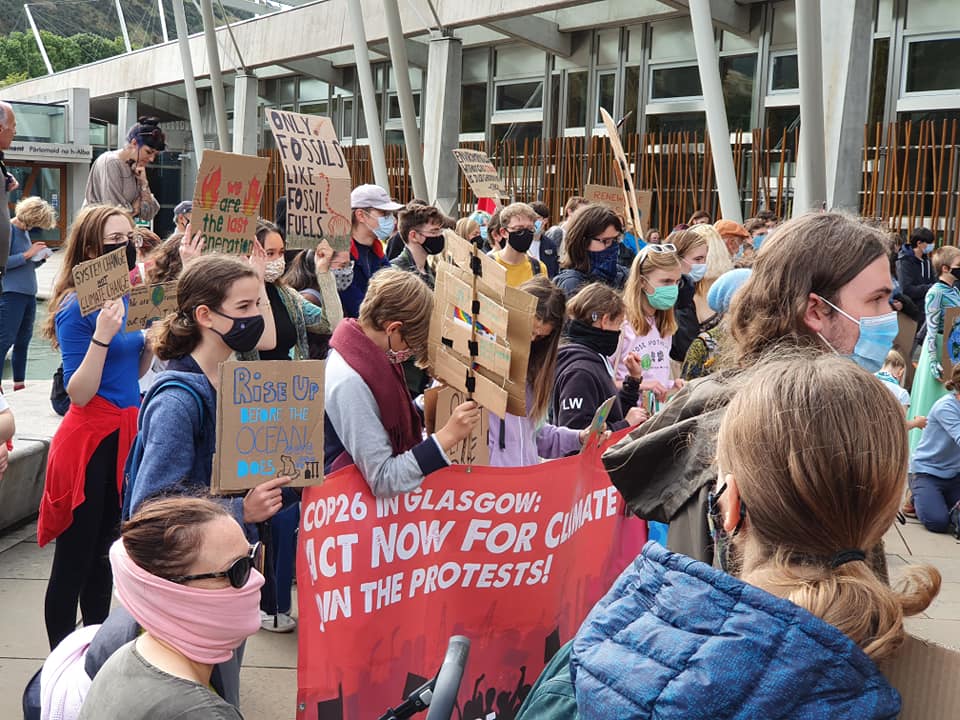
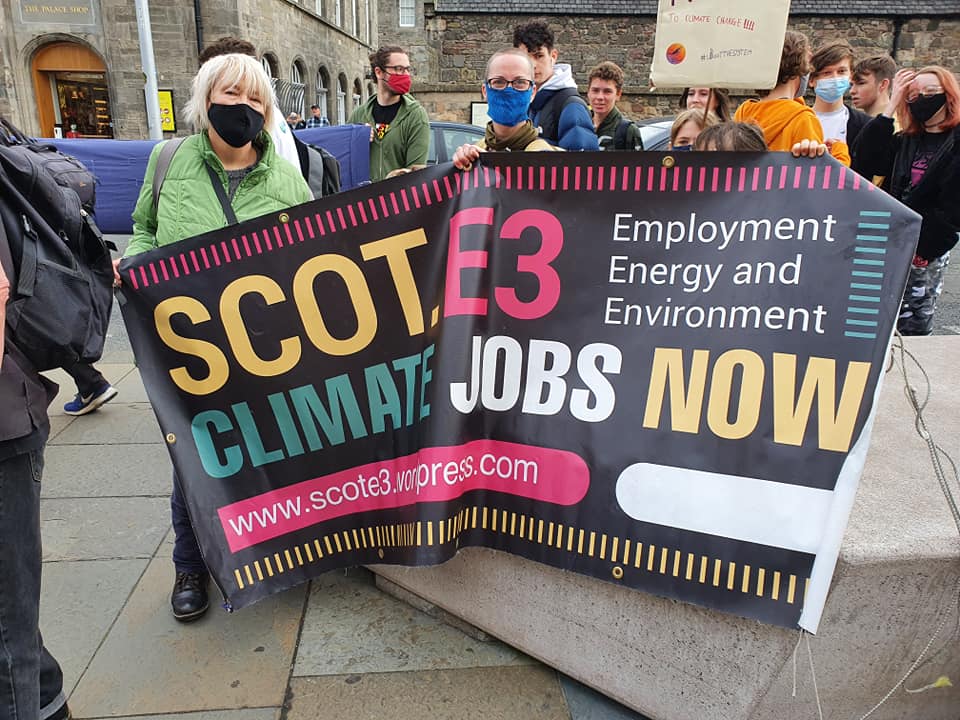
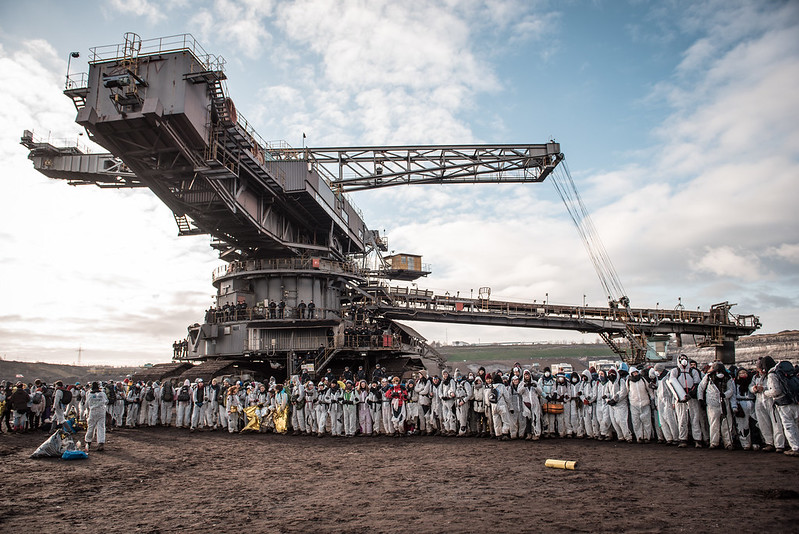



 Employment, Energy and Environment
