
On of the issues that came up in discussion at the recent Scot.E3 conference was ‘Energy from Waste’. There is large-scale investment in this technology taking place across the UK. We agreed to produce a briefing on the topic. What follows is the text of the first draft of the briefing. We are also developing further resources that will be added to the Resources page on this site. We’d welcome comments on the text and ideas for useful resources that we could link to.
There are a large number of Energy from Waste (EFW) projects planned across the UK. By the end of 2017 there were nearly 120 EFW proposals at various planning stages. Sixteen of these are in Scotland. In this briefing we take a critical look at Energy from Waste and ask whether it has a place in a strategy for a zero carbon Scotland.
Energy from Waste Projects
At first sight, the term ‘Energy from Waste’ appears to be all things green. It suggests a new and rational way of ‘treating’ the ever-growing mountains of waste that are an inevitable by-product of our throwaway society. It invites the idea of a ‘green energy’ that has been derived from what would otherwise be a possibly harmful and long-term environmental problem. When the alternatives proposed are either a long-term toxic and smelly and unsightly landfill problem or a health-threatening incineration route, then EFW appears to be a sensible choice.
Behind the EFW hype, which many UK local authorities have accepted, there is a fog of confusion regarding the most optimal waste management solutions; whether they be recycling or minimising the production of waste at source – both options are ruled out by market driven/low cost and value-for-money economics.
Landfill
Since 1945 the volume of disposable waste per household in the UK has multiplied threefold. Over the years, the local authorities have traditionally chosen landfill disposal as the preferred waste ‘treatment’ route. However, landfill, demands considerable land acreage and depth and entails significant public health risks as well as potentially long-term hazards for the environment. Aside from smell and vermin nuisance, landfill sites- even the best managed ones- constitute over time- a high risk of biological and toxin leaching into surface soils and ground-waters. Methane from decomposition also adds to greenhouse gas emissions.
For all of these reasons, waste management authorities have either been incentivised away from landfill by grants for recycling- or more often – ‘disincentivised’ in the way of increasingly punitive landfill taxes. First introduced in the 1970’s, landfill taxes have been subsequently reinforced by EU directive-and as alternative waste ‘treatment’ technologies have fallen in capital cost, so landfill taxes have risen.

Landfill tax per tonne
2010 £63.00
2018 £88.95
2019-20 £94.15
Tax policies make EFW-type waste treatment strategies appear attractive- particularly because in exchange for a penalty for handling waste, there is an income from generating electricity.
EFW technologies
There are a number of EFW technologies on offer but all share the same objective of converting solid (or in some cases, liquid/sludge) waste into energy for the production of electricity.
Typically, an EFW plant is based on an incinerator chamber into which is fed solid waste. The upper walls of the chamber comprise water-filled tubes in which super-heated steam is produced for a steam turbine that in turn produces electricity.
Steam is also captured from the waste feed system. If the plant is fitted with what is called a ‘back-pressure’ steam turbine, then high-pressure hot water can be distributed to local industrial and residential heating networks in what is called a Combined Heat and Power (CHP) system.
However, as such plant is typically fed unsorted, or semi-sorted waste with a low calorific value, the combustion process will be ‘boosted’ with an additional combustion element in the form of natural gas or diesel oil. Less typical EFW technologies with little application to date, are the various gasification processed that involve the digestion of biological waste- usually food or agricultural wastes which are then converted into a ‘bio-gas’ which via a gas turbine is converted into a higher electricity output. In some processes, the waste is heat-treated anaerobically – i.e. in low oxygen conditions- (pyrolysis) to produce a synthetic ‘natural’ gas.
All EFW systems discharge exhaust gases. The principal emission is carbon dioxide but there are also emissions of nitrogen dioxide. Quenching water can contain uncombusted toxins and solid wastes in the form of light ash or clinker have to be disposed of safely.
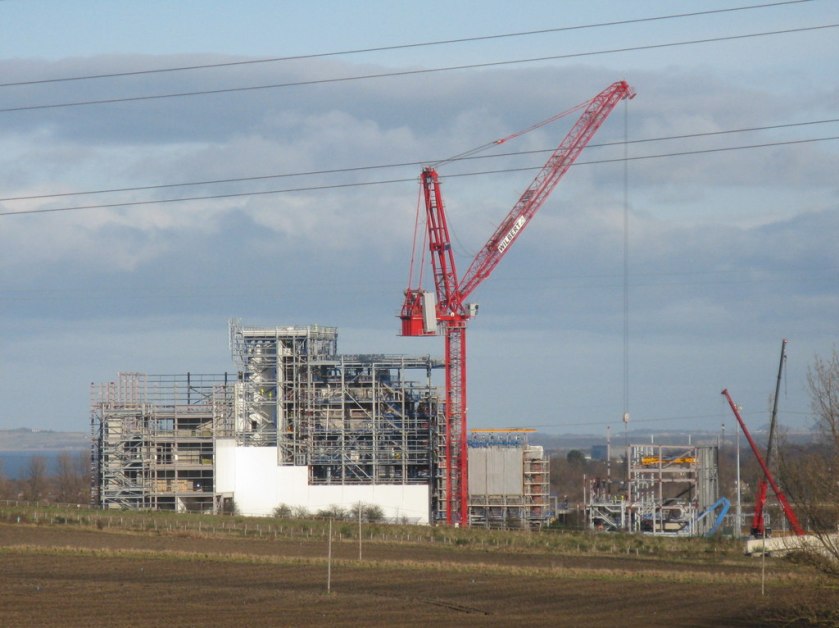
Image M J Richardson, CC BY-SA 2.0 https://www.geograph.org.uk/photo/5668478
Renewable energy?
EFW systems add greenhouse gases to the atmosphere through the process itself and also through large-scale transport of waste to the incinerators (mostly by road). They are a response to the perceived problem of landfill rather than tackling systems that produce unrecyclable waste. To operate efficiently EFW plants require a continuing supply of waste at or around current levels. Scotland produces around 1.6 million tonnes of combustible municipal waste per year, if current plans come to fruition this means and awful lot of capacity chasing a very finite amount of waste. Local authorities could be tied in to contracts to supply waste for the next thirty or forty years. This could pose a real threat to the commitment to recycle plastics and other recoverable materials out of the waste treatment stream. The Scottish Environmental Protection Agency notes that EFW is not a renewable energy source but claims that because it can be substituted for fossil fuel electricity production it forms an important part of the Scottish Strategy for sustainable energy!
Alternative Strategy needed
Energy from Waste is not green and not sustainable. It undermines attempts to reuse and recycle and it has a significant carbon footprint through transport of waste to centralised sites and through the greenhouse emissions from the burning of waste.
Investment in Energy from waste should be reallocated to genuinely sustainable technologies aimed at cutting greenhouse gas emissions, which also provide opportunities for jobs in construction and better opportunities for long-term employment.
Further reading
For further information on Energy from Waste go to www.scote3.wordpress.com and click on the Resources tab in the menu. This briefing is one in a series produced by Scot.E3.

 Employment, Energy and Environment