Understanding Climate Change

Myles Allen has made an important contribution to our understanding of  role of human activity on the global climate.  He was interviewed on Radio 4’s ‘The Life Scientific’ last week.  Well worth listening to the podcast on BBC Sounds.

https://www.bbc.co.uk/sounds/play/m000fgcn

myles allen

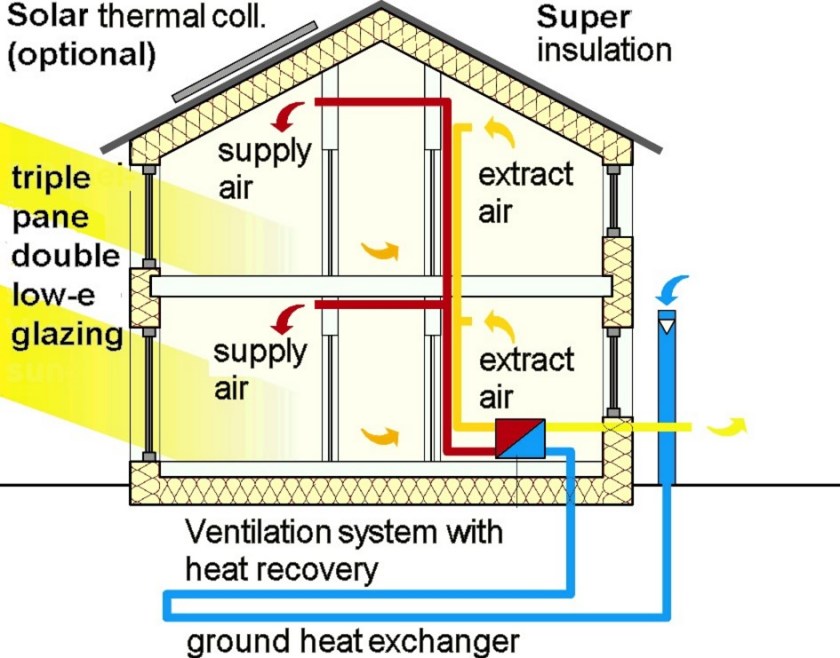
Energy efficient housing

The announcement by Paul Wheelhouse that the Scottish government will work on new regulations to ensure that new homes use renewable or low carbon energy sources for heating is a small but welcome step in the right direction.  However, the timescale for action is disappointingly unambitious; the new measures are not planned to be implemented until 2024.  Setting a much shorter deadline would send a message to private sector builders and local authorities that ‘climate emergency’ is exactly what it says. In housing, as elsewhere, action needs to be take place on the shortest time lines possible.

Let’s up the pressure for a mass public programme of retrofitting existing houses to be energy efficient.  This is a necessary step and in addition the climate jobs and the improvements in living conditions that it would generate would have a massive impact on people’s attitude to the climate emergency and what needs to be done.  It would be just transition in practice.

Passivhaus_section_en

Passive House, Image CC BY SA 3.0

Disaster Environmentalism

The People and Nature blog has just published three really thought proving articles.

The first ‘Disaster environmentalism looking the future in the face’ takes a critical look at recent writing by Rupert Read, Jem Bendell and others that argues that civilisational collapse as a result of climate change is inevitable and for approaches to dealing with collapse that require ‘deep adaptation’.

The second ‘Disaster environmentalism: roads to a post-growth economy’ is a contribution to the debate on Degrowth.   It argues that ‘“Economic growth”, as manifested by global capitalism, is completely unsustainable. “Green growth”, or “socialist growth”, are no substitutes. Our challenge to the economic system must open the way for a society based on human happiness and fulfillment, values completely at odds with – and distorted and defaced by – the rich-country consumerist ideology that helps to justify ever-expanding material production’.

The final post ‘Disaster environmentalism: what to do’ explores the political implications of the positions outlined in the first two posts and takes a sharp look at the politics and practice of social change.

Taken together the three posts are an important contribution to debate in the climate movement and recommended reading for climate activists.

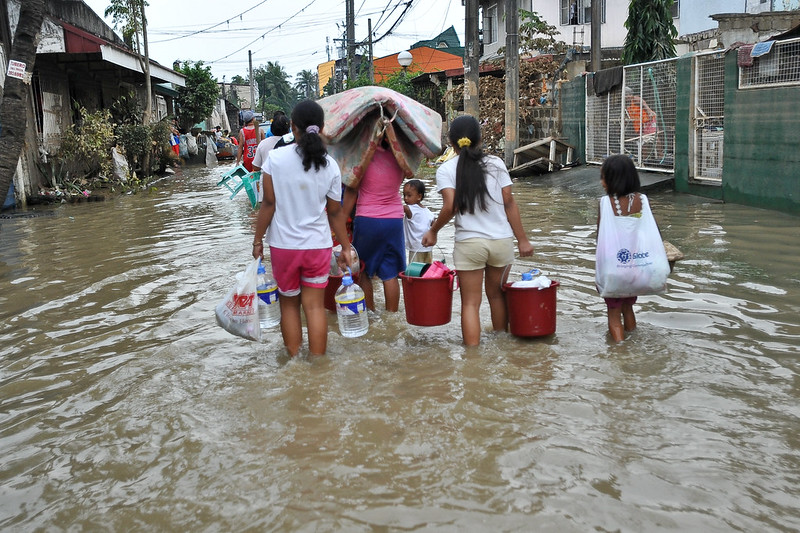
Typhoon Ondoy Aftermath

Typhoon Ondoy Aftermath CC BY-NC-ND 2.0

COP25, social movements and climate justice

Latin American social movements have been organising in opposition to COP 25 from well before the upsurge of popular protest in Chile and the transfer of the UN Climate talks to Madrid. The ‘Regional Gathering: Climate crisis, energy transition and mining extractivism in Latin America’ was held from September 26 to 28 in Santiago, Chile. We reproduce the declaration issued by the gathering:

Declaration

Faced with the undeniable climate crisis and the false solutions proposed by multilateral spaces that have been co-opted by the transnational business sector and supported by governments, the meeting was organised by the Latin American Observatory of Environmental Conflicts (OLCA), the Observatory of Mining Conflicts of Latin America (OCMAL) together with War on Want and Mining Watch Canada.
We consider:
That national and transnational companies and governments, mainly of the industrialised North, are those truly responsible for environmental breakdown due to their extractive activities in search of capitalist accumulation and the promotion of consumerism.
That the current discourse around the climate crisis places the blame on individual responsibility, thereby distracting the attention from those most responsible.
That the peoples, communities and organisations that resist these extractive activities – in defence of life, water and territories – are stigmatised, repressed, criminalised and murdered.
That companies and extractivist governments are the ones who commit true criminal acts against all forms of life, violating Human Rights and the Rights of Nature.
That mining extractivism in all its phases causes ecocide and ethnocide in the different territories where it operates.
That hidden behind the discourse of the ‘energy transition’ is a program of economic growth for the Global North which threatens to exponentially increase sacrifice zones under the auspices of guaranteeing the supply of minerals for so-called ‘green’ technologies. This will come at the cost of the exploitation of our territories and communities, all while intensifying the ecological crisis.
That the recent panic surrounding the climate crisis in the Global North can only ever be understood in the context of the struggles present in our urban and rural communities of the Global South, who have been resisting the intersecting social and ecological crises since the inception of colonialism. This panic cannot impose false solutions or reproduce extractivism.
That the climate crisis, as part of an ecological crisis, is a condition of the capitalist world development model.
We denounce:
Any attempt by mining companies to benefit from the climate crisis using deceptive initiatives such as: “inclusive tailings”, and the ‘adoption’ of environmental liabilities, Responsible Mining, Green Mining, Sustainable Mining, Ecological Mining, Clean Mining, Climate Smart Mining, Future Smart Mining, offsetting mechanisms for social and environmental damages, Green Economy and any other concept that seeks to wash its image or perpetuate impunity.
The actions of governments and corporations that dismember, divide, privatise, auction-off and commercialise nature and our territories to turn them into resources, merchandise or environmental services.
Visions of a transition which reproduce extractivist capitalism, including those focused on the nationalisation of minerals and oil and do not guarantee structural changes.
Any appropriation of local knowledge, expertise and wisdom by mining companies and governments to encourage extractive activities.
That extractivist companies, in addition to exploiting the environment, also engage in widespread corruption, eliminating trust in public institutions and the functioning of the judicial system.
That to date, the COPs have failed to provide real solutions to address climate injustice and inequality caused by predatory extractivism. Instead they have, under the pressure of Northern countries, made decisions in the interests of the economic model which is responsible for the ecological and climate crisis.
We recognise:
That the strength to face this crisis lies with young people, women, communities and organisations, movements and territories.
That our anti-capitalist struggle is also a decolonial, anti-patriarchal and anti-racist struggle.
That the true knowledge-keepers of territories are those who have historically inhabited them.
That nature is a subject of rights and recognition of this is a global necessity.
The self-determination of peoples to resist and say “no” to the invasion of mining companies in their territories.
We will fight
So that ecological justice emerges from the territories where the processes to protect life, water, ecosystems and Mother Earth are increasingly threatened and impacted by predatory extractivist capitalism.
To strengthen and respect the autonomy of communities and their organisations to define solutions in the framework of justice and equity based on nature, the planet and humanity.
For the respect of the Indigenous peoples, peasants and other communities, who are the guardians of their territories.
To cease the auctioning of mining and oil concessions in our territories.
Alongside frontline resistance to mega-mining and processes which seek mining-bans.
To ensure that mining companies which have benefited from the looting of nature are fully liable for mine-closure processes, and that integral repair of the territory arises from collective and participatory processes led by affected communities.
So that environmental catastrophes, pollution, murders and any other violation in territories affected by mining companies are recognised for what they are: crimes. It is urgent to develop binding policies and mechanisms to confront the generalised impunity enjoyed by companies, their owners, their executives and their financial centres.
To strengthen organisations and movements that fight in defence of the territories.
To develop regional solidarity and agreements to ensure food, energy and economic sovereignty.
To defend water in all its states as a source of life.
To sow, celebrate and strengthen territories free of mining.

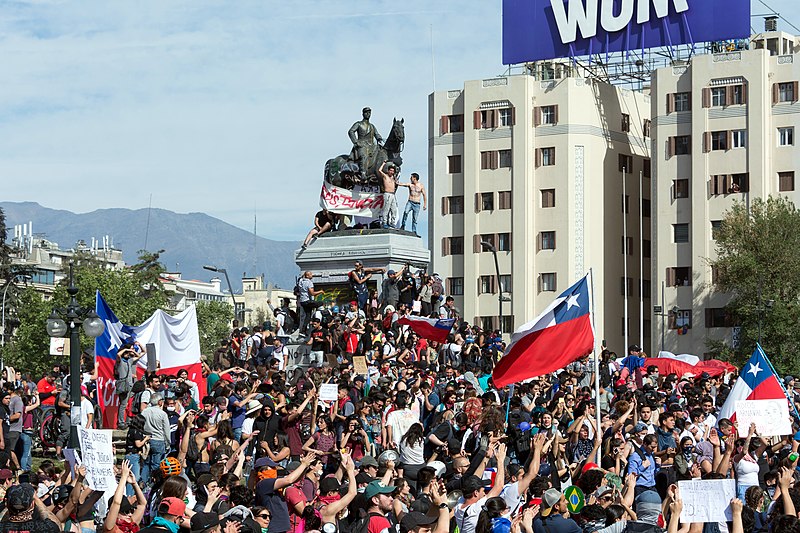
800px-Protestas_en_Chile_20191022_07

Signatories:
Asamblea por la Defensa del Elki (Chile/Elqui)
Acción Ecológica (Ecuador/Quito)
Asamblea por el Agua del Guasco Alto (Chile/Huasco)
Belén dice NO a la minería (Chile/Arica)
CENSAT Agua Viva (Colombia/Bogotá)
Centro de Documentación e Información Bolivia (CEDIB) (Bolivia/Cochabamba)
Centro de Investigación sobre Inversión y Comercio (CEICOM) (El Salvador/ San Salvador)
Codemaa (Chile/Atacama)
Comunidad Indígena Diaguita Patay Co (Chile/Huasco)
Coordinadora Ambiental Valles en Movimiento Limarí – Monte Patria (Chile/Limarí–Monte Patria)
Coordinadora Penco-Lirquén (Chile/Penco-Lirquén)
Coordinadora por la Defensa del Río Loa y la Madre Tierra (Chile/Calama)
London Mining Network (Reino Unido/Londres)
Movimiento por las Sierras y Aguas de Minas Gerais (Brasil/ Minas Gerais)
Mesa Comunal de Turismo Monte Patria y Limarí (Chile/Monte Patria – Limarí)
Mining Watch Canada (Canadá/Ottawa)
Observatorio de Conflictos Mineros en América Latina (OCMAL) (Chile/Santiago)
Observatorio Conflictos Mineros de Zacatecas (OCMZAC) (México/Zacatecas)
Observatorio de Ecología Política de Venezuela (OEPV) (Venezuela/Caracas)
Observatorio Latinoamericano de Conflictos Ambientales (OLCA) (Chile/Santiago)
Observatorio Plurinacional de Salares Andinos (OPSA) (Chile/Atacama)
Putaendo Resiste (Chile/Putaendo)
Red de Afectados por la Vale (Brasil/Minas Gerais, Brumadinho)
Red de Mujeres El Loa (Chile/Calama)
War on Want (Reino Unido/Londres)


Solidarity with Chile! System change not climate change

The COP 25 talks began in Madrid on Monday this week.  Originally scheduled for Chile the conference was transferred to Spain as millions took to the streets in Chile to protest against the high cost of living, privatisation and inequality.

These United Nations meetings (COP = conference of the parties) have taken place annually since the first summit in 1995.  On a number of occasions the COP meetings have set specific targets for reducing green house gas emissions.  None of these targets have been met; on the contrary there has been a huge rise.  The two most common greenhouse gases are carbon dioxide and methane.  In the 25 years since the Berlin summit atmospheric carbon dioxide levels have risen by 67 parts per million by volume (ppmv).  This is a bigger increase than took place in the previous 200 years.  Methane levels have tripled since the Berlin summit.

There are two solidarity events taking place this Friday evening (6th December):

In Edinburgh a human chain in Princes Street – assembling at the Usher Hall in Lothian Road at 5.30pm.  More details on Facebook 

and Glasgow 17:30-18:30  Buchanan Street Steps, Facebook for more details

31842085623_dfd424712b_c

Image by Pete Cannell, Flickr COP 22 Paris, 2015

Climate Strike – Friday 29th November

Friday 29th November is the date of the next round of Youth Climate Strikes. There are demonstrations in towns and cities throughout Scotland – you can find the details on the SYCS website and share the events on social media from their Facebook page. The September strikes saw the development of workplace solidarity with a range of actions from lunchtime meetings to walkouts. November 29th is an opportunity to build on this. UCU members working in a number of Scottish universities will be on strike over pay and pensions on the 29th and the UCU is encouraging their members to go from their picket lines to join the climate protests. This is a great opportunity for workers in other unions to show practical solidarity with the UCU and the school students.

Check out our previous post on arguing for solidarity action in the workplace.

48765693228_bc6737968b_c


Borders and the Climate Emergency

The climate emergency is forcing ever-greater numbers of people to migrate, Ida Picard analyses the function that borders play in extinction capitalism and argues that we must be uncompromising in calling for all borders to go.  This post was first published at http://www.rs21.org.uk 

There will be an opportunity to discuss some of the issues raised in this article at the Scot.E3 conference this weekend in Edinburgh. Find out more about the conference here.  Book for the conference on Eventbrite and email triple.e.scot@gmail.com if you want to book one or more crèche places.

It is extremely welcome that climate change has moved so far up the agenda and is now being discussed outside of the circles traditionally concerned with it. However, climate change and its crises need to be seen in connection with other elements of capitalist crisis, such as imperialism, austerity and the border regime, to name just a few.

barb-30178_1280

Capitalism is crisis

In order to bring these other aspects into focus it is useful to begin by examining on a general level certain aspects of capitalist production. The capitalist mode of production is dependent on continuously escalating the extraction of natural resources, thereby necessitating the non-stop rise of greenhouse gas emissions, pollution and environmental degradation.

Realistically, without ending capitalism, we have no chance of halting or reversing the complete breakdown of the world’s ecosystems. Within our current economic order major petroleum companies are able to manipulate and to a large extent control state policies and act as stakeholders in international agreements, avoiding liability for damage done to people living near pipelines and other oil facilities.

All the big petroleum companies have entire departments dedicated to lobbying states. In addition, states in capitalism are locked in to the pursuit of the maximisation of national economic growth. And so, within this one example, we can see how the reciprocal dependence between fossil capital and the state locks in a logic of climate breakdown.

As Brian Parkin has put it:

It is both an irony and a paradox that [within capitalism] we have developed the scientific means of understanding both the causes and possible means of reducing climate change, whilst being locked into a mode of production for which the appetite for petroleum remains insatiable. 

Meanwhile, the numbers of people displaced across the world over continues to grow. The UN is predicting 200 million climate refugees by 2050, or as they call it ‘persons displaced in the context of disasters and climate change’.

However, when we talk about climate refugees we should not think just about people having to relocate due to floods, droughts or other extreme climate phenomena. We must go further and include among climate refugees people moving due to conflict over resources, food insecurity, imperialist wars and economic migration in the wake of whole areas of the world being rapidly made uninhabitable.

It is becoming increasingly evident that more and more people will be forced to flee circumstances which make life unsustainable, whilst there exists a relationship between capital and the state system which guarantees the increasingly intense exploitation of human labour power and degradation of the world’s resources.

Extractivism and border regimes

In this context – the role of the state as a ‘container’ of the crisis facing us starts to become clear. While the pressure builds and breakdown looms, Western states including Britain are fortifying their borders, as border controls creep ever deeper into all strata of our societies.

Borders perform a crucial function: border regimes ensure that the crisis appears ‘contained’ through the regimentation and control of citizenship and the movement of people.

At the same time, borders represent an attempt to maintain the global division of labour through creating areas of the world where social reproduction is significantly cheaper, that is, where the wages and the maintenance costs of the labour force are lower, and where workers are unable to travel between areas of the world to seek better pay and conditions.

This division of labour structures the world in such a way that entire sections of the economy are particularly specialised. Extractive industries, such as oil drilling or coal mining, destroy the capacity to produce in any other way, by polluting the soil, destroying the conditions of production, or simply driving out competing forms of capital. These same regions are also dependent on certain markets, which make up the ‘other side’ of this division of labour.

For example, highly intensive mineral mining in Africa depends on and supports global supply chains for phones made in China and then sold in Europe. This means that entire areas of the world have become less and less able to provide for the varied needs of populations who live there.

Borders reinforce this division by regulating the flow of commodities between these different poles and tying people to particular areas of the world. We also see that extractive industries often provide the majority of the funding for those same militias who police the borders and control the supplies of resources, in part because they tend to deliver higher rates of profit than other forms of production, and are oriented around simple labour processes which are easy to control and securitise.

In Sudan, for instance, the Janjaweed militia get most of their revenue from the Sudanese oil fields, but also from the European Union, which pays them to violently enforce its borders and stop desperate people trying to reach crossing points into Europe.

This interdependence of extractive industry, borders and the repressive state machine is highly significant. For decades, people have been fleeing the wars in the Middle East waged over one of the world’s petroleum hubs, or moving away from areas of the world made uninhabitable or unable to support its population by extractive capital.

Internal borders

The border also creates and reinforces a division of labour within Britain. The border regime determines which people have the ‘right’ to work, or to claim benefits, or even to reside in the country. In reality, under capitalism, no-one can live without a wage, and so many migrants are forced to accept illegal contracts paying less than minimum wage, or are frightened into not demanding better pay and conditions by the threat of deportation and criminalisation.

However, even sections of the left still fail to show the basic political solidarity needed against the border and against these racist divisions. The border is, in many ways, a microcosm of the global division of labour, which structures the capitalist mode of production that is destroying the planet. The border regime even mirrors many of the practices of colonial control, previously tested on colonised peoples, such as surveillance methods, violent repression, detention without trial and accusations of subversion.

The solidification of the border regimes in the UK, Europe and the US cannot be analysed without recognising that the borders imposed on the world through colonialism and imperialism are arbitrary and unstable, and that the global ravages of capitalism – in the form of imperialism – is creating conditions from which people will necessarily need to move.

Fighting the state on the territory of our borders, calling for an end to borders altogether, has long been seen as an extremely radical demand – maybe more polemical than real. But with the climate breakdown this is no longer so.

‘Overpopulation’

Often, however – conversations about climate change centre not on the ravages of capital, but instead the supposed ravages of people. This can be demonstrated with reference to two different, but related, examples. The first is ‘overpopulation’ – a bogeyman for the climate crisis which is shared across the political spectrum, from mass-murdering fascists to David Attenborough.

This idea that it is ‘people’ exhausting the world’s resources, and that these resources can never grow at the same rate as the human population, is not a new argument. Thomas Malthus (1766-1834) called for population control for poor people, whose ‘overpopulation’, he claimed, led to a host of societal ills.

457px-Thomas_Malthus

Wikipedia

The same arguments are used today, primarily against ‘populations’ in the Global South: climate change is caused by ‘too many people’ and in particular, the ‘too many people’ who live outside the West. Marx himself addressed this argument several times – particularly as it relates to Ireland. In volume one of Capital (1867) he wrote:

As appetite grows with eating, English rentiers and capitalists will continue to discover that Ireland with three and a half million people, still continues to be miserable, miserable because she is overpopulated. Therefore Ireland’s depopulation must go still further, in order that she may fulfil her true destiny: to be a sheep walk and cattle pasture for English capitalists!

Ireland was not overpopulated – neither is the global south overpopulated today. Capital is, however, over-extracting and overproducing. In the same way that English capitalists restructured the Irish economy to gear it towards the wool trade and meat production, large parts of the world are made uninhabitable through organising local economies for the production of commodities for export on the world market rather than for the reproduction of the population.

Put more specifically, areas of the world are only overpopulated insofar as their whole ecosystems become organised to produce certain commodities for international markets.

These global markets are what cause people to have to move. When capital is ‘booming’ there is huge demand for labour, when it is bust those populations are no longer required. This explains, in part, the change in attitude in Western Europe towards migration in the last 50 years. In the post-war period European markets demanded more labourers. European states were happy to bring labourers in from the colonies, at worse pay and in poorer conditions than the native population.

Of course, now, in the context of climate breakdown and imperialist warfare, the situation is different. In the same way the Malthusians argued that it is people draining the natural resources of the world, people in the West are describing those who migrate here as draining the resources of our nation states or national economies. The broader point here is that we cannot talk in abstract terms about overpopulation: economic conditions always underpin state responses to migration.

Voices within the environmental movement use these arguments too. For example, Rupert Read, who recently went on Question Time as a spokesperson for Extinction Rebellion has written that ‘mass migration’ reduces social cohesion. He argues that it makes the development of ‘the increasingly collaborative, progressive economy we need to become greener’ impossible, and he has argued against moving people from areas where they would have a low environmental footprint to high impact areas like the West.

This is thinly veiled racism, the belief that some people simply belong in poorer and more exploited parts of the world. It is also part of what fuels a growing number of eco-fascists. It relies on an essentialist, racist view of environmentalism, which views environmental politics as being about retreating back to our ‘original’ homelands and living separated by race.

Climate justice is migrant justice

While many on the left have been unacceptably slow at accepting that responding to climate change must be a key part of our internationalism and international solidarity as socialists and anti-capitalists, there are some very positive examples too.

A few weeks ago, an environmental group named Bristol Rising Tide occupied part of the Home Office’s depot in Portishead with Reclaim the Power, stopping Immigration Enforcement vans for leaving. Similarly, the Stansted 15 action, where activists blocked a deportation plane from taking off, was organised in large part by individuals who had learnt the techniques of airport protest from (and within) the climate movement. During the school strike in September, migrant solidarity groups including Lesbians and Gays Support the Migrants organised a bloc, using the slogan ‘climate justice is migrant justice’.

While, for now, we are not feeling the sharpest edge of climate change in this country and are in some ways separated from those who are, those of us who consider ourselves to be anti-capitalist must recognise that climate change, as with capitalism itself, binds together each place, each person, and each contradiction.

This worldwide ecological breakdown – and the ravages of imperialism, of transnational petro-capital, of increasingly militarised border regimes across the world – cannot be addressed by disorganised legalistic proposals. The Paris Accord, the Supreme Court, and even the Labour Party will not save us from climate breakdown, because they are embedded in the logic of the same system that drives exploitation and imperialism. For the same reason they will certainly not save those forced to migrate through imperialist wars, breakdown of ecological systems or deepening poverty.

This is not an argument for abandoning our responsibility for fighting our own states – we must struggle for a breaking down of the border regime.

But it should come as no surprise to socialists and communists that the world is facing a breaking point: we have always known that capitalism leads to constant crisis, misery and war.

For so many across the world, the catastrophe is already here, it has already been going on for much longer than climate change has been on the agenda in the Western world. Climate change is simply demonstrating that it is completely untenable to continue to organise the world this way.


Towards Net Zero?

On the 7th February 2019 Edinburgh City Council resolved to declare a climate emergency. On the 25th October Edinburgh City Council’s Policy and Sustainability met to consider a draft report from the Place-Based Climate Action Network (P-CAN) research project on Achieving Net Zero in the City of Edinburgh. The report will form the basis for discussion of an action plan at the February 2020 meeting of the committee.

In this post Pete Cannell gives a personal response to the report. We hope to publish further contributions on this important topic and we welcome comments, responses to the questions he poses and further contributions.

It’s important and encouraging that, in response to pressure from the School Student strikers, XR and the wider movement, Edinburgh City Council is set to discus actions to reduce carbon emissions. This post takes a critical look at the report that forms the basis for the council’s discussions.

‘Achieving Net Zero in the City of Edinburgh’ is a technical report that summarises research undertaken by the Edinburgh Centre for Carbon Innovation (ECCI), drawing on expertise from the University of Edinburgh and the University of Leeds. Net zero means that carbon emissions from activity in Edinburgh are balanced by an equal amount of carbon being removed from the atmosphere. The net zero target applies to emissions from within the local authority boundaries. Critically, however, some emissions, most notably those from aviation are not included.

The cost-benefit analysis used by the research team is based on the same methodology that was used in the Stern Review on the Economics of Climate Change that was published in 2006.

The report notes that Edinburgh’s baseline emissions have declined by 40.3% since 2001. This reduction is almost entirely a result of changes in the way that Scotland’s electricity is generated with coal fired power stations closing down and replacement by renewables – primarily wind. Renewables are now such an important part of the grid that there is little scope for further reduction from this source.

The report models three scenarios for how much energy use and emissions could be reduced by 2030:

1. A 56% reduction in carbon emissions as a result of ‘cost effective’ investments amounting to £3.976 billion over the next 11 years. The savings resulting from these investments would repay the investment in 7.5 years and continue to generate savings thereafter.

2. A 62% reduction as a result of ‘cost neutral’ investments of £7.492 billion over the 11 years to 2030 that would be paid back in savings over 12.5 years.

3. A 67% reduction exploiting the full technical potential of the different mitigation measures proposed. This is estimated to require investment of at least £8.135 billion with the cost neutral pay back extending to 16.1 years.

The figures aggregate emission reduction strategies across multiple sectors – commercial, transport, domestic and industrial and the report provides some detailed proposals for the kinds of investment that needs to be made in each of these.

The report is honest about the scale of the technical and investment challenge but confines consideration of politics and strategy to the observation that:

Whilst the opportunities outlined here are all feasible and ‘win-wins’ for stakeholder groups across the city, they will require near-immediate and unequivocal support from institutions and the public.

Will the City Council’s action plan be framed in a way that faces up to the urgency of the crisis and wins unequivocal support? And will it address the gap between the reductions proposed in the report and net zero? Climate campaigners have a critical role to play here. We have a responsibility to build a movement embedded in working class communities across the city that is active, restless, rebellious and probes, questions and criticizes at every stage and every step. And we need to develop a collective understanding of how actions to reduce emissions and the unequivocal support of the mass of the population are achieved and built through democratic engagement and a focus on social justice.

There are a host of questions that we need to address. In the hope of starting a debate I’ll mention just a few!

The activities of the city council are responsible for only a small percentage of Edinburgh’s emissions. So how does an effective action plan ensure that the investment into emissions reductions envisaged by ‘Towards Net Zero’ take place across all areas of energy consumption? How does a council action plan leverage action across the whole city? Clearly there’s a role for regulation – for example imposing building regulations that mandate carbon neutral new builds. There’s also a case for investment in large-scale public initiatives – for example building insulation.

‘Towards Net Zero’ focuses on a cost benefit approach together with the implementation of existing low carbon technologies – and holds out the promise that in future emerging technologies will bridge the gap to net zero. Is this an appropriate methodology in the face of an existential crisis? Can it actually work? It’s not business as usual but it suggests that conventional methods together with technology can achieve net zero. So is net zero achievable without system change? And if it’s not, what does system change look like?

Treating carbon reduction as an issue about investment and technology may also hide real issues of policy. So for example business and tourism planning in Edinburgh have both had huge impact on how and where we live, the distances we travel to work and how we travel. As Edinburgh’s workforce is pushed further outside the city boundaries to find affordable accommodation the carbon footprint of our daily working lives has grown. But the ‘Towards Net Zero’ effectively excludes these issues, as it does the massive rise in aviation emissions, which are so strongly linked to current planning priorities. So while we can commend the City Council’s steps towards an action plan there is a powerful case for integrated planning across the region and for new policy frameworks for housing, health, work, transport and tourism that centre on zero carbon and social justice.

2018-07-04 12.45.17

Image: Pete Cannell, CC0

There is an opportunity to discuss the issues raised in this post at the  Scot.E3 conference that takes place on 16th November.  Book for the conference on Eventbrite and email triple.e.scot@gmail.com if you want to book one or more crèche places.

New Briefing on BECCS

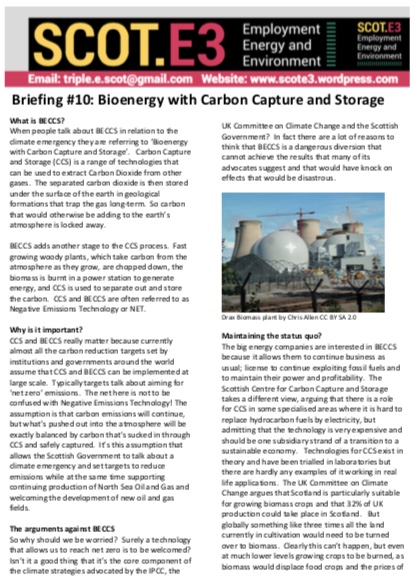
The latest ScotE3 takes a critical look at BECCS – Bioenergy with Carbon Capture and Storage.  Like all the ScotE3 briefings it is designed as a short, and hopefully clear, introduction to the topic.  We welcome feedback and ideas for improvement.

You can read the text of the briefing below and download the full pdf from the resources page.

briefing 10 graphic for blog

What is BECCS?

When people talk about BECCS in relation to the climate emergency they are referring to ‘Bioenergy with Carbon Capture and Storage’.   Carbon Capture and Storage (CCS) is a range of technologies that can be used to extract Carbon Dioxide from other gases.  The separated carbon dioxide is then stored under the surface of the earth in geological formations that trap the gas long-term.  So carbon that would otherwise be adding to the earth’s atmosphere is locked away.

BECCS adds another stage to the CCS process.  Fast growing woody plants, which take carbon from the atmosphere as they grow, are chopped down, the biomass is burnt in a power station to generate energy, and CCS is used to separate out and store the carbon.  CCS and BECCS are often referred to as Negative Emissions Technology or NET.

Why is it important?

CCS and BECCS really matter because currently almost all the carbon reduction targets set by institutions and governments around the world assume that CCS and BECCS can be implemented at large scale.  Typically targets talk about aiming for ‘net zero’ emissions.  The net here is not to be confused with Negative Emissions Technology! The assumption is that carbon emissions will continue, but what’s pushed out into the atmosphere will be exactly balanced by carbon that’s sucked in through CCS and safely captured.  It’s this assumption that allows the Scottish Government to talk about a climate emergency and set targets to reduce emissions while at the same time supporting continuing production of North Sea Oil and Gas and welcoming the development of new oil and gas fields.

The arguments against BECCS

So why should we be worried?  Surely a technology that allows us to reach net zero is to be welcomed?  Isn’t it a good thing that it’s the core component of the climate strategies advocated by the IPCC, the UK Committee on Climate Change and the Scottish Government?  In fact there are a lot of reasons to think that BECCS is a dangerous diversion that cannot achieve the results that many of its advocates suggest and that would have knock on effects that would be disastrous.

Maintaining the status quo?

The big energy companies are interested in BECCS because it allows them to continue business as usual; license to continue exploiting fossil fuels and to maintain their power and profitability.  The Scottish Centre for Carbon Capture and Storage takes a different view, arguing that there is a role for CCS in some specialised areas where it is hard to replace hydrocarbon fuels by electricity, but admitting that the technology is very expensive and should be one subsidiary strand of a transition to a sustainable economy.   Technologies for CCS exist in theory and have been trialled in laboratories but there are hardly any examples of it working in real life applications.  The UK Committee on Climate Change argues that Scotland is particularly suitable for growing biomass crops and that 32% of UK production could take place in Scotland.   But globally something like three times all the land currently in cultivation would need to be turned over to biomass.  Clearly this can’t happen, but even at much lower levels growing crops to be burned, as biomass would displace food crops and the prices of staple foods would increase forcing the poorest further into hunger and starvation.

Restoring ecosystems that capture carbon

Forests are a very important way in which carbon is removed from the atmosphere; about 25% of current emissions are taken up.  However, worldwide forests are under threat and clear cutting of forests to grow soya and other crops for meat production causes around 10% of global carbon emissions.   An end to deforestation and proactively working to re-establish natural forests could have a big impact on carbon reduction.  Trees are important but not just any trees.  When monoculture plantations replace trees – for example Palm Oil the same land area is much less efficient at absorbing carbon.  BECCS often assumes clearance of existing forest for monoculture cultivation of biomass.  And there are many other serious impacts: displacement of indigenous communities, destruction of ecosystems and of pesticides.

Separating out carbon dioxide from other gases or from the atmosphere is an energy intensive process so it’s expensive financially and in terms of our overall energy budget.   Operating at large scale might reduce the cost per ton of carbon but it would still need very large amounts of clean energy.

Scotland has a number of locations where the underground rock formations are suitable for underground storage of carbon dioxide.  Many parts of the world do not.  Proponents of CCS suggest that carbon storage could be a profitable new industry – however, long distance transport of captured gas would also require a lot of clean energy.

System change

Ultimately, however, the problem with BECCS and CCS is political.  Governments and corporations favour it as a solution because it seems to allow existing infrastructure and power relationships to be preserved.  It suggests that climate catastrophe can be averted by technical fixes.

Even if the technology works and can be introduced rapidly and at scale it seems highly unlikely that it can mitigate emissions sufficiently to avoid going well beyond a 1.5 degree rise.  However, for as long as CCS remains the main plank of mainstream strategies it diverts action and investment away from sustainable strategies that we know could work.  And it acts as a barrier to the systemic change that is required to save the planet.

All our material is published under a CC0 public domain license (unless otherwise stated.  You are welcome to share, reuse and reversion.  This briefing draws heavily on a FOE(S) and FOE(international) webinar. 


A Planet to Win

Pete Cannell reviews a new book from Verso – ‘A planet to win: why we need a green new deal’.

Scan

A Planet to Win: Why We Need a Green New Deal

Kate Aronoff, Alyssa Battistoni, Daniel Aldana Cohen and Thea Riofrancos

Verso 2019

A You Gov Blue poll of US voters in March 2019 found that 59% supported the idea of a Green New Deal.  ‘A Planet to Win – Why We Need a Green New Deal’ is a highly readable explanation of what the Green New Deal represents and the challenges that have to be overcome to implement it.  The book focuses on what needs to be done in the US over the next decade (a small quibble – some references to the UK are not entirely accurate) but it’s highly recommended for a UK audience.  Not least because the authors are absolutely clear about the necessity for system change.  They share the view expressed by Naomi Klein in the introduction that ‘The promise of the Green New Deal is that climate crisis is an opportunity to build a better world’.

The authors believe that radical change is essential and that such change ‘only happens when millions of people are organizing, striking and marching, shaping politics and the economy from below’.  They argue that the transition to a sustainable economy has to be driven by mass action, contesting power and ending social inequality.  They are also clear-eyed about the challenges that we face in building such a movement.  They situate the Green New Deal in the context of more than 40 years of neo-liberalism when living standards for many Americans have been at best stagnant and during which inequality has grown.  Moreover, they take on the issues of power in society.  Understanding that big business will be as vicious in defence of the status quo as they have been in attacking the US Labour Movement.  They argue that there are two essential tasks.  Breaking down the divide between the labour and climate movements and at the same time rebuilding the strength, vitality and combativity of the former.  Most of the book is devoted to providing arguments that will convince trade unionists of the necessity for action and more generally to win the movement to an understanding that collective action rather than individual sacrifice is what is required in the face of an existential crisis.

UK readers may be less familiar with the original New Deal.  The Great Depression had a devastating impact on the US economy with many millions thrown out of work.  The New Deal was a programme of public works, reforms and regulations that aimed to put people back to work.  It was implemented on a mass scale. “Workers hired under the Works Progress Administration constructed 651,000 miles of highway … 125,000 public buildings including 41,300 schools, and 469 airports.  They built 8,000 parks and 18,000 playgrounds and athletics fields.”  And it was popular.  The authors of ‘A Planet to Win’ understand that the New Deal was designed to save capitalism not to bury it.  However, they make use of it to illustrate how rapid action on a massive scale is possible.  The history of the New Deal also informs their emphasis on job creation and job guarantees that extend far beyond workers in the carbon based industries.  Indeed they stress that it was about social reproduction as well as production and argue that in the 21stcentury jobs in care, health and education are critical to a just transition.

Perhaps the best thing about this book is its relentless focus on the politics of climate action and the need for climate justice.  It rejects strategies that ignore the need to address social inequality and simply rely on technical fixes.  It argues that we need systemic change.  The technology exists, what’s needed is the political will to push change through in a short period of time.  Here the book is at its’ weakest.  I think this reflects a more general weakness of the socialist left.  Recognising the need for radical democracy and rebuilding collective organisation and the collective power of the working class is necessary.  The book is good on this.  Recognising that big business and the giant energy corporations have to be brought to book is also critical and again the authors are clear about this.  What’s less clearly articulated is the role of the state in relation to capital.  The US Green New Deal is radical and takes on board race and gender in a way that the original New Deal did not.  In considering options for sustainability it recognises the impact on the global of additional demand for natural resources but it as primarily a national strategy.  It has little to say on the military industrial complex.  The US military has a huge carbon footprint.  If the Pentagon were a country it would be number 55 in the world for carbon emissions.  But even more critical to a strategy for system change the giant military corporations dominate the industrial economy, exert a stranglehold on research and development and monopolise skills and knowledge essential for transition.  Just like the energy companies their hold must be broken.

Quite rightly the authors of ‘A planet to win’ are critical of those who would like to cherry pick some elements of the Green New Deal while trying to maintain the status quo. They argue that the real fantasy is that half measures, preserving business as usual, can work.  An effective strategy implies a radical Green New Deal.

Whether we like it or not the global climate crisis is coincident with a global crisis of organisation on the left.  The nature of both crises is deeply influenced by the last four decades of neo-liberalism.   The urgency of the climate crisis presents unique challenges and opportunities. So for example, in the US, at the same time as public policy is set on a path of rapidly increasing fossil fuel production, the movement for a Green New Deal is growing rapidly.  For the first time in decades ‘socialism’ is back on the agenda.  This book is a valuable contribution to the first faltering steps to build out of the marginalisation of the left.   A different kind of economy is not only necessary it is possible.

This article was first posted on http://www.rs21.org.uk