

Briefing 18 takes a critical look at ‘Sustainable Aviation Fuel’ and the Westminster government’s Jet Zero plan.
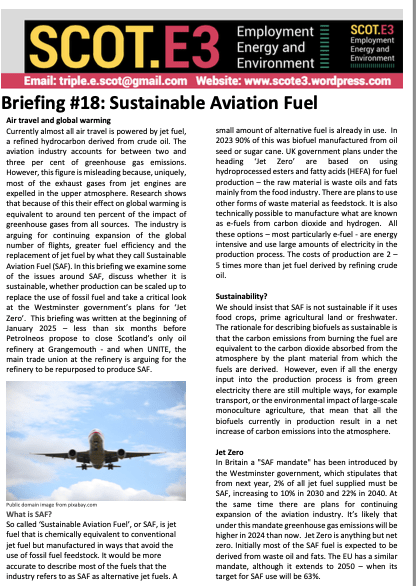

Click on the image to download the briefing
Air travel and global warming
Currently almost all air travel is powered by jet fuel, a refined hydrocarbon derived from crude oil. The aviation industry accounts for between two and three per cent of greenhouse gas emissions. However, this figure is misleading because, uniquely, most of the exhaust gases from jet engines are expelled in the upper atmosphere. Research shows that because of this their effect on global warming is equivalent to around ten percent of the impact of greenhouse gases from all sources. The industry is arguing for continuing expansion of the global number of flights, greater fuel efficiency and the replacement of jet fuel by what they call Sustainable Aviation Fuel (SAF). In this briefing we examine some of the issues around SAF, discuss whether it is sustainable, whether production can be scaled up to replace the use of fossil fuel and take a critical look at the Westminster government’s plans for ‘Jet Zero’. This briefing was written at the beginning of January 2025 – less than six months before PetroIneos propose to close Scotland’s only oil refinery at Grangemouth – and when UNITE, the main trade union at the refinery is arguing for the refinery to be repurposed to produce SAF.

What is SAF?
So called ‘Sustainable Aviation Fuel’, or SAF, is jet fuel that is chemically equivalent to conventional jet fuel but manufactured in ways that avoid the use of fossil fuel feedstock. It would be more accurate to describe most of the fuels that the industry refers to as SAF as alternative jet fuels. A small amount of alternative fuel is already in use. In 2023 90% of this was biofuel manufactured from oil seed or sugar cane. UK government plans under the heading ‘Jet Zero’ are based on using hydroprocessed esters and fatty acids (HEFA) for fuel production – the raw material is waste oils and fats mainly from the food industry. There are plans to use other forms of waste material as feedstock. It is also technically possible to manufacture what are known as e-fuels from carbon dioxide and hydrogen. All these options – most particularly e-fuel – are energy intensive and use large amounts of electricity in the production process. The costs of production are 2 – 5 times more than jet fuel derived by refining crude oil.
Sustainability?
We should insist that SAF is not sustainable if it uses food crops, prime agricultural land or freshwater. The rationale for describing biofuels as sustainable is that the carbon emissions from burning the fuel are equivalent to the carbon dioxide absorbed from the atmosphere by the plant material from which the fuels are derived. However, even if all the energy input into the production process is from green electricity there are still multiple ways, for example transport, or the environmental impact of large-scale monoculture agriculture, that mean that all the biofuels currently in production result in a net increase of carbon emissions into the atmosphere.
Jet Zero
In Britain a “SAF mandate” has been introduced by the Westminster government, which stipulates that from next year, 2% of all jet fuel supplied must be SAF, increasing to 10% in 2030 and 22% in 2040. At the same time there are plans for continuing expansion of the aviation industry. It’s likely that under this mandate greenhouse gas emissions will be higher in 2024 than now. Jet Zero is anything but net zero. Initially most of the SAF fuel is expected to be derived from waste oil and fats. The EU has a similar mandate, although it extends to 2050 – when its target for SAF use will be 63%.
Practicality/Scalability
A report published in May 2024 by the Institute for Policy Studies analysed Jet Zero, aviation industry plans and other initiatives and found that there is currently “no realistic or scalable alternative” to standard kerosene-based jet fuels. Jet Zero is not about a transition to a sustainable low carbon industry, and it’s based on fanciful assumptions. There are severe limits to its scalability due to the limited supply of used cooking oil and animal fat. British airlines will be in competition for these supplies with others around the world. For example, in the EU there is only enough supply for about 2% of current demand. It’s also in competition with the production of bio diesel for road haulage which uses the same feedstock. The scale of the gap between Jet Zero and net zero is illustrated by the fact that even with current levels of flights 50% of all agricultural land in Britain would have to be devoted to the production of biofuel to eliminate the need for fossil fuel. If crop-based biofuel is ruled out and SAF were to be produced from other forms of waste as well as cooking oils, it’s estimated that if all the useable waste in the UK was converted to SAF it would still provide less than 20% of the fuel demands from outgoing flights.
Conclusion
UNITE’s plan for the Grangemouth oil refinery suggests that there is an assured future as a biofuel hub for Britain. As we write the details of the plan are not publicly available. We can only assume that they are based on the faulty logic of the British government’s Jet Zero report. Sadly, these figures just don’t add up. There is a powerful case for a plan to support the Grangemouth workforce into a sustainable future, but Jet Zero is an illusion. SAF is not a magic bullet. Current technologies are not capable of meeting the fuel demands of the aviation industry. E-fuels are potentially scalable, but the costs are prohibitive. We will discuss what is to be done about aviation in a future briefing.
Click the link to download Briefing 18
You might also want to look at Briefing 10 – ‘Bioenergy with carbon capture and storage (BECCS)’ and Briefing 17 – Net Zero
All of the ScotE3 briefings can be downloaded from this site’s resources page.



 Employment, Energy and Environment