Scot E3 (Scotland), Campaign against Climate Change (UK), Climaximo (Portugal), Bridge to the Future (Norway) and One Million Climate Jobs (South Africa)
We are asking organisations and individuals to add their names and to share with friends and networks. If you are happy to add your name to the statement please email contact@globalclimatejobs.org and copy to triple.e.scot@gmail.com. Please make it clear whether you are supporting as an individual or on behalf of an organisation. We will forward your details to the coalition of Climate Jobs campaigns who have produced the statement.
The covid pandemic has also shown what happens when governments ignore scientific warnings. Terrible as that has been, the effects of climate change will be far worse. We need to act now.
Humanity faces an environmental crisis and an economic crisis. Unemployment is rising at dizzying speed. We will need Green New Deals to put very large numbers of people back to work, fix our health and care systems, and meet human needs. Climate jobs must be a central part of this.
On the one hand, we need to do a thousand things to halt climate change. But by far the most important is to stop burning coal, oil and gas. These fossil fuels are now used for electricity, transport, heating and industry. We can, and must, cut those emissions by at least 95%.
However, humans will still need heat, energy, shelter, transport and material goods. So as we close down the old, we must build new alternatives. That’s where climate jobs come in.
On the other hand, the world is entering into recession and financial crisis at a dizzying pace. It is clear that governments in many countries will now offer hundreds of billions, and probably trillions of dollars, to rescue troubled banks, oil companies, aviation companies, and other corporations. The workers in those industries will be laid off. We need to spend that money on climate jobs for workers – a stimulus that can help human beings who need jobs, instead of bankers and share prices.
When we say “climate jobs”, we don’t just mean any worthwhile green job. We mean jobs that lead directly to cuts in emissions of greenhouse gases. The main jobs in most countries will be in renewable energy, building smart grids, public transport, new housing, converting old buildings, conversion of industry, forestry, helping farmers, and waste.
There is no reason for delay. We already have all the technology we need. Promises today of action in ten or thirty years are either pious hopes or lies. We need deep cuts in emissions next year, and every year after. That means massive numbers of climate jobs next year too.
Corporations and the market have had decades to solve the problem. They have not done so. We could argue about whether they can eventually do it. But it is clear that they will not act in time. Only governments can raise the amounts of money needed for climate jobs to replace almost all the fossil fuels we burn now. And only governments will do the many essential things which make no profit. So most of the jobs will have to be in the public sector.
Climate jobs, and wider Green New Deals, are a necessity. They are also a strategy for mobilising a mass climate movement. For too long the enemies of climate action have said we have to choose between jobs and the environment. Climate jobs projects cut through all that – we will have more jobs and save the climate.
Public sector climate jobs will also mean we can promise retraining and new jobs to miners, oil workers and other carbon workers. That is morally right. It is also politically important.
Humanity will never halt climate change without the organised and enthusiastic support of small farmers and workers in Asia, Latin America and Africa. The majority of people killed and ruined by climate change will also come from those continents. Most of them will be poor. But they will not fight to stay poor. Climate jobs means they can fight for a low carbon world with an alternative path to development. Climate jobs, and wider Green New Deals, can make poverty history.
The idea of climate jobs first came naturally from trade unionists. But we need a far wider and stronger movement than that. That means climate strikers, climate activists, trade unionists, scientists, engineers, voters and Earthlings campaigning together, in many different ways. Each country is different, and there is much to debate everywhere about how climate jobs projects could work. But we need a global campaign, in every country, growing until we reach a tipping point where humanity can rescue the future of life on Earth.
From soaring death-tolls to the threat of global famine, COVID-19, designated by the World Health Organisation as a pandemic only a month ago, has brought about the rapid disruption of our world economy like no other event in human history.
This is a public health crisis, but it’s also an unprecedented crisis of inequality, as lockdown guidelines, implemented around the world, are followed by the collapse of entire industries, unprecedented spikes in unemployment, a growing scarcity of essential commodities as a consequence of the ongoing disruption to global supply chains, and huge social dislocation arising from these.
A worldwide crisis is being exposed, of lack of access to even basic infrastructure – housing, clean water, energy and food – that would make a lockdown viable for many millions of people around the world. As the negative impacts of disruption set in, it’s the people most deprived of this basic infrastructure that feel the hardest impacts.
Inequalities of race, gender, age and ability are being exacerbated. Those with the means and security to self-isolate and access medical support are able to do so, while those without are left to suffer the consequences.
There are currently more than 70 million people around the world that have been forcibly displaced from their homes. 3 billion people have no access to hand-washing facilities.
This devastating level of deprivation undermines our collective power to contain and suppress the ongoing spread of new disease. We’ve seen no clearer illustration of the way that global inequality threatens the collective security of all of us.
The COVID-19 crisis and the inequalities it exposes are set against the backdrop of our greater ecological crisis. As the UN special rapporteur on extreme poverty and human rights has warned us, this crisis sees humanity on course for a century of “climate apartheid” as the impacts of rising temperatures fall with violent disproportionality between the wealthy and the poor.
As the repercussions of this pandemic plunge the world into deeper economic turmoil, we know that it’s those living already on the frontlines of climate crisis – indigenous communities, subsistence farmers, coastal communities and the urban poor, particularly in the global south – whose lives and livelihoods will again be most at risk.
Even before this pandemic, COP26 was billed as a crucial staging post in the challenge of bringing the world’s political leaders and civil society organisations together to achieve consensus on a pathway to rapidly reducing carbon emissions while building global resilience in the face of climate breakdown.
Necessarily postponed until 2021, COP26 will now be the first meeting of the world’s climate leaders in the wake of COVID-19. We will have survived one of the world’s worst public health crises in a century and we will be seeking a pathway to recovery from the worst economic downturn since the Great Depression.
COP26 will now be a vital arena in which to demand that this recovery, as yet to be imagined, be both a green recovery, and crucially a just recovery, that tackles the scourge of global inequality at the root, while reducing carbon emissions. The COVID-19 crisis has exposed the deep inequalities in our structures, and highlighted the vulnerabilities of ecological, social and economic systems. But it has also shown how we can and must respond to crises. Our response must put the most vulnerable and marginalised first. It must be urgent and ambitious. It must be democratic, and we must resist authoritarian attempts to use crisis responses to increase their power and control. It must be based on transformative, people-centered solutions rather than political and economic business as usual, and it must be informed by whole systems thinking to ensure a truly just transition.
As we’re now discovering so vividly, our futures are deeply interconnected; whether we acknowledge that or not, there is no path to ecological balance that doesn’t start by putting the goals of social and economic justice front and centre.
Now is not the time to stop talking about climate change. Now is the time to raise our voices even louder, to call out the profiteers, to resist exploitation, to build power and stand in global solidarity as we prepare to tackle multiple crises and fight common injustices. If you wish to add your group/organisation to the list of signatories, please do so by filling this form.
At last night’s meeting held jointly with Edinburgh CND we showed the 30 minute version of Steve Sprung’s film about the Lucas Plan. We strongly recommend watching the full version and you can find out more about the film at the dedicated website. You can also follow up on current developments via the new Lucas Plan website. If you weren’t able to make the meeting you can watch the 30 minute version here https://vimeo.com/305253552
James Masson is a university student who is also involved with environmental activism. Coming from the North East of Scotland Just Transition is of particular interest to him. We are really pleased that he’s given us permission to republish this article on Just Transition, which was written as a journalism project.
In recent years, climate change has become a key issue and we are only starting to realise the full impact that it could have on our lives. The Intergovernmental Panel on Climate Change (IPCC) fifth report stated in 2013 that they are 95% confident that climate change is being caused by humans burning greenhouse gases. More recently the UN Chief called climate change an existential threat to humanity. In light of the scientific consensus that burning fossil fuels is bad for the planet and therefore all life on Earth it seems obvious to suggest we stop burning fossil fuels, and of course we should. However, we cannot forget about all the jobs and money tied up in the fossil fuel industry.
The North East of Scotland is a region that depends upon the oil and gas sector for much of its wealth. Scottish government stats show that in 2019 the oil and gas sector accounts for £16.2 billion or 9% or Scotland’s economy. The high concentration of fossil fuel jobs within the North East has meant that the employment rate in Aberdeenshire, in 2018, was 82.3% compared to the UK average of 74.8%.
The North East relies heavily on the existence of the oil and gas sector for its prosperity and therefore we must replace the oil and gas industry with an equally strong industry that will mean the local area isn’t hurt economically. This is a concept that is referred to as a just transition. The aim of a just transition is to ensure that communities reliant on fossil fuel industries are not economically disadvantaged when moving away from fossil fuels and are provided with opportunities to grow economically in other sectors, namely the renewable industry.
If we want to avoid the worst consequences of climate change a just transition needs to happen very soon. Scotland just like the rest of the world is warming at an alarming rate.
The annual Edinburgh May Day rally moved online this year. Scot.E3 had a contingent on the 2019 march and we were pleased to support and publicise this year’s rally. All the speeches (and excellent music) are online at the Edinburgh and Lothians May Day website. Well worth listening to if you weren’t able to make the event and sharing with friends and workmates. We heard from Asad Rehman (Director of War on Want), Mary Senior (UCU and STUC), Kate Rutter (actor and socialist) and Quan Nguyen (Climate Camp. To wet your appetite here’s most of Asad’s contribution.
At the same time as making some workers redundant, oil and gas companies have continued to operate rigs on a three weeks on three weeks off pattern. In ‘No Market Solution’, posted on this blog yesterday, Neil Rothnie asks a critical question about the safety of the workforce. He queries whether at a time of global oil glut this is really essential work and whether it can possibly be safe
Who knows how effective this [testing] is, or whether the infection is spiraling offshore only to come home with these guys at the end of their trip? Are all the companies quarantining all outward and inward bound workers? Are they testing everyone every day? Otherwise what possible precautions could be put in place to get workers offshore via helicopter to work eat and sleep (sometimes in shared cabins) cheek by jowl in an atmosphere of endlessly recycled air?
One of the tragic lessons we’ve learnt from Covid-19 is that concentrations of people in enclosed environments are horribly vulnerable to a highly infectious virus. Too late in the day the consequences of not protecting elderly and vulnerable people and care workers living and working in care homes have come to the fore in public debate. After initial publicity the plight of 100,000 workers who are still trapped on cruise ships around the world has been largely ignored. According to the Guardian newspaper at least fifty of the ships have Covid-19 infections spreading onboard while the workers are shut out of ports and unable to return to their homes.
In this context we need a public debate and rapid action to protect the lives of the North Sea workforce. It’s clear that the industry is not putting safety first – at a time of crisis they are making the workforce pay the price through redundancies and unacceptable risks to their lives, while at the same time continuing to pay out massive dividends to share holders.
Protect the workers now
Shut down offshore production and development until there is a clear case that it’s safe to resume. Ensure that livelihoods are protected.
Protect the workers in the future
Organise for a rapid, planned just transition out of hydrocarbons and into a new sustainable economy.
Neil Rothnie spent his working life on the North Sea oilrigs. In this post he looks at Covid-19 and the slump in oil process and how oil workers pay the price for the super profits stolen by the oil companies.
COVID19 exposes that there are no “market” solutions to the real problems that face us. In fact the, “neo-liberal” market-led society has left us with a precarious health service which has all but had to shut down looking after the health of the majority of people just to be able to cope with this virus. And it’s left us with insufficient resources in the form of testing kits and PPE and ventilators. The market can’t lead us out of this COVID19 emergency (no one is even making this claim) neither will it be able to lead us out of global warming and the developing climate emergency. When the oil & gas industry says that it is the solution to global warming it’s lying. Their plan is business as usual – produce every drop that can be economically produced from the North Sea and (presumably) worldwide. Greed, private property and getting rich drive the oil industry. Co-operation, the recognition of the crucial role of key workers, an end to poverty homelessness and the provision of basic necessities to all has to be the response to COVID19. No going back to the days when our “heroes” will once again be the “celebrities” that stand in for and apologise for the filthy rich. Our heroes are health and care workers, supermarket and delivery workers. Let’s make sure it stays that way.
Under conditions of this Covid19 pandemic, the exploitation of the workforce has taken on a more overt and sinister form, where workers are herded offshore under conditions where it is impossible to maintain social distancing. Only a virtual news blackout has allowed employers to try and mitigate the risks (to their reputations) by jumping the queue being formed by health and care workers, and privately organising COVID19 testing for oil & gas workers going offshore. Who knows how effective this is, or whether the infection is spiraling offshore only to come home with these guys at the end of their trip? Are all the companies quarantining all outward and inward bound workers? Are they testing everyone every day? Otherwise what possible precautions could be put in place to get workers offshore via helicopter to work eat and sleep (sometimes in shared cabins) cheek by jowl in an atmosphere of endlessly recycled air?
Belatedly the industry have organised their own “testing” regimes but are still capable of fucking that up by sending guys offshore before results are in and have, in at least one case, ended up sending one guy out who had tested positive to the virus and then disallowed his fellow passengers from self-isolating.
The testing of oil & gas workers for COVID19 before many health services and care workers could get tests, needs I think to be challenged. It’s not on as far as I’m concerned. How essential are oil & gas workers during a pandemic and a global glut of oil? Even a 10% cut in global production isn’t enough to artificially hike the prices that we ultimately pay to levels where the rich can continue to get their “dividends”. Many of these workers, far from being “key” workers have turned out to not even be essential to the industry. The industry is sacking workers en mass in the midst of a social crisis that we’re all supposed to be in together. What bollocks!
Oil that workers have sweated and risked life and limb to produce is trading at negative prices in a market that’s driven by greed and geopolitics and periodically crashes. Where the workers pay with their jobs, again and again? An industry that cannot learn the lessons of the periodic disaster and near-disasters and must be very close to another. What kind of life is that for the workforce? And all this from the industry that threatens an existential crisis for people and nature.
If the employers can’t/won’t furlough their workers, then the Government should step in and do so directly. If the Government won’t do it they should come out and explain why.
At every opportunity, and to get out of the holes they’ve dug themselves into, the industry periodically drives up exploitation by driving down wages and increasing offshore work periods. Dumping whole swathes of the workforce is the traditional method of achieving this. We’re well into the latest phase of this with another 30,000 UK job losses predicted on top of the steady stream of redundancies already underway.
We need to go for the industry by the throat and break this unholy alliance that exists between them and the Government and in which the trade unions have been willing participants or “partners” in sweetheart agreements. The media has largely failed to be anything more than a propaganda mouthpiece.
Should we not shut-in oil production, furlough the workers and use up the global glut if need be. Is this not the time to start offering oil & gas workers the chance to retrain for the renewables sector (or for whatever they want) and escape the ongoing nightmare of an industry that is an eater of men and women and a threat to our very existence?
The coal miners, their families and communities were fucked-off in the last energy transition. Oil & gas workers will get the same treatment if they stand by and let it happen this time.
Edinburgh and Lothians May Day Committee has organised an online rally for climate justice for 1pm on Friday May 1st, International Workers day.
The speakers are: Asad Rehman (War on Want), Quan Nguyen (Climate Camp), Mary Senior (UCU and STUC) and Kate Rutter (actor/socialist). The compere will be Susan Morrison and there will be music from Penny Stone and Calum Baird.
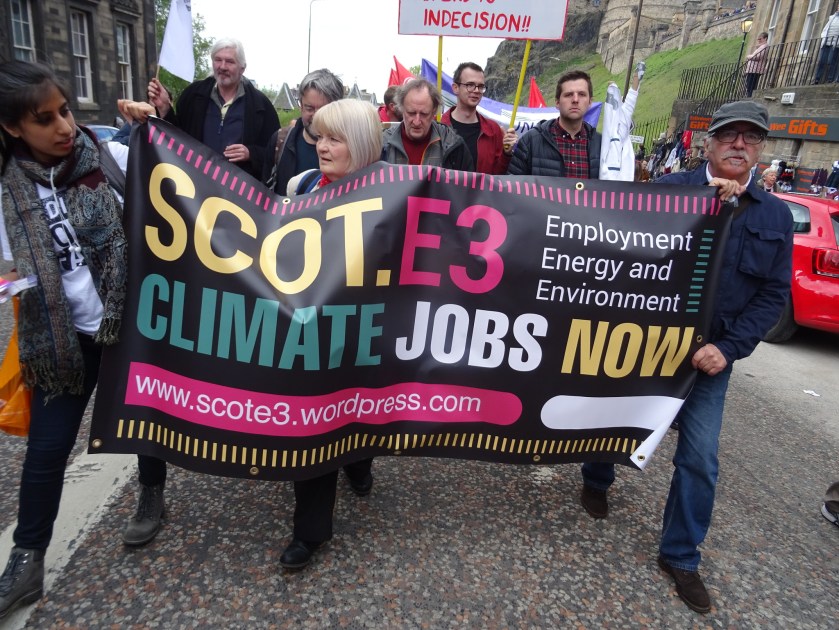
Scot.E3 banner on the 2019 Edinburgh May Day March
Scot.E3 is holding an online event in partnership with Edinburgh CND as part of the Edinburgh and Lothians May Day events. On Wednesday 6th May 7pm we’ll be showing the short version of the Lucas Plan film and then having a discussion on divestment and alternative production. Full details of how to join the meeting on the events page.
In this post, the latest in a series on the pandemic and climate crisis, Mike Downham discusses some of the lessons that we can learn. The article was first published in the Scottish Socialist Voice newspaper.
Yesterday I met two front-line doctors in Pakistan at a Zoom meeting. They described their work as a suicide mission. They have no PPE provided – they make what they can themselves. Health workers who protested were arrested and brutally treated. They have three ventilators for the whole country (population 213 million), and no staff trained to use them. Anyone who gets coronavirus pneumonia dies. The government doesn’t have a policy.
In India slumdwellers are being issued with hydroxychloroquine as an experiment – there’s no evidence that it’s effective. Getting food to these people, who by the way are human beings, is a bigger immediate problem than stopping infection. The government is panicking, already opening up the lockdown at a point when the epidemic is just taking off.
Yemen, after five years of civil war, has 2 million malnourished children. Malnutrition is notorious for reducing resistance to infections of all kinds. They don’t know how much coronavirus they have in the country because they don’t have tests.
As for Africa, a continent of poverty and underfunded health services, the predictions for numbers of deaths range from the terrible to the catastrophic – but how can you usefully describe the difference between hundreds of thousands of deaths and millions of deaths?
Meanwhile the Government of our rich, relatively small country, remains more concerned with covering its tracks than doing anything of significance. The Scottish Government didn’t adopt a better policy than Westminster’s at the point when they could have split, an act of subservience which the independence movement won’t forget.
Saving lives must be our priority, and I’ll come back to that. But, first, this pandemic is a huge learning opportunity, and if we don’t take action on the basis of what we learn, and begin to take action now, rather than wait until ‘it’s all over’- there will be other pandemics of new viruses, waiting for their moment. We need to act now to tackle the root causes, not just the symptoms.
There is little doubt that this new coronavirus originated in primary forests, as did Ebola, Zika, Swine Fever, Sars and Mers. All these viruses are thought to have existed for centuries in primary forests, where they were contained by sustainable ecosystems. The trouble started with deforestation to make way for agriculture – agriculture which has become more and more industrialised, monocultural and as a result unsustainable. There have been different intermediate hosts for each ‘new’ virus before it reached humans, and we don’t yet know which hosts were involved for the Covid-19 virus. Pigs are prime suspects, because pork has become a staple in China for the many who can now afford it. The Chinese eat an average of 39kg of pork in a year – even the Americans eat only 27kg. This appetite for pork has fuelled a huge expansion of highly profitable production by big companies. The animals are raised in factory farms with the usual inhumane crowding and conditions. Last year 100 million pigs died in China with Swine Fever. These farms are mostly sited on newly bulldozed forest land.
The initial theory that the pandemic started in a wild animal market in Wuhan is no longer holding up, though it may have contributed. An additional factor may also have been that wild-animal foragers were forced to push deeper into forests to satisfy demand, another large and profitable food market for big business, disrupting sustainable ecosystems as they hunt.
The first thing we’ve learned, then, is that the profit motive on the part of big agricultural companies is the root cause of this pandemic. These companies, as we know, have expanded by grabbing forested land in poor countries – less expense, and easier to buy off protest.
The second thing we’ve learned is that governments, for the most part, have failed us in controlling this pandemic once it started. The most despicable examples are the UK and USA Governments. For the UK Government to be prepared to sacrifice older people to save the shareholders is an abuse of human life which people will never forgive.
The third, and biggest thing we’re learning is that we have the power to control this epidemic ourselves. London bus drivers, having failed to get adequate protection from the Government, or from the Mayor of London, or from Transport for London, took things into their own hands. They organised through a whatsap group, sealed the front doors of their buses and waived fares. They were driven to this because they were dying – at the last count 30 TfL workers, bus drivers or Tube workers, have had their lives ended by corona virus infection.
Some intensive care NHS workers have decided, hospital by hospital, to refuse to work if they don’t have adequate protection. NO KIT, NO CARE. They feel they have a responsibility to make that painful decision, not only for their own survival as vitally essential workers, but also because they know that if they become infected they will pass on the virus to large numbers of both patients and other workers. They will not be complicit with intensive care units becoming coronavirus reservoirs.
Construction workers are forcing closure of non-essential sites – luxury flats and hotels for example – if they do not have adequate protection, either by persuading management to shut down, or by walking out. NO KIT, NO WORK.
People not at work are setting up highly effective mutual support networks in their communities.
That’s a lot to have learned in a few weeks, but it’s not all. We’re learning, through lockdown, ways of daily living that had been taken away from us – people are realising they’ve been working too hard, delegating too much of the care and education of their kids, delegating too much of the care of their older people, and relying too heavily on long and vulnerable supply chains for their necessities, especially food. They’ve learned above all that they like to have opportunities to be kind.
This pandemic isn’t the biggest crisis we face. Far bigger is the crisis of global warming. Yet there are similarities between these crises. Both are killing large numbers of people. Both are global. And the only solution is radical change of the economic system, mediated through participative and decentralised democracy.
Some of the things we’ve learned from this epidemic are directly transferable to the fight against global warming. Bulldozing primary forest is as lethal through its huge impact on global warming, as it is through the setting free of new viruses. As we come to understand more intimately the unsustainability of monoculture of pigs we’ll be able to more confidently reject the crazy proposal, supported by the Scottish Government, to replace Scotland’s old forests with monoculture quick-growing trees to capture carbon, harvesting these trees frequently to burn them in power stations – ‘Bio Energy and Carbon Capture and Storage’ or BECCS, which is nothing more than a capitalist scam.
One of the construction sites which was shut down last week on the insistence of workers was the building of a new gas power station at Keadby, near Scunthorpe. The workers saw this as work which was only essential to the company (SSE, headquarters at Perth), not to them or to the rest of us. It’s a short step from here to seeing the nonsense of building a new fossil fuel power station at the very point when we should be argueing, right now, for a Just Transition away from North Sea oil and gas. The construction workers will have jobs which are truly essential to all of us, and which will put their essential skills to better use. And we will be able to meet our carbon targets without resorting to carbon capture.
The action by London bus drivers to provide free bus travel puts us into a strong position to argue right now for publicly owned, democratically controlled, decarbonised and free public transport across the board. What’s more, people are already talking about how good it is to have less traffic on the roads. They know their health is benefitting from reduced air pollution.
I’ll finish by coming back to the immediate priority of saving lives. There are three things we can all do to save lives, on top of social distancing. We can encourage people in our communities and networks, particularly older people, who develop symptoms they think may be due to coronavirus, and become breathless, to phone for an ambulance if they can’t get through to NHS 111 or their GP. It’s become clear that many people are uncertain how ill they should be before calling for help, yet we’ve also learned that breathing difficulty can get worse rapidly, and that getting to hospital quickly gives people a better chance of being treated successfully. This decision isn’t easy to make, especially if you live on your own, or even for the people living with you. It can help to give your phone number to any older people you know so that they can at least speak with someone if they can’t get NHS advice when they need it.
Secondly, it’s also become clear that some people who suddenly become ill in other ways – they think they may be having a heart attack, or a stroke, or they have breathing difficulty because of COPD or asthma which has got worse – are hesitating about going to hospital at all. They may be frightened of catching the virus, or of putting further strain on the hospital and the ambulance service – or both. They may delay phoning, or even not phone at all. They can be supported to understand that although there is a risk of catching the virus if they go into hospital, the risk of not going into hospital is more certain. Paramedics are reporting that people are dying at home with these common non-Covid emergencies – or getting to hospital too late to be treated successfully.
Thirdly, we can join the swelling chorus of people demanding better PPE and testing in care-homes – for the sake of both residents and workers. It’s an on-going scandal that the Government continues to be slow to respond to the needs of care homes, and to be less than open about the numbers of deaths of people in care homes caused by this virus. In France, where care-home deaths have been added to hospital deaths in daily reports since early in their epidemic, around 50% of all Covid deaths have been in care homes. The lack of respect shown by the UK Government for people dying in care homes by not even counting them is despicable.
This pandemic is frightening – people are dying around us in appalling numbers, and our governments have failed us. But the virus has brought with it a determination among people everywhere to change the way our world works. Nothing could be worse than a return to ‘normality’.
Scot.E3 has added it’s name to this statement from the Global Campaign to Demand Climate Justice
A New Normal
The COVID-19 pandemic exposes an economic system unable to meet the needs of people and planet. Our only solution to address this global crisis, occurring amid a devastating climate crisis, is to join together and build a more just, resilient, and sustainable world. As members and allies of the Global Campaign to Demand Climate Justice we are making an initial set of demands of governments as they respond to the pandemic.
The word apocalypse comes from the word for revelation. The COVID-19 pandemic is revealing what the global majority has known all along: that the dominant economic system prioritises profits over people and planet.
With each new day of infections, deaths and destroyed livelihoods, the pandemic is exposing the gross injustices of our existing systems. Years of neoliberalism, ‘structural adjustment’ and austerity have dismantled the social welfare state, specifically underfunding and hollowing out health systems across the globe. We are left with deficits of life-saving equipment, and surpluses of polluting industries.
The dimensions of the collective suffering and individual trauma unfolding are too vast to contemplate. Families confronting loss or lockdown in abusive relationships; bodies facing devastating illness; communities facing hunger and isolation.
But the pandemic has also shown our enormous collective strength, and the possibilities that emerge when a crisis is taken seriously, and people join together.
For those of us in the global climate justice movement, the unravelling of the pandemic comes as no surprise. For decades, as movements we have denounced the violent impacts of an unequal global economic system, the devastation of an accelerating climate crisis, and the shockingly cruel ways in which those least responsible bear its heaviest burdens. For decades, we have demanded an end to a status quo that was and continues to be a death sentence for the world’s poorest. The coronavirus crisis is a stark reminder of a prolonged past, and our response to it a dress rehearsal for the present and future.
Justice
As with the climate crisis, the COVID-19 crisis loads the heaviest burdens on those most vulnerable. The poorest are affected first and worst. It inflames the disparities carved by wealth, gender, class, race, (dis)ability and other intersectional factors. The highest costs are being borne by those least able to pay them, who were always condemned to bear such costs.
Most clearly, those most at risk of infection are those least able to isolate themselves.
A lockdown means confinement in our homes. But some of us are entirely without a home, or live with multiple family members and relatives in one house. Some of us are internally displaced people’s or refugee camps, or in detention centres, or go without access to running water and sanitation. For some of us, home is the site of violence and abuse, and staying home means an end to public activity we rely on for our day-to-day subsistence. Some of us can’t stay home because we are working in the most crucial and life-sustaining sectors, such as agriculture, without protection, including many of the subsistence and family farmers who feed over two-thirds of the world.
Women and girls bear the brunt of care work in our current system, in the home, in our communities and also in the economy, as they are the majority of health care workers. This pandemic has shown us the importance of care work, the work needed to raise families, to cook and clean and take care of the sick and elderly. It has shown us the profound impact of the lack of public services and social institutions for care work . We must use this moment to understand the importance of care work, share it among all peoples and build a society and economy that takes on care work based on feminist, care-affirming principles.
In many countries, health, food and basic services sectors are supported by migrant labour, many of whom do not have a voice, recourse to public funds and most often serving with the least protection. Migrant voices are also most often ignored in climate discussions. In times of crises, whether health or natural calamities, they are one of the most vulnerable, discriminated against, and ignored.
Those most affected by the climate crisis – people in the Global South who have faced the violence of environmental degradation, extended drought, and forced displacement – have now become one of most vulnerable populations to contagion and its effects. In areas where the health of communities has been debilitated by polluting industries, leading to an array of respiratory and immunological conditions, people are particularly at risk to COVID-19.
The pandemic is already opening the door to a major economic crisis, with an upcoming recession that will render the vast majority of the global population – who live day-to-day with precarious livelihoods – in a condition of even more chronic poverty. The risk of famine and deep disruptions to food sovereignty is significant. Southern countries are burdened with illegitimate and unsustainable debt – accumulated through decades of exploitative and predatory lending by Northern governments, international financial institutions and big banks in collaboration with southern elites and those Southern governments with authoritarian and corrupt practices. The prioritization of payments of these debts have taken a heavy toll on public services and continue to take up a huge part of public spending that should be allocated instead to public health responses to the pandemic.
A Crossroads
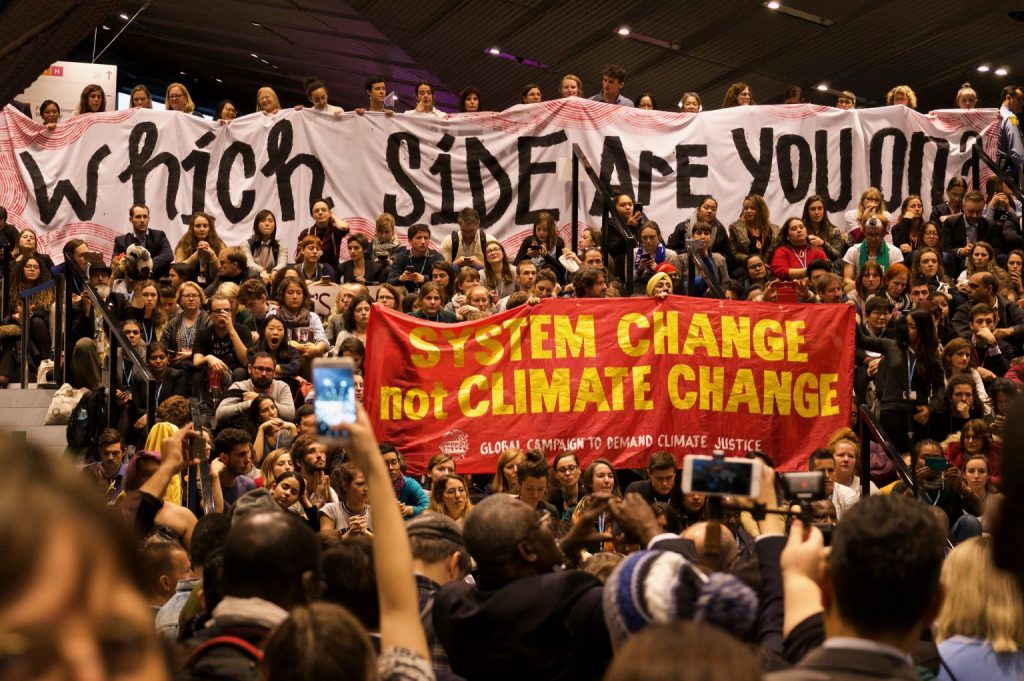
We are at a crossroads. For years, we have demanded ‘system change not climate change’. System change now seems more necessary than ever, and more possible. The rules of the game are changing swiftly. Upheaval is unavoidable.
The question is: what kind of change is unfolding? What kind of system is emerging? What direction will change take?
The powerful are taking advantage of the crisis to advance disaster capitalism and a new authoritarianism, handing themselves expanding police and military powers, and rushing through extractive projects. Many governments are seizing the chance to push through draconian measures, police the population, undermine workers’ rights, repress the rights of Indigenous peoples, restrict public participation in decision-making, restrict access to sexual and reproductive health services, and institute widespread surveillance. In the worst situations, repressive actors are using the moment of political instability to violently quash dissent, legitimise racism, religious fundamentalism and advance predatory mining frontiers, and execute land defenders.
But the crisis they are making use of, also offers an opportunity for our movements to shape the emergent future. Our movements know the way forward, the type of world we need to build. Across the world, people are realising that our dominant economic system does not meet peoples’ needs. They are clearly seeing that corporations and the market will not save us. They are noticing that when a crisis is taken seriously, governments are capable of taking bold action and mobilise enormous resources to confront it. The limits of the possible can be radically shaken and rewritten. Within weeks, policy proposals long-campaigned for in many contexts (an end to evictions, liberating prisoners, bold economic redistribution to name but a few) have become common-sense and mainstream responses.
We are living through a convulsive but very fertile political moment. Our world has been forced into solidarity by a virus which ignores all borders; our deep interdependence has never been more undeniable.
In such a crisis rethinking and reimagining our economic model is inescapable. Resilient and justice-based solutions are not only possible, but the only real solution.
It is clear now that we need a response of solidarity, equity and care, with massive public investment that puts people and planet first, not polluting industries and profiteers. Just recoveries, and global and national new deals to build a regenerative, distributive and resilient economy is both necessary, and increasingly politically feasible.
The Fight for A New Normal
We will not return to a normal in which the suffering of the many underwrote the luxuries of the few. While politicians will push for a rapid resumption of the status quo, we can’t go back to normal, as social movements have affirmed, when that normal was killing people and the planet.
Our climate justice movements are in both a perilous and promising situation. The urgency of climate breakdown has dropped under the radar, even as climate violence is relentless, expressed most recently in devastating storms across the Pacific, forest fires in China, and torrential rains in Colombia. Unless we take this political moment, climate action will be on the backburner, and economies in the rich North will be turbocharged and revived with dirty investments that deepen the climate crisis. We must be vigilant and persevering to ensure that addressing the climate crisis must be front and center of bailouts, and programmes to ensure the resilience of society and all peoples.
Our movements have an expertise which is invaluable at this time. While COVID-19 and the climate crisis may have different direct causes, their root causes are the same: a reliance on the market, a failure of the state to address long-term threats, the absence of social protection, and an overarching economic model that protects investments over lives and the planet. The same extractivist system that extracts, burns and destroys ecosystems, is the same system which enables dangerous pathogens to spread. The solutions to the COVID-19 and climate crises are the same: solidarity, redistribution, collaboration, equity, and social protection. It is our opportunity and responsibility to join the dots, and use this political moment to confront corporate power, and build a more just and sustainable society.
The Horizons We Can Claim
The pandemic has changed the game. We have the resources to build an economic model that doesn’t trash the planet and provides for all. We have the momentum to recover from this crisis in a way that builds our resilience and fortifies our dignity as societies. Now is our time to claim it.
As members of the Global Campaign to Demand Climate Justice, we demand a bold response to the COVID-19 pandemic that simultaneously helps address the wider climate crisis, and transform the unequal economic system that has led to both.
We demand that governments:
Prioritise the health and wellbeing of people. People must always be valued over profit, for an economy is worthless without its people. No one is disposable. Fully fund and resource health services and systems, ensuring care for all, without exception. Governments must also prioritise robust investment in other essential public services, such as safe shelter, water, food and sanitation. These services are not only essential in stemming the spread of disease in the long-term, but are core to governments’ obligation to respect, protect, and fulfill human rights for all. Therefore, they must not be privatised and instead be managed in an equitable, publicly-accountable manner.
Guarantee the protection of marginalised populations. Provide aid, social protection, and relief to rural populations and the families that compose them, who are at the forefront of feeding our world. Special protection must also be guaranteed for the social and human rights of all peoples put in vulnerable and precarious circumstances, such as those in situations of homelessness, people in prison, refugees and migrants, elders in home care, orphans, and especially environmental defenders who are now being murdered with even greater frequency under the cover of the COVID-19 emergency.
Issue immediate economic and social measures to provide relief and security to all, particularly the most vulnerable and marginalised groups in our societies. Protect labour rights and guarantee protections for all workers, from the formal to the informal economy, and guarantee a universal basic income. Recognise, visibilise and value all care work, the real labour that is sustaining us during this crisis.
Governments must stop subsidies for fossil fuels and reorient public funds away from the military-industrial complex, and private corporations, and use them instead to ensure access to clean energy, water, and important utilities and public services for the well-being of communities.
We call for an immediatecancelation of debt payments by Southern countries due in 2020 and 2021 with no accrual of interest nor penalties, so that funds can be used for health services to combat COVID19 and for economic assistance for communities and people who are facing greater hardships in the face of the pandemic and responses to it. A mere suspension of payments is not enough, and will simply delay the pain of debt servicing. We also demand an immediate start to an independent international process to address illegitimate and unsustainable debt and debt crises to pave the way for unconditional debt cancelation for all Southern countries.
Governments must also transform tax systems, abolishing fiscal holidays for multinational corporations which undermine revenues, and abolish value-added tax and goods and services taxes for basic goods. Take immediate steps towards stopping illicit financial flows and shutting down tax havens.
Support a long-term just transition and recoveryout of this crisis, and take the crisis as an opportunity to shift to equitable, socially just, climate-resilient and zero-carbon economies. We cannot afford bailouts that simply fill corporate pockets or rescue polluting industries incompatible with a living planet. Rather, we need an economic recovery that builds resilience, dissolves injustices, restores our ecosystems, and leads a managed decline of fossil fuels and a justice-oriented transition towards a fair & sustainable economy. Governments should pursue economic programmes including just trade relations that prioritize domestic needs, dignified and decent jobs across the entire economy, including in the care economy, ecological restoration and agro-ecology, essential services and decentralised renewable energy — all necessary for an equitable and climate-just world.
Reject efforts to push so-called “structural reforms” that only serve to deepen oppression, inequality and impoverishment , including by international financial institutions such as the World Bank and International Monetary Fund, who may use the pandemic to push schemes in the Global South under the guise of “shortening the time to recovery.” The neoliberal pillars of austerity, deregulation, and privatisation — especially of essential services such as water, health, education etc — have devastated people across the world and are incompatible with a just recovery.
Bolster international cooperation and people to people solidarity. Global problems that respect no borders, whether they be the climate or COVID-19 crisis, can only have cooperative and equitable solutions. In a deeply unequal world, transferring technology and finance from the richest to the poorest countries is crucial. Governments should facilitate instead of hindering the efforts of people’s movements, citizens groups, Indigenous peoples and civil society organizations to link up across borders and countries for mutual support. We also call on governments to honor their historical responsibility and stop using tactics that dismiss that responsibility and delay a strong international response, such as withholding funding from the WHO and other institutions in a time of crisis.
Collaborate on the development of and unrestricted accessto vaccines and any medical breakthroughs of experimental therapy drugs, led by principles of international cooperation and free distribution. We need to ensure that any COVID-19 vaccine will reach all and that no country will be able to become a monopoly buyer, and no entity a monopoly producer.
Immediately cease extractive projects, from mining to fossil fuels to industrial agriculture, including extraterritorial projects undertaken by corporations headquartered in your country, which are accelerating ecological crises, encroaching on Indigenous territories, and putting communities at risk.
Reject any and all attempts to waive liability ofcorporations and industries. The actors that are responsible, in so many ways, for this multifaceted crisis and the broken system absolutely cannot be granted loopholes that allow them to escape responsibility for their abuses at home and across the world.
Governments must not take advantage of the crisis to push through draconian measures including the expansion of police and military powers that undermine workers’ rights, repress the rights of Indigenous peoples, restrict public participation in decision-making, restrict access to sexual and reproductive health services, or institute widespread surveillance under cover of the crisis.