COP15 on Biodiversity (or in full the 15th Conference of the Parties to the United Nations Convention on Biological Diversity) begins in a week’s time. In this article ScotE3 activist Mike Downham looks at the impact that avian flu is having on the natural environment. This article was first published in Scottish Socialist Voice.
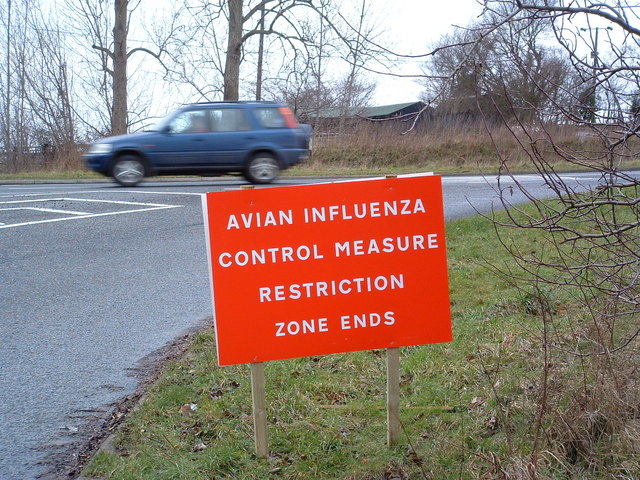
Whatever the risk of spread to humans, as yet thought to be low, the current outbreak of the H5N8 variant of avian influenza is a tragedy for wild birds, particularly sea birds. H5N8 both spreads more readily and causes more lethal disease in birds than previous variants.
Every bird species is precious in itself. But some of the sea birds currently dying are already rare. For these this outbreak could result in extinction.
If anyone has any doubts about the extent of the tragedy they should watch this short RSPB video
What the RSPB doesn’t say, because large NGOs are restricted by the need to nurture their relationships with governments, is that the disgusting methods which a largely deregulated poultry industry continues to get away with are the cause of this world-scale disaster. The H5N8 outbreak is one more example of the results of commodification of food for profit, and of the increasingly reckless sacrifice of nature by big business in the context of end-stage capitalism.
The severe variant of the avian flu virus is just the latest genie which capitalism has helped to escape from the bottle. And as we’ve learned from the Covid pandemic, once viruses have escaped there’s nothing a capitalist world is prepared to do to put them back. We’re told we just have to live (or die) with them, as if there was no alternative.
But governments have to say things which give the appearance that they care. Westminster’s Biosecurity Minister Lord Benyon said recently: “Our wild birds are facing exceptional pressures from avian flu this year and we have seen the tragic effect it has had – particularly on our seabird colonies. I very much share concerns about the impact avian influenza is likely to have on breeding populations of wild birds in the future, particularly those that nest in large numbers and represent some of our rarer species.” But his actions to save wild birds are restricted to limited culls of commercial poultry and instructions to the public about not touching dead birds. Nothing about regulation of the poultry industry – because regulation is prohibited by his government’s rule-book.
As many of these birds are only or at least primarily found in Scotland, regulation of the poultry industry is certainly something that the people of Scotland should be shouting about. Instead we go on obediently eating chicken because it’s cheap.
The Nature Crisis is often side-lined, especially at times like the present when human beings are facing multiple crises. Exploitation of nature by man goes back to the Garden of Eden. But for the roughly two hundred years since the crescendo of industrialisation in the West, we’ve become more and more conditioned to the arrogant idea that other species are here only for our benefit – note Lord Benyon’s “our wild birds” and “our rarer species”, implying that we have some sort of ownership rights over wild birds. It’s arguable that this arrogance in relation to other species is the most fundamental reason for the current mess humanity is in.
The Scottish Government’s Biodiversity Strategy Consultation closed a few weeks ago. I had the privilege of working with the Friends of St. Fittick’s Park, Aberdeen, to submit a contribution to the Consultation. Our submission told the remarkable story of the Park’s restoration and enhanced biodiversity over recent years, while now the Park is under threat of industrial development at the hands of the all-powerful North Sea Oil and Gas Industry.
The submission goes on to point out that the Scottish Government, led by the Scottish National Party for 15 years, has presided over a range of policies which have driven the Nature Crisis the Government is now consulting about.
These policies have in common that they are designed to benefit wealthy people and are driven by profit. Some are entirely the Scottish Government’s responsibility, others are through collusion with the UK Government. Unless these policies are radically reformed any attempts to address the Nature Crisis will fail, sooner rather than later. The policies which have been most crippling for nature include:
1. Land ownership
50% of Scotland’s private rural land is owned by 432 individuals, mostly large estate-owners and industrial-scale farmers. As historian James Hunter has said: “Scotland continues to be stuck with the most concentrated, most inequitable, most unreformed and most undemocratic landownership system in the entire developed world”. In addition nearly all public land is controlled by central or local government, not by local communities.
2. The sacrifice of biodiverse land for development
Weak regulation enables biodiverse land to be paved over for industrial or unaffordable housing development.
3. Farm subsidies
Huge sums of money continue to be paid to farmers, particularly large livestock farmers, to boost their profitability. Further money is paid to mostly large farmers and estate owners to improve biodiversity, but most of these people are primarily concerned with increasing their wealth, both profits and land values. Biodiversity is not often their primary motivation.
4. Bioenergy with carbon capture (BECCS)
The Scottish Government remains wedded to the concept of planting up huge areas of land with monoculture fast-growing trees, even to felling diverse forests to make way for these new plantations. The plan is to burn the timber from these new forests in power stations and deal with the carbon emitted by “Carbon Capture” – a process yet to be developed and tested at scale.
5. North Sea oil and gas extraction
The Scottish Government is also wedded to extracting every last drop of oil and gas from the North Sea. This has a negative impact on marine species, as well as fuelling both the Climate and the Cost of Living Crises.
6. A one-nation perspective
The Scottish Government’s current proposals for addressing the nature emergency are an example of its tendency to think in terms of only one nation. Biodiversity has to be considered internationally. We should be thinking in terms of what Scotland can do to contribute to the efforts of other nations.
Places like St. Fittick’s Park can help us shift our mind-set towards thinking in terms of every non-human species being important in its own right – not only those species which benefit humanity or those which are threatened by extinction.
If the Nature Crisis was brought centre-stage two benefits beyond enhanced biodiversity could follow. First, at least some of the many people who care strongly about nature, given information which would help them to recognise that profit for the wealthy is what drives the Nature, the Climate, and the Cost of Living Crises in common, would join the fight to stop North Sea oil and gas extraction, which is fundamental to all three crises in the UK and Scotland.
Second, young people and children are in general more and more aware of the devastation to nature they see around them. These are the people who will sustain the fight for a better world long after our time is up.
Children in particular tend to be alert to the nature around them. The younger the children, the closer they are to the ground to make observations that we may not notice. A few months ago, at an Open Day for the Strathblane Wildlife Sanctuary it was my pleasant job to lead tours of the site. For the first tour of the day ten pre-school children and ten parents turned up at the gate. The tour was led not by me but by the children, who ran ahead to point out lady-birds, slugs and molehills.
Our fight as adults at this crisis-torn stage of hgistory must include ensuring that every child has the opportunity to explore wild land in their immediate neighbourhood.
We are happy to repost this call from the Coal Action Network. Please sign the petition.
The biggest coal mine in the UK just applied to get even bigger.
Demand the Welsh Government act on its own policies and laws against coal mining to rule out this climate catastrophe going ahead – sign this petition now to add people pressure where it’s needed. This coal is for industry, but read why we don’t need to set fire to our future to keep warm this winter.
Local picture
The huge opencast Ffos-y-fran coal mine, in Merthyr Tydfil, has inflicted 15 long years of explosives blasts, noise and dust pollution on local residents. When the coal mine was approved, residents were promised this would stop and the coal mine would close nearly 3 months ago in September 2022.
Now the mining company wants to mine coal nearly 4 years longer – with nothing to stop it from trying to extend coal mine again. Enough is enough. This has already been too much for many local residents.
The mining company has failed to ensure its workers are trained into other industries with a future – using its failure as a bargaining chip for the coal mine to be extended. We ask the Welsh Government to instead include these workers in a Universal Basic Income pilot to support them in finding alternative employment with a future.
The Welsh Government has a policy to consider coal mine applications centrally if the local Council want to approve them. This is because the impacts are not just local, but affect national climate commitments and global climate change. Expanding the Ffos-y-fran coal mine could become a massive setback for Wales’ progress towards reaching net-zero, and reputation internationally as leading the UK towards a sustainable future.
Scotland has just announced an effective ban on all forms of new or expanded coal mining for any purpose. Applications like expanding Ffos-y-fran highlight that the Welsh Government also needs to announce a blanket ban on new coal, or risks become a climate laggard.
Sign our petition asking Welsh Climate Change Minister Julie James to rule out letting this application to expand the UK’s biggest coal mine from being granted.
Thanks,
Daniel, and the team at Coal Action Network
P.S Got Twitter? Retweetour petition and spread the word!
Quan Nguyen was the Scottish Coordinator of the COP26 Coalition. His recent article reflecting on how the climate movement has developed since COP26 is well worth reading.
Here we publish a personal response to Quan’s article from retired oil worker Neil Rothnie. This is an important discussion, and we’d love to publish more views. If you’d like to write something, or perhaps be interviewed, please use the Contact tab to get in touch.
I think we can share the confidence of Quan’s final thought that;
“ . . . . we are still standing and can rise again to challenge the heart of Europe’s fossil fuel capitalism on its own soil.”
And this from the man who has more reason than most to be “tired and exhausted”. Because on top of his big job as Scottish Coordinator of the COP26 Coalition, he also led the hugely successful and well organised weeklong Climate Camps. This year the 2022 camp challenged the UK climate movement’s London-centricity, and confronted the international oil and gas industry in its European capital by occupying the Torry dock of Aberdeen harbour and laying down a marker for the whole movement. Sooner rather than later the job of shutting down the North Sea will have to be carried out by a movement that has the active support of the masses. Who thinks the industry/government conspiracy will do it themselves in a planned way that avoids climate chaos and gives us renewable energy? Looks like Quan thinks that that scenario is a fantasy.
This of course begs the question of what part in this transition – the “real” transition not the greenwashing shite that Quan warns about – will be played by the oil workers, their families and friends and neighbours in communities throughout the country. An issue we in ScotE3 have been grappling with at some length. And more thought needs to be given.
When Quan deals with the lessons of COP26, his call is for a rethink of what he sees as a form of“protest” that no longer works. His analysis is a hard read but his conclusion that:
“We need to recognise that the climate crisis will worsen and there is no blueprint for the climate movement to follow towards climate justice”.
surely opens up a space for a detailed examination of his thoughts on the lessons. Perhaps others reading this post might want to look at the problems he perceives in more detail.
I’d never heard of Alaa Abd El-Fattah, who both Quan and Naomi Klein champion. But we could do a lot worse than give serious attention to his 4 themes. Quan pulls the 3rd and 4th together as,
“We need to defend the complexity and diversity of our own movement, and create our own spaces, not consume ready-made action plans that lead to nowhere.”
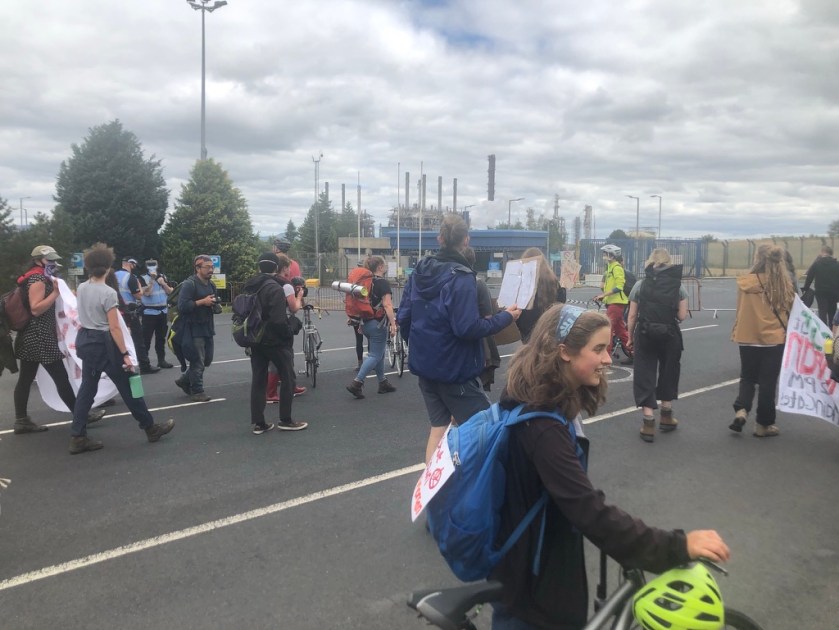
At one level, this is exactly what Climate Camp Scotland was doing in partnership with local oppositionists to Shell’s Ethylene plant at Mossmorran last year, and the Friends of St Fittick’s in Torry in Aberdeen this year.
Action at the 2021 Climate Camp at Mossmorran
Certainly the “complexity and the diversity” was there for all to see in those who turned out and made the camps a huge success. But I’m guessing that there is another level at which this theme is even more relevant. “Our own spaces” must surely be understood not only as our camps, and the spaces we control when we take our actions onto the streets, but also (even more so?) as our communities – the geographical areas in which we share our everyday lives and where we can begin to take some real control. “The diversity and complexity” is surely our neighbours in all their uniqueness and individuality. “The ready made plans that lead to nowhere” surely the poverty and cold mapped out for us by government in lock step with oil industry profiteering and investor dividends, all predicated on the weaponisation of North Sea gas,
“The ready-made action plans” are also the endlessly failing blah blah blah of successive COPs that lead not to “nowhere” but to global climate disaster already breaking out now in the Pakistan floods, now in the Sudanese drought and famine, and Net Zero obfuscation everywhere.
And where can we “fix our own democracy” if not in our own communities? It’s here that the lessons we are learning in the climate justice movement about inclusivity can be fought for amongst the widest layers of society in the coming actual everyday struggles to access warmth and food and companionship in the face of the cold, hunger and debt that the billionaires both in and outside government and in the markets and in the oil and gas industry have planned for many of us this winter. There’s no way that what Quan calls “Fossil Capitalism” can be ended without the active participation of the widest layers of society. We need to go where the people are. They’re in their communities getting ready to face cold and hunger. The climate justice movement needs to begin to think about being there with them, engaging in conversations and organising in solidarity. We have a common enemy – North Sea gas.
When Quan says that;
“We need to recognise that the climate crisis will worsen and there is no blueprint for the climate movement to follow towards climate justice.”
He’s surely saying that there’s going to be no rational transition to renewables – no peaceful road to climate justice. What chance that the RMT union, let alone other oil and gas investors, can break their addiction to Shell and BP dividends, or that the banks and the markets are prepared to voluntarily slaughter the golden goose? All indications are that the exact opposite is the plan that they just cannot deviate from. They’ll transition only when the last dollar has been made from the last profitable barrel of oil and gas from the North Sea. It’s called “maximising economic recovery” and it’s the UK government plan handed to them by Sir Ian Wood. And if this is the industry plan in the UK, you can bet that it’s the industry plan everywhere. And we all know that by that time it’ll be too late. As Quan says,“Time is running out”
One way or another we are facing, I think, a huge discontinuity. Piper Alpha, Deepwater Horizon, the trashing of the Niger Delta, in fact the trashing of almost everywhere the industry sets foot in, is how the global oil industry organises. Dictatorial regimes around the world are the industry’s preferred stomping grounds. The myth of an organised and orderly North Sea Transition as espoused by Deirdre Michie of Oil & Gas UK, and other industry leaders, politicians and union apologists couldn’t be further from the traditional methods of, and outcomes of, the industry. There’s no peaceful road to oil and gas, no peaceful transition, to sustainability. Unaffordable North Sea gas and the unaffordable electricity it underpins have been weaponized, and are guided missiles launched straight into our homes to destroy our personal economies, and if unchallenged, our lives.
Alaa Abdel-Fattah is a British-Egyptian writer, human rights defender and software developer. He was one of the leading voices and campaigners during the 25 January 2011 revolution. He has been published in numerous outlets; is well-known for founding a prominent Arabic blog aggregator; and has been involved in a number of citizen journalism initiatives. His book, You Have Not Yet Been Defeated, which compiles some of his deeply influential writings, has received widespread acclaim.
Alaa has been arrested under every Egyptian head of state during his lifetime. He is currently in detention following an unfair trial on spurious charges that relate to his human rights advocacy. On 2 April 2022, Alaa embarked on an open-ended hunger strike as a last bid for freedom. After more than 200 days of partial hunger strike, Alaa announced that, as of 1 November 2022, he is stopping his previous 100-calorie intake and moving to a full hunger strike. Alaa also decided that on 6 November 2022, coinciding with the beginning of COP27 in Sharm el-Sheikh, Egypt, he will start a water strike. This means that if he is not released, Alaa will die before the end of COP27.
“If one wished for death then a hunger strike would not be a struggle. If one were only holding onto life out of instinct then what’s the point of a strike? If you’re postponing death only out of shame at your mother’s tears then you’re decreasing the chances of victory….I’ve taken a decision to escalate at a time I see as fitting for my struggle for my freedom and the freedom of prisoners of a conflict they’ve no part in, or they’re trying to exit from; for the victims of a regime that’s unable to handle its crises except with oppression, unable to reproduce itself except through incarceration” – Alaa wrote in a letter to his family announcing escalation of his hunger strike.
On 31 October 2022, the United Nations (UN) Special Rapporteur on human rights and the environment said, “In advance of COP27, I am joining the chorus of global voices calling for the immediate release of Alaa Abd el-Fattah, an Egyptian activist who has languished in jail for years merely for voicing his opinion. Freedom of speech is a prerequisite for climate justice!”
We, the undersigned organisations and groups:
Call on the Egyptian authorities to immediately release Alaa Abdel Fattah and all those arrested and detained solely for exercising their rights
Call on the British authorities to intervene to secure the release and deportation to the UK of their fellow citizen Alaa Abdel Fattah, as his health is deteriorating to a critical and life-threatening point
Call on the UN High Commissioner for Human Rights to publicly reiterate its call on Egypt to immediately release Alaa Abdel-Fattah, Mohamed el-Baqer, and all those arrested and detained solely for exercising their rights
Call on UN Special Procedures to publicly reiterate their call on Egypt to immediately release Alaa Abdel-Fattah, Mohamed el-Baqer and Mohamed “Oxygen” Ibrahim Radwan and all those arrested and detained solely for exercising their rights
Call on all government leaders and business leaders going toCOP27 to use all possible leverage and urge the Egyptian authorities to immediately release Alaa Abdel Fattah and all those arrested and detained solely for exercising their rights
Call on civil society organisations, groups and activists going to COP27 to urge the Egyptian authorities to immediately release Alaa Abdel Fattah and all those arrested and detained solely for exercising their rights
Background information: On 29 September 2019, Alaa Abdel Fattah was arrested while fulfilling his probation requirements at El-Dokki Police Station. He was questioned before the Supreme State Security Prosecution (SSSP)on charges of joining an illegal organisation, receiving foreign funding, spreading false news, and misusing social media; he was then ordered into pretrial detention pending case no. 1356 of 2019. On the same day, Alaa’s lawyer Mohamed el-Baqer attended Alaa’s interrogation and was similarly arrested, questioned before the SSSP, and ordered into pretrial detention pending the same case and arbitrary charges. During their pretrial detention Alaa Abdel Fattah and Mohamed el-Baqer were arbitrarily added to Egypt’s terrorist list in relation to a separate case (no. 1781 of 2019), for which they have never been questioned or given the right to defend themselves. As a result of this designation, they face a travel ban, asset freeze, and for el-Baqer, potential disbarment as a lawyer. On 20 December 2021, following an unfair trial before a State security emergency court, in which they were denied their right to due process (defense lawyers were denied the right to present a defense on behalf of their clients, and denied permission to copy the case files), Abdel Fattah was sentenced to five years in prison, and el-Baqer and blogger Mohamed “Oxygen” Ibrahim Radwan to four years in prison on charges of “spreading false news”. Verdicts from such courts cannot be appealed. The time they spent in pretrial detention pending the original case ( No. 1356 of 2019) will not count as time served toward the December 2021 prison sentences, and the verdict is final since it has subsequently been ratified by President Al-Sisi. Further details here.
Preparations for COP27 are taking place against the backdrop of an ongoing and deep-rooted human rights crisis in Egypt. The Egyptian authorities have for years employed draconian laws, including laws on counter terrorism, cyber crimes, and civil society, to stifle all forms of peaceful dissent and shut down civic space. Under the current government of President Abdel Fattah al-Sisi, thousands continue to be arbitrarily detained without a legal basis, following grossly unfair trials, or solely for peacefully exercising their human rights. Thousands are held in prolonged pre-trial detention on the basis of spurious terrorism and national security accusations. Among those arbitrarily detained are dozens of journalists targeted for their media work, social media users punished for sharing critical online content, women convicted on morality-related charges for making Tik Tok videos, and members of religious minorities accused of blasphemy. Prisoners are held in detention conditions that violate the absolute prohibition of torture and other ill-treatment, and since President Abdel Fattah al-Sisi came to power hundreds have died in custody amid reports of denial of healthcare and other abuses. Egypt remains one of the world’s top executioners, executing 107 people in 2020 and 83 in 2021, with at least 356 people sentenced to death in 2021, many following grossly unfair trials including by emergency courts. The crisis of impunity has emboldened Egyptian security forces to carry out extra-judicial executions and other unlawful killings, enforced disappearances and torture with no fear of consequences.
This post is a report of the Scot.E3 public meeting held on 24th October 2022. It includes videos from the meeting and links to resources and further information about the St Fitticks Campaign. Please share widely.
The meeting began with a contribution from Ishbel Shand from the Save St Fitticks Campaign
You can read a written version of Ishbel’s contribution here
Pete Cannell followed up with a short contribution on the North Sea oil and gas industry
The two speakers were followed by a wide ranging discussion which is summarised in the following account:
At the ScotE3 public meeting on 24th October “St.Fittick’s Park – Defeat the Oilogarchy” Ishbel Shand, on behalf of the Save St.Fittick’s Park campaign in Aberdeen, reminded us that nearly a century ago Antonio Gramsci, writing from a fascist prison cell, said “The old world is dying, the new is struggling to be born. We live in a time of monsters.” You can watch the whole of Ishbel’s speech about the history and current significance of St.Fittick’s Park on the YouTube link above. It’s a compelling story not to be missed.
Pete Cannell spoke next, on behalf of ScotE3. He emphasised in particular the catastrophic nature of the North Sea Transition Deal, agreed in March last year and flouted as the first agreement “between the government of a G7 country and its oil and gas production community”. Almost unbelievably this Deal has been signed up to by the Scottish Government and by the Unions which represent the oil and gas workers. More oil and gas, nuclear, and hydrogen for heating. This is a disaster for the climate – particularly in terms of investment. It’s what underpins the Cost of Living Crisis because energy prices would inevitably remain high – much higher than would be the case with renewable sources of energy. It would also be a disaster for jobs – preserving the status quo for jobs is the worst-case scenario, defying any chance of a just transition. You can watch Pete’s presentation on the second YouTube link.
We had hoped for a speaker from Climate Camp, who sited their annual camp this year in St.Fittick’s Park and illegally occupied the site of the old fishing and boat-building village of Torry, destroyed to make way for oil and gas industrialisation. Unfortunately no-one from Climate Campaign was available for this meeting, but their name was on the lips of many participants as a model of how to respect local communities rather than impose on them.
The bulk of the meeting was given to general discussion. Many good points were made, including:
The oil and gas industry has never brought anything positive to the Torry community
There is a parallel between the threatened industrialisation of St.Fittick’s with the Bo’ness road in Grangemouth, which physically divides the local community and threatens the health of that community with air pollution from traffic congestion.
There is also a parallel with the Buckie community’s fight to save the Slochy Wloods
The potential power of communities is huge when they come together to fight – for example the success last year, at enormous personal costs, of the Ujaama indigenous communities in securing land rights in Tanznia.
There is a fundamental democratic deficit which in general communities face.
There’s not just one unaccountable Goliath faced by the David of the Torry community but four – One North East, oil tycoon Ian Wood’s company which will control the development of an “Energy Transition Zone”; Aberdeen Harbour; Ironside Farrar, the environmental consultants tasked with drawing up a “master plan”; and Aberdeen City Council and its Local Development Plan.
Artists/musicians recently performed 45 minutes of songs and poetry at the new Arts Centre in Banchory
Films, short and long, have been made about St. Fittick’s.
University students are giving St. Fittick’s magnificent support
Those of us who don’t live in Aberdeen need to extend the Local actions of the Torry Community to National actions and solidarity across Scotland, through spreading the word far and wide about the threat to St. Fittick’s.
We all need too to take opportunities to spread the St. Fittick’s story internationally.
There’s a need for more radical change than just fighting for “renewables” – a term which can conceal negative elements – for example the jackets for off-shore turbines are plastic and the blades are steel.
The Cost of Living Crisis is fundamental in that it has the potential to mobilize nearly everyone.
The Scotland-wide COP 27 mobilisation is at 12noon on Saturday 12th November in Edinburgh. People from Aberdeen wanting to join this rally were encouraged to accept hospitality from those members of ScotE3 based in Edinburgh.
Yes, this is a time of monsters, but it’s also a time of jewels. St. Fittick’s Park itself is a jewel, as is the current response of the campaign to the threat of industrialising the Park.
The chair ended the meeting with this quote from Ishbel, which emphasises the often-neglected but fundamental significance of the Nature Crisis in all our current struggles:
We can choose to continue with the old dying world of exploitation of people and nature for short-term financial gain. Or we can choose to repair and nurture our damaged environment and learn to live within the constraints that nature imposes.
The film about Old Torry is particularly moving. The Aberdeen Social Centre have a complete collection of issues of the “Aberdeen People’s Press” from the period.. One Old Torry resident, with a compulsory purchase order on her home, laments that the same Council that wouldn’t allow her to put in new windows because of the historic importance of her house are now going to bull-doze it, because Shell want the land.
A link to Mike Downham’s post on St Fitticks on this site
Mike Downham explains why the fight to save St Fitticks Park is so important.
As I write this (on 22nd September) the Scottish Government Reporter has announced her decision to confirm zoning changes in the Aberdeen Local Development Plan which would allow St. Fittick’s Park to be industrialised.
St. Fittick’s Park
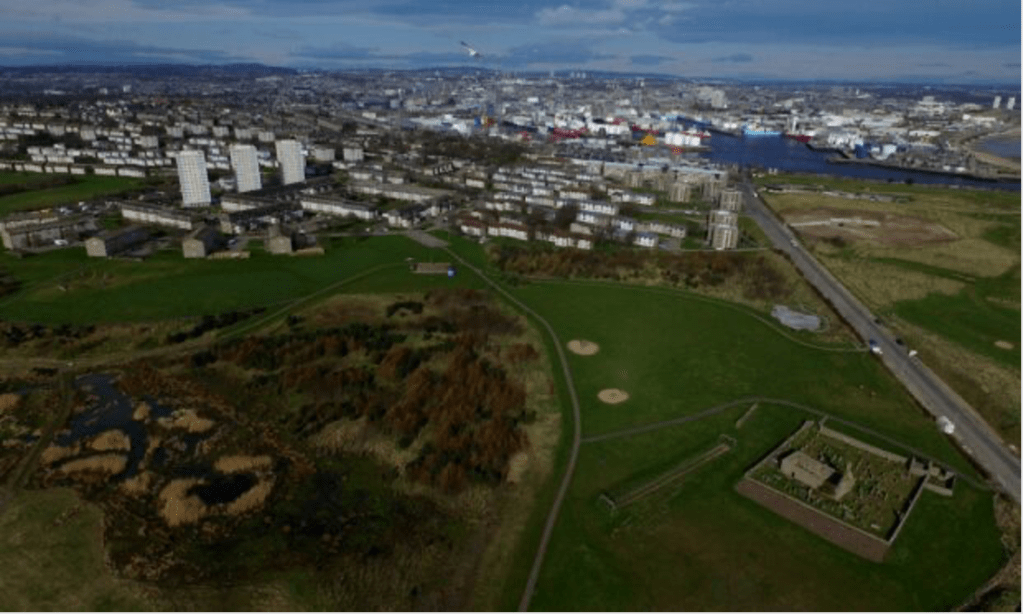
The 17-acre St. Fittick’s Park is owned by Aberdeen City Council and currently zoned as Greenbelt and part of the Greenspace Network. For centuries the land had been grazed by farm animals, until the 1960s when it became a rough field, much explored by children and known affectionately by the local community of Torry as “Our Fieldie”. The East Tullos burn which crosses the land had been channelised and over time became polluted with heavy metals and hydrocarbons.
About 20 years ago the Torry community came together to create a nature-based vision for a public park, with access paths and play equipment for children. £250,000 was raised to realise this vision, £168,000 by the community, with Aberdeen Council contributing the remainder. The new park was named St. Fittick’s because it includes a ruined church overlooking the North Sea at Nigg Bay. From here you can look across fields to the edge of Torry, and wonder how different this landscape must have looked when, according to legend, a religious foundation was established here by St Fittick in the mid 600s.
The story runs that St Fittick, an Irish monk, was thrown overboard by superstitious sailors when a storm blew up. He came ashore at Nigg Bay and established a church to give thanks for his salvation. Legend became history in the late 1100s when a chapel was built on the site of today’s ruins, under the auspices of Arbroath Abbey. This chapel was consecrated in 1242 by the Bishop of St Andrews David de Bernham, and continued to serve the local community until the Reformation.
In 2012 Aberdeen City Council carried out a city-wide greenspace assessment and identified St. Fittick’s Park as a priority for nature-based improvements. The Council commissioned a feasibility study for a project with three objectives: 1) Improve water quality of East Tullos Burn, 2) Improve
biodiversity and 3) Create a public amenity. Combining Aberdeen City Council funds with funds from SEPA, Aberdeen Greenspace, and others, £365,000 was spent to complete the project in 2014. Using a nature-based design, the burn was naturalised with meanders and aquatic and riparian vegetation and reedbeds and wetlands were added to provide habitat and help clean the water of pollution. The project installed 180,000 native wetland and wildflower plants, 20,000 square metres of wildflower seeding, extensive woodland planting on the adjacent upland slopes and 800m of access paths. The community got to work, in one day alone planting 10,000 trees.
The biodiversity and aesthetic beauty of the Park have significantly improved year on year over the last ten years. The Park is now well used and well loved, with school children, families and seasoned or budding naturalists enjoying this rich and diverse landscape. Many species of birds, amphibians, invertebrates and mammals are observed and studied.
This summer an MSc graduate of Aberdeen University carried out an aquatic biodiversity and water quality study of East Tullos Burn and found statistically and biologically significant improvements in the burn as a result of the restoration project, notably an increase in species abundance and richness, an increase in the dynamics and complexity of the food web, and improvements in water quality. Additional studies have found an explosion in biodiversity since the restoration was completed, including 115 plant species, 42 breeding bird species, including eight red listed and eight amber listed, and dozens of migratory species. Invertebrate surveys found over forty species of moth, 11 butterfly species, and a range of other invertebrates. Two invertebrates found on survey were nationally threatened species.
The Torry Community
St. Fittick’s Park is the last remaining accessible green space for a community of 10,000 people, in an area unfairly burdened by pollution, where few residents have private gardens. Before the advent of the Oil and Gas Industry, Torry was a centre for fishing, fish-processing, boat building and boat repair. Only the fish-processing remains. The old fishing village was destroyed in the 1970s to facilitate oil-related harbour developments.
An open letter from a local GP, signed by 22 doctors from across Aberdeen, points out that Torry is surrounded by two industrial harbours, an industrial estate, a railway line, a sewage works, landfill sites, a regional waste center, an incinerator that is currently being built, and one of the most polluted roads in Scotland. Much of the housing, the doctors say, is poor-quality – small, damp and affected by noise and light pollution. Residents frequently complain of high levels of exposure to antisocial behaviour. The doctors draw a comparison between the Aberdeen area of West End North, where the residents of two streets have exclusive access to 15 acres of mature riverside woodland, and the residents of the Torry community: “There is a 13-year difference in life expectancy between these two areas …The difference in healthy life expectancy is around twenty years. There is an eight-fold increase in the risk for someone in Torry being admitted to hospital with complications of chronic lung disease …Torry has a higher proportion of young people and children living in it … there is a significantly higher proportion of dependent children per household than in the rest of the city, and more often in single parent households. Child poverty is accordingly high. Access to private transport is less common in the area and access to distant green space is thus much more difficult …[Torry] also has the highest level of unemployment in the city. Median household income is more than four times greater in West End North … Rates of dental decay in Torry run at over 80% by the end of primary school. These schools have some of the lowest levels of attendance in the city. Teenage pregnancies are still more than twice the average for the city and around eight times more than for West End North. Prescriptions for antidepressant medication are more than twice those for West End North. Drug-related hospital stays are almost three-times the Scottish average, and drug overdoses are more frequent here than anywhere else in the city. There are also disproportionately high levels of domestic abuse and household fires.”
St Fittick’s Park, Torry, is being eyed for an energy transition zone business park. Photo by Kenny Elrick/DCT Media
The award-winning wetlands in St Fittick’s Park could be at risk if the ETZ goes ahead on the Torry site. Photo by Kath Flannery/DCT Media
The Threat
Now St. Fittick’s Park is under threat of industrial development, which would pave over with concrete a large part of the Park. Unbelievably, Aberdeen City Council has agreed with the Oil and Gas Industry to designate St. Fittick’s Park as an opportunity site for a new Energy Transition Zone (ETZ) in the local authority’s 2020 Proposed Local Development Plan. The Council and Energy Transition Zone Limited, the private partner in the proposed development, assert that industrial use of the park, adjacent to Aberdeen’s new South Harbour, is necessary to advance the North East’s transition to a low carbon economy. The new South Harbour itself is an affront to the biodiversity and well-being of the Torry area. As recently as one year ago, visitors to St. Fittick’s Park could walk along the shore of Nigg Bay and look out across the bay to the North Sea. Now this shore has been reduced to a placid pool blocked from the ocean by a high concrete wall.
The Enemy
But this proposal is only ‘unbelievable’ if you continue to think, as it was reasonable to think in the past, that our elected representatives, whether in local or national governments, are serving the interests of their electorates. These days it’s the big energy corporations with their huge wealth who run things – through lobbying and bribing our politicians, and through their control of the media so that we get to be told only their version of reality. In relation to the proposed Energy Transition Zone in Aberdeen it’s the oil tycoon Sir Ian Wood who is the mover and shaker. He got control of economic development in the city in 2016 via the City Region Deal. Wood chairs the development company Opportunity North East (ONE) which is pushing the ETZ. He has enormous influence on both Westminster and Holyrood. The Wood Review of 2014 led to the tax cuts for the Oil and Gas Industry and the principle “MaximizingEconomic Recovery of UK petroleum” in the Infrastructure Bill, 2015. Note the intentionally occult jargon of “Infrastructure Bill” and “Maximum Economic Recovery” – for which read extracting every last drop of oil and gas from the North Sea regardless of costs and climate impact. Inevitably Wood also has a huge influence on a Scottish Government which increasingly tails the Westminster Government in its energy policies. He is the man behind the plans to industrialise the park.
A Scam
If you look a little more closely at the purpose of the ETZ , you are told that “The project is based on using clean energy such as offshore wind, hydrogen and carbon capture and storage”, with a quote from Wood who says “We’ve got the opportunity in the north-east of Scotland to help balance the economy with a new industry, and at the same time, play a really significant role in one of the world’s greatest problems right now in global warming.” Wood said recently that it was only in the last two or three years that he realised that climate change was a serious problem.
This is a classic example of being told only his version of the story because in reality neither hydrogen or carbon capture and storage have any chance whatsoever in reducing global warming in the necessary time-scale, nor can they be described as ‘clean energy’. For simple explanations about hydrogen energy and carbon capture and storagesee Microsoft Word – briefing 13.docx (wordpress.com) and Microsoft Word – Briefing 10.docx (wordpress.com). In reality these technologies are fake tickets to allow the oil and gas companies to continue to pay their executives and their shareholders and to remain in business.
Collision of Crises
At St. Fittick’s Park we are seeing a head-on three-way collision between the Oil and Gas Industry, the Climate Crisis, and the Cost of Living Crisis. Neither the Climate Crisis nor the Cost of Living crisis can be sustainably resolved until extraction and burning of fossil fuels is stopped globally – see the report of a recent discussion which made this clear at North Sea Oil and Gas and the Cost of Living – Employment, Energy and Environment (scote3.net) . Stopping reliance on fossil fuels will mean different things for different countries, depending on their current energy sources. But for the UK and Scotland it’s primarily about stopping North Sea oil and gas extraction.
Collisions like this are of course not unique to Aberdeen. But what makes this one unusual is that it’s actually a four-way collision involving the Nature Crisis too, plus the visual proximity between a resource vital for Nature and a resource vital for the survival of the North Sea Oil and Gas Industry. This proximity makes obvious a choice which is often blurred by the topographical distances between the conflicting interests. Moreover in the case of St. Fittick’s Park it’s not only Nature which is being put under yet another threat which it can’t afford, but it’s also the well-being of one of the most deprived communities in Scotland.
The Nature Crisis
The Nature Crisis is often side-lined, especially at times like the present when human beings are facing multiple crises. Exploitation of Nature by man goes back to the Garden of Eden. But for the roughly two hundred years since the crescendo of industrialisation in the West, we’ve become more and more conditioned to the arrogant idea that other species are here only for our benefit. It’s arguable that this arrogance is the most fundamental reason for the mess humanity is in now. Places like St. Fittick’s can help us shift our mind-set towards thinking in terms of every non-human species being important in its own right – not only those species which benefit humanity or those which are threatened by extinction.
Large numbers of local community-driven initiatives, not necessarily as big or remarkable as the St. Fittick’s initiative, are more likely to make a real difference to biodiversity than top-down directives. The Scottish Government’s top-down Biodiversity Strategy Consultation closed a week ago, the Friends of St. Fittick’s Park having submitted a robust contribution. As well as telling the remarkable story of the Park’s restoration and enhanced biodiversity, the submission points out that the Scottish Government, led by the Scottish National Party for 15 years, has presided over a range of policies which have driven the current Nature emergency the Government is consulting about:
These policies have in common that they are designed to benefit wealthy people and are driven by profit. Some of these policies are entirely the Scottish Government’s responsibility, some are through collusion with the UK Government. Unless these policies are radically reformed any attempts to address the Nature Emergency will fail, sooner rather than later. The policies which have been most crippling for Nature include:
1. Land ownership
50% of Scotland’s private rural land is owned by 432 individuals, mostly large estate-owners and industrial-scale farmers. As historian James Hunter has said: “Scotland continues to be stuck with the most concentrated, most inequitable, most unreformed and most undemocratic landownership system in the entire developed world”. In addition nearly all public land is controlled by central or local government, not by local communities.
2. The sacrifice of biodiverse land for development
Weak regulation enables more and more biodiverse land to be paved over for industrial or unaffordable housing development.
3. Farm subsidies
Huge sums of money continue to be paid to farmers, particularly large livestock farmers, to boost their profitability. Further money is paid to mostly large farmers and estate owners to improve biodiversity, but most of these people are primarily concerned with increasing their wealth, both profits and land values. Biodiversity is not often their primary motivation.
4. Bioenergy with carbon capture (BECCS)
The Scottish Government remains wedded to the concept of planting up huge areas of land with monoculture fast-growing trees, even to felling more diverse forests to make way for these new plantations. The plan is to burn the timber from these new forests in power stations and deal with the carbon emitted by “Carbon Capture” – a process yet to be developed and tested at scale.
5. North Sea oil and gas extraction
The Scottish Government is also wedded to extracting every last drop of oil and gas from the North Sea. This has a negative impact on marine species; fuels, literally, global heating; and is responsible for the current cost of living crisis.
6. A one-nation perspective
The Scottish Government’s current proposals for addressing the nature emergency are an example of its tendency to think in terms of only one nation. Biodiversity has to be considered internationally. We should be thinking in terms of what Scotland can do to contribute to the efforts of other nations.
If the Nature Crisis was brought centre-stage two benefits, beyond enhanced biodiversity, could follow. First, at least some of the many people who care strongly about Nature, given information which would help them to recognise that profit for the wealthy is what drives the Nature, the Climate, the Cost of Living and the Poverty crises in common, they would be more likely to join the fight to stop North Sea oil and gas extraction, which is fundamental to all four crises in the UK and Scotland.
Second, young people and children are in general more and more aware of the devastation to Nature they see around them. These are the people who will sustain the fight for a better world long after our time is up. It was because the young people of the Climate Camp movement feel an urgency to stop this devastation that they based themselves in St. Fittick’s Park this summer. When they arrived they were shown round the Park, having to take care not to tread on abundant tiny frogs.
Children in particular tend to be alert to the Nature around them. The younger the children, the closer they are to the ground to make observations that we may not notice. A few weeks ago, at an Open Day for the Strathblane Wildlife Sanctuary (a much smaller and more recent initiative than St. Fittick’s Park), it was my pleasant job to lead tours of the site. For the first tour of the day ten pre-school children and ten parents turned up at the gate. The tour was led not by me but by the children, who ran ahead to point out lady-birds, slugs and molehills.
Our fight as adults must include ensuring that every child has the opportunity to explore wild land in their immediate neighbourhood.
If you want to join the fight to save St. Fittick’s Park by becoming a Friend of the Park please email
Safe Landing demands an Aviation Workers’ Climate Assembly ahead of the International Civil Aviation Assembly (ICAO)’s 41st General Assembly, to include and empower aviation workers to develop an independent vision for the future of air travel.
Date of Release – 23.09.2022
ICAO Headquarters, Montréal, Canada, 21st September 2022, — Safe Landing is a growing global movement of aviation workers campaigning for long-term employment. They do this by challenging business & political leaders to conform with climate science and reject dangerous growth. They advocate for a sustainable and adaptive aviation industry and are proposing that ICAO facilitate anAviation Workers’ Climate Assembly. This would enable aviation workers to navigate a secure future for their careers, in line with current climate science. A Workers’ Assembly would be run independently of corporate and political influence, with a sortition process that would democratically select a group of participants representative of worker demographics across the sector. These workers would be presented with expert information from various climate, technology and policy specialists, before engaging in facilitated deliberation, in order to then produce and vote on output recommendations that can be presented to ICAO and other relevant political & industry organisations.
Safe Landing, founded by Todd Smith and Finlay Asher, has been operating since 2020 and includes aviation workers from across the globe. It now has over 600 active supporters from across the aviation sector. The group demands that business leaders:
be honest about the total environmental impact of flying,
be realistic about the limits of technology to solve this problem, be transparent about future regulations required to reduce emissions, and have a robust plan, that accounts for this, and supports workers during any transition
In the absence of these actions, Safe Landing promotes the concept of Aviation Workers’ Assemblies to relevant Trade Unions and organisations operating within the sector: as a tool for aviation workers to design and then demand a sustainable future for the aviation industry, with safe careers within it.
Finlay Asher, 32, co-founder of Safe Landing and aircraft engine designer states “the aviation industry is currently emerging from years of turbulence induced by the Covid-19 pandemic. However, as aircraft return to the skies in ever greater numbers, we run the risk of failing to learn from history, and flying workers straight back into danger. Rather than use this opportunity to pivot aviation and transform air travel: business leaders are doubling-down on business-as-usual growth of fossil fuel reliant aircraft and airports. When the next crisis hits us, it will be workers once again taking the hit. We have to recognise that our current leaders are not on our side, most won’t be around in 2030 to deal with the consequences of the next major industry crash. As aviation workers, we want safe and secure careers spanning decades. It’s time to grab the controls in the flightdeck, and chart our own safe flight path forward.”
Todd Smith, 33, co-founder of Safe Landing and airline pilot, also adds, “with the remaining global carbon budget we have left, we can’t continue to double air traffic every 15 years, as we have done historically. We want to empower aviation workers to understand that we need to change how we fly in the short-term, so that we can safeguard the existence of a healthy aviation sector in the long-term. As pilots, we’re trained to think free from bias and to mitigate risks, in order to preserve life. We must follow our training and ensure that the industry does everything it can to minimise danger to our workforce, our communities and our homes. After all, safety is our Number 1 priority. We need workers to get round the table, then let’s give them the time and the space to do what we do best: come up with solutions. We need all aviation workers on board: on the journey towards a sustainable future for the planet and for our own industry – we are all crew.”
Contact
For more information regarding this press release, please contact Finlay Asher. Press contact for Safe Landing: Finlay Asher Contact Details: info@safe-landing.org, +44 (0)7984 602404
About Safe Landing
Safe Landing is a group of professionals within the aviation industry: pilots, cabin crew, airline and airport staff, air traffic controllers, aerospace engineers, and factory workers.
Here are a couple of the videos from the Global Climate Jobs conference that took place at the weekend. All of the plenary sessions are available on the network’s YouTube channel.
Report of a public meeting called by ScotE3 on 12th September
The conversation at this meeting between about 40 people from widely differing backgrounds was both extremely valuable and extremely lively. It’s clear that a lot of people have got their blood up.
The meeting was kicked off by contributions from Neil Rothnie, who has spent much of his life as a North Sea offshore worker, and from Pete Cannell, a founder member of ScotE3. You can watch the video of their talks on YouTube
Three climate activists – Quan Nguyen (Climate Camp), Zareen Islam (Muslim Women’s Association of Edinburgh), and Phoebe Hayman (Just Stop Oil) – were then asked to react to Neil and Pete’s contributions. You can watch the video of their reactions here
Here are some of the points that Neil and Pete made in their introduction
The meeting has been called ostensibly about the cost-of-living crisis and North Sea oil and gas, but if we’re not talking about climate change, we’re not really talking about the real world.
The oil companies operating on the North Sea have a plan to explore for, and produce, every single barrel of oil and gas that exists there. It’s called Maximising Economic Recovery. It’s written into law and has been since way before COP26. And if it’s the oil industry plan for the North Sea, it’s the oil industry plan everywhere. The deal to expedite Maximum Economic Recovery – called the ‘North Sea Transition Deal’ is signed up to by Scottish and UK governments and unions.
Almost all the gas used for heating in the UK comes from the British and Norwegian sectors of the North Sea and comes ashore via pipelines.
Only a very small amount of gas used in the UK ever came from Russia – it came by tanker – and was primarily used for plastic and other industrial processes not for heating.
The huge hike in gas prices came before the war in Ukraine. Gas and oil prices have been highly volatile for many decades. Not long ago the price dipped below zero for a short period.
Liz Truss has confirmed the enormity of the cost-of-living crisis, driven largely by North Sea gas here in the UK, in spectacular fashion by throwing £130 billion at it. Money she’s going to borrow in our name and make us pay back.
The fantasy is she’s going to grow the economy to pay for this. The madness is she thinks she’s going to do it by being cheerleader for the oil and gas industry on the North Sea and by fracking for shale gas in England.
The reality either way is that is she is going to try and make the people pay.
Truss treats the global market price for gas as if it is God given. The price bears no relation to how much gas costs to produce. It’s set by speculation (by hedge funds) betting on what the price might be at some point in the future.
There’s been no significant increase in the cost of gas production on the North Sea.
The finances of the poorest, the most vulnerable, those with special needs, are stretched to the limit by the price hikes that are already in place and would have been wrecked immediately by the October rise had it gone ahead as planned. The Truss decision to freeze energy bills for the next two years is not some sort of act of charity or generosity, but an admission that to proceed with the planned rises in retail energy prices till they met the wholesale energy price levels that profiteering by the gas producers and electricity generators and the market speculators have engineered, is just not acceptable. The people after years of austerity and real wages reductions, just could not, and would not, shoulder this burden.
The £130 billion package, even if the plan is that we eventually pay for it somehow in energy bills over the next 10 years, is a kind of a victory. At the very least it gives us the breathing space to begin to build a response in the communities. But that is still urgent.
Had the October cap rise gone ahead it is likely that catastrophic levels of poverty would have been the result and that local communities would have been faced with a couple of immediate challenges. How the most vulnerable were to keep warm? How they were to stay fed? These challenges have been at best delayed for many people but are still present for many already on prepayment meters and are likely to be unable to heat homes effectively or afford inflated food prices this winter.
The people of Pakistani heritage living in Govanhill and Pollokshields have watched as their families, friends and erstwhile neighbours in about a third of the districts and 12% of the land surface of Pakistan are devastated by floods which even the Government of Pakistan, recognises are a direct result of global warming driven by fossil fuel burning. Fossil fuel burning specifically not by most of the victims.
While trying to raise aid for the victims in Pakistan, this part of our community is facing their own fossil fuel induced crisis, a cost-of-living crisis that threatens to drive them into cold and hunger and which is driven by profiteering on North Sea gas.
The extraction of megaprofits from the North Sea is driving the current cost of living crisis. Longer-term Truss’s ‘payback plan’ and the government’s plans for Nuclear, Hydrogen for heat and fracking will ensure a high-cost energy future and continue to trash the environment.
A sustainable future requires breaking the power of the big energy companies on the North Sea, and through democratic public control phasing down production, ending the subsidies and shifting all that investment into renewables.
When they shout – It’s the war in Ukraine. We’ve got to shout it’s profiteering on North Sea gas.
You can watch a full video of the introductory talks here
And here is an attempt at summarising the general discussion which followed:
Actions we can take immediately
Most people don’t understand what’s happening. We need to get out into the streets with leaflets and speak to people – which is the key strategy of Just Stop Oil.
We should speak more about our ideas, and less about ‘theirs’.
A good talking point is the recent worst flooding ever in Pakistan. At the same moment when Pakistani families living in Scotland were watching their relatives dying on the news, many of these families, for example on the south side in Glasgow, are facing the impossibility this winter of both keeping warm and having enough to eat. Both these disasters are a direct result of the world continuing to burn fossil fuels as its main source of energy.
We need to keep expressing our solidarity with the people of the global south who are enduring the worst effects of global heating.
The power of the big North Sea oil and gas companies, through lobbying, bribery and their control of the media, is huge. This is a war we’re fighting, not a battle.
Beware these companies as they begin to invest in renewables. If we allow ourselves to be fooled by this they will make sure that renewables are developed in a way which is most profitable for them instead of prioritising public benefit.
We need to fight for state ownership of not only distribution of energy but also its production.
The processing plant at Mossmorran must be shut down.
One participant suggested that we should get into the Labour and LibDem parties and make the politicians listen to what we have to say.
We should organise for COP27 (to be held in November at Sharm El Sheik, Egypt).
At the same time as addressing the big political picture, we need to provide support for the many people in our communities who will be in desperate need this winter – for example by setting up ‘Warm Banks’, as communities in North Edinburgh are planning towards.
Workers and Unions
The unions need to come together with the workers, demanding with a single voice no more fossil fuel extraction and just transition for the workers.
There will be no pay and no jobs on a dead planet
We should go to picket lines to express solidarity and not be afraid to speak about the big picture, whatever immediate demands the strikers are making. For example whatever RMT workers immediate demands, they are the people who will be running the electric trains to get people out of their cars.
On October 1st we should be on the streets to support the BT group workers and their Communication Workers Union
We should particularly express solidarity with the current wave of wild-cat strikes by the North Sea offshore workers, especially in view of their Unions’ criticisms of their strike action. The work conditions of these workers are appalling,
Our rulers
Do not care about us
Are under the control of the big oil and gas companies
Deserve our anger
Hopeful considerations
Working together: one participant talked about ‘joining the dots’ – another suggested a good way of doing this is by supporting RMT pickets and making sure that climate and supporting public transport is part of the agenda; critical to make the links between organised workers and communities – the Edinburgh Trade Unions in Communities initiative is a good example. It was noted that the anti-fracking campaign went well because of solidarity across Scotland and England. So, the theme across these is about connecting, working together for greater impact.
There are now the beginnings of widespread collective action
The North Sea is at an end-game stage, with reducing quantities of oil and gas to extract, and the prospect of rising costs of extraction.
Two years ago, Platform ran a questionnaire for offshore workers which showed many hadn’t even heard about just transition, but that most would gladly move to jobs in renewables if they were given the opportunity.
One participant pointed out that when fundamental daily needs like warmth and food are being denied to large numbers of people, history tells us that revolution is likely. Other civilisations have fallen in similar circumstances.
Upcoming meetings
A number of events were mentioned during the discussion go to our Events page for details.




 Employment, Energy and Environment