Crunch time for ex-GKN workers and their just transition plan

Italian workers who occupied a GKN factory to oppose closure went on to make a plan which shows what a just transition can look like. Now it is time to support their plans to start production.

Italian workers who occupied a GKN factory to oppose closure went on to make a plan which shows what a just transition can look like. Now it is time to support their plans to start production.

Matthew Crighton reports on the latest developments.

See previous articles on this site on the workers’struggle here and here.

Workers at GKN near Florence occupied the factory against closure over 3 years ago and are still there, after winning 6 legal cases including successful challenges to the lay-offs. They have been sustained by cycles of mobilisation by supporters across Tuscany giving solidarity and practical donations.

The strong trade union organisation in the plant didn’t just oppose closure of their factory, they decided to build a case for re-opening with a plan for socially-useful production, rather than servicing the luxury car manufacturers. Pooling their expertise and reaching outwards, they now have a plan for just transition to make solar panels and cargo bikes.

I was pleased to join a UK delegation to the Solidarity Assembly at the site on 13 October and a public event on the day before about convergence between the trade union and climate movements and even got to speak at it. More of the detail of their story is covered in the articles to which there are links below so here I will just summarise the current situation which we learnt about.

About one third of the original 400 workers are still taking part, now organised into the GFF Collective. After a series of sales, neither GKN nor Melrose, the company which bought from it, are now involved and the workers’ struggle to retain employment has become focused on their plan to re-start production, not of the luxury car parts which GKN made, but products of vital importance for the transition to zero carbon – cargo bikes and solar panels, includingrefurbishment of old panels. This was prepared in consultation with the climate movement in Italy and potential users of the products and its purpose is seen as leading a switch to reindustrialisation through addressing environmental crisis.

The Regional Council of Tuscany has given this plan some support but it has not taken the key next step to provide the Collective with working capital. The most recent development has been that the factory site has been sold again to property companies and the workers fear that they intend to use if for warehousing, retail or housing. As a result, they are looking for options of other sites for their collective enterprise while not giving up on the first one.

The Collective launched an appeal for funds and in particular for the purchase of shareholdings. Two UNISON branches in Scotland have committed to do this and I was able to act for them at the Assembly and report back. The good news which we received is that the Collective has been successful in reaching its target of 1 million euros.

The worrying news was that the Tuscany Regional Council still has no timetable for passing the decision which can enable it to give the funding and support needed. In this light, the Collective’s resolution to the Assembly both set a deadline at which, if there is still not a decision, it will have to reconsider the viability of its plan; and set a target for further fundraising of another 1 million euro.

As things stand at the end of October, the workers have three demands:

  • Pay unpaid salaries to the workers
  • Administration by the national government: the Government is asked to appoint a special receiver to the company
  • That the regional government buys the factory off the current owners and hands it over to the workers to run themselves under workers’ control

The deadline which they have set is 15 November and the date of the next mobilisation and an assembly at which the situation can be re-assessed in 17 November. As the Collective says “It will be a celebration for the start of the plan or anger against an entire system”.

It was inspiring to witness workers reaching out to the climate movement and solidarity received in return. As the attendance showed this has been a rallying point for the left in Tuscany, Italy and wider in Europe.

I was able to bring our experiences in Scotland, of Friends of the Earth and STUC setting up the Just Transition Partnership, to the audience. I emphasised what each movement has learnt from the other and the need for a foundation of respect between them. I was pleased that the next day, Greta Thunberg spoke on the same theme of building a mass movement of workers who want to stop climate change and environmentalist in solidarity with workers struggles.

The ex-GKN workers need solidarity and have a call out to buy shares to raise working capital for their cooperative. The shareholding appeal remains open and also straight donations can be made – see below*. Lastly, this inspiring example and lessons from it need to be widely known. Speakers can be provided.

Here are articles about it:

Rebirth or Surrender – 14 October 2024 – in Italian but Google can translate

The Italian Workers Occupying Against Climate Crisis – 11 October 2024

The GKN Workers Fight Continues – 13 March 2024  – Red Pepper

Facebook Group: GKN Factory Occupation – UK Solidarity Network

Key Learnings:

  • The inspirational impact of workers acting to defend their jobs, to defend the planet and transform the economy.
  • A concrete example of joint work between trade union and climate movements, at activist and formal levels – there is lots for activists in the UK to learn about this…
  • The inertia which arises from neither the trade union structures nor the local government being ready with support for this kind of initiative
  • The need for workers in all industrial enterprises to be thinking ahead and preparing just transition plans
  • The shift from a dispute with an employer about closure to a workers plan for production requires a new combination of skills, organising capacity and resources – fundraising for industrial production, securing a site, arranging finance and organising a workforce while continuing the political struggle is a big challenge
  • The importance of solidarity for keeping this going.

Matthew Crighton

matthewcrighton@gmail.com

* Donations can be made by single or continuous bank transfer to the following Banca Etica current account in the name of Soms Pinerolo IBAN IT81 E050 1801 0000 0002 0000 339 BIC ETICIT22XXX
Making just transition possible

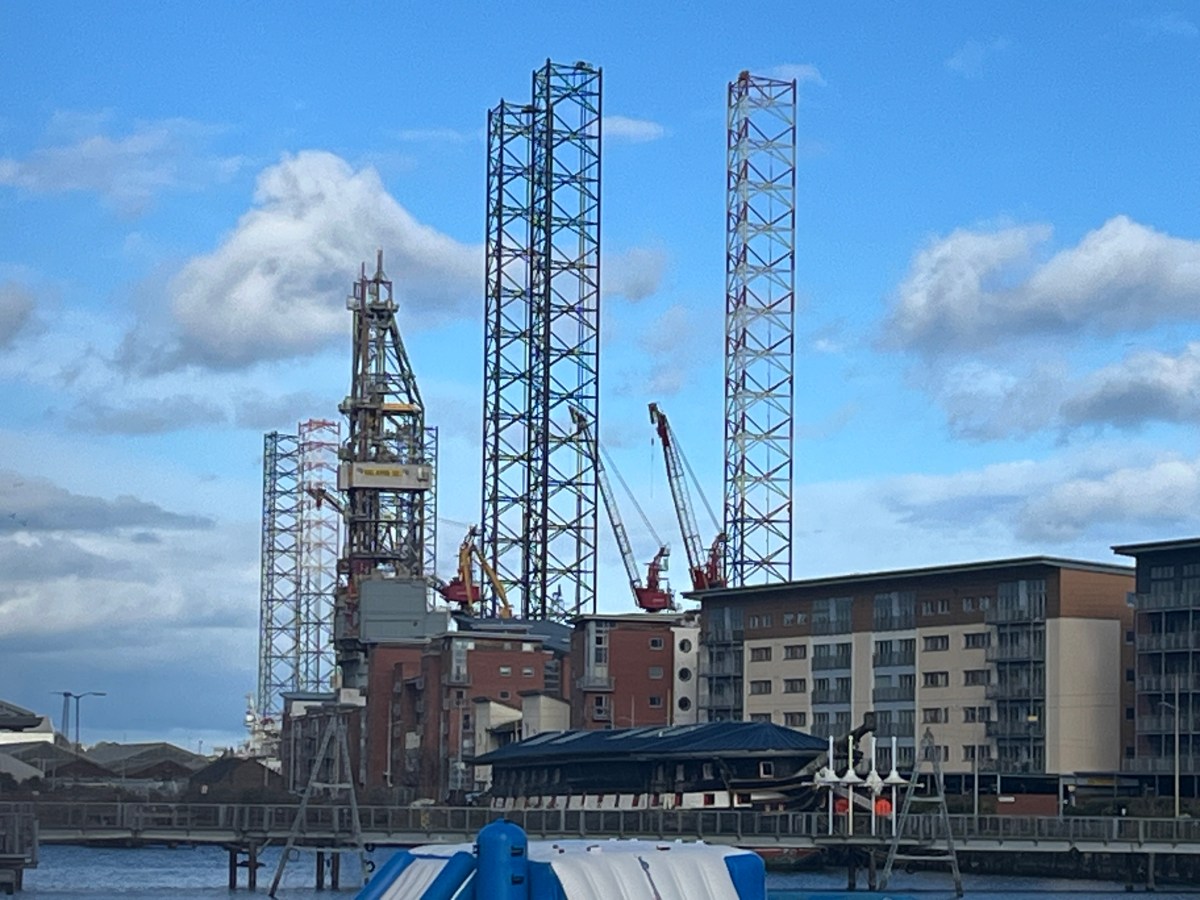
Dundee Harbour – image by Pete Cannell CC0

The previous speakers have talked about some of the very important practical issues that are central to enabling a transition to a sustainable zero carbon economy. There’s plenty of evidence to show that phasing out oil and gas combined with serious investment in renewables creates more jobs.  The Sea Change report, published in 2019, shows how switching from oil and gas to wind and solar would create a big net increase in jobs and how failing to make this transition would mean that targets to cut carbon emissions would not be met.

Similarly, home insulation, retrofitting and replacing gas with electricity for heating and cooking is essential, but critically dependent on a skilled workforce. 

This workshop is framed around developing a workers plan for just transition. I would argue that the main elements of such a plan are in place.  That being the case in the rest of this contribution I’d like to talk about why there’s not yet a simple consensus about a plan.  Having a plan is clearly necessary, and critical to being credible in the eyes of working people who are not yet convinced.  

In one sense we’ve made serious progress in the last five or so years, it’s now common sense in the climate movement to talk about the role of workers and the need for a just transition.  I think in this respect COP26 in Glasgow was a watershed moment.  But ironically in practical terms, in terms of action I think we’ve gone backwards in the same period.  So, for example, the number of workers in renewables in Scotland is about the same now as it was in 2014.  In the eyes of many workers talk of just transition looks like hot air.  And in the hands of right-wing populist politicians, it fuels arguments that the climate crisis is not a problem and climate action is a threat.  So, there’s a real danger that repetition of just transition, in the absence tangible steps that improve lives and livelihoods, becomes a form of greenwashing. 

So, while we need consensus on what to do for me the 64,000-dollar question is 

How do we build a mass movement with powerful roots in every workplace and working-class community that has the power to make the necessary changes happen?

I think the climate movement often underestimates the extent to which commitment to the North Sea and to the interests of the big oil and gas companies shapes and directs climate policy.  Westminster, Holyrood, the energy sector trade unions and the oil and gas industry work in partnership through what used to be called Oil and Gas UK and has now been rebranded as Offshore Energies UK.  They are all signed up to the North Sea Transition Deal and it essentially guides their actions.  So, for example it’s hard to find a serious analyst who things hydrogen for domestic heating and cooking makes sense but using hydrogen in this way remains a key plank of policy for both Westminster and Holyrood.  And while it does other options are not pursued.  Why?  Because hydrogen together with Carbon Capture and Storage is the best option for Fossil Capital that wants to maintain existing market dominance, infrastructure and (not least) profits.

For more than fifty years the big oil and gas companies have used their operations in the UK sector of the North Sea to blaze a trail for what we have come to know as neoliberalism; establishing practices that have been copied and taken up internationally. Outsourcing, multiple layers of subcontracting, vicious anti-union policies and the use of blacklists.  At the same time the so-called free ‘market’ has been featherbedded by massive state subsidies which have exceeded taxation revenue.  

In the old saying – if we had a choice – we wouldn’t start from here.  All the evidence is that we are just going past the 1.5degree threshold and the scientific evidence is that change is taking place more rapidly than anticipated.  This while the Scottish government which has been strong on rhetoric but feebly reliant on the market for action is judged to be a long way for reaching its targets and Westminster gives the green light for maintaining oil and gas production.  And the most important unions remain wedded to a policy of partnership with the energy industry. To answer my earlier question, that partnership, is why we don’t have consensus about a plan.  It’s the partnership that pulls in Unite, RMT and GMB behind CCS, Hydrogen and Nuclear.

In this context I think it’s legitimate to ask whether just transition is any longer the right framing for what we want or need.  

We need to be clear about what we want to happen and largely that thinking is in place.  But to make it happen – perhaps what we should now be talking about is rupture rather than transition. And the power to make that rupture resides within the working class.

North Sea workers are key, but the oil industry has been successful at keeping their organisation fractured and largely ineffective.  I think it’s most likely that oil workers will become active participants in the rupture we need only if the mass movement we need is built across all sectors and in working class communities.  

And if we are to win that mass participation then there’s no place for partnership with Fossil capital – and that means some very sharp arguments within our movement.

Support the GKN workers in Florence

Thanks to REELNews for sharing this call

Already one of the most important climate justice struggles in Europe, the campaign by GKN workers is under imminent attack – and they need your help to complete their inspiring struggle

For over two years now, workers have been occupying the GKN autoparts factory in Florence to stop it from closing, in the longest factory occupation in Italian history.

They have received huge support in demonstrations of up to 40,000 people – and crucially, from the climate movement, which inspired the workers to come up with an alternative plan of production. 

Instead of autoparts, they plan to produce cargo bikes and solar panels, and use them to build a local economy based on the needs of people. They have already produced a prototype of the cargo bike; now they urgently need your help to make this “just transition” away from fossil fuels a reality.

The bosses are planning on sacking all the workers on January 1st so the first priority is to come to a New Years Eve event at the factory if you can, for a huge concert – and to barricade the factory. They’ve fought off redundancies before; with the same support, they can do it again.

But then they need to raise one million euros in a popular shareholder campaign, to start production off the cargo bikes and solar panels under workers control. So please share this video call out with trade unions, with environmental organisations, with everyone who wants to see a global just transition away from fossil fuels. Shares start from 100 euros, and already they have raised 315,000 euros – you can find details of how to take part at https://insorgiamo.org/100×10-000/.

You can also help by spreading their story; by offering to translate materials into other languages; and if you have the technical expertise, to look at the production plan to help improve it. Also, if you know of a cooperative or progressive group who would be interested in buying the cargo bikes or solar panels, that would be incredibly useful too. If you can help with any of this, email the collective at collettivo.gkn.firenze@gmail.com.

As the workers say, they can’t create an alternative model to capitalist fossil fuel production in just one factory – but they can create an example of what is possible.

Please support them in this absolutely crucial battle for a liveable, sustainable future.
