‘Transition’ from oil? Our idea now looks like a delusion

NEIL ROTHNIE, retired oil worker and climate activist, reflects on his participation in Extinction Rebellion and what we have, and have not, achieved.

This post was first published on the People and Nature blog. If you’d like to respond to this article please use the contact form to get in touch.

“The rebellion starts here”, I wrote in October 2019. “There must be non violent direct action aimed at big oil, and targeting oil production.”

The article, North Sea oil and gas: the elephant in the room, was originally a leaflet that I took to London, to Extinction Rebellion’s festival of rebellion.

At that time I was four years’ retired, after 40 years as an offshore oilworker. I was experiencing a personal renaissance, as Extinction Rebellion (XR) crashed onto the streets. 

My article wasn’t particularly radical or controversial. Certainly not to most XR rebels who were its target audience. And it still today, at least in part, reflects what is a fairly mainstream position in the climate movement. 

I wasn’t really focussed on XR’s demands as such – e.g. getting the government to “tell the truth”.  Even then I wasn’t convinced that that was very likely, but I certainly didn’t disagree. I knew next to nothing about the popular assemblies that XR was calling for, or about whether Net Zero was remotely achievable by 2025.  

But I’d been hugely impressed by the way Extinction Rebellion had burst onto the scene, blocking bridges over the Thames the year before. That’s when I’d become aware of the movement.  

By this time, I was troubled about global warming and thought that it would take the masses to intervene in this existential issue. Really all I wanted to do was to bring my own experience to bear on the situation.

I’d been flabbergasted that many rebels I’d spoken to had little awareness of the North Sea oilfield’s existence.

I felt that the “fossil fuels” that were understood to be the major source of greenhouse gases when burned, were in fact still pretty much a “concept” – something in their heads, rather than real stuff mined by real people in our patch.  

My article called on the climate movement to turn towards the oil workers with a call for a “just transition”.

Just transition of course was not my formulation, but was a concept that I swallowed whole, and expected would appeal to the offshore oil workforce on some level and might be the basis for workers to mobilise around.  

This, after all, was the workforce that had engaged in a huge struggle after the 167 deaths by burning and drowning on the Piper Alpha platform, albeit 30 years previously.

In what now seems like an age since 2019, we’ve seen virtually no response from oil and gas workers, despite a concerted turn towards them by parts of the climate movement.

Perhaps the one concrete thing is that we know that they would be more than happy to transfer from offshore oilfield to offshore wind field … if they can keep the lifestyle and the wages.

But the workers are still in lock step with their trade unions (the minority that are actually organised) and with their employers, with Big Oil globally, and with our government. 

Short of a massive storm event on the North Sea creating another major tragedy, it’s hard to see this unholy alliance unravelling any time soon.  

But while I’m not embarrassed by the 2019 article, I don’t think it reflects the reality we’re experiencing, never mind the future we’re facing. That is why I came back and asked Simon for the use of his blog again.  

Right now, everywhere, we have an accelerating pattern of disasters, intermittently destroying lives and the natural environment and by all accounts driving the tendency towards mass extinctions of species. 

We’ve seen a succession of global heating-induced disasters rock the planet. The floods in Pakistan, the fires in the Amazon, and today in California, stand out for me. It’s relentless. You’ll have your own list.

Can I tell the future? Well obviously not. But, as far as any layman can understand the climate science consensus, it seems that we’re way way further down the road to a radically different global climate, and massive changes to local weather that cause mayhem and misery.  

My characterisation of the industry/government strategy as “business as usual” was, and remains, accurate, I think.  

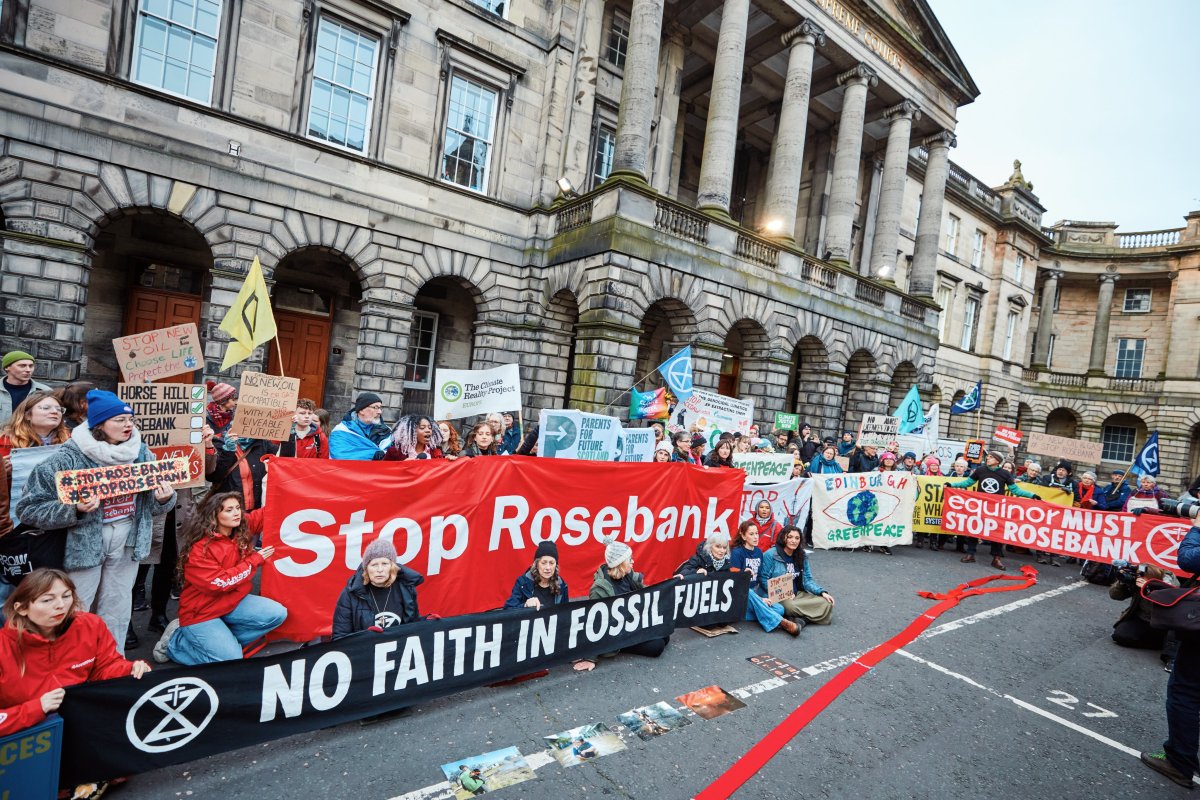
The court decision last week, that the process that gave the go-ahead for the development of the Rosebank and Jackdaw fields on the North Sea was unlawful, should pose absolutely no problem for the industry that was complicit in the hanging of Ken Saro-wiwa, and has been involved in human and ecological atrocities across the globe.  

Not much of a problem either, I’d have thought, for Rachel Reeves and Sir Starmer with their Growth & Growth & Growth mantra.  

The concept of a transition – never mind “just” – from fossil fuels to renewables, led in any part by the massed ranks of the proletariat self-organised in the offshore unions, now looks like an ongoing exercise in self delusion.

Long before XR was set up, in 1989-90, I was desperate to get some sort of an idea of the nature of the relationship of oil and capitalism – something that might inform me whether the rank and file Offshore Industry Liaison Committee (OILC) could chew what we’d bitten off by organising strikes and platform occupations after the Piper Alpha disaster. [Note. Here is an interview with Neil about this, and an archive of the rank and file paper he edited, Blowout.]

I was looking for some sort of an understanding of the possibilities and opportunities. Where did any of this lead? 

Thirty-five years later, and along comes Adam Hanieh with his book Crude Capitalism: oil, corporate power and the making of the world market (reviewed here and here). He says, as I read him, that the capital system and fossil fuels are inextricably entwined.

His book begs the question, at least for me, of the likelihood that the capital system can turn off oil and gas, and replace the world’s energy needs from renewables, before climate chaos becomes the norm.  

The vision this question conjures up, in my imagination, is of someone ripping out their own heart with one hand, while trying to construct a replacement organ with the other. 

Meanwhile Jean-Baptiste Fressoz tells us, in his book More and More and More: an all-consuming history of energy (Allen Lane, 2024), that that holy grail of the climate movement, a “transition” to renewables, is in fact a pipe dream, a chimera.  

There never was, it seems, in human history a precedent – an energy transition – corresponding in any way to the fantasy we hold of fossil fuels being replaced by renewables. Oil didn’t replace coal. Coal didn’t replace wood. It’s just been “more and more and more”.

The history, Fressoz insists, is of “symbiotic” relationships. Burning coal leads to using (more) wood. The exploitation of oil and gas drives (more) wood and (more) coal to be used, and crucially, renewable energy adds to and encourages the use of (more) wood and coal and oil and gas in such a way that Fressoz sees no plausible scenario where global heating might remain within 1.5, or 2.0 degrees C. 

We’re looking at “three degrees C – a catastrophic increase” he says. “How can we make do with less and less and less?” he asks.  

And Brett Christophers, in his book The Price is Wrong: why capitalism won’t save the planet (reviewed here) challenges another growing orthodoxy. The idea is firmly out there that now that the price of renewables is right, that renewables are “cheaper” than fossil fuels.  

This, the argument goes, will inevitably, according to the laws of the market, mean that renewables will supplant fossil fuels. Only who would have guessed that in fact “the price is wrong”, and that all along it’s been profits, not prices, that drive capitalism?

Let’s suppose that you’ve checked out these authors for yourself, and found that my very crude argument, largely drawn from my reading of them, casts reasonable doubt on the idea that there is a snowball’s chance in hell of the current “powers that be” getting us out of this mess.

Then your next step might be to have a look around for the Leninist parties that are going to wrest global power from the current crop of megalomaniacs and oligarchs and downright genocidal bastards. Where are the forces that will lead us over the barricades, kalashnikovs in hand, to capture the state (everywhere) and plan our way out of this one?

Perhaps that’s not the place to look. Perhaps it’s going to be more complicated.

If you are, like I am, disabused of almost every certainty you ever held dear, then there is at least one step that might help us “take care of ourselves”. No! This is not about Lush bath bombs (if they are still a thing). It’s not about playing Radio 3 in the mornings instead of exploding from bed shouting and swearing at Radio 4’s climate-deniers-lite.

April 2012: Volunteers running a centre where Hurricane Sandy survivors could stock up on staples. Photo by Liz Roll/ Creative Commons

“Taking Care of Ourselves in a World on Fire” is the subtitle of Adam Greenfield’s book Lifehouse (Verso, 2024). The “care” he’s talking about is putting human need, human relations and self organisation at the centre of our practice – in a period when it would seem that we are going to have to learn to survive and make worthwhile lives with less and less and less.  

And all this in the face of escalating climate emergencies and the inevitable breakdowns they provoke. 

The book is rooted in Greenfield’s own experience as part of Occupy Sandy, which had morphed out of Occupy Wall Street, organising relief to the victims of the hurricane that hit New York in 2012.  

He draws material together from the way people have been self organising in the face of inadequate official support, abandonment and just downright open hostility, in places as disparate as Rojava in Kurdistan; Jackson, Mississippi, in the USA; Greece in 2010, during the debt crisis that exploded health care; and in California, where the Black Panthers organised from the late 60s to the early 80s.  

The book is “optimistic”, not “hopeful”. Greenfield inveighs against hope, and lays out a rationale and a blueprint for a practice, and a physical space, that offers us a place to organise and the chance of shelter and community and dignity.

This is a rant, not a series of book reviews. And it may turn out to be no more prescient than that one from 2019. 

But is Greenfield, broadly speaking, right?  No point in just hoping so. The point of his book is, it seems to me, not just to understand the world but to change it. I’ve heard that somewhere before. A first step might be to have a look. 

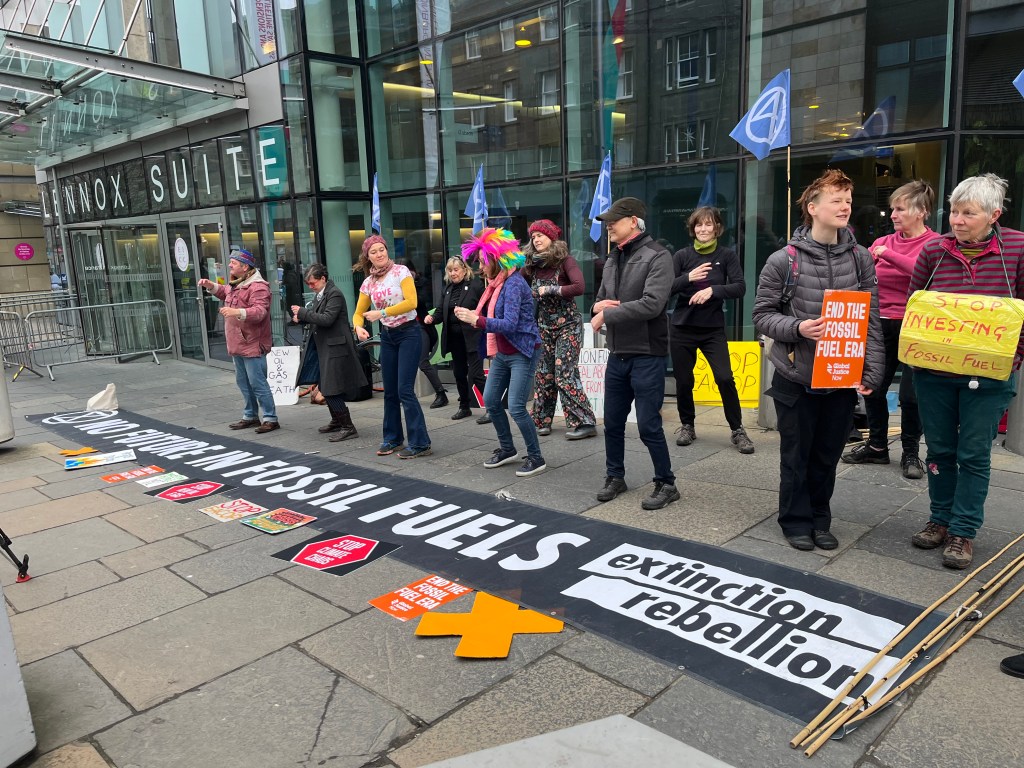
“DISCOBEDIANCE” DANCE FOR CLIMATE JUSTICE

Climate campaigners from Extinction Rebellion Scotland, Divest Lothian and Global Justice Now Scotland danced (and leafleted) outside the Pensions and Lifetime Savings Association Conference at the  Edinburgh International Conference Centre on 28th February to highlight the flawed climate risk models used by pension funds and to call on the funds to stop investing in fossil fuels. 

Despite increasingly stark warnings from climate scientists, oil majors continue to uinvest far more in fossil fuel expansion than in renewables.

For example, the East African Crude Oil Pipeline (EACOP) is being developed by TotalEnergies to run for 1444km across Uganda and Tanzania.  It will transport oil for export to the global north that will release 34 million metric tons of CO2 each year.

Many. UK pension funds including the University Superannuation Scheme, West Midlands Pension Fund and Lothian Pension Fund invest in TotalEnergies.  However, the tide is turning.  PFZW is the third largest pension fund in Europe.  On February 24th it announced that has completed a two-year programme during which, 310 oil and gas companies that do not comply with the Paris Climate Agreement have been sold (including Shell, BP and TotalEnergies).  It plans to significantly increase investments in companies focused on the energy transition.

Thanks to Divest Lothian for information and some of the text.

Fossil Fuels and Right-Wing Populism

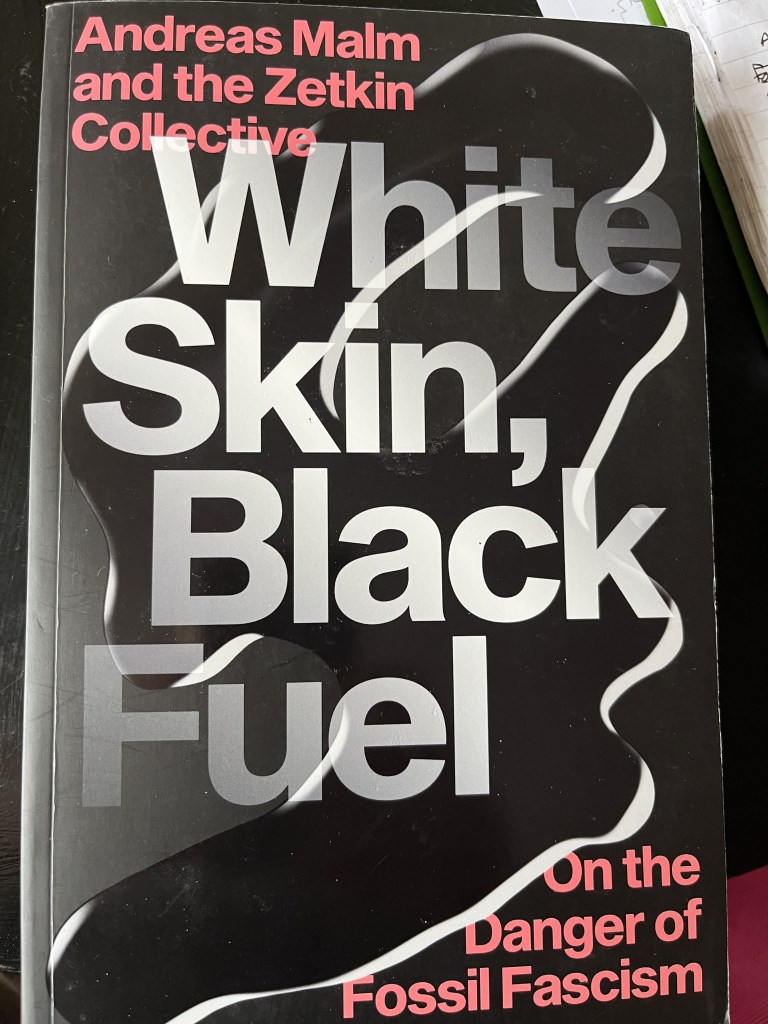
This post explores the way in which right wing populist parties use climate denial as a key part of their agenda.  In thinking about the topic, I found Andreas Malm’s excellent book ‘White Skin – Black Fuel on the danger of Fossil Fascism’ very helpful.  Early on in the book, Malm notes that: 

“All European far-right parties of political significance in the early twenty-first century expressed climate denial.”

The book weas written 3 years ago but it’s hard to think of more recent exceptions.  So, there’s definitely something to be explained here.

Clearly climate denial didn’t start with the rise of right-wing populism.  From the 1970’s onwards the major oil and gas companies, particularly Exxon, were researching the impact of greenhouse gas emissions on the environment and at the same time funding organisations like the Global Climate Coalition in the US whose role was to argue that pushing large amounts of CO2 into the atmosphere was not a problem.  Privately they knew from early on that fossil fuel extraction would have a devastating effect on the global climate.  In 1995 the GCC in an internal document wrote that 

“the potential impact of human emissions of greenhouse gases such as CO2 on climate is well established and cannot be denied”

but in public they denied it.  

As a strategy outright denial had its limitations.  The Kyoto protocol signed in 1997 marked the beginning of a new strategy – a shift from denial to greenwashing.  

The three core tenets of Kyoto are:

  1. Postpone the showdown with Fossil Fuels into distant future.
  2. Place no serious limits on fossil fuel extraction.
  3. New opportunities for generating profit.

In the UK, the industry’s plans for the North Sea are a good example of postponing any showdown with fossil fuels.  The strategy is based on continuing extraction through to and beyond 2050 and the development of a so-called net zero oil and gas basin.  Here net zero depends on heroic assumptions about techno-fixes such as carbon capture and storage combined with creative accountancy that ascribes all responsibility for the carbon in the oil and gas that’s produced to the users.  Globally there are virtually no regulatory limits on the production of fossil fuels.  It’s assumed that any run down will be as a result of market forces.  At the same time trading carbon permits has been highly profitable in financial terms and has allowed the industry to claim that the trade contributes to reducing carbon emissions.  There is next to no evidence that carbon trading and offsetting has reduced greenhouse gas emissions.

So as far as big business goes, we are still in the era of greenwashing.  Big oil and gas are at pains to argue that they want to protect the planet.  And almost all governments around the world are in lockstep with fossil fuel industry in this strategy.  Practically, depending on local circumstances the form that greenwashing takes varies, but everywhere it’s about maintaining or enhancing the profitability of fossil capital and preserving the existing infrastructure.  So, in the UK for example hydrogen is touted as the answer to domestic cooking and heating.  In the short to medium term this would probably mean higher carbon emissions than the existing use of natural gas and if ultimately the hydrogen was all green, i.e. produced by electrolysis it would be fantastically inefficient.  Requiring the use of up to seven times as much electricity than would be required to simply electrify cooking and heating.  But it’s attractive to the industry because it enables the continuation of existing economic and technical infrastructure.

The result of all this is that investment is skewed away from forms of energy use and production that are sustainable and rapidly achievable – and rather than supporting a just transition for workers and communities existing inequalities are maintained and ramped up. The ongoing cost of living crisis in which poor consumers of gas and electricity contribute to eye watering profits for energy producers and distributors is a case in point.

And it’s this that has provided fertile ground for right wing populist parties.

Five decades of neo-liberalism has syphoned money and resources from public to private and increased inequality everywhere so that working class people are anxious or scared about climate, cost of living, war, housing, growing old – in a world where the belief that their parents or grandparents had that things would be better for the next generation is dead.  Most people don’t trust established politicians – established parties offer variations on the same neo-liberal agenda.  Into this vacuum has stepped forms of right-wing populism that purport to offer alternatives to the ‘establishment’.

Right wing populism takes different forms – sometimes taking over long-established parties – Trump and the Republican Party in the US.  Or in the UK the continuing rise of right-wing populists as a major, perhaps majority faction within the Tory party.  Sometimes emerging from explicitly fascist formations, for example, Le Pen in France or Meloni in Italy.  And sometimes completely new organisations, for example the AfD in Germany.  None of them are into Greenwashing.  They are all about Climate Denial.

In Spain a prominent member of right wing populist party Vox explains climate change as 

“any change on the sun, the moon, the rotation of the earth, volcanoes and naturally occurring atmospheric phenomena but absolutely not on CO2 emitted by humans. It would, said Abascal, be ‘very arrogant’ to believe that humans could alter the climate. It would be ‘even more arrogant’ to think that the alteration could be rectified by ‘coercive laws and taxes’.”

The AfD in Germany has increased its influence through organising around climate issues, demonising perhaps the biggest climate movement around the world, foregrounding the cost-of-living crisis and agitating around the farmers protests.  Often supported and facilitated in this by the state and the police.

It’s obviously not just climate that is building the new far right.  Climate issues intersect with the legacy of neo-liberalism, migration and racism and the failure of the left to provide an alternative that speaks to working people’s insecurity and against individualistic solutions.  The far-right populists feed off social media fuelled confusion and conspiracies.  Very often angry or frightened people looking for answers find them in apparently anti-establishment and authoritative voices online.  

So, what’s to be done.  I think we can see the embryo of an alternative in the picket lines and in the huge response to the ongoing horror in Gaza.  It’s struck me standing on UCU picket lines last year, and then again in the last few months picketing and leafleting outside the Leonardo arms factory in Edinburgh, how many of the passing drivers beep their horns and wave.  Early in the morning many of them are white van drivers, very few of them will be in a union.  There’s are real possibility of breaking the rise of the populist right.  But if I’m right about why they’ve been able to build on climate I think part of what a revitalised left has to do is set it’s face firmly against partnership with fossil capital and clearly against solutions like CCS for continuing oil and gas production and hydrogen for domestic heating that preserve the power of fossil capital.  And that means for example that UNITE, RMT and GMB need to stop supporting the oil and gas industry’s North Sea transition deal.

Fossil fuel systems and how to change them

Simon Pirani is the author of ‘Burning Up – A Global History of Fossil Fuel Consumption’* – Simon recently spoke on Fossil Fuel Systems at one of. series of events discussion issues around ecosocialism. The video of his introduction provides a very clear and comprehensive account of how fossil fuel systems are embedded in modern capitalist economies and of the challenges of breaking from an economic system based on these fuels.

Simon blogs at the People and Nature website which carries lots of articles that will be of interest to followers of Scot.E3.

* we have a small number of copies of Simon’s book available at the reduced price of £11 (postage extra) – email triple.e.scot@gmail.com if you’d be interested in a copy.

Divest Strathclyde

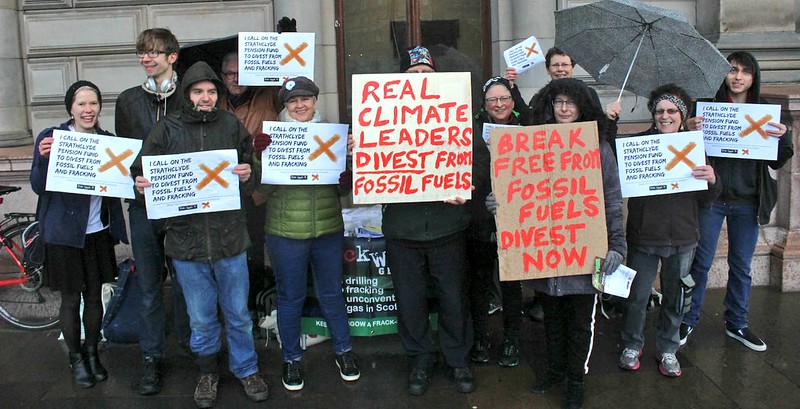
On April 1st Glasgow City Council will be debating whether to end investing pension funds in fossil fuels. If successful, this will be a big step forward for divestment campaigns. The motion is proposed by the Green Party and we post their press statement below.

Image from Friends of the Earth Scotland on Flickr CC BY SA 2.0

Scottish Green Party
25/03/2021Glasgow City Council to vote for end to fossil fuel investments.  Today will see the publication of a motion by Scottish Green party councillors in Glasgow for the Council to commit to ending its pension fund investments in fossil fuels. At present the Strathclyde Pension Fund, which GCC is part of, has over £500 million worth of holdings in fossil fuel companies.  The motion, included below, is part of the budget agreement between the SNP administration the Scottish Green Party, so is expected to pass with overwhelming support when the vote takes place on April 1st.Green Party Councillor Kim Long, who will be moving the motion on April 1st, said: “It makes no sense, financially or ethically, to continue to invest in the fossil fuels that are destroying our planet. We know that in Glasgow, the climate crisis will impact the poorest communities the hardest – and all the money the city plans to spend on mitigating this damage is wasted if we keep pouring money into the very thing we know is making the problem worse. But this is also an opportunity – local government pension funds are the single biggest public store of wealth in Scotland. We need to stop fuelling the crisis, and instead invest in a Green recovery to create the fairer, greener Glasgow we need.  “Isla Scott from Divest Strathclyde, which supports the move, said: “We urge Councillors and the Strathclyde Pension Fund (SPF) committee to show climate leadership as we head towards COP26 and to commit to start divesting immediately. The continued investment of over £500 million in fossil fuels is abhorrent and cannot be justified in a climate crisis. Furthermore, it risks pensioners’ money being lost in stranded assets, money that could be better invested in funding climate solutions and a just transition to a green economy. We will continue to campaign for divestment for as long as the SPF continues to fund the breakdown of our climate.”  The motion is below. 

Council. 

Recalls its previous support for a transformative Green New Deal to respond to the climate and ecological emergencies; 

Believes that a Green New Deal for the city region will require massive investment, and that the Council’s own pension investments could play an important part in that;
Recognises that the Strathclyde Pension Fund supports low carbon initiatives through its direct investment portfolio, but is concerned that the Fund retains large holdings, worth in excess of £500 million last year, in fossil fuel industries that are driving the climate and ecological emergencies and perpetuating global inequalities;.

Notes the Council’s fiduciary duty as administering authority for the Strathclyde Pension Fund must be paramount in all decision making around the pension fund. Further notes the calls made over many years from campaigners on the issue of fossil fuel divestment and notes that many other major public and private institutions have already made and acted on commitments to fossil fuel divestment, demonstrating leadership on the climate emergency at the same time as protecting the long-term interests of their individual investors;.

Believes that in the year of the COP26 climate summit, when the eyes of the world will be on Glasgow, the city and its institutions must show climate leadership; and therefore.

Resolves to write to the Strathclyde Pension Fund committee, asking that it make a formal commitment to fossil fuel divestment prior to COP26, with the intention of divesting completely as quickly as possible, and no later than 2029; and that it further considers how it can reinvest the Pension Fund Members’ hard-earned money to drive a green recovery for the Glasgow region.

Andrew Smith
Communications Officer
Scottish Greens
0141 321 7940
07800 972393